EP0065710B1 - Procédé de fabrication d'une pièce céramique en carbure de silicium fritté - Google Patents
Procédé de fabrication d'une pièce céramique en carbure de silicium fritté Download PDFInfo
- Publication number
- EP0065710B1 EP0065710B1 EP82104167A EP82104167A EP0065710B1 EP 0065710 B1 EP0065710 B1 EP 0065710B1 EP 82104167 A EP82104167 A EP 82104167A EP 82104167 A EP82104167 A EP 82104167A EP 0065710 B1 EP0065710 B1 EP 0065710B1
- Authority
- EP
- European Patent Office
- Prior art keywords
- weight
- temperature
- wax
- polystyrene
- silicon carbide
- Prior art date
- Legal status (The legal status is an assumption and is not a legal conclusion. Google has not performed a legal analysis and makes no representation as to the accuracy of the status listed.)
- Expired
Links
- 238000004519 manufacturing process Methods 0.000 title claims description 5
- 239000000919 ceramic Substances 0.000 title claims description 3
- 238000010438 heat treatment Methods 0.000 claims description 24
- 239000004793 Polystyrene Substances 0.000 claims description 21
- 229920002223 polystyrene Polymers 0.000 claims description 21
- 238000000034 method Methods 0.000 claims description 19
- HBMJWWWQQXIZIP-UHFFFAOYSA-N silicon carbide Chemical compound [Si+]#[C-] HBMJWWWQQXIZIP-UHFFFAOYSA-N 0.000 claims description 18
- 239000000203 mixture Substances 0.000 claims description 17
- 238000005245 sintering Methods 0.000 claims description 15
- 229910010271 silicon carbide Inorganic materials 0.000 claims description 14
- 239000004014 plasticizer Substances 0.000 claims description 10
- 230000001590 oxidative effect Effects 0.000 claims description 8
- OKTJSMMVPCPJKN-UHFFFAOYSA-N Carbon Chemical compound [C] OKTJSMMVPCPJKN-UHFFFAOYSA-N 0.000 claims description 6
- 229910052799 carbon Inorganic materials 0.000 claims description 6
- DOIRQSBPFJWKBE-UHFFFAOYSA-N dibutyl phthalate Chemical compound CCCCOC(=O)C1=CC=CC=C1C(=O)OCCCC DOIRQSBPFJWKBE-UHFFFAOYSA-N 0.000 claims description 6
- ZOXJGFHDIHLPTG-UHFFFAOYSA-N Boron Chemical compound [B] ZOXJGFHDIHLPTG-UHFFFAOYSA-N 0.000 claims description 5
- XAGFODPZIPBFFR-UHFFFAOYSA-N aluminium Chemical compound [Al] XAGFODPZIPBFFR-UHFFFAOYSA-N 0.000 claims description 5
- 229910052782 aluminium Inorganic materials 0.000 claims description 5
- 229910052796 boron Inorganic materials 0.000 claims description 5
- 238000003763 carbonization Methods 0.000 claims description 5
- 150000002148 esters Chemical group 0.000 claims description 5
- MQIUGAXCHLFZKX-UHFFFAOYSA-N Di-n-octyl phthalate Natural products CCCCCCCCOC(=O)C1=CC=CC=C1C(=O)OCCCCCCCC MQIUGAXCHLFZKX-UHFFFAOYSA-N 0.000 claims description 4
- 239000000654 additive Substances 0.000 claims description 4
- 230000000996 additive effect Effects 0.000 claims description 4
- BJQHLKABXJIVAM-UHFFFAOYSA-N bis(2-ethylhexyl) phthalate Chemical group CCCCC(CC)COC(=O)C1=CC=CC=C1C(=O)OCC(CC)CCCC BJQHLKABXJIVAM-UHFFFAOYSA-N 0.000 claims description 4
- 239000003795 chemical substances by application Substances 0.000 claims description 4
- 239000011261 inert gas Substances 0.000 claims description 4
- 238000001746 injection moulding Methods 0.000 claims description 4
- 239000004411 aluminium Substances 0.000 claims description 3
- 229910052790 beryllium Inorganic materials 0.000 claims description 2
- ATBAMAFKBVZNFJ-UHFFFAOYSA-N beryllium atom Chemical compound [Be] ATBAMAFKBVZNFJ-UHFFFAOYSA-N 0.000 claims description 2
- 150000001573 beryllium compounds Chemical class 0.000 claims description 2
- 150000001639 boron compounds Chemical class 0.000 claims description 2
- 238000002156 mixing Methods 0.000 claims description 2
- 208000020442 loss of weight Diseases 0.000 claims 2
- 229920001296 polysiloxane Polymers 0.000 claims 2
- 150000001399 aluminium compounds Chemical class 0.000 claims 1
- 229940077746 antacid containing aluminium compound Drugs 0.000 claims 1
- 238000007669 thermal treatment Methods 0.000 claims 1
- 239000001993 wax Substances 0.000 description 13
- 230000004580 weight loss Effects 0.000 description 10
- XUIMIQQOPSSXEZ-UHFFFAOYSA-N Silicon Chemical compound [Si] XUIMIQQOPSSXEZ-UHFFFAOYSA-N 0.000 description 7
- XKRFYHLGVUSROY-UHFFFAOYSA-N Argon Chemical compound [Ar] XKRFYHLGVUSROY-UHFFFAOYSA-N 0.000 description 6
- 238000010411 cooking Methods 0.000 description 6
- 239000000843 powder Substances 0.000 description 6
- 238000002347 injection Methods 0.000 description 4
- 239000007924 injection Substances 0.000 description 4
- XEEYBQQBJWHFJM-UHFFFAOYSA-N Iron Chemical compound [Fe] XEEYBQQBJWHFJM-UHFFFAOYSA-N 0.000 description 3
- 229910052786 argon Inorganic materials 0.000 description 3
- 239000000725 suspension Substances 0.000 description 3
- IJGRMHOSHXDMSA-UHFFFAOYSA-N Atomic nitrogen Chemical compound N#N IJGRMHOSHXDMSA-UHFFFAOYSA-N 0.000 description 2
- XDTMQSROBMDMFD-UHFFFAOYSA-N Cyclohexane Chemical compound C1CCCCC1 XDTMQSROBMDMFD-UHFFFAOYSA-N 0.000 description 2
- 239000002671 adjuvant Substances 0.000 description 2
- 238000010304 firing Methods 0.000 description 2
- 229910052742 iron Inorganic materials 0.000 description 2
- 239000000463 material Substances 0.000 description 2
- 239000000047 product Substances 0.000 description 2
- KTXWGMUMDPYXNN-UHFFFAOYSA-N 2-ethylhexan-1-olate;titanium(4+) Chemical compound [Ti+4].CCCCC(CC)C[O-].CCCCC(CC)C[O-].CCCCC(CC)C[O-].CCCCC(CC)C[O-] KTXWGMUMDPYXNN-UHFFFAOYSA-N 0.000 description 1
- 239000004215 Carbon black (E152) Substances 0.000 description 1
- VGGSQFUCUMXWEO-UHFFFAOYSA-N Ethene Chemical compound C=C VGGSQFUCUMXWEO-UHFFFAOYSA-N 0.000 description 1
- 239000005977 Ethylene Substances 0.000 description 1
- VEXZGXHMUGYJMC-UHFFFAOYSA-N Hydrochloric acid Chemical compound Cl VEXZGXHMUGYJMC-UHFFFAOYSA-N 0.000 description 1
- 229910052581 Si3N4 Inorganic materials 0.000 description 1
- 229910000831 Steel Inorganic materials 0.000 description 1
- 241001080024 Telles Species 0.000 description 1
- RTAQQCXQSZGOHL-UHFFFAOYSA-N Titanium Chemical group [Ti] RTAQQCXQSZGOHL-UHFFFAOYSA-N 0.000 description 1
- AZDRQVAHHNSJOQ-UHFFFAOYSA-N alumane Chemical class [AlH3] AZDRQVAHHNSJOQ-UHFFFAOYSA-N 0.000 description 1
- CSDREXVUYHZDNP-UHFFFAOYSA-N alumanylidynesilicon Chemical compound [Al].[Si] CSDREXVUYHZDNP-UHFFFAOYSA-N 0.000 description 1
- QVGXLLKOCUKJST-UHFFFAOYSA-N atomic oxygen Chemical compound [O] QVGXLLKOCUKJST-UHFFFAOYSA-N 0.000 description 1
- 239000011324 bead Substances 0.000 description 1
- 238000001816 cooling Methods 0.000 description 1
- 238000010586 diagram Methods 0.000 description 1
- 239000012153 distilled water Substances 0.000 description 1
- 239000012467 final product Substances 0.000 description 1
- 239000007789 gas Substances 0.000 description 1
- 239000010439 graphite Substances 0.000 description 1
- 229910002804 graphite Inorganic materials 0.000 description 1
- 238000000227 grinding Methods 0.000 description 1
- 238000001192 hot extrusion Methods 0.000 description 1
- 229930195733 hydrocarbon Natural products 0.000 description 1
- 150000002430 hydrocarbons Chemical class 0.000 description 1
- 239000012535 impurity Substances 0.000 description 1
- 229910052500 inorganic mineral Inorganic materials 0.000 description 1
- -1 iron ions Chemical class 0.000 description 1
- 239000007788 liquid Substances 0.000 description 1
- 230000007774 longterm Effects 0.000 description 1
- 239000011707 mineral Substances 0.000 description 1
- 238000012986 modification Methods 0.000 description 1
- 230000004048 modification Effects 0.000 description 1
- 229910052757 nitrogen Inorganic materials 0.000 description 1
- 239000003921 oil Substances 0.000 description 1
- 239000001301 oxygen Substances 0.000 description 1
- 229910052760 oxygen Inorganic materials 0.000 description 1
- 125000005498 phthalate group Chemical group 0.000 description 1
- 238000000746 purification Methods 0.000 description 1
- 238000007493 shaping process Methods 0.000 description 1
- 229910052710 silicon Inorganic materials 0.000 description 1
- 239000010703 silicon Substances 0.000 description 1
- APSBXTVYXVQYAB-UHFFFAOYSA-M sodium docusate Chemical group [Na+].CCCCC(CC)COC(=O)CC(S([O-])(=O)=O)C(=O)OCC(CC)CCCC APSBXTVYXVQYAB-UHFFFAOYSA-M 0.000 description 1
- 239000000243 solution Substances 0.000 description 1
- 235000015096 spirit Nutrition 0.000 description 1
- 239000010959 steel Substances 0.000 description 1
- 229920001169 thermoplastic Polymers 0.000 description 1
- 239000004416 thermosoftening plastic Substances 0.000 description 1
- XLYOFNOQVPJJNP-UHFFFAOYSA-N water Chemical compound O XLYOFNOQVPJJNP-UHFFFAOYSA-N 0.000 description 1
Classifications
-
- C—CHEMISTRY; METALLURGY
- C04—CEMENTS; CONCRETE; ARTIFICIAL STONE; CERAMICS; REFRACTORIES
- C04B—LIME, MAGNESIA; SLAG; CEMENTS; COMPOSITIONS THEREOF, e.g. MORTARS, CONCRETE OR LIKE BUILDING MATERIALS; ARTIFICIAL STONE; CERAMICS; REFRACTORIES; TREATMENT OF NATURAL STONE
- C04B35/00—Shaped ceramic products characterised by their composition; Ceramics compositions; Processing powders of inorganic compounds preparatory to the manufacturing of ceramic products
- C04B35/622—Forming processes; Processing powders of inorganic compounds preparatory to the manufacturing of ceramic products
- C04B35/626—Preparing or treating the powders individually or as batches ; preparing or treating macroscopic reinforcing agents for ceramic products, e.g. fibres; mechanical aspects section B
- C04B35/63—Preparing or treating the powders individually or as batches ; preparing or treating macroscopic reinforcing agents for ceramic products, e.g. fibres; mechanical aspects section B using additives specially adapted for forming the products, e.g.. binder binders
- C04B35/632—Organic additives
- C04B35/634—Polymers
- C04B35/63404—Polymers obtained by reactions only involving carbon-to-carbon unsaturated bonds
- C04B35/63432—Polystyrenes
-
- C—CHEMISTRY; METALLURGY
- C04—CEMENTS; CONCRETE; ARTIFICIAL STONE; CERAMICS; REFRACTORIES
- C04B—LIME, MAGNESIA; SLAG; CEMENTS; COMPOSITIONS THEREOF, e.g. MORTARS, CONCRETE OR LIKE BUILDING MATERIALS; ARTIFICIAL STONE; CERAMICS; REFRACTORIES; TREATMENT OF NATURAL STONE
- C04B35/00—Shaped ceramic products characterised by their composition; Ceramics compositions; Processing powders of inorganic compounds preparatory to the manufacturing of ceramic products
- C04B35/515—Shaped ceramic products characterised by their composition; Ceramics compositions; Processing powders of inorganic compounds preparatory to the manufacturing of ceramic products based on non-oxide ceramics
- C04B35/56—Shaped ceramic products characterised by their composition; Ceramics compositions; Processing powders of inorganic compounds preparatory to the manufacturing of ceramic products based on non-oxide ceramics based on carbides or oxycarbides
- C04B35/565—Shaped ceramic products characterised by their composition; Ceramics compositions; Processing powders of inorganic compounds preparatory to the manufacturing of ceramic products based on non-oxide ceramics based on carbides or oxycarbides based on silicon carbide
-
- C—CHEMISTRY; METALLURGY
- C04—CEMENTS; CONCRETE; ARTIFICIAL STONE; CERAMICS; REFRACTORIES
- C04B—LIME, MAGNESIA; SLAG; CEMENTS; COMPOSITIONS THEREOF, e.g. MORTARS, CONCRETE OR LIKE BUILDING MATERIALS; ARTIFICIAL STONE; CERAMICS; REFRACTORIES; TREATMENT OF NATURAL STONE
- C04B35/00—Shaped ceramic products characterised by their composition; Ceramics compositions; Processing powders of inorganic compounds preparatory to the manufacturing of ceramic products
- C04B35/622—Forming processes; Processing powders of inorganic compounds preparatory to the manufacturing of ceramic products
- C04B35/626—Preparing or treating the powders individually or as batches ; preparing or treating macroscopic reinforcing agents for ceramic products, e.g. fibres; mechanical aspects section B
- C04B35/63—Preparing or treating the powders individually or as batches ; preparing or treating macroscopic reinforcing agents for ceramic products, e.g. fibres; mechanical aspects section B using additives specially adapted for forming the products, e.g.. binder binders
- C04B35/632—Organic additives
- C04B35/634—Polymers
-
- C—CHEMISTRY; METALLURGY
- C04—CEMENTS; CONCRETE; ARTIFICIAL STONE; CERAMICS; REFRACTORIES
- C04B—LIME, MAGNESIA; SLAG; CEMENTS; COMPOSITIONS THEREOF, e.g. MORTARS, CONCRETE OR LIKE BUILDING MATERIALS; ARTIFICIAL STONE; CERAMICS; REFRACTORIES; TREATMENT OF NATURAL STONE
- C04B35/00—Shaped ceramic products characterised by their composition; Ceramics compositions; Processing powders of inorganic compounds preparatory to the manufacturing of ceramic products
- C04B35/622—Forming processes; Processing powders of inorganic compounds preparatory to the manufacturing of ceramic products
- C04B35/626—Preparing or treating the powders individually or as batches ; preparing or treating macroscopic reinforcing agents for ceramic products, e.g. fibres; mechanical aspects section B
- C04B35/63—Preparing or treating the powders individually or as batches ; preparing or treating macroscopic reinforcing agents for ceramic products, e.g. fibres; mechanical aspects section B using additives specially adapted for forming the products, e.g.. binder binders
- C04B35/638—Removal thereof
Definitions
- the object of the present invention is to provide a manufacturing process in which the rate of temperature rise during cooking can be higher, and consequently the duration of cooking shorter, and which does not require the addition of agent. costly viscosity reduction.
- the method of the invention is characterized in that the baking of the molded part comprises heating in an oxidizing atmosphere, at a temperature between 230 and 330 ° C, then maintaining at this temperature for a period sufficient to remove the wax and crosslink and at least partially oxidize the polystyrene.
- silicon carbide powder obtained by the Acheson process, of the crystalline variety a and with a specific surface of 7 m 2 / g.
- the powder is placed in a silicon carbide crucible which is introduced into a graphite resistance furnace connected to a vacuum pump, for a purification treatment.
- a vacuum pump for a purification treatment.
- the temperature is maintained for 5 min to 12 h, this duration depending on the amount of impurities and varying in opposite direction to the maximum temperature.
- a heat treatment of 5 min at 1600 ° C may be sufficient.
- the specific surface of the powder is no more than 2 m 2 / g approximately, and its quantity of oxygen approximately 500 ppm. 1% by weight of powdered crystalline boron is added thereto, by dispersing the mixture in a volatile organic liquid such as mineral spirits or cyclohexane.
- Another sintering additive can be substituted for boron, for example 1 to 5% by weight of aluminum silicon nitride, which contains 6 to 90% of aluminum relative to silicon, and 0.025 to 1.0% by weight. Crystallized weight of boron according to the method which is the subject of patent application EP-a 82.101212.7 No. of 18 February 1982 of the holder.
- the suspension is ground in a steel ball mill.
- a steel ball mill For example, for a suspension of 30 g of one of the preceding mixtures in 140 cm 3 of cyclohexane, the mill contains 1.6 kg of balls 3 mm in diameter, rotating at a speed of 300 rpm. The grinding is continued for 3 h.
- the powder is dried, then dispersed in a dilute hydrochloric acid solution until the iron ions disappear. Washed with acidulated distilled water, then decanted and dried the suspension in an oven.
- the mixing is continued for 2 h.
- the material obtained is allowed to cool, it is granulated and sieved.
- the injection molding is carried out in a piston apparatus.
- the material is then maintained at 150 ° C, at a pressure greater than 175 bar. It is also possible to carry out shaping by thermoplastic hot extrusion.
- the parts obtained are then subjected to the baking treatment, in the presence of air, the rate of temperature rise and the temperature of the baking level depending on their thickness. For example, for pieces 1.3 mm thick, they are brought from 20 to 230 ° C in 2 h, then they are kept for 28 h at 230 ° C. For thicker parts, the temperature rise rate would be lower and the final temperature higher.
- the weight loss of the parts is measured, which must be approximately 8 to 9%, so that there remains in the parts 6 to 7% of a product derived from polystyrene, which may already be at less in the form of carbon.
- the amount of polystyrene broken down is approximately one third of the initial amount.
- the firing can be considered complete when about a quarter of the initial polystyrene has been removed.
- the pieces are subjected to a heat treatment under vacuum, or under inert gas (such as argon or nitrogen), bringing them to about 900 ° C. at such a speed that the weight loss of the parts, due in particular to the release of ethylene, has stabilized at this temperature.
- This rate of temperature rise can be from 50 to 100 ° C / h.
- the parts obtained are then directly sinterable, for example at 2100 ° C under argon for 30 min.
- the sintered parts have specific masses between 3.05 and 3.20 kg / dm 3 , ie greater than or equal to 95% of the theoretical specific mass.
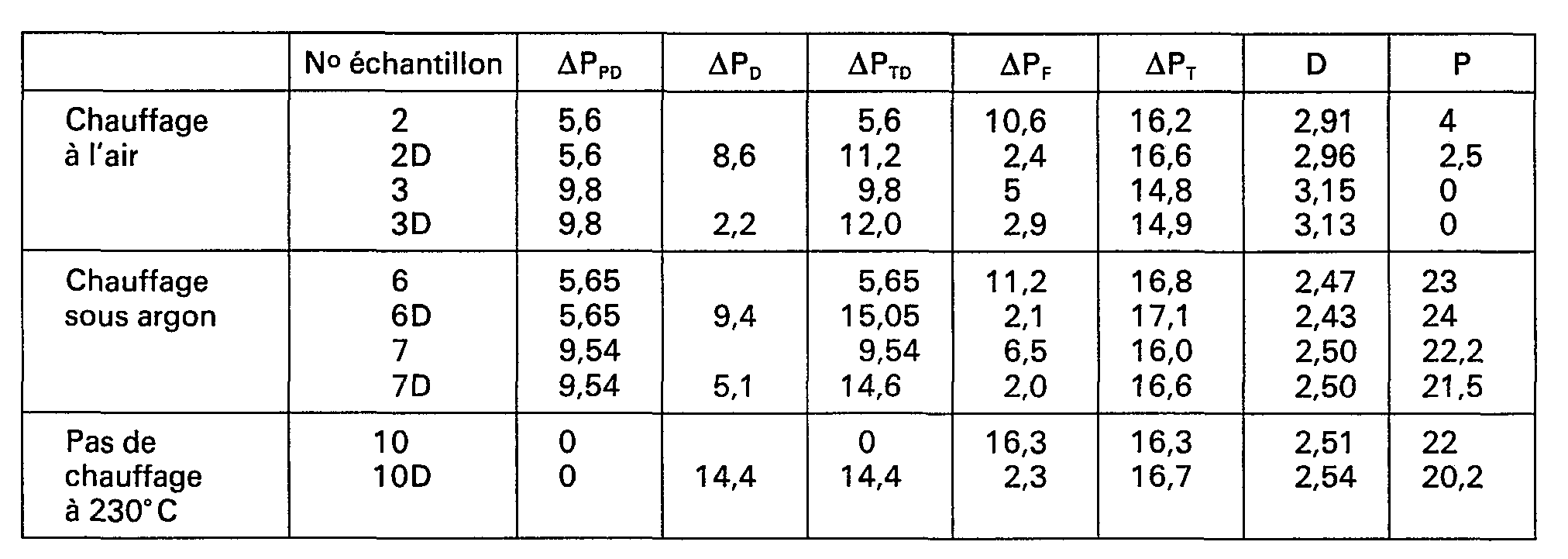
- the index D for a sample indicates that it has been subjected to heat treatment under vacuum at 900 ° C.
Landscapes
- Chemical & Material Sciences (AREA)
- Engineering & Computer Science (AREA)
- Ceramic Engineering (AREA)
- Manufacturing & Machinery (AREA)
- Materials Engineering (AREA)
- Structural Engineering (AREA)
- Organic Chemistry (AREA)
- Inorganic Chemistry (AREA)
- Chemical Kinetics & Catalysis (AREA)
- Ceramic Products (AREA)
Description
- La présente invention concerne un procédé de fabrication d'une pièce céramique en carbure de silicium fritté, dans lequel
- a) on forme un mélange comprenant une poudre de carbure de silicium, au moins un adjuvant de frittage du groupe comprenant le bore ou les composés du bore, le béryllium ou les composés du béryllium, l'aluminium ou les composés de l'aluminium, du polystyrène formant, en mélange avec une cire de température de volatilisation inférieure à la sienne, un agent de moulage par injection, et procurant par sa carbonisation au cours du frittage de 0,5 à 5% en poids de carbone, rapportés au poids de carbure de silicium,
- b) on forme par injection une pièce moulée,
- c) on cuit la pièce moulée, et
- d) on fritte la pièce moulée cuite à une température comprise entre 1900 et 2200° C, sous atmosphère inerte ou sous vide.
- On a déjà proposé, dans le document FR-A No 2432491, un procédé de ce genre, dans lequel on effectue la cuisson de la pièce moulée à une température comprise entre 500 et 1000°C, dans des conditions telles que l'excès de carbone requis pour faciliter le frittage soit procuré par la carbonisation du polystyrène, ce qui implique une cuisson en atmosphère non oxydante. On ajoute par ailleurs au mélange initial de 0,1 à 3% en poids, rapportés au poids total du mélange, d'un organo- titanatetel que letitanate detétra- (2-éthylhexyle), de façon à abaisser sa viscosité.
- Un tel procédé nécessite, du fait de la température de cuisson élevée, une montée en température très progressive, à une vitesse de 1 à 10°C/h, jusqu'à la température finale, et par suite une cuisson de longue durée, pour éviter des déformations des pièces. Par ailleurs, les organotitanates sont des produits coûteux et laissent dans le produit final un résidu de titane.
- La présente invention a pour but de procurer un procédé de fabrication dans lequel la vitesse de montée en température à la cuisson puisse être plus élevée, et par suite la durée de la cuisson plus courte, et qui ne nécessite pas l'adjonction d'agent de réduction de la viscosité coûteux.
- Le procédé de l'invention est caractérisé en ce que la cuisson de la pièce moulée comprend un chauffage en atmosphère oxydante, à une température comprise entre 230 et 330°C, puis le maintien à cette température pendant une durée suffisante pour éliminer la cire et réticuler et oxyder au moins en partie le polystyrène.
- Il répond en outre de préférence à au moins l'une des caractéristiques suivantes.
- - On règle la température et la durée du chauffage entre 230 et 330°C, de manière à décomposer de 20 à 60% du polystyrène initial.
- - La proportion du polystyrène est de 5 à 18% en poids, rapportés au poids de carbure de silicium.
- - La proportion de cire est de 1 à 8% en poids, rapportés au poids de carbure de silicium.
- - La cire est une cire d'ester de température de volatilisation comprise entre 100 et 300° C.
- - On ajoute au mélange de polystyrène et de cire un plastifiant éliminable au cours de la cuisson de la pièce moulée.
- - La proportion de plastifiant est de 2 à 6% en poids, rapportés au poids de carbure de silicium.
- - Le plastifiant est du phtalate de dioctyle ou de dibutyle.
- - Le mélange comprend environ 85% en poids de carbure de silicium et d'adjuvant de frittage, 9% de polystyrène, 2,4% de cire et 3,6% de plastifiant; à l'issue du chauffage en atmosphère oxydante, la perte de poids est de 8 à 9%.
- - Après le chauffage en atmosphère oxydante, on soumet la pièce à un traitement thermique sous gaz inerte, par chauffage jusqu'à une température finale de 900°C environ, à une vitesse de montée en température telle que la perte de poids de la pièce se soit stabilisée lorsqu'elle atteint la température finale.
- - La vitesse de montée en température est comprise entre 50 et 100° C/h.
- Il est décrit ci-après, à titre d'exemple, un procédé de fabrication de pièces en carbure de silicium fritté selon l'invention.
- On part de poudre de carbure de silicium obtenue par le procédé Acheson, de la variété cristalline a et de surface spécifique 7 m2/g. La poudre est disposée dans un creuset en carbure de silicium que l'on introduit dans un four à résistance de graphite relié à une pompe à vide, pour un traitement de purification. On met le four sous un vide d'environ 1 mbar, puis on élève la température du four jusqu'à 1200 à 1600° C. On peut éventuellement opérer sous un vide plus poussé, de l'ordre de 10-3 mbar, à l'aide d'une pompe à vide secondaire. Dans ce cas, on observe une remontée temporaire de pression dans le four, provoquée par les gaz qui se dégagent de la poudre.
- On maintient la température pendant 5 min à 12 h, cette durée dépendant de la quantité d'impuretés et variant en sens inverse de la température maximale. Pour une poudre relativement pure, un traitement thermique de 5 min à 1600°C peut suffire.
- Après le traitement thermique, la surface spécifique de la poudre n'est plus que de 2 m2/g environ, et sa quantité d'oxygène d'environ 500 ppm. On lui ajoute 1 % en poids de bore cristallisé pulvérulent, en dispersant le mélange dans un liquide organique volatil tel que l'essence minérale ou le cyclohexane.
- On peut substituer au bore un autre additif de frittage, par exemple 1 à 5% en poids de nitrure de silicium de d'aluminium, qui contient 6 à 90% d'aluminium par rapport au silicium, et 0,025 à 1,0% en poids de bore cristallisé, selon le procédé qui a fait l'objet de la demande de brevet EP-A No 82.101212.7 du 18 février 1982 de la titulaire.
- On broie la suspension dans un broyeur à billes d'acier. Par exemple, pour une suspension de 30 g de l'un des mélanges précédents dans 140 cm3 de cyclohexane, le broyeur contient 1,6 kg de billes de 3 mm de diamètre, en rotation à une vitesse de 300 tr/min. On poursuit le broyage pendant 3 h.
- Pour éliminer le fer provenant des billes et des parois du broyeur, on sèche la poudre, puis la disperse dans une solution diluée d'acide chlorhydrique jusqu'à disparition des ions du fer. On lave à l'eau distillée acidulée, puis on décante et sèche la suspension à l'étuve.
- On introduit alors dans un malaxeur 85 parties en poids de la poudre obtenue ci-dessus, 9 parties en poids de polystyrène lubrifié vendu sous la désignation commerciale 1531 par la société Ato-Chimie, 2,4 parties de cire d'ester commercialisée par la société BASF, et 3,6 parties de dioctylphtalate vendu par la société PCU K sous la désignation DOP K8.
- On poursuit le malaxage pendant 2 h. On laisse refroidir la matière obtenue, on la granule et la tamise.
- On effectue le moulage par injection dans un appareil à piston.
- On maintient alors la matière à 150°C, à une pression supérieure à 175 bar. On peut également procéder à une mise en forme par extrusion à chaud thermoplastique.
- Les pièces obtenues sont alors soumises au traitement de cuisson, en présence d'air, la vitesse de montée en température et la température du palier de cuisson dépendant de leur épaisseur. Par exemple, pour des pièces de 1,3 mm d'épaisseur, on les porte de 20 à 230°C en 2 h, puis on les maintient 28 h à 230°C. Pour des pièces plus épaisses, la vitesse de montée en température serait plus faible et la température finale plus élevée. Après refroidissement, on mesure la perte de poids des pièces, qui doit être d'environ 8 à 9%, de sorte qu'il reste dans les pièces de 6 à 7% d'un produit dérivé du polystyrène, qui peut être déjà au moins en partie sous forme de carbone. La quantité de polystyrène décomposée est d'environ un tiers de la quantité initiale.
- On peut opérer aussi avec des mélanges à teneurs plus élevées ou moins élevées en carbure de silicium, notamment 80 à 90% en poids de carbure de silicium, et 10 à 20% de mélange additif de polystyrène, de cire et de plastifiant contenant environ 60% de polystyrène. Pour une teneur de 80% de carbure de silicium, la cuisson peut être considérée comme terminée lorsque environ un quart du polystyrène initial a été éliminé. Après le traitement de cuisson en présence d'air, on soumet les pièces à un traitement thermique sous vide, ou sous gaz inerte (tel que l'argon ou l'azote), en les portant à 900°C environ à une vitesse telle que la perte de poids des pièces, due notamment au dégagement d'éthylène, se soit stabilisée à cette température. Cette vitesse de montée en température peut être de 50 à 100° C/h.
- Les pièces obtenues sont alors directement frittables, par exemple à 2100°C sous argon pendant 30 min.
- Les pièces frittées ont des masses spécifiques comprises entre 3,05 et 3,20 kg/dm3, soit supérieures ou égales à 95% de la masse spécifique théorique.
- Si on effectue sur les mêmes pièces moulées une opération de cuisson selon le même diagramme de températures, mais sans le traitement oxydant, puis le même traitement thermique sous vide ou sous gaz inerte à 900°C, et la même opération de frittage à 2100° C, on n'obtient que des pièces poreuses, d'une porosité ouverte de 20 à 25%, de masse spécifique 2,46 à 2,50 kg/dm3. Il semble que l'on puisse attribuer cette porosité à un manque de carbone libre dû à une dépolymérisation du polystyrène sans carbonisation.
- Il est donné dans le tableau, à titre de comparaison, les pertes de poids et les masses spécifiques et porosités finales après frittage de pièces soumises à un chauffage à 230° C, à un traitement thermique sous vide à 900° C et à un frittage à 2100° C tels que décrits ci-dessus, de pièces soumises à un chauffage sous argon puis à un traitement thermique sous vide et au frittage, et enfin de pièces frittées à l'état cru, ou après le seul traitement thermique sous vide.
- Dans ce tableau, les termes ΔPPD, Δ PD, Δ PTD, ΔPF, ΔPT, D et P signifient respectivement:
- perte de poids (en pour-cent) après chauffage à l'air à 230°C,
- perte de poids résultant du traitement thermique sous vide à 900° C,
- perte de poids totale après le traitement thermique sous vide,
- perte de poids au frittage,
- perte de poids totale après le frittage,
- masse spécifique (en kilogrammes par décimètre cube), et
- porosité (en pour-cent).
- L'indice D pour un échantillon indique qu'il a été soumis au traitement thermique sous vide à 900° C.
- Bien que le mode opératoire qui vient d'être décrit ci-dessus paraisse la forme de réaction préférable de l'invention, on comprendra que certaines modifications peuvent lui être apportées sans sortir du cadre général de celle-ci. En particulier, on peut utiliser une autre cire d'adjonction au polystyrène qu'une cire d'ester microcristalline, par exemple une cire d'hydrocarbure, et un autre plastifiant que le phtalate de dioctyle, par exemple le phtalate de dibutyle. On peut ajouter à la cire une huile de température de volatilisation plus basse. On peut effectuer l'injection dans un appareil à vis.
Claims (11)
caractérisé en ce que la cuisson de la pièce moulée comprend un chauffage en atmosphère oxydante, à une température comprise entre 230 et 330° C, puis le maintien à cette température pendant une durée suffisante pour éliminer la cire et réticuler et oxyder au moins en partie le polystyrène.
Applications Claiming Priority (2)
| Application Number | Priority Date | Filing Date | Title |
|---|---|---|---|
| FR8109822 | 1981-05-18 | ||
| FR8109822A FR2505816B1 (fr) | 1981-05-18 | 1981-05-18 | Procede de fabrication d'une piece ceramique en carbure de silicium fritte |
Publications (2)
| Publication Number | Publication Date |
|---|---|
| EP0065710A1 EP0065710A1 (fr) | 1982-12-01 |
| EP0065710B1 true EP0065710B1 (fr) | 1984-11-14 |
Family
ID=9258564
Family Applications (1)
| Application Number | Title | Priority Date | Filing Date |
|---|---|---|---|
| EP82104167A Expired EP0065710B1 (fr) | 1981-05-18 | 1982-05-13 | Procédé de fabrication d'une pièce céramique en carbure de silicium fritté |
Country Status (5)
| Country | Link |
|---|---|
| US (1) | US4424179A (fr) |
| EP (1) | EP0065710B1 (fr) |
| JP (1) | JPS6021944B2 (fr) |
| DE (1) | DE3261233D1 (fr) |
| FR (1) | FR2505816B1 (fr) |
Families Citing this family (12)
| Publication number | Priority date | Publication date | Assignee | Title |
|---|---|---|---|---|
| JPS59224306A (ja) * | 1983-05-13 | 1984-12-17 | 日本碍子株式会社 | セラミツク部品の製造法 |
| DD242325A3 (de) * | 1983-05-27 | 1987-01-28 | Reiner Kinder | Verfahren zur herstellung hochporoeser mineralischer koerper mit polyformer struktur |
| US4530808A (en) * | 1984-04-11 | 1985-07-23 | General Electric Company | Binder removal from thermoplastically formed SiC article |
| ATE42534T1 (de) * | 1985-09-26 | 1989-05-15 | Studiecentrum Kernenergi | Verfahren zur herstellung eines gesinterten formkoerpers. |
| IT1215202B (it) * | 1986-12-03 | 1990-01-31 | G E V I P I A G | Organo di tenuta in materiale duro sinterizzato da un semilavorato formato con un legante organico |
| US5108964A (en) * | 1989-02-15 | 1992-04-28 | Technical Ceramics Laboratories, Inc. | Shaped bodies containing short inorganic fibers or whiskers and methods of forming such bodies |
| US5080846A (en) * | 1989-11-13 | 1992-01-14 | Hoechst Celanese Corp. | Process for removing polyacetal binder from molded ceramic greenbodies |
| US5344815A (en) * | 1991-08-16 | 1994-09-06 | Gte Laboratories Incorporated | Fabrication of high TC superconducting helical resonator coils |
| US5324712A (en) * | 1991-08-16 | 1994-06-28 | Gte Laboratories Incorporated | Formation of the high TC 2223 phase in BI-SR-CA-CU-O by seeding |
| KR100483929B1 (ko) * | 2001-11-10 | 2005-04-15 | 학교법인 한마학원 | 규소계 산업 폐기물을 내화물 분말로 제조하는 방법 |
| US10753015B2 (en) | 2017-09-15 | 2020-08-25 | Lear Corporation | High performance wool blend fabric |
| CN115368139B (zh) * | 2022-10-26 | 2023-01-24 | 山东华美新材料科技股份有限公司 | 一种碳化硅陶瓷均温板的制备方法 |
Family Cites Families (7)
| Publication number | Priority date | Publication date | Assignee | Title |
|---|---|---|---|---|
| GB706728A (en) * | 1950-11-28 | 1954-04-07 | Bendix Aviat Corp | Improvements in or relating to the moulding of ceramics |
| US3985846A (en) | 1975-04-16 | 1976-10-12 | W. R. Grace & Co. | Ceramic firing process |
| US4312954A (en) | 1975-06-05 | 1982-01-26 | Kennecott Corporation | Sintered silicon carbide ceramic body |
| CA1066830A (fr) * | 1976-01-07 | 1979-11-20 | Ford Motor Company Of Canada | Liants perdus pour le moulage de corps fait de particules solides, et technique de moulage connexe |
| US4144207A (en) * | 1977-12-27 | 1979-03-13 | The Carborundum Company | Composition and process for injection molding ceramic materials |
| US4207226A (en) | 1978-08-03 | 1980-06-10 | The Carborundum Company | Ceramic composition suited to be injection molded and sintered |
| US4233256A (en) | 1978-12-18 | 1980-11-11 | The Carborundum Company | Process for injection molding sinterable carbide ceramic materials |
-
1981
- 1981-05-18 FR FR8109822A patent/FR2505816B1/fr not_active Expired
-
1982
- 1982-05-10 US US06/376,630 patent/US4424179A/en not_active Expired - Lifetime
- 1982-05-13 EP EP82104167A patent/EP0065710B1/fr not_active Expired
- 1982-05-13 DE DE8282104167T patent/DE3261233D1/de not_active Expired
- 1982-05-17 JP JP57082965A patent/JPS6021944B2/ja not_active Expired
Also Published As
| Publication number | Publication date |
|---|---|
| EP0065710A1 (fr) | 1982-12-01 |
| JPS57196772A (en) | 1982-12-02 |
| FR2505816A1 (fr) | 1982-11-19 |
| DE3261233D1 (en) | 1984-12-20 |
| US4424179A (en) | 1984-01-03 |
| FR2505816B1 (fr) | 1985-05-31 |
| JPS6021944B2 (ja) | 1985-05-30 |
Similar Documents
| Publication | Publication Date | Title |
|---|---|---|
| EP0065710B1 (fr) | Procédé de fabrication d'une pièce céramique en carbure de silicium fritté | |
| US4560668A (en) | Substantially pore-free shaped articles of polycrystalline silicon carbide, and a process for their manufacture by isostatic hot-pressing | |
| US7723247B2 (en) | Method for pressurelessly sintering zirconium diboride/silicon carbide composite bodies to high densities | |
| EP0626358A2 (fr) | Céramique dense ayant une conductibilité électrique et une résistance élevée | |
| US8097548B2 (en) | High-density pressurelessly sintered zirconium diboride/silicon carbide composite bodies and a method for producing the same | |
| US4019913A (en) | Process for fabricating silicon carbide articles | |
| WO1987005287A1 (fr) | Procede de fabrication de verre | |
| EP0013433A1 (fr) | Matériau résistant à l'oxydation à chaud à base de nitrure de silicium, et procédé de fabrication de ce matériau | |
| US4124665A (en) | Method of making a tungsten carbide body | |
| JP4382919B2 (ja) | シリコン含浸炭化珪素セラミックス部材の製造方法 | |
| CA1127828A (fr) | Procede d'elaboration d'une ceramique dense en carbure de silicium | |
| EP0072306B1 (fr) | Procédé de préparation d'un matériau composite comportant une matrice inorganique dans laquelle sont reparties des inclusions de carbone vitreux, matériau obtenu par ce procédé et son utilisation comme contact électrique | |
| EP0027639A1 (fr) | Procédé de fabrication de pièces en silicium nitrure | |
| EP0058941B1 (fr) | Procédé de fabrication de pièces en carbure de silicium dense | |
| JP3297547B2 (ja) | 炭化珪素質焼結体の製造方法 | |
| JPH0359033B2 (fr) | ||
| FR2674846A1 (fr) | Procede de preparation de ceramiques monolithiques non oxydes a partir de precurseurs organometalliques. | |
| JP3160218B2 (ja) | 軽金属溶湯用の耐酸化性炭素材 | |
| JPH034514B2 (fr) | ||
| JPS61136963A (ja) | 窒化ケイ素基焼結体の製造方法 | |
| JP2001270787A (ja) | 炭化珪素・石英複合体からなるセラミック部材 | |
| JPH07187878A (ja) | シリコン単結晶製造用黒鉛ルツボ | |
| JPH0571541B2 (fr) | ||
| JPH06100366A (ja) | セラミックス−炭素系複合材の製造方法 | |
| JPH07187807A (ja) | SiC質焼結体のプレス成形用原料およびプレス成形方法 |
Legal Events
| Date | Code | Title | Description |
|---|---|---|---|
| PUAI | Public reference made under article 153(3) epc to a published international application that has entered the european phase |
Free format text: ORIGINAL CODE: 0009012 |
|
| AK | Designated contracting states |
Designated state(s): BE DE FR GB IT NL |
|
| 17P | Request for examination filed |
Effective date: 19830526 |
|
| ITF | It: translation for a ep patent filed | ||
| GRAA | (expected) grant |
Free format text: ORIGINAL CODE: 0009210 |
|
| AK | Designated contracting states |
Designated state(s): BE DE FR GB IT NL |
|
| REF | Corresponds to: |
Ref document number: 3261233 Country of ref document: DE Date of ref document: 19841220 |
|
| PLBE | No opposition filed within time limit |
Free format text: ORIGINAL CODE: 0009261 |
|
| STAA | Information on the status of an ep patent application or granted ep patent |
Free format text: STATUS: NO OPPOSITION FILED WITHIN TIME LIMIT |
|
| 26N | No opposition filed | ||
| REG | Reference to a national code |
Ref country code: GB Ref legal event code: 732 |
|
| PGFP | Annual fee paid to national office [announced via postgrant information from national office to epo] |
Ref country code: NL Payment date: 19870531 Year of fee payment: 6 |
|
| NLS | Nl: assignments of ep-patents |
Owner name: CERAMIQUES ET COMPOSITES TE COURBEVOIE, FRANKRIJK. |
|
| PG25 | Lapsed in a contracting state [announced via postgrant information from national office to epo] |
Ref country code: BE Effective date: 19890531 |
|
| PG25 | Lapsed in a contracting state [announced via postgrant information from national office to epo] |
Ref country code: NL Effective date: 19891201 |
|
| NLV4 | Nl: lapsed or anulled due to non-payment of the annual fee | ||
| PGFP | Annual fee paid to national office [announced via postgrant information from national office to epo] |
Ref country code: GB Payment date: 19970425 Year of fee payment: 16 |
|
| PGFP | Annual fee paid to national office [announced via postgrant information from national office to epo] |
Ref country code: DE Payment date: 19970428 Year of fee payment: 16 |
|
| PG25 | Lapsed in a contracting state [announced via postgrant information from national office to epo] |
Ref country code: GB Free format text: LAPSE BECAUSE OF NON-PAYMENT OF DUE FEES Effective date: 19980513 |
|
| GBPC | Gb: european patent ceased through non-payment of renewal fee |
Effective date: 19980513 |
|
| PG25 | Lapsed in a contracting state [announced via postgrant information from national office to epo] |
Ref country code: DE Free format text: LAPSE BECAUSE OF NON-PAYMENT OF DUE FEES Effective date: 19990302 |
|
| PGFP | Annual fee paid to national office [announced via postgrant information from national office to epo] |
Ref country code: FR Payment date: 20010525 Year of fee payment: 20 |