EP0066430B1 - Synchronfernsehempfänger - Google Patents
Synchronfernsehempfänger Download PDFInfo
- Publication number
- EP0066430B1 EP0066430B1 EP82302614A EP82302614A EP0066430B1 EP 0066430 B1 EP0066430 B1 EP 0066430B1 EP 82302614 A EP82302614 A EP 82302614A EP 82302614 A EP82302614 A EP 82302614A EP 0066430 B1 EP0066430 B1 EP 0066430B1
- Authority
- EP
- European Patent Office
- Prior art keywords
- output
- voltage controlled
- local oscillator
- controlled local
- phase
- Prior art date
- Legal status (The legal status is an assumption and is not a legal conclusion. Google has not performed a legal analysis and makes no representation as to the accuracy of the status listed.)
- Expired
Links
- 230000001360 synchronised effect Effects 0.000 title claims description 43
- 238000001914 filtration Methods 0.000 claims description 5
- 238000010408 sweeping Methods 0.000 claims description 5
- 238000010586 diagram Methods 0.000 description 12
- 230000010354 integration Effects 0.000 description 4
- 238000004519 manufacturing process Methods 0.000 description 4
- 230000005236 sound signal Effects 0.000 description 4
- 230000035945 sensitivity Effects 0.000 description 3
- 230000008878 coupling Effects 0.000 description 2
- 238000010168 coupling process Methods 0.000 description 2
- 238000005859 coupling reaction Methods 0.000 description 2
- 238000001514 detection method Methods 0.000 description 2
- 238000000034 method Methods 0.000 description 2
- 230000010363 phase shift Effects 0.000 description 2
- 230000003321 amplification Effects 0.000 description 1
- 239000003990 capacitor Substances 0.000 description 1
- 238000006243 chemical reaction Methods 0.000 description 1
- 238000010276 construction Methods 0.000 description 1
- 239000013078 crystal Substances 0.000 description 1
- 238000003199 nucleic acid amplification method Methods 0.000 description 1
- 230000010355 oscillation Effects 0.000 description 1
- 238000006467 substitution reaction Methods 0.000 description 1
- 230000002194 synthesizing effect Effects 0.000 description 1
Images



Classifications
-
- H—ELECTRICITY
- H04—ELECTRIC COMMUNICATION TECHNIQUE
- H04N—PICTORIAL COMMUNICATION, e.g. TELEVISION
- H04N5/00—Details of television systems
- H04N5/44—Receiver circuitry for the reception of television signals according to analogue transmission standards
- H04N5/455—Demodulation-circuits
Definitions
- This invention relates to a television synchronous receiver.
- FR-A-1088402 discloses a synchronous receiver having a synchronous receiving system comprising: a voltage controlled local oscillator; a means for shifting the phase of an output of said voltage controlled local oscillator by 90°; a first and a second synchronous detectors to detect an in-phase component and a quadrature component of a broadcast signal by the output of said voltage controlled local oscillator and an output of said means for shifting the phase of the output of said voltage controlled local oscillator by 90°, respectively; a phase comparator to detect the phase error between said broadcast signal and the output of said voltage controlled local oscillator; a low-pass filter for low-pass filtering an output of said phase comparator and applying said output to said voltage controlled local oscillator, said synchronous receiving system controlling said voltage controlled local oscillator so that the phase error between said broadcast-signal and the output of said voltage controlled local oscillator becomes minimum and said first synchronous detector detects said broadcast signals.
- a conventional television electronic tuner uses resonant circuits consisting of a diode and an inductor in each of a radio frequency input circuit, an interstage double tuning circuit and a local oscillating circuit. Since such a TV electronic tuner uses four varactor diodes whose voltage-capacitance characteristics slightly differ one another and since the tuner has the double tuning circuit, it is necessary to adjust inductance of the inductor and coupling coefficient of the double tuning circuit to obtain desired frequency tracking and selectivity. For this reason, circuits integration and manufacture automation of the TV electronic tuner become difficult.
- US-A-4163259 discloses an output signal of a UHF and VHF tuner supplied to an IF amplifier.
- a tuning system comprising a super heterodyne system is employed wherein a resonant circuit consisting of variable capacitance diodes and an inductor is used in each of the high-frequency input circuits, and a stagger double tuning circuit and a local oscillation circuit is used in the UHF and VHF tuner. Since the tuner uses plural variable capacitance diodes varying in voltage-capacitance characteristic and includes a double tuning circuit, the inductances of the inductors and the coupling factor between the inductors must be carefully adjusted so as to obtain desired tracking and selectivity characteristics. Again, circuit integration and automation of manufacture is difficult with such a circuit.
- the present invention provides a television synchronous receiver of the type disclosed in FR-A-1088402 wherein a television channel selecting means is provided, which establishes the output of voltage controlled local oscillator at a frequency very near to the video carrier frequency of a television broadcast signal to select a desired television signal, and that an output signal of a radio frequency input circuit is applied to said first and second synchronous detectors.
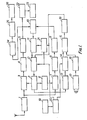
- 1 is a radio frequency input circuit
- 2 is a voltage controlled local oscillator
- 3 is a synchronous detector
- 4 is a low-pass filter
- 5 is a signal amplifier
- 6 is a 90° phase shifter
- 7 is a synchronous detector
- 8 is a low-pass filter
- 9 is a signal amplifier
- 10 is a phase comparator
- 11 is a low-pass filter
- 12 is an analog switch, and these construct a first PLL (phase locked loop) which is known as "Costas loop”.
- PLL phase locked loop
- 13 is a prescaler
- 14 is a programmable divider
- 15 is a phase comparator
- 16 is a low-pass filter
- 17 is a reference oscillator
- 18 is a reference divider
- 19 is a control entry apparatus
- 20 is a channel selection control circuit
- 21 is an analog switch.
- one output of the channel selection circuit 20 gives the programmable divider 14 a divide ratio
- the other output of the channel selection circuit 20 switches the analog switch 12 and the analog switch 21 from the second PLL side to the first PLL side after the second PLL becomes in steady state.
- 22 is a video signal amplifier
- 23 is a video output apparatus
- 24 is a sound intermediate frequency amplifier
- 25 is a frequency discriminator
- 26 is a sound output apparatus.
- a plurality of television broadcast signals are entered. Let a video carrier signal of a channel of the television broadcast signals be v v (t) and a sound carrier signal of the same channel be v s (t).
- v v (t) is vestigial sideband modulated
- v v (t) is where Re means the real part of the equation in ⁇ ⁇
- I(t) is the amplitude of the in-phase component of the carrier
- Q(t) is the amplitude of the quadrature component of the carrier
- w v is the angular frequency of the video carrier
- ⁇ v is the phase of the video carrier.
- I(t) contains a video information signal and a synchronizing signal, but I(t) will be simply called a video signal.
- the in-phase amplitude of the video carrier is obtained as a detected output.
- the quadrature-phase amplitude of the video carrier is not detected.
- the detected output is passed through the low-pass filter 4 and is amplified in the signal amplifier 5 as a video detected output which is conveyed through the video signal amplifier 22 and is displayed at the video output apparatus 23.
- the filtering characteristics of the low-pass filter 4 is shown in Figure 2. Since the video signal is vestigial-sideband modulated, the detector output characteristics of the synchronous detector 3 is shown in Figure 3(a). Therefore, the video amplifier 22 is designed so as to have the characteristics shown Figure 3(b).
- v s (t) is written as where As is the amplitude of the sound carrier, w s is the angular frequency of the sound carrier, S(t) is a sound signal, and ⁇ s is the phase of the sound carrier.
- the synchronous detector 3 is an analog multiplier, if v s (t) of the equation (eq., hereafter) (7) and v o (t) of eq. (2) are applied to the synchronous detector 3, the output vp s (t) is If the term of the frequency ⁇ s + ⁇ o is removed by the low-pass filter 4, then where ⁇ lF is ⁇ s - ⁇ o , or sound intermediate angular frequency, ⁇ lF is ⁇ s - ⁇ o ,or the phase of the sound intermediate frequency carrier. Eq. (9) shows nothing but the sound intermediate frequency carrier converted from the sound radio frequency carrier signal shown by eq. (7).
- the sound intermediate frequency carrier of frequency w, F can be passed because of the characteristics of the low-pass filter 4 shown in Figure 2. 4.5 MHz is taken as WIF , and this diagram shows the example for NTSC system. In other systems the frequency is different.
- the sound intermediate frequency carrier is passed through the low-pass filter 4 and is amplified in the signal amplifier 5 and the sound intermediate frequency amplifier 24.
- the output of 24 is detected in the frequency discriminator 25, and the sound signal S(t) is obtained, which is applied to the sound output apparatus 26.
- the synchronous receiving system is made by applying the so-called Costas loop to a television receiver.
- This application is more effective for a radio receiver than for a television receiver.
- the reason of the above is that the television signal contains the synchronizing signal for scanning.
- the television signal always contains the synchronizing signal during broadcast, that is, even if the video signal vanishes, ⁇ l(t) 2_ Q(t) 2 ⁇ in eq. (12) does not become zero.
- ⁇ l(t) 2 -Q(t) 2 ⁇ of eq. (12) is I(t) 2 , and when the sound signal vanishes, this I(t) 2 equals zero.
- the oscillating frequency ⁇ o (t) of the voltage controlled local oscillator 2 equals to the input video carrier frequency w v (t).
- the synchronous receiving system behaves as PLL. But the system behaves not only as PLL, but also as a frequency feed back loop.
- the frequency synthesizer is equipped as the second PLL to synthesize the local oscillating frequency in the pull-in range.
- the channel selection circuit 20 gives a dividing ratio to the programmable divider 14.
- the output of the voltage controlled local oscillator 2 is previously divided and is applied to the programmable divider 14, the divide ratio of which is given in the manner mentioned above.
- the output of the programmable divider 14 is applied to one of the input terminal of the phase comparator 15, and the reference signal which is obtained by dividing the output of the reference oscillator 17 in the reference divider 18 is applied to the other terminal of the phase comparator 15.
- the above mentioned two inputs are compared in the phase comparator 15, and its output is given to the voltage controlled local oscillator 2 through the low-pass filter 16 and the analog switch 12. If the reference oscillator 17 is accurately controlled by a crystal resonator, the voltage controlled local oscillator 2 oscillates with very slight frequency error to the video carrier frequency of the desired selecting channel. Since this frequency error is very small, the pull-in time is short enough to channel selecting performance.
- the output of the channel selection circuit 20 also controls the analog switch 12 and the analog switch 21 so as to open the second PLL and to close the first PLL after the frequency synthesizer becomes in the steady-state.
- the output voltage of the low-pass filter 16 is applied to the voltage controlled local oscillator 2 through the analog switch 21.
- This output voltage is also applied to the low-pass filter 11 through the analog switch 21.
- the analog switch 12 isolates the voltage controlled local oscillator 2 from the output terminal of the low-pass filter 11.
- the analog switch 12 isolates the voltage controlled local oscillator 2 from the low-pass filter 16 and connects the voltage controlled local oscillator 2 to the low-pass filter 11.
- the analog switch 21 is opened.
- the voltage v o (t) for controlling the voltage controlled local oscillator 2 is given from the phase comparator 10. After such a switch operation, the first PLL is closed.
- the television synchronous receiver shown in Figure 1 needs a broad-band 90° phase shifter.
- the embodiment in Figure 4 is intended to use a phase locked loop which locks when the phase error between two input signals is 90°, instead of using the 90° phase shifter.
- Figure 4 shows a block diagram of another embodiment of the present invention.
- elements from block 1 to 5 and from block 7 to 23 indicate the same elements from the block 1 to 5 and from block 7 to 23 of Figure 1, respectively, and its operation is also the same.
- a loop which consists of a second phase comparator 27, a low-pass filter 28, a voltage adder 29. and a voltage controlled local oscillator 30, constructs a third PLL and corresponds to the 90° phase shifter 6 in Figure 1. The operation of such a loop is as follows:
- ⁇ Q (t) leads or lags in phase to the standard in such a condition, the difference of ⁇ Q (t) and ⁇ o (t) is controlled to become 90°. That is, the output of the first voltage controlled local oscillator 2 or the second voltage controlled local oscillator 30 has the 90° phase difference from each other.
- ⁇ o ⁇ Q , i.e., the oscillating frequency of the second voltage controlled local oscillator 30 is equal to the oscillating frequency of the first voltage controlled local oscillator 2.
- the free running frequency of the second voltage controlled local oscillator 30 is not always equal to ⁇ o . Because the voltage control characteristics of the voltage controlled local oscillators 2 and 30 usually differ slightly from each other. Assuming ⁇ be the oscillating frequency difference between the first voltage controlled local oscillator 2 and the second voltage controlled local oscillator 30, we will describe a behaviour of the PLL.
- Laplace transforms of the above mentioned v o (t), ⁇ o (t), va(t), ⁇ o (t), v d (t), V c1 (t) and ⁇ e (t) be V o (s), ⁇ o (s), Va(s), ⁇ Q (s), V d (s), V c1 (s) and ⁇ e (s), respectively, a sensitivity of the phase comparator 27 be K d , and a transfer function of the low pass filter 28 be F(s), then From eq. (17) ⁇ eq. (19), the transfer function H(s) of the loop is then Therefore the phase error ⁇ e (s) is Applying the final value theorem of Laplace transforms to eq.
- the third PLL constructed by the phase comparator 27, the low pass filter 28, the voltage . adder 29 and the voltage controlled local oscillator 30 of Figure 4 can be used in place of the 90° phase shifter of Figure 1.
- the PLL behaves as the 90° phase shifter with wide frequency range.
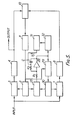
- Figure 5 shows a block diagram of further another embodiment of the third PLL.
- Blocks 2, 3, 4, 7, 8, 10 and 11 of Figure 5 show the same elements of 2, 3, 4, 7, 8, 10 and 11 in Figure 4, respectively, and their operations are also the same.
- the loop constructed by a phase comparator 27, a low-pass filter 28 and a voltage controlled local oscillator 30 forms a PLL.
- a constant current Is is supplied from a current switch 31 to a connecting point between a resistor R 2 and a capacitor C. Since an integrated voltage whose integrate constant is the product of R 2 and C is obtained from the low-pass filter 28, the output frequency of the second voltage controlled local oscillator 30 becomes in swept state. Consequently, the difference of the sweeping frequency and the output frequency ⁇ o of the first voltage controlled local oscillator 2 becomes also in the swept state. Let the sweep rate of the sweeping frequency be ⁇ rad/sec 2 , then the input phase of the PLL which consists of the phase comparator 27, the low-pass filter 28 and the voltage controlled local oscillator 30 is
- an output phase of the first voltage controlled local oscillator 2 be ⁇ o (t)
- an output phase difference between the first and the second voltage controlled local oscillator 2 and 30 be ⁇ e (t).
- the sensitivity of the phase comparator 27 be K d
- the control sensitivity of the voltage controlled local oscillator 30 be Kq
- the transfer function of the low-pass filter 28 be F(s)
- the phase error ⁇ e (s) is Since the ⁇ o (s) of eq.
- the PLL which consists of the phase comparator 27, the low-pass filter 28 and the voltage controlled local oscillator 30 of Figure 5 can be used in place of the 90° phase shifter of Figure 1. Moreover, the PLL becomes the 90° phase shifter with wide frequency range.
- the voltage comparator 32 is provided so as to control the direction of the output current of the current switch 31 at the moment when the output voltage of the low-pass filter 28 reaches a determined value.
- FIG. 6 is the more concrete circuit diagram of the above described third PLL.
- a first voltage controlled local oscillator 2, a second voltage controlled local oscillator 30, a phase comparator 27, a low-pass filter 28, a voltage adder 29, a voltage comparator 32 and a voltage switch 31 correspond to the blocks of the same number shown in Figure 5, respectively.
- a block 33 shows an R-S flip-flop, and a block 34 shows a switch to control the output Is from the current switch 31 to be zero to cause the phase error shown by eq. (28).
- the switch 34 is turned to the opposite side shown in Figure 6 by the detection signal of the PLL's steady state or by the signal generated after passage of enough time for the PLL to reach the steady state.
Landscapes
- Engineering & Computer Science (AREA)
- Multimedia (AREA)
- Signal Processing (AREA)
- Stabilization Of Oscillater, Synchronisation, Frequency Synthesizers (AREA)
Claims (4)
Applications Claiming Priority (4)
| Application Number | Priority Date | Filing Date | Title |
|---|---|---|---|
| JP78215/81 | 1981-05-22 | ||
| JP56078215A JPS57193131A (en) | 1981-05-22 | 1981-05-22 | Television channel selecting device |
| JP56100270A JPS589437A (ja) | 1981-06-26 | 1981-06-26 | 受信機 |
| JP100270/81 | 1981-06-26 |
Publications (3)
| Publication Number | Publication Date |
|---|---|
| EP0066430A2 EP0066430A2 (de) | 1982-12-08 |
| EP0066430A3 EP0066430A3 (en) | 1984-05-16 |
| EP0066430B1 true EP0066430B1 (de) | 1987-05-06 |
Family
ID=26419302
Family Applications (1)
| Application Number | Title | Priority Date | Filing Date |
|---|---|---|---|
| EP82302614A Expired EP0066430B1 (de) | 1981-05-22 | 1982-05-21 | Synchronfernsehempfänger |
Country Status (3)
| Country | Link |
|---|---|
| US (1) | US4461035A (de) |
| EP (1) | EP0066430B1 (de) |
| DE (1) | DE3276290D1 (de) |
Families Citing this family (9)
| Publication number | Priority date | Publication date | Assignee | Title |
|---|---|---|---|---|
| US4578706A (en) * | 1982-11-12 | 1986-03-25 | Matsushita Electric Industrial Co., Ltd. | Television synchronous receiver |
| US4623926A (en) | 1982-11-12 | 1986-11-18 | Matsushita Electric Industrial Co., Ltd. | Television synchronous receiver |
| US4598319A (en) * | 1983-06-24 | 1986-07-01 | Matsushita Electric Industrial Co., Ltd. | Television synchronous receiver |
| US4653074A (en) * | 1985-01-24 | 1987-03-24 | Sperry Corporation | Bit sync generator |
| KR880014813A (ko) * | 1987-05-20 | 1988-12-24 | 이우에 사또시 | Pll 영상 검파회로 |
| US4796102A (en) * | 1987-08-03 | 1989-01-03 | Motorola, Inc. | Automatic frequency control system |
| JP2625759B2 (ja) * | 1987-09-22 | 1997-07-02 | ソニー株式会社 | オートチューニング装置 |
| DE4125995A1 (de) * | 1991-06-08 | 1992-12-10 | Licentia Gmbh | Empfaengeranordnung |
| US6292002B1 (en) * | 1999-08-16 | 2001-09-18 | The B. F. Goodrich Company | Crystal resonant frequency sensor |
Family Cites Families (6)
| Publication number | Priority date | Publication date | Assignee | Title |
|---|---|---|---|---|
| NL100109C (de) * | 1953-01-21 | |||
| US4091410A (en) * | 1976-11-08 | 1978-05-23 | Zenith Radio Corporation | Frequency and phase lock loop synchronous detecting system having a pair of phase lock conditions |
| US4163259A (en) * | 1977-12-14 | 1979-07-31 | Zenith Radio Corporation | Windowed tuning system with synchronous detector |
| US4271434A (en) * | 1978-05-17 | 1981-06-02 | Matsushita Electric Industrial Co., Ltd. | Channel selector |
| JPS5564477A (en) * | 1978-11-10 | 1980-05-15 | Sony Corp | Television receiver |
| US4253118A (en) * | 1979-07-02 | 1981-02-24 | Zenith Radio Corporation | Synchronous detection system |
-
1982
- 1982-05-19 US US06/379,994 patent/US4461035A/en not_active Expired - Lifetime
- 1982-05-21 DE DE8282302614T patent/DE3276290D1/de not_active Expired
- 1982-05-21 EP EP82302614A patent/EP0066430B1/de not_active Expired
Also Published As
| Publication number | Publication date |
|---|---|
| DE3276290D1 (en) | 1987-06-11 |
| EP0066430A3 (en) | 1984-05-16 |
| EP0066430A2 (de) | 1982-12-08 |
| US4461035A (en) | 1984-07-17 |
Similar Documents
| Publication | Publication Date | Title |
|---|---|---|
| JP2912791B2 (ja) | 高周波受信装置 | |
| US4581643A (en) | Double conversion television tuner with frequency response control provisions | |
| US4575761A (en) | AFT arrangement for a double conversion tuner | |
| US5983088A (en) | Wide frequency spectrum television tuner with single local oscillator | |
| US5329319A (en) | Stabilized frequency and phase locked loop with saw devices on common substrate | |
| US4461035A (en) | Television synchronous receiver | |
| EP0456099B1 (de) | Frequenzdemodulator für Frequenzsprungbetrieb mit Kanälen | |
| US5995169A (en) | SIF signal processing circuit | |
| HK1008406B (en) | On channel agile fm demodulator | |
| US5272534A (en) | Television receiver with automatic tuning control | |
| US3978411A (en) | Sweep output generator having a frequency modulated local oscillator for the station selector of a television receiver | |
| EP0179620B1 (de) | Anordnung zur selbsttätigen Feinabstimmung | |
| US4578706A (en) | Television synchronous receiver | |
| US3808541A (en) | Automatic fine tuning system and method for use in super-heterodyne receivers | |
| US4486782A (en) | Frequency stabilization of a VCO FM modulator | |
| JPS642294B2 (de) | ||
| JPS6241472Y2 (de) | ||
| JPH036070Y2 (de) | ||
| JPH0157866B2 (de) | ||
| JPH0336139Y2 (de) | ||
| JPH0328624Y2 (de) | ||
| JPS609204A (ja) | テレビジヨン信号の検波回路 | |
| JPS6136427B2 (de) | ||
| JPS6148284B2 (de) | ||
| JPH01302913A (ja) | 電子選局装置 |
Legal Events
| Date | Code | Title | Description |
|---|---|---|---|
| PUAI | Public reference made under article 153(3) epc to a published international application that has entered the european phase |
Free format text: ORIGINAL CODE: 0009012 |
|
| AK | Designated contracting states |
Designated state(s): DE FR GB |
|
| PUAL | Search report despatched |
Free format text: ORIGINAL CODE: 0009013 |
|
| AK | Designated contracting states |
Designated state(s): DE FR GB |
|
| 17P | Request for examination filed |
Effective date: 19841116 |
|
| GRAA | (expected) grant |
Free format text: ORIGINAL CODE: 0009210 |
|
| AK | Designated contracting states |
Kind code of ref document: B1 Designated state(s): DE FR GB |
|
| REF | Corresponds to: |
Ref document number: 3276290 Country of ref document: DE Date of ref document: 19870611 |
|
| ET | Fr: translation filed | ||
| PLBE | No opposition filed within time limit |
Free format text: ORIGINAL CODE: 0009261 |
|
| STAA | Information on the status of an ep patent application or granted ep patent |
Free format text: STATUS: NO OPPOSITION FILED WITHIN TIME LIMIT |
|
| 26N | No opposition filed | ||
| REG | Reference to a national code |
Ref country code: GB Ref legal event code: 746 Effective date: 19951123 |
|
| REG | Reference to a national code |
Ref country code: FR Ref legal event code: D6 |
|
| PGFP | Annual fee paid to national office [announced via postgrant information from national office to epo] |
Ref country code: FR Payment date: 19960510 Year of fee payment: 15 |
|
| PGFP | Annual fee paid to national office [announced via postgrant information from national office to epo] |
Ref country code: GB Payment date: 19960513 Year of fee payment: 15 |
|
| PGFP | Annual fee paid to national office [announced via postgrant information from national office to epo] |
Ref country code: DE Payment date: 19960528 Year of fee payment: 15 |
|
| PG25 | Lapsed in a contracting state [announced via postgrant information from national office to epo] |
Ref country code: GB Effective date: 19970521 |
|
| GBPC | Gb: european patent ceased through non-payment of renewal fee |
Effective date: 19970521 |
|
| PG25 | Lapsed in a contracting state [announced via postgrant information from national office to epo] |
Ref country code: FR Free format text: LAPSE BECAUSE OF NON-PAYMENT OF DUE FEES Effective date: 19980130 |
|
| PG25 | Lapsed in a contracting state [announced via postgrant information from national office to epo] |
Ref country code: DE Free format text: LAPSE BECAUSE OF NON-PAYMENT OF DUE FEES Effective date: 19980203 |
|
| REG | Reference to a national code |
Ref country code: FR Ref legal event code: ST |