EP0067512A2 - Procédé de fabrication d'un adhésif vitrifiable - Google Patents
Procédé de fabrication d'un adhésif vitrifiable Download PDFInfo
- Publication number
- EP0067512A2 EP0067512A2 EP82302221A EP82302221A EP0067512A2 EP 0067512 A2 EP0067512 A2 EP 0067512A2 EP 82302221 A EP82302221 A EP 82302221A EP 82302221 A EP82302221 A EP 82302221A EP 0067512 A2 EP0067512 A2 EP 0067512A2
- Authority
- EP
- European Patent Office
- Prior art keywords
- adhesive
- polymerizable
- assemblage
- polymerization
- articles
- Prior art date
- Legal status (The legal status is an assumption and is not a legal conclusion. Google has not performed a legal analysis and makes no representation as to the accuracy of the status listed.)
- Withdrawn
Links
- 239000000853 adhesive Substances 0.000 title claims abstract description 149
- 230000001070 adhesive effect Effects 0.000 title claims abstract description 149
- 238000000034 method Methods 0.000 title claims abstract description 53
- 229920005989 resin Polymers 0.000 claims abstract description 30
- 239000011347 resin Substances 0.000 claims abstract description 30
- BLRPTPMANUNPDV-UHFFFAOYSA-N Silane Chemical compound [SiH4] BLRPTPMANUNPDV-UHFFFAOYSA-N 0.000 claims abstract description 26
- 229910000077 silane Inorganic materials 0.000 claims abstract description 26
- -1 benzoin alkyl ether Chemical class 0.000 claims description 31
- 238000006116 polymerization reaction Methods 0.000 claims description 30
- 239000000945 filler Substances 0.000 claims description 24
- 238000004017 vitrification Methods 0.000 claims description 22
- 230000001235 sensitizing effect Effects 0.000 claims description 19
- ISAOCJYIOMOJEB-UHFFFAOYSA-N desyl alcohol Natural products C=1C=CC=CC=1C(O)C(=O)C1=CC=CC=C1 ISAOCJYIOMOJEB-UHFFFAOYSA-N 0.000 claims description 13
- 238000010438 heat treatment Methods 0.000 claims description 13
- 244000028419 Styrax benzoin Species 0.000 claims description 12
- 235000000126 Styrax benzoin Nutrition 0.000 claims description 12
- 235000008411 Sumatra benzointree Nutrition 0.000 claims description 12
- 150000001412 amines Chemical class 0.000 claims description 12
- 229960002130 benzoin Drugs 0.000 claims description 12
- 235000019382 gum benzoic Nutrition 0.000 claims description 12
- 125000005594 diketone group Chemical group 0.000 claims description 10
- 230000000694 effects Effects 0.000 claims description 10
- 239000003795 chemical substances by application Substances 0.000 claims description 7
- 230000000379 polymerizing effect Effects 0.000 claims description 4
- 230000005855 radiation Effects 0.000 claims description 4
- 239000011256 inorganic filler Substances 0.000 abstract description 2
- 229910003475 inorganic filler Inorganic materials 0.000 abstract description 2
- 239000000203 mixture Substances 0.000 description 25
- 230000002165 photosensitisation Effects 0.000 description 20
- 239000003504 photosensitizing agent Substances 0.000 description 20
- 241000894007 species Species 0.000 description 16
- 150000004756 silanes Chemical class 0.000 description 13
- 239000000463 material Substances 0.000 description 11
- VYPSYNLAJGMNEJ-UHFFFAOYSA-N silicon dioxide Inorganic materials O=[Si]=O VYPSYNLAJGMNEJ-UHFFFAOYSA-N 0.000 description 11
- NIXOWILDQLNWCW-UHFFFAOYSA-N acrylic acid group Chemical group C(C=C)(=O)O NIXOWILDQLNWCW-UHFFFAOYSA-N 0.000 description 8
- 150000001875 compounds Chemical class 0.000 description 7
- 125000000217 alkyl group Chemical group 0.000 description 5
- 125000003118 aryl group Chemical group 0.000 description 5
- 125000004432 carbon atom Chemical group C* 0.000 description 5
- 239000004568 cement Substances 0.000 description 5
- 239000000470 constituent Substances 0.000 description 5
- 229910021485 fumed silica Inorganic materials 0.000 description 5
- VNQXSTWCDUXYEZ-UHFFFAOYSA-N 1,7,7-trimethylbicyclo[2.2.1]heptane-2,3-dione Chemical compound C1CC2(C)C(=O)C(=O)C1C2(C)C VNQXSTWCDUXYEZ-UHFFFAOYSA-N 0.000 description 4
- 229930006711 bornane-2,3-dione Natural products 0.000 description 4
- 150000002148 esters Chemical class 0.000 description 4
- 230000002209 hydrophobic effect Effects 0.000 description 4
- 230000000977 initiatory effect Effects 0.000 description 4
- 125000005395 methacrylic acid group Chemical group 0.000 description 4
- 150000004760 silicates Chemical class 0.000 description 4
- 125000000391 vinyl group Chemical group [H]C([*])=C([H])[H] 0.000 description 4
- 229920002554 vinyl polymer Polymers 0.000 description 4
- 125000003903 2-propenyl group Chemical group [H]C([*])([H])C([H])=C([H])[H] 0.000 description 3
- 239000004342 Benzoyl peroxide Substances 0.000 description 3
- OMPJBNCRMGITSC-UHFFFAOYSA-N Benzoylperoxide Chemical compound C=1C=CC=CC=1C(=O)OOC(=O)C1=CC=CC=C1 OMPJBNCRMGITSC-UHFFFAOYSA-N 0.000 description 3
- 125000002877 alkyl aryl group Chemical group 0.000 description 3
- 125000003710 aryl alkyl group Chemical group 0.000 description 3
- 235000019400 benzoyl peroxide Nutrition 0.000 description 3
- 230000015556 catabolic process Effects 0.000 description 3
- 125000001495 ethyl group Chemical group [H]C([H])([H])C([H])([H])* 0.000 description 3
- 238000009472 formulation Methods 0.000 description 3
- 239000003112 inhibitor Substances 0.000 description 3
- CRVGTESFCCXCTH-UHFFFAOYSA-N methyl diethanolamine Chemical compound OCCN(C)CCO CRVGTESFCCXCTH-UHFFFAOYSA-N 0.000 description 3
- 150000002978 peroxides Chemical class 0.000 description 3
- 239000000377 silicon dioxide Substances 0.000 description 3
- 238000003860 storage Methods 0.000 description 3
- 229910002012 Aerosil® Inorganic materials 0.000 description 2
- 238000004026 adhesive bonding Methods 0.000 description 2
- 150000001298 alcohols Chemical class 0.000 description 2
- 125000003342 alkenyl group Chemical group 0.000 description 2
- QVQLCTNNEUAWMS-UHFFFAOYSA-N barium oxide Chemical compound [Ba]=O QVQLCTNNEUAWMS-UHFFFAOYSA-N 0.000 description 2
- 230000009286 beneficial effect Effects 0.000 description 2
- 239000011230 binding agent Substances 0.000 description 2
- IISBACLAFKSPIT-UHFFFAOYSA-N bisphenol A Chemical compound C=1C=C(O)C=CC=1C(C)(C)C1=CC=C(O)C=C1 IISBACLAFKSPIT-UHFFFAOYSA-N 0.000 description 2
- 239000007767 bonding agent Substances 0.000 description 2
- 239000003054 catalyst Substances 0.000 description 2
- 238000006243 chemical reaction Methods 0.000 description 2
- 238000010276 construction Methods 0.000 description 2
- 239000003822 epoxy resin Substances 0.000 description 2
- 239000007789 gas Substances 0.000 description 2
- 239000011521 glass Substances 0.000 description 2
- 125000002887 hydroxy group Chemical group [H]O* 0.000 description 2
- 238000005286 illumination Methods 0.000 description 2
- 229910010272 inorganic material Inorganic materials 0.000 description 2
- 239000011147 inorganic material Substances 0.000 description 2
- MRELNEQAGSRDBK-UHFFFAOYSA-N lanthanum(3+);oxygen(2-) Chemical compound [O-2].[O-2].[O-2].[La+3].[La+3] MRELNEQAGSRDBK-UHFFFAOYSA-N 0.000 description 2
- 125000002496 methyl group Chemical group [H]C([H])([H])* 0.000 description 2
- 239000012766 organic filler Substances 0.000 description 2
- 239000002245 particle Substances 0.000 description 2
- 229920000647 polyepoxide Polymers 0.000 description 2
- 238000002360 preparation method Methods 0.000 description 2
- 125000001436 propyl group Chemical group [H]C([*])([H])C([H])([H])C([H])([H])[H] 0.000 description 2
- 239000010453 quartz Substances 0.000 description 2
- 125000001424 substituent group Chemical group 0.000 description 2
- 238000012360 testing method Methods 0.000 description 2
- 230000009466 transformation Effects 0.000 description 2
- 238000011282 treatment Methods 0.000 description 2
- XLYOFNOQVPJJNP-UHFFFAOYSA-N water Substances O XLYOFNOQVPJJNP-UHFFFAOYSA-N 0.000 description 2
- WYTZZXDRDKSJID-UHFFFAOYSA-N (3-aminopropyl)triethoxysilane Chemical compound CCO[Si](OCC)(OCC)CCCN WYTZZXDRDKSJID-UHFFFAOYSA-N 0.000 description 1
- YYPNLXNMXQFMHG-GSEHKNNPSA-N (3r,5s,8s,9s,10s,13s,14s,17s)-17-acetyl-3-hydroxy-10,13-dimethyl-1,2,3,4,5,6,7,8,9,12,14,15,16,17-tetradecahydrocyclopenta[a]phenanthren-11-one;[2-[(3r,5s,8s,9s,10s,13s,14s,17s)-3-hydroxy-10,13-dimethyl-11-oxo-1,2,3,4,5,6,7,8,9,12,14,15,16,17-tetradecahyd Chemical compound C([C@@H]1CC2)[C@H](O)CC[C@]1(C)[C@@H]1[C@@H]2[C@@H]2CC[C@H](C(=O)C)[C@@]2(C)CC1=O.C([C@@H]1CC2)[C@H](O)CC[C@]1(C)[C@@H]1[C@@H]2[C@@H]2CC[C@H](C(=O)COC(=O)C)[C@@]2(C)CC1=O YYPNLXNMXQFMHG-GSEHKNNPSA-N 0.000 description 1
- IDXCKOANSQIPGX-UHFFFAOYSA-N (acetyloxy-ethenyl-methylsilyl) acetate Chemical compound CC(=O)O[Si](C)(C=C)OC(C)=O IDXCKOANSQIPGX-UHFFFAOYSA-N 0.000 description 1
- KETQAJRQOHHATG-UHFFFAOYSA-N 1,2-naphthoquinone Chemical compound C1=CC=C2C(=O)C(=O)C=CC2=C1 KETQAJRQOHHATG-UHFFFAOYSA-N 0.000 description 1
- 229940105324 1,2-naphthoquinone Drugs 0.000 description 1
- VSRMDJXITMVPNC-UHFFFAOYSA-N 2,2-dimethoxy-1,2-diphenylethanol Chemical compound C=1C=CC=CC=1C(OC)(OC)C(O)C1=CC=CC=C1 VSRMDJXITMVPNC-UHFFFAOYSA-N 0.000 description 1
- VVIVSEAIEJSCJX-UHFFFAOYSA-N 2,3,5,6-tetrafluoro-4-[2-(2,3,5,6-tetrafluoro-4-hydroxyphenyl)propan-2-yl]phenol Chemical compound FC=1C(F)=C(O)C(F)=C(F)C=1C(C)(C)C1=C(F)C(F)=C(O)C(F)=C1F VVIVSEAIEJSCJX-UHFFFAOYSA-N 0.000 description 1
- XMNIXWIUMCBBBL-UHFFFAOYSA-N 2-(2-phenylpropan-2-ylperoxy)propan-2-ylbenzene Chemical compound C=1C=CC=CC=1C(C)(C)OOC(C)(C)C1=CC=CC=C1 XMNIXWIUMCBBBL-UHFFFAOYSA-N 0.000 description 1
- NLGDWWCZQDIASO-UHFFFAOYSA-N 2-hydroxy-1-(7-oxabicyclo[4.1.0]hepta-1,3,5-trien-2-yl)-2-phenylethanone Chemical compound OC(C(=O)c1cccc2Oc12)c1ccccc1 NLGDWWCZQDIASO-UHFFFAOYSA-N 0.000 description 1
- DMZPTAFGSRVFIA-UHFFFAOYSA-N 3-[tris(2-methoxyethoxy)silyl]propyl 2-methylprop-2-enoate Chemical compound COCCO[Si](OCCOC)(OCCOC)CCCOC(=O)C(C)=C DMZPTAFGSRVFIA-UHFFFAOYSA-N 0.000 description 1
- XDLMVUHYZWKMMD-UHFFFAOYSA-N 3-trimethoxysilylpropyl 2-methylprop-2-enoate Chemical compound CO[Si](OC)(OC)CCCOC(=O)C(C)=C XDLMVUHYZWKMMD-UHFFFAOYSA-N 0.000 description 1
- YYVYAPXYZVYDHN-UHFFFAOYSA-N 9,10-phenanthroquinone Chemical compound C1=CC=C2C(=O)C(=O)C3=CC=CC=C3C2=C1 YYVYAPXYZVYDHN-UHFFFAOYSA-N 0.000 description 1
- GAWIXWVDTYZWAW-UHFFFAOYSA-N C[CH]O Chemical group C[CH]O GAWIXWVDTYZWAW-UHFFFAOYSA-N 0.000 description 1
- 241000907788 Cordia gerascanthus Species 0.000 description 1
- QSJXEFYPDANLFS-UHFFFAOYSA-N Diacetyl Chemical group CC(=O)C(C)=O QSJXEFYPDANLFS-UHFFFAOYSA-N 0.000 description 1
- ZAFNJMIOTHYJRJ-UHFFFAOYSA-N Diisopropyl ether Chemical class CC(C)OC(C)C ZAFNJMIOTHYJRJ-UHFFFAOYSA-N 0.000 description 1
- 208000035126 Facies Diseases 0.000 description 1
- UEEJHVSXFDXPFK-UHFFFAOYSA-N N-dimethylaminoethanol Chemical compound CN(C)CCO UEEJHVSXFDXPFK-UHFFFAOYSA-N 0.000 description 1
- BPQQTUXANYXVAA-UHFFFAOYSA-N Orthosilicate Chemical compound [O-][Si]([O-])([O-])[O-] BPQQTUXANYXVAA-UHFFFAOYSA-N 0.000 description 1
- HCHKCACWOHOZIP-UHFFFAOYSA-N Zinc Chemical compound [Zn] HCHKCACWOHOZIP-UHFFFAOYSA-N 0.000 description 1
- NOZAQBYNLKNDRT-UHFFFAOYSA-N [diacetyloxy(ethenyl)silyl] acetate Chemical compound CC(=O)O[Si](OC(C)=O)(OC(C)=O)C=C NOZAQBYNLKNDRT-UHFFFAOYSA-N 0.000 description 1
- 238000010521 absorption reaction Methods 0.000 description 1
- 150000001252 acrylic acid derivatives Chemical class 0.000 description 1
- 230000003213 activating effect Effects 0.000 description 1
- 125000004423 acyloxy group Chemical group 0.000 description 1
- 239000012790 adhesive layer Substances 0.000 description 1
- 150000001336 alkenes Chemical class 0.000 description 1
- 125000003545 alkoxy group Chemical group 0.000 description 1
- PNEYBMLMFCGWSK-UHFFFAOYSA-N aluminium oxide Inorganic materials [O-2].[O-2].[O-2].[Al+3].[Al+3] PNEYBMLMFCGWSK-UHFFFAOYSA-N 0.000 description 1
- 125000004104 aryloxy group Chemical group 0.000 description 1
- 230000000712 assembly Effects 0.000 description 1
- 238000000429 assembly Methods 0.000 description 1
- 229910052916 barium silicate Inorganic materials 0.000 description 1
- HMOQPOVBDRFNIU-UHFFFAOYSA-N barium(2+);dioxido(oxo)silane Chemical compound [Ba+2].[O-][Si]([O-])=O HMOQPOVBDRFNIU-UHFFFAOYSA-N 0.000 description 1
- WURBFLDFSFBTLW-UHFFFAOYSA-N benzil Chemical compound C=1C=CC=CC=1C(=O)C(=O)C1=CC=CC=C1 WURBFLDFSFBTLW-UHFFFAOYSA-N 0.000 description 1
- 230000015572 biosynthetic process Effects 0.000 description 1
- CSXPRVTYIFRYPR-UHFFFAOYSA-N bis(ethenyl)-diethoxysilane Chemical compound CCO[Si](C=C)(C=C)OCC CSXPRVTYIFRYPR-UHFFFAOYSA-N 0.000 description 1
- 229940106691 bisphenol a Drugs 0.000 description 1
- 239000000919 ceramic Substances 0.000 description 1
- 239000003086 colorant Substances 0.000 description 1
- 229920001577 copolymer Polymers 0.000 description 1
- HCRZXNOSPPHATK-UHFFFAOYSA-L copper;3-oxobutanoate Chemical compound [Cu+2].CC(=O)CC([O-])=O.CC(=O)CC([O-])=O HCRZXNOSPPHATK-UHFFFAOYSA-L 0.000 description 1
- 230000007547 defect Effects 0.000 description 1
- 238000006731 degradation reaction Methods 0.000 description 1
- LSXWFXONGKSEMY-UHFFFAOYSA-N di-tert-butyl peroxide Chemical compound CC(C)(C)OOC(C)(C)C LSXWFXONGKSEMY-UHFFFAOYSA-N 0.000 description 1
- ZBMGMUODZNQAQI-UHFFFAOYSA-N dimethyl(prop-2-enyl)silicon Chemical compound C[Si](C)CC=C ZBMGMUODZNQAQI-UHFFFAOYSA-N 0.000 description 1
- 239000006185 dispersion Substances 0.000 description 1
- 238000009826 distribution Methods 0.000 description 1
- 239000000975 dye Substances 0.000 description 1
- 230000005611 electricity Effects 0.000 description 1
- HFTNNOZFRQLFQB-UHFFFAOYSA-N ethenoxy(trimethyl)silane Chemical compound C[Si](C)(C)OC=C HFTNNOZFRQLFQB-UHFFFAOYSA-N 0.000 description 1
- FWDBOZPQNFPOLF-UHFFFAOYSA-N ethenyl(triethoxy)silane Chemical compound CCO[Si](OCC)(OCC)C=C FWDBOZPQNFPOLF-UHFFFAOYSA-N 0.000 description 1
- NKSJNEHGWDZZQF-UHFFFAOYSA-N ethenyl(trimethoxy)silane Chemical compound CO[Si](OC)(OC)C=C NKSJNEHGWDZZQF-UHFFFAOYSA-N 0.000 description 1
- GCSJLQSCSDMKTP-UHFFFAOYSA-N ethenyl(trimethyl)silane Chemical compound C[Si](C)(C)C=C GCSJLQSCSDMKTP-UHFFFAOYSA-N 0.000 description 1
- FEHYCIQPPPQNMI-UHFFFAOYSA-N ethenyl(triphenoxy)silane Chemical compound C=1C=CC=CC=1O[Si](OC=1C=CC=CC=1)(C=C)OC1=CC=CC=C1 FEHYCIQPPPQNMI-UHFFFAOYSA-N 0.000 description 1
- MBGQQKKTDDNCSG-UHFFFAOYSA-N ethenyl-diethoxy-methylsilane Chemical compound CCO[Si](C)(C=C)OCC MBGQQKKTDDNCSG-UHFFFAOYSA-N 0.000 description 1
- JEWCZPTVOYXPGG-UHFFFAOYSA-N ethenyl-ethoxy-dimethylsilane Chemical compound CCO[Si](C)(C)C=C JEWCZPTVOYXPGG-UHFFFAOYSA-N 0.000 description 1
- GGJQEMXRDJPGAH-UHFFFAOYSA-N ethenyl-ethoxy-diphenylsilane Chemical compound C=1C=CC=CC=1[Si](C=C)(OCC)C1=CC=CC=C1 GGJQEMXRDJPGAH-UHFFFAOYSA-N 0.000 description 1
- MOSXLDGILGBOSZ-UHFFFAOYSA-N ethenyl-methyl-phenylsilicon Chemical compound C=C[Si](C)C1=CC=CC=C1 MOSXLDGILGBOSZ-UHFFFAOYSA-N 0.000 description 1
- MABAWBWRUSBLKQ-UHFFFAOYSA-N ethenyl-tri(propan-2-yloxy)silane Chemical compound CC(C)O[Si](OC(C)C)(OC(C)C)C=C MABAWBWRUSBLKQ-UHFFFAOYSA-N 0.000 description 1
- WOXXJEVNDJOOLV-UHFFFAOYSA-N ethenyl-tris(2-methoxyethoxy)silane Chemical compound COCCO[Si](OCCOC)(OCCOC)C=C WOXXJEVNDJOOLV-UHFFFAOYSA-N 0.000 description 1
- 150000002170 ethers Chemical class 0.000 description 1
- 238000010304 firing Methods 0.000 description 1
- 229910052736 halogen Inorganic materials 0.000 description 1
- 150000002367 halogens Chemical class 0.000 description 1
- LNEPOXFFQSENCJ-UHFFFAOYSA-N haloperidol Chemical compound C1CC(O)(C=2C=CC(Cl)=CC=2)CCN1CCCC(=O)C1=CC=C(F)C=C1 LNEPOXFFQSENCJ-UHFFFAOYSA-N 0.000 description 1
- 238000000265 homogenisation Methods 0.000 description 1
- 230000001976 improved effect Effects 0.000 description 1
- 238000011065 in-situ storage Methods 0.000 description 1
- 239000003999 initiator Substances 0.000 description 1
- 238000003780 insertion Methods 0.000 description 1
- 230000037431 insertion Effects 0.000 description 1
- 238000009413 insulation Methods 0.000 description 1
- 238000005304 joining Methods 0.000 description 1
- 238000003475 lamination Methods 0.000 description 1
- 238000012423 maintenance Methods 0.000 description 1
- 230000014759 maintenance of location Effects 0.000 description 1
- 238000004519 manufacturing process Methods 0.000 description 1
- 150000002734 metacrylic acid derivatives Chemical class 0.000 description 1
- 229910052751 metal Inorganic materials 0.000 description 1
- 239000002184 metal Substances 0.000 description 1
- 229910001463 metal phosphate Inorganic materials 0.000 description 1
- 239000005055 methyl trichlorosilane Substances 0.000 description 1
- JLUFWMXJHAVVNN-UHFFFAOYSA-N methyltrichlorosilane Chemical compound C[Si](Cl)(Cl)Cl JLUFWMXJHAVVNN-UHFFFAOYSA-N 0.000 description 1
- 238000002156 mixing Methods 0.000 description 1
- JRZJOMJEPLMPRA-UHFFFAOYSA-N olefin Natural products CCCCCCCC=C JRZJOMJEPLMPRA-UHFFFAOYSA-N 0.000 description 1
- 239000003605 opacifier Substances 0.000 description 1
- 230000003287 optical effect Effects 0.000 description 1
- 150000002894 organic compounds Chemical class 0.000 description 1
- 239000012860 organic pigment Substances 0.000 description 1
- 229920001568 phenolic resin Polymers 0.000 description 1
- 239000005011 phenolic resin Substances 0.000 description 1
- 125000001997 phenyl group Chemical group [H]C1=C([H])C([H])=C(*)C([H])=C1[H] 0.000 description 1
- 230000000704 physical effect Effects 0.000 description 1
- 239000000049 pigment Substances 0.000 description 1
- 229920000642 polymer Polymers 0.000 description 1
- 125000002924 primary amino group Chemical group [H]N([H])* 0.000 description 1
- 238000012545 processing Methods 0.000 description 1
- 238000007348 radical reaction Methods 0.000 description 1
- 238000007789 sealing Methods 0.000 description 1
- 229910052710 silicon Inorganic materials 0.000 description 1
- 239000010703 silicon Substances 0.000 description 1
- HBMJWWWQQXIZIP-UHFFFAOYSA-N silicon carbide Chemical compound [Si+]#[C-] HBMJWWWQQXIZIP-UHFFFAOYSA-N 0.000 description 1
- 229910010271 silicon carbide Inorganic materials 0.000 description 1
- 239000007787 solid Substances 0.000 description 1
- 125000005504 styryl group Chemical group 0.000 description 1
- 230000008093 supporting effect Effects 0.000 description 1
- 239000004094 surface-active agent Substances 0.000 description 1
- 238000010998 test method Methods 0.000 description 1
- UFHILTCGAOPTOV-UHFFFAOYSA-N tetrakis(ethenyl)silane Chemical compound C=C[Si](C=C)(C=C)C=C UFHILTCGAOPTOV-UHFFFAOYSA-N 0.000 description 1
- SQAIGLXMIMWFEQ-UHFFFAOYSA-N tetrakis(prop-2-enyl) silicate Chemical compound C=CCO[Si](OCC=C)(OCC=C)OCC=C SQAIGLXMIMWFEQ-UHFFFAOYSA-N 0.000 description 1
- 238000012719 thermal polymerization Methods 0.000 description 1
- 125000001544 thienyl group Chemical group 0.000 description 1
- 150000003573 thiols Chemical class 0.000 description 1
- IMFACGCPASFAPR-UHFFFAOYSA-N tributylamine Chemical compound CCCCN(CCCC)CCCC IMFACGCPASFAPR-UHFFFAOYSA-N 0.000 description 1
- UMFJXASDGBJDEB-UHFFFAOYSA-N triethoxy(prop-2-enyl)silane Chemical compound CCO[Si](CC=C)(OCC)OCC UMFJXASDGBJDEB-UHFFFAOYSA-N 0.000 description 1
- HYWCXWRMUZYRPH-UHFFFAOYSA-N trimethyl(prop-2-enyl)silane Chemical compound C[Si](C)(C)CC=C HYWCXWRMUZYRPH-UHFFFAOYSA-N 0.000 description 1
- WNWMJFBAIXMNOF-UHFFFAOYSA-N trimethyl(propyl)silane Chemical compound CCC[Si](C)(C)C WNWMJFBAIXMNOF-UHFFFAOYSA-N 0.000 description 1
- CWMFRHBXRUITQE-UHFFFAOYSA-N trimethylsilylacetylene Chemical group C[Si](C)(C)C#C CWMFRHBXRUITQE-UHFFFAOYSA-N 0.000 description 1
- YFTHZRPMJXBUME-UHFFFAOYSA-N tripropylamine Chemical compound CCCN(CCC)CCC YFTHZRPMJXBUME-UHFFFAOYSA-N 0.000 description 1
- FBGNFSBDYRZOSE-UHFFFAOYSA-N tris(ethenyl)-ethoxysilane Chemical compound CCO[Si](C=C)(C=C)C=C FBGNFSBDYRZOSE-UHFFFAOYSA-N 0.000 description 1
- PKRKCDBTXBGLKV-UHFFFAOYSA-N tris(ethenyl)-methylsilane Chemical compound C=C[Si](C)(C=C)C=C PKRKCDBTXBGLKV-UHFFFAOYSA-N 0.000 description 1
- 239000011701 zinc Substances 0.000 description 1
- 229910052725 zinc Inorganic materials 0.000 description 1
Images
Classifications
-
- C—CHEMISTRY; METALLURGY
- C09—DYES; PAINTS; POLISHES; NATURAL RESINS; ADHESIVES; COMPOSITIONS NOT OTHERWISE PROVIDED FOR; APPLICATIONS OF MATERIALS NOT OTHERWISE PROVIDED FOR
- C09J—ADHESIVES; NON-MECHANICAL ASPECTS OF ADHESIVE PROCESSES IN GENERAL; ADHESIVE PROCESSES NOT PROVIDED FOR ELSEWHERE; USE OF MATERIALS AS ADHESIVES
- C09J5/00—Adhesive processes in general; Adhesive processes not provided for elsewhere, e.g. relating to primers
-
- C—CHEMISTRY; METALLURGY
- C09—DYES; PAINTS; POLISHES; NATURAL RESINS; ADHESIVES; COMPOSITIONS NOT OTHERWISE PROVIDED FOR; APPLICATIONS OF MATERIALS NOT OTHERWISE PROVIDED FOR
- C09J—ADHESIVES; NON-MECHANICAL ASPECTS OF ADHESIVE PROCESSES IN GENERAL; ADHESIVE PROCESSES NOT PROVIDED FOR ELSEWHERE; USE OF MATERIALS AS ADHESIVES
- C09J4/00—Adhesives based on organic non-macromolecular compounds having at least one polymerisable carbon-to-carbon unsaturated bond ; adhesives, based on monomers of macromolecular compounds of groups C09J183/00 - C09J183/16
-
- Y—GENERAL TAGGING OF NEW TECHNOLOGICAL DEVELOPMENTS; GENERAL TAGGING OF CROSS-SECTIONAL TECHNOLOGIES SPANNING OVER SEVERAL SECTIONS OF THE IPC; TECHNICAL SUBJECTS COVERED BY FORMER USPC CROSS-REFERENCE ART COLLECTIONS [XRACs] AND DIGESTS
- Y10—TECHNICAL SUBJECTS COVERED BY FORMER USPC
- Y10T—TECHNICAL SUBJECTS COVERED BY FORMER US CLASSIFICATION
- Y10T428/00—Stock material or miscellaneous articles
- Y10T428/31504—Composite [nonstructural laminate]
- Y10T428/31652—Of asbestos
- Y10T428/31663—As siloxane, silicone or silane
Definitions
- This invention relates to processes for adhering articles together. More particularly, such processes are disclosed wherein articles are fused together employing vitrifiable adhesive compositions. Processes wherein fixturing of articles is accomplished prior to vitrication are also disclosed.
- the sauerreisens are aqueous based, inorganic materials which may be used to bond together articles. Accordingly, such sauerreisens are applied to the articles to be bonded together and the material exposed to high temperature, usually through firing. The sauerreisens are thus caused to fuse to afford bonding between or among the articles.
- the sauerreisens and similar cements may be used only according to processes which are difficult to practice and which result in bonded species which are lacking in certain desired physical or electrical characteristics. Thus, sauer Glas-bonded articles have significant water- sorptivity. In this regard, such processes provide bonds which tend to be partially conductive of electricity when employed under conditions of high humidity and are, accordingly, unsuitable for certain electrical applications.
- U.S. Patent 3,901,752 issued to Taylor discloses the employment of mixtures of pyrolizable polymeric binders and polymerizable organic compositions for the in situ preparation of adhesive compositions at high temperatures. Such mixtures are especially suitable for laminations.
- U.S. Patent 3,728,185 issued to Gray discloses compositions having inorganic particulates dispersed in a binder comprising an olefin-S0 2 copolymer. Upon heatingg, S0 2 and olefin are liberated and the inorganic material fused to effect sealing.
- Yet another object is to obtain vitrified adhesives from such processes which are at once stable to high temperatures and retain good electrical insulative properties under conditions of high humidity.
- Yet another object is to provide such adhesive processes which enable fixturing of one article to another prior to adhesion.
- Another object is to secure such adhesive processes which employ photochemical polymerization to establish the position of one article relative to a second article so that vitrification of the adhesive will be accompanied by retention of the preselected spatial orientation of the articles.
- Yet another object is directed to processes which provide vitrified adhesives which are hydrophobic.
- two or more objects may be adhered together by contacting each of the articles with a polymerizable adhesive comprising at least about 25% of an inorganic particulate filler and a polymerizable resin comprising at least about 0.25% by weight of the adhesive of a polymerizable silane, by polymerizing the adhesive and by heating the polymerized adhesive to effect vitrification.
- the polymerization of the vitrifiable adhesive is accomplished through the use of actinic light-initiated reactions. It has also been found possible to effect fixturing of the articles to be adhered together prior to the polymerization of the adhesive and subsequent vitrification.
- adhesives comprising at least about 25% of an inorganic particulate filler and a polymerizable resin comprising at least about 0.25% by weight of the adhesive of a polymerizable silane undergo vitrification upon exposure to elevated temperatures. Accordingly, it has been observed that when such adhesives have been employed as fixturing adhesives in high temperature projection lamps, and when such lamps are operated at elevated temperatures, for example above about 300 * C, that volatilization of certain organic compounds occurs. Initially, this volatilization was considered to be a defect of the system and was viewed as being an indication that such adhesives would not be useful at elevated temperatures. It was subsequently found, however, that the volatilization of the organic constituents of the adhesive occurred simultaneously with the vitrification of the residual portions of the adhesive.
- the resinous component of the filled adhesive comprised a polymerizable silane in an amount of at least about 0.25% of the total weight of the adhesive
- a transformation occurred in the adhesive which is described for the purposes of this specification as being a vitrification. It was observed that following such high temperature processing, the adhesive residue adhered to the articles to which it was contacted, was hard and durable, was hydrophobic, and did not degrade upon further exposure to high temperatures.
- the mechanism of vitrification in the present system is not fully understood, it is believed that the presence of at least about 0.25% by weight of the adhesive of polymerizable silane in the resinous component of the adhesives useful in the practice of the present invention causes an interlocking of the particulate filler used in the adhesive.
- the resulting structure may be viewed as being a heterogeneous silicate aggregate. Due to the natural hydrophobicity of silicates, the aggregate tends to reject water absorption and to maintain a natural electrical resistivity. This material is viewed as being not unrelated to a ceramic comprising as it does a large proportion of silicates. It is similarly resistant to further changes upon exposure to high temperatures and is believed to be virtually unchanged up to at least about 1,000°C.
- the polymerizable adhesives useful in the practice of the processes of this invention comprise at least about 25% of an inorganic particulate filler and a polymerizable resin comprising at least about 0.25% by weight of the adhesive of a polymerizable silane.
- the inorganic particulate fillers useful in the practice of this invention may be any of a wide range of fillers known to those skilled in the art. Accordingly, silicates such as quartz, silica, pyrogenic silica, fumed silica, barium silicate, and numerous others may be so employed. Such silicates are preferred for the practice of the present invention but other fillers such as alumina, lanthana, baria, and other fillers known to those skilled in the art may also be employed. All such fillers should be employed in particulate form. While numerous particle size ranges may be employed, it is preferred to have relatively small particle size distributions. Accordingly, fillers such as microfine vitrious silica and pyrogenic silica are preferred.
- the fillers are included in the adhesives useful in the practice and processes of this invention in' an amount of at least about 25% by weight. Accordingly, amounts of filler from about 25% to about 90% may be so employed. Preferably, amounts of filler of from about 35% to about 80% and even more preferred from about 50% to about 80% are used. Mixtures of fillers may be employed.
- the fillers may be silanated prior to use if desired.
- the silanes employed in such treatments are not considered when calculating the amount of polymerizable silane included in the adhesive.
- the adhesives useful in the practice of the processes of this invention also comprise a polymerizable resin.
- the polymerizable resins useful in this regard may be any of a wide variety of resins which may be polymerized photochemically, thermally, or otherwise to yield polymerized products. Photochemically reactive silanes are preferred. It is necessary only that the polymerizable resin component of the adhesive comprise at least about 0.25% by weight of the adhesive of a polynerizable silane.
- the polymerizable resins which are preferred for employment in the polymerizable adhesives of the present invention are disclosed in copending U.S. Patent application Serial No. 233,951 filed February 17, 1981 and assigned to the assignee of this invention. The specification of the foregoing application is incorporated by reference as though set forth fully herein.
- the silanes which are preferred for use in the practice of this invention are any of those silanes which contain functionalities which participate in photochemical on other polymerization.
- such silanes have one or more reactive ethylenic unsaturations.
- unsaturations include, for example, vinyl, allyl, "dienyl", acetylenyl, acrylyl, methacrylyl, other acrylic homologs, and many other reactive ethylenic functionalities.
- such silanes belong to the class of acrylosilanes, which class includes methacrylic and homologous species.
- R l -R 4 are the same or different and may be H, alkyl, alkenyl, aryl, aralkyl, alkaryl, alkoxy, vinyl, aryloxy, acy- loxy, etc. having from 1 to about 30 carbon atoms and where at least one of R l -R 4 is alkyl, aryl, aralkyl, alkaryl having from 1 to about 30 carbon atoms and being substituted with at least one group having formula II: where R 5 is H, alkyl, alkenyl or phenyl having from 1 to about 6 carbon atoms.
- acrylosilanes preferred species include those where R l -R 3 are the same or different and may be methoxy, ethoxy, propoxy, etc., methoxyethoxy, butoxyeth- oxy, etc., methyl, ethyl, propyl, etc., and where R 4 may be acryloxyethyl, acryloxypropyl, methacryloxypropyl, methacryloxy- butyl, etc.
- R 4 may be acryloxyethyl, acryloxypropyl, methacryloxypropyl, methacryloxy- butyl, etc.
- Another family of silane species which is useful in the practice of this invention include those light polymerizable silanes which have non-acrylic photochemically reactive ethylenic unsaturations. Accordingly, such family may be represented by formula I: where R l -R 4 have the meanings suscribed to them previously and at least one of R l -R 4 has the formula: where R 6 is alkyl, aryl, aralkyl, or alkaryl having from 1 to about 30 carbon atoms. While formula III discloses a terminal ethylenic unsaturation, those skilled in the art will easily recognize that compounds having internal ethylenic unsaturations may also be suitable for the practice of one or more embodiments of the present invention.
- This family will be recoqnized to include vinyl, allyl, and other ethylenically unsaturated silanes. It should be appreciated that others of groups R l -R 3 may also include one or more of such reactive ethylenic unsaturations.
- Exemplary members of this family of polymerizable silanes which is useful for the practice of the invention include, for example, allyldimethylsilane, allyltriethoxysilane, allyltrimethylsilane, diphenylvinylethoxysilane, divinyldieth- oxysilane, phenylmethylvinylsilane, tetraallyloxysilane, tetra- vinylsilane, trimethylsilylacetylene, 1-(trimethylsilyl)propane, trivinylethoxysilane, trivinylmethylsilane, vinyldimethylethoxy- silane, vinylmethyldiacetoxysilane, vinylmethyl-diethoxysilane, vinyloxytrimethylsilane, vinyltriacetoxysilane, vinyltriethoxysilane, vinyltriisopropoxysilane, vinyltrimethoxysilane, vinyl- trimethylsilane, vinyltriphenoxysilane, vinyltris(2-
- silaneous materials suitable for use in the practice of one or more embodiments of this invention is, of necessity, limited.
- numerous ethylenically unsaturated silane compounds exist which are photochemically or otherwise polymerizable. Such persons will easily be able to ascertain which of such compounds are suitable for inclusion in one or more embodiments of the invention. Accordingly, all such compounds may, prima facie, be used therein. Furthermore, mixtures of two or more of such silane compounds may be so employed.
- the polymerizable silane (or mixtures of silanes) may be included in the polymerizable resins of the present invention in amounts of at least about 0.25% by weight of the polymerizable adhesive. Amounts of polymerizable silane may be included up to about 75% of the total weight of the polymerizable adhesive, however. It is preferred, however, to employ amounts of silane in the polymerizable resin between about 1% and about 60% of the weight of the polymerizable adhesive, and even more preferred to employ from about 5% to about 50% of such silane.
- the polymerizable resin component of the polymerizable adhesive may also comprise other polymerizable species in addition to the polymerizable silanes. Accordingly, the polymerizable resins may comprise ethylenically unsaturated or otherwise polymerizable constituents up to about 74.75% by weight of the polymerizable adhesive.
- Preferred reactive, ethylenically unsaturated mater ials for the practice of this invention include the acrylic, methacrylic,_ethacrylic, etc. esters of various alcohols and other hydroxyl containing polymers and prepolymers. Also useful, are vinyl, allyl, styryl, "enyl”, “dienyl”, acetylenyl, and numerous other reactive, ethylenically unsaturated species.
- Preferred for use for the practice of the invention are the acrylic and lower alkyl acrylic acid esters, such as the acrylates and methacrylates. Exemplary species of this class include the acrylic, methacrylic, etc. esters of materials having from 1 to about 40 and preferably from 1 to about 30 carbon atoms.
- Such materials may be substituted with, inter alia, hydroxyl, amino, thiol, halogen, and other functionalities.
- Especially preferred examples include the esters of methyl-, ethyl-, isopropyl-, perfluorooctyl-, hydroxyethyl, 4-hydroxyphenyl-, aminoethyl-, aminophenyl-, thiophenyl-, and numerous other alcohols.
- Preferred among these are the acrylic, methacrylic, etc. esters of bisphenol-A and its epoxy resins, prepolymers and related materials.
- the acrylic esters of 2,2-bis(4-hydroxy2,3,5,6tetra- fluorophenyl)propane are also preferred.
- the polymerizable adhesive may comprise additional substituents as well.
- activating agents may be of the type which catalyze thermopolymerization.
- a photosensitizing system may be so employed.
- thermopolymerization any of a number of thermal, radical-initiating catalysts which are well known to those skilled in the art may be employed. Included among these are benzoyl peroxide, di-tert-butyl peroxide, di-cumyl peroxide, and many others.
- polymerizable adhesive may preferably be included in amounts of from about 0.1% to about 2% by weight of the polymerizable adhesive.
- thermal initiation catalysts may be present, polymerization of the polymerizable adhesive may be obtained by exposure thereof to heat or other thermal energy source such as microwave radiation.
- a photochemical initiating system is included in the polymerizable adhesives.
- such adhesives comprise an amount of a photosensitizing system effective to cause polymerization of the adhesive when it is exposed to actinic light.
- the photosensitizing system may comprise any of those compounds which are capable of initiating such photopolymerization.
- the photosensitizing system may comprise- sensitizing species for visible, ultraviolet, or other actinic light.
- such photosensitizing system comprises an alpha diketone together with an amine.
- alpha diketones may be any of those alpha diketones capable of initiating photopolymerization in the polymerizable adhesive systems of this invention.
- camphoroquinone, benzil, biacetyl, 9,10-phenanthrenequinone, and 1,2-naphthoquinone have been found to be preferred.
- camphoroquinone Numerous amines have been found to be useful when joined with alpha diketones in photosensitizing systems. Such amines as tributylamine, tripropylamine, etc. may be employed.
- Preferred species include the substituted amines such as N,N-dialkylalka- nolamines, N-alkyldialkanolamines and trialkanolamines. N-methyldiethanolamine and N,N-dimethylethanolamine are most preferred.
- Such combinations of alpha diketones and amines to form photosensitizing systems will be recognized by those skilled in the art to be especially preferred for use in photopolymerizable adhesives which are to be polymerized by visible light.
- the adhesives of this invention may also be polymerized by ultraviolet light.
- ultraviolet light sensitizing systems should be included.
- R 7 and Rg may be the same or different and may be alkyl or aryl.
- Other sensitizers include benzoin alkyl ethers, which are preferred.
- the methyl, ethyl, propyl, etc. benzoin ethers may be employed.
- Benzoin methyl, ethyl, and isopropyl ethers have been found to be preferred.
- benzoin ketals such as benzoin dimethylketal and analogous species. These may also be considered to be benzoin alkyl ethers.
- the photosensitizing system may comprise mixtures of ultraviolet and visible light sensitizing systems.
- an alpha diketone and amine may be combined with a benzoin ether to form a broad spectrum photosensitizing system.
- Light polymerizable adhesives employing such sensitizing systems will have concomitantly broad polymerization response to light.
- Such combined photosensitizing systems are preferred in certain embodiments. It is believed that when benzoin alkyl ethers are combined with the alpha dione and amine to form such broad spectrum sensitizing systems in the adhesive formulations of the invention, the benzoin alkyl ethers are stabilized such that storage of the resulting polymerizable adhesives is facilitated. Accordingly, it is believed that it is possible to employ lesser quantities of benzoin alkyl ethers when such ethers are admixed with alpha diketones and amines than is otherwise required.
- the adhesive processes employ polymerizable adhesive compositions which comprise photosensitizing systems which are supplemented by the addition of thermal polymerization promoters.
- thermal promoters may be peroxides or other radical reaction promotion compounds such as benzoyl peroxide, which have been discussed above, in addition to metal species. -. such as copper (II) acetoacetate, etc.
- amounts of peroxide or other species which are effective to promote the polymerization of the polymerizable adhesives according to the processes of the present invention may be included in such adhesives.
- Such promoters may be added in an amount effective to increase substantially the rate of the photopolymerization reaction. In general, such promoters may be added in an amount of from about 0.1% to about 2% of the weight of the polymerizable resin.
- the photosensitizing systems are present in the polymerizable adhesives of this invention in amounts effective to cause polymerization of the adhesive when the adhesive is exposed to actinic light of suitable wavelength and intensity.
- such photosensitizing systems comprise from about 0.3% to about 8% of the weight of the polymerizable resin. It is more preferred to employ such photosensitizing systems in amounts of from about .4% to about 6% of such total resin weight.
- the polymerizable resin comprises approximately 40% by weight of the total adhesive weight while the photosensitizing system comprises approximately 2% by weight of the total weight -of the polymerizable adhesive.
- the individual constituents of the photopolymerization system may vary.
- camphoroquinone may be employed in the photosensitizing systems in amounts from about 0.1% to about 2% by weight of the total resin with from about 0.2% to about 1% being preferred.
- Accompanying the camphoroquinone may be an amine such as methyldiethanolamine.
- methyldiethanolamine may be added in amounts of from about 0.3% to about 6% by weight of the total weight of the polymerizable resin with from about 0.5% to about 3% being preferred. It has been found to be beneficial to admix, for example, benzoyl peroxide in such photosensitizing systems in amounts varying from about 0.1% to about 2% by weight of the total weight of the polymerizable resin.
- ultraviolet light sensitizing systems such as benzoin ethers
- they may, similarly, comprise from about 0.1% to about 6% by weight of the total weight of the polymerizable resin, with from about 0.3% to about 3% by weight being preferred.
- complex photosensitizing systems such as those which comprise in combination, alpha-diketones, amines, benzoin ethers, and peroxides may be formulated and that, in some embodiments, such complex, broad spectrum systems are preferred.
- the best measure of the appropriate amount of components of a photosensitizing system according to the present invention is that amount which is effective in causing polymerization of the adhesive when such adhesive is exposed to actinic light.
- the polymerizable adhesives may also comprise organic fillers, pigments, colors, dyes, surface active agents, opacifiers, radio-opaqueing agents, and other modificants.
- the adhesives for use in the processes of this invention may be formulated by mixing together the selected components. Accordingly, it is generally necessary only to mix the silaneous species together with the non-silaneous polymeri- - zable compounds (if any) to form the polymerizable resin and to add thereto the selected photosensitizing system.
- the inorganic fillers along with the optional organic fillers, pigments, and other modificants are then combined with the resin. Thereafter, it is usually helpful to degas the formulation and/or to allow the formulation to stand for from about 6 hours to about 7 days to allow full homogenization and dispersion of the components of the mixture.
- certain of the adhesives are light curable, preparation and storage away from incidental light is usually not necessary due to their remarkable stability to low ambient light levels.
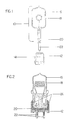
- Fig. 1 is a schematic exploded view of such an incandescent lamp.
- the lamp may be viewed as comprising an envelope bulb unit 10 and a base assembly 12 having a cavity 14 for the insertion of the bulb.
- Fig. 2 shows a different view of the lamp of Fig. 1 after the bulb and base subassemblies have been conjoined.
- the bulb comprises a glass envelope 16, a filament 18, leads 20 and contact pins 22.
- polymerizable adhesive.24 is employed to fill at least a portion of cavity 14 which is not occupied by bulb subassembly 10.
- the polymerizable adhesive is subsequently polymerized and then heated to effect vitrification thus to result in a fully cemented lamp.
- the cement 24 is strong, strongly adheres the lamp to the base, is hydrophobic, and maintains good electrical resistivity at high'humidity. It is also stable to temperatures of at least 750°C.
- fixturing process it is frequently desirable to effect a precise optical alignment between the filament 18 via the bulb 16 and the base 12.
- a fixturing process In such a case, a photopolymerization initiator is included in the polymerizable adhesives used in the practice of the present processes.
- the fixturing process is preferably practiced in accordance with Serial No. 234,473 filed February 17, 1981 and assigned to the assignee of this invention, which application is included by reference as if fully set forth herein.
- portions of an actinic light polymerizable adhesive 24 is placed in contact. with both the bulb and the base 12. Subsequent positioning of the base and the bulb relative to each other is performed to attain a preselected spatial orientation thereof. Irradiation of the polymerizable adhesive with actinic light for a period of time sufficient to cause polymerization of the adhesive results in the fixed maintenance of the spacial orientation. In such cases-, it is not necessary completely to,fill the cavity 14 with polymerizable adhesive 24 prior to fixturing. It is possible to use only discrete amounts of adhesive during this fixturing phase. Following the polymerization of the polymerizable adhesive with actinic light, the material may be vitrified. Optionally, additional quantities of polymerizable adhesive may be added to the cavity 14, polymerized, and the entire mass vitrified either seriatim or at once.
- one or more of the articles to be joined together is treated by a silanating agent.
- a silanating agent Any of those silanating agents known to those skilled in the art may be used such as aminopropyltriethoxysilane, methyltrichlorosilane, etc.
- the fixturing process thus disclosed is not limited to the assembly of lamps but is applicable to a wide range of fixturing and manufacturing processes.
- the polymerizable adhesive according to the processes of the present invention and after such adhesive has been polymerized either photochemically, thermally or otherwise, the polymerized- . adhesive is vitrified. This vitrification accomplished through the application of heat or thermal energy to the polymerized adhesive. Accordingly, the adhesive is heated either in an oven, with a flame, through microwave radiation, or in other ways known to those skilled in the art at temperatures sufficient to drive off or vaporize volatile organic components and to cause vitrification of the polymerized adhesive.
- the heat source may emanate from the articles themselves. Accordingly, the lamp of Figs. 1 and 2 may simply be operated in the normal fashion following polymerization of the adhesive.
- the internal heat generated by the incandescent' lamp is sufficient in most cases to effect evolution of gaseous organic products, where present, and to vitrify the adhesive. This procedure is preferred in, for example, airport runway illumination devices.
- the heating to effect vitrification takes place at temperatures and for periods of time sufficient to cause substantially complete evolution of organic gases, if any. Additionally, temperatures and times are selected which are sufficient for the vitrification to proceed substantially to completion.
- a polymerizable resin was formulated from the follow- in g constituents:
- the polymerizable adhesive of Example 1 was used for the joining of a lamp bulb to its supporting sleeve.
- the lamp bulb and sleeve were contacted by a quantity of the polymerizable adhesive and caused to polymerize' by exposure for about 10 seconds with a 1.8 watt/cm 2 (400-500mm) at contact visible light source.
- Baking of the lamp for approximately 2 hours at 300°C resulted in a vitrified adhesive layer firmly bonded to both lamp and sleeve.
- the adhesive was relatively impervious to water and evidenced no breakdown of resistivity upon exposure to humid conditions.
- a polymerizable resin was formulated from the following constituents:
- Adhesive compositions similar to that described in Example 3 were formulated having varying amounts of polymerizable silane. Accordingly such adhesives were formulated by replacing a portion or all of the silane with Epocryl" acrylic to yield the composition of Table I.
- Two specimens of each of those adhesive composition were prepared in precision bore glass tubing, each having dimensions of 6mm diameter by l2mm length. Each specimen was polymerized by exposure to a common photoflood lamp for 2 minutes. The polymerized specimens were initially flamed with a bunsen burner to remove easily volatilized materials and then heated in a muffle furnace. The heating was begun at 400°C for 30 minutes, raised to 500°C for 15 minutes and then to 600°C for 15 minutes. Total heating time was approximately one hour.
Landscapes
- Chemical & Material Sciences (AREA)
- Organic Chemistry (AREA)
- Adhesives Or Adhesive Processes (AREA)
Applications Claiming Priority (2)
| Application Number | Priority Date | Filing Date | Title |
|---|---|---|---|
| US06/274,065 US4422891A (en) | 1981-06-16 | 1981-06-16 | Vitrifiable adhesive process |
| US274065 | 1981-06-16 |
Publications (2)
| Publication Number | Publication Date |
|---|---|
| EP0067512A2 true EP0067512A2 (fr) | 1982-12-22 |
| EP0067512A3 EP0067512A3 (fr) | 1983-09-21 |
Family
ID=23046608
Family Applications (1)
| Application Number | Title | Priority Date | Filing Date |
|---|---|---|---|
| EP82302221A Withdrawn EP0067512A3 (fr) | 1981-06-16 | 1982-04-29 | Procédé de fabrication d'un adhésif vitrifiable |
Country Status (3)
| Country | Link |
|---|---|
| US (1) | US4422891A (fr) |
| EP (1) | EP0067512A3 (fr) |
| JP (1) | JPS57212277A (fr) |
Families Citing this family (8)
| Publication number | Priority date | Publication date | Assignee | Title |
|---|---|---|---|---|
| US4674980A (en) * | 1982-05-03 | 1987-06-23 | Den-Mat, Inc. | Dental composite and porcelain repair |
| JPS59103224A (ja) * | 1982-12-03 | 1984-06-14 | 三菱電機株式会社 | 開閉器 |
| JPS61223716A (ja) * | 1985-03-28 | 1986-10-04 | Olympus Optical Co Ltd | 光学部品の保持装置 |
| US5204219A (en) * | 1987-07-30 | 1993-04-20 | Minnesota Mining And Manufacturing Company | Photographic element with novel subbing layer |
| JP2797650B2 (ja) * | 1990-05-21 | 1998-09-17 | 松下電器産業株式会社 | 半導体素子の実装方法 |
| EP0764704B1 (fr) * | 1995-09-25 | 2000-03-08 | Dow Corning Corporation | Utilisation de polymères précéramiques comme adhésifs pour l'électronique |
| US11285702B2 (en) | 2016-07-22 | 2022-03-29 | 3M Innovative Properties Company | Siloxane-based adhesive layers as ceramic precursors |
| CN109476964B (zh) | 2016-07-22 | 2022-04-26 | 3M创新有限公司 | 作为陶瓷前体的聚合物粘合剂层 |
Family Cites Families (13)
| Publication number | Priority date | Publication date | Assignee | Title |
|---|---|---|---|---|
| US3398210A (en) * | 1963-06-17 | 1968-08-20 | Dow Corning | Compositions comprising acryloxyalkylsilanes and unsaturated polyester resins |
| US3619246A (en) * | 1969-05-12 | 1971-11-09 | Usm Corp | Treatment of resin surfaces to improve their receptivity to coatings and the like and resin bodies with treated surfaces |
| US3728185A (en) * | 1970-05-22 | 1973-04-17 | Owens Illinois Inc | Olefin-so2 compositions containing finely divided fusible inorganic material and method for bonding therewith |
| US3901752A (en) * | 1971-10-14 | 1975-08-26 | Owens Illinois Inc | Laminating process utilizing mixtures of pyrolyzable and polymerizable binders |
| US3919438A (en) * | 1972-02-10 | 1975-11-11 | Gen Electric | Method of coating using a silicone modified polyester |
| US3970709A (en) * | 1972-10-17 | 1976-07-20 | Lord Corp | Adhesive formulations for bonded metal assemblies with resistance to aggressive environments |
| US4084021A (en) * | 1974-10-08 | 1978-04-11 | Minnesota Mining And Manufacturing Company | Method for rendering substrates resistant to abrasion |
| US4082635A (en) * | 1976-08-02 | 1978-04-04 | Ciba-Geigy Corporation | Ultraviolet light-curable diacrylate hydantoin adhesive compositions |
| JPS6019790B2 (ja) * | 1977-11-18 | 1985-05-17 | 株式会社日立製作所 | 光硬化型接着性組成物とそれを用いて被着体を接着する方法 |
| US4188451A (en) * | 1978-04-12 | 1980-02-12 | General Electric Company | Polycarbonate article coated with an adherent, durable, silica filled organopolysiloxane coating and process for producing same |
| US4201808A (en) * | 1978-06-12 | 1980-05-06 | Union Carbide Corporation | Radiation curable silicone release compositions |
| JPS5950181B2 (ja) * | 1979-03-07 | 1984-12-06 | ト−レ・シリコ−ン株式会社 | 高温でセラミツク化するシリコ−ン組成物 |
| EP0058514A1 (fr) * | 1981-02-17 | 1982-08-25 | Dentsply International, Inc. | Adhésifs à base de silanes durcissables par irradiation |
-
1981
- 1981-06-16 US US06/274,065 patent/US4422891A/en not_active Expired - Fee Related
-
1982
- 1982-04-29 EP EP82302221A patent/EP0067512A3/fr not_active Withdrawn
- 1982-06-16 JP JP57102359A patent/JPS57212277A/ja active Pending
Also Published As
| Publication number | Publication date |
|---|---|
| EP0067512A3 (fr) | 1983-09-21 |
| US4422891A (en) | 1983-12-27 |
| JPS57212277A (en) | 1982-12-27 |
Similar Documents
| Publication | Publication Date | Title |
|---|---|---|
| CA1214678A (fr) | Composition photopolymerisable renfermant un catalyseur constitue d'une dicetone et de l'acide 4-(n,n-dimethylamino)benzoique ou d'un ester de celui-ci | |
| US4504231A (en) | Process for filling teeth | |
| Ruyter | Composites-characterization of composite filling materials: reactor response | |
| EP0140140B1 (fr) | Matériau composite dentaire et de restauration de porcelaine | |
| Kumbuloglu et al. | Shear bond strength of composite resin cements to lithium disilicate ceramics | |
| US4082635A (en) | Ultraviolet light-curable diacrylate hydantoin adhesive compositions | |
| US4422891A (en) | Vitrifiable adhesive process | |
| CA1259149A (fr) | Composition de rechargement dentaire, a teneur de monomere monofonctionnel | |
| USRE35264E (en) | Dental adhesive system | |
| EP1323407A2 (fr) | Restauration dentaire en résine composite | |
| EP1249221A1 (fr) | Composition adhesive dentaire | |
| JPH10245525A (ja) | 接着性組成物 | |
| US4792577A (en) | Stain-resistant no-mix orthodontic adhesive | |
| CA1244177A (fr) | Resine methacrylique utilisee en dentisterie | |
| CN111500222B (zh) | 光开关固化型聚异丁烯胶粘剂组成物及其施胶工艺 | |
| CA1117685A (fr) | Compose polymerisable pour les restaurations dentaires | |
| IE55586B1 (en) | Dental restorative compositions having improved mechanical properties and hydrolytic stability | |
| EP0058514A1 (fr) | Adhésifs à base de silanes durcissables par irradiation | |
| US4192795A (en) | Barium aluminum silicate filler for U.V. curable composites | |
| EP0064834B1 (fr) | Système adhésif dentaire | |
| Paula et al. | Effect of thickness of indirect restoration and distance from the light-curing unit tip on the hardness of a dual-cured resin cement | |
| EP0776956A2 (fr) | Adhésifs | |
| US4443494A (en) | Method for joining objects | |
| Fahmy et al. | Effect of Light‐Emitting Diode (LED) Curing Modes on Resin/Dentin Bond Strength | |
| KR100911843B1 (ko) | 비휘발성 치과용 조성물 |
Legal Events
| Date | Code | Title | Description |
|---|---|---|---|
| PUAI | Public reference made under article 153(3) epc to a published international application that has entered the european phase |
Free format text: ORIGINAL CODE: 0009012 |
|
| AK | Designated contracting states |
Designated state(s): DE FR GB IT NL |
|
| PUAL | Search report despatched |
Free format text: ORIGINAL CODE: 0009013 |
|
| AK | Designated contracting states |
Designated state(s): DE FR GB IT NL |
|
| STAA | Information on the status of an ep patent application or granted ep patent |
Free format text: STATUS: THE APPLICATION IS DEEMED TO BE WITHDRAWN |
|
| 18D | Application deemed to be withdrawn |
Effective date: 19840522 |
|
| RIN1 | Information on inventor provided before grant (corrected) |
Inventor name: GONSER, DONALD I. |