EP0067515A2 - Verfahren und Vorrichtung zur Steuerung eines Tintenstrahldruckers - Google Patents
Verfahren und Vorrichtung zur Steuerung eines Tintenstrahldruckers Download PDFInfo
- Publication number
- EP0067515A2 EP0067515A2 EP82302272A EP82302272A EP0067515A2 EP 0067515 A2 EP0067515 A2 EP 0067515A2 EP 82302272 A EP82302272 A EP 82302272A EP 82302272 A EP82302272 A EP 82302272A EP 0067515 A2 EP0067515 A2 EP 0067515A2
- Authority
- EP
- European Patent Office
- Prior art keywords
- pressure
- ink
- nozzle
- writing fluid
- print head
- Prior art date
- Legal status (The legal status is an assumption and is not a legal conclusion. Google has not performed a legal analysis and makes no representation as to the accuracy of the status listed.)
- Withdrawn
Links
- 238000000034 method Methods 0.000 title claims abstract description 9
- 239000012530 fluid Substances 0.000 claims abstract description 30
- 238000007639 printing Methods 0.000 claims abstract description 19
- 238000007641 inkjet printing Methods 0.000 claims abstract description 14
- 230000037406 food intake Effects 0.000 claims abstract description 6
- 230000001276 controlling effect Effects 0.000 claims description 8
- 230000001105 regulatory effect Effects 0.000 claims description 3
- 238000013022 venting Methods 0.000 description 6
- 239000007788 liquid Substances 0.000 description 4
- 238000011109 contamination Methods 0.000 description 3
- 239000013078 crystal Substances 0.000 description 3
- 230000005686 electrostatic field Effects 0.000 description 3
- 238000013459 approach Methods 0.000 description 2
- 208000031481 Pathologic Constriction Diseases 0.000 description 1
- 238000004140 cleaning Methods 0.000 description 1
- 230000001351 cycling effect Effects 0.000 description 1
- 239000013013 elastic material Substances 0.000 description 1
- 230000005284 excitation Effects 0.000 description 1
- 239000000463 material Substances 0.000 description 1
- 238000012544 monitoring process Methods 0.000 description 1
- 230000000737 periodic effect Effects 0.000 description 1
- 238000004064 recycling Methods 0.000 description 1
- 230000000717 retained effect Effects 0.000 description 1
- 239000004065 semiconductor Substances 0.000 description 1
- 230000001052 transient effect Effects 0.000 description 1
- 238000011144 upstream manufacturing Methods 0.000 description 1
Images


Classifications
-
- B—PERFORMING OPERATIONS; TRANSPORTING
- B41—PRINTING; LINING MACHINES; TYPEWRITERS; STAMPS
- B41J—TYPEWRITERS; SELECTIVE PRINTING MECHANISMS, i.e. MECHANISMS PRINTING OTHERWISE THAN FROM A FORME; CORRECTION OF TYPOGRAPHICAL ERRORS
- B41J2/00—Typewriters or selective printing mechanisms characterised by the printing or marking process for which they are designed
- B41J2/005—Typewriters or selective printing mechanisms characterised by the printing or marking process for which they are designed characterised by bringing liquid or particles selectively into contact with a printing material
- B41J2/01—Ink jet
- B41J2/17—Ink jet characterised by ink handling
Definitions
- This invention relates generally to ink jet printing, and more particularly concerns switching an ink jet print head from the energized state to the de-energized state without emitting undesired writing fluid therefrom.
- ink jet printing employs a writing fluid or ink which is forced under pressure through a small nozzle to form a jet.
- the jet is vibrated so as to form pressure waves which cause the jet to break up into a stream of droplets of substantially uniform size and spacing at a well defined distance from the nozzle.
- a voltage is applied to an electrode surrounding the break up point of the jet. This induces an electrical charge of a specific pre-determined magnitude on the forming drop.
- the charge is retained by the drop throughout its flight to the recording sheet.
- the stream of drops pass through an electrostatic field formed by a fixed high voltage across a pair of horizontal deflection plates. Since the charge in each drop is individually controlled, a drop can be deflected vertically by a desired amount.
- the drops are deflected vertically from bottom to top and one column of dots and/or spaces is referred to as a scan. If, in forming a character, a particular space in a scan is to be left blank, it is blanked by leaving the drops uncharged. These undeflected drops are intercepted by a gutter and recycled to the ink reservoir. As drops are deflected vertically, the print head or the recording sheet are moved at a substantially constant speed. Thus, drops are deposited on the recording sheet at the appropriate positions within a raster area to form the desired character.
- US-A-3924974 describes a fluid jet device formed of a tube having a curvalinear cross-section comprising two bow-like shaped sections, a flat member disposed along the axis of the tubes spanning opposite walls thereof along the major diameter to form a cord of the two bow-like shaped section, and a nozzle joined to the tube.
- the flat member divides the tube into two chambers for fluid with each having a cross-sectional area enclosed by a bow-like shaped section.
- the tube is made from a magneto-stricture material. When a circumferential magnetic field is applied to the tube, the tube contracts reducing the volume thereof to eject a jet of fluid through the nozzle.
- US-A-3945020 discloses a liquid jet recorder in which nozzles project a recording liquid from supply receptacles through the use of pumps.
- the recording liquid passes between control electrodes.
- Pressure regulators are interposed between the nozzles and pumps.
- Suction pads are provided for cleaning the electrodes.
- US-A-3950761 describes an electromagnetically actuated plunger driven against the bottom portion of an elastic material comprising the bottom of an ink storage. This pressurizes the ink held in storage, thereby conducting the ink to the tip of the nozzle under pressure.
- US-A-4005435 discloses a liquid jet droplet generator including a pump which furnishes pressurized ink to a nozzle contacting a tapered horn having a piezoelectric transducer associated therewith. Excitation of the transducer produces periodic pressure variations to form droplets of a thicker viscosity ink than heretofore utilized.
- US-A-4089007 describes an ink jet printing system having a primary orifice and a secondary orifice of a binary actuated pressure transducer.
- the pressure regulator is interposed between an ink pump and nozzle array.
- the primary orifice furnishes ink at a pressure below the minimum with both orifices, together, supplying ink at a pressure above the desired maximum.
- the pressure sensor controls the solenoid to open the valve at the minimum pressure and to close the valve at the maximum pressure, thus cycling between the two conditions.
- US-A-4171527 discloses an ink jet printing machine in which a circuit detects contamination of the charge electrodes or deflection plates by ink. The ink jet head is shut-off in response to contamination being sensed.
- US-A-4184168 describes an ink jet head in which a high voltage pulse is applied to a piezoelectric transducer.
- the transducer is deformed pressurizing ink in the chamber and an ink jet is discharged through a nozzle.
- a comparator compares video signal with a reference voltage to deliver a high level output when the video signal is equal to or higher than the reference and a low level output when the video signal is lower than the reference voltage.
- a pulse synchronization circuit receives the output from the comparator and delivers an output pulse in synchronism with a printing sync pulse when a high or low level signal is received from the comparator.
- a sample-hold circuit holds the peak value of the video signal. The output of the sample-hold circuit is applied to a high-voltage energization circuit which develops the high voltage pulse. The output pulse from the synchronization circuit resets the sample-hold circuit.
- An ink jet printing machine in accordance with the present invention is characterised by means for switching said projecting means from the energized conditon to the deenergized conditon with no undesired writing fluid being emitted therefrom and ingestion of air therein.
- a method of ink jet printing according to the invention is characterised by the steps of energizing a print head to project writing fluid therefrom, deenergizing the print head to prevent the projection of printing fluid therefrom, and switching from said step of energizing to said step of de-energizing with no undesired writing fluid being emitted therefrom and ingestion of air therein.
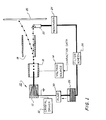
- the ink jet printing machine employs a nozzle.
- Nozzle 10 projects a jet of writing fluid or ink therefrom.
- the ink is forced through nozzle 10 under pressure to form the jet.
- a transducer e.g. piezoelectric crystal 12, associated with nozzle 10, vibrates the ink within the cavity of nozzle 10 at a fixed ultrasonic frequency.
- the pressure waves cause the jet of ink to break up into a stream of droplets at a fixed distance from the exit of nozzle 10.
- a voltage source 14 applies a voltage of a predetermined magnitude to electrodes 16.
- Electrodes 16 are positioned at the point wherein the jet of ink emitted from nozzle 10 breaks up into droplets.
- the voltage applied to the electrodes induces an electrical charge of a specific, predetermined magnitude on the forming drop.
- the voltage applied to electrode 16 by voltage source 14 is controlled by a character data input.
- the magnitude of the voltage is determinative of the specific character being formed on the recording sheet.
- the charged droplets pass through a pair of parallel plates 18. Plates 18 are electrically biased to a fixed voltage level. This produces a fixed high voltage across plates 18 resulting in an electrostatic field therebetween.
- the drops deflect a specified amount depending upon the selected charge thereon and the electrostatic field through which they pass.
- the drops are deflected vertically onto recording sheet 20.
- recording sheet 20 is a sheet of paper.
- a series of drops form a column in the character.
- One column of dots and/or spaces is the scan. If in forming a character, a particular space in the scan is to be left blank, or white, the drops remain uncharged. Inasmuch as the drops are not charged,they remain undeflectedby deflection plates 18 and are received by gutter 22.
- the unused ink passes into reservoir 24 for subsequent recycling. From reservoir 24, the ink passes through filter screen 26 and into ink supply 28. Pump 30 advances the ink from supply 28 back to nozzle 10.
- Piezoelectric crystal 12 is electrically excited by a crystal driver circuit 32.
- the ink in the nozzle In order to prevent extraneous or undesired ink flow when the printing machine is switched from the energized state to the de-energized state, the ink in the nozzle must be depressurized.
- the pressure is initially reduced slowly to the pressure corresponding to the minimum captive velocity of the jet of ink by gutter 22, and rapidly for the rest of the depressurization cycle. Inasmuch as the rapid part of the depressurization is started at a much lower pressure than was heretofore utilized, the pressure undershoot is minimized.
- the first reduction of ink pressure in the nozzle may be achieved by controlling the supply of ink thereto.
- the control system for regulating the pressure of the ink being furnished to the nozzle is depicted in Figure 2.
- Pump 30 advances ink from ink supply 28 through valve 34 to nozzle 10.
- inlet port 34(a) of valve 34 is coupled to outlet port 34(b).
- Controller 36 regulates valve 34.
- controller 36 activates valve 34 such that inlet port 34(a) is coupled to outlet port 34(b).
- Pump 38 is connected to inlet port 34(a) and nozzle 10 is connected to outlet port 34(b). Venting port 34(c) is closed.
- controller 36 When the printing machine is de-energized, controller 36 activates valve 34 such that outlet port 34(b) is coupled to venting port 34(c). Inasmuch as inlet port 34(a) is closed, ink will no longer be furnished to outlet port 34(b). Controller 36 monitors the pressure in the conduit coupled to outlet port 34(b). Pressure tranducer 38 converts the measured pressure to voltage.
- pressure transducer 38 may be a strain gauge diaphragm which detects constant and high frequency pressure changes.
- One suitable type of pressure transducer is a Kulite semiconductor. The output from pressure transducer 38 is amplified by instrumentation amplifier 40.
- the output voltage from amplifier 40 is approximately 0.16 volts/psi.
- the output from amplifier 40 is compared with a reference voltage corresponding to a reference pressure by comparator 42.
- the comparator When the output from amplifier 40 is equal to or less than the reference voltage or pressure, the comparator generates a signal to open port 34(c), thereby venting the system to atmosphere.
- the operating pressure of the printing system is about 40 psi.
- comparator 42 now generates a signal opening port 34(c).
- the pressure now decays rapidly from 10 psi to about 0 psi without any dribble or extraneous undesired ink flow being emitted from nozzle 10. From 40 psi to 10 psi, a flow of ink is emitted from nozzle 10 which is captured by gutter 22. It is clear that this control scheme may be employed for an array of nozzles in addition to a single nozzle. In this way, each nozzle of the array is selectively actuated and deactuated without one nozzle remaining on while the next successive nozzle is energized.
- controller 36 includes a timing circuit 44.
- timing circuit 44 controls valve 34 such that outlet port 34(b) is coupled to closed venting port 34(c).
- the timing circuit opens port 34(c) to vent to atmosphere after the elapse of a specified time delay. For example, if the system operates at 40 psi, the line pressure will decay to about 10 psi after an elapse of 17 milliseconds. Thus, timing circuit 44 will open port 34(c) to vent to atmosphere after the elapse of 17 milliseconds from supply termination.
- the jet of ink will be captured by gutter 22 from 40 psi to about 10 psi and, thereafter, the pressure will decrease rapidly from 10 psi to 0 psi with little or no undershoot. This significantly prevents the occurrence of dribble or the emission of undesired ink from nozzle 10, as well as preventing air ingestion through the nozzle.
- FIG. 5 there is shown a graph of ink pressure as a function of time.
- the system is initially at operating pressure, i.e. 40 psi.
- the ink supply to nozzle 10 is shut-off.
- the pressure in nozzle 10 will decay to the reference pressure, i.e. 10 psi.
- the nozzle is vented to atmosphere producing a rapid depressurization of the system.
- the time delay between closing the ink supply to the nozzle and venting the system to atmosphere is determined by either monitoring the pressure until it reaches the desired pressure or by knowing the time required to reach the desired pressure and utilizing a timing circuit to produce this delay.
- the present invention controls switching a nozzle from energization to de-energization without projecting undesired writing ink therefrom.
- the nozzle maintains a jet of ink from the operating pressure to the reference pressure. This depressurization occurs slowly and permits the gutter to capture this jet of ink.
- the reference pressure Once the reference pressure is achieved, the system is vented to atmosphere reducing the pressure almost instantaneously. Inasmuch as the pressure is reduced rapidly, the transient undershoot is minimal and no undesired ink droplets or dribble occurs. In this way, successive nozzles of an array of nozzles may be switched from the energized state to the de-energized state without producing undesired ink flow and contamination.
Landscapes
- Particle Formation And Scattering Control In Inkjet Printers (AREA)
- Ink Jet (AREA)
Applications Claiming Priority (2)
| Application Number | Priority Date | Filing Date | Title |
|---|---|---|---|
| US26047481A | 1981-05-04 | 1981-05-04 | |
| US260474 | 2002-09-30 |
Publications (2)
| Publication Number | Publication Date |
|---|---|
| EP0067515A2 true EP0067515A2 (de) | 1982-12-22 |
| EP0067515A3 EP0067515A3 (de) | 1983-11-09 |
Family
ID=22989313
Family Applications (1)
| Application Number | Title | Priority Date | Filing Date |
|---|---|---|---|
| EP82302272A Withdrawn EP0067515A3 (de) | 1981-05-04 | 1982-05-04 | Verfahren und Vorrichtung zur Steuerung eines Tintenstrahldruckers |
Country Status (2)
| Country | Link |
|---|---|
| EP (1) | EP0067515A3 (de) |
| JP (1) | JPS57187267A (de) |
Cited By (2)
| Publication number | Priority date | Publication date | Assignee | Title |
|---|---|---|---|---|
| EP0138322A1 (de) * | 1983-08-19 | 1985-04-24 | A.B. Dick Company | Tintenventil für Markierungssysteme |
| EP0623472A3 (de) * | 1993-05-04 | 1997-03-26 | Markem Corp | Tintenstrahldrucker. |
Family Cites Families (2)
| Publication number | Priority date | Publication date | Assignee | Title |
|---|---|---|---|---|
| JPS56142067A (en) * | 1980-04-04 | 1981-11-06 | Ricoh Co Ltd | Ink feeding device for ink jet recorder |
| JPS5787966A (en) * | 1980-11-25 | 1982-06-01 | Ricoh Co Ltd | Ink jet recorder |
-
1982
- 1982-04-28 JP JP7248382A patent/JPS57187267A/ja active Pending
- 1982-05-04 EP EP82302272A patent/EP0067515A3/de not_active Withdrawn
Cited By (2)
| Publication number | Priority date | Publication date | Assignee | Title |
|---|---|---|---|---|
| EP0138322A1 (de) * | 1983-08-19 | 1985-04-24 | A.B. Dick Company | Tintenventil für Markierungssysteme |
| EP0623472A3 (de) * | 1993-05-04 | 1997-03-26 | Markem Corp | Tintenstrahldrucker. |
Also Published As
| Publication number | Publication date |
|---|---|
| JPS57187267A (en) | 1982-11-17 |
| EP0067515A3 (de) | 1983-11-09 |
Similar Documents
| Publication | Publication Date | Title |
|---|---|---|
| EP0229320B1 (de) | Hydraulische Servoregelungseinrichtung des Schreibflüssigkeitsdruckes in einem Tintenstrahldrucksystem | |
| EP0115181B1 (de) | Verfahren zum Betreiben eines Tintenstrahlapparates | |
| US5757391A (en) | High-frequency drop-on-demand ink jet system | |
| US4433341A (en) | Ink level control for ink jet printer | |
| US4240082A (en) | Momentumless shutdown of a jet drop recorder | |
| KR890701370A (ko) | 잉크제트 프린터 | |
| US4518974A (en) | Ink jet air removal system | |
| JPS638908B2 (de) | ||
| EP0025877A1 (de) | Tintenstrahldruckkopf und Tintenstrahldrucker | |
| US5808642A (en) | Continuous ink jet printer print head | |
| US4651161A (en) | Dynamically varying the pressure of fluid to an ink jet printer head | |
| US5298923A (en) | Ink jet misdischarge recovery by simultaneously driving an ink jet head and exhausting ink therefrom | |
| US7681971B2 (en) | Ink jet apparatus | |
| EP0287373B1 (de) | Kontinuierlich arbeitender Farbstrahldrucker | |
| EP0067515A2 (de) | Verfahren und Vorrichtung zur Steuerung eines Tintenstrahldruckers | |
| US8342622B2 (en) | Liquid ejection apparatus and method | |
| JPS5840508B2 (ja) | インパルス方式マルチノズルインクジエツトヘツド | |
| JPS63139749A (ja) | インクジエツト記録ヘツド | |
| JP4447014B2 (ja) | 液滴を付着させるための装置 | |
| EP1637329A1 (de) | Tröpfchengenerator | |
| JP2018103530A (ja) | 液体噴射装置の駆動方法及び液体噴射装置 | |
| WO1990013431A1 (en) | Continuous ink jet printing | |
| US4516134A (en) | Ink jet printer shut-down control | |
| JPH07329317A (ja) | 連続噴射型インクジェット記録装置 | |
| JP2024063656A (ja) | 液体吐出検査装置 |
Legal Events
| Date | Code | Title | Description |
|---|---|---|---|
| PUAI | Public reference made under article 153(3) epc to a published international application that has entered the european phase |
Free format text: ORIGINAL CODE: 0009012 |
|
| AK | Designated contracting states |
Designated state(s): DE GB IT |
|
| PUAL | Search report despatched |
Free format text: ORIGINAL CODE: 0009013 |
|
| AK | Designated contracting states |
Designated state(s): DE GB IT |
|
| STAA | Information on the status of an ep patent application or granted ep patent |
Free format text: STATUS: THE APPLICATION HAS BEEN WITHDRAWN |
|
| 18W | Application withdrawn |
Withdrawal date: 19831221 |
|
| RIN1 | Information on inventor provided before grant (corrected) |
Inventor name: WOJCIECHOWSKI, MATTHEW P. Inventor name: KORDS, DONALD N. Inventor name: REZANKA, IVAN |