EP0067591A1 - Supraconducteur stabilisé avec Al et procédé pour fabriquer celui-ci - Google Patents
Supraconducteur stabilisé avec Al et procédé pour fabriquer celui-ci Download PDFInfo
- Publication number
- EP0067591A1 EP0067591A1 EP82302756A EP82302756A EP0067591A1 EP 0067591 A1 EP0067591 A1 EP 0067591A1 EP 82302756 A EP82302756 A EP 82302756A EP 82302756 A EP82302756 A EP 82302756A EP 0067591 A1 EP0067591 A1 EP 0067591A1
- Authority
- EP
- European Patent Office
- Prior art keywords
- wire
- superconducting
- wires
- elementary
- high purity
- Prior art date
- Legal status (The legal status is an assumption and is not a legal conclusion. Google has not performed a legal analysis and makes no representation as to the accuracy of the status listed.)
- Granted
Links
Images
Classifications
-
- H—ELECTRICITY
- H01—ELECTRIC ELEMENTS
- H01B—CABLES; CONDUCTORS; INSULATORS; SELECTION OF MATERIALS FOR THEIR CONDUCTIVE, INSULATING OR DIELECTRIC PROPERTIES
- H01B12/00—Superconductive or hyperconductive conductors, cables, or transmission lines
- H01B12/02—Superconductive or hyperconductive conductors, cables, or transmission lines characterised by their form
- H01B12/08—Stranded or braided wires
-
- H—ELECTRICITY
- H10—SEMICONDUCTOR DEVICES; ELECTRIC SOLID-STATE DEVICES NOT OTHERWISE PROVIDED FOR
- H10N—ELECTRIC SOLID-STATE DEVICES NOT OTHERWISE PROVIDED FOR
- H10N60/00—Superconducting devices
- H10N60/01—Manufacture or treatment
- H10N60/0128—Manufacture or treatment of composite superconductor filaments
-
- H—ELECTRICITY
- H10—SEMICONDUCTOR DEVICES; ELECTRIC SOLID-STATE DEVICES NOT OTHERWISE PROVIDED FOR
- H10N—ELECTRIC SOLID-STATE DEVICES NOT OTHERWISE PROVIDED FOR
- H10N60/00—Superconducting devices
- H10N60/20—Permanent superconducting devices
-
- Y—GENERAL TAGGING OF NEW TECHNOLOGICAL DEVELOPMENTS; GENERAL TAGGING OF CROSS-SECTIONAL TECHNOLOGIES SPANNING OVER SEVERAL SECTIONS OF THE IPC; TECHNICAL SUBJECTS COVERED BY FORMER USPC CROSS-REFERENCE ART COLLECTIONS [XRACs] AND DIGESTS
- Y02—TECHNOLOGIES OR APPLICATIONS FOR MITIGATION OR ADAPTATION AGAINST CLIMATE CHANGE
- Y02E—REDUCTION OF GREENHOUSE GAS [GHG] EMISSIONS, RELATED TO ENERGY GENERATION, TRANSMISSION OR DISTRIBUTION
- Y02E40/00—Technologies for an efficient electrical power generation, transmission or distribution
- Y02E40/60—Superconducting electric elements or equipment; Power systems integrating superconducting elements or equipment
-
- Y—GENERAL TAGGING OF NEW TECHNOLOGICAL DEVELOPMENTS; GENERAL TAGGING OF CROSS-SECTIONAL TECHNOLOGIES SPANNING OVER SEVERAL SECTIONS OF THE IPC; TECHNICAL SUBJECTS COVERED BY FORMER USPC CROSS-REFERENCE ART COLLECTIONS [XRACs] AND DIGESTS
- Y10—TECHNICAL SUBJECTS COVERED BY FORMER USPC
- Y10S—TECHNICAL SUBJECTS COVERED BY FORMER USPC CROSS-REFERENCE ART COLLECTIONS [XRACs] AND DIGESTS
- Y10S505/00—Superconductor technology: apparatus, material, process
- Y10S505/825—Apparatus per se, device per se, or process of making or operating same
- Y10S505/884—Conductor
- Y10S505/887—Conductor structure
-
- Y—GENERAL TAGGING OF NEW TECHNOLOGICAL DEVELOPMENTS; GENERAL TAGGING OF CROSS-SECTIONAL TECHNOLOGIES SPANNING OVER SEVERAL SECTIONS OF THE IPC; TECHNICAL SUBJECTS COVERED BY FORMER USPC CROSS-REFERENCE ART COLLECTIONS [XRACs] AND DIGESTS
- Y10—TECHNICAL SUBJECTS COVERED BY FORMER USPC
- Y10S—TECHNICAL SUBJECTS COVERED BY FORMER USPC CROSS-REFERENCE ART COLLECTIONS [XRACs] AND DIGESTS
- Y10S505/00—Superconductor technology: apparatus, material, process
- Y10S505/825—Apparatus per se, device per se, or process of making or operating same
- Y10S505/917—Mechanically manufacturing superconductor
- Y10S505/927—Metallurgically bonding superconductive members
-
- Y—GENERAL TAGGING OF NEW TECHNOLOGICAL DEVELOPMENTS; GENERAL TAGGING OF CROSS-SECTIONAL TECHNOLOGIES SPANNING OVER SEVERAL SECTIONS OF THE IPC; TECHNICAL SUBJECTS COVERED BY FORMER USPC CROSS-REFERENCE ART COLLECTIONS [XRACs] AND DIGESTS
- Y10—TECHNICAL SUBJECTS COVERED BY FORMER USPC
- Y10S—TECHNICAL SUBJECTS COVERED BY FORMER USPC CROSS-REFERENCE ART COLLECTIONS [XRACs] AND DIGESTS
- Y10S505/00—Superconductor technology: apparatus, material, process
- Y10S505/825—Apparatus per se, device per se, or process of making or operating same
- Y10S505/917—Mechanically manufacturing superconductor
- Y10S505/928—Metal deforming
- Y10S505/93—Metal deforming by drawing
-
- Y—GENERAL TAGGING OF NEW TECHNOLOGICAL DEVELOPMENTS; GENERAL TAGGING OF CROSS-SECTIONAL TECHNOLOGIES SPANNING OVER SEVERAL SECTIONS OF THE IPC; TECHNICAL SUBJECTS COVERED BY FORMER USPC CROSS-REFERENCE ART COLLECTIONS [XRACs] AND DIGESTS
- Y10—TECHNICAL SUBJECTS COVERED BY FORMER USPC
- Y10T—TECHNICAL SUBJECTS COVERED BY FORMER US CLASSIFICATION
- Y10T29/00—Metal working
- Y10T29/49—Method of mechanical manufacture
- Y10T29/49002—Electrical device making
- Y10T29/49014—Superconductor
Definitions
- the invention relates to Al-stabilized superconducting wire of smaller size and lighter weight, higher current density, greater stability and lower AC loss, and particularly to wire for use in superconducting magnet used in charging magnetic field, such as pulse magnet and the like, and the method for producing the same.
- Superconducting material presently for use in superconducting magnetic wire comprises alloys, such as Nb-Ti, Nb-Zr, etc., and intermetallic compounds, such as Nb 3 Sn, V 3 Ga, etc.
- these materials are used with stabilizer in composing with high purity Cu or high purity Al.
- high purity Al is particularly effective as stabilizer with its low density which is less than 1/3 that of high purity Cu, high electroconductivity at very low temperatures, high heat conductivity, display of saturation property in magnetoresistance effect, etc.
- Al and superconducting material are generally integrated by the following method.
- High purity Cu and superconducting material are composed, and then Al is integrated with the composite.
- This method involves no small difficulty, since the higher is the purity of A 1, the lower is the mechanical strength thereof.
- a l wires are intertwisted around a composite comprising Cu and superconducting material (hereinafter referred to as a superconducting elementary wire).
- the Al-stabilized superconducting wire produced by these processes are satisfactory as far as said three features are concerned, i.e., small size and light weight, high current density and high stability.
- the Al-stabilized superconducting wire is not free from difficulties in respect of mechanical strength and AC loss in view of the fact that Al is disposed around the superconducting elementary wire and that compound of high purity copper and superconducting material, i.e., Cu-sleeved superconducting elementary wire, is used.
- the AC loss can be divided into loss due to the inner structure of the superconducting wire and loss attributable to mechanical strength against the electromagnetic force applied to the wire when the superconducting wire is wound in a magnet.
- the former loss consists of three components: hysteresis loss arising in the superconductor (e.g., NbTi filament itself); coupling loss due to electromagnetic coupling arising between the superconductors (e.g., between NbTi filaments and between superconducting elementary wires); and eddy current loss caused in the normal conductive metal parts (e.g., Cu and Al used as stabilizers).
- the superconductor e.g., NbTi filament itself
- coupling loss due to electromagnetic coupling arising between the superconductors e.g., between NbTi filaments and between superconducting elementary wires
- eddy current loss caused in the normal conductive metal parts e.g., Cu and Al used as stabilizers.
- the former loss conceivably comprises mechanical heat generation and movement of wound wire caused by repetitive electromagnetic force in charging magnetic field.
- the stabilizing material is not disposed enbloc in the predetermined amount but is divided so that the eventual total area is equal to said amount.
- the stabilizing material is dispersed and disposed around the superconducting elementary wire.
- the superconducting wire should have the maximal mechanical strength.
- the above-described conventional Al-stabilized superconducting wire has a disadvantageous structure in respect of mechanical strength and eddy current loss since Al is disposed around the superconducting elementary wire.
- the surface of the superconducting elementary wire was covered by Al which was more susceptible to mechanical deformation and plastic deformation compared with the superconducting elementary wire.
- the conductivity was liable to be reduced at low temperatures by the deformation.
- the Al wire disposed around the superconducting elementary wire is in the state of electromagnetic contact with each other. Since Al as stabilizer is disposed continuously (as an integrated whole), it caused the eddy current loss to increase.
- the structure is disadvantageous against coupling current between the superconducting elementary wires in respect that the superconducting wire is Cu-sleeved superconducting wire having high purity copper as matrix. - 1
- the elementary wires are sleeved with Cu, they are electrically in contact with each other with interposition of low resistance metal, e.g., Cu, when the superconducting wires are physically in contact with each other and Cu-Al-Cu when Al wires are interposed between the superconducting elementary wires.
- low resistance metal e.g., Cu
- high purity Al in the intertwisted wire is susceptible to breaking, and once breakage occurs, the high purity Al is accumulated at the inlet of the die thereby making it impossible to obtain smoothly intertwisted wire.
- the invention has been made with a view to obviating the aforedescribed difficulties.
- the invention is characterized firstly in that, in intertwisted wire comprising superconducting elementary wire and high purity Al wire of serving as stabilizer, the core of said intertwisted wire which was chosen from superconducting elementary wire or electrically insulated nonmagnetic metal chiefly composing elementary wires and high purity Al wires alternately intertwisted therearound, and secondly in that said intertwisted wire is bonded by impregnating it with solder thereby enabling to impart greater toughness.
- the invention is further characterized thirdly in that superconducting elementary wires and high purity Al wire are intertwisted into a required configuration, the intertwisted wire being immersed in and impregnated with solder prior to pressing process thereby enabling to improve adhesion between the elementary wires, and fourthly in that the elementary wire is subsequently subjected to heat treatment for the recovery of residual resistivity ratio of Al.
- the intertwisted wire can be subjected to reduction process without the risk of breakage of the high purity Al wire, the clearance between the elementary wires being reduced by the reduction process thereby enabling to increase the current density.
- the superconducting material and high purity Al wire are integrated into a complete composite material thereby enabling the intertwisted wire to have high mechanical toughness and improved electrical contact for high stability.
- the invention enables to produce Al-stabilized superconducting wire of light weight and high current density.
- the surface reduction ratio of the intertwisted wire in the reduction process after solder impregnation is preferably below 40% for the following reasons.
- the solder layer on the surface is ununiformly distorted, whereby the texture of the elementary wire (particularly high purity Al) is occasionally exposed to result in wire breakage.
- irregular deformation of the superconducting wire causes a degradation of critical current.
- the surface of superconducting elementary wire and that of high purity Al wire are preferably coated by a layer of Sn, Sn-Pb or Sn-Ag, according to the need, so as to facilitate solder impregnation and reduction process after intertwisting.
- the surface of high purity Al in particular should be Cu-coated or covered by plated layer of Sn, Sn-Pb or Sn-Ag so that it can be impregnated with solder by immersion.
- the high purity Al wire preferably has a purity above 99.99% for the following reasons.
- the purity is less than 99.99%, electroconductivity at very low temperatures is reduced and the merit of high purity Al as stabilizer is substabtially reduced to the level of Cu.
- the heat treatment temperature (softening temperature) for recovering the residual resistance due to processing distorsion received during the Al wire drawing process and the reduction process after solder impregnation will be above 200°C, and the impregnated solder, in some cases, will be melted at this temperature.
- the superconducting material NbTi or Nb 3 Sn
- the superconducting material is in the state of fine multifilaments for the reduction of hysteresis loss, and high purity Cu disposed around each of the filaments is capable of eliminating local instability.
- Cu alloy sleeved fine multi-superconducting wire is preferable for the outer sleeve of the superconducting elementary wire thereby enabling to cut off the coupling current between the elementary wires.
- the superconducting elementary wire may have a round, square or any other configuration.
- the superconducting elementary wires and high purity Al wires after intertwisting, solder impregnation and co-working process may have a round, square or any other configuration.
- the co-working process can be selected from among die drawing, groove rolling, roller die, Turk's head rolls, etc.
- the high purity Al wire is subjected to heat treatment for the recovery of residual resistivity ratio since the residual resistivity ratio is reduced due to processing distorsion during the wire drawing, solder impregnation and co-working process.
- the heat treatment conditions depend on the purity of Al wire, kind of solder and processing degree, the conditions can be selected below the melting temperature of solder if the Al having a purity above 99.99% is used.
- the solder for impregnation is preferably Sn-Pb alloy solder or Sn-Ag alloy solder in particular, though selectable from among various other materials.
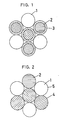
- the Al-stabilized superconducting wire according to the invention has the characteristics as described hereinunder in reference to the accompanying drawings.
- each of the high purity A l wires 1 is supported on three sides thereof by material of relatively high strength, such as superconducting elementary wire 2.
- material of relatively high strength such as superconducting elementary wire 2.
- the Al-stabilized superconducting composite has greater mechanical strength against the external force, such as electromagnetic force, etc., compared with the case in which the whole periphery of the composite is covered by Al, thereby rendering the wire less susceptible to plastic deformation and free from a decline of electroconductivity at low temperatures due to distortion.
- the high purity Al wire 1 is divided around the superconducting elementary wire 2, while a superconducting elementary wire having a high resistance Cu alloy shell 3 is infallibly disposed between the high purity Al wires, whereby the high purity Al wire 1 is not only free from electromagnetic coupling but also completely divided electromagnetically.
- the eddy current loss is drastically reduced.
- Coupling current does not easily arise between superconducting elementary wires since each of said wires has a shell 3 of high resistance Cu alloy. Thus the coupling loss between superconducting elementary wires is greatly reduced.
- Cu alloy constituting the superconducting elementary wire comprises alloys of CuNi, Cu-Be, etc. which can be integrated with superconducting material, while having sufficient electrical resistance to reduce the coupling current.
- Nonmagnetic metals and alloys thereof chiefly consisting of Cu alloys for use in the core of the intertwisted wire according to the invention may be selected from among such metals as will not adversely affect the mechanical and electromagnetic properties of the intertwisted wire when used with the superconducting elementary wire.
- the metals have also sufficient strength to reinforce the intertwisted wire. It is necessary that the metals have sufficient electrical resistance to preclude electrical contact between Al wires and reduce eddy current loss.
- electrically insulated (e.g. Formal insulated) Cu is also recommendable.
- Some of the superconducting wires intertwisted around the core may be replaced by electrically insulated nonmagnetic metal or alloy thereof, chiefly comprising Cu or Cu alloy, having mechanical properties substantially same as or even higher than said superconducting elementary wire as well as electrical resistance capable of precluding electrical contact between Al wires.
- the invention permits a still further alternative. If necessitated in connection with the design of the conductor relatively high resistance C u alloy, such as Cu-iti, may be provided around superconducting filaments which surrounded by high purity Cu capable of removing local instability, though the coupling loss is of a smaller order compared with that between superconducting elementary wires, so as to cut inter-filament coupling current. In fact, such Cu alloy sleeved mixed-matrix fine multi-filamentary wire may be used without impediment.
- C u alloy such as Cu-iti
- the outside diameter was 0.92 mm ⁇ .
- the composite wire comprising solder impregnated superconducting elementary wires and high purity Al wires were drawn to 0.82 mm ⁇ by an ordinary wire drawing machine.
- the area reduction ratio was 20%.
- the wire was subjected to heat treatment at 150°C for 3 hours in order to recover residual resistivity ratio.
- the sectional view of the Al-stabilized superconducting wire thus produced shows that each of the elementary wires is in complete contact with each other with interposition of a thin solder layer.
- a mechanical (tensile) test showed that the wire was completely integrated in respect of the mechanical.properties.
- the residual resistivity ratio of the high purity Al was about 1,000 after heat treatment,' or more than four times as high as that of Cu generally used as stabilizer, three times as high in respect of conductivity at low temperatures, and about ten times as high at 6 Tesla when magnetic resistance effect was taken into account.
- the high purity Al has shown to have very high properties as stabilizer.
- the Al-stabilized superconducting elementary wire thus obtained has been found to have very high stability, e.g., critical current being 110A at 6 Tesla, no nucleus-film boiling transition occurring on the surface of the superconducting conductor even when a current 2-3 times as high as the value of critical current was supplied and recovery current being greater than critical current.
- critical current being 110A at 6 Tesla
- the method according to the invention enables to obtain the following effects.
- the Al-stabilized superconducting wire according to the invention has been found to have high stability, low AC loss, light weight and high mechanical properties.
- the invention enables to produce said A1- stabilized superconducting wire industrially and economically.
Landscapes
- Engineering & Computer Science (AREA)
- Manufacturing & Machinery (AREA)
- Superconductors And Manufacturing Methods Therefor (AREA)
Priority Applications (1)
| Application Number | Priority Date | Filing Date | Title |
|---|---|---|---|
| AT82302756T ATE19562T1 (de) | 1981-05-28 | 1982-05-27 | Al-stabilisierter supraleiter und verfahren zu seiner herstellung. |
Applications Claiming Priority (4)
| Application Number | Priority Date | Filing Date | Title |
|---|---|---|---|
| JP56081760A JPS57196405A (en) | 1981-05-28 | 1981-05-28 | Al stabilized superconductive wire |
| JP56081759A JPS57196404A (en) | 1981-05-28 | 1981-05-28 | Method of producing al stabilized superconductive wire |
| JP81759/81 | 1981-05-28 | ||
| JP81760/81 | 1981-05-28 |
Publications (2)
| Publication Number | Publication Date |
|---|---|
| EP0067591A1 true EP0067591A1 (fr) | 1982-12-22 |
| EP0067591B1 EP0067591B1 (fr) | 1986-04-30 |
Family
ID=26422766
Family Applications (1)
| Application Number | Title | Priority Date | Filing Date |
|---|---|---|---|
| EP82302756A Expired EP0067591B1 (fr) | 1981-05-28 | 1982-05-27 | Supraconducteur stabilisé avec Al et procédé pour fabriquer celui-ci |
Country Status (3)
| Country | Link |
|---|---|
| US (2) | US4506109A (fr) |
| EP (1) | EP0067591B1 (fr) |
| DE (1) | DE3270840D1 (fr) |
Cited By (2)
| Publication number | Priority date | Publication date | Assignee | Title |
|---|---|---|---|---|
| CN103378284A (zh) * | 2012-04-11 | 2013-10-30 | 布鲁克Eas有限公司 | 超导线 |
| EP2680333A1 (fr) * | 2012-06-25 | 2014-01-01 | Bruker EAS GmbH | Supraconducteur NbTi comprenant des blocs Al répartis sur la circonférence pour la réduction du poids |
Families Citing this family (17)
| Publication number | Priority date | Publication date | Assignee | Title |
|---|---|---|---|---|
| US4646428A (en) * | 1985-11-21 | 1987-03-03 | Oxford Superconducting Technology | Method of fabricating multifilament intermetallic superconductor |
| US4863804A (en) * | 1985-11-29 | 1989-09-05 | Westinghouse Electric Corporation | Superconductor wire and methods of constructing same |
| US4711825A (en) * | 1986-04-10 | 1987-12-08 | The United States Of America As Represented By The Secretary Of The Air Force | Composite aluminum conductor for pulsed power applications at cryogenic temperatures |
| FR2649529B1 (fr) * | 1989-07-04 | 1991-09-20 | Alsthom Gec | Conducteur supraconducteur a brins multiples transposes a canaux internes de refroidissement, et son procede de fabrication |
| DE69023403T2 (de) * | 1989-07-21 | 1996-07-11 | Hitachi Cable | Aluminiumstabilisierter Supraleiter und supraleitende Spule und Verfahren zur Herstellung des Supraleiters. |
| US5266416A (en) * | 1991-02-20 | 1993-11-30 | The Furukawa Electric Co., Ltd. | Aluminum-stabilized superconducting wire |
| US5573861A (en) * | 1993-07-06 | 1996-11-12 | Sumitomo Chemical Co., Ltd. | High purity aluminum conductor used at ultra low temperature |
| FR2707420B1 (fr) * | 1993-07-07 | 1996-05-15 | Sumitomo Chemical Co | Conducteur en aluminium de grande pureté utilisé à très basse température. |
| US6109508A (en) * | 1998-03-11 | 2000-08-29 | Texas Instruments Incorporated | Fine pitch bonding method using rectangular wire and capillary bore |
| US6407339B1 (en) | 1998-09-04 | 2002-06-18 | Composite Technology Development, Inc. | Ceramic electrical insulation for electrical coils, transformers, and magnets |
| JP2001101929A (ja) * | 1999-09-30 | 2001-04-13 | Yazaki Corp | フレキシブル高強度軽量導体 |
| US7390963B2 (en) * | 2006-06-08 | 2008-06-24 | 3M Innovative Properties Company | Metal/ceramic composite conductor and cable including same |
| KR100779378B1 (ko) | 2006-10-10 | 2007-11-23 | 성균관대학교산학협력단 | 교류손실 저감용 다심 초전도 박막 선재 및 이의 제조 방법 |
| US20080163474A1 (en) * | 2007-01-09 | 2008-07-10 | Seung Hong | Soldered superconductor with hard insulation |
| US7728229B2 (en) * | 2007-03-29 | 2010-06-01 | Luvata Espoo Oy | Multi-stabilized NbTi composite superconducting wire |
| CN110444336B (zh) * | 2018-12-30 | 2021-03-30 | 西部超导材料科技股份有限公司 | 一种采用脉冲电流制备MgB2多芯超导线材的方法 |
| CN114188089B (zh) * | 2021-12-07 | 2023-01-17 | 先进能源科学与技术广东省实验室 | 一种超导缆结构 |
Citations (4)
| Publication number | Priority date | Publication date | Assignee | Title |
|---|---|---|---|---|
| US3767842A (en) * | 1972-02-25 | 1973-10-23 | Commissariat Energie Atomique | Super conducting cable of elemental conductors in a metal matrix within a metallic jacket |
| DE1665554B2 (de) * | 1966-02-18 | 1974-02-14 | Siemens Ag, 1000 Berlin U. 8000 Muenchen | Kabeiförmiger Supraleiter |
| US4078299A (en) * | 1972-09-11 | 1978-03-14 | The Furukawa Electric Co. Ltd. | Method of manufacturing flexible superconducting composite compound wires |
| GB2052838A (en) * | 1979-06-05 | 1981-01-28 | Bbc Brown Boveri & Cie | Superconducting cable |
Family Cites Families (8)
| Publication number | Priority date | Publication date | Assignee | Title |
|---|---|---|---|---|
| US3596349A (en) * | 1968-05-02 | 1971-08-03 | North American Rockwell | Method of forming a superconducting multistrand conductor |
| US3708606A (en) * | 1970-05-13 | 1973-01-02 | Air Reduction | Cryogenic system including variations of hollow superconducting wire |
| JPS5036159B1 (fr) * | 1970-12-28 | 1975-11-21 | ||
| US3743986A (en) * | 1972-02-08 | 1973-07-03 | Atomic Energy Commission | Improved resistive envelope for a multifilament superconductor wire |
| DE2333893C3 (de) * | 1973-07-03 | 1975-12-11 | Siemens Ag, 1000 Berlin Und 8000 Muenchen | Verfahren zum Herstellen eines Supraleiters mit einer aus wenigstens zwei Elementen bestehenden supraleitenden intermetallischen Verbindung |
| US4109374A (en) * | 1975-08-28 | 1978-08-29 | Aluminum Company Of America | Superconductor composite and method of making the same |
| US4148129A (en) * | 1976-11-01 | 1979-04-10 | Airco, Inc. | Aluminum-stabilized multifilamentary superconductor and method of its manufacture |
| CH648148A5 (de) * | 1979-02-09 | 1985-02-28 | Bbc Brown Boveri & Cie | Supraleitendes kabel. |
-
1982
- 1982-05-26 US US06/382,363 patent/US4506109A/en not_active Expired - Fee Related
- 1982-05-27 DE DE8282302756T patent/DE3270840D1/de not_active Expired
- 1982-05-27 EP EP82302756A patent/EP0067591B1/fr not_active Expired
-
1984
- 1984-10-31 US US06/666,632 patent/US4659007A/en not_active Expired - Fee Related
Patent Citations (4)
| Publication number | Priority date | Publication date | Assignee | Title |
|---|---|---|---|---|
| DE1665554B2 (de) * | 1966-02-18 | 1974-02-14 | Siemens Ag, 1000 Berlin U. 8000 Muenchen | Kabeiförmiger Supraleiter |
| US3767842A (en) * | 1972-02-25 | 1973-10-23 | Commissariat Energie Atomique | Super conducting cable of elemental conductors in a metal matrix within a metallic jacket |
| US4078299A (en) * | 1972-09-11 | 1978-03-14 | The Furukawa Electric Co. Ltd. | Method of manufacturing flexible superconducting composite compound wires |
| GB2052838A (en) * | 1979-06-05 | 1981-01-28 | Bbc Brown Boveri & Cie | Superconducting cable |
Cited By (3)
| Publication number | Priority date | Publication date | Assignee | Title |
|---|---|---|---|---|
| CN103378284A (zh) * | 2012-04-11 | 2013-10-30 | 布鲁克Eas有限公司 | 超导线 |
| EP2680333A1 (fr) * | 2012-06-25 | 2014-01-01 | Bruker EAS GmbH | Supraconducteur NbTi comprenant des blocs Al répartis sur la circonférence pour la réduction du poids |
| US9251931B2 (en) | 2012-06-25 | 2016-02-02 | Bruker Eas Gmbh | NbTi superconductor with peripherally distributed Al block for weight reduction |
Also Published As
| Publication number | Publication date |
|---|---|
| US4506109A (en) | 1985-03-19 |
| EP0067591B1 (fr) | 1986-04-30 |
| DE3270840D1 (en) | 1986-06-05 |
| US4659007A (en) | 1987-04-21 |
Similar Documents
| Publication | Publication Date | Title |
|---|---|---|
| EP0067591B1 (fr) | Supraconducteur stabilisé avec Al et procédé pour fabriquer celui-ci | |
| CN101356660B (zh) | 线在沟道内超导体及其制造方法 | |
| EP0234071B1 (fr) | Procédé de fabrication d'un conducteur électrique supraconducteur | |
| USRE32178E (en) | Process for producing compound based superconductor wire | |
| US4586012A (en) | Soldered superconductive coils for a pulse magnet | |
| US4153986A (en) | Method for producing composite superconductors | |
| JPH0471112A (ja) | アルミ安定化超電導々体の製造方法 | |
| JPH0146963B2 (fr) | ||
| JPS6212606B2 (fr) | ||
| US4426550A (en) | Multiwire conductor having greatly increased interwire resistance and method for making same | |
| JP3061630B2 (ja) | Nb▲下3▼Sn化合物からなる超電導線材の製造方法 | |
| US4215465A (en) | Method of making V3 Ga superconductors | |
| JP2699732B2 (ja) | 超電導導体及びこれに用いる安定化材 | |
| JP2742436B2 (ja) | 化合物系超電導撚線の製造方法 | |
| JP3045517B2 (ja) | 化合物系超電導撚線およびその製造方法 | |
| JP2876667B2 (ja) | アルミニウム安定化超電導線 | |
| JP3428771B2 (ja) | Nb3Sn系化合物超電導線材 | |
| JP3042094B2 (ja) | 超電導導体用安定化材及びこれを用いた超電導導体 | |
| JP2742421B2 (ja) | 超電導線およびその製造方法 | |
| JP2719155B2 (ja) | 超電導撚線の製造方法 | |
| JP2749136B2 (ja) | アルミニウム安定化超電導線材 | |
| JP2742437B2 (ja) | 化合物系超電導撚線の製造方法 | |
| JPH10162663A (ja) | アルミ安定化超電導導体 | |
| JPS604573B2 (ja) | 化合物系中空超電導磁石の製造方法 | |
| JPH0430124B2 (fr) |
Legal Events
| Date | Code | Title | Description |
|---|---|---|---|
| PUAI | Public reference made under article 153(3) epc to a published international application that has entered the european phase |
Free format text: ORIGINAL CODE: 0009012 |
|
| AK | Designated contracting states |
Designated state(s): AT BE CH DE FR GB IT LI LU NL SE |
|
| 17P | Request for examination filed |
Effective date: 19830419 |
|
| GRAA | (expected) grant |
Free format text: ORIGINAL CODE: 0009210 |
|
| AK | Designated contracting states |
Kind code of ref document: B1 Designated state(s): AT BE CH DE FR GB IT LI LU NL SE |
|
| REF | Corresponds to: |
Ref document number: 19562 Country of ref document: AT Date of ref document: 19860515 Kind code of ref document: T |
|
| ITF | It: translation for a ep patent filed | ||
| PG25 | Lapsed in a contracting state [announced via postgrant information from national office to epo] |
Ref country code: LU Free format text: LAPSE BECAUSE OF NON-PAYMENT OF DUE FEES Effective date: 19860531 |
|
| REF | Corresponds to: |
Ref document number: 3270840 Country of ref document: DE Date of ref document: 19860605 |
|
| ET | Fr: translation filed | ||
| PLBI | Opposition filed |
Free format text: ORIGINAL CODE: 0009260 |
|
| 26 | Opposition filed |
Opponent name: SIEMENS AKTIENGESELLSCHAFT, BERLIN UND MUENCHEN Effective date: 19870126 |
|
| NLR1 | Nl: opposition has been filed with the epo |
Opponent name: SIEMENS AKTIENGESELLSCHAFT. |
|
| PGFP | Annual fee paid to national office [announced via postgrant information from national office to epo] |
Ref country code: AT Payment date: 19890512 Year of fee payment: 8 |
|
| PGFP | Annual fee paid to national office [announced via postgrant information from national office to epo] |
Ref country code: SE Payment date: 19890517 Year of fee payment: 8 Ref country code: FR Payment date: 19890517 Year of fee payment: 8 |
|
| ITTA | It: last paid annual fee | ||
| PGFP | Annual fee paid to national office [announced via postgrant information from national office to epo] |
Ref country code: NL Payment date: 19890531 Year of fee payment: 8 Ref country code: GB Payment date: 19890531 Year of fee payment: 8 |
|
| PGFP | Annual fee paid to national office [announced via postgrant information from national office to epo] |
Ref country code: LU Payment date: 19890606 Year of fee payment: 8 |
|
| PGFP | Annual fee paid to national office [announced via postgrant information from national office to epo] |
Ref country code: CH Payment date: 19890614 Year of fee payment: 8 |
|
| PGFP | Annual fee paid to national office [announced via postgrant information from national office to epo] |
Ref country code: BE Payment date: 19890703 Year of fee payment: 8 |
|
| RDAG | Patent revoked |
Free format text: ORIGINAL CODE: 0009271 |
|
| STAA | Information on the status of an ep patent application or granted ep patent |
Free format text: STATUS: PATENT REVOKED |
|
| REG | Reference to a national code |
Ref country code: CH Ref legal event code: PL |
|
| 27W | Patent revoked |
Effective date: 19890606 |
|
| NLR2 | Nl: decision of opposition | ||
| GBPR | Gb: patent revoked under art. 102 of the ep convention designating the uk as contracting state | ||
| BERE | Be: lapsed |
Owner name: SUMITOMO ELECTRIC INDUSTRIES LTD Effective date: 19900531 Owner name: AGENCY OF INDUSTRIAL SCIENCE AND TECHNOLOGY Effective date: 19900531 |
|
| EUG | Se: european patent has lapsed |
Ref document number: 82302756.0 |
|
| APAH | Appeal reference modified |
Free format text: ORIGINAL CODE: EPIDOSCREFNO |