EP0068044A1 - Wässrige Pigmentpasten und deren Verwendung - Google Patents
Wässrige Pigmentpasten und deren Verwendung Download PDFInfo
- Publication number
- EP0068044A1 EP0068044A1 EP81108071A EP81108071A EP0068044A1 EP 0068044 A1 EP0068044 A1 EP 0068044A1 EP 81108071 A EP81108071 A EP 81108071A EP 81108071 A EP81108071 A EP 81108071A EP 0068044 A1 EP0068044 A1 EP 0068044A1
- Authority
- EP
- European Patent Office
- Prior art keywords
- water
- weight
- pigment
- parts
- copolymer
- Prior art date
- Legal status (The legal status is an assumption and is not a legal conclusion. Google has not performed a legal analysis and makes no representation as to the accuracy of the status listed.)
- Granted
Links
- 239000000049 pigment Substances 0.000 title claims abstract description 40
- XLYOFNOQVPJJNP-UHFFFAOYSA-N water Substances O XLYOFNOQVPJJNP-UHFFFAOYSA-N 0.000 claims abstract description 32
- 239000000203 mixture Substances 0.000 claims abstract description 27
- 239000011230 binding agent Substances 0.000 claims abstract description 17
- 229920001577 copolymer Polymers 0.000 claims abstract description 12
- 239000000945 filler Substances 0.000 claims abstract description 7
- 239000003960 organic solvent Substances 0.000 claims abstract description 7
- 150000001875 compounds Chemical class 0.000 claims abstract description 6
- 230000000485 pigmenting effect Effects 0.000 claims abstract description 6
- 239000003973 paint Substances 0.000 claims description 16
- 229920002554 vinyl polymer Polymers 0.000 claims description 6
- LYCAIKOWRPUZTN-UHFFFAOYSA-N Ethylene glycol Chemical compound OCCO LYCAIKOWRPUZTN-UHFFFAOYSA-N 0.000 claims description 5
- WHNWPMSKXPGLAX-UHFFFAOYSA-N N-Vinyl-2-pyrrolidone Chemical compound C=CN1CCCC1=O WHNWPMSKXPGLAX-UHFFFAOYSA-N 0.000 claims description 4
- 229920001567 vinyl ester resin Polymers 0.000 claims description 3
- QTBSBXVTEAMEQO-UHFFFAOYSA-M Acetate Chemical compound CC([O-])=O QTBSBXVTEAMEQO-UHFFFAOYSA-M 0.000 claims description 2
- CERQOIWHTDAKMF-UHFFFAOYSA-N Methacrylic acid Chemical compound CC(=C)C(O)=O CERQOIWHTDAKMF-UHFFFAOYSA-N 0.000 claims description 2
- 150000002762 monocarboxylic acid derivatives Chemical class 0.000 claims 1
- 238000000576 coating method Methods 0.000 abstract description 15
- 239000011248 coating agent Substances 0.000 abstract description 9
- 239000002904 solvent Substances 0.000 abstract description 4
- 239000007864 aqueous solution Substances 0.000 abstract description 2
- 239000006185 dispersion Substances 0.000 abstract description 2
- 238000004070 electrodeposition Methods 0.000 abstract 1
- 239000004922 lacquer Substances 0.000 description 10
- POAOYUHQDCAZBD-UHFFFAOYSA-N 2-butoxyethanol Chemical compound CCCCOCCO POAOYUHQDCAZBD-UHFFFAOYSA-N 0.000 description 6
- 238000004519 manufacturing process Methods 0.000 description 6
- 238000005516 engineering process Methods 0.000 description 5
- 239000011521 glass Substances 0.000 description 5
- AZUYLZMQTIKGSC-UHFFFAOYSA-N 1-[6-[4-(5-chloro-6-methyl-1H-indazol-4-yl)-5-methyl-3-(1-methylindazol-5-yl)pyrazol-1-yl]-2-azaspiro[3.3]heptan-2-yl]prop-2-en-1-one Chemical compound ClC=1C(=C2C=NNC2=CC=1C)C=1C(=NN(C=1C)C1CC2(CN(C2)C(C=C)=O)C1)C=1C=C2C=NN(C2=CC=1)C AZUYLZMQTIKGSC-UHFFFAOYSA-N 0.000 description 4
- GWEVSGVZZGPLCZ-UHFFFAOYSA-N Titan oxide Chemical compound O=[Ti]=O GWEVSGVZZGPLCZ-UHFFFAOYSA-N 0.000 description 4
- 239000011324 bead Substances 0.000 description 4
- 238000000227 grinding Methods 0.000 description 4
- 229910052751 metal Inorganic materials 0.000 description 4
- 239000002184 metal Substances 0.000 description 4
- 229920000642 polymer Polymers 0.000 description 4
- 239000000243 solution Substances 0.000 description 4
- LHENQXAPVKABON-UHFFFAOYSA-N 1-methoxypropan-1-ol Chemical compound CCC(O)OC LHENQXAPVKABON-UHFFFAOYSA-N 0.000 description 3
- 229920000877 Melamine resin Polymers 0.000 description 3
- UEEJHVSXFDXPFK-UHFFFAOYSA-N N-dimethylaminoethanol Chemical compound CN(C)CCO UEEJHVSXFDXPFK-UHFFFAOYSA-N 0.000 description 3
- 229910000831 Steel Inorganic materials 0.000 description 3
- 239000002253 acid Substances 0.000 description 3
- 239000003795 chemical substances by application Substances 0.000 description 3
- 229960002887 deanol Drugs 0.000 description 3
- 239000012972 dimethylethanolamine Substances 0.000 description 3
- UIWXSTHGICQLQT-UHFFFAOYSA-N ethenyl propanoate Chemical compound CCC(=O)OC=C UIWXSTHGICQLQT-UHFFFAOYSA-N 0.000 description 3
- 238000005189 flocculation Methods 0.000 description 3
- 230000016615 flocculation Effects 0.000 description 3
- -1 for example Chemical compound 0.000 description 3
- UQSXHKLRYXJYBZ-UHFFFAOYSA-N iron oxide Inorganic materials [Fe]=O UQSXHKLRYXJYBZ-UHFFFAOYSA-N 0.000 description 3
- 238000002360 preparation method Methods 0.000 description 3
- 239000010959 steel Substances 0.000 description 3
- OZAIFHULBGXAKX-UHFFFAOYSA-N 2-(2-cyanopropan-2-yldiazenyl)-2-methylpropanenitrile Chemical compound N#CC(C)(C)N=NC(C)(C)C#N OZAIFHULBGXAKX-UHFFFAOYSA-N 0.000 description 2
- SVONRAPFKPVNKG-UHFFFAOYSA-N 2-ethoxyethyl acetate Chemical compound CCOCCOC(C)=O SVONRAPFKPVNKG-UHFFFAOYSA-N 0.000 description 2
- NIXOWILDQLNWCW-UHFFFAOYSA-M Acrylate Chemical compound [O-]C(=O)C=C NIXOWILDQLNWCW-UHFFFAOYSA-M 0.000 description 2
- 241001561902 Chaetodon citrinellus Species 0.000 description 2
- PPBRXRYQALVLMV-UHFFFAOYSA-N Styrene Chemical compound C=CC1=CC=CC=C1 PPBRXRYQALVLMV-UHFFFAOYSA-N 0.000 description 2
- 229920000180 alkyd Polymers 0.000 description 2
- TZCXTZWJZNENPQ-UHFFFAOYSA-L barium sulfate Chemical compound [Ba+2].[O-]S([O-])(=O)=O TZCXTZWJZNENPQ-UHFFFAOYSA-L 0.000 description 2
- 238000010790 dilution Methods 0.000 description 2
- 239000012895 dilution Substances 0.000 description 2
- 238000010528 free radical solution polymerization reaction Methods 0.000 description 2
- 239000001023 inorganic pigment Substances 0.000 description 2
- 235000013980 iron oxide Nutrition 0.000 description 2
- 238000000034 method Methods 0.000 description 2
- 239000012860 organic pigment Substances 0.000 description 2
- 239000003791 organic solvent mixture Substances 0.000 description 2
- 229920006395 saturated elastomer Polymers 0.000 description 2
- 239000007787 solid Substances 0.000 description 2
- 239000000758 substrate Substances 0.000 description 2
- 239000004408 titanium dioxide Substances 0.000 description 2
- 125000000391 vinyl group Chemical group [H]C([*])=C([H])[H] 0.000 description 2
- 239000004924 water-based lacquer Substances 0.000 description 2
- OSSNTDFYBPYIEC-UHFFFAOYSA-N 1-ethenylimidazole Chemical compound C=CN1C=CN=C1 OSSNTDFYBPYIEC-UHFFFAOYSA-N 0.000 description 1
- PBGPBHYPCGDFEZ-UHFFFAOYSA-N 1-ethenylpiperidin-2-one Chemical compound C=CN1CCCCC1=O PBGPBHYPCGDFEZ-UHFFFAOYSA-N 0.000 description 1
- OAYXUHPQHDHDDZ-UHFFFAOYSA-N 2-(2-butoxyethoxy)ethanol Chemical compound CCCCOCCOCCO OAYXUHPQHDHDDZ-UHFFFAOYSA-N 0.000 description 1
- GOXQRTZXKQZDDN-UHFFFAOYSA-N 2-Ethylhexyl acrylate Chemical compound CCCCC(CC)COC(=O)C=C GOXQRTZXKQZDDN-UHFFFAOYSA-N 0.000 description 1
- ZNQVEEAIQZEUHB-UHFFFAOYSA-N 2-ethoxyethanol Chemical compound CCOCCO ZNQVEEAIQZEUHB-UHFFFAOYSA-N 0.000 description 1
- XQGDNRFLRLSUFQ-UHFFFAOYSA-N 2H-pyranthren-1-one Chemical class C1=C(C2=C3C4=C56)C=CC3=CC5=C3C=CC=CC3=CC6=CC=C4C=C2C2=C1C(=O)CC=C2 XQGDNRFLRLSUFQ-UHFFFAOYSA-N 0.000 description 1
- HRPVXLWXLXDGHG-UHFFFAOYSA-N Acrylamide Chemical compound NC(=O)C=C HRPVXLWXLXDGHG-UHFFFAOYSA-N 0.000 description 1
- 239000004925 Acrylic resin Substances 0.000 description 1
- 239000004593 Epoxy Substances 0.000 description 1
- NRCMAYZCPIVABH-UHFFFAOYSA-N Quinacridone Chemical compound N1C2=CC=CC=C2C(=O)C2=C1C=C1C(=O)C3=CC=CC=C3NC1=C2 NRCMAYZCPIVABH-UHFFFAOYSA-N 0.000 description 1
- WGLPBDUCMAPZCE-UHFFFAOYSA-N Trioxochromium Chemical compound O=[Cr](=O)=O WGLPBDUCMAPZCE-UHFFFAOYSA-N 0.000 description 1
- XTXRWKRVRITETP-UHFFFAOYSA-N Vinyl acetate Chemical compound CC(=O)OC=C XTXRWKRVRITETP-UHFFFAOYSA-N 0.000 description 1
- QYKIQEUNHZKYBP-UHFFFAOYSA-N Vinyl ether Chemical compound C=COC=C QYKIQEUNHZKYBP-UHFFFAOYSA-N 0.000 description 1
- 239000005083 Zinc sulfide Substances 0.000 description 1
- 150000001242 acetic acid derivatives Chemical class 0.000 description 1
- NIXOWILDQLNWCW-UHFFFAOYSA-N acrylic acid group Chemical group C(C=C)(=O)O NIXOWILDQLNWCW-UHFFFAOYSA-N 0.000 description 1
- 150000001298 alcohols Chemical class 0.000 description 1
- 150000001338 aliphatic hydrocarbons Chemical class 0.000 description 1
- 229920003180 amino resin Polymers 0.000 description 1
- 230000001680 brushing effect Effects 0.000 description 1
- 125000000484 butyl group Chemical group [H]C([*])([H])C([H])([H])C([H])([H])C([H])([H])[H] 0.000 description 1
- 239000006229 carbon black Substances 0.000 description 1
- 238000005266 casting Methods 0.000 description 1
- 239000000919 ceramic Substances 0.000 description 1
- 238000006243 chemical reaction Methods 0.000 description 1
- ZCDOYSPFYFSLEW-UHFFFAOYSA-N chromate(2-) Chemical class [O-][Cr]([O-])(=O)=O ZCDOYSPFYFSLEW-UHFFFAOYSA-N 0.000 description 1
- 229910000423 chromium oxide Inorganic materials 0.000 description 1
- 239000002270 dispersing agent Substances 0.000 description 1
- 238000001035 drying Methods 0.000 description 1
- YCUBDDIKWLELPD-UHFFFAOYSA-N ethenyl 2,2-dimethylpropanoate Chemical compound CC(C)(C)C(=O)OC=C YCUBDDIKWLELPD-UHFFFAOYSA-N 0.000 description 1
- IGBZOHMCHDADGY-UHFFFAOYSA-N ethenyl 2-ethylhexanoate Chemical compound CCCCC(CC)C(=O)OC=C IGBZOHMCHDADGY-UHFFFAOYSA-N 0.000 description 1
- AFSIMBWBBOJPJG-UHFFFAOYSA-N ethenyl octadecanoate Chemical compound CCCCCCCCCCCCCCCCCC(=O)OC=C AFSIMBWBBOJPJG-UHFFFAOYSA-N 0.000 description 1
- 230000009969 flowable effect Effects 0.000 description 1
- 238000009472 formulation Methods 0.000 description 1
- RBTKNAXYKSUFRK-UHFFFAOYSA-N heliogen blue Chemical compound [Cu].[N-]1C2=C(C=CC=C3)C3=C1N=C([N-]1)C3=CC=CC=C3C1=NC([N-]1)=C(C=CC=C3)C3=C1N=C([N-]1)C3=CC=CC=C3C1=N2 RBTKNAXYKSUFRK-UHFFFAOYSA-N 0.000 description 1
- WGCNASOHLSPBMP-UHFFFAOYSA-N hydroxyacetaldehyde Natural products OCC=O WGCNASOHLSPBMP-UHFFFAOYSA-N 0.000 description 1
- 239000011256 inorganic filler Substances 0.000 description 1
- 150000002505 iron Chemical class 0.000 description 1
- VBMVTYDPPZVILR-UHFFFAOYSA-N iron(2+);oxygen(2-) Chemical class [O-2].[Fe+2] VBMVTYDPPZVILR-UHFFFAOYSA-N 0.000 description 1
- PBOSTUDLECTMNL-UHFFFAOYSA-N lauryl acrylate Chemical compound CCCCCCCCCCCCOC(=O)C=C PBOSTUDLECTMNL-UHFFFAOYSA-N 0.000 description 1
- 239000010985 leather Substances 0.000 description 1
- 150000002739 metals Chemical class 0.000 description 1
- 125000005397 methacrylic acid ester group Chemical group 0.000 description 1
- 238000002156 mixing Methods 0.000 description 1
- MEFBJEMVZONFCJ-UHFFFAOYSA-N molybdate Chemical compound [O-][Mo]([O-])(=O)=O MEFBJEMVZONFCJ-UHFFFAOYSA-N 0.000 description 1
- OBJNZHVOCNPSCS-UHFFFAOYSA-N naphtho[2,3-f]quinazoline Chemical compound C1=NC=C2C3=CC4=CC=CC=C4C=C3C=CC2=N1 OBJNZHVOCNPSCS-UHFFFAOYSA-N 0.000 description 1
- 230000003472 neutralizing effect Effects 0.000 description 1
- FSAJWMJJORKPKS-UHFFFAOYSA-N octadecyl prop-2-enoate Chemical compound CCCCCCCCCCCCCCCCCCOC(=O)C=C FSAJWMJJORKPKS-UHFFFAOYSA-N 0.000 description 1
- 239000001053 orange pigment Substances 0.000 description 1
- 230000001590 oxidative effect Effects 0.000 description 1
- 239000000123 paper Substances 0.000 description 1
- 239000002245 particle Substances 0.000 description 1
- 125000002080 perylenyl group Chemical group C1(=CC=C2C=CC=C3C4=CC=CC5=CC=CC(C1=C23)=C45)* 0.000 description 1
- CSHWQDPOILHKBI-UHFFFAOYSA-N peryrene Natural products C1=CC(C2=CC=CC=3C2=C2C=CC=3)=C3C2=CC=CC3=C1 CSHWQDPOILHKBI-UHFFFAOYSA-N 0.000 description 1
- IEQIEDJGQAUEQZ-UHFFFAOYSA-N phthalocyanine Chemical compound N1C(N=C2C3=CC=CC=C3C(N=C3C4=CC=CC=C4C(=N4)N3)=N2)=C(C=CC=C2)C2=C1N=C1C2=CC=CC=C2C4=N1 IEQIEDJGQAUEQZ-UHFFFAOYSA-N 0.000 description 1
- 229920003023 plastic Polymers 0.000 description 1
- 239000004033 plastic Substances 0.000 description 1
- 229920000728 polyester Polymers 0.000 description 1
- 238000006116 polymerization reaction Methods 0.000 description 1
- 229920002635 polyurethane Polymers 0.000 description 1
- 239000004814 polyurethane Substances 0.000 description 1
- 238000007639 printing Methods 0.000 description 1
- 229920005989 resin Polymers 0.000 description 1
- 239000011347 resin Substances 0.000 description 1
- 238000005096 rolling process Methods 0.000 description 1
- 239000004576 sand Substances 0.000 description 1
- 238000004062 sedimentation Methods 0.000 description 1
- 238000005507 spraying Methods 0.000 description 1
- 238000003860 storage Methods 0.000 description 1
- 239000000454 talc Substances 0.000 description 1
- 229910052623 talc Inorganic materials 0.000 description 1
- 238000010345 tape casting Methods 0.000 description 1
- 239000013008 thixotropic agent Substances 0.000 description 1
- 229920006305 unsaturated polyester Polymers 0.000 description 1
- 239000002966 varnish Substances 0.000 description 1
- 239000000080 wetting agent Substances 0.000 description 1
- 239000002023 wood Substances 0.000 description 1
- 229910052984 zinc sulfide Inorganic materials 0.000 description 1
- DRDVZXDWVBGGMH-UHFFFAOYSA-N zinc;sulfide Chemical compound [S-2].[Zn+2] DRDVZXDWVBGGMH-UHFFFAOYSA-N 0.000 description 1
Classifications
-
- C—CHEMISTRY; METALLURGY
- C09—DYES; PAINTS; POLISHES; NATURAL RESINS; ADHESIVES; COMPOSITIONS NOT OTHERWISE PROVIDED FOR; APPLICATIONS OF MATERIALS NOT OTHERWISE PROVIDED FOR
- C09D—COATING COMPOSITIONS, e.g. PAINTS, VARNISHES OR LACQUERS; FILLING PASTES; CHEMICAL PAINT OR INK REMOVERS; INKS; CORRECTING FLUIDS; WOODSTAINS; PASTES OR SOLIDS FOR COLOURING OR PRINTING; USE OF MATERIALS THEREFOR
- C09D17/00—Pigment pastes, e.g. for mixing in paints
-
- C—CHEMISTRY; METALLURGY
- C09—DYES; PAINTS; POLISHES; NATURAL RESINS; ADHESIVES; COMPOSITIONS NOT OTHERWISE PROVIDED FOR; APPLICATIONS OF MATERIALS NOT OTHERWISE PROVIDED FOR
- C09D—COATING COMPOSITIONS, e.g. PAINTS, VARNISHES OR LACQUERS; FILLING PASTES; CHEMICAL PAINT OR INK REMOVERS; INKS; CORRECTING FLUIDS; WOODSTAINS; PASTES OR SOLIDS FOR COLOURING OR PRINTING; USE OF MATERIALS THEREFOR
- C09D139/00—Coating compositions based on homopolymers or copolymers of compounds having one or more unsaturated aliphatic radicals, each having only one carbon-to-carbon double bond, and at least one being terminated by a single or double bond to nitrogen or by a heterocyclic ring containing nitrogen; Coating compositions based on derivatives of such polymers
- C09D139/04—Homopolymers or copolymers of monomers containing heterocyclic rings having nitrogen as ring member
- C09D139/06—Homopolymers or copolymers of N-vinyl-pyrrolidones
-
- Y—GENERAL TAGGING OF NEW TECHNOLOGICAL DEVELOPMENTS; GENERAL TAGGING OF CROSS-SECTIONAL TECHNOLOGIES SPANNING OVER SEVERAL SECTIONS OF THE IPC; TECHNICAL SUBJECTS COVERED BY FORMER USPC CROSS-REFERENCE ART COLLECTIONS [XRACs] AND DIGESTS
- Y10—TECHNICAL SUBJECTS COVERED BY FORMER USPC
- Y10S—TECHNICAL SUBJECTS COVERED BY FORMER USPC CROSS-REFERENCE ART COLLECTIONS [XRACs] AND DIGESTS
- Y10S524/00—Synthetic resins or natural rubbers -- part of the class 520 series
- Y10S524/901—Electrodepositable compositions
Definitions
- the invention relates to aqueous pigment pastes and their use for pigmenting water-borne or dispersed paint binders and for producing pigmented high-gloss water-based paints for various fields of application.
- German patent application P 30 43 601.2 claims pigment pastes and their use for pigmenting organically dissolved coating binders and for producing pigmented high-gloss coatings for various fields of application. These pastes can also be coated with 1 aqueous paint binder. However, the resulting lacquers can hardly be called water-based lacquers because, due to the sometimes very high solvent content of the pastes, they still contain considerable amounts of organic solvents.
- pigment pastes with a significantly reduced solvent content are therefore desirable.
- the object of the present invention is to show pigment pastes which meet these requirements and which are more environmentally friendly.
- immiscible or only partially miscible copolymerizable ⁇ , ⁇ -olafinically unsaturated compound (a) a vinyl ester of a C 2 - to C 18 -monocarboxylic acid and / or a (meth) acrylic acid ester of a C 4 - to C 18 - Monoalcohol as well as water-soluble copolymerizable N-vinyl compound (b) to use N-vinylpyrrolidone.
- the present invention also relates to the use of the pigment pastes according to the invention for pigmenting water-based or dispersed paint binders or binder mixtures and as tinting pastes for already pigmented high-gloss water-based paints.
- Vinyl esters are preferably suitable as copolymerizable ⁇ , ⁇ -ethylenically unsaturated compounds (a) which are immiscible or only partially miscible with water.
- a C 2 - to C 18 -monocarboxylic acid such as, for example, vinyl acetate, vinyl propionate, vinyl pivalate, vinyl 2-ethylhexanate, vinyl stearate and / or acrylic or methacrylic acid esters of C 4 to C 18 alcohols, such as butyl (meth ) acrylate, 2-ethylhexyl acrylate, lauryl acrylate, octadecyl acrylate.
- Vinyl propionate is particularly preferred.
- Other, less preferred representatives of component (a) are non-soluble or only slightly water-soluble derivatives of (meth) acrylamide, vinyl ether and / or vinyl aromatics, such as styrene.
- water-soluble N-vinyl compound (b) e.g. N-vinyl pyrrolidone, N-vinyl piperidone and N-vinyl imidazole are preferred.
- Component (C) can be prepared by conventional solution polymerization, preferably in solvents as mentioned under (B), optionally also in a mixture with water.
- the K values (according to Fikentscher) of component (C) are generally between 20 and 50, preferably between 25 and 40.
- Component (D) is an inorganic or organic pigment, a filler or a mixture thereof, which is customary in coating technology and which disperses finely in the mixture of components (A), (B) and (C) and in amounts from 10 to 79% by weight, preferably 15 to 70% by weight, is contained in the pigment pastes according to the invention.
- Preferred inorganic pigments or fillers are titanium dioxide, chromium oxide, chromates, iron oxides, iron complexes, molybdate pigments, zinc sulfide, barium sulfate, chalk and talc; preferred organic pigments are carbon black, phthalocyanine, perylene, quinacridone, flavanthrone, anthrapyrimidine and pyranthrone derivatives. Of course, mixtures of the pigments and fillers mentioned are also suitable for setting certain shades.
- the pigment pastes according to the invention can also contain other auxiliaries customary in coating technology, such as leveling agents, wetting agents, defoamers, neutralizing agents, dispersing aids, thixotropic agents and anti-settling agents.
- auxiliaries customary in coating technology such as leveling agents, wetting agents, defoamers, neutralizing agents, dispersing aids, thixotropic agents and anti-settling agents.
- component (D) for example in a 1 to 10% by weight solution of the copolymer (C) is pasted according to the mixture of components (A) and (B), according to in "The methods customary in coating technology are wet-ground and in this way finely dispersed in the mixture of (A), (B) and (C), a dissolver or similar mixing unit advantageously being used for the pasting.
- Preferred dispersing agents are shaking machines, such as Red Devil from Erichsen, agitator mills, sand mills etc., preference being given to closed grinding apparatuses for rheological reasons .. If appropriate, other auxiliaries which are customary in coating technology can be incorporated into the mixture before the pigments are dispersed.
- the pigments and / or fillers (D) contained in the pigment pastes according to the invention after dispersing generally have a particle size according to DIN 53 203 of less than 15 ⁇ m .
- the pastes can have, for example, solids contents of 15 to 80% by weight, preferably 20 to 70% by weight; after 1 week of storage and beyond they are still flowable and show practically no tendency to sedimentation. They are pumpable and can therefore also be handled in ring lines without any problems.
- the pigment pastes according to the invention are universally compatible and can therefore be lacquered with aqueous solutions or dispersions from a wide variety of paint binders, such as, for example, acrylate, saturated and unsaturated polyester, alkyd, epoxy, polyurethane and aminoplast resins and all conceivable intra- and intermolecular combinations of these will.
- paint binders such as, for example, acrylate, saturated and unsaturated polyester, alkyd, epoxy, polyurethane and aminoplast resins and all conceivable intra- and intermolecular combinations of these will.
- the coating is carried out with an amount of binder or binder mixture corresponding to the desired pigment volume concentration.
- the binder is usually added to the paste, but the reverse order is also possible.
- the paint is preferably done with a high-speed stirrer, where speeds of 2000 rpm are sufficient.
- customary lacquer auxiliaries which may also be used can preferably be added.
- the resulting lacquers can be diluted with water to the desired processing viscosity and have the usual stabilities.
- the pigment pastes according to the invention can also be mixed with one another in the required ratio and then lacquered. Pastes produced on the basis of various copolymers (C) are also fully compatible with one another. . Finally, it is also possible to subsequently incorporate small amounts of a pigment paste according to the invention into this to tint a finished water-based paint.
- the finished paints can be applied to a wide variety of substrates such as paper, wood, glass, ceramics, leather, plastics and metals.
- the preferred substrate is metal.
- the pigment pastes according to the invention make it possible, for example, to formulate aqueous primers, fillers and topcoats for automotive coating. By lacquering with the appropriate binders, water-based lacquers which are suitable for band lacquering can finally be obtained.
- the finished lacquers are applied using customary methods such as brushing, knife coating, spraying, rolling, casting or printing.
- the coatings can be cured by physical and / or oxidative drying, but in most cases at higher temperatures, as is common in practice.
- the coatings obtained are characterized by good climatic-technological properties that are more direct Grindings are equivalent, ie the paint properties remain unaffected by the paste binder (C).
- the solids content of the copolymer solution is 76%.
- lacquers described below can be carried out with good success with all pigment pastes according to Examples 1 and 2, taking into account the respectively desired pigment volume concentrations. However, only a few examples are given here.
Landscapes
- Chemical & Material Sciences (AREA)
- Life Sciences & Earth Sciences (AREA)
- Engineering & Computer Science (AREA)
- Materials Engineering (AREA)
- Wood Science & Technology (AREA)
- Organic Chemistry (AREA)
- Paints Or Removers (AREA)
- Pigments, Carbon Blacks, Or Wood Stains (AREA)
- Inks, Pencil-Leads, Or Crayons (AREA)
Abstract
Description
- Die Erfindung betrifft wäßrige Pigmentpasten und deren Verwendung zur Pigmentierung wäßrig gelöster bzw. dispergierter Lackbindemittel sowie zur Herstellung pigmentierter hochglänzender Wasserlacke für verschiedene Anwendungsbereiche.
- In der deutschen Patentanmeldung P 30 43 601.2 werden Pigmentpasten und deren Verwendung zur Pigmentierung organisch gelöster Lackbindemittel sowie zur Herstellung pigmentierter Hochglanzlacke für verschiedene Anwendungsbereiche beansprucht. Diese Pasten können auch mit 1 wäßrigen Lackbindemitteln aufgelackt werden. Die resultierenden Lacke sind jedoch kaum als Wasserlacke zu bezeichnen, da sie, bedingt durch den zum Teil recht hohen Lösungsmittelgehalt der Pasten, noch beträchtliche Mengen organischer Lösungsmittel enthalten.
- Für den speziellen Einsatz auf dem Wasserlackgebiet sind daher Pigmentpasten mit deutlich reduziertem Lösungsmittelanteil erwünscht. Aufgabe der vorliegenden Erfindung ist es, diesen Anforderungen entsprechende Pigmentpasten aufzuzeigen, die umweltfreundlicher sind.
- Gegenstand der vorliegenden Erfindung ist eine Pigmentpaste, die dadurch gekennzeichnet ist, daß sie im wesentlichtlen besteht aus
- (A) 1 bis 80 Gew.% Wasser,
- (B) 5 bis 84 Gew.% mindestens eines organischen Lösungsmittels,
- (C) 0,1 bis 20 Gew.% eines Copolymeren aus
- (a) 10 bis 75 Gew.% mindestens einer nicht oder nur teilweise mit Wasser mischbaren copolymerisierbaren α,ß-olefinisch ungesättigten Verbindung und
- _(b) 25 bis 90 Gew.% mindestens einer wasserlöslichen copolymerisierbaren N-Vinylverbindung und
- (D) 10 bis 79 Gew.% mindestens eines in dem Gemisch aus (A), (B) und (C) dispergierten feinteiligen Pigments und/oder Füllstoffes,
- Bevorzugt ist es, als nicht oder nur teilweise mit Wasser mischbare copolymerisierbare α,ß-olafinisch ungesättigte Verbindung (a) einen Vinylester einer C2- bis C18-Monocarbonsäure und/oder einen (Meth)acrylsäureester eines C4- bis C18-Monoalkohols sowie als wasserlösliche copolymerisierbare N-Vinylverbindung (b) N-Vinylpyrrolidon zu verwenden.
- Gegenstand der vorliegenden Erfindung ist außerdem die Verwendung der erfindungsgemäßen Pigmentpasten zur Pigmentierung wäßrig gelöster bzw. dispergierter Lackbindemittel bzw. Bindemittelmischungen sowie als Abtönpasten für bereits pigmentierte hochglänzende Wasserlacke.
- überraschend war, daß die zur Herstellung der erfindungsgemäßen Pigmentpasten erforderliche Anmahlung der Pigmente in der Pastenbindemittellösung auch bei Anwesenheit größerer Mengen Wasser ohne Flockulation möglich ist. Es war ebenfalls nicht vorherzusehen, daß die erfindungs- gemäßen Pigmentpasten trotz ihres niedrigen Bindemittel-und zum Teil hohen Wassergehalts über lange Zeit ohne Glanzverlust stabil sind.
- Zu den einzelnen Komponenten der erfindungsgemäßen Pigmentpasten ist folgendes auszuführen:
- (A) Die Komponente (A) ist Wasser, das in den erfindungsgemäßen Pigmentpasten in,Mengen von 1 bis 80, vorzugsweise 15 bis 60 Gew.% enthalten ist.
- (B) Die Komponente (B) ist ein organisches Lösungsmittel oder Lösungsmittelgemisch, das in einer Konzentration von 5 bis 84, vorzugsweise 15 bis 50 Gew.% in den erfindungsgemäßen Pigmentpasten enthalten ist. Als derartige organische Lösungsmittel eignen sich vorzugsweise:
- C2- bis C4-Monoalkylether eines Mono- oder Oligoalkylenglykols, wie z.B. Ethylglykol, Butylglykol, Butyldiglykol, 1-Methoxypropanol-(2) und/oder deren Acetate, wie z.B. Ethylglykolacetat, sowie andere in der Lacktechnologie übliche organische Lösungsmittel oder -gemische, ausgenommen rein aliphatische Kohlenwasserstoffe.
- (C) Die Komponente (C) ist ein Copolymeres, das beispielsweise durch Lösungspolymerisation herstellbar ist, in einer Menge von 0,1 bis 20 Gew.%, vorzugsweise 3 bis 8 Gew.%, in den erfindungsgemäßen Pigmentpasten enthalten ist, und
- (a) 10 bis 75 Gew.%, vorzugsweise 20 bis 40 Gew.%, mindestens einer nicht oder nur teilweise mit Wasser mischbaren copolymerisierbaren α,ß-ethylenisch ungesättigten Verbindung und
- (b) 25 bis 90 Gew.%, vorzugsweise 60 bis 80 Gew.%, mindestens einer wasserlöslichen copolymerisierbaren N-Vinylverbindung
- Als nicht oder nur teilweise mit Wasser mischbare copolymerisierbare α,ß-ethylenisch ungesättigte Verbindungen (a) eignen sich vorzugsweise Vinylester . einer C2- bis C18-Monocarbonsäure, wie z.B. Vinylacetat, Vinylpropionat, Vinylpivalat, Vinyl-2-ethyl--hexanat, Vinylstearat und/oder Acrylsäure- oder Methacrylsäureester von C4- bis C18-Alkoholen, wie z.B. Butyl(meth)acrylat, 2-Ethylhexylacrylat, Laurylacrylat, Octadecylacrylat. Besonders bevorzugt ist Vinylpropionat. Als weitere, weniger bevorzugte Vertreter der Komponente (a) sind nicht oder nur geringfügig wasserlösliche Derivate des (Meth)acrylamids, Vinylether und/oder Vinylaromaten, wie Styrol, anzuführen.
- Als wasserlösliche N-Vinylverbindung (b) sind z.B. N-Vinylpyrrolidon, N-Vinylpiperidon und N-Vinylimidazol bevorzugt.
- Die Komponente (C) kann durch übliche Lösungspolymerisation, vorzugsweise in Lösungsmitteln, wie sie unter (B) genannt sind, gegebenenfalls auch im Gemisch mit Wasser, hergestellt werden.
- Die K-Werte (nach Fikentscher) der Komponente (C) liegen im allgemeinen zwischen 20 und 50, vorzugsweise zwischen 25 und 40.
- (D) Die Komponente (D) ist ein in der Lacktechnologie übliches anorganisches oder organisches Pigment, ein Füllstoff oder eine Mischung aus diesen, das in dem Gemisch aus den Komponenten (A), (B) und (C) feinteilig dispergiert und in Mengen von 10 bis 79 Gew.%, vorzugsweise 15 bis 70 Gew.%, in den erfindungsgemäßen Pigmentpasten enthalten ist.
- Bevorzugte anorganische Pigmente bzw. Füllstoffe : sind Titandioxid, Chromoxid, Chromate, Eisenoxide, Eisenkomplexe, Molybdatpigmente, Zinksulfid, Bariumsulfat, Kreide und Talkum; bevorzugte organische Pigmente sind Ruß, Phthalocyanin-, Perylen-, Chinacridon-, Flavanthron-, Anthrapyrimidin- und Pyranthronabkömmlinge. Selbstverständlich sind auch Gemische aus den genannten Pigmenten und Füllstoffen zur Einstellung bestimmter Farbtöne geeignet.
- Die Summe der unter (A), (B), (C) und (D) genannten Prozentzahlen ist gleich 100.
- Die erfindungsgemäßen Pigmentpasten können außerdem andere in der Lacktechnologie übliche Hilfsstoffe, wie Verlaufsmittel, Netzmittel, Entschäumer, Neutralisationsmittel, Dispergierhilfsmittel, Thixotropiermittel und Antiabsetzmittel in untergeordneten Mengen enthalten.
- Zur Herstellung der erfindungsgemäßen Pigmentpasten wird beispielsweise die Komponente (D), vorzugsweise in einer 1- bis 10 Gew.%-igen Lösung des Copolymeren (C) der Mischung der Komponenten (A) und (B) angeteigt, nach in "der Lacktechnologie üblichen Methoden naß vermahlen und auf diese Weise in dem Gemisch aus (A), (B) und (C) fein dispergiert, wobei zum Anteigen zweckmäßigerweise ein Dissolver oder ähnliche Mischaggregate eingesetzt werden. Bevorzugte Dispergatoren sind Schüttelmaschinen, wie beispielsweise Red Devil der Fa. Erichsen, Rührwerksmühlen, Sandmühlen etc., wobei aus rheologischen Gründen geschlossene Mahlapparaturen bevorzugt sind. Gegebenenfalls mitzuverwendende andere in der Lacktechnologie übliche Hilfsstoffe können bereits vor der Dispergierung der Pigmente in die Mischung eingearbeitet werden.
- Die nach dem Dispergieren in den erfindungsgemäßen Pigmentpasten enthaltenen Pigmente und/oder Füllstoffe (D) weisen im allgemeinen eine Korngröße nach DIN 53 203 unter 15/um auf. Die Pasten können beispielsweise Feststoffgehalte von 15 bis 80 Gew.%, vorzugsweise 20 bis 70 Gew.% haben; sie sind nach 1 Woche Lagerung und darüber hinaus noch fließfähig und zeigen praktisch keine Sedimentationsneigung. Sie sind pumpbar und können somit auch in Ringleitungen problemlos gehandhabt werden.
- Die erfindungsgemäßen Pigmentpasten sind universell verträglich und können deshalb mit wäßrigen Lösungen oder Dispersionen aus verschiedensten Lackbindemitteltypen, wie beispielsweise Acrylat-, gesättigten und ungesättigten Polyester-, Alkyd-, Epoxy-, Polyurethan- und Aminoplastharzen sowie allen denkbaren intra- und intermolekularen Kombinationen aus diesen aufgelackt werden.
- Das Auflacken erfolgt mit einer der gewünschten Pigmentvolumenkonzentration entsprechenden Menge an Bindemittel bzw. Bindemittelgemisch. Dabei wird in der Regel das Bindemittel zur Paste gegeben, jedoch ist auch die umgekehrte Reihenfolge möglich. Das Auflacken geschieht vorzugsweise mit einem Schnellrührer, wobei Drehzahlen von 2000 U/min bei weitem ausreichen. Beim Auflacken können vorzugsweise auch gegebenenfalls mitzuverwendende übliche Lackhilfsmittel hinzugefügt werden. Die resultierenden Lacke können mit Wasser auf die gewünschte Verarbeitungsviskosität verdünnt werden und weisen übliche Stabilitäten auf.
- Zur Einstellung bestimmter Farbtöne können die erfindungsgemäßen Pigmentpasten auch untereinander im jeweils erforderlichen Verhältnis gemischt und anschließend aufgelackt werden. Auch auf Basis verschiedener Copolymerer (C) hergestellte Pasten sind voll miteinander verträglich. . Schließlich besteht auch die Möglichkeit, zum Abtönen eines fertigen Wasserlacks geringe Mengen einer erfindungsgemäßen Pigmentpaste in diesen nachträglich einzuarbeiten.
- Die fertigen Lacke können auf die verschiedensten Substrate, wie beispielsweise Papier, Holz, Glas, Keramik, Leder, Kunststoffe und Metalle, aufgebracht werden. Das bevorzugte Substrat ist Metall. Die erfindungsgemäßen Pigmentpasten ermöglichen beispielsweise die Formulierung von wäßrigen Grundierungen, Füllern und Decklacken für die Automobillackierung. Durch Auflacken mit den entsprechenden Bindemitteln können schließlich auch Wasserlacke, die für Bandlackierung geeignet sind, erhalten werden.
- Die Applikation der fertigen Lacke erfolgt nach üblichen Methoden, wie Streichen, Rakeln, Spritzen, Walzen, Gießen oder Drucken. Je nach Formulierung können die Überzüge durch physikalische und/oder oxidative Trocknung, in der Mehrzahl der Fälle aber bei höheren Temperaturen, wie sie in der Praxis üblich sind, gehärtet werden. Die erhaltenen Überzüge zeichnen sich durch gute klimatisch-technologische Eigenschaften aus, die denen direkter Anmahlungen äquivalent sind, d.h. die Lackeigenschaften bleiben durch das Pastenbindemittel (C) unbeeinflußt.
- Die folgenden Beispiele sollen den Gegenstand vorliegender Erfindung näher erläutern, ohne diesen einzuschränken. Wenn nicht anders angegeben, handelt es sich bei den aufgeführten Teilen und Prozentangaben um Gewichtsteile bzw. Gewichtsprozente.
- In einem Reaktionsgefäß werden 200 Teile Ethylenglykolmonobutylether auf 90°C erwärmt. Dann wird binnen 2 Stunden eine Mischung aus 396 Teilen N-Vinylpyrrolidon, 204 Teilen Vinylpropionat und 1,2 Teilen Azobisisobutyronitril zugetropft. Abschließend wird 1 Stunde lang bei 90°C nachpolymerisiert. Das resultierende Lösungspolymerisat hat einen K-Wert nach Fikentscher von 24.
- Der Festkörpergehalt der Copolymerisatlösung beträgt 76 %.
- In einer Mischung aus 53 Teilen des Copolymerisats nach Beispiel 1a), 168 Teilen Ethylenglykolmonobutylether und 180 Teilen Wasser werden 500 Teile Titandioxid angeteigt und mit 1000 Teilen Stahlkugeln 2 Stunden lang in einer Schüttelmaschine (z.B. Red Devil) dispergiert. Nach Abtrennen der Stahlkugeln wird eine Weißpaste erhalten, die wie folgt charakterisiert ist:

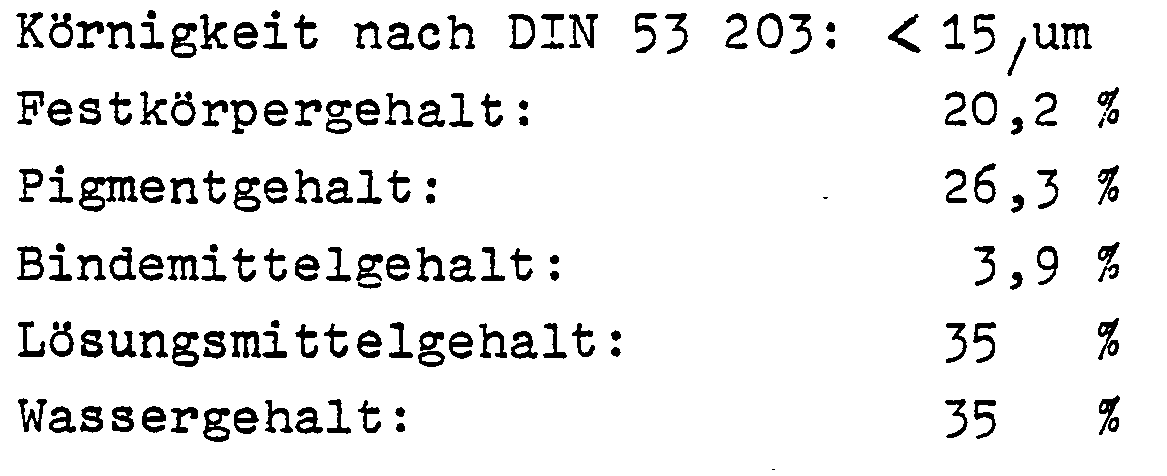
- In einer Mischung aus 0,7 Teilen des Polymerisats nach Beispiel 1a), 4,6 Teilen Ethylenglykolmonobutylether und 4,8 Teilen Wasser werden 3,6 Teile Kupferphthalocyanin mit einem Schnellrührer angeteigt. Die Mischung wird anschließend zweimal durch eine kontinuierliche Rührwerksmühle geschickt (Durchsatz ca. 8 1/h). Als Mahlkörper werden Stahlkugeln verwendet. Die resultierende Blaupaste ist durch folgende Daten charakterisiert:
- In einer Mischung aus 45 Teilen des Polymerisats nach Beispiel 1a) 199 Teilen Ethylenglykolmonobutylether und 210 Teilen Wasser werden 146 Teile Eisenoxidgelb angeteigt und mit 500 Teilen Glasperlen ca. 1 Stunde lang in einer diskontinuierlichen Rührwerksmühle dispergiert. Nach Abtrennung der Glasperlen wird eine Gelbpaste erhalten, die wie folgt charakterisiert ist:

- In einer Mischung aus 12,1 Teilen des Polymerisats nach 'Beispiel 1a), 55,4 Teilen Ethylenglykolmonobutylether und 116,7 Teilen Wasser werden 65,8 Teile eines handelsüblichen Orangepigments angeteigt und mit 200 g Glasperlen ca. 1 Stunde lang in einer diskontinuierlichen Rührwerksmühle dispergiert. Nach Abtrennen der Glasperlen wird eine Orangepaste erhalten, die wie folgt charakterisiert ist:

- Farbtonpasten
- 100 Teile Blaupaste nach Beispiel 1c) und 31,5 Teile Weißpaste nach Beispiel 1b) werden miteinander verrührt. Die resultierende Blautonpaste zeigt keine Kornvergröberung (Flockulation) und ist wie folgt charakterisiert:

- 45,6 Teile Orangepaste nach Beispiel 1e) 5,4 Teile Weißpaste nach Beispiel 1b) und 20,6 Teile Gelbpaste nach Beispiel 1d) werden miteinander verrührt. Die resultierende Orangepaste zeigt keine Kornvergröberung (Flockulation) und ist wie folgt charakterisiert:

- Die im folgenden beschriebenen Auflackungen können unter Berücksichtigung der jeweils gewünschten Pigmentvolumenkonzentrationen mit gutem Erfolg bei allen Pigmentpasten nach den Beispielen 1 und 2 durchgeführt werden. Hier werden jedoch nur einige Beispiele angeführt.
- 200 Teile Weißpaste nach Beispiel 1) werden mit 414,5 Teilen einer Mischung aus 95 Teilen eines handelsüblichen Polyacrylatharzes mit einer Säurezahl von ca. 40 und einem K-Wert nach Fikentscher von ca. 25, 6 Teilen Dimethylethanolamin, 28,5 Teilen eines handelsüblichen methanolveretherten Melaminformaldehydharzes und 285 Teilen Wasser mit einem Schnellrührer eine Minute bei 2000 U/min vermischt.
- Der resultierende Lack ist wie folgt charakterisiert:

- Er wird auf Bleche gerakelt und 30 Minuten bei 150°C eingebrannt. Man erhält hochglänzende Überzüge, deren Eigenschaften denen der direkt pigmentierten Klarlackmischung völlig entsprechen.
- 200 Teile Blautonpaste nach Beispiel 2a) werden mit 946 Teilen einer Mischung aus 256 Teilen eines handelsüblichen gesättigten Polyesters mit einer Säurezahl von ca. 40 und einer OH-Zahl von ca. 90, 16 Teilen Dimethylethanolamin, 77 Teilen eines handelsüblichen methanolveretherten Melaminformaldehydharzes und 597 Teilen Wasser mit Hilfe eines Schnellrührers eine Minute bei 2000 U/min aufgelackt. Der resultierende Lack ist wie folgt charakterisiert:

- Er wird, gegebenenfalls nach Verdünnung mit Wasser, auf Bleche appliziert und 30 Minuten bei 150°C eingebrannt. Die erhaltenen Überzüge sind hochglänzend und zeigen das gleiche Eigenschaftsbild wie eine entsprechende direkt pigmentierte Klarlackmischung.
- 200 Teile Orangetonpaste nach Beispiel 2b) werden mit 703 Teilen einer Mischung aus 215 Teilen eines handelsüblichen kurzöligen Alkydharzes mit einer Säurezahl von ca. 45 und einer OH-Zahl von ca. 60, 15 Teilen Dimethylethanolamin, 65 Teilen eines handelsüblichen methanolveretherten Melaminformaldehydharzes und 408 Teilen Wasser mit Hilfe eines Schnellrührers 1 Minute bei 2000 U/min aufgelackt. Der resultierende Lack ist wie folgt charakterisiert:

Claims (6)
Priority Applications (1)
| Application Number | Priority Date | Filing Date | Title |
|---|---|---|---|
| AT81108071T ATE11422T1 (de) | 1981-06-02 | 1981-10-08 | Waessrige pigmentpasten und deren verwendung. |
Applications Claiming Priority (2)
| Application Number | Priority Date | Filing Date | Title |
|---|---|---|---|
| DE19813121765 DE3121765A1 (de) | 1981-06-02 | 1981-06-02 | Waessrige pigmentpasten und deren verwendung |
| DE3121765 | 1981-06-02 |
Publications (2)
| Publication Number | Publication Date |
|---|---|
| EP0068044A1 true EP0068044A1 (de) | 1983-01-05 |
| EP0068044B1 EP0068044B1 (de) | 1985-01-23 |
Family
ID=6133686
Family Applications (1)
| Application Number | Title | Priority Date | Filing Date |
|---|---|---|---|
| EP81108071A Expired EP0068044B1 (de) | 1981-06-02 | 1981-10-08 | Wässrige Pigmentpasten und deren Verwendung |
Country Status (7)
| Country | Link |
|---|---|
| US (1) | US4388435A (de) |
| EP (1) | EP0068044B1 (de) |
| JP (1) | JPS57200466A (de) |
| AT (1) | ATE11422T1 (de) |
| BR (1) | BR8107480A (de) |
| DE (2) | DE3121765A1 (de) |
| ES (1) | ES507246A0 (de) |
Cited By (2)
| Publication number | Priority date | Publication date | Assignee | Title |
|---|---|---|---|---|
| EP0343796A3 (de) * | 1988-05-27 | 1991-04-24 | Minnesota Mining And Manufacturing Company | Pigment-Dispersionen |
| EP0507202A1 (de) * | 1991-04-05 | 1992-10-07 | Chemische Werke Kluthe GmbH | Universalfarbpaste |
Families Citing this family (24)
| Publication number | Priority date | Publication date | Assignee | Title |
|---|---|---|---|---|
| DE3311513A1 (de) * | 1983-03-30 | 1984-10-04 | Basf Farben + Fasern Ag, 2000 Hamburg | Hitzehaertbare ueberzugsmittel und ihre verwendung |
| DE3311514A1 (de) * | 1983-03-30 | 1984-10-25 | Basf Farben + Fasern Ag, 2000 Hamburg | Herstellung von harnstoffkondensationprodukten und deren verwendung |
| DE3311517A1 (de) * | 1983-03-30 | 1984-10-04 | Basf Farben + Fasern Ag, 2000 Hamburg | In der hitze selbstvernetzende lackbindemittel, ihre herstellung und verwendung |
| US4632961A (en) * | 1983-08-09 | 1986-12-30 | Nippon Paint Co., Ltd. | Colored base composition and paint composition containing the same |
| JPS6060169A (ja) * | 1983-09-12 | 1985-04-06 | Dainippon Toryo Co Ltd | カチオン型電着塗料組成物 |
| DE3333073A1 (de) * | 1983-09-14 | 1985-03-21 | Herberts Gmbh, 5600 Wuppertal | Verfahren zur herstellung von lagerfaehigen konzentraten und deren verwendung zur herstellung von ueberzugsmitteln |
| JPS6086171A (ja) * | 1983-10-17 | 1985-05-15 | Kansai Paint Co Ltd | 水性顔料分散液 |
| JPS6092360A (ja) * | 1983-10-27 | 1985-05-23 | Kansai Paint Co Ltd | 水性顔料分散液 |
| DK467285D0 (da) * | 1985-10-11 | 1985-10-11 | Koege Kemisk Vaerk | Fremgangsmaade til fremstilling af en organisk pigmentdispersion |
| US5037476A (en) * | 1987-01-20 | 1991-08-06 | At&T Bell Laboratories | Process for improving photostability of titanium dioxide pigments in binder compositions without decreasing reflectivity |
| FI904862A7 (fi) * | 1989-10-09 | 1991-04-10 | Sumitomo Electric Industries | Vedenkestävä optinen kuitukaapeli |
| EP0466646B1 (de) * | 1990-07-11 | 1996-08-28 | Ciba-Geigy Ag | Verfahren zum verzugsfreien Pigmentieren von Polyolefinen |
| DE4204610A1 (de) * | 1992-02-15 | 1993-08-19 | Herberts Gmbh | Verfahren zur herstellung von spachtelmassen und verwendung der erhaltenen spachtelmassen |
| US5523340A (en) * | 1995-01-23 | 1996-06-04 | Industrial Technology Research Institute | Anionic electrodepositable coating composition for pigment dispersed color filter |
| US6132581A (en) * | 1999-04-22 | 2000-10-17 | Ppg Industries Ohio, Inc. | Electrocoating compositions containing polyvinylpyrrolidone crater control agents |
| US7875655B2 (en) | 2006-01-20 | 2011-01-25 | Material Innovations, Llc | Carpet waste composite |
| EP2114648B1 (de) * | 2006-11-22 | 2014-09-03 | Material Innovations, LLC | Holz-kunststoff-zusammensetzungen mit wiederverwerteten teppichresten sowie verfahren zur herstellung |
| DE102008022464A1 (de) * | 2008-05-07 | 2009-11-12 | Basf Coatings Ag | Kathodischer Elektrotauchlack enthaltend Vinylpyrrolidon-Copolymer |
| US20100021753A1 (en) * | 2008-07-25 | 2010-01-28 | E. I. Du Pont De Nemours And Company | Multizone wood polymer composite article |
| CN102307723B (zh) | 2008-12-19 | 2014-06-04 | 纤维复合有限责任公司 | 利用离聚物面料的木塑复合物及其制造方法 |
| KR102584869B1 (ko) | 2015-02-10 | 2023-10-06 | 에스더블유아이엠씨 엘엘씨 | 신규 전착 시스템 |
| ES3062460T3 (en) | 2019-12-20 | 2026-04-10 | Ppg Ind Ohio Inc | Electrodepositable coating composition including a phyllosilicate pigment and a dispersing agent |
| US12172421B2 (en) | 2020-11-18 | 2024-12-24 | Rise Building Products Llc | Composite building materials and methods of manufacture |
| US11572646B2 (en) | 2020-11-18 | 2023-02-07 | Material Innovations Llc | Composite building materials and methods of manufacture |
Citations (3)
| Publication number | Priority date | Publication date | Assignee | Title |
|---|---|---|---|---|
| US3492253A (en) * | 1966-07-06 | 1970-01-27 | Gaf Corp | Pigment compositions of alkylated polymers of heterocyclic n-vinyl monomers and use of same with oleoresinous vehicles |
| EP0034771A1 (de) * | 1980-02-22 | 1981-09-02 | Rohner AG Pratteln | Hochkonzentrierte, lagerstabile und wärmebeständige, fliessfähige, wässrige Dispersion von in Wasser schwer- bis unlöslichen Wirksubstanzen, Verfahren zur Herstellung der Dispersion, Verfahren zum Veredeln von Kunststoffen, Papier oder Textilien sowie veredelte Kunststoffe, veredeltes Papier oder veredelte Textilien |
| EP0052224A2 (de) * | 1980-11-19 | 1982-05-26 | BASF Aktiengesellschaft | Pigmentpasten und deren Verwendung |
Family Cites Families (2)
| Publication number | Priority date | Publication date | Assignee | Title |
|---|---|---|---|---|
| DE1275029B (de) | 1963-04-03 | 1968-08-14 | Basf Ag | Verfahren zur Herstellung von Drucken auf Fasermaterial |
| US3356627A (en) * | 1963-06-17 | 1967-12-05 | Rohm & Haas | Aqueous blends of two water-insoluble polymers, one of which has 1 to 15% of a monomer containing an alcoholic hydroxyl, amino, amido or ureido group |
-
1981
- 1981-06-02 DE DE19813121765 patent/DE3121765A1/de not_active Withdrawn
- 1981-10-08 AT AT81108071T patent/ATE11422T1/de not_active IP Right Cessation
- 1981-10-08 DE DE8181108071T patent/DE3168516D1/de not_active Expired
- 1981-10-08 EP EP81108071A patent/EP0068044B1/de not_active Expired
- 1981-11-10 US US06/320,020 patent/US4388435A/en not_active Expired - Fee Related
- 1981-11-18 BR BR8107480A patent/BR8107480A/pt unknown
- 1981-11-18 ES ES507246A patent/ES507246A0/es active Granted
- 1981-11-18 JP JP56183916A patent/JPS57200466A/ja active Pending
Patent Citations (3)
| Publication number | Priority date | Publication date | Assignee | Title |
|---|---|---|---|---|
| US3492253A (en) * | 1966-07-06 | 1970-01-27 | Gaf Corp | Pigment compositions of alkylated polymers of heterocyclic n-vinyl monomers and use of same with oleoresinous vehicles |
| EP0034771A1 (de) * | 1980-02-22 | 1981-09-02 | Rohner AG Pratteln | Hochkonzentrierte, lagerstabile und wärmebeständige, fliessfähige, wässrige Dispersion von in Wasser schwer- bis unlöslichen Wirksubstanzen, Verfahren zur Herstellung der Dispersion, Verfahren zum Veredeln von Kunststoffen, Papier oder Textilien sowie veredelte Kunststoffe, veredeltes Papier oder veredelte Textilien |
| EP0052224A2 (de) * | 1980-11-19 | 1982-05-26 | BASF Aktiengesellschaft | Pigmentpasten und deren Verwendung |
Cited By (2)
| Publication number | Priority date | Publication date | Assignee | Title |
|---|---|---|---|---|
| EP0343796A3 (de) * | 1988-05-27 | 1991-04-24 | Minnesota Mining And Manufacturing Company | Pigment-Dispersionen |
| EP0507202A1 (de) * | 1991-04-05 | 1992-10-07 | Chemische Werke Kluthe GmbH | Universalfarbpaste |
Also Published As
| Publication number | Publication date |
|---|---|
| ATE11422T1 (de) | 1985-02-15 |
| DE3168516D1 (en) | 1985-03-07 |
| ES8305399A1 (es) | 1983-04-01 |
| JPS57200466A (en) | 1982-12-08 |
| EP0068044B1 (de) | 1985-01-23 |
| US4388435A (en) | 1983-06-14 |
| ES507246A0 (es) | 1983-04-01 |
| BR8107480A (pt) | 1983-04-12 |
| DE3121765A1 (de) | 1982-12-16 |
Similar Documents
| Publication | Publication Date | Title |
|---|---|---|
| EP0068044B1 (de) | Wässrige Pigmentpasten und deren Verwendung | |
| EP0052224B1 (de) | Pigmentpasten und deren Verwendung | |
| EP1026178B1 (de) | Aminoxidgruppen enthaltende Maleinsäureanhydrid-Copolymere und ihre Verwendung als Dispergiermittel für Pigmente oder Füllstoffe | |
| EP2125909B1 (de) | Kamm(block)copolymere | |
| DE69105818T2 (de) | Wässerige Überzugszusammensetzung. | |
| EP0260456B1 (de) | Pigmentdispersion und deren Verwendung | |
| EP0195931A1 (de) | Wasserverdünnbare Überzugsmittel zur Herstellung von Basisschichten bei Zweischichtlackierung | |
| DE19836253C1 (de) | Endfunktionalisierte Polymethacrylsäureester und deren Verwendung als Dispergiermittel zur Herstellung wäßriger Pigmentpasten | |
| EP0418469A1 (de) | Wasserverdünnbarer Nagellack | |
| EP4015588A1 (de) | Verwendung von rhamnolipiden und/oder sophorolipiden in beschichtungszusammensetzungen zur erhaltung eines homogenen farbbildes des trockenen beschichtungsfilms und/oder zur erhöhung der arbeitssicherheit bei der herstellung von beschichtungszusammensetzungen | |
| DE69309863T2 (de) | Mica enthaltende Pigmentzusammensetzung | |
| EP4015584A1 (de) | Verwendung von rhamnolipiden und/oder sophorolipiden zur erhöhung der ergiebigkeit und/oder zur erhaltung der applikationseigenschaften bei lagerung von beschichtungszusammensetzungen | |
| DE69402511T2 (de) | Aluminiumpigmente | |
| DE2308594A1 (de) | Bisazomethinpigment und verfahren zu seiner herstellung | |
| EP0205510B1 (de) | Pulverpigmente mit verbesserten rheologischen eigenschaften, verfahren zu ihrer herstellung und ihre verwendung mit einem gehalt von mindestens 5% unsubstituiertem chinacridon | |
| DE19811791A1 (de) | Wäßrige Dispersionen mit einer speziellen Dispergiermittelkombination | |
| DE2855943B2 (de) | Verfahren zur Herstellung von Pigmentzusammensetzungen und deren Verwendung | |
| DE2934642C2 (de) | ||
| EP0074080B1 (de) | Additionsverbindungen, Verfahren zu ihrer Herstellung und ihre Verwendung | |
| EP1010734A2 (de) | Wässrige metalleffektpigmenthaltige Beschichtungszusammensetzungen | |
| DE10350719A1 (de) | Effektpigmente enthaltende Pigmentpasten, Verfahren zu ihrer Herstellung und ihre Verwendung | |
| EP0436135B1 (de) | Verfahren zur Herstellung von Dibutylzinnoxid enthaltenden Katalysatorpasten und deren Verwendung | |
| EP0347760B1 (de) | Verwendung von wässrigen Kunststoffdispersionen | |
| EP0656402A2 (de) | Pigmentzusammensetzung aus modifiziertem Diketopyrrolopyrrol und Aminoalkylacrylatharz | |
| DE2500865A1 (de) | Trockene, wasserdispergierbare pigmentmassen und verfahren zu ihrer herstellung |
Legal Events
| Date | Code | Title | Description |
|---|---|---|---|
| PUAI | Public reference made under article 153(3) epc to a published international application that has entered the european phase |
Free format text: ORIGINAL CODE: 0009012 |
|
| 17P | Request for examination filed |
Effective date: 19811008 |
|
| AK | Designated contracting states |
Designated state(s): AT CH DE FR GB LI |
|
| GRAA | (expected) grant |
Free format text: ORIGINAL CODE: 0009210 |
|
| AK | Designated contracting states |
Designated state(s): AT CH DE FR GB LI |
|
| REF | Corresponds to: |
Ref document number: 11422 Country of ref document: AT Date of ref document: 19850215 Kind code of ref document: T |
|
| REF | Corresponds to: |
Ref document number: 3168516 Country of ref document: DE Date of ref document: 19850307 |
|
| ET | Fr: translation filed | ||
| PGFP | Annual fee paid to national office [announced via postgrant information from national office to epo] |
Ref country code: AT Payment date: 19850923 Year of fee payment: 5 |
|
| PLBE | No opposition filed within time limit |
Free format text: ORIGINAL CODE: 0009261 |
|
| STAA | Information on the status of an ep patent application or granted ep patent |
Free format text: STATUS: NO OPPOSITION FILED WITHIN TIME LIMIT |
|
| 26N | No opposition filed | ||
| PG25 | Lapsed in a contracting state [announced via postgrant information from national office to epo] |
Ref country code: AT Effective date: 19861008 |
|
| PG25 | Lapsed in a contracting state [announced via postgrant information from national office to epo] |
Ref country code: DE Effective date: 19861016 |
|
| PG25 | Lapsed in a contracting state [announced via postgrant information from national office to epo] |
Ref country code: LI Effective date: 19861031 Ref country code: CH Effective date: 19861031 |
|
| PG25 | Lapsed in a contracting state [announced via postgrant information from national office to epo] |
Ref country code: FR Free format text: LAPSE BECAUSE OF NON-PAYMENT OF DUE FEES Effective date: 19870630 |
|
| REG | Reference to a national code |
Ref country code: CH Ref legal event code: PL |
|
| GBPC | Gb: european patent ceased through non-payment of renewal fee | ||
| REG | Reference to a national code |
Ref country code: FR Ref legal event code: ST |
|
| PG25 | Lapsed in a contracting state [announced via postgrant information from national office to epo] |
Ref country code: GB Effective date: 19881121 |