EP0068603B1 - Catalyseur à base de silice amorphe et procédé pour sa préparation - Google Patents
Catalyseur à base de silice amorphe et procédé pour sa préparation Download PDFInfo
- Publication number
- EP0068603B1 EP0068603B1 EP82302012A EP82302012A EP0068603B1 EP 0068603 B1 EP0068603 B1 EP 0068603B1 EP 82302012 A EP82302012 A EP 82302012A EP 82302012 A EP82302012 A EP 82302012A EP 0068603 B1 EP0068603 B1 EP 0068603B1
- Authority
- EP
- European Patent Office
- Prior art keywords
- catalyst
- silica
- monolayer
- synthesis gas
- compound
- Prior art date
- Legal status (The legal status is an assumption and is not a legal conclusion. Google has not performed a legal analysis and makes no representation as to the accuracy of the status listed.)
- Expired
Links
- VYPSYNLAJGMNEJ-UHFFFAOYSA-N Silicium dioxide Chemical compound O=[Si]=O VYPSYNLAJGMNEJ-UHFFFAOYSA-N 0.000 title claims description 69
- 239000003054 catalyst Substances 0.000 title claims description 68
- 238000000034 method Methods 0.000 title claims description 16
- 238000004519 manufacturing process Methods 0.000 title claims description 4
- OKKJLVBELUTLKV-UHFFFAOYSA-N Methanol Chemical compound OC OKKJLVBELUTLKV-UHFFFAOYSA-N 0.000 claims description 54
- 239000011148 porous material Substances 0.000 claims description 31
- 239000000377 silicon dioxide Substances 0.000 claims description 29
- 230000015572 biosynthetic process Effects 0.000 claims description 23
- 238000003786 synthesis reaction Methods 0.000 claims description 23
- 238000006243 chemical reaction Methods 0.000 claims description 22
- 229910052751 metal Inorganic materials 0.000 claims description 21
- 239000002184 metal Substances 0.000 claims description 21
- 239000002356 single layer Substances 0.000 claims description 19
- 229930195733 hydrocarbon Natural products 0.000 claims description 17
- 150000002430 hydrocarbons Chemical class 0.000 claims description 17
- 239000011159 matrix material Substances 0.000 claims description 17
- 150000001875 compounds Chemical class 0.000 claims description 16
- XUIMIQQOPSSXEZ-UHFFFAOYSA-N Silicon Chemical group [Si] XUIMIQQOPSSXEZ-UHFFFAOYSA-N 0.000 claims description 7
- 239000004411 aluminium Substances 0.000 claims description 6
- 229910052782 aluminium Inorganic materials 0.000 claims description 6
- XAGFODPZIPBFFR-UHFFFAOYSA-N aluminium Chemical compound [Al] XAGFODPZIPBFFR-UHFFFAOYSA-N 0.000 claims description 6
- 239000002904 solvent Substances 0.000 claims description 6
- HCHKCACWOHOZIP-UHFFFAOYSA-N Zinc Chemical compound [Zn] HCHKCACWOHOZIP-UHFFFAOYSA-N 0.000 claims description 5
- 229910052725 zinc Inorganic materials 0.000 claims description 5
- 239000011701 zinc Substances 0.000 claims description 5
- RTAQQCXQSZGOHL-UHFFFAOYSA-N Titanium Chemical compound [Ti] RTAQQCXQSZGOHL-UHFFFAOYSA-N 0.000 claims description 3
- 239000010410 layer Substances 0.000 claims description 3
- 239000010936 titanium Substances 0.000 claims description 3
- 229910052719 titanium Inorganic materials 0.000 claims description 3
- FYYHWMGAXLPEAU-UHFFFAOYSA-N Magnesium Chemical compound [Mg] FYYHWMGAXLPEAU-UHFFFAOYSA-N 0.000 claims description 2
- QCWXUUIWCKQGHC-UHFFFAOYSA-N Zirconium Chemical compound [Zr] QCWXUUIWCKQGHC-UHFFFAOYSA-N 0.000 claims description 2
- 150000004703 alkoxides Chemical class 0.000 claims description 2
- 150000004820 halides Chemical class 0.000 claims description 2
- 229910052749 magnesium Inorganic materials 0.000 claims description 2
- 239000011777 magnesium Substances 0.000 claims description 2
- 239000002344 surface layer Substances 0.000 claims description 2
- 229910052726 zirconium Inorganic materials 0.000 claims description 2
- 239000007789 gas Substances 0.000 description 19
- 239000011324 bead Substances 0.000 description 16
- 239000000203 mixture Substances 0.000 description 7
- XLYOFNOQVPJJNP-UHFFFAOYSA-N water Substances O XLYOFNOQVPJJNP-UHFFFAOYSA-N 0.000 description 7
- VLKZOEOYAKHREP-UHFFFAOYSA-N n-Hexane Chemical compound CCCCCC VLKZOEOYAKHREP-UHFFFAOYSA-N 0.000 description 6
- -1 transition metal cations Chemical class 0.000 description 6
- VXEGSRKPIUDPQT-UHFFFAOYSA-N 4-[4-(4-methoxyphenyl)piperazin-1-yl]aniline Chemical compound C1=CC(OC)=CC=C1N1CCN(C=2C=CC(N)=CC=2)CC1 VXEGSRKPIUDPQT-UHFFFAOYSA-N 0.000 description 5
- 239000005049 silicon tetrachloride Substances 0.000 description 5
- IJGRMHOSHXDMSA-UHFFFAOYSA-N Atomic nitrogen Chemical compound N#N IJGRMHOSHXDMSA-UHFFFAOYSA-N 0.000 description 4
- LFQSCWFLJHTTHZ-UHFFFAOYSA-N Ethanol Chemical compound CCO LFQSCWFLJHTTHZ-UHFFFAOYSA-N 0.000 description 4
- 230000003197 catalytic effect Effects 0.000 description 4
- 150000001768 cations Chemical class 0.000 description 4
- 238000010438 heat treatment Methods 0.000 description 4
- 125000002887 hydroxy group Chemical group [H]O* 0.000 description 4
- 239000007788 liquid Substances 0.000 description 4
- FIPWRIJSWJWJAI-UHFFFAOYSA-N Butyl carbitol 6-propylpiperonyl ether Chemical group C1=C(CCC)C(COCCOCCOCCCC)=CC2=C1OCO2 FIPWRIJSWJWJAI-UHFFFAOYSA-N 0.000 description 3
- 150000001335 aliphatic alkanes Chemical class 0.000 description 3
- 239000003921 oil Substances 0.000 description 3
- 238000002360 preparation method Methods 0.000 description 3
- 239000000741 silica gel Substances 0.000 description 3
- 229910002027 silica gel Inorganic materials 0.000 description 3
- MYWQGROTKMBNKN-UHFFFAOYSA-N tributoxyalumane Chemical compound [Al+3].CCCC[O-].CCCC[O-].CCCC[O-] MYWQGROTKMBNKN-UHFFFAOYSA-N 0.000 description 3
- UGFAIRIUMAVXCW-UHFFFAOYSA-N Carbon monoxide Chemical compound [O+]#[C-] UGFAIRIUMAVXCW-UHFFFAOYSA-N 0.000 description 2
- XEEYBQQBJWHFJM-UHFFFAOYSA-N Iron Chemical compound [Fe] XEEYBQQBJWHFJM-UHFFFAOYSA-N 0.000 description 2
- BTANRVKWQNVYAZ-UHFFFAOYSA-N butan-2-ol Chemical compound CCC(C)O BTANRVKWQNVYAZ-UHFFFAOYSA-N 0.000 description 2
- 229910002091 carbon monoxide Inorganic materials 0.000 description 2
- 239000003245 coal Substances 0.000 description 2
- 238000000151 deposition Methods 0.000 description 2
- WOZVHXUHUFLZGK-UHFFFAOYSA-N dimethyl terephthalate Chemical compound COC(=O)C1=CC=C(C(=O)OC)C=C1 WOZVHXUHUFLZGK-UHFFFAOYSA-N 0.000 description 2
- 238000009826 distribution Methods 0.000 description 2
- SQNZJJAZBFDUTD-UHFFFAOYSA-N durene Chemical compound CC1=CC(C)=C(C)C=C1C SQNZJJAZBFDUTD-UHFFFAOYSA-N 0.000 description 2
- 239000000499 gel Substances 0.000 description 2
- 230000007062 hydrolysis Effects 0.000 description 2
- 238000006460 hydrolysis reaction Methods 0.000 description 2
- 230000003301 hydrolyzing effect Effects 0.000 description 2
- 239000000543 intermediate Substances 0.000 description 2
- 229910052747 lanthanoid Inorganic materials 0.000 description 2
- 150000002739 metals Chemical class 0.000 description 2
- 229910052757 nitrogen Inorganic materials 0.000 description 2
- 239000002245 particle Substances 0.000 description 2
- 229960005235 piperonyl butoxide Drugs 0.000 description 2
- 229910052723 transition metal Inorganic materials 0.000 description 2
- VEXZGXHMUGYJMC-UHFFFAOYSA-M Chloride anion Chemical compound [Cl-] VEXZGXHMUGYJMC-UHFFFAOYSA-M 0.000 description 1
- VYZAMTAEIAYCRO-UHFFFAOYSA-N Chromium Chemical compound [Cr] VYZAMTAEIAYCRO-UHFFFAOYSA-N 0.000 description 1
- 239000005749 Copper compound Substances 0.000 description 1
- UFHFLCQGNIYNRP-UHFFFAOYSA-N Hydrogen Chemical compound [H][H] UFHFLCQGNIYNRP-UHFFFAOYSA-N 0.000 description 1
- KJTLSVCANCCWHF-UHFFFAOYSA-N Ruthenium Chemical compound [Ru] KJTLSVCANCCWHF-UHFFFAOYSA-N 0.000 description 1
- 239000002253 acid Substances 0.000 description 1
- 150000001298 alcohols Chemical class 0.000 description 1
- 150000001399 aluminium compounds Chemical class 0.000 description 1
- PNEYBMLMFCGWSK-UHFFFAOYSA-N aluminium oxide Inorganic materials [O-2].[O-2].[O-2].[Al+3].[Al+3] PNEYBMLMFCGWSK-UHFFFAOYSA-N 0.000 description 1
- 238000004458 analytical method Methods 0.000 description 1
- 125000000129 anionic group Chemical group 0.000 description 1
- 150000004945 aromatic hydrocarbons Chemical class 0.000 description 1
- 125000003118 aryl group Chemical group 0.000 description 1
- 125000004429 atom Chemical group 0.000 description 1
- QVGXLLKOCUKJST-UHFFFAOYSA-N atomic oxygen Chemical compound [O] QVGXLLKOCUKJST-UHFFFAOYSA-N 0.000 description 1
- 150000001555 benzenes Chemical class 0.000 description 1
- 238000009835 boiling Methods 0.000 description 1
- 238000006555 catalytic reaction Methods 0.000 description 1
- 239000012501 chromatography medium Substances 0.000 description 1
- 229910052804 chromium Inorganic materials 0.000 description 1
- 239000011651 chromium Substances 0.000 description 1
- 150000001880 copper compounds Chemical class 0.000 description 1
- 239000012153 distilled water Substances 0.000 description 1
- 238000001035 drying Methods 0.000 description 1
- 230000032050 esterification Effects 0.000 description 1
- 238000005886 esterification reaction Methods 0.000 description 1
- 238000001704 evaporation Methods 0.000 description 1
- 230000008020 evaporation Effects 0.000 description 1
- 238000002474 experimental method Methods 0.000 description 1
- 239000011521 glass Substances 0.000 description 1
- 239000001257 hydrogen Substances 0.000 description 1
- 229910052739 hydrogen Inorganic materials 0.000 description 1
- 238000011065 in-situ storage Methods 0.000 description 1
- 229910052742 iron Inorganic materials 0.000 description 1
- 238000002156 mixing Methods 0.000 description 1
- 230000007935 neutral effect Effects 0.000 description 1
- 239000001301 oxygen Substances 0.000 description 1
- 229910052760 oxygen Inorganic materials 0.000 description 1
- 125000004430 oxygen atom Chemical group O* 0.000 description 1
- 239000005373 porous glass Substances 0.000 description 1
- 229910052707 ruthenium Inorganic materials 0.000 description 1
- 229920006395 saturated elastomer Polymers 0.000 description 1
- 229910052710 silicon Inorganic materials 0.000 description 1
- 239000010703 silicon Substances 0.000 description 1
- 150000003377 silicon compounds Chemical class 0.000 description 1
- 239000007858 starting material Substances 0.000 description 1
- 150000003606 tin compounds Chemical class 0.000 description 1
- 150000003624 transition metals Chemical class 0.000 description 1
Images
Classifications
-
- C—CHEMISTRY; METALLURGY
- C07—ORGANIC CHEMISTRY
- C07C—ACYCLIC OR CARBOCYCLIC COMPOUNDS
- C07C1/00—Preparation of hydrocarbons from one or more compounds, none of them being a hydrocarbon
- C07C1/20—Preparation of hydrocarbons from one or more compounds, none of them being a hydrocarbon starting from organic compounds containing only oxygen atoms as heteroatoms
-
- B—PERFORMING OPERATIONS; TRANSPORTING
- B01—PHYSICAL OR CHEMICAL PROCESSES OR APPARATUS IN GENERAL
- B01J—CHEMICAL OR PHYSICAL PROCESSES, e.g. CATALYSIS OR COLLOID CHEMISTRY; THEIR RELEVANT APPARATUS
- B01J21/00—Catalysts comprising the elements, oxides, or hydroxides of magnesium, boron, aluminium, carbon, silicon, titanium, zirconium, or hafnium
- B01J21/12—Silica and alumina
-
- B—PERFORMING OPERATIONS; TRANSPORTING
- B01—PHYSICAL OR CHEMICAL PROCESSES OR APPARATUS IN GENERAL
- B01J—CHEMICAL OR PHYSICAL PROCESSES, e.g. CATALYSIS OR COLLOID CHEMISTRY; THEIR RELEVANT APPARATUS
- B01J21/00—Catalysts comprising the elements, oxides, or hydroxides of magnesium, boron, aluminium, carbon, silicon, titanium, zirconium, or hafnium
- B01J21/14—Silica and magnesia
-
- B—PERFORMING OPERATIONS; TRANSPORTING
- B01—PHYSICAL OR CHEMICAL PROCESSES OR APPARATUS IN GENERAL
- B01J—CHEMICAL OR PHYSICAL PROCESSES, e.g. CATALYSIS OR COLLOID CHEMISTRY; THEIR RELEVANT APPARATUS
- B01J23/00—Catalysts comprising metals or metal oxides or hydroxides, not provided for in group B01J21/00
- B01J23/06—Catalysts comprising metals or metal oxides or hydroxides, not provided for in group B01J21/00 of zinc, cadmium or mercury
-
- B—PERFORMING OPERATIONS; TRANSPORTING
- B01—PHYSICAL OR CHEMICAL PROCESSES OR APPARATUS IN GENERAL
- B01J—CHEMICAL OR PHYSICAL PROCESSES, e.g. CATALYSIS OR COLLOID CHEMISTRY; THEIR RELEVANT APPARATUS
- B01J37/00—Processes, in general, for preparing catalysts; Processes, in general, for activation of catalysts
- B01J37/02—Impregnation, coating or precipitation
- B01J37/0201—Impregnation
- B01J37/0209—Impregnation involving a reaction between the support and a fluid
-
- C—CHEMISTRY; METALLURGY
- C07—ORGANIC CHEMISTRY
- C07C—ACYCLIC OR CARBOCYCLIC COMPOUNDS
- C07C1/00—Preparation of hydrocarbons from one or more compounds, none of them being a hydrocarbon
- C07C1/02—Preparation of hydrocarbons from one or more compounds, none of them being a hydrocarbon from oxides of a carbon
- C07C1/04—Preparation of hydrocarbons from one or more compounds, none of them being a hydrocarbon from oxides of a carbon from carbon monoxide with hydrogen
- C07C1/0425—Catalysts; their physical properties
- C07C1/043—Catalysts; their physical properties characterised by the composition
-
- C—CHEMISTRY; METALLURGY
- C10—PETROLEUM, GAS OR COKE INDUSTRIES; TECHNICAL GASES CONTAINING CARBON MONOXIDE; FUELS; LUBRICANTS; PEAT
- C10G—CRACKING HYDROCARBON OILS; PRODUCTION OF LIQUID HYDROCARBON MIXTURES, e.g. BY DESTRUCTIVE HYDROGENATION, OLIGOMERISATION, POLYMERISATION; RECOVERY OF HYDROCARBON OILS FROM OIL-SHALE, OIL-SAND, OR GASES; REFINING MIXTURES MAINLY CONSISTING OF HYDROCARBONS; REFORMING OF NAPHTHA; MINERAL WAXES
- C10G3/00—Production of liquid hydrocarbon mixtures from oxygen-containing organic materials, e.g. fatty oils, fatty acids
- C10G3/42—Catalytic treatment
- C10G3/44—Catalytic treatment characterised by the catalyst used
- C10G3/48—Catalytic treatment characterised by the catalyst used further characterised by the catalyst support
- C10G3/49—Catalytic treatment characterised by the catalyst used further characterised by the catalyst support containing crystalline aluminosilicates, e.g. molecular sieves
-
- C—CHEMISTRY; METALLURGY
- C07—ORGANIC CHEMISTRY
- C07C—ACYCLIC OR CARBOCYCLIC COMPOUNDS
- C07C2521/00—Catalysts comprising the elements, oxides or hydroxides of magnesium, boron, aluminium, carbon, silicon, titanium, zirconium or hafnium
- C07C2521/02—Boron or aluminium; Oxides or hydroxides thereof
-
- C—CHEMISTRY; METALLURGY
- C07—ORGANIC CHEMISTRY
- C07C—ACYCLIC OR CARBOCYCLIC COMPOUNDS
- C07C2521/00—Catalysts comprising the elements, oxides or hydroxides of magnesium, boron, aluminium, carbon, silicon, titanium, zirconium or hafnium
- C07C2521/06—Silicon, titanium, zirconium or hafnium; Oxides or hydroxides thereof
-
- C—CHEMISTRY; METALLURGY
- C07—ORGANIC CHEMISTRY
- C07C—ACYCLIC OR CARBOCYCLIC COMPOUNDS
- C07C2521/00—Catalysts comprising the elements, oxides or hydroxides of magnesium, boron, aluminium, carbon, silicon, titanium, zirconium or hafnium
- C07C2521/06—Silicon, titanium, zirconium or hafnium; Oxides or hydroxides thereof
- C07C2521/08—Silica
-
- C—CHEMISTRY; METALLURGY
- C07—ORGANIC CHEMISTRY
- C07C—ACYCLIC OR CARBOCYCLIC COMPOUNDS
- C07C2521/00—Catalysts comprising the elements, oxides or hydroxides of magnesium, boron, aluminium, carbon, silicon, titanium, zirconium or hafnium
- C07C2521/10—Magnesium; Oxides or hydroxides thereof
-
- C—CHEMISTRY; METALLURGY
- C07—ORGANIC CHEMISTRY
- C07C—ACYCLIC OR CARBOCYCLIC COMPOUNDS
- C07C2523/00—Catalysts comprising metals or metal oxides or hydroxides, not provided for in group C07C2521/00
- C07C2523/06—Catalysts comprising metals or metal oxides or hydroxides, not provided for in group C07C2521/00 of zinc, cadmium or mercury
-
- C—CHEMISTRY; METALLURGY
- C10—PETROLEUM, GAS OR COKE INDUSTRIES; TECHNICAL GASES CONTAINING CARBON MONOXIDE; FUELS; LUBRICANTS; PEAT
- C10G—CRACKING HYDROCARBON OILS; PRODUCTION OF LIQUID HYDROCARBON MIXTURES, e.g. BY DESTRUCTIVE HYDROGENATION, OLIGOMERISATION, POLYMERISATION; RECOVERY OF HYDROCARBON OILS FROM OIL-SHALE, OIL-SAND, OR GASES; REFINING MIXTURES MAINLY CONSISTING OF HYDROCARBONS; REFORMING OF NAPHTHA; MINERAL WAXES
- C10G2300/00—Aspects relating to hydrocarbon processing covered by groups C10G1/00 - C10G99/00
- C10G2300/10—Feedstock materials
- C10G2300/1022—Fischer-Tropsch products
-
- C—CHEMISTRY; METALLURGY
- C10—PETROLEUM, GAS OR COKE INDUSTRIES; TECHNICAL GASES CONTAINING CARBON MONOXIDE; FUELS; LUBRICANTS; PEAT
- C10G—CRACKING HYDROCARBON OILS; PRODUCTION OF LIQUID HYDROCARBON MIXTURES, e.g. BY DESTRUCTIVE HYDROGENATION, OLIGOMERISATION, POLYMERISATION; RECOVERY OF HYDROCARBON OILS FROM OIL-SHALE, OIL-SAND, OR GASES; REFINING MIXTURES MAINLY CONSISTING OF HYDROCARBONS; REFORMING OF NAPHTHA; MINERAL WAXES
- C10G2300/00—Aspects relating to hydrocarbon processing covered by groups C10G1/00 - C10G99/00
- C10G2300/40—Characteristics of the process deviating from typical ways of processing
- C10G2300/4006—Temperature
-
- C—CHEMISTRY; METALLURGY
- C10—PETROLEUM, GAS OR COKE INDUSTRIES; TECHNICAL GASES CONTAINING CARBON MONOXIDE; FUELS; LUBRICANTS; PEAT
- C10G—CRACKING HYDROCARBON OILS; PRODUCTION OF LIQUID HYDROCARBON MIXTURES, e.g. BY DESTRUCTIVE HYDROGENATION, OLIGOMERISATION, POLYMERISATION; RECOVERY OF HYDROCARBON OILS FROM OIL-SHALE, OIL-SAND, OR GASES; REFINING MIXTURES MAINLY CONSISTING OF HYDROCARBONS; REFORMING OF NAPHTHA; MINERAL WAXES
- C10G2300/00—Aspects relating to hydrocarbon processing covered by groups C10G1/00 - C10G99/00
- C10G2300/40—Characteristics of the process deviating from typical ways of processing
- C10G2300/4018—Spatial velocity, e.g. LHSV, WHSV
-
- Y—GENERAL TAGGING OF NEW TECHNOLOGICAL DEVELOPMENTS; GENERAL TAGGING OF CROSS-SECTIONAL TECHNOLOGIES SPANNING OVER SEVERAL SECTIONS OF THE IPC; TECHNICAL SUBJECTS COVERED BY FORMER USPC CROSS-REFERENCE ART COLLECTIONS [XRACs] AND DIGESTS
- Y02—TECHNOLOGIES OR APPLICATIONS FOR MITIGATION OR ADAPTATION AGAINST CLIMATE CHANGE
- Y02P—CLIMATE CHANGE MITIGATION TECHNOLOGIES IN THE PRODUCTION OR PROCESSING OF GOODS
- Y02P20/00—Technologies relating to chemical industry
- Y02P20/50—Improvements relating to the production of bulk chemicals
- Y02P20/52—Improvements relating to the production of bulk chemicals using catalysts, e.g. selective catalysts
-
- Y—GENERAL TAGGING OF NEW TECHNOLOGICAL DEVELOPMENTS; GENERAL TAGGING OF CROSS-SECTIONAL TECHNOLOGIES SPANNING OVER SEVERAL SECTIONS OF THE IPC; TECHNICAL SUBJECTS COVERED BY FORMER USPC CROSS-REFERENCE ART COLLECTIONS [XRACs] AND DIGESTS
- Y02—TECHNOLOGIES OR APPLICATIONS FOR MITIGATION OR ADAPTATION AGAINST CLIMATE CHANGE
- Y02P—CLIMATE CHANGE MITIGATION TECHNOLOGIES IN THE PRODUCTION OR PROCESSING OF GOODS
- Y02P30/00—Technologies relating to oil refining and petrochemical industry
- Y02P30/20—Technologies relating to oil refining and petrochemical industry using bio-feedstock
Definitions
- This invention relates to an amorphous silica based catalyst and to a process for its production.
- the catalyst will find particular but not exclusive use in the conversion of synthesis gas, methanol or ethanol to hydrocarbons.
- coal As the world's reserves of oil are being exhausted, much attention is being focused on the use of coal as a feedstock for the preparation of substitutes for oil-based products.
- Processes are known whereby coal can be treated with steam and oxygen at elevated temperatures to produce synthesis gas, comprising predominantly hydrogen and carbon monoxide.
- Synthesis gas may be converted by known reactions into methanol. It is desirable to be able to convert synthesis gas or methanol into higher hydrocarbons which can be used as starting materials in the preparation of substitutes for oil-based products.
- a catalyst for synthesis gas or methanol conversion comprises a highly porous amorphous silica having a monolayer of an amphoteric metal chemically bonded onto up to 90% of the surface of the silica matrix, the catalyst having a maximum pore diameter of about 1.5 nm.
- the amphoteric metal will have a valence of 2 or 3, the surface of the silica will not be electrically neutral unless balancing ionic species are present.
- the balancing ionic species are protons, although other cations may be used, either alone or in any combination with or without protons. Suitable other cations include transition metal cations, lanthanide cations and ammonium ions.
- the amphoteric metal is aluminium, although metals such as zinc, magnesium, zirconium or titanium may also be used.
- the catalyst may further include a monolayer of hydroxylated silicon atoms deposited on the highly porous amorphous silica. The monolayer of amphoteric metal is then bonded onto the monolayer of silicon atoms. In this way it is possible to alter the maximum pore diameter of the catalyst while retaining the monolayer of amphoteric metal chemically bonded onto the silica matrix.
- Amorphous silicas are known and are usually available in hydroxylated form as silica gels (often known as xerogels). In amorphous silicas the silicon atoms are tetrahedrally co-ordinated in a matrix of oxygen atoms. In xerogel form the surface of the silica is provided predominantly with hydroxyl groups. Amorphous silicas are easily prepared and available in a wide variety of particle sizes and pore diameters. Usually most of the surface area of the gel is constituted by the pore walls. They are generally used as chromatography media and do not exhibit any significant catalytic activity in the conversion of synthesis gas or methanol to hydrocarbons.
- the amphoteric metal atom bonded as a monolayer onto the silica matrix is constrained to adopt tetrahedral co-ordination. Since the metal will be di- or tri-valent, the surface will need to have two or one monovalent cations respectively associated with it in order to balance the electrical charges on the surface. When the cation is a proton, this will give rise to strongly acid sites on the catalyst surface. These are thought to be responsible for the catalytic activity. Since the catalytic activity is thought to be centred on a proton it is likely that the products of catalytic reactions will include aromatic rings and branched chain alkanes formed via carbonium ion intermediates. Although the applicants believe that this is the rationale behind the action of the catalyst, they do not wish to be limited by such explanation.
- the pore diameter of the catalyst determines to a certain extent the product type and distribution. At a maximum pore diameter of about 1.5 nm the pores can accommodate mononuclear polysubstituted aromatics up to about (C 14 ). However, with maximum pore diameter of 0.5 nm the largest molcules which can be accommodated are approximately the size of durene (C,o).
- the catalyst of the present invention should be mixed with a catalyst impregnated with a transition metal, such as iron, to convert the synthesis gas in situ to Fischer-Tropsch type products by reduction of the carbon monoxide.
- a transition metal such as iron
- the second catalyst may be impregnated with zinc and chromium or zinc and copper compounds to convert the synthesis gas to methanol.
- Other second catalysts which may be used to produce suitable intermediates for conversion to hydrocarbons by the catalyst according to the invention include an alumina or silica support impregnated with lanthanide metals such as ruthenium.
- a process for the production of a catalyst for synthesis gas or methanol conversion comprises treating a highly porous amorphous silica with a solution of a hydrolysable compound of an amphoteric metal, removing the solvent to leave a monolayer of the compound on up to 90% of the surface area of the silica matrix, and causing the surface of the silica to react with the compound to produce a catalyst having a monolayer of the amphoteric metal chemically bonded onto up to 90% of the surface of the silica matrix and a maximum pore diameter of about 1.5 nm.
- any parts of the hydrolysable compound which have not reacted with the silica matrix should subsequently be hydrolysed by reaction with water.
- the catalyst may subsequently be heated to dehydrate the surface layer to produce complete reaction of the amphoteric metal with the silica matrix so that anionic sites are created on the surface of the catalyst.
- the compound may be an alkoxide or halide of any one of the metals mentioned above.
- the compound is a chloride or secondary butoxide.
- the solvent may be any relatively low boiling liquid in which the compound may be dissolved without hydrolysis occurring. Suitable liquids include the lower alkanes, and in particular hexane.
- the silica is dried before it is treated with the solution of the hydrolysable compound so that any physically absorbed water thereon is removed before it can react with the compound.
- the highly porous silica has a mean pore diameter of about 2 nm, in which case the presence of the monolayer of chemically bonded amphoteric metal will reduce the pore diameter by the necessary amount. If the silica has a larger pore diameter, or if a smaller pore diameter is required, the process should include the step of depositing one or more layers of silica on the pore surface area. This may be done by depositing a hydrolysable silicon compound such as silicon tetrachloride on the highly porous silica and hydrolysing it to produce the required pore diameter.
- a hydrolysable silicon compound such as silicon tetrachloride
- a mixed catalyst for the conversion of synthesis gas to methanol may be prepared by mixing the catalyst prepared as described above with a suitable second catalyst, for instance, any one of the types of catalyst described above.
- the catalyst according to the invention will be of particular but not exclusive use in the conversion of synthesis gas or methanol into mixtures of branched and aromatic hydrocarbons, although it will also be of use in the conversion of higher alcohols such as ethanol or mixtures thereof into hydrocarbons.
- the catalyst may be used in any of the known catalytic reactors for the conversion of gases or liquids.
- the catalyst may be present as a fixed, moving or fluidised bed.
- Beads (100 g) of a highly porous amorphous silica gel having a mean pore diameter of 2 nm, a pore surface area of 800 m 2 fg, a pore volume of 0.4-cm 3 /g and a particle size of 125 microns were heated at 150°C for two hours in a dry atmosphere to remove any moisture physically absorbed onto the beads. The dried beads were placed under a slight vacuum.
- a solution of aluminium butoxide in dry hexane (40 ml, 1.4 M) was cooled and added to the beads. The mixture was gently shaken. The shaking and vacuum were applied in order to ensure that all air in the pores was removed and that the solution was able to penetrate completely into the pores. After the vacuum was released, the solvent was removed from the beads over a period of about 2 hours by evaporation. The desolvated beads were allowed to stand at room temperature for about 16 hours. During this time it was assumed that the hydroxyl groups on the silica surface reacted with the aluminium compound, hydrolysing some of the aluminium-butoxide groups to form a monolayer of alkoxylated aluminium on the silica surface. Secondary butanol was evolved during the reaction.
- the amount of aluminium secondary butoxide in the solution was selected so that only 50% of the surface area of the silica was covered by alkoxylated aluminium.
- the beads were then added to an excess of water under slight vacuum so that the water penetrated the pores completely.
- the mixture was left to stand at room temperature so that the remaining butoxide groups were hydrolysed to hydroxyl groups.
- the beads were washed free of the secondary butanol formed during the hydrolysis and were dried by heating at 150°C.
- the catalyst thus formed had a maximum pore diameter of 1.5 nm.
- the catalyst was divided into three portions. One portion was not further treated, and the other two portions were heated to 400°C and 500°C respectively.
- a second type of catalyst was prepared from a similar silica gel.
- beads (100 g) of the xerogel were dried at 120°C at a pressure of 10 mm Hg for 4 hours to remove any absorbed surface moisture.
- the beads were allowed to cool under an atmosphere of dry nitrogen.
- an excess of silicon tetrachloride was added to them and the pressure reduced to ensure that the silicon tetrachloride completely filled the pores of the beads.
- the beads saturated with silicon tetrachloride were allowed to stand at room temperature for 24 hours.
- surface hydroxyl groups on the xerogel reacted to hydrolyse at least some of the silicon-chlorine bonds, thereby bonding a monolayer of silicon atoms onto the xerogel surface.
- the hydrated zerogel thus produced was heated at 120° under reduced pressure for 4 hours and at 250°C for a further 4 hours. This produced a treated xerogel having a smaller pore diameter than the original.
- the treated silica gel was then reacted with a solution of aluminium butoxide exactly as described above, and only differed from it in that it produced a catalyst having a maximum pore diameter of 0.5 nm.
- the catalyst was also divided into three portions and was heat treated as described above.
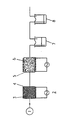
- Methanol was produced from synthesis gas in a reactor 1 and supplied to a heating chamber 2 comprising a bed of non-porous glass beads 3 in an electrically heated container 4.
- the glass beads 3 were maintained at 370°C.
- the heated vapour was passed from the chamber 2 to reaction vessel 5 which contained the catalyst 6.
- the catalyst 6 was maintained at a temperature of 375°C and the vapour was passed through the vessel 5 at a LHSV of 1.
- the products of the reaction were collected in traps 7 and 8 and analysed. Trap 8 was cooled in liquid nitrogen to enable gaseous products to be collected.
- the catalysts prepared above were mixed intimately with a commercially available conventional Fischer-Tropsch catalyst. Each mixture of catalysts was heated to 450°C and synthesis gas was passed through at a LHSV of about 0.3. Significant amounts of hydrocarbons, including aromatics were collected. It was assumed that some paraffinic hydrocarbons were produced from the synthesis gas by the Fischer-Tropsch reaction. However, it was apparent that oxycarbon compounds produced by the Fischer-Tropsch reaction were converted to hydrocarbons by the catalyst according to the invention. Moreover, it appeared that some of the paraffinic hydrocarbons were cyclised by the catalyst according to the invention.
- the present invention provides a novel catalyst which can be used alone to convert methanol and other lower alkanols to hydrocarbons. Moreover, it can be used in combination with other catalysts to convert synthesis gas to hydrocarbons.
Landscapes
- Chemical & Material Sciences (AREA)
- Organic Chemistry (AREA)
- Chemical Kinetics & Catalysis (AREA)
- Engineering & Computer Science (AREA)
- Materials Engineering (AREA)
- Oil, Petroleum & Natural Gas (AREA)
- General Chemical & Material Sciences (AREA)
- Crystallography & Structural Chemistry (AREA)
- Catalysts (AREA)
- Organic Low-Molecular-Weight Compounds And Preparation Thereof (AREA)
- Low-Molecular Organic Synthesis Reactions Using Catalysts (AREA)
Claims (15)
Applications Claiming Priority (2)
| Application Number | Priority Date | Filing Date | Title |
|---|---|---|---|
| GB8118956 | 1981-06-19 | ||
| GB8118956 | 1981-06-19 |
Publications (3)
| Publication Number | Publication Date |
|---|---|
| EP0068603A2 EP0068603A2 (fr) | 1983-01-05 |
| EP0068603A3 EP0068603A3 (en) | 1983-07-20 |
| EP0068603B1 true EP0068603B1 (fr) | 1985-12-04 |
Family
ID=10522652
Family Applications (1)
| Application Number | Title | Priority Date | Filing Date |
|---|---|---|---|
| EP82302012A Expired EP0068603B1 (fr) | 1981-06-19 | 1982-04-20 | Catalyseur à base de silice amorphe et procédé pour sa préparation |
Country Status (9)
| Country | Link |
|---|---|
| EP (1) | EP0068603B1 (fr) |
| JP (1) | JPS586242A (fr) |
| AU (1) | AU551222B2 (fr) |
| BR (1) | BR8203382A (fr) |
| CA (1) | CA1171067A (fr) |
| DE (1) | DE3267754D1 (fr) |
| GB (1) | GB2100710B (fr) |
| NZ (1) | NZ200514A (fr) |
| ZA (1) | ZA822831B (fr) |
Families Citing this family (14)
| Publication number | Priority date | Publication date | Assignee | Title |
|---|---|---|---|---|
| EP0072612B1 (fr) * | 1981-08-18 | 1985-11-27 | Coal Industry (Patents) Limited | Catalyseur à base de silice amorphe et procédé pour sa préparation |
| GB2132595B (en) * | 1982-12-10 | 1986-03-05 | Coal Ind | Modified silica catalysts |
| US4469814A (en) * | 1982-12-10 | 1984-09-04 | Coal Industry (Patents) Limited | Catalysts |
| FR2553430B1 (fr) * | 1983-10-14 | 1986-02-21 | Shell Int Research | Procede pour l'hydro-isomerisation de cires de petrole |
| DE3479429D1 (en) * | 1983-10-14 | 1989-09-21 | Shell Int Research | Hydrocarbon conversion processes and modified refractory oxides which can be used in such processes |
| FR2553302B1 (fr) * | 1983-10-14 | 1986-04-18 | Shell Int Research | Procede pour la preparation d'oxydes refractaires modifies et leur utilisation dans des procedes d'hydroconversion |
| GB2151596B (en) * | 1983-12-09 | 1987-02-18 | Coal Ind | Improvements in catalysts |
| GB8403156D0 (en) * | 1984-02-07 | 1984-03-14 | Coal Industry Patents Ltd | Catalysts |
| ATE84768T1 (de) * | 1985-10-29 | 1993-02-15 | Redco Nv | Aluminiumoxyd enthaltende kieselerdeteilchen, verfahren zu ihrer herstellung und deren verwendung. |
| DE3838710A1 (de) * | 1988-11-15 | 1990-05-17 | Sued Chemie Ag | Katalysator auf der basis von kristallinen alumosilikaten |
| DE4213018C1 (de) * | 1992-04-21 | 1993-12-09 | Degussa | Katalysator zur oxidativen Reinigung der Abgase von Dieselmotoren |
| US6703429B2 (en) * | 2001-08-23 | 2004-03-09 | Chevron U.S.A. Inc. | Process for converting synthesis gas into hydrocarbonaceous products |
| US7019037B2 (en) * | 2001-10-26 | 2006-03-28 | Battelle Memorial Institute | Monolayer coated aerogels and method of making |
| DE102009028653A1 (de) * | 2009-08-19 | 2011-02-24 | Wacker Chemie Ag | Katalysator zur Hydrodechlorierung von Chlorsilanen zu Hydrogensilanen und Verfahren zur Darstellung von Hydrogensilanen mit diesem Katalysator |
Family Cites Families (9)
| Publication number | Priority date | Publication date | Assignee | Title |
|---|---|---|---|---|
| GB1028166A (en) * | 1964-03-06 | 1966-05-04 | British Petroleum Co | Improvements in or relating to catalysts |
| DK132544C (da) * | 1970-01-22 | 1976-05-24 | Shell Int Research | Fremgangsmade til fremstilling af en siliciumdioxid-titanoxid-katalysator der egner sig til fremstilling af oxiranforbindelser ved omsetning af olefinisk umettede carbonhydrider med organiske hydroperoxider |
| US3907709A (en) * | 1972-09-02 | 1975-09-23 | Huels Chemische Werke Ag | Esterification catalysts |
| CA1062285A (fr) * | 1974-04-24 | 1979-09-11 | Mobil Oil Corporation | Conversion de gaz de synthese en melanges d'hydrocarbure |
| US4072733A (en) * | 1976-04-02 | 1978-02-07 | Ethyl Corporation | Conversion of methanol and dimethyl ether |
| NL7613414A (nl) * | 1976-12-02 | 1978-06-06 | Shell Int Research | Behandeling van silica. |
| NL7704656A (nl) * | 1977-04-28 | 1978-10-31 | Shell Int Research | Werkwijze voor de bereiding van koolwaterstoffen. |
| US4283306A (en) * | 1979-04-20 | 1981-08-11 | E. I. Du Pont De Nemours And Company | Crystalline silica and use in alkylation of aromatics |
| GB2075357A (en) * | 1980-05-09 | 1981-11-18 | Coal Industry Patents Ltd | Catalysts for the condensation of oxygenated organic compounds to give hydrocarbons |
-
1982
- 1982-04-20 GB GB08211371A patent/GB2100710B/en not_active Expired
- 1982-04-20 DE DE8282302012T patent/DE3267754D1/de not_active Expired
- 1982-04-20 EP EP82302012A patent/EP0068603B1/fr not_active Expired
- 1982-04-26 ZA ZA822831A patent/ZA822831B/xx unknown
- 1982-04-27 CA CA000401722A patent/CA1171067A/fr not_active Expired
- 1982-05-04 NZ NZ200514A patent/NZ200514A/en unknown
- 1982-06-09 BR BR8203382A patent/BR8203382A/pt unknown
- 1982-06-15 AU AU84867/82A patent/AU551222B2/en not_active Ceased
- 1982-06-16 JP JP57102329A patent/JPS586242A/ja active Pending
Also Published As
| Publication number | Publication date |
|---|---|
| EP0068603A2 (fr) | 1983-01-05 |
| JPS586242A (ja) | 1983-01-13 |
| AU551222B2 (en) | 1986-04-24 |
| BR8203382A (pt) | 1983-05-31 |
| GB2100710B (en) | 1985-01-03 |
| AU8486782A (en) | 1982-12-23 |
| GB2100710A (en) | 1983-01-06 |
| ZA822831B (en) | 1983-02-23 |
| DE3267754D1 (en) | 1986-01-16 |
| EP0068603A3 (en) | 1983-07-20 |
| NZ200514A (en) | 1985-05-31 |
| CA1171067A (fr) | 1984-07-17 |
Similar Documents
| Publication | Publication Date | Title |
|---|---|---|
| EP0068603A2 (fr) | Catalyseur à base de silice amorphe et procédé pour sa préparation | |
| Loupy | Solvent-free reactions | |
| US4465892A (en) | Isomerization of paraffins or olefins with bridged clays | |
| Campelo et al. | Effect of phosphate precursor and organic additives on the structural and catalytic properties of amorphous mesoporous AlPO4 materials | |
| EP1268386B1 (fr) | Procede de ramification d'acides gras satures et/ou insatures et/ou alkyl esters de ceux-ci | |
| JPH0691174A (ja) | 活性化ベータゼオライト触媒及びその異性化プロセス | |
| US5599762A (en) | Use of glycol ether compounds for the production of polyolefin catalysts and supports | |
| US3113980A (en) | Catalysts and process for the selective hydrogenation of acetylenes | |
| CA1209980A (fr) | Supports de catalyse, et conversion d'hydrocarbures a l'aide d'agents de catalyse de meme type | |
| Shen et al. | Alkylation of isobutane/1-butene on methyl-modified Nafion/SBA-15 materials | |
| US4511667A (en) | Composite zeolite-asbestos catalysts | |
| Shah et al. | Tertiary recycling of waste polystyrene using magnesium impregnated catalysts into valuable products | |
| US4427578A (en) | Amorphous silica-based catalyst and process for its production | |
| Adams et al. | Methyl t-butyl ether (MTBE) production: a comparison of montmorillonite-derived catalysts with an ion-exchange resin | |
| JP4468891B2 (ja) | イソロンギホレンの触媒的製造方法 | |
| US4380657A (en) | Conversion of alkanols to ethers | |
| Jazzaa et al. | ON THE NATURE OF THE BONDING IN AND REACTIVITY OF SILICA GEL SUPPORTED PERMANGANATE | |
| JP7803854B2 (ja) | チタン化触媒、チタン化触媒を調製する方法、及びエポキシ化の方法 | |
| EP0112064B1 (fr) | Catalyseur | |
| US4469814A (en) | Catalysts | |
| GB2117366A (en) | Catalyst and method of its preparation | |
| Shen et al. | Alkylation of isobutane/1-butene on methyl-modified nafion/SBA-16 materials | |
| RU2133638C1 (ru) | Способ скелетной изомеризации нормальных олефинов | |
| US4384154A (en) | Conversion of isobutene to aromatics | |
| US4367361A (en) | Alkene oligomerization process |
Legal Events
| Date | Code | Title | Description |
|---|---|---|---|
| PUAI | Public reference made under article 153(3) epc to a published international application that has entered the european phase |
Free format text: ORIGINAL CODE: 0009012 |
|
| AK | Designated contracting states |
Designated state(s): BE DE FR NL SE |
|
| PUAL | Search report despatched |
Free format text: ORIGINAL CODE: 0009013 |
|
| RHK1 | Main classification (correction) |
Ipc: B01J 21/06 |
|
| AK | Designated contracting states |
Designated state(s): BE DE FR NL SE |
|
| 17P | Request for examination filed |
Effective date: 19830614 |
|
| GRAA | (expected) grant |
Free format text: ORIGINAL CODE: 0009210 |
|
| AK | Designated contracting states |
Designated state(s): BE DE FR NL SE |
|
| REF | Corresponds to: |
Ref document number: 3267754 Country of ref document: DE Date of ref document: 19860116 |
|
| ET | Fr: translation filed | ||
| PGFP | Annual fee paid to national office [announced via postgrant information from national office to epo] |
Ref country code: NL Payment date: 19860430 Year of fee payment: 5 |
|
| PLBE | No opposition filed within time limit |
Free format text: ORIGINAL CODE: 0009261 |
|
| STAA | Information on the status of an ep patent application or granted ep patent |
Free format text: STATUS: NO OPPOSITION FILED WITHIN TIME LIMIT |
|
| 26N | No opposition filed | ||
| PG25 | Lapsed in a contracting state [announced via postgrant information from national office to epo] |
Ref country code: SE Effective date: 19870421 |
|
| BERE | Be: lapsed |
Owner name: COAL INDUSTRY (PATENTS) LTD Effective date: 19870430 |
|
| PG25 | Lapsed in a contracting state [announced via postgrant information from national office to epo] |
Ref country code: NL Effective date: 19871101 |
|
| NLV4 | Nl: lapsed or anulled due to non-payment of the annual fee | ||
| PG25 | Lapsed in a contracting state [announced via postgrant information from national office to epo] |
Ref country code: FR Free format text: LAPSE BECAUSE OF NON-PAYMENT OF DUE FEES Effective date: 19871230 |
|
| PG25 | Lapsed in a contracting state [announced via postgrant information from national office to epo] |
Ref country code: DE Effective date: 19880101 |
|
| REG | Reference to a national code |
Ref country code: FR Ref legal event code: ST |
|
| PG25 | Lapsed in a contracting state [announced via postgrant information from national office to epo] |
Ref country code: BE Effective date: 19890430 |
|
| EUG | Se: european patent has lapsed |
Ref document number: 82302012.8 Effective date: 19880906 |