EP0069292A1 - Polymere mit mindestens zwei stabilen und reversibel ineinander umwandelbaren Oxidationsstufen, Verfahren zu ihrer Herstellung und ihre Verwendung - Google Patents
Polymere mit mindestens zwei stabilen und reversibel ineinander umwandelbaren Oxidationsstufen, Verfahren zu ihrer Herstellung und ihre Verwendung Download PDFInfo
- Publication number
- EP0069292A1 EP0069292A1 EP82105599A EP82105599A EP0069292A1 EP 0069292 A1 EP0069292 A1 EP 0069292A1 EP 82105599 A EP82105599 A EP 82105599A EP 82105599 A EP82105599 A EP 82105599A EP 0069292 A1 EP0069292 A1 EP 0069292A1
- Authority
- EP
- European Patent Office
- Prior art keywords
- polymer
- polymers
- alkyl
- general formulas
- alkylene
- Prior art date
- Legal status (The legal status is an assumption and is not a legal conclusion. Google has not performed a legal analysis and makes no representation as to the accuracy of the status listed.)
- Granted
Links
- 229920000642 polymer Polymers 0.000 title claims abstract description 74
- 230000003647 oxidation Effects 0.000 title claims abstract description 15
- 238000007254 oxidation reaction Methods 0.000 title claims abstract description 15
- 238000000034 method Methods 0.000 title claims description 6
- 238000002360 preparation method Methods 0.000 title claims description 4
- 230000008569 process Effects 0.000 title claims description 3
- 238000006243 chemical reaction Methods 0.000 claims abstract description 16
- 238000004870 electrical engineering Methods 0.000 claims abstract description 4
- 229920003023 plastic Polymers 0.000 claims abstract description 3
- 239000004033 plastic Substances 0.000 claims abstract description 3
- 230000005855 radiation Effects 0.000 claims abstract description 3
- 230000002441 reversible effect Effects 0.000 claims abstract description 3
- -1 1,9-disubstituted phenalene Chemical class 0.000 claims description 20
- 125000006833 (C1-C5) alkylene group Chemical group 0.000 claims description 8
- 125000001118 alkylidene group Chemical group 0.000 claims description 8
- 229910052799 carbon Inorganic materials 0.000 claims description 7
- 229910052739 hydrogen Inorganic materials 0.000 claims description 7
- PPBRXRYQALVLMV-UHFFFAOYSA-N Styrene Chemical compound C=CC1=CC=CC=C1 PPBRXRYQALVLMV-UHFFFAOYSA-N 0.000 claims description 6
- 229920001577 copolymer Polymers 0.000 claims description 6
- 125000003118 aryl group Chemical group 0.000 claims description 5
- 229910052736 halogen Inorganic materials 0.000 claims description 5
- 150000002367 halogens Chemical class 0.000 claims description 5
- FPYJFEHAWHCUMM-UHFFFAOYSA-N maleic anhydride Chemical compound O=C1OC(=O)C=C1 FPYJFEHAWHCUMM-UHFFFAOYSA-N 0.000 claims description 5
- 239000002904 solvent Substances 0.000 claims description 5
- 229910052717 sulfur Inorganic materials 0.000 claims description 5
- 229910052711 selenium Inorganic materials 0.000 claims description 4
- 229910052787 antimony Inorganic materials 0.000 claims description 3
- 229910052785 arsenic Inorganic materials 0.000 claims description 3
- 125000003710 aryl alkyl group Chemical group 0.000 claims description 3
- 125000000732 arylene group Chemical group 0.000 claims description 3
- 229910052714 tellurium Inorganic materials 0.000 claims description 3
- 150000001875 compounds Chemical class 0.000 claims description 2
- 125000001140 1,4-phenylene group Chemical group [H]C1=C([H])C([*:2])=C([H])C([H])=C1[*:1] 0.000 claims 1
- 125000000753 cycloalkyl group Chemical group 0.000 claims 1
- 125000004956 cyclohexylene group Chemical group 0.000 claims 1
- 150000002985 phenalenes Chemical class 0.000 abstract description 5
- WYURNTSHIVDZCO-UHFFFAOYSA-N Tetrahydrofuran Chemical compound C1CCOC1 WYURNTSHIVDZCO-UHFFFAOYSA-N 0.000 description 18
- 150000003254 radicals Chemical class 0.000 description 14
- LBSXSAXOLABXMF-UHFFFAOYSA-N 4-Vinylaniline Chemical compound NC1=CC=C(C=C)C=C1 LBSXSAXOLABXMF-UHFFFAOYSA-N 0.000 description 12
- ZMXDDKWLCZADIW-UHFFFAOYSA-N N,N-Dimethylformamide Chemical compound CN(C)C=O ZMXDDKWLCZADIW-UHFFFAOYSA-N 0.000 description 9
- IMNFDUFMRHMDMM-UHFFFAOYSA-N N-Heptane Chemical compound CCCCCCC IMNFDUFMRHMDMM-UHFFFAOYSA-N 0.000 description 9
- 125000001301 ethoxy group Chemical group [H]C([H])([H])C([H])([H])O* 0.000 description 9
- YLQBMQCUIZJEEH-UHFFFAOYSA-N tetrahydrofuran Natural products C=1C=COC=1 YLQBMQCUIZJEEH-UHFFFAOYSA-N 0.000 description 9
- VLKZOEOYAKHREP-UHFFFAOYSA-N n-Hexane Chemical compound CCCCCC VLKZOEOYAKHREP-UHFFFAOYSA-N 0.000 description 8
- 230000008859 change Effects 0.000 description 7
- WEVYAHXRMPXWCK-UHFFFAOYSA-N Acetonitrile Chemical compound CC#N WEVYAHXRMPXWCK-UHFFFAOYSA-N 0.000 description 6
- UWRZIZXBOLBCON-UHFFFAOYSA-N 2-phenylethenamine Chemical compound NC=CC1=CC=CC=C1 UWRZIZXBOLBCON-UHFFFAOYSA-N 0.000 description 5
- RWNKSTSCBHKHTB-UHFFFAOYSA-N Hexachloro-1,3-butadiene Chemical compound ClC(Cl)=C(Cl)C(Cl)=C(Cl)Cl RWNKSTSCBHKHTB-UHFFFAOYSA-N 0.000 description 5
- FHCPAXDKURNIOZ-UHFFFAOYSA-N tetrathiafulvalene Chemical compound S1C=CSC1=C1SC=CS1 FHCPAXDKURNIOZ-UHFFFAOYSA-N 0.000 description 5
- JWZWZPUFIJATRQ-UHFFFAOYSA-N 9-butoxyphenalen-1-one Chemical compound C1=CC=C2C=CC(=O)C3=C2C1=CC=C3OCCCC JWZWZPUFIJATRQ-UHFFFAOYSA-N 0.000 description 4
- YMWUJEATGCHHMB-UHFFFAOYSA-N Dichloromethane Chemical compound ClCCl YMWUJEATGCHHMB-UHFFFAOYSA-N 0.000 description 4
- 125000004106 butoxy group Chemical group [*]OC([H])([H])C([H])([H])C(C([H])([H])[H])([H])[H] 0.000 description 4
- 125000000250 methylamino group Chemical group [H]N(*)C([H])([H])[H] 0.000 description 4
- BASFCYQUMIYNBI-UHFFFAOYSA-N platinum Chemical compound [Pt] BASFCYQUMIYNBI-UHFFFAOYSA-N 0.000 description 4
- 229920002689 polyvinyl acetate Polymers 0.000 description 4
- 239000011118 polyvinyl acetate Substances 0.000 description 4
- 239000000047 product Substances 0.000 description 4
- 125000006527 (C1-C5) alkyl group Chemical group 0.000 description 3
- WSLDOOZREJYCGB-UHFFFAOYSA-N 1,2-Dichloroethane Chemical compound ClCCCl WSLDOOZREJYCGB-UHFFFAOYSA-N 0.000 description 3
- OKKJLVBELUTLKV-UHFFFAOYSA-N Methanol Chemical compound OC OKKJLVBELUTLKV-UHFFFAOYSA-N 0.000 description 3
- 229920002845 Poly(methacrylic acid) Polymers 0.000 description 3
- 125000000484 butyl group Chemical group [H]C([*])([H])C([H])([H])C([H])([H])C([H])([H])[H] 0.000 description 3
- 238000001212 derivatisation Methods 0.000 description 3
- UYMKPFRHYYNDTL-UHFFFAOYSA-N ethenamine Chemical compound NC=C UYMKPFRHYYNDTL-UHFFFAOYSA-N 0.000 description 3
- 125000001495 ethyl group Chemical group [H]C([H])([H])C([H])([H])* 0.000 description 3
- 239000007788 liquid Substances 0.000 description 3
- 125000002496 methyl group Chemical group [H]C([H])([H])* 0.000 description 3
- 239000000203 mixture Substances 0.000 description 3
- 238000003756 stirring Methods 0.000 description 3
- HOVGVQXNLIMLNN-UHFFFAOYSA-N 9-hydroxyphenalen-1-one Chemical compound C1=CC=C2C=CC(=O)C3=C2C1=CC=C3O HOVGVQXNLIMLNN-UHFFFAOYSA-N 0.000 description 2
- DDOQXZFGJIXGPO-UHFFFAOYSA-N 9-methoxyphenalen-1-one Chemical compound C1=CC=C2C=CC(=O)C3=C2C1=CC=C3OC DDOQXZFGJIXGPO-UHFFFAOYSA-N 0.000 description 2
- LFQSCWFLJHTTHZ-UHFFFAOYSA-N Ethanol Chemical compound CCO LFQSCWFLJHTTHZ-UHFFFAOYSA-N 0.000 description 2
- 229920003060 Poly(vinyl benzyl chloride) Polymers 0.000 description 2
- XUIMIQQOPSSXEZ-UHFFFAOYSA-N Silicon Chemical compound [Si] XUIMIQQOPSSXEZ-UHFFFAOYSA-N 0.000 description 2
- 229910021607 Silver chloride Inorganic materials 0.000 description 2
- 238000010521 absorption reaction Methods 0.000 description 2
- 238000002484 cyclic voltammetry Methods 0.000 description 2
- 125000002147 dimethylamino group Chemical group [H]C([H])([H])N(*)C([H])([H])[H] 0.000 description 2
- 230000005518 electrochemistry Effects 0.000 description 2
- 125000001997 phenyl group Chemical group [H]C1=C([H])C([H])=C(*)C([H])=C1[H] 0.000 description 2
- 229910052697 platinum Inorganic materials 0.000 description 2
- 229920002451 polyvinyl alcohol Polymers 0.000 description 2
- 125000001436 propyl group Chemical group [H]C([*])([H])C([H])([H])C([H])([H])[H] 0.000 description 2
- 230000009467 reduction Effects 0.000 description 2
- 229910052710 silicon Inorganic materials 0.000 description 2
- 239000010703 silicon Substances 0.000 description 2
- HKZLPVFGJNLROG-UHFFFAOYSA-M silver monochloride Chemical compound [Cl-].[Ag+] HKZLPVFGJNLROG-UHFFFAOYSA-M 0.000 description 2
- 238000004528 spin coating Methods 0.000 description 2
- ZRZHXNCATOYMJH-UHFFFAOYSA-N 1-(chloromethyl)-4-ethenylbenzene Chemical compound ClCC1=CC=C(C=C)C=C1 ZRZHXNCATOYMJH-UHFFFAOYSA-N 0.000 description 1
- VXNZUUAINFGPBY-UHFFFAOYSA-N 1-Butene Chemical group CCC=C VXNZUUAINFGPBY-UHFFFAOYSA-N 0.000 description 1
- DURPTKYDGMDSBL-UHFFFAOYSA-N 1-butoxybutane Chemical compound CCCCOCCCC DURPTKYDGMDSBL-UHFFFAOYSA-N 0.000 description 1
- IHVMVTBHISOISX-UHFFFAOYSA-N 2-aminophenalen-1-one Chemical compound C1=CC(C(C(N)=C2)=O)=C3C2=CC=CC3=C1 IHVMVTBHISOISX-UHFFFAOYSA-N 0.000 description 1
- CSDSSGBPEUDDEE-UHFFFAOYSA-N 2-formylpyridine Chemical compound O=CC1=CC=CC=N1 CSDSSGBPEUDDEE-UHFFFAOYSA-N 0.000 description 1
- IZSICESBWDKSCB-UHFFFAOYSA-N 4-prop-1-en-2-ylaniline Chemical compound CC(=C)C1=CC=C(N)C=C1 IZSICESBWDKSCB-UHFFFAOYSA-N 0.000 description 1
- JPNIRTQZLVSKFV-UHFFFAOYSA-N 9-aminophenalen-1-one Chemical compound C1=CC=C2C=CC(=O)C3=C2C1=CC=C3N JPNIRTQZLVSKFV-UHFFFAOYSA-N 0.000 description 1
- AFQVVBQMDJGRIG-UHFFFAOYSA-N 9-butylsulfanylphenalen-1-one Chemical compound C1=CC=C2C=CC(=O)C3=C2C1=CC=C3SCCCC AFQVVBQMDJGRIG-UHFFFAOYSA-N 0.000 description 1
- NOWFYBYSAFRIGC-UHFFFAOYSA-N 9-sulfanylphenalen-1-one Chemical compound C1=CC=C2C=CC(=O)C3=C2C1=CC=C3S NOWFYBYSAFRIGC-UHFFFAOYSA-N 0.000 description 1
- 239000004215 Carbon black (E152) Substances 0.000 description 1
- HEDRZPFGACZZDS-UHFFFAOYSA-N Chloroform Chemical compound ClC(Cl)Cl HEDRZPFGACZZDS-UHFFFAOYSA-N 0.000 description 1
- JIGUQPWFLRLWPJ-UHFFFAOYSA-N Ethyl acrylate Chemical compound CCOC(=O)C=C JIGUQPWFLRLWPJ-UHFFFAOYSA-N 0.000 description 1
- VVQNEPGJFQJSBK-UHFFFAOYSA-N Methyl methacrylate Chemical compound COC(=O)C(C)=C VVQNEPGJFQJSBK-UHFFFAOYSA-N 0.000 description 1
- SECXISVLQFMRJM-UHFFFAOYSA-N N-Methylpyrrolidone Chemical compound CN1CCCC1=O SECXISVLQFMRJM-UHFFFAOYSA-N 0.000 description 1
- 229920002125 Sokalan® Polymers 0.000 description 1
- HFBMWMNUJJDEQZ-UHFFFAOYSA-N acryloyl chloride Chemical compound ClC(=O)C=C HFBMWMNUJJDEQZ-UHFFFAOYSA-N 0.000 description 1
- OKOSPWNNXVDXKZ-UHFFFAOYSA-N but-3-enoyl chloride Chemical compound ClC(=O)CC=C OKOSPWNNXVDXKZ-UHFFFAOYSA-N 0.000 description 1
- 239000002738 chelating agent Substances 0.000 description 1
- 239000007795 chemical reaction product Substances 0.000 description 1
- 229960001701 chloroform Drugs 0.000 description 1
- 239000011248 coating agent Substances 0.000 description 1
- 238000000576 coating method Methods 0.000 description 1
- 230000000052 comparative effect Effects 0.000 description 1
- 239000012954 diazonium Substances 0.000 description 1
- 239000000975 dye Substances 0.000 description 1
- 230000000694 effects Effects 0.000 description 1
- 238000007046 ethoxylation reaction Methods 0.000 description 1
- SUPCQIBBMFXVTL-UHFFFAOYSA-N ethyl 2-methylprop-2-enoate Chemical compound CCOC(=O)C(C)=C SUPCQIBBMFXVTL-UHFFFAOYSA-N 0.000 description 1
- 125000000031 ethylamino group Chemical group [H]C([H])([H])C([H])([H])N([H])[*] 0.000 description 1
- 230000002349 favourable effect Effects 0.000 description 1
- 238000001914 filtration Methods 0.000 description 1
- 229930195733 hydrocarbon Natural products 0.000 description 1
- 150000002430 hydrocarbons Chemical class 0.000 description 1
- MCVVUJPXSBQTRZ-ONEGZZNKSA-N methyl (e)-but-2-enoate Chemical compound COC(=O)\C=C\C MCVVUJPXSBQTRZ-ONEGZZNKSA-N 0.000 description 1
- GITITJADGZYSRL-UHFFFAOYSA-N methyl but-3-enoate Chemical compound COC(=O)CC=C GITITJADGZYSRL-UHFFFAOYSA-N 0.000 description 1
- 230000004048 modification Effects 0.000 description 1
- 238000012986 modification Methods 0.000 description 1
- KAEDQVBDSAUNQT-UHFFFAOYSA-N n,n-dibutylbutan-1-amine;perchloric acid Chemical compound [O-]Cl(=O)(=O)=O.CCCC[NH+](CCCC)CCCC KAEDQVBDSAUNQT-UHFFFAOYSA-N 0.000 description 1
- 150000002894 organic compounds Chemical class 0.000 description 1
- NQFOGDIWKQWFMN-UHFFFAOYSA-N phenalene Chemical compound C1=CC([CH]C=C2)=C3C2=CC=CC3=C1 NQFOGDIWKQWFMN-UHFFFAOYSA-N 0.000 description 1
- 229920002800 poly crotonic acid Polymers 0.000 description 1
- 229920000915 polyvinyl chloride Polymers 0.000 description 1
- 239000004800 polyvinyl chloride Substances 0.000 description 1
- 125000002112 pyrrolidino group Chemical group [*]N1C([H])([H])C([H])([H])C([H])([H])C1([H])[H] 0.000 description 1
- 230000001846 repelling effect Effects 0.000 description 1
- 238000001226 reprecipitation Methods 0.000 description 1
- 230000004044 response Effects 0.000 description 1
- 230000000717 retained effect Effects 0.000 description 1
- 150000003839 salts Chemical class 0.000 description 1
- 230000035945 sensitivity Effects 0.000 description 1
- 239000000126 substance Substances 0.000 description 1
- 238000006467 substitution reaction Methods 0.000 description 1
- 230000002194 synthesizing effect Effects 0.000 description 1
Classifications
-
- H—ELECTRICITY
- H01—ELECTRIC ELEMENTS
- H01M—PROCESSES OR MEANS, e.g. BATTERIES, FOR THE DIRECT CONVERSION OF CHEMICAL ENERGY INTO ELECTRICAL ENERGY
- H01M4/00—Electrodes
- H01M4/02—Electrodes composed of, or comprising, active material
- H01M4/36—Selection of substances as active materials, active masses, active liquids
- H01M4/60—Selection of substances as active materials, active masses, active liquids of organic compounds
-
- C—CHEMISTRY; METALLURGY
- C08—ORGANIC MACROMOLECULAR COMPOUNDS; THEIR PREPARATION OR CHEMICAL WORKING-UP; COMPOSITIONS BASED THEREON
- C08F—MACROMOLECULAR COMPOUNDS OBTAINED BY REACTIONS ONLY INVOLVING CARBON-TO-CARBON UNSATURATED BONDS
- C08F8/00—Chemical modification by after-treatment
-
- G—PHYSICS
- G02—OPTICS
- G02F—OPTICAL DEVICES OR ARRANGEMENTS FOR THE CONTROL OF LIGHT BY MODIFICATION OF THE OPTICAL PROPERTIES OF THE MEDIA OF THE ELEMENTS INVOLVED THEREIN; NON-LINEAR OPTICS; FREQUENCY-CHANGING OF LIGHT; OPTICAL LOGIC ELEMENTS; OPTICAL ANALOGUE/DIGITAL CONVERTERS
- G02F1/00—Devices or arrangements for the control of the intensity, colour, phase, polarisation or direction of light arriving from an independent light source, e.g. switching, gating or modulating; Non-linear optics
- G02F1/01—Devices or arrangements for the control of the intensity, colour, phase, polarisation or direction of light arriving from an independent light source, e.g. switching, gating or modulating; Non-linear optics for the control of the intensity, phase, polarisation or colour
- G02F1/15—Devices or arrangements for the control of the intensity, colour, phase, polarisation or direction of light arriving from an independent light source, e.g. switching, gating or modulating; Non-linear optics for the control of the intensity, phase, polarisation or colour based on an electrochromic effect
- G02F1/1514—Devices or arrangements for the control of the intensity, colour, phase, polarisation or direction of light arriving from an independent light source, e.g. switching, gating or modulating; Non-linear optics for the control of the intensity, phase, polarisation or colour based on an electrochromic effect characterised by the electrochromic material, e.g. by the electrodeposited material
- G02F1/1516—Devices or arrangements for the control of the intensity, colour, phase, polarisation or direction of light arriving from an independent light source, e.g. switching, gating or modulating; Non-linear optics for the control of the intensity, phase, polarisation or colour based on an electrochromic effect characterised by the electrochromic material, e.g. by the electrodeposited material comprising organic material
- G02F1/15165—Polymers
-
- H—ELECTRICITY
- H01—ELECTRIC ELEMENTS
- H01B—CABLES; CONDUCTORS; INSULATORS; SELECTION OF MATERIALS FOR THEIR CONDUCTIVE, INSULATING OR DIELECTRIC PROPERTIES
- H01B1/00—Conductors or conductive bodies characterised by the conductive materials; Selection of materials as conductors
- H01B1/06—Conductors or conductive bodies characterised by the conductive materials; Selection of materials as conductors mainly consisting of other non-metallic substances
- H01B1/12—Conductors or conductive bodies characterised by the conductive materials; Selection of materials as conductors mainly consisting of other non-metallic substances organic substances
- H01B1/124—Intrinsically conductive polymers
-
- H—ELECTRICITY
- H10—SEMICONDUCTOR DEVICES; ELECTRIC SOLID-STATE DEVICES NOT OTHERWISE PROVIDED FOR
- H10K—ORGANIC ELECTRIC SOLID-STATE DEVICES
- H10K85/00—Organic materials used in the body or electrodes of devices covered by this subclass
- H10K85/10—Organic polymers or oligomers
- H10K85/111—Organic polymers or oligomers comprising aromatic, heteroaromatic, or aryl chains, e.g. polyaniline, polyphenylene or polyphenylene vinylene
-
- H—ELECTRICITY
- H10—SEMICONDUCTOR DEVICES; ELECTRIC SOLID-STATE DEVICES NOT OTHERWISE PROVIDED FOR
- H10K—ORGANIC ELECTRIC SOLID-STATE DEVICES
- H10K85/00—Organic materials used in the body or electrodes of devices covered by this subclass
- H10K85/10—Organic polymers or oligomers
- H10K85/141—Organic polymers or oligomers comprising aliphatic or olefinic chains, e.g. poly N-vinylcarbazol, PVC or PTFE
-
- H—ELECTRICITY
- H10—SEMICONDUCTOR DEVICES; ELECTRIC SOLID-STATE DEVICES NOT OTHERWISE PROVIDED FOR
- H10K—ORGANIC ELECTRIC SOLID-STATE DEVICES
- H10K85/00—Organic materials used in the body or electrodes of devices covered by this subclass
- H10K85/60—Organic compounds having low molecular weight
- H10K85/615—Polycyclic condensed aromatic hydrocarbons, e.g. anthracene
-
- H—ELECTRICITY
- H10—SEMICONDUCTOR DEVICES; ELECTRIC SOLID-STATE DEVICES NOT OTHERWISE PROVIDED FOR
- H10K—ORGANIC ELECTRIC SOLID-STATE DEVICES
- H10K85/00—Organic materials used in the body or electrodes of devices covered by this subclass
- H10K85/60—Organic compounds having low molecular weight
- H10K85/611—Charge transfer complexes
-
- Y—GENERAL TAGGING OF NEW TECHNOLOGICAL DEVELOPMENTS; GENERAL TAGGING OF CROSS-SECTIONAL TECHNOLOGIES SPANNING OVER SEVERAL SECTIONS OF THE IPC; TECHNICAL SUBJECTS COVERED BY FORMER USPC CROSS-REFERENCE ART COLLECTIONS [XRACs] AND DIGESTS
- Y02—TECHNOLOGIES OR APPLICATIONS FOR MITIGATION OR ADAPTATION AGAINST CLIMATE CHANGE
- Y02E—REDUCTION OF GREENHOUSE GAS [GHG] EMISSIONS, RELATED TO ENERGY GENERATION, TRANSMISSION OR DISTRIBUTION
- Y02E60/00—Enabling technologies; Technologies with a potential or indirect contribution to GHG emissions mitigation
- Y02E60/10—Energy storage using batteries
Definitions
- the polymers according to the invention accordingly contain 1,9-disubstituted phenal radicals as a side group on the main polymer chain, these radicals being linked to the main polymer chain via the 9-position on the phenal radical.
- polymers with reactive side groups can be converted into derivatized polymers with new, desirable properties.
- poly (vinylamine) reacts with 2-pyridinecarbaldehyde to form a novel polymeric chelating agent for Cu 2 ⁇ (cf. E. Bayer, K. Geckler and K. Weingärtner, Makromolekulare Chemie, 181, 585 (1980)).
- TTF tetrathiafulvalene
- poly (vinylbenzyl chloride) can be converted into an electrochromic polymer that shows color changes when voltage is applied (cf. FB Kaufmann, AH Schroeder, EM Engler and VV Patel, Applied Physical Letters, 36 (6) 422 (1980)).
- Half-value or half-level potentials are defined in the standard textbooks of electrochemistry (see, for example, “Organic "Electrochemistry", MN Baizer, M. Dekker Verlag, 'New York, 1973).
- substituted phenalenes are extremely intensely colored compounds and can be used as dyes (cf. GB-PS 1 388 417).
- Known electrochromic systems such as The poly (vinylbenzyl chloride) coupled with tetrathiafulvalene (TTF) have the disadvantage that the active groups have a relatively weak absorption in the visible range, so that the desired effect is not very pronounced.
- the invention was therefore based on the object of synthesizing new, easy to prepare polymers with at least two stable and reversibly convertible oxidation states.
- the properties of the polymers are said to provide, in particular, a very good, generally improved usability and range of applications in electrical engineering and chemistry.
- the polymers according to the invention are obtained by reacting polymers with reactive groups with 1,9-disubstituted phenalenes.
- the reaction is generally carried out in solvents at temperatures in the range from 50 to 150.degree.
- the polymers produced according to the invention can be oxidized or reduced to adjust the half-value potential desired in each case.
- Y is preferably 0, NR or S and in particular 0; Z preferably OR, NR 2 , SR, -O- (CH 2 ) m -OR, -NH- (CH 2 ) m -OR, -0- (CH 2 ) m -NR 2 , -NH- (CH 2 ) m -NR 2 or -O- (CH 2 ) m -CHO; Y 'is preferably OR or NR 2 ; Z 'preferably OR or NR 2 and R preferably H or C 1 -C 5 alkyl, such as methyl, ethyl, butyl.
- Suitable 1,9-substituted phenalenes are, for example, 9-n-butoxy-1-phenalenone, 9-N-methylamino-1-phenalenone, 9-amino-1-phenalenone, 9- (butylthio) -1-phenalenone, 9- Mercapto-1-phenalenone, 9-mercapto-1-thiophenalenone, 9-hydroxy-l-thiophenalenone, 9-amino-1-thiophenalenone, 9-N-butylamino-l-thiophenalenone, 9-n-butoxy-1-thiophenalenone, 9-amino-l-iminophenalenone, 1- (ethoxy) -9- (benzylthio) phenalenium tetrafluoroborate, 1- (ethoxy) -9- (butoxy) phenalenium tetrafluoroborate, 1-ethoxy-9- (ethoxy) phenalenium
- 9-butoxy-l-alkyliminophenalenone 9- (butoxy) -1- (butylthio) - phenalenium tetrafluoroborate, 9- (butylthio) -1- (ethoxy) phenalenium tetrafluoroborate, 9- (pentyleneoxy-5'-aldehyde) -1-phenalenone, 9-N - ((n-butylene - 4'-ol) amino-1-phenalenone, 9-N (n-butylene-4'-amine) - amino-1-phenalenone.
- Suitable halogen in the radical X are in particular Cl or Br.
- the radical R are: methyl, ethyl, propyl, butyl and phenyl.
- R can be, for example, CH 2 , C 2 H 4 , C 3 H 6 , C 4 H 8 or an optionally substituted phenylene radical.
- the radical R 3 are CH 2, C 2 H 4, C 3 H 6, C 4 H 8, C 6 H 10 or a g e g e-bene substituted phenylene radical, such as C 6 H 4, or
- R 5 is, for example, methyl, ethyl, propyl or butyl.
- R 1 H, CH 3 - or C 2 H 5 -;
- R 2 -CH 2 - or -CH (CH 3 ) -;
- R 3 -CH 2 -, -C 2 H 4 -,
- R 5 C H3 ;
- X OH , NH 2 , COOR 1 , -OC (O) -R 5 , COCl or Cl.
- R is preferably H, CH 3 , C 2 H 5 or C 4 H 9 .
- the polymers with the reactive side groups can be those which are composed solely of repeating units of the general formulas (III), (IV) or (V). These polymers generally contain 5 to 10,000, preferably 50 to 5000, of the units of the general formulas (III), (IV) or (V) incorporated. However, they can equally well be copolymers which, in addition to the units of, for example, the general formulas (III) or (IV), also contain other comonomers without reactive groups, such as, for example, ethylene, propylene, styrene and the like.
- the ratio of the comonomeric building blocks to one another and thus the proportion of reactive groups in the copolymer depends, inter alia, on the desired degree of modification with the 1,9-disubstituted phenalenes.
- the molecular weight of the polymers with the reactive side groups can vary within wide limits and is preferably wise in the range of 500 to 1,000,000, in particular between 5000 and 500,000 (weight average).
- Suitable polymers which contain recurring units of the general formulas (III) or (IV) are, for example: poly (vinyl chloride), poly (vinyl alcohol), partially saponified polyvinyl acetate, polyvinyl acetate or poly (vinylamine), and also poly (-1-amino) -propene- (2)), poly (l-hydroxy-propen- (2)), poly (crotonic acid methyl ester), poly (vinyl acetic acid methyl ester), poly (vinyl acetic acid chloride), poly (p-aminostyrene), poly (p -amino-alpha-methylstyrene), poly (p-chloromethylstyrene), poly (acrylic acid), poly (acrylic acid ethyl ester), poly (acrylic acid chloride), poly (methacrylic acid), poly (methacrylic acid methyl ester) and poly (methacrylic acid ethyl ester).
- Suitable polymers of the general formula (III) are e.g. Copolymers of styrene and fumaric and / or maleic anhydride.
- Particularly suitable polymers are: poly (vinylamine), poly (p-aminostyrene), poly (vinyl alcohol), partially saponified polyvinyl acetate, poly (vinyl acetate) or copolymers of styrene and maleic anhydride.
- Poly (p-aminostyrene) is particularly suitable.
- the polymers with the reactive side groups are usually dissolved in suitable solvents at 50-150 ° C. and the 1,9-disubstituted phenalenes, dissolved in the same solvents, are added dropwise in the heat.
- the resulting reaction products are precipitated and isolated after 1 to 30 hours by adding a suitable liquid which does not dissolve the polymers according to the invention. If appropriate, the polymer according to the invention isolated in this way is dissolved again and it is not precipitated by adding the polymer dissolving liquid again. This repelling can be repeated several times.
- Suitable solvents for the preparation of the polymers according to the invention are ethanol, methanol, trichloromethane, dichloromethane, 1,2-dichloroethane, dimethylformamide (DMF), N-methylpyrrolidone, perchlorobutadiene, dibutyl ether and tetrahydrofuran (THF).
- DMF, perchlorobutadiene, 1,2-dichloromethane or THF are particularly suitable.
- THF is particularly favorable.
- Suitable liquids which do not dissolve the polymers according to the invention are e.g. Acetonitrile, n-hexane or n-heptane.
- the polymers according to the invention are oxidized or reduced.
- the oxidation or reduction preferably takes place electrochemically, in which e.g. the polymers according to the invention are applied by "spin coating" on electrode plates as 1 to 1000 ⁇ m thick films and are electrochemically oxidized or reduced in this form.
- Particularly preferred polymers according to the invention are obtained in the reaction of poly (p-aminostyrene) with 9-butoxy-l-phenalenone or with 9- (Butoxy) -1- (ethoxy) phenalenium tetrafluoroborate.
- the reaction of poly [pN- (9'-phenalen-1'-one) aminostyrene)] with triethyloxonium tetrafluoroborate is given as an example of the change in the oxidation state in the polymers according to the invention and thus their half-value potential.
- the new polymers can be used in electrical engineering for producing electrically conductive systems, for converting and fixing radiation, for producing electrical switches, as "electrochromic displays", for antistatic finishing of plastics or as reversible redox systems.
- the mixture is left to react for 5 hours and the product is then precipitated from the solution, which has been concentrated to 200 ml, by adding n-heptane.
- the product is purified by reprecipitation twice with perchlorobutadiene / n-hexane.
Landscapes
- Chemical & Material Sciences (AREA)
- Physics & Mathematics (AREA)
- Materials Engineering (AREA)
- Engineering & Computer Science (AREA)
- Spectroscopy & Molecular Physics (AREA)
- General Chemical & Material Sciences (AREA)
- Chemical Kinetics & Catalysis (AREA)
- Nonlinear Science (AREA)
- Organic Chemistry (AREA)
- Electrochemistry (AREA)
- Polymers & Plastics (AREA)
- General Physics & Mathematics (AREA)
- Optics & Photonics (AREA)
- Medicinal Chemistry (AREA)
- Health & Medical Sciences (AREA)
- Addition Polymer Or Copolymer, Post-Treatments, Or Chemical Modifications (AREA)
- Macromolecular Compounds Obtained By Forming Nitrogen-Containing Linkages In General (AREA)
- Electrochromic Elements, Electrophoresis, Or Variable Reflection Or Absorption Elements (AREA)
Abstract
Description
- Die Erfindung betrifft Polymere mit mindestens zwei stabilen und reversibel ineinander überführbaren Oxidationsstufen mit Halbwertspotentialen im Bereich von E1/2 = -1,5 V bis +1 V, die hergestellt werden durch Umsetzung von Polymeren mit reaktiven Seitengruppen mit organischen Verbindungen aus der Klasse der 1,9-substituierten Phenalene. Die erfindungsgemäßen Polymeren enthalten dementsprechend als Seitengruppe an der Polymerhauptkette 1,9-disubstituierte Phenalenreste, wobei die Verknüpfung dieser Reste mit der Polymerhauptkette über die 9-Stellung am Phenalenrest erfolgt.
- Es ist bereits bekannt, daß sich Polymere mit reaktiven Seitengruppen zu derivatisierten Polymeren mit neuen, wünschenswerten Eigenschaften umsetzen lassen. So reagiert Poly(vinylamin) mit 2-Pyridincarbaldehyd zu einem neuartigen polymeren Chelatbildner für Cu2⊕ (vgl. E. Bayer, K. Geckler und K. Weingärtner, Makromolekulare Chemie, 181, 585 (1980)). Oder es läßt sich Poly(vinylbenzyl- chlorid) durch die Derivatisierung mit Tetrathiafulvalene (TTF) in ein elektrochromes Polymeres umwandeln, welches bei Anlegen von Spannung Farbbänderungen aufweist (vgl. F.B. Kaufmann, A.H. Schroeder, E.M. Engler und V.V. Patel, Applied Physical Letters, 36 (6) 422 (1980)).
- Es ist weiterhin bekannt, daß der ungeradzahlige, alte- nierende C13-Kohlenwasserstoff Phenalen:in 3 Oxidationsstufen auftreten kann [vgl. I. Murata, "Topics in Non-Benzoid Aromatic Systems", Vol. I, 159 (1976)]. Bei "Störung" dieses π-Systems durch 1,9-Substitution bleibt die Fähigkeit des Systems, in mehreren Oxidationsstufen zu existieren, erhalten (vgl. K.D. Franz, Journal of Organic Chemistry, 44, 1704 (1979) und K.D. Franz und R.L. Martin, Tetrahedron, 34, 2147 (1978)). So zeigen Phenalene folgende Halbwerts- oder Halbstufenpotentiale (E 1/2):

- 9-Hydroxy-l-phenalenon, E1/2 = -0,95 V
- 9-Methoxy-l-phenalenon, E1/2 = -1,11 V
- 9-(N-Methylamino)-1-
- -phenalenon , E1/2 = -1,27 V
- 1-Ethoxy-9-(benzylthio)phenaleniumtetrafluorborat, E1/2 = + 0,1 V; E1/2 = -0,97 V 1-(N-Methylamino)-9-(dimethylamino)-phenaleniumtetrafluorborat E1/2 = -0,43 V; E 1/2 = -1,3 V
- Halbwerts- oder Halbstufenpotentiale sind in den gängigen Lehrbüchern der Elektrochemie definiert (vgl. z.B. "Organic "Electrochemistry", M.N. Baizer , M. Dekker Verlag, ' New York, 1973).
- Weiterhin ist bekannt, daß die substituierten Phenalene ausgesprochen intensiv gefärbte Verbindungen sind und als Farbstoffe verwendet werden können (vgl. GB-PS 1 388 417).
- Bekannte elektrochrome Systeme, wie z.B. das mit Tetrathiafulvalen (TTF) gekoppelte Poly(vinylbenzylchlorid) besitzen den Nachteil, daß die aktiven Gruppen eine relativ schwache Absorption im sichtbaren Bereich besitzen, so daß der gewünschte Effekt nicht sehr stark ausgeprägt ist.
- Dies muß bei der Verwendung dieses und anderer Systeme durch eine Erhöhung der Schichtdicke des Polymeren und/oder der Verwendung großer TTF-Mengen ausgeglichen werden. Dies führt zu erhöhten elektrischen Widerstandswerten und damit zu höheren Ansprechzeiten und verminderter Empfindlichkeit.
- Der Erfindung lag daher die Aufgabe zugrunde, neue, einfach darzustellende Polymere mit mindestens zwei stabilen und reversibel ineinander umwandelbaren Oxidationsstufen zu synthetisieren. Die Polymeren sollen mindestens zwei stabile Oxidationsstufen mit Halbwertspotentialen von E1/2 = -1,5 V bis E1/2 = +1,0 V aufweisen. Sie sollen ferner eine starke Absorption im sichtbaren Bereich besitzen. Durch die Eigenschaften der Polymeren sollen insbesondere eine sehr gute, im allgemeinen verbesserte Verwendbarkeit und Anwendungsbreite in der Elektrotechnik und der Chemie gegeben sein.
- Diese Aufgabe wird durch die erfindungsgemäßen neuen Polymeren und das Verfahren zu ihrer Herstellung gelöst. Gegenstand der Erfindung sind danach Polymere, welche mindestens zwei stabile und reversibel ineinander umwandelbare Oxidationsstufen mit Halbwertspotentialen im Bereich von E1/2 = -1,5 V bis +1 V auszubilden vermögen, enthaltend als Seitengruppe an der Polymerhauptkette 1,9-disubstituierte Phenalenreste, die über die 9-Stellung mit der Polymerhauptkette verknüpft sind.
- Die erfindungsgemäßen Polymeren werden erhalten durch Umsetzung von Polymeren mit reaktiven Gruppen mit 1,9-disubstituierten Phenalenen. Die Umsetzung erfolgt im allgemeinen in Lösungsmitteln bei Temperaturen im Bereich von 50 bis 150°C. Zur Einstellung des jeweils gewünschten Halbwertspotentials können die erfindungsgemäß hergestellten Polymeren oxidiert bzw. reduziert werden.
- Zur Umsetzung mit den Polymeren mit den reaktiven Gruppen sind insbesondere 1,9-disubstituierte Phenalene der allgemeinen Formeln (I) oder (II)

- Y: 0, NR, S, Se oder Te;
- Z: OR, SR, NR2, -O-(CH2)m-OR, -NH-(CH2)m-OR, -S-(CH2)m-OR, -NH-(CH2)m-NR2, -O-(CH2)m-NR2, -S-(CH2)m-NR2, -0-(CH2)m-CHO oder -N2MeF6 mit ME' = As oder Sb;
- Y': -OR, -SR oder -NR2
- Z': -OR, -SR oder -NR2;
- R: H, C1-C5-Alkyl, C6-C12-Cycloalkyl, C7-C14-Aralkyl, wobei in der Gruppe -NR2 die beiden Reste R auch cyclisch miteinander verbunden sein können;
- m: eine Zahl von 1 bis 5.
- In den Formeln (I) und (II) ist Y vorzugsweise 0, NR oder S und insbesondere 0; Z vorzugsweise OR, NR2, SR, -O-(CH2)m-OR, -NH-(CH2)m-OR, -0-(CH2)m-NR2, -NH-(CH2)m-NR2 oder -O-(CH2)m-CHO; Y' vorzugsweise OR oder NR2; Z' vorzugsweise OR oder NR2 und R vorzugsweise H oder C1-C5-Alkyl, wie z.B. Methyl, Ethyl, Butyl. Wenn Z = SR ist, ist R insbesondere C1-C5-Alkyl; wenn Z = -NH-(CH2)m-OR, -NH-(CH2)m-NR2, -O-(CH2)m-OR oder -O-(CH2)m-NR2 ist, ist R insbesondere H; wenn Z = NR2 ist, können die Reste R insbesondere beide H, beide C1-C5-Alkyl oder ein Rest R = H und der zweite Rest R = C1-C5-Alkyl sein. Wenn Y' oder Z' = OR ist, ist R insbesondere C1-C5-Alkyl; wenn Y' oder Z' = NR2 ist, sind die Reste R insbesondere entweder beide C1-C5-Alkyl, oder über eine Alkylenbrücke cyclisch miteinander verknüft oder einer H und der andere C1-C5-Alkyl.
- Geeignete 1,9-substituierte Phenalene sind z.B. 9-n-Butoxy--l-phenalenon, 9-N-Methylamino-l-phenalenon, 9-Amino-1-phenalenon, 9-(Butylthio)-1-phenalenon, 9-Mercapto-1-phenalenon, 9-Mercapto-1-thiophenalenon, 9-Hydroxy-l-thiophenalenon, 9-Amino-1-thiophenalenon, 9-N-Butylamino-l-thiophenalenon, 9-n-Butoxy-1-thiophenalenon, 9-Amino-l-iminophenalenon, 1-(Ethoxy)-9-(benzylthio)phenaleniumtetrafluorborat, 1-(Ethoxy)-9-(butoxy)phenaleniumtetrafluorborat, 1-Ethoxy-9-(ethoxy)phenaleniumtetrafluorborat, 9-(Isopro- pylamino)-1-(ethoxy)phenaleniumtetrafluorborat, 9-(Di- methylamino)-1-(ethylamino)phenaleniumtetrafluorborat, 9-(Methylamino)-1-(methylamino)phenaleniumtetrafluorborat, 9-(Butoxy)-1-(pyrrolidino)phenaleniumtetrafluorborat, 1-Phenalenon-9-diazoniumhexafluorantimonat oder 1-Thio- phenalenon-9diazoniumhexafluorantimonat. Weiter können genannt werden, 9-Butoxy-l-alkyliminophenalenon, 9-(Butoxy)-1-(butylthio)- phenaleniumtetrafluorborat, 9-(Butylthio)-1-(ethoxy)phenaleniumtetrafluorborat, 9-(Pentylenoxy-5'-aldehyd)-1-phenalenon, 9-N-((n-Butylen--4'-ol)amino-1-phenalenon, 9-N(n-Butylen-4'-amin)- -amino-1 -phenalenon. Die Darstellung dieser erfindungsgemäß einzusetzenden 1,9-disubstituierten Phenalene ist in den Literaturstellen Journal of Organic Chemistry, 44, 1704 (1979), Tetrahedron, 34, 2147 (1978) sowie in der GB-PS 1 388 417 beschrieben.
- Als Polymere mit den reaktiven Seitengruppen, die für die Umsetzung mit den 1,9-disubstituierten Phenalenen in Betracht kommen, eignen sich insbesondere solche, die wieder kehrende Einheiten der allgemeinen Formeln (III), (IV) oder (V)
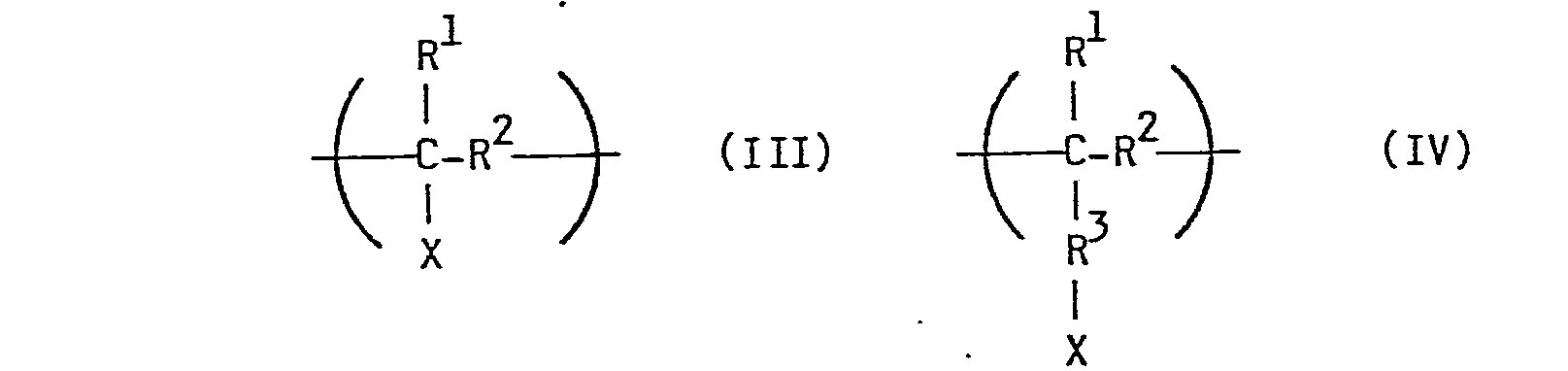

- X: OH, SH, NH2, -COOR1, -0-C(0)-R5, COCl oder Halogen;
- R1: H, C1-C5-Alkyl oder Aryl;
- R2: C1-C5-Alkylen oder -Alkyliden oder Arylen;
- R3: C1-C5-Alkylen oder -Alkyliden, 1,4-Cycloalkylen oder p-Arylen;
- R4: CH(C6H5)-CH2;
- R5: C1-C5-Alkyl.
- Als Halogen in dem Rest X kommen insbesondere Cl oder Br in Betracht. Als Beispiele für den Rest R seien genannt: Methyl, Ethyl, Propyl, Butyl und Phenyl. R kann beispielsweise CH2, C2H4, C3H6, C4H8 oder ein gegebenenfalls substituierter Phenylenrest sein. Beispiele für den Rest R3 sind CH2, C2H4, C3H6, C4H8, C6H10 oder ein gege-benenfalls substituierter Phenylenrest, wie C6H4 oder
-


- Bei den Polymeren mit den reaktiven Seitengruppen kann es sich um solche handeln, die allein aus wiederkehrenden Einheiten der allgemeinen Formeln (III), (IV) oder (V) aufgebaut sind. Diese Polymere enthalten im allgemeinen 5 bis 10000, vorzugsweise 50 bis 5000, der Einheiten der allgemeinen Formeln (III), (IV) oder (V) eingebaut. Es kann sich aber gleichermaßen auch um Copolymere handeln, die neben den Einheiten beispielsweise der allgemeinen Formeln (III) oder (IV) noch weitere Comonomere ohne reaktive Gruppen, wie z.B. Ethylen, Propylen, Styrol und dgl., eingebaut enthalten. In solchen Copolymeren richtet sich das Verhältnis der comonomeren Bausteine untereinander und damit der Anteil der reaktiven Gruppen im Copolymeren u.a. nach dem gewünschten Grad der Modifizierung mit den 1,9-disubstituierten Phenalenen. Das Molekulargewicht der Polymeren mit den reaktiven Seitengruppen kann in weiten Grenzen schwanken und liegt vorzugs- weise im Bereich von 500 bis 1.000.000, insbesondere zwischen 5000 und 500.000 (Gewichtsmittel).
- Geeignete Polymere, die wiederkehrende Einheiten der allgemeinen Formeln (III) oder (IV) eingebaut enthalten, sind beispielsweise: Poly(vinylchlorid), Poly(vinylalkohol), teilverseiftes Polyvinylacetat, Polyvinylacetat oder Poly-(vinylamin), ferner Poly(-1-amino-propen-(2)), Poly(l--hydroxy-propen-(2)), Poly(crotonsäuremethylester), Poly-(vinylessigsäuremethylester), Poly(vinylessigsäure- chlorid), Poly(p-aminostyrol), Poly(p-amino-alpha-methylstyrol), Poly(p-chlormethylstyrol), Poly(acrylsäure), Poly-(acrylsäureethylester), Poly(acrylsäurechlorid), Poly-(methacrylsäure), Poly(methacrylsäuremethylester) sowie Poly(methacrylsäureethylester).
- Geeignete Polymere der allgemeinen Formel (III) sind z.B. Copolymere aus Styrol und Fumar- und/oder Maleinsäureanhydrid. Besonders geeignete Polymere sind: Poly(vinyl- amin), Poly(p-aminostyrol), Poly(vinylalkohol), teilverseiftes Polyvinylacetat, Poly(vinylacetat) oder Copolymere aus Styrol und Maleinsäureanhydrid. Besonders gut geeignet ist Poly(p-aminostyrol).
- Zur Herstellung der erfindungsgemäßen Polymeren werden die Polymeren mit den reaktiven Seitengruppen üblicherweise in geeigneten Lösungsmitteln bei 50 - 150°C gelöst und die 1,9-disubstituierten Phenalene, in den selben Lösungsmitteln gelöst, in der Hitze zugetropft. Die entstandenen Reaktionsprodukte werden nach 1 bis 30 Stunden durch Zugabe einer geeigneten , die erfindungsgemäßen Polymere nicht lösenden Flüssigkeit ausgefällt und isoliert. Gegebenenfalls löst man das so isolierte erfindungsgemäße Polymere wieder auf und fällt es durch Zugabe der nicht lösenden Flüssigkeit wieder aus. Dieses Umfällen kann mehrmals wiederholt werden.
- Geeignete Lösungsmittel für die Herstellung der erfindungsgemäßen Polymeren sind Ethanol, Methanol, Trichlormethan, Dichlormethan, 1,2-Dichlorethan, Dimethylformamid (DMF), N-Methylpyrrolidon, Perchlorbutadien, Dibutylether und Tetrahydrofuran (THF). Besonders geeignet sind DMF, Perchlorbutadien, 1,2-Dichlormethan oder THF. Insbesondere günstig ist THF. Geeignete, die erfindungsgemäßen Polymeren nicht lösende Flüssigkeiten sind z.B. Acetonitril, n-Hexan oder n-Heptan.
- Durch die Umsetzung der Polymeren mit den reaktiven Seitengruppen mit den 1,9-disubstituierten Phenalenen erhält man polymere organische Substanzen, welche 1,9-disubstituierte Phenalene als Seitengruppe an den Polymerhauptketten tragen, wobei die Verknüpfung zwischen den Polymerhauptketten und den Phenalenresten über die 9-Stellung am Phenalenrest erfolgt. Diese erfindungsgemäßen Polymeren vermögen mindestens zwei stabile und reversibel ineinander umwandelbare Oxidationsstufen auszubilden.
- Zur Änderung der Oxidationsstufen werden die erfindungsgemäßen Polymeren oxidiert bzw. reduziert. Die Oxidation oder Reduktion geschieht dabei vorzugsweise elektrochemisch, in dem z.B. die erfindungsgemäßen Polymeren durch "spin-coating" auf Elektrodenplättchen als 1 bis 1000 ,um dicke Filme aufgebracht und in dieser Form elektrochemisch oxidiert oder reduziert werden.
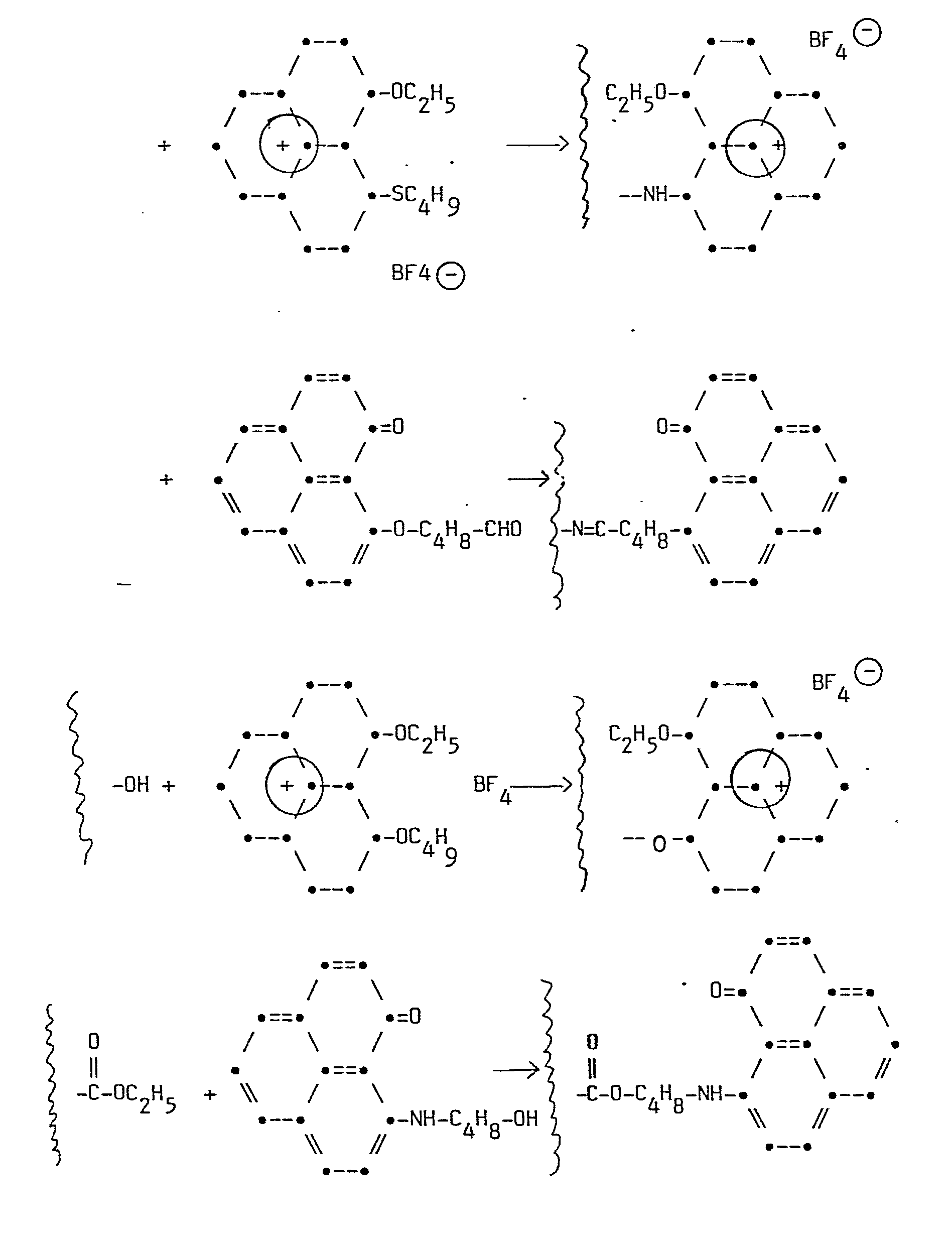
- Im folgenden wird eine Übersicht über ausgewählte erfindungsgemäße Reaktionen gegeben. Besonders bevorzugte erfindungsgemäße Polymere werden erhalten bei der Umsetzung von Poly(p-aminostyrol) mit 9-Butoxy-l-phenalenon oder mit 9-(Butoxy)-1-(ethoxy)phenaleniumtetrafluorborat. Als Beispiel für die Änderung der Oxidationsstufe in den erfindungsgemäßen Polymeren und damit deren Halbwertspotential ist die Reaktion von Poly[p-N-(9'-phenalen-1'-on)amino- styrol)] mit Triethyloxoniumtetrafluorborat angeführt.
- Die neuen Polymeren können in der Elektrotechnik zur Herstellung elektrisch leitfähiger Systeme, zur Umwandlung und Fixierung von Strahlung, zur Herstellung elektrischer Schalter, als "elektrochromic displays", zur antistatischen Ausrüstung von Kunststoffen oder als reversible Redoxsysteme verwendet werden.
- Uebersicht ueber die Reaktionsschemata

- Reaktionsschemata - Fortsetzung


- 1 Mol Poly(p-aminostyrol) (= 119 g) werden in 1500 ml Tetrahydrofuran (THF) gelöst und auf 65°C erhitzt. 1 Mol (= 252 g) 9-Butoxy-l-phenalenon werden in 250 ml THF gelöst und zur heißen Polymerlösung im Lauf von 30 Minuten unter Rühren zugetropft. Man läßt 10 Stunden bei 65°C nachreagieren und fällt dann das Polymere durch Zutropfen von 1000 ml n-Hexan aus. Das ausgefallene Produkt wird abgenutscht und noch zweimal mit THF/n-Hexan umgefällt.
- Ausbeute an Poly[p-N-(9'-phenalen-l'-on)aminostyrol]: 279 g Derivatisierungsgrad ca. 90 %, bezogen auf Poly(p-amino- styrol).
- Formel:

- Das mit 9-Butoxy-l-phenalenon umgesetzte Poly(p-amino- styrol) (Beispiel 1) wird in Tetrahydrofuran gelöst und durch "spin coating" auf platinbeschichtete Silikonplättchen in einer Schichtdicke von 1 bis 1000 /um aufgebracht. Ein solches beschichtetes Plättchen wird in ein Bad von Aceontril, in dem Tri-n-butylammoniumperchlorat als Leitsalz aufgelöst ist, eingetaucht. Das Oxidations-und Reduktionsverhalten der Beschichtung wird nun gegen eine Silberchloridelektrode durch cyclische Voltametrie gemessen. Folgende Halbwertspotentiale (E1/2) wurden gemessen:
- E1/2 = ca. -1,3 V; Farbumschlag: Rot → Braun
- 1 Mol Poly(p-aminostyrol) (= 119 g) werden in 1000 ml 1,2--Dichlorethan gelöst und auf 50°C erhitzt. 1 Mol (= 368 g) 9-n-Butoxy-l-(ethoxy)phenaleniumtetrafluorborat werden in 1000 ml 1,2-Dichlorethan gelöst und im Laufe von 1 Stunde zur Polymerlösung unter Rühren zugetropft. Man läßt 10 Stunden bei 80°C nachreagieren und engt anschließend die Lösung im Vakuum auf 500 ml ein. Durch Zusatz von 1000 ml n-Heptan wird das derivatisierte Polymere ausgefällt und durch Filtration abgetrennt. Das Produkt wird im Vakuum getrocknet.
- Ausbeute an Poly{p-N[9'-phenalenium-1'-(ethoxy)tetrafluor- borat]aminostyrol}: 413 g = 100 % Derivatisierungsgrad ca. 100 %, bezogen auf Poly(p-amino- styrol)
- Formel:

- Das erfindungsgemäße Polymere wird, wie in Beispiel 1 beschrieben, als Film in einer Dicke von 1 bis 1000 /um auf platinbeschichtete Silikonplättchen aufgebracht und in einer Acetonitril/Tri-n-butylammoniumperchloratlösung durch cyclische Voltametrie untersucht (Vergleich: Silberchloridelektrode). Folgende Halbwertspotentiale wurden gemessen:
- E1/2 = -0,3 V; Farbumschlag: Tiefgrün → Braun
- E1/2 = -1,4 V; Farbumschlag: Braun → Blau
- 0,2 Mol Poly[p-N-(9'-phenalen-1'-on)aminostyrol] (= 59,2 g) werden in 300 ml Perchlorbutadien gelöst. Zu dieser Lösung wird bei Zimmertemperatur unter Rühren eine Lösung von 0,2 Mol Triethyloxoniumtetrafluorborat (= 38 g) in Perchlorbutadien (200 ml) im Laufe von 1 Stunde zugetropft. Man läßt 5 Stunden nachreagieren und fällt anschließend das Produkt aus der auf 200 ml eingeengten Lösung durch Zugabe von n-Heptan aus. Das Produkt wird durch zweimaliges Umfällen mit Perchlorbutadien/n-Hexan gereinigt.
- Ausbeute am Poly{p-N-[9'-phenalenium-1'-(ethoxy)tetra- fluorborat]aminostyrol} (Formel siehe Beispiel 2):
- 82 g = 99 %.
- Ethoxylierungsgrad ca. 100 %.
- Das Redoxverhalten des Polymeren war identisch mit dem aus Beispiel 2. Es wurden folgende Halbwertspoteniale (E1/2) gemessen.:
- El/2 = -0,26 V; Farbumschlag: Tiefgrün→Braun
- E1/2 = -1,39 V; Farbumschlag: Braun → Blau
Claims (14)


Applications Claiming Priority (2)
| Application Number | Priority Date | Filing Date | Title |
|---|---|---|---|
| DE3126264A DE3126264A1 (de) | 1981-07-03 | 1981-07-03 | Polymere mit mindestens zwei stabilen und reversibel umwandelbaren oxidationsstufen und ihre anwendung als redoxsysteme und in der elektrotechnik sowie zur antistatischen ausruestung von kunststoffen |
| DE3126264 | 1981-07-03 |
Publications (2)
| Publication Number | Publication Date |
|---|---|
| EP0069292A1 true EP0069292A1 (de) | 1983-01-12 |
| EP0069292B1 EP0069292B1 (de) | 1985-05-15 |
Family
ID=6136020
Family Applications (1)
| Application Number | Title | Priority Date | Filing Date |
|---|---|---|---|
| EP82105599A Expired EP0069292B1 (de) | 1981-07-03 | 1982-06-25 | Polymere mit mindestens zwei stabilen und reversibel ineinander umwandelbaren Oxidationsstufen, Verfahren zu ihrer Herstellung und ihre Verwendung |
Country Status (4)
| Country | Link |
|---|---|
| US (1) | US4464511A (de) |
| EP (1) | EP0069292B1 (de) |
| JP (1) | JPS5865706A (de) |
| DE (2) | DE3126264A1 (de) |
Cited By (5)
| Publication number | Priority date | Publication date | Assignee | Title |
|---|---|---|---|---|
| EP0111237A3 (de) * | 1982-12-04 | 1986-07-02 | BASF Aktiengesellschaft | Batterie oder elektrochemischer Speicher auf Basis von elektrochemisch oxidierbaren und/oder reduzierbaren Polymeren |
| EP0145337A3 (en) * | 1983-11-21 | 1986-12-10 | Chevron Research Company | Electrochromic devices |
| WO1989011496A1 (fr) * | 1988-05-19 | 1989-11-30 | MERCK Patent Gesellschaft mit beschränkter Haftung | Polymeres a chaines laterales |
| FR2696470A1 (fr) * | 1992-10-07 | 1994-04-08 | Rhone Poulenc Films | Compositions de polymères contenant des composés organiques amphiphiles électroactifs de la famille des complexes à transfert de charge et/ou des sels d'ions radicaux, leur obtention et leur utilisation. |
| EP3375774A1 (de) * | 2017-03-17 | 2018-09-19 | Trioptotec GmbH | Phenalen-1-on-haltige photosensibilisatorzusammensetzung, phenalen-1-on-verbindungen sowie deren verwendung |
Families Citing this family (1)
| Publication number | Priority date | Publication date | Assignee | Title |
|---|---|---|---|---|
| JPH0617390B2 (ja) * | 1989-03-03 | 1994-03-09 | 工業技術院長 | 含フッ素高分子化合物とその製造方法及び超薄膜 |
Citations (1)
| Publication number | Priority date | Publication date | Assignee | Title |
|---|---|---|---|---|
| DE1288914B (de) * | 1959-02-26 | 1969-02-06 | Gevaert Photo Prod Nv | Photoleitfaehige Schicht mit einem polymeren Photoleiter |
Family Cites Families (1)
| Publication number | Priority date | Publication date | Assignee | Title |
|---|---|---|---|---|
| GB1388417A (en) | 1972-02-28 | 1975-03-26 | Ici Ltd | Phenalenone dyestuffs |
-
1981
- 1981-07-03 DE DE3126264A patent/DE3126264A1/de not_active Withdrawn
-
1982
- 1982-06-25 DE DE8282105599T patent/DE3263517D1/de not_active Expired
- 1982-06-25 EP EP82105599A patent/EP0069292B1/de not_active Expired
- 1982-06-30 JP JP57111822A patent/JPS5865706A/ja active Pending
- 1982-07-01 US US06/394,184 patent/US4464511A/en not_active Expired - Fee Related
Patent Citations (1)
| Publication number | Priority date | Publication date | Assignee | Title |
|---|---|---|---|---|
| DE1288914B (de) * | 1959-02-26 | 1969-02-06 | Gevaert Photo Prod Nv | Photoleitfaehige Schicht mit einem polymeren Photoleiter |
Non-Patent Citations (2)
| Title |
|---|
| AUSTRALIAN JOURNAL OF CHEMISTRY, Band 28, Nr. 11, November 1975, Seiten 2343-2351; * |
| IBM TECHNICAL DISCLOSURE BULLETIN, Band 22, Nr. 5, Oktober 1979, Seiten 2116-2118, New York (USA); * |
Cited By (12)
| Publication number | Priority date | Publication date | Assignee | Title |
|---|---|---|---|---|
| EP0111237A3 (de) * | 1982-12-04 | 1986-07-02 | BASF Aktiengesellschaft | Batterie oder elektrochemischer Speicher auf Basis von elektrochemisch oxidierbaren und/oder reduzierbaren Polymeren |
| EP0145337A3 (en) * | 1983-11-21 | 1986-12-10 | Chevron Research Company | Electrochromic devices |
| WO1989011496A1 (fr) * | 1988-05-19 | 1989-11-30 | MERCK Patent Gesellschaft mit beschränkter Haftung | Polymeres a chaines laterales |
| US5783643A (en) * | 1991-05-21 | 1998-07-21 | Rhone-Poulenc Films | Polymer compositions comprising electroactive amphiphilic organic compounds and electroconductive shaped articles produced therefrom |
| FR2696470A1 (fr) * | 1992-10-07 | 1994-04-08 | Rhone Poulenc Films | Compositions de polymères contenant des composés organiques amphiphiles électroactifs de la famille des complexes à transfert de charge et/ou des sels d'ions radicaux, leur obtention et leur utilisation. |
| EP0592333A1 (de) * | 1992-10-07 | 1994-04-13 | Rhone-Poulenc Films | Polymerzusammensetzungen, enthaltend organische amphiphile elektro-aktive Charge-Transfer-Komplexe und/oder Radikalionensalze, Herstellung und Verwendung davon |
| US5753728A (en) * | 1992-10-07 | 1998-05-19 | Rhone-Poulenc Chimie | Polymer compositions comprising electroactive amphiphilic organic compounds and electroconductive shaped articles produced therefrom |
| US5783112A (en) * | 1992-10-07 | 1998-07-21 | Rhone-Poulenc Chimie | Polymer compositions comprising electroactive amphiphil organic compounds and electroconductive shaped articles produced therefrom |
| EP3375774A1 (de) * | 2017-03-17 | 2018-09-19 | Trioptotec GmbH | Phenalen-1-on-haltige photosensibilisatorzusammensetzung, phenalen-1-on-verbindungen sowie deren verwendung |
| WO2018167264A1 (de) * | 2017-03-17 | 2018-09-20 | Trioptotec Gmbh | Phenalen-1-on-haltige photosensibilisatorzusammensetzung, phenalen-1-on-verbindung sowie deren verwendung |
| US11186545B2 (en) | 2017-03-17 | 2021-11-30 | Trioptotec Gmbh | Phenalene-1-one-containing photosensitizer composition, phenalene-1-one compound and the use thereof |
| US11987557B2 (en) | 2017-03-17 | 2024-05-21 | Trioptotec Gmbh | Phenalene-1-one-containing photosensitizer composition, phenalene-1-one compound and the use thereof |
Also Published As
| Publication number | Publication date |
|---|---|
| DE3126264A1 (de) | 1983-01-20 |
| DE3263517D1 (en) | 1985-06-20 |
| EP0069292B1 (de) | 1985-05-15 |
| JPS5865706A (ja) | 1983-04-19 |
| US4464511A (en) | 1984-08-07 |
Similar Documents
| Publication | Publication Date | Title |
|---|---|---|
| DE2945383C2 (de) | ||
| DE69909932T2 (de) | Verfahren zur Herstellung von wasserlöslichem leitfähigem Polyanilin | |
| DE69524977T2 (de) | Lösliche, elektroleitfähige polypyrrole und verfahren zur herstellung | |
| EP0129698A2 (de) | Verfahren zur Herstellung von Polypyrrolen und nach diesem Verfahren erhaltene filmförmige Produkte | |
| DE4244360A1 (en) | New sulphonated copolymer(s) of aniline, N-alkyl-aniline, or phenylenediamine, etc - have increased solubility in aq. and alcoholic solns. and greater electrical conductivity | |
| DE3223544A1 (de) | Copolymere von pyrrolen, verfahren zu ihrer herstellung sowie ihre verwendung | |
| EP0840760B1 (de) | Polymerelektrolyte und verfahren zu deren herstellung | |
| DE69131765T2 (de) | Polyviologenmodifizierte Elektrode und deren Anwendung | |
| DE112010000765T5 (de) | Polyanilinaddiertes Vorpolymer, Verfahren zur Herstellung eines polyanilinaddierten Vorpolymers, Polyanilin-Pfropfpolymer, Verfahren zur Herstellung eines Polyanilin-Pfropfpolymers, vernetztes Material und Farbe | |
| DE69828573T2 (de) | Transparente leitfähige Polymere | |
| DE69217759T2 (de) | Fluorierte Thiophene, von diesen Thiophenen abgeleitete Polymere, leitfähige Polymere, die diese Polymere enthalten, Verfahren zu ihrer Herstellung, ihre Anwendung sowie Vorrichtungen die diese leitfähigen Polymere enthalten | |
| DE60208649T2 (de) | Verwendung von Sulfon-, Phosphon- und Phosphor-Säuren als Dotierstoffe von Polyanilinen und aus Polyanilinen leitfähigen Verbundmaterialien | |
| DE3627242A1 (de) | Verfahren zur herstellung eines elektrisch leitenden polymeren | |
| DE3704411C2 (de) | ||
| EP0069292B1 (de) | Polymere mit mindestens zwei stabilen und reversibel ineinander umwandelbaren Oxidationsstufen, Verfahren zu ihrer Herstellung und ihre Verwendung | |
| DE69835316T2 (de) | Festelektrolyt | |
| DE69701954T2 (de) | Dichlor-tetrafluor-[2,2]-Paracyclophan, Verfahren zu deren Herstellung und daraus hergestellte poly-alpha,alpha-difluor-chlor-para-xylylen Filme | |
| DE3441011C2 (de) | Elektroleitfähiges organisches Polymer, enthaltend einen Elektronenakzeptor als Dotiermittel und Verfahren zu dessen Herstellung | |
| DE69311061T2 (de) | Copolymere, Verfahren zu deren Herstellung und dieses Polymer verwendende Material zur Färbung/Verfärbung | |
| DE3105948A1 (de) | Verfahren zur herstellung von stabilen elekrisch leitfaehigen polymeren systemen und deren verwendung in der elektrotechnik und zur antistatischen ausruestung von kunststoffen | |
| EP0295676A2 (de) | Durch oxidative Polymerisation erhältliche Polymere | |
| DE69507285T2 (de) | Polyaniline und deren herstellung | |
| DE2364070A1 (de) | Polymerisatloesung | |
| DE3512476A1 (de) | Triphenylamin-polymer | |
| DE3701495A1 (de) | Polymer einer fuenfgliedrigen heterocyclischen verbindung und dessen herstellung |
Legal Events
| Date | Code | Title | Description |
|---|---|---|---|
| PUAI | Public reference made under article 153(3) epc to a published international application that has entered the european phase |
Free format text: ORIGINAL CODE: 0009012 |
|
| AK | Designated contracting states |
Designated state(s): BE DE FR GB NL |
|
| 17P | Request for examination filed |
Effective date: 19821210 |
|
| GRAA | (expected) grant |
Free format text: ORIGINAL CODE: 0009210 |
|
| AK | Designated contracting states |
Designated state(s): BE DE FR GB NL |
|
| REF | Corresponds to: |
Ref document number: 3263517 Country of ref document: DE Date of ref document: 19850620 |
|
| ET | Fr: translation filed | ||
| PLBE | No opposition filed within time limit |
Free format text: ORIGINAL CODE: 0009261 |
|
| STAA | Information on the status of an ep patent application or granted ep patent |
Free format text: STATUS: NO OPPOSITION FILED WITHIN TIME LIMIT |
|
| 26N | No opposition filed | ||
| PGFP | Annual fee paid to national office [announced via postgrant information from national office to epo] |
Ref country code: FR Payment date: 19900515 Year of fee payment: 9 |
|
| PGFP | Annual fee paid to national office [announced via postgrant information from national office to epo] |
Ref country code: BE Payment date: 19900528 Year of fee payment: 9 |
|
| PGFP | Annual fee paid to national office [announced via postgrant information from national office to epo] |
Ref country code: DE Payment date: 19900613 Year of fee payment: 9 |
|
| PGFP | Annual fee paid to national office [announced via postgrant information from national office to epo] |
Ref country code: GB Payment date: 19900615 Year of fee payment: 9 |
|
| PGFP | Annual fee paid to national office [announced via postgrant information from national office to epo] |
Ref country code: NL Payment date: 19900630 Year of fee payment: 9 |
|
| PG25 | Lapsed in a contracting state [announced via postgrant information from national office to epo] |
Ref country code: DE Effective date: 19910619 |
|
| PG25 | Lapsed in a contracting state [announced via postgrant information from national office to epo] |
Ref country code: GB Effective date: 19910625 |
|
| PG25 | Lapsed in a contracting state [announced via postgrant information from national office to epo] |
Ref country code: BE Effective date: 19910630 |
|
| BERE | Be: lapsed |
Owner name: BASF A.G. Effective date: 19910630 |
|
| PG25 | Lapsed in a contracting state [announced via postgrant information from national office to epo] |
Ref country code: NL Effective date: 19920101 |
|
| NLV4 | Nl: lapsed or anulled due to non-payment of the annual fee | ||
| GBPC | Gb: european patent ceased through non-payment of renewal fee | ||
| PG25 | Lapsed in a contracting state [announced via postgrant information from national office to epo] |
Ref country code: FR Effective date: 19920228 |
|
| REG | Reference to a national code |
Ref country code: FR Ref legal event code: ST |