EP0069954B1 - Verfahren zur Herstellung von Permethrinsäurementhylester - Google Patents
Verfahren zur Herstellung von Permethrinsäurementhylester Download PDFInfo
- Publication number
- EP0069954B1 EP0069954B1 EP82105966A EP82105966A EP0069954B1 EP 0069954 B1 EP0069954 B1 EP 0069954B1 EP 82105966 A EP82105966 A EP 82105966A EP 82105966 A EP82105966 A EP 82105966A EP 0069954 B1 EP0069954 B1 EP 0069954B1
- Authority
- EP
- European Patent Office
- Prior art keywords
- mol
- ester
- acid
- menthol
- menthyl ester
- Prior art date
- Legal status (The legal status is an assumption and is not a legal conclusion. Google has not performed a legal analysis and makes no representation as to the accuracy of the status listed.)
- Expired
Links
- 150000002148 esters Chemical class 0.000 title claims description 14
- 238000000034 method Methods 0.000 title claims description 8
- 238000002360 preparation method Methods 0.000 title claims description 4
- LLMLSUSAKZVFOA-UHFFFAOYSA-N 3-(2,2-dichlorovinyl)-2,2-dimethylcyclopropanecarboxylic acid Chemical compound CC1(C)C(C=C(Cl)Cl)C1C(O)=O LLMLSUSAKZVFOA-UHFFFAOYSA-N 0.000 title claims 2
- NOOLISFMXDJSKH-UTLUCORTSA-N (+)-Neomenthol Chemical compound CC(C)[C@@H]1CC[C@@H](C)C[C@@H]1O NOOLISFMXDJSKH-UTLUCORTSA-N 0.000 claims description 7
- NOOLISFMXDJSKH-UHFFFAOYSA-N DL-menthol Natural products CC(C)C1CCC(C)CC1O NOOLISFMXDJSKH-UHFFFAOYSA-N 0.000 claims description 7
- 229940041616 menthol Drugs 0.000 claims description 7
- 230000001476 alcoholic effect Effects 0.000 claims description 4
- 229910052783 alkali metal Inorganic materials 0.000 claims description 2
- 150000001340 alkali metals Chemical class 0.000 claims description 2
- 238000006243 chemical reaction Methods 0.000 claims description 2
- 125000004494 ethyl ester group Chemical group 0.000 claims 2
- OKKJLVBELUTLKV-UHFFFAOYSA-N Methanol Chemical compound OC OKKJLVBELUTLKV-UHFFFAOYSA-N 0.000 description 24
- WQDUMFSSJAZKTM-UHFFFAOYSA-N Sodium methoxide Chemical compound [Na+].[O-]C WQDUMFSSJAZKTM-UHFFFAOYSA-N 0.000 description 12
- 239000002904 solvent Substances 0.000 description 8
- 238000005809 transesterification reaction Methods 0.000 description 8
- 125000002496 methyl group Chemical group [H]C([H])([H])* 0.000 description 7
- 239000000203 mixture Substances 0.000 description 7
- NOOLISFMXDJSKH-AEJSXWLSSA-N (+)-menthol Chemical compound CC(C)[C@H]1CC[C@H](C)C[C@@H]1O NOOLISFMXDJSKH-AEJSXWLSSA-N 0.000 description 6
- LFQSCWFLJHTTHZ-UHFFFAOYSA-N Ethanol Chemical compound CCO LFQSCWFLJHTTHZ-UHFFFAOYSA-N 0.000 description 6
- 239000003513 alkali Substances 0.000 description 5
- -1 chloroacetylene compound Chemical class 0.000 description 4
- 125000001495 ethyl group Chemical group [H]C([H])([H])C([H])([H])* 0.000 description 4
- 238000003756 stirring Methods 0.000 description 4
- ZWEHNKRNPOVVGH-UHFFFAOYSA-N 2-Butanone Chemical compound CCC(C)=O ZWEHNKRNPOVVGH-UHFFFAOYSA-N 0.000 description 3
- HBAQYPYDRFILMT-UHFFFAOYSA-N 8-[3-(1-cyclopropylpyrazol-4-yl)-1H-pyrazolo[4,3-d]pyrimidin-5-yl]-3-methyl-3,8-diazabicyclo[3.2.1]octan-2-one Chemical class C1(CC1)N1N=CC(=C1)C1=NNC2=C1N=C(N=C2)N1C2C(N(CC1CC2)C)=O HBAQYPYDRFILMT-UHFFFAOYSA-N 0.000 description 3
- CSCPPACGZOOCGX-UHFFFAOYSA-N Acetone Chemical compound CC(C)=O CSCPPACGZOOCGX-UHFFFAOYSA-N 0.000 description 3
- XEKOWRVHYACXOJ-UHFFFAOYSA-N Ethyl acetate Chemical compound CCOC(C)=O XEKOWRVHYACXOJ-UHFFFAOYSA-N 0.000 description 3
- RTAQQCXQSZGOHL-UHFFFAOYSA-N Titanium Chemical compound [Ti] RTAQQCXQSZGOHL-UHFFFAOYSA-N 0.000 description 3
- 239000003054 catalyst Substances 0.000 description 3
- VLKZOEOYAKHREP-UHFFFAOYSA-N n-Hexane Chemical compound CCCCCC VLKZOEOYAKHREP-UHFFFAOYSA-N 0.000 description 3
- 239000010936 titanium Substances 0.000 description 3
- 229910052719 titanium Inorganic materials 0.000 description 3
- BWLHXMCCPUJBSW-UHFFFAOYSA-N 3-(2-chloroethynyl)-2,2-dimethylcyclopropane-1-carboxylic acid Chemical compound CC1(C)C(C#CCl)C1C(O)=O BWLHXMCCPUJBSW-UHFFFAOYSA-N 0.000 description 2
- QUSNBJAOOMFDIB-UHFFFAOYSA-N Ethylamine Chemical compound CCN QUSNBJAOOMFDIB-UHFFFAOYSA-N 0.000 description 2
- KFZMGEQAYNKOFK-UHFFFAOYSA-N Isopropanol Chemical compound CC(C)O KFZMGEQAYNKOFK-UHFFFAOYSA-N 0.000 description 2
- LRHPLDYGYMQRHN-UHFFFAOYSA-N N-Butanol Chemical compound CCCCO LRHPLDYGYMQRHN-UHFFFAOYSA-N 0.000 description 2
- IMNFDUFMRHMDMM-UHFFFAOYSA-N N-Heptane Chemical compound CCCCCCC IMNFDUFMRHMDMM-UHFFFAOYSA-N 0.000 description 2
- OFBQJSOFQDEBGM-UHFFFAOYSA-N Pentane Chemical compound CCCCC OFBQJSOFQDEBGM-UHFFFAOYSA-N 0.000 description 2
- 238000001816 cooling Methods 0.000 description 2
- 239000013078 crystal Substances 0.000 description 2
- FKRCODPIKNYEAC-UHFFFAOYSA-N ethyl propionate Chemical compound CCOC(=O)CC FKRCODPIKNYEAC-UHFFFAOYSA-N 0.000 description 2
- 238000010438 heat treatment Methods 0.000 description 2
- BDERNNFJNOPAEC-UHFFFAOYSA-N propan-1-ol Chemical compound CCCO BDERNNFJNOPAEC-UHFFFAOYSA-N 0.000 description 2
- 239000011541 reaction mixture Substances 0.000 description 2
- LLMLSUSAKZVFOA-UHFFFAOYSA-M 3-(2,2-dichloroethenyl)-2,2-dimethylcyclopropane-1-carboxylate Chemical class CC1(C)C(C=C(Cl)Cl)C1C([O-])=O LLMLSUSAKZVFOA-UHFFFAOYSA-M 0.000 description 1
- XDTMQSROBMDMFD-UHFFFAOYSA-N Cyclohexane Chemical compound C1CCCCC1 XDTMQSROBMDMFD-UHFFFAOYSA-N 0.000 description 1
- NTIZESTWPVYFNL-UHFFFAOYSA-N Methyl isobutyl ketone Chemical compound CC(C)CC(C)=O NTIZESTWPVYFNL-UHFFFAOYSA-N 0.000 description 1
- UIHCLUNTQKBZGK-UHFFFAOYSA-N Methyl isobutyl ketone Natural products CCC(C)C(C)=O UIHCLUNTQKBZGK-UHFFFAOYSA-N 0.000 description 1
- KXKVLQRXCPHEJC-UHFFFAOYSA-N acetic acid trimethyl ester Natural products COC(C)=O KXKVLQRXCPHEJC-UHFFFAOYSA-N 0.000 description 1
- 150000001298 alcohols Chemical class 0.000 description 1
- 230000015572 biosynthetic process Effects 0.000 description 1
- 229930195733 hydrocarbon Natural products 0.000 description 1
- 150000002430 hydrocarbons Chemical class 0.000 description 1
- 150000002576 ketones Chemical class 0.000 description 1
- 239000000155 melt Substances 0.000 description 1
- QJOOIMSFFIUFKX-UHFFFAOYSA-N methyl 3-(2,2-dichloroethenyl)-2,2-dimethylcyclopropane-1-carboxylate Chemical compound COC(=O)C1C(C=C(Cl)Cl)C1(C)C QJOOIMSFFIUFKX-UHFFFAOYSA-N 0.000 description 1
- 150000004702 methyl esters Chemical class 0.000 description 1
- BAVYZALUXZFZLV-UHFFFAOYSA-N mono-methylamine Natural products NC BAVYZALUXZFZLV-UHFFFAOYSA-N 0.000 description 1
- 230000003287 optical effect Effects 0.000 description 1
- 229960000490 permethrin Drugs 0.000 description 1
- 238000000926 separation method Methods 0.000 description 1
- QDRKDTQENPPHOJ-UHFFFAOYSA-N sodium ethoxide Chemical compound [Na+].CC[O-] QDRKDTQENPPHOJ-UHFFFAOYSA-N 0.000 description 1
- 239000010409 thin film Substances 0.000 description 1
Classifications
-
- C—CHEMISTRY; METALLURGY
- C07—ORGANIC CHEMISTRY
- C07C—ACYCLIC OR CARBOCYCLIC COMPOUNDS
- C07C67/00—Preparation of carboxylic acid esters
- C07C67/03—Preparation of carboxylic acid esters by reacting an ester group with a hydroxy group
-
- C—CHEMISTRY; METALLURGY
- C07—ORGANIC CHEMISTRY
- C07C—ACYCLIC OR CARBOCYCLIC COMPOUNDS
- C07C2601/00—Systems containing only non-condensed rings
- C07C2601/02—Systems containing only non-condensed rings with a three-membered ring
-
- C—CHEMISTRY; METALLURGY
- C07—ORGANIC CHEMISTRY
- C07C—ACYCLIC OR CARBOCYCLIC COMPOUNDS
- C07C2601/00—Systems containing only non-condensed rings
- C07C2601/12—Systems containing only non-condensed rings with a six-membered ring
- C07C2601/14—The ring being saturated
Definitions
- the present invention relates to a process for the preparation of permethrin ethyl ester.
- a process for the preparation of methyl permethrinate of the formula I was found by reacting methyl or ethyl permethrate with menthol, which is characterized in that in the presence of 1 to 30 mol% of alkali metal alcoholate, optionally in the form of its alcoholic solutions, based on the methyl or ethyl permethrate used, between 50 and 180 ° C works.
- Formula 1 includes all enantiomers.
- the reaction according to the invention is carried out at temperatures between 50 and 180, preferably between 80 and 140 ° C.
- Sodium methylate and sodium ethylate are preferably used as alkali alcoholates.
- the alkali alcoholates are used in an amount of 1 to 30, preferably 2 to 20 mol%, based on the amount of permethric acid ester used.
- the alcoholates can be used as such or in the form of their alcoholic solutions.
- the alcoholic solutions of the alkali alcoholates are preferred.
- Menthol is used in both the d and i enantiomers.
- the process can be carried out continuously or batchwise.
- menthyl esters obtainable by the process serve to separate the optical isomers of permethric acid.
- a suitable solvent is added to the resulting d-menthyl ester mixture and the (+) - transpermethric acid d-menthyl ester is suctioned off.
- Suitable solvents are hydrocarbons such as ligroin, petroether, hexane, heptane, pentane, cyclohexane, and ketones such as acetone, methyl ethyl ketone, methyl isobutyl ketone; Esters such as methyl or ethyl amine, methyl or ethyl acetate, methyl or ethyl propionate; and alcohols such as methanol, ethanol, isopropanol, n-propanol, butanol; Ligroin, methanol, ethanol is particularly preferred.
- hydrocarbons such as ligroin, petroether, hexane, heptane, pentane, cyclohexane, and ketones such as acetone, methyl ethyl ketone, methyl isobutyl ketone
- Esters such as methyl or ethyl amine, methyl
- ester mixture obtained in the form of an oil is cooled to 25 to 50 ° C., preferably room temperature, and the less soluble (+) - transisomer which crystallizes out is suctioned off.
- the two enantiomers can be separated from one another.
- a thin film evaporator (length of the evaporator part approx. 200 mm; ⁇ approx. 30 mm) is added over a period of 1 h under a vacuum of approx. 5 mbar and a heating jacket temperature of 110 ° C a mixture of 223 g ( ⁇ ) -transpermethric acid methyl ester (1 mol), 195 g d-menthol (1.25 mol) and 7.3 g 11% sodium methylate solution (heated to approx. 50 ° C) 0.035 mol).
- the bottom product obtained is 345.2 g of a yellowish to beige melt with a composition of 96.3% ( ⁇ ) -transpermethric acid d-menthyl ester, 0.9% d-menthol, 1.3% ( ⁇ ) -transpermethric acid methyl ester and ⁇ 0.2% 2,2-Dimethyl-3- (2-chloroethynyl) cyclopropanecarboxylic acid d-menthyl ester.
Landscapes
- Chemical & Material Sciences (AREA)
- Organic Chemistry (AREA)
- Organic Low-Molecular-Weight Compounds And Preparation Thereof (AREA)
Description
- Die vorliegende Erfindung betrifft ein Verfahren zur Herstellung von Permethrinsäurementhylester.
- Es ist bereits bekannt, dass man Permethrinsäurementhylester erhält, indem man Permethrinsäureethylestermit Menthol erhitzt. Die dabei erhältlichen Ausbeuten sind jedoch nicht zufriedenstellend (DE-OS Nr. 2928406). Dies, obwohl mit Titantetraethylat als Umesterungskatalysator gearbeitet wird. Titantetraalkohole gelten für derartige Umesterung als besonders geeignet (DE-OS Nr. 2812365).
- Umesterungsreaktionen von Permethrinsäuremethylester mit Natriummethylat als Umesterungkatalysator sind bereits bekannt. Es muss dabei jedoch in Lösungsmittel gearbeitet werden, um das entstehende Methanol abdestillieren zu können. Die Ausbeuten und Reinheiten bei der Umesterung sind nicht befriedigend (DE-OS Nr.2716771).
- Es wurde ein Verfahren zur Herstellung von Permethrinsäurementhylester der Formel I gefunden,
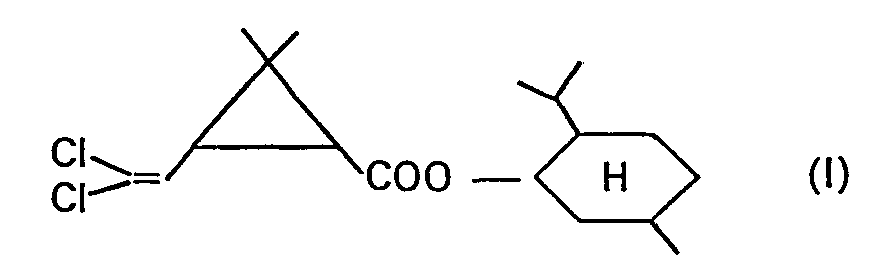
- Formel 1 umfasst dabei sämtliche Enantiomeren.
- Es war überraschend, dass die Umesterung in Gegenwart von Alkalialkoholaten ohne Bildung der Chloracetylenverbindung der Formel

- Es war ausserdem überraschend, dass es mit H ilfe von Alkalialkoholat möglich ist, die Ausbeute der Umesterung im Vergleich zu den als besonders gut wirksam geltenden Umesterungskatalysatoren Titantetraalkoholat beträchtlich zu steigern. Die Ausbeutesteigerung ist auch im Hinblick darauf überraschend, dass ohne die Verwendung von Lösungsmitteln gearbeitet wird, die dem entstehenden Alkohol azeotrop aus dem Reaktionsgemisch schleppen.
- Die erfindungsgemässe Reaktion wird bei Temperaturen zwischen 50 und 180, bevorzugt zwischen 80 und 140°C, durchgeführt.
- Bevorzugt werden als Alkalialkoholate Natriummethylat und Natriumethylat eingesetzt. Die Alkalialkoholate werden in einer Menge von 1 bis 30, bevorzugt 2 bis 20 Mol-%, bezogen auf die eingesetzte Permethrinsäureestermenge, eingesetzt. Die Alkoholate können als solche oder in Form ihrer alkoholischen Lösungen eingesetzt werden. Bevorzugt sind die alkoholischen Lösungen der Alkalialkoholate.
- Pro Mol Permethrinsäureester werden 1 bis 5, bevorzugt 1,1 bis 2,5 mol Menthol eingesetzt.
- Menthol wird sowohl in Form des d- als auch des i-Enantiomeren eingesetzt.
- Das Verfahren kann dabei kontinuierlich oder diskontinuierlich durchgeführt werden.
- Das Verfahren wird ohne die Verwendung besonderer Lösungsmittel durchgeführt. Diese Arbeitsweise hat den Vorteil, dass bei der späteren Trennung der Permethrinsäurementhylester in ihre optisch aktiven Isomeren diese Lösungsmittel nicht entfernt werden müssen.
- Die nach dem Verfahren erhältlichen Menthylester dienen dazu, die optischen Isomeren der Permethrinsäure zu trennen. Dazu wird das anfallende d-Menthylestergemisch mit einem geeigneten Lösungsmittel versetzt und der (+)-Transpermethrinsäure-d-menthylester abgesaugt.
- Geeignete Lösungsmittel sind Kohlenwasserstoffe wie Ligroin, Petroether, Hexan, Heptan, Pentan, Cyclohexan, sowie Ketone wie Aceton, Methylethyketon, Methylisobutylketon; Ester wie Aminensäuremethyl oder -ethylester, Essigsäuremethyl oder -ethylester, Propionsäuremethyl oder -ethylester; sowie Alkohole wie Methanol, Ethanol, Isopropanol, n-Propanol, Butanol; besonders bevorzugt wird Ligroin, Methanol, Ethanol.
- Eine andere Möglichkeit, das anfallende Menthylestergemisch in seine optisch aktiven Isomeren zu trennen, besteht darin, dass man ohne Lösungsmittel arbeitet. Dazu wird das in Form eines Öls anfallende Estergemisch auf 25 bis 50°C, bevorzugt Raumtemperatur, abgekühlt und das dabei auskristallisierende, schwerer lösliche (+)-Transisomere abgesaugt.
- In einem Rührkolben werden 1 mol (223 g) (±)-Transpermethrinsäuremethylester, 195 g d-Menthol (1,25 mol) und 7,3 g 11 %ige Natriummethylatlösung (0,035 mol) im Vakuum von ca. 50 mbar auf 110 bis 120°C erhitzt.
- Nach 1 stündiger Nachrührzeit bei 110 bis 120°C wird 1 h bei ca. 5 mbar und 110 bis 120°C weitergerührt, wobei überschüssiges Menthol abdestilliert. Es verbleiben 351 g einer hellgelben Schmelze, die beim Abkühlen erstarrt, mit einer Zusammensetzung von 95,2% (±)-Transpermethrinsäure-d-menthylester, 1,8% d-Menthol, 1,9% (±)-Transpermethrinsäuremethylester und <0,2% 2,2-Dimethyl-3-(2-chlorethinyl)cyclopropancarbonsäure-d-menthylester.
- Bei Behandlung der Schmelze mit einem geeigneten Lösungsmittel können die beiden Enantiomeren voneinander getrennt werden.
- Über einen Dünnschichtverdampfer (Länge des Verdampferteils ca. 200 mm; ø ca. 30 mm) gibt man im Verlaufe 1 h unter Vakuum von ca. 5 mbar und einer Heizmanteltemperatur von 110°C eine auf ca. 50°C erwärmte Mischung aus 223 g (±)-Transpermethrinsäuremethylester (1 mol), 195 g d- Menthol (1,25 mol) und 7,3 g 11 %ige Natriummethylatlösung (0,035 mol). Als Sumpf erhält man 345,2 g einer gelblichen bis beigen Schmelze mit einer Zusammensetzung von 96,3% (±)-Transpermethrinsäure-d-menthylester, 0,9% d-Menthol, 1,3% (±)-Transpermethrinsäuremethylester und <0,2% 2,2-Dimethyl-3-(2-chlor- ethinyl)cyclopropancarbonsäure-d-menthylester.
- In einem Rührkolben werden 1 mol (223 g) (±)-Transpermethrinsäuremethylester, 195 g d-Menthol (1,25 mol) und 7,3 g 11 %ige Natriummethylatlösung (0,035 mol) im Vakuum von ca. 50 mbar auf 110 bis 120°C erhitzt.
- Nach 1 stündiger Nachrührzeit bei 110 bis 120°C wird 1 h bei ca. 5 mbar und 110 bis 120°C weitergerührt, wobei überschüssiges Menthol abdestilliert. Nach Zugabe von 500 ml Methanol wird der Kolbeninhalt auf 15°C abgekühlt, das ausgefallene Kristallisat abgesaugt, zweimal mit jeweils 125 ml Methanol gewaschen und anschliessend im Vakuum getrocknet.
- Man erhält 143,9 g (+)-Transpermethrinsäure-d-menthylester mit einem Gehalt von 99%.
- In einem Rührkolben werden 223 g (1 mol) (±)-Transpermethrinsäuremethylester, 312 g d-Menthol (2 mol) vorgelegt und auf 130 bis 140°C erhitzt. Bei 130 bis 140°C werden im Vakuum von 300 mbar 5 g 11 %ige Natriummethylatlösung zugetropft und 30 min 130 bis 140°C und ca. 300 mbar nachgerührt, wobei Methanol abdestilliert. Nach Abkühlung auf ca. 60 bis 65°C werden 500 ml Methanol zugegeben und das Reaktionsgemisch auf 5°C abgekühlt, wobei der (±)-Transpermethrinsäure-d-menthylester auskristallisiert.
- Das Kristallisat wird abgesaugt, zweimal mit jeweils 100 ml Methanol gewaschen und anschliessend im Vakuum getrocknet. Man erhält 132,7 g (±)-Transpermethrinsäure-d-menthylester mit einem Gehalt von 99,3%.
Claims (1)
- Verfahren zur Herstellung von Permethrinsäurementhylester der Formel

Applications Claiming Priority (2)
| Application Number | Priority Date | Filing Date | Title |
|---|---|---|---|
| DE3127752 | 1981-07-14 | ||
| DE19813127752 DE3127752A1 (de) | 1981-07-14 | 1981-07-14 | Verfahren zur herstellung von permethrinsaeurementhylester |
Publications (2)
| Publication Number | Publication Date |
|---|---|
| EP0069954A1 EP0069954A1 (de) | 1983-01-19 |
| EP0069954B1 true EP0069954B1 (de) | 1984-12-05 |
Family
ID=6136872
Family Applications (1)
| Application Number | Title | Priority Date | Filing Date |
|---|---|---|---|
| EP82105966A Expired EP0069954B1 (de) | 1981-07-14 | 1982-07-05 | Verfahren zur Herstellung von Permethrinsäurementhylester |
Country Status (9)
| Country | Link |
|---|---|
| US (1) | US4518791A (de) |
| EP (1) | EP0069954B1 (de) |
| JP (1) | JPS5818336A (de) |
| BR (1) | BR8204069A (de) |
| DE (2) | DE3127752A1 (de) |
| DK (1) | DK313882A (de) |
| HU (1) | HU188319B (de) |
| IL (1) | IL66299A (de) |
| ZA (1) | ZA824963B (de) |
Families Citing this family (1)
| Publication number | Priority date | Publication date | Assignee | Title |
|---|---|---|---|---|
| ES8600199A1 (es) * | 1983-12-13 | 1985-10-01 | Union Explosivos Rio Tinto | Procedimiento de preparacion de nuevos esteres del acido vinilciclopropancarboxilico en su forma racemica u opticamente activa, con actividad pesticida. |
Family Cites Families (11)
| Publication number | Priority date | Publication date | Assignee | Title |
|---|---|---|---|---|
| US3683005A (en) * | 1970-01-08 | 1972-08-08 | Taisho Pharmaceutical Co Ltd | Cyclopropanecarboxylic acid esters |
| US4024163A (en) * | 1972-05-25 | 1977-05-17 | National Research Development Corporation | Insecticides |
| JPS5813522B2 (ja) * | 1974-10-24 | 1983-03-14 | 住友化学工業株式会社 | 新しいシクロプロパンカルボン酸エステルを含有する殺虫、殺ダニ剤 |
| ZA772039B (en) * | 1976-04-15 | 1978-03-29 | Ici Ltd | Manufacture of esters |
| US4183948A (en) * | 1977-01-24 | 1980-01-15 | Imperial Chemical Industries Limited | Halogenated esters |
| DE2730515A1 (de) * | 1977-07-06 | 1979-01-18 | Bayer Ag | Substituierte phenoxybenzyloxycarbonylderivate, verfahren zu ihrer herstellung und ihre verwendung als insektizide und akarizide |
| DE2843073A1 (de) * | 1977-10-06 | 1979-04-19 | Ciba Geigy Ag | Cyclopropankarbonsaeure-phenoxybenzylester, verfahren zu ihrer herstellung und ihre verwendung in der schaedlingsbekaempfung |
| DE2820521A1 (de) * | 1978-05-11 | 1979-11-15 | Basf Ag | Verfahren zur umesterung |
| DE2928406A1 (de) * | 1979-07-13 | 1981-01-29 | Bayer Ag | Neue menthylester, verfahren zu ihrer herstellung und ihre verwendung zur enantiomerentrennung chiraler carbonsaeuren |
| DE2939913A1 (de) * | 1979-10-02 | 1981-04-30 | Bayer Ag, 5090 Leverkusen | 3-(2,3-dichlor-3,3-difluor-prop-1-en-1-yl)-2,2-dimethyl-cyclopropancarbonsaeure-fluor-benzylester, verfahren zu ihrer herstellung sowie ihre verwendung in schaedlingsbekaempfungsmitteln |
| DE3065914D1 (en) * | 1979-12-21 | 1984-01-19 | Ici Plc | Substituted benzyl esters of cyclopropane carboxylic acids and their preparation, compositions containing them and methods of combating insect pests therewith, and substituted benzyl alcohols |
-
1981
- 1981-07-14 DE DE19813127752 patent/DE3127752A1/de not_active Withdrawn
-
1982
- 1982-07-05 DE DE8282105966T patent/DE3261459D1/de not_active Expired
- 1982-07-05 EP EP82105966A patent/EP0069954B1/de not_active Expired
- 1982-07-09 JP JP57118743A patent/JPS5818336A/ja active Granted
- 1982-07-12 IL IL66299A patent/IL66299A/xx not_active IP Right Cessation
- 1982-07-13 BR BR8204069A patent/BR8204069A/pt unknown
- 1982-07-13 ZA ZA824963A patent/ZA824963B/xx unknown
- 1982-07-13 DK DK313882A patent/DK313882A/da not_active Application Discontinuation
- 1982-07-14 HU HU822284A patent/HU188319B/hu unknown
-
1984
- 1984-04-03 US US06/596,324 patent/US4518791A/en not_active Expired - Lifetime
Also Published As
| Publication number | Publication date |
|---|---|
| IL66299A (en) | 1985-06-30 |
| JPH0323535B2 (de) | 1991-03-29 |
| HU188319B (en) | 1986-04-28 |
| DK313882A (da) | 1983-01-15 |
| HUT35239A (en) | 1985-06-28 |
| IL66299A0 (en) | 1982-11-30 |
| DE3127752A1 (de) | 1983-02-03 |
| ZA824963B (en) | 1983-05-25 |
| BR8204069A (pt) | 1983-07-05 |
| DE3261459D1 (en) | 1985-01-17 |
| JPS5818336A (ja) | 1983-02-02 |
| US4518791A (en) | 1985-05-21 |
| EP0069954A1 (de) | 1983-01-19 |
Similar Documents
| Publication | Publication Date | Title |
|---|---|---|
| EP0638575B1 (de) | Verfahren zur Herstellung von Diorganodialkoxysilanen | |
| EP0002027B1 (de) | Verfahren zur Herstellung von 2-Buten-1-ol-Verbindungen durch Isomerisierung der entsprechenden 3-Buten-1-ol-Verbindungen | |
| EP0069954B1 (de) | Verfahren zur Herstellung von Permethrinsäurementhylester | |
| EP0022955A1 (de) | Verbessertes Verfahren zur Herstellung von höheren ungesättigten Ketonen | |
| DE2060218C3 (de) | Verfahren zur Herstellung von 1 -Phenyl-vinyl-1 -phosphonsaure | |
| DE2435244A1 (de) | Verfahren zur herstellung von 3-phenylpyridazonen | |
| DE3422412A1 (de) | Verfahren zur herstellung eines gemisches aus einem gegebenenfalls substituierten zimtsaeureester und einem gegenbenenfalls substituierten ss-alkoxy-ss-phenyl-propionsaeureester sowie verfahren zur herstellung von gegebenenfalls substituierter zimtsaeure | |
| EP0112502B1 (de) | Omega,omega-Diacyloxy-2,6-dimethyl-octatriensäureester und -aldehyde, Verfahren zu ihrer Herstellung und Verwendung zur Synthese von Terpenverbindungen | |
| DE2420474B2 (de) | Verfahren zur herstellung von benzoinaethern | |
| EP0579113B1 (de) | Verbessertes Verfahren zur Herstellung von cyclischen Acetalen von 3-formyl-2-butenyl-triphenylphosphoniumchlorid | |
| EP0500639B1 (de) | Verfahren zur herstellung von alkyl-[3-chlorphenyl]-sulfonen | |
| DE4329293A1 (de) | Lipase katalysierte Acylierung von Alkoholen mit Diketenen | |
| EP0049911A2 (de) | Verfahren zur Herstellung von alpha-Hydroxybenzylphosphonsäureestern | |
| EP0251058A2 (de) | Verfahren zur Racemisierung optisch aktiver- Phenoxy- propionsäureester und deren Derivate | |
| DE2345360A1 (de) | Verfahren zur herstellung von transchrysanthemummonocarbonsaeure und deren alkylestern | |
| DE2065698A1 (de) | Verfahren zur herstellung von 2isopropyl-6-methyl-4(3h)-pyrimidon | |
| EP1070706B1 (de) | Verfahren zur Herstellung von 1-substituierten 5-Hydroxy-imidazolin-2,4-dionen und 1-substituierten 5-Alkoxy-imidazolin-2,4-dionen | |
| AT330195B (de) | Verfahren zur herstellung von phenylpyridazonen | |
| EP0252389B1 (de) | 1,1-Dialkoxy-2-methyl-4,4- diacyloxy-2-butene | |
| DE69227890T2 (de) | Verfahren zur herstellung von 5-amino-3-methylpyrazol | |
| EP0005228A1 (de) | Verfahren zur Herstellung von 0,0-Diäthyl-0-(1-phenyl-2-cyano-propen(1)yl)-thionophosphorsäureester | |
| DD240008A1 (de) | Verfahren zur reinigung von alkyl-3-aryl-3-acyl-carbazaten | |
| DE3733754C2 (de) | ||
| DE19832146B4 (de) | Verfahren zur Herstellung von 3-Methylpyrazol bzw. dessen Salze | |
| DE2227651C3 (de) | Verfahren zur Herstellung von Pyridyl-2-aminomethylenmalonsäurederivaten |
Legal Events
| Date | Code | Title | Description |
|---|---|---|---|
| PUAI | Public reference made under article 153(3) epc to a published international application that has entered the european phase |
Free format text: ORIGINAL CODE: 0009012 |
|
| 17P | Request for examination filed |
Effective date: 19820705 |
|
| AK | Designated contracting states |
Designated state(s): BE CH DE FR GB IT LI NL |
|
| RBV | Designated contracting states (corrected) |
Designated state(s): BE CH DE FR GB IT LI NL |
|
| ITF | It: translation for a ep patent filed | ||
| GRAA | (expected) grant |
Free format text: ORIGINAL CODE: 0009210 |
|
| AK | Designated contracting states |
Designated state(s): BE CH DE FR GB IT LI NL |
|
| REF | Corresponds to: |
Ref document number: 3261459 Country of ref document: DE Date of ref document: 19850117 |
|
| ET | Fr: translation filed | ||
| PLBE | No opposition filed within time limit |
Free format text: ORIGINAL CODE: 0009261 |
|
| STAA | Information on the status of an ep patent application or granted ep patent |
Free format text: STATUS: NO OPPOSITION FILED WITHIN TIME LIMIT |
|
| 26N | No opposition filed | ||
| ITTA | It: last paid annual fee | ||
| PGFP | Annual fee paid to national office [announced via postgrant information from national office to epo] |
Ref country code: DE Payment date: 20010613 Year of fee payment: 20 |
|
| PGFP | Annual fee paid to national office [announced via postgrant information from national office to epo] |
Ref country code: CH Payment date: 20010625 Year of fee payment: 20 |
|
| PGFP | Annual fee paid to national office [announced via postgrant information from national office to epo] |
Ref country code: FR Payment date: 20010628 Year of fee payment: 20 |
|
| PGFP | Annual fee paid to national office [announced via postgrant information from national office to epo] |
Ref country code: GB Payment date: 20010704 Year of fee payment: 20 |
|
| PGFP | Annual fee paid to national office [announced via postgrant information from national office to epo] |
Ref country code: NL Payment date: 20010731 Year of fee payment: 20 |
|
| PGFP | Annual fee paid to national office [announced via postgrant information from national office to epo] |
Ref country code: BE Payment date: 20010816 Year of fee payment: 20 |
|
| BE20 | Be: patent expired |
Free format text: 20020705 *BAYER A.G. |
|
| REG | Reference to a national code |
Ref country code: GB Ref legal event code: IF02 |
|
| PG25 | Lapsed in a contracting state [announced via postgrant information from national office to epo] |
Ref country code: LI Free format text: LAPSE BECAUSE OF EXPIRATION OF PROTECTION Effective date: 20020704 Ref country code: GB Free format text: LAPSE BECAUSE OF EXPIRATION OF PROTECTION Effective date: 20020704 Ref country code: CH Free format text: LAPSE BECAUSE OF EXPIRATION OF PROTECTION Effective date: 20020704 |
|
| PG25 | Lapsed in a contracting state [announced via postgrant information from national office to epo] |
Ref country code: NL Free format text: LAPSE BECAUSE OF EXPIRATION OF PROTECTION Effective date: 20020705 |
|
| REG | Reference to a national code |
Ref country code: GB Ref legal event code: PE20 Effective date: 20020704 |
|
| REG | Reference to a national code |
Ref country code: CH Ref legal event code: PL |
|
| NLV7 | Nl: ceased due to reaching the maximum lifetime of a patent |
Effective date: 20020705 |