EP0069963B1 - Matériau vitreux et application à un composant à semiconducteur - Google Patents
Matériau vitreux et application à un composant à semiconducteur Download PDFInfo
- Publication number
- EP0069963B1 EP0069963B1 EP82105998A EP82105998A EP0069963B1 EP 0069963 B1 EP0069963 B1 EP 0069963B1 EP 82105998 A EP82105998 A EP 82105998A EP 82105998 A EP82105998 A EP 82105998A EP 0069963 B1 EP0069963 B1 EP 0069963B1
- Authority
- EP
- European Patent Office
- Prior art keywords
- vitreous material
- oxide
- glass
- temperature
- semiconducting component
- Prior art date
- Legal status (The legal status is an assumption and is not a legal conclusion. Google has not performed a legal analysis and makes no representation as to the accuracy of the status listed.)
- Expired
Links
Classifications
-
- C—CHEMISTRY; METALLURGY
- C03—GLASS; MINERAL OR SLAG WOOL
- C03C—CHEMICAL COMPOSITION OF GLASSES, GLAZES OR VITREOUS ENAMELS; SURFACE TREATMENT OF GLASS; SURFACE TREATMENT OF FIBRES OR FILAMENTS MADE FROM GLASS, MINERALS OR SLAGS; JOINING GLASS TO GLASS OR OTHER MATERIALS
- C03C3/00—Glass compositions
- C03C3/04—Glass compositions containing silica
- C03C3/062—Glass compositions containing silica with less than 40% silica by weight
- C03C3/07—Glass compositions containing silica with less than 40% silica by weight containing lead
- C03C3/072—Glass compositions containing silica with less than 40% silica by weight containing lead containing boron
- C03C3/074—Glass compositions containing silica with less than 40% silica by weight containing lead containing boron containing zinc
-
- C—CHEMISTRY; METALLURGY
- C03—GLASS; MINERAL OR SLAG WOOL
- C03C—CHEMICAL COMPOSITION OF GLASSES, GLAZES OR VITREOUS ENAMELS; SURFACE TREATMENT OF GLASS; SURFACE TREATMENT OF FIBRES OR FILAMENTS MADE FROM GLASS, MINERALS OR SLAGS; JOINING GLASS TO GLASS OR OTHER MATERIALS
- C03C4/00—Compositions for glass with special properties
Definitions
- the present invention relates to a glassy material and the application of this material to a semiconductor component.
- a glass-based material is known, described in French patent application No. 2028127 published on October 9, 1970.
- This material which can be applied to the sealing of two pieces of glass intended for the electronic industry, comprises a mixture of a sealing glass with aluminum titanate, the sealing glass possibly being composed for example of zinc oxide, lead oxide, boron oxide and silica.
- the object of the present invention is to produce a transparent vitreous material, having simultaneously good resistance to devitrification, a low coefficient of thermal expansion and a relatively low coating temperature, in order to be capable of being applied to the coating of parts of silicon used in the manufacture of semiconductor components.
- the subject of the present invention is a glassy material comprising zinc oxide ZnO, lead oxide PbO, boron oxide B 2 O 3 , silica Si0 2 , aluminum titanate Al 2 TiO 5 and optionally bismuth oxide Bi 2 0 3 , characterized in that it comprises by weight
- the present invention also relates to a semiconductor component comprising a piece of silicon, characterized in that it further comprises a layer of a vitreous material adhering to the external surface of the piece, the vitreous material comprising by weight
- the vitreous material according to the invention is a mixture of six oxides: zinc oxide ZnO, lead oxide PbO, boron oxide B 2 0 3 , silica Si0 2 , aluminum titanate Al 2 TiO 5 and bismuth oxide Bi 2 0 3 .
- the proportion by weight of each oxide in the mixture can vary from a minimum value to a maximum value, these values being given in table 1. ⁇
- These oxides are mixed in powder form in a platinum crucible which is heated for approximately 3 h to obtain the melting of the mixture, at a temperature of 1100 ° C.
- the mixture is mechanically stirred during the melting so as to accelerate the elimination of the bubbles and the liquefaction of the unmelted parts.
- the homogeneous liquid bath thus obtained is poured into a graphite mold.
- the solidified material is then subjected to an annealing, then samples can be cut in order to determine the properties of the glassy material thus obtained.
- the coating temperature is the temperature at which a glass sample placed on a substrate begins to spread on the substrate.
- this vitreous material it is possible to use this vitreous material to deposit a protective coating on the exterior surface of a piece of silicon intended for the manufacture of a semiconductor component such as a photoelectric solar cell.
- a transparent layer is formed which adheres to the external surface of the part.
- the deposition of this layer does not risk damaging the p-n junctions of the silicon part.
- the low coefficient of expansion of the glassy material according to the invention makes it possible to reduce the mechanical stresses between the silicon substrate and the deposited glass. This avoids the cracking of the layer observed when using a glass according to the prior art.
- the glass layer is stable with respect to ultraviolet radiation, which is an important advantage for a solar cell, compared to certain coatings based on organic compounds.
- the deposited layer also constitutes good protection of the silicon against atmospheric contamination and mechanical shock.
Landscapes
- Chemical & Material Sciences (AREA)
- Life Sciences & Earth Sciences (AREA)
- Engineering & Computer Science (AREA)
- Chemical Kinetics & Catalysis (AREA)
- General Chemical & Material Sciences (AREA)
- Geochemistry & Mineralogy (AREA)
- Materials Engineering (AREA)
- Organic Chemistry (AREA)
- Glass Compositions (AREA)
- Structures Or Materials For Encapsulating Or Coating Semiconductor Devices Or Solid State Devices (AREA)
Description
- La présente invention concerne un matériau vitreux et l'application de ce matériau à un composant à semi-conducteur.
- On connaît un matériau à base de verre décrit dans la demande de brevet français No 2028127 publiée le 9 octobre 1970. Ce matériau, qui peut être appliqué au scellement de deux pièces de verres destinées à l'industrie électronique, comporte un mélange d'un verre de scellement avec du titanate d'aluminium, le verre de scellement pouvant être composé par exemple d'oxyde de zinc, d'oxyde de plomb, d'oxyde de bore et de silice.
- Cependant, les compostions de scellement décrites dans cette demande de brevet cristallisent à basse température et ne peuvent donc être utilisées dans certaines applications.
- La présente invention a pour but de réaliser un matériau vitreux transparent, présentant simultanément une bonne résistance à la dévitrification, un faible coefficient de dilatation thermique et une température de nappage relativement faible, afin d'être capable d'être appliqué au revêtement de pièces de silicium employées dans la fabrication de composants à semi-conducteur.
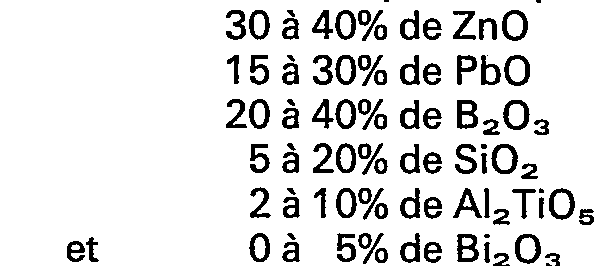
- La présente invention a pour objet un matériau vitreux comportant de l'oxyde de zinc ZnO, de l'oxyde de plomb PbO, de l'oxyde de bore B2O3, de la silice Si02, du titanate d'aluminium Al2TiO5 et éventuellement de l'oxyde de bismuth Bi203, caractérisé en ce qu'il comporte en poids
- La présente invention a aussi pour objet un composant à semi-conducteur comportant une pièce de silicium, caractérisé en ce qu'il comporte en outre une couche d'un matériau vitreux adhérant à la surface extérieure de la pièce, le matériau vitreux comportant en poids

- Des formes particulières d'exécution de l'objet de la présente invention sont décrites ci-dessous, à titre d'exemple.
- Le matériau vitreux selon l'invention est un mélange de six oxydes: l'oxyde de zinc ZnO, l'oxyde de plomb PbO, l'oxyde de bore B203, la silice Si02, le titanate d'aluminium Al2TiO5 et l'oxyde de bismuth Bi203. La proportion pondérale de chaque oxyde dans le mélange peut varier d'une valeur minimale à une valeur maximale, ces valeurs étant données dans le tableau 1. →
- Ces oxydes sont mélangés sous forme de poudre dans un creuset en platine qui est chauffé pendant 3 h environ pour obtenir la fusion du mélange, à

- Celui-ci présente une bonne résistance à la dévitrification, un coefficient de dilatation linéaire de l'ordre de 5·10-6/°C, et une température de nappage inférieure ou égale à 650° C. On rappelle que la température de nappage est la température à laquelle un échantillon de verre posé sur un substrat commence à s'étaler sur le substrat.
- Il est possible d'utiliser ce matériau vitreux pour déposer un revêtement protecteur sur la surface extérieure d'une pièce de silicium destinée à la fabrication d'un composant à semi-conducteur tel qu'une cellule solaire photoélectrique. Par fusion d'un échantillon du matériau vitreux posé sur la pièce, on forme une couche transparente adhérant à la surface extérieure de la pièce.
- Grâce à la faible température de nappage du matériau, le dépôt de cette couche ne risque pas de détériorer les jonctions p-n de la pièce de silicium. D'autre part, le faible coefficient de dilatation du matériau vitreux selon l'invention permet de diminuer les contraintes mécaniques entre le substrat de silicium et le verre déposé. On évite ainsi les fissurations de la couche constatées lorsqu'on utilise un verre selon l'art antérieur.
- La couche de verre est stable vis-à-vis du rayonnement ultraviolet, ce qui est un avantage important pour une cellule solaire, par rapport à certains revêtements à base de composés organiques.
- La couche déposée constitue également une bonne protection du silicium contre la contamination atmosphérique et les chocs mécaniques.
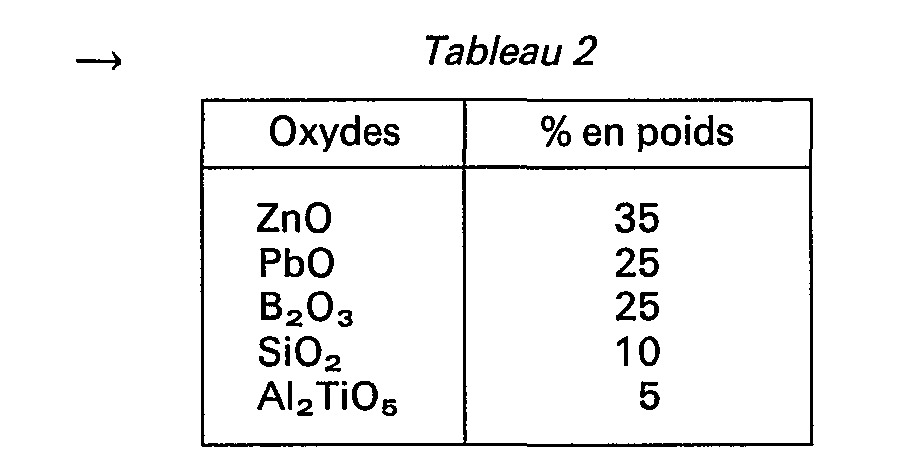
- A titre indicatif, on a réalisé des échantillons d'un verre présentant la composition suivante: →
- Les mesures effectuées sur ces échantillons ont permis d'obtenir les résultats suivants:
- - coefficient de dilatation moyen entre 20 et 300° C: 5,2·10-6/°C,
- - température de nappage 650° C,
- - température de transformation 510°C,
- - résistance à la dévitrification: bonne; le verre reste transparent après quatre cycles thermiques successifs comprenant chacun une montée à650°C, un palier à 650°C pendant ¼ h et une descente jusqu'à la température ambiante,
- - résistance au rayonnement ultraviolet et à l'humidité: bonne,
- - transmission optique dans la gamme de rayonnement visible: très bonne.
Claims (2)


Applications Claiming Priority (2)
| Application Number | Priority Date | Filing Date | Title |
|---|---|---|---|
| FR8113497 | 1981-07-09 | ||
| FR8113497A FR2509285A1 (fr) | 1981-07-09 | 1981-07-09 | Materiau vitreux et application a un composant a semi-conducteur |
Publications (2)
| Publication Number | Publication Date |
|---|---|
| EP0069963A1 EP0069963A1 (fr) | 1983-01-19 |
| EP0069963B1 true EP0069963B1 (fr) | 1984-12-05 |
Family
ID=9260378
Family Applications (1)
| Application Number | Title | Priority Date | Filing Date |
|---|---|---|---|
| EP82105998A Expired EP0069963B1 (fr) | 1981-07-09 | 1982-07-06 | Matériau vitreux et application à un composant à semiconducteur |
Country Status (5)
| Country | Link |
|---|---|
| US (1) | US4409292A (fr) |
| EP (1) | EP0069963B1 (fr) |
| JP (1) | JPS5820752A (fr) |
| DE (1) | DE3261460D1 (fr) |
| FR (1) | FR2509285A1 (fr) |
Families Citing this family (4)
| Publication number | Priority date | Publication date | Assignee | Title |
|---|---|---|---|---|
| KR100395022B1 (ko) * | 1994-04-22 | 2005-11-28 | 디보나 홀딩 아게 | 치아플라크중화효과가있는캔디 |
| US5629247A (en) * | 1996-05-08 | 1997-05-13 | The O'hommel Company | High bismuth oxide based flux and paint compositions for glass substrates |
| US6184163B1 (en) * | 1998-03-26 | 2001-02-06 | Lg Electronics Inc. | Dielectric composition for plasma display panel |
| KR100682931B1 (ko) * | 2005-02-15 | 2007-02-15 | 삼성전자주식회사 | 비정질 유전막 및 그 제조 방법 |
Family Cites Families (9)
| Publication number | Priority date | Publication date | Assignee | Title |
|---|---|---|---|---|
| FR1258070A (fr) * | 1959-05-28 | 1961-04-07 | Westinghouse Electric Corp | Composition de verre |
| NL251694A (fr) * | 1959-05-28 | |||
| FR1370296A (fr) * | 1962-09-20 | 1964-08-21 | Du Pont | Résistance électrique |
| NL298179A (fr) * | 1962-09-20 | |||
| US3645839A (en) * | 1969-01-10 | 1972-02-29 | Owens Illinois Inc | Glass sealing compositions containing aluminum titanate |
| US3734702A (en) * | 1969-01-10 | 1973-05-22 | Owens Illinois Inc | Glass sealing method |
| US3684536A (en) * | 1970-11-04 | 1972-08-15 | Du Pont | Bismuthate glass-ceramic precursor compositions |
| JPS5110844B2 (fr) * | 1973-04-24 | 1976-04-07 | ||
| DE2517743C3 (de) * | 1975-04-22 | 1980-03-06 | Jenaer Glaswerk Schott & Gen., 6500 Mainz | Passivierender Schutzüberzug für Siliziumhalbleiterbauelemente |
-
1981
- 1981-07-09 FR FR8113497A patent/FR2509285A1/fr active Granted
-
1982
- 1982-07-06 DE DE8282105998T patent/DE3261460D1/de not_active Expired
- 1982-07-06 EP EP82105998A patent/EP0069963B1/fr not_active Expired
- 1982-07-09 US US06/396,950 patent/US4409292A/en not_active Expired - Lifetime
- 1982-07-09 JP JP57119662A patent/JPS5820752A/ja active Granted
Also Published As
| Publication number | Publication date |
|---|---|
| FR2509285A1 (fr) | 1983-01-14 |
| FR2509285B1 (fr) | 1984-08-10 |
| JPS6146419B2 (fr) | 1986-10-14 |
| US4409292A (en) | 1983-10-11 |
| DE3261460D1 (en) | 1985-01-17 |
| EP0069963A1 (fr) | 1983-01-19 |
| JPS5820752A (ja) | 1983-02-07 |
Similar Documents
| Publication | Publication Date | Title |
|---|---|---|
| KR930006319B1 (ko) | 저온도 글래스 조성물, 페이스트 및 사용방법 | |
| FLASCHEN et al. | Formation and Properties of Low‐Melting Glasses in the Ternary Systems As—TI—S, As‐TI‐Se, and As—Se—S | |
| US3542572A (en) | Germania-silica glasses | |
| WO1993010052A1 (fr) | Compositions de verre de scellement a base temperature | |
| US4962066A (en) | Solder paste for fastening semiconductors onto ceramic bases | |
| US5013697A (en) | Sealing glass compositions | |
| FR2421857A1 (fr) | Composition pour resistance emaillee, resistance emaillee et procede de realisation d'une telle resistance | |
| DE3873938T2 (de) | Laminiertes substrat fuer integrierte schaltungen. | |
| US3303399A (en) | Glasses for encapsulating semiconductor devices and resultant devices | |
| FR2683831A1 (fr) | Article metallique revetu. | |
| US3637425A (en) | An insulating coating on silicon | |
| EP0215462B1 (fr) | Pâte de liaison entre des semi-conducteurs et des sous-couches céramiques | |
| DE4220472A1 (de) | Verfahren zur Herstellung von Leichtbaureflektoren mittels beschichteter Silicium-Formkörper | |
| US4109054A (en) | Composites of glass-ceramic-to-metal, seals and method of making same | |
| DE2104625B2 (de) | Verwendung einer lotlegierung | |
| DE1596820C2 (de) | Glas auf der Basis von ZnO-B tief 2 O tief 3 -SiO tief 2 mit einem thermischen Ausdehnungskoeffizienten von 44,5 bis 44,8.10 hoch -7 / Grad C (0-300 Grad C) und seine Verwendung | |
| KR970007179B1 (ko) | 은-충전유리 | |
| EP0069963A1 (fr) | Matériau vitreux et application à un composant à semiconducteur | |
| US3663244A (en) | High durability lead titanate-containing enamel for glass ceramics | |
| US3752701A (en) | Glass for coating semiconductors, and semiconductor coated therewith | |
| DE1496545C3 (de) | Verwendung von Glas als Schutzschicht für Halbleiter | |
| US3115415A (en) | Vitreous enamel, article and method | |
| DE2037524A1 (de) | Verfahren zur Herstellung eines in Glas gekapselten Halbleiterbauelements | |
| US3674520A (en) | Solder glass for adhering sealing or coating | |
| KR20190019734A (ko) | 자기 애자 금구류의 코팅 방법 및 이의 의해 제조된 자기 애자 |
Legal Events
| Date | Code | Title | Description |
|---|---|---|---|
| PUAI | Public reference made under article 153(3) epc to a published international application that has entered the european phase |
Free format text: ORIGINAL CODE: 0009012 |
|
| AK | Designated contracting states |
Designated state(s): BE DE FR GB IT NL |
|
| 17P | Request for examination filed |
Effective date: 19830623 |
|
| ITF | It: translation for a ep patent filed | ||
| GRAA | (expected) grant |
Free format text: ORIGINAL CODE: 0009210 |
|
| AK | Designated contracting states |
Designated state(s): BE DE FR GB IT NL |
|
| REF | Corresponds to: |
Ref document number: 3261460 Country of ref document: DE Date of ref document: 19850117 |
|
| PLBE | No opposition filed within time limit |
Free format text: ORIGINAL CODE: 0009261 |
|
| STAA | Information on the status of an ep patent application or granted ep patent |
Free format text: STATUS: NO OPPOSITION FILED WITHIN TIME LIMIT |
|
| 26N | No opposition filed | ||
| ITTA | It: last paid annual fee | ||
| REG | Reference to a national code |
Ref country code: GB Ref legal event code: 732E |
|
| REG | Reference to a national code |
Ref country code: FR Ref legal event code: TP Ref country code: FR Ref legal event code: CD |
|
| ITPR | It: changes in ownership of a european patent |
Owner name: CESSIONE;PHOTOWATT INTERNATIONAL S.A. |
|
| NLT1 | Nl: modifications of names registered in virtue of documents presented to the patent office pursuant to art. 16 a, paragraph 1 |
Owner name: ALCATEL ALSTHOM COMPAGNIE GENERALE D'ELECTRICITE T |
|
| NLS | Nl: assignments of ep-patents |
Owner name: PHOTOWATT INTERNATIONAL S.A. TE BOURGOIN JALLIEU, |
|
| BECH | Be: change of holder |
Free format text: 940126 S.A. *PHOTOWATT INTERNATIONAL |
|
| PGFP | Annual fee paid to national office [announced via postgrant information from national office to epo] |
Ref country code: DE Payment date: 19950529 Year of fee payment: 14 |
|
| PGFP | Annual fee paid to national office [announced via postgrant information from national office to epo] |
Ref country code: BE Payment date: 19950602 Year of fee payment: 14 |
|
| PGFP | Annual fee paid to national office [announced via postgrant information from national office to epo] |
Ref country code: GB Payment date: 19950615 Year of fee payment: 14 |
|
| PGFP | Annual fee paid to national office [announced via postgrant information from national office to epo] |
Ref country code: NL Payment date: 19950728 Year of fee payment: 14 |
|
| PGFP | Annual fee paid to national office [announced via postgrant information from national office to epo] |
Ref country code: FR Payment date: 19960524 Year of fee payment: 15 |
|
| PG25 | Lapsed in a contracting state [announced via postgrant information from national office to epo] |
Ref country code: GB Effective date: 19960706 |
|
| PG25 | Lapsed in a contracting state [announced via postgrant information from national office to epo] |
Ref country code: BE Effective date: 19960731 |
|
| BERE | Be: lapsed |
Owner name: S.A. PHOTOWATT INTERNATIONAL Effective date: 19960731 |
|
| PG25 | Lapsed in a contracting state [announced via postgrant information from national office to epo] |
Ref country code: NL Effective date: 19970201 |
|
| GBPC | Gb: european patent ceased through non-payment of renewal fee |
Effective date: 19960706 |
|
| NLV4 | Nl: lapsed or anulled due to non-payment of the annual fee |
Effective date: 19970201 |
|
| PG25 | Lapsed in a contracting state [announced via postgrant information from national office to epo] |
Ref country code: DE Effective date: 19970402 |
|
| PG25 | Lapsed in a contracting state [announced via postgrant information from national office to epo] |
Ref country code: FR Free format text: LAPSE BECAUSE OF NON-PAYMENT OF DUE FEES Effective date: 19980331 |
|
| REG | Reference to a national code |
Ref country code: FR Ref legal event code: ST |