EP0070048A2 - Dérivés de tyrosine - Google Patents
Dérivés de tyrosine Download PDFInfo
- Publication number
- EP0070048A2 EP0070048A2 EP82200649A EP82200649A EP0070048A2 EP 0070048 A2 EP0070048 A2 EP 0070048A2 EP 82200649 A EP82200649 A EP 82200649A EP 82200649 A EP82200649 A EP 82200649A EP 0070048 A2 EP0070048 A2 EP 0070048A2
- Authority
- EP
- European Patent Office
- Prior art keywords
- tyrosine
- arginine
- composition
- epidermis
- chemical process
- Prior art date
- Legal status (The legal status is an assumption and is not a legal conclusion. Google has not performed a legal analysis and makes no representation as to the accuracy of the status listed.)
- Granted
Links
- 150000003667 tyrosine derivatives Chemical class 0.000 title claims description 12
- 210000002615 epidermis Anatomy 0.000 claims abstract description 19
- 235000001014 amino acid Nutrition 0.000 claims abstract description 15
- 150000001413 amino acids Chemical class 0.000 claims abstract description 15
- OUYCCCASQSFEME-QMMMGPOBSA-N L-tyrosine Chemical compound OC(=O)[C@@H](N)CC1=CC=C(O)C=C1 OUYCCCASQSFEME-QMMMGPOBSA-N 0.000 claims description 32
- 229960004441 tyrosine Drugs 0.000 claims description 23
- 238000002360 preparation method Methods 0.000 claims description 17
- 229940024606 amino acid Drugs 0.000 claims description 14
- ODKSFYDXXFIFQN-BYPYZUCNSA-N L-arginine Chemical compound OC(=O)[C@@H](N)CCCN=C(N)N ODKSFYDXXFIFQN-BYPYZUCNSA-N 0.000 claims description 12
- OUYCCCASQSFEME-UHFFFAOYSA-N tyrosine Natural products OC(=O)C(N)CC1=CC=C(O)C=C1 OUYCCCASQSFEME-UHFFFAOYSA-N 0.000 claims description 12
- 229930064664 L-arginine Natural products 0.000 claims description 11
- 235000014852 L-arginine Nutrition 0.000 claims description 11
- AHLPHDHHMVZTML-BYPYZUCNSA-N L-Ornithine Chemical compound NCCC[C@H](N)C(O)=O AHLPHDHHMVZTML-BYPYZUCNSA-N 0.000 claims description 10
- RHGKLRLOHDJJDR-BYPYZUCNSA-N L-citrulline Chemical compound NC(=O)NCCC[C@H]([NH3+])C([O-])=O RHGKLRLOHDJJDR-BYPYZUCNSA-N 0.000 claims description 10
- 238000001311 chemical methods and process Methods 0.000 claims description 10
- KDXKERNSBIXSRK-YFKPBYRVSA-N L-lysine Chemical compound NCCCC[C@H](N)C(O)=O KDXKERNSBIXSRK-YFKPBYRVSA-N 0.000 claims description 8
- 238000006386 neutralization reaction Methods 0.000 claims description 8
- 150000003839 salts Chemical class 0.000 claims description 8
- AHLPHDHHMVZTML-UHFFFAOYSA-N Orn-delta-NH2 Natural products NCCCC(N)C(O)=O AHLPHDHHMVZTML-UHFFFAOYSA-N 0.000 claims description 5
- 229960002173 citrulline Drugs 0.000 claims description 5
- 229960003104 ornithine Drugs 0.000 claims description 5
- 235000019766 L-Lysine Nutrition 0.000 claims description 4
- 239000004472 Lysine Substances 0.000 claims description 4
- 229960003646 lysine Drugs 0.000 claims description 4
- YSMODUONRAFBET-UHNVWZDZSA-N erythro-5-hydroxy-L-lysine Chemical compound NC[C@H](O)CC[C@H](N)C(O)=O YSMODUONRAFBET-UHNVWZDZSA-N 0.000 claims description 3
- QJHBJHUKURJDLG-UHFFFAOYSA-N hydroxy-L-lysine Natural products NCCCCC(NO)C(O)=O QJHBJHUKURJDLG-UHFFFAOYSA-N 0.000 claims description 3
- -1 L-hydroxylysineo Chemical class 0.000 claims 1
- 230000007935 neutral effect Effects 0.000 claims 1
- 239000000203 mixture Substances 0.000 abstract description 43
- 239000000126 substance Substances 0.000 abstract description 16
- 230000003711 photoprotective effect Effects 0.000 abstract description 8
- 239000002537 cosmetic Substances 0.000 abstract description 7
- 230000000699 topical effect Effects 0.000 abstract description 5
- 230000003061 melanogenesis Effects 0.000 abstract description 4
- 239000005445 natural material Substances 0.000 abstract 1
- 230000001737 promoting effect Effects 0.000 abstract 1
- RWSXRVCMGQZWBV-WDSKDSINSA-N glutathione Chemical compound OC(=O)[C@@H](N)CCC(=O)N[C@@H](CS)C(=O)NCC(O)=O RWSXRVCMGQZWBV-WDSKDSINSA-N 0.000 description 11
- 239000000546 pharmaceutical excipient Substances 0.000 description 9
- 210000003491 skin Anatomy 0.000 description 9
- 239000000470 constituent Substances 0.000 description 7
- LOIYMIARKYCTBW-OWOJBTEDSA-N trans-urocanic acid Chemical compound OC(=O)\C=C\C1=CNC=N1 LOIYMIARKYCTBW-OWOJBTEDSA-N 0.000 description 7
- DHMQDGOQFOQNFH-UHFFFAOYSA-N Glycine Chemical compound NCC(O)=O DHMQDGOQFOQNFH-UHFFFAOYSA-N 0.000 description 6
- 235000003969 glutathione Nutrition 0.000 description 6
- 229960003180 glutathione Drugs 0.000 description 6
- 108010024636 Glutathione Proteins 0.000 description 5
- 206010047642 Vitiligo Diseases 0.000 description 5
- 230000005855 radiation Effects 0.000 description 5
- ODKSFYDXXFIFQN-UHFFFAOYSA-N arginine Natural products OC(=O)C(N)CCCNC(N)=N ODKSFYDXXFIFQN-UHFFFAOYSA-N 0.000 description 4
- 230000000694 effects Effects 0.000 description 4
- 239000000243 solution Substances 0.000 description 4
- LOIYMIARKYCTBW-UHFFFAOYSA-N trans-urocanic acid Natural products OC(=O)C=CC1=CNC=N1 LOIYMIARKYCTBW-UHFFFAOYSA-N 0.000 description 4
- 239000004471 Glycine Substances 0.000 description 3
- 208000012641 Pigmentation disease Diseases 0.000 description 3
- DNIAPMSPPWPWGF-UHFFFAOYSA-N Propylene glycol Chemical compound CC(O)CO DNIAPMSPPWPWGF-UHFFFAOYSA-N 0.000 description 3
- 102000003425 Tyrosinase Human genes 0.000 description 3
- 108060008724 Tyrosinase Proteins 0.000 description 3
- 239000003795 chemical substances by application Substances 0.000 description 3
- HNDVDQJCIGZPNO-UHFFFAOYSA-N histidine Natural products OC(=O)C(N)CC1=CN=CN1 HNDVDQJCIGZPNO-UHFFFAOYSA-N 0.000 description 3
- XLYOFNOQVPJJNP-UHFFFAOYSA-N water Substances O XLYOFNOQVPJJNP-UHFFFAOYSA-N 0.000 description 3
- 239000004475 Arginine Substances 0.000 description 2
- 206010015150 Erythema Diseases 0.000 description 2
- XUMBMVFBXHLACL-UHFFFAOYSA-N Melanin Chemical compound O=C1C(=O)C(C2=CNC3=C(C(C(=O)C4=C32)=O)C)=C2C4=CNC2=C1C XUMBMVFBXHLACL-UHFFFAOYSA-N 0.000 description 2
- 241000699670 Mus sp. Species 0.000 description 2
- 235000009697 arginine Nutrition 0.000 description 2
- 230000015572 biosynthetic process Effects 0.000 description 2
- 230000001413 cellular effect Effects 0.000 description 2
- WBYWAXJHAXSJNI-UHFFFAOYSA-N cinnamic acid Chemical class OC(=O)C=CC1=CC=CC=C1 WBYWAXJHAXSJNI-UHFFFAOYSA-N 0.000 description 2
- 150000001875 compounds Chemical class 0.000 description 2
- RXKJFZQQPQGTFL-UHFFFAOYSA-N dihydroxyacetone Chemical compound OCC(=O)CO RXKJFZQQPQGTFL-UHFFFAOYSA-N 0.000 description 2
- 231100000321 erythema Toxicity 0.000 description 2
- 230000007794 irritation Effects 0.000 description 2
- 238000000034 method Methods 0.000 description 2
- 239000003921 oil Substances 0.000 description 2
- 235000019198 oils Nutrition 0.000 description 2
- 239000003504 photosensitizing agent Substances 0.000 description 2
- 239000002243 precursor Substances 0.000 description 2
- 230000001681 protective effect Effects 0.000 description 2
- 150000004053 quinones Chemical class 0.000 description 2
- 238000003786 synthesis reaction Methods 0.000 description 2
- FPIPGXGPPPQFEQ-UHFFFAOYSA-N 13-cis retinol Natural products OCC=C(C)C=CC=C(C)C=CC1=C(C)CCCC1(C)C FPIPGXGPPPQFEQ-UHFFFAOYSA-N 0.000 description 1
- 206010001488 Aggression Diseases 0.000 description 1
- 235000007866 Chamaemelum nobile Nutrition 0.000 description 1
- 241000196324 Embryophyta Species 0.000 description 1
- 102000004190 Enzymes Human genes 0.000 description 1
- 108090000790 Enzymes Proteins 0.000 description 1
- XUJNEKJLAYXESH-REOHCLBHSA-N L-Cysteine Chemical compound SC[C@H](N)C(O)=O XUJNEKJLAYXESH-REOHCLBHSA-N 0.000 description 1
- WTDRDQBEARUVNC-UHFFFAOYSA-N L-Dopa Natural products OC(=O)C(N)CC1=CC=C(O)C(O)=C1 WTDRDQBEARUVNC-UHFFFAOYSA-N 0.000 description 1
- LEVWYRKDKASIDU-IMJSIDKUSA-N L-cystine Chemical compound [O-]C(=O)[C@@H]([NH3+])CSSC[C@H]([NH3+])C([O-])=O LEVWYRKDKASIDU-IMJSIDKUSA-N 0.000 description 1
- HNDVDQJCIGZPNO-YFKPBYRVSA-N L-histidine Chemical compound OC(=O)[C@@H](N)CC1=CN=CN1 HNDVDQJCIGZPNO-YFKPBYRVSA-N 0.000 description 1
- FFEARJCKVFRZRR-BYPYZUCNSA-N L-methionine Chemical compound CSCC[C@H](N)C(O)=O FFEARJCKVFRZRR-BYPYZUCNSA-N 0.000 description 1
- 244000042664 Matricaria chamomilla Species 0.000 description 1
- 235000007232 Matricaria chamomilla Nutrition 0.000 description 1
- 244000179970 Monarda didyma Species 0.000 description 1
- 235000010672 Monarda didyma Nutrition 0.000 description 1
- 206010067482 No adverse event Diseases 0.000 description 1
- 244000000231 Sesamum indicum Species 0.000 description 1
- 235000003434 Sesamum indicum Nutrition 0.000 description 1
- 206010040880 Skin irritation Diseases 0.000 description 1
- NINIDFKCEFEMDL-UHFFFAOYSA-N Sulfur Chemical compound [S] NINIDFKCEFEMDL-UHFFFAOYSA-N 0.000 description 1
- 206010042496 Sunburn Diseases 0.000 description 1
- FPIPGXGPPPQFEQ-BOOMUCAASA-N Vitamin A Natural products OC/C=C(/C)\C=C\C=C(\C)/C=C/C1=C(C)CCCC1(C)C FPIPGXGPPPQFEQ-BOOMUCAASA-N 0.000 description 1
- FPIPGXGPPPQFEQ-OVSJKPMPSA-N all-trans-retinol Chemical compound OC\C=C(/C)\C=C\C=C(/C)\C=C\C1=C(C)CCCC1(C)C FPIPGXGPPPQFEQ-OVSJKPMPSA-N 0.000 description 1
- 238000004458 analytical method Methods 0.000 description 1
- RWZYAGGXGHYGMB-UHFFFAOYSA-N anthranilic acid Chemical class NC1=CC=CC=C1C(O)=O RWZYAGGXGHYGMB-UHFFFAOYSA-N 0.000 description 1
- 239000007864 aqueous solution Substances 0.000 description 1
- 230000003796 beauty Effects 0.000 description 1
- 235000012216 bentonite Nutrition 0.000 description 1
- 230000005779 cell damage Effects 0.000 description 1
- 239000013043 chemical agent Substances 0.000 description 1
- 238000004040 coloring Methods 0.000 description 1
- 235000018417 cysteine Nutrition 0.000 description 1
- XUJNEKJLAYXESH-UHFFFAOYSA-N cysteine Natural products SCC(N)C(O)=O XUJNEKJLAYXESH-UHFFFAOYSA-N 0.000 description 1
- 229960003067 cystine Drugs 0.000 description 1
- 238000009792 diffusion process Methods 0.000 description 1
- 229940120503 dihydroxyacetone Drugs 0.000 description 1
- MHUWZNTUIIFHAS-CLFAGFIQSA-N dioleoyl phosphatidic acid Chemical compound CCCCCCCC\C=C/CCCCCCCC(=O)OCC(COP(O)(O)=O)OC(=O)CCCCCCC\C=C/CCCCCCCC MHUWZNTUIIFHAS-CLFAGFIQSA-N 0.000 description 1
- 239000000839 emulsion Substances 0.000 description 1
- 239000003623 enhancer Substances 0.000 description 1
- 210000001339 epidermal cell Anatomy 0.000 description 1
- UQPHVQVXLPRNCX-UHFFFAOYSA-N erythrulose Chemical compound OCC(O)C(=O)CO UQPHVQVXLPRNCX-UHFFFAOYSA-N 0.000 description 1
- 238000000605 extraction Methods 0.000 description 1
- 238000009472 formulation Methods 0.000 description 1
- 230000005764 inhibitory process Effects 0.000 description 1
- 230000000622 irritating effect Effects 0.000 description 1
- 229960004502 levodopa Drugs 0.000 description 1
- 210000002752 melanocyte Anatomy 0.000 description 1
- 229930182817 methionine Natural products 0.000 description 1
- 231100000252 nontoxic Toxicity 0.000 description 1
- 230000001590 oxidative effect Effects 0.000 description 1
- 239000008194 pharmaceutical composition Substances 0.000 description 1
- 230000019612 pigmentation Effects 0.000 description 1
- 229920000642 polymer Polymers 0.000 description 1
- 239000003755 preservative agent Substances 0.000 description 1
- 229960004063 propylene glycol Drugs 0.000 description 1
- 235000013772 propylene glycol Nutrition 0.000 description 1
- 150000004059 quinone derivatives Chemical class 0.000 description 1
- 239000012048 reactive intermediate Substances 0.000 description 1
- 150000003873 salicylate salts Chemical class 0.000 description 1
- 231100000475 skin irritation Toxicity 0.000 description 1
- 230000036556 skin irritation Effects 0.000 description 1
- WPLOVIFNBMNBPD-ATHMIXSHSA-N subtilin Chemical compound CC1SCC(NC2=O)C(=O)NC(CC(N)=O)C(=O)NC(C(=O)NC(CCCCN)C(=O)NC(C(C)CC)C(=O)NC(=C)C(=O)NC(CCCCN)C(O)=O)CSC(C)C2NC(=O)C(CC(C)C)NC(=O)C1NC(=O)C(CCC(N)=O)NC(=O)C(CC(C)C)NC(=O)C(NC(=O)C1NC(=O)C(=C/C)/NC(=O)C(CCC(N)=O)NC(=O)C(CC(C)C)NC(=O)C(C)NC(=O)CNC(=O)C(NC(=O)C(NC(=O)C2NC(=O)CNC(=O)C3CCCN3C(=O)C(NC(=O)C3NC(=O)C(CC(C)C)NC(=O)C(=C)NC(=O)C(CCC(O)=O)NC(=O)C(NC(=O)C(CCCCN)NC(=O)C(N)CC=4C5=CC=CC=C5NC=4)CSC3)C(C)SC2)C(C)C)C(C)SC1)CC1=CC=CC=C1 WPLOVIFNBMNBPD-ATHMIXSHSA-N 0.000 description 1
- 229910052717 sulfur Inorganic materials 0.000 description 1
- 239000011593 sulfur Substances 0.000 description 1
- 230000037072 sun protection Effects 0.000 description 1
- 210000000106 sweat gland Anatomy 0.000 description 1
- 231100000820 toxicity test Toxicity 0.000 description 1
- 238000009281 ultraviolet germicidal irradiation Methods 0.000 description 1
- 235000015112 vegetable and seed oil Nutrition 0.000 description 1
- 239000008158 vegetable oil Substances 0.000 description 1
- 235000019155 vitamin A Nutrition 0.000 description 1
- 239000011719 vitamin A Substances 0.000 description 1
- 229940045997 vitamin a Drugs 0.000 description 1
Classifications
-
- A—HUMAN NECESSITIES
- A61—MEDICAL OR VETERINARY SCIENCE; HYGIENE
- A61K—PREPARATIONS FOR MEDICAL, DENTAL OR TOILETRY PURPOSES
- A61K8/00—Cosmetics or similar toiletry preparations
- A61K8/18—Cosmetics or similar toiletry preparations characterised by the composition
- A61K8/30—Cosmetics or similar toiletry preparations characterised by the composition containing organic compounds
- A61K8/40—Cosmetics or similar toiletry preparations characterised by the composition containing organic compounds containing nitrogen
- A61K8/44—Aminocarboxylic acids or derivatives thereof, e.g. aminocarboxylic acids containing sulfur; Salts; Esters or N-acylated derivatives thereof
-
- A—HUMAN NECESSITIES
- A61—MEDICAL OR VETERINARY SCIENCE; HYGIENE
- A61Q—SPECIFIC USE OF COSMETICS OR SIMILAR TOILETRY PREPARATIONS
- A61Q17/00—Barrier preparations; Preparations brought into direct contact with the skin for affording protection against external influences, e.g. sunlight, X-rays or other harmful rays, corrosive materials, bacteria or insect stings
- A61Q17/04—Topical preparations for affording protection against sunlight or other radiation; Topical sun tanning preparations
-
- A—HUMAN NECESSITIES
- A61—MEDICAL OR VETERINARY SCIENCE; HYGIENE
- A61Q—SPECIFIC USE OF COSMETICS OR SIMILAR TOILETRY PREPARATIONS
- A61Q19/00—Preparations for care of the skin
- A61Q19/04—Preparations for care of the skin for chemically tanning the skin
-
- C—CHEMISTRY; METALLURGY
- C07—ORGANIC CHEMISTRY
- C07C—ACYCLIC OR CARBOCYCLIC COMPOUNDS
- C07C275/00—Derivatives of urea, i.e. compounds containing any of the groups, the nitrogen atoms not being part of nitro or nitroso groups
- C07C275/04—Derivatives of urea, i.e. compounds containing any of the groups, the nitrogen atoms not being part of nitro or nitroso groups having nitrogen atoms of urea groups bound to acyclic carbon atoms
- C07C275/06—Derivatives of urea, i.e. compounds containing any of the groups, the nitrogen atoms not being part of nitro or nitroso groups having nitrogen atoms of urea groups bound to acyclic carbon atoms of an acyclic and saturated carbon skeleton
- C07C275/16—Derivatives of urea, i.e. compounds containing any of the groups, the nitrogen atoms not being part of nitro or nitroso groups having nitrogen atoms of urea groups bound to acyclic carbon atoms of an acyclic and saturated carbon skeleton being further substituted by carboxyl groups
Definitions
- the present invention essentially relates to new tyrosine derivatives and a chemical process for the preparation of these new tyrosine derivatives.
- These new tyrosine derivatives can be incorporated into a composition which can be used in particular as a cosmetic product intended to be applied topically to the epidermis to promote the photo-pigmentation thereof and / or its photo-protection by exposure to solar radiation. or ultra-violet.
- compositions favoring the tanning of the skin and / or its photo-protection For example, we know so-called anti-sun preparations which allow exposure to the sun, with tanning, while protecting the skin from UV B radiation. , reputed to be matogenic and dangerous erythd, which use screen substances or sun filters prepared by synthesis such as salicylates, anthranilates, cinnamates or para-amino benzoic esters or of natural origin obtained by extraction from plants, for example vegetable oils, sesame, chamomile.
- photo-sensitizers applied internally or topically, prepared by synthesis such as furocoumarins or 5 or 8-methoxypsoralens (MOP), or of natural origin such as the essence of bergamot, the vitamin A or F.
- tanning or tanning products are also known which use chemical agents such as dihydroxyacetone, erythrulose, glycerosis.
- other known preparations use coloring and tinting products which provide a tanned or tanned complexion.
- a composition which mainly comprises the use of a tyrosinase in order to achieve a tanning effect by oxidizing action on the tyrosine present in the skin or found therein by the prior application of substances containing it.
- tyrosinase we mainly use tyrosinase while tyrosine is used quite incidentally.
- the tyrosinase used according to this document has a major drawback, namely that it cannot be used in current cosmetic preparations because of its instability in its dissolved form. On the other hand, this document does not specify the conditions for inhibition of this enzyme.
- tyrosine is used as it is, that is to say under a free form and in aqueous solution so that this document does not make it possible to solve the abovementioned drawbacks if it does not arrive in the best of cases only to provide a superficial pigmentation of the epidermis and the composition according to this document must therefore be used in renewed and frequent application taking into account the difficulty of making it penetrate into the external layers of the epidermis.
- the present invention therefore aims to remedy the aforementioned drawbacks of the preparations or compositions known bronzers by providing new derivatives making it possible to carry out photo-pigmentation of the epidermis and / or its photo-protection by exposure to solar or ultra-violet radiation, which are well tolerated by the epidermis and avoid the appearance of painful erythema or "sunburn" which may have more or less serious consequences.
- this solution according to the invention must allow diffusion of the product or products used up to the level of the melanocytes simply by repeated topical application to the skin with solar or ultraviolet radiation on the intact epidermis while avoiding irritation of the epidermis which is likely to produce side effects.
- This solution to this new technical problem should preferably be of particularly simple design.
- This solution consists, according to the present invention, of new tyrosine derivatives, characterized in that it is the complex salt of tyrosine with at least one basic amino acid homologous to those normally present in the epidermis.
- the basic amino acid is chosen from L-arginine, L-ornithine, L-citrulline, L-lysine, or L-hydroxylysine.
- L-tyrosine complex salt of L-arginine preferably consisting of 47% by weight of tyrosine and 53% by weight of arginine.
- the present invention also relates to a chemical process for the preparation of new derivatives of aforementioned tyrosine, characterized in that it comprises the neutralization of tyrosine with at least one basic amino acid homologous to those normally present in the epidermis.
- this abovementioned basic amino acid is chosen from L-arginine, L-ornithine, L-citrulline, L-lysine or L-hydroxylysine.
- the neutralization is carried out so as to adjust the pH to neutrality or to the epidermal pH.
- a composition comprising, as homologous substance, melanin precursor, L-tyrosine in the form of an L-tyrosine-L-arginine base complex which is perfectly soluble and stable and the pH of which can be adjusted to neutrality or to the epidermal pH by varying the proportions of each of the constituents.
- this complex is made up of 47% L-tyrosine and 53% L-arginine base.
- This complex is then diluted in an excipient such as a water, hydroglycolic, hydroalcoholic excipient, an oil / water or water / oil emulsion, a polymer gel, a miscellaneous or telluric organic gel: bentonites, clays, bentones, hectorites , cellulosic gel, so that this complex constitutes from 0.1 to 20% by weight of the total composition, which makes it possible to prepare a composition which can be used in particular in cosmetics and in sun products: photo-protectors, tanning products having different presentations .
- an excipient such as a water, hydroglycolic, hydroalcoholic excipient, an oil / water or water / oil emulsion, a polymer gel, a miscellaneous or telluric organic gel: bentonites, clays, bentones, hectorites , cellulosic gel, so that this complex constitutes from 0.1 to 20% by weight of the total composition, which makes it possible to prepare a composition which can be
- a composition having homologues are prepared as the following components: - Complex of '
- the preparation of this composition is carried out in the following manner: first of all the L-tyrosine and the L-arginine base are mixed so as to produce an L-tyrosine-L-arginine complex then the glutathione is added. Then, the association of these three components is diluted in a usual excipient of the type defined in Example 1 above in order to obtain a composition having a total amino acid concentration of between 0.1 and 20% by weight of the composition.
- glutathione has a particularly important cellular photo-protective role.
- glutathione has a protective moderating role against cellular damage caused by quinones, highly reactive intermediates, which intervene in the process of melanogenesis, these quinones being known to seriously affect the RNA of epidermal cells.
- glutathione can be substituted by other sulfur-containing amino acids such as cystine, cysteine, methionine.
- glycine is a synergizing agent serving to fix quinone derivatives and DOPA which enter the melanogenesis cycle. This association therefore strengthens cellular protective activity (RNA) and, moreover, is particularly substantive
- This preparation of this composition is carried out in a similar manner to that of the preceding examples so as to obtain a total concentration of homologous substances of between 0.1 and 20% by weight of the composition.
- histidine reinforces the substantive role of the composition as well as its photo-protective role since it is the precursor of urocanic acid present in the epidermis and the sweat glands.
- histidine can be replaced by urocanic acid or its derivatives, preferably arginine urocanate, histidine urocanate or arginine-histidine urocanate.
- urocanic acid constitutes the most functional natural photo-protector for the skin by partially stopping harmful ultraviolet B rays.
- free urocanic acid is not very soluble and not very substantive, its salts, in particular its salts with amino acids, have the advantage of being soluble, active on the photoprotective level and substantive on the epidermis.
- a composition is prepared giving excellent results with a total concentration of homologous substances equal to 3% in the form of a hydroglycerine solute having the following constituents:
- a composition forming a sun protection preparation is prepared having a total concentration of homologous substances equal to 3% of the composition, comprising the following constituents:
- the excipient consists of the following compounds: As well as minor amounts of preservatives.
- the excipient only plays a role of vehicle, cosmetically or dermatologically suitable, without significant influence on the activity of the complexes or associations of homologous substances the object of the present invention.
- composition of the present invention To demonstrate the physiological actions of the composition of the present invention, clinical trials have been carried out on patients suffering from achromias of the skin. The treated patients suffered from vitiligo.
- UVR lamp For the treatment of vitiligo, topical applications of the above composition were carried out every 24 hours on the apigmented or irregularly pigmented areas, and then irradiations were carried out for a period of time of approximately 10 minutes - 30 minutes with a 20 watt UVR lamp.
- the emission of UV rays comprises approximately: 20% of UVB rays and 80% of UVA rays.
- the repigmentation increases in intensity, without the appearance of erythemas.
- composition according to the present invention by topical applications solves such a problem with a simple UV irradiation for a short period of time which clearly highlights the photo-pigmentogenic activity of the composition according to the present invention with UVA-UVB exposure.
- mice were studied the primary skin irritation according to the official method of analysis of cosmetic and beauty products published in the French Official Journal of April 21, 1971. Equal- ment, a study was carried out with regard to the index of primary ocular irritation on mice with the index of surface cutaneous aggressiveness of the composition according to the present invention by iterative applications.
Landscapes
- Health & Medical Sciences (AREA)
- Life Sciences & Earth Sciences (AREA)
- Veterinary Medicine (AREA)
- Animal Behavior & Ethology (AREA)
- General Health & Medical Sciences (AREA)
- Public Health (AREA)
- Dermatology (AREA)
- Chemical & Material Sciences (AREA)
- Organic Chemistry (AREA)
- Birds (AREA)
- Epidemiology (AREA)
- Cosmetics (AREA)
- Organic Low-Molecular-Weight Compounds And Preparation Thereof (AREA)
- Pharmaceuticals Containing Other Organic And Inorganic Compounds (AREA)
- Acyclic And Carbocyclic Compounds In Medicinal Compositions (AREA)
Abstract
Description
- La présente invention a essentiellement pour objet de nouveaux dérivés de tyrosine et un procédé chimique de préparation de ces nouveaux dérivés de tyrosine.
- Ces nouveaux dérivés de tyrosine peuvent être incorporés dans une composition, utilisable notamment comme produit cosmétique destinée à être appliquée topique- ment sur l'épiderme pour favoriser la photo-pigmentation de celui-ci et/ou sa photo-protection par exposition au rayonnement solaire ou ultra-violet .
- On connaît déjà des compositions favorisant le bronzage de la peau et/ou sa photo-protectiono Par exemple, on connaît des préparations dites anti-solaires qui permettent l'exposition au soleil,avec bronzage, tout en protégeant la peau des rayonnements UV B, réputés érythd matogènes et dangereux, qui utilisent des substances écran ou filtres solaires préparées par synthèse telles que les salicylates, anthranilates, cinnamates ou esters para-amino benzoïques ou d'origine naturelle obtenues par extraction à partir de végétaux, par exemple huiles végétales, sésame, camomille.
- D'autres préparations connues utilisent des photo-sensibilisants appliqués par voie interne ou topique, préparés par synthèse tels que les furocoumarines ou le 5 ou 8-méthoxypsoralènes (M.O.P.), ou d'origine naturelle tels que l'essence de bergamote, la vitamine A ou F.
- On connaît également d'autres produits dits bronzants ou tannants sans soleil qui utilisent des agents chimiques tels que dihydroxyacétone, érythrulose, glycérose. De même d'autres préparations connues utilisent des produits colorants et teintés qui procurent un teint hâlé ou bronzé.
- Cependant, toutes ces préparations ou composition connues permettant un bronzage de la peau avec ou sans soleil utilisent des agents étrangers à la peau et présentent des inconvénients très importants et bien connus. En effet, ces agents étrangers sont rarement substantifs. D'autre part, ils sont plus ou moins bien tolérés. En outre, ils doivent être utilisés en applications renouvelées et fréquentes compte tenu de la difficulté de les faire pénétrer dans les couches externes de l'épiderme.
- Certaines de ces préparations connues sont même dangereuses, en particulier les préparations à base de photo-sensibilisants et doivent donc être utilisés avec précautions.
- Par ailleurs, on connaît aussi à partir du brevet belge n° 458.709 une composition comportant principalement l'emploi d'une tyrosinase en vue de réaliser un effet bronzant par action oxydante sur la tyrosine présente dans la peau ou s'y trouvant par l'application préalable de substances la contenant. Selon ce document, on utilise principalement la tyrosinase alors que la tyrosine est employée tout à fait accessoirement. En outre, la tyrosinase utilisée selon ce document présente un inconvénient majeur à savoir qu'elle ne peut être utilisée dans les préparations cosmétiques courantes en raison de son instabilité dans sa forme dissoute. D'autre part, ce document ne précise pas les conditions d'inhibition de cette enzyme.
- Enfin, selon ce document, la tyrosine est employée telle quelle, c'est-à-diresous une forme libre et en solution aqueuse de sorte que ce document ne permet pas de_résoudre les inconvénients précités s'il n'arrive dans le meilleur des cas qu'à fournir une pigmentation superficielle de l'épiderme et la composition selon ce document doit donc être utilisée en application renouvelée et fréquente compte tenu de la difficulté de la faire pénétrer dans les couches externes de l'épiderme.
- D'autre part, un ouvrage de JANYSTIN HANDBUCH DER KOSMETIKA UND RIECHSTOFFE, volume 1/1969, pages 1117-1119 cite sur des bases théoriques un certain nombre d'amino-acides dont on indique notamment simplement que la tyrosine "doit" procurer un brunissement de la peau, une telle mention théorique ne pouvant en aucun cas être utilisable en pratique pour un homme du métier.
- L'art antérieur n'a donc pas fourni de solution capable de remédier aux inconvénients précités.
- La présente invention adonc pour but de remédier aux inconvénients précités des préparations ou compositions bronzantes connues en fournissant de nouveaux dérivés permettant de réaliser une photo-pigmentation de l'épiderme et/ou sa photo-protection par exposition aux rayonnements solaires ou ultra-violets, qui soient bien tolérés par l'épiderme et évitent l'apparition d'érythèmes ou "coups de soleil" douloureux et pouvant avoir des conséquences plus ou moins graves.
- En d'autres termes,cette solution selon l'invention doit permettre une diffusion du ou des produits utilisés jusqu'au niveau des mélanocytes simplement par application topique cutanée répétée avec des rayonnements solaires ou ultra-violets sur l'épiderme intact tout en évitant une irritation relativement à l'épiderme qui est susceptible de produire des effets secondaires. Cette solution à ce nouveau problème technique doit être de préférence de conception particulièrement simple.
- Cette solution consiste, selon la présente invention, en de nouveaux dérivés de tyrosine, caractérisés en ce qu'il s'agit du sel complexe de tyrosine avec au moins un acide aminé basique homologue de ceux normalement présents dans l'épiderme.
- Avantageusement, l'acide aminé basique est choisi parmi L-arginine, L-ornithine, L-citrulline, L-lysine, ou L-hydroxylysine.
- Selon un mode de réalisation préféré, il s'agit du sel complexe de L-tyrosine de L-arginine, de préférence constitué par 47 % en poids de tyrosine et 53 % en poids d'arginine.
- La présente invention a également pour objet un procédé chimique de préparation des nouveaux dérivés de tyrosine précités, caractérisé en ce qu'il comprend la neutralisation de la tyrosine avec au moins un acide aminé basique homologue de ceux normalement présents dans l'épiderme.
- Avantageusement, cet acide aminé basique précité est choisi parmi la L-arginine, L-ornithine, L-citrulline, L-lysine ou L-hydroxylysine.
- Selon un mode de réalisation particulièrement préféré, la neutralisation est réalisée de manière à régler le pH sur la neutralité ou sur le pH épidermique.
- Ainsi, avec l'emploi de ces nouveaux dérivés de tyrosine on n'utilise que des substances homologues ou analogues à celles existant normalement dans l'épiderme et qui jouent directement ou indirectement un rôle dans la mélanogénèse. Une composition cosmétique, ou dermo-corrective,préparée avec de tels composés est donc parfaitement tolérée par le sujet.
- D'autres buts, caractéristiques et avantages de la présente invention apparaîtront plus clairement à la lumière des exemples suivants donnés simplement à titre d'illustration de la préparation et de l'emploi des nouveaux dérivés de tyrosine dans des compositions cosmétiques et dermo-correctives et qui ne sauraient donc en aucune façon limiter la portée de la présente invention.
- Dans les exemples, toutes les proportions sont données en pourcentage en poids sauf indications contraires.
- On prépare une composition comprenant comme substance homologue, précurseur de mélanine, de la L-tyrosine sous forme de complexe L-tyrosine-L-arginine base qui est parfaitement soluble et stable et dont on peut régler le pH sur la neutralité ou sur le pH épidermique en faisant varier les proportions de chacun des constituants.
- Par exemple, ce complexe est formé de 47 % de L-tyrosine et 53 % de L-arginine base.
- Ce complexe est ensuite dilué dans un excipient tel qu'un excipient hydrique, hydroglycolique, hydro- alcoolique, une émulsion huile/eau ou eau/huile, un gel de polymère, un gel organique divers ou tellurique: bentonites, argiles, bentones, hectorites, gel cellulosiques, de façon que ce complexe constitue de 0,1 à 20 % en poids de la composition totale, ce qui permet de préparer une composition utilisable notamment en cosmétique et dans les produits solaires : photo- protecteurs, produits bronzants ayant différentes présentations.
- On prépare une composition ayant comme substances homologues les constituants suivants : - Complexe de : '

- On doit noter que cette association arginine-L-tyrosine glutathion a un rôle photo-protecteur cellulaire particulièrement important. En effet, le glutathion a un rôle protecteur modérateur contre les dégâts cellulaires provoqués par les quinones, intermédiaires fortement réactifs, qui interviennent dans le processus de la mélanogénèse, ces quinones étant connues pour affecter gravement l'ARN des cellules épidermiques.
- On doit noter qu'on peut substituer le glutathion par d'autres acides aminés soufrés tels que la cystine, la cystéine, la méthionine.
- On prépare une composition ayant comme substance homologue les constituants suivants :
- - Complexe de :Cette composition est préparée en formant d'abord le complexe L-tyrosine-L-arginine puis en ajoutant le glutathion et la glycine. Ensuite, ce mélange est dilué dans un excipient de façon à ce que la concentration totale en substances homologues soit comprise entre environ 0,1 et 20 % en poids, ledit excipient étant l'un de ceux cités à l'Exemple 1.

- On doit noter que la glycine est un agent synergisant servant de fixateur des dérivés quinoniques et de la DOPA qui entrent dans le cycle de la mélanogénèse. Cette association renforce donc l'activité protectrice cellulaire (ARN) et de plus, est particulièrement substantive
- On prépare une composition ayant, comme substance homologue, les constituants suivants :
- - Complexe de :

- Cette préparation de cette composition est réalisée de manière similaire à celle des exemples précédents de manière à obtenir une concentration totale en substances homologues comprise entre 0,1 et 20 % en poids de la composition.
- On doit noter que l'histidine renforce le rôle substantif de la composition ainsi que son rôle photo-protecteur étant donné qu'elle est le précurseur de l'acide urocanique présent au niveau de l'épiderme et des glandes sudoripares.
- Ainsi, on peut remplacer l'histidine par l'acide urocanique ou ses dérivés, de préférence l'urocanate d'arginine, l'urocanate d'histidine ou l'urocanate d'arginine-histidine.
- On doit noter que l'acide urocanique constitue le photo-protecteur naturel le plus fonctionnel pour la peau en arrêtant partiellement les ultra-violets B qui sont nocifs. D'autre part, l'acide urocanique libre étant peu soluble et peu substantif, ses sels, en particulier ses sels avec des acides aminés, ont l'avantage d'être solubles, actifs sur le plan photo-protecteur et substantifs sur l'épiderme.
- On prépare une composition donnant d'excellents résultats avec une concentration totale en substances homologues égale à 3 % sous forme de soluté hydro- glycériné ayant les constituants suivants :
-

- On prépare une composition comprenant les constituants suivants : (substances homologues = 3 % en poids)
- - Complexe de :

- On prépare une composition ayant une concentration totale en substances homologues égale à 9 % avec les constituants suivants :
- - Complexe de :

- On prépare une composition formant préparation protectrice solaire ayant une concentration totale en substances homologues égale à 3 % de la composition, comprenant les constituants suivants :
-

- L'excipient est constitué par les composés suivants :

- On doit noter que dans les formulations précitées données simplement à titre d'exemple, l'excipient ne joue qu'un rôle de véhicule, cosmétiquement ou derma- tologiquement adapté, sans influence notable sur l'activité des complexes ou associations des substances homologues faisant l'objet de la présente invention.
- Dans certains cas particuliers, on peut renforcer la photo-protection en ajoutant des filtres solaires de synthèse tels que des cinnamates en quantités comprises entre 0,10 et 5 % en poids de la composition ou encore on peut ajouter des renforçateurs de tannage sans soleil tels que D.H.A. (Dihydroxyacétine) à une concentration comprise entre 0,3 et 4 % en poids de la composition.
- Pour démontrer les actions physiologiques de la composition de la présente invention, des essais cliniques ont été réalisés sur des patients souffrant d'achromies de la peau. Les patients traités souffraient de vitiligo.
- Pour traiter ces patients, on a préparé une préparation topique de la composition selon la présente invention contenant de la tyrosine, comprenant un soluté hydroglycolique à 20 % de propyleneglycol dans lequel on a dissous à une teneur de 3 % en poids la combinaison suivante de substances homologues :
- - Complexe de :

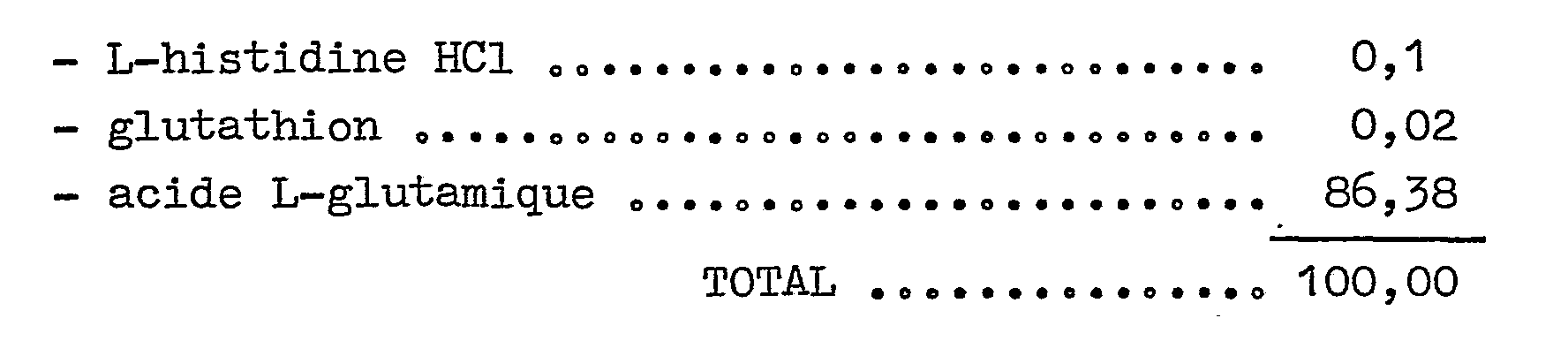
- Pour le traitement du vitiligo, des applications topiques de la composition ci-dessus ont été réalisées toutes les 24 heures sur les zones apigmentées ou irrégulièrement pigmentées, et on a réalisé ensuite des irradiations pendant une période de temps d'environ 10 minutes - 30 minutes avec une lampe UVR de 2 0 watts. L'émission de rayons UV comprend environ : 20 % de rayons UVB et 80 % de rayons UVA.
- Cinq patients souffrant de vitiligo ont été traités avec la composition pharmaceutique ci-dessus en réalisant six radiations successives de 20 minutes, chacune espacée de 24 heures, avec la lampe UVR ci-dessus.
- Les résultats ont été tout à fait surprenants dès la première irradiation, par repigmentation marginale des zones apigmentées.
- Après la seconde irradiation, la repigmentation apparaît sur la totalité de la superficie des zones dépigmentées traitées.
- Pendant les irradiations restantes, la repigmentation s'accroît en intensité, sans apparition d'érythèmes.
- Ces résultats sont particulièrement inattendus puisqu'il a été jusqu'à présent très difficile de trouver un traitement efficace du vitiligo. La composition selon la présente invention par applications topiques permet de résoudre un tel problème avec une simple irradiation UV pendant une période de temps courte ce qui met clairement en évidence l'activité photo- pigmentogène de la composition selon la présente invention avec exposition UVA-UVB.
- D'autre part, des essais de toxicité ont été réalisés sur des souris en étudiant l'irritation primaire cutanée selon la méthode officielle d'analyse des produits cosmétiques et des produits de beauté publiée dans le Journal Officiel français du 21 Avril 1971. Egale- ment, une étude a été réalisée en ce qui concerne l'indice d'irritation occulaire primaire sur des souris avec l'indice d'aggressivité cutanée superficielle de la composition selon la présente invention par des applications itératives.
- Pour les trois études ci-dessus, réalisées selon les procédures officielles avec la même composition que celle employée pour le traitement précité du vitiligo, on n'a pas observé d'effets irritants de sorte qu'on peut en conclure que la composition de la présente invention n'a aucun effet toxique.
Claims (11)
Priority Applications (1)
| Application Number | Priority Date | Filing Date | Title |
|---|---|---|---|
| AT82200649T ATE43577T1 (de) | 1978-10-19 | 1979-10-08 | Tyrosine-derivate. |
Applications Claiming Priority (2)
| Application Number | Priority Date | Filing Date | Title |
|---|---|---|---|
| FR7829797A FR2439013A1 (fr) | 1978-10-19 | 1978-10-19 | Composition, utilisable notamment comme produit cosmetique permettant un bronzage de la peau, comprenant l'emploi d'acides amines |
| FR7829797 | 1978-10-19 |
Related Parent Applications (1)
| Application Number | Title | Priority Date | Filing Date |
|---|---|---|---|
| EP79400718.7 Division | 1979-10-08 |
Publications (3)
| Publication Number | Publication Date |
|---|---|
| EP0070048A2 true EP0070048A2 (fr) | 1983-01-19 |
| EP0070048A3 EP0070048A3 (en) | 1983-03-16 |
| EP0070048B1 EP0070048B1 (fr) | 1989-05-31 |
Family
ID=9213931
Family Applications (2)
| Application Number | Title | Priority Date | Filing Date |
|---|---|---|---|
| EP79400718A Expired EP0010483B1 (fr) | 1978-10-19 | 1979-10-08 | Composition utilisable notamment comme produit cosmétique permettant un bronzage de la peau, comprenant l'emploi d'acides aminés |
| EP82200649A Expired EP0070048B1 (fr) | 1978-10-19 | 1979-10-08 | Dérivés de tyrosine |
Family Applications Before (1)
| Application Number | Title | Priority Date | Filing Date |
|---|---|---|---|
| EP79400718A Expired EP0010483B1 (fr) | 1978-10-19 | 1979-10-08 | Composition utilisable notamment comme produit cosmétique permettant un bronzage de la peau, comprenant l'emploi d'acides aminés |
Country Status (5)
| Country | Link |
|---|---|
| US (1) | US4419343A (fr) |
| EP (2) | EP0010483B1 (fr) |
| AT (1) | ATE43577T1 (fr) |
| DE (2) | DE2966267D1 (fr) |
| FR (1) | FR2439013A1 (fr) |
Cited By (4)
| Publication number | Priority date | Publication date | Assignee | Title |
|---|---|---|---|---|
| FR2622103A1 (fr) * | 1987-10-22 | 1989-04-28 | Thorel Jean Noel | Nouvelles compositions dermatologiques bronzantes insectifuges |
| EP0318369A1 (fr) * | 1987-11-27 | 1989-05-31 | Lvmh Recherche | Composition à base de phases lamellaires lipidiques hydratées ou de liposomes contenant de la tyrosine ou un dérivé de tyrosine et composition cosmétique ou pharmaceutique, notamment dermatologique, à activité pigmentante, l'incorporant |
| US5290562A (en) * | 1987-11-27 | 1994-03-01 | L V M H Recherche | Compositions and methods employing liposomes including tyrosine or a tyrosine derivative |
| US5425954A (en) * | 1993-09-30 | 1995-06-20 | Curafas Incorporated | Topical amino acid - vitamin complex compositions for pharmaceutical and cosmetic use |
Families Citing this family (41)
| Publication number | Priority date | Publication date | Assignee | Title |
|---|---|---|---|---|
| CH671514A5 (fr) * | 1986-12-03 | 1989-09-15 | Induchem Ag | |
| FR2608424B1 (fr) * | 1986-12-17 | 1989-06-16 | Cazacou Cecilia | Accelerateur de bronzage sans ecran solaire utilisant un complexe naturel favorisant la melanogenese |
| US4806344A (en) * | 1987-01-05 | 1989-02-21 | Gaskin Frances C | Sun protectant composition and method |
| FR2612776B1 (fr) * | 1987-03-25 | 1990-10-12 | Thorel Jean | Procede et composition de bronzage en deux phases |
| US4806360A (en) * | 1987-10-23 | 1989-02-21 | Advanced Polymer Systems | Synthetic melanin aggregates |
| US4855144A (en) * | 1987-10-23 | 1989-08-08 | Advanced Polymer Systems | Synthetic melanin aggregates |
| AU2971689A (en) * | 1988-02-11 | 1989-08-17 | Estee Lauder Inc. | Tanning compositions and their use |
| DE3990820T1 (de) * | 1988-07-19 | 1990-07-19 | Serobiologiques Lab Sa | Lichtschutzmittel fuer hautzellen auf basis von nukleinsaeuren und/oder deren derivaten |
| FR2634374B1 (fr) * | 1988-07-19 | 1993-10-15 | Laboratoires Serobiologiques | Agents photoprotecteurs, cytophotoprotecteurs cutanes ayant une activite photoprotectrice des cellules constitutives, fonctionnelles de la peau, en particulier des cellules de langerhans, a base de composes nucleiques : nucleoprotides, ribonucleotides et desoxyribonucleotides, ribonucleosides et desoxyribonucleosides, compositions cosmetiques ou dermo-pharmaceutiques contenant un tel agent ainsi que des nouveaux composes en soi |
| US5455036A (en) * | 1990-06-29 | 1995-10-03 | Bode Chemie | Method of using cis-urocaninic acid for topically treating psoriasis |
| JP3091270B2 (ja) * | 1990-09-28 | 2000-09-25 | 協和醗酵工業株式会社 | 美白化粧料 |
| US5229104A (en) * | 1991-04-29 | 1993-07-20 | Richardson-Vicks Inc. | Artificial tanning compositions containing positively charged paucilamellar vesicles |
| KR930011983A (ko) * | 1991-12-16 | 1993-07-20 | 원본미기재 | 셀프-탠너 화장제 조성물 |
| US5318774A (en) * | 1992-02-28 | 1994-06-07 | Richardson-Vicks Inc. | Composition and method for imparting an artificial tan to human skin |
| GB9217444D0 (en) * | 1992-08-17 | 1992-09-30 | Unilever Plc | Compounds compositions and methods for producing pigmentation in hair or skin |
| DE4230076C2 (de) * | 1992-09-09 | 1995-12-14 | Beiersdorf Ag | cis-Urocaninsäure als Antioxidans |
| DE69408309T2 (de) * | 1993-04-16 | 1998-08-20 | The Procter & Gamble Co., Cincinnati, Ohio | Mittel zum künstlichen sonnenbräunen und zum schutz der haut gegen uv-strahlen |
| US5470577A (en) * | 1993-07-07 | 1995-11-28 | Trustees Of Boston University | Stimulation of tanning by DNA fragments or single-stranded DNA |
| PT752843E (pt) * | 1994-03-29 | 2001-04-30 | Procter & Gamble | Composicoes para bronzeamento artificial possuindo um desenvolvimento melhorado de cor |
| US5514437A (en) * | 1994-03-29 | 1996-05-07 | The Procter & Gamble Company | Artificial tanning compositions having improved stability |
| US6147056A (en) * | 1995-06-06 | 2000-11-14 | Trustees Of Boston University | Use of locally applied DNA fragments |
| US5955059A (en) * | 1995-06-06 | 1999-09-21 | Trustees Of Boston University | Use of locally applied DNA fragments |
| US20030032610A1 (en) * | 1996-06-03 | 2003-02-13 | Gilchrest Barbara A. | Method to inhibit cell growth using oligonucleotides |
| US7094766B1 (en) | 1995-06-06 | 2006-08-22 | Trustees Of Boston University | Use of locally applied DNA fragments |
| US6197317B1 (en) | 1997-08-11 | 2001-03-06 | Marvin E. Klein | Composition and method for the treatment of skin |
| US6703030B2 (en) | 1998-06-16 | 2004-03-09 | Marvin E. Klein | Amino fruit acid composition and method for the treatment of skin |
| GB9913764D0 (en) * | 1999-06-14 | 1999-08-11 | Procter & Gamble | Hair care compositions |
| AU3996799A (en) * | 1999-05-18 | 2000-12-05 | Klein, Marvin E. | Alpha amino acid composition and method for the treatment of skin |
| AU2001251115A1 (en) * | 2000-03-31 | 2001-10-15 | Trustees Of Boston University | Use of locally applied dna fragments |
| FR2831445A1 (fr) * | 2002-02-14 | 2003-05-02 | Oreal | Composition comprenant au moins un pro-desquamant et au moins un compose activateur de la melanogenese |
| FR2831439A1 (fr) * | 2002-02-14 | 2003-05-02 | Oreal | Composition comprenant au moins un autobronzant et au moins un compose activteur de la melanogenese |
| WO2003099238A1 (fr) * | 2002-05-29 | 2003-12-04 | Unilever Plc | Maitrise de l'odeur dans des compositions cosmetiques contenant un sel d'amine |
| US20040185074A1 (en) * | 2003-03-17 | 2004-09-23 | Unilever Home & Personal Care Usa, Division Of Conopco, Inc. | Odor control in amine salt containing cosmetic compositions |
| US20060269924A1 (en) * | 2003-04-11 | 2006-11-30 | Trustees Of Boston University | Modulation of telomere-initiated cell signaling |
| DE102004020060B3 (de) | 2004-04-20 | 2005-06-02 | Coty B.V. | Kosmetisches Verfahren zur Behandlung der Haut mit Sonnenprodukten und Sonnenprodukt-Kombination |
| DE102004062170B3 (de) * | 2004-12-17 | 2006-06-08 | Lancaster Group Gmbh | Kosmetisches Präparat zur Bräunungsverlängerung und die Verwendung des Präparates |
| DE102005021805B3 (de) * | 2005-05-04 | 2006-10-05 | Lancaster Group Gmbh | Kosmetisches Verfahren zur Körpermodellierung mit Sonnenschutz und Modellierungs-Set |
| EP2065029B1 (fr) | 2007-11-30 | 2013-04-17 | Evonik Goldschmidt GmbH | Soins personnels et composition cosmétique contenant des tétrapeptides avec les motifs GX1X2G, PX1X2P, ou PX1X2K |
| US8877166B2 (en) * | 2008-10-14 | 2014-11-04 | Cockerell Dermatology Development, Ltd. | SPF liquid cleansing compositions |
| EP3668521B1 (fr) * | 2017-08-14 | 2024-10-02 | The Regents of the University of Colorado, a body corporate | Inhibition du stress oxydant, de la glycation et de la réticulation de protéines |
| EP3991791A4 (fr) * | 2019-06-25 | 2023-07-12 | Ajinomoto Co., Inc. | Mélange d'acides aminés présentant une structure co-amorphe |
Family Cites Families (6)
| Publication number | Priority date | Publication date | Assignee | Title |
|---|---|---|---|---|
| BE458709A (fr) * | ||||
| DE1003922B (de) * | 1956-05-28 | 1957-03-07 | Beiersdorf & Co A G P | Lichtschutzmittel |
| FR1252400A (fr) * | 1960-03-22 | 1961-01-27 | Nestle Lemur Company | Procédé et produits pour la coloration de substances kératiniques |
| FR2034543A1 (en) * | 1969-02-13 | 1970-12-11 | Etd Experimentales Centre | L-tyrosine contg compsn in glucose for - treating fatigue syndrome |
| DE2364525A1 (de) * | 1973-12-24 | 1975-07-03 | Henkel & Cie Gmbh | Neue n-polyhydroxyalkyl-aminosaeuren, deren herstellung, sowie diese enthaltende hautpflege- und hautschutzmittel |
| US4021538A (en) * | 1975-09-29 | 1977-05-03 | Yu Ruey J | Method for producing pigmentation in hair or skin |
-
1978
- 1978-10-19 FR FR7829797A patent/FR2439013A1/fr active Granted
-
1979
- 1979-10-08 DE DE7979400718T patent/DE2966267D1/de not_active Expired
- 1979-10-08 EP EP79400718A patent/EP0010483B1/fr not_active Expired
- 1979-10-08 EP EP82200649A patent/EP0070048B1/fr not_active Expired
- 1979-10-08 DE DE198282200649T patent/DE70048T1/de active Pending
- 1979-10-08 AT AT82200649T patent/ATE43577T1/de active
-
1981
- 1981-08-19 US US06/294,402 patent/US4419343A/en not_active Expired - Lifetime
Cited By (6)
| Publication number | Priority date | Publication date | Assignee | Title |
|---|---|---|---|---|
| FR2622103A1 (fr) * | 1987-10-22 | 1989-04-28 | Thorel Jean Noel | Nouvelles compositions dermatologiques bronzantes insectifuges |
| EP0318369A1 (fr) * | 1987-11-27 | 1989-05-31 | Lvmh Recherche | Composition à base de phases lamellaires lipidiques hydratées ou de liposomes contenant de la tyrosine ou un dérivé de tyrosine et composition cosmétique ou pharmaceutique, notamment dermatologique, à activité pigmentante, l'incorporant |
| WO1989004651A1 (fr) * | 1987-11-27 | 1989-06-01 | Lvmh Recherche | Composition a base de phases lamellaires lipidiques hydratees ou de liposomes contenant de la tyrosine ou un derive de tyrosine et composition cosmetique ou pharmaceutique, notamment dermatologique, a activite pigmentante, l'incorporant |
| FR2623716A1 (fr) * | 1987-11-27 | 1989-06-02 | Lvmh Rech | Composition a base de phases lamellaires lipidiques hydratees ou de liposomes contenant de la tyrosine ou un derive de tyrosine et composition cosmetique ou pharmaceutique, notamment dermatologique, a activite pigmentante, l'incorporant |
| US5290562A (en) * | 1987-11-27 | 1994-03-01 | L V M H Recherche | Compositions and methods employing liposomes including tyrosine or a tyrosine derivative |
| US5425954A (en) * | 1993-09-30 | 1995-06-20 | Curafas Incorporated | Topical amino acid - vitamin complex compositions for pharmaceutical and cosmetic use |
Also Published As
| Publication number | Publication date |
|---|---|
| EP0010483B1 (fr) | 1983-10-05 |
| DE70048T1 (de) | 1983-08-18 |
| DE2966267D1 (en) | 1983-11-10 |
| US4419343A (en) | 1983-12-06 |
| FR2439013B1 (fr) | 1982-01-15 |
| EP0010483A1 (fr) | 1980-04-30 |
| EP0070048A3 (en) | 1983-03-16 |
| EP0070048B1 (fr) | 1989-05-31 |
| FR2439013A1 (fr) | 1980-05-16 |
| ATE43577T1 (de) | 1989-06-15 |
Similar Documents
| Publication | Publication Date | Title |
|---|---|---|
| EP0010483B1 (fr) | Composition utilisable notamment comme produit cosmétique permettant un bronzage de la peau, comprenant l'emploi d'acides aminés | |
| CA2105230C (fr) | Composition cosmetique ou pharmaceutique comprenant en association une peroxydase et un agent anti-oxygene singulet | |
| EP0925058A1 (fr) | Utilisation cosmetique de composes a structure lipoaminoacide et compositions cosmetiques a activite apaisante incorporant certains de ces composes | |
| FR2607699A1 (fr) | Preparation cosmetique antisolaire pour le visage et le corps | |
| FR2701948A1 (fr) | Produit de couplage de l'histamine ou l'histamine méthyl-substituée et d'un acide aminé, procédé de préparation et applications thérapeutiques, cosmétologiques et agroalimentaires. | |
| WO2002015871A1 (fr) | Utilisation de la tyramine dans des compositions cosmetiques destinees a eclaicir la peau | |
| EP0770377B2 (fr) | Composition filtrante à usage cosmétique ou dermatologique contenant un chelateur de fer | |
| FR2829696A1 (fr) | Utilisation de l'acide pantetheine sulfonique et/ou de ses sels en tant qu'agent anti-radicalaire | |
| EP0754446A2 (fr) | Utilisation d'un agent antioxydant et/ou antiradicalaire dans une composition filtrante à usage cosmétique ou dermatologique | |
| EP0585018A1 (fr) | Composition cosmétique pour la coloration des cheveux et de la peau et comme protecteur UV | |
| FR2734478A1 (fr) | Composition cosmetique ou pharmaceutique utilisable par voie topique ou orale ayant des proprietes antiradicalaires et un pouvoir filtrant vis-a-vis des uv | |
| EP0887072A1 (fr) | Utilisation de sulfites et métabisulfites, pour la fabrication de compositions cosmétiques ou pharmaceutiques, notamment en dermatologie, à effet inhibiteur de la mélanogénèse ou à activité dépigmentante. | |
| WO2011086296A1 (fr) | Nouveaux peptides anti-age modulateurs de la survivine et compositions les comprenant | |
| WO2008059127A1 (fr) | Composition pharmaceutique et/ou cosmetique contenant des peptides | |
| WO2008062110A2 (fr) | Composition cosmetique et/ou pharmaceutique comprenant comme principe actif au moins un peptide et utilisation de ce peptide | |
| CA2144127C (fr) | Composition pour lutter contre les taches et/ou le vieillissement de la peau, ses utilisations | |
| WO2008015344A2 (fr) | Composition dermatologique et/ou cosmetique contenant des polypeptides ou des peptides issus de la proteine slc24a5 | |
| EP2414382B1 (fr) | Peptides eclaircissants activateurs du proteasome et compositions les contenant | |
| WO2008145854A1 (fr) | Composition pharmaceutique et/ou cosmetique contenant des peptides | |
| EP0749750A1 (fr) | Composition pour protéger et/ou lutter contre les taches et/ou le vieillissement de la peau, ses utilisations | |
| WO2010112713A2 (fr) | Nouveaux peptides eclaircissants activateurs du proteasome et compositions les contenant | |
| FR2753096A1 (fr) | Utilisation cosmetique de composes a structure lipoaminoacide et compositions cosmetiques a activite apaisante incorporant certains de ces composes | |
| WO2008145851A1 (fr) | Composition pharmaceutique et/ou cosmetique contenant des peptides | |
| EP2150266A1 (fr) | Composition pharmaceutique et/ou cosmetique contenant un principe actif antioxydant et activateur de l'energie cellulaire | |
| FR2757395A1 (fr) | Utilisation d'un extrait de la plante davallia, dans les domaines cosmetique et pharmaceutique, notamment dermatologique |
Legal Events
| Date | Code | Title | Description |
|---|---|---|---|
| PUAI | Public reference made under article 153(3) epc to a published international application that has entered the european phase |
Free format text: ORIGINAL CODE: 0009012 |
|
| PUAL | Search report despatched |
Free format text: ORIGINAL CODE: 0009013 |
|
| AC | Divisional application: reference to earlier application |
Ref document number: 10483 Country of ref document: EP |
|
| AK | Designated contracting states |
Designated state(s): AT BE CH DE GB IT LU NL SE |
|
| AK | Designated contracting states |
Designated state(s): AT BE CH DE GB IT LU NL SE |
|
| TCAT | At: translation of patent claims filed | ||
| ITCL | It: translation for ep claims filed |
Representative=s name: DE DOMINICIS & PARTNERS |
|
| TCNL | Nl: translation of patent claims filed | ||
| DET | De: translation of patent claims | ||
| 17P | Request for examination filed |
Effective date: 19830910 |
|
| 17Q | First examination report despatched |
Effective date: 19860505 |
|
| GRAA | (expected) grant |
Free format text: ORIGINAL CODE: 0009210 |
|
| AC | Divisional application: reference to earlier application |
Ref document number: 10483 Country of ref document: EP |
|
| AK | Designated contracting states |
Kind code of ref document: B1 Designated state(s): AT BE CH DE GB IT LU NL SE |
|
| PG25 | Lapsed in a contracting state [announced via postgrant information from national office to epo] |
Ref country code: AT Effective date: 19890531 |
|
| REF | Corresponds to: |
Ref document number: 43577 Country of ref document: AT Date of ref document: 19890615 Kind code of ref document: T |
|
| ITF | It: translation for a ep patent filed | ||
| GBT | Gb: translation of ep patent filed (gb section 77(6)(a)/1977) | ||
| REF | Corresponds to: |
Ref document number: 2967689 Country of ref document: DE Date of ref document: 19890706 |
|
| PLBE | No opposition filed within time limit |
Free format text: ORIGINAL CODE: 0009261 |
|
| STAA | Information on the status of an ep patent application or granted ep patent |
Free format text: STATUS: NO OPPOSITION FILED WITHIN TIME LIMIT |
|
| 26N | No opposition filed | ||
| ITTA | It: last paid annual fee | ||
| EPTA | Lu: last paid annual fee | ||
| EAL | Se: european patent in force in sweden |
Ref document number: 82200649.0 |
|
| PGFP | Annual fee paid to national office [announced via postgrant information from national office to epo] |
Ref country code: LU Payment date: 19960901 Year of fee payment: 18 |
|
| PGFP | Annual fee paid to national office [announced via postgrant information from national office to epo] |
Ref country code: GB Payment date: 19960927 Year of fee payment: 18 |
|
| PGFP | Annual fee paid to national office [announced via postgrant information from national office to epo] |
Ref country code: SE Payment date: 19961007 Year of fee payment: 18 |
|
| PGFP | Annual fee paid to national office [announced via postgrant information from national office to epo] |
Ref country code: DE Payment date: 19961030 Year of fee payment: 18 |
|
| PGFP | Annual fee paid to national office [announced via postgrant information from national office to epo] |
Ref country code: NL Payment date: 19961031 Year of fee payment: 18 |
|
| PGFP | Annual fee paid to national office [announced via postgrant information from national office to epo] |
Ref country code: BE Payment date: 19961128 Year of fee payment: 18 |
|
| PGFP | Annual fee paid to national office [announced via postgrant information from national office to epo] |
Ref country code: CH Payment date: 19970131 Year of fee payment: 18 |
|
| PG25 | Lapsed in a contracting state [announced via postgrant information from national office to epo] |
Ref country code: LU Free format text: LAPSE BECAUSE OF NON-PAYMENT OF DUE FEES Effective date: 19971008 Ref country code: GB Free format text: LAPSE BECAUSE OF NON-PAYMENT OF DUE FEES Effective date: 19971008 |
|
| PG25 | Lapsed in a contracting state [announced via postgrant information from national office to epo] |
Ref country code: SE Free format text: LAPSE BECAUSE OF NON-PAYMENT OF DUE FEES Effective date: 19971009 |
|
| PG25 | Lapsed in a contracting state [announced via postgrant information from national office to epo] |
Ref country code: CH Free format text: LAPSE BECAUSE OF NON-PAYMENT OF DUE FEES Effective date: 19971031 Ref country code: BE Free format text: LAPSE BECAUSE OF NON-PAYMENT OF DUE FEES Effective date: 19971031 |
|
| BERE | Be: lapsed |
Owner name: S.A. LABORATOIRES SEROBIOLOGIQUES Effective date: 19971031 |
|
| PG25 | Lapsed in a contracting state [announced via postgrant information from national office to epo] |
Ref country code: NL Free format text: LAPSE BECAUSE OF NON-PAYMENT OF DUE FEES Effective date: 19980501 |
|
| GBPC | Gb: european patent ceased through non-payment of renewal fee |
Effective date: 19971008 |
|
| REG | Reference to a national code |
Ref country code: CH Ref legal event code: PL |
|
| NLV4 | Nl: lapsed or anulled due to non-payment of the annual fee |
Effective date: 19980501 |
|
| PG25 | Lapsed in a contracting state [announced via postgrant information from national office to epo] |
Ref country code: DE Free format text: LAPSE BECAUSE OF NON-PAYMENT OF DUE FEES Effective date: 19980701 |
|
| EUG | Se: european patent has lapsed |
Ref document number: 82200649.0 |