EP0070253B1 - Photopolymerisierbare Harze - Google Patents
Photopolymerisierbare Harze Download PDFInfo
- Publication number
- EP0070253B1 EP0070253B1 EP82810285A EP82810285A EP0070253B1 EP 0070253 B1 EP0070253 B1 EP 0070253B1 EP 82810285 A EP82810285 A EP 82810285A EP 82810285 A EP82810285 A EP 82810285A EP 0070253 B1 EP0070253 B1 EP 0070253B1
- Authority
- EP
- European Patent Office
- Prior art keywords
- group
- formula
- carbon atoms
- groups
- resin
- Prior art date
- Legal status (The legal status is an assumption and is not a legal conclusion. Google has not performed a legal analysis and makes no representation as to the accuracy of the status listed.)
- Expired
Links
- 239000011347 resin Substances 0.000 title claims description 55
- 229920005989 resin Polymers 0.000 title claims description 55
- XLYOFNOQVPJJNP-UHFFFAOYSA-N water Substances O XLYOFNOQVPJJNP-UHFFFAOYSA-N 0.000 claims description 32
- 125000004432 carbon atom Chemical group C* 0.000 claims description 30
- -1 tetramethylene, pentamethylene, methylpentamethylene Chemical group 0.000 claims description 19
- 230000005855 radiation Effects 0.000 claims description 18
- SMZOUWXMTYCWNB-UHFFFAOYSA-N 2-(2-methoxy-5-methylphenyl)ethanamine Chemical compound COC1=CC=C(C)C=C1CCN SMZOUWXMTYCWNB-UHFFFAOYSA-N 0.000 claims description 17
- 125000004435 hydrogen atom Chemical group [H]* 0.000 claims description 17
- NIXOWILDQLNWCW-UHFFFAOYSA-N 2-Propenoic acid Natural products OC(=O)C=C NIXOWILDQLNWCW-UHFFFAOYSA-N 0.000 claims description 14
- 238000000034 method Methods 0.000 claims description 12
- CERQOIWHTDAKMF-UHFFFAOYSA-N Methacrylic acid Chemical compound CC(=C)C(O)=O CERQOIWHTDAKMF-UHFFFAOYSA-N 0.000 claims description 9
- RTZKZFJDLAIYFH-UHFFFAOYSA-N ether Substances CCOCC RTZKZFJDLAIYFH-UHFFFAOYSA-N 0.000 claims description 9
- 125000002947 alkylene group Chemical group 0.000 claims description 7
- 150000001875 compounds Chemical class 0.000 claims description 7
- 125000003700 epoxy group Chemical group 0.000 claims description 7
- 125000000217 alkyl group Chemical group 0.000 claims description 6
- 125000002496 methyl group Chemical group [H]C([H])([H])* 0.000 claims description 6
- OFOBLEOULBTSOW-UHFFFAOYSA-N Malonic acid Chemical compound OC(=O)CC(O)=O OFOBLEOULBTSOW-UHFFFAOYSA-N 0.000 claims description 5
- 125000001931 aliphatic group Chemical group 0.000 claims description 5
- 125000003055 glycidyl group Chemical group C(C1CO1)* 0.000 claims description 5
- 238000002360 preparation method Methods 0.000 claims description 5
- IJGRMHOSHXDMSA-UHFFFAOYSA-N Atomic nitrogen Chemical compound N#N IJGRMHOSHXDMSA-UHFFFAOYSA-N 0.000 claims description 4
- 239000002253 acid Substances 0.000 claims description 4
- 229910052757 nitrogen Inorganic materials 0.000 claims description 4
- 229910052760 oxygen Inorganic materials 0.000 claims description 4
- 239000001301 oxygen Substances 0.000 claims description 4
- LFQSCWFLJHTTHZ-UHFFFAOYSA-N Ethanol Chemical compound CCO LFQSCWFLJHTTHZ-UHFFFAOYSA-N 0.000 claims description 3
- ISWSIDIOOBJBQZ-UHFFFAOYSA-N Phenol Chemical compound OC1=CC=CC=C1 ISWSIDIOOBJBQZ-UHFFFAOYSA-N 0.000 claims description 3
- 150000008064 anhydrides Chemical class 0.000 claims description 3
- 125000004836 hexamethylene group Chemical group [H]C([H])([*:2])C([H])([H])C([H])([H])C([H])([H])C([H])([H])C([H])([H])[*:1] 0.000 claims description 3
- 239000001257 hydrogen Substances 0.000 claims description 3
- 229910052739 hydrogen Inorganic materials 0.000 claims description 3
- 125000002887 hydroxy group Chemical group [H]O* 0.000 claims description 3
- 125000004433 nitrogen atom Chemical group N* 0.000 claims description 3
- 125000004450 alkenylene group Chemical group 0.000 claims description 2
- 125000000732 arylene group Chemical group 0.000 claims description 2
- 125000004429 atom Chemical group 0.000 claims description 2
- 239000011203 carbon fibre reinforced carbon Substances 0.000 claims description 2
- 125000002915 carbonyl group Chemical group [*:2]C([*:1])=O 0.000 claims description 2
- 125000002843 carboxylic acid group Chemical group 0.000 claims description 2
- 125000005724 cycloalkenylene group Chemical group 0.000 claims description 2
- 125000002993 cycloalkylene group Chemical group 0.000 claims description 2
- 150000002148 esters Chemical class 0.000 claims description 2
- 125000005462 imide group Chemical group 0.000 claims description 2
- 125000000654 isopropylidene group Chemical group C(C)(C)=* 0.000 claims description 2
- 125000001570 methylene group Chemical group [H]C([H])([*:1])[*:2] 0.000 claims description 2
- 125000000472 sulfonyl group Chemical group *S(*)(=O)=O 0.000 claims description 2
- 125000004434 sulfur atom Chemical group 0.000 claims description 2
- QVGXLLKOCUKJST-UHFFFAOYSA-N atomic oxygen Chemical compound [O] QVGXLLKOCUKJST-UHFFFAOYSA-N 0.000 claims 2
- 125000003368 amide group Chemical group 0.000 claims 1
- 125000005515 organic divalent group Chemical group 0.000 claims 1
- 239000000203 mixture Substances 0.000 description 39
- 239000004593 Epoxy Substances 0.000 description 22
- 239000000047 product Substances 0.000 description 18
- 238000006243 chemical reaction Methods 0.000 description 16
- 239000011111 cardboard Substances 0.000 description 14
- 150000002118 epoxides Chemical class 0.000 description 14
- 125000003580 L-valyl group Chemical group [H]N([H])[C@]([H])(C(=O)[*])C(C([H])([H])[H])(C([H])([H])[H])[H] 0.000 description 13
- NLZUEZXRPGMBCV-UHFFFAOYSA-N Butylhydroxytoluene Chemical compound CC1=CC(C(C)(C)C)=C(O)C(C(C)(C)C)=C1 NLZUEZXRPGMBCV-UHFFFAOYSA-N 0.000 description 12
- HEMHJVSKTPXQMS-UHFFFAOYSA-M Sodium hydroxide Chemical compound [OH-].[Na+] HEMHJVSKTPXQMS-UHFFFAOYSA-M 0.000 description 12
- 238000000576 coating method Methods 0.000 description 11
- DOIRQSBPFJWKBE-UHFFFAOYSA-N phthalic acid di-n-butyl ester Natural products CCCCOC(=O)C1=CC=CC=C1C(=O)OCCCC DOIRQSBPFJWKBE-UHFFFAOYSA-N 0.000 description 11
- IISBACLAFKSPIT-UHFFFAOYSA-N bisphenol A Chemical compound C=1C=C(O)C=CC=1C(C)(C)C1=CC=C(O)C=C1 IISBACLAFKSPIT-UHFFFAOYSA-N 0.000 description 9
- 235000009161 Espostoa lanata Nutrition 0.000 description 8
- 240000001624 Espostoa lanata Species 0.000 description 8
- WERYXYBDKMZEQL-UHFFFAOYSA-N butane-1,4-diol Chemical compound OCCCCO WERYXYBDKMZEQL-UHFFFAOYSA-N 0.000 description 8
- 239000003054 catalyst Substances 0.000 description 8
- 239000011248 coating agent Substances 0.000 description 8
- RZJKZTPKSRPUFJ-UHFFFAOYSA-N 5,5-dimethyl-1,3-bis(oxiran-2-ylmethyl)imidazolidine-2,4-dione Chemical compound O=C1N(CC2OC2)C(=O)C(C)(C)N1CC1CO1 RZJKZTPKSRPUFJ-UHFFFAOYSA-N 0.000 description 7
- KWVGIHKZDCUPEU-UHFFFAOYSA-N 2,2-dimethoxy-2-phenylacetophenone Chemical compound C=1C=CC=CC=1C(OC)(OC)C(=O)C1=CC=CC=C1 KWVGIHKZDCUPEU-UHFFFAOYSA-N 0.000 description 6
- ZWEHNKRNPOVVGH-UHFFFAOYSA-N 2-Butanone Chemical compound CCC(C)=O ZWEHNKRNPOVVGH-UHFFFAOYSA-N 0.000 description 6
- VYZAMTAEIAYCRO-UHFFFAOYSA-N Chromium Chemical compound [Cr] VYZAMTAEIAYCRO-UHFFFAOYSA-N 0.000 description 6
- OKIZCWYLBDKLSU-UHFFFAOYSA-M N,N,N-Trimethylmethanaminium chloride Chemical compound [Cl-].C[N+](C)(C)C OKIZCWYLBDKLSU-UHFFFAOYSA-M 0.000 description 6
- 229910052804 chromium Inorganic materials 0.000 description 6
- 239000011651 chromium Substances 0.000 description 6
- QSHDDOUJBYECFT-UHFFFAOYSA-N mercury Chemical compound [Hg] QSHDDOUJBYECFT-UHFFFAOYSA-N 0.000 description 6
- 150000002923 oximes Chemical class 0.000 description 6
- LYCAIKOWRPUZTN-UHFFFAOYSA-N Ethylene glycol Chemical compound OCCO LYCAIKOWRPUZTN-UHFFFAOYSA-N 0.000 description 5
- 239000003960 organic solvent Substances 0.000 description 5
- VVBLNCFGVYUYGU-UHFFFAOYSA-N 4,4'-Bis(dimethylamino)benzophenone Chemical compound C1=CC(N(C)C)=CC=C1C(=O)C1=CC=C(N(C)C)C=C1 VVBLNCFGVYUYGU-UHFFFAOYSA-N 0.000 description 4
- 0 CCC(C)(*(C)N)C1CC1 Chemical compound CCC(C)(*(C)N)C1CC1 0.000 description 4
- 229910052799 carbon Inorganic materials 0.000 description 4
- 229910052753 mercury Inorganic materials 0.000 description 4
- 229910052751 metal Inorganic materials 0.000 description 4
- 239000002184 metal Substances 0.000 description 4
- 238000006116 polymerization reaction Methods 0.000 description 4
- 150000003839 salts Chemical class 0.000 description 4
- ZCDADJXRUCOCJE-UHFFFAOYSA-N 2-chlorothioxanthen-9-one Chemical compound C1=CC=C2C(=O)C3=CC(Cl)=CC=C3SC2=C1 ZCDADJXRUCOCJE-UHFFFAOYSA-N 0.000 description 3
- ZMANZCXQSJIPKH-UHFFFAOYSA-N Triethylamine Chemical compound CCN(CC)CC ZMANZCXQSJIPKH-UHFFFAOYSA-N 0.000 description 3
- 150000001252 acrylic acid derivatives Chemical class 0.000 description 3
- ISAOCJYIOMOJEB-UHFFFAOYSA-N benzoin Chemical compound C=1C=CC=CC=1C(O)C(=O)C1=CC=CC=C1 ISAOCJYIOMOJEB-UHFFFAOYSA-N 0.000 description 3
- GYZLOYUZLJXAJU-UHFFFAOYSA-N diglycidyl ether Chemical compound C1OC1COCC1CO1 GYZLOYUZLJXAJU-UHFFFAOYSA-N 0.000 description 3
- 239000003112 inhibitor Substances 0.000 description 3
- 238000007142 ring opening reaction Methods 0.000 description 3
- 238000003756 stirring Methods 0.000 description 3
- 239000000126 substance Substances 0.000 description 3
- 239000000758 substrate Substances 0.000 description 3
- RHUYHJGZWVXEHW-UHFFFAOYSA-N 1,1-Dimethyhydrazine Chemical compound CN(C)N RHUYHJGZWVXEHW-UHFFFAOYSA-N 0.000 description 2
- 229940057054 1,3-dimethylurea Drugs 0.000 description 2
- AZQWKYJCGOJGHM-UHFFFAOYSA-N 1,4-benzoquinone Chemical compound O=C1C=CC(=O)C=C1 AZQWKYJCGOJGHM-UHFFFAOYSA-N 0.000 description 2
- BVQVLAIMHVDZEL-UHFFFAOYSA-N 1-phenyl-1,2-propanedione Chemical compound CC(=O)C(=O)C1=CC=CC=C1 BVQVLAIMHVDZEL-UHFFFAOYSA-N 0.000 description 2
- SEULWJSKCVACTH-UHFFFAOYSA-N 1-phenylimidazole Chemical compound C1=NC=CN1C1=CC=CC=C1 SEULWJSKCVACTH-UHFFFAOYSA-N 0.000 description 2
- SHKUUQIDMUMQQK-UHFFFAOYSA-N 2-[4-(oxiran-2-ylmethoxy)butoxymethyl]oxirane Chemical compound C1OC1COCCCCOCC1CO1 SHKUUQIDMUMQQK-UHFFFAOYSA-N 0.000 description 2
- QTBSBXVTEAMEQO-UHFFFAOYSA-N Acetic acid Chemical compound CC(O)=O QTBSBXVTEAMEQO-UHFFFAOYSA-N 0.000 description 2
- XKRFYHLGVUSROY-UHFFFAOYSA-N Argon Chemical compound [Ar] XKRFYHLGVUSROY-UHFFFAOYSA-N 0.000 description 2
- LCFVJGUPQDGYKZ-UHFFFAOYSA-N Bisphenol A diglycidyl ether Chemical compound C=1C=C(OCC2OC2)C=CC=1C(C)(C)C(C=C1)=CC=C1OCC1CO1 LCFVJGUPQDGYKZ-UHFFFAOYSA-N 0.000 description 2
- HEDRZPFGACZZDS-UHFFFAOYSA-N Chloroform Chemical compound ClC(Cl)Cl HEDRZPFGACZZDS-UHFFFAOYSA-N 0.000 description 2
- MYMOFIZGZYHOMD-UHFFFAOYSA-N Dioxygen Chemical compound O=O MYMOFIZGZYHOMD-UHFFFAOYSA-N 0.000 description 2
- QIGBRXMKCJKVMJ-UHFFFAOYSA-N Hydroquinone Chemical compound OC1=CC=C(O)C=C1 QIGBRXMKCJKVMJ-UHFFFAOYSA-N 0.000 description 2
- MGJKQDOBUOMPEZ-UHFFFAOYSA-N N,N'-dimethylurea Chemical compound CNC(=O)NC MGJKQDOBUOMPEZ-UHFFFAOYSA-N 0.000 description 2
- CTQNGGLPUBDAKN-UHFFFAOYSA-N O-Xylene Chemical compound CC1=CC=CC=C1C CTQNGGLPUBDAKN-UHFFFAOYSA-N 0.000 description 2
- XYFCBTPGUUZFHI-UHFFFAOYSA-N Phosphine Chemical compound P XYFCBTPGUUZFHI-UHFFFAOYSA-N 0.000 description 2
- WCUXLLCKKVVCTQ-UHFFFAOYSA-M Potassium chloride Chemical compound [Cl-].[K+] WCUXLLCKKVVCTQ-UHFFFAOYSA-M 0.000 description 2
- FAPWRFPIFSIZLT-UHFFFAOYSA-M Sodium chloride Chemical compound [Na+].[Cl-] FAPWRFPIFSIZLT-UHFFFAOYSA-M 0.000 description 2
- 244000028419 Styrax benzoin Species 0.000 description 2
- 235000000126 Styrax benzoin Nutrition 0.000 description 2
- 235000008411 Sumatra benzointree Nutrition 0.000 description 2
- WNLRTRBMVRJNCN-UHFFFAOYSA-N adipic acid Chemical compound OC(=O)CCCCC(O)=O WNLRTRBMVRJNCN-UHFFFAOYSA-N 0.000 description 2
- OBETXYAYXDNJHR-UHFFFAOYSA-N alpha-ethylcaproic acid Natural products CCCCC(CC)C(O)=O OBETXYAYXDNJHR-UHFFFAOYSA-N 0.000 description 2
- 150000001408 amides Chemical class 0.000 description 2
- 229960002130 benzoin Drugs 0.000 description 2
- 230000032050 esterification Effects 0.000 description 2
- 238000005886 esterification reaction Methods 0.000 description 2
- 125000001495 ethyl group Chemical group [H]C([H])([H])C([H])([H])* 0.000 description 2
- 238000009472 formulation Methods 0.000 description 2
- 235000019382 gum benzoic Nutrition 0.000 description 2
- 238000010438 heat treatment Methods 0.000 description 2
- KWGKDLIKAYFUFQ-UHFFFAOYSA-M lithium chloride Chemical compound [Li+].[Cl-] KWGKDLIKAYFUFQ-UHFFFAOYSA-M 0.000 description 2
- 239000000463 material Substances 0.000 description 2
- WWZKQHOCKIZLMA-UHFFFAOYSA-N octanoic acid Chemical compound CCCCCCCC(O)=O WWZKQHOCKIZLMA-UHFFFAOYSA-N 0.000 description 2
- 239000011087 paperboard Substances 0.000 description 2
- VLTRZXGMWDSKGL-UHFFFAOYSA-N perchloric acid Chemical compound OCl(=O)(=O)=O VLTRZXGMWDSKGL-UHFFFAOYSA-N 0.000 description 2
- 229920000058 polyacrylate Polymers 0.000 description 2
- 230000000379 polymerizing effect Effects 0.000 description 2
- 229920001451 polypropylene glycol Polymers 0.000 description 2
- 150000003242 quaternary ammonium salts Chemical class 0.000 description 2
- CXMXRPHRNRROMY-UHFFFAOYSA-N sebacic acid Chemical compound OC(=O)CCCCCCCCC(O)=O CXMXRPHRNRROMY-UHFFFAOYSA-N 0.000 description 2
- 239000002904 solvent Substances 0.000 description 2
- 239000007858 starting material Substances 0.000 description 2
- 150000003512 tertiary amines Chemical class 0.000 description 2
- UMGDCJDMYOKAJW-UHFFFAOYSA-N thiourea Chemical compound NC(N)=S UMGDCJDMYOKAJW-UHFFFAOYSA-N 0.000 description 2
- 239000008096 xylene Substances 0.000 description 2
- OBETXYAYXDNJHR-SSDOTTSWSA-M (2r)-2-ethylhexanoate Chemical compound CCCC[C@@H](CC)C([O-])=O OBETXYAYXDNJHR-SSDOTTSWSA-M 0.000 description 1
- WJFKNYWRSNBZNX-UHFFFAOYSA-N 10H-phenothiazine Chemical compound C1=CC=C2NC3=CC=CC=C3SC2=C1 WJFKNYWRSNBZNX-UHFFFAOYSA-N 0.000 description 1
- PUGOMSLRUSTQGV-UHFFFAOYSA-N 2,3-di(prop-2-enoyloxy)propyl prop-2-enoate Chemical compound C=CC(=O)OCC(OC(=O)C=C)COC(=O)C=C PUGOMSLRUSTQGV-UHFFFAOYSA-N 0.000 description 1
- FALRKNHUBBKYCC-UHFFFAOYSA-N 2-(chloromethyl)pyridine-3-carbonitrile Chemical compound ClCC1=NC=CC=C1C#N FALRKNHUBBKYCC-UHFFFAOYSA-N 0.000 description 1
- DZZAHLOABNWIFA-UHFFFAOYSA-N 2-butoxy-1,2-diphenylethanone Chemical compound C=1C=CC=CC=1C(OCCCC)C(=O)C1=CC=CC=C1 DZZAHLOABNWIFA-UHFFFAOYSA-N 0.000 description 1
- OMIGHNLMNHATMP-UHFFFAOYSA-N 2-hydroxyethyl prop-2-enoate Chemical compound OCCOC(=O)C=C OMIGHNLMNHATMP-UHFFFAOYSA-N 0.000 description 1
- ZCUJYXPAKHMBAZ-UHFFFAOYSA-N 2-phenyl-1h-imidazole Chemical compound C1=CNC(C=2C=CC=CC=2)=N1 ZCUJYXPAKHMBAZ-UHFFFAOYSA-N 0.000 description 1
- VFZKVQVQOMDJEG-UHFFFAOYSA-N 2-prop-2-enoyloxypropyl prop-2-enoate Chemical compound C=CC(=O)OC(C)COC(=O)C=C VFZKVQVQOMDJEG-UHFFFAOYSA-N 0.000 description 1
- 125000004172 4-methoxyphenyl group Chemical group [H]C1=C([H])C(OC([H])([H])[H])=C([H])C([H])=C1* 0.000 description 1
- DWEQVNFWAKJCEY-UHFFFAOYSA-N 4-methylimidazolidin-2-one Chemical class CC1CNC(=O)N1 DWEQVNFWAKJCEY-UHFFFAOYSA-N 0.000 description 1
- BFBALPQGUUDWRM-UHFFFAOYSA-N 4-oxo-4-(3-oxopent-4-enoxy)butanoic acid Chemical compound C=CC(=O)CCOC(=O)CCC(=O)O BFBALPQGUUDWRM-UHFFFAOYSA-N 0.000 description 1
- YIROYDNZEPTFOL-UHFFFAOYSA-N 5,5-Dimethylhydantoin Chemical compound CC1(C)NC(=O)NC1=O YIROYDNZEPTFOL-UHFFFAOYSA-N 0.000 description 1
- OQAPYXJOOYQXDV-UHFFFAOYSA-N 5,5-dimethyl-3-[2-(oxiran-2-ylmethoxy)propyl]-1-(oxiran-2-ylmethyl)imidazolidine-2,4-dione Chemical compound C1OC1COC(C)CN(C(C1(C)C)=O)C(=O)N1CC1CO1 OQAPYXJOOYQXDV-UHFFFAOYSA-N 0.000 description 1
- CUARLQDWYSRQDF-UHFFFAOYSA-N 5-Nitroacenaphthene Chemical compound C1CC2=CC=CC3=C2C1=CC=C3[N+](=O)[O-] CUARLQDWYSRQDF-UHFFFAOYSA-N 0.000 description 1
- VSJRBQDMBFFHMC-UHFFFAOYSA-N 5-ethyl-5-methylimidazolidine-2,4-dione Chemical compound CCC1(C)NC(=O)NC1=O VSJRBQDMBFFHMC-UHFFFAOYSA-N 0.000 description 1
- CSCPPACGZOOCGX-UHFFFAOYSA-N Acetone Chemical compound CC(C)=O CSCPPACGZOOCGX-UHFFFAOYSA-N 0.000 description 1
- 229930185605 Bisphenol Natural products 0.000 description 1
- CPELXLSAUQHCOX-UHFFFAOYSA-M Bromide Chemical compound [Br-] CPELXLSAUQHCOX-UHFFFAOYSA-M 0.000 description 1
- OKTJSMMVPCPJKN-UHFFFAOYSA-N Carbon Chemical compound [C] OKTJSMMVPCPJKN-UHFFFAOYSA-N 0.000 description 1
- VGGSQFUCUMXWEO-UHFFFAOYSA-N Ethene Chemical compound C=C VGGSQFUCUMXWEO-UHFFFAOYSA-N 0.000 description 1
- 239000005977 Ethylene Substances 0.000 description 1
- KRHYYFGTRYWZRS-UHFFFAOYSA-M Fluoride anion Chemical compound [F-] KRHYYFGTRYWZRS-UHFFFAOYSA-M 0.000 description 1
- UFHFLCQGNIYNRP-UHFFFAOYSA-N Hydrogen Chemical compound [H][H] UFHFLCQGNIYNRP-UHFFFAOYSA-N 0.000 description 1
- CNCOEDDPFOAUMB-UHFFFAOYSA-N N-Methylolacrylamide Chemical compound OCNC(=O)C=C CNCOEDDPFOAUMB-UHFFFAOYSA-N 0.000 description 1
- HEHKSDGWHMUMCR-UHFFFAOYSA-N NC1C(CCC2CC2)C1 Chemical compound NC1C(CCC2CC2)C1 HEHKSDGWHMUMCR-UHFFFAOYSA-N 0.000 description 1
- VMHLLURERBWHNL-UHFFFAOYSA-M Sodium acetate Chemical compound [Na+].CC([O-])=O VMHLLURERBWHNL-UHFFFAOYSA-M 0.000 description 1
- 229910000831 Steel Inorganic materials 0.000 description 1
- GSEJCLTVZPLZKY-UHFFFAOYSA-N Triethanolamine Chemical compound OCCN(CCO)CCO GSEJCLTVZPLZKY-UHFFFAOYSA-N 0.000 description 1
- XSQUKJJJFZCRTK-UHFFFAOYSA-N Urea Natural products NC(N)=O XSQUKJJJFZCRTK-UHFFFAOYSA-N 0.000 description 1
- VZTQQYMRXDUHDO-UHFFFAOYSA-N [2-hydroxy-3-[4-[2-[4-(2-hydroxy-3-prop-2-enoyloxypropoxy)phenyl]propan-2-yl]phenoxy]propyl] prop-2-enoate Chemical compound C=1C=C(OCC(O)COC(=O)C=C)C=CC=1C(C)(C)C1=CC=C(OCC(O)COC(=O)C=C)C=C1 VZTQQYMRXDUHDO-UHFFFAOYSA-N 0.000 description 1
- 239000002250 absorbent Substances 0.000 description 1
- 230000002745 absorbent Effects 0.000 description 1
- 229960000583 acetic acid Drugs 0.000 description 1
- HFBMWMNUJJDEQZ-UHFFFAOYSA-N acryloyl chloride Chemical compound ClC(=O)C=C HFBMWMNUJJDEQZ-UHFFFAOYSA-N 0.000 description 1
- 125000003647 acryloyl group Chemical group O=C([*])C([H])=C([H])[H] 0.000 description 1
- 239000001361 adipic acid Substances 0.000 description 1
- 235000011037 adipic acid Nutrition 0.000 description 1
- 229910001508 alkali metal halide Inorganic materials 0.000 description 1
- 150000008045 alkali metal halides Chemical class 0.000 description 1
- 150000008044 alkali metal hydroxides Chemical class 0.000 description 1
- 229910052782 aluminium Inorganic materials 0.000 description 1
- XAGFODPZIPBFFR-UHFFFAOYSA-N aluminium Chemical compound [Al] XAGFODPZIPBFFR-UHFFFAOYSA-N 0.000 description 1
- 229910052786 argon Inorganic materials 0.000 description 1
- RBFQJDQYXXHULB-UHFFFAOYSA-N arsane Chemical compound [AsH3] RBFQJDQYXXHULB-UHFFFAOYSA-N 0.000 description 1
- 239000002585 base Substances 0.000 description 1
- WURBFLDFSFBTLW-UHFFFAOYSA-N benzil Chemical compound C=1C=CC=CC=1C(=O)C(=O)C1=CC=CC=C1 WURBFLDFSFBTLW-UHFFFAOYSA-N 0.000 description 1
- RWCCWEUUXYIKHB-UHFFFAOYSA-N benzophenone Chemical compound C=1C=CC=CC=1C(=O)C1=CC=CC=C1 RWCCWEUUXYIKHB-UHFFFAOYSA-N 0.000 description 1
- 239000012965 benzophenone Substances 0.000 description 1
- XSCHRSMBECNVNS-UHFFFAOYSA-N benzopyrazine Natural products N1=CC=NC2=CC=CC=C21 XSCHRSMBECNVNS-UHFFFAOYSA-N 0.000 description 1
- FWYSSOIRLVHQNC-UHFFFAOYSA-M benzyl(trimethyl)azanium;acetate Chemical compound CC([O-])=O.C[N+](C)(C)CC1=CC=CC=C1 FWYSSOIRLVHQNC-UHFFFAOYSA-M 0.000 description 1
- KXHPPCXNWTUNSB-UHFFFAOYSA-M benzyl(trimethyl)azanium;chloride Chemical compound [Cl-].C[N+](C)(C)CC1=CC=CC=C1 KXHPPCXNWTUNSB-UHFFFAOYSA-M 0.000 description 1
- 230000015572 biosynthetic process Effects 0.000 description 1
- XFUOBHWPTSIEOV-UHFFFAOYSA-N bis(oxiran-2-ylmethyl) cyclohexane-1,2-dicarboxylate Chemical compound C1CCCC(C(=O)OCC2OC2)C1C(=O)OCC1CO1 XFUOBHWPTSIEOV-UHFFFAOYSA-N 0.000 description 1
- 235000010354 butylated hydroxytoluene Nutrition 0.000 description 1
- 125000005708 carbonyloxy group Chemical group [*:2]OC([*:1])=O 0.000 description 1
- 239000003638 chemical reducing agent Substances 0.000 description 1
- 239000003795 chemical substances by application Substances 0.000 description 1
- 238000001816 cooling Methods 0.000 description 1
- 239000013078 crystal Substances 0.000 description 1
- XXBDWLFCJWSEKW-UHFFFAOYSA-N dimethylbenzylamine Chemical compound CN(C)CC1=CC=CC=C1 XXBDWLFCJWSEKW-UHFFFAOYSA-N 0.000 description 1
- 150000002009 diols Chemical class 0.000 description 1
- CZZYITDELCSZES-UHFFFAOYSA-N diphenylmethane Chemical compound C=1C=CC=CC=1CC1=CC=CC=C1 CZZYITDELCSZES-UHFFFAOYSA-N 0.000 description 1
- QILSFLSDHQAZET-UHFFFAOYSA-N diphenylmethanol Chemical compound C=1C=CC=CC=1C(O)C1=CC=CC=C1 QILSFLSDHQAZET-UHFFFAOYSA-N 0.000 description 1
- 238000007598 dipping method Methods 0.000 description 1
- 238000001035 drying Methods 0.000 description 1
- 238000005265 energy consumption Methods 0.000 description 1
- BAFHCWDYLASWIN-UHFFFAOYSA-N ethene;propan-2-one Chemical compound C=C.CC(C)=O BAFHCWDYLASWIN-UHFFFAOYSA-N 0.000 description 1
- 239000012467 final product Substances 0.000 description 1
- 239000012362 glacial acetic acid Substances 0.000 description 1
- 125000000623 heterocyclic group Chemical group 0.000 description 1
- 150000001469 hydantoins Chemical class 0.000 description 1
- 150000002429 hydrazines Chemical class 0.000 description 1
- WGCNASOHLSPBMP-UHFFFAOYSA-N hydroxyacetaldehyde Natural products OCC=O WGCNASOHLSPBMP-UHFFFAOYSA-N 0.000 description 1
- YAMHXTCMCPHKLN-UHFFFAOYSA-N imidazolidin-2-one Chemical compound O=C1NCCN1 YAMHXTCMCPHKLN-UHFFFAOYSA-N 0.000 description 1
- 239000012442 inert solvent Substances 0.000 description 1
- 230000005865 ionizing radiation Effects 0.000 description 1
- 229910001507 metal halide Inorganic materials 0.000 description 1
- 150000005309 metal halides Chemical class 0.000 description 1
- 150000002739 metals Chemical class 0.000 description 1
- CXKWCBBOMKCUKX-UHFFFAOYSA-M methylene blue Chemical compound [Cl-].C1=CC(N(C)C)=CC2=[S+]C3=CC(N(C)C)=CC=C3N=C21 CXKWCBBOMKCUKX-UHFFFAOYSA-M 0.000 description 1
- 229960000907 methylthioninium chloride Drugs 0.000 description 1
- GUAWMXYQZKVRCW-UHFFFAOYSA-N n,2-dimethylaniline Chemical compound CNC1=CC=CC=C1C GUAWMXYQZKVRCW-UHFFFAOYSA-N 0.000 description 1
- 125000004123 n-propyl group Chemical group [H]C([H])([H])C([H])([H])C([H])([H])* 0.000 description 1
- 125000001971 neopentyl group Chemical group [H]C([*])([H])C(C([H])([H])[H])(C([H])([H])[H])C([H])([H])[H] 0.000 description 1
- RGSFGYAAUTVSQA-UHFFFAOYSA-N pentamethylene Natural products C1CCCC1 RGSFGYAAUTVSQA-UHFFFAOYSA-N 0.000 description 1
- 125000004817 pentamethylene group Chemical group [H]C([H])([*:2])C([H])([H])C([H])([H])C([H])([H])C([H])([H])[*:1] 0.000 description 1
- 229950000688 phenothiazine Drugs 0.000 description 1
- 229910000073 phosphorus hydride Inorganic materials 0.000 description 1
- 239000012994 photoredox catalyst Substances 0.000 description 1
- 239000003504 photosensitizing agent Substances 0.000 description 1
- 239000002798 polar solvent Substances 0.000 description 1
- 229920000642 polymer Polymers 0.000 description 1
- 239000001103 potassium chloride Substances 0.000 description 1
- 235000011164 potassium chloride Nutrition 0.000 description 1
- 125000001453 quaternary ammonium group Chemical group 0.000 description 1
- 125000001567 quinoxalinyl group Chemical class N1=C(C=NC2=CC=CC=C12)* 0.000 description 1
- 239000000376 reactant Substances 0.000 description 1
- 238000007086 side reaction Methods 0.000 description 1
- 239000001632 sodium acetate Substances 0.000 description 1
- 235000017281 sodium acetate Nutrition 0.000 description 1
- JHJLBTNAGRQEKS-UHFFFAOYSA-M sodium bromide Inorganic materials [Na+].[Br-] JHJLBTNAGRQEKS-UHFFFAOYSA-M 0.000 description 1
- 239000011780 sodium chloride Substances 0.000 description 1
- PUZPDOWCWNUUKD-UHFFFAOYSA-M sodium fluoride Inorganic materials [F-].[Na+] PUZPDOWCWNUUKD-UHFFFAOYSA-M 0.000 description 1
- 238000004528 spin coating Methods 0.000 description 1
- 238000005507 spraying Methods 0.000 description 1
- 239000010959 steel Substances 0.000 description 1
- 229940014800 succinic anhydride Drugs 0.000 description 1
- BUUPQKDIAURBJP-UHFFFAOYSA-N sulfinic acid Chemical compound OS=O BUUPQKDIAURBJP-UHFFFAOYSA-N 0.000 description 1
- 229910052717 sulfur Inorganic materials 0.000 description 1
- HWCKGOZZJDHMNC-UHFFFAOYSA-M tetraethylammonium bromide Chemical compound [Br-].CC[N+](CC)(CC)CC HWCKGOZZJDHMNC-UHFFFAOYSA-M 0.000 description 1
- YMBCJWGVCUEGHA-UHFFFAOYSA-M tetraethylammonium chloride Chemical compound [Cl-].CC[N+](CC)(CC)CC YMBCJWGVCUEGHA-UHFFFAOYSA-M 0.000 description 1
- 125000000383 tetramethylene group Chemical group [H]C([H])([*:1])C([H])([H])C([H])([H])C([H])([H])[*:2] 0.000 description 1
- 238000004448 titration Methods 0.000 description 1
- 230000001988 toxicity Effects 0.000 description 1
- 231100000419 toxicity Toxicity 0.000 description 1
- NIUZJTWSUGSWJI-UHFFFAOYSA-M triethyl(methyl)azanium;chloride Chemical compound [Cl-].CC[N+](C)(CC)CC NIUZJTWSUGSWJI-UHFFFAOYSA-M 0.000 description 1
- YFTHZRPMJXBUME-UHFFFAOYSA-N tripropylamine Chemical compound CCCN(CCC)CCC YFTHZRPMJXBUME-UHFFFAOYSA-N 0.000 description 1
- WFKWXMTUELFFGS-UHFFFAOYSA-N tungsten Chemical compound [W] WFKWXMTUELFFGS-UHFFFAOYSA-N 0.000 description 1
- 229910052721 tungsten Inorganic materials 0.000 description 1
- 239000010937 tungsten Substances 0.000 description 1
- 229910052724 xenon Inorganic materials 0.000 description 1
- FHNFHKCVQCLJFQ-UHFFFAOYSA-N xenon atom Chemical compound [Xe] FHNFHKCVQCLJFQ-UHFFFAOYSA-N 0.000 description 1
Classifications
-
- C—CHEMISTRY; METALLURGY
- C08—ORGANIC MACROMOLECULAR COMPOUNDS; THEIR PREPARATION OR CHEMICAL WORKING-UP; COMPOSITIONS BASED THEREON
- C08F—MACROMOLECULAR COMPOUNDS OBTAINED BY REACTIONS ONLY INVOLVING CARBON-TO-CARBON UNSATURATED BONDS
- C08F20/00—Homopolymers and copolymers of compounds having one or more unsaturated aliphatic radicals, each having only one carbon-to-carbon double bond, and only one being terminated by only one carboxyl radical or a salt, anhydride, ester, amide, imide or nitrile thereof
- C08F20/02—Monocarboxylic acids having less than ten carbon atoms, Derivatives thereof
- C08F20/10—Esters
- C08F20/34—Esters containing nitrogen, e.g. N,N-dimethylaminoethyl (meth)acrylate
- C08F20/36—Esters containing nitrogen, e.g. N,N-dimethylaminoethyl (meth)acrylate containing oxygen in addition to the carboxy oxygen, e.g. 2-N-morpholinoethyl (meth)acrylate or 2-isocyanatoethyl (meth)acrylate
-
- C—CHEMISTRY; METALLURGY
- C08—ORGANIC MACROMOLECULAR COMPOUNDS; THEIR PREPARATION OR CHEMICAL WORKING-UP; COMPOSITIONS BASED THEREON
- C08F—MACROMOLECULAR COMPOUNDS OBTAINED BY REACTIONS ONLY INVOLVING CARBON-TO-CARBON UNSATURATED BONDS
- C08F2/00—Processes of polymerisation
- C08F2/46—Polymerisation initiated by wave energy or particle radiation
- C08F2/48—Polymerisation initiated by wave energy or particle radiation by ultraviolet or visible light
-
- G—PHYSICS
- G03—PHOTOGRAPHY; CINEMATOGRAPHY; ANALOGOUS TECHNIQUES USING WAVES OTHER THAN OPTICAL WAVES; ELECTROGRAPHY; HOLOGRAPHY
- G03F—PHOTOMECHANICAL PRODUCTION OF TEXTURED OR PATTERNED SURFACES, e.g. FOR PRINTING, FOR PROCESSING OF SEMICONDUCTOR DEVICES; MATERIALS THEREFOR; ORIGINALS THEREFOR; APPARATUS SPECIALLY ADAPTED THEREFOR
- G03F7/00—Photomechanical, e.g. photolithographic, production of textured or patterned surfaces, e.g. printing surfaces; Materials therefor, e.g. comprising photoresists; Apparatus specially adapted therefor
- G03F7/004—Photosensitive materials
- G03F7/027—Non-macromolecular photopolymerisable compounds having carbon-to-carbon double bonds, e.g. ethylenic compounds
Definitions
- the present invention When exposed to actinic radiation, the present invention relates to resins which polymerize, methods for their preparation and the polymerization of such resins mixed with water by means of actinic radiation, supports with such a resin applied thereon in the polymerizable state and to substrates carrying resin polymerized by actinic radiation.
- Substances capable of polymerizing on exposure to actinic radiation are used as surface coatings, e.g. on metals, paper and cardboard (i.e. about 0.1 to 0.5 mm thick cardboard used to build folding boxes).
- actinic radiation is that the energy consumption is generally lower than if the substances had to be polymerized by the action of heat.
- Substances widely used here are the adduct of acrylic acid or methacrylic acid with the diglycidyl ether of bisphenol A, i.e. 2,2-bis- [4- (3-acryloyloxy-2-hydroxypropoxy) phenyl] propane or its methacryloyl homolog.
- the viscosity of the formulations containing these adducts is generally too high for easy application, and therefore low molecular weight photopolymerizable acrylates, such as propylene glycol diacrylate and glycerol triacrylate, are also incorporated.
- the resins of the formula are made in two stages. The first is the implementation of a diepoxide of formula IV with a diol, a dicarboxylic acid or a heterocycle of the formula V to a pre-extended, linear diepoxide of the formula VI
- This diepoxide is then heated with acrylic acid (0.3 eq) to form a resin which is highly viscous in the cold and which is mainly attributed to structure VII, in which R 9 now represents a 3-acryloyloxy - 2-hydroxypropyl group .
- an object of this invention are resins which polymerize on exposure to actinic radiation and form hard, non-tacky, chemically resistant coatings, these resins having the formula correspond, in which b is zero or 1 and e is an average number at least 1, R 10 each for a hydrogen atom or a methyl group, R 11 each for the organic divalent radical of a compound having two directly attached to one or more oxygen, nitrogen or Sulfur atom (s) bound glycidyl groups after their removal, R 12 in each case for the divalent radical of a dihydric alcohol, phenol or a compound with two groups selected from amide and imide groups after removal of two terminal, one or more oxygen or nitrogen atom (s) bonded hydrogen atoms, R 13 each for an alkylene group with 1 to 6 carbon atoms, an alkenylene group with 2 to 10 carbon atoms, an arylene group with 6 to 10 carbon atoms or a cycloalkylene or cycloalkenylene group with 5 to 8 carbon atom
- Preferred resins of the formula VIII are those in which e is a number with an average value of at most 10, in particular 1, 2 to 5.
- R 11 and e R 12 groups mean a group of the formula IX. It is believed that the water compatibility of the compounds of formula VIII attributed to the presence of groups of Formula IX; however, if too many of the R 11 and R 12 groups have such a constitution, the photopolymerized product may have insufficient resistance to water for some purposes. It is therefore desirable that at least 25% of the sum of the groups R 11 and R 12 , if they do not represent a group of the formula IX, contain an oxyalkyleneoxy group with 2 to 40 carbon atoms (optionally interrupted in the chain by one or more ether oxygen atoms) or represent an oxyarylenoxy group having 6 to 18 carbon atoms.
- R 11 and R 12 if they do not represent a group of the formula IX, each represent an oxyalkyleneoxy group, the alkylene component of which is a chain having 3 to 6 successive carbon atoms or a chain interrupted by one or more ether oxygen atoms from 4 to 28 carbon atoms, an oxyphenyleneoxy group or a group of the formula wherein R 18 represents a carbon-carbon bond, an ether oxygen atom, a carbonyl group, a sulfonyl group, a methylene group or an isopropylidene group.
- R 13 and R 14 are preferably both alkylene groups having 2 to 6 carbon atoms.
- Resins are particularly preferred which contain groups of the formula IX, in which each pair R 15 represents a group of the formula -C (R 16 R 17 ) CO-, where R 16 is a methyl, ethyl, n-propyl, n- Pentyl, neopentyl, sec.-amyl or 2-ethylhexyl group and R 17 is a methyl group or R 16 and R 17 together are a pentamethylene or hexamethylene group.
- the groups of the formulas XI to XIX each represent the rest of the 5,5-dimethylhydantoin, 5-ethyl-5-methylhydantoin, imidazolin-2-one, 1,3-dimethylurea, hexahydro-2H-pyrimidin-2-one, 5 -Methyl-5- (2-ethylhexyl) hydantoins, 5,5-pentamethylene hydantoins, 4-methylimidazolidin-2-ones or 1,1'-methylene-bis- (5,5-dimethylhydantoins).
- R 11 and R 12 which also do not correspond to formula IX, are those of the formula where f is an average number 7.3, and
- the groups of the formulas XX to XXIII each represent the residues of ethylene glycol, butane-1,4-diol, a poly (oxypropylene) glycol with an average molecular weight of 425 or 2,2-bis (4-hydroxyphenyl) propane.
- Resins of Formula VIII in which b is zero can be prepared in two stages.
- the first is the implementation of a diepoxide of the formula with a dihydric alcohol, a dihydric phenol, a dicarboxylic acid or an amide or amide-imide of the formula wherein a pre-extended, linear diepoxide of the formula wherein e, R 11 and R12 have the meanings given above, forms.
- the diepoxide of the formula XXIV is usually heated with the compound of the formula XXV at a temperature in the range from 120 ° to 210 ° C., and in particular at from 140 ° to 190 ° C.
- the reaction can be accelerated by adding suitable catalysts.
- Such catalysts are alkali metal hydroxides such as sodium hydroxide, alkali metal halides such as lithium chloride, potassium chloride and sodium chloride, bromide or fluoride, tertiary amines such as triethylamine, tri-n-propylamine, N-benzyldimethylamine, N, N'-dimethylaniline and triethanolamine, quaternary ammonium bases such as Benzyltrimethylammoniumhydroxyd, quaternary ammonium salts such as tetramethylammonium chloride, tetraethylammonium chloride, benzyltrimethylammonium chloride, benzyltrimethylammonium acetate and methyltriethylammonium chloride, as well as hydrazines with a tertiary nitrogen atom, such as 1, 1-dimethylhydrazine, which can also be used in its quart.
- alkali metal hydroxides such as sodium hydroxide
- the reaction can sometimes proceed quantitatively so quickly that no addition of catalyst is necessary. While the starting materials are generally mixed with one another at room temperature and then brought to the reaction temperature, it is advantageous in the case of components which are very reactive with one another, if the diepoxide of the formula XXIV is first heated to the required reaction temperature and then the other reaction components are gradually added in small portions adds. The progress of the reaction until the formation of a final product with a defined, essentially constant epoxy group content can be followed by titrating the epoxy groups in samples taken during the reaction.
- the water-thinnable resin of the formula VIII is prepared from the pre-extended diepoxide of the formula XXVI by opening the terminal epoxy groups by means of reaction with acrylic acid or methacrylic acid.
- This reaction generally takes place at a temperature of 60 ° to 150 ° C., in particular at 100 ° to 130 ° C., optionally in the presence of an inert, polar solvent such as chloroform.
- the molar ratio of the pre-extended diepoxide of the formula XXVI to acrylic acid or methacrylic acid preferably has a value such that essentially all of the glycidyl groups shown are converted into (meth) acryloyl-2-hydroxypropyl groups.
- a catalyst for the ring opening reaction is preferably present.
- This catalyst may be sodium acetate or preferably a tertiary amine or quaternary ammonium salt such as one of the above, or a salt of trivalent chromium with an alkanoic acid such as octanoic acid and 2-ethylhexanoic acid, or with an alkenic acid such as acrylic acid.
- a radical inhibitor such as hydroquinone or 2,6-di-tert-butyl-4-methylphenol can be added to reduce the occurrence of side reactions. It is not necessary to remove such inhibitors after the reaction has ended, since they maintain the stability of the product but do not prevent its polymerization when exposed to actinic radiation.
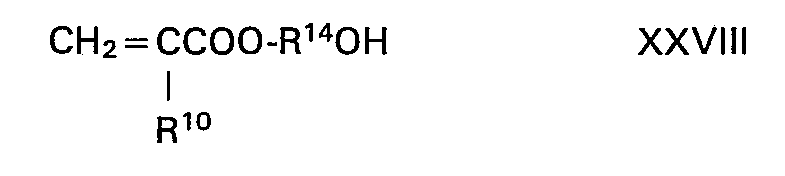
- Resins of the formula VIII, in which b is 1, can be obtained from pre-elongated, linear diepoxides of the formula XXVI by opening the terminal epoxy groups in the reaction with a dicarboxylic acid of the formula wherein R13 has the meaning given above, or with an anhydride of an acid of the formula XXVII and subsequent esterification of the terminal carboxylic acid groups thus formed with a hydroxyl-containing ester of acrylic or methacrylic acid, the formula wherein R 10 and R 14 have the meanings given above, produce.
- the ring opening of the epoxy groups generally takes place under the same conditions as described above for the ring opening of the diepoxides of the formula XXVI with acrylic or methacrylic acid, i.e. at a temperature of 60-150 ° C in the presence of a catalyst and optionally a radical inhibitor.
- the esterification with a hydroxyester of the formula XXVIII takes place under conventional conditions, in particular by heating to 60 ° to 150 ° C., especially at 100 ° to 130 ° C., in the absence of a solvent or in an inert solvent, preferably water-immiscible, and optionally in the presence of a water-releasing agent. If desired, these two stages can be carried out as a one-stage reaction by bringing all the reactants together in a single container and heating them to the desired temperature.
- This invention therefore further relates to a process for the preparation of photopolymerizable resins of the formula VIII, in which b is zero, which consists in reacting the designated epoxy groups in a pre-extended diepoxide of the formula XXVI with acrylic or methacrylic acid, and a process for the preparation of photopolymerizable Resins of the formula VIII, in which b is 1, which consists in reacting such a pre-extended diepoxide with a dicarboxylic acid of the formula XXVII or its anhydride together with a hydroxyalkyl ester of the formula XXVIII.
- a layer of the resin can be applied by coating the support with a resin which is mixed with water, the layer being obtained, for example, by dipping, spin coating (or vortex application, ie a process in which the material is placed on a support). which is then rotated at high speed around the material above to distribute), spraying or roller application.
- the invention further relates to a carrier made of, for example, aluminum, steel or another metal, paper or cardboard, which carries a layer of a resin of the formula VIII, and to a surface of such a substrate carrying a polymer polymerized by exposure to actinic radiation.
- a carrier made of, for example, aluminum, steel or another metal, paper or cardboard, which carries a layer of a resin of the formula VIII, and to a surface of such a substrate carrying a polymer polymerized by exposure to actinic radiation.
- Another object is a process for polymerizing such a resin, which consists in exposing a layer of the resin on a carrier to actinic radiation.
- actinic radiation with a wavelength of 200 to 600 nm is preferably used.
- the exposure of the resin to actinic radiation is preferably carried out in the presence of a photosensitizer, such as a quinone, a diphenylcarbinol, 5-nitroacenaphthene, a 2-substituted thioxanthone, a diphenylmethane, an ⁇ -haloacetophenone such as p-tert-butylphenyl-trichloromethyl ketone, a photoredox catalyst such as a mixture of a phenothiazine dye (e.g.
- a substituted quinoxaline with an electron donor reducing agent such as a sulfinic acid or its salt, a phosphine or arsine or thiourea, a benzophenone, a benzil dialkyl ketal such as benzil dimethyl ketal (ie a-methoxybenzoinmethyl ether, benzoin dimethyl ketal)
- Preferred sensitizers are Michler's ketone [i.e. 4,4'-bis (dimethylamino) benzophenone], benzoin-n-butyl ether and mixtures of these two, metal salts of 2- (m- or p-methoxyphenyl) -quinoxaline- (6'- or -7'- sulfonic acid in a mixture with a metal salt of toluene-p-sulfinic acid, 1-phenylpropane-1, 2-dione-2- (O-ethoxycarbonyl) oxime, benzil dimethyl ketal and mixtures of these two, and also 2-chlorothioxanthone and its mixtures Usually 0.1 to 20% and preferably 0.5 to 15% by weight of sensitizer, calculated on the weight of the photopolymerizable resin, is used.
- the resin should be applied to the carrier in a thickness of about 1 to 250 microns. If there is no excessive amount of water in the coating, drying is unnecessary; residual water in the film generally does not interfere with photopolymerization, especially if the substrate is relatively water absorbent, e.g. Cardboard.
- Suitable actinic radiation sources include carbon arcs, mercury vapor arcs, fluorescent tubes with fluorescent light emitting phosphors, argon and xenon glow lamps, tungsten lamps and photographic flood lamps. Among them, mercury vapor arcs, especially sunlamps, fluorescent sunlamps and metal halide lamps, are most suitable.
- the time required to expose a resin depends on various factors, including, for example, the individual resin used, the thickness of the coating, the type of light source and its distance from the coating, but this can easily be determined by serial tests.
- the epoxy contents are determined by titration with 0.1N perchloric acid solution in glacial acetic acid in the presence of excess tetraethylammonium bromide with crystal violet as an indicator. Parts and percentages are always parts by weight and percentages by weight.
- the mixture thus obtained is stirred for 6 hours at 100 ° to 105 ° C, after which its epoxy content has fallen to a negligible value.
- Water (8 g) is added to the resin to dilute it.
- the resulting solution has a viscosity of 22 Pa.s at 25 ° C.
- the product corresponds essentially to the formula VIII, in which b is zero, e has an average value of 2.0 and R 10 each represents a hydrogen atom, R 11 each represents a group of the formula XI and R12 each represents a group of the formula XXI.
- 1-phenyl-1,2-propanedione-2- (O-ethoxycarbonyl) oxime (0.02 g) and bezildimethyl ketal (0.02 g) are dissolved in 2 g of the solution.
- a 4 ⁇ m thick film of the sensitized solution is drawn onto 0.33 mm thick cardboard and exposed to UV radiation by passing it once through a “miniature” apparatus (Primarc Ltd., Stoke Row, from Henleyon-Thames, England) ), which has two medium pressure mercury arc lamps (80 W per cm) and runs at a belt speed of 60 meters per minute.
- the hardened coating is tack-free and highly flexible: it meets the standard test for solvent resistance by resisting rubbing 20 times with a cotton ball soaked in ethyl methyl ketone or water.
- the product corresponds essentially to the formula VIII, in which b is zero, R 10 is in each case a hydrogen atomic means that some of the groups R 11 of the formula XI and the rest of the formula XXIII and the groups R 12 of the formula XXI correspond.
- a sensitized solution is prepared, a 4 ⁇ m thick film is drawn onto cardboard and irradiated as described in Example 1.
- the irradiated film is tack-free and highly flexible and meets the organic solvent and water resistance tests according to Example 1.
- Acrylic acid (10.7 g) and 2,6-di-t-butyl-4-methylphenol (0.14 g) are added and the mixture is stirred as in Example 2 for 7 hours, after which its epoxy content is negligible.
- Water (11.3 g) is added to the resin to dilute it.
- the product corresponds essentially to the formula VII, in which b is zero, R 10 each represents a hydrogen atom, some of the groups R "of the formula XI and the rest of the formula XXIII and the groups R 12 of the formula XXI.
- a sensitized solution is prepared and a 4 ⁇ m thick film is drawn onto cardboard and irradiated as described in Example 1.
- the irradiated film is tack-free and highly flexible, and it meets the organic solvent and water resistance tests according to Example 1.
- a mixture of N, N'-diglycidyl-5,5-dimethylhydantoin (epoxide content 7.83 val / kg, 250 g), diglycidyl ether of a polyoxypropylene glycol with an average molecular weight of 425 (epoxide content 2.81 val / kg, 750 g) is stirred Bisphenol A (150 g) and sodium hydroxide (0.65 g) for 5 hours at 165 ° C, at which time the epoxy content of the mixture is 2.27 eq / kg.
- Acrylic acid (184 g), 2,6-di-t-butyl-4-methylphenol (2.6 g) and chromium III trisoctanoate (1.6 g) are added to the resin at 120 ° C.
- the mixture is stirred for 11 hours at 110 ° C to 120 ° C, after which its epoxy content is negligible.
- Water (70 g) is added to the resin to form a solution with a viscosity of 6.1 Pa.s at 25 ° C.
- the product corresponds essentially to the formula VIII, in which b is zero, R 10 each represents a hydrogen atom, some of the groups R 11 correspond to the formula XI and the rest of the formula XXIII and the groups R 12 correspond to the formula XXII.
- Benzyl dimethyl ketal (0.4 g) is dissolved in 19.6 g of the solution.
- a 4 ⁇ m thick film of the sensitized solution is drawn onto cardboard and irradiated as described in Example 1.
- the hardened cover is non-sticky and highly flexible; it resists rubbing 10 times with a cotton ball soaked in ethyl methyl ketone and rubbing 20 times with a cotton ball soaked in water.
- the product corresponds essentially to the formula VIII, in which b is zero, R 10 each represents a hydrogen atom, some groups R 11 of the formula XI, some of the formula XXII and the rest of the formula XXIII and the groups R 12 also correspond to the formula XXIII.
- a sensitized solution is prepared as in Example 4 and a 4 ⁇ m thick film is applied to cardboard and exposed to UV radiation according to Example 1.
- the hardened coating is tack-free and highly flexible, and it meets the organic solvent and water resistance tests according to Example 1 .
- 5.5-Pentamethylene hydantoin (16.2 g) is added in portions with stirring to a mixture of 1,4-butanediol diglycidyl ether (epoxide content 8.6 val / kg, 36.5 g) and N-phenylimidazole (0.02 g), keeping the temperature at 120-130 °. after the addition has ended, the mixture is stirred for 11 ⁇ 2 hours at 155 °, at which time its epoxy content has dropped to 2.47 eq / kg. At 100 ° C, acrylic acid (9.2 g) and 2,6-di-t-butyl-4-methylphenol (0.1 g) are added.
- the mixture is stirred for 5 hours at 100 to 105 °, after which its epoxy content has fallen to a negligible value.
- Water (10.5 g) is added to dilute the resin.
- the resulting solution has a viscosity of 12.6 g Pa.s at 25 °.
- the product corresponds essentially to the formula VIII, in which b is zero, e has an average value of 1.7, R 10 each represents a hydrogen atom, R 11 each represents a group of the formula XXI and R 12 each represents a group of the formula XVII.
- Adipic acid (13.9 g) is added in portions with stirring to a mixture of N, N'-diglycidyl-5,5-dimethylhydantoin (epoxide content 7.8 val / kg, 40 g) and N-phenylimidazole (0.02 g ), keeping the temperature between 120 and 130 °.
- the mixture is stirred at 140 ° C. for 1 hour, at which time its epoxy content has dropped to 2.1 val / kg. 1 at 100 is added acrylic acid (8.1 g) and 2,6-di-t-butyl-4-methylphenol (0.1 g) was added and the mixture is stirred 4 1/2 hours at 100-105 °, after which the Epoxy content has dropped to a negligible level.
- Sufficient water is added so that the resulting solution contains 20% water and has a viscosity of 4.3 Pa.s at 25 °.
- the product corresponds essentially to the formula VIII, in which b is zero, e has an average value of 2.0, R 10 each represents a hydrogen atom, R 11 adipoyl and R 12 each represent a group of the formula XI.
- a sensitized solution is prepared as in Example 6, and a 4 ⁇ m thick film of the sensitized solution is drawn onto cardboard and irradiated as described in Example 1.
- the irradiated film is tack-free and highly flexible, and it meets the organic solvent and water resistance tests according to Example 1.
- a mixture of diglycidyl hexahydrophthalate (epoxide content 6.4val / kg, 41.2 g) and tetramethylammonium chloride (0.1 g) is heated to 100 ° C. and 5.5-dimethylhydantoin (10.2 g) is added in portions over the course of 1 hour . Then the mixture is stirred for 4 hours at 100 ° C., after which the epoxy content has dropped to 2.45 eq / kg.
- the product essentially corresponds to the formula VIII, in which b 1 and e are 1 and R 10 are each hydrogen, R 11 is hexahydrophthaloyl, R 12 is a group of the formula XI and R 13 and R 14 are each ethylene.
- This product (15 g) is mixed with water (5 g) and mixed with benzil dimethyl ketal (0.2 g) and 2-chlorothioxanthone (0.2 g).
- a 6 ⁇ m thick film is drawn onto cardboard and irradiated for 1 to 2 seconds under an 80 W per cm medium-pressure mercury lamp at a distance of 25 cm.
- the irradiated coating is tack-free and resists rubbing twice with a cotton ball soaked in ethylene methyl ketone and rubbing 5 times with a cotton ball soaked in water.
- the product is allowed to cool to 100 ° C., a mixture of methacrylic acid (5.36 g) and 2,6-di-t-butyl-4-methylphenol (0.15 g) is added dropwise over the course of 1 hour and the mixture is then stirred 6 hours at 100 ° C.
- the xylene is evaporated off under reduced pressure; the product has an epoxy content of 0.82 val / kg.
- This product (6 g) is mixed with water (2 g), 1-phenyl-1,2-propanedione-2- (O-ethoxycarbonyl) oxime (0.08 g) and benzil dimethyl ketal (0.08 g).
- a 6 ⁇ m thick film of the sensitized solution is drawn onto 0.33 mm thick cardboard and irradiated for 5 seconds under an 80 W per cm medium-pressure mercury lamp at a distance of 25 cm.
- the irradiated coating is tack-free and resists rubbing three times with a cotton ball soaked in ethyl methyl ketone and rubbing twice with a cotton ball soaked in water.
- 5.5-Dimethylhydantoin (77.4 g) is added in portions with stirring to a mixture of 1,4-butanediol diglycidyl ether with an epoxide content of 8.6% / kg, 200 g) and tetramethylammonium chloride (0.25 g).
- the mixture is heated to 120 ° C., an exothermic reaction starting which raises the temperature to 230 ° C.
- the mixture is cooled to 100 ° C; it has an epoxy content of 2.2 val / kg.
- This product (10 parts) is mixed with 2 parts of water, 0.1 part of 2-chlorothioxanthone and 0.1 part of benzil dimethyl ketal and a 6 ⁇ m thick layer of the composition is applied to cardboard.
- the layer is irradiated for 10 seconds at a distance of 25 cm with an 80 W per cm medium-pressure mercury lamp; the film is tack-free and resists rubbing 6 times with a cotton ball soaked in water.
Landscapes
- Chemical & Material Sciences (AREA)
- Health & Medical Sciences (AREA)
- Chemical Kinetics & Catalysis (AREA)
- Medicinal Chemistry (AREA)
- Polymers & Plastics (AREA)
- Organic Chemistry (AREA)
- Physics & Mathematics (AREA)
- Spectroscopy & Molecular Physics (AREA)
- General Physics & Mathematics (AREA)
- Macromonomer-Based Addition Polymer (AREA)
- Epoxy Resins (AREA)
- Paints Or Removers (AREA)
Description
- Die vorliegende Erfindung betrifft bei Belichtung mit aktinischer Strahlung polymerisierende Harze, Methoden zu deren Herstellung und die Polymerisation solcher mit Wasser gemischten Harze mittels aktinischer Strahlung, Schichtträger mit einem solchen darauf aufgebrachten Harz im polymerisierbaren Zustand und ein mittels aktinischer Strahlung polymerisiertes Harz tragende Substrate.
- Bei Belichtung mit aktinischer Strahlung der Polymerisation fähige Substanzen werden als Oberflächenbeschichtungen verwendet, z.B. auf Metallen, Papier und Karton (d.h. etwa 0,1 bis 0,5 mm dicke, zum Aufbau von Faltschachteln verwendete Kartonpappe). Der Vorteil der Verwendung aktinischer Strahlung liegt darin, dass der Energieverbrauch im allgemeinen niedriger ist, als wenn die Substanzen durch Hitzeeinwirkung polymerisiert werden müssten. Dabei weithin verwendete Substanzen sind das Addukt von Acrylsäure oder Methacrylsäure mit dem Diglycidyläther von Bisphenol A, d.h. 2,2-Bis-[4-(3--acryloyloxy-2-hydroxypropoxy)-phenyl]-propan oder dessen Methacryloylhomolog. Die Viskosität der diese Addukte enthaltenden Formulierungen ist jedoch im allgemeinen zu hoch für leichten Auftrag, und deshalb werden niedermolekulare photopolymerisierbare Acrylate, wie Propylenglykoldiacrylat und Glycerintriacrylat miteingebaut.
- Die Verwendung flüchtiger, niedermolekularer Acrylatester in solchen Formulierungen ist jedoch häufig aus Toxizitätsgründen unerwünscht, und es besteht daher ein Bedarf für mittels aktinischer Strahlung polymerisierbare, als Oberflächenbeschichtungen verwendbare Harze, die aber keine niedermolekularen Acrylatester enthalten.
- Es wurde nun gefunden, dass man durch Verwendung gewisser neuartiger vorverlängerter Harze den oben genannten Bedarf zumindest weitgehend erfüllen kann.
- In der britischen Patentschrift Nr. 1 521 933 der Anmelderin wurden Harze beschrieben, die vor Belichtung mit aktinischer Strahlung wasserlöslich sind, aber bei Belichtung mit aktinischer Strahlung polymerisieren und wasserunlöslich werden, wobei diese Harze der Formel
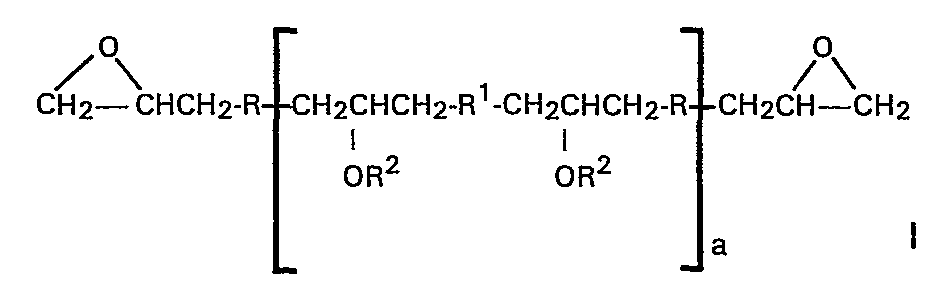


- Die Harze der Formel werden in zwei Stufen hergestellt. Bei der ersten handelt es sich um die Umsetzung eines Diepoxids der Formel IV


- In der zweiten Stufe werden einige oder sämtliche der abgebildeten sekundären Hydroxylgruppen mittels Umsetzung mit z.B. N-(Hydroxymethyl)-acrylamid oder Acryloylchlorid durch Gruppen der Formel -O-(CH2NH)dCOC(R6) = CH2 ersetzt.
- In der britischen Patentschrift Nr. 1 367 207 hat die Anmelderin Polyacrylate N-heterocyclischer Verbindungen beschrieben. In einem der Beispiele ist ein Verfahren beschrieben, bei dem 1 -Glycidyl-3-(2-gly- cidyloxy-n-propyl)-5,5-dimethylhydantoin (0,9 val) mit Sebacinsäure (0,6 val) erhitzt wird, wobei sich ein Produkt vorwiegend der Struktur

- Dieses Diepoxid erhitzt man dann mit Acrylsäure (0,3 val) unter Bildung eines Harzes, das in der Kälte hochviskos ist und dem hauptsächlich die Struktur VII, worin R9 nun jeweils für eine 3-Acryloyloxy--2-hydroxypropylgruppe steht, zugeschrieben wird.
- In der britischen Patentschrift Nr. 1 399 135 wurde von der Anmelderin die Polymerisation von Polyacrylaten wie solchen der Formel VII, worin R9 jeweils eine 3-Acryloyloxy-2-hydroxypropylgruppe bedeutet, mittels ionisierender Strahlung beschrieben.
- Es wurde nun gefunden, dass neuartige acryloyl-oder methacryloylhaltige Harze herstellbar sind, die die obigen Erfordernisse im wesentlichen erfüllen. Zwar sind sie nicht unbedingt voll in Wasser löslich, doch sind sie damit mischbar und lassen sich mit begrenzten Wassergehalten (z.B. von 5 bis 25 Gew.-%) leicht auftragen.
- Ein Gegenstand dieser Erfindung sind demnach Harze, die bei Belichtung mit aktinischer Strahlung polymerisieren und harte, nicht-klebrige, chemisch widerstandsfähige Überzüge bilden, wobei diese Harze der Formel


- Bevorzugt werden solche Harze der Formel VIII, worin e eine Zahl vom Durchschnittswert höchstens 10, insbesondere 1, 2 bis 5, ist.
- Vorzugsweise bedeuten höchstens 75% der Summe der (e+1) R11 und e R12-Gruppen eine Gruppe der Formel IX. Es wird angenommen, dass die Wasserverträglichkeit der Verbindungen der Formel VIII der Gegenwart von Gruppen der Formel IX zuzuschreiben ist; besitzt ein zu hoher Teil der R11- und R12-Gruppen jedoch eine solche Konstitution, so kann das photopolymerisierte Produkt für einige Zwecke eine ungenügende Widerstandsfähigkeit gegen Wasser aufweisen. Es ist deshalb wünschenswert, dass mindestens 25% der Summe der Gruppen R11 und R12, falls diese nicht für eine Gruppe der Formel IX stehen, eine (gegebenenfalls in der Kette durch ein oder mehrere Äthersauerstoffatome unterbrochene) Oxyalkylenoxygruppe mit 2 bis 40 Kohlenstoffatomen oder eine Oxyarylenoxygruppe mit 6 bis 18 Kohlenstoffatomen darstellen. Ferner werden Verbindungen der Formel VIII bevorzugt, worin R11 und R12, falls sie nicht für eine Gruppe der Formel IX stehen, je eine Oxyalkylenoxygruppe bedeuten, deren Alkylenkomponente eine Kette mit 3 bis 6 aufeinanderfolgenden Kohlenstoffatomen oder eine durch ein oder mehrere Äthersauerstoffatome unterbrochene Kette von 4 bis 28 Kohlenstoffatomen, eine Oxyphenylenoxygruppe oder eine Gruppe der Formel

- Ist b 1, so stehen R13 und R14 vorzugsweise beide für Alkylengruppe mit 2 bis 6 Kohlenstoffatomen.
- Besonders bevorzugt werden Harze, die Gruppen der Formel IX enthalten, worin jedes Paar R15 eine Gruppe der Formel -C(R16R17)CO- darstellt, wobei R16 eine Methyl-, Äthyl-, n-Propyl-, n-Pentyl-, Neopentyl-, sek.-Amyl- oder 2-Äthylhexylgruppe und R17 eine Methylgruppe oder R16 und R17 zusammen eine Pentamethylen- oder Hexamethylengruppe bedeuten.
- Spezielle Beispiele für als R11 und R12 geeignete, zudem der Formel IX entsprechende Gruppen sind
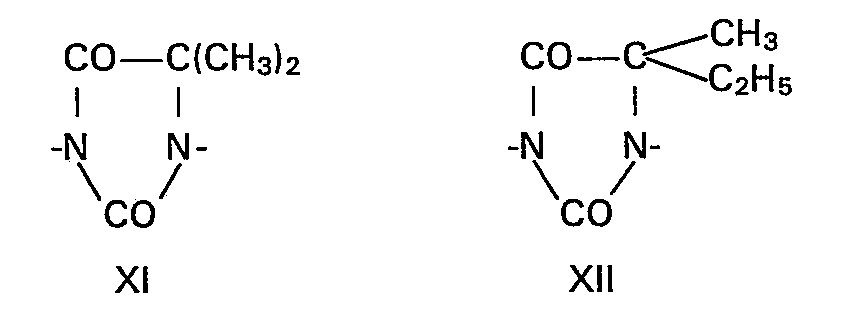


- Die Gruppen der Formeln XI bis XIX stellen jeweils den Rest des 5,5-Dimethylhydantoins, 5-Äthyl-5--methylhydantoins, Imidazolin-2-ons, 1,3-Dimethylharnstoffs, Hexahydro-2H-pyrimidin-2-ons, 5-Methyl-5-(2-äthylhexyl)-hydantoins, 5,5-Pentamethylen-hydantoins, 4-Methylimidazolidin-2-ons bzw. 1,1'-Methylen-bis-(5,5-dimethylhydantoins) dar.
- Spezielle Beispiele für geeignete Gruppen R11 und R12, die nicht zudem der Formel IX entsprechen, sind solche der Formel



- Die Gruppen der Formeln XX bis XXIII stellen jeweils die Reste des Äthylenglykols, Butan-1,4-diols, eines Poly-(oxypropylen)-glykols vom Durchschnittsmolekulargewicht 425 bzw. 2,2-Bis-(4-hydroxyphenyl)-propans dar.
- Harze der Formel VIII, in denen b null ist, lassen sich in zwei Stufen herstellen.
- Dabei handelt es sich bei der ersten um die Umsetzung eines Diepoxids der Formel


- Üblicherweise wird das Diepoxid der Formel XXIV mit der Verbindung der Formel XXV bei einer Temperatur im Bereich 120°-210°C, und insbesondere bei 140°-190°C, erhitzt. Die Reaktion lässt sich durch Zusatz geeigneter Katalysatoren beschleunigen. Beispiele für solche Katalysatoren sind Alkalihydroxyde wie Natriumhydroxyd, Alkalihalogenide wie Lithiumchlorid, Kaliumchlorid und Natriumchlorid, -bromid oder -fluorid, tertiäre Amine wie Triäthylamin, Tri-n-propylamin, N-Benzyldimethylamin, N,N'-Dimethylanilin und Triäthanolamin, quartäre Ammoniumbasen wie Benzyltrimethylammoniumhydroxyd, quartäre Ammoniumsalze wie Tetramethylammoniumchlorid, Tetraäthylammoniumchlorid, Benzyltrimethylammoniumchlorid, Benzyltrimethylammoniumacetat und Methyltriäthylammoniumchlorid, sowie Hydrazine mit einem tertiären Stickstoffatom, wie 1, 1-Dimethylhydrazin, das auch in seiner quartärisierten Form eingesetzt werden kann. Je nach der Wahl der Ausgangsstoffe kann die Reaktion manchmal so schnell quantitativ verlaufen, dass keine Katalysatorzugabe nötig ist. Während die Ausgangsstoffe im allgemeinen bei Raumtemperatur miteinander vermischt und dann auf die Reaktionstemperatur gebracht werden, ist es bei miteinander sehr reaktiven Komponenten vorteilhaft, wenn man das Diepoxid der Formel XXIV zunächst für sich auf die erforderliche Reaktionstemperatur erhitzt und dann die übrigen Reaktionskomponenten allmählich in kleinen Portionen zusetzt. Das Fortschreiten der Reaktion bis zur Bildung eines Endprodukts mit einem definierten, im wesentlichen konstant bleibenden Epoxidgruppengehalt lässt sich durch Titrieren der Epoxidgruppen in während der Reaktion genommenen Proben verfolgen.
- Derartige Vorverlängerungsreaktionen sind bekannt (siehe z.B. die oben erwähnte britische Patentschrift Nr. 1 521 933).
- In der zweiten Stufe wird aus dem vorverlängerten Diepoxid der Formel XXVI durch Öffnung der endständigen Epoxidgruppen mittels Umsetzung mit Acrylsäure oder Methacrylsäure das wasserverdünnbare Harz der Formel VIII hergestellt.
- Diese Reaktion erfolgt im allgemeinen bei einer Temperatur von 60° bis 150°C, insbesondere bei 100° bis 130°C, gegebenenfalls in Gegenwart eines inerten, polaren Lösungsmittels wie Chloroform. Vorzugsweise hat das Molverhältnis des vorverlängerten Diepoxids der Formel XXVI zu Acrylsäure oder Methacrylsäure einen solchen Wert, dass im wesentlichen sämtliche abgebildeten Glycidylgruppen in (Meth)acryloyl-2-hydroxypropylgruppen umgewandelt werden.
- Vorzugsweise liegt ein Katalysator für die Ring- öffnungsreaktion vor. Dieser Katalysator kann Natriumacetat oder vorzugsweise ein tertiäres Amin oder quartäres Ammoniumsalz wie eines der oben angeführten, oder ein Salz des dreiwertigen Chroms mit einer Alkansäure, wie Octansäure und 2-Äthylhexansäure, oder mit einer Alkensäure wie Acrylsäure sein.
- Gewünschtenfalls kann man einen Radikalinhibitor wie Hydrochinon oder 2,6-Di-tert.-butyl-4-methylphenol mit zusetzen, um das Eintreten von Nebenreaktionen zu verringern. Solche Inhibitoren braucht man nach Beendigung der Reaktion nicht zu entfernen, da sie die Stabilität des Produkts aufrechterhalten, aber seine Polymerisation bei Belichtung mit aktinischer Strahlung nicht verhindern.
- Harze der Formel VIII, in denen b 1 ist, lassen sich aus vorverlängerten, linearen Diepoxiden der Formel XXVI durch Öffnen der endständigen Epoxidgruppen bei der Umsetzung mit einer Dicarbonsäure der Formel

- Die Ringöffnung der Epoxidgruppen erfolgt im allgemeinen unter denselben Bedingungen, wie oben für die Ringöffnung der Diepoxide der Formel XXVI mit Acryl- oder Methacrylsäure beschrieben, d.h. bei einer Temperatur von 60-150 °C in Gegenwart eines Katalysators und gegebenenfalls eines Radikalinhibitors.
- Die Veresterung mit einem Hydroxyester der Formel XXVIII erfolgt unter herkömmlichen Bedingungen, insbesondere durch Erhitzen auf 60° bis 150°C, speziell bei 100° bis 130°C, in Abwesenheit eines Lösungsmittels oder in einem inerten, vorzugsweise mit Wasser nicht mischbaren Lösungsmittel sowie gegebenenfalls in Gegenwart eines wasserabspaltenden Mittels. Gewünschtenfalls kann man diese beiden Stufen als Einstufenreaktion durchführen, indem man sämtliche Reaktionspartner in einem einzigen Behälter zusammenbringt und auf die gewünschte Temperatur erhitzt.
- Gegenstand dieser Erfindung ist demnach weiterhin ein Verfahrten zur Herstellung photopolymerisierbarer Harze der Formel VIII, worin b null ist, welches darin besteht, dass man die bezeichneten Epoxidgruppen in einem vorverlängerten Diepoxid der Formel XXVI mit Acryl- oder Methacrylsäure umsetzt, sowie ein Verfahren zur Herstellung photopolymerisierbarer Harze der Formel VIII, worin b 1 ist, welches darin besteht, dass man ein solches vorverlängertes Diepoxid mit einer Dicarbonsäure der Formel XXVII oder deren Anhydrid zusammen mit einem Hydroxyalkylester der Formel XXVIII umsetzt.
- Eine Schicht des Harzes lässt sich durch Beschichtung des Trägers mit einem Harz, das mit Wasser gemischt ist, aufbringen, wobei man die Schicht beispielsweise durch Tauchen, Aufschleudern (bzw. Wirbelauftrag, d.h. ein Verfahren, bei dem das Material auf einen Träger aufgelegt wird, der dann hochtourig rotiert wird, um das Material darüber zu verteilen), Aufsprühen oder Walzenantrag aufbringt.
- Gegenstand der Erfindung ist ferner ein Träger aus beispielsweise Aluminium, Stahl oder einem anderen Metall, Papier oder Karton, der eine Schicht eines Harzes der Formel VIII trägt, sowie ein auf seiner Oberfläche ein solches, durch Belichtung mit aktinischer Strahlung polymerisiertes Harz tragendes Substrat. Ein weiterer Gegenstand ist ein Verfahren zum Polymerisieren eines solchen Harzes, weiches darin besteht, dass man eine Schicht des Harzes auf einem Träger aktinischer Strahlung aussetzt.
- Bei der Polymerisation der erfindangsgemässen Harze verwendet man vorzugsweise aktinische Strahlung einer Wellenlänge von 200 bis 600 nm.
- Vorzugsweise erfolgt die Belichtung des Harzes mit aktinischer Strahlung in Gegenwart eines Photosensibilisators, wie einem Chinon, einem Diphenylcarbinol, 5-Nitroacenaphthen, einem 2-substituierten Thioxanthon, einem Diphenylmethan, einem α-Halogenoacetophenon wie p-tert.-Butylphenyl-tri- chlormethylketon, einem Photoredoxkatalysator wie einem Gemisch aus einem Phenothiazinfarbstoff (z.B. Methylenblau) oder einem substituierten Chinoxalin mit einem Elektronendonatorreduktionsmittel wie einer Sulfinsäure oder deren Salz, einem Phosphin oder Arsin oder Thioharnstoff, einem Benzophenon, einem Benzildialkylketal wie Benzildimethylketal (d.h. a-Methoxybenzoinmethyläther), Benzoin, einem Benzoinalkyläther oder einem O-Alkoxycarbonylderivat eines Oxims des Benzils oder 1-Phenylpropan-1,2-dions, wie Benzil-(O-äth-oxycarbonyl)--a-monoxim und 1-Phenylpropan-1,2-dion-2-(O--äthoxycarbonyl)-oxim. Bevorzugte Sensibilisatoren sind Michlers Keton [d.h. 4,4'-Bis-(dimethylamino)--benzophenon], Benzoin-n-butyläther sowie Gemische dieser beiden, Metallsalze der 2-(m- oder p--Methoxyphenyl)-chinoxalin-(6'- oder -7'-sulfonsäure im Gemisch mit einem Metallsalz der Toluol-p--sulfinsäure, 1-Phenylpropan-1 ,2-dion-2-(O-äthoxy- carbonyl)-oxim, Benzildimethylketal und Gemische dieser beiden, sowie 2-Chlorthioxanthon und dessen Gemische mit Benzildimethylketal. Üblicherweise werden 0,1 bis 20% und vorzugsweise 0,5 bis 15 Gew.-% Sensibilisator, berechnet auf das Gewicht des photopolymerisierbaren Harzes, eingesetzt.
- Das Harz soll auf den Träger in einer Dicke von etwa 1 bis 250 µm aufgebracht werden. Falls nicht übermässige Mengen Wasser in der Beschichtung vorhanden sind, ist Trocknen unnötig; restliches Wasser im Film stört im allgemeinen die Photopolymerisation nicht, insbesondere wenn das Substrat relativ wasseraufsaugend ist, z.B. Pappe.
- Geeignete aktinische Strahlungsquellen sind unter anderem Kohlelichtbögen, Quecksilberdampflichtbögen, Leuchtröhren mit Ultraviolettes Licht aussendehden Leuchtstoffen, Argon- und Xenonglimmlampen, Wolframlampen und photographische Flutlampen. Darunter sind Quecksilberdampflichtbögen, insbesondere Höhensonnen, fluoreszierende Höhensonnen und Metallhalogenidlampen am besten geeignet. Die zur Belichtung eines Harzes erforderliche Zeit hängt von verschiedenen Faktoren ab, unter anderem beispielsweise dem einzelnen verwendeten Harz, der Dicke der Beschichtung, der Art der Lichtquelle und deren Abstand von der Beschichtung, doch lässt sich dies leicht durch Serienversuche ermitteln.
- Die nachfolgenden Beispiele erläutern die Erfindung. Die Epoxidgehalte werden durch Titration mit 0,1n-Perchlorsäurelösung in Eisessig in Gegenwart von überschüssigem Tetraäthylammoniumbromid mit Kristallviolett als Indikator bestimmt. Teile und Prozentangaben sind stets Gewichtsteile und Gewichtsprozente.
- Man rührt ein Gemisch aus N,N'-Diglycidyl-5,5--dimethylhydantoin (Epoxidgehalt 7,88 val/kg, 50 g) und 1,4-Butandiol (12 g), nach Zusatz von Chrom-III-trisoctanoat (0,075 g) als Katalysator für die nachfolgende Umsetzung mit Acrylsäure, 5 Stunden lang bei 190°C, wonach der Epoxidgehalt des Gemischs auf 2,35 val/kg gefallen ist. Dann gibt man Acrylsäure (10,2 g) und 2,6-Di-t-butyl-4-methylphenol (0,14 g) bei 100°C zu dem vorverlängerten Harz. Das so erhaltene Gemisch wird 6 Stunden bei 100° bis 105°C gerührt, wonach sein Epoxidgehalt auf einen vernachlässigbar kleinen Wert gefallen ist. Zur Verdünnung versetzt man das Harz mit Wasser (8 g). Die entstandene Lösung besitzt eine Viskosität von 22 Pa.s bei 25°C.
- Das Produkt entspricht im wesentlichen der Formel VIII, worin b null ist, e einen Durchschnittswert von 2,0 aufweist sowie R10 jeweils ein Wasserstoffatom, R11 jeweils eine Gruppe der Formel XI und R12 jeweils eine Gruppe der Formel XXI bedeuten.
- Man löst 1-Phenyl-1,2-propandion-2-(O-äthoxy- carbonyl)-oxim (0,02 g) und Bezildimethylketal (0,02 g) in 2 g der Lösung. Man zieht einen 4 µm dicken Film der sensibilisierten Lösung auf 0,33 mm dicken Karton auf und belichtet mit UV-Strahlung durch einmaliges Durchführen durch einen «Mini- cure»-Apparat (Primarc Ltd., Stoke Row, bei Henleyon-Thames, England), der zwei Mitteldruckquecksilberbogenlampen (80 W pro cm) aufweist und mit einer Bandgeschwindigkeit von 60 Metern pro Minute läuft. Der gehärtete Überzug ist klebfrei und hochbiegsam: er genügt der Normprüfung auf Lösungsmittelbeständigkeit, indem er 20maligem Reiben mit einem in Äthylmethylketon bzw. Wasser getränkten Wattebausch jeweils widersteht.
- Man rührt ein Gemisch aus N,N'-Diglycidyl-5,5--dimethylhydantoin (Epoxidgehalt 7,88 val/kg, 41,9 g), Bisphenol-A-diglycidyläther (Epoxidgehalt 5,2 val/kg, 12,0 g) und Chrom-III-trisoctanoat (0,075 g) enthaltendem 1,4-Butandiol (12,0 g) 5 Stunden bei 185°C, wonach der Epoxidgehalt des Gemischs 2,38 val/kg beträgt. Dann gibt man Acrylsäure (10,7 g) und 2,6-Di-t-butyl-4-methylphenoi (0,14 g) dazu und rührt das Gemisch wie in Beispiel 1, jedoch 7 Stunden lang, zu welcher Zeit sein Epoxidgehalt auf einen vernachlässigbar kleinen Wert gefallen ist. Zur Verdünnung versetzt man das Harz mit Wasser (12 g). Die Lösung besitzt eine Viskosität von 15 Pa.s bei 25°C.
- Das Produkt entspricht im wesentlichen der Formel VIII, worin b null ist, R10 jeweils ein Wasserstoffatom bedeutet, einige der Gruppen R11 der Formel XI und der Rest der Formel XXIII sowie die Gruppen R12 der Formel XXI entsprechen.
- Man stellt eine sensibilisierte Lösung her, zieht einen 4 µm dicken Film auf Karton auf und bestrahlt wie in Beispiel 1 beschrieben. Der bestrahlte Film ist klebfrei und hochbiegsam und genügt den organischen Lösungsmittel- und Wasserbeständigkeitsprüfungen gemäss Beispiel 1.
- Man rührt ein Gemisch aus N,N'-Diglycidyl-5,5--dimethylhydantoin (Epoxidgehalt 7,88 val/kg, 25 g), Bisphenol-A-diglycidyläther (Epoxidgehalt 5,2 val/kg, 25 g) und Chrom-III-trisoctanoat (0,075 g) enthaltendem 1,4-Butandiol (8,5 g) 6½ Stunden bei 185°C, zu welcher Zeit der Epoxidgehalt des Gemischs 2,55 val/kg beträgt.
- Man gibt Acrylsäure (10,7 g) und 2,6-Di-t-butyl-4--methylphenol (0,14 g) dazu und rührt das Gemisch wie in Beispiel 2 7 Stunden lang, wonach sein Epoxidgehalt vernachlässigbar ist. Zur Verdünnung versetzt man das Harz mit Wasser (11,3 g).
- Das Produkt entspricht im wesentlichen der Formel VII, worin b null ist, R10 jeweils ein Wasserstoffatom bedeutet, einige der Gruppen R" der Formel XI und der Rest der Formel XXIII sowie die Gruppen R12 der Formel XXI entsprechen.
- Man stellt eine sensibilisierte Lösung her und zieht einen 4 µm dicken Film dieser auf Karton auf und bestrahlt wie in Beispiel 1 beschrieben. Der bestrahlte Film ist klebfrei und hochbiegsam, und er genügt den organischen Lösungsmittel- und Wasserbeständigkeitsprüfungen gemäss Beispiel 1.
- Man rührt ein Gemisch aus N,N'-Diglycidyl-5,5--dimethylhydantoin (Epoxidgehalt 7,83 val/kg, 250 g), Diglycidyläther eines Polyoxypropylenglykols vom Durchschnittsmolekulargewicht 425 (Epoxidgehalt 2,81 val/kg, 750 g), Bisphenol A (150 g) und Natriumhydroxyd (0,65 g) 5 Stunden bei 165°C, zu welcher Zeit der Epoxidgehalt des Gemischs 2,27 val/kg beträgt. Man gibt Acrylsäure (184 g), 2,6-Di--t-butyl-4-methylphenol (2,6 g) und Chrom-III-trisoctanoat (1,6 g) zu dem Harz bei 120°C. Das Gemisch wird 11 Stunden bei 110°C bis 120°C gerührt, wonach sein Epoxidgehalt vernachlässigbar ist. Man versetzt das Harz mit Wasser (70 g) unter Bildung einer Lösung mit einer Viskosität von 6,1 Pa.s bei 25°C.
- Das Produkt entspricht im wesentlichen der Formel VIII, worin b null ist, R10 jeweils ein Wasserstoffatom bedeutet, einige der Gruppen R11 der Formel XI und der Rest der Formel XXIII sowie die Gruppen R12 der Formel XXII entsprechen.
- Benzildimethylketal (0,4 g) wird in 19,6 g der Lösung aufgelöst. Man zieht einen 4 µm dicken Film der sensibilisierten Lösung auf Karton auf und bestrahlt wie in Beispiel 1 beschrieben. Der gehärtete Überzug ist klebfrei und hochbiegsam; er widersteht 10maligem Reiben mit einem in Äthylmethylketon getränkten Wattebausch sowie 20maligem Reiben mit einem in Wasser getränkten Wattebausch.
- Ähnliche Ergebnisse erhält man mit einem Produkt aus einem Harz, bei dem 2-Phenylimidazol anstelle von Natriumhydroxyd als Vorverlängerungskatalysator verwendet wurde.
- Man rührt ein Gemisch aus N,N'-Diglycidyl-5,5-dimethylhydantoin (Epoxidgehalt 7,83 val/kg, 250 g), Diglycidyläther eines Polyoxypropylenglykols vom Durchschnittsmolekulargewicht 425 (Epoxidgehalt 8,81 val/kg, 500 g), Bisphenol-A-diglycidyläther (Epoxidgehalt 5,31 val/kg, 250 g), Bisphenol A (202 g) und Natriumhydroxyd (0,64 g) 51/2 Stunden bei 165°C, zu welcher Zeit der Epoxidgehalt 2,44 val/kg beträgt, Acrylsäure (200g), 2,6-Di-t-butyl-4-methylphenol (2',8 g) und Chrom-III-trisoctanoat (1,8 g) werden dem Harz bei 110°C zugesetzt, und das Gemisch wird 7 Stunden bei 105° bis 110°C gerührt, wonach dessen Epoxidgehalt vernachlässigbar ist (unter 0,1 1 val/kg). Zum Verdünnen versetzt man das Harz mit Wasser (155 g), wobei sich eine Lösung mit einer Viskosität von 25,3 Pa.s bei 25°C bildet.
- Das Produkt entspricht im wesentlichen der Formel VIII, worin b null ist, R10 jeweils ein Wasserstoffatom bedeutet, einige Gruppen R11 der Formel XI, einige der Formel XXII und der Rest der Formel XXIII sowie die Gruppen R12 ebenfalls der Formel XXIII entsprechen.
- Man stellt wie in Beispiel 4 eine sensibilisierte Lösung her und zieht einen 4 µm dicken Film auf Karton auf und belichtet mit UV-Strahlung gemäss Beispiel 1. Der gehärtete Überzug ist klebfrei und hochbiegsam, und er genügt den organischen Lösungsmittel-und Wasserbeständigkeitsprüfungen gemäss Beispiel 1.
- Man gibt 5,5-Pentamethylenhydantoin (16,2 g) portionsweise unter Rühren zu einem Gemisch aus 1,4-Butandioldiglycidyläther (Epoxidgehalt 8,6 val/kg, 36,5 g) und N-Phenylimidazol (0,02 g), wobei man die Temperatur bei 120-130° hält. nach beendeter Zugabe wird das Gemisch 1½ Stunden bei 155° gerührt, zu welcher Zeit sein Epoxidgehalt auf 2,47 val/kg gefallen ist. Bei 100°C gibt man Acrylsäure (9,2 g) und 2,6-Di-t-butyl-4-methylphenol (0,1 g) dazu. Das Gemisch wird 5 Stunden bei 100 bis 105° gerührt, wonach dessen Epoxidgehalt auf einen vernachlässigbar kleinen Wert gefallen ist. Zum Verdünnen des Harzes versetzt man mit Wasser (10,5 g). Die entstandene Lösung besitzt eine Viskosität von 12,6 g Pa.s bei 25°.
- Das Produkt entspricht im wesentlichen der Formel VIII, worin b null ist, e einen Durchschnittswert von 1, 7 aufweist, R10 jeweils ein Wasserstoffatom, R11 jeweils eine Gruppe der Formel XXI und R12 jeweils eine Gruppe der Formel XVII bedeuten.
- Man löst 1-Phenyl-1,2-propandion-2-(O-äthoxy- carbonyl)-oxim (0,2 g) und Benzildimethylketal (0,2 g) in 20 g der obigen Lösung. man zieht einen 4 µm dicken Film dersensibilisierten Lösung auf Karton auf und bestrahlt wie in Beispiel 1 beschrieben. Der bestrahlte Film ist klebfrei und hochbiegsam, und er genügt den organischen Lösungsmittel- und Wasserbeständigkeitssprüfungen gemäss Beispiel 1.
- Man gibt Adipinsäure (13,9 g) portionsweise unter Rühren zu einem Gemisch aus N,N'-Diglycidyl-5,5--dimethylhydantoin (Epoxidgehalt 7,8 val/kg, 40 g) und N-Phenylimidazol (0,02 g), wobei man die Temperatur zwischen 120 und 130° hält. Nach beendeter Zugabe rührt man das Gemisch 1 Stunde bei 140°C, zu welcher Zeit dessen Epoxidgehalt auf 2,1 val/kg gefallen ist. Bei 1001 gibt man Acrylsäure (8,1 g) und 2,6-Di-t-butyl-4-methylphenol (0,1 g) dazu und rührt das Gemisch 41/2 Stunden bei 100-105 °, wonach dessen Epoxidgehalt auf einen vernachlässigbar kleinen Wert gefallen ist. Man setzt genügend Wasser zu, damit die entstandene Lösung 20% Wasser enthält und eine Viskosität von 4,3 Pa.s bei 25° aufweist.
- Das Produkt entspricht im wesentlichen der Formel VIII, worin b null ist, e einen Durchschnittswert von 2,0 aufweist, R10 jeweils ein Wasserstoffatom, R11 Adipoyl und R12 jeweils eine Gruppe der Formel XI bedeuten.
- Man stellt wie in Beispiel 6 eine sensibilisierte Lösung her und zieht einen 4 µm dicken Film der sensibiliserten Lösung auf Karton auf und bestrahlt wie in Beispiel 1 beschrieben. Der bestrahlte Film ist klebfrei und hochbiegsam, und er genügt den organischen Lösungsmittel- und Wasserbeständigkeitsprüfungen gemäss Beispiel 1.
- Man erhitzt ein Gemisch aus Diglycidylhexahydrophthalat (Epoxidgehalt 6,4val/kg, 41,2 g) und Tetramethylammoniumchlorid (0,1 g) auf 100°C und gibt im Verlauf 1 Stunde 5,5-Dimethylhydantoin (10, 2 g) portionsweise dazu. Dann rührt man 4 Stunden bei 100°C, wonach der Epoxidgehalt auf 2,45 val/kg gefallen ist.
- In einem getrennten Gefäss verührt man Bernsteinsäureanhydrid (30 g), 2-Hydroxyäthylacrylat (34,2 g), Tetramethylammoniumchlorid (0,2 g) und 2,6-Di-t-butyl-4-methylphenol (0,15 g) und erhitzt 3 Stunden auf 90°C. Nach dem Abkühlen erhält man 3-(2-Acryloyläthoxycarbonyl)-propionsäure. Dieses Produkt (27,2 g) wird mit 2,6-Di-t-butyl--4-methylphenol (0,1 g) vermischt und im Verlauf 1 Stunde bei 100°C dem vorverlängerten Harz zusetzt. Dann rührt man das Gemisch noch 41/2 Stunden bei 100°C, wonach dessen Epoxidgehalt auf einen vernachlässigbar kleinen Wert gefallen ist.
- Das Produkt entspricht im wesentlichen der Formel VIII, worin b 1 und e 1 sind und R10 jeweils Wasserstoff, R11 Hexahydrophthaloyl, R12 eine Gruppe der Formel XI sowie R13 und R14 je Äthylen bedeuten.
- Man vermischt dieses Produkt (15 g) mit Wasser (5 g) und versetzt mit Benzildimethylketal (0,2 g) und 2-Chlorthioxanthon (0,2 g). Man zieht einen 6 µm dicken Film auf Karton auf und bestrahlt 1 bis 2 Sekunden unter einer 80 W pro cm-Mitteldruckquecksilberlampe im Abstand von 25 cm.
- Der bestrahlte Überzug ist klebfrei und widersteht 2maligem Reiben mit einem in Äthylenmethylketon getränkten Wattebausch und 5maligem Reiben mit einem in Wasser getränkten Wattebausch.
- Man erhitzt ein Gemisch aus N,N'-Diglycidyl-5,5--dimethylhydantoin (Epoxidgehalt 7,88 val/kg, 32 g), tetramethylammoniumchlorid (0,05 g) und Xylol (43 g) auf 120°C und gibt portionsweise 1,3-Dimethylharnstoff (11,0 g) dazu. Man rührt 43/4 Stunden bei 120°C, gibt noch weitere 0,05 g Tetramethylammoniumchlorid dazu und rührt das Gemisch 21/2 Stunden bei 120°C, zu welcher Zeit dessen Epoxidgehalt auf 2,25 val/kg gefallen ist.
- Man lässt das Produkt auf 100°C abkühlen, tropft im Verlauf 1 Stunden ein Gemisch aus Methacrylsäure (5,36 g) und 2,6-Di-t-butyl-4-methylphenol (0,15 g) dazu und rührt dann noch 6 Stunden bei 100°C. Das Xylol wird bei vermindertem Druck abgedampft; das Produkt besitzt einen Epoxidgehalt von 0,82 val/kg.
- Dieses Produkt (6 g) vermischt man mit Wasser (2 g), 1-Phenyl-1,2-propandion-2-(O-äthoxycarbonyl)-oxim (0,08 g) und Benzildimethylketal (0,08 g). Man zieht einen 6 µm dicken Film der sensibilisierten Lösung auf 0,33 mm dicken Karton auf und bestrahlt 5 Sekunden unter einer 80 W pro cm-Mitteldruckquecksilberlampe im Abstand von 25 cm.
- Der bestrahlte Überzug ist klebfrei und widersteht 3maligem Reiben mit einem in Äthylmethylketon getränkten Wattebausch sowie 2maligem Reiben mit einem in Wasser getränkten Wattebausch.
- Man gibt 5,5-Dimethylhydantoin (77,4 g) portionsweise unter Rühren zu einem Gemisch aus 1,4-Butan-dioldiglycidyläther Epoxidgehalt 8,6 wal/kg, 200 g) und Tetramethylammoniumchlorid (0,25 g). Man erhitzt auf 120°C, wobei eine die Temperatur auf 230°C erhöhende, exotherme Reaktion einsetzt. Dann wird das Gemisch auf 100°C abgekühlt; es besitzt einen Epoxidgehalt von 2,2 val/kg. Man gibt 2,6-Di-t-butyl-4-methylphenol (0,44 g) und danach im Verlauf 1 Stunde Methacrylsäure (54,6 g) und 2,6-Di-t-butyl-4-methylphenol (0,88 g) dazu. Man erhitzt das Gemisch 3½ Stunden auf 100°C, wonach dessen Epoxidgehalt auf 0,6 val/kg gefallen ist.
- Dieses Produkt (10 Teile) mischt man mit 2 Teilen Wasser 0,1 Teil 2-Chlorthioxanthon und 0,1 Teil Benzildimethylketal und bringt eine 6 µm dicke Schicht der Zusammensetzung auf Karton auf. Die Schicht wird 10 Sekunden im Abstand von 25 cm mit einer 80 W pro cm-Mitteldruckquecksilberlampe bestrahlt; der Film ist klebfrei und widersteht 6maligem Reiben mit einem in Wasser getränkten Wattebausch.
Claims (9)


Applications Claiming Priority (4)
| Application Number | Priority Date | Filing Date | Title |
|---|---|---|---|
| GB8121172 | 1981-07-09 | ||
| GB8121172 | 1981-07-09 | ||
| GB8209955 | 1982-04-03 | ||
| GB8209955 | 1982-04-03 |
Publications (2)
| Publication Number | Publication Date |
|---|---|
| EP0070253A1 EP0070253A1 (de) | 1983-01-19 |
| EP0070253B1 true EP0070253B1 (de) | 1985-09-04 |
Family
ID=26280065
Family Applications (1)
| Application Number | Title | Priority Date | Filing Date |
|---|---|---|---|
| EP82810285A Expired EP0070253B1 (de) | 1981-07-09 | 1982-07-05 | Photopolymerisierbare Harze |
Country Status (4)
| Country | Link |
|---|---|
| US (1) | US4392930A (de) |
| EP (1) | EP0070253B1 (de) |
| CA (1) | CA1194250A (de) |
| DE (1) | DE3266032D1 (de) |
Families Citing this family (3)
| Publication number | Priority date | Publication date | Assignee | Title |
|---|---|---|---|---|
| US4426158A (en) | 1981-02-26 | 1984-01-17 | Eta S.A., Fabriques D'ebauches | Analog-display electronic watch with stator mounted rotor, hand spindles and gear train |
| DE3367781D1 (en) * | 1982-04-03 | 1987-01-08 | Ciba Geigy Ag | Process for preparing prepregs from fibres that contain cellulose using aqueous resin compositions |
| EP3762459B1 (de) | 2018-09-10 | 2022-05-04 | Sun Chemical Corporation | Energiehärtbare zusammensetzungen mit teilweise acrylierten polyolen |
Family Cites Families (7)
| Publication number | Priority date | Publication date | Assignee | Title |
|---|---|---|---|---|
| US3808226A (en) * | 1971-01-15 | 1974-04-30 | Ciba Geigy Corp | Polyacrylates of n-heterocyclic compounds |
| CH546800A (de) * | 1971-07-09 | 1974-03-15 | Ciba Geigy Ag | Verfahren zum haerten von polyacrylaten mit ionisierenden strahlen. |
| US4012565A (en) * | 1975-05-30 | 1977-03-15 | The United States Of America As Represented By The Secretary Of Agriculture | Photodegradable polyolefin composition containing an N-halo hydantoin |
| GB1521933A (en) * | 1976-03-23 | 1978-08-16 | Ciba Geigy Ag | Photopolymerisable epoxy resins |
| US4084020A (en) * | 1976-06-17 | 1978-04-11 | W. R. Grace & Co. | Radiation polymerizable polyenes derived from hydantoin acids, amines and esters |
| US4167465A (en) * | 1976-08-04 | 1979-09-11 | Ciba-Geigy Corporation | Unsaturated hydantoin coagents |
| US4306954A (en) * | 1979-06-25 | 1981-12-22 | Minnesota Mining And Manufacturing Company | Process for polymerizing acrylic substituted hydantoins in air |
-
1982
- 1982-06-30 US US06/393,894 patent/US4392930A/en not_active Expired - Lifetime
- 1982-07-05 DE DE8282810285T patent/DE3266032D1/de not_active Expired
- 1982-07-05 EP EP82810285A patent/EP0070253B1/de not_active Expired
- 1982-07-07 CA CA000406754A patent/CA1194250A/en not_active Expired
Also Published As
| Publication number | Publication date |
|---|---|
| US4392930A (en) | 1983-07-12 |
| EP0070253A1 (de) | 1983-01-19 |
| CA1194250A (en) | 1985-09-24 |
| DE3266032D1 (en) | 1985-10-10 |
Similar Documents
| Publication | Publication Date | Title |
|---|---|---|
| EP0071571B1 (de) | Photopolymerisationsverfahren | |
| EP0062611B1 (de) | Photopolymerisationsverfahren | |
| DE2553346A1 (de) | Durch bestrahlung polymerisierbare ester | |
| EP0604364B1 (de) | Neue (cyclo)aliphatische Epoxidverbindungen | |
| EP0062610B1 (de) | Photopolymerisationsverfahren | |
| EP0057162B1 (de) | Verfahren zur Erzeugung von Abbildungen | |
| DE69630959T2 (de) | Neue sulfoniumsalzverbindungen, polymerisierungsinitiator, härtbare zusammensetzung und stärkungsverfahren | |
| DE69110975T2 (de) | Lösliches Calixarenderivat und Filme von diesem. | |
| DE2803881A1 (de) | Klebfolien | |
| EP0031593A1 (de) | Durch Strahlung polymerisierbares Gemisch und damit hergestelltes strahlungsempfindliches Kopiermaterial | |
| EP0155231A2 (de) | Verfahren zur Herstellung von Abbildungen | |
| EP0554215B1 (de) | Diacrylate und Dimethacrylate | |
| DE2643702A1 (de) | Ueberzugszusammensetzung | |
| EP0119959B1 (de) | Verfahren zur Bilderzeugung | |
| EP0102921A2 (de) | Verfahren zur Erzeugung von Abbildungen aus flüssigen Massen | |
| EP0115471B1 (de) | Verfahren zur Bilderzeugung | |
| DE2458345A1 (de) | Photopolymerisierbare bindemittel fuer druckfarben und ueberzugsmassen | |
| DE2207853A1 (de) | Photoempfindliche, dielektrische Zusammensetzung | |
| DE2442527A1 (de) | Photohaertbare harzmasse | |
| DE3841422A1 (de) | Verfahren zur bildung eines ausgehaerteten beschichtungsfilmes | |
| EP0069069A2 (de) | Polymerisierbare Zusammensetzungen und die daraus durch Polymerisation erhaltenen Produkte | |
| EP0075538B1 (de) | Polymerisierbare, Carboxylgruppen enthaltende Zusammensetzung | |
| DE2529584A1 (de) | Aktinisch induziertes polymerisationsverfahren | |
| EP0517657B1 (de) | Photoempfindliche Zusammensetzungen | |
| EP0126029B1 (de) | Verfahren zur Bilderzeugung |
Legal Events
| Date | Code | Title | Description |
|---|---|---|---|
| PUAI | Public reference made under article 153(3) epc to a published international application that has entered the european phase |
Free format text: ORIGINAL CODE: 0009012 |
|
| 17P | Request for examination filed |
Effective date: 19820707 |
|
| AK | Designated contracting states |
Designated state(s): CH DE FR GB IT LI NL SE |
|
| ITF | It: translation for a ep patent filed | ||
| GRAA | (expected) grant |
Free format text: ORIGINAL CODE: 0009210 |
|
| AK | Designated contracting states |
Designated state(s): CH DE FR GB IT LI NL SE |
|
| REF | Corresponds to: |
Ref document number: 3266032 Country of ref document: DE Date of ref document: 19851010 |
|
| ET | Fr: translation filed | ||
| PLBE | No opposition filed within time limit |
Free format text: ORIGINAL CODE: 0009261 |
|
| STAA | Information on the status of an ep patent application or granted ep patent |
Free format text: STATUS: NO OPPOSITION FILED WITHIN TIME LIMIT |
|
| 26N | No opposition filed | ||
| PGFP | Annual fee paid to national office [announced via postgrant information from national office to epo] |
Ref country code: FR Payment date: 19900528 Year of fee payment: 9 |
|
| PGFP | Annual fee paid to national office [announced via postgrant information from national office to epo] |
Ref country code: DE Payment date: 19900529 Year of fee payment: 9 |
|
| PGFP | Annual fee paid to national office [announced via postgrant information from national office to epo] |
Ref country code: GB Payment date: 19900613 Year of fee payment: 9 |
|
| PGFP | Annual fee paid to national office [announced via postgrant information from national office to epo] |
Ref country code: SE Payment date: 19900614 Year of fee payment: 9 |
|
| ITTA | It: last paid annual fee | ||
| PGFP | Annual fee paid to national office [announced via postgrant information from national office to epo] |
Ref country code: NL Payment date: 19900731 Year of fee payment: 9 |
|
| PGFP | Annual fee paid to national office [announced via postgrant information from national office to epo] |
Ref country code: CH Payment date: 19900924 Year of fee payment: 9 |
|
| PG25 | Lapsed in a contracting state [announced via postgrant information from national office to epo] |
Ref country code: GB Effective date: 19910705 |
|
| PG25 | Lapsed in a contracting state [announced via postgrant information from national office to epo] |
Ref country code: SE Effective date: 19910706 |
|
| PG25 | Lapsed in a contracting state [announced via postgrant information from national office to epo] |
Ref country code: LI Effective date: 19910731 Ref country code: CH Effective date: 19910731 |
|
| PG25 | Lapsed in a contracting state [announced via postgrant information from national office to epo] |
Ref country code: NL Effective date: 19920201 |
|
| GBPC | Gb: european patent ceased through non-payment of renewal fee | ||
| NLV4 | Nl: lapsed or anulled due to non-payment of the annual fee | ||
| PG25 | Lapsed in a contracting state [announced via postgrant information from national office to epo] |
Ref country code: FR Effective date: 19920331 |
|
| REG | Reference to a national code |
Ref country code: CH Ref legal event code: PL |
|
| PG25 | Lapsed in a contracting state [announced via postgrant information from national office to epo] |
Ref country code: DE Effective date: 19920401 |
|
| REG | Reference to a national code |
Ref country code: FR Ref legal event code: ST |
|
| EUG | Se: european patent has lapsed |
Ref document number: 82810285.5 Effective date: 19920210 |