EP0070444B1 - Verfahren zur Herstellung von 1,1'-Diacetalen - Google Patents
Verfahren zur Herstellung von 1,1'-Diacetalen Download PDFInfo
- Publication number
- EP0070444B1 EP0070444B1 EP82105970A EP82105970A EP0070444B1 EP 0070444 B1 EP0070444 B1 EP 0070444B1 EP 82105970 A EP82105970 A EP 82105970A EP 82105970 A EP82105970 A EP 82105970A EP 0070444 B1 EP0070444 B1 EP 0070444B1
- Authority
- EP
- European Patent Office
- Prior art keywords
- optionally substituted
- process according
- general formula
- alkyl
- mmol
- Prior art date
- Legal status (The legal status is an assumption and is not a legal conclusion. Google has not performed a legal analysis and makes no representation as to the accuracy of the status listed.)
- Expired
Links
- 238000000034 method Methods 0.000 title claims abstract description 14
- -1 silyl compound Chemical class 0.000 claims abstract description 12
- DHKHKXVYLBGOIT-UHFFFAOYSA-N acetaldehyde Diethyl Acetal Natural products CCOC(C)OCC DHKHKXVYLBGOIT-UHFFFAOYSA-N 0.000 claims abstract description 7
- 239000003054 catalyst Substances 0.000 claims abstract description 5
- 239000002904 solvent Substances 0.000 claims abstract description 5
- 125000004432 carbon atom Chemical group C* 0.000 claims description 12
- 238000006243 chemical reaction Methods 0.000 claims description 8
- WEVYAHXRMPXWCK-UHFFFAOYSA-N Acetonitrile Chemical compound CC#N WEVYAHXRMPXWCK-UHFFFAOYSA-N 0.000 claims description 6
- RTZKZFJDLAIYFH-UHFFFAOYSA-N Diethyl ether Chemical compound CCOCC RTZKZFJDLAIYFH-UHFFFAOYSA-N 0.000 claims description 6
- 125000001997 phenyl group Chemical group [H]C1=C([H])C([H])=C(*)C([H])=C1[H] 0.000 claims description 5
- 229920006395 saturated elastomer Polymers 0.000 claims description 5
- WYURNTSHIVDZCO-UHFFFAOYSA-N Tetrahydrofuran Chemical compound C1CCOC1 WYURNTSHIVDZCO-UHFFFAOYSA-N 0.000 claims description 4
- 125000000547 substituted alkyl group Chemical group 0.000 claims description 4
- 125000002777 acetyl group Chemical class [H]C([H])([H])C(*)=O 0.000 claims description 3
- 125000002496 methyl group Chemical group [H]C([H])([H])* 0.000 claims description 3
- 125000001931 aliphatic group Chemical group 0.000 claims description 2
- 229930195734 saturated hydrocarbon Natural products 0.000 claims description 2
- YLQBMQCUIZJEEH-UHFFFAOYSA-N tetrahydrofuran Natural products C=1C=COC=1 YLQBMQCUIZJEEH-UHFFFAOYSA-N 0.000 claims description 2
- 229930195735 unsaturated hydrocarbon Natural products 0.000 claims description 2
- 150000001241 acetals Chemical class 0.000 abstract description 8
- 230000015572 biosynthetic process Effects 0.000 abstract description 7
- 238000003786 synthesis reaction Methods 0.000 abstract description 5
- 229930182470 glycoside Natural products 0.000 abstract description 4
- 150000002338 glycosides Chemical class 0.000 abstract description 4
- 230000000707 stereoselective effect Effects 0.000 abstract description 3
- YMWUJEATGCHHMB-UHFFFAOYSA-N Dichloromethane Chemical compound ClCCl YMWUJEATGCHHMB-UHFFFAOYSA-N 0.000 description 36
- 239000000243 solution Substances 0.000 description 15
- XEKOWRVHYACXOJ-UHFFFAOYSA-N Ethyl acetate Chemical compound CCOC(C)=O XEKOWRVHYACXOJ-UHFFFAOYSA-N 0.000 description 11
- VLKZOEOYAKHREP-UHFFFAOYSA-N n-Hexane Chemical compound CCCCCC VLKZOEOYAKHREP-UHFFFAOYSA-N 0.000 description 11
- VYPSYNLAJGMNEJ-UHFFFAOYSA-N Silicium dioxide Chemical compound O=[Si]=O VYPSYNLAJGMNEJ-UHFFFAOYSA-N 0.000 description 6
- FTVLMFQEYACZNP-UHFFFAOYSA-N trimethylsilyl trifluoromethanesulfonate Chemical compound C[Si](C)(C)OS(=O)(=O)C(F)(F)F FTVLMFQEYACZNP-UHFFFAOYSA-N 0.000 description 6
- 125000001424 substituent group Chemical group 0.000 description 5
- 150000001299 aldehydes Chemical class 0.000 description 4
- 125000000217 alkyl group Chemical group 0.000 description 4
- 150000008131 glucosides Chemical class 0.000 description 4
- 229910052736 halogen Inorganic materials 0.000 description 4
- 150000002367 halogens Chemical class 0.000 description 4
- 239000011261 inert gas Substances 0.000 description 4
- 239000000741 silica gel Substances 0.000 description 4
- 229910002027 silica gel Inorganic materials 0.000 description 4
- OKKJLVBELUTLKV-UHFFFAOYSA-N Methanol Chemical compound OC OKKJLVBELUTLKV-UHFFFAOYSA-N 0.000 description 3
- ZMANZCXQSJIPKH-UHFFFAOYSA-N Triethylamine Chemical compound CCN(CC)CC ZMANZCXQSJIPKH-UHFFFAOYSA-N 0.000 description 3
- 229930182478 glucoside Natural products 0.000 description 3
- POPACFLNWGUDSR-UHFFFAOYSA-N methoxy(trimethyl)silane Chemical compound CO[Si](C)(C)C POPACFLNWGUDSR-UHFFFAOYSA-N 0.000 description 3
- 125000006239 protecting group Chemical group 0.000 description 3
- 238000004809 thin layer chromatography Methods 0.000 description 3
- CSCPPACGZOOCGX-UHFFFAOYSA-N Acetone Chemical compound CC(C)=O CSCPPACGZOOCGX-UHFFFAOYSA-N 0.000 description 2
- FAPWRFPIFSIZLT-UHFFFAOYSA-M Sodium chloride Chemical compound [Na+].[Cl-] FAPWRFPIFSIZLT-UHFFFAOYSA-M 0.000 description 2
- WQDUMFSSJAZKTM-UHFFFAOYSA-N Sodium methoxide Chemical compound [Na+].[O-]C WQDUMFSSJAZKTM-UHFFFAOYSA-N 0.000 description 2
- 125000004453 alkoxycarbonyl group Chemical group 0.000 description 2
- 150000001875 compounds Chemical class 0.000 description 2
- 239000000203 mixture Substances 0.000 description 2
- 239000011734 sodium Substances 0.000 description 2
- PYOKUURKVVELLB-UHFFFAOYSA-N trimethyl orthoformate Chemical compound COC(OC)OC PYOKUURKVVELLB-UHFFFAOYSA-N 0.000 description 2
- TYNKHEKALKCUBV-OOJXKGFFSA-N (2r,3s,4r,5r)-2,3,4,5,6-pentahydroxy-1-trimethylsilylhexan-1-one Chemical compound C[Si](C)(C)C(=O)[C@H](O)[C@@H](O)[C@H](O)[C@H](O)CO TYNKHEKALKCUBV-OOJXKGFFSA-N 0.000 description 1
- WSNMPAVSZJSIMT-UHFFFAOYSA-N COc1c(C)c2COC(=O)c2c(O)c1CC(O)C1(C)CCC(=O)O1 Chemical compound COc1c(C)c2COC(=O)c2c(O)c1CC(O)C1(C)CCC(=O)O1 WSNMPAVSZJSIMT-UHFFFAOYSA-N 0.000 description 1
- JCXJVPUVTGWSNB-UHFFFAOYSA-N Nitrogen dioxide Chemical class O=[N]=O JCXJVPUVTGWSNB-UHFFFAOYSA-N 0.000 description 1
- 238000006359 acetalization reaction Methods 0.000 description 1
- 125000001797 benzyl group Chemical group [H]C1=C([H])C([H])=C(C([H])=C1[H])C([H])([H])* 0.000 description 1
- 125000001584 benzyloxycarbonyl group Chemical group C(=O)(OCC1=CC=CC=C1)* 0.000 description 1
- 230000033228 biological regulation Effects 0.000 description 1
- 238000012512 characterization method Methods 0.000 description 1
- 238000010276 construction Methods 0.000 description 1
- 150000002016 disaccharides Chemical class 0.000 description 1
- 238000001704 evaporation Methods 0.000 description 1
- 230000008020 evaporation Effects 0.000 description 1
- 229930182489 iridoid glycoside Natural products 0.000 description 1
- 150000008145 iridoid glycosides Chemical class 0.000 description 1
- 230000014759 maintenance of location Effects 0.000 description 1
- 229930014626 natural product Natural products 0.000 description 1
- 125000000449 nitro group Chemical group [O-][N+](*)=O 0.000 description 1
- 125000001181 organosilyl group Chemical group [SiH3]* 0.000 description 1
- UYWQUFXKFGHYNT-UHFFFAOYSA-N phenylmethyl ester of formic acid Chemical group O=COCC1=CC=CC=C1 UYWQUFXKFGHYNT-UHFFFAOYSA-N 0.000 description 1
- 238000000746 purification Methods 0.000 description 1
- 150000003254 radicals Chemical class 0.000 description 1
- 239000011541 reaction mixture Substances 0.000 description 1
- 230000035484 reaction time Effects 0.000 description 1
- 238000009419 refurbishment Methods 0.000 description 1
- 239000011780 sodium chloride Substances 0.000 description 1
- 239000007858 starting material Substances 0.000 description 1
- 239000000126 substance Substances 0.000 description 1
- ITMCEJHCFYSIIV-UHFFFAOYSA-M triflate Chemical compound [O-]S(=O)(=O)C(F)(F)F ITMCEJHCFYSIIV-UHFFFAOYSA-M 0.000 description 1
- 125000000026 trimethylsilyl group Chemical group [H]C([H])([H])[Si]([*])(C([H])([H])[H])C([H])([H])[H] 0.000 description 1
- 125000002221 trityl group Chemical group [H]C1=C([H])C([H])=C([H])C([H])=C1C([*])(C1=C(C(=C(C(=C1[H])[H])[H])[H])[H])C1=C([H])C([H])=C([H])C([H])=C1[H] 0.000 description 1
Classifications
-
- C—CHEMISTRY; METALLURGY
- C07—ORGANIC CHEMISTRY
- C07H—SUGARS; DERIVATIVES THEREOF; NUCLEOSIDES; NUCLEOTIDES; NUCLEIC ACIDS
- C07H15/00—Compounds containing hydrocarbon or substituted hydrocarbon radicals directly attached to hetero atoms of saccharide radicals
- C07H15/18—Acyclic radicals, substituted by carbocyclic rings
-
- C—CHEMISTRY; METALLURGY
- C07—ORGANIC CHEMISTRY
- C07H—SUGARS; DERIVATIVES THEREOF; NUCLEOSIDES; NUCLEOTIDES; NUCLEIC ACIDS
- C07H1/00—Processes for the preparation of sugar derivatives
-
- C—CHEMISTRY; METALLURGY
- C07—ORGANIC CHEMISTRY
- C07H—SUGARS; DERIVATIVES THEREOF; NUCLEOSIDES; NUCLEOTIDES; NUCLEIC ACIDS
- C07H15/00—Compounds containing hydrocarbon or substituted hydrocarbon radicals directly attached to hetero atoms of saccharide radicals
- C07H15/02—Acyclic radicals, not substituted by cyclic structures
- C07H15/04—Acyclic radicals, not substituted by cyclic structures attached to an oxygen atom of the saccharide radical
-
- C—CHEMISTRY; METALLURGY
- C07—ORGANIC CHEMISTRY
- C07H—SUGARS; DERIVATIVES THEREOF; NUCLEOSIDES; NUCLEOTIDES; NUCLEIC ACIDS
- C07H17/00—Compounds containing heterocyclic radicals directly attached to hetero atoms of saccharide radicals
- C07H17/04—Heterocyclic radicals containing only oxygen as ring hetero atoms
Definitions
- glycosides with 1,1'-diacetal structure such as those in the 1,1 -linked disaccharides or iridoid glycosides (LF.Tietze, U. Niemeyer, Chem. Ber. 111, 2423 [1978]; L. -F. Tietze, U. Niemeyer, P. Marx, K.-H. Glüsenkamp, L. Schwenen, Tetrahedron 36, 735 [1980]; L.-F. Tietze, U. Niemeyer, P. Marx, K.- H. Glüsenkamp, Tetrahedron 36, 1231 [1980]).
- R 1 and R 2 can preferably together represent an alkylene radical with preferably 3 ⁇ 4 C atoms, which can optionally be substituted as indicated for R 1 and R 2 .
- the usual protective groups such as acetyl, benzyloxycarbonyl, benzyl or trityl are suitable as OH protective groups.
- reaction in a suitable solvent such as preferably CH 2 Cl 2 , CHCl 3 , acetonitrile, diethyl ether or tetrahydrofuran, II equimolar amounts or an excess III and about 1/10 equivalent of the catalyst IV or V are added. If the reaction is carried out in a temperature range between -80 and -40 ° C, formation of I takes place with retention of the configuration at C-1, inversion takes place at 0 to 100 ° C.
- a suitable solvent such as preferably CH 2 Cl 2 , CHCl 3 , acetonitrile, diethyl ether or tetrahydrofuran
- the acetals (2) required to prepare the products (3 and 4) can also be replaced by the respective aldehydes (11) and methyltrimethylsilyl ether (12) (see T. Tsunoda, et al., Tetrahedron Letters 1980, 1357) .
- Table 2 shows the starting materials used, the procedure, yields and products and their characterization.
Landscapes
- Chemical & Material Sciences (AREA)
- Organic Chemistry (AREA)
- Genetics & Genomics (AREA)
- Molecular Biology (AREA)
- Engineering & Computer Science (AREA)
- Biochemistry (AREA)
- Biotechnology (AREA)
- General Health & Medical Sciences (AREA)
- Health & Medical Sciences (AREA)
- Life Sciences & Earth Sciences (AREA)
- Crystallography & Structural Chemistry (AREA)
- Saccharide Compounds (AREA)
- Low-Molecular Organic Synthesis Reactions Using Catalysts (AREA)
- Steroid Compounds (AREA)
- Pharmaceuticals Containing Other Organic And Inorganic Compounds (AREA)
- Organic Low-Molecular-Weight Compounds And Preparation Thereof (AREA)
- Nitrogen And Oxygen Or Sulfur-Condensed Heterocyclic Ring Systems (AREA)
Description
- Die stereoselektive Bildung von Glycosiden gehört zu den anspruchsvollsten Synthese-Problemen in der Naturstoffchemie (G. Wulff und G. Röhle, Angew. Chem. 86, 173 [1974]; Angew. Chem. Int. Ed. Engl. 13, 157 [1974]). Besonders schwierig ist hierbei der Aufbau von Glycosiden mit 1,1'-Diacetalstruktur, wie sie in den 1,1 -verknüpften Disacchariden oder lridoidglycosiden (L-F.Tietze, U. Niemeyer, Chem. Ber. 111,2423 [1978]; L.-F. Tietze, U. Niemeyer, P. Marx, K.-H. Glüsenkamp, L. Schwenen, Tetrahedron 36, 735 [1980]; L.-F.Tietze, U. Niemeyer, P. Marx, K.-H. Glüsenkamp,Tetrahedron 36,1231 [1980]) vorliegen.
- Es wurde nun eine überraschend einfache Methode zur Synthese von 1,1'-Diacetalen der allgemeinen Formel I gefunden, die sich u. a. auch zur stereoselektiven Synthese von Glycosiden mit 1,1'-Diacetalstruktur eignet.

- Verbindungen der Formel I erhält man, indem man die an sich bekannten Silylverbindungen der Struktur II (siehe u.a. L. Birkofer, A. Ritter, F. Bentz, Chem. Ber. 97, 2196 [1964]; A. Klemmer, E. Buhe, R. Kutz, Liebigs Ann. Chem. 739, 185 [1970])


- In den vorstehend genannten allgemeinen Formeln bedeutet
- R1 und R2 die gleich oder verschieden sein können, einen gegebenenfalls substituierten aliphatischen gesättigten oder ungesättigten Kohlenwasserstoffrest, vorzugsweise mit 1-6 C-Atomen und wobei als Substituenten 1-6, bzw. 1-3 Substituenten vorzugsweise aus der Gruppe (geschütztes) OH, O-Alkyl mit vorzugsweise 1-4 C-Atomen, Alkyloxycarbonyl mit vorzugsweise 1―4 C-Atomen oder Phenyl in Betracht kommen. R1 und R2 können miteinander verbunden sein.
- R3 gegebenenfalls substituiertes Alkyl vorzugsweise mit 1-6 C-Atomen
- R4 gegebenenfalls substituiertes O-Alkyl mit vorzugsweise 1-6 C-Atomen oder gegebenenfalls substituierter gesättigter oder ungesättigter aliphatischer Rest mit 1-6 C-Atomen wobei als Substituenten für R3 und R4 1―6 vorzugsweise 1―3 Substituenten vorzugsweise die für R1 und R2 genannten und Halogen in Betracht kommen. R3 und R4 können miteinander verbunden sein.
- R5 gegebenenfalls substituiertes Alkyl mit 1-10 C-Atomen, vorzugsweise 1-6 C-Atomen oder gegebenenfalls substituiertes Phenyl wobei als Substituenten vorzugsweise Halogen, Nitro oder O-Alkyl mit vorzugsweise 1―4 C-Atomen in Betracht kommen
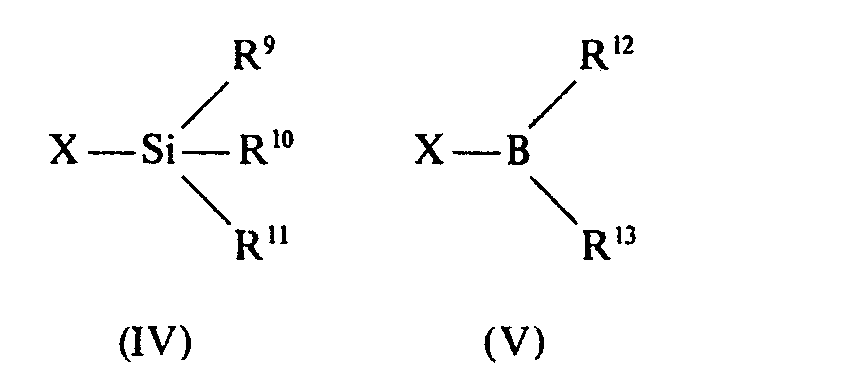
- R6―R13 die gleich oder verschieden sein können Alkyl mit 1―8 C-Atomen vorzugsweise Methyl.
- R1 und R2 können bevorzugt zusammen einen Alkylenrest mit vorzugsweise 3―4 C-Atomen darstellen, der gegebenenfalls wie bei R1 und R2 angegeben substituiert sein kann.
- X steht für FSO3, CF3CO2, CIO4, BF4, CH3SO3 oder CF3(CF2)n―SO3 mit n = 0―4 vorzugsweise CF3SO3.
- Besonders bevorzugt stellt

- Verbindungen der allgemeinen Formel

- Insbesondere liegen die Substituenten OR19―OR21 und CH2―O―R22 in VI in der gluco-Konfiguration vor.
- Als OH-Schutzgruppen eignen sich die üblichen Schutzgruppen wie Acetyl, Benzyloxycarbonyl, Benzyl oder Trityl.
- Zur Durchführung der Reaktion gibt man in einem geeigneten Lösungsmittel wie vorzugsweise CH2Cl2, CHCl3, Acetonitril, Diethylether oder Tetrahydrofuran zu II äquimolare Mengen oder einen Überschuß III und etwa 1/10 Äquivalent des Katalysators IV oder V hinzu. Führt man die Reaktion in einem Temperaturbereich zwischen -80 und -40°C durch, erfolgt die Bildung von I mit Retention der Konfiguration an C-1, bei 0 bis 100°C erfolgt Inversion.
- Das folgende Formelschema verdeutlicht die nachstehend tabellarisch aufgeführten Umsetzungen. In der Beschreibung und in den Tabellen wird jeweils auf die Ziffern unter den Formeln Bezug genommen.


- Die zur Darstellung der Produkte (3 und 4) benötigten Acetale (2) können auch durch die jeweiligen Aldehyde (11) und Methyl-trimethylsilylether (12) ersetzt werden (vgl. T. Tsunoda, et al., Tetrahedron Letters 1980, 1357). Die hierbei erzielten Ausbeuten an (3 und 4) sind gleich oder besser als die in Tabelle 2 angegebenen.

- Zu einer Lösung von 0,25 mmol Silylverbindung (1), 0,25 mmol Aldehyd (11) und 0,35 mmol Methyl-trimethylsilylether (12) in 2 ml wasserfreiem Dichlormethan gibt man bei ―70°C unter einer Inertgas- Atmosphäre 0,2 ml einer 0,1 molaren Lösung von Trimethylsilyl-trifluormethansulfonat in Dichlormethan und rührt 20 bis 60 h bei dieser Temperatur. Der Reaktionsverlauf kann dünnschichtchromatographisch an Kieselgel (Laufmittel: Hexan/Essigester 1 : 1) verfolgt werden.
- Es wurde weiterhin gefunden, daß die Zugabe von etwa 0,5 Moläquivalenten Aceton, bezogen auf z. B. Trimethylsilylglucose die Reaktionsgeschwindigkeit bei der Acetalisierung stark erhöhen kann.


- Die Umsetzungen erfolgten nach folgenden Arbeitsvorschriften
- A) Zu einer Lösung von 0,25 mmol Silylverbindung (1 bzw. 7) und 0,50 mmol Acetal (2) in 3 ml wasserfreiem Dichlormethan gibt man bei -70°C unter einer Inertgas-Atmosphäre 0,2 ml einer 0,1 molaren Lösung von Trimethylsilyl-trifluormethansulfonat in Dichlormethan und rührt 20 bis 60 h bei dieser Temperatur. Der Reaktionsverlauf kann dünnschichtchromatographisch an Kieselgel (Laufmittel: Hexan/Essigester 1 : 1) verfolgt werden.
- B) Zu einer Lösung von 0,25 mmol Silylverbindung (1) und 0,50 mmol Acetal (2) in 5 ml wasserfreiem Dichlormethan gibt man bei 0°C unter einer Inertgasatmosphäre 0,1 ml einer 0,1 molaren Lösung von Trimethylsilyl-trifluormethansulfonat in Dichlormethan und rührt 4 bis 16 h bei dieser Temperatur. Der Reaktionsverlauf kann dünnschichtchromatographisch an Kieselgel (Laufmittel: Hexan/ Essigester 1 :1 ) verfolgt werden.
- C) Zu einer Lösung von 105 mg (0,25 mmol) Silylverbindung (1 a) und 53,0 mg (0,50 mmol) Methylorthoformiat (2 i) in 3 ml wasserfreiem Dichlormethan gibt man bei -30°C unter einer Inertgasatmosphäre 0,2 ml einer 0,1 molaren Lösung von Trimethylsilyltrifluormethansulfonat in Dichlormethan und rührt ca. 40 h bei dieser Temperatur. Nach Aufarbeitung erhält man 70 mg eines Gemisches aus (3 h) und (6).
- D) Nach Methode C werden 42,4 (0,2 mmol) (9) mit 84,0 mg (0,2 mmol) (1) (α,β-Gemisch) umgesetzt (Reaktionsdauer 6 Tage). Man erhält 93,8 mg (89%) isomere Glucoside (10). Die Identifizierung erfolgte durch Vergleich mit Originalsubstanzen.
- Zur Aufarbeitung versetzt man mit 0,1 ml Triethylamin, wäscht die Reaktionsmischung mit gesättigter NaHCO3- und NaCl-Lösung und trocknet über Na2SO4/Na2CO3 (1 : 1). Nach Abdampfen des Lösungsmittels im Vakuum erhält man ein nahezu einheitliches Produkt, das zur weiteren Reinigung an Kieselgel chromatographiert werden kann.
- Die nachfolgende Tabelle 2 zeigt die eingesetzten Edukte, die Verfahrensweise, Ausbeuten sowie Produkte und ihre Charakterisierung.


Claims (7)

dadurch gekennzeichnet, daß man eine Silylverbindung der allgemeinen Formel II

mit einem Acetal der allgemeinen Formel 111

in Gegenwart eines Katalysators der allgemeinen Formel IV oder V

in einem geeigneten Lösungsmittel umsetzt.
Priority Applications (1)
| Application Number | Priority Date | Filing Date | Title |
|---|---|---|---|
| AT82105970T ATE9477T1 (de) | 1981-07-17 | 1982-07-05 | Verfahren zur herstellung von 1,1'-diacetalen. |
Applications Claiming Priority (2)
| Application Number | Priority Date | Filing Date | Title |
|---|---|---|---|
| DE3128271 | 1981-07-17 | ||
| DE19813128271 DE3128271A1 (de) | 1981-07-17 | 1981-07-17 | Verfahren zur herstellung von 1,1'-diacetalen |
Publications (2)
| Publication Number | Publication Date |
|---|---|
| EP0070444A1 EP0070444A1 (de) | 1983-01-26 |
| EP0070444B1 true EP0070444B1 (de) | 1984-09-19 |
Family
ID=6137128
Family Applications (1)
| Application Number | Title | Priority Date | Filing Date |
|---|---|---|---|
| EP82105970A Expired EP0070444B1 (de) | 1981-07-17 | 1982-07-05 | Verfahren zur Herstellung von 1,1'-Diacetalen |
Country Status (5)
| Country | Link |
|---|---|
| US (1) | US4524202A (de) |
| EP (1) | EP0070444B1 (de) |
| JP (1) | JPS5823637A (de) |
| AT (1) | ATE9477T1 (de) |
| DE (2) | DE3128271A1 (de) |
Families Citing this family (3)
| Publication number | Priority date | Publication date | Assignee | Title |
|---|---|---|---|---|
| DE3819634A1 (de) * | 1988-06-09 | 1989-12-14 | Bayer Ag | Neue aldophophamidglycoside, verfahren zu ihrer herstellung sowie ihre verwendung als pharmazeutische wirkstoffe |
| US20050222053A1 (en) * | 2003-10-31 | 2005-10-06 | Health Research, Inc. | Iridoid-saccharide compound and method of using same |
| US20080032939A1 (en) * | 2004-10-28 | 2008-02-07 | Health Research, Inc. | Iridoid-saccharide compound and method of using same |
Family Cites Families (6)
| Publication number | Priority date | Publication date | Assignee | Title |
|---|---|---|---|---|
| CH459982A (de) * | 1964-02-25 | 1968-07-31 | Hoffmann La Roche | Verfahren zur Herstellung von Polyenketonen |
| US4096321A (en) * | 1976-11-22 | 1978-06-20 | Hoffmann-La Roche Inc. | Process to produce oxazinomycin and intermediates |
| US4280011A (en) * | 1977-01-21 | 1981-07-21 | Hercules Incorporated | Aldehyde generators and foodstuffs containing such generators |
| US4272526A (en) * | 1978-07-11 | 1981-06-09 | Macarthys Pharmaceuticals Limited | Derivatives of chloral |
| US4374831A (en) * | 1981-12-28 | 1983-02-22 | American Cyanamid Company | Modulators of the complement system comprising bis-glucopyranosyl arylene sulfate derivatives |
| US4374832A (en) * | 1981-12-28 | 1983-02-22 | American Cyanamid Company | Modulators of the complement system comprising polyhexaose arylene sulfate derivatives |
-
1981
- 1981-07-17 DE DE19813128271 patent/DE3128271A1/de not_active Withdrawn
-
1982
- 1982-06-24 US US06/391,655 patent/US4524202A/en not_active Expired - Fee Related
- 1982-07-05 AT AT82105970T patent/ATE9477T1/de active
- 1982-07-05 DE DE8282105970T patent/DE3260782D1/de not_active Expired
- 1982-07-05 EP EP82105970A patent/EP0070444B1/de not_active Expired
- 1982-07-13 JP JP57120708A patent/JPS5823637A/ja active Pending
Also Published As
| Publication number | Publication date |
|---|---|
| ATE9477T1 (de) | 1984-10-15 |
| DE3128271A1 (de) | 1983-02-03 |
| US4524202A (en) | 1985-06-18 |
| EP0070444A1 (de) | 1983-01-26 |
| JPS5823637A (ja) | 1983-02-12 |
| DE3260782D1 (en) | 1984-10-25 |
Similar Documents
| Publication | Publication Date | Title |
|---|---|---|
| Mukaiyama et al. | An efficient glucosylation of alcohol using 1-thioglucoside derivative | |
| DE69315752T2 (de) | Tieftemperatur-Verfahren zur Herstellung von mit Alpha-Anomeren angereicherten 2-Deoxy-2,2-Difluor-D-Ribofuranosyl-Sulfonaten | |
| DE2365852A1 (de) | Verfahren zur herstellung von monoacetalen aromatischer 1,2-diketone | |
| DE69521065T2 (de) | Vitamin D3 Derivate und ein Verfahren zu ihrer Herstellung | |
| EP0212400B1 (de) | Neues Verfahren zur Herstellung von Sphingosinderivaten | |
| DE69222643T2 (de) | Verfahren zur herstellung von demethylepypodophyllotoxin | |
| EP0081674A1 (de) | Zwischenprodukte, Verfahren zu deren Herstellung und Verfahren zur Herstellung von Cephalosporinen | |
| DE69725700T2 (de) | Verfahren zur Herstellung von Baccatin III und seiner Derivate ausgehend von 10-Deacetylbaccatin III. | |
| DE69014152T2 (de) | Verfahren zur Herstellung von Tigogenin-beta-Cellobioside. | |
| EP0070444A1 (de) | Verfahren zur Herstellung von 1,1'-Diacetalen | |
| DD284024A5 (de) | Verfahren zum herstellen von o hoch 2 tief ,2'-anhydro-1-(beta-d-arabinofuranosyl)thymin | |
| DE3028339A1 (de) | Neue zwischenprodukte fuer die herstellung von spectinomycin und seiner analoger sowie verfahren zur herstellung der betreffenden zwischenprodukte | |
| EP0531256B1 (de) | Verfahren zur Herstellung von Glykosiden | |
| DE69226638T2 (de) | Verfahren zur trennung von gibberellinmischungen | |
| DE3415475A1 (de) | Verfahren zur herstellung von alkoxymethylenverbindungen von essigestern und substituierten essigestern | |
| EP0722946A1 (de) | Verfahren zur Herstellung von 3-Formyl-Cephem-Derivaten | |
| EP0031426A1 (de) | 7-Oxo-PGI2-derivate, Verfahren zu deren Herstellung sowie diese Verbindungen enthaltende pharmazeutische Präparate | |
| DE69209258T2 (de) | Verfahren zur Herstellung von Dichlormethylpyridinen | |
| DE69021767T2 (de) | Organosilicium-Verbindungen. | |
| DE870857C (de) | Verfahren zur Herstellung monohalogenierter 1, 3-Dioxane | |
| CH635057A5 (de) | Verfahren zur herstellung von tricycloheptan-6-onen. | |
| EP0365973B1 (de) | Verfahren zur Herstellung von 4-0-Alkyl-Rhodomycinen | |
| DE2653604C2 (de) | ||
| US3024244A (en) | Process for producing pyridoxine and intermediates | |
| DE1158499B (de) | Verfahren zur Herstellung von Isonitrilen |
Legal Events
| Date | Code | Title | Description |
|---|---|---|---|
| PUAI | Public reference made under article 153(3) epc to a published international application that has entered the european phase |
Free format text: ORIGINAL CODE: 0009012 |
|
| 17P | Request for examination filed |
Effective date: 19820705 |
|
| AK | Designated contracting states |
Designated state(s): AT BE CH DE FR GB IT LI NL SE |
|
| ITF | It: translation for a ep patent filed | ||
| GRAA | (expected) grant |
Free format text: ORIGINAL CODE: 0009210 |
|
| AK | Designated contracting states |
Designated state(s): AT BE CH DE FR GB IT LI NL SE |
|
| REF | Corresponds to: |
Ref document number: 9477 Country of ref document: AT Date of ref document: 19841015 Kind code of ref document: T |
|
| REF | Corresponds to: |
Ref document number: 3260782 Country of ref document: DE Date of ref document: 19841025 |
|
| ET | Fr: translation filed | ||
| PGFP | Annual fee paid to national office [announced via postgrant information from national office to epo] |
Ref country code: AT Payment date: 19850708 Year of fee payment: 4 |
|
| PLBE | No opposition filed within time limit |
Free format text: ORIGINAL CODE: 0009261 |
|
| STAA | Information on the status of an ep patent application or granted ep patent |
Free format text: STATUS: NO OPPOSITION FILED WITHIN TIME LIMIT |
|
| PGFP | Annual fee paid to national office [announced via postgrant information from national office to epo] |
Ref country code: NL Payment date: 19850731 Year of fee payment: 4 |
|
| 26N | No opposition filed | ||
| PG25 | Lapsed in a contracting state [announced via postgrant information from national office to epo] |
Ref country code: AT Effective date: 19860705 |
|
| PG25 | Lapsed in a contracting state [announced via postgrant information from national office to epo] |
Ref country code: SE Effective date: 19860706 |
|
| PG25 | Lapsed in a contracting state [announced via postgrant information from national office to epo] |
Ref country code: NL Effective date: 19870201 |
|
| NLV4 | Nl: lapsed or anulled due to non-payment of the annual fee | ||
| PGFP | Annual fee paid to national office [announced via postgrant information from national office to epo] |
Ref country code: DE Payment date: 19890617 Year of fee payment: 8 |
|
| PGFP | Annual fee paid to national office [announced via postgrant information from national office to epo] |
Ref country code: GB Payment date: 19890630 Year of fee payment: 8 Ref country code: CH Payment date: 19890630 Year of fee payment: 8 |
|
| PGFP | Annual fee paid to national office [announced via postgrant information from national office to epo] |
Ref country code: BE Payment date: 19890726 Year of fee payment: 8 |
|
| PGFP | Annual fee paid to national office [announced via postgrant information from national office to epo] |
Ref country code: FR Payment date: 19890728 Year of fee payment: 8 |
|
| ITTA | It: last paid annual fee | ||
| PG25 | Lapsed in a contracting state [announced via postgrant information from national office to epo] |
Ref country code: GB Effective date: 19900705 |
|
| PG25 | Lapsed in a contracting state [announced via postgrant information from national office to epo] |
Ref country code: LI Effective date: 19900731 Ref country code: CH Effective date: 19900731 Ref country code: BE Effective date: 19900731 |
|
| BERE | Be: lapsed |
Owner name: BAYER A.G. Effective date: 19900731 |
|
| GBPC | Gb: european patent ceased through non-payment of renewal fee | ||
| REG | Reference to a national code |
Ref country code: CH Ref legal event code: PL |
|
| PG25 | Lapsed in a contracting state [announced via postgrant information from national office to epo] |
Ref country code: FR Effective date: 19910329 |
|
| PG25 | Lapsed in a contracting state [announced via postgrant information from national office to epo] |
Ref country code: DE Effective date: 19910403 |
|
| REG | Reference to a national code |
Ref country code: FR Ref legal event code: ST |
|
| EUG | Se: european patent has lapsed |
Ref document number: 82105970.6 Effective date: 19870518 |