EP0070903A1 - Dispositif et procede de fabrication de tissus a poils ressemblant a de la fourrure - Google Patents
Dispositif et procede de fabrication de tissus a poils ressemblant a de la fourrure Download PDFInfo
- Publication number
- EP0070903A1 EP0070903A1 EP81903221A EP81903221A EP0070903A1 EP 0070903 A1 EP0070903 A1 EP 0070903A1 EP 81903221 A EP81903221 A EP 81903221A EP 81903221 A EP81903221 A EP 81903221A EP 0070903 A1 EP0070903 A1 EP 0070903A1
- Authority
- EP
- European Patent Office
- Prior art keywords
- manufacturing
- yarn
- artificial fur
- group
- pile
- Prior art date
- Legal status (The legal status is an assumption and is not a legal conclusion. Google has not performed a legal analysis and makes no representation as to the accuracy of the status listed.)
- Granted
Links
Images




Classifications
-
- D—TEXTILES; PAPER
- D02—YARNS; MECHANICAL FINISHING OF YARNS OR ROPES; WARPING OR BEAMING
- D02G—CRIMPING OR CURLING FIBRES, FILAMENTS, THREADS, OR YARNS; YARNS OR THREADS
- D02G3/00—Yarns or threads, e.g. fancy yarns; Processes or apparatus for the production thereof, not otherwise provided for
- D02G3/22—Yarns or threads characterised by constructional features, e.g. blending, filament/fibre
- D02G3/40—Yarns in which fibres are united by adhesives; Impregnated yarns or threads
- D02G3/404—Yarns or threads coated with polymeric solutions
- D02G3/406—Yarns or threads coated with polymeric solutions where the polymeric solution is removable at a later stage, e.g. by washing
-
- D—TEXTILES; PAPER
- D02—YARNS; MECHANICAL FINISHING OF YARNS OR ROPES; WARPING OR BEAMING
- D02G—CRIMPING OR CURLING FIBRES, FILAMENTS, THREADS, OR YARNS; YARNS OR THREADS
- D02G3/00—Yarns or threads, e.g. fancy yarns; Processes or apparatus for the production thereof, not otherwise provided for
- D02G3/22—Yarns or threads characterised by constructional features, e.g. blending, filament/fibre
- D02G3/36—Cored or coated yarns or threads
-
- D—TEXTILES; PAPER
- D02—YARNS; MECHANICAL FINISHING OF YARNS OR ROPES; WARPING OR BEAMING
- D02G—CRIMPING OR CURLING FIBRES, FILAMENTS, THREADS, OR YARNS; YARNS OR THREADS
- D02G3/00—Yarns or threads, e.g. fancy yarns; Processes or apparatus for the production thereof, not otherwise provided for
- D02G3/22—Yarns or threads characterised by constructional features, e.g. blending, filament/fibre
- D02G3/38—Threads in which fibres, filaments, or yarns are wound with other yarns or filaments, e.g. wrap yarns, i.e. strands of filaments or staple fibres are wrapped by a helically wound binder yarn
-
- D—TEXTILES; PAPER
- D03—WEAVING
- D03D—WOVEN FABRICS; METHODS OF WEAVING; LOOMS
- D03D27/00—Woven pile fabrics
-
- D—TEXTILES; PAPER
- D03—WEAVING
- D03D—WOVEN FABRICS; METHODS OF WEAVING; LOOMS
- D03D27/00—Woven pile fabrics
- D03D27/02—Woven pile fabrics wherein the pile is formed by warp or weft
- D03D27/10—Fabrics woven face-to-face, e.g. double velvet
-
- D—TEXTILES; PAPER
- D03—WEAVING
- D03D—WOVEN FABRICS; METHODS OF WEAVING; LOOMS
- D03D39/00—Pile-fabric looms
- D03D39/16—Double-plush looms, i.e. for weaving two pile fabrics face-to-face
- D03D39/18—Separating the two plush layers, e.g. by cutting
-
- D—TEXTILES; PAPER
- D04—BRAIDING; LACE-MAKING; KNITTING; TRIMMINGS; NON-WOVEN FABRICS
- D04B—KNITTING
- D04B1/00—Weft knitting processes for the production of fabrics or articles not dependent on the use of particular machines; Fabrics or articles defined by such processes
- D04B1/02—Pile fabrics or articles having similar surface features
- D04B1/025—Pile fabrics or articles having similar surface features incorporating loose fibres, e.g. high-pile fabrics or artificial fur
-
- D—TEXTILES; PAPER
- D04—BRAIDING; LACE-MAKING; KNITTING; TRIMMINGS; NON-WOVEN FABRICS
- D04B—KNITTING
- D04B21/00—Warp knitting processes for the production of fabrics or articles not dependent on the use of particular machines; Fabrics or articles defined by such processes
- D04B21/02—Pile fabrics or articles having similar surface features
-
- D—TEXTILES; PAPER
- D04—BRAIDING; LACE-MAKING; KNITTING; TRIMMINGS; NON-WOVEN FABRICS
- D04B—KNITTING
- D04B35/00—Details of, or auxiliary devices incorporated in, knitting machines, not otherwise provided for
- D04B35/34—Devices for cutting knitted fabrics
-
- D—TEXTILES; PAPER
- D10—INDEXING SCHEME ASSOCIATED WITH SUBLASSES OF SECTION D, RELATING TO TEXTILES
- D10B—INDEXING SCHEME ASSOCIATED WITH SUBLASSES OF SECTION D, RELATING TO TEXTILES
- D10B2403/00—Details of fabric structure established in the fabric forming process
- D10B2403/01—Surface features
- D10B2403/011—Dissimilar front and back faces
- D10B2403/0111—One hairy surface, e.g. napped or raised
-
- D—TEXTILES; PAPER
- D10—INDEXING SCHEME ASSOCIATED WITH SUBLASSES OF SECTION D, RELATING TO TEXTILES
- D10B—INDEXING SCHEME ASSOCIATED WITH SUBLASSES OF SECTION D, RELATING TO TEXTILES
- D10B2501/00—Wearing apparel
- D10B2501/04—Outerwear; Protective garments
- D10B2501/044—Fur garments; Garments of fur substitutes
Definitions
- the present invention relates to an improved method and apparatus for manufacturing artificial furs.
- the so-called high grade genuine furs such as mink, fox, etc., have been recognized as genuine furs of high grade which are almost impossible to artificially produce, because of their excellent touch-feeling, excellent luster and a special structural feature, mainly due to the hairs.
- U.S.P. No. 2,737,702 Some new technologies such as U.S.P. No. 2,737,702 have been disclosed as being comparatively advanced in the field of producing artificial fur.
- the method is proposed of producing an artificial fur by means of a knitting machine from a sliver composed of staple fibers of a first group, which form a layer of so-called guard hair of the fur, and staple fibers of a second group, which form a layer of under fur of the artificial fur.
- the use of a particular kind of fibers is proposed for the first group of fibers, wherein each fiber is provided with two tapered end portions.
- the quality of flutter of the guard hair is insufficient as compared with that of genuine fur.
- the touch feeling of this artificial fur is coarse; particularly, the touch feeling of the guard hair is rather coarse, so that the fur-like soft and elegant touch-feeling is not realized from this artificial fur.
- the above-mentioned problems are mainly due to the structural feature of the guard hairs; that is, in more detail, the root portion of the guard fibers, which is locked in the ground construction of the artificial fur, is not thin.
- this artificial fur comprises a ground construction and numerous units of pile fibers projected upward from the ground construction, and each unit of pile fibers is provided with a yarn-like bundle of root portion, at least a main part of the above--mentioned root portion is firmly locked in the ground construction and the fibers of each pile were opened up above the root portion, the pile fibers are made from fibrous materials and provided with varied lengths thereof in a range from almost zero to almost identical to the maximum length of the fibrous materials.
- This method comprises the following three steps, that is, a first step of creating a construction of pile cloth consisting of a ground construction and a plurality of yarn-like piles projected upward from the ground construction;
- the greater the pile length of the material pile cloth is, the greater number of free fibrous material which are not firmly held by the ground construction; in other words, the greater the quantity of waste fibrous.material created in the second step (raising operation) of the manufacturing method of the above-mentioned U.S.P. application.
- Such an increase in waste fibrous material by the removal of free fibrous materials cannot be neglected in practice.
- the term "pile cloth” means a pile fabric provided with a woven or knitted ground construction with or without a backing substance and a plurality of pile fibers projected upward from the ground construction, a pile cloth provided with a non-woven ground construction with or without a backing substance and a plurality of pile fibers projected upward from the ground construction.
- the principal object of the present invention is to provide an improved method and apparatus for manufacturing the artificial fur having characteristics similar to high c-ade genuine furs, such as structure, appearance, and touch-feeling thereof.
- the above-mentioned principal object of the present invention can be attained by the following basic idea for creating pile fibers projected upward from the ground construction; that is, in the manufacture of the pile cloth for the artificial fur from a material pile cloth such as so-called double velvet weave construction, or such as a tufted pile cloth utilizing a non-woven cloth as the ground construction thereof, the continuity of each pile of the material cloth is broken without breaking or cutting, at least some of the fibrous material, forming the guard hairs involved in the artificial fur, and contained in the pile.
- the method for manufacturing the artificial fur according to the present invention is characterized by the application of the processing based upon the above-mentioned basic idea.
- the apparatus to carry out the method according to the present invention embodies specific ideas for the member for breaking the continuity of each pile projected from the ground construction of the material pile cloth.
- Fig. 8A is a schematic perspective view of a separating member utilized for the apparatus shown in Fig. 7A,
- Figs. 8B and 8C are schematic perspective views of modifications of the separating member shown in Fig. 8A,
- Fig. 9 is a schematic side view of a material pile cloth having a double velvet weave construction with a separating member to act on about the middle of the connecting piles which connects two ground constructions thereof, according to the present invention
- Fig. 10 is a schematic side view of a pile cloth produced from the material pile cloth shown in Fig. 9,
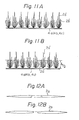
- Fig. 11A is a schematic side view of a material pile cloth provided with a plurality of loop piles with a separating member to act on about the middle of a loop pile thereof,
- Fig. 11B is a schematic side view of a pile cloth after breaking the continuity of the loop pile shown in Fig. 11A,
- F ig. 12A is a schematic side view of a typical artificial fur produced by the method and apparatus according to the present invention.
- Fig. 12B is a schematic side view of a modified artificial fur produced by the method and apparatus according to the present invention.
- Figs. 13A and 13B are schematic side views of a fibrous material forming the guard hairs of the artificial fur produced by the method and apparatus according to the present invention, respectively,
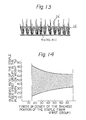
- Fig. 14 is a schematic side view of another modified artificial fur produced by a modified method and apparatus according to the present invention.
- Fig. 15 is a diagram indicating the relation between the blending ratio of the staple fiber (first group) in the pile (in weight %) and fineness in denier of the thickest
- the method for manufacturing artificial fur according to the present invention is characterized by the basic idea of breaking the continuity of each pile contained in the material pile cloth such as a fabric having a double velvet weave construction or a tufted pile cloth utilizing a woven or non-woven cloth.
- Fig. 1 indicates a typical model of the fiber arrangement of a theoretical bundle 1 of fibers 2, compacted in a yarn form by a means not shown, fibers 2 are uniformly arranged parallel to the longitudinal axis of the bundle of fibers, and this bundle 1 is held by a pair of grips (not shown) at the XX and YY positions so that the distance between the two gripped positions XX and YY is larger than the staple length of the component fibers 2.
- the bundle 1 is pulled apart by the grips along the longitudinal direction, therefore tension F along the longitudinal direction of the bundle 1 is created. Under such condition, as shown in Fig.
- three groups of fiber 2 are created, that is, a first group g , wherein fibers 2 are held by the grip represented by the line XX, the second group g 2 wherein fibers 2 are held by the grip represented by the line YY , and the third group g 3 wherein fiber 2 are free from anyone of the above-mentioned grips.
- the above--mentioned application of tension F to the bundle 1 of fibers 2, as shown in Fig. 2 breaks the continuity of the bundle 1.
- the semiproduct pile cloth for an artificial fur, can be made from a material pile cloth such as a pile fabric having a construction of double velvet weave or a pile cloth provided with a plurality of looped piles projected upward from a non-woven ground construction.
- each of the plurality of piles (hereinafter referred to as "connecting pile") connecting two ground constructions must be separated into two parts such that one is held by one ground construction while the other is held by the other ground construction thereby creating two pile cloth;
- the material yarn for the piles is composed of a plurality of fibers uniformly arranged in parallel to the longitudinal axis of a material bundle before providing twist.
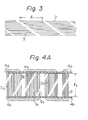
- the yarn 3 is represented as the bundle of the component fibers 2 in Fig. ' 3. In this drawing, each fiber 2 has an identical length l 1 .
- each looped pile When using material pile cloth such as a material pile cloth provided with a plurality of looped piles projected upward from a woven, knitted or non-woven ground construction, each looped pile must be separating into two parts such that both held by the ground construction. And, as the material pile cloth, the length Q 2 of the looped pile 3b projected upward from the ground construction 5 is preferred to be longer than the fiber length l 1 of the material fiber 2, as shown in Fig. 5. And the application of tension to pull apart the looped pile 3b made by the yarn 3 will creat, the similar phenomenon as in the examples of Figs. 2 and 4B. That is, it will separate the first group g 1 of the fibers 2 held by the ground construction 5 from the second group g 2 of the fibers 2 held by the ground construction 5 and will free the third group g 3 of fibers 2 not held by the ground construction cloth 5.
- sliding separation The above-mentioned phenomenon of separating the continuity of the pile 3a and 3b is hereinafter referred to as "sliding separation".
- Application of the above-mentioned basic technical idea of "sliding separation" to break the continuity of each pile of the material pile cloth significantly reduces, the possibility of cutting the tips of the fibers forming the guard hairs or possibility of creating large amount of fibers like the third group so that it allows considerable improve in the quality of the final product, artificial fur. It is one of the most significant results of the application of the present invention.
- the first material yarn is a spun yarn with very low twist.
- This yarn consists of a first group of fibrous material to form guard hairs and a second group of fibrous material to form under fur of the artificial fur produced by the method and apparatus according to the present invention.
- a fiber soluble in a certain chemical agent for the third group of fibers, therefore, one can use a fiber soluble in a certain chemical agent.
- the second material yarn is a double yarn formed by a first component yarn and a second component yarn.
- the first component yarn is composed of a first group of fibrous material to form the guard hairs and a second group of fibers to form fibers forming the under fur of the artificial fur produced by the method and apparatus according to the present invention.
- this first component yarn the above-mentioned two fibrous materials are blended uniformly and arranged in parallel to the longitudinal axis thereof. To impart yarn strength, this first component yarn is twisted.
- the second component yarn is made of a third fibrous material, in other words, the second component yarn may be a thin multifilament yarn or a thin spun yarn made from fibers easily removable by chemical or'physical treatment or from a normal material. In this case, it is very important to substantially elliminate the twist of the first component yarn when these two component yarns are twisted.
- a multi-filament yarn consisting of a plurality of individual filaments, each having a so-called island-in-sea fiber construction can be used to form the first group of fibrous material to form the guard hairs of the artificial fur produced by the method and apparatus according to the present invention.
- this multifilament yarn is twisted with another multifilament yarn to create a second group of fibrous material to form the under fur of the above-mentioned artificial fur. It is preferable to use this material yarn constructed with the second component yarn surrounding the first component yarn.
- This type of material yarn is hereinafter referred to as a third material yarn.
- the basic idea is to utilize the phenomenon of sliding separation to break the continuity of the piles of the material pile cloth in the present invention. Therefore, in every case utilizing the above-mentioned material yarns to form pile in the material pile cloth, it is essential to firstly change the condition of material yarn to the ideal construction shown in Fig. 3 as much as possible. This enables to smooth and effective sliding separation to break the continuity of the piles.
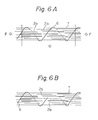
- each pile 2 in the material pile cloth is'formed by a bundle of fibers consisting of a first group of fibrous material 2a and a second group of fibrous material 2b, and a third fibrous material 6 spirally surrounding the above-mentioned bundle of fibrous materials as shown in Fig. 6A.
- the first group of fibrous material 2a is longer and thicker than the second group of fibrous material 2b so that the first one 2a will form the guard hairs and the second one 2b will form the under-fur of the final artificial fur.
- These two groups fibrous materials 2a, 2b are uniformly mixed in the yarn 7 and are arranged in parallel along the yarn axis.
- the material pile cloth is provided with a so-called double--velvet weave construction and the above-mentioned yarn 7 connects the two ground constructions when the double-velvet fabric is made. Therefore, the application of the above--mentioned sliding separation necessitates first cutting the third fibrous material 6 before creating the above--mentioned sliding separation.
- Research conducted by the present inventors showed that the third fibrous material 6 can be easily cut by applying tension to each connecting pile of the double velvet fabric.
- One method to cut the third fibrous material 6 is to apply a pushing force to the middle of each connecting pile made by the yarn 7 in the condition perpendicular to this portion. Another method is to apply a force to pull apart the two ground constructions. F ig. 6B shows the cutting of the third fibrous material 6.
- the third fibrous material 6 can be dissolved by a certain chemical agent including water, such chemical treatment can be applied before sliding separation.
- the third fibrous material can be effectively cut by vibrating action or a pushing action of a member without knife edge, instead of the cutting knife normally used for creating pile fabric from the double velvet woven or knitted fabric.
- the above--mentioned method of applying pushing force to each piles or the above-mentioned method of dissolving the-third fibrous material can be effectively applied.
- This modified technical idea is very useful when using the above-mentioned second material yarn. That is, since the yarn is provided with twists even if the number of twists is very low, the component fibers of the yarn are mutually interfered, therefore it is practical firstly cutting a part of each pile of the material pile cloth, because when this part is cut, the tension applied to the pile becomes to concentrate to the remained fibers in this portion and the above-mentioned mutual interference is simultaneously broken so that the above sliding separation is created more effectively.
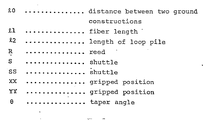
- Fig. 7A shows a schematic side view of double cloth plush weaving, wherein S and SS represent two shuttles respectively and R represents a reed of the weaving loom.
- S and SS represent two shuttles respectively and R represents a reed of the weaving loom.
- R represents a reed of the weaving loom.
- the continuity of each connecting pile made by the yarn 3, connecting two ground construction weaves 3a, 3b is broken by applying a pushing force of a separating member 10 at an intermediate stopping stage just before the displacement of the connecting piles.
- the separating member 10 is positioned at the point of separation of the front end of the double velvet fabric 4 into two pile weave constructions 4a, 4b so as to separate the connecting piles into two parts 3a and 3b.
- One of the typical embodiments of the separating member 10 is shown in Fig. 8A.
- the separating member 10 is provided with a knife portion 11 with a working edge lla and a sharpened tip portion llb.
- the working edge lla is not so sharp.
- This separating member 10 is capable of reciprocally displacement along the left yarn of the double velvet fabric 4, in such condition that the separating member 10 is displaced into the double velvet fabric 4.
- the double velvet fabric is displaced toward the member 10 as the woven fabric produced by the weaving loom is taken up.
- the working edge lla faces an alignment of the connecting piles located at the front end of the double velvet fabric 4.
- the pushing force of the member 10 is mainly applied to the alignment of the connecting piles located at the front end of the double velvet fabric 4.
- the above-mentioned pushing force first breaks the third fibrous material spirally surrounding the core portion of the yarn and then separates the fibers forming the core portion of each pile into two groups 3a and 3b as shown in Figs. 7A and 7B, wherein the fiber group 3a is firmly held by the ground construction 4a while the fiber group 3b is firmly held by the ground construction 4b. Fibers not to be held either ground construction 4a or 4b are held by one of the above-mentioned groups of fibers 3a,.3b in an easily separable condition or are removed from the working position of the separating member 10.
- the separating member 10 applies its pushing force from the outside of the double velvet fabric 4,.experiments by the present inventors, however, showed similar results if the separating member 10 applies its pushing force to the connecting piles from inside of the double velvet fabric 4 as shown in Fig. 7D.
- the taper angle 0 of the working portion of the separating member 10 is preferably in a range between 5° and 45° and that the length of the tapered working edge lla is preferably in a range between 5 mm and 200 mm.
- the above-mentioned third fibrous material spirally surrounding the core portion of the yarn 3 is weak enough to break with the additional tension created by pulling apart the two ground constructions 4a and 4b, one can omit the use of the above-mentioned separating member. If the above-mentioned third fibrous material is soluble in a certain chemical agent, one can treat the material pile cloth with this chemical agent, and omit the use of the separating member 10; pulling apart the two ground constructions 4a and 4b would be sufficient to create two pile fabrics.
- the material yarn having a configuration similar to the conventional spun yarn, if the length, thickness and the other characteristics of the first group of fibrous material, forcing the guard hairs of the artificial fur, are quite different from those of the second group of fiber material, forming the under fur of the artificial fur.
- F ig. 8c shows another separating member 10 which can be used to produce artificial fur, according to the present invention.
- the separating member 10 allows at least some of the first group of fibrous material to escape from cutting but cuts all of the second group of fibrous material during the breaking of the continuity of the connecting pile made by the yarn 3. As shown in Fig. 8c, this separating member 10 is provided with a sharp knife edge lld.
- such material yarn composed of'a spun yarn formed by the first group of fibrous material and a multi- filament yarn which will be cut to fibers of the under fur of the artificial fur, which were twisted each other in the condition of substantially eliminating the twist of the spun yarn
- the thickness of the first group of fibrous material is remarkably thicker than the thickness of the individual filament of the multi- filament yarn, and the mechanical properties of the former are much better than the latter
- the latter one multifilament yarn
- most of fibers of the former are capable of escaping from the cutting action of the knife edge lld of the member 10, that is, the sliding separation of the first group of fibrous material is created when pushing and shearing forces of the separating member 10 are applied to the connecting piles at the front end of the double velvet fabric 4 which is the material pile cloth.
- FIG. 9 indicating the condition right before breaking the connecting pile made by the yarn 3 which connects the two ground constructions 4a and 4b of material pile cloth 4 having a double velvet weave construction.
- the third fibrous material spirally surrounding the core portion of the yarn 3 is omitted.
- the separating member 10 works in the same way as in Figs. 7A and 7B.
- the member 10 applies a pushing force P to the middle of the connecting pile made by the yarn 3 at the outside end of the material pile cloth 4.
- this force P creates tension in this connecting piles.
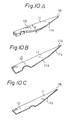
- the fiber length of the first group fibrous material (this length hereinafter referred to as f ) is shorter than the length Z 0 of this connecting portion between the two ground constructions 4a and 4b, no one fiber 2a of the first group will be held by both the ground constructions 4a and 4b.
- the length of the second group fibrous material (this length hereinafter referred to as f ) is shorter than f 1 , no one fiber 2b of the second group will be held by both the ground constructions 4a and 4b.
- the lengths f and f 2 of the first and second fibrous materials 2a, 2b are shorter than the length l 0 of this pile some of fibers 2a, 2b may not be held by either ground construction 4a or 4b. These free fibers become the wasted fibrous material mentioned already.
- the material pile cloth 4 is then separated into two pile cloths formed on the ground constructions 4a and 4b respectively and the above-mentioned free fibers are removed.
- Each pile cloth is therefore provided with a plural units of pile fibers having'such configuration that, in each unit, a plural pile fibers are gathered at their root portion and separated each other at their upper portions, and each unit is consisting of a plural fibers 2a of the first group and a plural fiber 2b of the second group as shown in Fig. 10.
- Fig. 11A shows a material pile cloth with a plurality of loop piles 3C projected from a ground construction 4C, such as non-woven cloth.
- Application of pushing force P to the middle of each loop pile 3C by the separating member 10 results in the same phenomenon as the embodiment shown in Figs. 9 and 10.
- the working position of the pushing force P to the pile may be changed. However, it was confirmed that the above-mentioned application of the pushing force to the middle of the pile is the most effective way of carrying out the method of the present invention.
- the typical artificial fur produced by the method and apparatus according to the present invention comprises a ground construction 4a (4b, 4c) and a plurality of units of pile fibers projected upward from this ground construction.
- Each unit of pile fibers 2a', 2b' is provided with a yarn-like bundle of its root portion, at least a main part of this root portion is firmly locked in this ground construction.
- the pile fibers 2a', 2b' of each unit are separated from each other from above its root portion.
- the pile fibers 2a', 2b' are made from fibrous materials and are provided with varied lengths ranging from almost zero to almost to the maximum length of the fibrous materials.
- the above-mentioned pile fibers are partly comprise relatively short and fine fibers 2b' (second group of fibers), which constitute the under fur, and partly comprise re- latively large diameter straight fibers 2a' (first group of fibers) projecting from the above-mentioned under fur as guard hairs.
- the guard hairs are substantially tapered at the free tips.
- the preferred material for the first group of fibrous material 2 a is one much thicker and longer than the second group of fibrous material 2b and having two tapered free ends as shown in Fig. 13A. This latter requirement is because the first group of fibrous material 2a is randomly blended with the second group of fibrous material 2b when the material yarn is produced.
- Fig. 13B Experiment by the present inventor, showed one can also use a modification of the first group of fibrous material 2a shown in Fig. 13B for the first group of fibers in the present invention.
- each fiber made by the first group of fibrous material 2a has the above--mentioned particular shape characterized by the tapered free ends it is the inventor's understanding that the tapered free ends each fibrous material easily escape from the cutting action of the sharp knife edge of the separating member while easily escaping the interference from fibrous material moving in the opposite direction during sliding separation.
- the preferred material for the second group of fibrous material includes various types, for example, staple fiber to be blended with the first group of fibrous material when the material spun yarn is produced, or a multifilament yarn formed by a plurality of thin individual filaments.
- the individual filaments are cut by a separating member having a sharp knife edge which creates sliding separation so as to break the continuity of the piles of the material pile cloth.
- fibrous material having cross sections such as triangular, square, irregular or elliptical etc.
- the fibrous material to use for manufacturing the artificial fur according to the present invention it is also important to select the optimal relation between the length, thickness of the first group and the second group, also the mixing ratio thereof in the material yarn forming the piles of the material pile cloth carefully.
- the ratio (length of the first group fibrous material)/ (length of the second group fibrous material) is in a range between 1.0 and 5.0, and if the ratio is below 1.0, or above 5.0, it is quite difficult to produce a material pile cloth having good quality.
- the mixing ratio of the above-mentioned two material in the material pile yarn the following condition is preferable, that is the mixing ratio of the first group of fibrous material to the second group of fibrous material is in a range between 15 and 70% in weight.
- the second group of fibrous material has its fiber length in a range between 1/2 and 1/3 of the length of the first group of fibrous material.
- a conventional spun yarn is used as a material pile yarn, since a low twist thereof is preferable to smoothly carry out the breaking of the continuity of the piles formed in the material cloth, it is further preferable to use such second group of fibrous material having pertinent crimps so as to assist stable formation of yarn.
- the length of these piles is defined by the length of the first group of fibrous material in such way that the length of the former is not shorter than the latter.
- the first group of fibrous material of a length in a range between 10 and 75 mm, preferably between 15 and 40 mm, and most preferably between 15 and 30 mm.
- the preferred ratio of the average thickness of the first group of fibrous material to the second group of fibrous material is in the range between 10 and 100.
- a thickness of the fibrous material of the second group in a range between 1 denier and several deniers, while the thickness of the first fibrous material in a range between scores and 100 deniers.
- Example 1 which will be explained later, is involved in this experimental test. And the following conclusion was obtained. That is, to produce the artificial fur having desired quality, it is necessary to carefully select the fibrous material regarding the above-mentioned mixing ratio in relation to the thickness of the fibrous materials so as to satisfy the condition defined by the following equations (1) and (2).
- the first group of fibrous material so as to satisfy the condition defined by the equation (1). If the thickness of the thickest portion of the first group of fibrous material is less than 15 deniers, the resilience of the guard hair of the artificial fur is so weak that the touch feeling of the artificial fur becomes wrong, on the other hand, if the above-mentioned thickness is thicker than 50 deniers, the touch feeling of the artificial fur becomes coarse so that the quality of the final product is wrong. To create the excellent quality of the artificial fur, it is also nec- cessary to satisfy the condition defined by the above--mentioned equation (2).
- the relation defined by the two equations (1) and (2) is represented by a diagram shown in Fig. 15.
- known artificial fiber materials such as polyester, polyamide, acrylic, polyorefine, protein fibers, rayon and acetate; and natural fiber materials such as wool, cotton, flux, silk etc. can be selectively utilized.
- various material yarn can be utilized to form piles of the material pile cloths.
- conventional spun yarns composite yarns having so-called an island-in-sea hypolymer fiber wherein island component becomes guard hairs of the final product, yarns composed of doubled component yarns; twisted yarns such as a conventional twisted yarn composed of a pair of component spun yarns, or composed of a conventional spun yarn spirally surrounded by a component filament yarn, or composed of a pair of multi-filament component yarns.
- the basic technical idea of this invention is the sliding separation of at least the first group of fibrous material so as to break the continuity of piles of the material pile cloth.
- the material yarns be modified so as to be as similar as po ssible to the ideal construction shown in Fig. 1.
- the number of twist must be reduced as less as possible. Therefore, in this case, it is preferable to use fibrous material having comparatively longer-length than the conventional spun yarns.
- fibrous material having comparatively longer-length than the conventional spun yarns.
- the fiber length of the first and second fiber groups is longer than the half of the length t0of the connecting pile which connects two ground constructions of a material pile cloth having the double velvet weave construction, or is longer than 1/2 of the length of the looped piles of a material pile cloth, application of a separating member to break the continuity of these piles enables the creation of artificial fur of the construction shown in Fig. 12B.
- Research conducted by the present inventors showed that such spun yarn composed of a first group of material fibers for the guard hairs, a second group of material fibers for the under fur and a third group of fibrous material to provide sufficient yarn strength for the weaving operation can be effectively used, if the third group of fibrous material can be easily removed from this yarn.
- the third group of fibrous material is a fiber of polyvinylalcohol resin which is soluble in water
- this third fiber component can be easily removed from the yarn by the known wet processing. Removal of such third component fibers from the yarn significantly loosens the construction of the material yarn in the material pile cloth, resulting in the necessary condition for the manufacturing method of the present invention.
- a material spun yarn having the conventional construction it is also possible to treat this yarn by an agent which -can be easily removed therefrom, so as to fix the yarn construction.
- an agent which -can be easily removed therefrom For example, a water-soluble polyvinylalcohol resin is used to fix the yarn construction.
- the yarn is.untwisted.
- the material yarn remains strength sufficient to carry out the weaving operation to produce the material pile cloth, because the initial yarn strength is still maintained.
- This material cloth is subjected to a chemical treatment to remove the such fixing agent. This significantly loosens the construction of the piles made by the above-mentioned material yarn, consequently a preferable construction of the piles to breaking the continuity of the piles of the material pile cloth is created.
- the following fibrous materials are effective as third group of fibrous material to be removed; polyester material which is soluble in alkaline solutions, when the fibrous material for the guard hair is polyamide material; polyamide material which is soluble in pseudo-acids, when the first group of fibrous material is polyester; acrylic fiber which is soluble in such solvent as DMF, DMSO, Rhodanic acid and Nitric acid; Styrene fiber which is soluble in trichlorine, Benzene, Xylene; Polyester produced by copolymerization with Sodium-Sulfoisophthalate which is soluble in alkaline solutions; etc.
- a double yarn consisting of a spun yarn formed only by a first group of fibrous material, twisted together with a multifilament yarn consisting of individual filaments to form the under fur of the artificial fur, can be effectively used.
- the twist of the spun yarn is substantially eliminated when the above-mentioned two yarns are twisted. Since the individual filaments of the above-mentioned multifilament yarn become the under fur of the final product, care must be taken on choosing or designing the thickness and the length of piles of the material pile cloth when using such double twisted yarn for the material pile cloths shown in Figs. 9 and 11A.
- a yarn consisting of a conventional spun yarn formed by a"first group of fibrous material and a second group of fibrous material, and a multifilament yarn spirally surrounds the spun yarn is preferably utilized, as already explained.
- the twist of this spun yarn is eliminated when the above-mentioned two yarns are twisted. Therefore, if the above-mentioned multifilament yarn is cut or eliminated by chemical treatment, before sliding separation of the connecting piles which connect two ground constructions of the material pile cloth, or the looped piles of the material pile cloth, the most desirable condition of the yarn construction of piles of the material pile cloth is created. Therefore, this type of material yarn is the most preferable material yarn.
- the above-mentioned multifilament yarn having thickness in a range between 3 0 and 150 denier depending upon the thickness of the material spun yarn, and if the thickness thereof is large, the number of windings thereof/unit length is reduced, in other words, the number of windings thereof/unit length is increased in accordance with the decreasing thickness of the above-mentioned multifilament yarn.
- the preferred material pile cloth includes various materials such as double velvet fabric, double pile knitted cloth, loop pile fabric, loop pile knitted cloth, and loop pile tufted cloth provided with a ground construction of fabric or non-woven cloth, can be utilized.
- the preferred ground construction of the material pile - cloth must also be considered as the properties thereof affects the qualities of the final artificial fur, such as the touch feeling or drape property. For example, if it expects to provide good drape property, it is desirable to use a thin ground construction or to increase the flexibility or stretchability of the ground construction. If imparting the above-mentioned particular properties to the ground construction, facilitates the sewing operation of garments. To achieve these properties, one can use, various material yarns, such as yarn provided with fibrous material easily removed from the yarn by additional chemical treatment; yarn composed of so-called splitable fibrous material; multifilament yarn formed by very fine individual filaments; and stretch yarn. In such case, one generally applies a pertinent auxiliary finishing treatment, such as backing treatment to impart a leather-like quality to the ground construction.
- the preferred finishing of the above-mentioned pile cloth, the final process for manufacturing the artificial fur includes the raising operation carried out to raise the pile fibers projected upward from the ground construction of the pile cloth while separating pile fibers of each unit thereof, and a brushing -operation to remove the free fibers are not firmly held by the ground construction of the pile cloth are applied.
- these finishing process are disclosed in the above-mentioned U.S. Patent application, therefore the explanation thereof is omitted except for the following new matter.
- fibrous material having fiber length almost identical to the length of the piles of the material pile cloth is used, it is as the second group of fibrous material, preferable to break each fibrous material of this second group by applying the scratching force created by the above-mentioned raising and/or brushing operation, so as to shorten the length of the second group of fibrous material projected upward from the ground construction. In such case, it is therefore preferable to use a thin and weak second group of fibrous material.
- each pile was completely opened from top to the root portion thereof by brushing treatment for eliminating the twist of the pile and at the same time, cotton fibers and PBT staple fibers having tapered portion on both ends of it without being held by the ground construction were also removed.
- Two kinds of blended spun yarn were produced by using different kinds of PBT staple fiber, having a fiber denier of 30d and 50d, respectively, and a fiber length of 37 mm but without tapers on both ends, as guard hairs and using cotton fiber as underfur.
- the blending ratio R was set at 30% and the yarn count was 10S.
- the blending ratio R was set at 45% and the yarn count was 9S.
- the fur like pile fabrics thus obtained were superior in that their guard hairs covered the surface of the pile fabrics effectively, but the absence of tapers at the ends of the guard hairs resulted in an artificial appearance and not so-smooth touch feeling.
- the characteristics of the piles, for instance fluttering were inferior to those of the fabrics of Example 1, because the roots of the guard hairs, even those having long fiber length, were not tapered and straight.
- Two kinds of blended spun yarn were produced by using different kinds of PBT staple fiber, having a fiber denier of 10d and 85d, respectively, and a fiber length of 37 mm, and further having tapers on both ends, as guard hairs and using cotton fiber as underfur.
- the blending ratio R was set at 45% and the yarn count was 10S, with 85d'PBT staple fiber, the blending ratio R was set at 50% and the yarn count was 7S.
- 10d PBT staple fiber did not performed as effectively guard hairs as those of genuine fur because they are too thin to create the same effect as genuine fur.
- a core spun yarn having a yarn count of 16S (330d) and twist number of 540 T/m(Z) was produced with a conventional ring spinning machine by a using rayon multi-filament yarn 210d-105f as underfur and a roving yarn composed of PBT staple fibers 8d x 35 mm having tapers on both ends as guard hairs.
- a rayon multi-filament yarn 50d-24f was piled to the above-mentioned core spun yarn and it was twisted by 500 T/ m in S direction with a ring twister.
- the material yarn thus obtained was provided with such yarn construction that a rayon multi-filament yarn 50d-24f wrapped around the core spun yarn having substantially zero twist.
- a material pile cloth was produced with a double velvet weaving loom by using the material yarn thus produced for creating connecting piles a polyester, spun yarn 30/ 2S for creating two ground constructions.
- the yarn densities of the ground construction were 44 x 44 (warp x weft) ends/inch, while the pile densities in the directions of warp and weft were 22 x 20 piles/inch, and the distance between the two ground constructions was 35 mm, in the material pile cloth thus produced.
- the position of the separating member was set at the center portion between two ground constructions and the continuity of the connecting pile was broken without cutting the guard hair staple fibers, while cutting the wrapping filament and underfur staple fibers.
- the separating member provided with the blade had the same configuration as shown in Fig. 8C in which the taper angle 0 was 15° and the length of the tape was 115 mm, this taper having a knife edge able to cut only rayon filament.
- the gray pile fabric thus obtained was subjected to backing treatment with a 15% polyulethane DMF solution and then was washed, dehydrated and dried.
- the cut pile fabric thus obtained after drying and finishing treatment had such a pile constructions as similar to that of genuine fur and showed natural mink like handling and appearance as shown in Fig. 14.
- a blended spun yarn having a yarn count of 8S and a twist number of 452 T/m (Z) was produced by a conventional cotton spinning system using 45% of PBT staple fiber 50d x 33 mm (without Ti0 2 ) as the first group of fibrous material having as guard hairs and using 55% of polyethylene terphthalate (referred as PET hereunder) staple fiber 1.5d x 22 mm as the second group of fibrous material as underfur.
- PET polyethylene terphthalate
- This spun yarn was then untwisted by 450 T/m (S) twist on fancy twister and was simultaneously piled with, a water soluble PVA filament yarn under a 0% of over-feed ratio.
- a yarn thus produced was formed by wrapping around a yarn bundle having yarn count of 8S, which was substantially no twist, by the water soluble PVA filament yarn.
- the double velvet fabric thus produced had the following construction:
- the separating operation of upper and lower pile fabric was performed by using separating member shown in Fig. 8C which could move forward and back along the center portion of each one of the alignment of the connecting piles and during such operation the continuation of the connecting piles were broken in such a manner that only PVA filament was cut but PBT staple fibers and PET staple fibers were slide-separated each other without cutting or breaking.
- the taken angle B was 15° and the length of the taper was 115 mm, this taper having edge not able to cut fibers but able to apply pressure to piles.
- P olyulethane solution was applied to the ground construction of the pile fabric thus produced and thereafter water soluble PVA filaments were removed.
- the pile fabrics thus produced had the following pile construction; the pile fibers had a suitable distribution of fiber lengths and a distinctive two layered construction of thick P B T staple fibers having longer mean fiber length and of thin PET staple fibers having shorter mean fiber length.
- a blended spun yarn having the yarn count of 10S and a twisting number of 12 T/m (Z) was produced by a conventional cotton spinning system using 70% of PBT staple fiber 30d x 35 mm, having tapers on both ends, as guard hairs and using 30% of cotton fiber as a supplemental component for improving the spinning effect (referred to as the third fibrous material).
- the spun yarn was twisted with PET filament yarn 300d-144f as underfur with 472 T/m (S) on a twisting machine.
- a double velvet fabric was produced by using the above-mentioned twisted yarn as the material yarn to create the connecting piles, and using 30/2S spun yarn composed of PET staple fibers 2d x 51 mm to create two ground constructions.
- the construction of the double velvet fabric thus produced was as follows.
- Separation of the upper and lower pile fabrics was performed using a separating member provided with a blade which moved forward and back along the center portion of each one of the alignment of connecting piles.
- the separating member was the similar configuration as shown in Fig. 8B wherein the taper angle 9 was 5° and the length of the taper was 165 mm in which the 115 mm length from the tip of it had sharp knife edge being able to cut P E T filament and following 50 mm length had only a dull edge.
- the blade broke the continuity of the connecting piles in such a manner that the PET staple fibers and a part of cotton fibers were cut and, PBT staple fibers were slide--separated each other without cutting.
- pile fabric After obtaining such pile fabric, backing treatment was performed by applying pdlyulethan emission to the ground construction and after washing and drying operation, brushing treatment was applied to the pile of the pile fabric to open the piles.
- the pile fabric thus obtained has such a pile construction that the length of most of all the pile fibers forming underfur were uniformly 18 mm while the fiber length of pile fibers of guard hairs were varying with a certain distribution in which it varied from the maximum length of 35 mm to the minimum of 0 mm.
- the pile fabric thus produced had natural mink like appearance and handling because this product had two layered constructions in pile composed of guard hair and underfur which could apparently be recognized and moreover this product has soft handling and excellent fluttering characteristics.
- a blended spun yarn having a yarn count of 10S and twist number of 473 T/ m (Z) was produced by a conventional cotton spinning system by using 50% of PBT staple fiber 50d x 31 mm having tapers on both ends as guard hairs, and by using 30% of P ET staple fiber 4d x 20 mm as underfur and 20% of acrylic staple fiber 1.5d x 38 mm soluble in weakly alkali liquid as the third fibrous material having a definite fiber length for improving the spinning ability.
- This blended spun yarn was piled with water soluble P V A filament yarn of 50d-18f. Then, this piled yarn was untwisted with 470 T/m (S) by a ring twister. Therefore, a material yarn in which water soluble PVA filament yarn spirally wrapped around the. substantially non-twisted yarn was obtained.
- a double velvet fabric was woven by using the above--mentioned material yarn thus obtained to create the connecting piles and by using a 30/2S spun yarn composed of 2d x 51 mm island-in-sea typed conjugated staple fiber mentioned in Example 5 to create two ground constructions.
- the construction of the double velvet fabric thus produced was as follows;
- the blade was the similar configuration as shown in Fig. 8B wherein the tip angle 8 was 5° and the length of taper portion was 165 mm in which the portion having 20 mm length from the tip had knife edge and next 95 mm length following this sharp portion had a little dull knife edge and the rest 50 mm length of it had only the edge being able to give pressure to the connecting piles.
- the separating member broke the continuity of the connecting piles in such a manner that it cut only the water soluble PVA filaments and slide-separated at least a certain number of the PBT staple fibers and a large number of PET staple fibers without cutting.
- the pile fabrics were then washed and dried then were brushed to open the piles.
- the pile fabrics thus obtained had the following pile construction; the length of the pile fibers in the piles were naturally distributed.
- the pile fabric obtained had a genuine mink like appearance and touch feeling. They showed the distinctive two layer pile construction of guard hairs and underfur. Further, elimination of the sea component from the ground construction made the ground construction softer.
- a blended spun yarn having a yarn count of 8S and a twist number of 452 T/m was produced by a conventional cotton spinning system by using 40% of PBT staple fiber 30d X 35 mm and 60 % of PET staple fiber 1.5d X 20 mm.
- This spun yarn was untwisted by 450 T/m(S) on fancy twister and was simultaneously piled with a water soluble PVA filament yarn under an over-feed ratio of 25%.
- a double velvet fabric the same as in Example 5 was produced by using this yarn as a material yarn to create piles and the same yarn as Example 5 as two ground construction.
- the construction of the above-mentioned double velvet fabric was as follows:
- This double velvet fabric was then treated to remove the water soluble PVA filament.
- a blended spun yarn (F 1 ) having a yarn count of 10S and a twisting number of 473 T/m(Z) was produced by using 5 5 % of cotton fiber as underfur and using 45% of PBT staple fiber having tapers on both ends as guard hair.
- This spun yarn was then piled with a water soluble PVA filament yarn of 50d-18f and both yarns were simultaneously twisted by 470 T/m(S) on a fancy twister.
- the grey pile fabric thus obtained was then subjected to backing treatment with 15% polyulethane DMF emulsion, then were washed, dehydrated and dried.
- Elimination of the PVA filaments was performed in the case of using the yarn F 2 , by hot water of 80°C.
- the pile fabrics were then brushed several times to open the piles and remove free fibers, after dehydrated and dried the pile fabric treated as mentioned above.
- the weaving efficiency was poor with the yarn F 1 .
- the shed could not open smoothly due to some long fluffs of guard hair projecting from the piles. There was also large pile breakage and guard hair detachment.
- a blended spun yarn having a yarn count of 10S and a twist number of 473 T/m(Z) was produced by a conventional cotton spinning system by using 45% of PBT staple fiber (no crimp) 40d X 31 mm having tapers on both ends as guard hairs and using 55% of PET staple fiber 1.5d X 38 mm as underfur.
- This spun yarn was then piled with a water soluble PVA filament yarn of 50d-18f and both were simultaneously twisted by 470 T/m(S). This produced a yarn with a water soluble PVA filament yarn wrapped around a core fibrous bundle of 10S of substantially zero twist.
- a double velvet fabric was produced by using this yarn as the material yarn to create connecting piles and using the spun yarn 30/2S composed of island-in-sea type conjugated staple fibers shown in Example 5 as the ground construction.
- the length of the connecting pile was set at 32 mm and other specification of the fabric constructions were the same as in Example 7.
- the blade of the separating member slide-separated almost all the PBT staple fibers having tapers on both ends without cutting while cutting most of the 1.5d PET staple fibers because of their thin-thickness, even if one end was free.
- a blended spun yarn having a yarn count of 16S/2 and a twist number of 560Z/443S T/m was produced by a conventional cotton spinning system by using 70% of PBT staple fiber 30d X 35 mm and 30% of water soluble PVA staple fiber 1.0d X 35 mm.
- a double velvet fabric was produced by using the above-mentioned spun yarn as pile yarn the material yarn to create connecting piles and by using 40S/2 spun yarn composed of 2d X 51 mm island--in-sea type conjugated staple fibers as two ground constructions, wherein the conjugated staple fibers consisted of P E T as the island component and polystylene as the sea component, (island/sea) was 55/45, ultra fine fiber bundle composed of 11 fibers each having O.ld, after eliminating sea component.
- the weave construction of this double velvet fabric was as follows:
- the double velvet fabric then subjected to hot water treatment to remove PVA staple fibers thereby loosening the interlace by the twists of component fibers of the connecting piles.
- This loosening action enabled this double velvet fabric to be easily separated into two pile fabrics by applying a separating force to the ground constructions to slide-separate the PBT staple fibers without cutting.
- the pile fabric thus obtained had the following construction; the length of the component pile fibers in each pile varies with a suitable distribution which is preferable to be an artificial fur, as shown in Fig. 12A.
Landscapes
- Engineering & Computer Science (AREA)
- Textile Engineering (AREA)
- Mechanical Engineering (AREA)
- Woven Fabrics (AREA)
- Knitting Of Fabric (AREA)
- Synthetic Leather, Interior Materials Or Flexible Sheet Materials (AREA)
- Yarns And Mechanical Finishing Of Yarns Or Ropes (AREA)
Abstract
Priority Applications (1)
| Application Number | Priority Date | Filing Date | Title |
|---|---|---|---|
| AT81903221T ATE21708T1 (de) | 1980-11-28 | 1981-11-28 | Verfahren zur herstellung eines pelzaehnlichen polgewebes und anordnung dazu. |
Applications Claiming Priority (6)
| Application Number | Priority Date | Filing Date | Title |
|---|---|---|---|
| JP166526/80 | 1980-11-28 | ||
| JP55166526A JPS6056821B2 (ja) | 1980-11-28 | 1980-11-28 | 特殊パイル布帛の製造方法 |
| JP56051655A JPS57167434A (en) | 1981-04-08 | 1981-04-08 | Production of special pile cloth |
| JP51655/81 | 1981-04-08 | ||
| JP79537/81 | 1981-05-26 | ||
| JP56079537A JPS57193569A (en) | 1981-05-26 | 1981-05-26 | Production of cut pile fabric |
Publications (3)
| Publication Number | Publication Date |
|---|---|
| EP0070903A1 true EP0070903A1 (fr) | 1983-02-09 |
| EP0070903A4 EP0070903A4 (fr) | 1983-04-06 |
| EP0070903B1 EP0070903B1 (fr) | 1986-08-27 |
Family
ID=27294386
Family Applications (1)
| Application Number | Title | Priority Date | Filing Date |
|---|---|---|---|
| EP81903221A Expired EP0070903B1 (fr) | 1980-11-28 | 1981-11-28 | Dispositif et procede de fabrication de tissus a poils ressemblant a de la fourrure |
Country Status (6)
| Country | Link |
|---|---|
| US (2) | US4773135A (fr) |
| EP (1) | EP0070903B1 (fr) |
| AU (2) | AU7895982A (fr) |
| CA (1) | CA1176046A (fr) |
| IT (1) | IT1140087B (fr) |
| WO (1) | WO1982001900A1 (fr) |
Cited By (3)
| Publication number | Priority date | Publication date | Assignee | Title |
|---|---|---|---|---|
| EP0164228A1 (fr) * | 1984-05-14 | 1985-12-11 | Toray Industries, Inc. | Procédé et dispositif pour la fabrication de velours en double-pièce |
| GB2253638A (en) * | 1991-03-15 | 1992-09-16 | Jan Lindblad | Pile fabric mat for use in games |
| EP0511388A4 (en) * | 1990-10-09 | 1993-05-19 | Toray Industries, Inc. | Leather-touch pile fabric and method of making said fabric |
Families Citing this family (25)
| Publication number | Priority date | Publication date | Assignee | Title |
|---|---|---|---|---|
| JPH0829632B2 (ja) * | 1988-07-11 | 1996-03-27 | 鐘紡株式会社 | 筆記具用インク吸蔵体及びその製造方法 |
| US5169467A (en) * | 1988-07-11 | 1992-12-08 | Kanebo, Ltd. | Ink occlusion material for writing utensils |
| FR2636981A1 (fr) * | 1988-09-27 | 1990-03-30 | Delcer Sa Textile | Tricot chaine a effet de bouclette sur les deux faces et son procede de fabrication |
| US5137306A (en) * | 1990-02-26 | 1992-08-11 | The George-Ingraham Corp. | Multiple-duct conduit system with expansion chamber coupling |
| US5487941A (en) * | 1991-11-12 | 1996-01-30 | Pepin; John N. | Continuous/discontinuous filament yarn or tow |
| JP2001286493A (ja) * | 2000-02-03 | 2001-10-16 | Shiro Yamada | 植毛用人造毛およびその製造方法 |
| CN1254576C (zh) * | 2000-04-18 | 2006-05-03 | 乐曼两合有限公司 | 包含稳定化的长丝组合体的非织造织物结构体及其制造方法 |
| US6923219B2 (en) * | 2003-04-11 | 2005-08-02 | J.B. Martin Company, Inc. | Double-sided fabric: flat side / woven pile fabric |
| US7117899B1 (en) * | 2005-05-18 | 2006-10-10 | Boon Do Kim | Pile mesh fabric |
| NL1034291C2 (nl) * | 2007-08-27 | 2010-02-09 | Hugo De Vries | Kunstgrastapijt, en werkwijze en inrichting voor het vormen daarvan. |
| US8276358B2 (en) * | 2009-12-22 | 2012-10-02 | Ruentex Industries Limited | Process of manufacturing ultra-soft yarn and fabric thereof |
| WO2011095994A1 (fr) * | 2010-02-04 | 2011-08-11 | Kannappan Govindaswamy | Procédé de tissage, de traitement et de finissage d'un tissu à poils |
| EP2532775B1 (fr) * | 2011-06-07 | 2013-07-24 | Gessner AG | Substrat textile constitué de plusieurs matériaux jetables et/ou utilisables différents, utilisation d'un tel substrat textile et procédé de préparation d'un tel substrat textile |
| US20130255324A1 (en) | 2012-03-30 | 2013-10-03 | Deckers Outdoor Corporation | Density enhancement method for wool pile fabric |
| US9540752B2 (en) * | 2013-03-01 | 2017-01-10 | Acs Industries, Inc. | Tinkle-free knitted wire mesh filters and methods for making such filters |
| US12331433B2 (en) | 2015-03-20 | 2025-06-17 | Sysco Guest Supply, Llc | Textile structures comprising core spun yarns and associated methods for manufacture |
| WO2018140740A1 (fr) | 2017-01-27 | 2018-08-02 | Deckers Outdoor Corporation | Toison de laine de tonte et procédé de fabrication de toison de laine de tonte par tricotage de fil |
| US11713524B2 (en) | 2017-01-27 | 2023-08-01 | Deckers Outdoor Corporation | Sheared wool fleece and method for making sheared wool fleece utilizing yarn knitting |
| WO2018182567A1 (fr) * | 2017-03-27 | 2018-10-04 | Sysco Guest Supply, Llc | Serviettes éponge comprenant des fils à âme et procédés associés de fabrication |
| CA3085008C (fr) * | 2017-12-06 | 2024-10-01 | Sanko Tekstil Isletmeleri Sanayi Ve Ticaret Anonim Sirketi | Procede de tricotage de tissu velours |
| TWI695100B (zh) * | 2018-06-19 | 2020-06-01 | 王彰慶 | 環保花式紗及其製作方法 |
| IT201900015695A1 (it) * | 2019-09-05 | 2021-03-05 | Dclass Soc A Responsabilita Limitata | Materiale in pelliccia artificiale e suo metodo di fabbricazione |
| DE202019105243U1 (de) * | 2019-09-20 | 2019-10-04 | Mr. Snow Gmbh | Textile Gleitoberfläche für Ski- und Rodelanwendungen |
| IT202100011663A1 (it) * | 2021-05-06 | 2022-11-06 | Inseta S R L | Un metodo e relativo macchinario per la produzione di una pelliccia ecologica |
| CN116084067A (zh) * | 2023-03-01 | 2023-05-09 | 安徽翰联色纺股份有限公司 | 一种鸭绒丝混纺纱的生产工艺 |
Family Cites Families (27)
| Publication number | Priority date | Publication date | Assignee | Title |
|---|---|---|---|---|
| BE348763A (fr) * | ||||
| GB189400228A (en) * | 1894-01-04 | 1894-10-20 | Herbert Anderton Foster | Improvements in the Manufacture of Cut Pile Fabrics. |
| US1760464A (en) * | 1928-02-10 | 1930-05-27 | Sidney Blumenthal & Co Inc | Method of making imitation animal fur |
| US2737702A (en) * | 1951-07-27 | 1956-03-13 | Borg George W Corp | Artificial fur product and process of manufacture |
| GB793699A (en) * | 1954-11-04 | 1958-04-23 | Lister & Co Ltd | Improvements in and relating to pile fabrics |
| US2979803A (en) * | 1956-06-05 | 1961-04-18 | Collins & Aikman Corp | Fur-effect fabrics and method of making same |
| NL227390A (fr) * | 1957-04-30 | 1900-01-01 | ||
| US3013325A (en) * | 1958-05-22 | 1961-12-19 | Arthur F Mcnally | Fur-effect fabric and method of making same |
| FR1229468A (fr) * | 1958-07-14 | 1960-09-07 | Plueschweberei Grefrath G M B | Procédé de fabrication d'une étoffe à poil rappelant la fourrure naturelle, et étoffe à poil obtenue par ce procédé |
| US3096561A (en) * | 1959-12-14 | 1963-07-09 | Collins & Aikman Corp | Tufted pile fabric and method |
| US3302385A (en) * | 1961-08-26 | 1967-02-07 | Ruddell James Nelson | Modification of filaments |
| US3321448A (en) * | 1965-09-16 | 1967-05-23 | Du Pont | Nylon staple fiber for blending with other textile fibers |
| US3341386A (en) * | 1966-01-11 | 1967-09-12 | Collins & Aikman Corp | Method of making frieze effect fabrics |
| JPS4820914B1 (fr) * | 1970-12-30 | 1973-06-25 | ||
| JPS5122108B2 (fr) * | 1971-08-28 | 1976-07-07 | ||
| US3965663A (en) * | 1971-11-01 | 1976-06-29 | Kammgarnspinnerei Burglen | Spun yarn |
| GB1514430A (en) * | 1975-07-14 | 1978-06-14 | Kuraray Co | Fabric |
| JPS52155269A (en) * | 1976-06-17 | 1977-12-23 | Toray Industries | Suedeelike textile and method of producing same |
| JPS5442467A (en) * | 1977-09-02 | 1979-04-04 | Kuraray Co | Leather like plush cloth using extra fine fiber and production thereof |
| AU529092B2 (en) * | 1978-03-24 | 1983-05-26 | Toray Industries, Inc. | Fasciated yarn |
| JPS5545883A (en) * | 1978-09-29 | 1980-03-31 | Sakabe Kk | Production of piece dyed pile fabric |
| JPS5557069A (en) * | 1978-10-16 | 1980-04-26 | Teijin Ltd | Production of synthetic leather |
| JPS55148245A (en) * | 1979-05-01 | 1980-11-18 | Asahi Chemical Ind | Composite pile fabric and production thereof |
| US4384450A (en) * | 1979-08-13 | 1983-05-24 | Celanese Corporation | Mixed fiber length yarn |
| EP0030566B1 (fr) * | 1979-12-06 | 1986-07-30 | Toray Industries, Inc. | Tissu à poils |
| JPS5756574A (en) * | 1980-09-22 | 1982-04-05 | Toray Industries | Production of leather like pile fabric |
| US4466237A (en) * | 1980-12-16 | 1984-08-21 | Celanese Corporation | Mixed fiber length yarn |
-
1981
- 1981-11-27 CA CA000391047A patent/CA1176046A/fr not_active Expired
- 1981-11-28 AU AU7895982A patent/AU7895982A/xx active Pending
- 1981-11-28 WO PCT/JP1981/000358 patent/WO1982001900A1/fr not_active Ceased
- 1981-11-28 EP EP81903221A patent/EP0070903B1/fr not_active Expired
- 1981-11-28 AU AU78959/81A patent/AU553766B2/en not_active Ceased
- 1981-11-30 IT IT25353/81A patent/IT1140087B/it active
-
1986
- 1986-05-15 US US06/863,591 patent/US4773135A/en not_active Expired - Lifetime
- 1986-10-28 US US06/923,973 patent/US4729215A/en not_active Expired - Lifetime
Cited By (5)
| Publication number | Priority date | Publication date | Assignee | Title |
|---|---|---|---|---|
| EP0164228A1 (fr) * | 1984-05-14 | 1985-12-11 | Toray Industries, Inc. | Procédé et dispositif pour la fabrication de velours en double-pièce |
| EP0511388A4 (en) * | 1990-10-09 | 1993-05-19 | Toray Industries, Inc. | Leather-touch pile fabric and method of making said fabric |
| US5609935A (en) * | 1990-10-09 | 1997-03-11 | Toray Industries, Inc. | Fur-like piled fabric and method for production thereof |
| GB2253638A (en) * | 1991-03-15 | 1992-09-16 | Jan Lindblad | Pile fabric mat for use in games |
| GB2253638B (en) * | 1991-03-15 | 1995-01-04 | Jan Lindblad | A teeing-up mat for use in golf and other club games |
Also Published As
| Publication number | Publication date |
|---|---|
| CA1176046A (fr) | 1984-10-16 |
| WO1982001900A1 (fr) | 1982-06-10 |
| IT8125353A0 (it) | 1981-11-30 |
| US4729215A (en) | 1988-03-08 |
| US4773135A (en) | 1988-09-27 |
| IT1140087B (it) | 1986-09-24 |
| AU7895982A (en) | 1982-06-17 |
| AU553766B2 (en) | 1986-07-24 |
| EP0070903B1 (fr) | 1986-08-27 |
| EP0070903A4 (fr) | 1983-04-06 |
Similar Documents
| Publication | Publication Date | Title |
|---|---|---|
| EP0070903B1 (fr) | Dispositif et procede de fabrication de tissus a poils ressemblant a de la fourrure | |
| CA1164639A (fr) | Simili-fourrure, et methode de fabrication connexe | |
| EP0091676B1 (fr) | Etoffe chenille tissée ou tricotée et son procédé de fabrication | |
| US4546020A (en) | Artificial fur with guard hair fibers and under fur fibers | |
| EP0045611A1 (fr) | Matériau synthétique imitant la fourrure et procédé pour sa fabrication | |
| KR101757244B1 (ko) | 삼베와 같은 질감을 갖는 인견직물 및 그의 제직 방법 | |
| JP3047521B2 (ja) | 複合糸を使用した編織物の製造方法 | |
| JPS6219533B2 (fr) | ||
| JPH07252744A (ja) | 羊毛/レーヨン混紡織物 | |
| JPS6152253B2 (fr) | ||
| SU1572422A3 (ru) | Способ получени искусственного меха, образованного полотном основы и выступающими из основы множеством ворсовых волокон | |
| JPH1077535A (ja) | ドライな風合いを呈する複合繊維糸条 | |
| JPS643978B2 (fr) | ||
| JPS6136103B2 (fr) | ||
| JP2540882B2 (ja) | 強撚糸織物 | |
| JPH09209224A (ja) | 嵩高紡績糸を用いた織物 | |
| JP2004052142A (ja) | 特殊加工糸 | |
| JPH09170129A (ja) | 嵩高織物 | |
| CA1245947A (fr) | Simili-fourrure | |
| DE3888176T2 (de) | Latent gekräuseltes Garn, aus diesem Garn hergestellte Stoffbahn und Verfahren zur Herstellung dieses Garnes. | |
| JPS6120664B2 (fr) | ||
| JPH07316941A (ja) | 縫 糸 | |
| JP2002054037A (ja) | レーヨン交撚糸 | |
| JPH10102334A (ja) | ドライな風合いを呈する複合繊維糸条の製造法 | |
| JPS62117884A (ja) | 柔軟な皮革様シ−ト状物 |
Legal Events
| Date | Code | Title | Description |
|---|---|---|---|
| PUAI | Public reference made under article 153(3) epc to a published international application that has entered the european phase |
Free format text: ORIGINAL CODE: 0009012 |
|
| 17P | Request for examination filed |
Effective date: 19820818 |
|
| AK | Designated contracting states |
Designated state(s): AT CH DE FR GB LI NL SE |
|
| GRAA | (expected) grant |
Free format text: ORIGINAL CODE: 0009210 |
|
| AK | Designated contracting states |
Kind code of ref document: B1 Designated state(s): AT CH DE FR GB LI NL SE |
|
| REF | Corresponds to: |
Ref document number: 21708 Country of ref document: AT Date of ref document: 19860915 Kind code of ref document: T |
|
| ET | Fr: translation filed | ||
| REF | Corresponds to: |
Ref document number: 3175232 Country of ref document: DE Date of ref document: 19861002 |
|
| PLBE | No opposition filed within time limit |
Free format text: ORIGINAL CODE: 0009261 |
|
| STAA | Information on the status of an ep patent application or granted ep patent |
Free format text: STATUS: NO OPPOSITION FILED WITHIN TIME LIMIT |
|
| 26N | No opposition filed | ||
| EAL | Se: european patent in force in sweden |
Ref document number: 81903221.0 |
|
| PGFP | Annual fee paid to national office [announced via postgrant information from national office to epo] |
Ref country code: FR Payment date: 19971112 Year of fee payment: 17 |
|
| PGFP | Annual fee paid to national office [announced via postgrant information from national office to epo] |
Ref country code: AT Payment date: 19971113 Year of fee payment: 17 |
|
| PGFP | Annual fee paid to national office [announced via postgrant information from national office to epo] |
Ref country code: SE Payment date: 19971117 Year of fee payment: 17 |
|
| PGFP | Annual fee paid to national office [announced via postgrant information from national office to epo] |
Ref country code: NL Payment date: 19971130 Year of fee payment: 17 |
|
| PGFP | Annual fee paid to national office [announced via postgrant information from national office to epo] |
Ref country code: CH Payment date: 19971209 Year of fee payment: 17 |
|
| PG25 | Lapsed in a contracting state [announced via postgrant information from national office to epo] |
Ref country code: AT Free format text: LAPSE BECAUSE OF NON-PAYMENT OF DUE FEES Effective date: 19981128 |
|
| PG25 | Lapsed in a contracting state [announced via postgrant information from national office to epo] |
Ref country code: SE Free format text: LAPSE BECAUSE OF NON-PAYMENT OF DUE FEES Effective date: 19981129 |
|
| PG25 | Lapsed in a contracting state [announced via postgrant information from national office to epo] |
Ref country code: LI Free format text: LAPSE BECAUSE OF NON-PAYMENT OF DUE FEES Effective date: 19981130 Ref country code: CH Free format text: LAPSE BECAUSE OF NON-PAYMENT OF DUE FEES Effective date: 19981130 |
|
| PG25 | Lapsed in a contracting state [announced via postgrant information from national office to epo] |
Ref country code: NL Free format text: LAPSE BECAUSE OF NON-PAYMENT OF DUE FEES Effective date: 19990601 |
|
| REG | Reference to a national code |
Ref country code: CH Ref legal event code: PL |
|
| PG25 | Lapsed in a contracting state [announced via postgrant information from national office to epo] |
Ref country code: FR Free format text: LAPSE BECAUSE OF NON-PAYMENT OF DUE FEES Effective date: 19990730 |
|
| EUG | Se: european patent has lapsed |
Ref document number: 81903221.0 |
|
| NLV4 | Nl: lapsed or anulled due to non-payment of the annual fee |
Effective date: 19990601 |
|
| REG | Reference to a national code |
Ref country code: FR Ref legal event code: ST |
|
| PGFP | Annual fee paid to national office [announced via postgrant information from national office to epo] |
Ref country code: GB Payment date: 19991124 Year of fee payment: 19 |
|
| PGFP | Annual fee paid to national office [announced via postgrant information from national office to epo] |
Ref country code: DE Payment date: 19991129 Year of fee payment: 19 |
|
| PG25 | Lapsed in a contracting state [announced via postgrant information from national office to epo] |
Ref country code: GB Free format text: LAPSE BECAUSE OF NON-PAYMENT OF DUE FEES Effective date: 20001128 |
|
| GBPC | Gb: european patent ceased through non-payment of renewal fee |
Effective date: 20001128 |
|
| PG25 | Lapsed in a contracting state [announced via postgrant information from national office to epo] |
Ref country code: DE Free format text: LAPSE BECAUSE OF NON-PAYMENT OF DUE FEES Effective date: 20010801 |