EP0071473A2 - Groupement combinatoire d'articles - Google Patents
Groupement combinatoire d'articles Download PDFInfo
- Publication number
- EP0071473A2 EP0071473A2 EP82303994A EP82303994A EP0071473A2 EP 0071473 A2 EP0071473 A2 EP 0071473A2 EP 82303994 A EP82303994 A EP 82303994A EP 82303994 A EP82303994 A EP 82303994A EP 0071473 A2 EP0071473 A2 EP 0071473A2
- Authority
- EP
- European Patent Office
- Prior art keywords
- articles
- category
- weight
- target
- batch
- Prior art date
- Legal status (The legal status is an assumption and is not a legal conclusion. Google has not performed a legal analysis and makes no representation as to the accuracy of the status listed.)
- Granted
Links
Images




Classifications
-
- G—PHYSICS
- G01—MEASURING; TESTING
- G01G—WEIGHING
- G01G19/00—Weighing apparatus or methods adapted for special purposes not provided for in the preceding groups
- G01G19/387—Weighing apparatus or methods adapted for special purposes not provided for in the preceding groups for combinatorial weighing, i.e. selecting a combination of articles whose total weight or number is closest to a desired value
- G01G19/393—Weighing apparatus or methods adapted for special purposes not provided for in the preceding groups for combinatorial weighing, i.e. selecting a combination of articles whose total weight or number is closest to a desired value using two or more weighing units
-
- G—PHYSICS
- G01—MEASURING; TESTING
- G01G—WEIGHING
- G01G19/00—Weighing apparatus or methods adapted for special purposes not provided for in the preceding groups
- G01G19/22—Weighing apparatus or methods adapted for special purposes not provided for in the preceding groups for apportioning materials by weighing prior to mixing them
- G01G19/34—Weighing apparatus or methods adapted for special purposes not provided for in the preceding groups for apportioning materials by weighing prior to mixing them with electrical control means
- G01G19/346—Weighing apparatus or methods adapted for special purposes not provided for in the preceding groups for apportioning materials by weighing prior to mixing them with electrical control means involving comparison with a reference value
Definitions
- This invention relates to combinatorial batching of articles.
- a combinatorial weighing and counting method may include steps of setting a target weight or target number for articles (hereafter the target weight and target number will be referred to as the target value where appropriate), and obtaining a batch of the collected articles wherein the total value (weight or number) of the article is equal to the target value, or is closest to the target value within preset allowable limits.
- a previously proposed combinatorial weighing method includes steps of weighing articles which have been introduced into the weighing hoppers of a plurality of weighing machines, selecting the combination of weighing machines that gives a weight total equal to a target weight or closest to-the target weight within preset allowable limits, discharging only the articles held by the hoppers of the selected weighing machines, replenishing the emptied hoppers with articles and then finding the next combination, and repeating the foregoing process to permit highly accurate weighing to continue in automatic fashion.
- a previously proposed combinatorial counting method includes steps of weighing articles which have been introduced into the weighing hoppers of a plurality of weighing machines, diving each weight value by the weight of each article (i.e., the unit weight thereof) to obtain the number of the articles introduced into each weighing machine, adding combinations of the article numbers, selecting the combination of weighing machines that gives a total number equal to a target number or closest to the target number within preset allowable limits, discharging only the articles held by the hoppers of the selected weighing machines, replenishing the emptied hoppers with articles and then finding the next combination, and repeating the foregoing process to permit highly accurate counting to continue in automatic fashion.
- An embodiment of the present invention can provide a combinatorial weighing and counting method wherein it is possible to set a target value for each category of articles belonging to a plurality of different categories, and to obtain a batch of articles wherein the total weight or total number of the articles of each category in the batch is equal to the target value set for that category, or is closest to the target value within preset allowable limits.
- An embodiment of the present invention can provide a combinatorial weighing method including the steps of setting a target number for each of a plurality of article categories, and obtaining a batch of the articles wherein the total number of articles of each category in the batch is that which is equal to the target number set for that category, or that which is closest to the target number within preset allowable limits, while the total weight of all the articles in the batch is that which is closest to a target weight, wherein when no combination of the articles of a certain article category is found that gives a value equal to the target number or closest to the target number within the preset allowable limits, the target number for each of the articles is revised.
- FIG. 1 which shows an apparatus for practicing a combinatorial weighing method applied to articles of a single variety
- numeral 1 denotes a main feeder of vibratory conveyance type. Articles to be weighed are introduced into the main feeder 1 and imparted with vibratory motion for a predetermined length of time so as to be dispersed radially outward from the center of the main feeder.
- Numerals 2, 2... denote n-number of weighing stations which are arranged around the main feeder 1 along radially extending lines to receive the articles dispersed by the main feeder.
- Each weighing station 2 includes a dispersing feeder 2a, a pool hopper 2b, a pool hopper gate 2c, a weighing hopper 2d, a weight sensor 2e, and a weighing hopper gate 2f.
- the dispersing feeder 2a comprises an independently vibratable conveyance device for feeding the articles by means of vibration, or an independently operable shutter. In,eithef case, each dispersing feeder 2a is so arranged that the articles received from the centrally located main feeder 1 can be introduced into the corresponding pool hopper 2b disposed therebelow.
- the pool hopper gate 2c is provided on each pool hopper 2b in such a manner that the articles received in the pool hopper 2b are released into the weighing hopper 2d when the pool hopper gate 2c is opened.
- Each weighing machine consists of a weighing hopper 2d and weight sensor 2e of its own, the latter being attached to the hopper 2d.
- the weight sensor 2e is operable to measure the weight of the articles introduced into the corresponding weighing hopper, and to apply an electrical signal indicative of the measured weight to a combination control unit, shown in Fig. 2.
- the combination control unit selects the combination of weighing machines (known as the "best" combination) that gives a total weight equal to a target value or closest to the target value within preset allowable limits, as will be described below in further detail.
- Each weighing hopper 2d is provided with its own weighing hopper gate 2f.
- a drive control unit (Fig.2), upon receiving the signals from each of the weight sensors, produces a signal to open only the weighing hopper gates 2f of those weighing machines that give the best combination, these gates 2f discharging the articles into a common chute 3 where they are collected together.
- the collecting chute 3 has the shape of a funnel and is so arranged as to receive the articles from any of the circularly arrayed weighing hoppers 2d via the hopper gates 2f, which are located above the funnel substantially along its outer rim.
- the collecting chute 3 is provided with a timing hopper 4 at the lower end thereof for temporarily holding the collected articles. The arrival of an externally applied signal from a packaging machine or the like causes the timing hopper 4 to release the retained articles from the system.
- the combination control unit includes an n-bit binary counter 5a for counting timing pulses TP of a predetermined period and for generating combinations of the n-number of weighing machines. These combinations will also be referred to as "combination patterns" where appropriate. Specifically, for n-number of weighing hoppers, n combinations are possible when each combination is composed of one weighing hopper from the total of n weighing hoppers, n(n-l)/2! combinations are possible when each combination is composed of two weighing hoppers selected from said total, and, in general, n(n-1)(n-2)...(n-r+1)/r!
- each combination is composed of r-number of weighing hoppers selected from said total of n weighing hoppers. Accordingly, when the n-bit binary counter 5a has counted 2 n- 1 timing pulses TP, a total of 2 n- 1 different bit patterns, from 000...001 to 111...111, will have been generated. Therefore, if a correlation is established between the first bit and the first weighing machine, between the second bit and the second weighing machine, and between third through n-th bits and the third through n-th weighing machines, respectively, then the generated bit pattern will be an indication of the abovementioned combination pattern.
- the generated bit pattern indicative of the value of the count in counter 5a, is applied to a multiplexer 5b.
- the arithmetic circuit 5f also receives a signal W a , indicative of a target value, from a target weight register 5c which stores the target weight.
- Numerals 5d and 5e denote upper and lower limit setting devices, respectively, for storing preset allowable limits (namely an upper limit or maximum value Ma, and a lower limit or minimum value Mi, respectively) for weight values.
- the minimum value Mi is set equal to the target value, as is customary. If it were set lower than the target value, the result could be delivery of articles having a total weight less than that intended, and complaints may ensue.
- the value X is applied to a comparator 5g, whose output is connected to a counter 5h.
- the comparator 5g discriminates whether the gross weight X lies in the range defined by M. and M. Specifically, if the following relation holds: then the comparator 5g will increment (count up) the counter 5h by one.
- a minimum deviation register 5j for storing the minimum deviation is set automatically to the deviation A the first time only, and thereafter is updated as the conditions warrant, as will be described later.
- a best combination memory 5k is adapted to store the best combination pattern.
- Numeral 5m and 5n denote gates.
- Numeral 6 denotes a drive control unit.
- the drive control unit 6 which receives a signal from memory 5k indicative of the best combination pattern, is operable to open the weighing hopper gates 2f (Fig.l) specified by the best combination pattern, so that the corresponding weighing hoppers 2d discharge their articles into the collecting chute 3, and to open the corresponding pool hopper gates 2c so that the emptied weighing hoppers 2d may be replenished with articles.
- each of the pool hoppers 2b and weighing hoppers 2d contain a supply of the articles.
- the weight sensors 2e associated with the respective weighing machines measure the weights of the articles and produce the weight values Wl through W10 which are sent to the combination computing unit 5.
- the comparator 5g determines whether equation (3) is satisfied; if it is, then the content of counter 5h is incremented by one.
- the operation described above is repeated until all 2 n- 1 combinations have been generated. At such time the content of the minimum deviation register 5j will be the minimum deviation value obtained from the 2 n -1.
- the content of the best combination memory 5k will be the combination pattern that gave said minimum value.
- the best combination is thus selected from the total of Z n- 1 possible combination patterns. Thenceforth the value of the count in counter 5h and-the combination pattern stored in the best combination memory 5k are applied to the drive control unit 6.
- the drive control unit 6 opens the hopper gates 2f specified by the input combination pattern.
- the corresponding weighing hoppers 2d of the weighing machines that give said best combination therefore discharge their articles into the collecting chute 3, after which the drive control unit 6 opens the corresponding pool hopper gates 2c to replenish the emptied weighing hoppers 2d with articles.
- the dispersing feeders 2a corresponding to the now-empty pool hoppers are vibrated for a fixed length of time to resupply these pool hoppers with articles. This completes one combinatorial weighing cycle, which may be repeated as often as required, to provide batches of the articles, each batch having a total weight equal to closest to the set target weight.
- the content of counter 5h is zero in the foregoing operation, articles are not discharged and each of the weighing machines must be supplemented with articles to resume the combinatorial computations.
- the apparatus includes first, second and third weighing apparatus CWA, CWB, CWC for weighing three (in this embodiment) different varieties of articles AA, BA, CA, a chute CHT for collecting the articles discharged from the first, second and. third weighing apparatus CWA, CWB, CWC, and a timing hopper TH for temporarily holding the collected articles, the timing hopper responding to an externally applied signal from a packaging machine or the like by discharging the retained articles from the system.
- Each weighing apparatus CWA, CWB, CWC has the construction shown in Fig. 1, with the exception of the collecting chute 3 and timing hopper 4.
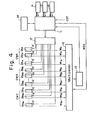
- a block diagram of circuitry for use with the system of Fig. 3 is illustrated in Fig. 4.
- a combination control unit 11, constituted by a microcomputer or the like, is adapted to store weight values Wll,Wl2,...Wln, W21,W22,...W2n, W31,W32,...W3n provided by weight sensors 2e 11 , 2e 12 ,...2e ln of weighing apparatus CWA, by weight sensors 2e21, 2e 22 ,....2e 2n of weighing apparatus CWB, and by weight sensors 2e 31 , 2e 32 ,... 2e 3n of weighing apparatus CWC, respectively, to find the best combination for each category of articles by computing combinations of the articles in each category in the same fashion as described in connection with Fig.
- the A/D converter 13 converts the analog weight value W ij obtained via the multiplexer 12 into a digital value and a signal indicative of this value is sent to the combination control unit 11 where the digital value is stored in an internal memory.
- weight setting unit 14 stores a target weight value W aa for the articles AA, weight setting unit 15 a target weight value W ba for the articles BA, and weight setting unit 16 a target weight value W for the articles CA.
- the articles AA, BA, CA are fed into each of the corresponding weighing hoppers 2d and pool hoppers 2b of each weighing apparatus CWA, CWB, CWC, respectively.
- a packaging machine (not shown) is ready to begin packaging articles
- a start signal CST is applied to the combination control unit 11.
- the control unit 11 responds to the start signal CST by applying the selection signal WSS to the multiplexer 12.
- the multiplexer 12 responds by first successively providing the A/D converter 13 with the output weight values Wll, W12,...Wln of the weight sensors 2e 11 , 2e 12 ,...2e ln that are weighing the articles AA in apparatus CWA.
- the A/D converter 13 successively converts the weight values Wll, W 12 ,...Wln into digital values and applies these values to the combination control unit.ll where they are stored in the unit's internal memory.
- the combination control unit 11 computes combinations, as described above with reference to Fig. 1, on the basis of the target value W aa set in setting unit 14.
- the control unit 11 finds the best combination resulting from the combinatorial computation and stores, in a best combination memory 24, the bit pattern (best combination pattern) corresponding to said best combination.
- the combination control unit 11 produces the selection signal WSS and successively reads in the output weight values W21, W22,...W2n from the weight sensors 2e 21 , 2e 22 ,... 2e 2n that are weighing the articles BA . Thenceforth, when the best combination of the articles BA is found by combinatorial computations just as described above, processing shifts to combinatorial computations performed for the articles CA.
- the combination control unit 11 provides a drive control unit 17 with the best combination pattern for each of the article categories AA, BA, CA, these best combination patterns having been stored in the memory 24.
- the drive control unit 17 responds by opening the weighing hopper gates 2f of those weighing machines designated by the best combination pattern, whereby the contained articles are discharged into the collecting chute CHT (Fig.3) and retained temporarily in the timing hopper TH.
- CHT collecting chute
- a batch made up of the articles in each category can be obtained, with the AA, BA, CA -category articles having the prescribed weights W , W ba , W , respectively.
- the target weights for the articles in each category were set in the setting units 14, 15, 16. It is also possible, however, to set the weight ratios of the articles AA, BA, CA and set the gross target weight of a batch separately, and then find the target weight value of the articles in each category from the weight ratio and gross target weight.
- target weights were set for the articles in each category. Substantially the same method may be followed to set numbers for these articles rather than weights.
- the method for setting article numbers differs in three points: (a) target numbers N aa , N ba , N are set rather than the target weights W aa , W ba , W ca ; (b) the unit weights W ua , W ub , W uc of the articles AA, BA, CA are set; and (c) the number of articles is found from the weight value and the unit weight.
- number setting units 18 through 20 and unit weight setting units 21 through 23 are connected to the combination control unit 11.
- the target numbers N aa , N ba , N ca of the articles AA, BA, CA are set in the setting units 18 through 20
- the unit weights W ua , W ub , W uc are set in the setting units 21 through 23.
- the control unit 11 computes the numbers of articles n 11 , n 12 ,...n ln for the category AA by dividing the weight values, obtained from the weight sensors 2e 11 , 2e 12 ,...2e ln , by the unit weight Wua, computes the numbers of articles n 21 , n 22 ,...n 2n for the category BA by dividing the weight values, obtained from the weight sensors 2e21, 2e22,...2e2n, by the unit weight W ub' computes the numbers of articles n 31 , n 32 ,...n 3n for the category CA by dividing the weight values, obtained from the weight sensors 2e 31 , 2e 32 ,...2e 3n , by the unit weight W uc , and computes combinations for each category of articles on the basis of the number of articles and the target numbers.
- the articles AA, BA, CA are fed into each of the corresponding weighing hoppers 2d and pool hoppers 2b of each weighing apparatus CWA, CWB, CWC, respectively.
- a packaging machine (not shown) is ready to begin packaging articles
- a start signal CST is applied to the combination control unit 11.
- the control unit 11 responds to the start signal CST by applying the selection signal WSS to the multiplexer 12.
- the multiplexer 12 responds by first successively providing the A/D converter 13 with the output weight values Wll, Wl2,...Wln of the weight sensors 2e 11 , 2e 12 ,...2e ln that are weighing the articles AA in apparatus CWA.
- the A/D converter 13 successively converts the weight values Wll, W12,...Wln into digital values and applies these values to the combination control unit 11.
- the control unit 11 divides the weight values Wll, W12,...Wln by the unit weight W ua set for the articles AA to compute the numbers of articles n 11 , n 12 ,.... n 1n , and stores the latter in a memory, not shown.
- the control unit 11 then computes the best combination that gives the number of articles equal to the target number N aa set in the target number setting unit 18, or closest to the target number N aa within the preset allowable limits. This best combination is stored in the best combination memory 24.
- the combination control unit 11 provides a drive control unit 17 with the best combination pattern for each of the article categories AA, BA, CA, these best combination patterns having been stored in the memory 24.
- the drive control unit 17 responds by opening the weighing hopper gates 2f of those weighing machines designated by the best combination patterns, whereby the contained articles are discharged into the collecting chute CHT (Fig.3) and retained temporarily in the timing hopper TH.
- CHT collecting chute
- the target numbers for the articles in each category were set in the setting units 18, 19, 20. It is also possible, however, to set the number ratios of the articles AA, BA, CA and set the overall target number for all the articles, and then find the target numbers N aa , N ba' N ca of each of the articles in each category from the number ratio and overall target number.
- a target number is set for each of a plurality of article categories, with a batch being obtained wherein the number of articles in each category is the target number set for that category and the total weight of all the articles in the batch is that closest to a target weight.
- the memory 24 has best combination pattern storage areas 24a, 24b, 24c for storing the best combination patterns for each of the article categories AA, BA, CA.
- the combination control unit 11 is adapted to find the best combination that gives a number ot articles, of category AA, equal to the target number N aa or closest to the target number within the preset allowable limits, and to store the best combination pattern in the best combination storage area 24a. In a case where the best combination is not limited to a single one but to several, all of these best combination patterns are stored in the storage area 24a.
- the combination control unit 11 is further adapted to find the best combinations that give numbers of articles, of categories BA, CA, equal to the respective target numbers Nb ' N or closest to these target numbers within the preset allowable limits, and to store the best combination patterns in the best combination storage areas 24b, 24c.
- a target weight setting unit 25 is connected to the control unit 11 and sets the total target weight Wt for all of the articles. That is, the target weight Wt will be the weight set for an entire batch.
- control unit 11 When the control unit 11 has computed the best combinations corresponding to the article groups AA, BA, CA and has stored these best combinations in the best combination pattern storage areas 24a, 24b, 24c, the control unit proceeds to execute the following processing with respect to all of the best combinations, selected from one after another of each of the storage areas 24a, 24b, 24c.
- the combination control unit 11 finds, from the total of M combinations, the combination whose combined weight value is equal or closest to the target weight W t tor the batcn set in target weight setting unit 25.
- the articles AA, BA, CA are fed into each of the corresponding weighing hoppers 2d and pool hoppers 2b of each weighing apparatus CWA, CWB, CWC, respectively.
- a packaging machine (not shown) is ready to begin packaging articles
- a start signal CST is applied to the combination control unit 11.
- the control unit 11 responds to the start signal C ST by applying the selection signal WSS to the multiplexer 12.
- the multiplexer 12 responds by first successively providing the A/D converter 13 with the output weight values Wll, W12,...Wln of the weight sensors 2e 11 , 2e 12 ,...2e ln that are weighing the articles AA in apparatus CWA.
- the A/D converter 13 successively converts the weight values Wll, W12,...Wln into digital values and applies these values to the combination control unit 11.
- the control unit 11 divides the weight values Wll, Wl2,...Wln by the unit weight W ua set for the articles AA to compute the numbers of articles n 11 , n 12, ...n ln , and stores the latter in a memory, not shown.
- the control unit 11 then computes the best combination that gives the number of articles equal to the target number N aa set in the target number setting unit 18, or closest to the target number N aa within the preset allowable limits. This best combination is stored in the combination pattern storage area 24a. It should be noted that there may be several best combinations, and not just one.
- the combination control unit 11 is operable to select, from among all of the combinations of best combination patterns chosen from one after another of the storage areas 24a, 24b, 24c, that combination whose total weight is equal or closest to the target weight Wt set in the target weight setting unit 25.
- the control unit 11 thenceforth opens the weighing hopper gates of the weighing machines corresponding to the combination whose total weight is equal or closest to the target weight Wt, thereby releasing the corresponding articles into'the collecting chute CHT where they are retained temporarily by the timing hopper TH.
- a batch composed of the articles in each category can be obtained, with the AA, BA, CA-category articles having the prescribed numbers of articles N , N ba , N ca , respectively, and with the total weight of all articles in the batch being that which is equal or closest to the target weight Wt.
- Another embodiment comprises a combinatorial weighing method including the steps of setting a target number for each of a plurality of article categories, and obtaining a batch of the articles wherein the total number of articles of each category in the batch is that which is equal to the target number set for that category, or that which is closest to the target number within preset allowable limits, while the total weight of all the articles in the batch is that which is closest to a target weight, wherein when no combination of the articles of a certain article category is found that gives a value equal to the target number or closest to the target number within the preset allowable limits, the target number for each of the articles is revised.
- the method can be practiced by means of the arrangement shown in Fig. 6 without alteration, the only difference being the processing executed by the combination control unit 11.
- the change in processing can be effected merely by changing the program of the microcomputer constituting the control unit 11.
- the combination control unit 11 is constantly checking for the arrival of the start signal CST, produced when the packaging machine (not shown) is ready. At the instant the signal CST arrives, the control unit sends the selection signal WSS to the multiplexer 12.
- the multiplexer 12 responds by first successively providing the A/D converter 13 with the output weight values Wll, W12,...Wln of the weight sensors 2e 11 , 2e 12 ,...2e ln that are weighing the articles AA in the first weighing apparatus CWA.
- the A/D converter 13 successively converts the weight values W11, W12,...Wln into digital values which are read in and stored by the combination control unit 11.
- the control unit 11 divides the weight values W11, W12,...Wln by the unit weight W ua set for the articles AA to compute and store the numbers of articles n 11 , n 12 ,...n ln .
- the control unit 11 then computes the best combination that gives the number of articles equal to the target number N aa set in the target number setting unit 18, or closest to the target number N aa within the preset allowable limits. This best combination is stored in the combination pattern storage area 24a. Similar processing is executed with respect to the articles BA, CA in order to obtain the combinations that give numbers coinciding with the target numbers N ba , N ca' or numbers closest to them with the preset allowable limits.
- the combination control unit 11 executes processing to revise the target number. Specifically, in order to change the target number N aa for the articles AA without changing the overall number of articles when the articles AA, BA, CA are collected together in a batch, the target number for one of the other categories, say the articles BA, is changed automatically (the target number N ca for the other articles CA is left unaltered). When this has been accomplished, the control unit 11 computes the best combinations based on the revised target numbers N , and N ba' , and on N ca .
- the control unit 11 selects, from among all combinations of the best combination patterns chosen from one after another of the storage areas 24a, 24b, 24c, that combination whose total weight value is equal or closest to the target weight Wt set by the target weight setting unit 25. Such will end the revising process. Thereafter, the control unit 11 opens the weighing hopper gates belonging to the weighing machines that correspond to said combination (of best combination patterns) whose total weight is equal or closest to the target weight, thereby discharging the corresponding articles to provide the prescribed batch.
- the unit weights of the articles AA, BA , CA are approximately the same and there is little variance in each unit weight.
- the control unit 11 while holding the overall number of articles constant when the articles are collected together in a batch, is operable to change the target number N aa for the articles AA and, as described above, to change the target number N ba for the articles BA or the target number N ca for the.articles CA. Then, in either case, the revision process is executed as set forth above.
- the control unit 11 changes these target values N aa , N ba and then executes the processing for computing combinations.
- the target values for the articles AA, BA are changed but not the target value N ca for the articles CA, while holding constant the overall number of articles when they are collected together.
- control unit 11 compulsorily changes these target numbers N aa , N ba , N ca to predetermined fixed values N aa' , N ba' , N ca , (without changing the overall number of articles) to execute the revision process.
- each category of articles makes up a predetermined weight or is composed of a predetermined number of the articles. It is possible also to bring the weight of all the articles or the number thereof into agreement with a target value or very close to the target value within preset allowable limits.
- An embodiment of the invention can provide a batch of articles of various categories, each category having a predetermined number of articles while the total weight of all the articles in the batch is equal to a target weight or closest to the target weight within preset allowable limits.
- An embodiment of the invention need not require that bulky articles of various kinds be mixed together in advance, thereby enabling the apparatus to be reduced in size. Further, in a case where a combination cannot be found that satisfies a given target number for a certain category of articles, this particular target number together with the target number for at least one other category of articles can be altered while holding the overall number of articles constant, after which combinations are computed afresh on the basis of these altered target numbers. This can avoid having to halt the weighing operation because a combination cannot be found.
Landscapes
- Physics & Mathematics (AREA)
- General Physics & Mathematics (AREA)
- Weight Measurement For Supplying Or Discharging Of Specified Amounts Of Material (AREA)
- Filling Or Emptying Of Bunkers, Hoppers, And Tanks (AREA)
Applications Claiming Priority (2)
| Application Number | Priority Date | Filing Date | Title |
|---|---|---|---|
| JP118722/81 | 1981-07-28 | ||
| JP56118722A JPS5819516A (ja) | 1981-07-28 | 1981-07-28 | 複数の種類の品物の混合組合せ計量方法 |
Publications (3)
| Publication Number | Publication Date |
|---|---|
| EP0071473A2 true EP0071473A2 (fr) | 1983-02-09 |
| EP0071473A3 EP0071473A3 (en) | 1984-07-11 |
| EP0071473B1 EP0071473B1 (fr) | 1989-05-24 |
Family
ID=14743458
Family Applications (1)
| Application Number | Title | Priority Date | Filing Date |
|---|---|---|---|
| EP82303994A Expired EP0071473B1 (fr) | 1981-07-28 | 1982-07-28 | Groupement combinatoire d'articles |
Country Status (5)
| Country | Link |
|---|---|
| US (2) | US4549617A (fr) |
| EP (1) | EP0071473B1 (fr) |
| JP (1) | JPS5819516A (fr) |
| AU (1) | AU557770B2 (fr) |
| DE (1) | DE3279714D1 (fr) |
Cited By (1)
| Publication number | Priority date | Publication date | Assignee | Title |
|---|---|---|---|---|
| WO1995022042A1 (fr) * | 1994-02-15 | 1995-08-17 | Precision Preweighs Pty. Ltd | Procede et appareil pour constituer des composants preemballes |
Families Citing this family (24)
| Publication number | Priority date | Publication date | Assignee | Title |
|---|---|---|---|---|
| JPS5861416A (ja) * | 1981-10-08 | 1983-04-12 | House Food Ind Co Ltd | 組合せ計量方法 |
| JPS58108412A (ja) * | 1981-12-21 | 1983-06-28 | Yamato Scale Co Ltd | 組合せ計量方法 |
| JPS5992316A (ja) * | 1982-11-18 | 1984-05-28 | Ishida Scales Mfg Co Ltd | 混合組合せ計数・計量方法及び装置 |
| JPH0672797B2 (ja) * | 1984-04-25 | 1994-09-14 | 株式会社石田衡器製作所 | 組合せ計量装置と包装機との連動システム |
| JPH0663814B2 (ja) * | 1984-04-26 | 1994-08-22 | 株式会社石田衡器製作所 | 自動秤量機 |
| WO1987004239A1 (fr) * | 1985-12-29 | 1987-07-16 | Anritsu Corporation | Appareil de pesage combine |
| US4678046A (en) * | 1986-01-31 | 1987-07-07 | Package Machinery Company | Combination weighing apparatus for two combined products |
| US4817042A (en) * | 1986-07-30 | 1989-03-28 | Pitney Bowes Inc. | Insertion machine with prioritized selection of inserts |
| JPS63255625A (ja) * | 1987-04-13 | 1988-10-21 | Ishida Scales Mfg Co Ltd | 混合組合せ計量計数装置 |
| JPS6412232A (en) * | 1987-07-03 | 1989-01-17 | Yamato Scale Co Ltd | Number combination scale |
| JPH01244319A (ja) * | 1988-03-25 | 1989-09-28 | Ishida Scales Mfg Co Ltd | 手動盛合わせ計量装置 |
| US4844190A (en) * | 1988-05-03 | 1989-07-04 | Ishida Scales Manufacturing Company, Ltd. | Combinational weigher for multiple operations |
| US4828054A (en) * | 1988-06-29 | 1989-05-09 | Package Machinery Company | Combination weigher having a standby product charge |
| US4995467A (en) * | 1989-06-09 | 1991-02-26 | Niemann Gary O | Method and apparatus for weighing and dispensing objects |
| US4947089A (en) * | 1989-10-30 | 1990-08-07 | Abel Manufacturing Co., Inc. | Apparatus for selectively controlling a plurality of electric motors |
| US6268571B1 (en) | 2000-06-23 | 2001-07-31 | David Benyukhis | Counting and combinatorial weighing method and apparatus |
| JP4669627B2 (ja) * | 2001-04-26 | 2011-04-13 | 株式会社イシダ | 組合せ計量装置及び組合せ計量包装システム |
| JP3863125B2 (ja) | 2003-06-05 | 2006-12-27 | 株式会社イシダ | 組合せ計量装置 |
| US20050060958A1 (en) * | 2003-08-29 | 2005-03-24 | Delta And Pine Land Company | Seed handling systems and methods |
| JP4809623B2 (ja) * | 2005-04-19 | 2011-11-09 | 大和製衡株式会社 | 混合計量用組合せ秤 |
| ITBO20050335A1 (it) * | 2005-05-10 | 2005-08-09 | Gd Spa | Metodo ed unita' per il raggruppamento di prodotti |
| JP4864612B2 (ja) * | 2006-09-04 | 2012-02-01 | 勝三 川西 | 組合せ秤および組合せ計量方法 |
| JP5800544B2 (ja) * | 2011-03-28 | 2015-10-28 | 大和製衡株式会社 | 組合せ秤 |
| JP7844233B2 (ja) * | 2022-04-07 | 2026-04-13 | 株式会社ニチレイフーズ | 計測システム、計測方法及び食品製造方法 |
Family Cites Families (10)
| Publication number | Priority date | Publication date | Assignee | Title |
|---|---|---|---|---|
| US3685602A (en) * | 1971-05-28 | 1972-08-22 | Gerald C Mayer | Automatic batch weigher |
| US3939928A (en) * | 1972-08-12 | 1976-02-24 | Kabushiki Kaisha Ishida Koki Seisakusyo | Weighing method and apparatus |
| US4139070A (en) * | 1976-09-10 | 1979-02-13 | National Controls, Inc. | Dual platform counting scale |
| JPS53141072A (en) * | 1977-05-15 | 1978-12-08 | Shinkou Denshi Kk | Method for counting number of parts by way of scale |
| DE2730515A1 (de) * | 1977-07-06 | 1979-01-18 | Bayer Ag | Substituierte phenoxybenzyloxycarbonylderivate, verfahren zu ihrer herstellung und ihre verwendung als insektizide und akarizide |
| JPS604106Y2 (ja) * | 1978-12-12 | 1985-02-05 | 大和製衡株式会社 | 組合せ秤 |
| US4222448A (en) * | 1979-06-29 | 1980-09-16 | Owens-Corning Fiberglas Corporation | Automatic batch weighing system |
| US4398613A (en) * | 1981-06-22 | 1983-08-16 | Yamato Scale Company, Ltd. | Device for grouping articles by combination selection so as to have the predetermined number |
| JPS58108412A (ja) * | 1981-12-21 | 1983-06-28 | Yamato Scale Co Ltd | 組合せ計量方法 |
| JPS6015215A (ja) * | 1983-07-05 | 1985-01-25 | Diesel Kiki Co Ltd | 車輌用空気調和装置 |
-
1981
- 1981-07-28 JP JP56118722A patent/JPS5819516A/ja active Granted
-
1982
- 1982-07-19 AU AU86170/82A patent/AU557770B2/en not_active Expired
- 1982-07-27 US US06/402,364 patent/US4549617A/en not_active Expired - Lifetime
- 1982-07-28 EP EP82303994A patent/EP0071473B1/fr not_active Expired
- 1982-07-28 DE DE8282303994T patent/DE3279714D1/de not_active Expired
-
1985
- 1985-06-19 US US06/746,627 patent/US4658920A/en not_active Expired - Lifetime
Cited By (1)
| Publication number | Priority date | Publication date | Assignee | Title |
|---|---|---|---|---|
| WO1995022042A1 (fr) * | 1994-02-15 | 1995-08-17 | Precision Preweighs Pty. Ltd | Procede et appareil pour constituer des composants preemballes |
Also Published As
| Publication number | Publication date |
|---|---|
| JPS5819516A (ja) | 1983-02-04 |
| DE3279714D1 (en) | 1989-06-29 |
| EP0071473B1 (fr) | 1989-05-24 |
| US4658920A (en) | 1987-04-21 |
| US4549617A (en) | 1985-10-29 |
| EP0071473A3 (en) | 1984-07-11 |
| AU557770B2 (en) | 1987-01-08 |
| AU8617082A (en) | 1983-02-03 |
| JPH0143889B2 (fr) | 1989-09-25 |
Similar Documents
| Publication | Publication Date | Title |
|---|---|---|
| EP0071473A2 (fr) | Groupement combinatoire d'articles | |
| EP0084968B1 (fr) | Méthode et dispositif de pesage | |
| US4442911A (en) | Method and apparatus for controlling zero adjustment of weight sensor | |
| EP0063056B1 (fr) | Méthode de pesage combinatoire et appareil pour celui-ci | |
| EP0097532B1 (fr) | Dispositif de pesage combinatoire | |
| US4467880A (en) | Combinatorial weighing apparatus | |
| US4529049A (en) | Combinatorial weighing or counting method | |
| EP0079237A2 (fr) | Procédé de dosage employant des opérations de pesage combinatoire | |
| US4642788A (en) | Combinatorial weighing method and apparatus | |
| EP0103476A2 (fr) | Méthode de pesage combinatoire et dispositif y relatif | |
| EP0074773A2 (fr) | Procédé de pesage combinatoire | |
| EP0074269B1 (fr) | Procédé pour le comptage de parties | |
| EP0124370B1 (fr) | Méthode et dispositif de pesage combinatoire | |
| EP0119854B1 (fr) | Méthode de pesage combinatoire et dispositif | |
| EP0125080B1 (fr) | Méthode combinatoire de pesage et dispositif | |
| US4574897A (en) | Combinatorial weighing apparatus | |
| EP0097529B1 (fr) | Méthodes de pesage combinatoire et dispositif | |
| EP0097531B1 (fr) | Méthode de pesage combinatoire et dispositif | |
| US4557340A (en) | Method of combinatorial weighing in a combinatorial weighing machine |
Legal Events
| Date | Code | Title | Description |
|---|---|---|---|
| PUAI | Public reference made under article 153(3) epc to a published international application that has entered the european phase |
Free format text: ORIGINAL CODE: 0009012 |
|
| AK | Designated contracting states |
Designated state(s): DE FR GB IT |
|
| PUAL | Search report despatched |
Free format text: ORIGINAL CODE: 0009013 |
|
| AK | Designated contracting states |
Designated state(s): DE FR GB IT |
|
| 17P | Request for examination filed |
Effective date: 19841210 |
|
| 17Q | First examination report despatched |
Effective date: 19860313 |
|
| D17Q | First examination report despatched (deleted) | ||
| GRAA | (expected) grant |
Free format text: ORIGINAL CODE: 0009210 |
|
| AK | Designated contracting states |
Kind code of ref document: B1 Designated state(s): DE FR GB IT |
|
| REF | Corresponds to: |
Ref document number: 3279714 Country of ref document: DE Date of ref document: 19890629 |
|
| ET | Fr: translation filed | ||
| ITF | It: translation for a ep patent filed | ||
| PLBE | No opposition filed within time limit |
Free format text: ORIGINAL CODE: 0009261 |
|
| STAA | Information on the status of an ep patent application or granted ep patent |
Free format text: STATUS: NO OPPOSITION FILED WITHIN TIME LIMIT |
|
| 26N | No opposition filed | ||
| ITTA | It: last paid annual fee | ||
| PGFP | Annual fee paid to national office [announced via postgrant information from national office to epo] |
Ref country code: FR Payment date: 20010712 Year of fee payment: 20 |
|
| PGFP | Annual fee paid to national office [announced via postgrant information from national office to epo] |
Ref country code: DE Payment date: 20010723 Year of fee payment: 20 |
|
| PGFP | Annual fee paid to national office [announced via postgrant information from national office to epo] |
Ref country code: GB Payment date: 20010725 Year of fee payment: 20 |
|
| REG | Reference to a national code |
Ref country code: GB Ref legal event code: IF02 |
|
| PG25 | Lapsed in a contracting state [announced via postgrant information from national office to epo] |
Ref country code: GB Free format text: LAPSE BECAUSE OF EXPIRATION OF PROTECTION Effective date: 20020727 |
|
| REG | Reference to a national code |
Ref country code: GB Ref legal event code: PE20 Effective date: 20020727 |