EP0071790A1 - Neue Fluormethylthiobenzoylfluoride und Verfahren zu ihrer Herstellung - Google Patents
Neue Fluormethylthiobenzoylfluoride und Verfahren zu ihrer Herstellung Download PDFInfo
- Publication number
- EP0071790A1 EP0071790A1 EP82106332A EP82106332A EP0071790A1 EP 0071790 A1 EP0071790 A1 EP 0071790A1 EP 82106332 A EP82106332 A EP 82106332A EP 82106332 A EP82106332 A EP 82106332A EP 0071790 A1 EP0071790 A1 EP 0071790A1
- Authority
- EP
- European Patent Office
- Prior art keywords
- fluorides
- atom
- fluoromethylthiobenzoyl
- chloride
- fluoride
- Prior art date
- Legal status (The legal status is an assumption and is not a legal conclusion. Google has not performed a legal analysis and makes no representation as to the accuracy of the status listed.)
- Granted
Links
- JZADSVBSBBICQY-UHFFFAOYSA-N 2-(fluoromethyl)benzenecarbothioyl fluoride Chemical class FCC1=CC=CC=C1C(F)=S JZADSVBSBBICQY-UHFFFAOYSA-N 0.000 title claims abstract description 10
- 238000004519 manufacturing process Methods 0.000 title abstract description 7
- KRHYYFGTRYWZRS-UHFFFAOYSA-N Fluorane Chemical compound F KRHYYFGTRYWZRS-UHFFFAOYSA-N 0.000 claims abstract description 22
- 229910000040 hydrogen fluoride Inorganic materials 0.000 claims abstract description 10
- 238000000034 method Methods 0.000 claims abstract description 8
- 238000002360 preparation method Methods 0.000 claims abstract description 8
- 239000007858 starting material Substances 0.000 claims abstract description 8
- XGVQKDPFJNEOGH-UHFFFAOYSA-N 2-(trichloromethyl)benzenecarbothioyl chloride Chemical class ClC(=S)C1=CC=CC=C1C(Cl)(Cl)Cl XGVQKDPFJNEOGH-UHFFFAOYSA-N 0.000 claims abstract description 6
- 229910052801 chlorine Inorganic materials 0.000 claims description 7
- 125000001309 chloro group Chemical group Cl* 0.000 claims description 6
- 229910052731 fluorine Inorganic materials 0.000 claims description 5
- 125000001153 fluoro group Chemical group F* 0.000 claims description 5
- 125000004435 hydrogen atom Chemical group [H]* 0.000 claims description 5
- 125000005843 halogen group Chemical group 0.000 claims description 4
- BELAORDXNUOIMD-UHFFFAOYSA-N 2-(trifluoromethyl)benzenecarbothioyl fluoride Chemical compound FC(=S)C1=CC=CC=C1C(F)(F)F BELAORDXNUOIMD-UHFFFAOYSA-N 0.000 claims description 2
- 239000011814 protection agent Substances 0.000 abstract description 2
- 238000006243 chemical reaction Methods 0.000 description 15
- -1 trifluoromethylthio-substituted benzoyl chlorides Chemical class 0.000 description 12
- YMWUJEATGCHHMB-UHFFFAOYSA-N Dichloromethane Chemical compound ClCCl YMWUJEATGCHHMB-UHFFFAOYSA-N 0.000 description 6
- UBOXGVDOUJQMTN-UHFFFAOYSA-N 1,1,2-trichloroethane Chemical compound ClCC(Cl)Cl UBOXGVDOUJQMTN-UHFFFAOYSA-N 0.000 description 5
- VEXZGXHMUGYJMC-UHFFFAOYSA-N Hydrochloric acid Chemical compound Cl VEXZGXHMUGYJMC-UHFFFAOYSA-N 0.000 description 5
- 239000000203 mixture Substances 0.000 description 5
- 239000002904 solvent Substances 0.000 description 5
- CRULTJNBCNAZST-UHFFFAOYSA-N 3-(trichloromethyl)benzenecarbothioyl chloride Chemical compound ClC(=S)C1=CC=CC(C(Cl)(Cl)Cl)=C1 CRULTJNBCNAZST-UHFFFAOYSA-N 0.000 description 4
- 150000001875 compounds Chemical class 0.000 description 4
- 238000010992 reflux Methods 0.000 description 4
- WKBOTKDWSSQWDR-UHFFFAOYSA-N Bromine atom Chemical group [Br] WKBOTKDWSSQWDR-UHFFFAOYSA-N 0.000 description 3
- JFDZBHWFFUWGJE-UHFFFAOYSA-N benzonitrile Chemical compound N#CC1=CC=CC=C1 JFDZBHWFFUWGJE-UHFFFAOYSA-N 0.000 description 3
- 229910052799 carbon Inorganic materials 0.000 description 3
- 239000007795 chemical reaction product Substances 0.000 description 3
- VLKZOEOYAKHREP-UHFFFAOYSA-N n-Hexane Chemical compound CCCCCC VLKZOEOYAKHREP-UHFFFAOYSA-N 0.000 description 3
- 238000001644 13C nuclear magnetic resonance spectroscopy Methods 0.000 description 2
- VDBNEDVMCMMGLT-UHFFFAOYSA-N 4-(trichloromethyl)benzenecarbothioyl chloride Chemical compound ClC(=S)C1=CC=C(C(Cl)(Cl)Cl)C=C1 VDBNEDVMCMMGLT-UHFFFAOYSA-N 0.000 description 2
- HEDRZPFGACZZDS-UHFFFAOYSA-N Chloroform Chemical compound ClC(Cl)Cl HEDRZPFGACZZDS-UHFFFAOYSA-N 0.000 description 2
- RTZKZFJDLAIYFH-UHFFFAOYSA-N Diethyl ether Chemical compound CCOCC RTZKZFJDLAIYFH-UHFFFAOYSA-N 0.000 description 2
- XEEYBQQBJWHFJM-UHFFFAOYSA-N Iron Chemical compound [Fe] XEEYBQQBJWHFJM-UHFFFAOYSA-N 0.000 description 2
- IMNFDUFMRHMDMM-UHFFFAOYSA-N N-Heptane Chemical compound CCCCCCC IMNFDUFMRHMDMM-UHFFFAOYSA-N 0.000 description 2
- PXHVJJICTQNCMI-UHFFFAOYSA-N Nickel Chemical compound [Ni] PXHVJJICTQNCMI-UHFFFAOYSA-N 0.000 description 2
- OFBQJSOFQDEBGM-UHFFFAOYSA-N Pentane Chemical compound CCCCC OFBQJSOFQDEBGM-UHFFFAOYSA-N 0.000 description 2
- 239000004809 Teflon Substances 0.000 description 2
- 229920006362 Teflon® Polymers 0.000 description 2
- WPYMKLBDIGXBTP-UHFFFAOYSA-N benzoic acid Chemical compound OC(=O)C1=CC=CC=C1 WPYMKLBDIGXBTP-UHFFFAOYSA-N 0.000 description 2
- 238000009835 boiling Methods 0.000 description 2
- GDTBXPJZTBHREO-UHFFFAOYSA-N bromine Substances BrBr GDTBXPJZTBHREO-UHFFFAOYSA-N 0.000 description 2
- 229910052794 bromium Inorganic materials 0.000 description 2
- DIKBFYAXUHHXCS-UHFFFAOYSA-N bromoform Chemical compound BrC(Br)Br DIKBFYAXUHHXCS-UHFFFAOYSA-N 0.000 description 2
- 125000004432 carbon atom Chemical group C* 0.000 description 2
- 239000003054 catalyst Substances 0.000 description 2
- MZRYXIZYCGRGQA-UHFFFAOYSA-N copper;trifluoro(trifluoromethylsulfanyl)methane Chemical compound [Cu].FC(F)(F)SC(F)(F)F MZRYXIZYCGRGQA-UHFFFAOYSA-N 0.000 description 2
- NNBZCPXTIHJBJL-UHFFFAOYSA-N decalin Chemical compound C1CCCC2CCCCC21 NNBZCPXTIHJBJL-UHFFFAOYSA-N 0.000 description 2
- 150000002222 fluorine compounds Chemical class 0.000 description 2
- 229940100892 mercury compound Drugs 0.000 description 2
- 150000002731 mercury compounds Chemical class 0.000 description 2
- UAEPNZWRGJTJPN-UHFFFAOYSA-N methylcyclohexane Chemical compound CC1CCCCC1 UAEPNZWRGJTJPN-UHFFFAOYSA-N 0.000 description 2
- XOKSLPVRUOBDEW-UHFFFAOYSA-N pinane Chemical compound CC1CCC2C(C)(C)C1C2 XOKSLPVRUOBDEW-UHFFFAOYSA-N 0.000 description 2
- 239000000047 product Substances 0.000 description 2
- 150000003254 radicals Chemical class 0.000 description 2
- FYSNRJHAOHDILO-UHFFFAOYSA-N thionyl chloride Chemical compound ClS(Cl)=O FYSNRJHAOHDILO-UHFFFAOYSA-N 0.000 description 2
- XLYOFNOQVPJJNP-UHFFFAOYSA-N water Substances O XLYOFNOQVPJJNP-UHFFFAOYSA-N 0.000 description 2
- GRWFGVWFFZKLTI-IUCAKERBSA-N (-)-α-pinene Chemical compound CC1=CC[C@@H]2C(C)(C)[C@H]1C2 GRWFGVWFFZKLTI-IUCAKERBSA-N 0.000 description 1
- SCYULBFZEHDVBN-UHFFFAOYSA-N 1,1-Dichloroethane Chemical compound CC(Cl)Cl SCYULBFZEHDVBN-UHFFFAOYSA-N 0.000 description 1
- SEQRDAAUNCRFIT-UHFFFAOYSA-N 1,1-dichlorobutane Chemical compound CCCC(Cl)Cl SEQRDAAUNCRFIT-UHFFFAOYSA-N 0.000 description 1
- WSLDOOZREJYCGB-UHFFFAOYSA-N 1,2-Dichloroethane Chemical compound ClCCCl WSLDOOZREJYCGB-UHFFFAOYSA-N 0.000 description 1
- KNKRKFALVUDBJE-UHFFFAOYSA-N 1,2-dichloropropane Chemical compound CC(Cl)CCl KNKRKFALVUDBJE-UHFFFAOYSA-N 0.000 description 1
- AMCBMCWLCDERHY-UHFFFAOYSA-N 1,3-dichloronaphthalene Chemical compound C1=CC=CC2=CC(Cl)=CC(Cl)=C21 AMCBMCWLCDERHY-UHFFFAOYSA-N 0.000 description 1
- ODNBVEIAQAZNNM-UHFFFAOYSA-N 1-(6-chloroimidazo[1,2-b]pyridazin-3-yl)ethanone Chemical compound C1=CC(Cl)=NN2C(C(=O)C)=CN=C21 ODNBVEIAQAZNNM-UHFFFAOYSA-N 0.000 description 1
- MPPPKRYCTPRNTB-UHFFFAOYSA-N 1-bromobutane Chemical compound CCCCBr MPPPKRYCTPRNTB-UHFFFAOYSA-N 0.000 description 1
- CYNYIHKIEHGYOZ-UHFFFAOYSA-N 1-bromopropane Chemical compound CCCBr CYNYIHKIEHGYOZ-UHFFFAOYSA-N 0.000 description 1
- VFWCMGCRMGJXDK-UHFFFAOYSA-N 1-chlorobutane Chemical compound CCCCCl VFWCMGCRMGJXDK-UHFFFAOYSA-N 0.000 description 1
- JTPNRXUCIXHOKM-UHFFFAOYSA-N 1-chloronaphthalene Chemical compound C1=CC=C2C(Cl)=CC=CC2=C1 JTPNRXUCIXHOKM-UHFFFAOYSA-N 0.000 description 1
- SQCZQTSHSZLZIQ-UHFFFAOYSA-N 1-chloropentane Chemical compound CCCCCCl SQCZQTSHSZLZIQ-UHFFFAOYSA-N 0.000 description 1
- XTDQDBVBDLYELW-UHFFFAOYSA-N 2,2,3-trimethylpentane Chemical compound CCC(C)C(C)(C)C XTDQDBVBDLYELW-UHFFFAOYSA-N 0.000 description 1
- OKVWYBALHQFVFP-UHFFFAOYSA-N 2,3,3-trimethylpentane Chemical compound CCC(C)(C)C(C)C OKVWYBALHQFVFP-UHFFFAOYSA-N 0.000 description 1
- GSZSUDMISDEOIU-UHFFFAOYSA-N 2-(trichloromethoxy)benzoyl chloride Chemical compound ClC(=O)C1=CC=CC=C1OC(Cl)(Cl)Cl GSZSUDMISDEOIU-UHFFFAOYSA-N 0.000 description 1
- NEKYEZZMSAFUMY-UHFFFAOYSA-N 2-(trifluoromethyl)benzenecarbothioic s-acid Chemical class OC(=S)C1=CC=CC=C1C(F)(F)F NEKYEZZMSAFUMY-UHFFFAOYSA-N 0.000 description 1
- NGNBDVOYPDDBFK-UHFFFAOYSA-N 2-[2,4-di(pentan-2-yl)phenoxy]acetyl chloride Chemical compound CCCC(C)C1=CC=C(OCC(Cl)=O)C(C(C)CCC)=C1 NGNBDVOYPDDBFK-UHFFFAOYSA-N 0.000 description 1
- NAMYKGVDVNBCFQ-UHFFFAOYSA-N 2-bromopropane Chemical compound CC(C)Br NAMYKGVDVNBCFQ-UHFFFAOYSA-N 0.000 description 1
- SJTCREFDYDHKKU-UHFFFAOYSA-N 3-(trifluoromethyl)benzenecarbothioyl fluoride Chemical compound FC(=S)C1=CC=CC(C(F)(F)F)=C1 SJTCREFDYDHKKU-UHFFFAOYSA-N 0.000 description 1
- AGIVSWHHBSZMNA-UHFFFAOYSA-N 3-chloro-2-(difluoromethyl)benzenecarbothioyl fluoride Chemical compound FC(F)C1=C(Cl)C=CC=C1C(F)=S AGIVSWHHBSZMNA-UHFFFAOYSA-N 0.000 description 1
- BQJNXUVKLSOGQK-UHFFFAOYSA-N 4-(trifluoromethyl)benzenecarbothioyl fluoride Chemical compound FC(=S)C1=CC=C(C(F)(F)F)C=C1 BQJNXUVKLSOGQK-UHFFFAOYSA-N 0.000 description 1
- LKFIKVKIWGUHCB-UHFFFAOYSA-N 4-chloro-2-(difluoromethyl)benzenecarbothioyl fluoride Chemical compound FC(F)C1=CC(Cl)=CC=C1C(F)=S LKFIKVKIWGUHCB-UHFFFAOYSA-N 0.000 description 1
- XFFNQWOBUQKIJB-UHFFFAOYSA-N 4-chloro-3-(trichloromethylsulfanyl)benzoyl chloride Chemical compound ClC(=O)C1=CC=C(Cl)C(SC(Cl)(Cl)Cl)=C1 XFFNQWOBUQKIJB-UHFFFAOYSA-N 0.000 description 1
- HQQTZCPKNZVLFF-UHFFFAOYSA-N 4h-1,2-benzoxazin-3-one Chemical class C1=CC=C2ONC(=O)CC2=C1 HQQTZCPKNZVLFF-UHFFFAOYSA-N 0.000 description 1
- ZCYVEMRRCGMTRW-UHFFFAOYSA-N 7553-56-2 Chemical compound [I] ZCYVEMRRCGMTRW-UHFFFAOYSA-N 0.000 description 1
- GUNJVIDCYZYFGV-UHFFFAOYSA-K Antimony trifluoride Inorganic materials F[Sb](F)F GUNJVIDCYZYFGV-UHFFFAOYSA-K 0.000 description 1
- 239000005711 Benzoic acid Substances 0.000 description 1
- ZOXJGFHDIHLPTG-UHFFFAOYSA-N Boron Chemical compound [B] ZOXJGFHDIHLPTG-UHFFFAOYSA-N 0.000 description 1
- OKTJSMMVPCPJKN-UHFFFAOYSA-N Carbon Chemical compound [C] OKTJSMMVPCPJKN-UHFFFAOYSA-N 0.000 description 1
- ZAMOUSCENKQFHK-UHFFFAOYSA-N Chlorine atom Chemical compound [Cl] ZAMOUSCENKQFHK-UHFFFAOYSA-N 0.000 description 1
- XDTMQSROBMDMFD-UHFFFAOYSA-N Cyclohexane Chemical compound C1CCCCC1 XDTMQSROBMDMFD-UHFFFAOYSA-N 0.000 description 1
- KRHYYFGTRYWZRS-UHFFFAOYSA-M Fluoride anion Chemical compound [F-] KRHYYFGTRYWZRS-UHFFFAOYSA-M 0.000 description 1
- NHTMVDHEPJAVLT-UHFFFAOYSA-N Isooctane Chemical compound CC(C)CC(C)(C)C NHTMVDHEPJAVLT-UHFFFAOYSA-N 0.000 description 1
- CYTYCFOTNPOANT-UHFFFAOYSA-N Perchloroethylene Chemical group ClC(Cl)=C(Cl)Cl CYTYCFOTNPOANT-UHFFFAOYSA-N 0.000 description 1
- RTAQQCXQSZGOHL-UHFFFAOYSA-N Titanium Chemical compound [Ti] RTAQQCXQSZGOHL-UHFFFAOYSA-N 0.000 description 1
- 125000001931 aliphatic group Chemical group 0.000 description 1
- 229910052782 aluminium Inorganic materials 0.000 description 1
- XAGFODPZIPBFFR-UHFFFAOYSA-N aluminium Chemical compound [Al] XAGFODPZIPBFFR-UHFFFAOYSA-N 0.000 description 1
- 150000001448 anilines Chemical class 0.000 description 1
- RWZYAGGXGHYGMB-UHFFFAOYSA-N anthranilic acid Chemical class NC1=CC=CC=C1C(O)=O RWZYAGGXGHYGMB-UHFFFAOYSA-N 0.000 description 1
- 229910052787 antimony Inorganic materials 0.000 description 1
- WATWJIUSRGPENY-UHFFFAOYSA-N antimony atom Chemical compound [Sb] WATWJIUSRGPENY-UHFFFAOYSA-N 0.000 description 1
- 230000009286 beneficial effect Effects 0.000 description 1
- 235000010233 benzoic acid Nutrition 0.000 description 1
- 150000001558 benzoic acid derivatives Chemical class 0.000 description 1
- PASDCCFISLVPSO-UHFFFAOYSA-N benzoyl chloride Chemical group ClC(=O)C1=CC=CC=C1 PASDCCFISLVPSO-UHFFFAOYSA-N 0.000 description 1
- 229910052796 boron Inorganic materials 0.000 description 1
- 229950005228 bromoform Drugs 0.000 description 1
- 125000000484 butyl group Chemical group [H]C([*])([H])C([H])([H])C([H])([H])C([H])([H])[H] 0.000 description 1
- 150000008280 chlorinated hydrocarbons Chemical class 0.000 description 1
- 239000000460 chlorine Substances 0.000 description 1
- 150000001845 chromium compounds Chemical class 0.000 description 1
- KFUSEUYYWQURPO-UPHRSURJSA-N cis-1,2-dichloroethene Chemical group Cl\C=C/Cl KFUSEUYYWQURPO-UPHRSURJSA-N 0.000 description 1
- 239000010941 cobalt Substances 0.000 description 1
- 229910017052 cobalt Inorganic materials 0.000 description 1
- GUTLYIVDDKVIGB-UHFFFAOYSA-N cobalt atom Chemical compound [Co] GUTLYIVDDKVIGB-UHFFFAOYSA-N 0.000 description 1
- 238000004821 distillation Methods 0.000 description 1
- 125000001495 ethyl group Chemical group [H]C([H])([H])C([H])([H])* 0.000 description 1
- 125000004216 fluoromethyl group Chemical group [H]C([H])(F)* 0.000 description 1
- 239000007789 gas Substances 0.000 description 1
- 150000008282 halocarbons Chemical class 0.000 description 1
- 230000002363 herbicidal effect Effects 0.000 description 1
- 229930195733 hydrocarbon Natural products 0.000 description 1
- 150000002430 hydrocarbons Chemical class 0.000 description 1
- 239000005457 ice water Substances 0.000 description 1
- 229910052740 iodine Inorganic materials 0.000 description 1
- 239000011630 iodine Substances 0.000 description 1
- HVTICUPFWKNHNG-UHFFFAOYSA-N iodoethane Chemical compound CCI HVTICUPFWKNHNG-UHFFFAOYSA-N 0.000 description 1
- 229910052742 iron Inorganic materials 0.000 description 1
- QTBFPMKWQKYFLR-UHFFFAOYSA-N isobutyl chloride Chemical compound CC(C)CCl QTBFPMKWQKYFLR-UHFFFAOYSA-N 0.000 description 1
- 125000000959 isobutyl group Chemical group [H]C([H])([H])C([H])(C([H])([H])[H])C([H])([H])* 0.000 description 1
- 125000001449 isopropyl group Chemical group [H]C([H])([H])C([H])(*)C([H])([H])[H] 0.000 description 1
- 239000007788 liquid Substances 0.000 description 1
- WPBNNNQJVZRUHP-UHFFFAOYSA-L manganese(2+);methyl n-[[2-(methoxycarbonylcarbamothioylamino)phenyl]carbamothioyl]carbamate;n-[2-(sulfidocarbothioylamino)ethyl]carbamodithioate Chemical compound [Mn+2].[S-]C(=S)NCCNC([S-])=S.COC(=O)NC(=S)NC1=CC=CC=C1NC(=S)NC(=O)OC WPBNNNQJVZRUHP-UHFFFAOYSA-L 0.000 description 1
- QSHDDOUJBYECFT-UHFFFAOYSA-N mercury Chemical compound [Hg] QSHDDOUJBYECFT-UHFFFAOYSA-N 0.000 description 1
- 229910052753 mercury Inorganic materials 0.000 description 1
- 125000002496 methyl group Chemical group [H]C([H])([H])* 0.000 description 1
- GYNNXHKOJHMOHS-UHFFFAOYSA-N methyl-cycloheptane Natural products CC1CCCCCC1 GYNNXHKOJHMOHS-UHFFFAOYSA-N 0.000 description 1
- PQIOSYKVBBWRRI-UHFFFAOYSA-N methylphosphonyl difluoride Chemical group CP(F)(F)=O PQIOSYKVBBWRRI-UHFFFAOYSA-N 0.000 description 1
- UNFUYWDGSFDHCW-UHFFFAOYSA-N monochlorocyclohexane Chemical compound ClC1CCCCC1 UNFUYWDGSFDHCW-UHFFFAOYSA-N 0.000 description 1
- SNMVRZFUUCLYTO-UHFFFAOYSA-N n-propyl chloride Chemical compound CCCCl SNMVRZFUUCLYTO-UHFFFAOYSA-N 0.000 description 1
- PVWOIHVRPOBWPI-UHFFFAOYSA-N n-propyl iodide Chemical compound CCCI PVWOIHVRPOBWPI-UHFFFAOYSA-N 0.000 description 1
- 229910052759 nickel Inorganic materials 0.000 description 1
- ZCYXXKJEDCHMGH-UHFFFAOYSA-N nonane Chemical compound CCCC[CH]CCCC ZCYXXKJEDCHMGH-UHFFFAOYSA-N 0.000 description 1
- BKIMMITUMNQMOS-UHFFFAOYSA-N normal nonane Natural products CCCCCCCCC BKIMMITUMNQMOS-UHFFFAOYSA-N 0.000 description 1
- TVMXDCGIABBOFY-UHFFFAOYSA-N octane Chemical compound CCCCCCCC TVMXDCGIABBOFY-UHFFFAOYSA-N 0.000 description 1
- BNIXVQGCZULYKV-UHFFFAOYSA-N pentachloroethane Chemical compound ClC(Cl)C(Cl)(Cl)Cl BNIXVQGCZULYKV-UHFFFAOYSA-N 0.000 description 1
- 239000003208 petroleum Substances 0.000 description 1
- 125000001997 phenyl group Chemical group [H]C1=C([H])C([H])=C(*)C([H])=C1[H] 0.000 description 1
- 229930006728 pinane Natural products 0.000 description 1
- 125000001436 propyl group Chemical group [H]C([*])([H])C([H])([H])C([H])([H])[H] 0.000 description 1
- 125000002914 sec-butyl group Chemical group [H]C([H])([H])C([H])([H])C([H])(*)C([H])([H])[H] 0.000 description 1
- 125000000999 tert-butyl group Chemical group [H]C([H])([H])C(*)(C([H])([H])[H])C([H])([H])[H] 0.000 description 1
- 229950011008 tetrachloroethylene Drugs 0.000 description 1
- 239000010936 titanium Substances 0.000 description 1
- 229910052719 titanium Inorganic materials 0.000 description 1
- 231100000331 toxic Toxicity 0.000 description 1
- 230000002588 toxic effect Effects 0.000 description 1
- HMEGAOPDVIKYFY-UHFFFAOYSA-N trichloromethylsulfanyl thiohypochlorite Chemical compound ClSSC(Cl)(Cl)Cl HMEGAOPDVIKYFY-UHFFFAOYSA-N 0.000 description 1
- YQQKTCBMKQQOSM-UHFFFAOYSA-N trifluoromethylsulfanylbenzene Chemical class FC(F)(F)SC1=CC=CC=C1 YQQKTCBMKQQOSM-UHFFFAOYSA-N 0.000 description 1
- 238000013022 venting Methods 0.000 description 1
- PXXNTAGJWPJAGM-UHFFFAOYSA-N vertaline Natural products C1C2C=3C=C(OC)C(OC)=CC=3OC(C=C3)=CC=C3CCC(=O)OC1CC1N2CCCC1 PXXNTAGJWPJAGM-UHFFFAOYSA-N 0.000 description 1
Classifications
-
- C—CHEMISTRY; METALLURGY
- C07—ORGANIC CHEMISTRY
- C07C—ACYCLIC OR CARBOCYCLIC COMPOUNDS
- C07C323/00—Thiols, sulfides, hydropolysulfides or polysulfides substituted by halogen, oxygen or nitrogen atoms, or by sulfur atoms not being part of thio groups
Definitions
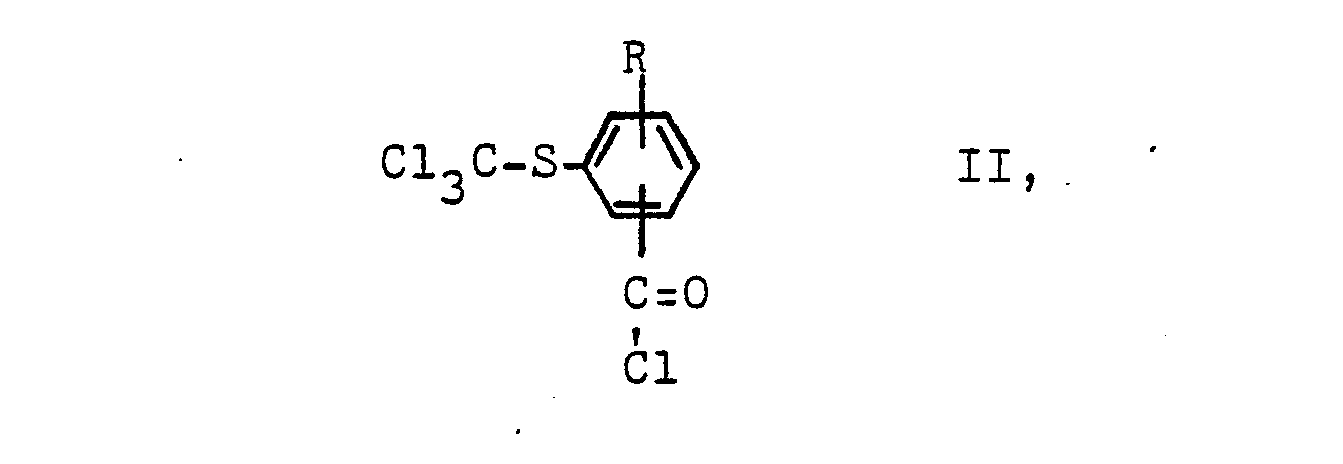
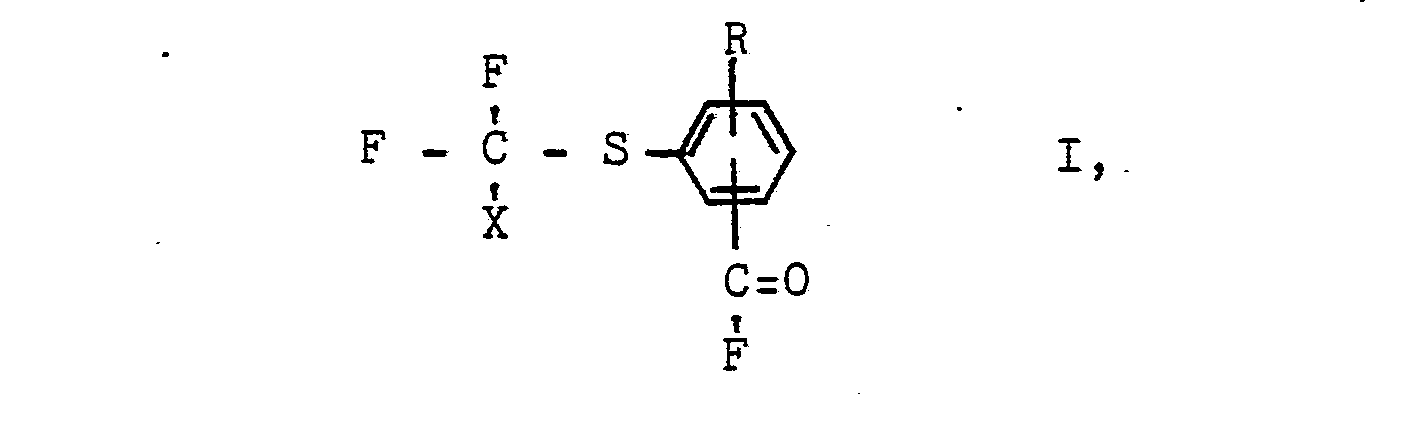
- the invention relates to new fluoromethylthiobenzoyl fluorides and a process for their preparation by reacting trichloromethylthiobenzoyl chlorides with hydrogen fluoride at 10 to 130 ° C.
- German Offenlegungsschrift 21 17 650 provides fluoromethoxybenzoyl fluorides and only mono- and difluoro compounds by reacting WB / P Corresponding trichloromethoxybenzoylchloride at 60 to 130 ° C under pressure. It is stated that only a reaction around 130 ° C. provides a certain proportion of the trifluoro compound.
- Example 5 shows that a mixture of mono- (11.8%), di- (79.6%) and trifluoro compounds (5.6%) is formed at 29-94 ° C.
- the reaction can be represented by the following formulas:
- the process according to the invention provides the new fluoromethylthiobenzoyl fluorides in a good yield and purity in a simple and economical manner. All of these beneficial properties are surprising.
- the temperatures and pressures according to the invention one would have expected mixtures of all three fluoromethyl compounds and at most a small proportion of trifluoro compounds, especially with regard to German published patent application 21 17 650.
- Preferred starting materials II and accordingly preferred end products I are those in the formulas X denotes a chlorine atom or fluorine atom and R denotes a hydrogen atom, a bromine atom, chlorine atom or an alkyl radical with 1 to 4 carbon atoms.
- the abovementioned radicals can also be substituted by radicals which are inert under the reaction conditions, e.g. Alkyl radicals or alkoxy radicals having 1 to 4 carbon atoms can be substituted.
- the starting compounds can be reacted with one another with stoichiometric amounts or advantageously in excess of hydrogen fluoride, advantageously in a ratio of 1.2 to 100 mol HF, preferably 1.5 to 20 mol HF per mol trichloromethylthiobenzoyl chloride.
- the reaction is carried out at a temperature of 10 to 130 ° C, for the production of the trifluoromethyl compound from 40 to 130 ° C, in particular from 40 to 80 ° C, for the production of the difluoromethyl compound between 10 and 40 ° C, in particular between 10 and 30 ° C, under pressure or without pressure, continuously or batchwise.
- the reaction pressure is 1 to 30 bar, 2 to 30 bar for the production of the trifluoromethyl compound, 1 to 10 bar for the production of the difluoromethyl compound.
- the HCl gas evolving during the reaction is released depending on the desired pressure.
- halogenated hydrocarbons in particular bromine and chlorinated hydrocarbons, for example tetrachlorethylene, 1,1,2,2- or 1,1., 1,2-tetrachloroethane, amyl chloride, Cyclohexyl chloride, 1,2-dichloropropane, methylene chloride, dichlorobutane, isopropyl bromide, n-propyl bromide, butyl bromide, chloroform, bromoform, ethyl iodide, propyl iodide, chloronaphthalene, dichloronaphthalene, carbon tetracbrane, 1,1,1- or 1,1,2-trichloroethane , Pentachloroethane, 1,2-dichloroethane, 1,1-dichloroethane, n-propyl chloride, 1,2-cis-dichloroethylene, n
- the solvent is expediently used in an amount of 80 to 10,000 percent by weight, preferably 100 to 600 percent by weight, based on starting material II.
- the reaction can be carried out without or with catalysts such as antimony, iron, cobalt, nickel, manganese, titanium, aluminum, boron and chromium compounds, e.g. the fluorides.
- catalysts such as antimony, iron, cobalt, nickel, manganese, titanium, aluminum, boron and chromium compounds, e.g. the fluorides.
- the reaction can be carried out as follows: hydrogen fluoride and the trichloromethylthiobenzoyl chloride, optionally in a mixture with solvents and / or catalysts, are stirred at the reaction temperature for 0.5 to 10 hours and the hydrochloric acid formed is removed at a pressure between 1 and 30 bar. The excess hydrofluoric acid is distilled off and can be circulated. The end product is purified in the usual way by distillation. It may also be appropriate to use the product Wash water with or without the addition of a water-immiscible solvent.
- fluoromethylthiobenzoyl fluorides obtainable by the process of the invention are valuable starting materials for the production of crop protection agents.
- benzoxazinones with a pronounced herbicidal action are obtained by reaction with anthranilic acids (DE-OS 29 14 915).
Landscapes
- Chemical & Material Sciences (AREA)
- Organic Chemistry (AREA)
- Organic Low-Molecular-Weight Compounds And Preparation Thereof (AREA)
Abstract
Description
- Die Erfindung betrifft neue Fluormethylthiobenzoylfluoride und ein Verfahren zu ihrer Herstellung durch Umsetzung von Trichlormethylthiobenzoylchloriden mit Fluorwasserstoff bei 10 bis 130°C.
- Darstellungen von Trifluormethylphenylsulfiden aus den entsprechenden Trichlor-Verbindungen mit Hilfe von Antimontrifluorid oder Fluorwasserstoff sind bekannt (C.A. 49,8172c); FR-PS 820 796).
- Die Darstellung von Trifluormethylthio-substituierten Benzoylchloriden wird bisher auf umständlichem Wege über das aus dem Trifluormethylthionicrobenzol durch Reduktion hergestellte Anilinderivat, das weiter zum entsprechenden Benzonitril und der Benzoesäure umgesetzt und anschließend mit Thionylchlorid chloriert wird, durchgeführt (C. A. loc. cit.).
- Weitere Methoden zu Trifluormethylthiobenzoesäurederivaten, die jedoch bis zur Stufe der Säurechloride noch weiteren Reaktionsschritten unterworfen werden müssen, beinhalten die Umsetzung von Jod- oder Brom-substituierten Nitrobenzolen oder Benzoesäureestern mit Quecksilber- oder Kupfertrifluormethylsulfid (US-PS 4 020 169; J. Org. Chem. 41, 1 644 (1976)).- Die für die Reaktionen notwendigen Quecksilberverbindungen sind teuer und giftig, sowie umständlich über das Trichlormethylthiosulfenylchlorid herzustellen. Das Kupfertrifluormethylsulfid wird aus der Quecksilberverbindung synthetisiert.
- Das in der deutschen Offenlegungsschrift 21 17 650 beschriebene Verfahren liefert Fluormethoxybenzoylfluoride und zwar nur Mono- und Difluorverbindungen durch Umsetzung WB/P entsprechender Trichlormethoxibenzoylchloride bei 60 bis 130°C unter Druck. Es wird angegeben, daß erst eine Umsetzung um etwa 130°C einen gewissen Anteil an der Trifluorverbindung liefert. Beispiel 5 zeigt, daß bei 29 - 94°C ein Gemisch von Mono- (11,8 %), Di- (79,6 %) und Trifluorverbindungen (5,6 %) entsteht.
- Es wurde nun gefunden, daß man Fluormethylthiobenzoylfluoride der Formel


- a) zur Herstellung der Trifluormethylthiobenzoylfluoride mit einer Temperatur von 40 bis 130°C und einem Druck von 2 bis 30 bar oder
- b) zur Herstellung der Difluormonochlormethylthiobenzoylfluoride zwischen 10 und 40°C und einem Druck von 1 bis 10 bar
- Weiterhin wurden die neuen Fluormethylthiobenzoylfluoride der Formel

- Die Umsetzung kann im Falle der Verwendung von m-Trichlormethylthiobenzoylchlorid durch die folgenden Formeln wiedergegeben werden:

- Bevorzugte Ausgangsstoffe II und dementsprechend bevorzugte Endstoffe I sind solche, in deren Formeln X ein Chloratom oder Fluoratom bedeutet und R ein Wasserstoffatom, ein Bromatom, Chloratom oder einen Alkylrest mit 1 bis 4 Ko%len- stoffatomen bezeichnet. Die vorgenannten Reste können noch durch unter den Reaktionsbedingungen inerte Reste, z.B. Alkylreste oder Alkoxireste mit 1 bis 4 Kohlenstoffatomen, substituiert sein.
- So kommen z.B. als Ausgangsstoffe II in Frage: m-Trichlormethylthiobenzoylchloride und entsprechend durch Brom, Chlor, Methyl-, Ethyl-, Propyl-, Isopropyl-, Butyl-, Isobutyl-, sek.-Butyl-, tert.-Butyl-gruppen in m-, o- oder p-Stellung am Phenylkern substituierte Benzoylchloride; entsprechende o- und p-Trichlormethylverbindungen.
- Die Ausgangsverbindungen können miteinander mit stöchiometrischen Mengen oder zweckmäßig im überschuß an Fluorwasserstoff, vorteilhaft im Verhältnis von 1,2 bis 100 Mol HF, vorzugsweise von 1,5 bis 20 Mol HF je Mol Trichlormethylthiobenzoylchlorid umgesetzt werden.
- Die Umsetzung wird bei einer Temperatur von 10 bis 130°C, für die Herstellung der Trifluormethyl-Verbindung von 40 bis 130°C, insbesondere von 40 bis 80°C, für die Herstellung der Difluormethyl-Verbindung zwischen 10 und 40°C, insbesondere zwischen 10 und 30°C, unter Druck oder drucklos, kontinuierlich oder diskontinuierlich durchgeführt.
- Der Reaktionsdruck beträgt 1 bis 30 bar, für die Herstellung der Trifluormethyl-Verbindung 2 bis 30 bar, für die Herstellung der Difluormethyl-Verbindung 1 bis 10 bar. Das bei der Reaktion sich entwickelnde HCl-Gas wird dabei je nach gewünschtem Druck abgelassen.
- "Die Reaktion kann ohne oder mit Lösungsmitteln erfolgen. Als Lösungsmittel kommen z.B. in Frage: Halogenkohlenwasserstoffe, insbesondere Brom- und Chlorkohlenwasserstoffe, z.B. Tetrachloräthylen, 1,1,2,2- oder 1,1.,1,2-Tetrachloräthan, Amylchlorid, Cyclohexylchlorid, 1,2-Dichlorpropan, Methylenchlorid, Dichlorbutan, Isopropylbromid, n-Propylbromid, Butylbromid, Chloroform, Bromoform, Äthyljodid, Propyljodid, Chlornaphthalin, Dichlornaphthalin, Tetracfbrkohlenstoff, 1,1,1- oder 1,1,2-Trichloräthan, Trichloräthylen, Pentachloräthan, 1,2-Dichloräthan, 1,1-Dichloräthan, n-Propylchlorid, 1,2-cis-Dichloräthylen, n-Butylchlorid, 2-, 3- und iso-Butylchlorid; aliphatische oder cycloaliphatische Kohlenwasserstoffe, z.B. Pentan, Heptan, a-Pinen, Pinan, Nonan, Benzinfraktionen innerhalb eines Siedepunktintervalls von 70 bis 190°C, Cyclohexan, Methylcyclohexan, Dekalin, Petrol- äther, Hexan, Ligroin, 2,2,4-Trimethylpentan, 2,2,3-Trimethylpentan, 2,3,3-Trimethylpentan, Octan; und entsprechende Gemische. Zweckmäßig verwendet man das Lösungsmittel in einer Menge von 80 bis 10 000 Gewichtsprozent, vorzugsweise von 100 bis 600 Gewichtsprozent, bezogen auf Ausgangsstoff II.
- Die Umsetzung kann ohne oder mit Katalysatoren wie Antimon-, Eisen-, Kobalt-, Nickel-, Mangan-, Titan-, Aluminium-, Borsowie Chrom-Verbindungen, z.B. die Fluoride, durchgeführt werden.
- Die Reaktion kann wie folgt durchgeführt werden: Fluorwasserstoff und das Trichlormethylthiobenzoylchlorid, gegebenenfalls im Gemisch mit Lösungsmitteln und/oder Katalysatoren werden bei der Reaktionstemperatur 0,5 bis 10 Stunden gerührt und die entstehende Salzsäure bei einem Druck zwischen 1 und 30 bar ausgekreist. Die überschüssige Flußsäure wird abdestilliert und kann im Kreis gefahren werden. Der Endstoff wird in üblicher Weise durch Destillation gereinigt. Es kann auch zweckmäßig sein, das Produkt mit Wasser mit oder ohne Zusatz eines mit Wasser nicht mischbaren Lösungsmittels zu waschen.
- Die nach dem Verfahren der Erfindung erhältlichen Fluormethylthiobenzoylfluoride sind wertvolle Ausgangsstoffe für die Herstellung von Pflanzenschutzmitteln. So erhält man beispielsweise durch Umsetzung mit Anthranilsäuren Benzoxazinone mit ausgeprägter herbizider Wirkung (DE-OS 29 14 915).
- Die in den folgenden Beispielen aufgeführten Teile bedeuten Gewichtsteile.
- In einem V4A-Autoklaven werden 1 540 Teile m-Trichlormethylthiobenzoylchlorid und 1 900 Teile Fluorwasserstoff 6 Stunden bei 70°C gerührt. Durch Abgasen der entstehenden Salzsäure wird der Druck bei 10 bar gehalten. Die Apparatur wird entspannt, die überschüssige Flußsäure abdestilliert und das flüssige Reaktionsprodukt destilliert. Ausbeute 891 Teile (75 % der Theorie) m-Trifluormethylthiobenzoylfluorid,

- In einem Teflonkolben mit Rückflußkühler werden 650 Teile p-Trichlormethylthiobenzoylchlorid und 500 Teile Fluorwasserstoff 7 Stunden unter Rückfluß (20°C) drucklos erhitzt. Die Aufarbeitung ergibt nach dem Abdestillieren der Flußsäure 441 Teile (83 % der Theorie) p-Chlordifluormethylthiobenzoylfluorid, Kp (16 mbar) 106 - 108°C;

- 13C-NMR (CDCl3) δ(ppm) (intern TMS):
- C1 127,22 (D) C4 135,11 (S) C7 156,61 (D)
- C2 132,25 (S) C5 136,04 (S) C8 130,05 (T)
- C3 136,04 (S) C6 132,25 (S)
- In einem Teflonkolben mit Rückflußkühler werden 2 600 Teile m-Trichlormethylthiobenzoylchlorid und 2 000 Teile Fluorwasserstoff 7 Stunden bei 1 bar unter Rückfluß gerührt (20°C). Nach dem Abdestillieren der Flußsäure erhält man 1 965 Teile (82 % der Theorie) m-Chlordifluormethylthiobenzoylfluorid, Kp (0,2 mbar) 47 - 50°C,

- In einem Autoklaven werden 270 Teile 3-Trichlormethyl- thio-4-chlorbenzoylchlorid und 500 Teile wasserfreie Flußsäure 8 Stunden bei 70°C mit 20 bar gerührt. Das Produktgemisch wird auf Eiswasser gegeben, mit Methylenchlorid extrahiert und mit Wasser gewaschen. Ausbeute: 130 Teile (62 % der Theorie) 3-Trifluormethylthio-4'-chlorbenzoyl- fluorid, Kp (0,1 mbar) 41°C.
- 13C-NMR (CDC13) (ppm) (intern TMS):
- C1 125,1 (D) C4 147,9 (S) C7 115,7 (D)
- C2 140,8 (S) C5 131,9 (S) C8 129,2 (Q)
- C3 126,5 (S) C6 134,7 (S)
- Analog Beispiel 1 wird die Umsetzung jedoch mit 1 540 Teilen p-Trichlormethylthiobenzoylchlorid und 1 900 Teilen Flußsäure, durchgeführt. Man erhält p-Trifluormethylthiobenzoylfluorid vom Kp (16 mbar) 85 - 89°C in einer Ausbeute von 70 % der Theorie;

umsetzt.
Claims (2)

umsetzt.
Applications Claiming Priority (2)
| Application Number | Priority Date | Filing Date | Title |
|---|---|---|---|
| DE3130436 | 1981-08-01 | ||
| DE19813130436 DE3130436A1 (de) | 1981-08-01 | 1981-08-01 | Neue fluormethylthiobenzoylfluoride und verfahren zu ihrer herstellung |
Publications (2)
| Publication Number | Publication Date |
|---|---|
| EP0071790A1 true EP0071790A1 (de) | 1983-02-16 |
| EP0071790B1 EP0071790B1 (de) | 1985-04-24 |
Family
ID=6138308
Family Applications (1)
| Application Number | Title | Priority Date | Filing Date |
|---|---|---|---|
| EP82106332A Expired EP0071790B1 (de) | 1981-08-01 | 1982-07-15 | Neue Fluormethylthiobenzoylfluoride und Verfahren zu ihrer Herstellung |
Country Status (4)
| Country | Link |
|---|---|
| US (1) | US4590016A (de) |
| EP (1) | EP0071790B1 (de) |
| JP (1) | JPS5826866A (de) |
| DE (2) | DE3130436A1 (de) |
Citations (2)
| Publication number | Priority date | Publication date | Assignee | Title |
|---|---|---|---|---|
| DE2117650A1 (de) * | 1971-04-10 | 1972-10-19 | Farbwerke Hoechst AG, vormals Meister Lucius & Brüning, 6000 Frankfurt | Difluorchlor- und Monofluordichlormethoxybenzoylfluoride |
| EP0039157A1 (de) * | 1980-04-10 | 1981-11-04 | Eli Lilly And Company | Chlorierung von 4-Methoxybenzoylchlorid |
Family Cites Families (4)
| Publication number | Priority date | Publication date | Assignee | Title |
|---|---|---|---|---|
| US2062743A (en) * | 1935-06-12 | 1936-12-01 | Kinetic Chemicals Inc | Production of fluorine-containing carbon compounds |
| US2181554A (en) * | 1936-04-18 | 1939-11-28 | Gen Aniline Works Inc | Benzenecarboxylic acid fluorides containing trifluoromethyl groups and process of preparing them |
| DE1768635A1 (de) * | 1968-06-10 | 1971-09-02 | Bayer Ag | Verfahren zur Herstellung von Nitrobenzalfluoriden |
| DE2040186A1 (de) * | 1970-08-13 | 1972-02-17 | Bayer Ag | Verfahren zur Herstellung von 2,2,4,4-Tetrafluor-1,3-benzodioxanen aus 2-Trichlormethoxy-benzoylchloriden |
-
1981
- 1981-08-01 DE DE19813130436 patent/DE3130436A1/de not_active Withdrawn
-
1982
- 1982-07-15 EP EP82106332A patent/EP0071790B1/de not_active Expired
- 1982-07-15 DE DE8282106332T patent/DE3263262D1/de not_active Expired
- 1982-07-30 JP JP57132280A patent/JPS5826866A/ja active Granted
-
1984
- 1984-03-14 US US06/589,305 patent/US4590016A/en not_active Expired - Lifetime
Patent Citations (2)
| Publication number | Priority date | Publication date | Assignee | Title |
|---|---|---|---|---|
| DE2117650A1 (de) * | 1971-04-10 | 1972-10-19 | Farbwerke Hoechst AG, vormals Meister Lucius & Brüning, 6000 Frankfurt | Difluorchlor- und Monofluordichlormethoxybenzoylfluoride |
| EP0039157A1 (de) * | 1980-04-10 | 1981-11-04 | Eli Lilly And Company | Chlorierung von 4-Methoxybenzoylchlorid |
Non-Patent Citations (2)
| Title |
|---|
| Chemical Abstracts, Band 49, Nr. 12, 25 Juni 1955, Columbus, Ohio, USA, L.M. YAGUPOL'SKII et al.: "Phenyl trifluoromethyl sulfides and phenyl trifluoromethyl sulfones with substituents in the p-position" Spalte 8172d & Zhur. Obshchei Khim. Band 24, 1954, Seiten 887 bis 894 * |
| HOUBEN WEYL, "Methoden der organischen Chemie" 4. Auflage, Band V/3 "Halogenverbindungen" 1962, GEORG THIEME VERLAG, Stuttgart, Seiten 119 bis 123 * |
Also Published As
| Publication number | Publication date |
|---|---|
| JPS5826866A (ja) | 1983-02-17 |
| JPH0328422B2 (de) | 1991-04-19 |
| DE3130436A1 (de) | 1983-02-17 |
| US4590016A (en) | 1986-05-20 |
| EP0071790B1 (de) | 1985-04-24 |
| DE3263262D1 (en) | 1985-05-30 |
Similar Documents
| Publication | Publication Date | Title |
|---|---|---|
| DE2900231A1 (de) | Verfahren zur herstellung von n,n- diaethyl-m-toluamid aus m-toluylsaeure durch katalytische reaktion mit diaethylamin in fluessiger phase | |
| EP0132733B1 (de) | Neue Fluorpivalsäurefluoride und Verfahren zu ihrer Herstellung | |
| DE2708190C2 (de) | Verfahren zur Herstellung von m-Brom-benzotrifluoriden | |
| EP0071790B1 (de) | Neue Fluormethylthiobenzoylfluoride und Verfahren zu ihrer Herstellung | |
| EP0004641A2 (de) | Verfahren zur Herstellung von Carbonsäureanhydriden | |
| EP0057844A1 (de) | Verfahren zur Herstellung von Polychlorbenzoylchloriden | |
| EP0029908A1 (de) | 6H-1,2,4,6-Thiatriazin-1,1-dioxide, Herbizide, die diese Verbindungen enthalten, ihre Anwendung als Herbizide und Verfahren zu ihrer Herstellung | |
| DE1805156A1 (de) | Verfahren zur Herstellung von 2-Acyloxythionobenzamiden | |
| EP1598331B1 (de) | Verfahren zur Herstellung von Phthalsäuredichlorid | |
| DE2548970A1 (de) | Trichlormethyl-trifluormethyl-benzole | |
| EP0048370B1 (de) | Verfahren zur Herstellung von trans-3-(Z-2-Chlor-2-aryl-vinyl)-2,2-dimethyl-cyclopropan-1-carbon-säure-derivaten, neue Zwischenprodukte hierfür, Verfahren zu deren Herstellung und Verwendung von Zwischenprodukten in Schädlingsbekämpfungsmitteln | |
| DE69214450T2 (de) | Verfahren zur herstellung von 5-(3-butyryl-2,4,6-trimethyl)-2-(1-(ethoxyimino)propyl)-3-hydroxycyclohex-2-en-1-on | |
| EP0546418A1 (de) | Verfahren zur Herstellung von 5-substituierten 2-Chlorpyridinen | |
| EP0365914B1 (de) | Neue Fluor enthaltende und an der CH3-Gruppe gegebenenfalls halogenierte Acetophenone und deren Herstellung aus neuen Fluor enthaltenden Benzonitrilen | |
| CH631991A5 (de) | Verfahren zur herstellung von triorganozinnhalogeniden. | |
| EP0089485A2 (de) | Verfahren zur Herstellung von 5-Chlor-1H-tetrazol-1-carbonsäureestern sowie Verfahren zur Herstellung der erforderlichen Dichlorisonitril-carbonsäureester | |
| EP0025552B1 (de) | Verfahren zur Herstellung von 1-Halogenalkylisocyanaten und 1-Alkenylisocyanaten | |
| EP0500639A1 (de) | Verfahren zur herstellung von alkyl-[3-chlorphenyl]-sulfonen. | |
| EP0485856B1 (de) | Verfahren zur Herstellung von 1,1-Difluoralkansulfenylchloriden | |
| EP0173153B1 (de) | Neue benzokondensierte, fluorierte, heterocyclische Verbindungen, ein Verfahren zu ihrer Herstellung und ihre Verwendung | |
| EP0071791B1 (de) | Neue Trichlormethylthiobenzoylhalogenide und Verfahren zur Herstellung von m- oder p-Trichlormethylthiobenzoylhalogeniden | |
| DE2937291C2 (de) | Verfahren zur Herstellung von 3-Methylthio-butanon(2) | |
| DE2451634A1 (de) | Trichloraethyliden-bis(isocyaniddichlorid) | |
| DE2049814B2 (de) | O,o-dialkyl-s-phenyl-dithiophosphorsaeureester, verfahren zu ihrer herstellung sowie ihre verwendung | |
| DE3122176A1 (de) | "substituierte 1-jod-1-butin-4-ole, verfahren zu ihrer herstellung und ihre verwendung als pflanzenschutzmittel" |
Legal Events
| Date | Code | Title | Description |
|---|---|---|---|
| PUAI | Public reference made under article 153(3) epc to a published international application that has entered the european phase |
Free format text: ORIGINAL CODE: 0009012 |
|
| AK | Designated contracting states |
Designated state(s): BE CH DE FR GB LI |
|
| 17P | Request for examination filed |
Effective date: 19821210 |
|
| GRAA | (expected) grant |
Free format text: ORIGINAL CODE: 0009210 |
|
| AK | Designated contracting states |
Designated state(s): BE CH DE FR GB LI |
|
| REF | Corresponds to: |
Ref document number: 3263262 Country of ref document: DE Date of ref document: 19850530 |
|
| ET | Fr: translation filed | ||
| PLBE | No opposition filed within time limit |
Free format text: ORIGINAL CODE: 0009261 |
|
| STAA | Information on the status of an ep patent application or granted ep patent |
Free format text: STATUS: NO OPPOSITION FILED WITHIN TIME LIMIT |
|
| 26N | No opposition filed | ||
| PGFP | Annual fee paid to national office [announced via postgrant information from national office to epo] |
Ref country code: FR Payment date: 19920619 Year of fee payment: 11 |
|
| PGFP | Annual fee paid to national office [announced via postgrant information from national office to epo] |
Ref country code: GB Payment date: 19920701 Year of fee payment: 11 |
|
| PGFP | Annual fee paid to national office [announced via postgrant information from national office to epo] |
Ref country code: BE Payment date: 19920807 Year of fee payment: 11 |
|
| PG25 | Lapsed in a contracting state [announced via postgrant information from national office to epo] |
Ref country code: GB Effective date: 19930715 |
|
| PG25 | Lapsed in a contracting state [announced via postgrant information from national office to epo] |
Ref country code: BE Effective date: 19930731 |
|
| BERE | Be: lapsed |
Owner name: BASF A.G. Effective date: 19930731 |
|
| GBPC | Gb: european patent ceased through non-payment of renewal fee |
Effective date: 19930715 |
|
| PG25 | Lapsed in a contracting state [announced via postgrant information from national office to epo] |
Ref country code: FR Effective date: 19940331 |
|
| REG | Reference to a national code |
Ref country code: FR Ref legal event code: ST |
|
| PGFP | Annual fee paid to national office [announced via postgrant information from national office to epo] |
Ref country code: CH Payment date: 20010628 Year of fee payment: 20 |
|
| PGFP | Annual fee paid to national office [announced via postgrant information from national office to epo] |
Ref country code: DE Payment date: 20010714 Year of fee payment: 20 |
|
| PG25 | Lapsed in a contracting state [announced via postgrant information from national office to epo] |
Ref country code: LI Free format text: LAPSE BECAUSE OF EXPIRATION OF PROTECTION Effective date: 20020714 Ref country code: CH Free format text: LAPSE BECAUSE OF EXPIRATION OF PROTECTION Effective date: 20020714 |
|
| REG | Reference to a national code |
Ref country code: CH Ref legal event code: PL |