EP0071959A2 - Dispositif pour embarquer ou débarquer des usagers de chaises roulantes de véhicule de transport public - Google Patents
Dispositif pour embarquer ou débarquer des usagers de chaises roulantes de véhicule de transport public Download PDFInfo
- Publication number
- EP0071959A2 EP0071959A2 EP82107001A EP82107001A EP0071959A2 EP 0071959 A2 EP0071959 A2 EP 0071959A2 EP 82107001 A EP82107001 A EP 82107001A EP 82107001 A EP82107001 A EP 82107001A EP 0071959 A2 EP0071959 A2 EP 0071959A2
- Authority
- EP
- European Patent Office
- Prior art keywords
- transport
- wheelchair
- arrangement according
- rail
- wheelchairs
- Prior art date
- Legal status (The legal status is an assumption and is not a legal conclusion. Google has not performed a legal analysis and makes no representation as to the accuracy of the status listed.)
- Withdrawn
Links
- 235000004443 Ricinus communis Nutrition 0.000 claims description 7
- 240000000528 Ricinus communis Species 0.000 claims description 6
- 238000005096 rolling process Methods 0.000 claims description 4
- 230000033001 locomotion Effects 0.000 claims description 3
- 238000004873 anchoring Methods 0.000 description 3
- 230000005484 gravity Effects 0.000 description 2
- 238000000034 method Methods 0.000 description 2
- 230000000087 stabilizing effect Effects 0.000 description 2
- 230000001133 acceleration Effects 0.000 description 1
- 230000004308 accommodation Effects 0.000 description 1
- 230000000295 complement effect Effects 0.000 description 1
- 238000003780 insertion Methods 0.000 description 1
- 230000037431 insertion Effects 0.000 description 1
- 230000000630 rising effect Effects 0.000 description 1
- 239000000725 suspension Substances 0.000 description 1
- 230000029305 taxis Effects 0.000 description 1
Images

Classifications
-
- A—HUMAN NECESSITIES
- A61—MEDICAL OR VETERINARY SCIENCE; HYGIENE
- A61G—TRANSPORT, PERSONAL CONVEYANCES, OR ACCOMMODATION SPECIALLY ADAPTED FOR PATIENTS OR DISABLED PERSONS; OPERATING TABLES OR CHAIRS; CHAIRS FOR DENTISTRY; FUNERAL DEVICES
- A61G3/00—Ambulance aspects of vehicles; Vehicles with special provisions for transporting patients or disabled persons, or their personal conveyances, e.g. for facilitating access of, or for loading, wheelchairs
- A61G3/02—Loading or unloading personal conveyances; Facilitating access of patients or disabled persons to, or exit from, vehicles
- A61G3/06—Transfer using ramps, lifts or the like
-
- B—PERFORMING OPERATIONS; TRANSPORTING
- B62—LAND VEHICLES FOR TRAVELLING OTHERWISE THAN ON RAILS
- B62D—MOTOR VEHICLES; TRAILERS
- B62D47/00—Motor vehicles or trailers predominantly for carrying passengers
- B62D47/02—Motor vehicles or trailers predominantly for carrying passengers for large numbers of passengers, e.g. omnibus
-
- A—HUMAN NECESSITIES
- A61—MEDICAL OR VETERINARY SCIENCE; HYGIENE
- A61G—TRANSPORT, PERSONAL CONVEYANCES, OR ACCOMMODATION SPECIALLY ADAPTED FOR PATIENTS OR DISABLED PERSONS; OPERATING TABLES OR CHAIRS; CHAIRS FOR DENTISTRY; FUNERAL DEVICES
- A61G2200/00—Information related to the kind of patient or his position
- A61G2200/30—Specific positions of the patient
- A61G2200/34—Specific positions of the patient sitting
-
- A—HUMAN NECESSITIES
- A61—MEDICAL OR VETERINARY SCIENCE; HYGIENE
- A61G—TRANSPORT, PERSONAL CONVEYANCES, OR ACCOMMODATION SPECIALLY ADAPTED FOR PATIENTS OR DISABLED PERSONS; OPERATING TABLES OR CHAIRS; CHAIRS FOR DENTISTRY; FUNERAL DEVICES
- A61G2220/00—Adaptations of particular transporting means
- A61G2220/16—Buses
-
- A—HUMAN NECESSITIES
- A61—MEDICAL OR VETERINARY SCIENCE; HYGIENE
- A61G—TRANSPORT, PERSONAL CONVEYANCES, OR ACCOMMODATION SPECIALLY ADAPTED FOR PATIENTS OR DISABLED PERSONS; OPERATING TABLES OR CHAIRS; CHAIRS FOR DENTISTRY; FUNERAL DEVICES
- A61G7/00—Beds specially adapted for nursing; Devices for lifting patients or disabled persons
- A61G7/10—Devices for lifting patients or disabled persons, e.g. special adaptations of hoists thereto
- A61G7/1013—Lifting of patients by
- A61G7/1017—Pivoting arms, e.g. crane type mechanisms
-
- A—HUMAN NECESSITIES
- A61—MEDICAL OR VETERINARY SCIENCE; HYGIENE
- A61G—TRANSPORT, PERSONAL CONVEYANCES, OR ACCOMMODATION SPECIALLY ADAPTED FOR PATIENTS OR DISABLED PERSONS; OPERATING TABLES OR CHAIRS; CHAIRS FOR DENTISTRY; FUNERAL DEVICES
- A61G7/00—Beds specially adapted for nursing; Devices for lifting patients or disabled persons
- A61G7/10—Devices for lifting patients or disabled persons, e.g. special adaptations of hoists thereto
- A61G7/104—Devices carried or supported by
- A61G7/1042—Rail systems
Definitions
- the invention relates to an arrangement on a means of passenger transport, in particular a bus, for accommodating wheelchair passengers.
- the invention is therefore based on the object of providing an arrangement which facilitates the entry and exit of wheelchair passengers and their securing in the means of transport.
- the solution according to the invention consists in that a travel rail is arranged above the receiving opening of the means of transport and the wheelchairs or wheelchair holders have a slide hanger which can be connected to the rail.
- “Wheelchairs” are not only to be understood as standard wheelchairs for the disabled, but also mobile seats specially designed for transport in the means of passenger transport, which are also referred to below as “wheelchairs”.
- the arrangement according to the invention makes the inclusion of wheelchair passengers in the means of transport independent of how the entry openings of the means of transport are designed in their lower region, namely in particular independently of steps. It is therefore entirely possible to provide one and the same entry opening in its lower area with steps for the entry of unhindered persons and in its upper area with the travel rail according to the invention for introducing wheelchair passengers without these devices preventing each other. On the contrary, they can complement each other because the person pushing the wheelchair passengers into the receiving opening should find any entry aids for themselves during the insertion in the lower area of the opening.
- the travel rail also requires little accommodation space if it has been moved from the position of use into an inoperative transport position within the means of transport, for example has been pivoted in or pushed in.
- the arrangement according to the invention also has the advantage that the slide hanger provided on the wheelchairs or wheelchair holders can also be used to secure the wheelchairs insofar as not only is it possible to directly secure the wheelchairs on the vehicle floor, but also on the vehicle ceiling via the slide hanger .
- roller seat specially provided for this arrangement can also be provided with the necessary transport security.
- a designated holder for standard wheelchairs can be easily carried out so that it can be securely anchored to the vehicle on the one hand and on the other hand improves the stability of the wheelchair in such a way that the forces required for personal security can be absorbed.
- this term should not only refer to the boarding process, but also the boarding process and the reloading.
- Roll seats are generally to be understood as the roll seats according to the invention with slide hangers, which also have means for securing a person for transportation and the inherent strength required for this purpose and, moreover, have at least two wheels for at least limited hall mobility, for example in hotel halls. They can either be connected to a slide hanger or constructed so that they can be easily connected to a wheel hanger bracket with a slide hanger.
- wheelchairs are those that are currently on the market and generally have no special facilities for transportation. They are relatively lightweight and are generally collapsible.
- Under wheelchair brackets are to be understood facilities that are equipped with a slide hanger according to the invention and have facilities that serve for secure connection to a standard wheelchair or a wheelchair and on the one hand lifting the wheelchair or seat by means of the arrangement according to the invention and on the other hand stabilizing the wheelchair allow or seat during transport.
- the rail is expediently arranged on the means of transport in such a way that, on the one hand, it can assume an inoperative transport position, in which it is, for example, folded or pushed into the vehicle, and, on the other hand, can be transferred to a position of use extending in the direction of the receiving movement and can be fastened therein.
- the running rail is permanently provided in the departure or arrival station.
- the rail can extend forwards or backwards from a lateral receiving opening of the means of transport in the longitudinal direction thereof and can be movable from a position in contact with the means of transport into a working position at a distance from the side wall. Even if the rail outside the means of transport is relatively long so as not to have to climb too steeply to the reception opening, only little space is required directly next to the means of transport for the rail in the working position and for picking up wheelchair passengers.
- the running rail is expediently essentially rigid in the position of use, its two ends being essentially the same height above the ground or the corridor of the means of transport corresponding to the height of the sliding trailer exhibit.
- the height of the outer rail end is then selected so that the gliders (for example rollers) of the wheelchairs (or wheelchairs) which have come up to the rail on the floor can be brought over the rail, after which the wheelchair is pushed towards the rising part of the rail and thereby being lifted off the floor.
- the inner end of the rail is in turn so high above the vehicle floor that the bottom wheels of the wheelchair sit on the vehicle floor, whereby the slider is free of the rail.
- the wheelchair is only moved by hand. Instead of this, mechanical lifting means can of course also be provided.
- the running rail can be combined with a cable winch. It is also possible that the outer end of the rail can be raised and lowered, so that the wheelchair attached to the outside is first raised so that it can subsequently be moved approximately horizontally until it has reached the corridor of the means of transport.
- the slide hanger is preferably provided with a driving lock that can be released by means of a handle that can be actuated when pushing forward or pulling backward. As soon as the person pushing the wheelchair no longer pushes and the handle becomes free, the driving lock intervenes and prevents the wheelchair from sliding down the rail unintentionally.
- At least one further rail in the means of transport leading from the receiving opening to the parking spaces of the wheelchairs.
- These is expediently provided as a continuation of the receiving guide rail and can even be made in one piece with it.
- Several other rails can be connected to a receiving rail or can be connected. This further travel rail enables the wheelchairs to be driven directly from the receptacle to the parking spaces provided for them, the hanging arrangement always ensuring maximum stability and safety.
- the further travel rail can be designed for a permanent connection to the slide hangers, wherein locking devices are expediently provided for the slide hangers or the wheelchairs. It is obvious that the permanent connection of the slide hangers with the travel rail, regardless of whether the locking device directly affects the slide hangers on the travel rail, improves the anchoring security of the wheelchairs in the means of transport. It is advantageous if locking devices are provided both in the lower region of the wheelchair or wheelchair holder and in the region of the travel rail.
- the wheelchairs detachable from the further travel rail.
- the wheelchair is then brought into the vicinity of the intended parking space by means of the travel rail, pushed towards it and anchored there by means of locking devices provided separately from the further travel rail.
- wheelchair brackets can also be provided with anchoring devices at the top and / or at the bottom. It expediently has a device for lifting at least the non-steerable wheelchair wheels and steering wheels in the vicinity thereof, so that the connected unit of wheelchair and wheelchair holder can be maneuvered in any direction regardless of the non-steerable wheelchair wheels.
- the wheeled seat often does not need to be able to be moved outside the vehicle and independently of it. In such cases, roles that make it independently mobile are sometimes unnecessary. It is then a special type of vehicle seat that is attached to the running rail from the vehicle to begin driving guests can be moved out in order to then be transferred with the passenger into the intended position within the vehicle. In this case, the running rail need not necessarily be arranged above the receiving opening.
- the height of the slide hanger is preferably adjustable so that a wheelchair or wheelchair carrier can also be connected to the travel rail if its height above the ground outside the means of transport should deviate from the standard dimension for any reason, for example due to unevenness in the ground.
- this feature allows the slide hanger to be adapted to different wheelchair heights.
- the wheelchair or wheelchair carrier is expediently rotatable about a vertical axis with respect to the travel rail, so that the wheelchair can be pushed in both directions.
- each arm is pivotally connected to the slider via a special hanger about a horizontal axis approximately parallel to the arm.
- the bus 1 has an entry opening (receiving opening) 2 with steps 3.
- a track 4 is rigidly attached to the bus by means not shown such that its outer end 5 has a height above the floor 6 which is slightly lower or is at least as high as the height of the slider 7 of the rolling seat 8 to be inserted or the wheelchair holder 9 of a commercially available wheelchair 10. Its inner end 11 has such a height above the hallway 12 of the bus 1 that the wheelchair can be retracted without difficulty and in the hallway 12 can be discontinued.
- the rail 4 is inserted or folded into the bus or folded up on its outside so that it does not interfere with the inside or outside.
- an articulated bus 1 which consists of a front carriage 13 and a trailer 14, is provided with a rear receiving opening 15.
- This receiving opening can be arranged relatively low because the engine is provided in the front end 13.
- the receiving travel rail 4 is held by a gallows 16 which can be inserted into the bus with the receiving rail.
- the sliders 7 on the sliding hangers 18 of the rolling seats 8 remain connected to this further travel rail in the vehicle, as a result of which the stabilizing effect of this connection is used.
- Further anchoring means on the vehicle floor and / or on the running rail or on the vehicle ceiling may be provided.
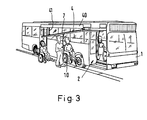
- FIG. 3 A particularly advantageous embodiment is shown in FIG. 3.
- the rail 4 is suspended here from a support device 40 which can be moved out laterally from the bus 1 and extends from the receiving opening 2 to the rear. Even when the rail is pulled out, it takes up little space.
- the wheelchairs of the passengers can be attached to the rail on the side of the bus and moved to the opening. Since the rail can be relatively long, its slope does not have to be particularly large, which makes it easier for the passengers to insert the wheelchairs.
- the rear part of the rail 4 can be suspended with a chain 41 or the like in such a way that the rail can be moved from the inclined to a horizontal position by means of an appropriate drive after use, so that it does not have a view from the windows during the journey with special needs.
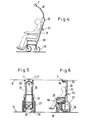
- a roller seat of the type designated in Fig. 1 and 2 with the reference numeral 8 is shown in Fig. 4 on a larger scale. It has two pairs of swivel castors 19 which enable convenient maneuvering and are equipped with the stability required for mounting in the means of transport.
- the frame of the rolling seat is equipped with the stability required to secure the passenger in the means of transport.
- a handle 23 is provided behind the roller seat back, which is used to actuate a driving lock (not shown) provided on the sliding roller 7. If the roller seat on the handle 23 is pushed or pulled, the driving lock is released; otherwise it will snap into place.
- 5 and 6 consists of two stands 24 which together form the slide hanger 18 with the castor 7 at the top. They have projecting forward, not shown in the drawing gripper 25, which can be connected rigidly and rigidly to the commercially available wheelchair 10, in such a way that it can be raised by means of the holder and also against the lifting forces as well compared to the acceleration forces occurring during transportation is stabilized.
- These grippers 25 do not need to engage near the seat, as shown in the drawing, but also, for example, on the lower longitudinal tubes of the wheelchair. They run out at the bottom in feet 26, which extend somewhat lower than the non-steerable wheels 27 of the wheelchair, so that the wheelchair, when connected to the holder, stands firmly and immovably on the floor by means of these feet.
- castors 28 are provided, which can be lowered by a suitable lowering device in such a way that the feet are lifted off the floor, so that the entire arrangement rests only on these castors 28 and the front castors 29 of the wheelchair and is freely maneuvered can. If a lateral maneuverability of the arrangement is not required, it can also be provided that the castors 28 are omitted, while the feet 26 can be raised and lowered, so that the arrangement rests optionally on the non-steerable wheels 27 and on the feet 26.
- the stand 24 run out in struts 30 which can be locked in cooperation with the roof 31 of the means of transport.
- the invention can be used not only for mass transportation, but also for individual vehicles such as cars.
Landscapes
- Health & Medical Sciences (AREA)
- Engineering & Computer Science (AREA)
- Public Health (AREA)
- Transportation (AREA)
- Mechanical Engineering (AREA)
- Chemical & Material Sciences (AREA)
- Combustion & Propulsion (AREA)
- Life Sciences & Earth Sciences (AREA)
- Animal Behavior & Ethology (AREA)
- General Health & Medical Sciences (AREA)
- Veterinary Medicine (AREA)
- Seats For Vehicles (AREA)
- Fittings On The Vehicle Exterior For Carrying Loads, And Devices For Holding Or Mounting Articles (AREA)
Applications Claiming Priority (2)
| Application Number | Priority Date | Filing Date | Title |
|---|---|---|---|
| DE3131935 | 1981-08-12 | ||
| DE19813131935 DE3131935C2 (de) | 1981-08-12 | 1981-08-12 | Anordnung an einem Personenverkehrsmittel, insbesondere Omnibus, zum Aufnehmen (bzw. Abgeben) von Rollstuhlfahrgästen |
Publications (2)
| Publication Number | Publication Date |
|---|---|
| EP0071959A2 true EP0071959A2 (fr) | 1983-02-16 |
| EP0071959A3 EP0071959A3 (fr) | 1983-11-23 |
Family
ID=6139196
Family Applications (1)
| Application Number | Title | Priority Date | Filing Date |
|---|---|---|---|
| EP82107001A Withdrawn EP0071959A3 (fr) | 1981-08-12 | 1982-08-03 | Dispositif pour embarquer ou débarquer des usagers de chaises roulantes de véhicule de transport public |
Country Status (3)
| Country | Link |
|---|---|
| EP (1) | EP0071959A3 (fr) |
| DE (1) | DE3131935C2 (fr) |
| DK (1) | DK360282A (fr) |
Cited By (8)
| Publication number | Priority date | Publication date | Assignee | Title |
|---|---|---|---|---|
| EP0223930A3 (en) * | 1985-11-19 | 1988-01-13 | Hespe & Woelm Gmbh & Co. Kg | Transporting apparatus for persons |
| GB2210856A (en) * | 1987-10-12 | 1989-06-21 | Remploy Ltd | Wheelchair hoist |
| US5209435A (en) * | 1989-10-24 | 1993-05-11 | Futrex, Inc. | Passsenger car with emergency exit |
| FR2744523A1 (fr) * | 1996-02-06 | 1997-08-08 | Rheinmetall Ind Ag | Vehicule de combat avec un habitacle pour tireurs ou equipage |
| US7559450B2 (en) | 2005-02-18 | 2009-07-14 | Ethicon Endo-Surgery, Inc. | Surgical instrument incorporating a fluid transfer controlled articulation mechanism |
| US20120219395A1 (en) * | 2009-08-18 | 2012-08-30 | Toyota Shatai Kabushiki Kaisha | Seatbelt device for wheelchair |
| EP2446870A3 (fr) * | 2010-10-29 | 2013-03-13 | Deanna Chantal Guigard | Véhicule médical |
| FR3151480A1 (fr) * | 2023-07-28 | 2025-01-31 | Fallone KAMBO | Véhicule de transport routier médicalisé |
Families Citing this family (1)
| Publication number | Priority date | Publication date | Assignee | Title |
|---|---|---|---|---|
| DE3236656A1 (de) * | 1982-10-04 | 1984-04-05 | FFG Fahrzeugwerkstätten Falkenried GmbH, 2000 Hamburg | Anordnung an einem personenverkehrsmittel, insbesondere omnibus, zum aufnehmen bzw. abgeben von rollstuhlfahrgaesten |
Family Cites Families (11)
| Publication number | Priority date | Publication date | Assignee | Title |
|---|---|---|---|---|
| US3656637A (en) * | 1970-06-30 | 1972-04-18 | Ray E Lynn | Invalid car lift |
| GB1383457A (en) * | 1973-08-10 | 1974-02-12 | Burvill E T | Invalid hoist |
| US3910432A (en) * | 1973-09-10 | 1975-10-07 | Browne Engineering Corp | Apparatus for lifting and loading a load into and out of a vehicle or the like |
| GB1427838A (en) * | 1973-11-14 | 1976-03-10 | Parry T | Invalid car hoist |
| US3957164A (en) * | 1974-10-16 | 1976-05-18 | Brown Joseph H | Wheelchair hoist and carrier |
| GB1572205A (en) * | 1976-11-22 | 1980-07-23 | Southward Eng Co Ltd | Transportation of disabled or invalided persons |
| US4071152A (en) * | 1976-12-13 | 1978-01-31 | County Of Santa Clara, State Of California | Wheelchair lift for public transportation vehicle |
| US4180366A (en) * | 1977-12-07 | 1979-12-25 | Vapor Corporation | Lift assembly for transit vehicles |
| DE2811868A1 (de) * | 1978-03-17 | 1979-09-27 | Gustav Bruns Maschinenbau Und | Vorrichtung fuer das ein- und ausbringen eines versehrten-rollstuhles bei einem oeffentlichen verkehrsmittel |
| DE2852228C2 (de) * | 1978-12-02 | 1982-05-13 | Walter Vetter Gmbh & Co, 7012 Fellbach | Kraftfahrzeug mit Hubeinrichtung |
| US4281744A (en) * | 1979-03-08 | 1981-08-04 | Koerber Charles F | Rotary wheelchair lift apparatus |
-
1981
- 1981-08-12 DE DE19813131935 patent/DE3131935C2/de not_active Expired
-
1982
- 1982-08-03 EP EP82107001A patent/EP0071959A3/fr not_active Withdrawn
- 1982-08-11 DK DK360282A patent/DK360282A/da not_active Application Discontinuation
Cited By (10)
| Publication number | Priority date | Publication date | Assignee | Title |
|---|---|---|---|---|
| EP0223930A3 (en) * | 1985-11-19 | 1988-01-13 | Hespe & Woelm Gmbh & Co. Kg | Transporting apparatus for persons |
| GB2210856A (en) * | 1987-10-12 | 1989-06-21 | Remploy Ltd | Wheelchair hoist |
| GB2210856B (en) * | 1987-10-12 | 1991-12-11 | Remploy Ltd | Motor vehicle adapted for disabled person |
| US5209435A (en) * | 1989-10-24 | 1993-05-11 | Futrex, Inc. | Passsenger car with emergency exit |
| FR2744523A1 (fr) * | 1996-02-06 | 1997-08-08 | Rheinmetall Ind Ag | Vehicule de combat avec un habitacle pour tireurs ou equipage |
| US7559450B2 (en) | 2005-02-18 | 2009-07-14 | Ethicon Endo-Surgery, Inc. | Surgical instrument incorporating a fluid transfer controlled articulation mechanism |
| US20120219395A1 (en) * | 2009-08-18 | 2012-08-30 | Toyota Shatai Kabushiki Kaisha | Seatbelt device for wheelchair |
| US8672356B2 (en) * | 2009-08-18 | 2014-03-18 | Toyota Shatai Kabushiki Kaisha | Seatbelt device for wheelchair |
| EP2446870A3 (fr) * | 2010-10-29 | 2013-03-13 | Deanna Chantal Guigard | Véhicule médical |
| FR3151480A1 (fr) * | 2023-07-28 | 2025-01-31 | Fallone KAMBO | Véhicule de transport routier médicalisé |
Also Published As
| Publication number | Publication date |
|---|---|
| DE3131935C2 (de) | 1983-12-08 |
| DK360282A (da) | 1983-02-13 |
| EP0071959A3 (fr) | 1983-11-23 |
| DE3131935A1 (de) | 1983-03-10 |
Similar Documents
| Publication | Publication Date | Title |
|---|---|---|
| EP0146029B1 (fr) | Véhicule franchissant des escaliers | |
| DE2657605C2 (fr) | ||
| EP0138116B1 (fr) | Fauteuil roulant pliable | |
| DE3131935C2 (de) | Anordnung an einem Personenverkehrsmittel, insbesondere Omnibus, zum Aufnehmen (bzw. Abgeben) von Rollstuhlfahrgästen | |
| DE202017107778U1 (de) | Leitungsfahrwagen | |
| DE29803435U1 (de) | Doppelstöckige Einstellanlage für Fahrräder | |
| DE2325425C3 (de) | Transportmittel für Körperbehinderte | |
| DE1194715B (de) | Vorrichtung zum Auf- und Abladen grosser, wagenkastenartiger Behaelter auf Fahrzeuge | |
| DE10253847A1 (de) | Aufnahmeeinrichtung für ein Fahrzeug | |
| DE102018204723A1 (de) | Personenkraftwagen mit Aufnahmevorrichtung für Warenbehälter eines Einkaufswagens | |
| DE3123145A1 (de) | "personen-befoerderungsfahrzeug" | |
| DE202010008734U1 (de) | Raupenwagen | |
| DE3117767A1 (de) | Mit entsprechenden wagen schachtelbarer schubgepaeckwagen | |
| DE3874118T2 (de) | Bewegliches schnelles rettungssystem fuer kabelbahnen. | |
| DE20219336U1 (de) | Fahrzeug | |
| EP0343264A1 (fr) | Ascenseur incliné | |
| EP0056490A2 (fr) | Charrette à bras | |
| EP0158735A1 (fr) | Appareil de levage et de garage pour avions | |
| DE2709994C2 (fr) | ||
| DE3541001C1 (de) | Vorrichtung zum Transport von Personen | |
| DE2364515C2 (de) | Gepäcktransportwagen | |
| DE3213741A1 (de) | Vorrichtung zum halten zumindest eines stuetzstocks an einem wagen | |
| DE123505C (fr) | ||
| DE8510089U1 (de) | Vorrichtung zum Abstellen eines Fahrzeugs | |
| DE7815687U1 (de) | Personenkraftfahrzeug mit mindestens einem einzelsitz fuer behinderte zum erleichterten ein- und aussteigen |
Legal Events
| Date | Code | Title | Description |
|---|---|---|---|
| PUAI | Public reference made under article 153(3) epc to a published international application that has entered the european phase |
Free format text: ORIGINAL CODE: 0009012 |
|
| AK | Designated contracting states |
Designated state(s): AT BE CH DE FR GB IT LI LU NL SE |
|
| PUAL | Search report despatched |
Free format text: ORIGINAL CODE: 0009013 |
|
| AK | Designated contracting states |
Designated state(s): AT BE CH DE FR GB IT LI LU NL SE |
|
| 17P | Request for examination filed |
Effective date: 19840509 |
|
| STAA | Information on the status of an ep patent application or granted ep patent |
Free format text: STATUS: THE APPLICATION IS DEEMED TO BE WITHDRAWN |
|
| 18D | Application deemed to be withdrawn |
Effective date: 19850301 |