EP0072724A2 - Vêtement de protection contre les accidents chimiques, bactériologiques et radioactifs - Google Patents
Vêtement de protection contre les accidents chimiques, bactériologiques et radioactifs Download PDFInfo
- Publication number
- EP0072724A2 EP0072724A2 EP82401402A EP82401402A EP0072724A2 EP 0072724 A2 EP0072724 A2 EP 0072724A2 EP 82401402 A EP82401402 A EP 82401402A EP 82401402 A EP82401402 A EP 82401402A EP 0072724 A2 EP0072724 A2 EP 0072724A2
- Authority
- EP
- European Patent Office
- Prior art keywords
- tent
- protection system
- shelter
- clothing
- decontamination
- Prior art date
- Legal status (The legal status is an assumption and is not a legal conclusion. Google has not performed a legal analysis and makes no representation as to the accuracy of the status listed.)
- Granted
Links
- 230000000721 bacterilogical effect Effects 0.000 title claims abstract description 7
- 239000000126 substance Substances 0.000 title claims abstract description 6
- 230000002285 radioactive effect Effects 0.000 title claims abstract description 4
- QVGXLLKOCUKJST-UHFFFAOYSA-N atomic oxygen Chemical compound [O] QVGXLLKOCUKJST-UHFFFAOYSA-N 0.000 claims abstract description 8
- 229910052760 oxygen Inorganic materials 0.000 claims abstract description 8
- 239000001301 oxygen Substances 0.000 claims abstract description 8
- 238000011109 contamination Methods 0.000 claims abstract description 5
- 239000004744 fabric Substances 0.000 claims abstract description 5
- 230000002745 absorbent Effects 0.000 claims abstract description 3
- 239000002250 absorbent Substances 0.000 claims abstract description 3
- 238000005202 decontamination Methods 0.000 claims description 13
- 230000003588 decontaminative effect Effects 0.000 claims description 13
- XLYOFNOQVPJJNP-UHFFFAOYSA-N water Substances O XLYOFNOQVPJJNP-UHFFFAOYSA-N 0.000 claims description 8
- 239000000463 material Substances 0.000 claims description 6
- 230000001681 protective effect Effects 0.000 claims description 6
- 239000002775 capsule Substances 0.000 claims description 4
- 239000004033 plastic Substances 0.000 claims description 4
- 238000005406 washing Methods 0.000 claims description 4
- 230000005484 gravity Effects 0.000 claims description 3
- 238000007789 sealing Methods 0.000 claims description 3
- 238000004873 anchoring Methods 0.000 claims description 2
- 238000005119 centrifugation Methods 0.000 claims description 2
- 239000000428 dust Substances 0.000 claims description 2
- 238000001914 filtration Methods 0.000 claims description 2
- 239000013043 chemical agent Substances 0.000 claims 1
- 230000006837 decompression Effects 0.000 claims 1
- 230000005855 radiation Effects 0.000 abstract description 5
- 239000003795 chemical substances by application Substances 0.000 abstract description 2
- 230000000694 effects Effects 0.000 abstract 1
- 238000000746 purification Methods 0.000 abstract 1
- 230000029058 respiratory gaseous exchange Effects 0.000 abstract 1
- 239000008187 granular material Substances 0.000 description 2
- JEIPFZHSYJVQDO-UHFFFAOYSA-N iron(III) oxide Inorganic materials O=[Fe]O[Fe]=O JEIPFZHSYJVQDO-UHFFFAOYSA-N 0.000 description 2
- 240000008042 Zea mays Species 0.000 description 1
- 238000010521 absorption reaction Methods 0.000 description 1
- 229940059082 douche Drugs 0.000 description 1
- 210000003608 fece Anatomy 0.000 description 1
- 239000011521 glass Substances 0.000 description 1
- 239000002991 molded plastic Substances 0.000 description 1
- 210000002345 respiratory system Anatomy 0.000 description 1
- 239000004753 textile Substances 0.000 description 1
Images


Classifications
-
- E—FIXED CONSTRUCTIONS
- E04—BUILDING
- E04H—BUILDINGS OR LIKE STRUCTURES FOR PARTICULAR PURPOSES; SWIMMING OR SPLASH BATHS OR POOLS; MASTS; FENCING; TENTS OR CANOPIES, IN GENERAL
- E04H9/00—Buildings, groups of buildings or shelters adapted to withstand or provide protection against abnormal external influences, e.g. war-like action, earthquake or extreme climate
- E04H9/04—Buildings, groups of buildings or shelters adapted to withstand or provide protection against abnormal external influences, e.g. war-like action, earthquake or extreme climate against air-raid or other war-like actions
- E04H9/10—Independent shelters; Arrangement of independent splinter-proof walls
- E04H9/12—Independent shelters; Arrangement of independent splinter-proof walls entirely underneath the level of the ground, e.g. air-raid galleries
-
- E—FIXED CONSTRUCTIONS
- E04—BUILDING
- E04H—BUILDINGS OR LIKE STRUCTURES FOR PARTICULAR PURPOSES; SWIMMING OR SPLASH BATHS OR POOLS; MASTS; FENCING; TENTS OR CANOPIES, IN GENERAL
- E04H15/00—Tents or canopies, in general
- E04H15/20—Tents or canopies, in general inflatable, e.g. shaped, strengthened or supported by fluid pressure
-
- E—FIXED CONSTRUCTIONS
- E04—BUILDING
- E04H—BUILDINGS OR LIKE STRUCTURES FOR PARTICULAR PURPOSES; SWIMMING OR SPLASH BATHS OR POOLS; MASTS; FENCING; TENTS OR CANOPIES, IN GENERAL
- E04H15/00—Tents or canopies, in general
- E04H15/20—Tents or canopies, in general inflatable, e.g. shaped, strengthened or supported by fluid pressure
- E04H2015/201—Tents or canopies, in general inflatable, e.g. shaped, strengthened or supported by fluid pressure with inflatable tubular framework, with or without tent cover
Definitions
- the present invention relates to a system for protection against chemical, bacteriological and radioactive accidents.
- Its purpose is to allow to quickly bring to work the material necessary to effectively and at least temporarily house a relatively large number of personnel in order to possibly ensure decontamination and then ensure their evacuation .
- the system is essentially characterized in that mobile intervention units are distributed over a territory distributed in fixed shelters for vehicles and personnel and intended for transporting material used to contaminated places.
- mounting portable shelters that can accommodate a relatively large group of people who, usually after decontamination, are then evacuated, generally using the same vehicles.
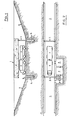
- the silo shelter generally provided under the ground, comprises a protective slab 1 under which is one or more vehicles 2, two vertical sliding doors 3 with quick opening by gravity and slow closing coming to be housed in cavities 4 and two access ramps 5. It is also possible to provide a guard post 8 (eg for 4 men), a decontamination room 7, with an entry airlock 6, served by the mobile unit of the vehicle and an anti-neutron protection station.
- a guard post 8 eg for 4 men
- decontamination room 7 with an entry airlock 6, served by the mobile unit of the vehicle and an anti-neutron protection station.
- all-terrain road vehicles are used which allow normal speed on an open road and the crossing of minor obstacles at reduced speed.
- these vehicles will be standardized with other civil protection vehicles.
- the vehicle comprises a sealed cabin and the trays of the vehicle and of the trailer are designed to contain, after unloading of the material, the people to be evacuated (for example 100 in number).
- the shelter tent is formed by an envelope or cover 9 with a quadrangular section (for example 15 ⁇ 15 m) made of plastic or plasticized fabric.
- the four curved edges are lined with inflatable flexible tubes 10 forming a frame.
- a tent mat 11 is attached to the tent.
- the tent is surrounded by a tube or tube 16 filled with water (load: + 6 tonnes) ensuring anchoring to the ground by gravity.
- the entrance to the tent is provided with an airlock 12 which can be connected to a decontamination tent as shown in FIG. 6.
- the tent is brought to the vehicle 2 by being folded in a zig-zag. Unloading is carried out by mooring one end 19 at a fixed point, for example a shaft 20, and by advancing the vehicle.
- the tent can inflate without any other manual intervention by injecting air into the tent (arriving at 13) and into the frame tubes (arriving at 13 - Figure 3).
- the tent is unfolded so as to be presented successively as shown in Figures SA and 5B.
- the pressure in the tubes is sufficient to support the weight of the tent with the door open; the overpressure of the fan supplying the tent is sufficient to support the weight of the tent even if the frame tubes 10 are deflated.
- the anchor water tube 16 ( Figures 3 and 4) is filled with water.
- a reel nozzle 17 ( Figure 4) which provides permanent decontamination by washing dust on the outside of the tent.
- the runoff water is collected at the bottom of the walls of the tent in a gutter 14, from where it arrives, passing through collectors 15, to a circular evacuation pipe 18, then is returned towards the top to the nozzle 17 after filtering and centrifugation.
- the anchor rod 16 constitutes a reserve of water for general use.
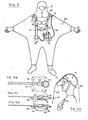
- This garment is formed of a piece 29 of a flexible non-stretch fabric which can completely absorb them from all chemical or bacteriological agents. It can be closed or opened by a waterproof pull tab 32.
- It includes a light helmet 30 with wide visor 31 (FIG. 7A) transparent and non-flammable, gloves 33 and slippers 34 fixed to the garment, elastic in the same material as the rest of the garment but without textile support.
- wide visor 31 FIG. 7A
- gloves 33 and slippers 34 fixed to the garment, elastic in the same material as the rest of the garment but without textile support.
- the sleeves 33 are wide, triangular allowing easy release of the hands to have at least one free hand inside the garment.
- Each sleeve is wide enough to allow complete freedom of movement: wipe the visor fog, change glasses, consult a map or compass, adjust a radio receiver, eat, eliminate droppings.
- the interior space of the garment can be large enough to carry a child or a pet.
- the indoor air is regenerated by a purifier in a closed circuit, the air circulation being ensured without mask by an injector using the energy of the oxygen contained in the or-the carboys 39, the absorption of C02 being ensured by alkaline granules (8 hours autonomy) contained in the cartridge 38.
- the injector-granule capsule assembly is made of molded plastic which is not recovered after use.
- the weight of the air regenerator, carboys and capsules (6 kg) is taken up by the shoulders thanks to a harness (35 suspenders) incorporated into the suit.
- This harness carries rings 44 where the bag 36 containing food and accessories and possibly the baby carrier 37 are attached.
- the jumpsuit is put on over the clothes except for the shoes. It requires no learning or adjustment; the respiratory system is turned on or off by opening or closing the cylinder (s).
- the ready-to-use suit is folded in a waterproof plastic bag with quick opening device.
- the pull tab 32 (FIGS. 7B, 7C, 7D) is waterproof except for a few millimeters at the level of the cursor 42.
- a sealing device 40 of this part comprises an elastic capsule 41, inflated with oxygen by a pipe 45 and which, as soon as the air regenerator is in operation, is applied against the cursor 42 and provides sealing total.
Landscapes
- Engineering & Computer Science (AREA)
- Architecture (AREA)
- Civil Engineering (AREA)
- Structural Engineering (AREA)
- Emergency Management (AREA)
- Environmental & Geological Engineering (AREA)
- Business, Economics & Management (AREA)
- Physics & Mathematics (AREA)
- Fluid Mechanics (AREA)
- Respiratory Apparatuses And Protective Means (AREA)
- Professional, Industrial, Or Sporting Protective Garments (AREA)
- Tents Or Canopies (AREA)
- Emergency Protection Circuit Devices (AREA)
Abstract
Description
- La présente invention a pour objet un système de protection contre les accidents chimiques, bactériologiques et radioactifs.
- Elle trouve son application dans le domaine de la protection civile en cas d'attaque par bombe atomique et aussi dans tous les cas de contamination, comme par exemple lors d'accidents pouvant survenir à une centrale nucléaire.
- Elle a pour but de permettre d'amener rapidement à pied d'oeuvre le matériel nécessaire pour abriter d'une manière efficace tout au moins provisoirement un nombre relativement important de personnel afin éventuellement d'en assurer la décontamination et ensuite d'assurer leur évacuation.
- En vue de la réalisation de ce but, le système est caractérisé essentiellement en ce que l'on prévoit sur un territoire des unités mobiles d'intervention réparties dans des abris fixes pour véhicules et personnel et destinées à transporter vers des endroits contaminés un matériel servant au montage d'abris portatifs pouvant recevoir un groupe relativement important de personnes lesquelles, habituellement après décontamination, sont ensuite évacuées, en général en faisant usage des mêmes véhicules.
- L'invention porte également sur des engins, éléments et objets de protection pris séparément lesquels seront décrits ci-après et représentés par les dessins ci-joints et comportent:
- - des abris fixes pour véhicules et équipages (figures 1 et 2)
- - des tentes-abris (figures 3, 4, 5, 5A et 5B)
- - un poste de décontamination (figure 6)
- - des vêtements de protection (figures 7, 7A, 7B, 7C et 7D).
- Abris-silos (figures 1 et 2)
- Comme montré par ces figures, l'abri-silo, généralement prévu sous le sol, comprend une dalle de protection 1 sous laquelle se trouve un ou plusieurs véhicules 2, deux portes coulissantes verticales 3 à ouverture rapide par gravité et fermeture lente venant se loger dans des cavités 4 et deux rampes d'accès 5. On peut aussi prévoir un poste de garde 8 (p.ex. pour 4 hommes), une salle de décontamination 7, avec un sas d'entrée 6, desservie par le groupe mobile du véhicule et un poste de protection anti-neutrons.
- On utilise en général des véhicules routiers tous terrains permettant une vitesse normale sur route dégagée et le franchissement d'obstacles mineurs à vitesse réduite.
- De préférence, ces véhicules seront standardisés avec les autres véhicules de la protection civile.
- En général le véhicule comprend une cabine étanche et les plateaux du véhicule et de la remorque sont prévus pour contenir après déchargement du matériel, les personnes à évacuer (par exemple au nombre de 100).
- La tente-abri est formée d'une enveloppe ou bache 9 à section quadrangulaire (par exemple 15 x 15 m) en plastique ou tissu plastifié. Les quatre arêtes courbes sont garnies de tubes souples gonflables 10 formant armature. De la tente est solidaire un tapis de sol 11.
- La tente est entourée d'un tube ou boudin 16 rempli d'eau (charge : + 6 tonnes) assurant l'ancrage au sol par gravité.
- L'entrée de la tente est munie d'un sas 12 pouvant se raccorder à une tente de décontamination telle que représentée par la figure 6.
- Ainsi que représenté par la figure 5, la tente est amenée sur le véhicule 2 en étant pliée en zig-zag. Le déchargement s'effectue en amarrant une extrémité 19 à un point fixe, par exemple un arbre 20, et en faisant avancer le véhicule.
- La tente peut se gonfler sans autre intervention manuelle en injectant de l'air dans la tente (arrivée en 13) et dans les tubes-armatures (arrivée en 13 - figure 3).
- La tente est dépliée de manière à se présenter successivement comme représenté par les figures SA et 5B.
- La pression dans les tubes est suffisante pour supporter le poids de la tente porte ouverte ; la surpression du ventilateur alimentant la tente suffit pour supporter le poids de la tente même si les tubes-armatures 10 sont dégonflés.
- Après gonflage et lorsque la tente est déployée, le tube à eau 16 d'ancrage (figures 3 et 4) est rempli d'eau.
- Au sommet de la tente est prévu un gicleur à moulinet 17 (figure 4) qui assure une décontamination permanente par lavage des poussières sur les faces extérieures de la tente.
- L'eau de ruissellement est recueillie au bas des parois de la tente dans une gouttière 14, d'où elle parvient, en passant par des collecteurs 15, à une conduite circulaire d'évacuation 18, puis est renvoyée vers le sommet au gicleur 17 après filtrage et centrifugation. Le boudin d'ancrage 16 constitue une réserve d'eau à usage général.
- Ce poste est formé d'une tente 28 en forme de couloir comprenant trois sections :
- - une section 23 de déshabillage et de contrôle du degré de contamination avec un espace 24 pour les vêtements contaminés
- - une section de lavage 25 avec douche
- - une section 26 de contrôle de la décontamination et de rhabillage avec des vêtements à jeter (stock en 27)
- Ce vêtement est formé d'une pièce 29 en un tissu souple non extensible pouvant absorber totalement les à tous agents chimiques ou bactériologiques. Il peut être fermé ou ouvert par une tirette étanche 32.
- Il comprend un casque léger 30 avec large visière 31 (figure 7A) transparente et ininflammable, des gants 33 et des chaussons 34 fixés au vêtement, élastiques en la même matière que le reste du vêtement mais sans support textile.
- Les manches 33 sont larges, triangulaires permettant un dégagement aisé des mains pour disposer d'au moins une main libre à l'intérieur du vêtement.
- Chaque manche est suffisamment large pour permettre une complète liberté de mouvement : essuyer la buée de la visière, changer de lunettes, consulter une carte ou une boussole, régler un récepteur radio, s'alimenter, éliminer les déjections.
- L'espace intérieur du vêtement peut être suffisamment grand pour permettre d'emporter un enfant ou un animal familier.
- Le vêtement est complété du côté intérieur par :
- - des bretelles 35 formant un harnais
- - un ou des sacs 36 à aliments
- - un sac 37 pour bébé
- - une cartouche 38 contenant un absorbant de CO 2
- - une ou des bonbonnes 39 d'oxygène (attachées aux bretelles 35).
- L'air intérieur est régénéré par un épurateur en circuit fermé, la circulation de l'air étant assurée sans masque par un injecteur utilisant l'énergie de l'oxygène contenu dans la ou-les bonbonnes 39, l'absorption du C02 étant assurée par des granules alcalins (autonomie de 8 heures) contenus dans la cartouche 38.
- L'ensemble injecteur-capsules de granules est en plastique moulé non récupéré après usage. Le poids du régénérateur d'air, bonbonnes et capsules (6 kg) est repris par les épaules grâce à un harnais (bretelles 35) incorporé à la combinaison. Ce harnais porte des anneaux 44 où se fixent le sac 36 contenant vivres et accessoires et éventuellement le porte-bébé 37.
- La combinaison s'enfile par dessus les vêtements à l'exception des chaussures. Elle n'exige aucun apprentissage ni réglage ; l'appareil respiratoire est mis en marche ou arrêté par l'ouverture ou la fermeture de la ou des bonbonnes. La combinaison prête à l'emploi est pliée dans un sac en plastique étanche avec dispositif d'ouverture rapide.
- La tirette 32 (figures 7B, 7C, 7D) est étanche sauf quelques millimètres au niveau du curseur 42.
- Un dispositif d'étanchéité 40 de cette partie comprend une capsule élastique 41, gonflée d'oxygène par un tuyau 45 et qui, dès que .1e régénérateur d'air est en marche, s'applique contre le curseu 42 et assure l'étanchéité totale.
- L'ensemble du détecteur est contenu dans un boîtier en plastique (120 x 80 x 15 mm) comprenant un compteur Geiger, à fenêtre mince, les piles d'alimentation, les circuits intégrés,'un interrupteur de mise en marche, deux voyants lumineux, vert et rouge. Ces voyants s'allument suivant le code suivant:
- Rouge seul : Radiations trop fortes pour sortir de l'abri pour plus de quelques minutes, même avec la combinaison.
- Rouge et vert : On peut sortir de l'abri et séjourner plusieurs heures dehors, protégé par la combinaison mais pas sans elle.
- Vert seul : On peut enlever la combinaison.
- Pas de voyants allumés : les batteries sont déchargées.
Claims (13)
Priority Applications (1)
| Application Number | Priority Date | Filing Date | Title |
|---|---|---|---|
| AT82401402T ATE18506T1 (de) | 1981-08-11 | 1982-07-28 | Schutzanzug gegen chemische, bakteriologische oder radioaktive folgen von ungluecken. |
Applications Claiming Priority (2)
| Application Number | Priority Date | Filing Date | Title |
|---|---|---|---|
| BE889925 | 1981-08-11 | ||
| BE889925 | 1981-08-11 |
Publications (3)
| Publication Number | Publication Date |
|---|---|
| EP0072724A2 true EP0072724A2 (fr) | 1983-02-23 |
| EP0072724A3 EP0072724A3 (en) | 1983-08-17 |
| EP0072724B1 EP0072724B1 (fr) | 1986-03-12 |
Family
ID=3861945
Family Applications (1)
| Application Number | Title | Priority Date | Filing Date |
|---|---|---|---|
| EP82401402A Expired EP0072724B1 (fr) | 1981-08-11 | 1982-07-28 | Vêtement de protection contre les accidents chimiques, bactériologiques et radioactifs |
Country Status (3)
| Country | Link |
|---|---|
| EP (1) | EP0072724B1 (fr) |
| AT (1) | ATE18506T1 (fr) |
| DE (1) | DE3269815D1 (fr) |
Cited By (4)
| Publication number | Priority date | Publication date | Assignee | Title |
|---|---|---|---|---|
| GB2172026A (en) * | 1984-11-07 | 1986-09-10 | Colin James Whitecros Paterson | Inflatable enclosure |
| WO2007102798A1 (fr) * | 2005-01-12 | 2007-09-13 | Steris, Inc. | Systeme de decontamination gonflable |
| DE102015108579A1 (de) * | 2015-05-30 | 2016-12-01 | Rimtax International Gmbh | Schutzabdeckung zur Einhausung einer Schadstoffquelle |
| WO2020069571A1 (fr) * | 2018-10-03 | 2020-04-09 | TechVault Pty Ltd | Système d'isolation permanente pour déchets dangereux dans un stockage final situé dans une formation géologique |
Family Cites Families (5)
| Publication number | Priority date | Publication date | Assignee | Title |
|---|---|---|---|---|
| FR857158A (fr) * | 1939-07-01 | 1940-08-29 | Perfectionnement à la fabrication des vêtements anti-gaz | |
| GB965431A (en) * | 1959-05-01 | 1964-07-29 | Gourock Ropework Company Ltd | Improvements in inflatable structures |
| FR1566305A (fr) * | 1968-01-29 | 1969-05-09 | ||
| DE1918244A1 (de) * | 1969-04-10 | 1970-11-12 | Bluecher Hubert | ABC-Zivil-UEberdruck-Schutzanzug gegen atomare,biologische und chemische Kampfstoffe |
| NL7608098A (nl) * | 1975-07-28 | 1977-02-01 | Unilever Nv | Opblaasbare tent. |
-
1982
- 1982-07-28 DE DE8282401402T patent/DE3269815D1/de not_active Expired
- 1982-07-28 AT AT82401402T patent/ATE18506T1/de not_active IP Right Cessation
- 1982-07-28 EP EP82401402A patent/EP0072724B1/fr not_active Expired
Cited By (4)
| Publication number | Priority date | Publication date | Assignee | Title |
|---|---|---|---|---|
| GB2172026A (en) * | 1984-11-07 | 1986-09-10 | Colin James Whitecros Paterson | Inflatable enclosure |
| WO2007102798A1 (fr) * | 2005-01-12 | 2007-09-13 | Steris, Inc. | Systeme de decontamination gonflable |
| DE102015108579A1 (de) * | 2015-05-30 | 2016-12-01 | Rimtax International Gmbh | Schutzabdeckung zur Einhausung einer Schadstoffquelle |
| WO2020069571A1 (fr) * | 2018-10-03 | 2020-04-09 | TechVault Pty Ltd | Système d'isolation permanente pour déchets dangereux dans un stockage final situé dans une formation géologique |
Also Published As
| Publication number | Publication date |
|---|---|
| DE3269815D1 (en) | 1986-04-17 |
| EP0072724A3 (en) | 1983-08-17 |
| EP0072724B1 (fr) | 1986-03-12 |
| ATE18506T1 (de) | 1986-03-15 |
Similar Documents
| Publication | Publication Date | Title |
|---|---|---|
| US4625468A (en) | Temporary/portable nuclear fallout shelter | |
| US5487400A (en) | Self-inflating tents | |
| KR101426893B1 (ko) | 안전 보호구 | |
| US3911913A (en) | Survival apparatus | |
| US6394867B1 (en) | Emergency self-inflating flotation device | |
| JP5579336B2 (ja) | 避難用シェルター及びその製造方法 | |
| US3256440A (en) | Devices for protection against radioactive fallout | |
| US6328618B1 (en) | Combination lifejacket and protective body heat retaining pod | |
| US20100299826A1 (en) | Mobile mass decontamination unit | |
| ES3000442T3 (en) | Mobile unit for thorough wet decontamination of persons | |
| US4631038A (en) | Protective capsule | |
| JP2013532089A (ja) | 津波待避用救命装置 | |
| CA2153513C (fr) | Abri de secours | |
| EP0072724A2 (fr) | Vêtement de protection contre les accidents chimiques, bactériologiques et radioactifs | |
| JP2007331660A (ja) | 収容カプセル | |
| JP2013043540A (ja) | 救命用カプセル | |
| BE889925A (fr) | Systeme de protection contre les accidents chimiques, bacteriologiques et radioactifs | |
| ES2824550T3 (es) | Traje de salvamento para naufragios con alta funcionalidad y aislación | |
| EP0931567A2 (fr) | Dispositif de sécurité contre les avalanches | |
| US7712151B2 (en) | Inflatable protective enclosure | |
| WO1985004211A1 (fr) | Abri de protection | |
| GB2137250A (en) | Inflatable shelter against chemical, biological, or nuclear hazards | |
| CN206928735U (zh) | 应急救生舱 | |
| JP2014124955A (ja) | 救命具 | |
| JP3187662U (ja) | 水害時用救命具 |
Legal Events
| Date | Code | Title | Description |
|---|---|---|---|
| PUAI | Public reference made under article 153(3) epc to a published international application that has entered the european phase |
Free format text: ORIGINAL CODE: 0009012 |
|
| AK | Designated contracting states |
Designated state(s): AT CH DE FR GB IT LI LU NL SE |
|
| PUAL | Search report despatched |
Free format text: ORIGINAL CODE: 0009013 |
|
| AK | Designated contracting states |
Designated state(s): AT CH DE FR GB IT LI LU NL SE |
|
| 17P | Request for examination filed |
Effective date: 19830822 |
|
| ITF | It: translation for a ep patent filed | ||
| GRAA | (expected) grant |
Free format text: ORIGINAL CODE: 0009210 |
|
| RAP1 | Party data changed (applicant data changed or rights of an application transferred) |
Owner name: BAUMERT, CHARLES |
|
| AK | Designated contracting states |
Kind code of ref document: B1 Designated state(s): AT CH DE FR GB IT LI LU NL SE |
|
| REF | Corresponds to: |
Ref document number: 18506 Country of ref document: AT Date of ref document: 19860315 Kind code of ref document: T |
|
| REF | Corresponds to: |
Ref document number: 3269815 Country of ref document: DE Date of ref document: 19860417 |
|
| PGFP | Annual fee paid to national office [announced via postgrant information from national office to epo] |
Ref country code: AT Payment date: 19860715 Year of fee payment: 5 |
|
| PG25 | Lapsed in a contracting state [announced via postgrant information from national office to epo] |
Ref country code: LU Free format text: LAPSE BECAUSE OF NON-PAYMENT OF DUE FEES Effective date: 19860731 |
|
| PGFP | Annual fee paid to national office [announced via postgrant information from national office to epo] |
Ref country code: NL Payment date: 19860731 Year of fee payment: 5 |
|
| PLBE | No opposition filed within time limit |
Free format text: ORIGINAL CODE: 0009261 |
|
| STAA | Information on the status of an ep patent application or granted ep patent |
Free format text: STATUS: NO OPPOSITION FILED WITHIN TIME LIMIT |
|
| 26N | No opposition filed | ||
| PG25 | Lapsed in a contracting state [announced via postgrant information from national office to epo] |
Ref country code: AT Effective date: 19870728 |
|
| PG25 | Lapsed in a contracting state [announced via postgrant information from national office to epo] |
Ref country code: LI Effective date: 19870731 Ref country code: CH Effective date: 19870731 |
|
| PG25 | Lapsed in a contracting state [announced via postgrant information from national office to epo] |
Ref country code: NL Effective date: 19880201 |
|
| NLV4 | Nl: lapsed or anulled due to non-payment of the annual fee | ||
| REG | Reference to a national code |
Ref country code: CH Ref legal event code: PL |
|
| PG25 | Lapsed in a contracting state [announced via postgrant information from national office to epo] |
Ref country code: DE Effective date: 19880401 |
|
| GBPC | Gb: european patent ceased through non-payment of renewal fee | ||
| PG25 | Lapsed in a contracting state [announced via postgrant information from national office to epo] |
Ref country code: SE Effective date: 19880729 |
|
| PG25 | Lapsed in a contracting state [announced via postgrant information from national office to epo] |
Ref country code: GB Free format text: LAPSE BECAUSE OF NON-PAYMENT OF DUE FEES Effective date: 19881121 |
|
| PGFP | Annual fee paid to national office [announced via postgrant information from national office to epo] |
Ref country code: FR Payment date: 19890711 Year of fee payment: 8 |
|
| PG25 | Lapsed in a contracting state [announced via postgrant information from national office to epo] |
Ref country code: FR Effective date: 19910329 |
|
| REG | Reference to a national code |
Ref country code: FR Ref legal event code: ST |
|
| EUG | Se: european patent has lapsed |
Ref document number: 82401402.1 Effective date: 19890510 |