EP0072912A1 - Verfahren zur Herstellung von Glyoxal - Google Patents
Verfahren zur Herstellung von Glyoxal Download PDFInfo
- Publication number
- EP0072912A1 EP0072912A1 EP82106325A EP82106325A EP0072912A1 EP 0072912 A1 EP0072912 A1 EP 0072912A1 EP 82106325 A EP82106325 A EP 82106325A EP 82106325 A EP82106325 A EP 82106325A EP 0072912 A1 EP0072912 A1 EP 0072912A1
- Authority
- EP
- European Patent Office
- Prior art keywords
- catalyst
- copper
- silver
- glyoxal
- weight
- Prior art date
- Legal status (The legal status is an assumption and is not a legal conclusion. Google has not performed a legal analysis and makes no representation as to the accuracy of the status listed.)
- Granted
Links
- LEQAOMBKQFMDFZ-UHFFFAOYSA-N glyoxal Chemical compound O=CC=O LEQAOMBKQFMDFZ-UHFFFAOYSA-N 0.000 title claims abstract description 104
- 229940015043 glyoxal Drugs 0.000 title claims abstract description 52
- 238000000034 method Methods 0.000 title claims abstract description 37
- 230000008569 process Effects 0.000 title claims abstract description 26
- 238000002360 preparation method Methods 0.000 title abstract description 5
- LYCAIKOWRPUZTN-UHFFFAOYSA-N Ethylene glycol Chemical compound OCCO LYCAIKOWRPUZTN-UHFFFAOYSA-N 0.000 claims abstract description 110
- 239000003054 catalyst Substances 0.000 claims abstract description 78
- BQCADISMDOOEFD-UHFFFAOYSA-N Silver Chemical compound [Ag] BQCADISMDOOEFD-UHFFFAOYSA-N 0.000 claims abstract description 47
- 239000004332 silver Substances 0.000 claims abstract description 47
- RYGMFSIKBFXOCR-UHFFFAOYSA-N Copper Chemical compound [Cu] RYGMFSIKBFXOCR-UHFFFAOYSA-N 0.000 claims abstract description 45
- 229910052802 copper Inorganic materials 0.000 claims abstract description 45
- 239000010949 copper Substances 0.000 claims abstract description 45
- 229910052709 silver Inorganic materials 0.000 claims abstract description 45
- 239000013078 crystal Substances 0.000 claims abstract description 36
- 230000003647 oxidation Effects 0.000 claims abstract description 15
- 238000007254 oxidation reaction Methods 0.000 claims abstract description 15
- QVGXLLKOCUKJST-UHFFFAOYSA-N atomic oxygen Chemical compound [O] QVGXLLKOCUKJST-UHFFFAOYSA-N 0.000 claims abstract description 9
- 229910052760 oxygen Inorganic materials 0.000 claims abstract description 9
- 239000001301 oxygen Substances 0.000 claims abstract description 9
- 239000011261 inert gas Substances 0.000 claims abstract description 5
- 238000006243 chemical reaction Methods 0.000 claims description 30
- 229910052698 phosphorus Inorganic materials 0.000 claims description 19
- 239000011574 phosphorus Substances 0.000 claims description 19
- OAICVXFJPJFONN-UHFFFAOYSA-N Phosphorus Chemical compound [P] OAICVXFJPJFONN-UHFFFAOYSA-N 0.000 claims description 14
- -1 phosphorus compound Chemical class 0.000 claims description 9
- 238000010924 continuous production Methods 0.000 claims description 2
- 229910052738 indium Inorganic materials 0.000 claims 1
- 239000002245 particle Substances 0.000 abstract description 7
- WGCNASOHLSPBMP-UHFFFAOYSA-N hydroxyacetaldehyde Natural products OCC=O WGCNASOHLSPBMP-UHFFFAOYSA-N 0.000 description 29
- 239000000243 solution Substances 0.000 description 26
- 239000007788 liquid Substances 0.000 description 20
- 239000000203 mixture Substances 0.000 description 14
- 238000010791 quenching Methods 0.000 description 13
- 238000009833 condensation Methods 0.000 description 11
- 230000005494 condensation Effects 0.000 description 11
- 239000007789 gas Substances 0.000 description 11
- 239000011541 reaction mixture Substances 0.000 description 10
- IJGRMHOSHXDMSA-UHFFFAOYSA-N Atomic nitrogen Chemical compound N#N IJGRMHOSHXDMSA-UHFFFAOYSA-N 0.000 description 7
- 239000002253 acid Substances 0.000 description 7
- 239000000047 product Substances 0.000 description 7
- CURLTUGMZLYLDI-UHFFFAOYSA-N Carbon dioxide Chemical compound O=C=O CURLTUGMZLYLDI-UHFFFAOYSA-N 0.000 description 6
- 238000004519 manufacturing process Methods 0.000 description 6
- WSFSSNUMVMOOMR-NJFSPNSNSA-N methanone Chemical compound O=[14CH2] WSFSSNUMVMOOMR-NJFSPNSNSA-N 0.000 description 6
- 230000000052 comparative effect Effects 0.000 description 5
- YCKOAAUKSGOOJH-UHFFFAOYSA-N copper silver Chemical compound [Cu].[Ag].[Ag] YCKOAAUKSGOOJH-UHFFFAOYSA-N 0.000 description 5
- XLYOFNOQVPJJNP-UHFFFAOYSA-N water Substances O XLYOFNOQVPJJNP-UHFFFAOYSA-N 0.000 description 5
- 238000010626 work up procedure Methods 0.000 description 5
- 230000015572 biosynthetic process Effects 0.000 description 4
- 230000000694 effects Effects 0.000 description 4
- 150000003018 phosphorus compounds Chemical class 0.000 description 4
- WVLBCYQITXONBZ-UHFFFAOYSA-N trimethyl phosphate Chemical compound COP(=O)(OC)OC WVLBCYQITXONBZ-UHFFFAOYSA-N 0.000 description 4
- WSFSSNUMVMOOMR-UHFFFAOYSA-N Formaldehyde Chemical compound O=C WSFSSNUMVMOOMR-UHFFFAOYSA-N 0.000 description 3
- KWYUFKZDYYNOTN-UHFFFAOYSA-M Potassium hydroxide Chemical compound [OH-].[K+] KWYUFKZDYYNOTN-UHFFFAOYSA-M 0.000 description 3
- 239000001569 carbon dioxide Substances 0.000 description 3
- 229910002092 carbon dioxide Inorganic materials 0.000 description 3
- 238000005260 corrosion Methods 0.000 description 3
- 230000007797 corrosion Effects 0.000 description 3
- 229910052757 nitrogen Inorganic materials 0.000 description 3
- 230000008929 regeneration Effects 0.000 description 3
- 238000011069 regeneration method Methods 0.000 description 3
- WKBOTKDWSSQWDR-UHFFFAOYSA-N Bromine atom Chemical class [Br] WKBOTKDWSSQWDR-UHFFFAOYSA-N 0.000 description 2
- DIKBFYAXUHHXCS-UHFFFAOYSA-N bromoform Chemical compound BrC(Br)Br DIKBFYAXUHHXCS-UHFFFAOYSA-N 0.000 description 2
- 230000003197 catalytic effect Effects 0.000 description 2
- 230000003247 decreasing effect Effects 0.000 description 2
- 230000009467 reduction Effects 0.000 description 2
- 239000012808 vapor phase Substances 0.000 description 2
- AATNZNJRDOVKDD-UHFFFAOYSA-N 1-[ethoxy(ethyl)phosphoryl]oxyethane Chemical compound CCOP(=O)(CC)OCC AATNZNJRDOVKDD-UHFFFAOYSA-N 0.000 description 1
- NYYLZXREFNYPKB-UHFFFAOYSA-N 1-[ethoxy(methyl)phosphoryl]oxyethane Chemical compound CCOP(C)(=O)OCC NYYLZXREFNYPKB-UHFFFAOYSA-N 0.000 description 1
- ZSSWXNPRLJLCDU-UHFFFAOYSA-N 1-diethylphosphorylethane Chemical compound CCP(=O)(CC)CC ZSSWXNPRLJLCDU-UHFFFAOYSA-N 0.000 description 1
- 229910001316 Ag alloy Inorganic materials 0.000 description 1
- 229910000881 Cu alloy Inorganic materials 0.000 description 1
- 229910000971 Silver steel Inorganic materials 0.000 description 1
- ATJFFYVFTNAWJD-UHFFFAOYSA-N Tin Chemical compound [Sn] ATJFFYVFTNAWJD-UHFFFAOYSA-N 0.000 description 1
- CLBRCZAHAHECKY-UHFFFAOYSA-N [Co].[Pt] Chemical compound [Co].[Pt] CLBRCZAHAHECKY-UHFFFAOYSA-N 0.000 description 1
- 239000000654 additive Substances 0.000 description 1
- 239000003570 air Substances 0.000 description 1
- 229910045601 alloy Inorganic materials 0.000 description 1
- 239000000956 alloy Substances 0.000 description 1
- 229910052787 antimony Inorganic materials 0.000 description 1
- WATWJIUSRGPENY-UHFFFAOYSA-N antimony atom Chemical compound [Sb] WATWJIUSRGPENY-UHFFFAOYSA-N 0.000 description 1
- 239000007864 aqueous solution Substances 0.000 description 1
- 229910052785 arsenic Inorganic materials 0.000 description 1
- RQNWIZPPADIBDY-UHFFFAOYSA-N arsenic atom Chemical compound [As] RQNWIZPPADIBDY-UHFFFAOYSA-N 0.000 description 1
- 230000009286 beneficial effect Effects 0.000 description 1
- 230000008901 benefit Effects 0.000 description 1
- 229910052797 bismuth Inorganic materials 0.000 description 1
- JCXGWMGPZLAOME-UHFFFAOYSA-N bismuth atom Chemical compound [Bi] JCXGWMGPZLAOME-UHFFFAOYSA-N 0.000 description 1
- GDTBXPJZTBHREO-UHFFFAOYSA-N bromine Substances BrBr GDTBXPJZTBHREO-UHFFFAOYSA-N 0.000 description 1
- 229910052794 bromium Inorganic materials 0.000 description 1
- 229950005228 bromoform Drugs 0.000 description 1
- 239000006227 byproduct Substances 0.000 description 1
- 239000007795 chemical reaction product Substances 0.000 description 1
- 238000011109 contamination Methods 0.000 description 1
- 239000012043 crude product Substances 0.000 description 1
- 230000009849 deactivation Effects 0.000 description 1
- VONWDASPFIQPDY-UHFFFAOYSA-N dimethyl methylphosphonate Chemical compound COP(C)(=O)OC VONWDASPFIQPDY-UHFFFAOYSA-N 0.000 description 1
- 238000009826 distribution Methods 0.000 description 1
- 150000002366 halogen compounds Chemical class 0.000 description 1
- 230000006872 improvement Effects 0.000 description 1
- 239000012535 impurity Substances 0.000 description 1
- 239000003112 inhibitor Substances 0.000 description 1
- 230000001788 irregular Effects 0.000 description 1
- 239000010985 leather Substances 0.000 description 1
- 239000000320 mechanical mixture Substances 0.000 description 1
- 239000000123 paper Substances 0.000 description 1
- 239000012071 phase Substances 0.000 description 1
- 230000008092 positive effect Effects 0.000 description 1
- 230000000171 quenching effect Effects 0.000 description 1
- 239000012495 reaction gas Substances 0.000 description 1
- 238000007086 side reaction Methods 0.000 description 1
- 238000005507 spraying Methods 0.000 description 1
- 230000006641 stabilisation Effects 0.000 description 1
- 238000011105 stabilization Methods 0.000 description 1
- 239000010935 stainless steel Substances 0.000 description 1
- 229910001220 stainless steel Inorganic materials 0.000 description 1
- 239000007858 starting material Substances 0.000 description 1
- 238000013517 stratification Methods 0.000 description 1
- 239000004753 textile Substances 0.000 description 1
- 229910052718 tin Inorganic materials 0.000 description 1
- DQWPFSLDHJDLRL-UHFFFAOYSA-N triethyl phosphate Chemical compound CCOP(=O)(OCC)OCC DQWPFSLDHJDLRL-UHFFFAOYSA-N 0.000 description 1
- BDZBKCUKTQZUTL-UHFFFAOYSA-N triethyl phosphite Chemical compound CCOP(OCC)OCC BDZBKCUKTQZUTL-UHFFFAOYSA-N 0.000 description 1
- CYTQBVOFDCPGCX-UHFFFAOYSA-N trimethyl phosphite Chemical compound COP(OC)OC CYTQBVOFDCPGCX-UHFFFAOYSA-N 0.000 description 1
- OXFUXNFMHFCELM-UHFFFAOYSA-N tripropan-2-yl phosphate Chemical compound CC(C)OP(=O)(OC(C)C)OC(C)C OXFUXNFMHFCELM-UHFFFAOYSA-N 0.000 description 1
- RXPQRKFMDQNODS-UHFFFAOYSA-N tripropyl phosphate Chemical compound CCCOP(=O)(OCCC)OCCC RXPQRKFMDQNODS-UHFFFAOYSA-N 0.000 description 1
Images
Classifications
-
- B—PERFORMING OPERATIONS; TRANSPORTING
- B01—PHYSICAL OR CHEMICAL PROCESSES OR APPARATUS IN GENERAL
- B01J—CHEMICAL OR PHYSICAL PROCESSES, e.g. CATALYSIS OR COLLOID CHEMISTRY; THEIR RELEVANT APPARATUS
- B01J37/00—Processes, in general, for preparing catalysts; Processes, in general, for activation of catalysts
- B01J37/02—Impregnation, coating or precipitation
- B01J37/024—Multiple impregnation or coating
-
- B—PERFORMING OPERATIONS; TRANSPORTING
- B01—PHYSICAL OR CHEMICAL PROCESSES OR APPARATUS IN GENERAL
- B01J—CHEMICAL OR PHYSICAL PROCESSES, e.g. CATALYSIS OR COLLOID CHEMISTRY; THEIR RELEVANT APPARATUS
- B01J23/00—Catalysts comprising metals or metal oxides or hydroxides, not provided for in group B01J21/00
- B01J23/70—Catalysts comprising metals or metal oxides or hydroxides, not provided for in group B01J21/00 of the iron group metals or copper
- B01J23/89—Catalysts comprising metals or metal oxides or hydroxides, not provided for in group B01J21/00 of the iron group metals or copper combined with noble metals
- B01J23/8926—Copper and noble metals
-
- B—PERFORMING OPERATIONS; TRANSPORTING
- B01—PHYSICAL OR CHEMICAL PROCESSES OR APPARATUS IN GENERAL
- B01J—CHEMICAL OR PHYSICAL PROCESSES, e.g. CATALYSIS OR COLLOID CHEMISTRY; THEIR RELEVANT APPARATUS
- B01J27/00—Catalysts comprising the elements or compounds of halogens, sulfur, selenium, tellurium, phosphorus or nitrogen; Catalysts comprising carbon compounds
- B01J27/14—Phosphorus; Compounds thereof
- B01J27/16—Phosphorus; Compounds thereof containing oxygen, i.e. acids, anhydrides and their derivates with N, S, B or halogens without carriers or on carriers based on C, Si, Al or Zr; also salts of Si, Al and Zr
- B01J27/18—Phosphorus; Compounds thereof containing oxygen, i.e. acids, anhydrides and their derivates with N, S, B or halogens without carriers or on carriers based on C, Si, Al or Zr; also salts of Si, Al and Zr with metals other than Al or Zr
- B01J27/1802—Salts or mixtures of anhydrides with compounds of other metals than V, Nb, Ta, Cr, Mo, W, Mn, Tc, Re, e.g. phosphates, thiophosphates
- B01J27/1817—Salts or mixtures of anhydrides with compounds of other metals than V, Nb, Ta, Cr, Mo, W, Mn, Tc, Re, e.g. phosphates, thiophosphates with copper, silver or gold
-
- C—CHEMISTRY; METALLURGY
- C07—ORGANIC CHEMISTRY
- C07C—ACYCLIC OR CARBOCYCLIC COMPOUNDS
- C07C45/00—Preparation of compounds having >C = O groups bound only to carbon or hydrogen atoms; Preparation of chelates of such compounds
- C07C45/27—Preparation of compounds having >C = O groups bound only to carbon or hydrogen atoms; Preparation of chelates of such compounds by oxidation
- C07C45/32—Preparation of compounds having >C = O groups bound only to carbon or hydrogen atoms; Preparation of chelates of such compounds by oxidation with molecular oxygen
- C07C45/37—Preparation of compounds having >C = O groups bound only to carbon or hydrogen atoms; Preparation of chelates of such compounds by oxidation with molecular oxygen of >C—O—functional groups to >C=O groups
- C07C45/38—Preparation of compounds having >C = O groups bound only to carbon or hydrogen atoms; Preparation of chelates of such compounds by oxidation with molecular oxygen of >C—O—functional groups to >C=O groups being a primary hydroxyl group
Definitions
- the invention relates to a new process for the preparation of glyoxal by oxidation of glycol in the presence of a copper / silver layer catalyst.
- glyoxal can be produced by vapor phase oxidation of ethylene glycol on an oxidation catalyst which contains copper in combination with tin, phosphorus, arsenic, antimony or bismuth.
- the catalyst which may also contain silver, is used as an alloy, preferably in the form of swarf or gauze.
- yields - based on converted ethylene glycol - are given between 55% and 72%.
- the higher values can only be achieved by accepting an incomplete glycol conversion. This is unsatisfactory from an economic point of view, since removal of the remaining glycol from the product is only possible with great effort.
- insufficient space-time yields are obtained by this known method.
- Another disadvantage is the cumbersome catalyst production.
- DE-PS 19 67 147 proposes a silver catalyst which contains phosphorus for the production of glyoxal from ethylene glycol. With this process too, a glyoxal yield of up to 70%, based on the ethylene glycol converted, must be purchased with unsatisfactory sales. The space-time yields are also unsatisfactory.
- DE-OS 21 58 343 the selectivity of the catalysts described in DE-PS 19 23 048 drops over a 700-hour operating period from an initial value of 60 to 64% to 55%. It is also stated that a catalyst containing copper, silver and phosphorus can be regenerated after a 700-hour run time by a 12-hour reduction at 450 ° C.
- DE-OS 21 58 344 describes the regeneration of a catalyst containing copper and phosphorus, in which an excess of oxygen is passed over the catalyst for at least 1 day. These regeneration processes have the disadvantage that they are associated with a loss of production and require complex safety measures in order to prevent the air used for regeneration from being mixed with the reaction gas.
- the life of copper catalysts is considerably extended if the vapor phase oxidation of ethylene glycol is carried out at from 225 to 500 ° C. and in the presence of a phosphorus compound, such as trimethylphosphate, which is volatile under the reaction conditions, where the amount of phosphorus (calculated P), based on the amount by weight of ethylene glycol, is 1 to 100 ppm.
- a phosphorus compound such as trimethylphosphate
- the catalysts are used in the form of swarf, wire mesh, gauze or also as supported catalysts. Through this procedure achieved a considerable reduction in the loss of activity of the catalyst, but did not achieve a permanent stabilization of the catalyst activity at a high level.
- DE-OS 28 03 318 describes a process for the production of glyoxal from glycol, in which the oxidation on silver crystals with a grain size of 0.1 to 2.5 mm with a residence time of at most 0.05 seconds and a temperature of 447 up to 707 ° C.
- this method achieves a multiple of the space-time yields obtained with the methods described above, the relatively low yield of only 55% is disadvantageous.
- the yield can be improved by adding bromoform to the starting mixture, corrosion problems and difficulties in terms of product purity must then be accepted.
- the oxidation of the glycol with oxygen in the presence of an inert gas such as nitrogen e.g. in a ratio of at least 4.4 moles of inert gas per mole of oxygen.
- the molar ratio of oxygen to ethylene glycol is expediently at least 0.7 to 1 and at most 1.4 to 1.
- the reaction temperatures indicated at 450 to 800 ° C. are the temperatures occurring in the catalyst bed.
- the residence time of the reaction mixture in the catalyst layer should not exceed 0.05 seconds.
- the oxidation is carried out on a multilayer catalyst which contains at least one layer of copper crystals and at least one layer of silver crystals.
- the total layer thickness of the catalyst is 5 to 100, preferably 20 to 40 mm.
- the catalyst layers are arranged in the reactor, which is usually set up vertically.
- the starting mixture of steam of the starting material ethylene glycol and oxygen or air is generally passed from top to bottom, so that the top layer also means the part of the catalyst facing the starting mixture.
- reactors of a different type for example horizontally arranged reactors, or when the starting mixture is guided differently, all the information in the description of the upper and lower part of the catalyst apply mutatis mutandis.
- the proportion of copper crystals is 10 to 45% by weight, in particular 20 to 30% by weight, and the proportion of silver crystals is 55 to 90% by weight, in particular 70 to 80% by weight. In a particularly preferred case, the proportion of copper crystals is 25% by weight and that of silver crystals 75% by weight of the total weight of the catalyst.
- the number of copper crystal layers, based on the number of silver crystal layers, can be larger, equal or smaller.
- the multilayer catalyst consists of one to four, preferably two to three, layers of copper crystals and one to four, preferably two to three, layers of silver crystals.
- the copper and silver crystals have a grain size of 0.1 to 2.5 mm, with grain size fractions of, for example, 0.2 to 0.4 mm, 0.4 to 0.75 mm, 0.75 to 1 for the individual layers , 0 mm, 1.0 to 2.5 mm can be used.
- the grain sizes of two adjacent layers can be increasing, constant, e.g. when changing from a copper layer to a silver layer or vice versa, or decreasing.
- the copper crystal layers can be arranged individually or several together above and / or below each silver crystal layer. Preferably only two or three copper layers are used and they are arranged above and / or below the upper silver layer.
- each individual silver or copper layer is usually regular, so that the layer thickness of the individual layer is the same over the entire layer cross section.
- the layer thickness depends directly on the proportions by weight of the total catalyst and the particular particle size of the particles.
- the layer thicknesses of two adjacent layers can be increasing, constant or decreasing when viewed in the direction of flow.
- the vaporous reaction mixtures obtainable in the catalytic oxidation are worked up in a manner known per se. For example, they are brought into contact with a liquid immediately after leaving the catalyst layer, which causes the immediate condensation of the oxidation products. Water, the condensed liquid reaction mixture or a mixture of these two liquids is used as the condensation liquid. It is particularly advantageous to use the condensed reaction mixture as the condensation liquid. If condensed reaction mixtures are used as the condensation liquid, the excess part of condensate, which is not circulated as a cooled condensation liquid, is removed as a crude product and, if necessary, fed to a workup or further reaction.
- the vaporous reaction mixture which has a temperature of 320 to 650 ° C., is expediently brought into contact with the condensation liquid within one second.
- the temperature of the condensation liquid is, for example, -20 to 70 ° C.
- This treatment is carried out, for example, by directing the flow of the hot reaction gases directly into a quench chamber which adjoins the catalyst layer directly in the direction of flow.
- the procedure is preferably such that the condensation liquid is brought into contact with the reaction gases in the form of droplets with an average diameter of 1 to 2000 micrometers.
- the droplets are removed with the help of customary dividing devices, in particular of nozzles.
- the spraying of the condensation liquid into the quench chamber is advantageously carried out in such a way that the majority of the droplets hit the stream of the reaction gases at an angle of 2 to 85 ° C. to the stream axis.
- the amount of condensation liquid (also referred to as quench liquid in the examples) is advantageously 20 to 100 parts by weight, based on 1 part by weight of the reaction gases.
- the process according to the invention provides a better overall result in terms of yield, space-time yield, purity of the end product and service life of the catalyst in a simpler and more economical way.
- the catalyst preparation or catalyst workup is particularly simple. In this way, copper and silver crystals of the relevant particle size, as are also obtained in the electrolytic production, can be used directly.
- the copper-silver layer catalyst which is distinguished by a long service life, can easily be replaced in cases where an exchange should nevertheless be necessary.
- the copper and silver layers can thus be mechanically separated from one another, which e.g. can be easily designed by inserting copper, silver or stainless steel nets between the copper and silver layers. Subsequently, both the copper and the silver can be electrolytically brought back into the catalytically active form almost without loss.
- the glyoxal obtained by the process according to the invention which is directly in the commercial form of a 40 s aq solution can be obtained is characterized by a comparatively high product quality, which remains unchanged even after a long period of operation.
- the residual content of the 40% glyoxal solution of unreacted glycol is below 0.1%, the content of glycol aldehyde and formaldehyde is only about 1% in each case. Since, in addition, the color number and the acid number of the glyoxal solutions also meet the high requirements in this connection for applications in the textile, paper and leather industries, no particular level of suitability, for example with an ion exchanger, is necessary in the process according to the invention.
- the addition of halogen compounds as an inhibitor, which is associated with a risk of corrosion, is avoided in the process according to the invention.
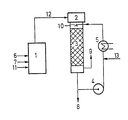
- a system with an ethylene glycol evaporator (1), corresponding feeds of ethylene glycol (6), water (7) and air or nitrogen (11) and a vertical tube reactor (2) are used.
- the reactor contains the feed (12) for the vaporous starting mixture and the reactor hood.
- the catalyst layer is below the reactor head, followed by the quench chamber (10), which forms the top of a packed column (3).
- the condensate is partly used as quenching liquid.
- the quench liquid is sprayed with a pump (4) via a heat exchanger (5) and a nozzle system immediately behind the catalyst layer into the hot gases, which are cooled in the quench chamber and partially condensed so that the glyoxal solution can be removed via line (8) .
- the exhaust gas escapes via line (9).
- a catalyst consisting of copper and silver crystals (41 parts) of the following composition is introduced into the reactor (2) (order of the layers from top to bottom in the direction of flow of the gases):
- the height of the entire catalyst layer is 30 mm.
- An hourly mixture of 220 parts of ethylene glycol, 220 parts of water, 536 parts of air and 1576 parts of nitrogen is fed to the evaporator (1), where it is heated and evaporated.
- the vaporous starting mixture is passed through the catalyst and reacted at 600 ° C and 1.2 bar.
- the residence time in the catalyst space is 0.006 seconds.
- the flow rate of the reaction gases when leaving the catalyst layer is 4.8 meters per second.
- the temperature of the quench liquid is 61 ° C. Water is initially introduced as the quench liquid. Depending on the amount of condensed reaction mixture obtained, part of the quench liquid is continuously drawn off via line 8. After a run-in phase, the quench liquid reaches a steady state concentration corresponding to its composition by concentration with a condensed reaction mixture. Thereafter, the balancing of the product solution continuously withdrawn from the quench circuit in accordance with the amount of condensing reaction mixture is started.
- 2 rings are used, each with 6 nozzles arranged on a gap. The nozzles of a ring are located on the column wall and are arranged symmetrically.
- the angle of impact of the droplets to the flow axis of all nozzles is different and is 15 to 75 ° C. In 70% of the droplets this angle is 30 to 75 °.
- the droplets have an average diameter of 200 micrometers. This gives 363 parts per hour of a 40% by weight glyoxal solution, that is 145 parts of glyoxal per hour, corresponding to a yield of 70.6% of theory, based on the glyoxal used.
- the catalyst life is 90 days.
- the glyoxal solution contains 0.05 percent by weight ethylene glycol, 1.2 percent by weight formaldehyde, 0.9 percent by weight glycolaldehyde and an acid number of 4 (amount of potassium hydroxide in milligrams required to neutralize one gram of glyoxal solution).
- the conversion is 99.9 percent, the space-time yield 15.4 g glyoxal per cm 3 catalyst volume and hour. Color number of the solution after three days of operation: 12 (the color number is determined using the platinum-cobalt scale according to ASTM D 1209-69).
- Example 2 The same system as in Example 1 is used.
- a layered catalyst as in Example 1 is introduced into the reactor, but instead of the copper of layers 1 and 2, corresponding amounts of silver crystals of the same grain size are used.
- Example 1 The reaction and workup is carried out as described in Example 1. This gives 386 parts per hour of a 32% by weight glyoxal solution, which is 124 parts of glyoxal per hour, corresponding to a yield of 60.3% of theory, based on the glycol used. Die.Glyoxalates has a content of 1.2 percent by weight ethylene glycol, 0.9 percent by weight formaldehyde, 6.1 percent by weight glycolaldehyde and an acid number of 4. The conversion is 97.9 percent, the space-time yield 13.2 g of glyoxal per cm 3 catalyst volume and hour. Color number of the solution after three days of operation: 15.
- Example 2 The same system as in Example 1 is used.
- a layered catalyst as in Example 1 is introduced into the reactor, but instead of the silver of layers 3 and 4, corresponding amounts of copper crystals of the same grain size are used.
- Example 1 The reaction and workup is carried out as described in Example 1. This gives 332 parts per hour of a 34 percent by weight glyoxal solution, that is 113 parts of glyoxal per hour, corresponding to a yield of 54.9% of theory, based on the glycol used.
- the glyoxal solution has a content of 3.7 percent by weight ethylene glycol, 0.9 percent by weight formaldehyde, 1.2 percent by weight glycolaldehyde and an acid number of 5.
- the conversion is 94.4 percent, the space-time yield 12.0 g glyoxal per cm 3 catalyst volume and hour. Color number of the solution after three days of operation: 20.
- Example 1 The same system as in Example 1 is used. A mechanical mixture of copper and silver crystals with the same particle size and weight distribution as specified in Example 1 is introduced into the reactor as a catalyst. The total amount (41 parts) is the same as in Example 1. The bed height of the catalyst is somewhat lower at 27 mm due to the higher bed weight of the mixture.
- the reaction and workup is carried out as described in Example 1. 362 parts per hour of a 33% by weight glyoxal solution are obtained, that is 119 parts glyoxal per hour, corresponding to a yield of 57.3% of theory, based on the glycol used.
- the glyoxal solution has a content of 1.9 percent by weight ethylene glycol, 1.1 percent by weight formaldehyde, 4.2 percent by weight glycolaldehyde and an acid number of 4.
- the conversion is 96.9 percent, the space-time yield 14.1 g glyoxal per cm 3 catalyst volume and hour. Color number of the solution after three days of operation: 15.
- Example 2 The same plant and the same multi-layer catalyst as in Example 1 are used.
- the reaction is carried out at 600 ° C. and 1.2 bar analogously to Example 1, with an additional 0.003 part per hour of trimethyl phosphate, (CH 3 O) 3 PO (ent- speaking 3 ppm P, based on the weight of ethylene glycol supplied) are added.
- CH 3 O trimethyl phosphate
- the glyoxal solution has a content of 0.05% by weight of ethylene glycol, 1.0% by weight of formaldehyde, 1.05% by weight of glycol aldehyde and an acid number of 5.
- the conversion is 99.9 percent, the space-time yield 16.9 g of glyoxal per cm 3 of catalyst volume and hour. Color number of the solution after three days of operation: 11.
- Example 2 The same system as in Example 1 is used. A multilayer copper and silver catalyst analogous to Example 1 is introduced into the reactor. The reaction is carried out at 600 ° C. and 1.2 bar analogously to Example 5, but with 0.03 part per hour of trimethyl phosphate, (CH 3 O) 3 PO (corresponding to 30 ppm P, based on the weight of ethylene glycol supplied) are fed to the gas mixture flowing to the catalyst.
- CH 3 O trimethyl phosphate
- the glyoxal solution has a content of 1.1 percent by weight ethylene glycol, 0.8 percent by weight formaldehyde, 3.5 Ge percent by weight glycolaldehyde and an acid number of 3.
- the conversion is 98.2 percent, the space-time yield 16.0 g of glyoxal per cm 3 of catalyst volume and hour. Color number of the solution after three days of operation: 9.
- the table shows the essential results of the examples according to the invention and of the comparative examples. It is clear that when the copper-silver layer catalyst (1) according to the invention is used, the glyoxal yield is considerably higher and the content of the glyoxal solution in troublesome and difficult to remove impurities is significantly lower than when using a pure silver or copper catalyst (2 or 3 ) or a copper-silver mixture (4).
- the addition of ppm phosphorus (5) according to the invention brings about an additional increase in yield with slightly improved product quality. However, if the amount of phosphorus is increased above the optimal value (6 with 30 ppm phosphorus), the yield drops and the product quality deteriorates.
Landscapes
- Chemical & Material Sciences (AREA)
- Organic Chemistry (AREA)
- Engineering & Computer Science (AREA)
- Materials Engineering (AREA)
- Chemical Kinetics & Catalysis (AREA)
- Organic Low-Molecular-Weight Compounds And Preparation Thereof (AREA)
- Catalysts (AREA)
- Low-Molecular Organic Synthesis Reactions Using Catalysts (AREA)
Abstract
Description
- Die Erfindung betrifft ein neues Verfahren zur Herstellung von Glyoxal durch Oxidation von Glykol in Gegenwart eines Kupfer/Silber-Schichtenkatalysators.
- Aus der DE-PS 19 23 048 ist bekannt, daß man Glyoxal durch Dampfphasenoxidation von Ethylenglykol an einem Oxidationskatalysator herstellen kann, der Kupfer in Kombination mit Zinn, Phosphor, Arsen, Antimon oder Wismut enthält. Der Katalysator, der zusätzlich auch Silber enthalten kann, wird als Legierung eingesetzt, vorzugsweise in Form von Drehspänen oder Gaze. Für die Kombination Silber/Kupfer/ Phosphor, werden Ausbeuten - bezogen auf umgesetztes Ethylenglykol - zwischen 55 % und 72 % angegeben. Die höheren Werte können allerdings nur unter Inkaufnahme eines unvollständigen Glykolumsatzes erzielt werden. Dies ist in wirtschaftlicher Sicht unbefriedigend, da eine Entfernung des restlichen Glykols aus dem Produkt nur mit großem Aufwand möglich ist. Außerdem werden nach diesem bekannten Verfahren unzureichende Raum-Zeit-Ausbeuten erhalten. Nachteilig ist ferner die umständliche Katalysatorherstellung.
- In der DE-PS 19 67 147 wird für die Herstellung von Glyoxal aus Ethylenglykol ein Silberkatalysator vorgeschlagen, der Phosphor enthält. Auch bei diesem Verfahren muß eine Glyoxalausbeute bis 70 %, bezogen auf umgesetztes Ethylenglykol, mit unbefriedigenden Umsätzen erkauft werden. Die Raum-Zeit-Ausbeuten sind ebenfalls unbefriedigend.
- Es hat nicht an Versuchen gefehlt, die geschilderten Nachteile zu beseitigen. So wird in der DE-OS 26 34 439 der Vorschlag gemacht, bei der Verwendung der phosphorhaltigen Katalysatoren aus Kupfer und/oder Silber dem Reaktionsgemisch eine Bromverbindung zuzugeben. Dadurch kann zwar die Hee/P Glyoxalausbeute bei nahezu vollständigem Umsatz auf 80,5 gesteigert werden. Die Raum-Zeit-Ausbeuten lassen jedoch auch bei diesem Verfahren zu wünschen übrig. Außerdem ergeben sich durch die aggressiven Bromverbindungen, die bei Reaktionstemperaturen um 450°C und in Gegenwart von Sauerstoff zugegeben werden, ernste Korrosionsprobleme..Ferner ist von Nachteil, daß die Kupfer enthaltenden Katalysatoren schnell altern, so daß die Ausbeute abfällt.
- Nach den Angaben der DE-OS 21 58 343 sinkt die Selektivität von in der DE-PS 19 23 048 beschriebenen Katalysatoren bei einer 700-stündigen Betriebsdauer von einem Anfangswert von 60 bis 64 % auf 55 % ab. Es ist ferner angegeben, daß man einen Kupfer, Silber und Phosphor enthaltenden Katalysator nach einer 700-stündiöen Laufzeit durch eine 12-stündige Reduktion bei 450°C regenerieren kann. In der DE-OS 21 58 344 wird die Regenerierung eines Kupfer und Phosphor enthaltenden Katalysators beschrieben, bei der über den Katalysator mindestens 1 Tag Sauerstoffüberschuß geleitet wird. Diese Regenerierverfahren haben den Nachteil, daß sie mit einem Produktionsausfall verbunden sind und aufwendige Sicherheitsmaßnahmen erfordern, um die Vermischung der zum Regenerieren verwendeten Luft mit dem Reaktionsgas auszuschließen.
- Nach dem Verfahren der DE-OS 28 32 405 wird die Lebensdauer von Kupfer-Katalysatoren erheblich verlängert, wenn man die Dampfphasenoxidation von Ethylenglykol bei Temperaturen von 225 bis 500°C und in Gegenwart einer unter den Reaktionsbedingungen flüchtigen Phosphorverbindung, wie Trimethylphosphat, durchführt, wobei die Phosphormenge (berechnet P), bezogen auf die Gewichtsmenge an Ethylenglykol, 1 bis 100 ppm beträgt. Die Katalysatoren werden hierbei in Form von Drehspänen, Drahtgeweben, Gazen oder auch als Trägerkatalysatoren eingesetzt. Durch dieses Verfahren wird zwar eine erhebliche Verringerung des Aktivitätsverlustes des Katalysators erzielt, eine dauerhafte Stabilisierung der Katalysatoraktivität auf hohem Niveau aber nicht erreicht.
- In der DE-OS 28 03 318 wird ein Verfahren zur Herstellung von Glyoxal aus Glykol beschrieben, bei dem man die Oxidation an Silberkristallen der Korngröße 0,1 bis 2,5 mm bei einer Verweilzeit von höchstens 0,05 Sekunden und einer Temperatur von 447 bis 707°C vornimmt. Mit diesem Verfahren erzielt man zwar ein Vielfaches der Raum-Zeit-Ausbeuten, die mit den oben beschriebenen Verfahren erhalten werden, von Nachteil ist jedoch die verhältnismäßig geringe Ausbeute von nur 55 %. Man kann die Ausbeute zwar durch einen Zusatz von-Bromoform zum Ausgangsgemisch verbessern, muß dann aber Korrosionsprobleme und Schwierigkeiten hinsichtlich der Produktreinheit in Kauf nehmen.
- Eine Verbesserung der Ausbeute läßt sich demgegenüber erzielen, wenn man die heißen Reaktionsgase nach dem Verfahren der DE-OS 29 22 599 mit Wasser oder einer wäßrigen Glyoxallösung kondensiert. Bei einem Umsatz von ca. 98 % wird durch diese Behandlung der Reaktionsgase die Glyoxalausbeute, bezogen auf eingesetztes Glykol, ohne Zusatz von Bromverbindungen von 55 % auf bis zu 62 % gesteigert. Darüberhinaus kann nach diesem Verfahren Glyoxal direkt in der handelsüblichen Form einer 40%igen wäßrigen Lösung hergestellt werden. Außerdem wird im Vergleich zum Verfahren der DE-OS 28 03 318 die Farbzahl des Glyoxals deutlich verbessert und die Betriebssicherheit durch Vermeidung von Verstopfungen im Kondensationsteil stark erhöht. Nachteilig bei diesem Verfahren ist jedoch die Verunreinigung der hergestellten wäßrigen Glyoxallösung mit Glykolaldehyd, zu dessen Entfernung keine wirtschaftlich vertretbaren Methoden zur Verfügung stehen.
- Es ergibt sich somit, daß die bekannten Verfahren zur Herstellung von Glyoxal durch katalytische Oxidation von Ethylenglykol im Hinblick auf einen wünschenswerten unkomplizierten und wirtschaftlichen Betrieb, eine einfache Katalysatorherstellung, lange Standzeit des Katalysators, gute Ausbeute bzw. Raum-Zeit-Ausbeute und Reinheit'des hergestellten Glyoxals, nicht befriedigen.
- Es wurde nun gefunden, daß man bei der kontinuierlichen Herstellung von Glyoxal durch Oxidation von Ethylenglykol, bei der man das Ethylenglykol mit Sauerstoff und einem Inertgas bei Temperaturen von 450 bis 800°C über einen Katalysator aus Kupfer und Silber leitet, besonders vorteil- - hafte Ergebnisse erzielt, wenn der Katalysator aus einer oder mehreren Schichten von Kupferkristallen und einer oder mehreren Schichten von Silberkristallen besteht, wobei die Kupfer- und Silberkristalle eine Korngröße von 0,1 bis 2,5 Millimeter aufweisen.
- Nach dem neuen Verfahren wird die Oxidation des Glykols mit Sauerstoff in Gegenwart eines Inertgases, wie Stickstoff, z.B. in einem Verhältnis von mindestens 4,4 Mol Inertgas je Mol Sauerstoff, durchgeführt. Das Molverhältnis von Sauerstoff zu Ethylenglykol beträgt zweckmäßig mindestens 0,7 zu 1 und höchstens 1,4 zu 1. Die mit 450 bis 800°C angegebenen Reaktionstemperaturen sind die im Katalysatorbett auftretenden Temperaturen. Die Verweilzeit des Reaktionsgemisches in der Katalysatorschicht sollte 0,05 Sekunden nicht überschreiten.
- Bei dem erfindungsgemäßen Verfahren wird die Oxidation an einem Mehrschichtenkatalysator durchgeführt, der mindestens eine Schicht aus Kupferkristallen und mindestens eine Schicht aus Silberkristallen enthält. Die Gesamtschichtdikke des Katalysators beträgt 5 bis 100, vorzugsweise 20 bis 40 mm. Die Katalysatorschichten sind in dem üblicherweise vertikal aufgestellten Reaktor angeordnet. Das Ausgangsgemisch aus Dampf des Ausgangsstoffes Ethylenglykol und Sauerstoff bzw. Luft wird im allgemeinen von oben nach unten geführt, so daß die oberste Schicht gleichzeitig der dem Ausgangsgemisch zugewandte Teil des Katalysators bedeutet. Bei Reaktoren anderer Bauart, z.B. horizontal angeordneten Reaktoren, oder bei anderer Führung des Ausgangsgemisches gelten alle Angaben der Beschreibung über oberen und unteren Teil des Katalysators sinngemäß.
- Bezogen auf das Gesamtgewicht aller Katalysatorteilchen beträgt der Anteil an Kupferkristallen 10 bis 45 Gew.%, insbesondere 20 bis 30 Gew.% und der Anteil an Silberkristallen 55 bis 90 Gew.%, insbesondere 70 bis 80 Gew.%. In einem besonders bevorzugten Fall beträgt der Anteil an Kupferkristallen 25 Gew.%, der an Silberkristallen 75 Gew.% des Gesamtgewichts des Katalysators.
- Die Zahl der Kupferkristallschichten kann, bezogen auf die Zahl der Silberkristallschichten, größer, gleich oder kleiner sein. Beispielsweise besteht der Mehrschichtenkatalysator aus ein bis vier, vorzugsweise zwei bis drei Schichten aus Kupferkristallen sowie aus ein bis vier, vorzugsweise zwei bis drei Schichten aus Silberkristallen. Die Kupfer-und Silberkristalle haben eine Korngröße von 0,1 bis 2,5 mm, wobei für die einzelnen Schichten Korngrößenfraktionen von zum Beispiel 0,2 bis 0,4 mm, 0,4 bis 0,75 mm, 0,75 bis 1,0 mm, 1,0 bis 2,5 mm verwendet werden.
- Die Korngrößen zweier benachbarter Schichten können in Strömungsrichtung zunehmend, gleichbleibend, z.B. beim Wechsel von einer Kupferschicht zu einer Silberschicht oder umgekehrt, oder abnehmend sein.
- Die Kupferkristallschichten können einzeln oder mehrere zusammen oberhalb und/oder unterhalb jeder Silberkristallschicht angeordnet sein. Vorzugsweise verwendet man nur zwei oder drei Kupferschichten und ordnet sie oberhalb und/oder unterhalb der oberen Silberschicht an.
- Die Schichtung jeder einzelnen Silber- oder Kupferschicht ist meist regelmäßig, so daß die Schichtdicke der Einzelschicht über den ganzen Schichtquerschnitt hinweg gleich ist. In diesen Fällen hängt die Schichtdicke direkt von den Gewichtsanteilen Gesamtkatalysator und der jeweiligen Korngröße der Teilchen ab. Man kann aber auch eine unregelmäßige Schichtung aller oder mehrerer Schichten oder zweckmäßig einer Silber- oder Kupferschicht vornehmen. Das geschieht z.B. dadurch, daß man in der Mitte, auf den Seiten oder vorteilhaft am Rande der Schicht die Hauptmenge der Katalysatorteilchen aufgibt und entsprechend nur eine kleinere Restmenge auf die übrige Schicht verteilt. Die Schichtdicken zweier benachbarter Schichten können in Strömungsrichtung gesehen zunehmend, gleichbleibend oder abnehmend sein.
- Es wurde weiterhin gefunden, daß man die bei der Reaktion als unerwünschte nebenreaktion ablaufende Bildung von Kohlendioxid vermindern und die Glyoxalausbeute steigern kann, wenn man die Oxidation an dem Kupfer-Silber-Schichtenkatalysator in Gegenwart einer unter den Reaktionsbedingungen flüchtigen Phosphorverbindung durchführt. Da der Zusatz der Phosphorverbindung dabei so bemessen sein muß, daß er die Bildung von Kohlendioxid zwar zurückdrängt, aber nicht zur Desaktivierung des Katalysators im Hinblick auf die Glyoxalbildung aus Glykol führt, setzt man beim erfindungsgemäßen Verfahren soviel der flüchtigen Phosphorverbindung zu, daß die Phosphormenge (berechnet P) 0,5 bis 20 ppm, bezogen auf die Gewichtsmenge an Ethylenglykol, beträgt.
- Als unter den Reaktionsbedingungen flüchtige Phosphcrverbindungen kommen z.B. Trimethylphosphat Triethylphosphat, Tri-iso-propylphosphat, Tri-n-propylphosphat, Trimethylphosphit, Triethylphosphit, Triethylphosphinoxid, Methylphosphonsäurediethylester, Methylphosphonsäuredimethylester oder Ethylphosphonsäurediethylester in Betracht.
- Die bei der katalytischen Oxidation erhältlichen dampfförmigen Reaktionsgemische werden auf an sich bekannte Weise aufgearbeitet. Beispielsweise werden sie unmittelbar nach dem Verlassen der Katalysatorschicht mit einer Flüssigkeit in Berührung gebracht, die die unverzügliche Kondensation der Oxidationsprodukte bewirkt. Als Kondensationsflüssigkeit verwendet man Wasser, das kondensierte flüssige Reaktionsgemisch oder ein Gemisch dieser beiden Flüssigkeiten. Besonders vorteilhaft ist es, das kondensierte Reaktionsgemisch als Kondensationsflüssigkeit zu verwenden. Bei der Verwendung von kondensierten Reaktionsgemischen als Kondensationsflüssigkeit wird der überschüssige Teil an Kondensat, welcher nicht als gekühlte Kondensationsflüssigkeit im Kreis geführt wird, als Rohprodukt entnommen und gegebenenfalls einer Aufarbeitung oder weiteren Umsetzung zugeführt.
- Das dampfförmige Reaktionsgemisch, das eine Temperatur von 320 bis 650°C aufweist, bringt man zweckmäßig innerhalb von einer Sekunde mit der Kondensationsflüssiskeit in Berührung. Die Temperatur der Kondensationsflüssigkeit beträgt dabei z.B. -20 bis 70°C. Man führt diese Behandlung z.B, so durch, daß man den Strom der heißen Reaktionsgase direkt in einen Quenchraum leitet, der sich in Strömungsrichtung unmittelbar an die Katalysatorschicht anschließt. Man verfährt dabei vorzugsweise so, daß man die Kondensationsflüssigkeit in Form von Tröpfchen mit einem durchschnittlichen Durchmesser von 1 bis 2000 Mikrometern mit den Reaktionsgasen in Berührung bringt. Die Tröpfchen werden mit Hilfe von an sich üblichen Zerteilungsvorrichtungen, insbesondere von Düsen, erzeugt. Das Einsprühen der Kondensationsflüssigkeit in den Quenchraum nimmt man vorteilhaft so vor, daß die Hauptmenge der Tröpfchen auf den Strom der Reaktionsgase mit einem Winkel von 2 bis 85°C zur Stromachse auftrifft.
- Die Menge an Kondensationsflüssigkeit (in den Beispielen auch als Quenchflüssigkeit bezeichnet) beträgt zweckmäßigerweise 20 bis 100 Gewichtsteile, bezogen auf 1 Gewichtsteil der Reaktionsgase.
- Das erfindungsgemäße Verfahren liefert im Vergleich zu den bekannten Verfahren auf einfacherem und wirtschaftlicherem Wege ein besseres Gesamtergebnis in Bezug auf Ausbeute, Raum-Zeit-Ausbeute, Reinheit des Endstoffs und Lebensdauer des Katalysators. Die Katalysatorherstellung bzw. Katalysatoraufarbeitung sind besonders einfach. So können Kupfer-und Silberkristalle der betreffenden Teilchengröße, wie sie auch bei der elektrolytischen Herstellung anfallen, direkt verwendet werden.
- Bei dem erfindungsgemäßen Verfahren kann man den Kupfer--Silber-Schichtenkatalysator, der sich durch eine hohe Lebensdauer auszeichnet, in den Fällen, in denen dennoch ein Austausch notwendig sein sollte, leicht ersetzen. So können die Kupfer- und Silber-Schichten mechanisch voneinander getrennt werden, was z.B. durch Einlegen von Kupfer-, Silber- oder Edelstahlnetzen zwischen die Kupfer- und Silberschichten mühelos gestaltet werden kann. Anschließend können sowohl das Kupfer als auch das Silber nahezu verlustfrei elektrolytisch direkt wieder in die katalytisch wirksame Form gebracht werden.
- Das nach dem erfindungsgemäßen Verfahren erhaltene Glyoxal, das direkt in der handelsüblichen Form einer 40 sigen wäßrigen Lösung erhalten werden kann, zeichnet sich durch eine vergleichsweise hohe Produktqualität aus, die auch bei langem Betriebszeitraum unverändert bleibt. So liegt der Restgehalt der 40%igen Glyoxallösung an unumgesetztem Glykol unter 0,1 %, der Gehalt an Glykolaldehyd und Formaldehyd liegt jeweils nur bei ca. 1 %. Da außerdem auch die Farbzahl und die Säurezahl der Glyoxallösungen den in diesem Zusammenhang hohen Anforderungen bei Anwendungen in der Textil-, Papier- und Lederindustrie genügen, ist bei dem erfindungsgemäßen Verfahren keine besondere Eeinigngsstufe, z.B. mit Ionenaustauscher, notwendig. Der Zusatz von Halogenverbindungen als Inhibitor, der mit einer Gefahr von Korrosionserscheinungen verbunden ist, wird bei dem erfindungsgemäßen Verfahren vermieden.
- Besonders hervorzuheben bei den erfindungsgemäßen Verfahren ist die außerordentlich gute Raum-Zeit-Ausbeute, die im Vergleich mit den bekannten Glyoxalverfahren das geringste Reaktorvolumen ermöglicht. Durch diesen Vorteil können die Investitionskosten erniedrigt werden. Zusammen mit der hohen Glyoxalausbeute gibt dies dem erfindungsgemäßen Verfahren eine sehr gute Wirtschaftlichkeit.
- Diese vorteilhaften Ergebnisse sind überraschend. So konnte nicht erwarten werden, daß die einfache schichtenartige Kombination von reinen Kupfer- und Silberkristallen besonderer Korngröße im Vergleich zur bekannten Verwendung von Silber/Kupfer-Legierungen mit weiteren Zusätzen (Promotoren) eine so wesentliche Steigerung der Reaktionsgeschwindigkeit und damit der Raum-Zeit-Ausbeute ermöglicht. Ebenso überraschend ist, daß im Vergleich zu der Verwendung von reinen Silberkristallen nicht nur die Ausbeute deutlich gesteigert, sondern auch gleichzeitig der Nebenproduktspiegel drastisch gesenkt wird. Auch die ausbeutesteigernde Wirkung von flüchtigen Phosphorverbindungen ist überraschend, da in der DE-OS 28 32 405 eine positive Wirkung von flüchtigen Phosphorverbindungen nur im Hinblick auf die Verlängerung der Lebensdauer von Kupferkatalysatoren erwähnt wird.
- Bei den Kupfer-Silber-Schichtenkatalysatoren, die beim erfindungsgemäßen Verfahren verwendet werden, treten während des Dauerbetriebes keine merkbaren Aktivitätsverluste auf, so daß Maßnahmen zum Zwecke der Verlängerung der Lebensdauer der Katalysatoren überflüssig sind. Es ist daher überraschend, daß der Zusatz von flüchtigen Phosphorverbindungen die Ausbeute durch Verringerung der Kohlendioxidbildung um einen bestimmten Betrag erhöht.
- Die in den folgenden Beispielen angeführten Teile bedeuten Gewichtsteile.
- (die Ziffern in Klammern beziehen sich auf die Figur)
- Man verwendet eine Anlage mit Ethylenglykol-Verdampfer (1), entsprechenden Zuführungen von Ethylenglykol (6), Wasser (7) und Luft bzw. Stickstoff (11) und einem senkrechten Rohrreaktor (2). Der Reaktor enthält an seinem Kopf die Zuführung (12) für das dampfförmige Ausgangsgemisch und die Reaktorhaube. Die Katalysatorschicht liegt unterhalb des Reaktorkopfes, weiter unten folgt der Quenchraum (10), der den Kopf einer Füllkorperkolonne (3) bildet. Das Kondensat wird teilweise als Quechflüssiökeit verwendet. Die Quenchflüssigkeit wird mit einer Pumpe (4) über einen Wärmetauscher (5) unn ein Düsensystem unmittelbar hinter der Katalystorschicht in die heißer Gase gesprüht, die im Quenchraum abgekühlt und teilweise kondensiert werden, so daß über die Leitung (8) die Glyoxallösung abgenommen werden kann. Das Abgas entweicht über die Leitung (9).
- In den Reaktor (2) wird ein Katalysator aus Kupfer- und Silberkristallen (41 Teile) folgender Zusammensetzung eingetragen (Reihenfolge der Schichten von oben nach unten in Strömungsrichtung der Gase):

- Die Höhe der gesamten Katalysatorschicht beträgt 30 mm. Dem Verdampfer (1) wird pro Stunde ein Gemisch von 220 Teilen Ethylenglykol, 220 Teilen Wasser, 536 Teilen Luft und 1576 Teilen Stickstoff zugeführt, wo es erhitzt und verdampft wird. Das dampfförmige Ausgangsgemisch wird durch den Katalysator geleitet und bei 600°C und 1,2 bar umgesetzt. Die Verweilzeit im Katalysatorraum beträgt 0,006 Sekunden.
- Die Strömungsgeschwindigkeit der Reaktionsgase beim Verlassen der Katalysatorschicht beträgt 4,8 Meter pro Sekunde. Die Temperatur der Quenchflüssigkeit beträgt 61°C. Als Quenchflüssigkeit wird zu Beginn Wasser vorgelegt. Entsprechend der Menge an anfallender kondensierter Reaktionsmischung wird ein Teil der Quenchflüssigkeit kontinuierlich über die Leitung 8 abgezogen. Nach einer Einfahrphase erreicht die Quenchflüssigkeit durch Aufkonzentration mit kondensierter Reaktionsmischung eine Stationärkonzentration, die deren Zusammensetzung entspricht. Danach wird mit der Bilanzierung der aus dem Quenchkreislauf entsprechend der Menge an kondensierender Reaktionsmischung kontinuierlich entnommenen Produktlösung begonnen. Zum Verdüsen der Quenchflüssigkeit werden 2 Ringe mit jeweils 6 auf Lücke angeordneten Düsen verwendet. Die Düsen eines Ringes befinden sich an der Kolonnenwand und sind symmetrisch angeordnet. Der Auftreffwinkel der Tröpfchen zur Stromachse aller Düsen ist unterschiedlich und beträgt 15 bis 75°C. Bei 70 % der Tröpfchen beträgt dieser Winkel 30 bis 75°. Die Tröpfchen haben einen durchschnittlichen Durchmesser von 200 Mikrometern. Man erhält 363 Teile pro Stunde einer 40-gewichtsprozentigen Glyoxallösung, das sind 145 Teile Glyoxal pro Stunde, entsprechend einer Ausbeute von 70,6 % der Theorie, bezogen auf verwendetes Glyoxal. Die Lebensdauer des Katalysators beträgt 90 Tage. Die Glyoxallösung hat einen Gehalt von 0,05 Gewichtsprozent Ethylenglykol, 1,2 Gewichtsprozent Formaldehyd, 0,9 Gewichtsprozent Glykolaldehyd und eine Säurezahl von 4 (Kaliumhydroxidmenge in Milligramm, die zur Neutralisation von einem Gramm Glyoxallösung benötigt wird).
- Der Umsatz beträgt 99,9 Prozent, die Raum-Zeit-Ausbeute 15,4 g Glyoxal pro cm3 Katalysatorvolumen und Stunde. Farbzahl der Lösung nach dreitätigem Betrieb: 12 (die Farbzahl wird mittels der Platin-Cobalt-Skala nach ASTM D 1209-69 bestimmt).
- (Vergleichsbeispiel, bei dem der Sehichtenkatalysator nur aus Silber besteht)
- Es wird die gleiche AnlaGe wie in Beispiel 1 verwendet. In den Reaktor wird ein Schichtenkatalysator wie in Beispiel 1 eingetragen, wobei jedoch anstelle des Kupfers der Schichten 1 und 2 entsprechende Mengen an Silberkristallen gleicher Korngröße verwendet werden.
- Die Umsetzung und Aufarbeitung wird wie im Beispiel 1 beschrieben durchgeführt. Man erhält 386 Teile pro Stunde einer 32-gewichtsprozentigen Glyoxallösung, das sind 124 Teile Glyoxal pro Stunde, entsprechend einer Ausbeute von 60,3 % der Theorie, bezogen auf verwendetes Glykol. Die.Glyoxallösung hat einen Gehalt von 1,2 Gewichtsprozent Ethylenglykol, 0,9 Gewichtsprozent Formaldehyd, 6,1 Gewichtsprozent Glykolaldehyd und eine Säurezahl von 4. Der Umsatz beträgt 97,9 Prozent, die Raum-Zeit-Ausbeute 13,2 g Glyoxal pro cm3 Katalysatorvolumen und Stunde. Farbzahl der Lösung nach dreitägigem Betrieb: 15.
- (Vergleichsbeispiel, bei dem der Schichtenkatalysator nur aus Kupfer besteht)
- Es wird die gleiche Anlage wie im Beispiel 1 verwendet. In den Reaktor wird ein Schichtenkatalysator wie im Beispiel 1 eingetragen, wobei jedoch anstelle des Silbers der Schichten 3 und 4 entsprechende Mengen an Kupferkristaller gleicher Korngröße verwendet werden.
- Die Umsetzung und Aufarbeitung wird wie im Beispiel 1 beschrieben durchgeführt. Man erhält 332 Teile pro Stunde einer 34-gewichtsprozentigen Glyoxallösung, das sind 113 Teile Glyoxal pro Stunde, entsprechend einer Ausbeute von 54,9 % der Theorie, bezogen auf verwendetes Glykol. Die Glyoxallösung, hat einen Gehalt von 3,7 Gewichtsprozent Ethylenglykol, 0,9 Gewichtsprozent Formaldehyd, 1,2 Gewichtsprozent Glykolaldehyd und eine Säurezahl von 5. Der Umsatz beträgt 94,4 Prozent, die Raum-Zeit-Ausbeute 12,0 g Glyoxal pro cm3 Katalysatorvolumen und Stunde. Farbzahl der Lösung nach dreitätigem Betrieb: 20.
- (Vergleichsbeispiel, bei dem als Katalysator eine Mischung von Kupfer und Silber verwendet wird)
- Es wird die gleiche Anlage wie in Beispiel 1 verwendet. In den Reaktor wird als Katalysator eine mechanische Mischung von Kupfer-und Silberkristallen mit der gleichen Korngrößen- und Gewichtsverteilung wie in Beispiel 1 angegeben eingefüllt. Die Gesamtmenge (41 Teile) ist die gleiche wie in Beispiel 1. Die Schütthöhe des Katalysators ist aufgrund des höheren Schüttgewichts der Mischung mit 27 mm etwas geringer.
- Die Umsetzung und Aufarbeitung wird wie im Beispiel 1 beschrieben durchgeführt. Man erhält 362 Teile pro Stunde einer 33-gewichtsprozentigen Glyoxallösung, das sind 119 Teile Glyoxal pro Stunde, entsprechend einer Ausbeute von 57,3 % der Theorie, bezogen auf verwendetes Glykol. Die Glyoxallösung hat einen Gehalt von 1,9 Gewichtsprozent Ethylenglykol, 1,1 Gewichtsprozent Formaldehyd, 4,2 Gewichtsprozent Glykolaldehyd und eine Säurezahl von 4.
- Der Umsatz beträgt 96,9 Prozent, die Raum-Zeit-Ausbeute 14,1 g Glyoxal pro cm3 Katalysatorvolumen und Stunde. Farbzahl der Lösung nach dreitägigem Betrieb: 15.
- (Zusatz einer flüchtigen Phosphorverbindung)
- Es wird die gleiche Anlage und der gleiche Hehrschichten-Katalysator wie in Beispiel 1 verwendet. Die Umsetzung wird bei 600°C und 1,2 bar analog Beispiel 1 durchgeführt, wobei dem zum Katalysator strömenden Gasgemisch zusätzlich 0,003 Teile pro Stunde Trimethylphosphat, (CH3O)3 PO (ent- sprechend 3 ppm P, bezogen auf das Gewicht an zugeführtem Ethylenglykol) zugegeben werden.
- Man erhält 353 Teile pro Stunde einer 45-gewichtsprozentigen Glyoxallösung, das sind 159 Teile Glyoxal pro Stunde, entsprechend einer Ausbeute von 77,3 % der Theorie, bezogen auf verwendetes Glykol. Die Lebensdauer des Katalysators beträgt 90 Tage. Die Glyoxallösung hat einen Gehalt von 0,05 Gewichtsprozent Ethylenglykol, 1,0 Gew.% Formaldehyd, 1,05 Gew.% Glykolaldehyd und eine Säurezahl von 5.
- Der Unsatz beträgt 99,9 Prozent, die Raum-Zeit-Ausbeute 16,9 g Glyoxal pro cm3 Katalysatorvolumen und Stunde. Farbzahl der Lösung nach dreitätigem Betrieb: 11.
- (Vergleichsbeispiel mit einer größeren Menge einer flüchtigen Phosphorverbindung)
- Es wird die gleiche Anlage wie in Beispiel 1 verwendet. In den Reaktor wird ein Mehrschichtenkatalysator aus Kupfer und Silber analog Beispiel 1 eingetragen. Die Umsetzung wird bei 600°C und 1,2 bar analog Beispiel 5 durchgeführt, wobei aber hier 0,03 Teile pro Stunde Trimethylphosphat, (CH3O)3 PO (entsprechend 30 ppm P, bezogen auf das Gewicht an zugeführtem Ethylenglykol) dem zum Katalysator strömenden Gasgemisch zugeführt werden.
- Man erhält 357 Teile einer 42-gewichtsprozentigen Glyoxallösung, das sind 150 Teile pro Stunde Glyoxal, entsprechend einer Ausbeute von 72,9 % der Theorie, bezogen auf verwendetes Glykol.
- Die Glyoxallösung hat einen Gehalt von 1,1 Gewichtsprozent Ethylenglykol, 0,8 Gewichtsprozent Formaldehyd, 3,5 Gewichtsprozent Glykolaldehyd und eine Säurezahl von 3. Der Umsatz beträgt 98,2 Prozent, die Raum-Zeit-Ausbeute 16,0 g Glyoxal pro cm3 Katalysatorvolumen und Stunde. Farbzahl der Lösung nach dreitägigem Betrieb: 9.
- In der Tabelle sind die wesentlichen Ergebnisse der erfindungs gemäßen Beispiele sowie der Vergleichsbeispiele zusammengestellt. Es wird deutlich, daß bei Verwendung des erfindungsgenäßen Kupfer-Silber-Schichtenkatalysators (1) die Glyoxalausbeute erheblich höher und der Gehalt der Glyoxallösung an störenden und schwer abtrennbaren Verunreinigungen deutlich niedriger ist als bei Verwendung eines reinen Silber- bzw. Kupferkatalysators (2 bzw. 3) oder einer Kupfer-Silber-Mischung (4). Der erfindungsgemäße Zusatz von ppm Phosphor (5) bewirkt eine zusätzliche Ausbeuteerhöhung bei leicht verbesserter Produktqualität. Wird die Phosphormenge jedoch über den optimalen Wert hinaus gesteigert (6 mit 30 ppm Phosphor), so sinkt die Ausbeute und die Produktqualität verschlechtert sich.

Claims (5)
Applications Claiming Priority (2)
| Application Number | Priority Date | Filing Date | Title |
|---|---|---|---|
| DE3130800 | 1981-08-04 | ||
| DE19813130800 DE3130800A1 (de) | 1981-08-04 | 1981-08-04 | Verfahren zur herstellung von glyoxal |
Publications (2)
| Publication Number | Publication Date |
|---|---|
| EP0072912A1 true EP0072912A1 (de) | 1983-03-02 |
| EP0072912B1 EP0072912B1 (de) | 1985-12-11 |
Family
ID=6138540
Family Applications (1)
| Application Number | Title | Priority Date | Filing Date |
|---|---|---|---|
| EP82106325A Expired EP0072912B1 (de) | 1981-08-04 | 1982-07-15 | Verfahren zur Herstellung von Glyoxal |
Country Status (3)
| Country | Link |
|---|---|
| EP (1) | EP0072912B1 (de) |
| JP (1) | JPS5826837A (de) |
| DE (2) | DE3130800A1 (de) |
Cited By (1)
| Publication number | Priority date | Publication date | Assignee | Title |
|---|---|---|---|---|
| EP0091060A3 (en) * | 1982-04-08 | 1986-07-23 | Basf Aktiengesellschaft | Process for producing formaldehyde |
Families Citing this family (3)
| Publication number | Priority date | Publication date | Assignee | Title |
|---|---|---|---|---|
| JPS5939844A (ja) * | 1982-08-31 | 1984-03-05 | Mitsui Toatsu Chem Inc | グリオキサ−ルの製造法 |
| JPS60100533A (ja) * | 1983-11-04 | 1985-06-04 | Mitsui Toatsu Chem Inc | グリオキサ−ルの製造法 |
| DE3712856A1 (de) * | 1987-04-15 | 1988-11-03 | Basf Ag | Verfahren zur herstellung von carbonylverbindungen |
Citations (6)
| Publication number | Priority date | Publication date | Assignee | Title |
|---|---|---|---|---|
| DE2634439A1 (de) * | 1975-07-31 | 1977-02-10 | American Cyanamid Co | Verfahren zur herstellung von glyoxal |
| EP0003343A1 (de) * | 1978-01-26 | 1979-08-08 | BASF Aktiengesellschaft | Verfahren zur Herstellung von Glyoxal |
| DE2831229A1 (de) * | 1978-07-15 | 1980-01-31 | Basf Ag | Verfahren zur herstellung von diketonen |
| EP0007570A1 (de) * | 1978-07-24 | 1980-02-06 | BASF Aktiengesellschaft | Verfahren zur Herstellung von Glyoxal aus Äthylenglykol |
| EP0008013A1 (de) * | 1978-07-19 | 1980-02-20 | BASF Aktiengesellschaft | Verfahren zur Herstellung von Carbonylverbindungen |
| US4258216A (en) * | 1975-07-31 | 1981-03-24 | American Cyanamid Company | Vapor phase oxidation process for glyoxal |
-
1981
- 1981-08-04 DE DE19813130800 patent/DE3130800A1/de not_active Withdrawn
-
1982
- 1982-07-15 EP EP82106325A patent/EP0072912B1/de not_active Expired
- 1982-07-15 DE DE8282106325T patent/DE3267908D1/de not_active Expired
- 1982-08-03 JP JP57134781A patent/JPS5826837A/ja active Granted
Patent Citations (6)
| Publication number | Priority date | Publication date | Assignee | Title |
|---|---|---|---|---|
| DE2634439A1 (de) * | 1975-07-31 | 1977-02-10 | American Cyanamid Co | Verfahren zur herstellung von glyoxal |
| US4258216A (en) * | 1975-07-31 | 1981-03-24 | American Cyanamid Company | Vapor phase oxidation process for glyoxal |
| EP0003343A1 (de) * | 1978-01-26 | 1979-08-08 | BASF Aktiengesellschaft | Verfahren zur Herstellung von Glyoxal |
| DE2831229A1 (de) * | 1978-07-15 | 1980-01-31 | Basf Ag | Verfahren zur herstellung von diketonen |
| EP0008013A1 (de) * | 1978-07-19 | 1980-02-20 | BASF Aktiengesellschaft | Verfahren zur Herstellung von Carbonylverbindungen |
| EP0007570A1 (de) * | 1978-07-24 | 1980-02-06 | BASF Aktiengesellschaft | Verfahren zur Herstellung von Glyoxal aus Äthylenglykol |
Cited By (1)
| Publication number | Priority date | Publication date | Assignee | Title |
|---|---|---|---|---|
| EP0091060A3 (en) * | 1982-04-08 | 1986-07-23 | Basf Aktiengesellschaft | Process for producing formaldehyde |
Also Published As
| Publication number | Publication date |
|---|---|
| DE3267908D1 (en) | 1986-01-23 |
| JPH0211575B2 (de) | 1990-03-14 |
| EP0072912B1 (de) | 1985-12-11 |
| DE3130800A1 (de) | 1983-02-24 |
| JPS5826837A (ja) | 1983-02-17 |
Similar Documents
| Publication | Publication Date | Title |
|---|---|---|
| EP1284948A1 (de) | Verfahren zur herstellung von gesättigten c 3-c 20-alkoholen | |
| DE1923048C3 (de) | Verfahren zur Herstellung von Dicarbonylverbindungen durch Dampfphasenoxydation eines aliphatischen Diols bzw. von Cyclohexan-l,2-diol | |
| DE2436818B2 (de) | Verfahren zur Herstellung von Acrylsäure durch Oxidation von Propylen mit Sauerstoff enthaltenden Gasen in zwei getrennten Oxidationsstufen | |
| DE2251364A1 (de) | Verfahren zur herstellung ungesaettigter karbonsaeuren aus den entsprechenden ungesaettigten aldehyden | |
| DD142707A5 (de) | Verfahren zur herstellung von essigsaeure,aethanol und acetaldehyd | |
| DE2847170C2 (de) | Verfahren zur kontinuierlichen Herstellung von Terephthalsäure | |
| DE2715209B2 (de) | Verfahren zur Herstellung von 3-Alkyl-buten-l-alen | |
| DE1816739C3 (de) | Verfahren zur Herstellung von Isopren | |
| DE2340395C3 (de) | Verfahren zur Herstellung von vicinalen Glykolestern | |
| DE702325C (de) | Verfahren zur Herstellung von Estern | |
| EP0072912B1 (de) | Verfahren zur Herstellung von Glyoxal | |
| EP0467169B1 (de) | Verfahren zur Herstellung von Formaldehyd | |
| DE3390191C2 (de) | Verfahren zur Herstellung von glyoxal | |
| EP0054227B1 (de) | Verfahren zur Herstellung von Hexafluoraceton sowie Verwendung der nach dem Verfahren zunächst erhaltenen Lösung | |
| DE1618639A1 (de) | Verfahren zur Herstellung von Diestern | |
| EP1558557B1 (de) | Verfahren zur katalytischen oxidation von methan zu methanol über methanolester | |
| DE3248986T1 (de) | Verbessertes Verfahren zur Herstellung von Indol | |
| DE2400326C2 (de) | Verfahren zur Herstellung höherer Alkohole | |
| DE3012357C2 (de) | Verfahren und Katalysator zur ortho-Alkylierung von Phenolen | |
| DE3226721C2 (de) | ||
| DE2035496C3 (de) | Verfahren zur kontinuierlichen Herstellung von Cumolhydroperoxid | |
| DE2533158A1 (de) | Verfahren zur herstellung von isopropylalkohol | |
| DE68915694T2 (de) | Verfahren zur Herstellung von verzweigten 1,3-Glykolen und ihren Monoestern. | |
| EP0091060B1 (de) | Verfahren zur Herstellung von Formaldehyd | |
| EP0004016B1 (de) | Verfahren zur Herstellung von Brenztraubensäurealkylestern |
Legal Events
| Date | Code | Title | Description |
|---|---|---|---|
| PUAI | Public reference made under article 153(3) epc to a published international application that has entered the european phase |
Free format text: ORIGINAL CODE: 0009012 |
|
| 17P | Request for examination filed |
Effective date: 19821211 |
|
| AK | Designated contracting states |
Designated state(s): BE CH DE FR GB IT LI NL |
|
| GRAA | (expected) grant |
Free format text: ORIGINAL CODE: 0009210 |
|
| AK | Designated contracting states |
Designated state(s): BE CH DE FR GB IT LI NL |
|
| ITF | It: translation for a ep patent filed | ||
| REF | Corresponds to: |
Ref document number: 3267908 Country of ref document: DE Date of ref document: 19860123 |
|
| ET | Fr: translation filed | ||
| PLBE | No opposition filed within time limit |
Free format text: ORIGINAL CODE: 0009261 |
|
| STAA | Information on the status of an ep patent application or granted ep patent |
Free format text: STATUS: NO OPPOSITION FILED WITHIN TIME LIMIT |
|
| 26N | No opposition filed | ||
| PGFP | Annual fee paid to national office [announced via postgrant information from national office to epo] |
Ref country code: LU Payment date: 19900817 Year of fee payment: 9 |
|
| PGFP | Annual fee paid to national office [announced via postgrant information from national office to epo] |
Ref country code: FR Payment date: 19910617 Year of fee payment: 10 |
|
| PGFP | Annual fee paid to national office [announced via postgrant information from national office to epo] |
Ref country code: CH Payment date: 19910618 Year of fee payment: 10 |
|
| PGFP | Annual fee paid to national office [announced via postgrant information from national office to epo] |
Ref country code: GB Payment date: 19910701 Year of fee payment: 10 |
|
| PGFP | Annual fee paid to national office [announced via postgrant information from national office to epo] |
Ref country code: DE Payment date: 19910718 Year of fee payment: 10 |
|
| ITTA | It: last paid annual fee | ||
| PGFP | Annual fee paid to national office [announced via postgrant information from national office to epo] |
Ref country code: NL Payment date: 19910731 Year of fee payment: 10 Ref country code: BE Payment date: 19910731 Year of fee payment: 10 |
|
| PG25 | Lapsed in a contracting state [announced via postgrant information from national office to epo] |
Ref country code: GB Effective date: 19920715 |
|
| PG25 | Lapsed in a contracting state [announced via postgrant information from national office to epo] |
Ref country code: DE Effective date: 19920716 |
|
| PG25 | Lapsed in a contracting state [announced via postgrant information from national office to epo] |
Ref country code: LI Effective date: 19920731 Ref country code: CH Effective date: 19920731 Ref country code: BE Effective date: 19920731 |
|
| BERE | Be: lapsed |
Owner name: BASF A.G. Effective date: 19920731 |
|
| PG25 | Lapsed in a contracting state [announced via postgrant information from national office to epo] |
Ref country code: NL Effective date: 19930201 |
|
| NLV4 | Nl: lapsed or anulled due to non-payment of the annual fee | ||
| GBPC | Gb: european patent ceased through non-payment of renewal fee |
Effective date: 19920715 |
|
| PG25 | Lapsed in a contracting state [announced via postgrant information from national office to epo] |
Ref country code: FR Effective date: 19930331 |
|
| REG | Reference to a national code |
Ref country code: CH Ref legal event code: PL |
|
| REG | Reference to a national code |
Ref country code: FR Ref legal event code: ST |