EP0073007B1 - Procédé pour la concentration de la lumière dans une plaine et composés fluorescents - Google Patents
Procédé pour la concentration de la lumière dans une plaine et composés fluorescents Download PDFInfo
- Publication number
- EP0073007B1 EP0073007B1 EP82107502A EP82107502A EP0073007B1 EP 0073007 B1 EP0073007 B1 EP 0073007B1 EP 82107502 A EP82107502 A EP 82107502A EP 82107502 A EP82107502 A EP 82107502A EP 0073007 B1 EP0073007 B1 EP 0073007B1
- Authority
- EP
- European Patent Office
- Prior art keywords
- alkyl
- substituted
- radical
- bis
- cyclohexyl
- Prior art date
- Legal status (The legal status is an assumption and is not a legal conclusion. Google has not performed a legal analysis and makes no representation as to the accuracy of the status listed.)
- Expired
Links
- 0 C*CCC1C(C)(C)CCCC1C Chemical compound C*CCC1C(C)(C)CCCC1C 0.000 description 6
- ZQUHGGTWIHOWPS-UHFFFAOYSA-N CC(C1)C2CC1=CC2 Chemical compound CC(C1)C2CC1=CC2 ZQUHGGTWIHOWPS-UHFFFAOYSA-N 0.000 description 1
- YRZNTCJZTVDNNI-UHFFFAOYSA-N CC(C1)CC2C1C1CC2CC1 Chemical compound CC(C1)CC2C1C1CC2CC1 YRZNTCJZTVDNNI-UHFFFAOYSA-N 0.000 description 1
- FIHLRNNXEHDGIE-UHFFFAOYSA-N CC1C(C)(C)C(C)(C)CC1 Chemical compound CC1C(C)(C)C(C)(C)CC1 FIHLRNNXEHDGIE-UHFFFAOYSA-N 0.000 description 1
- COUUIWMWPKDRGS-UHFFFAOYSA-N CC1C2(C)C34C2(C)C3(C)CC4C1 Chemical compound CC1C2(C)C34C2(C)C3(C)CC4C1 COUUIWMWPKDRGS-UHFFFAOYSA-N 0.000 description 1
- AEJGYGVCTHGJTE-UHFFFAOYSA-N C[NH+]([O-])O[N](C)(C)C Chemical compound C[NH+]([O-])O[N](C)(C)C AEJGYGVCTHGJTE-UHFFFAOYSA-N 0.000 description 1
Classifications
-
- F—MECHANICAL ENGINEERING; LIGHTING; HEATING; WEAPONS; BLASTING
- F21—LIGHTING
- F21K—NON-ELECTRIC LIGHT SOURCES USING LUMINESCENCE; LIGHT SOURCES USING ELECTROCHEMILUMINESCENCE; LIGHT SOURCES USING CHARGES OF COMBUSTIBLE MATERIAL; LIGHT SOURCES USING SEMICONDUCTOR DEVICES AS LIGHT-GENERATING ELEMENTS; LIGHT SOURCES NOT OTHERWISE PROVIDED FOR
- F21K2/00—Non-electric light sources using luminescence; Light sources using electrochemiluminescence
-
- C—CHEMISTRY; METALLURGY
- C08—ORGANIC MACROMOLECULAR COMPOUNDS; THEIR PREPARATION OR CHEMICAL WORKING-UP; COMPOSITIONS BASED THEREON
- C08K—Use of inorganic or non-macromolecular organic substances as compounding ingredients
- C08K5/00—Use of organic ingredients
- C08K5/0008—Organic ingredients according to more than one of the "one dot" groups of C08K5/01 - C08K5/59
-
- C—CHEMISTRY; METALLURGY
- C09—DYES; PAINTS; POLISHES; NATURAL RESINS; ADHESIVES; COMPOSITIONS NOT OTHERWISE PROVIDED FOR; APPLICATIONS OF MATERIALS NOT OTHERWISE PROVIDED FOR
- C09B—ORGANIC DYES OR CLOSELY-RELATED COMPOUNDS FOR PRODUCING DYES, e.g. PIGMENTS; MORDANTS; LAKES
- C09B3/00—Dyes with an anthracene nucleus condensed with one or more carbocyclic rings
- C09B3/22—Dibenzanthrones; Isodibenzanthrones
- C09B3/30—Preparation from starting materials already containing the dibenzanthrone or isodibenzanthrone nucleus
-
- C—CHEMISTRY; METALLURGY
- C09—DYES; PAINTS; POLISHES; NATURAL RESINS; ADHESIVES; COMPOSITIONS NOT OTHERWISE PROVIDED FOR; APPLICATIONS OF MATERIALS NOT OTHERWISE PROVIDED FOR
- C09B—ORGANIC DYES OR CLOSELY-RELATED COMPOUNDS FOR PRODUCING DYES, e.g. PIGMENTS; MORDANTS; LAKES
- C09B5/00—Dyes with an anthracene nucleus condensed with one or more heterocyclic rings with or without carbocyclic rings
- C09B5/02—Dyes with an anthracene nucleus condensed with one or more heterocyclic rings with or without carbocyclic rings the heterocyclic ring being only condensed in peri position
- C09B5/022—Dyes with an anthracene nucleus condensed with one or more heterocyclic rings with or without carbocyclic rings the heterocyclic ring being only condensed in peri position not provided for in one of the sub groups C09B5/04 - C09B5/20
- C09B5/028—Dyes with an anthracene nucleus condensed with one or more heterocyclic rings with or without carbocyclic rings the heterocyclic ring being only condensed in peri position not provided for in one of the sub groups C09B5/04 - C09B5/20 only N-containing hetero rings
-
- C—CHEMISTRY; METALLURGY
- C09—DYES; PAINTS; POLISHES; NATURAL RESINS; ADHESIVES; COMPOSITIONS NOT OTHERWISE PROVIDED FOR; APPLICATIONS OF MATERIALS NOT OTHERWISE PROVIDED FOR
- C09K—MATERIALS FOR MISCELLANEOUS APPLICATIONS, NOT PROVIDED FOR ELSEWHERE
- C09K11/00—Luminescent materials, e.g. electroluminescent or chemiluminescent
- C09K11/06—Luminescent materials, e.g. electroluminescent or chemiluminescent containing organic luminescent materials
Definitions
- the invention relates to a method for concentrating light by means of fluorescent compounds and new fluorescent compounds.
- the compounds required as fluorescence centers in these devices must have a high light fastness, in particular in the case of the conversion of light energy into electrical energy, so that the devices have a service life which is sufficient for the application, i.e. the compounds used as fluorescence centers must have high light fastness in the plastics used.
- DE-A No. 2038637 discloses 6,15-dialkoxy-5,14-diazaisoviolanthrendione- (9,18) which carry a linear or branched C 1 - to C 4 -alkyl radical in the alkoxy.
- Examples 3 and 4 describe 6,15-di-n-butoxy- and 6,15-diisobutoxy-5,14-diazaisoviolanthrendione- (9,18).
- the dialkoxydiazaisoviolanthrendiones are insoluble vat dyes that give very brilliant blue colors.
- CH-A No. 538534 describes fluorescent solutions in the infrared region which contain 16,17-dialkoxyviolanthrendione- (5,10) in a solvent.
- the alkoxy groups contain alkyl radicals with 1 to 18 carbon atoms.
- the solutions of these 16,17-dialkoxyviolanthrendiones as well as polyester fiber material dyed with these compounds fluoresce at wavelengths above 700 nm when they are irradiated with light below 700 nm. An application of these dyes for the concentration of light is not apparent from the description.
- the object of the present invention was to provide suitable compounds for the known devices for light concentration as fluorescence centers which have high fluorescence with high light fastness in the medium used and which have no adverse effect on the medium.
- R 1 and R 3 in the case of the substituents mentioned for X are C 3 -C 20 -afkyl, where R 1 can also be alkyl substituted by fluorine.
- Suitable residues of mono-, bi- or polycyclic hydrocarbons are, for example, those which are derived from cyclopentane, from hydrogenated Diels-Alder adducts of cyclopentadiene with compounds having a reactive double bond (philodiene compound), such as compounds which differ from bicycloheptane, bicyclooctane and derived from adamantane and derivatives derived from perhydro-1H-cyclopenta- [a] -phenanthrene - also known as sterane ⁇ .
- These base bodies are optionally substituted by one or more C 1 -C 10 -alkyl groups.
- Y are ⁇ OCO ⁇ C 3 - to C 18 -alkyl, ⁇ OSO 2 ⁇ C 3 - to C 18 -alkyl, where the alkyl groups are optionally substituted by fluorine or by C 1 to C 8 -alkoxy, ⁇ O ⁇ CO ⁇ O ⁇ R 11 , ⁇ OPO (OR 2 ) 2 , ⁇ OR 3 preferred.
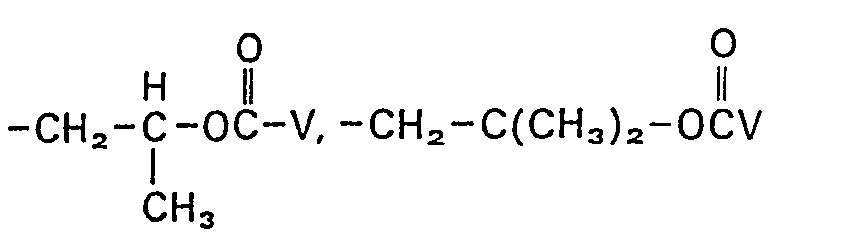
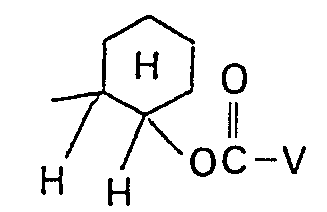
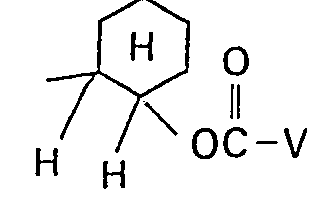
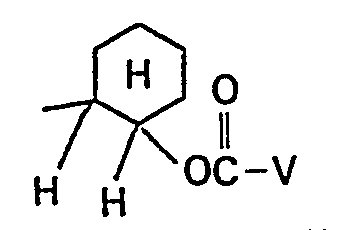
- Y are -OCO-C 3 -C 18 -alkyl, where the alkyl is optionally substituted by C 1 -C 8 -alkoxy, ⁇ OCO ⁇ OR 11 , ⁇ OPO (OR 2 ) 2 and ⁇ OR 3 , wherein R 11 has the meaning given above and R 2 is C 4 - to C 18 -alkyl, a 4- (C 3 - to C 10 -alkyl) cyclohexyl or a residue of a saturated mono-, bi- or polycyclic C 7 - to C 30 hydrocarbon and R 3 for C 3 - to C 18 alkyl, for 4- (C 3 - to C 10 alkyl) cyclohexyl, for a residue of a saturated mono-, bi- or polycyclic C 7 - bis C 30 hydrocarbon or for a remainder of the formulas or and V represents C s - to C 1 9 -alkyl, 4-C 3 - to C 20 -alkylphen
- the substituents Y in the case of disubstitution are preferably in positions 2 and 11, 4 and 13, 5 and 14, in particular in positions 6 and 15, and in Case of tetra substitution in positions 15, 16, 17 and 18.
- the substituents Y are preferably in positions 16 and 17, 3 and 12, 1 and 14.15 and 18, and 1.14, 16 and 17 and in particular in positions 16 and 17.
- the latter dyes have improved lightfastness compared to the other isoviolanthrone and violanthrone dyes.
- the compounds of the formulas I to VI are obtained by reacting the corresponding dihydroxy- or tetrahydroxyviolanthrendiones or isoviolanthrendiones with the corresponding acylating agents or alkylating agents.
- the acylation takes place e.g. with the corresponding acid halides, e.g. with the carboxylic acid chloride, phosphoric acid chloride or the corresponding sulfonic acid chloride in pyridine or in nitrobenzene in the presence of soda or potassium carbonate.
- the corresponding acid halides e.g. with the carboxylic acid chloride, phosphoric acid chloride or the corresponding sulfonic acid chloride in pyridine or in nitrobenzene in the presence of soda or potassium carbonate.
- the ethers are prepared by reaction with the corresponding alkylating agents in dimethylformamide or nitrobenzene. Details of the production can be found in the examples.
- reaction products of the formulas I to VI are purified by processes known per se, e.g. by recrystallization from organic solvents, by countercurrent distribution according to Craig, by chromatographic methods such as column chromatography, high pressure liquid chromatography or preparative layer chromatography. If necessary, the cleaning process is repeated one or more times or different cleaning processes are combined in order to obtain very pure compounds.
- the compounds 1 to VI are incorporated into plastics suitable for the application.
- the plastic is powdered as granules with the required amount of dye and the granules are then extruded to form sheets.
- Polymethyl methacrylate, polymethylacrylate, polystyrene, polydiethylene glycol are preferably used as plastics (medium), for example for use in concentrating light for solar cells koldiallyl biscarbonate, and also suitable polyamides and polycarbonates and polyvinyl chloride.
- the compounds can also be used when the plastic plates are produced by the casting process.
- the light collection systems can also use the compounds up to VI in the form of a solution, e.g. contained in alcohols, ketones, halogenated hydrocarbons or ethers.
- the new light collection systems can be used, for example, in conjunction with solar cells for harnessing solar energy and in scintillators of a known type (see, for example, JB Birks " The Theory and Practice of Scintillation Counting" [Pergamon Press, London 1964]; “ J. Opt. Am.”, 39, 912 [1949]; “ J. Appl. Phys.”, 40, 3544 [1969]; “Nuclear Instruments a. Methods", 87, 111 to 123 [1970]; “Research Disclosure", p. 43 [1977]; DE-OS No. 2629641) find use.
- they are suitable in conjunction with electronic controls as display devices with very low energy consumption.
- they are suitable for a variety of display, information and marking purposes, for example in passive display elements, information and traffic signs such as traffic lights and in drawing devices.
- the invention is illustrated by the following examples.
- the parts and percentages given below refer to the weight.
- the absorption maxima were determined on solutions of the dyes in chloroform.
- Fluorescence plates or foils are produced in accordance with application examples 1 or 2:
- red fluorescent dyes of the formulas X and Xa given in the following table were obtained analogously to Example 51.
- red fluorescent dyes of the formulas X and Xa given in the table below were prepared analogously to Example 58.
Landscapes
- Chemical & Material Sciences (AREA)
- Organic Chemistry (AREA)
- Engineering & Computer Science (AREA)
- Polymers & Plastics (AREA)
- Materials Engineering (AREA)
- Medicinal Chemistry (AREA)
- Physics & Mathematics (AREA)
- Electromagnetism (AREA)
- Chemical Kinetics & Catalysis (AREA)
- General Engineering & Computer Science (AREA)
- Health & Medical Sciences (AREA)
- Compositions Of Macromolecular Compounds (AREA)
- Luminescent Compositions (AREA)
- Organic Low-Molecular-Weight Compounds And Preparation Thereof (AREA)
- Silver Salt Photography Or Processing Solution Therefor (AREA)
- Detergent Compositions (AREA)
- Plural Heterocyclic Compounds (AREA)
Claims (11)




au moins un Y2 est mis pour un radical de formule -OSO2R1,






Applications Claiming Priority (2)
| Application Number | Priority Date | Filing Date | Title |
|---|---|---|---|
| DE19813133390 DE3133390A1 (de) | 1981-08-24 | 1981-08-24 | Verfahren zur flaechenmaessigen konzentrierung von licht und neue fluoreszierende verbindungen |
| DE3133390 | 1981-08-24 |
Publications (2)
| Publication Number | Publication Date |
|---|---|
| EP0073007A1 EP0073007A1 (fr) | 1983-03-02 |
| EP0073007B1 true EP0073007B1 (fr) | 1984-12-27 |
Family
ID=6139972
Family Applications (1)
| Application Number | Title | Priority Date | Filing Date |
|---|---|---|---|
| EP82107502A Expired EP0073007B1 (fr) | 1981-08-24 | 1982-08-18 | Procédé pour la concentration de la lumière dans une plaine et composés fluorescents |
Country Status (4)
| Country | Link |
|---|---|
| US (1) | US4486587A (fr) |
| EP (1) | EP0073007B1 (fr) |
| JP (2) | JPS5840359A (fr) |
| DE (2) | DE3133390A1 (fr) |
Cited By (4)
| Publication number | Priority date | Publication date | Assignee | Title |
|---|---|---|---|---|
| US8299354B2 (en) | 2008-08-19 | 2012-10-30 | Sabic Innovative Plastics Ip B.V. | Luminescent solar collector |
| US8304645B2 (en) | 2008-08-19 | 2012-11-06 | Sabic Innovative Plastics Ip B.V. | Luminescent solar collector |
| US8304647B2 (en) | 2008-08-19 | 2012-11-06 | Sabic Innovative Plastics Ip B.V. | Luminescent solar collector |
| US8314325B2 (en) | 2008-08-19 | 2012-11-20 | Sabic Innovative Plastics Ip B.V. | Luminescent solar collector |
Families Citing this family (18)
| Publication number | Priority date | Publication date | Assignee | Title |
|---|---|---|---|---|
| DE3514967A1 (de) * | 1985-04-25 | 1986-10-30 | Agfa-Gevaert Ag, 5090 Leverkusen | Sichtfenster von cassetten |
| DE3933903A1 (de) * | 1989-10-11 | 1991-04-18 | Basf Ag | Fluoreszenzpigmente |
| DE3942893A1 (de) * | 1989-12-23 | 1991-06-27 | Bayer Ag | Heterocyclische verbindungen |
| GB2251242B (en) * | 1990-12-31 | 1995-01-11 | Robert Ramage | Protecting compound |
| DE4424817A1 (de) | 1994-07-14 | 1996-01-18 | Basf Ag | Vernetzte Polymerteilchen mit Fluoreszenzfarbstoff |
| DE19949382A1 (de) | 1999-10-13 | 2001-04-19 | Basf Ag | Verwendung feinteiliger, farbstoffhaltiger Polymerisate PF als farbgebenden Bestandteil in kosmetischen Mitteln |
| US6084132A (en) * | 1999-12-03 | 2000-07-04 | Rohm And Haas Company | Fluorescent dyes |
| US6215008B1 (en) | 1999-12-03 | 2001-04-10 | Rohm And Haas Company | Fluorescent dyes |
| US6893147B2 (en) | 2002-04-05 | 2005-05-17 | General Electric Company | Lamp lens or bezel with visual effect |
| US7718238B2 (en) | 2002-05-13 | 2010-05-18 | Sabic Innovative Plastics Ip B.V. | Plastics articles such as bottles with visual effect |
| DE102005012211A1 (de) * | 2005-03-15 | 2006-09-28 | Basf Ag | Verwendung von Dibenzanthron- und Isodibenzanthron-Derivaten als Markierungsstoffe für Flüssigkeiten |
| DE102005043572A1 (de) * | 2005-09-12 | 2007-03-15 | Basf Ag | Fluoreszenzkonversionssolarzellen auf Basis von Terrylenfluoreszenzfarbstoffen |
| US8129190B2 (en) * | 2006-11-17 | 2012-03-06 | Applied Nanotech Holdings, Inc. | Tagged petroleum products and methods of detecting same |
| TW201139532A (en) | 2010-04-30 | 2011-11-16 | Styron Europe Gmbh | Improved light diffusing composition |
| US8513445B2 (en) | 2010-09-29 | 2013-08-20 | Polyera Corporation | Polycyclic aromatic molecular semiconductors and related compositions and devices |
| KR20150013796A (ko) | 2012-05-16 | 2015-02-05 | 노보폴리머스 앤.브이. | 폴리머 시트 |
| JP2014040380A (ja) * | 2012-08-21 | 2014-03-06 | Sharp Corp | 化合物、太陽電池モジュール及び太陽光発電装置 |
| JPWO2022250087A1 (fr) * | 2021-05-25 | 2022-12-01 |
Family Cites Families (6)
| Publication number | Priority date | Publication date | Assignee | Title |
|---|---|---|---|---|
| US1736084A (en) * | 1924-12-27 | 1929-11-19 | Gen Aniline Works Inc | Condensation product of the anthraquinone series and process of making same |
| US1713680A (en) * | 1925-10-20 | 1929-05-21 | Grasselli Dyestuff Corp | Green vat dyestuffs and process of making the same |
| US2075456A (en) * | 1934-05-04 | 1937-03-30 | Gen Aniline Works Inc | Compounds of the dibenzanthrone series |
| US3630941A (en) * | 1968-09-03 | 1971-12-28 | American Cyanamid Co | Infrared fluorescing systems |
| BE754442A (fr) * | 1969-08-05 | 1971-02-05 | Montedison Spa | Colorants de cuve |
| CH632731A5 (de) * | 1978-01-11 | 1982-10-29 | Ciba Geigy Ag | Verfahren zur herstellung von alkoxy-substituierten polycyclischen aromatischen verbindungen. |
-
1981
- 1981-08-24 DE DE19813133390 patent/DE3133390A1/de not_active Withdrawn
-
1982
- 1982-08-18 EP EP82107502A patent/EP0073007B1/fr not_active Expired
- 1982-08-18 DE DE8282107502T patent/DE3261699D1/de not_active Expired
- 1982-08-20 US US06/409,833 patent/US4486587A/en not_active Expired - Lifetime
- 1982-08-23 JP JP57144889A patent/JPS5840359A/ja active Pending
-
1987
- 1987-02-06 JP JP62024932A patent/JPS62209172A/ja active Granted
Cited By (4)
| Publication number | Priority date | Publication date | Assignee | Title |
|---|---|---|---|---|
| US8299354B2 (en) | 2008-08-19 | 2012-10-30 | Sabic Innovative Plastics Ip B.V. | Luminescent solar collector |
| US8304645B2 (en) | 2008-08-19 | 2012-11-06 | Sabic Innovative Plastics Ip B.V. | Luminescent solar collector |
| US8304647B2 (en) | 2008-08-19 | 2012-11-06 | Sabic Innovative Plastics Ip B.V. | Luminescent solar collector |
| US8314325B2 (en) | 2008-08-19 | 2012-11-20 | Sabic Innovative Plastics Ip B.V. | Luminescent solar collector |
Also Published As
| Publication number | Publication date |
|---|---|
| DE3133390A1 (de) | 1983-03-10 |
| JPS5840359A (ja) | 1983-03-09 |
| EP0073007A1 (fr) | 1983-03-02 |
| DE3261699D1 (en) | 1985-02-07 |
| JPH0316390B2 (fr) | 1991-03-05 |
| JPS62209172A (ja) | 1987-09-14 |
| US4486587A (en) | 1984-12-04 |
Similar Documents
| Publication | Publication Date | Title |
|---|---|---|
| EP0073007A1 (fr) | Procédé pour la concentration de la lumière dans une plaine et composés fluorescents | |
| EP0156997B1 (fr) | Procédé de concentration de la lumière sur une surface plane | |
| DE3434059C2 (de) | Tetrachlorperylen-3,4,9,10-tetracarbonsäurediimide | |
| EP0054217B1 (fr) | Colorants anthraquinoniques, procédé pour leur préparation, leur utilisation ainsi que des compositions à base de cristal liquide contenant des colorants anthraquinoniques | |
| EP0093367B1 (fr) | Colorants anthraquinoniques, leur préparation et utilisation et matériau dichroique contenant ces colorants anthraquinoniques | |
| EP0252406B1 (fr) | Procédé de fabrication de composés polycycliques | |
| EP0657436A2 (fr) | Procédé pour la préparation des dérivés des acides pérylène-3,4-dicarboxyliques, les composés préparés selon ce procédé et leur utilisation | |
| DE19848555A1 (de) | Neue Fluoreszenzfarbstoffe durch Kern-Erweiterung von Perylen-3,4:9,10-tetracarbonsäurebisimiden | |
| EP0638613A1 (fr) | Colorants perylène amidine-amide, procédé pour leur préparation et leur utilisation | |
| EP0227980B1 (fr) | Diimides de l'acide 3,4,9,10-pérylènetétracarboxylique fluorescentes et substituées par un groupe aroxy et leur emploi pour concentrer la lumière sur de petites surfaces | |
| EP0111197B1 (fr) | Colorants anthraquinoniques, leur préparation et leur utilisation ainsi qu'une matière dichroique contenant des colorants anthraquinoniques | |
| EP0769532A1 (fr) | Colorants fluorescents de naphtolactamimide | |
| EP0081766B1 (fr) | Systèmes pour récolter la lumière utilisant des dérivés de pérylène comme convertisseurs de lumière | |
| DE69814203T2 (de) | Flüssigkristallverbindungen und Verfahren zur Herstellung | |
| EP0854144B1 (fr) | Préparation d'acide perylene-3,4-dicarboxylique anhydrides | |
| DE3235526A1 (de) | Verfahren zur flaechenmaessigen konzentrierung von licht | |
| EP0046164A2 (fr) | Utilisation des dérivés de pérylène pour fonctions de fluorescence ainsi que des dérivés de pérylène | |
| DE3609804A1 (de) | Thiazolyl-cyan-cumarine und ihre verwendung zur flaechenmaessigen konzentrierung von licht | |
| DE102007004016A1 (de) | Bichromophore Perylenabkömmlinge für Solarenergiesysteme | |
| DE2929414A1 (de) | Pyrimido- eckige klammer auf 5',4' zu 5,6 eckige klammer zu -pyrido- eckige klammer auf 1,2-a eckige klammer zu -benzimidazole, verfahren zu ihrer herstellung und deren verwendung | |
| DE19924382B4 (de) | Triphenodioxazinverbindung, Herstellungsverfahren dafür und Flüssigkristallzusammensetzung | |
| DE2607966C3 (de) | Benzothioxanthene, Verfahren zu ihrer Herstellung und ihre Verwendung als Fluoreszenzfarbstoffe | |
| DE4327273A1 (de) | Perylenamidinimid-Farbstoffe | |
| DE1569731C3 (de) | Styrylfarbstoffe, Verfahren zu deren Herstellung und ihre Verwendung zum Färben und Bedrucken von Fasermaterialien | |
| DE3001188A1 (de) | Anthrapyrimidinderivate und ihre verwendung als farbstoffe |
Legal Events
| Date | Code | Title | Description |
|---|---|---|---|
| PUAI | Public reference made under article 153(3) epc to a published international application that has entered the european phase |
Free format text: ORIGINAL CODE: 0009012 |
|
| 17P | Request for examination filed |
Effective date: 19821211 |
|
| AK | Designated contracting states |
Designated state(s): CH DE FR GB IT LI |
|
| ITF | It: translation for a ep patent filed | ||
| GRAA | (expected) grant |
Free format text: ORIGINAL CODE: 0009210 |
|
| AK | Designated contracting states |
Designated state(s): CH DE FR GB IT LI |
|
| REF | Corresponds to: |
Ref document number: 3261699 Country of ref document: DE Date of ref document: 19850207 |
|
| ET | Fr: translation filed | ||
| ET1 | Fr: translation filed ** revision of the translation of the patent or the claims | ||
| PLBE | No opposition filed within time limit |
Free format text: ORIGINAL CODE: 0009261 |
|
| STAA | Information on the status of an ep patent application or granted ep patent |
Free format text: STATUS: NO OPPOSITION FILED WITHIN TIME LIMIT |
|
| 26N | No opposition filed | ||
| ITTA | It: last paid annual fee | ||
| PGFP | Annual fee paid to national office [announced via postgrant information from national office to epo] |
Ref country code: FR Payment date: 19960723 Year of fee payment: 15 |
|
| PGFP | Annual fee paid to national office [announced via postgrant information from national office to epo] |
Ref country code: CH Payment date: 19960731 Year of fee payment: 15 |
|
| PGFP | Annual fee paid to national office [announced via postgrant information from national office to epo] |
Ref country code: GB Payment date: 19960816 Year of fee payment: 15 |
|
| PGFP | Annual fee paid to national office [announced via postgrant information from national office to epo] |
Ref country code: DE Payment date: 19960821 Year of fee payment: 15 |
|
| PG25 | Lapsed in a contracting state [announced via postgrant information from national office to epo] |
Ref country code: DE Effective date: 19970627 |
|
| PG25 | Lapsed in a contracting state [announced via postgrant information from national office to epo] |
Ref country code: GB Free format text: LAPSE BECAUSE OF NON-PAYMENT OF DUE FEES Effective date: 19970818 |
|
| PG25 | Lapsed in a contracting state [announced via postgrant information from national office to epo] |
Ref country code: LI Free format text: LAPSE BECAUSE OF NON-PAYMENT OF DUE FEES Effective date: 19970831 Ref country code: CH Free format text: LAPSE BECAUSE OF NON-PAYMENT OF DUE FEES Effective date: 19970831 |
|
| GBPC | Gb: european patent ceased through non-payment of renewal fee |
Effective date: 19970818 |
|
| REG | Reference to a national code |
Ref country code: CH Ref legal event code: PL |
|
| PG25 | Lapsed in a contracting state [announced via postgrant information from national office to epo] |
Ref country code: FR Free format text: LAPSE BECAUSE OF NON-PAYMENT OF DUE FEES Effective date: 19980430 |
|
| REG | Reference to a national code |
Ref country code: FR Ref legal event code: ST |