EP0073021B1 - Acier martensitique, résistant aux températures élevées - Google Patents
Acier martensitique, résistant aux températures élevées Download PDFInfo
- Publication number
- EP0073021B1 EP0073021B1 EP82107559A EP82107559A EP0073021B1 EP 0073021 B1 EP0073021 B1 EP 0073021B1 EP 82107559 A EP82107559 A EP 82107559A EP 82107559 A EP82107559 A EP 82107559A EP 0073021 B1 EP0073021 B1 EP 0073021B1
- Authority
- EP
- European Patent Office
- Prior art keywords
- molybdenum
- tungsten
- point
- steel
- creep rupture
- Prior art date
- Legal status (The legal status is an assumption and is not a legal conclusion. Google has not performed a legal analysis and makes no representation as to the accuracy of the status listed.)
- Expired
Links
- 229910000831 Steel Inorganic materials 0.000 title claims description 48
- 239000010959 steel Substances 0.000 title claims description 48
- 229910000734 martensite Inorganic materials 0.000 title claims description 25
- 229910052721 tungsten Inorganic materials 0.000 claims description 42
- 229910052750 molybdenum Inorganic materials 0.000 claims description 34
- 239000011651 chromium Substances 0.000 claims description 24
- 239000010955 niobium Substances 0.000 claims description 18
- 229910052804 chromium Inorganic materials 0.000 claims description 13
- IJGRMHOSHXDMSA-UHFFFAOYSA-N Atomic nitrogen Chemical compound N#N IJGRMHOSHXDMSA-UHFFFAOYSA-N 0.000 claims description 12
- VYZAMTAEIAYCRO-UHFFFAOYSA-N Chromium Chemical compound [Cr] VYZAMTAEIAYCRO-UHFFFAOYSA-N 0.000 claims description 12
- 238000010791 quenching Methods 0.000 claims description 12
- 230000000171 quenching effect Effects 0.000 claims description 12
- 229910052799 carbon Inorganic materials 0.000 claims description 11
- 229910052757 nitrogen Inorganic materials 0.000 claims description 10
- 229910052759 nickel Inorganic materials 0.000 claims description 8
- 238000005496 tempering Methods 0.000 claims description 8
- 239000012535 impurity Substances 0.000 claims description 7
- 229910052758 niobium Inorganic materials 0.000 claims description 7
- OKTJSMMVPCPJKN-UHFFFAOYSA-N Carbon Chemical compound [C] OKTJSMMVPCPJKN-UHFFFAOYSA-N 0.000 claims description 6
- 229910052720 vanadium Inorganic materials 0.000 claims description 6
- ZOKXTWBITQBERF-UHFFFAOYSA-N Molybdenum Chemical compound [Mo] ZOKXTWBITQBERF-UHFFFAOYSA-N 0.000 claims 20
- 239000011733 molybdenum Substances 0.000 claims 20
- WFKWXMTUELFFGS-UHFFFAOYSA-N tungsten Chemical compound [W] WFKWXMTUELFFGS-UHFFFAOYSA-N 0.000 claims 20
- 239000010937 tungsten Substances 0.000 claims 20
- XEEYBQQBJWHFJM-UHFFFAOYSA-N Iron Chemical compound [Fe] XEEYBQQBJWHFJM-UHFFFAOYSA-N 0.000 claims 8
- PXHVJJICTQNCMI-UHFFFAOYSA-N Nickel Chemical compound [Ni] PXHVJJICTQNCMI-UHFFFAOYSA-N 0.000 claims 8
- XUIMIQQOPSSXEZ-UHFFFAOYSA-N Silicon Chemical compound [Si] XUIMIQQOPSSXEZ-UHFFFAOYSA-N 0.000 claims 4
- 229910052742 iron Inorganic materials 0.000 claims 4
- GUCVJGMIXFAOAE-UHFFFAOYSA-N niobium atom Chemical compound [Nb] GUCVJGMIXFAOAE-UHFFFAOYSA-N 0.000 claims 4
- 229910052710 silicon Inorganic materials 0.000 claims 4
- 239000010703 silicon Substances 0.000 claims 4
- LEONUFNNVUYDNQ-UHFFFAOYSA-N vanadium atom Chemical compound [V] LEONUFNNVUYDNQ-UHFFFAOYSA-N 0.000 claims 4
- WPBNNNQJVZRUHP-UHFFFAOYSA-L manganese(2+);methyl n-[[2-(methoxycarbonylcarbamothioylamino)phenyl]carbamothioyl]carbamate;n-[2-(sulfidocarbothioylamino)ethyl]carbamodithioate Chemical compound [Mn+2].[S-]C(=S)NCCNC([S-])=S.COC(=O)NC(=S)NC1=CC=CC=C1NC(=S)NC(=O)OC WPBNNNQJVZRUHP-UHFFFAOYSA-L 0.000 claims 3
- PWHULOQIROXLJO-UHFFFAOYSA-N Manganese Chemical compound [Mn] PWHULOQIROXLJO-UHFFFAOYSA-N 0.000 claims 1
- 229910052748 manganese Inorganic materials 0.000 claims 1
- 239000011572 manganese Substances 0.000 claims 1
- 229910000859 α-Fe Inorganic materials 0.000 description 23
- 239000000463 material Substances 0.000 description 21
- 238000012360 testing method Methods 0.000 description 13
- 238000000034 method Methods 0.000 description 8
- 229910045601 alloy Inorganic materials 0.000 description 7
- 239000000956 alloy Substances 0.000 description 7
- 238000000151 deposition Methods 0.000 description 6
- 230000007423 decrease Effects 0.000 description 5
- 230000008021 deposition Effects 0.000 description 5
- 239000000203 mixture Substances 0.000 description 4
- 229910001208 Crucible steel Inorganic materials 0.000 description 3
- 238000005275 alloying Methods 0.000 description 3
- 239000000470 constituent Substances 0.000 description 3
- 238000001816 cooling Methods 0.000 description 3
- 229910000851 Alloy steel Inorganic materials 0.000 description 2
- 229910001566 austenite Inorganic materials 0.000 description 2
- 230000015572 biosynthetic process Effects 0.000 description 2
- 239000003795 chemical substances by application Substances 0.000 description 2
- 230000000052 comparative effect Effects 0.000 description 2
- 238000011161 development Methods 0.000 description 2
- 238000010586 diagram Methods 0.000 description 2
- 239000002803 fossil fuel Substances 0.000 description 2
- 238000010438 heat treatment Methods 0.000 description 2
- 229910000599 Cr alloy Inorganic materials 0.000 description 1
- 239000000788 chromium alloy Substances 0.000 description 1
- 239000003245 coal Substances 0.000 description 1
- 238000005260 corrosion Methods 0.000 description 1
- 230000007797 corrosion Effects 0.000 description 1
- 238000013016 damping Methods 0.000 description 1
- 230000003247 decreasing effect Effects 0.000 description 1
- 230000000694 effects Effects 0.000 description 1
- 230000002349 favourable effect Effects 0.000 description 1
- 238000011835 investigation Methods 0.000 description 1
- 238000004519 manufacturing process Methods 0.000 description 1
- 238000005259 measurement Methods 0.000 description 1
- UNASZPQZIFZUSI-UHFFFAOYSA-N methylidyneniobium Chemical group [Nb]#C UNASZPQZIFZUSI-UHFFFAOYSA-N 0.000 description 1
- 239000003208 petroleum Substances 0.000 description 1
- 230000000630 rising effect Effects 0.000 description 1
- 238000005507 spraying Methods 0.000 description 1
- 239000000126 substance Substances 0.000 description 1
- XLYOFNOQVPJJNP-UHFFFAOYSA-N water Substances O XLYOFNOQVPJJNP-UHFFFAOYSA-N 0.000 description 1
Images

Classifications
-
- C—CHEMISTRY; METALLURGY
- C22—METALLURGY; FERROUS OR NON-FERROUS ALLOYS; TREATMENT OF ALLOYS OR NON-FERROUS METALS
- C22C—ALLOYS
- C22C38/00—Ferrous alloys, e.g. steel alloys
- C22C38/18—Ferrous alloys, e.g. steel alloys containing chromium
- C22C38/22—Ferrous alloys, e.g. steel alloys containing chromium with molybdenum or tungsten
Definitions
- the present invention relates to martensitic heat-resistant steel, in particular to a martensitic heat-resistant steel having an increased high temperature strength which is suitably used for turbine blades and the like.
- crucible steel 422 (12Cr-1 Mo-1W-1/4V steel) or steel H46 (12Cr-Mo-Nb-V steel) is used for the blades and 1Cr-1Mo-1/4V steel or 11Cr-1Mo-V-Nb-N steel is used for the rotor shafts.
- thermoelectric power plants using such fossil fuels. It is necessary to raise the steam temperature or pressure of a steam turbine in order to increase the generator efficiency. Materials used for steam turbines have insufficient creep rupture strength and so stronger materials are needed.
- Ni-base alloys and Co-base alloys are superior but these materials are expensive in addition to having inferior workability and a low damping constant.
- US-A-2,848,323 discloses a hardenable martensitic chromium alloy steel which contains nitrogen and further 0.05-0.15% AI in order to increase the percentage of nitrogen which may safely be added to the alloy.
- the alloy further includes Co in an amount of 2-10%, however, AI remarkably reduces the creep breaking resistance, and such amounts of Co reduce the high temperature strength of the alloy in the same way as Ni.
- US ⁇ A ⁇ 3,069,257 discloses a stainless alloy steel suited to high temperature applications. While this alloy includes Ni which improves the low temperature toughness the amount of Ni is low (less than 0.25%) and thus the toughness is relatively low.
- the inventors of the present invention found from successive investigations that the addition of Mo and W to heat-resistant steel of 11 Cr type containing C, Nb, Ni and N in amounts such that 6-ferrite may not be deposited leads to a rise of the creep strength.
- the present invention relates to a martensitic heat-resistant steel having an increased high temperature strength, which was invented on the basis of the above discovery.
- the steel consists of 0.1 to 0.2 wt.% C 0.4 wt.% or less Si, 1 wt.% or less Mn, 9 to 12 wt.% Cr, 0.1 to 0.3 wt.% V, 0.02 to 0.25 wt.% Nb, 0.03 to 0.1 wt.% N, 0.4 to 0.8 wt.% Ni, Mo and W being contained within the range surrounded by the points E: (Mo 0.9 wt.%, W 0.95 wt.%), F (Mo 1.3 wt%, W 0.95 wt.%), C: (Mo 1.6 wt.%, W 0.33 wt.%) and G: (Mo 1.1 wt.%, W 0.33 wt.%), as shown in Fig. 1, and the balance of Fe with incidental impurities.
- C is the essential element for achieving the desired tensile strength, too much of it leads to an unstable structure at higher temperatures and a decreased creep rupture strength.
- the optimal C content of 0.1 to 0.2 wt.% was determined.
- Nb is remarkably effective for increasing the high temperature strength, the addition of excessive amounts leads to the excessive deposition of niobium carbide and reduces the carbon concentration to reduce the strength, on the contrary.
- 0.07 to 0.25 wt.% Nb is preferably added since the quenching speed is fast for small-sized parts such as turbine blades in the case of the addition of Mo, W, V and N, to 11 Cr type steels.
- a higher creep rupture strength can be achieved with a Nb content of 0.02 to 0.12 wt.% since the quenching speed is lower.
- Cr is added in amounts of 9 to 12 wt.% since the addition of 9 wt.% or less of Cr leads to insufficient corrosion resistance to high temperature and pressure steam while the addition of excessive amounts of Cr leads to the development of 6-ferrite although it improves the high temperature strength.
- An especially preferred range is from 10.5 to 11.5 wt.%.
- Ni is added in amounts of 0.4 to 0.8 wt.% because the addition of excessive amounts of Ni leads to a decrease of the creep rupture strength although it is remarkably effective for increasing the toughness and preventing 6-ferrite from developing.
- Mn which is added as a deoxidizing agent in small amounts to achieve sufficient effects, is preferably added in amounts of 1 wt.% or less because addition in large amounts leads to the decrease of the high temperature strength. Especially preferred is a range of from 0.4 to 0.8 wt.%.
- Si deoxidizing in which Si is used as a deoxidizing agent, is not required.
- Si is preferably added in amounts of 0.4% or less by weight since a low Si content helps prevent 6-ferrite from depositing and prevent of temper brittleness.
- 6-ferrite lowers the ductility of steel and the contents of the 6-ferrite forming elements are adjusted lest 5-ferrite is substantially formed in the steel.
- the following chromium equivalent method is employed to prevent the formation of 6-ferrite.
- each alloying constituent is given a numerical value as an austenite promoter or ferrite promoter, it having been found that when the numerical value of each alloying constituent is multiplied by the weight percent of the constituent present and algebraically added and the sum is less than ten, the structure obtained is essentially free from ferrite.
- chromium equivalents as austenite promoters and ferrite promoters are set forth in the table below, and it will be understood that any reference to chromium equivalents herein refers to the chromium equivalent calculated using the values in the table.
- the chromium equivalents for preventing the formation of ⁇ -ferrite are somewhat affected by the quenching speed of the alloy steel.
- the chromium equivalents may be up to 10 in the case of small component parts because a high quenching speed can be used but in the case of large-scaled structures such as a steam turbine rotor shaft, the chromium equivalents are preferably below 9 because the quenching speed becomes low.
- the alloy structure preferably has a fully tempered martensitic structure because strength as well as ductility are high.
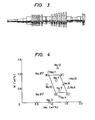
- the martensitic heat-resistant steel in accordance with the present invention is suitable for use in steam turbine blades and a steam turbine rotor shaft shown in Figs. 2 and 3 as the typical examples of steel application.
- the combination of alloying elements in the following composition is especially preferred.
- the steel is composed of forged steel consisting of 0.1 to 0.2 wt.% of C, up to 0.4 wt.% of Si, up to 1 wt.% of Mn, 9 to 12 wt.% of Cr, 0.1 to 0.3 wt.% of V, 0.07 to 0.25 wt.% of Nb, 0.03 to 0.1 wt.% of N, 0.4 to 0.8 wt.% of Ni, Mo and W in amounts falling within the range encompassed by lines connecting a point E (0.9 wt.% of Mo and 0.95 wt.% of W), a point F (1.3 wt.% of Mo and 0.95 wt.% of W), a point C (1.6 wt.% of Mo and 0.33 wt.% of W) and a point G (1.1 wt.% of Mo and 0.33 wt.% of W) and the balance of Fe with incidental impurities, having the chromium equivalents of up to 10 and consisting of a
- the fully tempered martensitic structure can be obtained by subjecting the steam turbine blades to the quenching treatment in which they are heated to 1,000 to 1,150°C for 30 minutes to one hour and are then quenched to form the fully martensitic structure, and then to the tempering treatment in which they are heated to 600 to 700°C for 1 to 5 hours and are then cooled slowly. Quenching is preferably carried out in oil and cooling after tempering is preferably furnace cooling.
- the steel is composed of forged steel consisting of 0.1 to 0.2 wt.% of C, up to 0.4 wt.% of Si, up to 1 wt.% of Mn, 9 to 12 wt.% of Cr, 0.1 to 0.3 wt.% of V, 0.02 to 0.12 wt.% of Nb, 0.03 to 0.1 wt.% of N, 0.4 to 0.8 wt.% of Ni, Mo and W in amounts falling within the range encompassed by lines connecting a point E (0.9 wt.% of Mo and 0.95 wt.% of W), a point F (1.3 wt.% of Mo and 0.95 wt.% of W), the point C (1.6 wt.% of Mo and 0.33 wt.% of W) and a point G (1.1 wt.% of Mo and 0.33 wt.% of W) and the balance of Fe with incidental impurities having a fully tempered martensitic structure and having a Cr equivalent of up
- the fully tempered martensitic structure can be obtained by subjecting the steam turbine rotor shaft to the quenching treatment in which it is heated uniformly to 1,050 to 1,100°C and is then quenched to form the fully martensitic structure, then to the primary tempering treatment in which the rotor shaft is heated to 530 to 600°C for 12 to 48 hours and is then quenched, and further to the secondary tempering treatment in which the rotor shaft is heated to a temperature, which is higher than the primary tempering temperature and is within the range of from 590 to 700°C, for at least 12 hours and then cooled slowly.
- the rotor shaft is preferably turned while being heated in both quenching and tempering. Cooling for quenching is preferably effected by spraying water while rotating the rotor shaft.
- Sample No. 1 is equivalent to Crucible steel 422
- sample No. 2 is equivalent to steel H46
- sample No. 3 is equivalent to the conventional 12Cr type steels for rotors. All of these samples were prepared for comparison with the materials according to the present invention, designated by Nos. 5, 7, and 14.
- Sample No. 1 was quenched in oil after being uniformly heated at 1,050°C and then tempered in the furnace at 630°C for 3 hours.
- the samples other than No. 1 were quenched in oil after being uniformly heated at 1,100°C and then tempered in the furnace at 650°C for 3 hours.
- Table 1 shows the measurement results of the above samples on tensile strength, elongation and reduction of area.
- Fig. 4 shows the relationship between the contents of Mo and W and to creep rupture strength at 600°C as well as the deposition of ⁇ -ferrite for 11Cr-Mo-W-0.2V-0.1Nb-0.05N steel. It is clearly found from Fig. 2 that the addition of excess Mo and W leads to the deposition of 6-ferrite and a reduction of the creep rupture strength, and after all the contents of Mo and W, which lead to higher creep rupture strength and the development of a homogeneous martensitic structure, are within the range defined by the points E, F, C and G.
- 11Cr-1.3Mo-0.2W-0.2V-0.05N-Nb steel shows an increased creep rupture strength at a Nb content of 0.07 to 0.25 wt.%.
- Steels of this type showed a slightly reduced creep rupture strength at a Nb content of 0.05 wt.%.
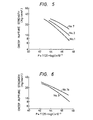
- Fig. 5 shows the results of creep rupture tests by means of Ralson-Miller's parameter method for crucible steel 422 (No. 1) as well as steel H46 (No. 2), which are being used at present as material for turbines, and steel No. 7 according to the present invention.
- the materials according to the present invention show a remarkably higher creep rupture strength than the conventional materials after creeping for 10 5 hours at 600°C of 15.7 kg/mm 2 (154 N/mm 2 ), and thereby are more sutiable for use in high-efficiency steam turbine blades operating at temperatures up to 600°C.
- Sample No. 14 in Table 1 was subjected to heat treatment equivalent to that to which the central holes of the large-sized steam turbine for rotor shaft are subjected.
- the conditions are as follows:
- Fig. 6 shows the results of creep rupture tests by means of Ralson-Miller's parameter method for this sample.
- the results of creep rupture tests for the conventional material are also shown for comparison.
- the material according to the present invention shows a remarkably higher creep rupture strength than the conventional material (No. 3).
- materials containing amounts of Mo and W within the range defined by points E, F, C and G, as shown in Fig. 1 show an increased creep rupture strength (11 kg/mm 2 ) (108 N/mm 2 ) or more for 10 5 hours at 600°C), and the homogeneous martensitic structure required for high efficiency steam turbine rotors operating at steam temperatures up to 600°C.
- the materials of rotor shafts it is important for the materials of rotor shafts to have higher creep rupture strength, tensile strength and impact strength. It was confirmed from the results of tests of the material (No. 14) according to the present invention that it shows superior mechanical properties required of materials for steam turbine rotor shafts, for example, the creep rupture strength after creeping for 10 5 hours at 600°C was 12.5 kg/mm 2 (123 N/mm 2 ), tensile strength of 93.0 kg/mm 2 (912 N/mm 2 ) and Sharpy's V-notched impact value of 1.5 kg-m (14,77), and has the homogeneous tempered martensitic structure not containing ⁇ -ferritic structure.
- martensitic heat-resistant steels according to the present invention have a remarkably higher high temperature strength, in particular a higher creep rupture strength, and are thereby preferably used as the material for high efficiency steam turbine blades and rotors operating at steam temperatures of up to 600°C.
Landscapes
- Chemical & Material Sciences (AREA)
- Engineering & Computer Science (AREA)
- Materials Engineering (AREA)
- Mechanical Engineering (AREA)
- Metallurgy (AREA)
- Organic Chemistry (AREA)
- Turbine Rotor Nozzle Sealing (AREA)
- Heat Treatment Of Strip Materials And Filament Materials (AREA)
- Heat Treatment Of Articles (AREA)
Claims (6)
du molybdène et du tungstène dans des proportions qui se trouvent à l'intérieur d'un domaine limité par les lignes reliant un point E (0,9% en poids de molybdène et 0,95% en poids de tungstène), un point F (1,3% en poids de molybdène et 0,95% en poids de tungstène), un point C (1,6% en poids de molybdène et 0,33% en poids de tungstène) et un point G (1,1% en poids de molybdène et 0,33% en poids de tungstène),
le reste étant constitué par du fer, avec des impuretés accidentelles.
du molybdène et du tungstène dans des proportions comprises dans un domaine délimité par les lignes reliant un point E (0,9% en poids de molybdène et 0,95% en poids de tungstène), un point F (1,3% en poids de molybdène et 0,95% en poids de tungstène), un point C (1,6% en poids de molybdène et 0,33% en poids de tungstène) et un point G (1,1% en poids de molybdène et 0,33% en poids de tungstène).
le reste étant constitué par du fer, avec des impuretés accidentelles;
cet acier ayant une structure martensitique complètement trempée et un équivalent Cr allant jusqu'à 10 et ne présentant pratiquement pas de structure ferritique 5 et lorsque cet acier est soumis au revenu après la trempe, la résistance au fluage pour une durée de 105 heures à 600°C est de 11 kg/mm2 (108 N/mm2) ou plus.
du molybdène et du tungstène dans des proportions comprises dans un domaine délimité par des lignes reliant un point E (0,9% en poids de molybdène et 0,95% en poids de tungstène), un point F (1,3% en poids de molybdène et 0,95% en poids de tungstène), un point C (1,6% en poids de molybdène et 0,33% en poids de tungstène) et un point G (1,1% en poids de molybdène et 0,33% en poids de tungstène)
le reste étant du fer avec des impuretés accidentelles.
du molybdène et du tungstène dans des proportions comprises dans un domaine délimité par des lignes reliant un point E (0,9% en poids de molybdène et 0,95% en poids de tungstène), un point F (1,3% en poids de molybdène et 0,95% en poids de tungstène), un point C (1,6% en poids de molybdène et 0,33% en poids de tungstène) et un point G (1,1% en poids de molybdène et 0,33% en poids de tungstène)
le reste étant constitué par du fer, avec des impuretés accidentelles;
cet acier ayant une structure martensitique complètement trempée et un équivalent Cr allant jusqu'à 10 et ne présentant pratiquement pas de structure ferritique 5 et lorsque cet acier est soumis au revenu après trempe, la résistance au fluage pour une durée de 105 heures à 600°C est de 11 kg/mm2 (108 N/mm2) ou plus.
Applications Claiming Priority (2)
| Application Number | Priority Date | Filing Date | Title |
|---|---|---|---|
| JP56132798A JPS5837159A (ja) | 1981-08-26 | 1981-08-26 | マルテンサイト系耐熱鋼 |
| JP132798/81 | 1981-08-26 |
Publications (2)
| Publication Number | Publication Date |
|---|---|
| EP0073021A1 EP0073021A1 (fr) | 1983-03-02 |
| EP0073021B1 true EP0073021B1 (fr) | 1987-07-22 |
Family
ID=15089807
Family Applications (1)
| Application Number | Title | Priority Date | Filing Date |
|---|---|---|---|
| EP82107559A Expired EP0073021B1 (fr) | 1981-08-26 | 1982-08-18 | Acier martensitique, résistant aux températures élevées |
Country Status (4)
| Country | Link |
|---|---|
| US (1) | US4414024A (fr) |
| EP (1) | EP0073021B1 (fr) |
| JP (1) | JPS5837159A (fr) |
| DE (1) | DE3276826D1 (fr) |
Families Citing this family (17)
| Publication number | Priority date | Publication date | Assignee | Title |
|---|---|---|---|---|
| JPS5989752A (ja) * | 1982-11-15 | 1984-05-24 | Hitachi Ltd | 12Cr系鋼溶接構造物 |
| JPS6024353A (ja) * | 1983-07-20 | 1985-02-07 | Japan Steel Works Ltd:The | 12%Cr系耐熱鋼 |
| JPS60128250A (ja) * | 1983-12-15 | 1985-07-09 | Toshiba Corp | 高クロム耐熱鋳鋼 |
| JPS60190551A (ja) * | 1984-03-09 | 1985-09-28 | Hitachi Ltd | 主蒸気管用耐熱鋼 |
| FR2565251B1 (fr) * | 1984-06-05 | 1987-12-31 | Alsthom Atlantique | Acier pour la fabrication de grosses pieces forgees et procede de traitement de cet acier |
| JPS616257A (ja) * | 1984-06-21 | 1986-01-11 | Toshiba Corp | 12%Cr耐熱鋼 |
| JPS616256A (ja) * | 1984-06-21 | 1986-01-11 | Toshiba Corp | 12%Cr耐熱鋼 |
| EP0188995B1 (fr) * | 1984-10-17 | 1991-01-23 | Mitsubishi Jukogyo Kabushiki Kaisha | Acier de coulée à teneur élevée en chrome pour récipient sous pression à haute température et procédé pour son traitement thermique |
| US4762577A (en) * | 1987-01-30 | 1988-08-09 | Westinghouse Electric Corp. | 9 Chromium- 1 molybdenum steel alloy having superior high temperature properties and weldability, a method for preparing same and articles fabricated therefrom |
| JPH0734202A (ja) * | 1993-07-23 | 1995-02-03 | Toshiba Corp | 蒸気タービン用ロータ |
| JP3315800B2 (ja) * | 1994-02-22 | 2002-08-19 | 株式会社日立製作所 | 蒸気タービン発電プラント及び蒸気タービン |
| US6305078B1 (en) * | 1996-02-16 | 2001-10-23 | Hitachi, Ltd. | Method of making a turbine blade |
| JP2007231868A (ja) * | 2006-03-02 | 2007-09-13 | Hitachi Ltd | 蒸気タービン動翼およびそれを用いた蒸気タービン並びに蒸気タービン発電プラント |
| KR102197204B1 (ko) * | 2013-06-25 | 2021-01-04 | 테나리스 커넥션즈 비.브이. | 고크롬 내열철강 |
| WO2016056654A1 (fr) * | 2014-10-10 | 2016-04-14 | 三菱日立パワーシステムズ株式会社 | Procédé de fabrication d'un corps d'arbre |
| WO2016136888A1 (fr) * | 2015-02-27 | 2016-09-01 | 国立研究開発法人物質・材料研究機構 | Acier ferritique résistant à la chaleur et son procédé de fabrication |
| DE102015206323A1 (de) * | 2015-04-09 | 2016-10-13 | Siemens Aktiengesellschaft | Bauteil mit Festigkeitsgradienten, Verfahren und Turbine |
Family Cites Families (8)
| Publication number | Priority date | Publication date | Assignee | Title |
|---|---|---|---|---|
| US2848323A (en) * | 1955-02-28 | 1958-08-19 | Birmingham Small Arms Co Ltd | Ferritic steel for high temperature use |
| CH369481A (de) * | 1956-01-11 | 1963-05-31 | Birmingham Small Arms Co Ltd | Verfahren zur Erhöhung der Kriechfestigkeit von Chromstahl |
| US3069257A (en) * | 1960-06-02 | 1962-12-18 | Armco Steel Corp | Alloy steel and method |
| US3767390A (en) * | 1972-02-01 | 1973-10-23 | Allegheny Ludlum Ind Inc | Martensitic stainless steel for high temperature applications |
| BE855896A (fr) * | 1977-06-20 | 1977-10-17 | Centre Rech Metallurgique | Ameliorations apportees aux aciers resistant au fluage et a l'oxydation a chaud |
| JPS5817820B2 (ja) * | 1979-02-20 | 1983-04-09 | 住友金属工業株式会社 | 高温用クロム鋼 |
| JPS55134159A (en) * | 1979-04-06 | 1980-10-18 | Daido Steel Co Ltd | Vortex combustion chamber member for diesel engine and mouthpiece material thereof |
| JPS5696056A (en) * | 1979-12-28 | 1981-08-03 | Mitsubishi Heavy Ind Ltd | High chromium steel for high temperature use |
-
1981
- 1981-08-26 JP JP56132798A patent/JPS5837159A/ja active Pending
-
1982
- 1982-08-18 EP EP82107559A patent/EP0073021B1/fr not_active Expired
- 1982-08-18 DE DE8282107559T patent/DE3276826D1/de not_active Expired
- 1982-08-26 US US06/411,802 patent/US4414024A/en not_active Expired - Fee Related
Also Published As
| Publication number | Publication date |
|---|---|
| JPS5837159A (ja) | 1983-03-04 |
| DE3276826D1 (en) | 1987-08-27 |
| US4414024A (en) | 1983-11-08 |
| EP0073021A1 (fr) | 1983-03-02 |
Similar Documents
| Publication | Publication Date | Title |
|---|---|---|
| EP0083254B1 (fr) | Acier résistant aux températures élevées | |
| US4414024A (en) | Martensitic heat-resistant steel | |
| US5069870A (en) | High-strength high-cr steel with excellent toughness and oxidation resistance | |
| JPH0563544B2 (fr) | ||
| EP0384433B1 (fr) | Acier ferritique résistant à la chaleur et présentant une excellente résistance mécanique aux températures élevées | |
| US4564392A (en) | Heat resistant martensitic stainless steel containing 12 percent chromium | |
| KR0175075B1 (ko) | 증기터빈용 회전자 및 그 제조방법 | |
| EP0065631B1 (fr) | Acier résistant à la corrosion et non magnétisable, et anneau de retenue en cette matière pour générateur | |
| US4090813A (en) | High-efficiency turbo-machine impellers | |
| US5591391A (en) | High chromium ferritic heat-resistant steel | |
| EP0384181B1 (fr) | Turbine à vapeur | |
| JPH10251809A (ja) | 高靭性フェライト系耐熱鋼 | |
| EP0178374B1 (fr) | Acier de coulée austénitique, résistant aux températures élevées | |
| JP2002235154A (ja) | 高Crフェライト系耐熱鋼材 | |
| EP0525331A1 (fr) | Acier réfractaire ferritique à haute teneur en chrome et présentant une haute résistance à la fragilisation par précipitation intergranulaire de cuivre | |
| US4585478A (en) | Heat resisting steel | |
| US3065068A (en) | Austenitic alloy | |
| US4927601A (en) | Heat resisting bearing steel | |
| KR100482706B1 (ko) | 오스테나이트스테인레스강및그의용도 | |
| JPS616256A (ja) | 12%Cr耐熱鋼 | |
| US2891858A (en) | Single phase austenitic alloy steel | |
| JPH11209851A (ja) | ガスタービンディスク材 | |
| JPH0885850A (ja) | 高Crフェライト系耐熱鋼 | |
| GB2368849A (en) | Martensitic stainless steel | |
| JP3418884B2 (ja) | 高Crフェライト系耐熱鋼 |
Legal Events
| Date | Code | Title | Description |
|---|---|---|---|
| PUAI | Public reference made under article 153(3) epc to a published international application that has entered the european phase |
Free format text: ORIGINAL CODE: 0009012 |
|
| AK | Designated contracting states |
Designated state(s): DE GB |
|
| 17P | Request for examination filed |
Effective date: 19830706 |
|
| GRAA | (expected) grant |
Free format text: ORIGINAL CODE: 0009210 |
|
| AK | Designated contracting states |
Kind code of ref document: B1 Designated state(s): DE GB |
|
| REF | Corresponds to: |
Ref document number: 3276826 Country of ref document: DE Date of ref document: 19870827 |
|
| PLBE | No opposition filed within time limit |
Free format text: ORIGINAL CODE: 0009261 |
|
| STAA | Information on the status of an ep patent application or granted ep patent |
Free format text: STATUS: NO OPPOSITION FILED WITHIN TIME LIMIT |
|
| 26N | No opposition filed | ||
| PGFP | Annual fee paid to national office [announced via postgrant information from national office to epo] |
Ref country code: GB Payment date: 19930804 Year of fee payment: 12 |
|
| PGFP | Annual fee paid to national office [announced via postgrant information from national office to epo] |
Ref country code: DE Payment date: 19931028 Year of fee payment: 12 |
|
| PG25 | Lapsed in a contracting state [announced via postgrant information from national office to epo] |
Ref country code: GB Effective date: 19940818 |
|
| GBPC | Gb: european patent ceased through non-payment of renewal fee |
Effective date: 19940818 |
|
| PG25 | Lapsed in a contracting state [announced via postgrant information from national office to epo] |
Ref country code: DE Effective date: 19950503 |