EP0073176A2 - Verfahren und Vorrichtung zur gaschromatographischen Analyse und Anwendung dieses Verfahrens - Google Patents
Verfahren und Vorrichtung zur gaschromatographischen Analyse und Anwendung dieses Verfahrens Download PDFInfo
- Publication number
- EP0073176A2 EP0073176A2 EP82810242A EP82810242A EP0073176A2 EP 0073176 A2 EP0073176 A2 EP 0073176A2 EP 82810242 A EP82810242 A EP 82810242A EP 82810242 A EP82810242 A EP 82810242A EP 0073176 A2 EP0073176 A2 EP 0073176A2
- Authority
- EP
- European Patent Office
- Prior art keywords
- adsorbent material
- column
- analyzed
- adsorbent
- analysis
- Prior art date
- Legal status (The legal status is an assumption and is not a legal conclusion. Google has not performed a legal analysis and makes no representation as to the accuracy of the status listed.)
- Ceased
Links
- 238000000034 method Methods 0.000 title claims description 19
- 238000004587 chromatography analysis Methods 0.000 title claims description 6
- 239000000463 material Substances 0.000 claims abstract description 55
- 239000003463 adsorbent Substances 0.000 claims abstract description 42
- 239000000126 substance Substances 0.000 claims abstract description 13
- 238000010438 heat treatment Methods 0.000 claims description 18
- OKTJSMMVPCPJKN-UHFFFAOYSA-N Carbon Chemical compound [C] OKTJSMMVPCPJKN-UHFFFAOYSA-N 0.000 claims description 12
- 238000004458 analytical method Methods 0.000 claims description 12
- 238000003795 desorption Methods 0.000 claims description 11
- 239000007789 gas Substances 0.000 claims description 10
- 239000007787 solid Substances 0.000 claims description 7
- 230000007935 neutral effect Effects 0.000 claims description 4
- 239000012159 carrier gas Substances 0.000 claims description 3
- 238000004817 gas chromatography Methods 0.000 claims description 3
- 239000007788 liquid Substances 0.000 claims description 3
- 239000011819 refractory material Substances 0.000 claims description 3
- 239000000919 ceramic Substances 0.000 claims description 2
- 150000001875 compounds Chemical class 0.000 claims description 2
- 239000010453 quartz Substances 0.000 claims description 2
- VYPSYNLAJGMNEJ-UHFFFAOYSA-N silicon dioxide Inorganic materials O=[Si]=O VYPSYNLAJGMNEJ-UHFFFAOYSA-N 0.000 claims description 2
- 239000011343 solid material Substances 0.000 claims description 2
- 238000001179 sorption measurement Methods 0.000 claims description 2
- 239000002594 sorbent Substances 0.000 claims 1
- IJGRMHOSHXDMSA-UHFFFAOYSA-N Atomic nitrogen Chemical compound N#N IJGRMHOSHXDMSA-UHFFFAOYSA-N 0.000 description 4
- 239000012071 phase Substances 0.000 description 4
- UHOVQNZJYSORNB-UHFFFAOYSA-N Benzene Chemical compound C1=CC=CC=C1 UHOVQNZJYSORNB-UHFFFAOYSA-N 0.000 description 3
- OKKJLVBELUTLKV-UHFFFAOYSA-N Methanol Chemical compound OC OKKJLVBELUTLKV-UHFFFAOYSA-N 0.000 description 3
- YXFVVABEGXRONW-UHFFFAOYSA-N Toluene Chemical compound CC1=CC=CC=C1 YXFVVABEGXRONW-UHFFFAOYSA-N 0.000 description 3
- 239000000203 mixture Substances 0.000 description 3
- 239000002904 solvent Substances 0.000 description 3
- 238000012546 transfer Methods 0.000 description 3
- CSCPPACGZOOCGX-UHFFFAOYSA-N Acetone Chemical compound CC(C)=O CSCPPACGZOOCGX-UHFFFAOYSA-N 0.000 description 2
- CURLTUGMZLYLDI-UHFFFAOYSA-N Carbon dioxide Chemical compound O=C=O CURLTUGMZLYLDI-UHFFFAOYSA-N 0.000 description 2
- LRHPLDYGYMQRHN-UHFFFAOYSA-N N-Butanol Chemical compound CCCCO LRHPLDYGYMQRHN-UHFFFAOYSA-N 0.000 description 2
- DIOQZVSQGTUSAI-UHFFFAOYSA-N decane Chemical compound CCCCCCCCCC DIOQZVSQGTUSAI-UHFFFAOYSA-N 0.000 description 2
- 238000000605 extraction Methods 0.000 description 2
- 239000007792 gaseous phase Substances 0.000 description 2
- 229910052757 nitrogen Inorganic materials 0.000 description 2
- 238000010926 purge Methods 0.000 description 2
- XDTMQSROBMDMFD-UHFFFAOYSA-N Cyclohexane Chemical compound C1CCCCC1 XDTMQSROBMDMFD-UHFFFAOYSA-N 0.000 description 1
- 241000959851 Thermales Species 0.000 description 1
- 239000005388 borosilicate glass Substances 0.000 description 1
- 229910002092 carbon dioxide Inorganic materials 0.000 description 1
- 239000001569 carbon dioxide Substances 0.000 description 1
- 238000006243 chemical reaction Methods 0.000 description 1
- 239000012141 concentrate Substances 0.000 description 1
- 230000001143 conditioned effect Effects 0.000 description 1
- 238000011161 development Methods 0.000 description 1
- 239000003989 dielectric material Substances 0.000 description 1
- 238000007865 diluting Methods 0.000 description 1
- 238000010790 dilution Methods 0.000 description 1
- 239000012895 dilution Substances 0.000 description 1
- 239000012535 impurity Substances 0.000 description 1
- 229910052751 metal Inorganic materials 0.000 description 1
- 239000002184 metal Substances 0.000 description 1
- 150000002739 metals Chemical class 0.000 description 1
- 238000013021 overheating Methods 0.000 description 1
- 239000003348 petrochemical agent Substances 0.000 description 1
- 238000011160 research Methods 0.000 description 1
- 238000005070 sampling Methods 0.000 description 1
- 238000000638 solvent extraction Methods 0.000 description 1
- 239000010409 thin film Substances 0.000 description 1
Images
Classifications
-
- G—PHYSICS
- G01—MEASURING; TESTING
- G01N—INVESTIGATING OR ANALYSING MATERIALS BY DETERMINING THEIR CHEMICAL OR PHYSICAL PROPERTIES
- G01N30/00—Investigating or analysing materials by separation into components using adsorption, absorption or similar phenomena or using ion-exchange, e.g. chromatography or field flow fractionation
- G01N30/02—Column chromatography
- G01N30/04—Preparation or injection of sample to be analysed
- G01N30/06—Preparation
- G01N30/12—Preparation by evaporation
Definitions
- the present invention relates to a method of analysis by gas chromatography in which the sample of material to be analyzed is concentrated on a solid hatch constituted by a column of adsorbent material, in which the adsorbent material is heated which is simultaneously swept by a stream of neutral gas, and into which this neutral gas charged with desorbed substances is conducted in a chromatographic column.
- Collection can range from a simple sampling of substances in the gaseous phase in pressure balance to the concentration of the sample on a support called a solid trap.
- the latter is especially advantageous for the analysis of substances in gaseous phase of low concentration, such as substances which pollute the environment.
- the thermal desorption technique uses an ap more complicated, and the transfer is generally done in two stages.
- the trap is first introduced into the carrier gas circuit and thermally desorbed for several minutes in the second cryogenic trap. This is in turn rapidly reheated and the sample thus passes through the column.
- adsorbent solid materials in particular activated carbon
- activated carbon are commonly used to concentrate vapors or gases with a view to their analysis by gas chromatography.
- the desorption of the adsorbed substances must be as rapid as possible.
- a device is generally used in which a thin tube containing the charged adsorbent material is suddenly introduced into an electrically preheated sleeve. The heated adsorbent material is swept by a stream of nitrogen and the nitrogen laden with desorbed substances is led directly into the chromatographic column. This device makes it possible to process quantities of adsorbent material of the order of a few milligrams.
- the desorption rate is limited due to the fact that the heating of the adsorbent material is carried out by conduction through the walls of the tube which contains it and that the maximum temperature of the heating body is limited by the softening point of the tube containing the adsorbent material.
- a borosilicate glass tube is used, the softening point of which is about 500 ° C.
- Berg in his article (Central Institute of Industrial Research Pb 350, Blindern, Oslo 3, Norway) describes a process in which we work at a temperature of 280 ° C, which is insufficient for a desorption approaching 100% as demonstrated by Colenutt and Thorburn in the article cited below.
- B.A. Colenutt and S. Thorburn (Chromatographia, vol. 12, No 8, August 1979, page 519) applied the principle of heating at the Curie point for the desorption of substances adsorbed on activated carbon.
- This method allows very rapid heating up to temperatures up to 770 ° C, but the quantities of treated activated carbon are insufficient for certain analyzes.
- the desorbed material is in contact with the metals brought to high temperature and risks undergoing chemical transformations.
- this method also does not guarantee uniform heating of any adsorbent, since the heating takes place gradually outside inside the adsorbent.
- the object of the present invention is to achieve a desorption as rapid as the desorption by heating at the Curie point, but by heating uniformly distributed throughout the adsorbent, without heating other materials than the adsorbent itself and with the possibility of treating relatively high quantities of adsorbent material at once.
- the method according to the invention is characterized in that the adsorbent column is heated by microwave, and in that one chooses a refractory adsorbent material having a sufficiently high dielectric loss coefficient to allow it to be heated by microwaves.
- the device according to the invention is characterized in that the heating device comprises a microwave generator, in that the column of adsorbent material is arranged in the microwave beam generated by the generator, and in that the adsorbent material is a refractory material having a sufficiently high dielectric loss coefficient to allow it to be heated by microwaves.
- This heating principle has already been applied to the heating of dielectric materials having adsorbed moisture, in order to measure this humidity, but this application is unrelated to the chromatographic analysis.
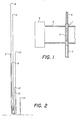
- an enclosure for example, but not exclusively tubular, in one refractory material such as for example quartz or a non-porous ceramic with a low dielectric loss coefficient, contains an adsorbent material 2, loaded with at least one adsorbed material to be analyzed chromatographically.
- This adsorbent material has a sufficient dielectric loss coefficient to allow it to be heated by microwaves under conditions where the material of enclosure 1 dissipates only little electrical power.
- Activated carbon has been found to be an adsorbent material suitable for treatment in the device according to the invention.
- other materials can be used, in particular a synthetic compound marketed under the name Tenax®, or the material to be analyzed itself, or a mixture of several of these materials.
- the material to be analyzed can also be in the solid state and / or liquid and / or gaseous.
- the enclosure can be connected at its lower end to a chromatognaphic column in the porous phase 3 and, at its upper end, to a tube 4 for admitting a purging gas, called the carrier gas.
- a microwave beam is emitted by a generator 5 and is guided on the tube 1 by a waveguide 6.
- the temperature of the adsorbent material 2 contained in the enclosure 1 rises almost instantaneously to a value which can reach 1000 ° C., thanks to the fact that heat is produced within the adsorbent material aa place to be transmitted by conduetion and matter. sorbed are trained at high coneentra- purge gas.
- the optimum conditions for a chromatographic analysis are achieved, without appreciable heating of the various elements of the device, without local overheating of the adsorbent material and without any part of the device reaching a temperature at which it could give off gases capable of pollute the sample to be analyzed.
- FIG. 2 represents, by way of example, a chromatogram showing the result of the analysis of a mixture of solvents.
- One thousand liters of pure mixture was injected into a one-liter bottle.
- the vapors thus diluted were sucked in (flow 5ml / s) through the activated carbon trap for 5 s.
- a desorption of 2 s gave a very good response on the flame ionization detector with a high attenuation.
- the adsorbent material can be conditioned or arranged in a manner which promotes the adsorption of the sample of materials to be analyzed, for example in a column, during the operating phase consisting concentrating the samples to be analyzed on the adsorbent material.
- the next phase consisting of desorbing the adsorbed materials, it may be advantageous to spread, for example in thin film, the adsorbent material to promote desorption.
Landscapes
- General Health & Medical Sciences (AREA)
- Physics & Mathematics (AREA)
- Life Sciences & Earth Sciences (AREA)
- Chemical & Material Sciences (AREA)
- Analytical Chemistry (AREA)
- Biochemistry (AREA)
- Immunology (AREA)
- General Physics & Mathematics (AREA)
- Health & Medical Sciences (AREA)
- Pathology (AREA)
- Sampling And Sample Adjustment (AREA)
- Treatment Of Liquids With Adsorbents In General (AREA)
- Other Investigation Or Analysis Of Materials By Electrical Means (AREA)
- Solid-Sorbent Or Filter-Aiding Compositions (AREA)
Applications Claiming Priority (2)
| Application Number | Priority Date | Filing Date | Title |
|---|---|---|---|
| CH517681A CH658913A5 (fr) | 1981-08-11 | 1981-08-11 | Dispositif de desorption des substances volatiles par micro-ondes pour analyse par chromatographie gazeuse. |
| CH5176/81 | 1981-08-11 |
Publications (2)
| Publication Number | Publication Date |
|---|---|
| EP0073176A2 true EP0073176A2 (de) | 1983-03-02 |
| EP0073176A3 EP0073176A3 (de) | 1983-06-15 |
Family
ID=4289177
Family Applications (1)
| Application Number | Title | Priority Date | Filing Date |
|---|---|---|---|
| EP82810242A Ceased EP0073176A3 (de) | 1981-08-11 | 1982-06-07 | Verfahren und Vorrichtung zur gaschromatographischen Analyse und Anwendung dieses Verfahrens |
Country Status (4)
| Country | Link |
|---|---|
| EP (1) | EP0073176A3 (de) |
| JP (1) | JPS5877659A (de) |
| AU (1) | AU8664182A (de) |
| CH (1) | CH658913A5 (de) |
Cited By (7)
| Publication number | Priority date | Publication date | Assignee | Title |
|---|---|---|---|---|
| EP0245642A1 (de) * | 1986-05-14 | 1987-11-19 | Gkss-Forschungszentrum Geesthacht Gmbh | Vorrichtung zur Probenaufgabe durch Thermodesorption |
| GB2223184A (en) * | 1988-09-13 | 1990-04-04 | Dow Chemical Co | Multidimensional chromatographic system |
| FR2637685A1 (fr) * | 1988-10-06 | 1990-04-13 | Berger Produits | Dispositif pour l'injection d'un echantillon gazeux dans une colonne de chromatographie en phase gazeuse |
| US5240604A (en) * | 1988-09-13 | 1993-08-31 | The Dow Chemical Company | Multidimensional chromatographic system |
| EP0510951A3 (en) * | 1991-04-22 | 1993-11-24 | Japan National Oil | Method for gathering and analysing hydrocarbon contained in sea water in small quantities |
| DE4406628A1 (de) * | 1994-03-01 | 1995-09-07 | Technolas Umwelt Und Industrie | Verfahren zur Analyse von an partikelförmigen Matrices adsorbierten flüchtigen Substanzen |
| EP1517732A4 (de) * | 2002-05-01 | 2005-10-19 | Biotage Inc | Behandlung von chemikalien in durchflusseinrichtung mit porösen medien |
Families Citing this family (1)
| Publication number | Priority date | Publication date | Assignee | Title |
|---|---|---|---|---|
| US6093921A (en) * | 1999-03-04 | 2000-07-25 | Mt Systems, Llc | Microwave heating apparatus for gas chromatographic columns |
Family Cites Families (6)
| Publication number | Priority date | Publication date | Assignee | Title |
|---|---|---|---|---|
| US3174325A (en) * | 1962-12-10 | 1965-03-23 | Ca Nat Research Council | Porous adsorber bodies for use in desorption spectrography |
| US3897679A (en) * | 1970-05-18 | 1975-08-05 | Scient Kit Corp Inc | Method of chemical analysis and apparatus for such analysis |
| DE2139992A1 (de) * | 1971-08-10 | 1973-02-22 | Bodenseewerk Perkin Elmer Co | Verfahren und vorrichtung zur probenahme und zum aufgeben einer probe in ein analysengeraet |
| CA1047792A (en) * | 1974-12-20 | 1979-02-06 | Bendix Corporation (The) | Flasher accessory for gas concentrator-gas chromatograph analyzer |
| DE2501057C3 (de) * | 1975-01-13 | 1982-04-01 | Siemens AG, 1000 Berlin und 8000 München | Verfahren zur Messung der Gesamt-Kohlenwasserstoffkonzentration ohne Methan |
| US4040805A (en) * | 1976-10-22 | 1977-08-09 | Board Of Supervisors Louisiana State University Agricultural And Mechanical College | Personal monitoring device, or dosimeter, for measuring exposure of personnel to organic vapors |
-
1981
- 1981-08-11 CH CH517681A patent/CH658913A5/fr not_active IP Right Cessation
-
1982
- 1982-06-07 EP EP82810242A patent/EP0073176A3/de not_active Ceased
- 1982-07-30 AU AU86641/82A patent/AU8664182A/en not_active Abandoned
- 1982-08-11 JP JP13863382A patent/JPS5877659A/ja active Pending
Cited By (9)
| Publication number | Priority date | Publication date | Assignee | Title |
|---|---|---|---|---|
| EP0245642A1 (de) * | 1986-05-14 | 1987-11-19 | Gkss-Forschungszentrum Geesthacht Gmbh | Vorrichtung zur Probenaufgabe durch Thermodesorption |
| GB2223184A (en) * | 1988-09-13 | 1990-04-04 | Dow Chemical Co | Multidimensional chromatographic system |
| GB2223184B (en) * | 1988-09-13 | 1992-07-15 | Dow Chemical Co | A multidimensional chromatographic system |
| US5240604A (en) * | 1988-09-13 | 1993-08-31 | The Dow Chemical Company | Multidimensional chromatographic system |
| FR2637685A1 (fr) * | 1988-10-06 | 1990-04-13 | Berger Produits | Dispositif pour l'injection d'un echantillon gazeux dans une colonne de chromatographie en phase gazeuse |
| EP0510951A3 (en) * | 1991-04-22 | 1993-11-24 | Japan National Oil | Method for gathering and analysing hydrocarbon contained in sea water in small quantities |
| DE4406628A1 (de) * | 1994-03-01 | 1995-09-07 | Technolas Umwelt Und Industrie | Verfahren zur Analyse von an partikelförmigen Matrices adsorbierten flüchtigen Substanzen |
| EP1517732A4 (de) * | 2002-05-01 | 2005-10-19 | Biotage Inc | Behandlung von chemikalien in durchflusseinrichtung mit porösen medien |
| US7063784B2 (en) | 2002-05-01 | 2006-06-20 | Biotage Ab | Processing of chemicals in flow-through device with porous media |
Also Published As
| Publication number | Publication date |
|---|---|
| EP0073176A3 (de) | 1983-06-15 |
| CH658913A5 (fr) | 1986-12-15 |
| AU8664182A (en) | 1983-02-17 |
| JPS5877659A (ja) | 1983-05-11 |
Similar Documents
| Publication | Publication Date | Title |
|---|---|---|
| CN104458970B (zh) | 一种热解吸装置 | |
| US4851683A (en) | Element specific radio frequency discharge helium plasma detector for chromatography | |
| Kosikowska et al. | Review of the determination of pesticide residues in ambient air | |
| KR0168455B1 (ko) | 고상 미량추출 및 탈착을 위한 방법과 그 장치 | |
| EP2831574B1 (de) | Vorrichtung und verfahren zur extraktion von in einer flüssigkeitsprobe enthaltenen verbindungen für analysezwecke | |
| US4849179A (en) | Apparatus for taking samples by thermal desorption | |
| FR3031179A1 (de) | ||
| EP0661537A3 (de) | Vorrichtung für Gaschromatographie. | |
| Jiang et al. | Determination of butyltins in mussel by gas chromatography with flame photometric detection using quartz surface-induced luminescence | |
| US5732476A (en) | Microwave-assisted separations using volatiles, and apparatus therefor | |
| EP3227674A1 (de) | Mikrovorrichtung für den nachweis von flüchtigen organischen verbindungen und verfahren zum nachweis von mindestens einer flüchtigen organischen verbindung in einer gasprobe | |
| EP0073176A2 (de) | Verfahren und Vorrichtung zur gaschromatographischen Analyse und Anwendung dieses Verfahrens | |
| US7078237B1 (en) | Micropyrolyzer for chemical analysis of liquid and solid samples | |
| FR2623290A1 (fr) | Procede d'analyse chromatographique de melanges de substances liquides et chromatographe en phase gazeuse pour la mise en oeuvre de ce procede | |
| WO1996000388A3 (en) | Selective removal of volatile substances injected into a chromatographic packing filled column | |
| Nielsen et al. | Trace determination of volatile sulfur compounds by solid-phase microextraction and GC-MS | |
| US5519947A (en) | Microwave-assisted generation of volatiles, of supercritical fluid, and apparatus therefor | |
| Azarraga et al. | An integrated GC/FT‐IR system for the analysis of environmental pollutants | |
| JP4994104B2 (ja) | 土壌中に含まれる石油系炭化水素成分の含有量を測定するために使用する気化装置 | |
| US4847207A (en) | Process for detection of organosulfur compounds and apparatus therefor | |
| Tong et al. | Principles and applications of unified chromatography | |
| Goode et al. | Determination of oxygen-containing additives in gasoline by gas chromatography–microwave-induced plasma atomic emission spectrometry | |
| Apps et al. | Trace analysis of complex organic mixtures using capillary gas‐liquid chromatography and the dynamic solvent effect | |
| Pack et al. | Use of an air/argon microwave plasma torch for the detection of tetraethyllead | |
| Mason et al. | Helium microwave induced plasma atomic emission detection for liquid chromatography utilizing a moving band interface |
Legal Events
| Date | Code | Title | Description |
|---|---|---|---|
| PUAI | Public reference made under article 153(3) epc to a published international application that has entered the european phase |
Free format text: ORIGINAL CODE: 0009012 |
|
| AK | Designated contracting states |
Designated state(s): AT BE CH DE FR GB IT LI LU NL SE |
|
| PUAL | Search report despatched |
Free format text: ORIGINAL CODE: 0009013 |
|
| AK | Designated contracting states |
Designated state(s): AT BE CH DE FR GB IT LI LU NL SE |
|
| 17P | Request for examination filed |
Effective date: 19830623 |
|
| STAA | Information on the status of an ep patent application or granted ep patent |
Free format text: STATUS: THE APPLICATION HAS BEEN REFUSED |
|
| 18R | Application refused |
Effective date: 19860927 |