EP0073450A2 - Procédé pour la production d'une résine méthacrylique apte à diffuser la lumière, et objets ainsi formés ayant une surface dépolie - Google Patents
Procédé pour la production d'une résine méthacrylique apte à diffuser la lumière, et objets ainsi formés ayant une surface dépolie Download PDFInfo
- Publication number
- EP0073450A2 EP0073450A2 EP82107722A EP82107722A EP0073450A2 EP 0073450 A2 EP0073450 A2 EP 0073450A2 EP 82107722 A EP82107722 A EP 82107722A EP 82107722 A EP82107722 A EP 82107722A EP 0073450 A2 EP0073450 A2 EP 0073450A2
- Authority
- EP
- European Patent Office
- Prior art keywords
- polymer
- light
- weight
- unsaturated monomer
- polymerizable unsaturated
- Prior art date
- Legal status (The legal status is an assumption and is not a legal conclusion. Google has not performed a legal analysis and makes no representation as to the accuracy of the status listed.)
- Granted
Links
- 239000000113 methacrylic resin Substances 0.000 title claims abstract description 33
- 238000000034 method Methods 0.000 title claims description 41
- 229920000642 polymer Polymers 0.000 claims abstract description 128
- 239000000203 mixture Substances 0.000 claims abstract description 72
- 239000000178 monomer Substances 0.000 claims abstract description 52
- VVQNEPGJFQJSBK-UHFFFAOYSA-N Methyl methacrylate Chemical compound COC(=O)C(C)=C VVQNEPGJFQJSBK-UHFFFAOYSA-N 0.000 claims abstract description 42
- 125000004432 carbon atom Chemical group C* 0.000 claims abstract description 7
- 239000004215 Carbon black (E152) Substances 0.000 claims abstract description 4
- 229930195733 hydrocarbon Natural products 0.000 claims abstract description 4
- 125000004435 hydrogen atom Chemical group [H]* 0.000 claims abstract description 4
- 239000011347 resin Substances 0.000 claims description 119
- 229920005989 resin Polymers 0.000 claims description 119
- 239000002245 particle Substances 0.000 claims description 28
- -1 hydrocarbon radical Chemical group 0.000 claims description 24
- 238000006116 polymerization reaction Methods 0.000 claims description 19
- 230000015572 biosynthetic process Effects 0.000 claims description 14
- 125000005395 methacrylic acid group Chemical group 0.000 claims description 10
- 239000006185 dispersion Substances 0.000 claims description 9
- 238000005266 casting Methods 0.000 claims description 8
- 238000000149 argon plasma sintering Methods 0.000 claims description 5
- 230000000379 polymerizing effect Effects 0.000 claims description 5
- 239000007870 radical polymerization initiator Substances 0.000 claims description 4
- 125000000217 alkyl group Chemical group 0.000 claims 2
- 125000000753 cycloalkyl group Chemical group 0.000 claims 2
- WCYWZMWISLQXQU-UHFFFAOYSA-N methyl Chemical group [CH3] WCYWZMWISLQXQU-UHFFFAOYSA-N 0.000 claims 2
- 125000002496 methyl group Chemical group [H]C([H])([H])* 0.000 abstract description 2
- 238000002834 transmittance Methods 0.000 description 30
- 229920001577 copolymer Polymers 0.000 description 15
- SJMYWORNLPSJQO-UHFFFAOYSA-N tert-butyl 2-methylprop-2-enoate Chemical compound CC(=C)C(=O)OC(C)(C)C SJMYWORNLPSJQO-UHFFFAOYSA-N 0.000 description 13
- PPBRXRYQALVLMV-UHFFFAOYSA-N Styrene Chemical compound C=CC1=CC=CC=C1 PPBRXRYQALVLMV-UHFFFAOYSA-N 0.000 description 12
- 230000003287 optical effect Effects 0.000 description 12
- SUPCQIBBMFXVTL-UHFFFAOYSA-N ethyl 2-methylprop-2-enoate Chemical compound CCOC(=O)C(C)=C SUPCQIBBMFXVTL-UHFFFAOYSA-N 0.000 description 10
- 230000000052 comparative effect Effects 0.000 description 9
- BAPJBEWLBFYGME-UHFFFAOYSA-N Methyl acrylate Chemical compound COC(=O)C=C BAPJBEWLBFYGME-UHFFFAOYSA-N 0.000 description 8
- AOJOEFVRHOZDFN-UHFFFAOYSA-N benzyl 2-methylprop-2-enoate Chemical compound CC(=C)C(=O)OCC1=CC=CC=C1 AOJOEFVRHOZDFN-UHFFFAOYSA-N 0.000 description 8
- 239000000047 product Substances 0.000 description 7
- XLYOFNOQVPJJNP-UHFFFAOYSA-N water Chemical compound O XLYOFNOQVPJJNP-UHFFFAOYSA-N 0.000 description 7
- WYGWHHGCAGTUCH-UHFFFAOYSA-N 2-[(2-cyano-4-methylpentan-2-yl)diazenyl]-2,4-dimethylpentanenitrile Chemical compound CC(C)CC(C)(C#N)N=NC(C)(C#N)CC(C)C WYGWHHGCAGTUCH-UHFFFAOYSA-N 0.000 description 6
- SOGAXMICEFXMKE-UHFFFAOYSA-N Butylmethacrylate Chemical compound CCCCOC(=O)C(C)=C SOGAXMICEFXMKE-UHFFFAOYSA-N 0.000 description 6
- NIXOWILDQLNWCW-UHFFFAOYSA-N acrylic acid group Chemical group C(C=C)(=O)O NIXOWILDQLNWCW-UHFFFAOYSA-N 0.000 description 6
- 150000001875 compounds Chemical class 0.000 description 6
- OIWOHHBRDFKZNC-UHFFFAOYSA-N cyclohexyl 2-methylprop-2-enoate Chemical compound CC(=C)C(=O)OC1CCCCC1 OIWOHHBRDFKZNC-UHFFFAOYSA-N 0.000 description 6
- 150000002148 esters Chemical class 0.000 description 6
- 238000010438 heat treatment Methods 0.000 description 6
- 229920003229 poly(methyl methacrylate) Polymers 0.000 description 6
- 239000004926 polymethyl methacrylate Substances 0.000 description 6
- 238000002360 preparation method Methods 0.000 description 6
- MCPKSFINULVDNX-UHFFFAOYSA-N drometrizole Chemical compound CC1=CC=C(O)C(N2N=C3C=CC=CC3=N2)=C1 MCPKSFINULVDNX-UHFFFAOYSA-N 0.000 description 5
- PNJWIWWMYCMZRO-UHFFFAOYSA-N pent‐4‐en‐2‐one Natural products CC(=O)CC=C PNJWIWWMYCMZRO-UHFFFAOYSA-N 0.000 description 5
- WDQMWEYDKDCEHT-UHFFFAOYSA-N 2-ethylhexyl 2-methylprop-2-enoate Chemical compound CCCCC(CC)COC(=O)C(C)=C WDQMWEYDKDCEHT-UHFFFAOYSA-N 0.000 description 4
- KUDUQBURMYMBIJ-UHFFFAOYSA-N 2-prop-2-enoyloxyethyl prop-2-enoate Chemical compound C=CC(=O)OCCOC(=O)C=C KUDUQBURMYMBIJ-UHFFFAOYSA-N 0.000 description 4
- JIGUQPWFLRLWPJ-UHFFFAOYSA-N Ethyl acrylate Chemical compound CCOC(=O)C=C JIGUQPWFLRLWPJ-UHFFFAOYSA-N 0.000 description 4
- TZCXTZWJZNENPQ-UHFFFAOYSA-L barium sulfate Chemical compound [Ba+2].[O-]S([O-])(=O)=O TZCXTZWJZNENPQ-UHFFFAOYSA-L 0.000 description 4
- 239000003795 chemical substances by application Substances 0.000 description 4
- 239000003999 initiator Substances 0.000 description 4
- 238000004519 manufacturing process Methods 0.000 description 4
- 229910001220 stainless steel Inorganic materials 0.000 description 4
- 239000010935 stainless steel Substances 0.000 description 4
- OZAIFHULBGXAKX-UHFFFAOYSA-N 2-(2-cyanopropan-2-yldiazenyl)-2-methylpropanenitrile Chemical compound N#CC(C)(C)N=NC(C)(C)C#N OZAIFHULBGXAKX-UHFFFAOYSA-N 0.000 description 3
- GOXQRTZXKQZDDN-UHFFFAOYSA-N 2-Ethylhexyl acrylate Chemical compound CCCCC(CC)COC(=O)C=C GOXQRTZXKQZDDN-UHFFFAOYSA-N 0.000 description 3
- GWEVSGVZZGPLCZ-UHFFFAOYSA-N Titan oxide Chemical compound O=[Ti]=O GWEVSGVZZGPLCZ-UHFFFAOYSA-N 0.000 description 3
- CQEYYJKEWSMYFG-UHFFFAOYSA-N butyl acrylate Chemical compound CCCCOC(=O)C=C CQEYYJKEWSMYFG-UHFFFAOYSA-N 0.000 description 3
- OGIDPMRJRNCKJF-UHFFFAOYSA-N titanium oxide Inorganic materials [Ti]=O OGIDPMRJRNCKJF-UHFFFAOYSA-N 0.000 description 3
- 238000011144 upstream manufacturing Methods 0.000 description 3
- MYWOJODOMFBVCB-UHFFFAOYSA-N 1,2,6-trimethylphenanthrene Chemical compound CC1=CC=C2C3=CC(C)=CC=C3C=CC2=C1C MYWOJODOMFBVCB-UHFFFAOYSA-N 0.000 description 2
- VDYWHVQKENANGY-UHFFFAOYSA-N 1,3-Butyleneglycol dimethacrylate Chemical compound CC(=C)C(=O)OC(C)CCOC(=O)C(C)=C VDYWHVQKENANGY-UHFFFAOYSA-N 0.000 description 2
- SMZOUWXMTYCWNB-UHFFFAOYSA-N 2-(2-methoxy-5-methylphenyl)ethanamine Chemical compound COC1=CC=C(C)C=C1CCN SMZOUWXMTYCWNB-UHFFFAOYSA-N 0.000 description 2
- FQMIAEWUVYWVNB-UHFFFAOYSA-N 3-prop-2-enoyloxybutyl prop-2-enoate Chemical compound C=CC(=O)OC(C)CCOC(=O)C=C FQMIAEWUVYWVNB-UHFFFAOYSA-N 0.000 description 2
- DBCAQXHNJOFNGC-UHFFFAOYSA-N 4-bromo-1,1,1-trifluorobutane Chemical compound FC(F)(F)CCCBr DBCAQXHNJOFNGC-UHFFFAOYSA-N 0.000 description 2
- VTYYLEPIZMXCLO-UHFFFAOYSA-L Calcium carbonate Chemical compound [Ca+2].[O-]C([O-])=O VTYYLEPIZMXCLO-UHFFFAOYSA-L 0.000 description 2
- HEDRZPFGACZZDS-UHFFFAOYSA-N Chloroform Chemical compound ClC(Cl)Cl HEDRZPFGACZZDS-UHFFFAOYSA-N 0.000 description 2
- YIVJZNGAASQVEM-UHFFFAOYSA-N Lauroyl peroxide Chemical compound CCCCCCCCCCCC(=O)OOC(=O)CCCCCCCCCCC YIVJZNGAASQVEM-UHFFFAOYSA-N 0.000 description 2
- CERQOIWHTDAKMF-UHFFFAOYSA-N Methacrylic acid Chemical compound CC(=C)C(O)=O CERQOIWHTDAKMF-UHFFFAOYSA-N 0.000 description 2
- 239000004793 Polystyrene Substances 0.000 description 2
- 229920007962 Styrene Methyl Methacrylate Polymers 0.000 description 2
- DAKWPKUUDNSNPN-UHFFFAOYSA-N Trimethylolpropane triacrylate Chemical compound C=CC(=O)OCC(CC)(COC(=O)C=C)COC(=O)C=C DAKWPKUUDNSNPN-UHFFFAOYSA-N 0.000 description 2
- OKKRPWIIYQTPQF-UHFFFAOYSA-N Trimethylolpropane trimethacrylate Chemical compound CC(=C)C(=O)OCC(CC)(COC(=O)C(C)=C)COC(=O)C(C)=C OKKRPWIIYQTPQF-UHFFFAOYSA-N 0.000 description 2
- 239000000654 additive Substances 0.000 description 2
- 150000001298 alcohols Chemical class 0.000 description 2
- WNROFYMDJYEPJX-UHFFFAOYSA-K aluminium hydroxide Chemical compound [OH-].[OH-].[OH-].[Al+3] WNROFYMDJYEPJX-UHFFFAOYSA-K 0.000 description 2
- 239000011324 bead Substances 0.000 description 2
- 238000007796 conventional method Methods 0.000 description 2
- 238000001816 cooling Methods 0.000 description 2
- 238000009826 distribution Methods 0.000 description 2
- 230000000694 effects Effects 0.000 description 2
- STVZJERGLQHEKB-UHFFFAOYSA-N ethylene glycol dimethacrylate Substances CC(=C)C(=O)OCCOC(=O)C(C)=C STVZJERGLQHEKB-UHFFFAOYSA-N 0.000 description 2
- CDOSHBSSFJOMGT-UHFFFAOYSA-N linalool Chemical compound CC(C)=CCCC(C)(O)C=C CDOSHBSSFJOMGT-UHFFFAOYSA-N 0.000 description 2
- 239000000463 material Substances 0.000 description 2
- 239000002609 medium Substances 0.000 description 2
- 125000005397 methacrylic acid ester group Chemical group 0.000 description 2
- ADFPJHOAARPYLP-UHFFFAOYSA-N methyl 2-methylprop-2-enoate;styrene Chemical compound COC(=O)C(C)=C.C=CC1=CC=CC=C1 ADFPJHOAARPYLP-UHFFFAOYSA-N 0.000 description 2
- 229920006395 saturated elastomer Polymers 0.000 description 2
- 239000003381 stabilizer Substances 0.000 description 2
- 150000003440 styrenes Chemical class 0.000 description 2
- 150000005846 sugar alcohols Polymers 0.000 description 2
- 239000005341 toughened glass Substances 0.000 description 2
- 229940096522 trimethylolpropane triacrylate Drugs 0.000 description 2
- 239000006097 ultraviolet radiation absorber Substances 0.000 description 2
- PFHOSZAOXCYAGJ-UHFFFAOYSA-N 2-[(2-cyano-4-methoxy-4-methylpentan-2-yl)diazenyl]-4-methoxy-2,4-dimethylpentanenitrile Chemical compound COC(C)(C)CC(C)(C#N)N=NC(C)(C#N)CC(C)(C)OC PFHOSZAOXCYAGJ-UHFFFAOYSA-N 0.000 description 1
- OMIGHNLMNHATMP-UHFFFAOYSA-N 2-hydroxyethyl prop-2-enoate Chemical compound OCCOC(=O)C=C OMIGHNLMNHATMP-UHFFFAOYSA-N 0.000 description 1
- VHSHLMUCYSAUQU-UHFFFAOYSA-N 2-hydroxypropyl methacrylate Chemical compound CC(O)COC(=O)C(C)=C VHSHLMUCYSAUQU-UHFFFAOYSA-N 0.000 description 1
- GWZMWHWAWHPNHN-UHFFFAOYSA-N 2-hydroxypropyl prop-2-enoate Chemical compound CC(O)COC(=O)C=C GWZMWHWAWHPNHN-UHFFFAOYSA-N 0.000 description 1
- 239000004342 Benzoyl peroxide Substances 0.000 description 1
- OMPJBNCRMGITSC-UHFFFAOYSA-N Benzoylperoxide Chemical compound C=1C=CC=CC=1C(=O)OOC(=O)C1=CC=CC=C1 OMPJBNCRMGITSC-UHFFFAOYSA-N 0.000 description 1
- NHZULBFZYDZOPA-UHFFFAOYSA-N C(C(=C)C)(=O)O.C(C(=C)C)(=O)O.C(C(=C)C)(=O)O.C(O)C(C)(CO)CO.C(C=C)(=O)O.C(C=C)(=O)O.C(C=C)(=O)O.C(O)C(C)(CO)CO Chemical compound C(C(=C)C)(=O)O.C(C(=C)C)(=O)O.C(C(=C)C)(=O)O.C(O)C(C)(CO)CO.C(C=C)(=O)O.C(C=C)(=O)O.C(C=C)(=O)O.C(O)C(C)(CO)CO NHZULBFZYDZOPA-UHFFFAOYSA-N 0.000 description 1
- LFQSCWFLJHTTHZ-UHFFFAOYSA-N Ethanol Chemical compound CCO LFQSCWFLJHTTHZ-UHFFFAOYSA-N 0.000 description 1
- WOBHKFSMXKNTIM-UHFFFAOYSA-N Hydroxyethyl methacrylate Chemical compound CC(=C)C(=O)OCCO WOBHKFSMXKNTIM-UHFFFAOYSA-N 0.000 description 1
- DGAQECJNVWCQMB-PUAWFVPOSA-M Ilexoside XXIX Chemical compound C[C@@H]1CC[C@@]2(CC[C@@]3(C(=CC[C@H]4[C@]3(CC[C@@H]5[C@@]4(CC[C@@H](C5(C)C)OS(=O)(=O)[O-])C)C)[C@@H]2[C@]1(C)O)C)C(=O)O[C@H]6[C@@H]([C@H]([C@@H]([C@H](O6)CO)O)O)O.[Na+] DGAQECJNVWCQMB-PUAWFVPOSA-M 0.000 description 1
- PMZURENOXWZQFD-UHFFFAOYSA-L Sodium Sulfate Chemical compound [Na+].[Na+].[O-]S([O-])(=O)=O PMZURENOXWZQFD-UHFFFAOYSA-L 0.000 description 1
- SWHLOXLFJPTYTL-UHFFFAOYSA-N [2-methyl-3-(2-methylprop-2-enoyloxy)-2-(2-methylprop-2-enoyloxymethyl)propyl] 2-methylprop-2-enoate Chemical compound CC(=C)C(=O)OCC(C)(COC(=O)C(C)=C)COC(=O)C(C)=C SWHLOXLFJPTYTL-UHFFFAOYSA-N 0.000 description 1
- HSZUHSXXAOWGQY-UHFFFAOYSA-N [2-methyl-3-prop-2-enoyloxy-2-(prop-2-enoyloxymethyl)propyl] prop-2-enoate Chemical compound C=CC(=O)OCC(C)(COC(=O)C=C)COC(=O)C=C HSZUHSXXAOWGQY-UHFFFAOYSA-N 0.000 description 1
- 239000006096 absorbing agent Substances 0.000 description 1
- XYLMUPLGERFSHI-UHFFFAOYSA-N alpha-Methylstyrene Chemical compound CC(=C)C1=CC=CC=C1 XYLMUPLGERFSHI-UHFFFAOYSA-N 0.000 description 1
- 239000003963 antioxidant agent Substances 0.000 description 1
- 238000013459 approach Methods 0.000 description 1
- 239000012736 aqueous medium Substances 0.000 description 1
- 150000007514 bases Chemical class 0.000 description 1
- 235000019400 benzoyl peroxide Nutrition 0.000 description 1
- GCTPMLUUWLLESL-UHFFFAOYSA-N benzyl prop-2-enoate Chemical compound C=CC(=O)OCC1=CC=CC=C1 GCTPMLUUWLLESL-UHFFFAOYSA-N 0.000 description 1
- 230000005540 biological transmission Effects 0.000 description 1
- 238000000071 blow moulding Methods 0.000 description 1
- 239000001045 blue dye Substances 0.000 description 1
- 238000009835 boiling Methods 0.000 description 1
- 238000012662 bulk polymerization Methods 0.000 description 1
- 229910000019 calcium carbonate Inorganic materials 0.000 description 1
- 239000007795 chemical reaction product Substances 0.000 description 1
- 239000003638 chemical reducing agent Substances 0.000 description 1
- 238000004040 coloring Methods 0.000 description 1
- 239000000470 constituent Substances 0.000 description 1
- KBLWLMPSVYBVDK-UHFFFAOYSA-N cyclohexyl prop-2-enoate Chemical compound C=CC(=O)OC1CCCCC1 KBLWLMPSVYBVDK-UHFFFAOYSA-N 0.000 description 1
- 230000007547 defect Effects 0.000 description 1
- 230000002950 deficient Effects 0.000 description 1
- 239000008367 deionised water Substances 0.000 description 1
- 229910021641 deionized water Inorganic materials 0.000 description 1
- 238000009792 diffusion process Methods 0.000 description 1
- 235000019329 dioctyl sodium sulphosuccinate Nutrition 0.000 description 1
- YHAIUSTWZPMYGG-UHFFFAOYSA-L disodium;2,2-dioctyl-3-sulfobutanedioate Chemical compound [Na+].[Na+].CCCCCCCCC(C([O-])=O)(C(C([O-])=O)S(O)(=O)=O)CCCCCCCC YHAIUSTWZPMYGG-UHFFFAOYSA-L 0.000 description 1
- 239000002612 dispersion medium Substances 0.000 description 1
- 238000004090 dissolution Methods 0.000 description 1
- 239000000975 dye Substances 0.000 description 1
- 238000007720 emulsion polymerization reaction Methods 0.000 description 1
- 239000003063 flame retardant Substances 0.000 description 1
- 238000010528 free radical solution polymerization reaction Methods 0.000 description 1
- 230000009477 glass transition Effects 0.000 description 1
- 238000005286 illumination Methods 0.000 description 1
- 230000000977 initiatory effect Effects 0.000 description 1
- 239000001023 inorganic pigment Substances 0.000 description 1
- KZCOBXFFBQJQHH-UHFFFAOYSA-N octane-1-thiol Chemical compound CCCCCCCCS KZCOBXFFBQJQHH-UHFFFAOYSA-N 0.000 description 1
- 150000001451 organic peroxides Chemical class 0.000 description 1
- 239000007800 oxidant agent Substances 0.000 description 1
- 238000005192 partition Methods 0.000 description 1
- 239000000049 pigment Substances 0.000 description 1
- 229920002776 polycyclohexyl methacrylate Polymers 0.000 description 1
- 239000003505 polymerization initiator Substances 0.000 description 1
- 229920002223 polystyrene Polymers 0.000 description 1
- 229920005553 polystyrene-acrylate Polymers 0.000 description 1
- NHARPDSAXCBDDR-UHFFFAOYSA-N propyl 2-methylprop-2-enoate Chemical compound CCCOC(=O)C(C)=C NHARPDSAXCBDDR-UHFFFAOYSA-N 0.000 description 1
- PNXMTCDJUBJHQJ-UHFFFAOYSA-N propyl prop-2-enoate Chemical compound CCCOC(=O)C=C PNXMTCDJUBJHQJ-UHFFFAOYSA-N 0.000 description 1
- 230000000717 retained effect Effects 0.000 description 1
- 229920002545 silicone oil Polymers 0.000 description 1
- 239000011734 sodium Substances 0.000 description 1
- 229910052708 sodium Inorganic materials 0.000 description 1
- 229910052938 sodium sulfate Inorganic materials 0.000 description 1
- 235000011152 sodium sulphate Nutrition 0.000 description 1
- 239000002904 solvent Substances 0.000 description 1
- 239000007858 starting material Substances 0.000 description 1
- 238000003756 stirring Methods 0.000 description 1
- 238000010558 suspension polymerization method Methods 0.000 description 1
- 238000010557 suspension polymerization reaction Methods 0.000 description 1
- WFKWXMTUELFFGS-UHFFFAOYSA-N tungsten Chemical compound [W] WFKWXMTUELFFGS-UHFFFAOYSA-N 0.000 description 1
- 239000010937 tungsten Substances 0.000 description 1
- 229910052721 tungsten Inorganic materials 0.000 description 1
- 238000007666 vacuum forming Methods 0.000 description 1
Images

Classifications
-
- C—CHEMISTRY; METALLURGY
- C08—ORGANIC MACROMOLECULAR COMPOUNDS; THEIR PREPARATION OR CHEMICAL WORKING-UP; COMPOSITIONS BASED THEREON
- C08F—MACROMOLECULAR COMPOUNDS OBTAINED BY REACTIONS ONLY INVOLVING CARBON-TO-CARBON UNSATURATED BONDS
- C08F265/00—Macromolecular compounds obtained by polymerising monomers on to polymers of unsaturated monocarboxylic acids or derivatives thereof as defined in group C08F20/00
- C08F265/04—Macromolecular compounds obtained by polymerising monomers on to polymers of unsaturated monocarboxylic acids or derivatives thereof as defined in group C08F20/00 on to polymers of esters
- C08F265/06—Polymerisation of acrylate or methacrylate esters on to polymers thereof
Definitions
- the present invention relates to a novel class of light-diffusible resins, a process for producing these resins, and formed articles having a delustered surface, which are obtained from these resins.
- the present invention relates to a novel light-diffusible methacrylic resin composed of two phases: a continuous phase formed of polymethyl methacrylate or a polymer obtained from a polymerizable unsaturated monomer ' mixture contaning at least 80% by weight of methyl methacrylate, and a dispersed phase formed of a polymer of a specific acrylic or methacrylic acid ester or a polymer obtained from a polymerizable unsaturated monomer mixture containing at least 50% by weight of this specific acrylic or methacrylic acid ester, in which a specific relation is established between the refractive index of the polymer of the dispersed phase and the refractive index of the polymer of the continuous phase.
- a process for producing these types of resins and formed articles having a delustered surface obtained from these resins are also disclosed.
- Light diffusion properties are typically obtained by the addition of inorganic pigments such as titanium oxide, barium sulfate and aluminum hydroxide or polystyrene and styrene- methyl methacrylate copolymers to the resin, and therefore, application fields of these light-diffusible resin are inevitably restricted. More specifically, in the conventional light-diffusible methacrylic resins, if it is desired to increase the light diffusibility to a certain level, it is impossible to provide a sufficient brightness, that is light transmittance, and therefore, according to the conventional technique, light diffusibility has been provided to methacrylic resins while sacrificing brightness to some extent.
- inorganic pigments such as titanium oxide, barium sulfate and aluminum hydroxide or polystyrene and styrene- methyl methacrylate copolymers
- the terms “brightness” means the intensity of the light transmitted through a resin, and the degree of the intensity is expressed by the total luminous transmittance.
- the term “light-diffusibility” means the dimness of the background seen through a resin; the degree of the dimness is quantitatively expressed by the maximum bend angle ⁇ .
- the ratio of the luminance measured to the unit incident illuminance is called “gain”, and the gain on the incident optical axis is especially called “peak gain”.
- the angle deviated from the optical axis for obtaining a gain of 33% of the peak gain is called “maximum bend angle” and is expressed by ⁇ . A larger value ⁇ indicates a higher light diffusibility.
- the angle ⁇ is about 2° to about 3°
- the background is not definitely recognized but is seen as being dim and vague.
- the value a is increased, the degree of the dimness of the background is increased, but the total luminous transmittance is ordinarily reduced.
- the value required for a resin varies according to the intended end use of the resin.
- Conventional methacrylic resins rendered light-diffusible by addition of known light diffusing agents are defective in that even in the case where a relatively small value a is required, or in the case where a required light diffusibility is satisfied with a relatively small valuer , reduction of the total luminous transmittance is extreme.
- a process for producing this novel methacrylic resin is also an object of this invention.
- Another object of the present invention is to provide a formed article having a delustered surface, which is obtained from the novel light-diffusible methacrylic resin herein described.
- a resin comprising a continuous phase formed of polymethyl methacrylate, or a polymer obtained from a polymerizable unsaturated monomer mixture containing at least 80% by weight of methyl methacrylate, and a dispersed phase formed of a polymer comprising units of an ester of an acrylic or methacrylic acid with an alcohol having at least 2 carbon atoms as the main constituent units, in which the refractive index of the polymer forming the continuous phase and the refractive index of the polymer forming the dispersed phase are within certain specific ranges, has the unique, desirable combination of a high total luminous transmittance and a fairly good diffusibility.
- the present invention was made on the basis of this finding.
- a light-diffusible methacrylic resin which comprises 80 to 99.9% by weight of a polymer (A) forming a continuous phase and 20 to 0.1% by weight of a polymer (B) forming a dispersed phase.
- Polymer (A) is a polymer prepared from methyl methacrylate alone, or a polymerizable unsaturated monomer mixture containing at least 80% by weight of methyl methacrylate;
- polymer (B) is a polymer prepared from at least one polymerizable unsaturated monomer represented by the following general formula: in which R i is a hydrogen atom or a methyl group and R 2 is a hydrocarbon radical having at least 2 carbon atoms or a derivative thereof.
- polymer (B) a polymerizable unsaturated monomer mixture is used containing at least 50% by weight of at least one polymerizable unsaturated monomer represented by the general formula [I].
- the ratio of the refractive index n B of the polymer (B) to the refractive index n A of the polymer (A) is in the range of 0.950 ⁇ n B/ n A ⁇ 0.998 or 1.002 ⁇ n B /n A ⁇ 1.050
- FIGURE 1 is a graph illustrating the relationships between bend angles of 0 through 50° and the gains, which are observed in a resin plate obtained in Example 4 (in accordance with the present invention) and a resin plate obtained in Comparative Example 5;
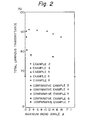
- FIGURE 2 is a graph illustrating the relationships between the total luminous transmittance and the maximum bend angle ⁇ which are observed in the resin plates obtained in Examples 2 through 6 (in accordance with the present invention) and Comparative Examples 3 through 7.
- the methacrylic resin of the present invention comprises a continuous phase and a dispersed phase, and between the refractive index n A of the polymer (A) forming the continuous phase and the refractive index n B of the polymer (B) forming the dispersed phase, there is established a specific relationship, that is, a ratio of 0.950 ⁇ n i3/ n A ⁇ 0.998 or 1.002 ⁇ n B/ n A ⁇ 1.050.
- the distribution (angular distribution) of the intensity of the light scattered by dispersed particles, depending on the angle to the incident optical axis, is determined according to the size and shape of the dispersed particles and the refractive index ratio of the dispersed particles to the dispersing medium.
- a light-diffusible resin which has a weak reflection of light and hence, is bright, can be obtained by adjusting the refractive index ratio between polymers consituting the dispersed phase and continuous phase to a value close to 1.
- the n B /n A value is in the range of 0.950 ⁇ n B/ n A ⁇ 0.998 or 1.002 ⁇ n B /n A ⁇ 1.050. If the n B/ n A value is in the range of n B /n A ⁇ 0.950 or 1.050 ⁇ n B/ n A , the reflection of the resin is relatively strong and the brightness is low, and therefore, the objects of the present invention cannot be attained.
- the n B/ n A value is appropriately selected from the above range according to the light diffusibility required for the particular resin. More specifically, when importance is attached to the brightness, the n B/ n A value approaches 1, and when stress is placed on the light diffusibility, the n B /n A value departs from 1.
- the degree of uniformity of dispersion of the dispersed phase in the continuous phase may be determined according to the intended use of the resin. Ordinarily it is preferred that the dispersion state be optically uniform to an extent such that local non-uniformity of the total luminous transmittance or light diffusibility is not found when the transmitted light is observed with the naked eye.
- the particle size of individual dispersed particles seen microscopically is not particularly critical, but a preferred range does exist.
- the shape of the dispersed particles is not particularly critical. Accordingly, the size of the dispersed particles is expressed by the radius a of equivalent spheres having the same refractive index and equal light scattering cross-section. In the case where the radius a of the dispersed particles is sufficiently smaller than the wavelength of the light and scattering regarded substantially as Rayleigh scattering is caused, the reflection light from the resin is strong and the total luminous transmittance is reduced, and therefore, good results cannot be obtained.
- the size of the dispersed particles be in the range of 0.1 to 500 microns in size, preferably about 0.5 to about 100 microns in size, calculated as the radius of equivalent spheres having the same refractive index and equal light scattering cross-section.
- the resin of the present invention comprises about 80 to about 99.9% by weight of the continuous phase and about 20 to about 0.1 % by weight of the dispersed phase. If the amount of the dispersed phase is less than 0.1% by weight, the light diffusibility of the resin is insufficient. On the other hand, if the amount of the dispersed phase exceeds 20% by weight, the light diffusibility of the resin is sufficient, but the total luminous transmittance is reduced. Further a reduction of the weatherability, solvent resistance, strength and heat resistance properties occurs and again good results are not ordinarily obtained. It is especially preferred that the amount of the continuous phase be from about 90 to about 99.5% by weight and the amount of the dispersed phase be from about 10 to about 0.5% by weight.
- the continuous phase of the light-diffusible methacrylic resin of the present invention is formed from polymer [A], that is, poly(methyl methacrylate) or a polymer obtained from a polymerizable unsaturated monomer mixture containing at least 80% by weight of methyl methacrylate.
- Polymerizable unsaturated monomers copolymerizable with methyl methacrylate incorporated in the polymerizable unsaturated monomer mixture are, for example, esters of acrylic and methacrylic acids with monohydric saturated and unsaturated alcohols, such as methyl acrylate, ethyl acrylate, ethyl methacrylate, propyl acrylate, propyl methacrylate, butyl acrylate, butyl methacrylate, 2-ethylhexyl acrylate, 2-ethylhexyl methacrylate, cyclohexyl acrylate, cyclohexyl methacrylate, benzyl acrylate and benzyl methacrylate, esters of acrlic and methacrylic acids with polyhydric alcohols, such as ethylene glycol diacrylate, ethylene glycol dimethacrylate, 1,3-butylene glycol diacrylate, 1,3-butylene glycol dimethacrylate,
- the polymerizable unsaturated monomer copolymerizable with methyl methacrylate is incorporated into the polymer [A] in an amount of up to about 20% by weight but preferably no more than about 10% by weight. If the amount of methyl methacrylate in the polymer [A] is less than 80% by weight, reduction of the strength, weatherability and heat resistance of the resin readily occurs, and the cost of the starting materials is increased.
- Esters of acrylic and methacrylic acids with monohydric saturated alcohols are preferred as the polymerizable unsaturated monomer copolymerizable with methyl methacrylate, and methyl acrylate, ethyl acrylate, ethyl methacrylate, butyl acrylate, butyl methacrylate, 2-ethylhexyl acrylate and 2-ethylhexyl methacrylate are especially preferred among these esters.
- the amount of the polymerizable unsaturated monomer copolymerizable with methyl methacrylate in the polymer [A] is adjusted to up to 10% by weight.
- poly(methyl methacrylate) and a polymer obtained from a mixture comprising at least 90% by weight of methyl methacrylate and up to 10% by weight of a polymerizable unsaturated monomer selected from methyl acrylate, ethyl acrylate, ethyl methacrylate, butyl acrylate, butyl methacrylate, 2-ethylhexyl acrylate and 2-ethylhexyl methacrylate.
- the polymer [B] forming the dispersed phase of the light-diffusible methacrylic resin must satisfy a specific relationship, defined in the present invention, of the refractive index with the polymer [A] forming the continuous phase.
- This polymer [B] is a polymer consisting solely of at least one polymerizable unsaturated monomer represented by the above general formula [I] or a polymer obtained from a polymerizable unsaturated monomer mixture containing at least 50% by weight of at least one polymerizable unsaturated monomer represented by the above general formula [I].
- the refractive index of each of these polymers is indicated parenthetically.
- the refractive index ratio of the polymer [B] forming the dispersed phase to the polymer [A] forming the continuous phase be within a specific range and that polymer [B] should be dispersed in the continuous phase in a good and homogeneous state.
- the polymer [B] in view of the handling easiness, it is preferred that the polymer [B] be in the vitreous (glass- like) state at room temperature.
- one or more of basic compounds are selected from t-butyl methacrylate, ethyl methacrylate, cyclohexyl methacrylate and benzyl methacrylate as monomers providing a polymer having a relatively high glass transition temperature.
- These are polymerized or copolymerized with other compounds represented by the general formula [I] or other polymerizable unsaturated monomers, and the resulting polymer which is in the vitreous state at room temperature and has a desired refractive index is used as the polymer [B] forming the dispersed phase.
- the polymerizable unsaturated monomer represented by the general formula [I] include t-butyl methacrylate (the refractive index ratio of the polymer to poly(methyl methacrylate) is 0.983; each parenthesized value given below shows this refractive index ratio), ethyl methacrylate (0.995), cyclohexyl methacrylate (1.010) and benzyl methacrylate (1.051).
- a polymer obtained by copolymerizing the polymerizable unsaturated monomer represented by the general formula [I] with other polymerizable unsaturated monomer may be used as the polymer [B] forming the dispersed phase of the resin of the present invention.
- styrene and styrene derivatives such as a-methyl styrene, methyl acrylate and methyl methacrylate, and esters of acrylic and methacrylic acids with polyhydric alcohols, such as ethylene glycol diacrylate, ethylene glycol dimethacrylate, 1,3-butylene glycol diacrylate, 1,3-butylene glycol dimethacrylate, trimethylol ethane triacrylate, trimethylol ethane trimethacrylate, trimethylol propane triacrylate, trimethylol propane trimethacrylate, pentaerythritol tetraacrylate and pentaerythritol tetramethacrylate.
- styrene and styrene derivatives such as a-methyl styrene, methyl acrylate and methyl methacrylate, and esters of acrylic and methacrylic acids with polyhydric alcohols, such as ethylene glycol diacryl
- styrene and methyl methacrylate are especially preferred.
- the polymerizable unsaturated monomer copolymerizable with the compound represented by the general formula [I] is incorporated in an amount of up to 50% by weight in the polymerizable unsaturated monomer mixture. If the amount of the compound represented by the general formula [I] in the polymerizable unsaturated monomer mixture is less than 50% by weight, even if the refractive index ratio of the polymer [B] to the polymer [A] is within the range specified in the present invention, a good dispersion state of the polymer [B] in the polymer [A] can hardly be obtained. In the present invention, it is especially preferred that the amount of the compound represented by the general formula [I] in the polymerizable unsaturated monomer mixture be at least about 80% by weight.
- the continuous phase and dispersed phase of the resin of the present invention are formed of the above-mentioned polymers [A] and [B], respectively.
- a resin may be obtained in which a very small amount of the polymer [B] is present in the continuous phase, a resin in which a very small amount of the polymer [A] is present in the dispersed phase and a resin in which the polymer [A] is present in the dispersed state in the dispersed phase.
- These light-diffusible resins are included within the scope of the present invention.
- the light-diffusible methacrylic resin of the present invention consists essentially of the above-mentioned two phases, that is, .the continuous phase and dispersed phase, but it may further comprise various conventional, art-recognized additives customarily added to methacrylic resins.
- Suitable additives may include, for example, coloring dyes, antioxidants, ultraviolet absorbers, other stabilizers, flame retardants and mold releasers for facilitating release of resins from casting molds.
- a resin in which a third phase incompatible in the continuous phase and dispersed phase is formed and an additional light diffusibility property is achieved is obtained by adding an ordinary pigment such as titanium oxide, barium sulfate, calcium carbonate or aluminum hydroxide or a known light-diffusing agent such as polystyrene or a styrene-methyl methacrylate copolymer. These too are included within the scope of the present invention.
- the ultimate shape of the resin of the present invention is not particularly critical, but as a typical example, a sheet or plate-like shape can be mentioned.
- the thickness of the resin plate is not particularly critical, but the thickness of the resin plate is ordinarily about 0.2 to about 20 mm and preferably about 1 to about 10 mm.
- the process for the preparation of the resin of the present invention is not particularly critical, however preferably the polymer [B] forming the dispersed phase is first-prepared, the polymer [B] is dissolved or dispersed in a polymerizable unsaturated monomer or a polymerizable unsaturated monomer mixture for formation of the polymer [A] forming the continuous phase or a partially polymerized product thereof, and the resulting polymerizable composition is subjected to polymerization to form a resin of the present invention comprising the continuous phase and dispersed phase.
- the novel resins are prepared by dissolving or dispersing about 20 to about 0.1% by weight of a polymer of a polymerizable unsaturated monomer represented by the general formula [I], or a polymer obtained from a polymerizable unsaturated monomer mixture containing at least 50% by weight of a polymerizable unsaturated monomer represented by the general formula [I], i.e., polymer [B], into about 80 to about 99.9% by weight of methyl methacrylate or a polymerizable unsaturated monomer mixture containing at least 80% by weight of methyl methacrylate, to be formed into a polymer [A] which forms the continuous phase, or a partially polymerized product thereof.
- a polymer of a polymerizable unsaturated monomer represented by the general formula [I] or a polymer obtained from a polymerizable unsaturated monomer mixture containing at least 50% by weight of a polymerizable unsaturated monomer represented by the general formula [I], i.e.
- the polymerization reaction is conducted in the presence of a radical polymerization initiator and ordinarily in a casting mold to obtain a light-diffusible methacrylic resin comprising a continuous phase formed of the polymer [A] and a dispersed phase formed of the polymer [B].
- the process for the preparation of the polymer [B] used in the above process for formation of the dispersed phase is not particularly critical, and various conventional polymerization techniques may be adopted such as emulsion polymerization, solution polymerization and bulk polymerization methods as are customarily carried out on an industrial scale. Ordinarily, however, suspension polymerization in an aqueous medium is preferred. This suspension polymerization method is advantageous in that the obtained polymer can be handled very easily and dissolution or dispersion of the polymer [B] in a polymerizable composition for formation of the polymer [A] can be performed relatively easily.
- the polymerizable composition for formation of the polymer [A] forming the continuous phase of the resin of the present invention one can use methyl methacrylate, partially polymerized methyl methacrylate, a polymerizable unsaturated monomer mixture containing at least 80% by weight of methyl methacrylate or a partially polymerized product thereof. It is ordinarily preferred that a partially polymerized product be used for efficiency of production.
- a partially polymerized product of the polymerizable composition may be obtained by dissolving a polymer prepared in advance into the polymerizable unsaturated monomer, but it is ordinarily preferable to adopt a method in which a radical polymerization initiator is added to the polymerizable unsaturated monomer and the obtained composition is heated at a boiling point of that composition to obtain a partially polymerized product.
- the polymer [B] forming the dispersed phase is dissolved or dispersed in the polymerizable composition for formation of the polymer [A] forming the continuous phase.
- the polymer [B] be homogeneously dissolved in the polymerizable composition for formation of the polymer [A].
- a radical polymerization initiator is added to the mixture obtained by dissolving or dispersing the polymer [B] in the polymerizable composition for formation of the polymer [A], and ordinarily, the mixture is cast in a desired casting mold and polymerized in the mold.
- Suitable polymerization initiators include: azo type initiators, such as 2,2'-azobis (isobutyronitrile), 2,2'-azobis(2,4-dimethylvaleronitrile) and 2,2'-azobis(2,4-dimethyl-4-methoxyvaleronitrile); organic peroxides such as benzoyl peroxide and lauroyl peroxide; and so- called redox type initiators comprising an oxidizing agent and a reducing agent in combination.
- azo type initiators such as 2,2'-azobis (isobutyronitrile), 2,2'-azobis(2,4-dimethylvaleronitrile) and 2,2'-azobis(2,4-dimethyl-4-methoxyvaleronitrile)
- organic peroxides such as benzoyl peroxide and lauroyl peroxide
- so- called redox type initiators comprising an oxidizing agent and a reducing agent in combination.
- the mixture is heated at 40 to 150°C to effect polymerization. It is especially preferred that the mixture be heated at 50 to 95°C at a first stage and be then heated to 100 to 140°C at a second stage to complete the polymerization.
- the casting mold to be used at the polymerization step there can be mentioned a mold comprising two tempered glass plates having peripheries thereof sealed by soft gaskets and a mold comprising two confronting stainless steel endless belts having peripheries thereof sealed by soft gaskets and one surface mirror-polished, which are advanced in the same direction at the same speed.
- An especially preferred process for the preparation of the light-diffusible methacrylic resin of the present invention comprises dissolving or dispersing a polymer [B] forming the dispersed phase into a polymerizable composition for formation of a polymer [A] forming the continuous phase, which is partially polymerized to a polymer content of 15 to 25% by weight, adding an azo-type or organic peroxide-type initiator to the solution or dispersion, continuously casting the mixture between two confronting stainless steel endless belts having peripheries sealed by soft gaskets and one surface mirror-polished, which are advanced in the same direction at the same speed, from the upstream end, heating the cast mixture to complete polymerization, and withdrawing the resulting resin plate continuoulsy from the downstream end.
- a resin plate obtained by dissolving or dispersing the polymer [B] forming the dispersed phase into the polymerizable composition for formation of the polymer [A] forming the continuous phase and polymerizing the solution or dispersion according to the process of the present invention has a two-phase structure.
- the structure comprises dispersed phase particles dispersed in the continuous phase, though the solution or dispersion before the polymerization is completely transparent.
- the section of each particle of the dispersed phase ordinarily has a circular shape, though it sometimes has an oval shape.
- the diameter of the circular section (or the long or short diameter of the oval section) of the dispersed particles varies according to the compositions, molecular weights and weight ratios of the polymers [A] and [B] and also to the curing speed at the step of polymerizing the polymerizable composition for the formation of the polymer [A] forming the continuous phase. Ordinarily it is in the range of from about 0.1 micron to about 200 microns.
- the weight ratio of the dispersed phase is higher or the curing speed at the step of polymerizing the polymerizable composition for formation of the polymer [A] forming the continuous phase is smaller, the diameter of particles of the dispersed phase (or the longer diameter or short diameter of oval particles, as the case may be) tends to become larger. Accordingly, if the foregoing conditions are appropriately selected according to required light-diffusing characteristics, a light-diffusible resin having a desirable light diffusibility is obtained.
- One having ordinary skill in the art will have no difficulty in producing the type of product that is desired.
- the light diffusibility of the articles made of the light-diffusible methacrylic resin of the present invention can further be increased by forming convexities and concavities on the surface of such articles.
- Various methods may be adopted for the formation of convexities and concavities on the resin surface. As an example one method in which polymerization is carried out in a casting mold having convexities and concavities formed on the surfaces thereof to reproduce these convexities and concavities on the surfaces of the formed resin can be used.
- a method in which a resin heated at a temperature higher than the forming temperature is pressed to an embossed mold to form convexities and concavities on the resin surface is used or a method in which a resin is heated at a temperature higher than the forming temperature and is subjected to draw forming to give a delustered surface to the resin can also be used.
- a resin is heated at a temperature above the heat distortion temperature and is subjected to draw forming.
- the size of individual dispersed particles of the polymer [B] forming the dispersed phase of the methacrylic resin of the present invention is 0.5 to 200 microns, as calculated as the radius of spheres having the same cross-section, by draw-forming the resin at a temperature higher than the heat distortion temperature, a very beautiful delustered surface can be produced. Therefore, a novel process for the production of a methacrylic resin formed article having an excellent delustered surface can be provided according to the present invention.
- the surface of the resin is delustered at a temperature higher than the heat distortion temperature.
- the heat distortion temperature we mean a deflection temperature determined according to the method of ASTM D-648-45T.
- the resin of the present invention is heated at a temperature higher than the heat distortion temperature of the resin, but it is ordinarily preferred that the resin be heated at a temperature higher by at least 10 0 C than the heat distortion temperature of the resin.
- Draw forming of the resin can be accomplished by biaxial or monoaxial stretching of a plane plate using a tenter or the like, free blow forming, ejection forming or vacuum forming.
- the light diffusibility of the resin due to the presence of the dispersed phase in the interior of the resin is monotonously reduced with decrease of the resin thickness.
- the draw ratio adopted at the draw-forming step be appropriately selected according to the desired degree of delustering and the desired degree of the light diffusibility.
- compositions can comprise, consist essentially of or consist of the materials set forth and the process or method can comprise, consist essentially of or consist of the steps set forth with such materials.
- the total luminous transmittance was determined according to the method of JIS K-7105.
- the maximum bend angle 0 was determined according to the following method: A tungsten lamp (2850°K) was lighted on an optical stand, and the distance between the light source and a sample attachment stand was adjusted so that the incident illuminance was 10 ft-cd. A sample was attached to the sample attachment stand and a luminance meter was arranged to confront the sample. The luminance (B ft-L) in the direction of 0° to the optical axis was measured by the luminance meter, and luminance values in directions of up to 5° to the optical axis were measured at intervals of 1°. Then, luminance values in directions of up to 50° to the optical axis were measured at intervals of 5°.
- the gain G was calculated according to the following formula:
- the bend angle was plotted on the abscissa and the gain was plotted on the ordinate to obtain a gain curve.
- the angle at which the gain value was 33% of the gain value at 0° was read from the curve, and this angle was defined as the maximum bend angle.
- the intrinsic viscosity of the polymer is one measured in chloroform at 25°C.
- each n B /n A value was calculated from the refractive indexesnA and ⁇ B of the polymers [A] and [B] measured independently.
- the gloss was measured by using a gloss meter supplied by Tokyo Denshoku at an incident angle of 60° and a reflection angle of 60°.
- a 500-liter autoclave provided with a jacket equipped with a stirrer and a temperature sensor was charged with a monomer mixture comprising 150 Kg (100 parts) of t-butyl methacrylate, 6 Kg (4 parts) of n-octylmercaptan and 0.3 Kg (0.2 part) of 2,2'-azobis(isobutyronitrile) and a dispersion medium comprising 300 Kg (200 parts) of deionized water, 0.75 Kg (0.5 part) of sodium sulfate and 0.03 Kg (0.02 part) of a dispersion stabilizer (methyl methacrylate/potassium sulfopropyl methacrylate copolymer).
- a monomer mixture comprising 150 Kg (100 parts) of t-butyl methacrylate, 6 Kg (4 parts) of n-octylmercaptan and 0.3 Kg (0.2 part) of 2,2'-azobis(isobutyronitrile) and
- Polymerization was carried out with stirring at 180 rpm while circulating warm water maintained at 75°C in the jacket. The peak of the polymerization heat was confirmed, and when 3 hours had passed from the initiation of the polymerization, the temperature of circulated warm water was elevated and the inner temperature was maintained at 95°C for 1 hour. Water was charged into the jacket to cool the contents, and the obtained beads of poly(t-butyl methacrylate) were washed and dried. The intrinsic viscosity of the obtained polymer was 0.015 1/g.
- the cast composition was allowed to pass through a shower zone of warm water maintained at 82°C over a period of 28 minutes, and the composition was allowed to pass through a heating zone of a far-infrared ray heater having a maximum heating temperature of 125°C and a gradually cooling zone over a period of 14 minutes.
- the obtained resin plate had a total luminous transmittance of 88.5% and a maximum bend angle a of 17°. Thus, it was confirmed that the resin plate had a high total light ray percent transmission and a high light diffusibility.
- the individual particles of the dispersed phase were spherical and had an average radius of 3.6 microns. The ⁇ B/ ⁇ A ratio was 0.983.
- the so-obtained resin plate had a total luminous transmittance of 91.0% and a maximum bend angle S of 5°. Thus, it was confirmed that the resin plate had a high total luminous transmittance and a high light diffusibility.
- the ⁇ B/ ⁇ A ratio was 0.987.
- Individual particles of the dispersed phase had an oval sectional shape having an average long diameter of 28 microns and an average short diameter of 20 microns.
- the resin plate had a total luminous transmittance of 90.6% and a maximum bend angle B of 7°. Thus, it was confirmed that the resin plate had a high total luminous transmittance and a high light diffusibility.
- Individual particles of the dispersed phase had a circular section having an average diameter of 16 microns.
- the cast composition was allowed to pass through a shower zone of warm water maintained at 76°C over a period of 56 minutes and also to pass through a heating zone of a far-infrared heater having a maximum heating temperature of 120°C and a gradually cooling zone over a period of 28 minutes.
- a bright light-diffusible resin plate of a light blue color having a thickness of 6 mm was continuously withdrawn from the downstream end.
- the resin plate had a total luminous transmittance of 88.9% and a maximum bend angle a of 15°. Thus, it was confirmed that the resin plate had a high total luminous transmittance and a high light diffusibility.
- the ⁇ B/ ⁇ A ratio was 1.031.
- Resin plates having a thickness of 2 mm were obtained by repeating the procedures of Example 10 in the same manner except that a polymer shown in Table 3 was used instead of the benzyl methacrylate/methyl methacrylate copolymer.
- the light-diffusible resin plate had a total luminous transmittance of 88% and a heat distortion temperature of 94.5°C.
- the dispersed particles had a circular section having an average radius of 7.1 microns.
- the ⁇ B/ ⁇ A ratio was 1.008.
- the so-obtained resin plate was heated at 150°C by a far-infrared ray heater and subjected to rejection forming.
- the draw ratio was changed as shown in Table 4 by adjusting the forming conditions appropriately.
- a light-diffusible resin plate having a thickness of 4 mm and a mirror surface gloss which contained a continuous phase of 98 parts of a methyl methacrylate/ethyl acrylate copolymer (the methyl methacrylate/ethyl acrylate charge weight ratio was 98/2 and the intrinsic viscosity of 0.026 1/g) and a dispersed phase of 2 parts of poly(t-butyl methacrylate) (the intrinsic viscosity was 0.015 1/g), was obtained.
- the resin plate had a total luminous transmittance of 87% and a heat distortion temperature of 95.1°C.
- the dispersed particles had a circular section having an average radius of 3.6 microns.
- the ⁇ B/ ⁇ A ratio was 0.983.
- the light-diffusible resin plate was heated at 150°C in a hot air circulating furnace and was free-blow- formed to a semi-spherical shape.
- the obtained formed article had a beautiful delustered surface.
- a light-diffusible resin plate having a thickness of 3 mm and a mirror surface gloss which comprised a continuous phase of 97 parts of poly(methyl methacrylate) (the intrinsic viscosity was 0.032 1/g) and a dispersed phase of 3 parts of a cyclohexyl methacrylate/ benzyl methacrylate copolymer (the cyclohexyl methacrylate/benzyl methacrylate charge weight ratio was 70/30 and the intrinsic viscosity was 0.017 l/g), was obtained.
- the resin plate had a total luminous transmittance of 87% and a heat distortion temperature of 98.4°C.
- the dispersed particles had a circular section having an average radius of 4.3 microns.
- the ⁇ B/ ⁇ A ratio was 1.021.
- the light-diffusible resin plate was heated at 140°C by a far-infrared ray heater and subjected to ejection forming.
- the draw ratio was changed as shown in Table 5 by appropriately adjusting the forming conditions.
- each of the so-obtained formed articles had a beautiful delustered surface.
- the relationships of the draw ratio to the gloss, total luminous transmittance and maximum bend angle B were determined to obtain results shown in Table 5. From these results it will readily be understood that each formed article had a high total luminous transmittance and a relatively excellent light diffusibility.
- a white opaque resin plate having a thickness of 3 mm and a mirror surface gloss was obtained.
- the resin plate had a heat distortion temperature of 105.3°C.
- the resin plate was heated at 180°C in a hot air circulating furnace and was free-blow-formed into a semi-spherical shape.
- the obtained formed article had a beautiful delustered surface.
- Example 19 The procedures of Example 19 were repeated in the same manner except that the t-butyl methacrylate/ethyl methacrylate copolymer was not added to the composition to be cast. A white opaque resin plate having a heat distortion temperature of 105.9°C was obtained. In the same manner as described in Example 19, the resin plate was heated at 180°C and free-blow-formed into a semi-spherical shape. The surface of the molded article retained a mirror surface gloss.
Landscapes
- Chemical & Material Sciences (AREA)
- Health & Medical Sciences (AREA)
- Chemical Kinetics & Catalysis (AREA)
- Medicinal Chemistry (AREA)
- Polymers & Plastics (AREA)
- Organic Chemistry (AREA)
- Compositions Of Macromolecular Compounds (AREA)
- Addition Polymer Or Copolymer, Post-Treatments, Or Chemical Modifications (AREA)
Applications Claiming Priority (4)
| Application Number | Priority Date | Filing Date | Title |
|---|---|---|---|
| JP136320/81 | 1981-08-31 | ||
| JP13632081A JPS5838742A (ja) | 1981-08-31 | 1981-08-31 | 光拡散性メタクリル樹脂及びその製造方法 |
| JP186115/81 | 1981-11-21 | ||
| JP18611581A JPS5889605A (ja) | 1981-11-21 | 1981-11-21 | 光拡散性メタクリレート重合体組成物およびその製造方法 |
Publications (3)
| Publication Number | Publication Date |
|---|---|
| EP0073450A2 true EP0073450A2 (fr) | 1983-03-09 |
| EP0073450A3 EP0073450A3 (en) | 1984-10-03 |
| EP0073450B1 EP0073450B1 (fr) | 1988-10-26 |
Family
ID=26469946
Family Applications (1)
| Application Number | Title | Priority Date | Filing Date |
|---|---|---|---|
| EP19820107722 Expired EP0073450B1 (fr) | 1981-08-31 | 1982-08-23 | Procédé pour la production d'une résine méthacrylique apte à diffuser la lumière, et objets ainsi formés ayant une surface dépolie |
Country Status (3)
| Country | Link |
|---|---|
| EP (1) | EP0073450B1 (fr) |
| AU (1) | AU559826B2 (fr) |
| DE (1) | DE3279154D1 (fr) |
Cited By (12)
| Publication number | Priority date | Publication date | Assignee | Title |
|---|---|---|---|---|
| US4525537A (en) * | 1982-06-03 | 1985-06-25 | Mitsubishi Rayon Co., Ltd. | Methacrylic resin shaped article, process for producing the same and process for producing a shaped article having a mat surface from said resin shaped article |
| EP0269324A3 (en) * | 1986-11-18 | 1989-04-12 | Rohm And Haas Company | Particulate polymer composition, a method of making particulate polymer compositions, and light-scattering thermoplastic polymer compositions containing the particulate polymers |
| US4839125A (en) * | 1986-05-16 | 1989-06-13 | Mitsubishi Rayon Co., Ltd. | Process for preparation of light-diffusing methacrylic resin plates |
| EP0342283A1 (fr) * | 1988-05-18 | 1989-11-23 | Rohm And Haas Company | Compositions thermoplastiques et thermodurcissables |
| US4963624A (en) * | 1988-02-17 | 1990-10-16 | Mitsubishi Rayon Co., Ltd. | Process for producing light-diffusing methacrylic resin article |
| FR2649113A1 (fr) * | 1989-07-03 | 1991-01-04 | Asahi Chemical Ind | Composition thermoplastique de resine acrilique |
| GB2234249A (en) * | 1989-07-17 | 1991-01-30 | Ici Plc | Coating compositions |
| US5004785A (en) * | 1987-11-30 | 1991-04-02 | Mitsubishi Rayon Co., Ltd. | Light-diffusing methacrylic resin and process for production thereof |
| EP0360137A3 (fr) * | 1988-09-20 | 1992-04-01 | BASF Aktiengesellschaft | Mélanges transparents thermoplastiques |
| US5237004A (en) * | 1986-11-18 | 1993-08-17 | Rohm And Haas Company | Thermoplastic and thermoset polymer compositions |
| EP0656548A3 (fr) * | 1993-12-01 | 1996-09-18 | Roehm Gmbh | Plaques de guidage de lumière à transmission égale. |
| ES2142725A1 (es) * | 1997-05-12 | 2000-04-16 | Infos Ingenieria Informatica S | Lector de huellas dactilares. |
Family Cites Families (2)
| Publication number | Priority date | Publication date | Assignee | Title |
|---|---|---|---|---|
| US3726586A (en) * | 1970-12-18 | 1973-04-10 | Rohm & Haas | Wedge shaped optical body |
| US4108923A (en) * | 1974-07-05 | 1978-08-22 | The Goodyear Tire & Rubber Company | Poly(methyl methacrylate) composition |
-
1982
- 1982-08-23 EP EP19820107722 patent/EP0073450B1/fr not_active Expired
- 1982-08-23 DE DE8282107722T patent/DE3279154D1/de not_active Expired
- 1982-08-27 AU AU87810/82A patent/AU559826B2/en not_active Ceased
Cited By (14)
| Publication number | Priority date | Publication date | Assignee | Title |
|---|---|---|---|---|
| US4525537A (en) * | 1982-06-03 | 1985-06-25 | Mitsubishi Rayon Co., Ltd. | Methacrylic resin shaped article, process for producing the same and process for producing a shaped article having a mat surface from said resin shaped article |
| US4839125A (en) * | 1986-05-16 | 1989-06-13 | Mitsubishi Rayon Co., Ltd. | Process for preparation of light-diffusing methacrylic resin plates |
| EP0269324A3 (en) * | 1986-11-18 | 1989-04-12 | Rohm And Haas Company | Particulate polymer composition, a method of making particulate polymer compositions, and light-scattering thermoplastic polymer compositions containing the particulate polymers |
| US5346954A (en) * | 1986-11-18 | 1994-09-13 | Rohm And Haas Company | Thermoplastic and thermoset polymer compositions |
| US5237004A (en) * | 1986-11-18 | 1993-08-17 | Rohm And Haas Company | Thermoplastic and thermoset polymer compositions |
| US5004785A (en) * | 1987-11-30 | 1991-04-02 | Mitsubishi Rayon Co., Ltd. | Light-diffusing methacrylic resin and process for production thereof |
| US4963624A (en) * | 1988-02-17 | 1990-10-16 | Mitsubishi Rayon Co., Ltd. | Process for producing light-diffusing methacrylic resin article |
| EP0342283A1 (fr) * | 1988-05-18 | 1989-11-23 | Rohm And Haas Company | Compositions thermoplastiques et thermodurcissables |
| EP0360137A3 (fr) * | 1988-09-20 | 1992-04-01 | BASF Aktiengesellschaft | Mélanges transparents thermoplastiques |
| US5039749A (en) * | 1989-07-03 | 1991-08-13 | Asahi Kasei Kogyo Kabushiki Kaisha | Thermoplastic acrylic resin composition |
| FR2649113A1 (fr) * | 1989-07-03 | 1991-01-04 | Asahi Chemical Ind | Composition thermoplastique de resine acrilique |
| GB2234249A (en) * | 1989-07-17 | 1991-01-30 | Ici Plc | Coating compositions |
| EP0656548A3 (fr) * | 1993-12-01 | 1996-09-18 | Roehm Gmbh | Plaques de guidage de lumière à transmission égale. |
| ES2142725A1 (es) * | 1997-05-12 | 2000-04-16 | Infos Ingenieria Informatica S | Lector de huellas dactilares. |
Also Published As
| Publication number | Publication date |
|---|---|
| EP0073450B1 (fr) | 1988-10-26 |
| DE3279154D1 (en) | 1988-12-01 |
| AU559826B2 (en) | 1987-03-19 |
| EP0073450A3 (en) | 1984-10-03 |
| AU8781082A (en) | 1983-03-10 |
Similar Documents
| Publication | Publication Date | Title |
|---|---|---|
| EP0269324B1 (fr) | Composition de polymères en particules, préparation de compositions de polymères en particules et compositions de polymères thermoplastiques diffusant la lumière, contenant les polymères en particules | |
| US5583191A (en) | Plastic lens | |
| EP0073450B1 (fr) | Procédé pour la production d'une résine méthacrylique apte à diffuser la lumière, et objets ainsi formés ayant une surface dépolie | |
| US3914338A (en) | Opalescent methylmethacrylate polymer bodies | |
| US5004785A (en) | Light-diffusing methacrylic resin and process for production thereof | |
| KR101958719B1 (ko) | 중합용 분산제를 이용하여 제조된 가교 고분자 입자를 포함하는 광확산 수지 조성물 및 이를 포함하는 광확산 성형체 | |
| US4509163A (en) | Process for producing a low hygroscopic methacrylic resin and information recording substrates made therefrom | |
| JP2000169658A (ja) | 光拡散性樹脂組成物 | |
| JP6642008B2 (ja) | (メタ)アクリル樹脂組成物及び(メタ)アクリル樹脂成形体 | |
| US4963624A (en) | Process for producing light-diffusing methacrylic resin article | |
| JPH0119420B2 (fr) | ||
| JPH0153900B2 (fr) | ||
| JPS62177009A (ja) | 耐熱性樹脂の製造法およびそれからなる光学用素子 | |
| CN114524997B (zh) | Ps光扩散板、其制备方法和微发泡热膨胀微球在制备ps光扩散板中的用途 | |
| JPH05302006A (ja) | 光拡散性メタクリル樹脂 | |
| US4525537A (en) | Methacrylic resin shaped article, process for producing the same and process for producing a shaped article having a mat surface from said resin shaped article | |
| JPH0119419B2 (fr) | ||
| JPS61141715A (ja) | 耐熱性共重合体樹脂、その製造法およびそれからなる光学用素子 | |
| JP2778917B2 (ja) | 光学用素子 | |
| KR102504520B1 (ko) | 광확산 비드 및 이의 제조방법 및 이를 포함하는 광확산 시트 | |
| JP7298654B2 (ja) | (メタ)アクリル系樹脂組成物及び樹脂成形体 | |
| JPH06107881A (ja) | 光拡散性メタクリル樹脂 | |
| JPH0679083B2 (ja) | 光学材料 | |
| JPH0442180B2 (fr) | ||
| JP2024140269A (ja) | 樹脂組成物、樹脂成形体及び樹脂成形体の製造方法 |
Legal Events
| Date | Code | Title | Description |
|---|---|---|---|
| PUAI | Public reference made under article 153(3) epc to a published international application that has entered the european phase |
Free format text: ORIGINAL CODE: 0009012 |
|
| AK | Designated contracting states |
Designated state(s): DE FR GB IT |
|
| PUAL | Search report despatched |
Free format text: ORIGINAL CODE: 0009013 |
|
| AK | Designated contracting states |
Designated state(s): DE FR GB IT |
|
| 17P | Request for examination filed |
Effective date: 19850402 |
|
| 17Q | First examination report despatched |
Effective date: 19860409 |
|
| GRAA | (expected) grant |
Free format text: ORIGINAL CODE: 0009210 |
|
| AK | Designated contracting states |
Kind code of ref document: B1 Designated state(s): DE FR GB IT |
|
| ITF | It: translation for a ep patent filed | ||
| REF | Corresponds to: |
Ref document number: 3279154 Country of ref document: DE Date of ref document: 19881201 |
|
| ET | Fr: translation filed | ||
| PLBE | No opposition filed within time limit |
Free format text: ORIGINAL CODE: 0009261 |
|
| STAA | Information on the status of an ep patent application or granted ep patent |
Free format text: STATUS: NO OPPOSITION FILED WITHIN TIME LIMIT |
|
| 26N | No opposition filed | ||
| ITTA | It: last paid annual fee | ||
| PGFP | Annual fee paid to national office [announced via postgrant information from national office to epo] |
Ref country code: FR Payment date: 19920807 Year of fee payment: 11 |
|
| PGFP | Annual fee paid to national office [announced via postgrant information from national office to epo] |
Ref country code: GB Payment date: 19920812 Year of fee payment: 11 |
|
| PGFP | Annual fee paid to national office [announced via postgrant information from national office to epo] |
Ref country code: DE Payment date: 19920824 Year of fee payment: 11 |
|
| PG25 | Lapsed in a contracting state [announced via postgrant information from national office to epo] |
Ref country code: GB Effective date: 19930823 |
|
| GBPC | Gb: european patent ceased through non-payment of renewal fee |
Effective date: 19930823 |
|
| PG25 | Lapsed in a contracting state [announced via postgrant information from national office to epo] |
Ref country code: FR Effective date: 19940429 |
|
| PG25 | Lapsed in a contracting state [announced via postgrant information from national office to epo] |
Ref country code: DE Effective date: 19940503 |
|
| REG | Reference to a national code |
Ref country code: FR Ref legal event code: ST |