EP0073690B1 - Procédé d'hydroconversion catalytique d'hydrocarbures lourds en phase liquide et en présence d'un catalyseur dispersé et de particules charbonneuses - Google Patents
Procédé d'hydroconversion catalytique d'hydrocarbures lourds en phase liquide et en présence d'un catalyseur dispersé et de particules charbonneuses Download PDFInfo
- Publication number
- EP0073690B1 EP0073690B1 EP82401336A EP82401336A EP0073690B1 EP 0073690 B1 EP0073690 B1 EP 0073690B1 EP 82401336 A EP82401336 A EP 82401336A EP 82401336 A EP82401336 A EP 82401336A EP 0073690 B1 EP0073690 B1 EP 0073690B1
- Authority
- EP
- European Patent Office
- Prior art keywords
- process according
- cenospheres
- charge
- weight
- hydrocarbon
- Prior art date
- Legal status (The legal status is an assumption and is not a legal conclusion. Google has not performed a legal analysis and makes no representation as to the accuracy of the status listed.)
- Expired
Links
- 229930195733 hydrocarbon Natural products 0.000 title claims description 24
- 150000002430 hydrocarbons Chemical class 0.000 title claims description 24
- 238000000034 method Methods 0.000 title claims description 23
- 230000008569 process Effects 0.000 title claims description 21
- 230000003197 catalytic effect Effects 0.000 title claims description 15
- 239000003054 catalyst Substances 0.000 title claims description 13
- 239000002245 particle Substances 0.000 title claims description 13
- 229910052751 metal Inorganic materials 0.000 claims description 28
- 239000002184 metal Substances 0.000 claims description 28
- 229910052739 hydrogen Inorganic materials 0.000 claims description 22
- 239000001257 hydrogen Substances 0.000 claims description 22
- 239000004215 Carbon black (E152) Substances 0.000 claims description 21
- PXHVJJICTQNCMI-UHFFFAOYSA-N Nickel Chemical compound [Ni] PXHVJJICTQNCMI-UHFFFAOYSA-N 0.000 claims description 21
- UFHFLCQGNIYNRP-UHFFFAOYSA-N Hydrogen Chemical compound [H][H] UFHFLCQGNIYNRP-UHFFFAOYSA-N 0.000 claims description 19
- XEEYBQQBJWHFJM-UHFFFAOYSA-N Iron Chemical compound [Fe] XEEYBQQBJWHFJM-UHFFFAOYSA-N 0.000 claims description 17
- 229910052750 molybdenum Inorganic materials 0.000 claims description 17
- 239000011733 molybdenum Substances 0.000 claims description 17
- 150000002739 metals Chemical class 0.000 claims description 15
- RWSOTUBLDIXVET-UHFFFAOYSA-N Dihydrogen sulfide Chemical compound S RWSOTUBLDIXVET-UHFFFAOYSA-N 0.000 claims description 11
- 150000001875 compounds Chemical class 0.000 claims description 11
- 229910052759 nickel Inorganic materials 0.000 claims description 11
- 150000002736 metal compounds Chemical class 0.000 claims description 10
- LEONUFNNVUYDNQ-UHFFFAOYSA-N vanadium atom Chemical group [V] LEONUFNNVUYDNQ-UHFFFAOYSA-N 0.000 claims description 10
- ZOKXTWBITQBERF-UHFFFAOYSA-N Molybdenum Chemical compound [Mo] ZOKXTWBITQBERF-UHFFFAOYSA-N 0.000 claims description 9
- 229910000037 hydrogen sulfide Inorganic materials 0.000 claims description 9
- 229910052742 iron Inorganic materials 0.000 claims description 9
- 239000000203 mixture Substances 0.000 claims description 9
- 229910052720 vanadium Inorganic materials 0.000 claims description 9
- IJGRMHOSHXDMSA-UHFFFAOYSA-N Atomic nitrogen Chemical compound N#N IJGRMHOSHXDMSA-UHFFFAOYSA-N 0.000 claims description 8
- 239000000243 solution Substances 0.000 claims description 8
- 239000002904 solvent Substances 0.000 claims description 8
- NINIDFKCEFEMDL-UHFFFAOYSA-N Sulfur Chemical compound [S] NINIDFKCEFEMDL-UHFFFAOYSA-N 0.000 claims description 7
- 238000006243 chemical reaction Methods 0.000 claims description 7
- 229910052717 sulfur Inorganic materials 0.000 claims description 7
- 239000011593 sulfur Substances 0.000 claims description 7
- OKTJSMMVPCPJKN-UHFFFAOYSA-N Carbon Chemical compound [C] OKTJSMMVPCPJKN-UHFFFAOYSA-N 0.000 claims description 6
- 239000007864 aqueous solution Substances 0.000 claims description 6
- 239000004071 soot Substances 0.000 claims description 6
- 239000012535 impurity Substances 0.000 claims description 5
- 239000007788 liquid Substances 0.000 claims description 5
- 238000009835 boiling Methods 0.000 claims description 4
- 238000002485 combustion reaction Methods 0.000 claims description 4
- 229910052757 nitrogen Inorganic materials 0.000 claims description 4
- 229910052799 carbon Inorganic materials 0.000 claims description 3
- 239000000839 emulsion Substances 0.000 claims description 3
- 239000011148 porous material Substances 0.000 claims description 3
- VYZAMTAEIAYCRO-UHFFFAOYSA-N Chromium Chemical compound [Cr] VYZAMTAEIAYCRO-UHFFFAOYSA-N 0.000 claims description 2
- 229910052804 chromium Inorganic materials 0.000 claims description 2
- 239000011651 chromium Substances 0.000 claims description 2
- 229910017052 cobalt Inorganic materials 0.000 claims description 2
- 239000010941 cobalt Substances 0.000 claims description 2
- GUTLYIVDDKVIGB-UHFFFAOYSA-N cobalt atom Chemical compound [Co] GUTLYIVDDKVIGB-UHFFFAOYSA-N 0.000 claims description 2
- WPBNNNQJVZRUHP-UHFFFAOYSA-L manganese(2+);methyl n-[[2-(methoxycarbonylcarbamothioylamino)phenyl]carbamothioyl]carbamate;n-[2-(sulfidocarbothioylamino)ethyl]carbamodithioate Chemical compound [Mn+2].[S-]C(=S)NCCNC([S-])=S.COC(=O)NC(=S)NC1=CC=CC=C1NC(=S)NC(=O)OC WPBNNNQJVZRUHP-UHFFFAOYSA-L 0.000 claims description 2
- WFKWXMTUELFFGS-UHFFFAOYSA-N tungsten Chemical compound [W] WFKWXMTUELFFGS-UHFFFAOYSA-N 0.000 claims description 2
- 229910052721 tungsten Inorganic materials 0.000 claims description 2
- 239000010937 tungsten Substances 0.000 claims description 2
- 238000012360 testing method Methods 0.000 description 22
- YXFVVABEGXRONW-UHFFFAOYSA-N Toluene Chemical compound CC1=CC=CC=C1 YXFVVABEGXRONW-UHFFFAOYSA-N 0.000 description 15
- 239000000047 product Substances 0.000 description 15
- 229910000765 intermetallic Inorganic materials 0.000 description 12
- 238000001914 filtration Methods 0.000 description 10
- 239000007787 solid Substances 0.000 description 9
- 238000000926 separation method Methods 0.000 description 8
- 239000000945 filler Substances 0.000 description 7
- 150000003839 salts Chemical class 0.000 description 7
- 239000007789 gas Substances 0.000 description 6
- 239000003849 aromatic solvent Substances 0.000 description 5
- 239000010426 asphalt Substances 0.000 description 4
- 239000000446 fuel Substances 0.000 description 4
- 150000004763 sulfides Chemical class 0.000 description 4
- 239000002585 base Substances 0.000 description 3
- -1 bitumens Substances 0.000 description 3
- 239000000571 coke Substances 0.000 description 3
- 239000000470 constituent Substances 0.000 description 3
- 238000004821 distillation Methods 0.000 description 3
- 230000000694 effects Effects 0.000 description 3
- 238000005194 fractionation Methods 0.000 description 3
- 239000000295 fuel oil Substances 0.000 description 3
- 238000002309 gasification Methods 0.000 description 3
- 150000002431 hydrogen Chemical class 0.000 description 3
- 239000012263 liquid product Substances 0.000 description 3
- 239000003921 oil Substances 0.000 description 3
- 238000004064 recycling Methods 0.000 description 3
- 238000005406 washing Methods 0.000 description 3
- XLYOFNOQVPJJNP-UHFFFAOYSA-N water Substances O XLYOFNOQVPJJNP-UHFFFAOYSA-N 0.000 description 3
- QGZKDVFQNNGYKY-UHFFFAOYSA-O Ammonium Chemical compound [NH4+] QGZKDVFQNNGYKY-UHFFFAOYSA-O 0.000 description 2
- LSNNMFCWUKXFEE-UHFFFAOYSA-M Bisulfite Chemical compound OS([O-])=O LSNNMFCWUKXFEE-UHFFFAOYSA-M 0.000 description 2
- LSDPWZHWYPCBBB-UHFFFAOYSA-N Methanethiol Chemical compound SC LSDPWZHWYPCBBB-UHFFFAOYSA-N 0.000 description 2
- OFBQJSOFQDEBGM-UHFFFAOYSA-N Pentane Chemical compound CCCCC OFBQJSOFQDEBGM-UHFFFAOYSA-N 0.000 description 2
- 239000002253 acid Substances 0.000 description 2
- 230000008901 benefit Effects 0.000 description 2
- 238000011437 continuous method Methods 0.000 description 2
- 238000001816 cooling Methods 0.000 description 2
- 238000005336 cracking Methods 0.000 description 2
- 239000010779 crude oil Substances 0.000 description 2
- 238000007324 demetalation reaction Methods 0.000 description 2
- 239000006185 dispersion Substances 0.000 description 2
- 239000010881 fly ash Substances 0.000 description 2
- 238000011065 in-situ storage Methods 0.000 description 2
- 238000002156 mixing Methods 0.000 description 2
- 239000005078 molybdenum compound Substances 0.000 description 2
- 150000002752 molybdenum compounds Chemical class 0.000 description 2
- 238000010926 purge Methods 0.000 description 2
- 230000035484 reaction time Effects 0.000 description 2
- 239000011269 tar Substances 0.000 description 2
- 238000011282 treatment Methods 0.000 description 2
- 238000005292 vacuum distillation Methods 0.000 description 2
- HNNQYHFROJDYHQ-UHFFFAOYSA-N 3-(4-ethylcyclohexyl)propanoic acid 3-(3-ethylcyclopentyl)propanoic acid Chemical compound CCC1CCC(CCC(O)=O)C1.CCC1CCC(CCC(O)=O)CC1 HNNQYHFROJDYHQ-UHFFFAOYSA-N 0.000 description 1
- KCXVZYZYPLLWCC-UHFFFAOYSA-N EDTA Chemical compound OC(=O)CN(CC(O)=O)CCN(CC(O)=O)CC(O)=O KCXVZYZYPLLWCC-UHFFFAOYSA-N 0.000 description 1
- LFQSCWFLJHTTHZ-UHFFFAOYSA-N Ethanol Chemical compound CCO LFQSCWFLJHTTHZ-UHFFFAOYSA-N 0.000 description 1
- PIICEJLVQHRZGT-UHFFFAOYSA-N Ethylenediamine Chemical compound NCCN PIICEJLVQHRZGT-UHFFFAOYSA-N 0.000 description 1
- ISWSIDIOOBJBQZ-UHFFFAOYSA-N Phenol Chemical compound OC1=CC=CC=C1 ISWSIDIOOBJBQZ-UHFFFAOYSA-N 0.000 description 1
- 241000923606 Schistes Species 0.000 description 1
- 235000015076 Shorea robusta Nutrition 0.000 description 1
- 244000166071 Shorea robusta Species 0.000 description 1
- VYPSYNLAJGMNEJ-UHFFFAOYSA-N Silicium dioxide Chemical compound O=[Si]=O VYPSYNLAJGMNEJ-UHFFFAOYSA-N 0.000 description 1
- CDBYLPFSWZWCQE-UHFFFAOYSA-L Sodium Carbonate Chemical compound [Na+].[Na+].[O-]C([O-])=O CDBYLPFSWZWCQE-UHFFFAOYSA-L 0.000 description 1
- 241001080024 Telles Species 0.000 description 1
- 241001125843 Trichiuridae Species 0.000 description 1
- 230000009471 action Effects 0.000 description 1
- 239000011149 active material Substances 0.000 description 1
- 125000001931 aliphatic group Chemical group 0.000 description 1
- 229910052783 alkali metal Inorganic materials 0.000 description 1
- 150000001340 alkali metals Chemical class 0.000 description 1
- 150000001412 amines Chemical class 0.000 description 1
- QGAVSDVURUSLQK-UHFFFAOYSA-N ammonium heptamolybdate Chemical compound N.N.N.N.N.N.O.O.O.O.O.O.O.O.O.O.O.O.O.O.O.O.O.O.O.O.O.O.O.O.[Mo].[Mo].[Mo].[Mo].[Mo].[Mo].[Mo] QGAVSDVURUSLQK-UHFFFAOYSA-N 0.000 description 1
- 150000001491 aromatic compounds Chemical class 0.000 description 1
- WPYMKLBDIGXBTP-UHFFFAOYSA-N benzoic acid Chemical compound OC(=O)C1=CC=CC=C1 WPYMKLBDIGXBTP-UHFFFAOYSA-N 0.000 description 1
- 239000011329 calcined coke Substances 0.000 description 1
- 238000004517 catalytic hydrocracking Methods 0.000 description 1
- 238000005119 centrifugation Methods 0.000 description 1
- 239000003245 coal Substances 0.000 description 1
- UFMZWBIQTDUYBN-UHFFFAOYSA-N cobalt dinitrate Chemical compound [Co+2].[O-][N+]([O-])=O.[O-][N+]([O-])=O UFMZWBIQTDUYBN-UHFFFAOYSA-N 0.000 description 1
- 229910001981 cobalt nitrate Inorganic materials 0.000 description 1
- 238000010908 decantation Methods 0.000 description 1
- 239000002283 diesel fuel Substances 0.000 description 1
- 229960001484 edetic acid Drugs 0.000 description 1
- 238000005516 engineering process Methods 0.000 description 1
- 238000001704 evaporation Methods 0.000 description 1
- 230000008020 evaporation Effects 0.000 description 1
- 238000002474 experimental method Methods 0.000 description 1
- 239000011790 ferrous sulphate Substances 0.000 description 1
- 235000003891 ferrous sulphate Nutrition 0.000 description 1
- 239000010419 fine particle Substances 0.000 description 1
- 230000009969 flowable effect Effects 0.000 description 1
- 238000004817 gas chromatography Methods 0.000 description 1
- 239000002010 green coke Substances 0.000 description 1
- 150000004820 halides Chemical class 0.000 description 1
- 238000010438 heat treatment Methods 0.000 description 1
- 239000010763 heavy fuel oil Substances 0.000 description 1
- 238000005984 hydrogenation reaction Methods 0.000 description 1
- 238000010656 hydrometalation reaction Methods 0.000 description 1
- 229910052500 inorganic mineral Inorganic materials 0.000 description 1
- 239000002198 insoluble material Substances 0.000 description 1
- 238000009434 installation Methods 0.000 description 1
- BAUYGSIQEAFULO-UHFFFAOYSA-L iron(2+) sulfate (anhydrous) Chemical compound [Fe+2].[O-]S([O-])(=O)=O BAUYGSIQEAFULO-UHFFFAOYSA-L 0.000 description 1
- 229910000359 iron(II) sulfate Inorganic materials 0.000 description 1
- 239000007791 liquid phase Substances 0.000 description 1
- 238000011068 loading method Methods 0.000 description 1
- 239000000463 material Substances 0.000 description 1
- 229910052976 metal sulfide Inorganic materials 0.000 description 1
- 239000011707 mineral Substances 0.000 description 1
- 235000010755 mineral Nutrition 0.000 description 1
- 238000012986 modification Methods 0.000 description 1
- 230000004048 modification Effects 0.000 description 1
- GEMHFKXPOCTAIP-UHFFFAOYSA-N n,n-dimethyl-n'-phenylcarbamimidoyl chloride Chemical compound CN(C)C(Cl)=NC1=CC=CC=C1 GEMHFKXPOCTAIP-UHFFFAOYSA-N 0.000 description 1
- KBJMLQFLOWQJNF-UHFFFAOYSA-N nickel(ii) nitrate Chemical compound [Ni+2].[O-][N+]([O-])=O.[O-][N+]([O-])=O KBJMLQFLOWQJNF-UHFFFAOYSA-N 0.000 description 1
- 239000003208 petroleum Substances 0.000 description 1
- 239000012071 phase Substances 0.000 description 1
- DHRLEVQXOMLTIM-UHFFFAOYSA-N phosphoric acid;trioxomolybdenum Chemical compound O=[Mo](=O)=O.O=[Mo](=O)=O.O=[Mo](=O)=O.O=[Mo](=O)=O.O=[Mo](=O)=O.O=[Mo](=O)=O.O=[Mo](=O)=O.O=[Mo](=O)=O.O=[Mo](=O)=O.O=[Mo](=O)=O.O=[Mo](=O)=O.O=[Mo](=O)=O.OP(O)(O)=O DHRLEVQXOMLTIM-UHFFFAOYSA-N 0.000 description 1
- 238000012545 processing Methods 0.000 description 1
- 239000008262 pumice Substances 0.000 description 1
- 150000003242 quaternary ammonium salts Chemical class 0.000 description 1
- 239000012429 reaction media Substances 0.000 description 1
- 238000012552 review Methods 0.000 description 1
- 238000007789 sealing Methods 0.000 description 1
- 239000000779 smoke Substances 0.000 description 1
- 229910052708 sodium Inorganic materials 0.000 description 1
- 239000011734 sodium Substances 0.000 description 1
- XMVONEAAOPAGAO-UHFFFAOYSA-N sodium tungstate Chemical compound [Na+].[Na+].[O-][W]([O-])(=O)=O XMVONEAAOPAGAO-UHFFFAOYSA-N 0.000 description 1
- 239000011949 solid catalyst Substances 0.000 description 1
- 239000012265 solid product Substances 0.000 description 1
- 229910001220 stainless steel Inorganic materials 0.000 description 1
- 239000010935 stainless steel Substances 0.000 description 1
- BUUPQKDIAURBJP-UHFFFAOYSA-N sulfinic acid Chemical compound OS=O BUUPQKDIAURBJP-UHFFFAOYSA-N 0.000 description 1
- 150000003464 sulfur compounds Chemical class 0.000 description 1
- 239000000725 suspension Substances 0.000 description 1
- 230000009466 transformation Effects 0.000 description 1
Images

Classifications
-
- C—CHEMISTRY; METALLURGY
- C10—PETROLEUM, GAS OR COKE INDUSTRIES; TECHNICAL GASES CONTAINING CARBON MONOXIDE; FUELS; LUBRICANTS; PEAT
- C10G—CRACKING HYDROCARBON OILS; PRODUCTION OF LIQUID HYDROCARBON MIXTURES, e.g. BY DESTRUCTIVE HYDROGENATION, OLIGOMERISATION, POLYMERISATION; RECOVERY OF HYDROCARBON OILS FROM OIL-SHALE, OIL-SAND, OR GASES; REFINING MIXTURES MAINLY CONSISTING OF HYDROCARBONS; REFORMING OF NAPHTHA; MINERAL WAXES
- C10G49/00—Treatment of hydrocarbon oils, in the presence of hydrogen or hydrogen-generating compounds, not provided for in a single one of groups C10G45/02, C10G45/32, C10G45/44, C10G45/58 or C10G47/00
- C10G49/02—Treatment of hydrocarbon oils, in the presence of hydrogen or hydrogen-generating compounds, not provided for in a single one of groups C10G45/02, C10G45/32, C10G45/44, C10G45/58 or C10G47/00 characterised by the catalyst used
-
- C—CHEMISTRY; METALLURGY
- C10—PETROLEUM, GAS OR COKE INDUSTRIES; TECHNICAL GASES CONTAINING CARBON MONOXIDE; FUELS; LUBRICANTS; PEAT
- C10G—CRACKING HYDROCARBON OILS; PRODUCTION OF LIQUID HYDROCARBON MIXTURES, e.g. BY DESTRUCTIVE HYDROGENATION, OLIGOMERISATION, POLYMERISATION; RECOVERY OF HYDROCARBON OILS FROM OIL-SHALE, OIL-SAND, OR GASES; REFINING MIXTURES MAINLY CONSISTING OF HYDROCARBONS; REFORMING OF NAPHTHA; MINERAL WAXES
- C10G49/00—Treatment of hydrocarbon oils, in the presence of hydrogen or hydrogen-generating compounds, not provided for in a single one of groups C10G45/02, C10G45/32, C10G45/44, C10G45/58 or C10G47/00
- C10G49/10—Treatment of hydrocarbon oils, in the presence of hydrogen or hydrogen-generating compounds, not provided for in a single one of groups C10G45/02, C10G45/32, C10G45/44, C10G45/58 or C10G47/00 with moving solid particles
- C10G49/12—Treatment of hydrocarbon oils, in the presence of hydrogen or hydrogen-generating compounds, not provided for in a single one of groups C10G45/02, C10G45/32, C10G45/44, C10G45/58 or C10G47/00 with moving solid particles suspended in the oil, e.g. slurries
Definitions
- the present invention relates to a process for the catalytic hydroconversion of heavy hydrocarbon feedstocks containing asphaltenes and metallic impurities, sulfur and nitrogen.
- the catalytic system of the invention leads, under the conditions of hydroconversion, to the transformation of a portion of the heavy products of the feedstock into products with a lower boiling point and significantly lowers the content of impurities by hydrodemetallization, hydrodesulfurization and hydrodenitrification as well as the value of the Conradson carbon residue.
- cenospheres Another important advantage of the presence of the cenospheres is to allow, at the end of the reaction, easy filtration of the catalyst residues (a) present in the liquid product of the reaction.
- the fines entrained by the gas, during gasification have an average size of less than 10 ⁇ m .
- They contain the metals from the oil, usually vanadium, iron and nickel, and, in addition, the metallic component of the oil-soluble catalytic metal compound which had been added.
- US Patent 4204943 describes a catalytic hydroconversion process in which the catalyst consists of carbonaceous or fine particles by deriving whose diameter is less than 10 ⁇ m. These particles and fines come from the gasification of coke.
- US Pat. No. 4,227,995 describes a catalytic hydrodemetallization process in which the catalyst consists of particles of calcined coke or of "green coke” having a porosity of less than 0.3 cm 3 / g and a specific surface smaller than 5 m 2 / g, 50 to 80% of the pores having diameters greater than 10,000 Angstroms (1 ⁇ m).
- US Pat. No. 4,299,685 describes a process for hydrocracking heavy oil, the catalyst of which consists of fly ash; fly ash are particles with a high mineral content and low carbon content; under the electron microscope, they have a smooth appearance. Their porosity is low, of the order of 0.3 to 0.4 cm 3 / g.
- cenospheres originating from the combustion of industrial heavy fuels, in combination with a metallic compound dissolved or finely divided in the feed, constitute an effective hydroconversion catalyst.
- cenospheres make it a very efficient and inexpensive material for transporting insoluble materials and the metals formed during hydroconversion.
- Their high content of metals (Fe, Ni, V) (approximately 1 to 10% by weight, in total, of at least one of these three metals) also gives them a catalytic activity of cracking, hydrogenation and demetallation. .
- their roughly spherical shape and their relatively large size ensure their easy removal by filtration without clogging the filters.
- the representative cenospheres used contain, by weight, from 0.1 to 2% of vanadium (preferably 0.4 to 2%), from 0.1 to 5% of iron (preferably 0.4 to 2% ) and from 0.2 to 1% of nickel (preferably 0.5 to 1%), these values not being limiting.
- They also contain carbon, for example 60 to 90% by weight, and sulfur, for example 2 to 10% by weight, as well as common elements such as Na and Ca.
- the specific surface of the cenospheres can be very variable, most often between 2 and 130 m 2 / g, preferably 2 to 20 m 2 / g.
- the average diameter of the cenospheres is usually greater than 10 ⁇ m, for example between 10 and 200 ⁇ m or between 20 and 200 ⁇ m, more particularly between 20 and 60 ⁇ m.
- Their grain density is usually from 0.3 to 0.8 g / cm 3 , preferably from 0.4 to 0.6 g / cm 3 , and their structural density usually from 1.2 to 2.5 g / cm 3 , preferably 1.3 to 2.1 g / cm 3 .
- Their total porous volume is usually 0.8 to 2.5 cm 3 / g, preferably 1.2 to 1.7 cm 3 / g.
- cenospheres Certain initially spherical cenospheres may have been broken and the invention also covers the use of debris from cenospheres.
- Hydroconversion is a process in which a part of the heavy constituents of the charge is transformed under hydrogen pressure, at high temperature, into products with a lower boiling point.
- This process is particularly well suited for the heaviest hydrocarbon feedstocks having a Conradson carbon residue of up to 50% by weight.
- These fillers also have very high contents by weight of asphaltenes (for example up to 40%), sulfur (for example up to 8%) and metals (for example up to 3000 ppm).
- the catalytic metal compound used in the invention is a finely divided metallic compound preferably originating from a metallic compound soluble in the charge or from an aqueous solution of a metallic salt which is dispersed in the charge or, intermediate, in a hydrocarbon solvent.
- the metallic constituent of these soluble compounds convertible into a solid dispersed catalyst belongs to groups VB, VI B, VII B and or VIII according to the table published by EH Sargent in 1962.
- the preferred metals are molybdenum, vanadium, chromium , tungsten, manganese, iron, nickel, cobalt.
- the preferred compounds are molybdenum naphthenate and molybdenum blue.
- the amount of the soluble metal compound added to the charge is for example between 10 and 1000 ppm, preferably between 50 and 500 ppm counted by weight of metal relative to the charge.
- the metal compound can be added either alone or mixed with one or more compounds of different metals.
- the metallic compound, dissolved in an aqueous solution optionally pre-emulsified with a hydrocarbon can be for example: ammonium or alkali metal heptamolybdate, cobalt nitrate, nickel nitrate, ferrous sulfate or sodium tungstate.
- the preferred compound is ammonium heptamolybdate either alone or as a mixture with another metallic water-soluble compound.
- the amount of metallic compound dissolved in the emulsified aqueous solution is between 10 and 1000 ppm, preferably between 50 and 500 ppm counted by weight of metal.
- the cenospheres most often come from smoke dedusting installations in large thermal power plants burning heavy industrial fuels, in particular heavy No. 2 fuels.
- cenospheres are mixed with the filler in the proportion of 0.1 to 5% by weight relative to the latter.
- the filler containing the cenospheres, the soluble metallic compound or the metallic salt provided by an aqueous solution or emulsion may or may not be subjected to a pretreatment.
- the purpose of this pretreatment is to transform the metal compound or the metal salt into a finely dispersed solid catalyst comprising from 10 to 1000 ppm, preferably from 50 to 300 ppm by weight of active material counted as elemental metal, based on the weight of filler .
- the pretreatment is carried out in the presence of hydrogen sulfide alone or in admixture with hydrogen at a temperature between 200 and 450 ° C and under a pressure between 25 and 250 bars. During this pretreatment, some or all of the metals contained in the cenospheres are also transformed into metallic sulphides.
- the charge mixed with the constituents of the catalytic system is sent to the hydroconversion reactor where the metallic compound or the metallic salt and the metals contained in the cenospheres are transformed into metallic sulfides under the action feed sulfur and / or sulfur compounds formed during the reaction, especially H 2 S.
- FIG. 3 describes an embodiment of the method given by way of example.
- the fresh charge, the soluble metallic compound or the emulsion of an aqueous solution of a metallic salt in a hydrocarbon are introduced respectively by lines 1, 2 and 3 into a mixing tank 4.
- This mixture is pumped, line 5, into a pretreatment reactor 6, where it is brought into contact with hydrogen containing from 2 to 10% of hydrogen sulfide.
- Hydrogen is a mixture of fresh hydrogen (line 7) and recycled hydrogen (line 8).
- the hydrogen sulphide is supplied either by recycling (line 8), or by a fresh supply (line 9).
- the temperature is between 200 and 450 ° C, preferably 350/450 ° C, the pressure between 25 and 250 bars, preferably 100/200 bars, the reaction time between 5 minutes and 4 hours, from preferably 10 minutes to 2 hours.
- the pretreated product is introduced (line 10) into the hydroconversion reactor 11.
- the temperature of this reactor is between 380 and 480 ° C, preferably 420 to 460 ° C, the partial pressure of hydrogen between 25 and 250 bars , preferably between 100 and 200 bars, the hydrogen flow rate between 1000 and 5000 liters TPN / liter of charge, preferably between 1000 and 2000 I / I and the space speed (VVH) defined by the charge volume per hour and per reactor volume between 0.1 and 10, preferably between 0.25 and 5.
- the effluent which leaves the hydroconversion reactor via line 12 comprises gases and a liquid having solids in suspension. It is introduced into a high pressure separator 13. From this separator leaves a gas (line 14) which contains hydrogen, hydrogen sulfide and light hydrocarbons. Part of this gas is recycled, after treatment to remove the hydrogen sulfide, to the pretreatment reactor or the hydroconversion reactor if there is no pretreatment. The other part is eliminated (28) to maintain the partial pressures of hydrogen and hydrogen sulfide at the fixed level.
- This fractionation unit can be a simple vacuum evaporator or a vacuum distillation column.
- the adjustment of the separation between distillate and residue is done to obtain a flowable and pumpable residue under industrial conditions.
- the residue drawn off through line 17 is mixed in tank 18 with an aromatic solvent with a boiling point of between 100 and 220 ° C., introduced through line 25.
- This solvent reduces the viscosity and allows a phase to be obtained.
- which is treated in a separation unit 20, joined at 18 by line 19. In this separation unit, the solids are separated by filtration or centrifugation or decantation.
- the filtered or centrifuged solids are washed with the same aromatic solvent (line 26), in the separation unit 20, to remove the oily products which coat the sulfides of the metals. catalytic, the metal sulfides contained in the charge, the cenospheres more or less charged with metals and metallic sulfides and the insoluble in the aromatic solvent.
- a fraction of these solids is eliminated via line 21. They can be burned, carbonated or treated in order to recover the metals.
- the other fraction is recycled to the hydroconversion reactor (line 22), this via the mixing tank 4, the residual aromatic solvent can either be kept or eliminated.
- the aromatic solvent is withdrawn, which is reinjected into the mixer 18 through line 25, and into the separation unit 20, through line 26, for washing the filtered or centrifuged solids.
- the hydrotreated residue leaves, largely free of metals, sulfur, nitrogen and asphaltenes. This residue is either burned, or gasified, or diluted to make a heavy fuel oil No. 2.
- a 250 ml stainless steel autoclave is used.
- the gas-liquid contact is ensured by shaking.
- a test is made with 30 g of filler.
- the autoclave after loading the soluble molybdenum compound, the cenospheres and the charge, is closed and weighed at atmospheric pressure, scanned with hydrogen and subjected to a hydrogen pressure of 100 bars for one hour to check the sealing.
- the autoclave filled with hydrogen at 100 bars at room temperature is brought to the test temperature, in 3/4 hour to 1 hour depending on the temperature.
- the reaction time corresponds to the temperature level. Cooling is done in the open air.
- the autoclave is first filled with hydrogen sulphide at 10 bars, then it is completed up to 100 bars with hydrogen.
- the mixture is heated to 380 ° C., left for 1 hour, cooled to room temperature, relaxed, scanned with hydrogen and then the test is repeated as indicated above.
- the reaction medium is diluted with toluene and filtered.
- the solids are washed with hot toluene.
- the two toluene solutions, for filtration and washing, are evaporated at 100 ° C. under 0.025 bar.
- the hydrocarbons entrained with toluene are analyzed.
- the evaporation residue constitutes the hydro-converted product.
- the weight balance must be greater than 95% for a test to be considered valid.
- the charge containing the soluble metallic compound and the cenospheres is mixed in line with hydrogen containing from 3 to 7% of hydrogen sulfide, then is brought to the reaction temperature through an oven, consisting of five heating elements. It then enters the bottom of a reactor, consisting of a vertical tube.
- the reactor effluent is cooled to 150 ° C and passed through a high pressure separator. The gas from this separator is recycled after being washed with water. A purge allows the partial pressures of hydrogen and hydrogen sulfide to be adjusted.
- the hydroconverted product is drawn off at the base of the high pressure separator.
- the operation is carried out batchwise with 30 g of Safanya asphalt diluted with 35% by volume of diesel oil at 420 ° C. for two hours; initial hydrogen pressure: 100 bars; no pretreatment.
- Various tests are carried out: test without catalyst, test with cenospheres alone, test with molybdenum naphthenate alone, test with molybdenum naphthenate plus cenospheres.
- cenospheres to molybdenum naphthenate therefore improves, in a very significant way, the demetallation without appreciably increasing the amount of insoluble matter.
- the cenospheres allow the fixation of vanadium, nickel and molybdenum.
- Molybdenum is not found in the liquid hydroconverted product.
- Example 2 The tests indicated in this example are carried out under the same conditions as in Example 1. A molybdenum blue in 5.8% solution in a C 7 -C 9 alcohol is used as the molybdenum compound.
- Example 2 The procedure is as in Example 1, but adding to the hydrocarbon feedstock, in addition to cobalt naphthenate and the cenospheres, 0.5% by weight, relative to the feedstock, of cenospheres recovered at the end of the Example 1 and washed with hot toluene.
- the addition of these recovered cenospheres makes it possible, as shown in Table IV, to reduce the supply of fresh molybdenum naphthenate to 100 ppm, without significant modification of the results.
- the charge is mixed with molybdenum naphthenate (500 ppm by weight of molybdenum) and 1% by weight of cenospheres, identical to those used in Example 1. It is introduced into the preheating oven at the rate of 1 liter / h , where it is brought to 430 ° C, the temperature at which it enters the reaction chamber.
- molybdenum naphthenate 500 ppm by weight of molybdenum
- cenospheres identical to those used in Example 1. It is introduced into the preheating oven at the rate of 1 liter / h , where it is brought to 430 ° C, the temperature at which it enters the reaction chamber.
- the total pressure is 150 bars.
- the recycled hydrogen is introduced online just before the preheater, with an H 2 / Hydrocarbon ratio equal to 1000 liters per liter, the hydrogen being considered at normal temperature and pressure.
- Hydrogen contains 2 to 3% hydrogen sulfide.
- the space velocity, charge volume per hour and per reactor volume, is equal to 1.2, which corresponds to a residence time in the reactor of 54 minutes.
- Table V shows the results obtained after 100 hours of operation under the preceding conditions.
- Table VI provides the filtration rates for these different products as well as their viscosity at 50 "C.
Landscapes
- Chemical & Material Sciences (AREA)
- Oil, Petroleum & Natural Gas (AREA)
- Engineering & Computer Science (AREA)
- Chemical Kinetics & Catalysis (AREA)
- General Chemical & Material Sciences (AREA)
- Organic Chemistry (AREA)
- Production Of Liquid Hydrocarbon Mixture For Refining Petroleum (AREA)
- Catalysts (AREA)
Description
- La présente invention concerne un procédé d'hydroconversion catalytique de charges lourdes hydrocarbonées contenant des asphaltènes et des impuretés métalliques, soufrées et azotées.
- Ce procédé utilise comme système catalytique une combinaison:
- a) d'au moins un composé de métal catalytique en solution ou dispersion, avec
- b) des suies constituées de particules appelées cénosphères provenant de la combustion de charges lourdes d'hydrocarbures, contenant des composés de métaux, notamment des composés de vanadium, nickel et fer. Ces suies représentent un élément catalytique bon marché.
- Le système catalytique de l'invention conduit dans les conditions de l'hydroconversion à la transformation d'une partie des produits lourds de la charge en produits à plus bas point d'ébullition et abaisse notablement la teneur en impuretés par hydrodémétallation, hydrodésulfuration et hydrodénitrification ainsi que la valeur du résidu de carbone Conradson.
- Un autre avantage important de la présence des cénosphères est de permettre, en fin de réaction, une filtration aisée des résidus de catalyseur (a) présents dans le produit liquide de la réaction.
- Un procédé d'hydroconversion de charges d'huiles lourdes hydrocarbonées utilisant comme catalyseur dispersé la combinaison de:
- a) un composé solide de métal catalique formé in situ à partir d'un composé de ce métal soluble dans la charge d'huile lourde, avec
- b) des particules charbonneuses ou des fines en dérivant, provenant de la gazéification de coke,
- Dans ce brevet, les fines entraînées par le gaz, lors de la gazéification, ont une taille moyenne inférieure à 10 lim. Elles renferment les métaux provenant de l'huile, c'est-à-dire usuellement du vanadium, du fer et du nickel, et, en plus, le constituant métallique du composé de métal catalytique, soluble dans l'huile, qui avait été ajouté.
- Le brevet US 4204943 décrit un procédé d'hydroconversion catalytique dont le catalyseur est constitué de particules charbonneuses ou fines en dérivant dont le diamètre est inférieur à 10 !lm. Ces particules et ces fines proviennent de la gazéification de coke.
- Le brevet US 4 227 995 décrit un procédé d'hydrodémétallation catalytique dont le catalyseur est constitué de particules de coke calciné ou de »green coke« ayant une porosité inférieure à 0,3 cm3/g et une surface spécifique plus petite que 5 m2/g, 50 à 80% des pores ayant des diamètres supérieurs à 10 000 Angstrôms (1 µm).
- Le brevet US 4 299 685 décrit un procédé d'hydrocracking d'huile lourde dont le catalyseur est constitué par des cendres volantes; les cendres volantes sont des particules à forte teneur en minéraux et faible teneur en carbone; au microscope électronique, elles présentent un aspect lisse. Leur porosité est faible, de l'ordre de 0,3 à 0,4 cm3/g.
- On a découvert que l'utilisation de particules carbonées au moins en partie sensiblement sphériques, dites cénosphères, provenant de la combustion des fuels lourds industriels, en combinaison avec un composé métallique dissous ou finement divisé dans la charge, constituent un catalyseur efficace d'hydroconversion de charges lourdes hydrocarbonées avec de très bons rendements en conversion des produits lourds en produits plus légers, en hydrodémétallation, en hydrodésulfuration et en hydrodénitrification.
- Les caractéristiques propres de ces cénosphères en font un matériau très efficace et bon marché pour véhiculer les matières insolubles et les métaux formés au cours de l'hydroconversion. Leur teneur en métaux (Fe, Ni, V) importante (environ 1 à 10% en poids, au total, de l'un au moins de ces trois métaux) leur confère également une activité catalytique de cracking, d'hydrogénation et de démétallation. Enfin leur forme grossièrement sphérique et leur taille relativement importante assurent leur élimination facile par filtration sans colmatage des filtres.
- De façon préferée les cénosphères représentatives utilisées renferment, en poids, de 0,1 à 2% de vanadium (de préférence 0,4 à 2%), de 0,1 à 5% de fer (de préférence 0,4 à 2%) et de 0,2 à 1% de nickel (de préférence 0,5 à 1 %), ces valeurs n'étant pas limitatives.
- Elles renferment également du carbone, par exemple 60 à 90% en poids, et du soufre, par exemple 2 à 10% en poids, ainsi que des éléments courants tels que Na et Ca.
- La surface spécifique des cénosphères peut être très variable, le plus souvent entre 2 et 130 m2/g, de préférence 2 à 20 m2/g.
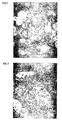
- Les cénosphères, examinées au microscope électronique, présentent une structure poreuse, analogue à celle de 1, ponce ou d'une éponge.
- La figure 1 est un agrandissement de 400 fois d'un groupe de cénosphères.
- La figure 2 est un agrandissement do 1000 fois d'un groupe de cénosphères.
- On admet généralement que les cénosphères résultent d'un craquage des gouttelettes de fuel. Elles se distinguent donc des particules élémentaires de suie dont la taille est de seulement quelques centaines d'Angstrôms (1 A = 10-10 mètres), bien que ces particules puissent s'agglomérer sous forme de chaînes beaucoup plus longues.
- Le diamètre moyen des cénosphères est habituellement supérieur à 10 ym, par exemple entre 10 et 200 µm ou entre 20 et 200 µm, plus particulièrement entre 20 et 60 µm.
- Leur densité de grain est habituellement de 0,3 à 0,8 g/cm3, de préférence de 0,4 à 0,6 g/cm3, et leur densité structurale habituellement de 1,2 à 2,5 g/cm3, de préférence 1,3 à 2,1 g/cm3.
- Leurvolume poreux total est habituellement de 0,8 à 2,5 cm3/g, de préférence 1,2 à 1,7 cm3/g.
- Certaines cénosphères initialement sphériques peuvent avoir été brisées et l'invention couvre aussi l'utilisation des débris de cénosphères.
- On appelle hydroconversion un procédé dans lequel une partie des constituants lourds de la charge est transformée sous pression d'hydrogène, à haute température, en produits à point d'ébullition plus bas.
- Suivant l'invention, on valorise les charges lourdes hydrocarbonées suivant un procédé d'hydroconversion qui comprend:
- 1. l'addition à la charge d'hydrocarbures de:
- a) au moins un composé de métal catalytique, de préférence sous forme d'une solution dans un solvant, par exemple dans l'eau ou dans un solvant d'hydrocarbure, le métal du composé appartenant à l'un au moins des groupes V B, VI B, VII B et VIII, et
- b) des cénosphères,
- 2. le maintien du mélange résultant dans des conditions d'hydroconversion, et
- 3. le fractionnement des produits obtenus.
- Le procédé, objet de cette invention, est applicable aux charges lourdes hyrocarbonées contenant des asphaltènes et des impuretés métalliques, soufrées et azotées. Ces charges lourdes comprennent:
- - les pétroles bruts et les fractions dérivées de ces pétroles bruts,
- - les fractions lourdes tirées du pétrole, telles que les résidus de distillation atmosphérique ou sous-vide,
- - les alphates provenant des unités de désasphaltage,
- - les goudrons, bitumes, produits venant des sables et schistes bitumineux,
- - les fractions liquides riches en asphaltènes provenant de la liquéfaction du charbon.
- Ce procédé est particulièrement bien adapté pour les charges hydrocarbonées les plus lourdes ayant un résidu en carbone Conradson pouvant aller jusqu'à 50% en poids. Ces charges ont également des teneurs pondérales très élevées en asphaltènes (par exemple jusqu'à 40%), en soufre (par exemple jusqu'à 8%) et en métaux (par exemple jusqu'à 3000 ppm).
- Le composé de métal catalytique, utilisé dans l'invention est un composé métallique finement divisé provenant de préférence d'un composé métallique soluble dans la charge ou d'une solution aqueuse d'un sel métallique que l'on disperse dans la charge ou, intermédiairement, dans un solvant hydrocarboné.
- Le composé métallique soluble dans la charge peut être choisi parmi:
- - les composés métalliques inorganiques tels que les halogénures, les oxyhalogénures, les polyhé- téroacides, par exemple: acide phosphomolybdique, bleus de molybdène, acide alkyldithiophos- phorique,
- - les sels métalliques d'un acide organique, aliphatique, naphténique ou aromatique, d'un acide sulfonique, d'un acide sulfinique, d'un acide xanthique, d'un mercaptan, d'un phénol ou d'un composé aromatique polyhydroxylé,
- - les chélates métalliques, tels que les complexes 8-côtoniques, les penta et hexacarbonyls, les complexes avec l'éthylènediamine, l'acide ethylènediaminetetracétique, les phtalocyanines,
- - les sels métalliques des amines organiques et des sels d'ammonium quaternaire.
- Le constituant métallique de ces composés solubles et convertibles en un catalyseur solide dispersé, appartient aux groupes V B, VI B, VII B et ou VIII suivant la table publiée par E. H. Sargent en 1962. Les métaux préférés sont le molybdène, le vanadium, le chrome, le tungstène, le manganèse, le fer, le nickel, le cobalt. Les composés préférés sont le naphténate de molybdène et le bleu de molybdène.
- La quantité du composé métallique soluble ajouté à la charge est comprise par exemple entre 10 et 1000 ppm, de préférence entre 50 et 500 ppm comptées en poids de métal par rapport à la charge.
- Le composé métallique peut être ajouté soit seul, soit mélangé avec un ou plusieurs composés de métaux différents.
- Le composé métallique, dissous dans une solution aqueuse éventuellement pré-émulsifiée avec un hydrocarbure, peut être par exemple: l'heptamolybdate d'ammonium ou d'un métal alcalin, le nitrate de cobalt, le nitrate de nickel, le sulfate ferreux ou le tungstate de sodium.
- Le composé préféré est l'heptamolybdate d'ammonium soit seul, soit en mélange avec un autre composé métallique soluble dans l'eau.
- La quantité de composé métallique dissous dans la solution aqueuse émulsifiée est comprise entre 10 et 1000 ppm, de préférence entre 50 et 500 ppm comptées en poids de métal.
- Les cénosphères proviennent le plus souvent des installations de dépoussiérage des fumées dans les grandes centrales thermiques brûlant des fuels lourds industriels, en particulier des fuels lourds n" 2.
- Ces cénosphères sont mélangées avec la charge dans la proportion de 0,1 à 5% en poids par rapport à celle-ci.
- La charge contenant les cénosphères, le composé métallique soluble ou le sel métallique apporté par une solution ou une émulsion aqueuse peut être soumise ou non à un prétraitement.
- Ce prétraitement a pour but de transformer le composé métallique ou le sel métallique en un catalyseur solide finement dispersé comprenant de 10 à 1000 ppm, de préférence de 50 à 300 ppm en poids de matière active comptée en métal élémentaire, basé sur le poids de charge. Le prétraitement se fait en présence d'hydrogène sulfuré seul ou en mélange avec de l'hydrogène à une température entre 200 et 450° C et sous une pression comprise entre 25 et 250 bars. Au cours de ce prétraitement une partie ou la totalité des métaux contenus dans les cénosphères est transformée également en sulfures métalliques.
- Quand il n'y a pas de prétraitement, la charge mélangée avec les constituants du système catalytique est envoyée au réacteur d'hydroconversion où le composé métallique ou le sel métallique et les métaux contenus dans les cénosphères sont transformés en sulfures métalliques sous l'action du soufre de la charge et/ou des composés du soufre formés au cours de la réaction, notamment H2S.
- La figure 3 décrit un mode de réalisation du procédé donné à titre d'exemple.
- La charge fraîche, le composé métallique soluble ou l'émulsion d'une solution aqueuse d'un sel métallique dans un hydrocarbure sont introduits respectivement par les conduites 1, 2 et 3 dans un bac de mélange 4.
- Ce mélange est pompé, conduite 5, dans un réacteur de prétraitement 6, où il est mis en contact avec de l'hydrogène contenant de 2 à 10% d'hydrogène sulfuré. L'hydrogène est un mélange d'hydrogène frais (conduite 7) et d'hydrogène de recyclage (conduite 8). L'hydrogène sulfuré est apporté soit par recyclage (conduite 8), soit par un apport frais (conduite 9). Pour ce prétraitement, la température est comprise entre 200 et 450°C, de préférence 350/450°C, la pression entre 25 et 250 bars, de préférence 100/200 bars, le temps de réaction entre 5 minutes et 4 heures, de préférence 10 minutes à 2 heures.
- Le produit prétraité est introduit (conduite 10) dans le réacteur d'hydroconversion 11. La température de ce réacteur est comprise entre 380 et 480°C, de préférence 420 à 460°C, la pression partielle d'hydrogène entre 25 et 250 bars, de préférence entre 100 et 200 bars, le débit d'hydrogène entre 1000 et 5000 litres TPN/litre de charge, de préférence entre 1000 et 2000 I/I et la vitesse spatiale (VVH) définie par le volume de charge par heure et par volume de réacteur entre 0,1 et 10, de préférence entre 0,25 et 5.
- L'effluent qui sort du réacteur d'hydroconversion par la conduite 12, comprend des gaz et un liquide ayant en suspension des solides. Il est introduit dans un séparateur haute pression 13. De ce séparateur part un gaz (conduite 14) qui contient de l'hydrogène, de l'hydrogène sulfuré et des hydrocarbures légers. Une partie de ce gaz est recyclée, après traitement pour éliminer le sulfure d'hydrogène, vers le réacteur de prétraitement ou le réacteur d'hydroconversion s'il n'y a pas de prétraitement. L'autre partie est éliminée (28) pour maintenir les pressions partielles d'hydrogène et d'hydrogène sulfuré au niveau fixé.
- Par la conduite 15 est soutiré, à travers une vanne de détente, un produit liquide avec en suspension des solides.
- Pour traiter ce mélange, il est possible d'utiliser différents traitements, faisant appel à des technologies connues. Ceux-ci diffèrent suivant les caractéristiques de la charge, la sévérité de l'hydroconversion, l'utilisation des produits finis, par exemple.
- Atitre indicatif, est donné un mode de traitement représenté dans la figure 3 ci-jointe.
- Le produit liquide, issu du séparateur 13 par la conduite 15, passe dans un séparateur basse pression (non représenté) où une purge d'eau peut être faite. Il est ensuite introduit (conduite 15) dans une unité de fractionnement 16, d'où l'on retire une ou plusieurs fractions (17 et 29).
- Cette unité de fractionnement peut être un simple vaporisateur sous vide ou une colonne de distillation sous vide. Le réglage de la séparation entre distillat et résidu est fait pour obtenir un résidu coulable et pompable dans des conditions industrielles.
- Le résidu soutiré par la conduite 17 est mélangé dans le bac 18 avec un solvant aromatique de point d'ébullition compris entre 100 et 220°C, introduit par la conduite 25. Ce solvant diminue la viscosité et permet l'obtention d'une phase qui est traitée dans une unité de séparation 20, réunie à 18 par la conduite 19. Dans cette unité de séparation on sépare les solides par filtration ou centrifugation ou décantation.
- Les solides filtrés ou centrifugés sont lavés par le même solvant aromatique (conduite 26), dans l'unité de séparation 20, pour éliminer les produits huileux qui enrobent les sulfures des métaux catalytiques, les sulfures des métaux contenus dans la charge, les cénosphères plus ou moins chargées en métaux et en sulfures métalliques et les insolubles dans le solvant aromatique.
- Une fraction de ces solides est éliminée par la conduite 21. Ils peuvent être brûlés, gazéifiés ou traités en vue de récupérer les métaux. L'autre fraction est recyclée vers le réacteur d'hydroconversion (conduite 22), celà par l'intermédiaire du bac de mélange 4, le solvant aromatique résiduel pouvant être soit gardé, soit éliminé.
- La phase liquide provenant de l'unité de séparation 20, mélangée au solvant de lavage, entre par la conduite 23 dans une unité de distillation 24.
- En tête de cette unité est soutiré le solvant aromatique qui est réinjecté dans le mélangeur 18 par la conduite 25, et dans l'unité de séparation 20, par la conduite 26, pour le lavage des solides filtrés ou centrifugés. A la base de la colonne de distillation 24, sort le résidu hydrotraité (conduit 27), en grande partie débarrassé de métaux, de soufre, d'azote et d'asphaltènes. Ce résidu est soit brûlé, soit gazéifié, soit dilué pourfaire un fuel lourd n° 2.
- Il convient de noter qu'avec le recyclage d'une partie des produits solides provenant de l'unité de séparation 20, il est possible soit de diminuer, soit même de suspendre par intermittence, l'introduction avec la charge de composé métallique frais. La quantité de ce composé métallique frais sera choisie en fonction du niveau d'activité désiré.
- On utilise un autoclave de 250 ml en acier inoxydable. Le contact gaz-liquide est assuré par une agitation par secousses.
- Un essai est fait avec 30 g de charge. L'autoclave, après le chargement du composé soluble de molybdène, des cénosphères et de la charge, est fermé et pesé à pression atmosphérique, balayé à l'hydrogène et soumis à une pression d'hydrogène de 100 bars pendant une heure pour vérifier l'étanchéité.
- L'autoclave, rempli d'hydrogène sous 100 bars à température ambiante est porté à la température de l'essai, en 3/4 heure à 1 heure suivant la température. Le temps de réaction correspond au palier de température. Le refroidissement est fait à l'air libre.
- En cas de prétraitement, on remplit l'autoclave d'abord avec du sulfure d'hydrogène sous 10 bars, puis on complète jusqu'à 100 bars par de l'hydrogène. On chauffe jusqu'à 380°C, laisse 1 heure, refroidit à température ambiante, détend, balaye par de l'hydrogène puis on reprend l'essai comme indiqué plus haut.
- Après refroidissement l'autoclave est depressurisé. Les gaz sont lavés à la soude, mesurés dans un compteur et analysés par chromatographie en phase gazeuse.
- Le milieu réactionnel est dilué par du toluène et filtré. Les solides sont lavés par du toluène chaud. Les deux solutions toluéniqùes, de filtration et de lavage, sont évaporées à 100°C sous 0,025 bar. Les hydrocarbures entraînés avec le toluène sont analysés. Le résidu d'évaporation constitue le produit hydro-converti.
- Le bilan pondéral doit être supérieur à 95% pour qu'un essai soit jugé valable.
- La charge contenant le composé métallique soluble et les cénosphères est mélangée en ligne avec de l'hydrogène contenant de 3 à 7% d'hydrogène sulfuré, puis est portée à la température de réaction à travers un four, constitué de cinq éléments chauffants. Elle entre ensuite au bas d'un réacteur, consistant en un tube vertical. L'effluent du réacteur est refroidi jusqu'à 150°C et passe dans un séparateur haute prèssion. Le gaz venant de ce séparateur est recyclé après avoir été lavé à l'eau. Une purge permet de régler les pressions partielles d'hydrogène et d'hydrogène sulfuré. Le produit hydroconverti est soutiré à la base du séparateur haute pression.
- Deux charges ont été utilisées dans les exemples (tableau I); ce sont un résidu sous vide Safanya et un asphalte, provenant d'une unité de désasphaltage au pentane du même résidu sous vide; cet asphalte est dilué avec 35% en volume de gas-oil.


- On opère en discontinu avec 30 g d'asphalte Safanya dilué avec 35% en volume de gas-oil à 420°C pendant deux heures; pression initiale d'hydrogène: 100 bars; pas de prétraitement. On effectue différents essais: essai sans catalyseur, essai avec cénosphères seules, essai avec naphténate de molybdène seul, essai avec naphténate de molybdène plus des cénosphères.
- Le tableau Il rassemble les résultats fournis par ces essais.

- L'addition de cénosphères au naphténate de molybdène améliore donc, d'une façon très sensible, la démétallation sans augmenter sensiblement la quantité d'insoluble.
- Les cénosphères seules, essai 301, par rapport à l'essai 278, seulement thermique, présentent déjà une activité hydrogénante et désulfurante, ainsi que le montrent le rapport C'3/C3 et le pourcentage d'hydrodésulfuration.
- Les cénosphères permettent la fixation du vanadium, du nickel et du molybdène.
- On ne retrouve pas de molybdène dans le produit hydroconverti liquide.
- Les essais indiqués dans cet exemple sont faits dans les mêmes conditions que dans l'exemple 1. On utilise, comme composé soluble du molybdène, un bleu de molybdène en solution à 5,8% dans un alcool C7-C9.
- Le tableau III rassemble les résultats de ces essais.

- Ces essais confirment les résultats obtenus avec le naphténate de molybdène, à savoir la présence de cénosphères augmente l'activité d'hydrométallation et réduit le poids d'insoluble.
- On opère comme dans l'exemple 1, mais on ajoute à la charge d'hydrocarbures, en plus du naphténate de cobalt et des cénosphères, 0,5% en poids, par rapport à la charge, de cénosphères récupérées au terme de l'exemple 1 et lavées au toluène chaud. L'addition de ces cénosphères récupérées permet, ainsi que le montre le tableau IV, de réduire l'apport de naphténate de molybdène frais à 100 ppm, sans modification significative des résultats.


- On opère selon la méthode en continu décrite plus haut aec le résidu sous vide Safanya.
- La charge est mélangée avec du naphténate de molybdène (500 ppm en poids de molybdène) et 1% en poids de cénosphères, identiques à celles utilisées dans l'exemple 1. Elle est introduite dans le four de préchauffage à raison de 1 litre/h, où elle est portée à 430° C, température à laquelle elle entre dans la chambre de réaction.
- La pression totale est de 150 bars. L'hydrogène recyclé est introduit en ligne juste avant le préchauffeur, avec un rapport H2/Hydrocarbure égal à 1000 litres par litre, l'hydrogène étant considéré à température et pression normale. L'hydrogène contient de 2 à 3% d'hydrogène sulfuré. La vitesse spatiale, volume de charge par heure et par volume de réacteur, est égale à 1,2 ce qui correspond à un temps de séjour dans le réacteur de 54 minutes.
- Le tableau V montre les résultats obtenus après 100 heures de fonctionnement dans les conditions précédentes.

- On opère selon la méthode en continu décrite plus haut avec un asphalte Safanya dilué avec 50% de »Iight cycle oil«. Le mélange résultant a les caractéristiques suivantes:

- Deux essais sont faits dans des conditions opératoires rigoureusement identiques, indiquées dans le tableau VI.
- Dans le premier essai (111), on utilise le naphténate de molybdène seul, dans le deuxième essai (112) on additionne au naphténate de molybdène, 2% en poids, par rapport à la charge, de cénosphères.
- Pour chaque essai, un bilan sur 24 heures a été réalisé à 405°C, 417°C, 430°C. Sur les produits hydroconvertis soutirés à la base du séparateur haute pression des essais de filtration ont été faits dans les conditions suivantes:

- Le tableau VI fournit les vitesses de filtration pour ces différents produits ainsi que leur viscosité à 50" C.
- Il apparait très nettement que pour des conditions de filtration identiques et pour des viscosités presque semblables, la présence des cénosphères, décrites ci-dessus, favorise la filtration et donc la séparation du catalyseur en vue éventuellement d'un recyclage. Tout se passe comme si ces particules charbonneuses agissaient comme un adjuvant de filtration.
- A titre de comparaison, on a donnée les durées de filtration observées avec d'autres adjuvants de filtration. Seule la Célite (marque déposée) donne des résultats équivalents; l'avantage des cénosphères, après utilisation, est de pouvoir être brûlées.

est décrit dans le brevet US 4 178 227.
Claims (9)
Applications Claiming Priority (2)
| Application Number | Priority Date | Filing Date | Title |
|---|---|---|---|
| FR8115665A FR2511389A1 (fr) | 1981-08-11 | 1981-08-11 | Procede d'hydroconversion catalytique d'hydrocarbures lourds en phase liquide et en presence d'un catalyseur disperse et de particules charbonneuses |
| FR8115665 | 1981-08-11 |
Publications (2)
| Publication Number | Publication Date |
|---|---|
| EP0073690A1 EP0073690A1 (fr) | 1983-03-09 |
| EP0073690B1 true EP0073690B1 (fr) | 1985-06-19 |
Family
ID=9261443
Family Applications (1)
| Application Number | Title | Priority Date | Filing Date |
|---|---|---|---|
| EP82401336A Expired EP0073690B1 (fr) | 1981-08-11 | 1982-07-16 | Procédé d'hydroconversion catalytique d'hydrocarbures lourds en phase liquide et en présence d'un catalyseur dispersé et de particules charbonneuses |
Country Status (6)
| Country | Link |
|---|---|
| US (1) | US4431520A (fr) |
| EP (1) | EP0073690B1 (fr) |
| JP (1) | JPS58108294A (fr) |
| CA (1) | CA1191804A (fr) |
| DE (1) | DE3264271D1 (fr) |
| FR (1) | FR2511389A1 (fr) |
Cited By (1)
| Publication number | Priority date | Publication date | Assignee | Title |
|---|---|---|---|---|
| DE3912807A1 (de) * | 1989-04-19 | 1990-11-08 | Gfk Kohleverfluessigung Gmbh | Katalysator bzw. additiv zur hydrierenden behandlung von schweren erdoelen bzw. schweren erdoelfraktionen sowie verfahren zur gewinnung des katalysators |
Families Citing this family (36)
| Publication number | Priority date | Publication date | Assignee | Title |
|---|---|---|---|---|
| NL8203780A (nl) * | 1981-10-16 | 1983-05-16 | Chevron Res | Werkwijze voor de hydroverwerking van zware koolwaterstofhoudende olien. |
| DE3221411A1 (de) * | 1982-06-05 | 1983-12-08 | Veba Oel Entwicklungsgesellschaft mbH, 4660 Gelsenkirchen-Buer | Verfahren zur hydrierung von schweroel, bitumen und dergl. |
| DE3238689A1 (de) * | 1982-10-19 | 1984-04-26 | Rheinische Braunkohlenwerke AG, 5000 Köln | Verfahren zum hydrieren von schwer- und rueckstandsoelen und dafuer verwendete katalysatoren |
| US4592827A (en) * | 1983-01-28 | 1986-06-03 | Intevep, S.A. | Hydroconversion of heavy crudes with high metal and asphaltene content in the presence of soluble metallic compounds and water |
| US4518488A (en) * | 1983-02-28 | 1985-05-21 | Standard Oil Company (Indiana) | Metal-containing active carbon and methods for making and using same |
| GB2142930B (en) * | 1983-03-19 | 1987-07-01 | Asahi Chemical Ind | A process for cracking a heavy hydrocarbon |
| FR2548206B1 (fr) * | 1983-06-29 | 1986-06-27 | Inst Francais Du Petrole | Procede de formation de melanges de sels metalliques solubles, principalement du vanadium et du nickel, et utilisation des melanges formes comme catalyseurs d'hydrotraitement d'hydrocarbures lourds, en phase liquide |
| US4863892A (en) * | 1983-08-16 | 1989-09-05 | Phillips Petroleum Company | Antifoulants comprising tin, antimony and aluminum for thermal cracking processes |
| CA1244369A (fr) * | 1983-12-02 | 1988-11-08 | Nobumitsu Ohtake | Conversion des hydrocarbures lourds en produits de valeur superieure |
| GB2159168B (en) * | 1984-05-25 | 1989-05-10 | Gulf Research Development Co | Process for cracking high metals content feedstocks using a cracking catalyst mixture containing antimony and/or tin |
| US4732664A (en) * | 1984-11-26 | 1988-03-22 | Intevep, S.A. | Process for solid separation from hydroprocessing liquid product |
| US4637870A (en) * | 1985-04-29 | 1987-01-20 | Exxon Research And Engineering Company | Hydrocracking with phosphomolybdic acid and phosphoric acid |
| DE3534552A1 (de) * | 1985-09-27 | 1987-04-02 | Rheinische Braunkohlenw Ag | Verbesserte katalysatoren zur hydrierung von schwer- und rueckstandsoelen, ihre herstellung und verfahren unter verwendung derselben |
| FR2594137B1 (fr) * | 1986-02-10 | 1989-02-17 | Inst Francais Du Petrole | Procede d'hydrotraitement d'hydrocarbures lourds en phase liquide en presence d'un catalyseur disperse |
| FR2603598A1 (fr) * | 1986-09-10 | 1988-03-11 | Inst Francais Du Petrole | Procede d'hydroconversion d'une charge lourde d'hydrocarbures |
| DE3634275A1 (de) * | 1986-10-08 | 1988-04-28 | Veba Oel Entwicklungs Gmbh | Verfahren zur hydrierenden konversion von schwer- und rueckstandsoelen |
| US4708784A (en) * | 1986-10-10 | 1987-11-24 | Phillips Petroleum Company | Hydrovisbreaking of oils |
| US4853110A (en) * | 1986-10-31 | 1989-08-01 | Exxon Research And Engineering Company | Method for separating arsenic and/or selenium from shale oil |
| CA1305467C (fr) * | 1986-12-12 | 1992-07-21 | Nobumitsu Ohtake | Additif pour l'hydroconversion d'une fraction lourde d'hydrocarbure |
| US5000836A (en) * | 1989-09-26 | 1991-03-19 | Betz Laboratories, Inc. | Method and composition for retarding coke formation during pyrolytic hydrocarbon processing |
| US5319119A (en) * | 1991-03-15 | 1994-06-07 | Asahi Kasei Kogyo Kabushiki Kaisha | Oleophilic molybdenum compound for use in hydroconversion of a hydrocarbon and a method for producing the same |
| US5951849A (en) * | 1996-12-05 | 1999-09-14 | Bp Amoco Corporation | Resid hydroprocessing method utilizing a metal-impregnated, carbonaceous particle catalyst |
| US5954945A (en) | 1997-03-27 | 1999-09-21 | Bp Amoco Corporation | Fluid hydrocracking catalyst precursor and method |
| US5807478A (en) * | 1997-05-16 | 1998-09-15 | Exxon Research And Engineering Company | Bitumen modification using fly ash derived from bitumen coke |
| JP3404522B2 (ja) * | 1999-10-29 | 2003-05-12 | 独立行政法人産業技術総合研究所 | 重質油の水素化処理方法 |
| US7169489B2 (en) * | 2002-03-15 | 2007-01-30 | Fuelsell Technologies, Inc. | Hydrogen storage, distribution, and recovery system |
| US20030234010A1 (en) * | 2002-06-25 | 2003-12-25 | Redmond Scott D. | Methods and apparatus for converting internal combustion engine (ICE) vehicles to hydrogen fuel |
| US20040016769A1 (en) * | 2002-03-15 | 2004-01-29 | Redmond Scott D. | Hydrogen storage, distribution, and recovery system |
| US7011768B2 (en) * | 2002-07-10 | 2006-03-14 | Fuelsell Technologies, Inc. | Methods for hydrogen storage using doped alanate compositions |
| US20040065171A1 (en) * | 2002-10-02 | 2004-04-08 | Hearley Andrew K. | Soild-state hydrogen storage systems |
| US7737072B2 (en) * | 2004-09-10 | 2010-06-15 | Chevron Usa Inc. | Hydroprocessing bulk catalyst and uses thereof |
| EP1754770B1 (fr) * | 2005-08-16 | 2017-01-18 | Research Institute of Petroleum | Procédé pour la hydro-conversion de courants hydrocarbonés lourds |
| WO2009058861A2 (fr) * | 2007-10-31 | 2009-05-07 | Chevron U.S.A. Inc. | Catalyseur en vrac pour l'hydrotraitement et ses utilisations |
| US8722556B2 (en) * | 2007-12-20 | 2014-05-13 | Chevron U.S.A. Inc. | Recovery of slurry unsupported catalyst |
| US7818969B1 (en) | 2009-12-18 | 2010-10-26 | Energyield, Llc | Enhanced efficiency turbine |
| US10041004B2 (en) * | 2014-11-06 | 2018-08-07 | Uop Llc | Processes for producing deashed pitch |
Family Cites Families (11)
| Publication number | Priority date | Publication date | Assignee | Title |
|---|---|---|---|---|
| DE2250822C3 (de) * | 1971-10-18 | 1981-02-12 | Universal Oil Prod Co | Verfahren zur katalytischen Umwandlung einer asphaltenhaltigen Kohlenwasserstoffbeschickung |
| US4125455A (en) * | 1973-09-26 | 1978-11-14 | Texaco Inc. | Hydrotreating heavy residual oils |
| US3923635A (en) * | 1974-06-17 | 1975-12-02 | Exxon Research Engineering Co | Catalytic upgrading of heavy hydrocarbons |
| NL7412337A (nl) * | 1974-09-18 | 1976-03-22 | Shell Int Research | Werkwijze voor de bereiding van nieuwe kata- lysatoren. |
| US3978000A (en) * | 1975-03-19 | 1976-08-31 | American Cyanamid Company | Catalysts based on carbon supports |
| US4192735A (en) * | 1976-07-02 | 1980-03-11 | Exxon Research & Engineering Co. | Hydrocracking of hydrocarbons |
| US4204943A (en) * | 1978-03-24 | 1980-05-27 | Exxon Research & Engineering Co. | Combination hydroconversion, coking and gasification |
| US4178227A (en) * | 1978-03-24 | 1979-12-11 | Exxon Research & Engineering Co. | Combination hydroconversion, fluid coking and gasification |
| US4226742A (en) * | 1978-07-14 | 1980-10-07 | Exxon Research & Engineering Co. | Catalyst for the hydroconversion of heavy hydrocarbons |
| US4227995A (en) * | 1978-12-06 | 1980-10-14 | The Lummus Company | Demetallization of hydrocarbon feedstock |
| CA1124194A (fr) * | 1979-03-05 | 1982-05-25 | Ramaswami Ranganathan | Hydrocraquage de suspensions de cendres volantes dans des huiles lourdes |
-
1981
- 1981-08-11 FR FR8115665A patent/FR2511389A1/fr active Granted
-
1982
- 1982-07-16 EP EP82401336A patent/EP0073690B1/fr not_active Expired
- 1982-07-16 DE DE8282401336T patent/DE3264271D1/de not_active Expired
- 1982-08-11 JP JP57140478A patent/JPS58108294A/ja active Pending
- 1982-08-11 US US06/407,217 patent/US4431520A/en not_active Expired - Fee Related
- 1982-08-11 CA CA000409246A patent/CA1191804A/fr not_active Expired
Cited By (1)
| Publication number | Priority date | Publication date | Assignee | Title |
|---|---|---|---|---|
| DE3912807A1 (de) * | 1989-04-19 | 1990-11-08 | Gfk Kohleverfluessigung Gmbh | Katalysator bzw. additiv zur hydrierenden behandlung von schweren erdoelen bzw. schweren erdoelfraktionen sowie verfahren zur gewinnung des katalysators |
Also Published As
| Publication number | Publication date |
|---|---|
| DE3264271D1 (en) | 1985-07-25 |
| EP0073690A1 (fr) | 1983-03-09 |
| FR2511389A1 (fr) | 1983-02-18 |
| JPS58108294A (ja) | 1983-06-28 |
| FR2511389B1 (fr) | 1983-11-18 |
| CA1191804A (fr) | 1985-08-13 |
| US4431520A (en) | 1984-02-14 |
Similar Documents
| Publication | Publication Date | Title |
|---|---|---|
| EP0073690A1 (fr) | Procédé d'hydroconversion catalytique d'hydrocarbures lourds en phase liquide et en présence d'un catalyseur dispersé et de particules charbonneuses | |
| US7585406B2 (en) | Process for hydroconverting of a heavy hydrocarbonaceous feedstock | |
| US5496464A (en) | Hydrotreating of heavy hydrocarbon oils in supercritical fluids | |
| US5578197A (en) | Hydrocracking process involving colloidal catalyst formed in situ | |
| RU2352616C2 (ru) | Способ переработки тяжелого сырья, такого как тяжелая сырая нефть и кубовые остатки | |
| RU2360944C2 (ru) | Комплексный способ конверсии содержащего уголь сырья в жидкие продукты | |
| US8679322B2 (en) | Hydroconversion process for heavy and extra heavy oils and residuals | |
| CA1340305C (fr) | Composition catalytique comprenant un sulfure metallique en suspension dans un liquide contenant des asphaltenes et procede d'hydroviscoreduction d'une charge d'hydrocarbures | |
| FR2499584A1 (fr) | Procede de demetallisation et d'hydrocraquage simultanes d'huiles hydrocarbonees lourdes | |
| FR2792947A1 (fr) | Procede d'hydrocraquage d'huiles lourdes | |
| FR2753984A1 (fr) | Procede de conversion d'une fraction lourde d'hydrocarbures impliquant une hydrodemetallisation en lit bouillonnant de catalyseur | |
| BE1026853A1 (fr) | Procédé de traitement simultané | |
| FR2814467A1 (fr) | Procede combine de desasphaltage par solvant a faible degre et de cokefaction retardee | |
| CA2088402C (fr) | Procede d'hydrocraquage utilisant un catalyseur colloidal produit in situ | |
| FR2753982A1 (fr) | Procede catalytique en plusieurs etapes de conversion d'une fraction lourde d'hydrocarbures | |
| EP0235003A1 (fr) | Procédé d'hydrotraitement d'hydrocarbures lourds en phase liquide en présence d'un catalyseur dispersé | |
| FR2504144A1 (fr) | Nouveau procede d'hydrotraitement d'hydrocarbures lourds en presence de metaux reduits | |
| FR2636069A1 (fr) | Systeme catalytique pour l'hydroconversion des huiles lourdes | |
| FR2512457A1 (fr) | Procede de liquefaction du charbon | |
| FR2540883A1 (fr) | Procede d'hydrocraquage d'huiles lourdes en presence d'additif melange sec forme de charbon ou d'escarbilles et d'un compose metallique | |
| FR2479255A1 (fr) | Procede d'hydrocraquage d'hydrocarbures lourds utilisant du gaz de synthese | |
| GB1593314A (en) | Process for producing low-sulphur liquid and solid fuels from coal | |
| RU2556860C1 (ru) | Способ получения жидких углеводородных смесей путем гидроконверсии лигноцеллюлозной биомассы | |
| FR2551452A1 (fr) | Procede pour la valorisation de petroles bruts lourds | |
| FR2516931A1 (fr) | Procede de conversion d'une matiere carbonee en hydrocarbures paraffiniques inferieurs et hydrocarbures aromatiques monocycliques |
Legal Events
| Date | Code | Title | Description |
|---|---|---|---|
| PUAI | Public reference made under article 153(3) epc to a published international application that has entered the european phase |
Free format text: ORIGINAL CODE: 0009012 |
|
| AK | Designated contracting states |
Designated state(s): BE DE GB IT NL |
|
| 17P | Request for examination filed |
Effective date: 19830811 |
|
| ITF | It: translation for a ep patent filed | ||
| GRAA | (expected) grant |
Free format text: ORIGINAL CODE: 0009210 |
|
| AK | Designated contracting states |
Designated state(s): BE DE GB IT NL |
|
| REF | Corresponds to: |
Ref document number: 3264271 Country of ref document: DE Date of ref document: 19850725 |
|
| PLBE | No opposition filed within time limit |
Free format text: ORIGINAL CODE: 0009261 |
|
| STAA | Information on the status of an ep patent application or granted ep patent |
Free format text: STATUS: NO OPPOSITION FILED WITHIN TIME LIMIT |
|
| 26N | No opposition filed | ||
| PGFP | Annual fee paid to national office [announced via postgrant information from national office to epo] |
Ref country code: GB Payment date: 19910624 Year of fee payment: 10 |
|
| PGFP | Annual fee paid to national office [announced via postgrant information from national office to epo] |
Ref country code: BE Payment date: 19910723 Year of fee payment: 10 |
|
| ITTA | It: last paid annual fee | ||
| PGFP | Annual fee paid to national office [announced via postgrant information from national office to epo] |
Ref country code: NL Payment date: 19910731 Year of fee payment: 10 |
|
| PGFP | Annual fee paid to national office [announced via postgrant information from national office to epo] |
Ref country code: DE Payment date: 19910814 Year of fee payment: 10 |
|
| PG25 | Lapsed in a contracting state [announced via postgrant information from national office to epo] |
Ref country code: GB Effective date: 19920716 |
|
| PG25 | Lapsed in a contracting state [announced via postgrant information from national office to epo] |
Ref country code: BE Effective date: 19920731 |
|
| BERE | Be: lapsed |
Owner name: INSTITUT FRANCAIS DU PETROLE Effective date: 19920731 |
|
| PG25 | Lapsed in a contracting state [announced via postgrant information from national office to epo] |
Ref country code: NL Effective date: 19930201 |
|
| NLV4 | Nl: lapsed or anulled due to non-payment of the annual fee | ||
| GBPC | Gb: european patent ceased through non-payment of renewal fee |
Effective date: 19920716 |
|
| PG25 | Lapsed in a contracting state [announced via postgrant information from national office to epo] |
Ref country code: DE Effective date: 19930401 |