EP0074103B1 - N-(N'-(2-Chloräthyl)-N'-nitroso-carbamoyl)- oligopeptidester und -amide und Verfahren zu ihrer Herstellung - Google Patents
N-(N'-(2-Chloräthyl)-N'-nitroso-carbamoyl)- oligopeptidester und -amide und Verfahren zu ihrer Herstellung Download PDFInfo
- Publication number
- EP0074103B1 EP0074103B1 EP82108166A EP82108166A EP0074103B1 EP 0074103 B1 EP0074103 B1 EP 0074103B1 EP 82108166 A EP82108166 A EP 82108166A EP 82108166 A EP82108166 A EP 82108166A EP 0074103 B1 EP0074103 B1 EP 0074103B1
- Authority
- EP
- European Patent Office
- Prior art keywords
- chloroethyl
- nitroso
- carbamoyl
- ppm
- methyl ester
- Prior art date
- Legal status (The legal status is an assumption and is not a legal conclusion. Google has not performed a legal analysis and makes no representation as to the accuracy of the status listed.)
- Expired
Links
Classifications
-
- C—CHEMISTRY; METALLURGY
- C07—ORGANIC CHEMISTRY
- C07K—PEPTIDES
- C07K5/00—Peptides containing up to four amino acids in a fully defined sequence; Derivatives thereof
- C07K5/04—Peptides containing up to four amino acids in a fully defined sequence; Derivatives thereof containing only normal peptide links
- C07K5/06—Dipeptides
- C07K5/06008—Dipeptides with the first amino acid being neutral
- C07K5/06017—Dipeptides with the first amino acid being neutral and aliphatic
- C07K5/06026—Dipeptides with the first amino acid being neutral and aliphatic the side chain containing 0 or 1 carbon atom, i.e. Gly or Ala
-
- C—CHEMISTRY; METALLURGY
- C07—ORGANIC CHEMISTRY
- C07K—PEPTIDES
- C07K5/00—Peptides containing up to four amino acids in a fully defined sequence; Derivatives thereof
- C07K5/04—Peptides containing up to four amino acids in a fully defined sequence; Derivatives thereof containing only normal peptide links
- C07K5/06—Dipeptides
- C07K5/06191—Dipeptides containing heteroatoms different from O, S, or N
Definitions
- nitrosoureas e.g. 1,3-bis (2-chloroethyl) - 1-nitrosourea (BCNU), 1- (2-chloroethyl) -3-cyclohexyl-1-nitrosourea (CCNU) and 1- (2-chloroethyl) -3- (4th -methylcyclohexyl) -1-nitrosourea (MeCCNU)
- BCNU 1,3-bis (2-chloroethyl) - 1-nitrosourea
- CCNU 1- (2-chloroethyl) -3-cyclohexyl-1-nitrosourea
- MeCCNU 2-chloroethyl) -3- (4th -methylcyclohexyl) -1-nitrosourea
- the present case concerns oligopeptide esters which have an N- (2-chloroethyl) - N-nitroso-carbamoyl group on the amino group.
- N [N '- (2-chloroethyl) N'-nitroso-carbamoyl] amino acids or oligopeptides are used as the starting material for the synthesis of N- [N' (2-chloroethyl) - N'-nitroso-carbamoyl], - oligopeptide esters in turn are expediently accessible by reaction of N- (2-chloroethyl) - N-nitrosocarbamoylazide with amino acids or oligopeptides.
- N [N '- (2-chloroethyl) - N'-nitrosocarbamoyl] amino acids or oligopeptides mentioned react to form amides, so that they react with the ester or Amide of a second amino acid or a second oligopeptide form a peptide bond.
- the reaction of the starting material 1 with the ester or amide of a further amino acid or an oligopeptide II, which may be the same or different from the first amino acid or the first oligopeptide, is preferably carried out with cooling (about 0 ° C.), but also without problems at Room temperature.
- 1 mM N- [N'- (2-chloroethyl) - N'-nitroso-carbamoyl] - amino acid and 1 mM amino acid methyl ester are dissolved together in 20 ml dichloromethane.
- 1.1 mM (230 mg) of dicyclheylcarbodiimide, dissolved in 10 ml of dichloromethane, is slowly added dropwise to this solution with stirring.
- the reaction mixture is then further stirred for one hour and left to stand at room temperature overnight. After filtering off N, N'-dicyclohexylurea, the filtrate is concentrated in vacuo.
- the crude product is obtained, which is purified by column chromatography on ether / dichloromethane with different mixing ratios on silica gel. After the elution, the main fractions are combined and concentrated under vacuum. The residue is taken up in dichloromethane, mixed with n-pentane if necessary, and crystallized in the refrigerator.
- N- [N '- (2-chloroethyl) -N'-nitroso-carbamoyl] -glycine (1 mM) and L-valine methyl ester (1 mM) are dissolved together in 20 ml dichloromethane.
- Dicyclohexyl-carbodiimide (DCC; 1.1 mM) dissolved in 10 ml of dichloromethane, is added dropwise to this solution with stirring. The reaction mixture is then stirred for another hour and left to stand at room temperature overnight. After filtering off N, N'-dicyclohexylurea, the filtrate is concentrated in vacuo.
- N- [N '- (2-chloroethyl) - N'-nitroso-carbamoyl] -L-valine (1 mM) and L-methionine methyl ester (1 mM) are treated analogously to Example 1. Yellowish needles (dichloromethane / n-pentane), yield approx. 70%, mp. 81 to 82 ° C (dec.). Elemental analysis: Ber. C 42.37; H 6.35; N 14.12; Found: C 42.65; H 6.50; N 14.14.
- N- [N '- (2-chloroethyl) - N'-nitroso-carbamoyl] -L-phenylalanine (1 mM) and L-valine methyl ester (1 mM) are treated analogously as in Example 1. Yellow needles (dichloromethane / n-pentane), yield 60%, F p .107 to 108 ° C.
- N- [N '- (2-chloroethyl) - N'-nitroso-carbamoyl] -L-phenylalanine (1 mM) and L-leucine methyl ester (1 mM) are treated analogously as in Example 1.
- Light yellow needles (dichloromethane / n-pentane), yield approx. 60%, mp. 96 to 96.5 ° C.
- N- [N '- (2-chloroethyl) - N'-nitroso-carbamoyl] -L-phenylalanine (1 mM) and L-phenylalanine methyl ester (1 mM) are treated analogously to Example 1.
- Light yellow needles (dichloromethane / n-pentane), yield approx. 60%, mp. 116 to 117 ° C.
- N- [N'- (2-chloroethyl) - N'-nitroso-carbamoyl] -L-phenylalanine (1 mM) and L-methionine methyl ester (1 mM) are treated analogously as in Example 1.
- Light yellow needles (dichloromethane / n-pentane), yield approx. 70%, mp. 74 to 75 ° C.
- N- [N '- (2-chloroethyl) - N'-nitroso-carbamoyl] -L-methionine (1 mM) and L-phenylalanine methyl ester (1 mM) are treated analogously as in Example 1.
- Light yellow needles (dichloromethane / n-pentane), yield approx. 70%, mp. 70 to 71 ° C.
Landscapes
- Chemical & Material Sciences (AREA)
- Organic Chemistry (AREA)
- Molecular Biology (AREA)
- Proteomics, Peptides & Aminoacids (AREA)
- Biophysics (AREA)
- General Health & Medical Sciences (AREA)
- Genetics & Genomics (AREA)
- Medicinal Chemistry (AREA)
- Health & Medical Sciences (AREA)
- Biochemistry (AREA)
- Life Sciences & Earth Sciences (AREA)
- Organic Low-Molecular-Weight Compounds And Preparation Thereof (AREA)
- Peptides Or Proteins (AREA)
- Medicines That Contain Protein Lipid Enzymes And Other Medicines (AREA)
- Preparation Of Compounds By Using Micro-Organisms (AREA)
- Acyclic And Carbocyclic Compounds In Medicinal Compositions (AREA)
- Hydrogenated Pyridines (AREA)
Description
- Unter den Alkylantien ist in den letzten Jahren eine neue Stoffklasse in die Krebschemotherapie eingeführt worden, nämlich die Nitrosoharnstoffe, z.B. 1,3-bis- (2-Chloräthyl)- 1-nitrosoharnstoff (BCNU), 1-(2-Chloräthyl)-3-cyclohexyl-1-nitrosoharnstoff (CCNU) und 1-(2-Chloräthyl) -3- (4-methylcyclohexyl) -1-nitrosoharnstoff (MeCCNU) (Proceeding of the 7th new drug seminar on the nitroso-ureas (Washington, D.C., Dec. 15-16,1975), Cancer Treat. Rep., 60, 645-811 (1976)). Um Substanzen mit besserem therapeutischem Index zu erhalten, hat man in der letzten Zeit eine Reihe neuer Nitrosoharnstoffe mit verschiedenen Substituenten, z.B. Zuckerderivate, synthetisiert und experimentell getestet. (Anderson et al., Cancer Res. 35, 761 (1976), Hayat et al., Cancer Chemother. Pharmaco). 3,217 (1979.))
- Im Gegensatz zu den bisher synthetisierten Substanzen handelt es sich im vorliegenden Fall um Oligopeptidester, die an der Aminogruppe eine N-(2-Chloräthyl)- N-nitroso-carbamoylgruppierung tragen. Als Ausgangsmaterial zur Synthese von N-[N'(2-Chloräthyl)- N'-nitroso-carbamoyl],- oligopeptidestern dienen N[N'-(2-Chloräthyl) N'-nitroso-carbamoyl] aminosäuren oder -oligopeptide, die ihrerseits zweckmässig durch Reaktion von N-(2-Chloräthyl)- N-nitrosocarbamoylazid mit Aminosäuren bzw. Oligopeptiden zugänglich sind. Unter dem Einfluss von an sich bekannten Peptidkatalysatoren wie z.B. Dicyclohexylcarbodiimid (DCC) reagieren die erwähnten N[N'-(2-Chloräthyl)- N'-nitroso- carbamoyl] aminosäuren bzw. -oligopeptide zu Amiden, so dass sie mit dem Ester oder Amid einer zweiten Aminosäure bzw. eines zweiten Oligopeptids eine Peptidbindung bilden. Die Reaktion kann schematisch wie folgt dargestellt werden:


-
- - Glycyl-Glycin
- - Glycyl-Glycyl-Glycin und Peptide anderer Aminosäuren bis zum Tripeptid, sowie gemischt Oligopeptide wie:
- Glycyl-Alanin
- Alanyl-Leucin
- Leucyl-Alanin
- Glycyl-Tyrosin
- Leucyl-Glycyl-Tyrosin
- Leucyl-Glycyl-Prolin
- R4 = OCH3, NH2,-NHR4', wobei R4' Alkyl oder Aryl bzw. einen über die terminale Aminogruppe peptidisch gebundenen Oligopeptidrest darstellt, dessen endständige Carboxylgruppe ihrerseits als Methylester oder Amid vorliegt.
-
- -Glycin-Methylester
- -Glycyl-Glycyl-Methylester
- -Glycyl-Glycyl-Glycylmethylester
- Peptide anderer Aminosäuren bis Tripeptid sowie gemischte Oligopeptide wie:
- Glycyl-Alanin- Methylester
- Leucyl-Glycyl- Prolinmethylester
- Leucyl-Alanin-Amid
- Glycyl-Tyrosin-Amid
- Die Umsetzung des Ausgangsmaterials 1 mit dem Ester bzw. Amid einer weiteren Aminsäure oder eines Oligopeptids II, die gleich oder verschieden von der ersten Aminosäure bzw. dem ersten Oligopeptid sein können, erfolgt vorzugsweise unter Kühlung (etwa 0 °C), aber auch problemlos bei Raumtemperatur. Beispielsweise werden 1 mM N-[N'- (2-Chloräthyl)- N'-nitroso-carbamoyl]- aminosäure und 1 mM Aminosäuremethylester zusammen in 20 ml Dichlormethan gelöst. In diese Lösung wird unter Rühren 1,1 mM (230 mg) Dicyclheyl-carbodiimid, gelöst in 10 ml Dichlormethan, langsam zugetropft. Das Reaktionsgemisch wird dann weiter eine Stunde gerührt und über Nacht bei Zimmertemperatur stehengelassen. Nach Abfiltrieren von N,N'-Dicyclohexylharnstoff wird das Filtrat unter Vakuum eingeengt. Man erhält das Rohprodukt, das man säulenchromatographisch mit Ether/Dichlormethan unterschiedlicher Mischungsverhältnisse an Kieselgel reinigt. Nach der Elution werden die Hauptfraktionen kombiniert und unter Vakuum eingeengt. Der Rückstand wird in Dichlormethan aufgenommen, wenn nötig mit n-Pentan versetzt, und im Kühlschrank zur Kristallisation gebracht.
- Die folgenden Beispiele erläutern die Erfindung:
- Herstellung von N-[N'-(2-Chloräthyl)- N'-nitroso-carbamoyl]- glycyl-L-valinmethylester (allgemeine Formel III) R1 = -H R3= -CH(CH3)2
- N-[N'-(2-Chloräthyl)-N'-nitroso-carbamoyl]-glycin (1 mM) und L-Valinmethylester (1 mM) werden zusammen in 20 ml Dichlormethan gelöst. In dieser Lösung wird unter Rühren Dicyclohexyl-carbodiimid (DCC; 1,1 mM), gelöst in 10 ml Dichlormethan, zugetropft. Das Reaktionsgemisch wird dann noch eine Stunde gerührt und bei Zimmertemperatur über Nacht stehengelassen. Nach Abfiltrieren von N,N'-Dicyclohexylharnstoff wird das Filtrat unter Vakuum eingeengt. Das Rohprodukt wird durch Säulenchromatographie gereinigt (Kieselgel, eluiert mit Äther/ Dichlormethan 1:10). Aus den Hauptfraktionen wird das reine Produkt nach Entfernen von Lösungsmittel in Vakuum und durch Umkristallisation aus Dichlormethan/n-Pentan erhalten. Hellgelbe Nadeln, Ausbeute: ca. 70%, Fp. 97 bis 98 °C (Zers.); Elementaranalyse: Ber.: C 40,94; H 5,93; N 17,36; Gef.: C 41,09; H 6,00; N 17,16. Die 1H-NMR-spektroskopische Untersuchung ergab charakteristische Peaks bei δ = 0,95 ppm (m, -C(CH3)2); δ = 2,20 ppm (m, -CH=); δ = 3,50 ppm (t, Cl-CH2-); δ = 3,75 ppm (s, -OCH3); δ = 4,20 ppm (-N-CH2-CO- und -CH2-N-NO); δ = 4,60 ppm (m, -N-CH-C-); δ = 6,70 ppm (d, -NH-); δ = 7,70 ppm (t, -NH-). Das Massenspektrum zeigt kein Signal für ein Molekülion, aber charakteristische Fragmente bei M-107 und M-108, die der Abspaltung von Cl(CH2)2-NNO bzw. Cl(CH2)2-N = NOH zuzuschreiben sind.
- Herstellung von N-[N'-(2-Chloräthyl)-N'-nitroso-carbamoyl]- L-valyl- L-valinmethylester (allgemeine Formel III) R1 = R3 =-CH(CH3)2)
- N-[N'-(2-Chloräthyl)- N'-nitroso-carbamoyl]-L-valin (1 mM) und L-Valinmethylester (1 mM) werden analog wie unter Beispiel 1 behandelt. Das Produkt kristallisiert aus Dichlormethan/n-Pentan als hellgelbe Nadeln, Ausbeute 65%, Fp. 125 bis 126°C (Zers.); Elementaranalyse; Ber.: C 46,09; H 6,91; N 15,36; Gef.: C 46,31; H 7,10, N 15,23. Die 1H-NMR-spektroskopische Untersuchung ergab folgende charakteristische Peaks bei: δ = 0,9-1,1 ppm (m, -C(CH3)2); δ = 2,20 ppm (m, -CH=); 8 = 3,50 ppm (t, CI-CH2-); δ = 3,75 ppm (s, -OCH3); δ = 4,20 ppm (t, -CH2-N-NO); 8 = 4,50 ppm (m, -N-CH-CO); δ = 6,60 ppm (d, -NH-); δ = 7,50 ppm (d, -NH-). Das Massenspektrum zeigt einen Molekülpeak bei 364 und Peaks bei m/e = 258 und 257 (M-107 und M-108). Die letzten beiden Peaks entstehen durch Abspaltung von Cl-CH2-CH2-N-NO oder Cl-CH2-CH2-N-NOH, entweder durch einfache Aufspaltung der N-C-Bindung oder durch eine McLafferty Umlagerung.
- Herstellung von N-[N'-(2-Chloräthyl)- N'-nitroso-carbamoyl]- L-valyl-L- methioninmethylester (allgemeine Formel III) R1 = -CH(CH3)2; R3 = -CH2-CH2-SCH3)
- N-[N'-(2-Chloräthyl)- N'-nitroso-carbamoyl]-L-Valin (1 mM) und L-Methioninmethylester (1 mM) werden analog wie unter Beispiel 1 behandelt. Gelbliche Nadeln (Dichlormethan/n-Pentan), Ausbeute ca. 70%, Fp. 81 bis 82 °C (Zers.). Elementaranalyse: Ber. C 42,37; H 6,35; N 14,12; Gef.: C 42,65; H 6,50; N 14,14. Die 1H-NMR-spektroskopische Untersuchung ergab folgende charakteristische Peaks bei: δ = 1,00 ppm (m, -C(CH3)2); δ = 2,10 ppm (-CH2-S-CH3); -CH=); δ = 2,55 ppm (t, -CH2-); δ = 3,50 ppm (t, CI-CH2-); δ = 3,80 ppm (s, -OCH3); δ = 4,20 ppm (-CH2-N-NO); δ = 4,40 ppm (m, -N-CH-CO); 8 = 4,80 ppm (m, -N-CH-CO); δ = 6,80 ppm (d, -NH-); δ = 7,50 ppm (d, -NH-).
- Das Massenspektrum zeigt ein Molekülpeak bei 396 und Peaks bei m/e = 289 und 288 (M-107 und M-108).
- Herstellung von N-[N'-(2-Chloräthyl)- N'-nitroso-carbamoyl]- L-isoleucyl-L-leucinmethylester (allgemeine Formel III) R1 =-CH(CH3)CH2CH3; R3 =-CH2-CH(CH3)2)
- N-[N'-(2-Chloräthyl)- N'-nitroso-carbamoyl]-L-isoleucin (1 mM) und L-Leucinmethylester (1 mM) werden analog wie unter Beispiel 1 behandelt. Hellgelbe Nadeln (Dichlormethan/n-Pentan), Ausbeute ca. 60%, Fp. 128 bis 129°C (Zers.). Elementaranalyse: Ber.: C 48,91; H 7,44; N 14,26; Gef.: C 49,03; H 7,70; N 13,96. Die 1H-NMR-spektroskopische Untersuchung ergab folgende Peaks bei: δ = 1,00 ppm (-CH3); δ = 1,25-2,00 ppm (-CH=; -CH2-); δ = 3,50 ppm (t, Cl-CH2-); δ = 3,80 ppm (s, -OCH3); δ 4,20 ppm (t, CH2-N-NO); 8 = 4,40 ppm (m, -N-CH-CO); δ = 4,70 ppm (m, -N-CH-CO); δ = 6,30 ppm (d, -NH-); 8 = 7,45 ppm (d, -NH-). Das Massenspektrum zeigt ein Molekül-Peak bei 392 und Peaks von m/e = 286,285 (M-107, M-108).
- Herstellung von N-[N'-(2-Chloräthyl)- N'-nitroso-carbamoyl]- L-phenylalanyl-L- valinmethylester (III, R1 =-CH2-C6H5; R3 =-CH(CH3)2)
- N-[N'-(2-Chloräthyl)- N'-nitroso-carbamoyl]-L- phenylalanin (1 mM) und L-Valinmethylester (1 mM) werden analog wie unter Beispiel 1 behandelt. Gelbe Nadeln (Dichlormethan/n-Pentan), Ausbeute ca. 60%, Fp.107 bis 108 °C.
- Elementaranalyse: Ber.: C 52,36; H 6,10; N 13,57; Gef.: C 52,54; H 6,21; N 13,28.
- Die 1H-NMR-spektroskopische Untersuchung ergab folgende Peaks bei: δ = 0,85 ppm (m, -C(CH3)2); δ = 2,10 ppm (m, -CH=); δ = 3,15 ppm (d, -CH2-ph); δ = 3,40 ppm (t, Cl-CH2-); δ = 3,70 ppm (s, -OCH3); δ = 4,10 ppm (t, -CH2-N-NO); δ = 4,45 und 4,80 ppm (m, -N-CH-CO); δ = 6,35 ppm (d, -NH-); δ = 7,25 ppm (-C6H5); δ = 7,55 ppm (d, . -NH-). Das Massenspektrum zeigt einen Molekül-Peak bei 412 und Peaks bei m/e = 305, 304 (M-107, M-108).
- Herstellung von N-[N'-(2-Chloräthyl)- N'-nitroso-carbamoyl]- L-phenylalanyl-L- leucinmethylester (allgemeine Formel III) R1 = -CH2-C6H5; R3 = -CH2-CH(CH3)2)
- N-[N'-(2-Chloräthyl)- N'-nitroso-carbamoyl]-L-phenylalanin (1 mM) und L-Leucinmethylester (1 mM) werden analog wie unter Beispiel 1 behandelt. Hellgelbe Nadeln (Dichlormethan/n-Pentan), Ausbeute ca. 60%, Fp. 96 bis 96,5 °C.
- Elementaranalyse: Ber.: C 53,46; H 6,38; N 13,12; Gef.: C 53,29; H 6,34; N 12,92.
- Die 1H-NMR-spektroskopische Untersuchung ergab charakteristische Peaks bei: δ = 0,90 ppm (-C(CH3)2); 8 = 1,50 ppm (m, -CH2-CH=); δ = 3,15 ppm (d, -CH2-ph); 8 = 3,45 ppm (t, Cl-CH2-); δ = 3,75 ppm (s, -OCH3); δ = 4,10 ppm (t, -CH2-N-NO); 8 = 4,55 ppm (m, -N-CH-CO); δ = 4,80 ppm (m, -N-CH-CO); 8 = 6,20 ppm (d, -NH-); δ = 7,30 ppm (-C6H5); δ = 7,50 ppm (d,-NH-).
- Das Massenspektrum zeigt Molekül-Peaks bei 426 und Peaks bei m/e = 319, 318 (M-107, M-108).
- Herstellung von N-[N'-(2-Chtoräthyl)- N'nitroso-carbamoyl]- L-phenylalanyl-L- phenylalaninmethylester (allgemeine Formel III) R1 = R3=-CH2-C6H5).
- N-[N'-(2-Chloräthyl)- N'- nitroso-carbamoyl]-L-phenylalanin (1 mM) und L-Phenylalaninmethylester (1 mM) werden analog wie unter Beispiel 1 behandelt. Hellgelbe Nadeln (Dichlormethan/n-Pentan), Ausbeute ca. 60%, Fp. 116 bis 117 °C.
- Elementaranalyse: Ber.: C 57,33; H 5,47; N 12,16; Gef.: C 57,22; H 5,23; N 12,12.
- Die 1H-NMR-spektroskopische Untersuchung ergab folgende Peaks bei: δ = 3,10 ppm (CH2-ph); 8 = 3,40 ppm (t, Cl-CH2-); δ = 3,70 ppm (s, -OCH3); δ = 4,10 ppm (t, -CH2-N-NO); δ = 4,75 ppm (-N-CH-CO); δ = 6,10 ppm (d, -NH-); δ = 7,20 ppm (-C6H5); δ 7,40 ppm (d, -NH-).
- Das Massenspektrum zeigt Molekül-Peaks bei 460 und Peaks bei m/e = 353, 352 (M-107, M-108).
- Herstellung von N-[N'-(2-Chloräthyl)- N'-nitroso-carbamoyl]- L-phenylalanyl-L -methioninmethylester (allgemeine Formel III) R1 = ―CH2―C6H5; R3= CH2―CH2―SCH3)
- N-[N'- (2-Chloräthyl)- N'-nitroso-carbamoyl]-L-phenylalanin (1 mM) und L-Methioninmethylester (1 mM) werden analog wie unter Beispiel 1 behandelt. Hellgelbe Nadeln (Dichlormethan/n-Pentan), Ausbeute ca. 70%, Fp. 74 bis 75 °C.
- Elementaranalyse: Ber.: C 48,59; H 5,66; N 12,59; Gef.: C 48,69; H 5,67; N 12,41.
- Die 1H-NMR-spektroskopische Untersuchung ergab folgende charakteristische Peaks bei: δ = 2,05 ppm (-CH2-S-CH3); δ = 2,45 ppm (-CH2-); δ = 3,20 ppm (d, -CH2-ph); δ = 3,45 ppm (t, CI-CH2-); δ = 3,75 ppm (s, -OCH3); δ = 4,10 ppm (t, -CH2-N-NO); δ = 4,65 ppm (m, -N-CH-CO); 8 = 4,80 ppm (m, -N-CH-CO); δ = 6,50 ppm (d, -NH-); δ = 7,25 ppm (-C6H5); δ = 7,50 ppm (d,-NH-).
- Das Massenspektrum zeigt einen Molekül- Peak bei 444 und Peaks bei m/e = 337, 336 (M-107, M-108).
- Herstellung von N-[N'-(2- Chloräthyl)- N'-nitroso-carbamoyl]- L-methionyl- L-phenylalaninmethylester (allgemeine Formel III) R1 =-CH2-CH2-SCH3; R3 = CH2-C6H5).
- N-[N'-(2-Chloräthyl)- N'-nitroso-carbamoyl]-L-methionin (1 mM) und L-Phenylalaninmethylester (1 mM) werden analog wie unter Beispiel 1 behandelt. Hellgelbe Nadeln (Dichlormethan/n-Pentan), Ausbeute ca. 70%, Fp. 70 bis 71 °C.
- Elementaranalyse: Ber.: C 48,59; H 5,66; N 12,59; Gef.: C 48,64; H 5,68; N 12,36.
- Die 1H-NMR-spektroskopische Untersuchung ergab folgende Peaks bei: 8 = 2,05-2,20 ppm (-CH2-S-CH3); δ 2,65 ppm (t, -CH2-); δ = 3,10 ppm (d, -CH2-pH); 8 = 3,45 ppm (t, CI-CH2-); δ = 3,75 ppm (s, -OCH3); δ = 4,10 ppm (t, -CH2-N-NO); δ = 4,70-4,90 ppm (m, -N-CH-CO); 8 = 6,80 ppm (d, -NH-); 8 = 7,20 ppm (m, -C6H5); δ = 7,65 ppm (d, -NH-). Das Massenspektrum zeigt einen Molekül-Peak bei 444 und Peaks bei m/e = 337, 336 (M-107, M-108).
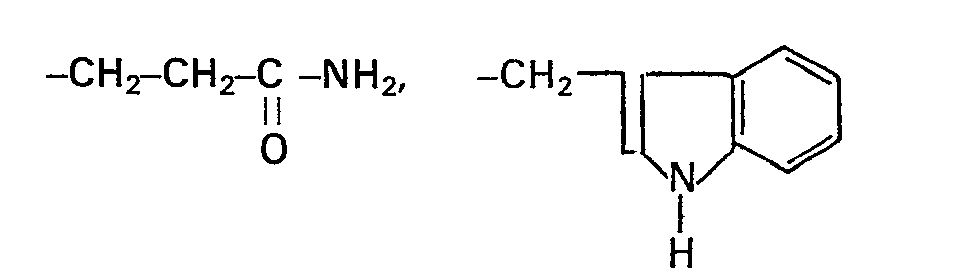
Claims (13)


Priority Applications (1)
| Application Number | Priority Date | Filing Date | Title |
|---|---|---|---|
| AT82108166T ATE17735T1 (de) | 1981-09-03 | 1982-09-03 | N-(n'-(2-chloraethyl)-n'-nitroso-carbamoyl)oligopeptidester und -amide und verfahren zu ihrer herstellung. |
Applications Claiming Priority (2)
| Application Number | Priority Date | Filing Date | Title |
|---|---|---|---|
| DE3134923A DE3134923C1 (de) | 1981-09-03 | 1981-09-03 | N-[N'-(2-Chloraethyl)-N'-nitroso-carbamoyl]-oligopeptidester und -amide und Verfahren zu ihrer Herstellung |
| DE3134923 | 1981-09-03 |
Publications (2)
| Publication Number | Publication Date |
|---|---|
| EP0074103A1 EP0074103A1 (de) | 1983-03-16 |
| EP0074103B1 true EP0074103B1 (de) | 1986-01-29 |
Family
ID=6140795
Family Applications (1)
| Application Number | Title | Priority Date | Filing Date |
|---|---|---|---|
| EP82108166A Expired EP0074103B1 (de) | 1981-09-03 | 1982-09-03 | N-(N'-(2-Chloräthyl)-N'-nitroso-carbamoyl)- oligopeptidester und -amide und Verfahren zu ihrer Herstellung |
Country Status (17)
| Country | Link |
|---|---|
| EP (1) | EP0074103B1 (de) |
| JP (1) | JPS58501769A (de) |
| AT (1) | ATE17735T1 (de) |
| AU (1) | AU8900982A (de) |
| BR (1) | BR8207845A (de) |
| DD (1) | DD209192A5 (de) |
| DE (2) | DE3134923C1 (de) |
| DK (1) | DK77583A (de) |
| FI (1) | FI830768A0 (de) |
| GR (1) | GR76534B (de) |
| HU (1) | HU190643B (de) |
| IL (1) | IL66689A (de) |
| MC (1) | MC1526A1 (de) |
| NO (1) | NO831475L (de) |
| WO (1) | WO1983000860A1 (de) |
| YU (1) | YU195982A (de) |
| ZA (1) | ZA826481B (de) |
Families Citing this family (3)
| Publication number | Priority date | Publication date | Assignee | Title |
|---|---|---|---|---|
| US2987263A (en) * | 1959-02-16 | 1961-06-06 | William R Senn | Apparatus for granulating phosphate rock fertilizer or the like |
| FR2540491A1 (fr) * | 1983-02-08 | 1984-08-10 | Centre Nat Rech Scient | Nouvelles nitrosourees, leur procede de preparation et leur application therapeutique |
| JPS6288472A (ja) * | 1985-10-14 | 1987-04-22 | Sharp Corp | フアクシミリの読取記録装置 |
Family Cites Families (1)
| Publication number | Priority date | Publication date | Assignee | Title |
|---|---|---|---|---|
| JPS5113722A (en) * | 1974-07-23 | 1976-02-03 | Suami T | Shinkina nitoroshinyosojudotaino seizoho |
-
1981
- 1981-09-03 DE DE3134923A patent/DE3134923C1/de not_active Expired
-
1982
- 1982-08-30 GR GR69161A patent/GR76534B/el unknown
- 1982-08-31 YU YU01959/82A patent/YU195982A/xx unknown
- 1982-09-01 IL IL66689A patent/IL66689A/xx unknown
- 1982-09-03 DE DE8282108166T patent/DE3268831D1/de not_active Expired
- 1982-09-03 BR BR8207845A patent/BR8207845A/pt unknown
- 1982-09-03 WO PCT/EP1982/000191 patent/WO1983000860A1/de not_active Ceased
- 1982-09-03 ZA ZA826481A patent/ZA826481B/xx unknown
- 1982-09-03 HU HU823208A patent/HU190643B/hu unknown
- 1982-09-03 AU AU89009/82A patent/AU8900982A/en not_active Abandoned
- 1982-09-03 DD DD82243011A patent/DD209192A5/de unknown
- 1982-09-03 JP JP57502693A patent/JPS58501769A/ja active Pending
- 1982-09-03 MC MC82EP8200191D patent/MC1526A1/xx unknown
- 1982-09-03 FI FI830768A patent/FI830768A0/fi not_active Application Discontinuation
- 1982-09-03 AT AT82108166T patent/ATE17735T1/de not_active IP Right Cessation
- 1982-09-03 EP EP82108166A patent/EP0074103B1/de not_active Expired
-
1983
- 1983-02-22 DK DK77583A patent/DK77583A/da not_active Application Discontinuation
- 1983-04-26 NO NO831475A patent/NO831475L/no unknown
Non-Patent Citations (2)
| Title |
|---|
| ARZNEIMITTEL FORSCHUNG DRUG RESEARCH, Band 32 (I), Nr. 5, Mai 1982, Seiten 484-486, Aulendorf (DE); W.J. ZELLER et al.: "Chemotherapeutic activity of 2-chloroethylnitrosocarbamoyl derivatives of amino acids in a transplanted rat leukemia (L5222)". * |
| CHEMICAL ABSTRACTS, Band 92, Nr. 3, 21. Januar 1980, Seite 54, Nr. 15507u, Columbus Ohio (USA); W.J. ZELLER et al.: "Examination of four newly synthesized 2-chloroethylnitrosoureas in comparison with BCNU, CCNU, MeCCNU, chlorozoticin and hydroxyethyl-CNU in preterminal rat leukemia L 5222". * |
Also Published As
| Publication number | Publication date |
|---|---|
| ZA826481B (en) | 1983-07-27 |
| DK77583A (da) | 1983-03-17 |
| BR8207845A (pt) | 1983-08-30 |
| IL66689A (en) | 1986-02-28 |
| DE3268831D1 (en) | 1986-03-13 |
| MC1526A1 (fr) | 1984-04-13 |
| JPS58501769A (ja) | 1983-10-20 |
| HU190643B (en) | 1986-09-29 |
| DD209192A5 (de) | 1984-04-25 |
| FI830768L (fi) | 1983-03-08 |
| WO1983000860A1 (en) | 1983-03-17 |
| EP0074103A1 (de) | 1983-03-16 |
| ATE17735T1 (de) | 1986-02-15 |
| FI830768A7 (fi) | 1983-03-08 |
| AU8900982A (en) | 1983-03-28 |
| GR76534B (de) | 1984-08-10 |
| FI830768A0 (fi) | 1983-03-08 |
| DK77583D0 (da) | 1983-02-22 |
| YU195982A (en) | 1985-08-31 |
| DE3134923C1 (de) | 1983-06-09 |
| NO831475L (no) | 1983-04-26 |
Similar Documents
| Publication | Publication Date | Title |
|---|---|---|
| Nefkens et al. | A novel activated ester in peptide syntheses | |
| EP0652228B1 (de) | Urethane und Urea zur Induktion der Cytokin-Produktion | |
| DE69125537T2 (de) | Alpha-keto-amidderivate mit Protease inhibierender Aktivität | |
| CH661931A5 (de) | N-substituierte amidoaminosaeuren, deren ester und amide. | |
| DE3887246T2 (de) | Verfahren zur Herstellung von Glutamin-Derivaten. | |
| DE3177306T2 (de) | Verfahren und Verbindungen zur Herstellung von H-ARG-X-Z-Y-TYR-R. | |
| US4857656A (en) | Active esters used for production of esters or amides and process for producing esters or amides | |
| NISHIZAWA et al. | A facile synthesis of bestatin | |
| DE3134923C1 (de) | N-[N'-(2-Chloraethyl)-N'-nitroso-carbamoyl]-oligopeptidester und -amide und Verfahren zu ihrer Herstellung | |
| SE452318B (sv) | Aminosyror till anvendning som mellanprodukter vid framstellning av bestatiner | |
| DE69315730T2 (de) | Verfahren zur Herstellung von Peptiden und neue Zwischenverbindungen dazu | |
| US4250086A (en) | Method and composition for preparation of H-SAR-LYS-SAR-GLN-NH2 | |
| JPH06122697A (ja) | ヘプタノール−Glu−Asp−Ala−アミノ酸系免疫賦活薬製造用中間体 | |
| SU1625882A1 (ru) | Способ получени гликопептидов глицирризиновой кислоты | |
| US4459225A (en) | Peptide amides and process for their manufacture | |
| Breitenmoser et al. | A Novel 2H‐Azirin‐3‐amine as a Dipeptide (Aib‐Hyp) Synthon | |
| US4122090A (en) | Cyclic esters of 3,4-dihydroxy-thiophene-1,1-dioxide compounds and 3,4-dihydroxy-cyclopentadienone compounds | |
| DE69428401T2 (de) | Verfahren zur Herstellung von alpha-Aminosäureamiden zur Verwendung in der Peptidsynthese | |
| DE69009224T2 (de) | Gem-diamino-Derivate und ihre Verwendung bei der Herstellung von Retro-Inverso-Peptiden. | |
| EP0018793B1 (de) | Peptide und Verfahren zu ihrer Herstellung | |
| Hermann et al. | Thia-analogues of amino acids synthesis of peptide derivatives containing 3-thia-analogues of amino acids | |
| DE3108322A1 (de) | Chromogenes enzymsubstrat | |
| DE69600566T2 (de) | Vorbereitung von geschützten Aminen bzw. alkylierten Aminosäuren | |
| Petermann et al. | Synthesis of β‐pyrazinyl‐L‐alanine (Paa) and of peptide derivatives | |
| EP0155165A2 (de) | Verfahren zur Einführung von Phospinoylgruppen in Aminogruppen |
Legal Events
| Date | Code | Title | Description |
|---|---|---|---|
| PUAI | Public reference made under article 153(3) epc to a published international application that has entered the european phase |
Free format text: ORIGINAL CODE: 0009012 |
|
| AK | Designated contracting states |
Designated state(s): AT BE CH DE FR GB IT LI LU NL SE |
|
| 17P | Request for examination filed |
Effective date: 19830322 |
|
| GRAA | (expected) grant |
Free format text: ORIGINAL CODE: 0009210 |
|
| AK | Designated contracting states |
Designated state(s): AT BE CH DE FR GB IT LI LU NL SE |
|
| REF | Corresponds to: |
Ref document number: 17735 Country of ref document: AT Date of ref document: 19860215 Kind code of ref document: T |
|
| REF | Corresponds to: |
Ref document number: 3268831 Country of ref document: DE Date of ref document: 19860313 |
|
| ET | Fr: translation filed | ||
| ITF | It: translation for a ep patent filed | ||
| R20 | Corrections of a patent specification |
Effective date: 19860521 |
|
| PG25 | Lapsed in a contracting state [announced via postgrant information from national office to epo] |
Ref country code: AT Effective date: 19860903 |
|
| PG25 | Lapsed in a contracting state [announced via postgrant information from national office to epo] |
Ref country code: SE Effective date: 19860904 |
|
| PG25 | Lapsed in a contracting state [announced via postgrant information from national office to epo] |
Ref country code: LU Free format text: LAPSE BECAUSE OF NON-PAYMENT OF DUE FEES Effective date: 19860930 Ref country code: BE Effective date: 19860930 |
|
| PLBE | No opposition filed within time limit |
Free format text: ORIGINAL CODE: 0009261 |
|
| STAA | Information on the status of an ep patent application or granted ep patent |
Free format text: STATUS: NO OPPOSITION FILED WITHIN TIME LIMIT |
|
| RAP2 | Party data changed (patent owner data changed or rights of a patent transferred) |
Owner name: TANG, WEI-CI, PROF. DR. Owner name: EISENBRAND, GERHARD, PROF. DR. |
|
| BECN | Be: change of holder's name |
Effective date: 19860129 |
|
| 26N | No opposition filed | ||
| NLT2 | Nl: modifications (of names), taken from the european patent patent bulletin |
Owner name: PROF. DR. GERHARD EISENBRAND EN PROF. DR. WEI-CI T |
|
| BERE | Be: lapsed |
Owner name: TANG WEI-CI Effective date: 19860930 Owner name: EISENBRAND GERHARD Effective date: 19860930 |
|
| PG25 | Lapsed in a contracting state [announced via postgrant information from national office to epo] |
Ref country code: NL Effective date: 19870401 |
|
| NLV4 | Nl: lapsed or anulled due to non-payment of the annual fee | ||
| REG | Reference to a national code |
Ref country code: GB Ref legal event code: 732 |
|
| PG25 | Lapsed in a contracting state [announced via postgrant information from national office to epo] |
Ref country code: GB Effective date: 19880903 |
|
| PG25 | Lapsed in a contracting state [announced via postgrant information from national office to epo] |
Ref country code: LI Effective date: 19880930 Ref country code: CH Effective date: 19880930 |
|
| PG25 | Lapsed in a contracting state [announced via postgrant information from national office to epo] |
Ref country code: FR Free format text: LAPSE BECAUSE OF NON-PAYMENT OF DUE FEES Effective date: 19890531 |
|
| REG | Reference to a national code |
Ref country code: CH Ref legal event code: PL |
|
| GBPC | Gb: european patent ceased through non-payment of renewal fee | ||
| PG25 | Lapsed in a contracting state [announced via postgrant information from national office to epo] |
Ref country code: DE Effective date: 19890601 |
|
| REG | Reference to a national code |
Ref country code: FR Ref legal event code: ST |
|
| EUG | Se: european patent has lapsed |
Ref document number: 82108166.8 Effective date: 19870812 |