EP0074477B1 - Détermination de nitrates dans l'eau - Google Patents
Détermination de nitrates dans l'eau Download PDFInfo
- Publication number
- EP0074477B1 EP0074477B1 EP82106506A EP82106506A EP0074477B1 EP 0074477 B1 EP0074477 B1 EP 0074477B1 EP 82106506 A EP82106506 A EP 82106506A EP 82106506 A EP82106506 A EP 82106506A EP 0074477 B1 EP0074477 B1 EP 0074477B1
- Authority
- EP
- European Patent Office
- Prior art keywords
- accordance
- nitrate
- catalyst
- transition metal
- water
- Prior art date
- Legal status (The legal status is an assumption and is not a legal conclusion. Google has not performed a legal analysis and makes no representation as to the accuracy of the status listed.)
- Expired
Links
- NHNBFGGVMKEFGY-UHFFFAOYSA-N Nitrate Chemical compound [O-][N+]([O-])=O NHNBFGGVMKEFGY-UHFFFAOYSA-N 0.000 title claims abstract description 68
- 229910002651 NO3 Inorganic materials 0.000 title claims abstract description 67
- XLYOFNOQVPJJNP-UHFFFAOYSA-N water Substances O XLYOFNOQVPJJNP-UHFFFAOYSA-N 0.000 title claims abstract description 51
- 239000003054 catalyst Substances 0.000 claims abstract description 50
- 238000000034 method Methods 0.000 claims abstract description 48
- 229910052723 transition metal Inorganic materials 0.000 claims abstract description 33
- RYGMFSIKBFXOCR-UHFFFAOYSA-N Copper Chemical group [Cu] RYGMFSIKBFXOCR-UHFFFAOYSA-N 0.000 claims abstract description 22
- 239000001257 hydrogen Substances 0.000 claims abstract description 22
- 229910052739 hydrogen Inorganic materials 0.000 claims abstract description 22
- UFHFLCQGNIYNRP-UHFFFAOYSA-N Hydrogen Chemical compound [H][H] UFHFLCQGNIYNRP-UHFFFAOYSA-N 0.000 claims abstract description 21
- 150000003624 transition metals Chemical class 0.000 claims abstract description 20
- 230000009467 reduction Effects 0.000 claims abstract description 18
- -1 transition metal salt Chemical class 0.000 claims abstract description 14
- 230000000737 periodic effect Effects 0.000 claims abstract description 10
- 239000002253 acid Substances 0.000 claims abstract description 9
- 150000003839 salts Chemical class 0.000 claims abstract description 8
- 230000008033 biological extinction Effects 0.000 claims abstract description 3
- BASFCYQUMIYNBI-UHFFFAOYSA-N platinum Chemical group [Pt] BASFCYQUMIYNBI-UHFFFAOYSA-N 0.000 claims description 29
- VEXZGXHMUGYJMC-UHFFFAOYSA-N Hydrochloric acid Chemical compound Cl VEXZGXHMUGYJMC-UHFFFAOYSA-N 0.000 claims description 14
- 229910052697 platinum Inorganic materials 0.000 claims description 11
- 239000010949 copper Substances 0.000 claims description 10
- 229910052802 copper Inorganic materials 0.000 claims description 9
- OKTJSMMVPCPJKN-UHFFFAOYSA-N Carbon Chemical compound [C] OKTJSMMVPCPJKN-UHFFFAOYSA-N 0.000 claims description 8
- 239000000203 mixture Substances 0.000 claims description 8
- 239000003638 chemical reducing agent Substances 0.000 claims description 5
- 229910052763 palladium Inorganic materials 0.000 claims description 5
- QGZKDVFQNNGYKY-UHFFFAOYSA-O Ammonium Chemical compound [NH4+] QGZKDVFQNNGYKY-UHFFFAOYSA-O 0.000 claims description 4
- 239000004927 clay Substances 0.000 claims description 4
- OAKJQQAXSVQMHS-UHFFFAOYSA-N hydrazine Substances NN OAKJQQAXSVQMHS-UHFFFAOYSA-N 0.000 claims description 4
- 229910052799 carbon Inorganic materials 0.000 claims description 3
- 238000011161 development Methods 0.000 claims description 3
- BVKZGUZCCUSVTD-UHFFFAOYSA-L Carbonate Chemical compound [O-]C([O-])=O BVKZGUZCCUSVTD-UHFFFAOYSA-L 0.000 claims description 2
- GRYLNZFGIOXLOG-UHFFFAOYSA-N Nitric acid Chemical compound O[N+]([O-])=O GRYLNZFGIOXLOG-UHFFFAOYSA-N 0.000 claims description 2
- HCHKCACWOHOZIP-UHFFFAOYSA-N Zinc Chemical group [Zn] HCHKCACWOHOZIP-UHFFFAOYSA-N 0.000 claims description 2
- 150000007513 acids Chemical class 0.000 claims description 2
- 229910052783 alkali metal Inorganic materials 0.000 claims description 2
- 150000001340 alkali metals Chemical class 0.000 claims description 2
- 229910010293 ceramic material Inorganic materials 0.000 claims description 2
- 239000011248 coating agent Substances 0.000 claims description 2
- 238000000576 coating method Methods 0.000 claims description 2
- 150000004820 halides Chemical class 0.000 claims description 2
- 229910052736 halogen Inorganic materials 0.000 claims description 2
- 150000002431 hydrogen Chemical class 0.000 claims description 2
- 150000007522 mineralic acids Chemical class 0.000 claims description 2
- 229910017604 nitric acid Inorganic materials 0.000 claims description 2
- 239000000758 substrate Substances 0.000 claims 8
- 230000015572 biosynthetic process Effects 0.000 claims 5
- 239000003610 charcoal Substances 0.000 claims 1
- 229910052801 chlorine Inorganic materials 0.000 claims 1
- 239000000460 chlorine Substances 0.000 claims 1
- 125000001309 chloro group Chemical group Cl* 0.000 claims 1
- 239000012530 fluid Substances 0.000 claims 1
- 125000005843 halogen group Chemical group 0.000 claims 1
- 239000000523 sample Substances 0.000 abstract description 16
- 239000012496 blank sample Substances 0.000 abstract description 9
- 239000000243 solution Substances 0.000 description 9
- QAOWNCQODCNURD-UHFFFAOYSA-L Sulfate Chemical compound [O-]S([O-])(=O)=O QAOWNCQODCNURD-UHFFFAOYSA-L 0.000 description 8
- KDLHZDBZIXYQEI-UHFFFAOYSA-N palladium Substances [Pd] KDLHZDBZIXYQEI-UHFFFAOYSA-N 0.000 description 8
- 238000002474 experimental method Methods 0.000 description 7
- 238000005984 hydrogenation reaction Methods 0.000 description 7
- NPXOKRUENSOPAO-UHFFFAOYSA-N Raney nickel Chemical compound [Al].[Ni] NPXOKRUENSOPAO-UHFFFAOYSA-N 0.000 description 6
- 229910000564 Raney nickel Inorganic materials 0.000 description 6
- 238000010521 absorption reaction Methods 0.000 description 6
- RRKTZKIUPZVBMF-IBTVXLQLSA-N brucine Chemical compound O([C@@H]1[C@H]([C@H]2C3)[C@@H]4N(C(C1)=O)C=1C=C(C(=CC=11)OC)OC)CC=C2CN2[C@@H]3[C@]41CC2 RRKTZKIUPZVBMF-IBTVXLQLSA-N 0.000 description 6
- 229910052751 metal Inorganic materials 0.000 description 6
- 239000002184 metal Substances 0.000 description 6
- 239000007868 Raney catalyst Substances 0.000 description 5
- VYPSYNLAJGMNEJ-UHFFFAOYSA-N Silicium dioxide Chemical compound O=[Si]=O VYPSYNLAJGMNEJ-UHFFFAOYSA-N 0.000 description 5
- UCKMPCXJQFINFW-UHFFFAOYSA-N Sulphide Chemical compound [S-2] UCKMPCXJQFINFW-UHFFFAOYSA-N 0.000 description 5
- 239000002574 poison Substances 0.000 description 5
- 231100000614 poison Toxicity 0.000 description 5
- 230000008569 process Effects 0.000 description 5
- 239000008399 tap water Substances 0.000 description 5
- 238000002835 absorbance Methods 0.000 description 4
- 239000003673 groundwater Substances 0.000 description 4
- VWDWKYIASSYTQR-UHFFFAOYSA-N sodium nitrate Chemical compound [Na+].[O-][N+]([O-])=O VWDWKYIASSYTQR-UHFFFAOYSA-N 0.000 description 4
- 239000000126 substance Substances 0.000 description 4
- 235000020679 tap water Nutrition 0.000 description 4
- RRKTZKIUPZVBMF-UHFFFAOYSA-N brucine Natural products C1=2C=C(OC)C(OC)=CC=2N(C(C2)=O)C3C(C4C5)C2OCC=C4CN2C5C31CC2 RRKTZKIUPZVBMF-UHFFFAOYSA-N 0.000 description 3
- 238000006243 chemical reaction Methods 0.000 description 3
- 230000000052 comparative effect Effects 0.000 description 3
- 239000000428 dust Substances 0.000 description 3
- 238000012544 monitoring process Methods 0.000 description 3
- TWNQGVIAIRXVLR-UHFFFAOYSA-N oxo(oxoalumanyloxy)alumane Chemical compound O=[Al]O[Al]=O TWNQGVIAIRXVLR-UHFFFAOYSA-N 0.000 description 3
- 238000002360 preparation method Methods 0.000 description 3
- 239000010453 quartz Substances 0.000 description 3
- 239000002352 surface water Substances 0.000 description 3
- 239000011701 zinc Substances 0.000 description 3
- RHMPLDJJXGPMEX-UHFFFAOYSA-N 4-fluorophenol Chemical compound OC1=CC=C(F)C=C1 RHMPLDJJXGPMEX-UHFFFAOYSA-N 0.000 description 2
- 229910021591 Copper(I) chloride Inorganic materials 0.000 description 2
- 150000001412 amines Chemical class 0.000 description 2
- QZPSXPBJTPJTSZ-UHFFFAOYSA-N aqua regia Chemical compound Cl.O[N+]([O-])=O QZPSXPBJTPJTSZ-UHFFFAOYSA-N 0.000 description 2
- OXBLHERUFWYNTN-UHFFFAOYSA-M copper(I) chloride Chemical compound [Cu]Cl OXBLHERUFWYNTN-UHFFFAOYSA-M 0.000 description 2
- 238000000354 decomposition reaction Methods 0.000 description 2
- 238000001514 detection method Methods 0.000 description 2
- 239000012153 distilled water Substances 0.000 description 2
- 230000002779 inactivation Effects 0.000 description 2
- 150000002500 ions Chemical class 0.000 description 2
- 238000004519 manufacturing process Methods 0.000 description 2
- 239000000463 material Substances 0.000 description 2
- BDAGIHXWWSANSR-UHFFFAOYSA-N methanoic acid Natural products OC=O BDAGIHXWWSANSR-UHFFFAOYSA-N 0.000 description 2
- 235000010344 sodium nitrate Nutrition 0.000 description 2
- 239000004317 sodium nitrate Substances 0.000 description 2
- 238000003756 stirring Methods 0.000 description 2
- 239000002351 wastewater Substances 0.000 description 2
- NGNBDVOYPDDBFK-UHFFFAOYSA-N 2-[2,4-di(pentan-2-yl)phenoxy]acetyl chloride Chemical class CCCC(C)C1=CC=C(OCC(Cl)=O)C(C(C)CCC)=C1 NGNBDVOYPDDBFK-UHFFFAOYSA-N 0.000 description 1
- OSWFIVFLDKOXQC-UHFFFAOYSA-N 4-(3-methoxyphenyl)aniline Chemical compound COC1=CC=CC(C=2C=CC(N)=CC=2)=C1 OSWFIVFLDKOXQC-UHFFFAOYSA-N 0.000 description 1
- VEXZGXHMUGYJMC-UHFFFAOYSA-M Chloride anion Chemical compound [Cl-] VEXZGXHMUGYJMC-UHFFFAOYSA-M 0.000 description 1
- VMQMZMRVKUZKQL-UHFFFAOYSA-N Cu+ Chemical compound [Cu+] VMQMZMRVKUZKQL-UHFFFAOYSA-N 0.000 description 1
- IOVCWXUNBOPUCH-UHFFFAOYSA-M Nitrite anion Chemical compound [O-]N=O IOVCWXUNBOPUCH-UHFFFAOYSA-M 0.000 description 1
- 150000001299 aldehydes Chemical class 0.000 description 1
- 239000007864 aqueous solution Substances 0.000 description 1
- 239000000987 azo dye Substances 0.000 description 1
- OZCRKDNRAAKDAN-UHFFFAOYSA-N but-1-ene-1,4-diol Chemical compound O[CH][CH]CCO OZCRKDNRAAKDAN-UHFFFAOYSA-N 0.000 description 1
- DLDJFQGPPSQZKI-UHFFFAOYSA-N but-2-yne-1,4-diol Chemical compound OCC#CCO DLDJFQGPPSQZKI-UHFFFAOYSA-N 0.000 description 1
- 230000000711 cancerogenic effect Effects 0.000 description 1
- 231100000315 carcinogenic Toxicity 0.000 description 1
- 230000003197 catalytic effect Effects 0.000 description 1
- 150000001805 chlorine compounds Chemical class 0.000 description 1
- 150000001875 compounds Chemical class 0.000 description 1
- 239000000470 constituent Substances 0.000 description 1
- 150000001879 copper Chemical class 0.000 description 1
- ORTQZVOHEJQUHG-UHFFFAOYSA-L copper(II) chloride Chemical compound Cl[Cu]Cl ORTQZVOHEJQUHG-UHFFFAOYSA-L 0.000 description 1
- 230000003247 decreasing effect Effects 0.000 description 1
- 238000006193 diazotization reaction Methods 0.000 description 1
- 235000020188 drinking water Nutrition 0.000 description 1
- 239000003651 drinking water Substances 0.000 description 1
- 238000011049 filling Methods 0.000 description 1
- 235000019253 formic acid Nutrition 0.000 description 1
- 239000007789 gas Substances 0.000 description 1
- 210000001035 gastrointestinal tract Anatomy 0.000 description 1
- 150000002367 halogens Chemical group 0.000 description 1
- 230000036541 health Effects 0.000 description 1
- 238000011065 in-situ storage Methods 0.000 description 1
- 238000011835 investigation Methods 0.000 description 1
- 230000007774 longterm Effects 0.000 description 1
- 239000000395 magnesium oxide Substances 0.000 description 1
- CPLXHLVBOLITMK-UHFFFAOYSA-N magnesium oxide Inorganic materials [Mg]=O CPLXHLVBOLITMK-UHFFFAOYSA-N 0.000 description 1
- AXZKOIWUVFPNLO-UHFFFAOYSA-N magnesium;oxygen(2-) Chemical compound [O-2].[Mg+2] AXZKOIWUVFPNLO-UHFFFAOYSA-N 0.000 description 1
- 238000005259 measurement Methods 0.000 description 1
- 238000000691 measurement method Methods 0.000 description 1
- 229910021645 metal ion Inorganic materials 0.000 description 1
- 208000005135 methemoglobinemia Diseases 0.000 description 1
- 150000002828 nitro derivatives Chemical class 0.000 description 1
- XKLJHFLUAHKGGU-UHFFFAOYSA-N nitrous amide Chemical compound ON=N XKLJHFLUAHKGGU-UHFFFAOYSA-N 0.000 description 1
- GQPLMRYTRLFLPF-UHFFFAOYSA-N nitrous oxide Inorganic materials [O-][N+]#N GQPLMRYTRLFLPF-UHFFFAOYSA-N 0.000 description 1
- 230000008520 organization Effects 0.000 description 1
- PIBWKRNGBLPSSY-UHFFFAOYSA-L palladium(II) chloride Chemical compound Cl[Pd]Cl PIBWKRNGBLPSSY-UHFFFAOYSA-L 0.000 description 1
- 230000002040 relaxant effect Effects 0.000 description 1
- 230000000630 rising effect Effects 0.000 description 1
- 239000000741 silica gel Substances 0.000 description 1
- 229910002027 silica gel Inorganic materials 0.000 description 1
- 239000012279 sodium borohydride Substances 0.000 description 1
- 229910000033 sodium borohydride Inorganic materials 0.000 description 1
- 238000010561 standard procedure Methods 0.000 description 1
- 230000000707 stereoselective effect Effects 0.000 description 1
- 150000003431 steroids Chemical class 0.000 description 1
- 238000012360 testing method Methods 0.000 description 1
- 238000002211 ultraviolet spectrum Methods 0.000 description 1
- 238000005406 washing Methods 0.000 description 1
Images

Classifications
-
- G—PHYSICS
- G01—MEASURING; TESTING
- G01N—INVESTIGATING OR ANALYSING MATERIALS BY DETERMINING THEIR CHEMICAL OR PHYSICAL PROPERTIES
- G01N33/00—Investigating or analysing materials by specific methods not covered by groups G01N1/00 - G01N31/00
- G01N33/18—Water
- G01N33/182—Specific anions in water
-
- Y—GENERAL TAGGING OF NEW TECHNOLOGICAL DEVELOPMENTS; GENERAL TAGGING OF CROSS-SECTIONAL TECHNOLOGIES SPANNING OVER SEVERAL SECTIONS OF THE IPC; TECHNICAL SUBJECTS COVERED BY FORMER USPC CROSS-REFERENCE ART COLLECTIONS [XRACs] AND DIGESTS
- Y10—TECHNICAL SUBJECTS COVERED BY FORMER USPC
- Y10T—TECHNICAL SUBJECTS COVERED BY FORMER US CLASSIFICATION
- Y10T436/00—Chemistry: analytical and immunological testing
- Y10T436/17—Nitrogen containing
- Y10T436/173076—Nitrite or nitrate
-
- Y—GENERAL TAGGING OF NEW TECHNOLOGICAL DEVELOPMENTS; GENERAL TAGGING OF CROSS-SECTIONAL TECHNOLOGIES SPANNING OVER SEVERAL SECTIONS OF THE IPC; TECHNICAL SUBJECTS COVERED BY FORMER USPC CROSS-REFERENCE ART COLLECTIONS [XRACs] AND DIGESTS
- Y10—TECHNICAL SUBJECTS COVERED BY FORMER USPC
- Y10T—TECHNICAL SUBJECTS COVERED BY FORMER US CLASSIFICATION
- Y10T436/00—Chemistry: analytical and immunological testing
- Y10T436/25—Chemistry: analytical and immunological testing including sample preparation
- Y10T436/25125—Digestion or removing interfering materials
Definitions
- the invention relates to a method for the determination of nitrate in water.
- nitrate concentration in surface and ground water has risen steadily due to over-fertilization in agriculture. From the chemical water statistics of the waterworks in the Federal Republic of Germany and West Berlin (edited by Dr. Gerhard Giebler, R. Oldenbourg Verlag, Kunststoff, 1959) it follows that the nitrate concentration in surface and groundwater is 50 mg / in most cases I reached or even exceeded. According to the World Health Organization, however, the nitrate concentration in drinking water should not exceed 50 mg / I, since in this case there is a risk that methaemoglobinaemia can be caused in children. According to recent findings, nitrate can form nitrosamine in conjunction with certain amines in the digestive tract, which can be classified as highly carcinogenic. As a result, it is necessary to continuously monitor the nitrate concentration in the water.
- ion-sensitive electrodes have become known in recent years, which allow a selective determination of the nitrate ion in water. So in the magazine Fresenius Z. Anal. Chem. 297, pages 414 to 418 (1979) describes a nitrate-selective electrode based on copper (I) -neocuproin complex. However, it has been found that such ion-selective electrodes are considerably susceptible to faults, so that they are not recommended for the continuous determination of nitrate in water.
- the nitrate shows a pronounced absorption maximum in the UV range at 210 nm, which could generally be used for a quantitative determination of the nitrate.
- surface, groundwater and wastewater have a large number of inorganic and organic water constituents that absorb in the UV range and thus overlap the nitrate absorption, no method has so far become known in which a reproducible determination of the nitrate via the UV Absorption occurs.
- DE-OS-24 60 078 hydrogenation catalysts which contain at least one metal of the platinum group such. B. Pt and / or Pd and at least one metal of the copper group such as. B. contain Cu and for the selective hydrogenation of acid chlorides to the corresponding aldehydes and for the stereospecific hydrogenation of numerous compounds such. B. of steroids are suitable.
- These known hydrogenation catalysts are prepared by the metal ions from a solution, the soluble salts of the platinum group metal such.
- B. contains copper chloride, preferably in the presence of a catalyst support such as. B.
- activated carbon or aluminum oxide which is impregnated with the solution, deposits together and - z. B. with hydrogen, sodium borohydride or formic acid - at z. B. 0 to 100 C reduced.
- 0.5 to 10% by weight of the metal of the platinum group and 0.05 to 10% by weight of the metal of the copper group are preferably applied to the catalyst support.
- No. 2,967,835 discloses a process for the preparation of a hydrogenation catalyst which is suitable, for example, for the hydrogenation of nitro compounds to the corresponding amines and in particular for the hydrogenation of 1,4-butynediol to 1,4-butenediol, in which an aqueous solution containing a copper salt and metallic palladium, preferably on a catalyst support such.
- B. activated carbon or aluminum oxide contains, with a reducing agent such.
- B. hydrazine is treated to precipitate on the palladium in situ metallic copper (preferably 5 to 30 parts copper per part palladium).
- the invention has for its object to provide a method for the determination of nitrate in water, in which the nitrate can be selectively reduced to form a blank sample, without reducing the water content, so that a rapid and sensitive determination of the nitrate in water, especially in continuous Operation via UV absorption is possible.
- This object is achieved in that the nitrate absorbance of a water sample compared to a blank sample in the UV range at 210 nm is determined, with a portion of the water sample being used as the blank sample, the nitrate of which was reduced in the presence of hydrogen using a catalyst which was reduced by reduction a solution of a Group VIII transition metal salt of the periodic table and a copper group transition metal salt in the presence of an acid.
- the catalyst used in the process of the invention is capable of selectively reducing the nitrate in water in the presence of hydrogen without, for example, reducing sulfate to sulfide, which would poison the catalyst.
- the method according to the invention can be used to determine nitrate in tap, ground, surface and waste water.
- the catalyst is explained in more detail below.
- the transition metal of group VIII of the periodic table is preferably a transition metal of the platinum group, in particular platinum or palladium.
- the salt of Platinum group transition metal preferably M 2 PtX 6 , M 2 PdX 6 , PdX 2 or PtX 2 , where M is an alkali metal, ammonium or hydrogen and X is a halogen.
- a particularly suitable transition metal salt is ammonium hexachloroplatinate.
- An oxide, carbonate, nitrate or halide, in particular of copper, can be used as the salt of the transition metal copper group.
- the transition metal of group VIII of the periodic table and the transition metal of the copper group are used in a certain molar ratio.
- Preliminary investigations have shown that the nitrate is reduced by Raney nickel and also by platinum; however, it was found that the sulfate present in the water was reduced to the sulfide. Since sulfide is a catalyst poison, the Raney nickel catalyst becomes inactive after a short time, so that it is unsuitable for the present purpose. Similar results were obtained in preliminary experiments with platinum, in which the platinum was rapidly inactivated even in the presence of 10 mg / l sulfate.
- the transition metal of group VIII of the periodic table and the transition metal of the copper group in the catalyst are suitably present in a molar ratio of 1: 8 to 8: 1, preferably 1: 4 to 4: 1.
- the molar ratio of the transition metal of group VIII of the periodic table to the transition metal of the copper group is approximately 1: 2 to 1: 4.
- transition metal salts When reducing the transition metal salts to the catalyst, an inorganic acid, in particular hydrochloric acid or nitric acid or a mixture of these two acids, is usually used as the acid.
- an inorganic acid in particular hydrochloric acid or nitric acid or a mixture of these two acids
- the transition metals can also be used in elemental form, for example by dissolving platinum chips and copper wire in aqua regia.
- the transition metal salts are reduced simultaneously, the reducing agent used being one which is located below the copper in the voltage series.
- Preferred reducing agents are, for example, zinc dust or a hydrazine compound.
- the catalyst is obtained by reduction at a temperature of 10 to 150 ° C, especially at 40 to 80 ° C.
- a catalyst which has been applied to a support and has been obtained by reduction in the presence of the support is expediently the solution of the transition metal salts is first exposed to a negative pressure in the presence of a porous support, so that the latter is impregnated with the solution.
- This process step can be carried out, for example, in a vacuum desiccator. Then the solution with the carrier thus prepared is brought back to atmospheric pressure, whereupon the transition metal salts introduced are reduced.
- Ceramic materials such as aluminum oxide, magnesium oxide, silica gel or kieselguhr, activated carbon or expanded clay, are suitable as porous supports.
- the support can be in the form of Berlsattel or Raschig rings so that the catalyst applied to the support can be used in packed columns.
- the carrier can also be in the form of an electrode. which is required for the development of hydrogen and to which a coating from the catalyst has been applied.
- the electrode can be made of any suitable material, for example carbon.
- the method according to the invention allows the nitrate in the water to be determined quickly and selectively without substantial manipulation of the water sample and without the addition of chemicals being largely avoided.
- the method according to the invention is particularly suitable for the continuous determination of nitrate and thus for the continuous monitoring of the water quality.
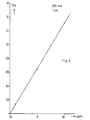
- the nitrate shows a pronounced absorption maximum in the UV range, in particular at 210 nm.
- FIG. 2 there is an exactly linear course between the absorbance of the nitrate at 210 nm and the nitrate concentration, so that the light attenuation of the nitrate in the UV range is suitable for the quantitative determination of the nitrate in the ppm range .
- a blank sample is obtained which differs from the water sample to be measured only in that the absorption band of the nitrate has disappeared as a result of the nitrate reduction, so that an exactly comparable blank sample is available.
- the measured nitrate values obtained by the process according to the invention were readily reproducible, which was checked by comparison with a modified brucine measurement method.
- the hydrogen can be supplied from a separate source.
- the hydrogen is preferably obtained electrolytically from the water, so that no separate chemical metering is required.
- the catalyst used for nitrate reduction can be present as a catalyst sponge in a fluidized bed through which the part of the water sample to be reduced is passed.
- the nitrate reduction is carried out using a catalyst which has been applied to a support and is, for example, introduced into a packed column.
- the reduction can also be carried out by using an electrode which is required for the hydrogen development and is coated with the catalyst.
- the water sample is preferably conducted countercurrent to the hydrogen in order to form the blank sample.
- the water sample should be reduced for up to 10 minutes, in particular 2 to 6 minutes in the presence of hydrogen and catalyst.
- the nitrate reduction can be carried out at 5 to 30 ° C., preferably at room temperature.
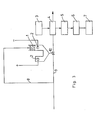
- FIG. 3 An expedient embodiment for carrying out the method according to the invention is shown in FIG. 3.
- a water sample is passed via line 9 into a cuvette 4, which is located within a photometer.
- Part of the water sample is fed via line 8 to a packed column 1 which is filled with the catalyst applied to a support.
- the portion of the water sample to be reduced flows through the packed column, for example at a rate of 100 to 300 ml / h, with hydrogen rising at the same time in countercurrent, which is generated electrolytically via the electrodes 2.
- the amount of hydrogen introduced is advantageously about 40 to 80 ml / min.
- the part of the water sample reduced in this way flows via line 10 into a quartz cuvette 4 within the photometer and is used here as a blind sample.
- the photometer contains a UV lamp 3, a detector 5, a memory 6 and a display device 7. Flow cuvettes can be used as quartz cuvettes, so that continuous operation is possible.
- nitrate depending on the molar ratio of platinum / copper in the cementate was examined.
- Tap water that contained 15 mg / l sulfate and was doped with sodium nitrate to 10 mg / l nitrate was used as model water.
- 100 ml of water were batchwise baked in the presence of the catalyst, which was freed from the hydrogen present by the production conditions by means of sodium nitrate solution for 5 minutes while stirring with hydrogen.
- the supply of the hydrogen gas was about 60 ml / min.
- the decrease in nitrate was determined using the absorbance in the UV range at 210 nm (Ex 210) and as a reference using a modified brucine method.
Landscapes
- Health & Medical Sciences (AREA)
- Life Sciences & Earth Sciences (AREA)
- Chemical & Material Sciences (AREA)
- Engineering & Computer Science (AREA)
- Food Science & Technology (AREA)
- Medicinal Chemistry (AREA)
- Physics & Mathematics (AREA)
- Analytical Chemistry (AREA)
- Biochemistry (AREA)
- General Health & Medical Sciences (AREA)
- General Physics & Mathematics (AREA)
- Immunology (AREA)
- Pathology (AREA)
- Catalysts (AREA)
- Investigating Or Analyzing Non-Biological Materials By The Use Of Chemical Means (AREA)
- Investigating Or Analysing Materials By Optical Means (AREA)
Claims (24)
Priority Applications (1)
| Application Number | Priority Date | Filing Date | Title |
|---|---|---|---|
| AT82106506T ATE31115T1 (de) | 1981-09-14 | 1982-07-19 | Bestimmung von nitrat im wasser. |
Applications Claiming Priority (2)
| Application Number | Priority Date | Filing Date | Title |
|---|---|---|---|
| DE19813136363 DE3136363A1 (de) | 1981-09-14 | 1981-09-14 | "bestimmung von nitrat im wasser und katalysator dafuer" |
| DE3136363 | 1981-09-14 |
Publications (3)
| Publication Number | Publication Date |
|---|---|
| EP0074477A2 EP0074477A2 (fr) | 1983-03-23 |
| EP0074477A3 EP0074477A3 (en) | 1985-01-09 |
| EP0074477B1 true EP0074477B1 (fr) | 1987-11-25 |
Family
ID=6141581
Family Applications (1)
| Application Number | Title | Priority Date | Filing Date |
|---|---|---|---|
| EP82106506A Expired EP0074477B1 (fr) | 1981-09-14 | 1982-07-19 | Détermination de nitrates dans l'eau |
Country Status (5)
| Country | Link |
|---|---|
| US (1) | US4526870A (fr) |
| EP (1) | EP0074477B1 (fr) |
| JP (1) | JPS58131564A (fr) |
| AT (1) | ATE31115T1 (fr) |
| DE (2) | DE3136363A1 (fr) |
Families Citing this family (8)
| Publication number | Priority date | Publication date | Assignee | Title |
|---|---|---|---|---|
| DE3324606C2 (de) * | 1983-07-08 | 1987-04-02 | Dr. Bruno Lange Gmbh, 1000 Berlin | Vorrichtung zum kontinuierlichen Messen des Nitratgehaltes von strömenden wässerigen Lösungen |
| US4599316A (en) * | 1983-12-02 | 1986-07-08 | Hoffmann-La Roche Inc. | Photometric method for the determination of inorganic phosphate in liquid samples |
| DE3830850A1 (de) * | 1988-09-10 | 1990-03-22 | Gutec Gmbh | Verfahren zur entfernung des nitrit- und/oder nitratgehaltes in wasser |
| GB9215741D0 (en) * | 1992-07-24 | 1992-09-09 | British Tech Group | Method and apparatus for the measurement of pollutants in liquids |
| US20110299085A1 (en) * | 2010-06-04 | 2011-12-08 | Solum, Inc. | Rapid Tissue Analysis Technique |
| FR2997152B1 (fr) | 2012-10-24 | 2015-01-02 | Anvis Sd France Sas | Support pneumatique. |
| US11567052B2 (en) * | 2019-10-29 | 2023-01-31 | Hach Company | Nitrate detection with copper oxidation |
| CN114018845B (zh) * | 2021-10-22 | 2023-10-17 | 金川镍钴研究设计院有限责任公司 | 一种高铁、铜基体样品中硝酸根离子的测定方法 |
Family Cites Families (8)
| Publication number | Priority date | Publication date | Assignee | Title |
|---|---|---|---|---|
| US2822475A (en) * | 1955-03-04 | 1958-02-04 | Phillips Petroleum Co | Analyzer |
| US2967835A (en) * | 1957-08-01 | 1961-01-10 | Gen Aniline & Film Corp | Hydrogenation catalyst |
| US3228991A (en) * | 1962-03-08 | 1966-01-11 | Monsanto Co | Process and catalyst for the preparation of methyl-1, 3-cyclopentadiene |
| GB1328532A (en) * | 1971-04-19 | 1973-08-30 | British Petroleum Co | Selective hydrogenation of diolefins and acetylenes |
| US3910770A (en) * | 1971-12-23 | 1975-10-07 | Gulf Research Development Co | Catalytic converter |
| HU168073B (fr) * | 1973-12-19 | 1976-02-28 | ||
| US4083809A (en) * | 1976-08-20 | 1978-04-11 | Gaf Corporation | Hydrogenation catalyst and method of producing same |
| US4218518A (en) * | 1979-01-17 | 1980-08-19 | Vaseen Vesper A | Fuel cell use of gaseous fuels and oxygen provided at electrode absorbed in liquid dielectric |
-
1981
- 1981-09-14 DE DE19813136363 patent/DE3136363A1/de not_active Withdrawn
-
1982
- 1982-07-19 EP EP82106506A patent/EP0074477B1/fr not_active Expired
- 1982-07-19 AT AT82106506T patent/ATE31115T1/de not_active IP Right Cessation
- 1982-07-19 DE DE8282106506T patent/DE3277744D1/de not_active Expired
- 1982-09-14 JP JP57160716A patent/JPS58131564A/ja active Pending
-
1983
- 1983-08-26 US US06/526,510 patent/US4526870A/en not_active Expired - Fee Related
Also Published As
| Publication number | Publication date |
|---|---|
| EP0074477A3 (en) | 1985-01-09 |
| US4526870A (en) | 1985-07-02 |
| DE3277744D1 (en) | 1988-01-07 |
| EP0074477A2 (fr) | 1983-03-23 |
| JPS58131564A (ja) | 1983-08-05 |
| DE3136363A1 (de) | 1983-03-24 |
| ATE31115T1 (de) | 1987-12-15 |
Similar Documents
| Publication | Publication Date | Title |
|---|---|---|
| EP0359074B1 (fr) | Procédé, catalyseur et dipositif d'élimination de la concentration de nitrite et/ou de nitrate de l'eau | |
| DE3019582C2 (fr) | ||
| DE2404613C3 (de) | Verfahren zur Reinigung eines zur Nitrierung aromatischer Verbindungen verwendeten Stroms verbrauchter Säure | |
| DE4308101C1 (de) | Verfahren zur Herstellung platingruppenmetallhaltiger Hydrierkatalysatoren auf Aktivkohle | |
| DE3045921A1 (de) | Adsorbentien auf zeolithbasis, ihre herstellung sowie ihre verwendung zur behandlung radioaktiver abwaesser | |
| EP0074477B1 (fr) | Détermination de nitrates dans l'eau | |
| CH644771A5 (de) | Katalysator fuer die photolytische erzeugung von wasserstoff aus wasser. | |
| DE2424689A1 (de) | Verfahren zum analysieren von quecksilber | |
| Oehme et al. | Determination of cadmium, lead and copper in wine by differential pulse anodic stripping voltammetry | |
| DE4020914A1 (de) | Verfahren zur entfernung des ammoniak-gehaltes in gasen | |
| DE69212736T2 (de) | Verfahren und Anlage für die Denitrifikation von Wasser mit metallischem Eisen | |
| DE3021408A1 (de) | Verfahren zum auftragen von palladium auf rauchtabakmischungen | |
| DE2361399C3 (de) | Flbssigkeitschromatographisches Verfahren | |
| DE1077895B (de) | Verfahren und Vorrichtung zur Analyse von gasfoermigen Stoffen | |
| DE4117665C2 (de) | Verfahren zur Messung der Verunreinigungskonzentration an Kobalt und Kupfer und Entfernung dieser Verunreinigungen aus einer Elektrolytlösung für die elektrolytische Extraktion von Zink | |
| DE69816083T2 (de) | Verfahren zur Beschleunigung der Reaktion von Ozon und Abwasser mit Hilfe eines Katalysators | |
| DE820134C (de) | Verfahren zur Entfernung von Wasserstoff und bzw. oder Sauerstoff aus Gasgemischen und Mittel hierzu | |
| DE2902876A1 (de) | Verfahren und vorrichtung zur bestimmung von nitrit-stickstoff in waessrigen loesungen | |
| DD207695A5 (de) | Verfahren zur behandlung von aromatische amine enthaltenden abwaessern | |
| DE3906781A1 (de) | Verfahren zur reduktion des nitrit- und/oder nitratgehaltes in wasser zu ammonium | |
| DE1080994B (de) | Verfahren zur Herstellung von Aldehyden und Ketonen | |
| DE1498606A1 (de) | Verfahren und Vorrichtung zum Abtrennen von Jod von organischen und biologischen Substanzen | |
| DE1175442B (de) | Verfahren zur Gewinnung von Rhodium | |
| DE1667763A1 (de) | Verfahren zur Oxydation loeslicher Sulfidverbindungen | |
| DE955086C (de) | Verfahren zur Verbesserung der Aktivitaet von frischen, ungebrauchten Katalysatoren aus Platin oder Palladium auf Tonerdetraegern |
Legal Events
| Date | Code | Title | Description |
|---|---|---|---|
| PUAI | Public reference made under article 153(3) epc to a published international application that has entered the european phase |
Free format text: ORIGINAL CODE: 0009012 |
|
| AK | Designated contracting states |
Designated state(s): AT BE CH DE FR GB LI NL |
|
| PUAL | Search report despatched |
Free format text: ORIGINAL CODE: 0009013 |
|
| AK | Designated contracting states |
Designated state(s): AT BE CH DE FR GB LI NL |
|
| 17P | Request for examination filed |
Effective date: 19850312 |
|
| 17Q | First examination report despatched |
Effective date: 19860516 |
|
| RAP1 | Party data changed (applicant data changed or rights of an application transferred) |
Owner name: MUELLER, HEINZ JOACHIM |
|
| RIN1 | Information on inventor provided before grant (corrected) |
Inventor name: MUELLER, HEINZ JOACHIM |
|
| GRAA | (expected) grant |
Free format text: ORIGINAL CODE: 0009210 |
|
| AK | Designated contracting states |
Kind code of ref document: B1 Designated state(s): AT BE CH DE FR GB LI NL |
|
| PG25 | Lapsed in a contracting state [announced via postgrant information from national office to epo] |
Ref country code: NL Effective date: 19871125 Ref country code: FR Free format text: THE PATENT HAS BEEN ANNULLED BY A DECISION OF A NATIONAL AUTHORITY Effective date: 19871125 Ref country code: BE Effective date: 19871125 |
|
| REF | Corresponds to: |
Ref document number: 31115 Country of ref document: AT Date of ref document: 19871215 Kind code of ref document: T |
|
| REF | Corresponds to: |
Ref document number: 3277744 Country of ref document: DE Date of ref document: 19880107 |
|
| EN | Fr: translation not filed | ||
| NLV1 | Nl: lapsed or annulled due to failure to fulfill the requirements of art. 29p and 29m of the patents act | ||
| GBV | Gb: ep patent (uk) treated as always having been void in accordance with gb section 77(7)/1977 [no translation filed] | ||
| PG25 | Lapsed in a contracting state [announced via postgrant information from national office to epo] |
Ref country code: AT Effective date: 19880719 |
|
| PG25 | Lapsed in a contracting state [announced via postgrant information from national office to epo] |
Ref country code: LI Effective date: 19880731 Ref country code: CH Effective date: 19880731 |
|
| PLBE | No opposition filed within time limit |
Free format text: ORIGINAL CODE: 0009261 |
|
| STAA | Information on the status of an ep patent application or granted ep patent |
Free format text: STATUS: NO OPPOSITION FILED WITHIN TIME LIMIT |
|
| 26N | No opposition filed | ||
| PG25 | Lapsed in a contracting state [announced via postgrant information from national office to epo] |
Ref country code: GB Free format text: LAPSE BECAUSE OF NON-PAYMENT OF DUE FEES Effective date: 19881121 |
|
| REG | Reference to a national code |
Ref country code: CH Ref legal event code: PL |
|
| PG25 | Lapsed in a contracting state [announced via postgrant information from national office to epo] |
Ref country code: DE Effective date: 19900403 |