EP0074573A1 - Verfahren zur Herstellung von Kohlenstoff/Metall-Verbundmaterial unter Vorbehandlung des Kohlenstoffs mit Tetraisopropyltitanat - Google Patents
Verfahren zur Herstellung von Kohlenstoff/Metall-Verbundmaterial unter Vorbehandlung des Kohlenstoffs mit Tetraisopropyltitanat Download PDFInfo
- Publication number
- EP0074573A1 EP0074573A1 EP82108110A EP82108110A EP0074573A1 EP 0074573 A1 EP0074573 A1 EP 0074573A1 EP 82108110 A EP82108110 A EP 82108110A EP 82108110 A EP82108110 A EP 82108110A EP 0074573 A1 EP0074573 A1 EP 0074573A1
- Authority
- EP
- European Patent Office
- Prior art keywords
- carbon
- carbon material
- composite material
- tetraisopropyltitanate
- matrix metal
- Prior art date
- Legal status (The legal status is an assumption and is not a legal conclusion. Google has not performed a legal analysis and makes no representation as to the accuracy of the status listed.)
- Granted
Links
Images


Classifications
-
- D—TEXTILES; PAPER
- D01—NATURAL OR MAN-MADE THREADS OR FIBRES; SPINNING
- D01F—CHEMICAL FEATURES IN THE MANUFACTURE OF ARTIFICIAL FILAMENTS, THREADS, FIBRES, BRISTLES OR RIBBONS; APPARATUS SPECIALLY ADAPTED FOR THE MANUFACTURE OF CARBON FILAMENTS
- D01F11/00—Chemical after-treatment of artificial filaments or the like during manufacture
- D01F11/10—Chemical after-treatment of artificial filaments or the like during manufacture of carbon
- D01F11/14—Chemical after-treatment of artificial filaments or the like during manufacture of carbon with organic compounds, e.g. macromolecular compounds
-
- C—CHEMISTRY; METALLURGY
- C22—METALLURGY; FERROUS OR NON-FERROUS ALLOYS; TREATMENT OF ALLOYS OR NON-FERROUS METALS
- C22C—ALLOYS
- C22C49/00—Alloys containing metallic or non-metallic fibres or filaments
- C22C49/14—Alloys containing metallic or non-metallic fibres or filaments characterised by the fibres or filaments
-
- Y—GENERAL TAGGING OF NEW TECHNOLOGICAL DEVELOPMENTS; GENERAL TAGGING OF CROSS-SECTIONAL TECHNOLOGIES SPANNING OVER SEVERAL SECTIONS OF THE IPC; TECHNICAL SUBJECTS COVERED BY FORMER USPC CROSS-REFERENCE ART COLLECTIONS [XRACs] AND DIGESTS
- Y10—TECHNICAL SUBJECTS COVERED BY FORMER USPC
- Y10T—TECHNICAL SUBJECTS COVERED BY FORMER US CLASSIFICATION
- Y10T428/00—Stock material or miscellaneous articles
- Y10T428/12—All metal or with adjacent metals
- Y10T428/12493—Composite; i.e., plural, adjacent, spatially distinct metal components [e.g., layers, joint, etc.]
- Y10T428/12535—Composite; i.e., plural, adjacent, spatially distinct metal components [e.g., layers, joint, etc.] with additional, spatially distinct nonmetal component
- Y10T428/12625—Free carbon containing component
Definitions
- the present invention relates to a method for producing composite material, and, more particularly, relates to a method for producing composite material composed of a reinforcing carbon material such as carbon fibers or graphite particles embedded in a matrix metal.
- One such known method for producing such carbon/metal composite material is called the diffusion bonding method, or the hot pressing method.
- a number of sheets are made of carbon fiber and matrix metal by spraying molten matrix metal onto sheets or mats of carbon fiber in a vacuum; and then these sheets are overlaid together, again in a vacuum, and are pressed together at high temperature so that they stick together by the matrix metal diffusing between them.
- the infiltration method Another known method for producing such fiber reinforced material is called the infiltration method, or the autoclave method.
- carbon fibers are filled into a container, the carbon fibers are then evacuated of atmosphere, and then molten matrix metal is admitted into the container under pressure, so that this molten matrix metal infiltrates into the carbon fibers.
- This method also, requires the use of a vacuum device for producing a vacuum, in order to provide good contact between the matrix metal and the reinforcing material at their interface, without interference caused by atmospheric air trapped in the interstices of the fiber mass.
- either of the following two processes is performed: either (A) a coating of titanium oxide is formed on the surface of the reinforcing carbon material by heating the reinforcing carbon material with said coating of the mixture on its surface to a temperature of about 400 C; or (B) a coating of titanium carbide is formed on the surface of the reinforcing carbon material by heating the reinforcing carbon material with said coating of the mixture on its surface to a temperature of about 1200°C.
- This prior method in both the forms thereof described above, has the disadvantage that, after bringing together the reinforcing carbon material and the organic compound of titanium in the presence of stearic acid, it is necessary to heat treat the reinforcing coated carbon material at a high temperature of 400°C or 1200°C; and in order to prevent oxidation degradation of the reinforcing coated carbon material at this time it is necessary to perform this heat treatment in a reducing atmosphere or in vacuum, which is very troublesome and adds to the cost of the process to a very substantial extent.
- the choice of the proper organic titanium compound in order to improve the wettability between the reinforcing carbon material and the molten matrix metal which is to be added thereto is important, because, of course, not all of the organic compounds of titanium are effective on improvement of wettability.
- Another prior art method which has been used in order to improve the wettability between the reinforcing carbon material and the molten matrix metal which is to be added thereto is as follows.
- graphite particles or the like as a reinforcing material throughout the body of a mass of aluminum alloy or the like which is being used as a matrix metal
- this method of improving the wettability between the reinforcing carbon material and the molten matrix metal suffers from the disadvantage that a part of this nickel or copper coating on the reinforcing carbon material diffuses into the matrix metal while the matrix metal is melted and as said matrix metal is compounded with the reinforcing carbon material. This is likely to alter the characteristics of the matrix metal and accordingly of the final carbon/metal composite material, and may significantly deteriorate the properties of the resulting material.
- the present inventors have, considering the above described problems with respect to conventional methods for improving the wettability between the reinforcing carbon material and the molten matrix metal, carried out various experiments with regard to improving this wettability.
- the present inventors have known that, depending upon the type of organic titanium compound used for pretreating the reinforcing carbon material before compounding it with the matrix metal, the efficacy of this organic titanium compound for improving the wettability between the reinforcing carbon material and the molten matrix metal varies dramatically.
- the present inventors have known that, depending upon which particular organic compound of titanium is used for this pretreatment of the reinforcing carbon material before compounding it with the matrix metal, it may be possible to omit the step of heat treatment of the pretreated reinforcing carbon material; or at least such high temperatures as 400°C or 1200°C which run the risk of oxidization of the reinforcing carbon material if the heating is not done in a reducing atmosphere which is troublesome and expensive to provide, are not required.
- organic titanium compounds may be broadly classified into three types: esters of titanic acid, titanium chelates, and titanium acylates. Of these three types, the latter two, i.e. titanium chelates and titanium acylates which have generally low reactivity and also are not hydrolytic, have no substantial effect to improve the wettability between the reinforcing carbon material and the molten matrix metal.
- esters of titanic acid which are generally expressed by Ti(OR) 4 , wherein R is alkyl group, tetrastearyltitanate, which is almost not hydrolytic, has no substantial effect of improving the wettability.
- the present inventors have known that, considering these esters of titanic acid, those with a molecular weight of 570 or less have better effectiveness on improvement of the wettability between the reinforcing carbon material and the molten matrix metal, than do those with a molecular weight of greater than 570.
- tetraisopropyltitanate which has a molecular weight of 284, and which hereinafter will be designated as "TPT", which has particularly high reactivity, is particularly effective on improvement of the wettability between the reinforcing carbon material and the molten matrix metal.
- .It is a further object of the present invention to provide a method of manufacture of a carbon/metal composite material, wherein the wettability between the reinforcing carbon material and the matrix metal is improved as outlined above, which does not require the provision of any special reducing atmosphere.
- a method for manufacturing a composite material which includes carbon material in a matrix metal comprising the step of combining said carbon material with said matrix metal, characterized in that before said step of combining said carbon material with said matrix metal, first a step is performed of applying TPT to said carbon material so as to wet it, and next a step is performed of drying said carbon material wetted with said TPT.
- matrix metal is a metal selected from the group consisting of aluminum, magnesium, aluminum alloy, and magnesium alloy.
- the effect of TPT ' with regard to improving wettability between the reinforcing carbon material and the molten matrix metal is particularly good.
- these and other objects are more particularly and concretely accomplished by the above-mentioned method wherein, in said step of drying said carbon material wetted with said TPT, said carbon material wetted with said TPT is heated up to a temperature of 50 0 C to 200°C in the atmosphere.
- any of the TPT should remain in the liquid state without being completely dried, and, by the condition that the temperature for heating the reinforcing carbon material which has been treated with TPT is lower than 200°C, it is avoided that any of the TPT liquid should boil, thereby causing difficulty in obtaining an even coating over the surface of the reinforcing carbon material.
- this maximum temperature for heating the TPT treated reinforcing carbon material is so low as to be 200°C, there is no danger of this heating temperature causing oxidization of the reinforcing carbon material, and accordingly no provision of any special reducing atmosphere, or of a vacuum, for performing such heating in, is required. In fact, this heating of the reinforcing carbon material may be performed in the atmosphere.
- these and other objects are more particularly and concretely accomplished by the above-mentioned method wherein, in said step of applying TPT to said reinforcing carbon material so as to wet it, a solution of TPT in an organic solvent is applied to said reinforcing carbon material.
- the TPT as a neat liquid
- various organic solvents could be used, and in particular it is possible to use ethanol, propanol, hexane, benzine, carbon tetrachloride, or methyl chloroform.
- ethanol is the preferred organic solvent.
- the concentration of the TPT in the organic solvent should be at least 5% by volume, and particularly it is desirable that it should be 50% or more by volume.
- the TPT may be applied to the reinforcing carbon material by steeping the reinforcing carbon material in the TPT or the TPT solution, and in particular when the reinforcing carbon material is in the form of carbon fibers the TPT may be made to penetrate into the carbon fibers by vacuum suction.
- the present invention is suitable as a method for forming a carbon/metal composite material which includes carbon as reinforcing material in the form of carbon fibers, porous carbon materials, graphite particles, graphite powder, or other forms.
- carbon as reinforcing material in the form of carbon fibers, porous carbon materials, graphite particles, graphite powder, or other forms.
- these may be PAN (polyacrylonitrile) type, rayon type, pitch type, or some other types.
- the diameters of the fibers may be in the range of from 5 to 200 microns or thereabouts, and their form may be continuous fiber, mat, cut fibers, or some other shapes.
- a bundle of continuous carbon fibers was prepared, using 6000 carbon fibers of a high modulus PAN type, each having a diameter of 6 microns. This bundle of carbon fibers was steeped continuously in a 50% solution of TPT in ethanol, and then, after the solution had thoroughly infiltrated the bundle, the bundle was withdrawn from the-TPT/ethanol solution and was dried for 30 minutes at a temperature of 100 0 C. Next, a solution was prepared of acrylic resin solved in methylene chloride, and in this solution was suspended a quantity of aluminum powder having diameters not exceeding 40 microns; i.e. the powder was of about 300 mesh size. The bundle of carbon fibers pretreated as explained above was steeped in this suspension so as to absorb said aluminum powder, and then was dried for 10 minutes at a temperature of 50°C.
- this bundle of carbon fibers with aluminum powder absorbed thereinto was cut into lengths each 100 mm long, and these fibers were placed into a metal mold.
- heat at 580°C and pressure at 300kg/cm 2 was applied to said carbon fibers, in a vacuum, for 15 minutes.
- a first test piece for testing a tensile strength at 0 0 fiber orientation angle was cut from this carbon fiber reinforced aluminum composite material, so that the fiber axis coincides to the lingitudinal axis of the piece.
- the piece is 80mtn long, 10mm wide and 2mm thick, and a second test piece for testing a tensile strength at 90 0 fiber orientation angle was also cut from this carbon fiber reinforced aluminum composite material, so that the fiber axis coincides to the traverse axis of the piece.
- the piece is 50mm long, 20mm wide and 2mm thick.
- first and second test pieces as COMPARATIVE EXAMPLE 1, corresponding to the first and second test pieces of EMBODIMENT 1, were prepared in exactly the same manner as in EMBODIMENT 1, except that, instead of the 50 % solution of TPT in ethanol, a 50 % solution of tetrastearoxytitanium (hereinafter called "TST") in benzene was used.
- TST tetrastearoxytitanium
- the TST has a molecular weight of 1124 and is one of the esters of titanic acid having molecular weight of greater than 570.
- first and second test pieces as COMPARATIVE EXAMPLE 2, corresponding to the first and second test pieces of EMBODIMENT 1, were prepared in exactly the same manner as in EMBODIMENT 1, except that the bundle of carbon fibers was not treated with any solution of TPT such as prepared in EMBODIMENT 1.
- the tensile strength of the composite material is substantially increased with respect to both 0 0 fiber orientation angle and 90 0 fiber orientation angle.
- the reason for this increase in the tensile strength is considered to be an increased adhesion between the carbon fibers and the matrix metal.
- the TST which is one of the esters of titanic acid but has a high molecular weight such as 1124, has no ability as comparable to TPT in improving the adhesion between the carbon fibers and the matrix metal.
- carbon fibers 1 of a high modulus type having a diameter of 6 microns and a length of 100mm were arranged to a bundle in the same orientation, so as to form a bundle of carbon fibers having a volume fraction of 70%.
- this bundle of carbon fibers was charged into a case of stainless steel (JIS SUS304) having a square section of 10mm x 10mm and a length of 120mm, through its open end toward its closed end, while leaving an air space 3 adjacent said closed end.
- the case 2 thus charged with the carbon fibers 1 was steeped in a 50 volume % ethanol solution of TPT, and then a vacuum drawing was applied to make the solution thoroughly infiltrate the fiber bundle.
- the carbon fibers 1, as still mounted in the case 2 were dried at 100 0 C for 2 hours.
- this bundle of carbon fibers with the case enclosing them was heated up to 900°C, and thereafter the bundle of carbon fibers with the case was placed in a receiving chamber 4 formed in a mold 7, as shown in Fig. 2, so as to leave insulation air spaces 8 between the case and the wall of the receiving chamber 4, with the air space 3 in the case 2 being positioned below the carbon fibers 1, and was heated up to 250°C.
- the mold 1 was further provided with a pressure chamber 6, in which a plunger 5 was engaged.
- a molten aluminum alloy (JIS AC4C) at a temperature of 750°C was quickly poured into the pressure chamber 6, and was pressed up to 1000kg/cm 2 by the plunger 5 heated at a temperature of 200 0 C. This pressed condition was kept until the molten aluminum alloy had completely solidified.
- the solidified body was taken out of the mold, and the case 2 and the solidified aluminum alloy surrounding the case 2 were removed to provide a composite material of the carbon fibers and the aluminum alloy.
- a composite material as COMPARATIVE EXAMPLE 3 was manufactured in exactly the same manner as in EMBODIMENT 2, except that the bundle of carbon fibers was not treated with any solution of TPT such as used in EMBODIMENT 2.
- Fig. 3 is a micrograph of 500 magnifications of a fracture surface of the composite material of the carbon fibers and the aluminum alloy manufactured according to the above-mentioned EMBODIMENT 2 with the TPT treatment, taken by a scanning type electron microscope.
- Fig. 4 is a micrograph of 500 magnifications of a fracture surface of the composite material of the carbon fibers and the aluminum alloy manufactured according to the above-mentioned COMPARATIVE EXAMPLE 3 with no TPT treatment, taken by a scanning type electron microscope.
- f indicates a carbon fiber
- m indicates an aluminum alloy.
- a composite material was manufactured exactly in the same manner as in the above-mentioned EMBODIMENT 2 by using a bundle of carbon fibers of the same high modulus type and each having a diameter of 6 microns, except, however, that, instead of the aluminum alloy, a magnesium alloy (JIS MDC1A) was used as the matrix material. Also for the purposes of comparison, another composite material composed of the same carbon fibers and the magnesium alloy was manufactured without applying the TPT treatment to the carbon fibers, as COMPARATIVE EXAMPLE 4.
- JIS MDC1A magnesium alloy
- a perforated columnar body 10 of carbon having a diameter of 40mm and a thickness of 20mm was prepared.
- the apparent specific gravity and the porosity of the body were 1.05 and 50%, respectively.
- the body was fixed on a support 11 made of a stainless steel (JIS SUS304).
- this carbon body was heated up to 800°C.
- This heated body with the support was placed in a receiving chamber such as the chamber 4 of a mold such as the mold 7 shown in Fig. 2, and molten pure aluminum was poured into the receiving chamber so as to make the carbon body steeped therein and to form a molten aluminum body such as the body 9 in a pressure chamber such as the chamber 6 of the mold 7 in Fig. 2, and thereafter the molten aluminum body was compressed by a plunger such as the plunger 5 in Fig. 2, thereby infiltrating the molten aluminum into the pores of the carbon body 10.
- carbon fibers 31 of the same high modulus type and each having a diameter of 6 microns and a length of 60mm were arranged as a bundle, and this bundle was charged into a case 32 made of a stainless steel (JIS SUS304) and having a square cross-section of 10mm x 10mm and a length of 120mm, through its open end toward its closed end.
- the bundle of carbon fibers thus charged into the case had a volume fraction of 70%.
- the carbon fibers thus charged in the case were treated with TPT treatment in the same manner as in the above-mentioned EMBODIMENT 2.
- the carbon fibers 31 thus treated were placed in a pressure vessel 33 as shown in Fig. 7, and then molten pure zinc 34 was poured into this pressure vessel and was maintained at 550 0 C. Then, as shown in Fig. 8, the carbon fibers 31, with the case 32, were steeped in the bath of pure molten zinc. Thereafter, argon gas 35 was introduced into the pressure vessel 33, and was pressurized up to 50kg/cm 2 for 5 minutes.
- the carbon fibers 31 and the case 32 were taken out from the bath of pure molten zinc into the atmosphere of the argon gas, while maintaining the pressure of the argon gas at 50kg/cm 2 , and were cooled down in that condition until the bath of pure molten zinc solidified.
- the carbon fibers and the case were taken out from the pressure vessel, and by removing the case a composite material of the carbon fibers and pure zinc was obtained.
- COMPARATIVE EXAMPLE 5 a similar composite material was manufactured, as COMPARATIVE EXAMPLE 5, exactly in the same manner as in EMBODIMENT 5, except, however, that no TPT treatment was applied to the carbon fibers.
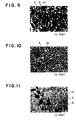
- Fig. 9 is a micrograph of 400 magnifications of a transverse section of the unidirectional composite material of carbon fibers and pure zinc manufactured according to the method of EMBODIMENT 5 with the TPT treatment. The micrograph was taken by an optical microscope.
- Fig. 10 is a micrograph of 400 magnifications of a transverse section of the unidirectional composite material manufactured according to COMPARATIVE EXAMPLE 5. The micrograph was also taken by an optical microscope. In these Figs. 9 and 10, f indicates a carbon fiber, and m indicates a pure zinc.
- An aluminum alloy (JIS AC4C) having a composition of 7 weight percent Si, 0.3 weight percent Mg, and the balance aluminum was charged into a graphite crucible by an amount of 3kg, and was melted at 700°C in a melting furnace. Then, the aluminum alloy thus melted was cooled down naturally in the furnace down to 640 0 C.
- the molten aluminum alloy was further cooled down in the furnace under agitation applied by a propeller rotated at a speed of 300 - 400 rpm as driven by a variable speed motor, so that the rate of cooling down should be 20°C per hour, down to 580°C at which the ratio of the solid phase was 20 - 40 %.
- the propeller was made of a carbon steel and its surface was coated with calcium zirconate applied by the flame spraying.
- Fig. 11 is a micrograph of 100 magnifications of a section of the composite material thus manufactured, taken by an optical microscope.
- m indicates an aluminum alloy as the matrix metal
- a indicates a graphite particle
- e indicates an eutectic Si crystal crystallized in the crystals of the aluminum alloy.
Landscapes
- Chemical & Material Sciences (AREA)
- Engineering & Computer Science (AREA)
- Chemical Kinetics & Catalysis (AREA)
- General Chemical & Material Sciences (AREA)
- Textile Engineering (AREA)
- Materials Engineering (AREA)
- Mechanical Engineering (AREA)
- Metallurgy (AREA)
- Organic Chemistry (AREA)
- Manufacture Of Alloys Or Alloy Compounds (AREA)
Applications Claiming Priority (2)
| Application Number | Priority Date | Filing Date | Title |
|---|---|---|---|
| JP138854/81 | 1981-09-03 | ||
| JP56138854A JPS5839758A (ja) | 1981-09-03 | 1981-09-03 | 炭素質材−金属複合材料の製造方法 |
Publications (2)
| Publication Number | Publication Date |
|---|---|
| EP0074573A1 true EP0074573A1 (de) | 1983-03-23 |
| EP0074573B1 EP0074573B1 (de) | 1987-04-01 |
Family
ID=15231700
Family Applications (1)
| Application Number | Title | Priority Date | Filing Date |
|---|---|---|---|
| EP82108110A Expired EP0074573B1 (de) | 1981-09-03 | 1982-09-02 | Verfahren zur Herstellung von Kohlenstoff/Metall-Verbundmaterial unter Vorbehandlung des Kohlenstoffs mit Tetraisopropyltitanat |
Country Status (4)
| Country | Link |
|---|---|
| US (1) | US4419389A (de) |
| EP (1) | EP0074573B1 (de) |
| JP (1) | JPS5839758A (de) |
| DE (1) | DE3275933D1 (de) |
Cited By (2)
| Publication number | Priority date | Publication date | Assignee | Title |
|---|---|---|---|---|
| EP0164536A3 (en) * | 1984-06-15 | 1987-10-28 | Toyota Jidosha Kabushiki Kaisha | Composite material with carbon reinforcing fibers and magnesium alloy matrix metal including zinc |
| EP0387468A3 (de) * | 1988-12-19 | 1991-06-05 | United Technologies Corporation | Appretur aus stabilen amorphen hydrierten Metalloxiden für Fasern in Compositmaterialien |
Families Citing this family (2)
| Publication number | Priority date | Publication date | Assignee | Title |
|---|---|---|---|---|
| US8241274B2 (en) | 2000-01-19 | 2012-08-14 | Medtronic, Inc. | Method for guiding a medical device |
| US20030024611A1 (en) * | 2001-05-15 | 2003-02-06 | Cornie James A. | Discontinuous carbon fiber reinforced metal matrix composite |
Citations (5)
| Publication number | Priority date | Publication date | Assignee | Title |
|---|---|---|---|---|
| DE2115925A1 (en) * | 1971-03-11 | 1972-09-14 | Aktiengesellschaft Brown, Boveri & Cie., Baden (Schweiz) | Carbon fibre reinforced aluminium - of high tensile strength and corrosion resistance |
| US3821013A (en) * | 1972-02-07 | 1974-06-28 | Celanese Corp | Surface modification of graphite fibers |
| US3888661A (en) * | 1972-08-04 | 1975-06-10 | Us Army | Production of graphite fiber reinforced metal matrix composites |
| DE2501024A1 (de) * | 1975-01-13 | 1976-07-22 | Fiber Materials | Faser-verbundmaterial |
| US4050997A (en) * | 1972-12-18 | 1977-09-27 | Maschinenfabrik Augsburg-Nurnberg Aktiengesellschaft | Method of manufacturing a fiber reinforced composite material |
Family Cites Families (6)
| Publication number | Priority date | Publication date | Assignee | Title |
|---|---|---|---|---|
| US2920385A (en) * | 1956-02-08 | 1960-01-12 | Borg Warner | Process of bonding carbon to aluminum |
| US3384463A (en) * | 1965-03-22 | 1968-05-21 | Dow Chemical Co | Graphite metal body composite |
| US3770488A (en) * | 1971-04-06 | 1973-11-06 | Us Air Force | Metal impregnated graphite fibers and method of making same |
| US4223075A (en) * | 1977-01-21 | 1980-09-16 | The Aerospace Corporation | Graphite fiber, metal matrix composite |
| US4157409A (en) * | 1978-08-28 | 1979-06-05 | The United States Of America As Represented By The Secretary Of The Army | Method of making metal impregnated graphite fibers |
| US4341823A (en) * | 1981-01-14 | 1982-07-27 | Material Concepts, Inc. | Method of fabricating a fiber reinforced metal composite |
-
1981
- 1981-09-03 JP JP56138854A patent/JPS5839758A/ja active Granted
-
1982
- 1982-08-30 US US06/413,126 patent/US4419389A/en not_active Expired - Fee Related
- 1982-09-02 EP EP82108110A patent/EP0074573B1/de not_active Expired
- 1982-09-02 DE DE8282108110T patent/DE3275933D1/de not_active Expired
Patent Citations (5)
| Publication number | Priority date | Publication date | Assignee | Title |
|---|---|---|---|---|
| DE2115925A1 (en) * | 1971-03-11 | 1972-09-14 | Aktiengesellschaft Brown, Boveri & Cie., Baden (Schweiz) | Carbon fibre reinforced aluminium - of high tensile strength and corrosion resistance |
| US3821013A (en) * | 1972-02-07 | 1974-06-28 | Celanese Corp | Surface modification of graphite fibers |
| US3888661A (en) * | 1972-08-04 | 1975-06-10 | Us Army | Production of graphite fiber reinforced metal matrix composites |
| US4050997A (en) * | 1972-12-18 | 1977-09-27 | Maschinenfabrik Augsburg-Nurnberg Aktiengesellschaft | Method of manufacturing a fiber reinforced composite material |
| DE2501024A1 (de) * | 1975-01-13 | 1976-07-22 | Fiber Materials | Faser-verbundmaterial |
Cited By (2)
| Publication number | Priority date | Publication date | Assignee | Title |
|---|---|---|---|---|
| EP0164536A3 (en) * | 1984-06-15 | 1987-10-28 | Toyota Jidosha Kabushiki Kaisha | Composite material with carbon reinforcing fibers and magnesium alloy matrix metal including zinc |
| EP0387468A3 (de) * | 1988-12-19 | 1991-06-05 | United Technologies Corporation | Appretur aus stabilen amorphen hydrierten Metalloxiden für Fasern in Compositmaterialien |
Also Published As
| Publication number | Publication date |
|---|---|
| DE3275933D1 (en) | 1987-05-07 |
| EP0074573B1 (de) | 1987-04-01 |
| US4419389A (en) | 1983-12-06 |
| JPS6151619B2 (de) | 1986-11-10 |
| JPS5839758A (ja) | 1983-03-08 |
Similar Documents
| Publication | Publication Date | Title |
|---|---|---|
| Amateau | Progress in the development of graphite-aluminum composites using liquid infiltration technology | |
| US4232091A (en) | Composite materials and their production | |
| EP0539011B1 (de) | Mit Nickel überzogene Vorform aus Kohlenstoff | |
| US4657065A (en) | Composite materials having a matrix of magnesium or magnesium alloy reinforced with discontinuous silicon carbide particles | |
| NO172449B (no) | Metallmatrikskompositt med tilfeldig orienterte, innleirede, uorganiske oksydfibre, prelaget legeme, samt fremgangsmaate for fremstilling av disse | |
| KR101740883B1 (ko) | 교반주조법을 이용한 탄소섬유 강화 알루미늄 복합재의 제조방법 | |
| US5588477A (en) | Method of making metal matrix composite | |
| Sánchez et al. | Fabrication of aluminium composites reinforced with carbon fibres by a centrifugal infiltration process | |
| Cratchley | Experimental Aspects of Fibrereinforced Metals | |
| JPH11269576A (ja) | 金属マトリックス繊維複合体の形成方法 | |
| FI91724C (fi) | Menetelmä metallimatriisikomposiitin valmistamiseksi negatiivista seosmuottia käyttäen | |
| US5705229A (en) | Process for producing composite material combining a magnesium alloy containing zirconium with a carbon reinforcement | |
| FR2475034A1 (fr) | B-sic lamelle, procede de preparation, ceramiques et refractaires le contenant | |
| EP0105890B1 (de) | Verfahren zur herstellung von verbundmaterialien mit einem matrix aus leichtmetall, und gegenstände nach diesem verfahren gefertigt | |
| Kendall | Development of metal matrix composites reinforced with high modulus graphite fibers | |
| JPH08508001A (ja) | 構造用炭素断熱材及びその製造方法 | |
| US4419389A (en) | Method for making carbon/metal composite pretreating the carbon with tetraisopropyltitanate | |
| US5024902A (en) | Fiber-reinforced metal | |
| Waku et al. | Future trends and recent developments of fabrication technology for advanced metal matrix composites | |
| Haught et al. | Mullite whisker felt and its application in composites | |
| Alizadeh et al. | Microstructure, mechanical properties and wear behavior of ni-coated continuous carbon fiber-reinforced a356 aluminum matrix composites fabricated by squeeze casting | |
| Baik | Interfacial reaction and fracture behavior of cobalt-coated Al2O3 reinforced aluminum composites | |
| Ertürk et al. | Enhanced mechanical performance of aluminum glass fiber reinforced foam material by cu modification | |
| JP2551850B2 (ja) | ハイブリッド繊維、その製造方法及びこの繊維で強化された金属の製造方法 | |
| Olszówka-Myalska et al. | Applying stir casting method for Mg alloy-short carbon fiber composite processing |
Legal Events
| Date | Code | Title | Description |
|---|---|---|---|
| PUAI | Public reference made under article 153(3) epc to a published international application that has entered the european phase |
Free format text: ORIGINAL CODE: 0009012 |
|
| AK | Designated contracting states |
Designated state(s): DE FR GB |
|
| 17P | Request for examination filed |
Effective date: 19830426 |
|
| GRAA | (expected) grant |
Free format text: ORIGINAL CODE: 0009210 |
|
| AK | Designated contracting states |
Kind code of ref document: B1 Designated state(s): DE FR GB |
|
| REF | Corresponds to: |
Ref document number: 3275933 Country of ref document: DE Date of ref document: 19870507 |
|
| ET | Fr: translation filed | ||
| PLBE | No opposition filed within time limit |
Free format text: ORIGINAL CODE: 0009261 |
|
| STAA | Information on the status of an ep patent application or granted ep patent |
Free format text: STATUS: NO OPPOSITION FILED WITHIN TIME LIMIT |
|
| 26N | No opposition filed | ||
| PGFP | Annual fee paid to national office [announced via postgrant information from national office to epo] |
Ref country code: GB Payment date: 19890831 Year of fee payment: 8 |
|
| PGFP | Annual fee paid to national office [announced via postgrant information from national office to epo] |
Ref country code: FR Payment date: 19890911 Year of fee payment: 8 |
|
| PGFP | Annual fee paid to national office [announced via postgrant information from national office to epo] |
Ref country code: DE Payment date: 19891002 Year of fee payment: 8 |
|
| PG25 | Lapsed in a contracting state [announced via postgrant information from national office to epo] |
Ref country code: GB Effective date: 19900902 |
|
| GBPC | Gb: european patent ceased through non-payment of renewal fee | ||
| PG25 | Lapsed in a contracting state [announced via postgrant information from national office to epo] |
Ref country code: FR Effective date: 19910530 |
|
| PG25 | Lapsed in a contracting state [announced via postgrant information from national office to epo] |
Ref country code: DE Effective date: 19910601 |
|
| REG | Reference to a national code |
Ref country code: FR Ref legal event code: ST |