EP0077239A1 - Einrichtung zur spatialen Korrektur bei einem Bildabtaster - Google Patents
Einrichtung zur spatialen Korrektur bei einem Bildabtaster Download PDFInfo
- Publication number
- EP0077239A1 EP0077239A1 EP82401755A EP82401755A EP0077239A1 EP 0077239 A1 EP0077239 A1 EP 0077239A1 EP 82401755 A EP82401755 A EP 82401755A EP 82401755 A EP82401755 A EP 82401755A EP 0077239 A1 EP0077239 A1 EP 0077239A1
- Authority
- EP
- European Patent Office
- Prior art keywords
- correction
- memory
- counter
- outputs
- correction signals
- Prior art date
- Legal status (The legal status is an assumption and is not a legal conclusion. Google has not performed a legal analysis and makes no representation as to the accuracy of the status listed.)
- Granted
Links
- 230000007704 transition Effects 0.000 claims abstract description 16
- 238000009499 grossing Methods 0.000 claims description 19
- 230000007547 defect Effects 0.000 abstract description 6
- 238000001914 filtration Methods 0.000 description 3
- 230000002238 attenuated effect Effects 0.000 description 2
- 239000003086 colorant Substances 0.000 description 2
- 239000000470 constituent Substances 0.000 description 2
- 230000010354 integration Effects 0.000 description 2
- 238000000034 method Methods 0.000 description 2
- 238000003860 storage Methods 0.000 description 2
- 238000004458 analytical method Methods 0.000 description 1
- 230000006399 behavior Effects 0.000 description 1
- 238000004364 calculation method Methods 0.000 description 1
- 238000010586 diagram Methods 0.000 description 1
- 238000010894 electron beam technology Methods 0.000 description 1
- 238000004519 manufacturing process Methods 0.000 description 1
- 230000000116 mitigating effect Effects 0.000 description 1
- 230000001360 synchronised effect Effects 0.000 description 1
Images

Classifications
-
- H—ELECTRICITY
- H04—ELECTRIC COMMUNICATION TECHNIQUE
- H04N—PICTORIAL COMMUNICATION, e.g. TELEVISION
- H04N23/00—Cameras or camera modules comprising electronic image sensors; Control thereof
- H04N23/10—Cameras or camera modules comprising electronic image sensors; Control thereof for generating image signals from different wavelengths
- H04N23/13—Cameras or camera modules comprising electronic image sensors; Control thereof for generating image signals from different wavelengths with multiple sensors
- H04N23/15—Image signal generation with circuitry for avoiding or correcting image misregistration
-
- H—ELECTRICITY
- H04—ELECTRIC COMMUNICATION TECHNIQUE
- H04N—PICTORIAL COMMUNICATION, e.g. TELEVISION
- H04N23/00—Cameras or camera modules comprising electronic image sensors; Control thereof
- H04N23/80—Camera processing pipelines; Components thereof
- H04N23/81—Camera processing pipelines; Components thereof for suppressing or minimising disturbance in the image signal generation
Definitions
- the present invention relates to a spatial correction device for an image analyzer.
- spatial correction is meant the correction of defects, due to the analyzer, which result in a spatial distortion between the image analyzed and the image restored by the analyzer.
- Convergence faults are found only in color image analyzers. They are due to an imperfect superposition, on the image restitution support, of the electron beams associated with each of the three fundamental colors and they result in the presence of colored fringes on the contours of the objects.
- Geometry and spot defects are encountered in all image analyzers, whether they operate in black and white or in color, and are due to imperfections in the analysis system itself.
- the geometry defects result in a geometric deformation of the restored image with respect to the analyzed image, and the spot defects result in the presence of a non-constant gray background on the restored image when the the analyzed image is a background of a constant gray.
- a device for correcting convergence faults for color cameras has been the subject of a French patent application No. 81 01 287 filed in the name of the applicant.
- This device essentially comprises a memory, called correction memory, capable of storing, for each of the rectangles resulting from a grid of the screen of the camera in M groups of L rows each and in N columns, a predetermined correction signal of horizontal scanning and a predetermined vertical scanning correction signal specific to each of two of the three fundamental colors, and a sequencer for controlling the application of these correction signals to the scanning means when the scanning means pass through the corresponding rectangles of the screen.
- Means for attenuating the discontinuities existing between horizontal and vertical scanning correction signals associated with adjacent lines of the same column are also provided so as to avoid too sudden approximations or spacings of the lines during the transitions between the different values of the corresponding correction signals.
- Two embodiments of these mitigation means are given.
- An exemplary embodiment in analog consists in attenuating these discontinuities by means of filters of the "RC" type.
- An example of digital implementation consists in attenuating these discontinuities by integrating the correction signals by means of an adder and a memory, called the integration memory, associated with the correction memory.
- these exemplary embodiments of the means for attenuating the discontinuities between correction signals contribute well to avoiding the phenomenon of sudden approaching or moving away of the lines, they do however leave another whole problem which is due to the presence of ruptures of derivatives during transitions between correction signals.
- the integration filtering method only attenuates the difference in amplitudes between two successive correction signals, but leaves edges remaining during the transitions between successive correction signals.
- the filtering method by means of filters of the "R.C" type attenuates both the amplitude difference and the edges between successive correction signals. However, it does not perfectly attenuate these fronts, because it maintains the presence of ruptures of derivatives during the transitions.
- the present invention aims to avoid this drawback. It indeed relates to a spatial correction device for image analyzer in which the transitions between correction signals are made without breaks in derivatives, and therefore practically insensitive to the constituent elements of the image analyzer.
- the spatial correction device for an image analyzer comprising an image restitution medium and means for scanning this medium, comprises a memory called correction memory capable of storing for each MN rectangles resulting from a grid of the image restitution support of the analyzer in M groups of L rows each and in N columns, a predetermined correction signal associated with this rectangle, a sequencer for ensuring the application of these correction signals when the scanning means pass through the corresponding rectangles of the image restoring medium , and interpolation means for calculating the intermediate values of the correction signals to be applied when the scanning means pass through each of the L lines of a given rectangle, so as to avoid breaks in the derivatives of the correction signals during transitions between this rectangle and the adjacent rectangles located on the same column.
- the convergence device shown in FIG. 1 includes a first memory 1, called correction memory, intended to store predetermined values of correction signals associated with different areas of the surface of the image restitution medium, and which must be applied either to the scanning means of the image analyzer, if it is a convergence or geometry correction, or to the means of generating the restored image, if it is a spot correction, when the scanning means pass through these different zones.
- correction memory intended to store predetermined values of correction signals associated with different areas of the surface of the image restitution medium, and which must be applied either to the scanning means of the image analyzer, if it is a convergence or geometry correction, or to the means of generating the restored image, if it is a spot correction, when the scanning means pass through these different zones.
- These different zones result from a grid of the surface of the image restitution support according to M groups of L lines each and according to N columns.
- the MN rectangles thus defined are associated with predetermined values of correction signals. For example, in the case of a 625-line shooting, the surface
- the object of the present invention is not the determination of the values to be assigned to the correction signals, but the application of these signals to the image analyzer. Therefore, the manner in which the correction signals are obtained will not be described in more detail.
- the spatial correction device also comprises a sequencer 2 itself comprising a first counter 3 and a second counter 4 for addressing the correction memory.
- the first counter 3 is incremented by a clock signal h l of frequency Nf, f designating the line scanning frequency of the image restitution medium.
- the second counter 4 is incremented by a clock signal h 2 of frequency .
- the first counter 3 is a modulo N counter, provided with outputs A n (with n variable from 0 to the integer part of log 2 N) providing the least significant binary elements for addressing the correction memory.
- the second counter 4 is a modulo counter M provided with outputs A m (with m variable from 0 to the entire part of log 2 M) supplying the most significant binary elements for addressing the correction memory.
- the spatial correction device also includes interpolation means 5 for calculating the intermediate values of the correction signals to be applied to each of the L lines of a given rectangle.
- the interpolation means 5 comprise a second memory 6, called smoothing memory, intended to store 2P predetermined values of smoothing coefficients associated with each of the L lines of each of the MN rectangles forming the above grid (with P integer ⁇ 0).
- the smoothing memory 6 is provided with address inputs connected to the outputs of a third modulo 2P counter 8 incremented by a clock signal H synchronous with the clock signal h 1 and having, during each signal period hl, a series of 2P pulses each having a duration at least equal to the read access time of the smoothing memory (or of the correction memory).
- the outputs of the smoothing memory are connected to the inputs of 2P registers 9 1 to 9 2P each provided with a clock input connected to the output of a decoder 10p of the value p (with p variable from 1 to 2P) .
- the decoders 10p are each provided with inputs connected to the outputs of the counter 8 and with an output providing a signal s.
- the interpolation means 5 also include a circuit for addressing the correction memory.
- This addressing circuit comprises an adder 11 provided with first inputs connected to the outputs of the second counter 4 and of second inputs connected to the outputs of a third memory 12, known as the successive addressing memory of the correction memory, itself provided of address inputs linked to the outputs of counter 8.
- a third memory 12 known as the successive addressing memory of the correction memory, itself provided of address inputs linked to the outputs of counter 8.
- In memory 12 are written in sequence the values -P, - (P-1) ..., -1, 0, +1, ..., P- 2, P-1.
- the address inputs of the correction memory 1 are connected to the juxtaposed outputs of the counter 3 and of the adder 11.
- the interpolation means 5 also include a set of 2P registers 14p (with p variable from 1 to 2P) provided with data inputs connected to the outputs of the correction memory and clock inputs connected respectively to the outputs of the decoders 10.
- the interpolation means 5 also comprise a set of 2P multipliers 15, each provided with first and second inputs connected respectively to the outputs of the registers 9p and 14p, and with an output providing a signal R, and an adder 16 provided with 2P inputs connected respectively to the outputs of multipliers 15 1 to 152P.
- the spatial correction device also comprises a digital analog converter 17 inserted between the outputs of the adder 16 and the input of the element of the image analyzer to which the correction signals are to be applied.
- the spatial correction device shown in Figure 1 operates as follows.
- the values of the correction signals associated with the corresponding rectangle of the support are read in the correction memory 1 restitution of the image, the reading order of the correction signals in the correction memory being determined by the priority of the horizontal scan over the vertical scan, that is to say by the priority of evolution of the variable n on the variable.m.
- the discontinuities existing between the correction signals associated with two adjacent columns situated on the same group of lines are naturally attenuated because the scanning is done along the lines, either by means of scanning, or by any other means usually filtering the discontinuities of the signals.
- the spatial correction device is provided with interpolation means 5 intended to predict the evolution of the correction signal from one line to the other of a given rectangle.
- a particular value of the correction signal is calculated for each value of q (with q variable from 1 to L), that is to say for each of the L lines of the group of lines of number m considered.
- xq, m , n be the value of the correction signal associated with the line of number q belonging to the group of lines of number m located in the column number n. This value is not supplied by the correction memory but it is calculated by the interpolation means according to the invention according to the following formula.
- x m , n be the value of the correction signal associated with the group of lines of number m located in the column of number n.
- the intermediate correction signal assigned to line q of the group of lines number m located in column number n is written:
- the adder 11 when during a given period of the clock signal of frequency N f the sequencer 2 reaches the values A and A corresponding to the address in the correction memory of the correction signal x mn associated with the rectangle of mn coordinates, the adder 11 successively supplies the 2 P addresses in the correction memory of the correction signal associated with the rectangle of coordinates m, n and of the correction signals associated with the 2 P-1 rectangles located on either side of the rectangle mn considered on the same column n.
- the 2P addresses thus obtained are used successively to address the correction memory which then supplies the correction signals associated with the 2P rectangles located on the same column n, these signals being stored in the registers 14 p activated successively at the rate of addressing of the correction memory thanks to the decoders 10p and to the counter 8 incremented by the clock signal H.
- the smoothing memory is addressed successively 2P times to supply the 2P smoothing coefficients a pqm associated with the line portion whose coordinates qmn correspond to the considered period of the clock signal h 1 .
- the smoothing coefficients a are determined either automatically or manually, so as to reproduce the shape of the curve chosen to represent the evolution of the correction signal between the obligatory waypoints corresponding to the values stored in the correction memory.
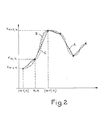
- FIG. 2 shows three examples of curves connecting values of the correction signals stored in the correction memory, these values being represented by crosses.
- This example is of little interest in practice since, as we have seen previously, it allows the breaking of derivatives during transitions.
- This example requires knowledge of more than two values of the correction signals located on either side of the line considered, and therefore, the storage of more than two smoothing coefficients per line.
- This example is more interesting in practice because it avoids the presence of derivative breaks at the transition points. However, it can have the disadvantage of not very accurately reflecting the evolution of the correction signal between two transition points. A remedy can be found for this situation by increasing the number of correction signal values located on either side of the line considered, and taken into account in the calculation, as well as the number of associated smoothing coefficients.
- This is shown by a third example of a curve, represented in narrow dotted lines, (curve C) which corresponds to an interpolation with prediction of tangency at the transition points.
Landscapes
- Engineering & Computer Science (AREA)
- Multimedia (AREA)
- Signal Processing (AREA)
- Video Image Reproduction Devices For Color Tv Systems (AREA)
- Image Processing (AREA)
- Length Measuring Devices By Optical Means (AREA)
- Facsimile Image Signal Circuits (AREA)
Applications Claiming Priority (2)
| Application Number | Priority Date | Filing Date | Title |
|---|---|---|---|
| FR8118638 | 1981-10-02 | ||
| FR8118638A FR2514220A1 (fr) | 1981-10-02 | 1981-10-02 | Dispositif de correction spatiale pour analyseur d'images |
Publications (2)
| Publication Number | Publication Date |
|---|---|
| EP0077239A1 true EP0077239A1 (de) | 1983-04-20 |
| EP0077239B1 EP0077239B1 (de) | 1985-05-02 |
Family
ID=9262708
Family Applications (1)
| Application Number | Title | Priority Date | Filing Date |
|---|---|---|---|
| EP82401755A Expired EP0077239B1 (de) | 1981-10-02 | 1982-09-28 | Einrichtung zur spatialen Korrektur bei einem Bildabtaster |
Country Status (6)
| Country | Link |
|---|---|
| US (1) | US4553164A (de) |
| EP (1) | EP0077239B1 (de) |
| JP (1) | JPS5875378A (de) |
| CA (1) | CA1202116A (de) |
| DE (1) | DE3263419D1 (de) |
| FR (1) | FR2514220A1 (de) |
Cited By (7)
| Publication number | Priority date | Publication date | Assignee | Title |
|---|---|---|---|---|
| FR2573264A1 (fr) * | 1984-11-09 | 1986-05-16 | Loire Electronique | Camera video en couleurs |
| GB2180714A (en) * | 1985-08-22 | 1987-04-01 | Rank Xerox Ltd | Imaging apparatus |
| FR2588437A1 (fr) * | 1985-10-07 | 1987-04-10 | Hasselblad Ab Victor | Dispositif de production d'un signal electrique representant une image, permettant notamment d'obtenir une image amelioree |
| FR2614488A1 (fr) * | 1987-04-22 | 1988-10-28 | Sony Corp | Camera de television en couleur a plusieurs tubes possedant un systeme de reglage automatique de la coincidence |
| FR2657208A1 (fr) * | 1990-01-16 | 1991-07-19 | Thomson Consumer Electronics | Procede et dispositif de correction automatique de geometrie, de superposition de couleurs et d'uniformite d'image pour camera de television. |
| EP0642265A1 (de) * | 1993-09-08 | 1995-03-08 | Philips Patentverwaltung GmbH | Verfahren und Anordnung zum Erzeugen von Röntgenaufnahmen |
| US7193640B2 (en) | 2003-10-31 | 2007-03-20 | Polaroid Corporation | Printer color registration correction |
Families Citing this family (13)
| Publication number | Priority date | Publication date | Assignee | Title |
|---|---|---|---|---|
| JPS6080374A (ja) * | 1983-10-11 | 1985-05-08 | Hitachi Denshi Ltd | テレビジヨンカメラ装置の撮像特性補正方法 |
| JPS60219885A (ja) * | 1984-04-16 | 1985-11-02 | Sony Corp | ビデオカメラの自動センタリング装置 |
| US4698685A (en) * | 1986-05-28 | 1987-10-06 | Rca Corporation | Apparatus and method for correcting CCD pixel nonuniformities |
| US4977355A (en) * | 1989-08-23 | 1990-12-11 | Rca Licensing Corportion | Convergence control system |
| EP0439605B1 (de) * | 1989-08-23 | 1997-03-26 | Thomson Consumer Electronics, Inc. | Konvergenzregelsystem für mehrfache vertikale formate |
| US5161002A (en) * | 1989-08-23 | 1992-11-03 | Thomson Consumer Electronics, Inc. | Convergence control system for multiple vertical formats |
| US5029392A (en) * | 1990-08-08 | 1991-07-09 | Ideal Industries, Inc. | Two point punch |
| US5600446A (en) * | 1993-03-16 | 1997-02-04 | Iga; Adam S. | Electronic camera apparatus for instant and conventional photography, and video cameras |
| CN1070013C (zh) * | 1994-12-14 | 2001-08-22 | 松下电器产业株式会社 | 具有校正亮度不均匀性的电路的投影型图像显示装置 |
| US6370476B1 (en) * | 1998-04-27 | 2002-04-09 | Trimble Navigation Limited | Interpolation of survey coordinate differences |
| US5978744A (en) * | 1998-04-27 | 1999-11-02 | Trimble Navigation Ltd. | Interpolation of survey coordinate differences |
| JP2008094430A (ja) * | 2006-10-12 | 2008-04-24 | Fujifilm Corp | カートリッジ収納ケース |
| JP2008094475A (ja) * | 2006-10-16 | 2008-04-24 | Fujifilm Corp | カートリッジ収納ケース |
Citations (2)
| Publication number | Priority date | Publication date | Assignee | Title |
|---|---|---|---|---|
| FR2070713A1 (de) * | 1969-11-12 | 1971-09-17 | Meldreth Electronics Ltd | |
| GB1353147A (en) * | 1970-04-18 | 1974-05-15 | Emi Ltd | Scanning arrangements |
Family Cites Families (3)
| Publication number | Priority date | Publication date | Assignee | Title |
|---|---|---|---|---|
| US3902011A (en) * | 1969-11-12 | 1975-08-26 | Meldreth Electronics Limited | Image analysing |
| US4309723A (en) * | 1980-04-14 | 1982-01-05 | Ampex Corporation | Apparatus and method for registration and shading of color television cameras |
| FR2498858B1 (fr) * | 1981-01-23 | 1986-03-21 | Thomson Csf | Dispositif de convergence pour camera couleurs |
-
1981
- 1981-10-02 FR FR8118638A patent/FR2514220A1/fr active Granted
-
1982
- 1982-09-13 US US06/417,592 patent/US4553164A/en not_active Expired - Fee Related
- 1982-09-28 EP EP82401755A patent/EP0077239B1/de not_active Expired
- 1982-09-28 DE DE8282401755T patent/DE3263419D1/de not_active Expired
- 1982-09-30 CA CA000412597A patent/CA1202116A/en not_active Expired
- 1982-09-30 JP JP57172482A patent/JPS5875378A/ja active Pending
Patent Citations (2)
| Publication number | Priority date | Publication date | Assignee | Title |
|---|---|---|---|---|
| FR2070713A1 (de) * | 1969-11-12 | 1971-09-17 | Meldreth Electronics Ltd | |
| GB1353147A (en) * | 1970-04-18 | 1974-05-15 | Emi Ltd | Scanning arrangements |
Cited By (13)
| Publication number | Priority date | Publication date | Assignee | Title |
|---|---|---|---|---|
| FR2573264A1 (fr) * | 1984-11-09 | 1986-05-16 | Loire Electronique | Camera video en couleurs |
| US4763192A (en) * | 1985-08-22 | 1988-08-09 | Rank Pullin Controls Limited | Imaging apparatus |
| GB2180714A (en) * | 1985-08-22 | 1987-04-01 | Rank Xerox Ltd | Imaging apparatus |
| GB2180714B (en) * | 1985-08-22 | 1989-08-16 | Rank Xerox Ltd | Image apparatus |
| GB2183421A (en) * | 1985-10-07 | 1987-06-03 | Hasselblad Ab Victor | Shading correction of facsimile images |
| FR2588437A1 (fr) * | 1985-10-07 | 1987-04-10 | Hasselblad Ab Victor | Dispositif de production d'un signal electrique representant une image, permettant notamment d'obtenir une image amelioree |
| GB2183421B (en) * | 1985-10-07 | 1990-03-28 | Hasselblad Ab Victor | Device for producing an electric signal representing an image |
| FR2614488A1 (fr) * | 1987-04-22 | 1988-10-28 | Sony Corp | Camera de television en couleur a plusieurs tubes possedant un systeme de reglage automatique de la coincidence |
| FR2657208A1 (fr) * | 1990-01-16 | 1991-07-19 | Thomson Consumer Electronics | Procede et dispositif de correction automatique de geometrie, de superposition de couleurs et d'uniformite d'image pour camera de television. |
| WO1991011075A1 (fr) * | 1990-01-16 | 1991-07-25 | Thomson Consumer Electronics S.A. | Procede et dispositif de correction automatique de geometrie, de superposition de couleurs et d'uniformite d'image pour camera de television |
| US5181098A (en) * | 1990-01-16 | 1993-01-19 | Thomson Consumer Electronics | Procedure and device for the automatic correction of skew, of color superimposition, and of image uniformity for television cameras |
| EP0642265A1 (de) * | 1993-09-08 | 1995-03-08 | Philips Patentverwaltung GmbH | Verfahren und Anordnung zum Erzeugen von Röntgenaufnahmen |
| US7193640B2 (en) | 2003-10-31 | 2007-03-20 | Polaroid Corporation | Printer color registration correction |
Also Published As
| Publication number | Publication date |
|---|---|
| US4553164A (en) | 1985-11-12 |
| FR2514220B1 (de) | 1983-12-02 |
| EP0077239B1 (de) | 1985-05-02 |
| FR2514220A1 (fr) | 1983-04-08 |
| JPS5875378A (ja) | 1983-05-07 |
| DE3263419D1 (en) | 1985-06-05 |
| CA1202116A (en) | 1986-03-18 |
Similar Documents
| Publication | Publication Date | Title |
|---|---|---|
| EP0077239B1 (de) | Einrichtung zur spatialen Korrektur bei einem Bildabtaster | |
| EP0147326B1 (de) | Digitales Filter mit veränderlicher Banddurchlass- und Phasencharakteristik | |
| FR2480544A1 (fr) | Circuit pour realiser une interpolation entre des valeurs prises dans deux rangees de donnees | |
| EP0128789B1 (de) | Verfahren zur Ausführung einer geometrischen Transformation eines Videobildes und Einrichtung zur Durchführung des Verfahrens | |
| FR2492203A1 (fr) | Systeme de memorisation et de restitution de donnees numeriques sur magnetoscopes | |
| FR2462076A1 (fr) | Compensateur de la chute hors limites d'un signal video et procede de formation d'un signal de remplacement dans le cas d'une telle chute hors limites | |
| EP0441692B1 (de) | Verfahren zur Steuerung eines Matrixbildschirms, bestehend aus zwei unabhängigen Teilen und Einrichtung zu seiner Durchführung | |
| FR2501944A1 (fr) | Dispositif pour la conversion du nombre de lignes de balayage | |
| EP0540403A1 (de) | Videoanalyseverfahren für die Montage eines übertragenen oder aufgezeichneten Fernsehprogramms und ihre Verwendung für Nachbearbeitungstechniken, insbesondere in mehrere Sprachen | |
| FR2543776A1 (fr) | Agencement de correction de distorsion de la trame dans un systeme de traitement video numerique | |
| BE897048A (fr) | Procede et dispositif pour le traitement d'images radioscopiques | |
| FR2596601A1 (fr) | Appareil cyclique de reduction du bruit | |
| FR2666712A1 (fr) | Dispositif pour commander un dispositif electronique de formation d'image. | |
| FR2543387A1 (de) | ||
| EP0106418B1 (de) | Gerät zum Untersuchen von Medien mittels Ultraschallechographie | |
| LU82705A1 (fr) | Dispositif de reproduction d'une image a densite variable de teinte | |
| FR2497043A1 (fr) | Dispositif d'impression d'une image | |
| FR2498858A1 (fr) | Dispositif de convergence pour camera couleurs | |
| FR2573562A1 (fr) | Memoire vive et circuit d'interpolation lineaire en comportant application | |
| FR2577681A1 (fr) | Procede d'extension de la gamme des frequences des recurrences radar acceptables par un transformateur numerique d'images et moyens de mise en oeuvre de ce procede | |
| EP0259902A1 (de) | Kodiervorrichtung mit differentieller Pulskodemodulation, zugehörige Dekodiervorrichtung und Übertragungssystem, das mindestens eine solche Kodier- oder Dekodiervorrichtung enthält | |
| EP0446334B1 (de) | Vorrichtung zur aufzeichnungsprogrammierung durch erkennung von referenzsignalen | |
| EP0287174A1 (de) | Einrichtung zum Transformieren von Bildern und mit einer solchen Einrichtung ausgerüstetes System | |
| FR2507847A1 (fr) | Egaliseur numerique autoadaptatif pour recepteur de donnees | |
| FR2544149A1 (fr) | Systeme de traitement d'images video |
Legal Events
| Date | Code | Title | Description |
|---|---|---|---|
| PUAI | Public reference made under article 153(3) epc to a published international application that has entered the european phase |
Free format text: ORIGINAL CODE: 0009012 |
|
| AK | Designated contracting states |
Designated state(s): BE DE GB NL |
|
| 17P | Request for examination filed |
Effective date: 19831007 |
|
| RBV | Designated contracting states (corrected) |
Designated state(s): BE DE GB |
|
| GRAA | (expected) grant |
Free format text: ORIGINAL CODE: 0009210 |
|
| AK | Designated contracting states |
Designated state(s): BE DE GB |
|
| REF | Corresponds to: |
Ref document number: 3263419 Country of ref document: DE Date of ref document: 19850605 |
|
| PLBE | No opposition filed within time limit |
Free format text: ORIGINAL CODE: 0009261 |
|
| STAA | Information on the status of an ep patent application or granted ep patent |
Free format text: STATUS: NO OPPOSITION FILED WITHIN TIME LIMIT |
|
| 26N | No opposition filed | ||
| PG25 | Lapsed in a contracting state [announced via postgrant information from national office to epo] |
Ref country code: BE Effective date: 19870930 |
|
| REG | Reference to a national code |
Ref country code: GB Ref legal event code: 746 |
|
| BERE | Be: lapsed |
Owner name: THOMSON-CSF Effective date: 19870930 |
|
| PGFP | Annual fee paid to national office [announced via postgrant information from national office to epo] |
Ref country code: GB Payment date: 19920813 Year of fee payment: 11 |
|
| PGFP | Annual fee paid to national office [announced via postgrant information from national office to epo] |
Ref country code: DE Payment date: 19920817 Year of fee payment: 11 |
|
| PG25 | Lapsed in a contracting state [announced via postgrant information from national office to epo] |
Ref country code: GB Effective date: 19930928 |
|
| GBPC | Gb: european patent ceased through non-payment of renewal fee |
Effective date: 19930928 |
|
| PG25 | Lapsed in a contracting state [announced via postgrant information from national office to epo] |
Ref country code: DE Effective date: 19940601 |