EP0077378B1 - Mechanisch stabilisiertes plattform-system - Google Patents
Mechanisch stabilisiertes plattform-system Download PDFInfo
- Publication number
- EP0077378B1 EP0077378B1 EP82901681A EP82901681A EP0077378B1 EP 0077378 B1 EP0077378 B1 EP 0077378B1 EP 82901681 A EP82901681 A EP 82901681A EP 82901681 A EP82901681 A EP 82901681A EP 0077378 B1 EP0077378 B1 EP 0077378B1
- Authority
- EP
- European Patent Office
- Prior art keywords
- platform
- gyro
- pendulum
- supporting structure
- gimbal
- Prior art date
- Legal status (The legal status is an assumption and is not a legal conclusion. Google has not performed a legal analysis and makes no representation as to the accuracy of the status listed.)
- Expired
Links
- 230000033001 locomotion Effects 0.000 claims abstract description 45
- 230000000087 stabilizing effect Effects 0.000 claims abstract description 24
- 230000000712 assembly Effects 0.000 claims description 13
- 238000000429 assembly Methods 0.000 claims description 13
- 238000010168 coupling process Methods 0.000 claims description 12
- 238000005859 coupling reaction Methods 0.000 claims description 12
- 230000008878 coupling Effects 0.000 claims description 11
- 230000005484 gravity Effects 0.000 claims description 7
- 230000010355 oscillation Effects 0.000 claims description 7
- 238000010521 absorption reaction Methods 0.000 claims description 5
- 239000000725 suspension Substances 0.000 claims description 4
- 229910000831 Steel Inorganic materials 0.000 claims description 2
- 239000004519 grease Substances 0.000 claims description 2
- 230000036039 immunity Effects 0.000 claims description 2
- 239000010959 steel Substances 0.000 claims description 2
- 230000000452 restraining effect Effects 0.000 abstract 1
- 230000000694 effects Effects 0.000 description 15
- 230000001133 acceleration Effects 0.000 description 11
- 238000011105 stabilization Methods 0.000 description 9
- 230000006641 stabilisation Effects 0.000 description 7
- 241000239290 Araneae Species 0.000 description 5
- 230000008901 benefit Effects 0.000 description 4
- 238000013016 damping Methods 0.000 description 4
- 238000006073 displacement reaction Methods 0.000 description 4
- 238000005096 rolling process Methods 0.000 description 4
- 230000007774 longterm Effects 0.000 description 3
- 230000008859 change Effects 0.000 description 2
- 238000010276 construction Methods 0.000 description 2
- 230000001687 destabilization Effects 0.000 description 2
- 230000005284 excitation Effects 0.000 description 2
- 230000014509 gene expression Effects 0.000 description 2
- 238000000034 method Methods 0.000 description 2
- 230000008569 process Effects 0.000 description 2
- 238000001228 spectrum Methods 0.000 description 2
- 230000003068 static effect Effects 0.000 description 2
- 238000009825 accumulation Methods 0.000 description 1
- 230000009471 action Effects 0.000 description 1
- 238000013459 approach Methods 0.000 description 1
- 230000002238 attenuated effect Effects 0.000 description 1
- 230000005540 biological transmission Effects 0.000 description 1
- 239000002131 composite material Substances 0.000 description 1
- 230000001808 coupling effect Effects 0.000 description 1
- 239000010779 crude oil Substances 0.000 description 1
- 230000001419 dependent effect Effects 0.000 description 1
- 239000012530 fluid Substances 0.000 description 1
- 230000007246 mechanism Effects 0.000 description 1
- NJPPVKZQTLUDBO-UHFFFAOYSA-N novaluron Chemical compound C1=C(Cl)C(OC(F)(F)C(OC(F)(F)F)F)=CC=C1NC(=O)NC(=O)C1=C(F)C=CC=C1F NJPPVKZQTLUDBO-UHFFFAOYSA-N 0.000 description 1
- 230000000737 periodic effect Effects 0.000 description 1
- 239000003208 petroleum Substances 0.000 description 1
- 230000009467 reduction Effects 0.000 description 1
- 230000035945 sensitivity Effects 0.000 description 1
- 238000010008 shearing Methods 0.000 description 1
- 230000001052 transient effect Effects 0.000 description 1
- 238000004804 winding Methods 0.000 description 1
Images


Classifications
-
- F—MECHANICAL ENGINEERING; LIGHTING; HEATING; WEAPONS; BLASTING
- F16—ENGINEERING ELEMENTS AND UNITS; GENERAL MEASURES FOR PRODUCING AND MAINTAINING EFFECTIVE FUNCTIONING OF MACHINES OR INSTALLATIONS; THERMAL INSULATION IN GENERAL
- F16M—FRAMES, CASINGS OR BEDS OF ENGINES, MACHINES OR APPARATUS, NOT SPECIFIC TO ENGINES, MACHINES OR APPARATUS PROVIDED FOR ELSEWHERE; STANDS; SUPPORTS
- F16M11/00—Stands or trestles as supports for apparatus or articles placed thereon ; Stands for scientific apparatus such as gravitational force meters
- F16M11/20—Undercarriages with or without wheels
- F16M11/2007—Undercarriages with or without wheels comprising means allowing pivoting adjustment
- F16M11/2035—Undercarriages with or without wheels comprising means allowing pivoting adjustment in more than one direction
-
- F—MECHANICAL ENGINEERING; LIGHTING; HEATING; WEAPONS; BLASTING
- F16—ENGINEERING ELEMENTS AND UNITS; GENERAL MEASURES FOR PRODUCING AND MAINTAINING EFFECTIVE FUNCTIONING OF MACHINES OR INSTALLATIONS; THERMAL INSULATION IN GENERAL
- F16M—FRAMES, CASINGS OR BEDS OF ENGINES, MACHINES OR APPARATUS, NOT SPECIFIC TO ENGINES, MACHINES OR APPARATUS PROVIDED FOR ELSEWHERE; STANDS; SUPPORTS
- F16M11/00—Stands or trestles as supports for apparatus or articles placed thereon ; Stands for scientific apparatus such as gravitational force meters
- F16M11/02—Heads
- F16M11/04—Means for attachment of apparatus; Means allowing adjustment of the apparatus relatively to the stand
- F16M11/06—Means for attachment of apparatus; Means allowing adjustment of the apparatus relatively to the stand allowing pivoting
- F16M11/10—Means for attachment of apparatus; Means allowing adjustment of the apparatus relatively to the stand allowing pivoting around a horizontal axis
-
- F—MECHANICAL ENGINEERING; LIGHTING; HEATING; WEAPONS; BLASTING
- F16—ENGINEERING ELEMENTS AND UNITS; GENERAL MEASURES FOR PRODUCING AND MAINTAINING EFFECTIVE FUNCTIONING OF MACHINES OR INSTALLATIONS; THERMAL INSULATION IN GENERAL
- F16M—FRAMES, CASINGS OR BEDS OF ENGINES, MACHINES OR APPARATUS, NOT SPECIFIC TO ENGINES, MACHINES OR APPARATUS PROVIDED FOR ELSEWHERE; STANDS; SUPPORTS
- F16M2200/00—Details of stands or supports
- F16M2200/04—Balancing means
- F16M2200/044—Balancing means for balancing rotational movement of the undercarriage
Definitions
- This invention relates generally to gyroscopically stabilized platforms, and more specifically to combination-element gyro stabilized platform systems, and specifically to statically balanced, mechanically stabilized platform systems, such as might be used to support antennas in mobile applications.
- a mechanically stabilized platform system is one in which a gyroscopic torsional impulse absorption system alone is used to absorb torsional impulses caused by vehicle motions.
- a gyroscopic torsional impulse absorption system is defined as comprising gyroscopic apparatus including a pair of gyroscopic rotors, means for independently mounting each of said rotors for rotation about one axis and for precession about another axis at an angle to said one axis, said axes of each rotor being respectively parallel and perpendicular to said axes of said other rotor, and centering means operatively connected to each of said axes mounting means.
- Mechanically stabilized platform systems can provide a stable mounting platform for devices such as cameras, directional antennas, and sensing and recording instruments when these devices are used on ships, aircraft, and land vehicles.
- direct mechanically stabilized platforms have had only limited use in the past in such applications because they suffered from three major shortcomings: (1) they were relatively inaccurate, (2) they had large and awkward configurations, and (3) they were susceptible to destabilization from yaw/turning and other azimuth motions combined with roll or pitch motions.
- US-A-2,537,772 - Dawson differs from the above noted patents in that it relies upon some unspecified "self-erecting" characteristic of a gyroscope in a statically balanced position-stabilizing device to eliminate the need for establishing any particular reference direction.
- the existence of any such self-erecting characteristic is contrary to the most fundamental property of a gyroscope, namely that when there is no moment of force acting upon the gyroscope, the axis of rotation maintains a fixed direction in inertial space.
- US-A-1,621,815 - Schueller proposes an arrangement which separates the overall system into two inter- connected assemblies, but its embodiments are such that yaw and turning motions will be superimposed on both the roll and pitch axes of the "stabilized" platform.
- the third major problem area in the prior art destabilization from qaw/turning motions combined with roll or pitch motions, resulted from such motions being converted into platform disturbing torques by the gyros whenever the gyro spin axes were not exactly vertical. If the gyro's spin axis is exactly vertical, the rotations of the gyro support frame about that vertical axis, as in yawing or turning, will have no effect. However, if the gyro spin axis has precessed some angle away from vertical as a result of reacting to a disturbing torque about the roll or pitch axis, then a component of the gyro's angular momentum will exist in the horizontal plane.
- US-A-4,020,491 - Bieser, et al describes embodiments comparable to those of US ⁇ A ⁇ 2,199,294 - Seligmann regarding turntable mounting of the entire system, and suggests that structural means be employed to lock the gyro pivot axis during rapid turning maneuvers to minimize torquing errors. Such locking has the undesirable effect of disabling the stabilization system during maneuvers when it might be needed most.
- US-A-4,193,308 - Guatemalaer, et al describes a fluid dashpot caging system for use in stabilized platforms in which the entire system may be rotatably mounted on a pedestal to permit azimuth orientations of the platform. Such azimuth orientation motions, if occurring simultaneously with roll or pitch motions, would of course cause the above-described torquing errors.
- Torque gradient as used herein is defined as having the dimensions of L. M per degree, or other equivalent units.
- a statically balanced-plus-auxiliary pendulum system a given torque gradient-toward-vertical can be obtained with an infinite variety of pendulum weight/pendulum length combinations. This makes possible a combination which produces any pre-selected value for the period of natural oscillation. This has important consequences for practical stabilization systems because such systems should have natural oscillation periods which will not be excited in their operation environment.
- ship vibrations fall into two separate bands in the frequency spectrum; those with periods in the range of about 0.02 to 0.25 seconds caused by the propulsion system and other machinery, and those in the range of about 4 to 100 seconds caused by gross ship and wave motions. Between these two bands there is a "window" in the frequency spectrum, from about 0.25 to 4 Hz, which is almost free of vibrations.
- the auxiliary pendulum with its suspension and coupling in the present invention is designed to have a natural period which falls within this band so that it is left essentially free of shipboard excitations.
- rigidty pendulous systems as taught in the prior art characteristically have natural periods in the range of 10 to 30 seconds which make them susceptible to excitation, and hence orientation inaccuracies, from gross ship and wave motions. This is, in fact, the second major effect referred to above which limits the accuracy of pendulous mechanically stabilized platform systems as taught in the prior art.
- a statically balanced stabilized platform system does not require the continuous application of reference orienting means; such means need be applied only long enough and frequently enough to prevent the accumulation of drift and wandering errors.
- the present invention allows for reducing the coupling effect between platform and auxiliary pendulum under conditions when the pendulum is subject to orientation errors, such as from horizontal accelerations induced by ship motions. Such de-coupling is not possible in rigidly-pendulous platform systems.
- This feature in the present invention is used in conjunction with the other features described herein and accordingly allows construction of much more accurate mechanically stabilized platform systems than were heretofore possible.
- the long-term reference orientation established by the auxiliary pendulum is transferred to the stable platform by non-rigid coupling means therebetween.
- the components used for this coupling can be designed to provide many kinds of torque restoration functions through selection and design of combinations of various devices which produce forces or torques, such as linear springs, non-linear springs, dash- pots, magnets and other magnetic devices, and various other pneumatic, hydraulic, electric and mechanical devices. Inclusion of viscous damping or other energy-absorbing mechanisms in the torque restoration function for the purpose of damping out platform oscillations is desirable.
- An example of a desirable torque restoration function is one which creates an increasing torque with increasing angular displacements for small displacements, and which maintains that torque at a constant value-for all larger displacements, and which includes a damping factor.
- Another example of a desirable torque restoration function is one which provides strong coupling during periods when the pendulum has small vertical errors, and which provides only weak or even no coupling at all when the pendulum has large vertical errors.
- the stabilization system may be constructed as two separate but inter-connected assemblies, each part of which is optimally designed for its particularfunctions.
- the two assemblies comprise the stabilizing assembly, and the stabilized platform including its operating equipment. These two assemblies are inter-connected with any variety of position or motion transmitting means such that the stabilized platform always has the same angular orientation with respect to a reference plane as does the stabilizing assembly.
- a further advantage of this feature is that it permits the stabilizing assembly to be placed at a location where its operating environment is less severe than that imposed on the operating equipment which it stabilizes. For example, the assembly could be mounted below deck rather than on a mast exposed to the elements. Still another advantage of this feature is that larger disturbing impulse absorbing capacity can be obtained from a given amount of gyro momentum as a result of having greater spacial design freedom, hence allowing larger gyro precession axis operating ranges.
- the gyro assembly support frame can be rotatably mounted on its own independent azimuth bearings within the stabilizing assembly. This arrangement minimizes the problems associated with yaw/turning combined with roll or pitch motions described above because the gyro assemblies experience only slight azimuth motions with respect to inertial space. Hence as far as the gyro assembly support frame is concerned yaw or turning motions effectively do not occur. An observer could note relative motion occurring between the gyro supportframe and the ship but it would in fact represent the support frame remaining static in inertial space while the ship turned under it.
- a mechanically stabilized platform system operates on the equivalency and convertibility of torsional impulse and angular momentum. Torsional impulses which tend to disturb the platform are resisted by changes in the angular momentum of the system. These changes appear in the form of gyro spin axis reorientation, usually referred to as precession. When a disturbing torque occurs the gyro first goes through a transient oscillating motion about its precession axis, and then begins to rotate about that axis at a constant rate. In the process a small angular offset occurs to the platform.
- Precession will continue until either the torque is removed, or the gyro reaches a precession angular limit, whichever occurs first.
- precession ceases and the platform's angular offset is corrected by the reference orientation means employed.
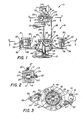
- platform structure 10 of equipment platform 13 supports operating equipment 11 such as a directional microwave antenna or radar apparatus.
- the equipment platform is defined herein as including all operating equipment mounted thereon.
- Operating equipment 11 is rotatably mounted on platform structure 10 and typically is slaved to follow the ship's gyro compass.
- Platform structure 10 itself is supported by the upper gimbal ring 19, which is pivotally mounted on the upper spider spindles 22 and 23.
- upper spider 20 is pivotally mounted on upper support spindles 15 and 16, which are supported by upper trunnions 17 and 18, which in turn are attached to the support structure 12.
- the axes of spindles 22 and 23 are shown to be co-linear and perpendicular to the co-linear axes of spindles 15 and 16. Both of these co-linear axes lie in the same plane.
- Gimbal brackets 24 and 25 attached to upper gimbal ring 19 support pivotally-mounted upper ball joints 26 and 27 with their pivotal centers lying respectively on spindle axes 22 and 23, and 15 and 16.
- Push-rods 28 and 29 are attached respectively to ball joints 26 and 27 at one end, and as shown in Figure 3, to lower ball joints 48 and 49 at their other end in order to connect the gimbal ring 19 to a gyroscopically controlled stabilizing assembly which is indicated by the reference 14 in Figure 1.
- Gimbal clips 50 and 51 support lower ball joints 48 and 49 and are themselves attached to lower gimbal ring 42 which is supported on lower spider spindles 56 and 57.
- Lower spider 43 supports spindles 56 and 57 and itself is pivotally supported by lower support spindles 44 and 45 which are supported by lower trunnions 46 and 47.
- the pivotal axis represented by spindles 56 and 57 is perpendicular to the pivotal axis represented by spindles 44 and 45. Both of these axes lie in the same plane.
- Lower trunnions 46 and 47 are mounted at another place on support structure 12 from that which supports upper trunnions 17 and 18.
- the axes represented by lower support spindles 44 and 45, and 56 and 57, are parallel respectively to the axes represented by upper support spindles 15 and 16, and 22 and 23.
- Azimuth bearings 40 and 41 are supported by lower gimbal ring 42 and themselves rotationally support gyro azimuth frame 39 on which are mounted gyro mounting frames 34 and 38.
- Gyro motor 30 and rotor 31 are pivotally supported on gyro pivot spindles 32 in gyro mounting frame 34.
- Gyro motor 35 and rotor 36 are pivotally supported on pivot spindles 37 in the gyro mounting frame 38.
- the pivot axis of gyro motor 30 is perpendicular to the pivotal axis of gyro motor 35. Although pivot spindles 32 are shown parallel to pivot spindles 56 and 57, these axes need not necessarily be oriented. Gyro motor with rotor 31 is statically balanced about pivot spindles 32; gyro motor 35 with rotor 36 is also statically balanced about pivot spindles 37.
- Gyro spring 59 is connected to eccentric extension 33 of spindle 32 at one end, and to spring clip 58 at its other end.
- Spring 60 is similarly connected between spindle 37 eccentric extension 55 and spring clip 61.
- Stabilized platform assembly 13 is statically balanced about the axis of spindles 15 and 16 and also about the axis of spindles 22 and 23.
- Stabilizing assembly 14 including push-rods 28 and 29 and ball joints 26, 48, 27, 49, is statically balanced about the axis of spindles 44 and 45 and also about the axis of the spindles 56 and 57.
- Gimbal springs 52 and 53 are connected between lower gimbal ring 42 and pendulum 62 so as to orient lower gimbal ring 42 with respect to gravity about the axis of spindles 44 and 45.
- the pendulum 62 is suspended from the supporting structure 12 by a pivot 63.
- Two other springs, not shown, are similarly connected to a second pendulum, not shown, to orient gimbal ring 42 about the axis of spindles 56 and 57 with respect to gravity.
- FIG 4 an embodiment of this invention is shown in which a single-axis stabilized platform is employed.
- Pivot axis spindles 15' are rotationally supported in trunnions 17' mounted on support structure 12'.
- Gyro motor 35' is statically balanced with respect to its support spindles 22' and 23' which are rotationally mounted in lower gimbal ring 42'.
- Ring 42' is supported on spindles 44' and 45' which in turn are supported in lower trunnions 46' and 47' as shown in Figure 5.
- Gyro pivot spring 60' is connected to eccentric extension 33' of spindle 23' at one end and at its other end to spring clip 58' which is attached to lower gimbal ring 42'.
- Gimbal springs 53' are connected between eccentric extension 21' of spindle 45' and tabs on pendulum 62'.
- the stabilized platform assembly 13' and the stabilizing assembly 14' including push-rod 28' and ball joints 26' and 48' are statically balanced about their respective support spindles 15' and 44' and 45', either individually or compositely.
- the trunnions 46" and 47" carry gimbal spindles 63" which pivotally support inner gimbal 73 which in turn pivotally supports outer gimbal ring 72 on spindles 75.
- Pendulum ring 69 is rigidly connected to outer gimbal ring 72 by means of struts 68. This overall arrangement provides pendulum ring 69 with pivotal freedom about two mutually perpendicular axes.
- Coil spring 70 rests in a groove in the upper surface of outer gimbal ring 72 at its lower end, and in a grooved ring 71 which is attached to lower gimbal ring 42" at its upper end. Excluding pendulum ring 69 with struts 68 and coil spring 70, stabilization assembly 14" is statically balanced about both orthogonal axes of spider 43". Thus the composite assembly comprised of stabilization assembly 14" and the stabilized platform assembly 13", not shown, including push-rods 28" and 29", is non-rigidily oriented with respect to gravity in two dimensions by pendulum ring 69 as a result of the coupling provided by coil spring 70.
- FIG 8 an embodiment of this invention is shown wherein the stabilized system is constructed as one integrated assembly.
- post 77 mounted on support structure 12" carries a universal joint consisting of loweryoke 80, upper yoke 82, and hidden internal cross 81.
- Yokes 80 and 82 pivot on the right-angled spindles of cross 81 so as to comprise a gimbal assembly.
- the upper extension of yoke 82 constitutes a stable platform on which operating equipment 11"' is mounted.
- the upper extension of yoke 82 also supports azimuth bearings 40'" and 41 "' which in turn rotationally support gyro frame 39"'.
- ' ' The entire assembly comprised of upper yoke 82, operating equipment 11 "', and gyro frame 39'" including all components attached thereto, is statically balanced about the two orthogonal axes of internal cross 81.
- Gyro frame 39'" is provided with two gyro assemblies comparable to those shown in Figures 1 and 6.
- Cable clips 67 attached at diametrically opposite positions on upper yoke 82, rigidly support pendulum cables 66 at their upper ends. At their lower ends pendulum cables 66 are pivotally connected to clips on pendulum ring 69' in the plane of Figure 8, but are rigidly connected to pendulum ring 69' in the plane shown in Figure 9. Thus the steady-state, or average, orientation of pendulum ring 69' is imparted symmetrically and with equal coupling stiffness in two orthogonal planes to upper yoke 82.
- pendulum cable 66 is shown to be comprised of an inner flexible core 64, such as a multi-strand steel cable, and an outer cover consisting of a closely wound coil spring case 65.
- the annular space between core 64 and case 65 is filled with a viscous medium, such as a petroleum grease. Relative motion between core 64 and case 65 which occurs whenever pendulum cable 66 flexes creates shearing displacements throughout the viscous medium which thereby absorb a portion of the energy causing cable flexure in the first place.
- FIG 11 an embodiment of this invention is shown wherein the reference orienting effect of pendulum ring 469 is complimented and modified by the reference orienting effect of coil spring 470.
- Coil spring 470 may be constructed so as to possess pre-selected non-linear stiffness-versus-deflection characteristics. The advantages of such construction are discussed below.
- gyro motors 30 and 35 drive their respective rotors 31 and 36 in opposite directions at some nominal design speed, typically in the range of 600 to 6,000 rpm.
- the two motors need not operate at the same speed.
- the system will find and maintain the orientations indicated in Figure 1.
- gyro azimuth frame 39 is essentially unrestrained in azimuth and hence is free to take any azimuth orientation.
- gyro frame 39 initially is in the position shown in Figures 1 and 3.
- gyro azimuth frame 39 When support structure 12 rotates about a vertical axis, comparable to a ship's turning motion in azimuth, gyro azimuth frame 39 will tend to remain static in its initial position as a consequence of its mass moment of inertia. If support structure 12 now rolls as this new azimuth position any disturbing torsional impulses induced by springs 52 and 53 from pendulum 62 will be resisted by precession motions of both gyro motor with rotor 31 and gyro motor 35 with rotor 36 as each assembly reacts to its components of the disturbing torsional impulses..
- This graceful re-stabilization characteristic of the present invention is markedly different from the re-stabilization behavior of rigidly pendulous mechanically stabilized systems which, after once having been tumbled will continue to be destabilized until, by fortuitous circumstances, the angular motion limits and the integrated disturbing impulse correcting capacity of the gyros are not exceeded over one complete oscillating cycle of the ship.
- the aforesaid fortuitous circumstances typically will occur for rigidly pendulous systems within ten to one hundred oscillating cycles of support structure 12, depending on how closely the total motion amplitude of support structure 12 approaches the useful operating range of the stabilized platform system.
- the embodiment shown in Figure 4 does not have immunity to azimuth motions of the support structure as is provided by the embodiment shown in Figure 1. This embodiment is therefore most useful in those applications which have negligibly small motions about one axis, e.g. pitch,' and which also experience only slow yaw/ turning rates. This situation exists for very large crude oil carrying ships.
- horizontal accelerations acting on the auxiliary pendulum 469 in Figure 11 can be represented by trigonometric expressions, as proposed in US-A-1,083,370-Luyken, for example. Further, approximations to such trigonometric expressions, but of the opposite sense, can be obtained for the force versus deflection relationship of coil spring 470 by winding it, for example, to have both taper and nonuniform coil spacing.
- the embodiment shown in Figure 11 allows significant reductions in the error causing effects of the reference orienting pendulum under operating conditions involving appreciable ship motions having attendant appreciable horizontal accelerations.
- a stabilized platform system may include a statically balanced, integral-type unit in which the gyro azimuth frame 39 is rigidly attached to lower gimbal ring 42 rather than mounted on its own azimuth bearings 40 and 41.
- damping means caging means, or power transmission means such as slip rings or rotary air gap transformer would not change the basic character of the stabilized platform system.
Landscapes
- Engineering & Computer Science (AREA)
- General Engineering & Computer Science (AREA)
- Mechanical Engineering (AREA)
- Vibration Prevention Devices (AREA)
- Details Of Measuring And Other Instruments (AREA)
Claims (17)
Applications Claiming Priority (2)
| Application Number | Priority Date | Filing Date | Title |
|---|---|---|---|
| US25845981A | 1981-04-28 | 1981-04-28 | |
| US258459 | 1981-04-28 |
Related Child Applications (1)
| Application Number | Title | Priority Date | Filing Date |
|---|---|---|---|
| EP85103829.9 Division-Into | 1985-03-29 |
Publications (3)
| Publication Number | Publication Date |
|---|---|
| EP0077378A1 EP0077378A1 (de) | 1983-04-27 |
| EP0077378A4 EP0077378A4 (de) | 1983-09-02 |
| EP0077378B1 true EP0077378B1 (de) | 1986-12-03 |
Family
ID=22980634
Family Applications (1)
| Application Number | Title | Priority Date | Filing Date |
|---|---|---|---|
| EP82901681A Expired EP0077378B1 (de) | 1981-04-28 | 1982-04-19 | Mechanisch stabilisiertes plattform-system |
Country Status (5)
| Country | Link |
|---|---|
| EP (1) | EP0077378B1 (de) |
| JP (1) | JPS58500728A (de) |
| DE (1) | DE3274574D1 (de) |
| NO (1) | NO824341L (de) |
| WO (1) | WO1982003903A1 (de) |
Families Citing this family (2)
| Publication number | Priority date | Publication date | Assignee | Title |
|---|---|---|---|---|
| FR2930615B1 (fr) * | 2008-04-28 | 2012-12-28 | Peugeot Citroen Automobiles Sa | Dispositif gyroscopique antivibratoire et vehicule automobile utilisant le dispositif |
| CN102568615B (zh) * | 2011-12-13 | 2013-05-22 | 华中科技大学 | 一种小型精密调平装置 |
Citations (3)
| Publication number | Priority date | Publication date | Assignee | Title |
|---|---|---|---|---|
| US2199294A (en) * | 1935-05-04 | 1940-04-30 | Anschuetz & Co Gmbh | Gyroscopic instrument |
| US4020491A (en) * | 1974-10-07 | 1977-04-26 | B E Industries | Combination gyro and pendulum weight passive antenna platform stabilization system |
| EP0026626A2 (de) * | 1979-09-24 | 1981-04-08 | UNITED STATES GOVERNMENT, as represented by THE NATIONAL AERONAUTICS AND SPACE ADMINISTRATION | Autonomes Navigationssystem |
Family Cites Families (11)
| Publication number | Priority date | Publication date | Assignee | Title |
|---|---|---|---|---|
| GB821138A (de) * | 1900-01-01 | |||
| FR455120A (fr) * | 1913-02-12 | 1913-07-23 | Elmer Ambrose Sperry | Perfectionnements relatifs aux appareils gyroscopiques |
| GB191500565A (en) * | 1915-01-13 | 1915-11-18 | John Perry | Improvements in or relating to Gyro-compasses. |
| GB460244A (en) * | 1935-07-25 | 1937-01-25 | Arthur Lionel Rawlings | Improvements in gyroscopic compasses |
| US2302894A (en) * | 1940-08-13 | 1942-11-24 | Ford Instr Co Inc | Gyroscopic compass |
| US2539772A (en) * | 1945-10-20 | 1951-01-30 | Raytheon Mfg Co | Position stabilizing device |
| GB612832A (en) * | 1946-02-01 | 1948-11-18 | Arthur Tisso Starr | Improvements in or relating to radio echo systems |
| US3163039A (en) * | 1960-12-19 | 1964-12-29 | North American Aviation Inc | Inertial navigator platform |
| US3296621A (en) * | 1963-10-11 | 1967-01-03 | Roger H Lapp | Torsionally decoupled antenna support |
| NO120353B (de) * | 1968-05-02 | 1970-10-05 | Simonsen & Mustad As | |
| US3614895A (en) * | 1969-06-26 | 1971-10-26 | Bendix Corp | Gyro platform erection system |
-
1982
- 1982-04-19 JP JP57501663A patent/JPS58500728A/ja active Pending
- 1982-04-19 EP EP82901681A patent/EP0077378B1/de not_active Expired
- 1982-04-19 WO PCT/US1982/000485 patent/WO1982003903A1/en not_active Ceased
- 1982-04-19 DE DE8282901681T patent/DE3274574D1/de not_active Expired
- 1982-12-22 NO NO824341A patent/NO824341L/no unknown
Patent Citations (3)
| Publication number | Priority date | Publication date | Assignee | Title |
|---|---|---|---|---|
| US2199294A (en) * | 1935-05-04 | 1940-04-30 | Anschuetz & Co Gmbh | Gyroscopic instrument |
| US4020491A (en) * | 1974-10-07 | 1977-04-26 | B E Industries | Combination gyro and pendulum weight passive antenna platform stabilization system |
| EP0026626A2 (de) * | 1979-09-24 | 1981-04-08 | UNITED STATES GOVERNMENT, as represented by THE NATIONAL AERONAUTICS AND SPACE ADMINISTRATION | Autonomes Navigationssystem |
Also Published As
| Publication number | Publication date |
|---|---|
| EP0077378A4 (de) | 1983-09-02 |
| DE3274574D1 (en) | 1987-01-15 |
| WO1982003903A1 (en) | 1982-11-11 |
| NO824341L (no) | 1982-12-22 |
| JPS58500728A (ja) | 1983-05-06 |
| EP0077378A1 (de) | 1983-04-27 |
Similar Documents
| Publication | Publication Date | Title |
|---|---|---|
| US4582291A (en) | Mechanically stabilized platform system | |
| US5897223A (en) | Stabilized platform system for camera | |
| US4020491A (en) | Combination gyro and pendulum weight passive antenna platform stabilization system | |
| US4596989A (en) | Stabilized antenna system having an acceleration displaceable mass | |
| US5396815A (en) | Suspension system for gimbal supported scanning payloads | |
| US4082005A (en) | Spin coupled, angular rate sensitive inertial sensors with mounting structure and method of fabricating and mounting same | |
| US4242917A (en) | Isolation flexure for gyroscopes | |
| US4472978A (en) | Stabilized gyrocompass | |
| US3529477A (en) | Gyroscopic rotor suspension | |
| US4920349A (en) | Antenna mounting with passive stabilization | |
| US4838099A (en) | Gyrocompass | |
| JP3030788B2 (ja) | ジャイロコンパス | |
| EP0077378A4 (de) | Mechanisch stabilisiertes plattform-system. | |
| US4126046A (en) | Twice spin frequency rotating filter | |
| US2534963A (en) | Nutation damper for gyroscopes | |
| CA1083389A (en) | Gyroscopic instrument comprising stabilizing and control gyros mounted on a common shaft | |
| CN111879321A (zh) | 一种基于机抖激光陀螺的惯性/天文组合导航系统 | |
| JPS607202A (ja) | スタビライザ装置 | |
| US3762062A (en) | Twin gyro north seeker | |
| RU2052369C1 (ru) | Устройство стабилизации углового движения космического аппарата | |
| US4266431A (en) | Gyroscopic apparatus | |
| US3739480A (en) | Gyro compassing apparatus and method | |
| US3318161A (en) | Control system for gyro-verticals | |
| RU176980U1 (ru) | Двухроторный гиростабилизатор | |
| JPS6148085B2 (de) |
Legal Events
| Date | Code | Title | Description |
|---|---|---|---|
| PUAI | Public reference made under article 153(3) epc to a published international application that has entered the european phase |
Free format text: ORIGINAL CODE: 0009012 |
|
| AK | Designated contracting states |
Designated state(s): DE FR GB NL |
|
| 17P | Request for examination filed |
Effective date: 19830502 |
|
| GRAA | (expected) grant |
Free format text: ORIGINAL CODE: 0009210 |
|
| AK | Designated contracting states |
Kind code of ref document: B1 Designated state(s): DE FR GB NL |
|
| PG25 | Lapsed in a contracting state [announced via postgrant information from national office to epo] |
Ref country code: NL Effective date: 19861203 Ref country code: FR Free format text: THE PATENT HAS BEEN ANNULLED BY A DECISION OF A NATIONAL AUTHORITY Effective date: 19861203 |
|
| REF | Corresponds to: |
Ref document number: 3274574 Country of ref document: DE Date of ref document: 19870115 |
|
| EN | Fr: translation not filed | ||
| NLV1 | Nl: lapsed or annulled due to failure to fulfill the requirements of art. 29p and 29m of the patents act | ||
| PLBE | No opposition filed within time limit |
Free format text: ORIGINAL CODE: 0009261 |
|
| STAA | Information on the status of an ep patent application or granted ep patent |
Free format text: STATUS: NO OPPOSITION FILED WITHIN TIME LIMIT |
|
| 26N | No opposition filed | ||
| GBPC | Gb: european patent ceased through non-payment of renewal fee | ||
| PG25 | Lapsed in a contracting state [announced via postgrant information from national office to epo] |
Ref country code: GB Effective date: 19881121 |
|
| PGFP | Annual fee paid to national office [announced via postgrant information from national office to epo] |
Ref country code: DE Payment date: 19920519 Year of fee payment: 11 |
|
| PG25 | Lapsed in a contracting state [announced via postgrant information from national office to epo] |
Ref country code: DE Effective date: 19940101 |