EP0077580A2 - Einrichtung zur Gewinnung von für Nahrungszwecke geeignetem Blut in einem Schlachthaus - Google Patents
Einrichtung zur Gewinnung von für Nahrungszwecke geeignetem Blut in einem Schlachthaus Download PDFInfo
- Publication number
- EP0077580A2 EP0077580A2 EP82201206A EP82201206A EP0077580A2 EP 0077580 A2 EP0077580 A2 EP 0077580A2 EP 82201206 A EP82201206 A EP 82201206A EP 82201206 A EP82201206 A EP 82201206A EP 0077580 A2 EP0077580 A2 EP 0077580A2
- Authority
- EP
- European Patent Office
- Prior art keywords
- blood
- animals
- circuit
- installation according
- outlet
- Prior art date
- Legal status (The legal status is an assumption and is not a legal conclusion. Google has not performed a legal analysis and makes no representation as to the accuracy of the status listed.)
- Granted
Links
Images


Classifications
-
- A—HUMAN NECESSITIES
- A22—BUTCHERING; MEAT TREATMENT; PROCESSING POULTRY OR FISH
- A22B—SLAUGHTERING
- A22B5/00—Accessories for use during or after slaughtering
- A22B5/04—Blood-collecting apparatus; Blood-stirring devices
Definitions
- the invention relates to an installation for recovering food-grade blood in a slaughterhouse; by "food grade blood” or by the abbreviation “edible blood” is meant blood from healthy animals and having qualities of sterility and hygienic cleanliness making its components capable of being used as additives in the most demanding applications, in particular, as additives incorporated into a food product intended for animals or humans (it is understood that the term “food quality” qualifies blood as such and has no limiting character as regards possible applications of it).
- blood is a rich product, which contains in particular a noble protein (globin) of a nature to enrich in an extremely interesting way many food products for humans or animals) or capable of 'be used in other applications because of its interesting technological properties (foaming and emulsifying power).
- a noble protein globin
- the invention proposes to provide an installation making it possible to recover the blood produced in slaughterhouses and to store its components (in particular cruor and plasma), under conditions compatible with subsequent use as food additives or with any other application requiring analogous qualities called nutritional quality
- Another objective of the invention is to considerably reduce the quantities of rendering blood flowing into slaughterhouses by the collection means provided for this purpose.
- the counting means comprise a pulse counter, called the entry counter, located at the entrance to the bleed passage, and a pulse counter called the exit counter, located downstream of the circuit. butchering at the veterinary checkpoint.
- Each primary tank has a capacity for storing blood from a predetermined number (N) of animals, and the number of tanks is adapted to allow temporary storage of a quantity of blood greater than that which would be provided by the number maximum number of animals likely to be present at any given time on the chain (from the entrance to the bleeding corridor to the veterinary checkpoint).
- the control unit which can be a programmable automaton is adapted to control (in the absence of intervention from the veterinarian) the progress of the following normal cycle: referral of blood to another primary tank at the end of each batch of N animals registered by the entry counter, and emptying towards the alimentary blood circuit of the tank containing the blood of the last batch of N animals registered at the exit counter.
- this unit controls the stopping of the trans carrier in the bleeding corridor and selects the primary tank which contained the blood of the consigned animal as well as possibly the following tanks. This or these tanks are then emptied towards the rendering blood collection means in order to avoid pollution of the food blood already collected.
- the blood of a given beast is not. never transferred to the food blood circuit before the time when it passes to veterinary control thanks to the provisional storage provided in the primary tanks: the installation in accordance with the invention thus makes it possible in all cases to avoid polluting food blood already transferred by the blood of a sick beast.
- the receiving chute, the conduits and the primary tank (s) which have been in contact with the polluted blood are subject to cleaning by means of cleaning liquids which are evacuated to the sewer.
- the receiving chute allows the blood to be collected at the same time that it springs from the animal under appropriate conditions of cleanliness and sterility.
- this chute is preferably associated with ventilation and filtration means, adapted to maintain the interior thereof in slight overpressure in sterilized air.
- this chute is also associated with means for injecting one or more additives into the collected blood, in particular anti-coagulant and / or preservative products. This avoids any alteration or coagulation of the blood in the installation, and its components (cruor and plasma) can be obtained and stored without denaturation or disappearance of their food quality.
- said chute is made with inclined guide cheeks situated on either side of the slot of collection, so as to guide the beast in the vicinity of the bled part thereof: the blood gushing from this part penetrates directly through the slit of re harvest without external contact and to the exclusion of all other bodies.
- the shape and the inclination of these guide cheeks are adapted to the physical characteristics of the animals to be bled; As will be seen below, two types of troughs can be provided, one for the recovery of the blood of calves or animals with anal physical characteristics - large gues, the other for the recovery of the blood of large bovines or d animals with similar physical characteristics.
- the installation according to the invention can combine means specifically adapted to calves, equipping one or more working chains of the slaughterhouse and means specifically adapted to large cattle, equipping one or more other chains.
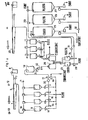
- the installation shown by way of example in FIG. 1 comprises specific means for recovering the blood of food-grade calves, specific means for recovering the blood of large bovine animals of the same quality and common means for storing cruor and plasma from this blood of calves or oxen; this facility is called upon to equip a traditional type slaughterhouse with (at least) two production lines, consisting of each with a slaughterhouse, a bleeding corridor, a butchering circuit and channels for collecting rendering blood.
- the part of the installation intended for the collection of blood from bled animals comprises a blood receiving chute 1 or 33 arranged in each bleeding lane.
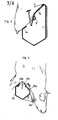
- the chute 1 that can be seen in Figures 2 and 3 is intended for calves and comprises, on its upper face, two cheeks la and lb inclined in the same direction and situated on either side of a collection slot lc .
- the cheek is inclined at about 45 ° for guiding the calf of the muzzle as shown in fi g ures, while the cheek lb has an upper portion having a similar inclination and a lower part of greater inclination ; this cheek 1b thus ensures the guidance of the calf's head at the sound level: the calf's head is slightly inclined as shown in Figures 2 and 3 which allows direct flow of blood through the slit lc.
- the chute 1 is supported by supports 2 above the bottom of the corridor which is conventionally provided with a grating surmounting a channel (made by a concrete form) for the collection of rendering blood.
- the chute 1 extends over the length of the bleeding corridor (which can be of the order of 3 meters) and its bottom ld is inclined towards one end to allow the flow of blood; in the example, this inclination is directed upstream, that is to say towards the entrance to the corridor where the calves arrive.
- the chute 1 comprises a ramp 3 for spraying an additive in liquid form, such as an anticoagulant and preservative additive.
- an additive in liquid form such as an anticoagulant and preservative additive.
- This ramp 3 which extends over the entire length of said chute makes it possible to intimately mix this additive with the blood, practically at the instant when it springs from the animal.
- the bleeding corridor is equipped, above the chute 1 and on either side thereof, with plates 4 and 5 of posi calving, which extend along the corridor and are arranged as shown in Figure 2 so as to maintain the body of the calf in a slightly offset position relative to the vertical, front legs directed towards the rear.
- the plate 5 is slightly further apart from the chute than the other plate 4 and descends lower than the latter.
- the calf attached by one or more rear legs to a conveyor hook 6 which allows it to be moved slowly along a rail in the bleeding corridor, has approximately the position shown in FIG. 2.
- the speed of progression can be of the order of 1 meter per minute.
- a pulse counter symbolized at 12 in Figure 1
- this classic counter in itself can be electromechanical (rod pushed back by the calves) or optical.
- Another counter symbolized in 13 is placed at the outlet of the chain downstream from the butchering circuit, at a veterinary control post where the animals are examined.
- the chute 1 is associated with a fan 7 equipped with filtering means and air sterilization means (for example / or sterile laminar flow / battery of ultra-violet lamps, which allow send clean and sterile air into said chute, putting it in slight internal overpressure.
- filtering means and air sterilization means for example / or sterile laminar flow / battery of ultra-violet lamps, which allow send clean and sterile air into said chute, putting it in slight internal overpressure.
- the spray bar 3 is connected to an additive injection assembly 8, composed of a reservoir and a metering pump making it possible to adjust the flow of additive delivered to said boom.
- the receiving chute 1 is connected to primary tanks such as 9, by means of blood flow switching means constituted in the example by a series of valves, 3 ways, 2 directions such as 10 ; a drain valve 11 is provided at the end of line to allow washing.
- these primary tanks can be 4 in number and each have a capacity slightly greater than the volume of blood supplied by 10 animals (70 liters).
- the bleeding and butchering time of each calf being approximately 20 minutes (duration separating the passage to the entry counter and the passage to the exit counter) and assuming that the average rate of the chain is 60 calves at the hour and its maximum rate of 90 calves per hour (usual performance of a current chain), the maximum number of calves present simultaneously on the chain is 30, so that the primary tanks 9 allow temporary storage guaranteeing that the blood of an animal has not yet been transferred downstream of the installation when this animal passes to the veterinary checkpoint.
- the primary tanks 9 are connected at their outlet to drainage circuits and referral means which allow either to transfer the food-grade blood downstream of the installation (normal cycle), or to evacuate one or more tanks to the means of collecting rendering blood (in the event of an animal disease, found at the checkpoint), or again for washing, to evacuate cleaning fluids in the drain
- the outlet for edible blood from the valve 17 is connected to a tank, called a buffer 19, which has sufficient capacity to continuously supply a centrifuge 20 located downstream thereof.
- a tank called a buffer 19
- the capacity of the tank 19 can be of the order of 600 liters which in practice guarantees a continuous supply of the centrifuge.
- the buffer tank 19 is connected at its outlet to two drainage circuits, one for the transfer of edible blood to the centrifuge, the other for the evacuation of the washing liquids to the sewer; these circuits are provided with liquid switching means.
- a switching valve 21 and an isolation valve 22 are provided as above.
- the centrifuge 20 of the conventional type is suitable for fractionating blood into cruor and plasma and delivers these bodies to storage means.
- the latter include cruor and plasma buffer tanks 23 and 24 and final storage tanks 25, 26 and 27 of greater capacity, connected to the buffer tanks.
- the quantities of plasma extracted from the blood being approximately twice as large as the quantities of cruor, two plasma tanks of 10,000 liters each can be provided for a single tank of cruor of the same capacity.
- Diverter and isolation valves such as 28 and 29 are associated with the pipes to allow either to transfer the cruor or the plasma to the final storage tanks, or to perform a washing operation with discharge of liquids into the sewer.
- the part of the installation intended for sheep is similar to that described above and is connected to the latter at the level of the storage means 23, 24, at the outlet of the centrifuges.
- this part intended for large cattle does not include buffer tanks (such as 3.9) because of the lower rates of the chain for this type of animal (25 to 30 per hour): the primary tanks in number of 3 with a capacity of approximately 110 liters each (7 to 8 cattle) are sufficient to ensure a continuous supply of the centrifuge, while ensuring that the blood of an animal will not be transferred to it until the veterinary control of the animal will have been carried out (the passage time of a bovine between the entry counter and the exit counter is approximately 30 to 35 minutes).
- the blood receiving chute 33 is slightly different for large cattle.
- the bleeding corridor does not have positioning plates and the chute 33 comprises, on its upper face, two cheeks 33a and 33b located on either side of the collection slot 33c and inclined at opposite direction in inverted V, so as to guide the animal's neck on one side and the latter's legs on the other.
- the beef is then positioned, as shown in Figure 4, arranged at 90 ° to the direction of advancement, the head passing on one side of the chute and the legs on the other.
- the chute is provided, on the side of the cheek 33a called to guide the neck of the animal, with an external guide 34 adapted to spread the head of the animal.
- the bleeding which is carried out for these animals at the base of the neck almost at the level of the chest thus delivers blood directly into the chute with negligible losses towards the outside and without risk of pollution.
- the normal operating cycle of the installation consists in counting the animals in batches corresponding to the capacity of a primary tank and to direct, after the bleeding of the last animals of each batch, the flow of blood towards the primary tank which succeeds that which has just been filled by the previous batch; in the absence of intervention by the veterinarian on a cycle stop device (symbolized in 36 which is found if killed at the control post, the control unit controls the emptying to the food blood circuit of the tank containing the blood of the animals from the last batch checked.
- visibly sick animals are preferably selected before slaughter to be the subject of a special procedure. This can significantly reduce the amount of blood sent to rendering.
- the veterinarian can take the decision to empty only the tank which contains the blood of the sick animal towards rendering, considering then that the passage of this blood in the chute and the ducts did not contaminate these elements enough to make the blood of the following animals unsuitable.
- washing cycles can be executed manually by delivering the various washing liquids into the installation, after having arranged the various circuits in the evacuation position towards the sewer.
- automatic washing means essentially comprising: storage tanks for cold water, hot water, detergents and rinsing products, a distribution network for these liquids to the various elements of the installation and a control unit allowing the injection of said liquids and their rejection in the sewer according to a programmed cycle.
Landscapes
- General Health & Medical Sciences (AREA)
- Hematology (AREA)
- Life Sciences & Earth Sciences (AREA)
- Engineering & Computer Science (AREA)
- Food Science & Technology (AREA)
- Health & Medical Sciences (AREA)
- Storage Of Fruits Or Vegetables (AREA)
- Feeding And Watering For Cattle Raising And Animal Husbandry (AREA)
- Processing Of Meat And Fish (AREA)
- Housing For Livestock And Birds (AREA)
- Catching Or Destruction (AREA)
- Apparatus For Disinfection Or Sterilisation (AREA)
- Investigating Or Analysing Biological Materials (AREA)
- Freezing, Cooling And Drying Of Foods (AREA)
Priority Applications (1)
| Application Number | Priority Date | Filing Date | Title |
|---|---|---|---|
| AT82201206T ATE32648T1 (de) | 1981-10-15 | 1982-09-28 | Einrichtung zur gewinnung von fuer nahrungszwecke geeignetem blut in einem schlachthaus. |
Applications Claiming Priority (2)
| Application Number | Priority Date | Filing Date | Title |
|---|---|---|---|
| FR8119571 | 1981-10-15 | ||
| FR8119571A FR2514613B1 (fr) | 1981-10-15 | 1981-10-15 | Installation pour la recuperation de sang de qualite alimentaire dans un abattoir |
Publications (3)
| Publication Number | Publication Date |
|---|---|
| EP0077580A2 true EP0077580A2 (de) | 1983-04-27 |
| EP0077580A3 EP0077580A3 (en) | 1985-08-28 |
| EP0077580B1 EP0077580B1 (de) | 1988-03-02 |
Family
ID=9263147
Family Applications (1)
| Application Number | Title | Priority Date | Filing Date |
|---|---|---|---|
| EP82201206A Expired EP0077580B1 (de) | 1981-10-15 | 1982-09-28 | Einrichtung zur Gewinnung von für Nahrungszwecke geeignetem Blut in einem Schlachthaus |
Country Status (6)
| Country | Link |
|---|---|
| EP (1) | EP0077580B1 (de) |
| AT (1) | ATE32648T1 (de) |
| DE (1) | DE3278150D1 (de) |
| DK (1) | DK456282A (de) |
| ES (1) | ES8306004A1 (de) |
| FR (1) | FR2514613B1 (de) |
Cited By (3)
| Publication number | Priority date | Publication date | Assignee | Title |
|---|---|---|---|---|
| FR2542574A1 (fr) * | 1983-03-14 | 1984-09-21 | Orszagos Husipari Kutatointeze | Procede et dispositif de prelevement et collecte hygienique de sang animal |
| NL1004542C2 (nl) * | 1996-11-15 | 1998-05-18 | Harimex Bv | Inrichting en werkwijze voor het opvangen van bloed bij het slachten van dieren. |
| WO2001008501A1 (fr) * | 1999-08-02 | 2001-02-08 | Bruno Thuilliez | Procede et dispositif de collecte de sang sans coagulation notamment de sang de volailles dans une chaîne d'abattage |
Families Citing this family (2)
| Publication number | Priority date | Publication date | Assignee | Title |
|---|---|---|---|---|
| ES2220190B1 (es) * | 2002-08-28 | 2005-08-16 | Apc Europe S.A. | Pica de deguello y utilizaciones correspondientes. |
| US10021885B2 (en) * | 2016-09-02 | 2018-07-17 | Mpsc, Inc. | Meat processing |
Family Cites Families (1)
| Publication number | Priority date | Publication date | Assignee | Title |
|---|---|---|---|---|
| US2422194A (en) * | 1943-01-20 | 1947-06-17 | Armour & Co | Method and apparatus for collection and treatment of blood |
-
1981
- 1981-10-15 FR FR8119571A patent/FR2514613B1/fr not_active Expired
-
1982
- 1982-09-28 AT AT82201206T patent/ATE32648T1/de not_active IP Right Cessation
- 1982-09-28 EP EP82201206A patent/EP0077580B1/de not_active Expired
- 1982-09-28 DE DE8282201206T patent/DE3278150D1/de not_active Expired
- 1982-10-11 ES ES516402A patent/ES8306004A1/es not_active Expired
- 1982-10-14 DK DK456282A patent/DK456282A/da not_active Application Discontinuation
Cited By (5)
| Publication number | Priority date | Publication date | Assignee | Title |
|---|---|---|---|---|
| FR2542574A1 (fr) * | 1983-03-14 | 1984-09-21 | Orszagos Husipari Kutatointeze | Procede et dispositif de prelevement et collecte hygienique de sang animal |
| NL1004542C2 (nl) * | 1996-11-15 | 1998-05-18 | Harimex Bv | Inrichting en werkwijze voor het opvangen van bloed bij het slachten van dieren. |
| EP0843969A1 (de) * | 1996-11-15 | 1998-05-27 | Harimex B.V. | Vorrichtung und Verfahren zur Blutsammlung beim Schlachten von Tieren |
| WO2001008501A1 (fr) * | 1999-08-02 | 2001-02-08 | Bruno Thuilliez | Procede et dispositif de collecte de sang sans coagulation notamment de sang de volailles dans une chaîne d'abattage |
| FR2798559A1 (fr) * | 1999-08-02 | 2001-03-23 | Bruno Thuilliez | Procede et dispositif de collecte de sang sans coagulation notamment de sang de volailles dans une chaine d'abattage |
Also Published As
| Publication number | Publication date |
|---|---|
| DE3278150D1 (en) | 1988-04-07 |
| DK456282A (da) | 1983-04-16 |
| FR2514613A1 (fr) | 1983-04-22 |
| ES516402A0 (es) | 1983-06-01 |
| EP0077580B1 (de) | 1988-03-02 |
| ES8306004A1 (es) | 1983-06-01 |
| FR2514613B1 (fr) | 1986-09-26 |
| EP0077580A3 (en) | 1985-08-28 |
| ATE32648T1 (de) | 1988-03-15 |
Similar Documents
| Publication | Publication Date | Title |
|---|---|---|
| EP0494031B1 (de) | Flüssigkeitsverteilungvorrichtung für ein Apparat zum Reinigen, Desinfizieren und Schmieren zahnärtzlicher Handstücke | |
| US2081947A (en) | Dairy plant | |
| NL1035972C (nl) | Inrichting voor het melken van dieren. | |
| EP0077580B1 (de) | Einrichtung zur Gewinnung von für Nahrungszwecke geeignetem Blut in einem Schlachthaus | |
| FR2494558A1 (fr) | Installation mobile pour la stabulation en groupes et le traitement d'animaux domestiques, en particulier de vaches laitieres | |
| US3629005A (en) | Milking unit sanitizer | |
| NO134695B (de) | ||
| WO2004032608A1 (en) | A milking plant | |
| SE514927C2 (sv) | Metod och anordning för rengöring av en mjölkningsanläggning | |
| CN209047001U (zh) | 一种魔芋种芋消毒装置 | |
| FR2542574A1 (fr) | Procede et dispositif de prelevement et collecte hygienique de sang animal | |
| US4616381A (en) | Ova harvesting system | |
| US3699923A (en) | Milking system | |
| EP1285582B1 (de) | Anlage und Verfahren zur Abnahme und Gewinning von Tierblut | |
| CN215380726U (zh) | 一种用于屠宰场杀猪的清洗装置 | |
| US3099277A (en) | Flushing apparatus for milking systems | |
| EP0506644B1 (de) | Vorrichtung zur Nassfutterdosierung für Tiere, insbesondere für Ferkel | |
| US2389630A (en) | Worktable for handling eggs | |
| US2451075A (en) | Milk receiver for automatic milking systems | |
| FR3077467A1 (fr) | Machine de traite mecanisee comprenant un dispositif d'injection d'un produit de rincage de la conduite d'acheminement du lait vers le tank a lait | |
| EP0988785B1 (de) | Fütterungsvorrichtung zur Verteilung von Futter, insbesondere von Flüssigfutter für Tiere wie Kälber | |
| WO2000053071A1 (fr) | Lave-mains autonome et ambulant pour un usage repetitif en milieu medical | |
| FR2480564A1 (fr) | Methode et installation pour l'allaitement artificiel de veaux eleves dans des boxes a poste fixe | |
| EP0313112A2 (de) | Behälter zum Verfestigen von Mozzarella und ähnlichen Pasta-Filata-Frischkäsen | |
| US3695231A (en) | Milking system |
Legal Events
| Date | Code | Title | Description |
|---|---|---|---|
| PUAI | Public reference made under article 153(3) epc to a published international application that has entered the european phase |
Free format text: ORIGINAL CODE: 0009012 |
|
| AK | Designated contracting states |
Designated state(s): AT BE CH DE GB IT LI LU NL SE |
|
| PUAL | Search report despatched |
Free format text: ORIGINAL CODE: 0009013 |
|
| AK | Designated contracting states |
Designated state(s): AT BE CH DE GB IT LI LU NL SE |
|
| 17P | Request for examination filed |
Effective date: 19860103 |
|
| 17Q | First examination report despatched |
Effective date: 19861117 |
|
| GRAA | (expected) grant |
Free format text: ORIGINAL CODE: 0009210 |
|
| AK | Designated contracting states |
Kind code of ref document: B1 Designated state(s): AT BE CH DE GB IT LI LU NL SE |
|
| PG25 | Lapsed in a contracting state [announced via postgrant information from national office to epo] |
Ref country code: NL Effective date: 19880302 Ref country code: IT Free format text: LAPSE BECAUSE OF FAILURE TO SUBMIT A TRANSLATION OF THE DESCRIPTION OR TO PAY THE FEE WITHIN THE PRESCRIBED TIME-LIMIT;WARNING: LAPSES OF ITALIAN PATENTS WITH EFFECTIVE DATE BEFORE 2007 MAY HAVE OCCURRED AT ANY TIME BEFORE 2007. THE CORRECT EFFECTIVE DATE MAY BE DIFFERENT FROM THE ONE RECORDED. Effective date: 19880302 Ref country code: AT Effective date: 19880302 |
|
| REF | Corresponds to: |
Ref document number: 32648 Country of ref document: AT Date of ref document: 19880315 Kind code of ref document: T |
|
| PG25 | Lapsed in a contracting state [announced via postgrant information from national office to epo] |
Ref country code: SE Effective date: 19880331 |
|
| REF | Corresponds to: |
Ref document number: 3278150 Country of ref document: DE Date of ref document: 19880407 |
|
| NLV1 | Nl: lapsed or annulled due to failure to fulfill the requirements of art. 29p and 29m of the patents act | ||
| GBV | Gb: ep patent (uk) treated as always having been void in accordance with gb section 77(7)/1977 [no translation filed] | ||
| PG25 | Lapsed in a contracting state [announced via postgrant information from national office to epo] |
Ref country code: LU Free format text: LAPSE BECAUSE OF NON-PAYMENT OF DUE FEES Effective date: 19880930 Ref country code: LI Effective date: 19880930 Ref country code: CH Effective date: 19880930 Ref country code: BE Effective date: 19880930 |
|
| PG25 | Lapsed in a contracting state [announced via postgrant information from national office to epo] |
Ref country code: GB Free format text: LAPSE BECAUSE OF NON-PAYMENT OF DUE FEES Effective date: 19881121 |
|
| PLBE | No opposition filed within time limit |
Free format text: ORIGINAL CODE: 0009261 |
|
| STAA | Information on the status of an ep patent application or granted ep patent |
Free format text: STATUS: NO OPPOSITION FILED WITHIN TIME LIMIT |
|
| 26N | No opposition filed | ||
| BERE | Be: lapsed |
Owner name: SOMMIER RENE Effective date: 19880930 |
|
| REG | Reference to a national code |
Ref country code: CH Ref legal event code: PL |
|
| PG25 | Lapsed in a contracting state [announced via postgrant information from national office to epo] |
Ref country code: DE Effective date: 19890601 |