EP0077602A2 - Appareil mécanique pour la décharge d'un agent extincteur - Google Patents
Appareil mécanique pour la décharge d'un agent extincteur Download PDFInfo
- Publication number
- EP0077602A2 EP0077602A2 EP82303503A EP82303503A EP0077602A2 EP 0077602 A2 EP0077602 A2 EP 0077602A2 EP 82303503 A EP82303503 A EP 82303503A EP 82303503 A EP82303503 A EP 82303503A EP 0077602 A2 EP0077602 A2 EP 0077602A2
- Authority
- EP
- European Patent Office
- Prior art keywords
- mechanical
- electrical
- mechanical energy
- storing
- generator
- Prior art date
- Legal status (The legal status is an assumption and is not a legal conclusion. Google has not performed a legal analysis and makes no representation as to the accuracy of the status listed.)
- Withdrawn
Links
Images
Classifications
-
- A—HUMAN NECESSITIES
- A62—LIFE-SAVING; FIRE-FIGHTING
- A62C—FIRE-FIGHTING
- A62C35/00—Permanently-installed equipment
-
- A—HUMAN NECESSITIES
- A62—LIFE-SAVING; FIRE-FIGHTING
- A62C—FIRE-FIGHTING
- A62C37/00—Control of fire-fighting equipment
- A62C37/36—Control of fire-fighting equipment an actuating signal being generated by a sensor separate from an outlet device
Definitions
- This invention relates to fire suppressant devices that employ electrically fired initiators. More particularly, it is concerned with a fire suppressant device in which a mechanical initiating signal can be transferred via mechanical linkage from a remote station to a mechanical-electrical actuator in order to generate an electrical signal for firing an electrically fired initiator.
- fire suppressant apparatus that include electrically fired initiators have required an independent source of electrical energy, and electrical conducting wires connecting the initiator, the source of electrical energy, and a remote actuating station.
- previous systems have proven generally satisfactory in operation, such systems are dependent on the integrity of the electrical conducting wire, and of the independent source of electrical energy.
- Such dependence on the integrity of electrical systems is considered by some marine engineers to be an undesirable trait for fire suppressant apparatus designed for shipboard use.
- an electrically fired detonation initiator in conjunction with a frangible seal is considered to be a superior system from the standpoint of instantaneous release of fire suppressant.
- a fire suppressant apparatus including a frangible seal and an electrically fired initiator that is not dependent on an external source of electrical energy, and reduces to a minimum the requirement for electrical conducting wire, would be a decided advantage.
- the apparatus hereof includes a frangible seal and electrically fired initiator, but is independent of external electrical energy sources, and reduces to a minimum the requirement for electrical conducting wires.
- the fire suppressant apparatus in accordance with. t he present invention broadly includes a hermetically sealed fire suppressant substance container, an electrically fired initiator for selectively rupturing the seal of the container, a mechanical-electrical actuator for generating an electrical signal sufficient to fire the initiator, a remote release station, and a mechanical linkage connecting the release station and the mechanical-electrical actuator.
- the mechanical-electrical . actuator is located adjacent to the suppressant container and in close proximity to the electrically fired initiator.
- the mechanical linkage includes a cable and pulley assembly
- the mechanical-electrical actuator includes a selectively rotatable pulley, a gear assembly operatively connected to the pulley, a spring for storing the mechanical energy derived from the rotation of the pulley and gear assembly, and a direct current generator for converting mechancial energy stored by the spring to electrical energy.
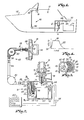
- a fire suppressant apparatus 10 in accordance with the invention broadly includes a hazard suppressant container 12 including an electrically fired initiator 14, a mechanical-electrical actuator 16, a remote operating station 18 and a mechanical linkage 20 connecting the station 18 and the actuator 16.
- the container 12 is conventional and has an externally threaded, tubular outlet 22.
- An internally threaded outlet extension 24 is threaded onto outlet 22.
- An annular mating washer 26 is interposed between the tubular outlet 22 and the outlet extension 24.
- the end 28 of outlet 22 is sealed by a transversely extending rupturable metallic burst element or membrane 30.
- Membrane 30 is a relatively thin, frangible diaphragm characterized by the quality of being resistant to rupture until a predetermined pressure is exceeded, but will undergo rupture upon application of a force above the pressure for which it was designed.
- Membrane 30 is further distinguished by the circular, concave-convex, dome-shaped configuration of the central portion thereof.
- the membrane is positioned over end 28 of outlet 22 with its concave face directed towards the container 12.
- the outlet extension 24 includes a bell-shaped suppressant distributor head 32.
- the initiator 14 includes a detonator 34, a detonator-receiving receptacle 36 and connection wires 38.
- the initiator 14 is threadably received within the outlet extension 24 such that one end 40 of the detonator 36 is in adjacent or abutting relationship with the convex face 42 of the membrane 30.
- the mechanical-electrical actuator 16 is connected to the fire suppressant container 12, adjacent to the detonator receptacle 36.
- the actuator 16 includes a rotatable, cantilever- mounted pulley 44, a gear assembly 46 operatively connected to the pulley 44, a drive spring 48 and a direct current generator 50.
- a ball and detent assembly 52 comprising a spring biased ball 54 mounted on the housing 56 of the actuator 16 and a machined recess 58 on the face of the pulley 44, is positioned to hold the pulley 44 in a rest position.
- the gear assembly 46 includes a driving gear 60 (see Fig. 3) and a smaller driven gear 62.
- Driven gear 62 is mounted on the armature 64 of the generator 50, whereas pulley 44 and gear 60 are mounted for rotation about a fixed shaft 66.
- the drive spring 48 is a coil spring, and is received within an enclosure 68 that projects from the generator housing 50.
- the internal end 70 of the drive spring 48 is operably connected to the armature 64 of the generator 50, and the external end 72 of the spring 48 is secured to the enclosure 68.
- the circumferential edge 74 of the driving gear 60 includes an untoothed gap or notch 76.
- the circumference of the driving gear 60 is preferably equal to or greater than about one and one quarter inches.
- the gear ratio of the driving gear to the driven gear is preferably from about 5:1 to about 10:1.
- the mechanical linkage 20 includes a cable assembly 78 and a plurality of corner pulleys 80.
- the cable asscmbly 78 includes a cable 82 shiftably received in a cable carrying conduit 84.
- the actuator end of cable 82 extends through a suitable gasketed elbow fitting 86 into housing 56 and is operatively connected to pulley 44.
- the opposite end of cable 82 extends through an apertured plate 88 affixed to bulkhead 90 and is coupled to an end fitting 92; the latter is secured to a handle 94 as best seen in Fig. 2.
- a brass sleeve (not shown) may advantageously be crimped on the cable 82, and positioned on the cable 82 so as to abut the outer surface of the actuator housing 56 when the cable 82 is fully wound on the pulley 44.
- fire suppressant apparatus 10 of the present invention may be interconnected with a conventional, automatic, hazard-sensing electronic firing mechanism 100 by wires 102.
- the wires 102 are received within the actuator housing 56 through fluid tight gasket 104.
- wires 38, 96 are completely enclosed within the actuator housing 56 and receptacle 36.
- the container 12 can be mounted by mounts 106 to a bulkhead 108 of the space to be protected, such as an engine room 110 of a ship 112 having an engine 114.
- the operator releases fire suppressant substance (not shown) from the container 12 by manually grasping the handle 94 and pulling the handle 94 away from its rest position abutting the plate 88, and thereby shifting the cable 82 within the conduit 84. Shifting of the cable 82 in turn rotates the pulley 44 and the driving gear 60 in a counterclockwise rotation as depicted in Fig. 3. Rotation of the driving gear 60 rotates the driven gear 62 and the . drive coil spring 48 is thereby tensioned and stores a quantum of mechanical energy derived from rotation of the gear assembly 46.
- Rotation of the gears 60, 62 proceeds as described until the gear 60 reaches a point (almost at the end of a full 360° revolution thereof) when gear 62 clears the peripheral teeth of the gear 60 and enters the notch 76. At this point the gear 62 and thereby armature 64 are free to rotate independently of gear 60, and rapidly do so under the influence of the tensioned drive spring 48. Such rotation of the armature 64 converts the stored mechanical energy into electrical energy and creates an electrical signal having the characteristics necessary to fire the detonator 34.
- Figure 4 depicts a typical waveform generated by the actuator 16.
- the waveform includes a rapidly rising leading edge 116, a generally level, intermediate portion 118, and a gradually descending, parabolic trailing edge 120.
- the cable 82 will not be wrapped around the pulley 44 once the handle 94 has been shifted and the actuator 16 thereby operated.
- the actuator 16 will not be operable until the cable 82 is manually rewound around the pulley 44.
- the handle 94 will remain in a shifted position until the cable 82 is rewound,-and will serve as a "tell-tale" sign that the fire suppressant has been discharged from the container 12.
- the voltage generated by the generator 50 will rapidly rise to a level of about 36 volts and will maintain that voltage for a time span of two to three seconds.
- a conventional initiator 14, such as the Elll DuPont initiator requires 500 milliamps applied for 2 milliseconds to fire. Since the resistance of the Elll initiator is about 1 ohm, those skilled in the art will realize that the actuator 16 provides a signal over 30 times greater than that required to fire an initiator, and for a period of time well in excess of that required for initiation. Thus it will be seen that the electrical signal provided by the actuator 16 is more than ample to insure consistent, predictable firing of the initiator 14, and one actuator 16 can be used to fire a plurality of initiators 14 if desired.
Landscapes
- Health & Medical Sciences (AREA)
- Public Health (AREA)
- Business, Economics & Management (AREA)
- Emergency Management (AREA)
- Fire-Extinguishing By Fire Departments, And Fire-Extinguishing Equipment And Control Thereof (AREA)
- Pharmaceuticals Containing Other Organic And Inorganic Compounds (AREA)
Applications Claiming Priority (2)
| Application Number | Priority Date | Filing Date | Title |
|---|---|---|---|
| US31271781A | 1981-10-19 | 1981-10-19 | |
| US312717 | 1981-10-19 |
Publications (2)
| Publication Number | Publication Date |
|---|---|
| EP0077602A2 true EP0077602A2 (fr) | 1983-04-27 |
| EP0077602A3 EP0077602A3 (fr) | 1983-12-14 |
Family
ID=23212692
Family Applications (1)
| Application Number | Title | Priority Date | Filing Date |
|---|---|---|---|
| EP82303503A Withdrawn EP0077602A3 (fr) | 1981-10-19 | 1982-07-02 | Appareil mécanique pour la décharge d'un agent extincteur |
Country Status (2)
| Country | Link |
|---|---|
| EP (1) | EP0077602A3 (fr) |
| JP (1) | JPS5872900A (fr) |
Cited By (1)
| Publication number | Priority date | Publication date | Assignee | Title |
|---|---|---|---|---|
| EP2216076A1 (fr) * | 2007-03-02 | 2010-08-11 | Ansul, LLC | Système de lutte contre l'incendie et système d'alarme d'urgence |
Family Cites Families (3)
| Publication number | Priority date | Publication date | Assignee | Title |
|---|---|---|---|---|
| FR451547A (fr) * | 1912-12-06 | 1913-04-21 | Xavier Flury | Mise en marche automatique pour moteurs à explosion |
| GB1545776A (en) * | 1976-05-11 | 1979-05-16 | Edwards Ltd C | Fire extinguishing devices |
| DE2828789A1 (de) * | 1978-06-30 | 1980-01-03 | Grescha Ges Grefe & Scharf | Ausloeseeinrichtung fuer die rauchklappenbetaetigung einer rauchabzugsanlage |
-
1982
- 1982-07-02 EP EP82303503A patent/EP0077602A3/fr not_active Withdrawn
- 1982-09-01 JP JP15248382A patent/JPS5872900A/ja active Pending
Cited By (4)
| Publication number | Priority date | Publication date | Assignee | Title |
|---|---|---|---|---|
| EP2216076A1 (fr) * | 2007-03-02 | 2010-08-11 | Ansul, LLC | Système de lutte contre l'incendie et système d'alarme d'urgence |
| AU2008223154B2 (en) * | 2007-03-02 | 2014-04-24 | Tyco Fire Products Lp | Fire suppression system and emergency annunciation system |
| US9352176B2 (en) | 2007-03-02 | 2016-05-31 | Tyco Fire Products Lp | Fire suppression system and emergency annunciation system |
| US10398916B2 (en) | 2007-03-02 | 2019-09-03 | Tyco Fire Products Lp | Fire suppression system and emergency annunciation system |
Also Published As
| Publication number | Publication date |
|---|---|
| JPS5872900A (ja) | 1983-04-30 |
| EP0077602A3 (fr) | 1983-12-14 |
Similar Documents
| Publication | Publication Date | Title |
|---|---|---|
| US1933694A (en) | Electrically controlled actuating device | |
| US3986560A (en) | Fire protection means | |
| US3749933A (en) | Underwater release device | |
| US2593432A (en) | Automatically operated radio buoy | |
| US2721913A (en) | Shock and static pressure discriminating switch | |
| US4482333A (en) | Automatic inflation system | |
| US20100288148A1 (en) | Networked pyrotechnic actuator incorporating high-pressure bellows | |
| US2775939A (en) | Drill mine | |
| US3983892A (en) | Explosive valve | |
| US4495849A (en) | Remotely activated cable cutter | |
| US3552495A (en) | Fire extinguisher | |
| US3072415A (en) | Miniature waterproof pressure seal | |
| US4306127A (en) | Corrosion sensor | |
| US3482484A (en) | Cutting tool | |
| US4782470A (en) | Hydrophone with extended operational life | |
| US3780752A (en) | Explosively actuated valve | |
| RU2296437C2 (ru) | Гидрофон с автоматической блокировкой при погружении за пределы регулируемого порога и способ его монтажа | |
| US3926137A (en) | Deep ocean parachute release | |
| JPS5872900A (ja) | 危険抑制装置 | |
| US4498491A (en) | Thermo-electric valve | |
| US3964390A (en) | Bursting disc assembly | |
| US3094928A (en) | Explosive release bolt and valve | |
| US2408816A (en) | Piezoelectric gauge and method of making the same | |
| US4207626A (en) | Acoustic decoy and jammer | |
| US5396845A (en) | Modular fuze |
Legal Events
| Date | Code | Title | Description |
|---|---|---|---|
| PUAI | Public reference made under article 153(3) epc to a published international application that has entered the european phase |
Free format text: ORIGINAL CODE: 0009012 |
|
| AK | Designated contracting states |
Designated state(s): AT BE CH DE FR GB IT LI LU NL SE |
|
| PUAL | Search report despatched |
Free format text: ORIGINAL CODE: 0009013 |
|
| AK | Designated contracting states |
Designated state(s): AT BE CH DE FR GB IT LI LU NL SE |
|
| STAA | Information on the status of an ep patent application or granted ep patent |
Free format text: STATUS: THE APPLICATION HAS BEEN WITHDRAWN |
|
| 18W | Application withdrawn |
Withdrawal date: 19840717 |
|
| RIN1 | Information on inventor provided before grant (corrected) |
Inventor name: STRALEY DANIEL L. Inventor name: SHEMA, JOHN S. |