EP0077628A1 - Verwendung von Nitrilkautschukvulkanisaten in Kraftstoffsystemen - Google Patents
Verwendung von Nitrilkautschukvulkanisaten in Kraftstoffsystemen Download PDFInfo
- Publication number
- EP0077628A1 EP0077628A1 EP82305406A EP82305406A EP0077628A1 EP 0077628 A1 EP0077628 A1 EP 0077628A1 EP 82305406 A EP82305406 A EP 82305406A EP 82305406 A EP82305406 A EP 82305406A EP 0077628 A1 EP0077628 A1 EP 0077628A1
- Authority
- EP
- European Patent Office
- Prior art keywords
- urethane
- fuel
- sulfur
- vulcanizate
- sour
- Prior art date
- Legal status (The legal status is an assumption and is not a legal conclusion. Google has not performed a legal analysis and makes no representation as to the accuracy of the status listed.)
- Granted
Links
- 239000000446 fuel Substances 0.000 title claims abstract description 67
- 229920000459 Nitrile rubber Polymers 0.000 title abstract description 26
- JOYRKODLDBILNP-UHFFFAOYSA-N Ethyl urethane Chemical compound CCOC(N)=O JOYRKODLDBILNP-UHFFFAOYSA-N 0.000 claims abstract description 59
- NINIDFKCEFEMDL-UHFFFAOYSA-N Sulfur Chemical compound [S] NINIDFKCEFEMDL-UHFFFAOYSA-N 0.000 claims abstract description 34
- 229910052717 sulfur Inorganic materials 0.000 claims abstract description 34
- 239000011593 sulfur Substances 0.000 claims abstract description 34
- 239000000203 mixture Substances 0.000 claims abstract description 20
- 239000003795 chemical substances by application Substances 0.000 claims abstract description 18
- 239000004215 Carbon black (E152) Substances 0.000 claims abstract description 16
- 229930195733 hydrocarbon Natural products 0.000 claims abstract description 16
- 150000002430 hydrocarbons Chemical class 0.000 claims abstract description 16
- 239000007795 chemical reaction product Substances 0.000 claims abstract description 12
- 125000005442 diisocyanate group Chemical group 0.000 claims abstract description 11
- 229920001577 copolymer Polymers 0.000 claims abstract description 9
- JSTCPNFNKICNNO-UHFFFAOYSA-N 4-nitrosophenol Chemical compound OC1=CC=C(N=O)C=C1 JSTCPNFNKICNNO-UHFFFAOYSA-N 0.000 claims abstract description 8
- VYPSYNLAJGMNEJ-UHFFFAOYSA-N Silicium dioxide Chemical compound O=[Si]=O VYPSYNLAJGMNEJ-UHFFFAOYSA-N 0.000 claims description 7
- 239000006229 carbon black Substances 0.000 claims description 6
- 239000000945 filler Substances 0.000 claims description 3
- 239000002245 particle Substances 0.000 claims description 3
- 239000000377 silicon dioxide Substances 0.000 claims description 3
- 230000003647 oxidation Effects 0.000 abstract description 7
- 238000007254 oxidation reaction Methods 0.000 abstract description 7
- 239000000047 product Substances 0.000 abstract description 6
- 238000006243 chemical reaction Methods 0.000 abstract description 2
- NLHHRLWOUZZQLW-UHFFFAOYSA-N Acrylonitrile Chemical compound C=CC#N NLHHRLWOUZZQLW-UHFFFAOYSA-N 0.000 description 22
- 229920001971 elastomer Polymers 0.000 description 21
- 150000002825 nitriles Chemical class 0.000 description 17
- 239000003502 gasoline Substances 0.000 description 16
- 238000012360 testing method Methods 0.000 description 13
- 239000003963 antioxidant agent Substances 0.000 description 11
- 239000000806 elastomer Substances 0.000 description 11
- 230000035699 permeability Effects 0.000 description 11
- 230000003078 antioxidant effect Effects 0.000 description 10
- 239000005060 rubber Substances 0.000 description 10
- 230000032683 aging Effects 0.000 description 9
- 230000000694 effects Effects 0.000 description 9
- 150000001875 compounds Chemical class 0.000 description 8
- 239000012948 isocyanate Substances 0.000 description 7
- 150000002513 isocyanates Chemical class 0.000 description 7
- RYGMFSIKBFXOCR-UHFFFAOYSA-N Copper Chemical compound [Cu] RYGMFSIKBFXOCR-UHFFFAOYSA-N 0.000 description 5
- 244000043261 Hevea brasiliensis Species 0.000 description 5
- 229910052802 copper Inorganic materials 0.000 description 5
- 239000010949 copper Substances 0.000 description 5
- 239000012530 fluid Substances 0.000 description 5
- 238000002347 injection Methods 0.000 description 5
- 239000007924 injection Substances 0.000 description 5
- 229920003052 natural elastomer Polymers 0.000 description 5
- 229920001194 natural rubber Polymers 0.000 description 5
- 150000003254 radicals Chemical class 0.000 description 5
- 235000019241 carbon black Nutrition 0.000 description 4
- 150000002432 hydroperoxides Chemical class 0.000 description 4
- 229910021645 metal ion Inorganic materials 0.000 description 4
- 238000000034 method Methods 0.000 description 4
- 238000004132 cross linking Methods 0.000 description 3
- 238000009472 formulation Methods 0.000 description 3
- 239000002828 fuel tank Substances 0.000 description 3
- 239000004615 ingredient Substances 0.000 description 3
- 230000007246 mechanism Effects 0.000 description 3
- 229910052751 metal Inorganic materials 0.000 description 3
- 239000002184 metal Substances 0.000 description 3
- 230000000704 physical effect Effects 0.000 description 3
- 239000004014 plasticizer Substances 0.000 description 3
- 229920000642 polymer Polymers 0.000 description 3
- 230000008569 process Effects 0.000 description 3
- 229920003051 synthetic elastomer Polymers 0.000 description 3
- 239000005061 synthetic rubber Substances 0.000 description 3
- KAKZBPTYRLMSJV-UHFFFAOYSA-N Butadiene Chemical compound C=CC=C KAKZBPTYRLMSJV-UHFFFAOYSA-N 0.000 description 2
- VTYYLEPIZMXCLO-UHFFFAOYSA-L Calcium carbonate Chemical compound [Ca+2].[O-]C([O-])=O VTYYLEPIZMXCLO-UHFFFAOYSA-L 0.000 description 2
- 229920013644 Chemigum Polymers 0.000 description 2
- JPVYNHNXODAKFH-UHFFFAOYSA-N Cu2+ Chemical compound [Cu+2] JPVYNHNXODAKFH-UHFFFAOYSA-N 0.000 description 2
- XLOMVQKBTHCTTD-UHFFFAOYSA-N Zinc monoxide Chemical compound [Zn]=O XLOMVQKBTHCTTD-UHFFFAOYSA-N 0.000 description 2
- 229910052782 aluminium Inorganic materials 0.000 description 2
- XAGFODPZIPBFFR-UHFFFAOYSA-N aluminium Chemical compound [Al] XAGFODPZIPBFFR-UHFFFAOYSA-N 0.000 description 2
- 150000001412 amines Chemical group 0.000 description 2
- 230000015572 biosynthetic process Effects 0.000 description 2
- 230000015556 catabolic process Effects 0.000 description 2
- 230000006835 compression Effects 0.000 description 2
- -1 copper Chemical class 0.000 description 2
- 229910001431 copper ion Inorganic materials 0.000 description 2
- 230000007423 decrease Effects 0.000 description 2
- 238000006731 degradation reaction Methods 0.000 description 2
- DMBHHRLKUKUOEG-UHFFFAOYSA-N diphenylamine Chemical class C=1C=CC=CC=1NC1=CC=CC=C1 DMBHHRLKUKUOEG-UHFFFAOYSA-N 0.000 description 2
- 239000011521 glass Substances 0.000 description 2
- 239000000463 material Substances 0.000 description 2
- 150000002739 metals Chemical class 0.000 description 2
- 239000000178 monomer Substances 0.000 description 2
- 150000002978 peroxides Chemical class 0.000 description 2
- ISWSIDIOOBJBQZ-UHFFFAOYSA-N phenol group Chemical group C1(=CC=CC=C1)O ISWSIDIOOBJBQZ-UHFFFAOYSA-N 0.000 description 2
- 229920000728 polyester Polymers 0.000 description 2
- 238000012545 processing Methods 0.000 description 2
- 230000009973 reversion resistant effect Effects 0.000 description 2
- 239000000126 substance Substances 0.000 description 2
- 150000003673 urethanes Chemical class 0.000 description 2
- LOCPTSFJZDIICR-UHFFFAOYSA-N 1,3-bis(3-isocyanato-4-methylphenyl)-1,3-diazetidine-2,4-dione Chemical compound C1=C(N=C=O)C(C)=CC=C1N1C(=O)N(C=2C=C(C(C)=CC=2)N=C=O)C1=O LOCPTSFJZDIICR-UHFFFAOYSA-N 0.000 description 1
- UJAWGGOCYUPCPS-UHFFFAOYSA-N 4-(2-phenylpropan-2-yl)-n-[4-(2-phenylpropan-2-yl)phenyl]aniline Chemical compound C=1C=C(NC=2C=CC(=CC=2)C(C)(C)C=2C=CC=CC=2)C=CC=1C(C)(C)C1=CC=CC=C1 UJAWGGOCYUPCPS-UHFFFAOYSA-N 0.000 description 1
- 241000239290 Araneae Species 0.000 description 1
- 229910001369 Brass Inorganic materials 0.000 description 1
- BRLQWZUYTZBJKN-UHFFFAOYSA-N Epichlorohydrin Chemical compound ClCC1CO1 BRLQWZUYTZBJKN-UHFFFAOYSA-N 0.000 description 1
- 241001441571 Hiodontidae Species 0.000 description 1
- MHAJPDPJQMAIIY-UHFFFAOYSA-N Hydrogen peroxide Chemical compound OO MHAJPDPJQMAIIY-UHFFFAOYSA-N 0.000 description 1
- 229920013647 Krynac Polymers 0.000 description 1
- 239000004594 Masterbatch (MB) Substances 0.000 description 1
- 239000006057 Non-nutritive feed additive Substances 0.000 description 1
- 239000005062 Polybutadiene Substances 0.000 description 1
- 239000004614 Process Aid Substances 0.000 description 1
- 238000010521 absorption reaction Methods 0.000 description 1
- 229940111121 antirheumatic drug quinolines Drugs 0.000 description 1
- 230000008901 benefit Effects 0.000 description 1
- 239000010951 brass Substances 0.000 description 1
- NTXGQCSETZTARF-UHFFFAOYSA-N buta-1,3-diene;prop-2-enenitrile Chemical compound C=CC=C.C=CC#N NTXGQCSETZTARF-UHFFFAOYSA-N 0.000 description 1
- 229910000019 calcium carbonate Inorganic materials 0.000 description 1
- BRPQOXSCLDDYGP-UHFFFAOYSA-N calcium oxide Chemical compound [O-2].[Ca+2] BRPQOXSCLDDYGP-UHFFFAOYSA-N 0.000 description 1
- 239000000292 calcium oxide Substances 0.000 description 1
- ODINCKMPIJJUCX-UHFFFAOYSA-N calcium oxide Inorganic materials [Ca]=O ODINCKMPIJJUCX-UHFFFAOYSA-N 0.000 description 1
- 239000003054 catalyst Substances 0.000 description 1
- 239000003153 chemical reaction reagent Substances 0.000 description 1
- 238000007906 compression Methods 0.000 description 1
- 238000000748 compression moulding Methods 0.000 description 1
- 150000001879 copper Chemical class 0.000 description 1
- 230000001419 dependent effect Effects 0.000 description 1
- 239000002274 desiccant Substances 0.000 description 1
- LRCFXGAMWKDGLA-UHFFFAOYSA-N dioxosilane;hydrate Chemical compound O.O=[Si]=O LRCFXGAMWKDGLA-UHFFFAOYSA-N 0.000 description 1
- 229920005558 epichlorohydrin rubber Polymers 0.000 description 1
- 230000008020 evaporation Effects 0.000 description 1
- 238000001704 evaporation Methods 0.000 description 1
- 238000001125 extrusion Methods 0.000 description 1
- 239000010419 fine particle Substances 0.000 description 1
- 230000006872 improvement Effects 0.000 description 1
- 239000003112 inhibitor Substances 0.000 description 1
- 238000012423 maintenance Methods 0.000 description 1
- 238000004519 manufacturing process Methods 0.000 description 1
- 239000003607 modifier Substances 0.000 description 1
- GFSJJVJWCAMZEV-UHFFFAOYSA-N n-(4-anilinophenyl)-2-methylprop-2-enamide Chemical group C1=CC(NC(=O)C(=C)C)=CC=C1NC1=CC=CC=C1 GFSJJVJWCAMZEV-UHFFFAOYSA-N 0.000 description 1
- 231100000252 nontoxic Toxicity 0.000 description 1
- 230000003000 nontoxic effect Effects 0.000 description 1
- 230000009965 odorless effect Effects 0.000 description 1
- 239000003921 oil Substances 0.000 description 1
- 230000001590 oxidative effect Effects 0.000 description 1
- 239000002530 phenolic antioxidant Substances 0.000 description 1
- 150000002989 phenols Chemical class 0.000 description 1
- 239000000843 powder Substances 0.000 description 1
- 239000010734 process oil Substances 0.000 description 1
- 150000003248 quinolines Chemical class 0.000 description 1
- 238000010992 reflux Methods 0.000 description 1
- 150000004760 silicates Chemical class 0.000 description 1
- 229960004029 silicic acid Drugs 0.000 description 1
- CIHOLLKRGTVIJN-UHFFFAOYSA-N tert‐butyl hydroperoxide Chemical compound CC(C)(C)OO CIHOLLKRGTVIJN-UHFFFAOYSA-N 0.000 description 1
- 238000010998 test method Methods 0.000 description 1
- 238000001721 transfer moulding Methods 0.000 description 1
- XLYOFNOQVPJJNP-UHFFFAOYSA-N water Substances O XLYOFNOQVPJJNP-UHFFFAOYSA-N 0.000 description 1
- 230000003442 weekly effect Effects 0.000 description 1
- 238000005303 weighing Methods 0.000 description 1
- 125000002256 xylenyl group Chemical class C1(C(C=CC=C1)C)(C)* 0.000 description 1
- 239000011787 zinc oxide Substances 0.000 description 1
Images




Classifications
-
- C—CHEMISTRY; METALLURGY
- C08—ORGANIC MACROMOLECULAR COMPOUNDS; THEIR PREPARATION OR CHEMICAL WORKING-UP; COMPOSITIONS BASED THEREON
- C08G—MACROMOLECULAR COMPOUNDS OBTAINED OTHERWISE THAN BY REACTIONS ONLY INVOLVING UNSATURATED CARBON-TO-CARBON BONDS
- C08G18/00—Polymeric products of isocyanates or isothiocyanates
- C08G18/06—Polymeric products of isocyanates or isothiocyanates with compounds having active hydrogen
- C08G18/28—Polymeric products of isocyanates or isothiocyanates with compounds having active hydrogen characterised by the compounds used containing active hydrogen
- C08G18/67—Unsaturated compounds having active hydrogen
- C08G18/69—Polymers of conjugated dienes
-
- C—CHEMISTRY; METALLURGY
- C08—ORGANIC MACROMOLECULAR COMPOUNDS; THEIR PREPARATION OR CHEMICAL WORKING-UP; COMPOSITIONS BASED THEREON
- C08K—Use of inorganic or non-macromolecular organic substances as compounding ingredients
- C08K5/00—Use of organic ingredients
- C08K5/16—Nitrogen-containing compounds
- C08K5/205—Compounds containing groups, e.g. carbamates
Definitions
- This invention relates to the use of particular urethane or urethane/sulfur cured acrylonitrile-butadiene elastomers in systems wherein a vulcanizate component with resistance to oxidized (sour) hydrocarbon fuel is desired, i.e., in systems wherein a vulcanizate functions in contact with hydrocarbon fuel having oxidation products therein.
- This invention also relates to articles adapted for use in a sour hydrocarbon fuel environment and comprising such cured acrylonitrile-butadiene vulcanizate. Still further this invention is directed to a fuel system adapted to be exposed to sour hydrocarbon fuel eomprising such articles.
- Fuel injection systems incorporating fuel recirculation may require increased maintenance as a result of degration of rubber stock, e.g., hoses, which are contacted by the fuel.
- This problem has been attributed to an attack on the rubber elastomer by oxidation products present in the fuel, which attack results in a loss of physical properties and ultimately a failure of the vulcanizate.
- This problem is aggravated by the fact that unlike in the case of conventional fuel systems, fuel is delivered to the engine under pressure (.2 - .3 MPa) in fuel injection sytems.
- sour fuel contains hydroperoxides which are the result of oxidation of the fuel, these peroxides themselves appear to have little affect on the durability of the rubber stock.
- hydroperoxides can catalytically decompose into free radicals, which then can attack the elastomer.
- Metal ions present in the fuel not only catalyze the formation of the radicals but also promote the initial formation of the hydroperoxides in the fuel.
- trace amounts of metals, such as copper may be present naturally in the fuel, the use of the fuel injection system increases the metal ion concentration in the fuel in several ways.
- urethane or urethane/sulfur cured nitrile elastomer compositions are used in systems wherein the vulcanizate comes in contact with sour hydrocarbon fuel.
- This urethane cured nitrile elastomer comprises the reaction product of (i) 100 parts by weight of an acrylonitrile-butadiene copolymer and (ii) a curative comprising 1-10 parts by weight of a urethane curing agent, wherein the urethane curing agent is the reaction product of nitrosophenol and a diisocyanate.
- the formed article is placed in the system wherein the article is contacted by sour hydrocarbon fuel at least part of the time the system is in operation.
- the curative may additionally comprise sulfur.
- the invention specifically provides an article adapted for use in a sour hydrocarbon fuel environment and comprising a vulcanizate, the composition of which consists essentially of the reaction product of (i) 100 parts by weight of an acrylonitrile-butadiene copolymer and (ii) a curative comprising 1-10 parts by weight of a urethane curing agent, wherein the urethane curing agent is the reaction. product of a nitrosophenol and a diisocyanate.
- the curative may additionally comprise sulfur. Examples of such articles are vessels, tubes, hoses, washers, gasket, jets and seals. The person skilled in the art will be familar with such articles.
- the invention provides a fuel system adapted to be exposed to sour hydrocarbon fuel comprising an article of desired configuration useful in the system wherein the composition of the article consists essentially of the reaction product of (i) 1 00 parts by weight of an acrylonitrile-butadiene copolymer and (ii) a curative agent comprising 1-10 parts by weight of a urethane curing agent, wherein the urethane curing agent is a reaction product of a nitrosophenol and a diisocyanate.
- the curative may additionally comprise sulfur.
- the acrylonitrile-butadiene copolymer preferably comprises from 25 to 50 mole percent of acrylonitrile.
- This invention relates to the use of urethane or urethane/sulfur cured nitrile elastomer materials in hydrocarbon fuel systems wherein elastomer vulcanizate having sour (oxidized) fuel resistance is desired.
- elastomer vulcanizate having sour (oxidized) fuel resistance is desired.
- the optimal vulcanizate composition, its cure, and the vulcanizate composition sour fuel resistance relationship will be discussed hereinafter in greater detail.
- the vulcanizate of this invention is the reaction product of (i) 100 parts by weight of an acrylonitrile-butadiene copolymer and (ii) a curative agent, comprising 1-10 parts by weight of a urethane curing agent, wherein the urethane curing agent is the reaction product of nitrosophenol and a diisocyanate.
- a schematic representation of the urethane cure mechanism is shown in Figure 1. It should be noted that in the final step, the diisocyanate reacts predominately at the amine functionality leaving a phenolic group at the crosslink site. This phenolic group is very similar to typical phenolic antioxidants.
- the nitrile vulcanizate of the subject invention are cured with a mixed urethane/sulfur curative system, therein the ratio of urethane to sulfur is between about 10:90 and 90:10, 50:50 being more preferred and 80:20 being most preferred.
- Nitrile elastomeric polymers suitable for use in this invention are commercially available in various Mooney ranges, generally from 25ML to 110ML.
- the choice of the particular Mooney viscosity nitrile is only dependent on the particular type of process used to manufacture the vulcanizate component, such processess including extrusion, compression and transfer molding.
- the relative sour hydrocarbon fuel resistance of the various vulcanizates is not related to its Mooney viscosity, i.e., the Mooney viscosity has no effect beyond processing in our invention.
- Nitrile elastomer compositions useful in this invention include conventional nitriles and bound antioxidant nitriles.
- the latter in addition to consisting of the conventional acrylonitrile and butadiene monomers, have a third monomer, an antioxidant, polymerized into the backbone.
- an antioxidant is N -(4-anilinophenyl) methacrylamide.
- Suitable commercially available nitrile elastomers include bound antioxidant Chemigum HR 765 (28%ACN) and Chemigum HR 365 (39%ACN), supplied by Goodyear Tire and Rubber Company and conventional - (no antioxidant) Krynac 38.50 (38% ACN) supplied by Polysar Limited of Canada.
- acrylonitrile-butadiene copolymer has an ACN content of about 20-50 mole percent of the copolymer.
- An ACN content of 25-40 mole percent is particularly suitable for some of the elastomer components taught in this application, particularly fuel hoses.
- the ACN content of the elastomers useful in this invention is not meant to be limited to this range. The particular use to which the vulcanizate will be put in the system and the properties therein desired will determine the optimal ACN content.
- the curative useful in this invention comprises either a urethane or a urethane/sulfur curing system.
- the urethane is the reaction product of a nitrosophenol and a diisocyanate.
- a specific example of this type of blocked diisocyanate is a urethane product of a 2,4-toluene diisocyanate dimer and 4-nitroso-2-6,xylenol.
- Commercially available curing agents comprising a product of this type are Novor 913, 920 and 924 available from Durham Chemicals Ltd., Britley, Co., Durham, England.
- the sour gasoline resistant elastomeric articles of this invention comprise a curing system which is a combination of sulfur and urethane (blocked isocyanate).
- a curing system combination of sulfur and blocked isocyanate is illustrated in USSN 796,114, filed May 11, 1977 in the name of Marano,(now abandoned) and is hereby herein expressly incorporated by reference.
- Morano directs his cure to natural rubber, this cure system is also suitable for curing the nitrile elastomer of the subject invention.
- the sulfur is used at rubber soluble levels.
- the sulfur accelerator is a catalyst for the urethane.
- a preferred block isocyanate combination comprises (per 100 parts of elastomer) combinations of isocyanate or blocked isocyanate and sulfur used such as follows in Table A.
- the urethane/sulfur curative system employed in this invention may comprise a ratio of urethane/sulfur curing agents of between about 1:9 and 9:1. However, preferably the curative system ratio is greater than about 1:1, 7 :3 being more preferred and 4:1 being most preferred. As can be seen from the Examples, the compound which is 80/20 u rethane/sulfur cured (R1601) gives the best sour fuel properties.
- nitrile elastomeric compositions used in this invention may also comprise organic or inorganic particulates such as carbon blacks, zinc oxide, fine particle calcium carbonate, silicas and silicates.
- elastomer compositions will accept all normal carbon black fillers characterized by particle sizes in the range of 20-35 millimicrons and structure, as measured by dibutylpthalate absorption, of 30 to 120.
- the most preferred carbon blacks are the thermal blacks (particle size in the range of 250-350 millimicrons).
- Silica has the advantage of improving the heat resistance and permeability of the fuel hose stocks. It does however also increase the compression set of the material. Therefore, a blend of silica and carbon black is preferred over either filler alone.
- the elastomeric vulcanizate of the invention may desirably also include still other ingredients.
- ingredients are antioxidants (e.g., polymerized quinolines, hindered amines, phenols), desiccants (e.g., calcium oxide), process oils, cure inhibitors or modifiers and the like known in the art.
- Elastomeric compositions were prepared as indicated in the following Table B. (Composition formulations are given in parts by weight.)
- a ST M test sheets (150 x 150 x 2 mm) were molded according to ASTM D 3182. Specimens were cut from the cured test sheets using a die and punch press.
- Tensile strength and elongation at break were determined on unaged and heat aged samples. Testing was done at room temperature according to ASTM D 412 (die C) at 500 mm per minute using an electromechcnical tester. Heat aging of the samples was done according to ASTM D 573-67 for 70 hours at 125°C or 150°C.
- Hardness of the vulcanizates was measured according to ASTM D 2240 using a Shore A durometer. A ten second relaxation was allowed before the final reading.
- Sour gasoline aging was performed at 40°C using twelve inch long glass tubes and a constant temperature aluminum block.
- Dumbbell specimens (ASTM D412-die C) were suspended in the tubes containing 200 ml sour gasoline. The tubes were fitted with water cooled reflux condensors to reduce volume loss from evaporation. Each tube contained nine dumbbell specimens.
- the test fluid was replenished with freshly made sour gasoline twice weekly (every 3 - 4 days), and physical properties (tensile, elongation, and hardness) were measured every seven days on three of the specimens. The specimens were removed from the fluid and tested according to ASTM D 471-77.
- test fluid was Indolene HO-I II , American Oil Company, which was soured to a peroxide number of 60 (meg of hydroperoxide per 1000 ml of test fluid) by adding 70% t-butyl hydroperoxide.
- a soluble copper salt was added to the fuel to bring the copper ion concentration to 1.6 x 10- 7 moles/liter. This represents the upper level of copper reported to be present in commercially available fuels. It is added to the fuel to accelerate the test and attempt to duplicate conditions existing in fuel injection systems.
- Permeability to fuel of the cured rubber samples was determined as follows: Thirty ml of the test fluid (Indolene HO III) was placed in an aluminum chamber 39 mm in diameter and 46 mm in depth. A disk cut from the cured A STM test sheet 58 mm in diameter closed the chamber and was held in place by a brass ring secured by a threaded locking ring. The apparatus is illustrated in Figure 8.
- the assembled apparatus was weighed before inverting and every two hours after standing inverted until four weighings had been made (8 hours total inversion). The apparatus was then kept inverted and weighed to O.Olg every 24 hours for 21 days. A box with the top and bottom removed was placed around the test containers so that air currents over the rubber disk diaphragm would be eliminated.
- Table C lists the physical properties of the nitrile elastomers of Table B before and after sour gasoline testing.
- R 1655 (50/50 urethane/sulfur) and R1656 (10/90 urethane/sulfur) show improvement over R1597 (sulfur), however the high crosslink density of '55 and '56 (due to sulfur) contributed to their performance.
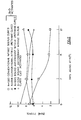
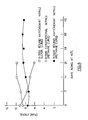
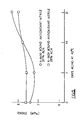
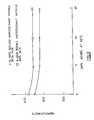
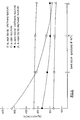
- Figure 9 graphically illustrates elongation behavior of the above nitriles after sour gasoline aging and clearly shows that sulfur cured nitriles are inferior to urethane cured nitriles with respect to sour gasoline resistance.
- Table D discloses additional formulations of the elastomeric test compounds referenced in the figures which were not disclosed in Table B. (Composition formulations are given in parts by weight).
- H i S il 215 is the tradename for precipitated hydrated silica from Pittsburg Plate and Glass Inc.
- Naugard 445 is the tradename for a substituted diphenylamine antioxidant available from Uniroyal Chemical Company.
- TE-80 is a processing aid available from Technical Processing Incorporated.
- Hercoflex 600 is a pentaerythritolester plasticizer from Hercules Incorporated.
- Struktol WB-312 is a process aid and Struktol WB-300 is a polyester plasticizer, both are available from Struktol Company.
- P araplex G-40 is a polyester plasticizer available from R ohm & Haas. Spider Sulfur is a free flowing, odorless, nontoxic light yellow powder available from C.P. Hall.
Landscapes
- Chemical & Material Sciences (AREA)
- Health & Medical Sciences (AREA)
- Chemical Kinetics & Catalysis (AREA)
- Medicinal Chemistry (AREA)
- Polymers & Plastics (AREA)
- Organic Chemistry (AREA)
- Compositions Of Macromolecular Compounds (AREA)
Applications Claiming Priority (2)
| Application Number | Priority Date | Filing Date | Title |
|---|---|---|---|
| US310585 | 1981-10-13 | ||
| US06/310,585 US4384079A (en) | 1981-10-13 | 1981-10-13 | Use of urethane cured nitrile elastomer as oxidized fuel resistant vulcanizates |
Publications (2)
| Publication Number | Publication Date |
|---|---|
| EP0077628A1 true EP0077628A1 (de) | 1983-04-27 |
| EP0077628B1 EP0077628B1 (de) | 1987-01-21 |
Family
ID=23203194
Family Applications (1)
| Application Number | Title | Priority Date | Filing Date |
|---|---|---|---|
| EP82305406A Expired EP0077628B1 (de) | 1981-10-13 | 1982-10-12 | Verwendung von Nitrilkautschukvulkanisaten in Kraftstoffsystemen |
Country Status (4)
| Country | Link |
|---|---|
| US (1) | US4384079A (de) |
| EP (1) | EP0077628B1 (de) |
| CA (1) | CA1183993A (de) |
| DE (1) | DE3275197D1 (de) |
Cited By (2)
| Publication number | Priority date | Publication date | Assignee | Title |
|---|---|---|---|---|
| EP0517257A1 (de) * | 1991-06-07 | 1992-12-09 | Toyoda Gosei Co., Ltd. | Brennstoffsorbentmittel |
| CN110144071A (zh) * | 2019-05-17 | 2019-08-20 | 无锡励金塑管熔接科技有限公司 | 一种石油管道及用于该石油管道的焊接设备和焊接方法 |
Families Citing this family (3)
| Publication number | Priority date | Publication date | Assignee | Title |
|---|---|---|---|---|
| US7037985B2 (en) * | 2003-04-24 | 2006-05-02 | Taylor Made Golf Company, Inc. | Urethane sporting equipment composition incorporating nitroso compound |
| ES2748034T3 (es) * | 2014-09-29 | 2020-03-12 | Zeon Corp | Caucho reticulado |
| CN112300505A (zh) * | 2020-11-18 | 2021-02-02 | 哈尔滨展鹏医药包装有限公司 | 一种口服液瓶用氯化丁基橡胶塞及其制备方法 |
Citations (1)
| Publication number | Priority date | Publication date | Assignee | Title |
|---|---|---|---|---|
| FR2019918A1 (de) * | 1968-10-04 | 1970-07-10 | Natural Rubber Producers |
Family Cites Families (2)
| Publication number | Priority date | Publication date | Assignee | Title |
|---|---|---|---|---|
| US3338862A (en) * | 1965-12-03 | 1967-08-29 | Internat Latex & Chemical Corp | Oil resistant nitrile rubbers and rubber cements prepared therefrom |
| JPS4947273B1 (de) * | 1970-01-23 | 1974-12-14 |
-
1981
- 1981-10-13 US US06/310,585 patent/US4384079A/en not_active Expired - Fee Related
-
1982
- 1982-09-22 CA CA000411907A patent/CA1183993A/en not_active Expired
- 1982-10-12 DE DE8282305406T patent/DE3275197D1/de not_active Expired
- 1982-10-12 EP EP82305406A patent/EP0077628B1/de not_active Expired
Patent Citations (1)
| Publication number | Priority date | Publication date | Assignee | Title |
|---|---|---|---|---|
| FR2019918A1 (de) * | 1968-10-04 | 1970-07-10 | Natural Rubber Producers |
Non-Patent Citations (1)
| Title |
|---|
| GUMMI, ASBEST, KUNSTSTOFFE, vol. 33, no. 5, May 1980, pages 296-308, A.W.Gentner Verlag, Stuttgart (DE); * |
Cited By (3)
| Publication number | Priority date | Publication date | Assignee | Title |
|---|---|---|---|---|
| EP0517257A1 (de) * | 1991-06-07 | 1992-12-09 | Toyoda Gosei Co., Ltd. | Brennstoffsorbentmittel |
| CN110144071A (zh) * | 2019-05-17 | 2019-08-20 | 无锡励金塑管熔接科技有限公司 | 一种石油管道及用于该石油管道的焊接设备和焊接方法 |
| CN110144071B (zh) * | 2019-05-17 | 2021-09-24 | 无锡励金塑管熔接科技有限公司 | 一种石油管道及用于该石油管道的焊接设备和焊接方法 |
Also Published As
| Publication number | Publication date |
|---|---|
| EP0077628B1 (de) | 1987-01-21 |
| US4384079A (en) | 1983-05-17 |
| DE3275197D1 (en) | 1987-02-26 |
| CA1183993A (en) | 1985-03-12 |
Similar Documents
| Publication | Publication Date | Title |
|---|---|---|
| US4404329A (en) | Rubber composition capable of giving vulcanizates having improved ozone cracking resistance and oil resistance | |
| DE3889350T2 (de) | Kautschukzusammensetzung und ihre Verwendung bei der Herstellung von Packungen und Schläuchen. | |
| EP2009050B1 (de) | Vernetzbare nitrilkautschukzusammensetzung und vernetztes kautschukprodukt | |
| EP1243602B1 (de) | Kautschuk, kautschukzusammensetzung und vernetzter gegenstand | |
| EP0077628A1 (de) | Verwendung von Nitrilkautschukvulkanisaten in Kraftstoffsystemen | |
| EP0687708B1 (de) | Hitze- und Ozonbeständige NBR/Epichlorohydrinmischungen | |
| CA1227597A (en) | Sulfur vulcanizable polymer compositions | |
| JPS63142047A (ja) | 加硫しうるポリマー組成物 | |
| US4631309A (en) | Shaped articles for use in the exploration for and/or production of petroleum and natural gas | |
| EP1512716B1 (de) | Nitrilpolymerzusammensetzung zur Anwendung bei magnetischen Dichtungen | |
| US5998531A (en) | Vulcanizable rubber composition for use as hot-water seals | |
| Bhattacharjee et al. | Properties and degradation of nitrile rubber | |
| US4542190A (en) | Cis-1,4-polyisoprene rubber composition | |
| US4424306A (en) | Method for modifying cis-1,4-polyisoprene rubber | |
| Nakagawa et al. | Ozone resistance of highly saturated nitrile rubber (HNBR) | |
| US4370440A (en) | Compositions comprising chlorosulphonated polyethylene, carboxylated butadiene-acrylonitrile and magnesium oxide useful for liners or membranes | |
| US4386181A (en) | Heat-aging-resistant rubber composition | |
| JP3593526B2 (ja) | ゴム組成物およびその成型品 | |
| US4268644A (en) | Vulcanizable rubber composition | |
| JP2021152093A (ja) | ゴム組成物およびそれを用いたゴム部材 | |
| Khani et al. | The impact of industrial methyl diethanolamine solution on the aging of cured ethylene‐propylene‐diene monomer and butyl rubber compounds, and associated blends with potential applications in rubber‐made sealants within gas refinery environments | |
| Elizabeth et al. | Evaluation of blends of natural rubber and hydrogenated nitrile rubber containing chemically modified natural rubber | |
| Farid | Evaluation of speciality elastomers for'qc sealing applications | |
| JP2005343942A (ja) | ゴム組成物およびその成型品 | |
| JPS5925832A (ja) | 自動車用テンシヨナ−・ダンパ− |
Legal Events
| Date | Code | Title | Description |
|---|---|---|---|
| PUAI | Public reference made under article 153(3) epc to a published international application that has entered the european phase |
Free format text: ORIGINAL CODE: 0009012 |
|
| AK | Designated contracting states |
Designated state(s): DE FR GB |
|
| 17P | Request for examination filed |
Effective date: 19830801 |
|
| GRAA | (expected) grant |
Free format text: ORIGINAL CODE: 0009210 |
|
| AK | Designated contracting states |
Kind code of ref document: B1 Designated state(s): DE FR GB |
|
| REF | Corresponds to: |
Ref document number: 3275197 Country of ref document: DE Date of ref document: 19870226 |
|
| ET | Fr: translation filed | ||
| PLBE | No opposition filed within time limit |
Free format text: ORIGINAL CODE: 0009261 |
|
| STAA | Information on the status of an ep patent application or granted ep patent |
Free format text: STATUS: NO OPPOSITION FILED WITHIN TIME LIMIT |
|
| 26N | No opposition filed | ||
| REG | Reference to a national code |
Ref country code: GB Ref legal event code: 746 |
|
| PGFP | Annual fee paid to national office [announced via postgrant information from national office to epo] |
Ref country code: GB Payment date: 19900920 Year of fee payment: 9 |
|
| PGFP | Annual fee paid to national office [announced via postgrant information from national office to epo] |
Ref country code: DE Payment date: 19901016 Year of fee payment: 9 |
|
| PGFP | Annual fee paid to national office [announced via postgrant information from national office to epo] |
Ref country code: FR Payment date: 19901031 Year of fee payment: 9 |
|
| REG | Reference to a national code |
Ref country code: FR Ref legal event code: DL |
|
| PG25 | Lapsed in a contracting state [announced via postgrant information from national office to epo] |
Ref country code: DE Effective date: 19910906 |
|
| PG25 | Lapsed in a contracting state [announced via postgrant information from national office to epo] |
Ref country code: GB Effective date: 19911012 |
|
| GBPC | Gb: european patent ceased through non-payment of renewal fee | ||
| PG25 | Lapsed in a contracting state [announced via postgrant information from national office to epo] |
Ref country code: FR Effective date: 19920630 |
|
| REG | Reference to a national code |
Ref country code: FR Ref legal event code: ST |