EP0077704A1 - Verfahren und Anlage zur Erlangung von Allantoisflüssigkeit in embryonierten Eiern - Google Patents
Verfahren und Anlage zur Erlangung von Allantoisflüssigkeit in embryonierten Eiern Download PDFInfo
- Publication number
- EP0077704A1 EP0077704A1 EP82401802A EP82401802A EP0077704A1 EP 0077704 A1 EP0077704 A1 EP 0077704A1 EP 82401802 A EP82401802 A EP 82401802A EP 82401802 A EP82401802 A EP 82401802A EP 0077704 A1 EP0077704 A1 EP 0077704A1
- Authority
- EP
- European Patent Office
- Prior art keywords
- liquid
- allantoic
- eggs
- station
- cavity
- Prior art date
- Legal status (The legal status is an assumption and is not a legal conclusion. Google has not performed a legal analysis and makes no representation as to the accuracy of the status listed.)
- Granted
Links
- 239000007788 liquid Substances 0.000 title claims abstract description 70
- 235000013601 eggs Nutrition 0.000 title claims abstract description 63
- 238000000034 method Methods 0.000 title claims abstract description 17
- 238000003306 harvesting Methods 0.000 title claims description 7
- 241000700605 Viruses Species 0.000 claims abstract description 8
- 241000712461 unidentified influenza virus Species 0.000 claims abstract description 6
- 239000000126 substance Substances 0.000 claims abstract description 4
- 238000005070 sampling Methods 0.000 claims description 19
- 239000000243 solution Substances 0.000 claims description 13
- 239000012530 fluid Substances 0.000 claims description 11
- FAPWRFPIFSIZLT-UHFFFAOYSA-M Sodium chloride Chemical compound [Na+].[Cl-] FAPWRFPIFSIZLT-UHFFFAOYSA-M 0.000 claims description 7
- 238000002347 injection Methods 0.000 claims description 7
- 239000007924 injection Substances 0.000 claims description 7
- 239000011780 sodium chloride Substances 0.000 claims description 4
- 239000007853 buffer solution Substances 0.000 claims description 3
- 239000001509 sodium citrate Substances 0.000 claims description 3
- NLJMYIDDQXHKNR-UHFFFAOYSA-K sodium citrate Chemical compound O.O.[Na+].[Na+].[Na+].[O-]C(=O)CC(O)(CC([O-])=O)C([O-])=O NLJMYIDDQXHKNR-UHFFFAOYSA-K 0.000 claims description 3
- 102000004190 Enzymes Human genes 0.000 claims description 2
- 108090000790 Enzymes Proteins 0.000 claims description 2
- 238000007689 inspection Methods 0.000 claims description 2
- 239000004094 surface-active agent Substances 0.000 claims description 2
- 238000005336 cracking Methods 0.000 claims 1
- 210000004027 cell Anatomy 0.000 description 8
- 238000004519 manufacturing process Methods 0.000 description 3
- 229960005486 vaccine Drugs 0.000 description 3
- 239000012153 distilled water Substances 0.000 description 2
- 210000002969 egg yolk Anatomy 0.000 description 2
- 239000000203 mixture Substances 0.000 description 2
- XLYOFNOQVPJJNP-UHFFFAOYSA-N water Chemical compound O XLYOFNOQVPJJNP-UHFFFAOYSA-N 0.000 description 2
- 102000005348 Neuraminidase Human genes 0.000 description 1
- 108010006232 Neuraminidase Proteins 0.000 description 1
- 239000007864 aqueous solution Substances 0.000 description 1
- 230000005587 bubbling Effects 0.000 description 1
- 238000010276 construction Methods 0.000 description 1
- 230000002950 deficient Effects 0.000 description 1
- -1 for example Proteins 0.000 description 1
- 238000009776 industrial production Methods 0.000 description 1
- 238000012986 modification Methods 0.000 description 1
- 230000004048 modification Effects 0.000 description 1
- 238000002604 ultrasonography Methods 0.000 description 1
- 229960004854 viral vaccine Drugs 0.000 description 1
Images
Classifications
-
- C—CHEMISTRY; METALLURGY
- C12—BIOCHEMISTRY; BEER; SPIRITS; WINE; VINEGAR; MICROBIOLOGY; ENZYMOLOGY; MUTATION OR GENETIC ENGINEERING
- C12N—MICROORGANISMS OR ENZYMES; COMPOSITIONS THEREOF; PROPAGATING, PRESERVING, OR MAINTAINING MICROORGANISMS; MUTATION OR GENETIC ENGINEERING; CULTURE MEDIA
- C12N7/00—Viruses; Bacteriophages; Compositions thereof; Preparation or purification thereof
-
- C—CHEMISTRY; METALLURGY
- C12—BIOCHEMISTRY; BEER; SPIRITS; WINE; VINEGAR; MICROBIOLOGY; ENZYMOLOGY; MUTATION OR GENETIC ENGINEERING
- C12M—APPARATUS FOR ENZYMOLOGY OR MICROBIOLOGY; APPARATUS FOR CULTURING MICROORGANISMS FOR PRODUCING BIOMASS, FOR GROWING CELLS OR FOR OBTAINING FERMENTATION OR METABOLIC PRODUCTS, i.e. BIOREACTORS OR FERMENTERS
- C12M21/00—Bioreactors or fermenters specially adapted for specific uses
- C12M21/10—Bioreactors or fermenters specially adapted for specific uses adapted for the cultivation of avian eggs or in avian eggs, e.g. for vaccine production
-
- C—CHEMISTRY; METALLURGY
- C12—BIOCHEMISTRY; BEER; SPIRITS; WINE; VINEGAR; MICROBIOLOGY; ENZYMOLOGY; MUTATION OR GENETIC ENGINEERING
- C12M—APPARATUS FOR ENZYMOLOGY OR MICROBIOLOGY; APPARATUS FOR CULTURING MICROORGANISMS FOR PRODUCING BIOMASS, FOR GROWING CELLS OR FOR OBTAINING FERMENTATION OR METABOLIC PRODUCTS, i.e. BIOREACTORS OR FERMENTERS
- C12M33/00—Means for introduction, transport, positioning, extraction, harvesting, peeling or sampling of biological material in or from the apparatus
- C12M33/04—Means for introduction, transport, positioning, extraction, harvesting, peeling or sampling of biological material in or from the apparatus by injection or suction, e.g. using pipettes, syringes, needles
-
- C—CHEMISTRY; METALLURGY
- C12—BIOCHEMISTRY; BEER; SPIRITS; WINE; VINEGAR; MICROBIOLOGY; ENZYMOLOGY; MUTATION OR GENETIC ENGINEERING
- C12N—MICROORGANISMS OR ENZYMES; COMPOSITIONS THEREOF; PROPAGATING, PRESERVING, OR MAINTAINING MICROORGANISMS; MUTATION OR GENETIC ENGINEERING; CULTURE MEDIA
- C12N2760/00—MICROORGANISMS OR ENZYMES; COMPOSITIONS THEREOF; PROPAGATING, PRESERVING, OR MAINTAINING MICROORGANISMS; MUTATION OR GENETIC ENGINEERING; CULTURE MEDIA ssRNA viruses negative-sense
- C12N2760/00011—Details
- C12N2760/16011—Orthomyxoviridae
Definitions
- the present invention relates to a method for harvesting allantoic fluid loaded with substances and in particular with viruses, for example influenza virus, or other biological or chemical substances, in embryonated eggs and with a device for the implementation. of this process.
- viruses for example influenza virus, or other biological or chemical substances
- the multiplication of certain viruses, and in particular the influenza virus, with the aim of manufacturing viral vaccines is carried out on embryonated eggs, in particular eggs of hens, preserved in incubator, for example for about fourteen days, the injection having place on the eleventh day.
- the allantoic fluid is taken from the eggs, this liquid, loaded with virus, then being treated for the manufacture of the vaccine itself.
- the harvest is carried out on machines, designed for this purpose, in which the eggs, arranged in cells, progress step by step.
- the eggs first pass through a stripping station where they are opened and visually inspected, then arrive from there at a sampling station.
- the latter contains a plurality of vertical needles with the pitch of the eggs, these needles being movable to penetrate into the cavity toidienne and suck the liquid.
- the eggs are then rejected by tipping in a bin.
- the operator who visually inspects the uncapped eggs selects the eggs which cannot be used, for example using a keyboard actuating an appropriate control device so that the needles corresponding to these eggs do not enter the egg when the eggs arrived at the picking station.
- the aspiration of the allantoic liquid by the aspiration needles must obviously be done without puncturing the yolk and it is therefore necessary to sufficiently limit the downward movement of the needles in the eggs to be certain not to aspirate anything other than the allantoic liquid , whatever the relatively variable internal conformation of the embryonated egg.
- the object of the invention is to improve such a method and to increase the yield of the harvest without the risk of collecting undesirable elements.
- Another object of the invention is to provide such a method which lends itself to automatic implementation.
- Yet another objective of the invention is to provide a device allowing the implementation of this method to be carried out in a simple and economical manner.
- the subject of the invention is a process for harvesting allantoic fluid and in particular allantoic fluid charged with influenza virus in embryonated eggs, in which the eggs are opened and inspected, then a needle or a needle is introduced into the allantoic cavity.
- suction tube for collecting the allantoic liquid characterized in that after having drawn the allantoic liquid, an aqueous liquid is introduced into said cavity in an amount sufficient to at least partially fill said cavity, which the liquid is left in the cavity for a period of between a few seconds and a few minutes, then that is introduced into the cavity again a suction needle or tubing and that we suck said liquid.
- aqueous liquid it is advantageous to use an aqueous solution whose nature is compatible with the subsequent use of the treated liquid for the production of a vaccine.
- This liquid can advantageously be a solution of sodium citrate, for example of the order of 0.125 M in distilled water.
- the time during which the solution is left in the allantoic cavity before aspiration is advantageously at least equal to one minute and preferably of the order of one and a half minutes, but it can be much longer depending on the case.
- the amount of liquid introduced into the allantoic cavity is preferably of the order of 7 to 8 ml per egg.
- the liquid is introduced into the allantoic cavity in the form of a jet at relatively low pressure.
- a conical jet can be used and, advantageously, the jet can be designed so as to wash the wall of the allantoic cavity as the needle descends into said cavity.
- the invention makes it possible to increase the yield of the virus culture on embryonated eggs of the order of 25 to 30%, which is of great practical importance if one takes into account the very large number of eggs necessary for the industrial production of vaccines .
- the invention also relates to a device for the implementation of this method and comprising successive sets of cells receiving eggs, means for advancing step by step said sets of cells with their eggs, a stripping station , means for inspecting and selecting eggs that cannot be used, a allantoic liquid sampling station comprising a plurality of sampling needles or tubes, namely one per egg, capable of vertical movement to penetrate the allantoic cavities uncapped eggs and withdraw by suction the allantoic liquid, the needles corresponding to the selected eggs which cannot be used do not carry out the removal, and means for evacuating the eggs, characterized in that it comprises means for introducing into the allantoic cavities a determined quantity of aqueous liquid, and means comprising suction needles or tubes for withdrawing, after a period waiting, said liquid by suction.
- said means for introducing liquid into the allantoic cavities are arranged in a station located downstream from the allantoic liquid sampling station and, preferably, the means for collecting said aqueous liquid are also arranged in a station located downstream of said liquid introduction station.
- the distance between the station for introducing the liquid and the station for withdrawing the introduced liquid can advantageously be chosen so that several sets of cells move simultaneously between said two stations, which makes it possible to keep the liquid introduced in the allantoic cavities long enough while retaining the high operating rates of the prior devices which have only one sampling station.
- the means for introducing the aqueous liquid into the allantoic cavity comprise tubes possibly capable of vertical adjustment above the allantoic cavities, these needles ending in a nozzle forming a conical jet under low pressure.
- the information entered by the operator and relating to the position of the non-usable eggs selected so as not to be harvested is taken and stored for the duration of the progress of the eggs towards the liquid introduction station, then the liquid sampling station introduced, so as not to actuate the nozzles and the corresponding suction needles.
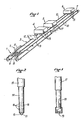
- the device shown successively comprises the following stations: introduction station 1, retraction station 2, inspection station 3, allantoic liquid sampling station 4, liquid introduction laboratory 5, liquid sampling laboratory 6, and evacuation station tion 7 (by tipping in a bin).
- the eggs are transported from one station to another in the trays 8 shown diagrammatically and comprising a plurality of regularly arranged cells, each containing an egg.
- the trays 8 are transported by a first pair of endless side chains 9 extending from station 1 to station 6 and then by a second pair of similar chains 10, located in the extension of chains 9 and extending from station 5 at evacuation station 7.
- the tray set up on the chains at station 1 is then first conveyed to station 2 where it stops.
- the top ends of the eggs placed in the cells are uncapped using, for example, a transversely movable blade 11, the sectioned caps being removed in a manner known per se.
- the tray then passes to station 3.
- a mirror 12 suitably inclined allows the operator to identify those of the eggs which, because of their deficient state, should not be sampled. It selects these eggs by entering, in electronic means known per se, the coordinates of each egg selected on the tray, for example using a numeric keyboard.
- the corresponding information is kept in a first memory so that, when the plate 8 is brought to the next step under the picking station 4, the selected eggs are not subject to any picking.
- the sampling station 4 comprises a plurality of sampling needles 13 disposed above the conveyor chains, these needles 13 being movable vertically from an elevated position above the eggs to a lowered position in which they penetrate into the allantoic cavity of the respective eggs, stopping at a sufficient distance before the bottom of this cavity to not not reach the yolk.
- suction of the allantoic liquid is carried out by the needles 13. It can be seen in FIG.
- such a needle 13 advantageously has an end 14 terminating conically at 15, this end being provided with a plurality of suction orifices 16 opening into a central channel (not shown), the liquid thus withdrawn then being taken up through suitable tubing to a collection container.
- the needles 13 again move upwards and leave the allandoid cavities of the eggs.
- the subsequent movement of the chains 9 then causes the tray 8 to pass over the chains 10 and the tray 8 to be positioned under the liquid introduction station 5.
- the quantity of allantoic fluid collected at station 4 generally varies from 6 to 13 ml per egg and there remains on average 1 ml of allantoic fluid in each egg, this quantity actually varying in fairly considerable proportions depending on the individual eggs.
- the station 5 comprises a plurality of needles or nozzles for introducing liquid 17, also arranged in step with the eggs in the cells and which are stationary.
- a view of such a needle 17 which has a central passage 18 in the lower end of which is screwed a hollow part ending in a frustoconical nozzle 19, preferably with a small opening angle.
- Liquid injection which passes through the central passage 18 then which leaves in the form of a conical jet flared out of the nozzle 19, takes place when the egg is located under the needle.
- the vertical distance between the upper part of the opened egg and the nozzle 19 is preferably adjustable between 0 and 10 mm.
- the distance between the station 5 and the injected liquid sampling station 6 is relatively large so that between the injection of liquid and the sampling, there is a period of one minute thirty.
- the station 6 is, as regards its construction, identical to the station 4 and has a plurality of needles 13 arranged in the same way at the pitch of the cells.
- the needles 13 descend then penetrate into the allantoic cavities of the eggs and suck the mixture formed by the injected liquid and the residual quantity of allantoic liquid not withdrawn at station 5. This aspiration provides about 5 ml of this liquid mixture on average per egg.
- the liquid withdrawn is either treated separately, or preferably purely and simply mixed with the collection of allantoic liquid from station 5.
- the plate 8 After raising the needles 13 of the station 6, the plate 8 can be evacuated by the evacuation station 7.
- the information concerning the selected eggs has also been sent to a second memory which makes it possible to avoid, for the selected eggs, the operation of needles 17 of station 5 and needles 13 of station 6.
- the liquid used is preferably 0.125 M sodium citrate in distilled water.
- other solutions such as physiological solutions of sodium chloride, different commonly used saline solutions or any suitable buffer solutions.
- influenza virus yield observed on average is around 25 to 30%, which is much higher than the percentage represented by the volume of allantoic fluid not harvested in station 3. This additional yield comes from the fact that virus not present in the allantoic fluid is extracted by the injected fluid, and collected.
Landscapes
- Life Sciences & Earth Sciences (AREA)
- Health & Medical Sciences (AREA)
- Chemical & Material Sciences (AREA)
- Organic Chemistry (AREA)
- Zoology (AREA)
- Engineering & Computer Science (AREA)
- Bioinformatics & Cheminformatics (AREA)
- Wood Science & Technology (AREA)
- Genetics & Genomics (AREA)
- General Engineering & Computer Science (AREA)
- Biotechnology (AREA)
- Microbiology (AREA)
- Biomedical Technology (AREA)
- Biochemistry (AREA)
- General Health & Medical Sciences (AREA)
- Molecular Biology (AREA)
- Sustainable Development (AREA)
- Virology (AREA)
- Medicinal Chemistry (AREA)
- Immunology (AREA)
- Apparatus Associated With Microorganisms And Enzymes (AREA)
- Micro-Organisms Or Cultivation Processes Thereof (AREA)
Applications Claiming Priority (2)
| Application Number | Priority Date | Filing Date | Title |
|---|---|---|---|
| FR8118675A FR2514027A1 (fr) | 1981-10-05 | 1981-10-05 | Procede et dispositif de recolte de liquide allantoique dans des oeufs embryonnes |
| FR8118675 | 1981-10-05 |
Publications (2)
| Publication Number | Publication Date |
|---|---|
| EP0077704A1 true EP0077704A1 (de) | 1983-04-27 |
| EP0077704B1 EP0077704B1 (de) | 1985-05-02 |
Family
ID=9262729
Family Applications (1)
| Application Number | Title | Priority Date | Filing Date |
|---|---|---|---|
| EP19820401802 Expired EP0077704B1 (de) | 1981-10-05 | 1982-10-04 | Verfahren und Anlage zur Erlangung von Allantoisflüssigkeit in embryonierten Eiern |
Country Status (3)
| Country | Link |
|---|---|
| EP (1) | EP0077704B1 (de) |
| DE (1) | DE3263423D1 (de) |
| FR (1) | FR2514027A1 (de) |
Cited By (1)
| Publication number | Priority date | Publication date | Assignee | Title |
|---|---|---|---|---|
| WO2016122950A1 (en) * | 2015-01-26 | 2016-08-04 | Zoetis Services Llc | Apparatus for harvesting egg fluid, and associated method |
Citations (1)
| Publication number | Priority date | Publication date | Assignee | Title |
|---|---|---|---|---|
| FR1432540A (fr) * | 1963-07-15 | 1966-03-25 | Merck & Co Inc | Appareil destiné à propager un virus dans des oeufs |
-
1981
- 1981-10-05 FR FR8118675A patent/FR2514027A1/fr active Granted
-
1982
- 1982-10-04 DE DE8282401802T patent/DE3263423D1/de not_active Expired
- 1982-10-04 EP EP19820401802 patent/EP0077704B1/de not_active Expired
Patent Citations (1)
| Publication number | Priority date | Publication date | Assignee | Title |
|---|---|---|---|---|
| FR1432540A (fr) * | 1963-07-15 | 1966-03-25 | Merck & Co Inc | Appareil destiné à propager un virus dans des oeufs |
Non-Patent Citations (1)
| Title |
|---|
| A.MAYR et al.: "Virologische Arbeitsmethoden"., Tome I, 1974, Veb Gustav Fischer Verlag, Jena (DD), pages 495 - 496 * |
Cited By (6)
| Publication number | Priority date | Publication date | Assignee | Title |
|---|---|---|---|---|
| WO2016122950A1 (en) * | 2015-01-26 | 2016-08-04 | Zoetis Services Llc | Apparatus for harvesting egg fluid, and associated method |
| KR20170100589A (ko) * | 2015-01-26 | 2017-09-04 | 조에티스 서비시즈 엘엘씨 | 알 유체를 수확하기 위한 장치 및 연관된 방법 |
| JP2018505665A (ja) * | 2015-01-26 | 2018-03-01 | ゾエティス・サービシーズ・エルエルシー | 卵液を採収するための装置及び関連する方法 |
| AU2016211809B2 (en) * | 2015-01-26 | 2019-08-01 | Zoetis Services Llc | Apparatus for harvesting egg fluid, and associated method |
| US10415019B2 (en) | 2015-01-26 | 2019-09-17 | Zoetis Services Llc | Apparatus for harvesting egg fluid, and associated method |
| US11085028B2 (en) | 2015-01-26 | 2021-08-10 | Zoetis Services Llc | Apparatus for harvesting egg fluid, and associated method |
Also Published As
| Publication number | Publication date |
|---|---|
| DE3263423D1 (en) | 1985-06-05 |
| EP0077704B1 (de) | 1985-05-02 |
| FR2514027B1 (de) | 1983-12-09 |
| FR2514027A1 (fr) | 1983-04-08 |
Similar Documents
| Publication | Publication Date | Title |
|---|---|---|
| EP2066261B1 (de) | Gerät zum befüllen von besamungsröhrchen | |
| CN101479173B (zh) | 单个提取眼用透镜的方法和装置 | |
| FR3056079B1 (fr) | Installation et procede de production de plantes en aeroponie / hydroponie | |
| US6371014B1 (en) | Fresh commodity peeling system and method | |
| FR2700918A1 (fr) | Installation pour la culture hors-sol de plantes. | |
| EP1383862A2 (de) | Inkubator und organismenschonende verfahren zur inkubation | |
| FR2525873A1 (fr) | Machine a denoyauter les fruits secs a pulpe sirupeuse | |
| CN114846967B (zh) | 一种可降解穴盘用旱地移栽装置 | |
| EP0077704B1 (de) | Verfahren und Anlage zur Erlangung von Allantoisflüssigkeit in embryonierten Eiern | |
| FR3002832A1 (fr) | Machine pour la separation des cerneaux et des coques de noix | |
| US3420743A (en) | Harvesting biologicals from eggs | |
| FR2539628A1 (fr) | Procede de separation de cellules mobiles, notamment de spermatozoides mobiles, ainsi que dispositif pour la mise en oeuvre de ce procede | |
| JP2003519502A (ja) | 柑橘系果物の皮剥きのための方法および装置 | |
| FR2521162A1 (fr) | Trepan semi-automatique pour realiser des cavites dans une couche de matiere gelifiee | |
| FR2873894A1 (fr) | Procede et dispositif d'injection d'oeufs | |
| CN221190308U (zh) | 一种拆盘输送设备 | |
| WO1994015454A1 (en) | An apparatus for sorting eggshells and unhatched eggs from newly hatched chickens | |
| FR2542574A1 (fr) | Procede et dispositif de prelevement et collecte hygienique de sang animal | |
| CN222758208U (zh) | 一种疫苗自动收获设备 | |
| BE1018120A3 (nl) | Werkwijze en inrichting voor het verwijderen van een samenhangende vulling uit een koker. | |
| FR2738988A1 (fr) | Machine automatique permettant de realiser le depotage et rempotage de plants et dispositif permettant la manutention desdits plants utilisables sur une telle machine | |
| CN121046179A (zh) | 一种疫苗自动收获设备 | |
| FR2638323A1 (fr) | Procede et dispositif pour le traitement du sperme | |
| EP4355090A1 (de) | Maschine zum injizieren von eiern und verfahren zum injizieren mindestens einer flüssigen substanz in eier | |
| JPH0423922A (ja) | きのこ培養基を除去する方法およびその装置 |
Legal Events
| Date | Code | Title | Description |
|---|---|---|---|
| PUAI | Public reference made under article 153(3) epc to a published international application that has entered the european phase |
Free format text: ORIGINAL CODE: 0009012 |
|
| AK | Designated contracting states |
Designated state(s): DE IT NL |
|
| 17P | Request for examination filed |
Effective date: 19831012 |
|
| ITF | It: translation for a ep patent filed | ||
| GRAA | (expected) grant |
Free format text: ORIGINAL CODE: 0009210 |
|
| AK | Designated contracting states |
Designated state(s): DE IT NL |
|
| REF | Corresponds to: |
Ref document number: 3263423 Country of ref document: DE Date of ref document: 19850605 |
|
| PLBE | No opposition filed within time limit |
Free format text: ORIGINAL CODE: 0009261 |
|
| STAA | Information on the status of an ep patent application or granted ep patent |
Free format text: STATUS: NO OPPOSITION FILED WITHIN TIME LIMIT |
|
| 26N | No opposition filed | ||
| ITTA | It: last paid annual fee | ||
| ITPR | It: changes in ownership of a european patent |
Owner name: CESSIONE;PASTEUR MERIEUX SERUME ET VACCINE |
|
| NLS | Nl: assignments of ep-patents |
Owner name: PASTEUR MERIEUX SERUMS ET VACCINS TE LYON, FRANKRI |
|
| PGFP | Annual fee paid to national office [announced via postgrant information from national office to epo] |
Ref country code: NL Payment date: 20010918 Year of fee payment: 20 |
|
| PGFP | Annual fee paid to national office [announced via postgrant information from national office to epo] |
Ref country code: DE Payment date: 20011010 Year of fee payment: 20 |
|
| PG25 | Lapsed in a contracting state [announced via postgrant information from national office to epo] |
Ref country code: NL Free format text: LAPSE BECAUSE OF EXPIRATION OF PROTECTION Effective date: 20021004 |
|
| NLV7 | Nl: ceased due to reaching the maximum lifetime of a patent |
Effective date: 20021004 |