EP0078023A1 - Procédé pour traiter des matières cellulosiques avec de l'acide fluorhydrique gazeux - Google Patents
Procédé pour traiter des matières cellulosiques avec de l'acide fluorhydrique gazeux Download PDFInfo
- Publication number
- EP0078023A1 EP0078023A1 EP82109718A EP82109718A EP0078023A1 EP 0078023 A1 EP0078023 A1 EP 0078023A1 EP 82109718 A EP82109718 A EP 82109718A EP 82109718 A EP82109718 A EP 82109718A EP 0078023 A1 EP0078023 A1 EP 0078023A1
- Authority
- EP
- European Patent Office
- Prior art keywords
- desorption
- gas
- substrate
- reactor
- sorption
- Prior art date
- Legal status (The legal status is an assumption and is not a legal conclusion. Google has not performed a legal analysis and makes no representation as to the accuracy of the status listed.)
- Granted
Links
- 239000000463 material Substances 0.000 title claims abstract description 25
- KRHYYFGTRYWZRS-UHFFFAOYSA-N Fluorane Chemical compound F KRHYYFGTRYWZRS-UHFFFAOYSA-N 0.000 title claims description 42
- 238000000034 method Methods 0.000 title claims description 20
- 239000007789 gas Substances 0.000 claims abstract description 110
- 238000003795 desorption Methods 0.000 claims abstract description 91
- 239000000758 substrate Substances 0.000 claims abstract description 66
- 238000001179 sorption measurement Methods 0.000 claims abstract description 58
- 229920002678 cellulose Polymers 0.000 claims abstract description 13
- 239000001913 cellulose Substances 0.000 claims abstract description 12
- 238000010924 continuous production Methods 0.000 claims abstract description 3
- 229910000040 hydrogen fluoride Inorganic materials 0.000 claims description 29
- 239000002023 wood Substances 0.000 claims description 21
- IJGRMHOSHXDMSA-UHFFFAOYSA-N Atomic nitrogen Chemical compound N#N IJGRMHOSHXDMSA-UHFFFAOYSA-N 0.000 claims description 13
- 239000012159 carrier gas Substances 0.000 claims description 11
- 238000009835 boiling Methods 0.000 claims description 10
- 230000029087 digestion Effects 0.000 claims description 8
- 238000010438 heat treatment Methods 0.000 claims description 8
- 229910052757 nitrogen Inorganic materials 0.000 claims description 7
- 239000002699 waste material Substances 0.000 claims description 4
- 239000010893 paper waste Substances 0.000 claims description 3
- 230000005284 excitation Effects 0.000 claims 1
- 238000006243 chemical reaction Methods 0.000 abstract description 12
- 239000011261 inert gas Substances 0.000 abstract description 10
- 230000003301 hydrolyzing effect Effects 0.000 abstract description 2
- 239000000203 mixture Substances 0.000 description 22
- 235000010980 cellulose Nutrition 0.000 description 11
- 238000011068 loading method Methods 0.000 description 10
- XLYOFNOQVPJJNP-UHFFFAOYSA-N water Substances O XLYOFNOQVPJJNP-UHFFFAOYSA-N 0.000 description 9
- QTBSBXVTEAMEQO-UHFFFAOYSA-N Acetic acid Chemical compound CC(O)=O QTBSBXVTEAMEQO-UHFFFAOYSA-N 0.000 description 6
- 238000000605 extraction Methods 0.000 description 5
- 241000196324 Embryophyta Species 0.000 description 4
- 239000002253 acid Substances 0.000 description 4
- 238000001816 cooling Methods 0.000 description 4
- 229910052500 inorganic mineral Inorganic materials 0.000 description 4
- 229920005610 lignin Polymers 0.000 description 4
- 239000011707 mineral Substances 0.000 description 4
- 230000001413 cellular effect Effects 0.000 description 3
- 238000010586 diagram Methods 0.000 description 3
- 238000000855 fermentation Methods 0.000 description 3
- 230000004151 fermentation Effects 0.000 description 3
- 230000007062 hydrolysis Effects 0.000 description 3
- 238000006460 hydrolysis reaction Methods 0.000 description 3
- 239000007788 liquid Substances 0.000 description 3
- 239000000126 substance Substances 0.000 description 3
- 235000000346 sugar Nutrition 0.000 description 3
- 241000609240 Ambelania acida Species 0.000 description 2
- CURLTUGMZLYLDI-UHFFFAOYSA-N Carbon dioxide Chemical compound O=C=O CURLTUGMZLYLDI-UHFFFAOYSA-N 0.000 description 2
- WQZGKKKJIJFFOK-GASJEMHNSA-N Glucose Natural products OC[C@H]1OC(O)[C@H](O)[C@@H](O)[C@@H]1O WQZGKKKJIJFFOK-GASJEMHNSA-N 0.000 description 2
- VEXZGXHMUGYJMC-UHFFFAOYSA-N Hydrochloric acid Chemical compound Cl VEXZGXHMUGYJMC-UHFFFAOYSA-N 0.000 description 2
- 241000218657 Picea Species 0.000 description 2
- QAOWNCQODCNURD-UHFFFAOYSA-N Sulfuric acid Chemical compound OS(O)(=O)=O QAOWNCQODCNURD-UHFFFAOYSA-N 0.000 description 2
- 150000007513 acids Chemical class 0.000 description 2
- SRBFZHDQGSBBOR-LECHCGJUSA-N alpha-D-xylose Chemical compound O[C@@H]1CO[C@H](O)[C@H](O)[C@H]1O SRBFZHDQGSBBOR-LECHCGJUSA-N 0.000 description 2
- 239000010905 bagasse Substances 0.000 description 2
- 238000007664 blowing Methods 0.000 description 2
- 150000001720 carbohydrates Chemical class 0.000 description 2
- 238000009833 condensation Methods 0.000 description 2
- 230000005494 condensation Effects 0.000 description 2
- 230000001419 dependent effect Effects 0.000 description 2
- 239000008103 glucose Substances 0.000 description 2
- 239000000047 product Substances 0.000 description 2
- 229910001220 stainless steel Inorganic materials 0.000 description 2
- 239000010935 stainless steel Substances 0.000 description 2
- 239000010902 straw Substances 0.000 description 2
- 150000008163 sugars Chemical class 0.000 description 2
- 238000011144 upstream manufacturing Methods 0.000 description 2
- 229960003487 xylose Drugs 0.000 description 2
- 238000009622 Bergius process Methods 0.000 description 1
- 235000008733 Citrus aurantifolia Nutrition 0.000 description 1
- LFQSCWFLJHTTHZ-UHFFFAOYSA-N Ethanol Chemical compound CCO LFQSCWFLJHTTHZ-UHFFFAOYSA-N 0.000 description 1
- PXGOKWXKJXAPGV-UHFFFAOYSA-N Fluorine Chemical compound FF PXGOKWXKJXAPGV-UHFFFAOYSA-N 0.000 description 1
- 229920002488 Hemicellulose Polymers 0.000 description 1
- UFHFLCQGNIYNRP-UHFFFAOYSA-N Hydrogen Chemical compound [H][H] UFHFLCQGNIYNRP-UHFFFAOYSA-N 0.000 description 1
- 239000004698 Polyethylene Substances 0.000 description 1
- 235000011941 Tilia x europaea Nutrition 0.000 description 1
- 238000010521 absorption reaction Methods 0.000 description 1
- 230000001476 alcoholic effect Effects 0.000 description 1
- WUKWITHWXAAZEY-UHFFFAOYSA-L calcium difluoride Chemical compound [F-].[F-].[Ca+2] WUKWITHWXAAZEY-UHFFFAOYSA-L 0.000 description 1
- AXCZMVOFGPJBDE-UHFFFAOYSA-L calcium dihydroxide Chemical compound [OH-].[OH-].[Ca+2] AXCZMVOFGPJBDE-UHFFFAOYSA-L 0.000 description 1
- 229910001634 calcium fluoride Inorganic materials 0.000 description 1
- 239000000920 calcium hydroxide Substances 0.000 description 1
- 229910001861 calcium hydroxide Inorganic materials 0.000 description 1
- 235000014633 carbohydrates Nutrition 0.000 description 1
- 239000001569 carbon dioxide Substances 0.000 description 1
- 229910002092 carbon dioxide Inorganic materials 0.000 description 1
- 230000015556 catabolic process Effects 0.000 description 1
- 238000003776 cleavage reaction Methods 0.000 description 1
- 239000012084 conversion product Substances 0.000 description 1
- 239000002826 coolant Substances 0.000 description 1
- 230000006378 damage Effects 0.000 description 1
- 238000006731 degradation reaction Methods 0.000 description 1
- 238000005516 engineering process Methods 0.000 description 1
- 238000001704 evaporation Methods 0.000 description 1
- 230000008020 evaporation Effects 0.000 description 1
- 238000011049 filling Methods 0.000 description 1
- 239000000706 filtrate Substances 0.000 description 1
- 238000001914 filtration Methods 0.000 description 1
- 239000011737 fluorine Substances 0.000 description 1
- 229910052731 fluorine Inorganic materials 0.000 description 1
- 239000000446 fuel Substances 0.000 description 1
- 150000004676 glycans Chemical class 0.000 description 1
- 229910052739 hydrogen Inorganic materials 0.000 description 1
- 239000001257 hydrogen Substances 0.000 description 1
- 230000001771 impaired effect Effects 0.000 description 1
- 239000004571 lime Substances 0.000 description 1
- 229920002521 macromolecule Polymers 0.000 description 1
- 238000004519 manufacturing process Methods 0.000 description 1
- 239000000178 monomer Substances 0.000 description 1
- 238000006386 neutralization reaction Methods 0.000 description 1
- 229910052756 noble gas Inorganic materials 0.000 description 1
- 150000002835 noble gases Chemical class 0.000 description 1
- 238000013021 overheating Methods 0.000 description 1
- -1 polyethylene Polymers 0.000 description 1
- 229920000573 polyethylene Polymers 0.000 description 1
- 229920001282 polysaccharide Polymers 0.000 description 1
- 239000005017 polysaccharide Substances 0.000 description 1
- 102000004169 proteins and genes Human genes 0.000 description 1
- 108090000623 proteins and genes Proteins 0.000 description 1
- 239000002994 raw material Substances 0.000 description 1
- 239000011541 reaction mixture Substances 0.000 description 1
- 238000011084 recovery Methods 0.000 description 1
- 230000001105 regulatory effect Effects 0.000 description 1
- 230000007017 scission Effects 0.000 description 1
- 239000002904 solvent Substances 0.000 description 1
- 238000003860 storage Methods 0.000 description 1
- 239000000341 volatile oil Substances 0.000 description 1
- 238000010626 work up procedure Methods 0.000 description 1
Images

Classifications
-
- C—CHEMISTRY; METALLURGY
- C13—SUGAR INDUSTRY
- C13K—SACCHARIDES OBTAINED FROM NATURAL SOURCES OR BY HYDROLYSIS OF NATURALLY OCCURRING DISACCHARIDES, OLIGOSACCHARIDES OR POLYSACCHARIDES
- C13K1/00—Glucose; Glucose-containing syrups
- C13K1/02—Glucose; Glucose-containing syrups obtained by saccharification of cellulosic materials
Definitions
- cellulosic material e.g. Wood or waste from annual plants that can chemically digest with mineral acids.
- the cellulose contained which is a macromolecular substance, is broken down into glycosidic bonds into water-soluble, smaller molecules down to the monomer units, the glucose molecules.
- the sugars obtained in this way can include fermented into alcohol or used as a fermentation raw material for the production of proteins.
- This is the technical meaning of wood saccharification.
- mineral acids suitable for this purpose dilute sulfuric acid (Scholler process) and concentrated hydrochloric acid (Bergius process) were used on an industrial scale decades ago; see e.g. Ullmann's Encyclopedia of Technical Chemistry, 3rd edition, Kunststoff-Berlin, 1957, Volume 8, pp. 591 ff.
- DE-PS 585 318 describes a method and a device for treating wood with gaseous hydrogen fluoride, in which hydrogen fluoride gas, which can be diluted with an inert gas, is reacted with wood in a first zone of a reaction tube with a screw conveyor, that this zone is cooled from the outside below the boiling point of the hydrogen fluoride. After the digestion, which may take place in an intermediate zone, the hydrogen fluoride is expelled by external heating and / or blowing out with an inert gas stream in order to be brought back into contact with fresh wood in the cooling zone mentioned.
- the high technical outlay in this process is not only due to the vacuum technology itself, but also due to the fact that the boiling point of hydrogen fluoride falls below the value of -20 ° C at 150 mbar; this means that condensation is no longer possible without the aid of complex coolants or units.
- gaseous hydrogen fluoride in a mixture with an inert carrier gas can be circulated almost without loss, producing a load of the substrate required for good yields, without the technically highly disadvantageous cooling below the boiling point of the hydrogen fluoride being necessary.
- This is achieved by dividing the desorption process into several stages, in which the desorption takes place in cocurrent or countercurrent of HF gas mixtures and reaction material (substrate).
- HF gas mixtures of different HF concentrations are formed, which act on the substrate at different points in the sorption stage in such a way that low-HF gas mixtures affect unloaded or HF-loaded material, Act gas mixtures with higher HF concentrations on already heavily loaded material.
- the subject of the invention is thus a continuous process for the digestion of cellulose-containing material (substrate) with gaseous hydrogen fluoride by sorption of the HF and subsequent desorption, which is characterized in that the HF is sorbed by the substrate at a temperature above its boiling point in a sorption stage, and that the substrate is then freed from the sorbed HF by heating in n desorption stages, n being an integer and the stages mentioned running in gas-tight reactors, and the substrate being introduced into the sorption reactor through a gas-tight lock and then successively through gas-tight locks into the first, second ).
- n is an integer. preferably from 2 to 6, in particular from 2 to 4.
- the reactors separated from one another by gas-tight locks can be of the same or different types: for example, stirred vessels are suitable.
- Wood or waste from annual plants e.g. straw or bagasse
- a pre-hydrolyzate of wood or waste from annual plants e.g. straw or bagasse
- waste paper e.g., a pre-hydrolyzate of wood or waste from annual plants, or, also preferably, waste paper
- This water can either be introduced by being present in the substrate as residual moisture of 0.5 to 20, preferably 1 to 10, in particular 3 to 7% by weight, or by being contained in the HF inert gas mixture, or in both.
- reaction material (substrate), the cellulose-containing material, is transported from one reactor to another, for example, by free fall, via rotary feeders and / or by screw conveyors.
- Air and nitrogen are suitable as inert carrier gases.
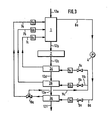
- the gas flow takes place according to the invention in such a way that the gas outlet opening of a sorption reactor is connected via a gas line with an intermediate gas pump (blower) and n-1 branches to the gas inlet openings of n desorption reactors, and the gas outlet openings of these n desorption reactors are connected via gas lines to n gas inlet openings of the sorption reactor.
- a valve and a heat exchanger are interposed in front of the gas inlet openings of the desorption reactors.
- Heat exchangers can also be arranged in front of the gas inlet openings of the sorption reactor.
- They may have the task of bringing the gas mixture intended for sorption to the optimum temperature for this. They may also have the task of accompanying substances in the feed material, such as water, which may have been released during the desorption. Condense acetic acid, essential oils, but let the hydrogen fluoride pass in gaseous form.
- the gas flow leaving the sorption reactor and containing a maximum of 5% by weight HF, preferably almost completely HF-free, is divided by the branches into n partial gas flows, the size of which depends on the respective setting of the. Valves depends.
- n partial gas flows are heated in the heat exchangers to the temperature required for the desorption and are allowed to act on the substrate in the desorption reactors in countercurrent to, or preferably in cocurrent with, the substrate.
- the n partial gas flows are again enriched with HF by the HF released during the desorption.
- This enrichment with HF is of different sizes in the individual partial gas streams.
- a lot of HF is released during the desorption of the substrate, which is introduced here with maximum HF loading.
- the desorption takes place with substrate, that in the previous desorption stages HF has already been freed ever further.
- the last (nth) desorption reactor only a little HF is released, since the substrate is already introduced into HF, largely depleted in HF.
- the substrate only contains HF traces.
- the division into n partial gas streams can also be carried out in such a way that the gas stream leaving the gas outlet opening of the sorption reactor is first fed completely through the pump to the last (nth) desorption reactor - after heating in the upstream heat exchanger. in which it acts on the already largely depleted HF substrate. Only after leaving this last (nth) desorption reactor is the gas stream divided into an (nth) partial gas stream, which is fed directly to the corresponding gas inlet opening of the sorption reactor, and n-1 partial gas flows, which are directed to the penultimate ((n-1) -th) to the first desorption reactor, after heating in the respective upstream heat exchanger.
- the HF concentration in the n-th HF carrier gas stream leaving the last (n-th) desorption reactor is relatively low and increases more and more in the penultimate ((n-1) th) and the previous ones and is in the first HF carrier gas stream, which leaves the first desorption reactor, is highest (up to over 95% by weight). .
- the HF carrier gas streams of different HF concentrations are fed through gas lines to the n gas inlet openings of the sorption reactor, in such a way that the nth HF gas flow onto only a little HF-loaded substrate and the first HF gas flow onto the HF ( almost) maximum loaded substrate.
- the remaining HF gas streams are fed to the substrate at gas inlet openings of the sorption reactor located in between.
- the maximum HF loading of the cellulose-containing material depends on its type and nature and on the residence time in the sorption stage and is accordingly between 10 and 120%, preferably between 30 and 80%, based on the weight of the material used.
- the substrate loaded with HF after leaving the sorption reactor and before entering the first desorption reactor, can still pass through a dwell reactor which may have a comminution device for coarse reaction material and the temperature of which is expediently kept in a range which is dependent on the temperatures in the last part of the sorption reactor and is trapped in the first desorption reactor.
- the optimal dwell time i.e. the average length of stay of the substrate in the apparatus from the beginning of the sorption to the end of the desorption depends on the type and nature of the material to be digested and must be matched to the respective case. Accordingly, it can range from about 30 minutes to about 5 hours.
- the arrangement according to the invention allows the flow rate and temperature of the HF carrier gas mixture to be adapted to the requirements which are different in the individual regions of the sorption stage and in the individual desorption stages and are dependent on the HF loading degree of the substrate.
- the sorption reactor 1 is connected to the desorption reactor 3a via the gas line 8a, the pump 4, the valve 9a and the heat exchanger 5a, and this is connected to the sorption reactor 1 via the gas line 7a and the heat exchanger 6a. Furthermore, the sorption reactor 1 is connected to the desorption reactors 3b or 3c via the gas line 8a, the pump 4, the gas lines 8b or 8c, the valves 9b or 9c and the heat exchangers 5b or 5c, and this is via the gas lines 7b or 7c and the heat exchangers 6b and 6c are connected to the sorption reactor 1.
- the cellulosic material (substrate) to be digested is introduced into the sorption reactor 1. This process is symbolized by the arrows 12a in FIGS. 1 and 3.
- HF-inert gas mixtures the HF concentration of which is lowest in gas line 7a and highest in gas line 7c, are supplied to sorption reactor 1 through gas lines 7a, 7b and 7c. In the sorption reactor 1, they flow against the substrate and emerge from the reactor 1 as an almost completely HF-free total gas stream.
- the substrate loaded with HF is transported from the sorption reactor 1 into the dwell reactor 2 (arrow 12b) and from there successively into the first, second and third desorption reactors 3c, 3b and 3a (arrows 12c, 12d and 12e).
- the gas stream leaving the sorption reactor 1 is divided into three partial flows after passing through the gas line 8a and the pump 4, in accordance with the respective setting of the valves 9a, 9b and 9c. After heating in the heat exchangers 5a or 5b or 5c, these partial gas flows enter the desorption reactors 3a or 3b or 3c and flow through them in countercurrent to, or, preferably, in cocurrent with the substrate.
- HF is desorbed by the action of the heated gas streams on the HF-loaded substrate.
- the first desorption reactor 3c since the substrate with maximum HF loading is introduced, most HF is released by desorption, a smaller amount is released in the reactor 3b, and in the last desorption reactor 3a, into which the substrate already largely frees from HF, the smallest amount of HF is released. Accordingly, the HF concentrations in the gas streams leaving the desorption reactors are highest in reactor 3c and lowest in reactor 3a.
- the HF gas stream which emerges from the reactor 3b has an intermediate HF concentration in between.
- the HF gas streams of different HF concentrations are fed into the sorption reactor 1 at various inlet points through the gas lines 7a or 7b or 7c after passing through the interposed heat exchangers 6a or 6b or 6c.
- the HF gas flow from the gas line 7a with the lowest HF concentration strikes substrate which is only very slightly loaded with HF.
- the HF gas stream from the gas line 7c with the highest HF concentration strikes the substrate which (almost) has the maximum HF loading.
- the HF gas flow from the gas line 7b is allowed to act on the substrate at an intermediate point of the sorption reactor 1, which substrate already has a relatively high HF load.
- the substrate After desorption has taken place in the reactor 3a, the substrate leaves it in an open form (arrow 12f). It only contains traces of residual hydrogen fluoride and is processed, which is carried out in a manner known per se.
- a special embodiment is shown schematically in Figure 2.
- a three-way valve (10) is interposed in the gas line 7a, which allows a (more or less large) part of the HF gas stream emerging from the desorption reactor 3a to be passed into a gas line (11) special circuit again and to be introduced between the valve 9a and an intermediate pump (4a) into the gas line 8a via a branch.
- the three-way valve 10 can also be a control valve.
- the part of the HF inert gas mixture which is returned in this special cycle is about 10 to about 90%, preferably about 50 to about 90%, of the total mixture which leaves the desorption reactor 3a.
- This particular arrangement which analogously also allows partial recirculation of the HF inert gas mixtures leaving the desorption reactors 3c or 3b, allows the gas velocities of the HF inert gas mixtures passing through to be optimized.
- FIG. 3 shows a further special embodiment of the method according to the invention.
- a three-way valve (10a) is interposed in the gas line 7a, which allows the gas stream leaving the sorption reactor 1 to be divided into partial gas streams only after it has passed the desorption reactor 3a. While a partial flow only passes through the reactor 3a and is fed directly to the sorption reactor 1, the other two partial flows are still passed through a second desorption reactor (3c or 3b) before they are fed to the reactor 1 through the gas lines 7c or 7b.
- This particular embodiment allows the largest possible amount of gas, ie the total amount of carrier gas, to act on the substrate in the last desorption stage, as a result of which the desorption is accelerated.
- the digested material produced by the process according to the invention is a mixture of lignin and oligomeric saccharides. It can be worked up in a manner known per se by extraction with water, advantageously in the heat or boiling heat, and by simultaneous or subsequent neutralization with lime. Filtration provides lignin, e.g. can be used as fuel, as well as a small amount of calcium fluoride, which results from the residual hydrogen fluoride contained in the reaction material. The filtrate, a clear, slightly yellowish sugar solution, can be added to the alcoholic fermentation or fermentation either immediately or after setting an appropriate concentration. The dissolved, oligomeric sugars can also be treated by brief post-treatment, e.g. with highly diluted mineral acid at temperatures above 100 ° C, almost quantitatively converted into glucose.
- Example 1 was carried out in an apparatus arrangement which is shown schematically in FIG. 1. It consisted of a sorption reactor (1), a residence reactor (2) and three desorption reactors (3a, 3b, 3c), which were connected to each other by pipelines and cellular wheel locks.
- a vertical tube made of stainless steel with a clear width of 5 cm and a length of 80 cm was used as the sorption reactor, which carried a gas-tight rotary valve with a filling funnel at the upper end and was also provided with a gas-tight rotary valve at the lower end.
- In the longitudinal axis of the tube was a slowly rotating shaft with narrow wings. At 3 points, which were distributed over the lower two thirds of the pipe length, there were inlets for HF-containing gases.
- the gas outlet opening was located just below the top rotary valve.
- the indwelling reactor was a cylindrical vessel of approx. 2 1 contents made of semi-transparent polyethylene.
- the desorption reactors were made of stainless steel and were heatable rotary tube reactors trained, which could be flowed through in the same direction by the substrate and by the flowing gases.
- the usable volume of the desorption reactors was approximately 3 l each.
- Second desorption reactor (3b) The product loaded with HF was introduced from the first desorption reactor (3c) by means of a gas-tight rotary valve; a substrate with a loading of approx. 10: 100 was discharged; the desorption temperature was 70 - 80 ° C; the exiting gas mixture contained about 25% by weight of HF.
- Third desorption reactor (3a) The product loaded with HF was introduced from the second desorption reactor (3b) by means of a gas-tight rotary valve; a substrate with approximately 0.5% by weight HF was discharged; the desorption temperature was approx. 90 ° C; the exiting gas mixture contained about 5% by weight of HF.
- the three gas mixtures generated in the desorption reactors were fed through the pipelines (7a, 7b, 7c) and the heat exchangers (6a, 6b, 6c), where they were cooled to 25-30 ° C., into the sorption reactor ( 1) passed so that circuits of carrier gas (nitrogen) and HF came about with continuous conveyance of substrate through the apparatus.
- the digested substrate largely freed from HF, was extracted in the usual way with hot water
- raw spruce wood shavings were broken down to a residual moisture content of about 5% by weight.
- wood accompanying substances such as acetic acid were driven off and condensed and separated in the heat exchangers 6c to 6a.
- wood sugar was obtained in a yield of about 70% by weight, based on the carbohydrates contained in the material used.
Landscapes
- Chemical & Material Sciences (AREA)
- Health & Medical Sciences (AREA)
- Emergency Medicine (AREA)
- General Health & Medical Sciences (AREA)
- Life Sciences & Earth Sciences (AREA)
- Biochemistry (AREA)
- Organic Chemistry (AREA)
- Polysaccharides And Polysaccharide Derivatives (AREA)
- Solid-Sorbent Or Filter-Aiding Compositions (AREA)
Priority Applications (1)
| Application Number | Priority Date | Filing Date | Title |
|---|---|---|---|
| AT82109718T ATE12258T1 (de) | 1981-10-24 | 1982-10-21 | Verfahren zum aufschluss von zellulosehaltigem material mit gasfoermigem fluorwasserstoff. |
Applications Claiming Priority (2)
| Application Number | Priority Date | Filing Date | Title |
|---|---|---|---|
| DE3142215 | 1981-10-24 | ||
| DE19813142215 DE3142215A1 (de) | 1981-10-24 | 1981-10-24 | "verfahren zum aufschluss von zellulosehaltigem material mit gasfoermigem fluorwasserstoff" |
Publications (2)
| Publication Number | Publication Date |
|---|---|
| EP0078023A1 true EP0078023A1 (fr) | 1983-05-04 |
| EP0078023B1 EP0078023B1 (fr) | 1985-03-20 |
Family
ID=6144759
Family Applications (1)
| Application Number | Title | Priority Date | Filing Date |
|---|---|---|---|
| EP82109718A Expired EP0078023B1 (fr) | 1981-10-24 | 1982-10-21 | Procédé pour traiter des matières cellulosiques avec de l'acide fluorhydrique gazeux |
Country Status (5)
| Country | Link |
|---|---|
| US (1) | US4556432A (fr) |
| EP (1) | EP0078023B1 (fr) |
| AT (1) | ATE12258T1 (fr) |
| CA (1) | CA1192706A (fr) |
| DE (2) | DE3142215A1 (fr) |
Families Citing this family (10)
| Publication number | Priority date | Publication date | Assignee | Title |
|---|---|---|---|---|
| US4650689A (en) * | 1985-03-25 | 1987-03-17 | Urban Fuels, Inc. | Process for ethanol production from cellulosic materials |
| US5876505A (en) * | 1998-01-13 | 1999-03-02 | Thermo Fibergen, Inc. | Method of producing glucose from papermaking sludge using concentrated or dilute acid hydrolysis |
| US7815876B2 (en) | 2006-11-03 | 2010-10-19 | Olson David A | Reactor pump for catalyzed hydrolytic splitting of cellulose |
| US7815741B2 (en) | 2006-11-03 | 2010-10-19 | Olson David A | Reactor pump for catalyzed hydrolytic splitting of cellulose |
| DE102007030957A1 (de) * | 2007-07-04 | 2009-01-08 | Siltronic Ag | Verfahren zum Reinigen einer Halbleiterscheibe mit einer Reinigungslösung |
| EP2585606A4 (fr) | 2010-06-26 | 2016-02-17 | Virdia Ltd | Mélanges de sucres, méthodes de production et d'utilisation associées |
| IL206678A0 (en) | 2010-06-28 | 2010-12-30 | Hcl Cleantech Ltd | A method for the production of fermentable sugars |
| IL207329A0 (en) | 2010-08-01 | 2010-12-30 | Robert Jansen | A method for refining a recycle extractant and for processing a lignocellulosic material and for the production of a carbohydrate composition |
| IL207945A0 (en) | 2010-09-02 | 2010-12-30 | Robert Jansen | Method for the production of carbohydrates |
| US9512495B2 (en) | 2011-04-07 | 2016-12-06 | Virdia, Inc. | Lignocellulose conversion processes and products |
Citations (2)
| Publication number | Priority date | Publication date | Assignee | Title |
|---|---|---|---|---|
| DE577764C (de) * | 1930-03-18 | 1933-06-03 | I G Farbenindustrie Akt Ges | Verfahren zur Umwandlung von Polysacchariden |
| EP0051237A1 (fr) * | 1980-10-30 | 1982-05-12 | Hoechst Aktiengesellschaft | Procédé de préparation de saccharides à partir de matériaux cellulosiques |
Family Cites Families (4)
| Publication number | Priority date | Publication date | Assignee | Title |
|---|---|---|---|---|
| DE585318C (de) * | 1930-06-21 | 1933-10-02 | I G Farbenindustrie Akt Ges | Verfahren zur Behandlung fester oder fluessiger Stoffe mit Gasen oder Daempfen |
| US3481827A (en) * | 1968-08-02 | 1969-12-02 | Grace W R & Co | Process for bleaching wood pulp with fluorine,hydrofluoric acid,and oxygen difluoride |
| US3919041A (en) * | 1969-02-06 | 1975-11-11 | Ethyl Corp | Multi-stage chlorine dioxide delignification of wood pulp |
| US3619350A (en) * | 1969-07-11 | 1971-11-09 | Richard Marchfelder | Chlorine dioxide pulp bleaching system |
-
1981
- 1981-10-24 DE DE19813142215 patent/DE3142215A1/de not_active Withdrawn
-
1982
- 1982-10-21 EP EP82109718A patent/EP0078023B1/fr not_active Expired
- 1982-10-21 AT AT82109718T patent/ATE12258T1/de not_active IP Right Cessation
- 1982-10-21 DE DE8282109718T patent/DE3262696D1/de not_active Expired
- 1982-10-22 CA CA000414039A patent/CA1192706A/fr not_active Expired
-
1985
- 1985-03-12 US US06/710,533 patent/US4556432A/en not_active Expired - Fee Related
Patent Citations (2)
| Publication number | Priority date | Publication date | Assignee | Title |
|---|---|---|---|---|
| DE577764C (de) * | 1930-03-18 | 1933-06-03 | I G Farbenindustrie Akt Ges | Verfahren zur Umwandlung von Polysacchariden |
| EP0051237A1 (fr) * | 1980-10-30 | 1982-05-12 | Hoechst Aktiengesellschaft | Procédé de préparation de saccharides à partir de matériaux cellulosiques |
Non-Patent Citations (2)
| Title |
|---|
| BIOTECHNOLOGY AND BIOENGINEERING, Band XXIV, Nr. 4, April 1982, Seiten 903-918, John Wiley & Sons, New York, USA * |
| CHEMICAL ABSTRACTS, Band 96, Nr. 24, 14. Juni 1982, Seite 169, Nr. 202455v, Columbus, Ohio, USA * |
Also Published As
| Publication number | Publication date |
|---|---|
| DE3262696D1 (en) | 1985-04-25 |
| US4556432A (en) | 1985-12-03 |
| ATE12258T1 (de) | 1985-04-15 |
| DE3142215A1 (de) | 1983-05-05 |
| EP0078023B1 (fr) | 1985-03-20 |
| CA1192706A (fr) | 1985-09-03 |
Similar Documents
| Publication | Publication Date | Title |
|---|---|---|
| EP0054871B1 (fr) | Procédé pour l'hydrolyse de la cellulose à partir de matières végétales en glucose et dispositif pour la mise en oeuvre de ce procédé | |
| DE3216004C2 (fr) | ||
| EP0078023B1 (fr) | Procédé pour traiter des matières cellulosiques avec de l'acide fluorhydrique gazeux | |
| CH678183A5 (fr) | ||
| DE69526788T2 (de) | Verfahren zur fraktionierung von schlempe | |
| DE3040850C2 (de) | Verfahren zur Gewinnung wasserlöslicher Saccharide aus cellulosehaltigem Material | |
| DE3539492C2 (fr) | ||
| DE3142214C2 (fr) | ||
| DE3142216C2 (fr) | ||
| AT395983B (de) | Verfahren zur herstellung von aethanol aus zuckerhaeltigen rohstoffen sowie anlage zur durchfuehrung des verfahrens | |
| DE60024457T2 (de) | Ethanolherstellungsverfahren ohne destillationsschlempeproduktion | |
| SK50852005A3 (sk) | Systém na výrobu cukru | |
| DE69013652T2 (de) | Verfahren und Einrichtung zur Herstellung einer zumindest 80% Xylose enthaltende Zuckermischung aus einem lignocellulosischen Substrat. | |
| DE102008028859A1 (de) | Selbstfahrendes Erntefahrzeug für technisch zu nutzendes Erntegut | |
| DE3822992C1 (en) | Process and device for the production of ethanol from starch-containing raw materials | |
| DE69013656T2 (de) | Unter Druck kontinuierlicher Reaktor zur Imprägnierung und Hydrolyse des lignocellulosischen Substrates, Verfahren und Einrichtung zur Herstellung einer Mischung von Zucker auf Xylosebasis. | |
| DE2633339C2 (de) | Verfahren und Vorrichtung zur Gewinnung von konzentriertem Zuckersaft aus zuckerhaltigen Pflanzenteilen | |
| EP4289974B1 (fr) | Procédé amélioré de carbonatation et appareil pour sa mise en oeuvre | |
| DE1567339C3 (de) | Verfahren zur Gewinnung von Zuckern und einem ligninhaltigen Rückstand bei der kontinuierlichen Behandlung von Holz oder anderen zellulosehaltigen Materialien | |
| DE3110117C2 (de) | Herstellung von Cellulose aus Holz oder anderen lignocellulosehaltigen Pflanzen durch mikrobiellen Abbau der Lignocellulose | |
| DE102009000815A1 (de) | Verfahren zur Abtrennung flüchtiger Verbindungen | |
| DE305690C (fr) | ||
| CH97623A (de) | Verfahren und Anlage zur Überführung von Zellulose und zellulosehaltigen Stoffen in für industrielle Zwecke verwendbare Glukose. | |
| DE69200770T2 (de) | Verbesserte Vorbehandlung von Rübenschnitzeln vor der Diffusion. | |
| DE2412859A1 (de) | Vorrichtung zum destillieren von maische und trocknen von schlempe |
Legal Events
| Date | Code | Title | Description |
|---|---|---|---|
| PUAI | Public reference made under article 153(3) epc to a published international application that has entered the european phase |
Free format text: ORIGINAL CODE: 0009012 |
|
| AK | Designated contracting states |
Designated state(s): AT BE CH DE FR GB IT LI NL SE |
|
| 17P | Request for examination filed |
Effective date: 19830825 |
|
| ITF | It: translation for a ep patent filed | ||
| GRAA | (expected) grant |
Free format text: ORIGINAL CODE: 0009210 |
|
| AK | Designated contracting states |
Designated state(s): AT BE CH DE FR GB IT LI NL SE |
|
| REF | Corresponds to: |
Ref document number: 12258 Country of ref document: AT Date of ref document: 19850415 Kind code of ref document: T |
|
| REF | Corresponds to: |
Ref document number: 3262696 Country of ref document: DE Date of ref document: 19850425 |
|
| ET | Fr: translation filed | ||
| PLBE | No opposition filed within time limit |
Free format text: ORIGINAL CODE: 0009261 |
|
| STAA | Information on the status of an ep patent application or granted ep patent |
Free format text: STATUS: NO OPPOSITION FILED WITHIN TIME LIMIT |
|
| 26N | No opposition filed | ||
| PGFP | Annual fee paid to national office [announced via postgrant information from national office to epo] |
Ref country code: FR Payment date: 19890918 Year of fee payment: 8 |
|
| PGFP | Annual fee paid to national office [announced via postgrant information from national office to epo] |
Ref country code: SE Payment date: 19890927 Year of fee payment: 8 |
|
| PGFP | Annual fee paid to national office [announced via postgrant information from national office to epo] |
Ref country code: AT Payment date: 19890929 Year of fee payment: 8 |
|
| PGFP | Annual fee paid to national office [announced via postgrant information from national office to epo] |
Ref country code: GB Payment date: 19890930 Year of fee payment: 8 |
|
| PGFP | Annual fee paid to national office [announced via postgrant information from national office to epo] |
Ref country code: BE Payment date: 19891024 Year of fee payment: 8 |
|
| ITTA | It: last paid annual fee | ||
| PGFP | Annual fee paid to national office [announced via postgrant information from national office to epo] |
Ref country code: NL Payment date: 19891031 Year of fee payment: 8 |
|
| PGFP | Annual fee paid to national office [announced via postgrant information from national office to epo] |
Ref country code: DE Payment date: 19891212 Year of fee payment: 8 |
|
| PGFP | Annual fee paid to national office [announced via postgrant information from national office to epo] |
Ref country code: CH Payment date: 19891218 Year of fee payment: 8 |
|
| PG25 | Lapsed in a contracting state [announced via postgrant information from national office to epo] |
Ref country code: GB Effective date: 19901021 Ref country code: AT Effective date: 19901021 |
|
| PG25 | Lapsed in a contracting state [announced via postgrant information from national office to epo] |
Ref country code: SE Effective date: 19901022 |
|
| PG25 | Lapsed in a contracting state [announced via postgrant information from national office to epo] |
Ref country code: LI Effective date: 19901031 Ref country code: CH Effective date: 19901031 Ref country code: BE Effective date: 19901031 |
|
| BERE | Be: lapsed |
Owner name: HOECHST A.G. Effective date: 19901031 |
|
| PG25 | Lapsed in a contracting state [announced via postgrant information from national office to epo] |
Ref country code: NL Effective date: 19910501 |
|
| NLV4 | Nl: lapsed or anulled due to non-payment of the annual fee | ||
| GBPC | Gb: european patent ceased through non-payment of renewal fee | ||
| PG25 | Lapsed in a contracting state [announced via postgrant information from national office to epo] |
Ref country code: FR Effective date: 19910628 |
|
| REG | Reference to a national code |
Ref country code: CH Ref legal event code: PL |
|
| PG25 | Lapsed in a contracting state [announced via postgrant information from national office to epo] |
Ref country code: DE Effective date: 19910702 |
|
| REG | Reference to a national code |
Ref country code: FR Ref legal event code: ST |
|
| EUG | Se: european patent has lapsed |
Ref document number: 82109718.5 Effective date: 19910603 |