EP0078051A2 - Verfahren zur Abtrennung von Schwermetallbestandteilen aus Zwischenprodukten der Fabrikation von Phosphordüngemitteln - Google Patents
Verfahren zur Abtrennung von Schwermetallbestandteilen aus Zwischenprodukten der Fabrikation von Phosphordüngemitteln Download PDFInfo
- Publication number
- EP0078051A2 EP0078051A2 EP82109876A EP82109876A EP0078051A2 EP 0078051 A2 EP0078051 A2 EP 0078051A2 EP 82109876 A EP82109876 A EP 82109876A EP 82109876 A EP82109876 A EP 82109876A EP 0078051 A2 EP0078051 A2 EP 0078051A2
- Authority
- EP
- European Patent Office
- Prior art keywords
- acid
- formula
- extraction
- heavy metal
- phosphoric acid
- Prior art date
- Legal status (The legal status is an assumption and is not a legal conclusion. Google has not performed a legal analysis and makes no representation as to the accuracy of the status listed.)
- Granted
Links
Classifications
-
- C—CHEMISTRY; METALLURGY
- C01—INORGANIC CHEMISTRY
- C01B—NON-METALLIC ELEMENTS; COMPOUNDS THEREOF; METALLOIDS OR COMPOUNDS THEREOF NOT COVERED BY SUBCLASS C01C
- C01B25/00—Phosphorus; Compounds thereof
- C01B25/16—Oxyacids of phosphorus; Salts thereof
- C01B25/18—Phosphoric acid
- C01B25/234—Purification; Stabilisation; Concentration
- C01B25/237—Selective elimination of impurities
- C01B25/238—Cationic impurities, e.g. arsenic compounds
-
- C—CHEMISTRY; METALLURGY
- C22—METALLURGY; FERROUS OR NON-FERROUS ALLOYS; TREATMENT OF ALLOYS OR NON-FERROUS METALS
- C22B—PRODUCTION AND REFINING OF METALS; PRETREATMENT OF RAW MATERIALS
- C22B3/00—Extraction of metal compounds from ores or concentrates by wet processes
- C22B3/20—Treatment or purification of solutions, e.g. obtained by leaching
- C22B3/26—Treatment or purification of solutions, e.g. obtained by leaching by liquid-liquid extraction using organic compounds
- C22B3/38—Treatment or purification of solutions, e.g. obtained by leaching by liquid-liquid extraction using organic compounds containing phosphorus
- C22B3/385—Thiophosphoric acids, or esters thereof
-
- Y—GENERAL TAGGING OF NEW TECHNOLOGICAL DEVELOPMENTS; GENERAL TAGGING OF CROSS-SECTIONAL TECHNOLOGIES SPANNING OVER SEVERAL SECTIONS OF THE IPC; TECHNICAL SUBJECTS COVERED BY FORMER USPC CROSS-REFERENCE ART COLLECTIONS [XRACs] AND DIGESTS
- Y02—TECHNOLOGIES OR APPLICATIONS FOR MITIGATION OR ADAPTATION AGAINST CLIMATE CHANGE
- Y02P—CLIMATE CHANGE MITIGATION TECHNOLOGIES IN THE PRODUCTION OR PROCESSING OF GOODS
- Y02P10/00—Technologies related to metal processing
- Y02P10/20—Recycling
Definitions
- the invention relates to a process for the separation of heavy metal components, in particular cadmium and mercury, from crude phosphoric acids which have been obtained by digestion of crude phosphates with nitric acid and from which the majority of the calcium nitrate formed has been removed.
- Phosphorus-containing fertilizers are often produced by acid digestion of phosphorite or apatite.
- the poorly soluble tricalcium phosphate of the crude phosphate is decomposed under the influence of mineral acid.
- the calcium salts of the mineral acids used must then be separated off in order to obtain the crude phosphoric acid formed as a product.
- Metallic impurities such as Cd, Pb, Hg and As contained in the raw phosphate mostly remain in the phosphoric acid. Since this acid is not suitable for all purposes, numerous attempts have already been made to free it from undesired metallic contaminants. So far, however, these proposals have not offered a technically advantageous route for processing raw phosphoric acid into fertilizers.
- the proposed methods are particularly unsuitable for removing heavy metal ions from the crude phosphoric acid which results from the digestion of crude phosphate using 60% nitric acid using the known Odda method.
- the strongly nitric acid-containing wet phosphoric acid of the digestion for the separation of the calcium nitrate, the solubility of which is highly temperature-dependent, is cooled and the calcium nitrate is separated off as tetrahydrate.
- Heavy metal ions such as Cd, Pb, Hg and As present in the crude phosphate largely remain in the solution of the digestion j of the so-called mother acid.
- the mother acid usually contains 15-20% by weight P 2 O 5 , 30-35% by weight HNO 3 and 7-10% by weight CaO.
- the mother acid is usually neutralized step by step with ammonia with evaporation of water and the crystal slurry formed is mixed with potassium salts and granulated into fertilizers.
- the present invention was therefore based on the object of developing a method by means of which fertilizers low in heavy metals are produced using the Odda process can be put.
- this object can be achieved advantageously by ammonia-reducing the mother acid resulting from the Odda process to a pH in the range from 0.5 to 1.5, in particular from 0.6 to 1 , 2, and the resulting phosphoric acid solution, preferably in countercurrent, is extracted with a water-immiscible or only slightly miscible solvent, the solvent being a phosphorus compound from the group consisting of dithiophosphoric acid di-esters, dithiophosphonic acid 0-esters and Dithiophosphinic acids are selected and advantageously used in a mixture with an inert organic diluent.
- Maintaining the pH range mentioned above is particularly important for the extraction and separation of the cadmium.
- extraction of the mother acid is hindered by the fact that complex precipitates from phosphates, silica gel, calcium, magnesium and aluminum compounds occur at the same time.
- Glass electrodes expedient combination electrodes with the reference system Ag / AgCl, reference electrolyte 3m KCl + AgCl or 3.5m KCl, are used to measure the pH values in the concentrated mineral acid solutions.
- single-rod electrodes which are safe from hydrogen sulfide, can be used, e.g. are equipped with two electrolyte chambers connected in series and separated by diaphragms. The pH values must be measured in the concentrated solution without dilution and at room temperature.
- dithiophosphoric acid dialkyl esters cf. US Patents 2523147, 2705694 and 2798880
- dithiophosphinic acids and dithiophosphonic acid 0-esters cf. FR Pat. No. 1,396,093 and US Pat. No. 3,300,409
- oxidizing agents such as high concentrations of nitrate ions in acidic solution
- the digestion also contains nitroxides (NO x ).
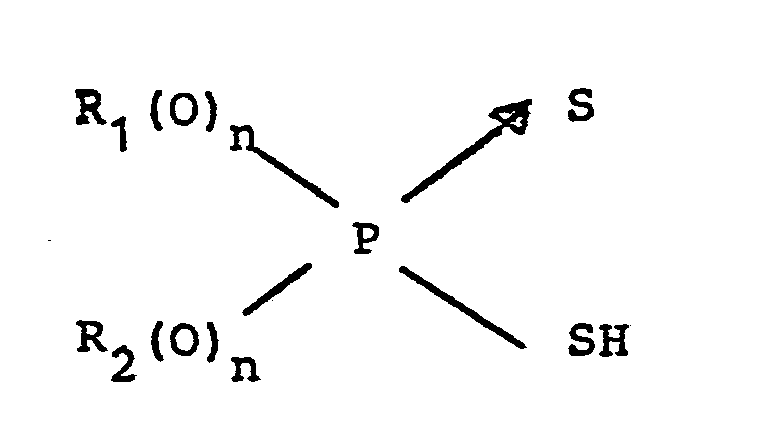
- the phosphorus compounds suitable as extractants according to the invention have the general formula I in which R 1 and R 2 are identical or different and saturated or unsaturated aliphatic, araliphatic or aromatic hydrocarbon radicals having 1 to 18 carbon atoms, which are optionally substituted, and R 1 and R 2 together have 6 to 36 carbon atoms, preferably 8 - Have 24 carbon atoms and possibly also common sam form an optionally substituted two-bonded radical and n each independently represent the number 0 or 1.
- the amount of extractants to be used according to the invention is not critical and can vary within wide limits. However, they are preferably used in amounts of 0.05-50% by weight, in particular in amounts of 0.1-10% by weight, based on the amount of mother acid.
- the extractants according to the invention can be used individually or as a mixture.
- substitutions by halogen, hydroxyl, alkoxy, carboxy or NO 2 groups are preferred, provided that the resulting radicals are overall hydrophobic enough that the compounds of the formula I are sparingly soluble in water to the desired degree.
- poorly soluble in water used in relation to the phosphorus compounds according to the invention does not mean that the compound in question must be completely insoluble, but merely that the compound must have sufficient immiscibility with respect to the phase of the nitric acid-containing phosphoric acid in order to separate the liquids into to enable two different phases.
- the phosphorus compounds of formula I according to the invention are excellently capable of extraction in undiluted, liquid form, it is preferable to use them in a mixture with inert, organic diluents in order to achieve an even better handling and control of the extraction, and among others. also for reasons of economy.
- organic diluents are those organic solvents in which the compounds of formula I are soluble, which also virtually insoluble in the set to pH 0.5 to 1.5, unbleached Nitraticnen horklareitesen containing Phos p and are chemically indifferent to the latter.
- organic solvents such as petroleum ether, kerosene, extra light heating oil, decahydronaphthalene, tetrabromoethane or xylene.
- the quantitative ratio of the compounds of formula I to inert organic solvent can be varied within wide limits. Weights are preferred Ratios from 1: 2 to 1:50, especially 1: 5 to 1:20.
- the extraction process according to the invention and also the back-extraction or removal processes for eliminating the heavy metal constituents from the extractant for reusing the latter can be carried out continuously or batchwise or batchwise. In the case of a discontinuous procedure, it may be necessary to repeat the extraction until the desired degree of extraction effect is achieved.
- the extraction can be carried out in a wide temperature range at low or elevated temperatures, preferably between 5 and 120 ° C., in particular at 10 to 90 ° C. Normal temperature and ambient temperature are particularly preferred. You can also work at normal pressure or under increased pressure.
- the two-phase extraction mixture can be placed on a centrifuge, e.g. a separator.
- the metallic contaminants that have been extracted into the organic extractant phase can generally be extracted from this phase by back extracting with water or acidic aqueous solutions, e.g. diluted mineral acids.
- the organic extractant can be regenerated in an advantageous manner, while the heavy metal components pass into the aqueous phase.
- the organic phase containing the extracting agent can advantageously first be extracted with an aqueous solution of an alkaline compound before it is mixed with dilute mineral acid, e.g. dilute hydrochloric acid. Alkaline extract and acid extract can then be combined. In the first of the two sub-steps, arsenic and partially cadmium are extracted, while in the second step cadmium and mercury are removed quantitatively.
- certain heavy metals can be enriched in the re-extraction solutions.
- the heavy metal ions can be extracted from the aqueous re-extraction solutions by precipitation, e.g. as hydroxides or sulfides, are separated and isolated.
- the samples are then centrifuged for 2-5 minutes and the two-phase mixtures separated in a separatory funnel.
- the phosphoric acid solutions obtained are mixed with a little concentrated hydrochloric acid and analyzed by means of atomic absorption.
- the heavy metal contents found are converted to the ammonia-treated mother acid or based on the organic extractant phase.
Landscapes
- Chemical & Material Sciences (AREA)
- Organic Chemistry (AREA)
- Engineering & Computer Science (AREA)
- Environmental & Geological Engineering (AREA)
- Materials Engineering (AREA)
- General Life Sciences & Earth Sciences (AREA)
- Geochemistry & Mineralogy (AREA)
- Geology (AREA)
- Inorganic Chemistry (AREA)
- Manufacturing & Machinery (AREA)
- Life Sciences & Earth Sciences (AREA)
- Mechanical Engineering (AREA)
- Metallurgy (AREA)
- Extraction Or Liquid Replacement (AREA)
- Processing Of Solid Wastes (AREA)
- Production Of Liquid Hydrocarbon Mixture For Refining Petroleum (AREA)
- Solid-Sorbent Or Filter-Aiding Compositions (AREA)
- Treatment Of Liquids With Adsorbents In General (AREA)
- Fertilizers (AREA)
Abstract
Description
- Die Erfindung betrifft ein Verfahren zur Abtrennung von Schwermetallbestandteilen, insbesondere Cadmium und Quecksilber, aus Rohphosphorsäuren, die durch Aufschluß von Rohphosphaten mit Salpetersäure gewonnen und aus denen die Hauptmenge des gebildeten Calciumnitrats entfernt wurden.
- Phosphorhaltige Düngemittel werden vielfach durch sauren Aufschluß von Phosphorit oder Apatit hergestellt. Unter der Einwirkung von Mineralsäure wird das schwerlösliche Tricalciumphosphat des Rohphosphats zersetzt. Die Calciumsalze der eingesetzten Mineralsäuren müssen anschließend abgetrennt werden, um die entstandene rohe Phosphorsäure als Produkt zu erhalten. Im Rohphosphat enthaltene metallische Verunreinigungen wie Cd, Pb, Hg und As verbleiben größtenteils in der Phosphorsäure. Da diese Säure nicht für alle Verwendungszwecke geeignet ist, wurden bereits zahlreiche Versuche unternommen, um sie von unerwünschten metallischen Verunreinigungen zu befreien. Für die Verarbeitung roher Phosphorsäure zu Düngemitteln boten diese Vorschläge aber bisher keinen technisch günstigen Weg.
- So berichtet AMDEL Bull. 1976 (19) 1 - 10, von der Beseitigung von Cadmium aus Rohphosphat durch Kalzinierung, ein wirtschaftlich sehr aufwendiges Verfahren. Nach DE-OS 2422902 kann Cadmium durch Druckfällung mit Schwefelwasserstoff beseitigt werden. Außer der Erschwernis, mit Schwefelwasserstoff unter Druck arbeiten zu müssen, ist für die Durchführung des Verfahrens die Einhaltung bestimmter Konzentrationen an P2O5 erforderlich. Die japanische Offenlegungsschrift 1979/37 096 schlägt ein Verfahren vor, bei dem zweistufig durch Behandlung mit einem wasserlöslichen organischen Lösungsmittel und Destillation sowie ggf. durch anschließende Extraktion Phosphorsäure gereinigt werden soll. Auch die Cadmiumabtrennung mittels Ionenaustauscher ist beschrieben worden (Japanische Offenlegungsschrift 1978/ 56 190). Auch die Festbettelelektrolyse (Metalloberfläche 34 (1980) 494 - 501) bietet bisher keinen Weg zur Lösung des Problems.
- Die vorgeschlagenen Verfahren sind insbesondere ungeeignet, um die beim Aufschluß von Rohphosphat mittels 60 %iger Salpetersäure nach dem bekannten Odda-Verfahren entstehende rohe Phosphorsäure von Schwermetallionen zu befreien.
- Beim Odda-Prozeß wird die stark salpetersäurehaltige Naßphosphorsäure des Aufschlusses zur Abscheidung des Calciumnitrats, dessen Löslichkeit stark temperaturabhängig ist, abgekühlt und das Calciumnitrat als Tetrahydrat abgetrennt. Im Rohphosphat vorhandene Schwermetallionen wie Cd, Pb, Hg und As verbleiben großenteils in der Lösung des Aufschlussesjder sogenannten Muttersäure. Die Muttersäure enthält gewöhnlich 15 - 20 Gew.-% P2O5, 30 - 35 Gew.-% HNO3 und 7 - 10 Gew.-% CaO.
- Anschließend wird üblicherweise die Muttersäure stufenweise mit Ammoniak unter Verdampfung von Wasser neutralisiert und der entstehende Kristallbrei mit Kaliumsalzen vermischt und zu Düngemitteln granuliert.
- Der vorliegenden Erfindung lag somit die Aufgabe zugrunde, ein Verfahren zu entwickeln, mit dessen Hilfe schwermetallarme Düngemittel nach dem Odda-Prozeß hergestellt werden können.
- Es wurde nun überraschenderweise gefunden, daß man diese Aufgabe vorteilhaft dadurch lösen kann, daß man die bei dem Odda-Verfahren resultierende Muttersäure mit Ammoniak auf einen pH-Kert in dem Bereich von 0,5 - 1,5, insbesondere 0,6 - 1,2, einstellt und die so erhaltene phosphorsaure Lösung, vorzugsweise im Gegenstrom, mit einem mit Wasser nicht oder nur wenig mischbaren Lösungsmittel extrahiert, wobei als Lösungsmittel eine Phosphor-Verbindung aus der Gruppe der Dithiophosphorsäure-di-ester, Dithiophosphonsäure-0-ester und Dithiophosphinsäuren ausgewählt und vorteilhafterweise im Gemisch mit einem inerten organischen Verdünnungsmittel angewandt wird.
- Die Einhaltung des obengenannten pH-Wert-Bereiches ist vor allem für die Extraktion und Abtrennung des Cadmiums besonders wichtig. In Bereichen höherer pH-Werte wird andererseits eine Extraktion der Muttersäure dadurch behindert, daß gleichzeitig komplexe Niederschläge aus Phosphaten, Kieselgel, Calcium-, Magnesium- und AluminiumVerbindungen auftreten.
- Zur Messung der pH-Werte in den konzentriert mineralsauren Lösungen werden Glaselektroden, zweckmäßigerweise Einstabmeßketten mit dem Bezugsystem Ag/AgCl, Bezugselektrolyt 3m KCl+AgCl oder 3,5m KCl, verwendet. Es können speziell Schwefelwasserstoff-sichere Einstabmeßketten verwendet werden, die z.B. mit zwei hintereinander geschalteten, durch Diaphragmen getrennten Elektrolytkammern ausgestattet sind. Die pH-Werte müssen in der konzentrierten Lösung ohne Verdünnung und bei Raumtemperatur gemessen werden.
- Es ist bekannt, daß Dithiophosphorsäuredialkylester (vgl. US. Patente 2523147, 2705694 und 2798880) und Dithiophosphinsäuren sowie Dithiophosphonsäure-0-ester (vgl. FR-PS 1 396 093 und US-PS 3 300 409) leicht oxidierbar sind und deshalb als Antioxidantien eingesetzt werden. Es mußte daher erwartet werden, daß die Anwesenheit von Oxidationsmitteln, wie hohe Konzentrationen an Nitrationen in saurer Losung ein Hindernis für eine extraktive Behandlung der obengenannten Muttersäure mittels der erfindungsgemäßen Extraktionsmittel darstellt. Die Muttersäure enthält zudem vom Aufschluß her außerdem noch Nitroxide (NOx).
- Die erfindungsgemäß als Extraktionsmittel geeigneten Phosphorverbindungen besitzen die allgemeine Formel I,

- Als Beispiele für erfindungsgemäße Extraktionsmittel der Formel I seien u.a. genannt:
- Dithiophosphorsäure-di-(2-ethyl-hexyl)-ester
- Dithiophosphorsäure-di-isotridecyl-ester
- Dithiophosphorsäure-di-sek. butyl-ester
- Dithiophosphorsäure-di-kresyl-ester
- Cyclohexyl-dithiophosphonsäure-O-n-butylester
- Di-Cyclohexyl-dithiophosphinsäure
- Di-phenyl-dithiophosphinsäure
- Di-(tricyclo-(5,2,1,0,26) decenyl)-dithiophosphinsäure Naphthalin-2-dithio-phosphonsäure-O-ethylester
- Die Menge an erfindungsgemäß einzusetzenden Extraktionsmitteln ist nicht kritisch und kann in weiten Bereichen schwanken. Vorzugsweise werden sie jedoch in Mengen von 0,05 - 50 Gew.-%, insbesondere in Mengen von 0,1 - 10 Gew.-%, bezogen auf die Menge an Muttersäure, eingesetzt.
- Die erfindungsgemäßen Extraktionsmittel können einzeln oder als Gemisch eingesetzt werden. Bei den Verbindungen der Formel I mit substituierten Resten R1 und R2 kommen vorzugsweise Substitutionen durch Halogen, Hydroxy-, Alkoxy-, Carboxy- oder NO2-Gruppen infrage, sofern die resultierenden Reste insgesamt hydrophob genug sind, damit die Verbindungen der Formel I im gewünschten Grade in Wasser schwer-löslich sind.
- Bevorzugte Verbindungen der Formel I sind ferner solche, worin R1 und R2 = (C1-C18)-Alkyl, (C5-C6)-Cycloalkyl, Phenyl-(C1-C2)-alkyl, Phenyl, durch (C1-C4)-Alkyl substituiertes Phenyl, Naphthyl, die jeweils ggf. durch Halogen, Hydroxy, Alkoxy, Carboxy oder N02 substituiert sind, oder Tricyclodecenyl bedeuten, wobei R1 und R2 zusammen 8 bis 24 C-Atome aufweisen.
- Der in Bezug auf die erfindungsgemäßen Phosphorverbindungen gebrauchte Begriff der Schwerlöslichkeit in Wasser bedeutet jedoch nicht, daß die betreffende Verbindung vollkommen unlöslich sein muß, sondern lediglich, daß die Verbindung gegenüber der Phase der salpetersäurehaltigen Phosphorsäure eine genügende Nichtmischbarkeit aufweisen muß, um eine Trennung der Flüssigkeiten in zwei verschiedene Phasen zu ermöglichen.
- Obgleich die erfindungsgemäßen Phosphorverbindungen der Formel I in unverdünnter, flüssiger Form hervorragend zur Extraktion befähigt sind, ist es vorzuziehen, sie im Gemisch mit inerten, organischen Verdünnungsmitteln zu verwenden, um eine noch bessere Handhabung und Regelung der Extraktion zu erreichen, und u.a. auch aus Wirtschaftlichkeitsgründen.
- Bei den zur erfindungsgemäßen Verwendung geeigneten organischen Verdünnungsmitteln handelt es sich um solche organischen Lösungsmittel, in denen die Verbindungen der Formel I löslich sind, die außerdem praktisch unlöslich in den auf pH 0,5 bis 1,5 eingestellten, rohen,Nitraticnen enthaltenden Phosphorsäurelösungen sind und sich den letzteren gegenüber chemisch indifferent verhalten. Es kommen hierbei eine große Zahl verschiedener organischer Lösungsmittel infrage, wie bspw. Petroleumbenzin, Kerosin, Heizöl extra leicht, Dekahydronaphthalin, Tetrabrom- äthan oder Xylol. Das Mengenverhältnis der Verbindungen der Formel I zu inertem organischem Lösungsmittel kann in weiten Grenzen variiert werden. Bevorzugt sind Gewichtsverhältnisse von 1 : 2 bis 1 : 50, insbesondere 1 : 5 bis 1 : 20.
- Das erfindungsgemäße Extraktionsverfahren sowie auch die Rückextraktions- oder Entfernungsverfahren zur Eliminierung der Schwermetallbestandteile aus dem Extraktionsmittel zur Wiederverwendung des letzteren können kontinuierlich oder diskontinuierlich bzw. ansatzweise durchgeführt werden. Bei diskontinuierlicher Verfahrensweise kann es erforderlich sein, die Extraktion so oft zu wiederholen, bis das gewünschte Ausmaß an Extraktionseffekt erreicht ist.
- Bei kontinuierlicher Verfahrensweise kann z.B. vorteilhaft im Gegenstrom der phosphorsauren Lösungen zur Extraktionsmittelphase gearbeitet werden.
- Die Extraktion kann in einem breiten Temperaturbereich bei niedriger oder erhöhter Temperatur durchgeführt werden, vorzugsweise zwischen 5 und 120°C, insbesondere bei 10 bis 90°C. Besonders bevorzugt sind Normaltemperatur und Umgebungstemperatur. Auch kann bei Normaldruck oder unter erhöhtem Druck gearbeitet werden. Zur Verbesserung der Phasentrennung kann das zweiphasige Extraktionsgemisch auf eine Zentrifuge, z.B. einen Separator, gegeben werden.
- Für den Fachmann war keineswegs vorhersehbar, daß es durch das erfindungsgemäße Verfahren gelingen würde, aus konzentrierten phosphorsäuren Lösungen, deren Eigenschaft, mit Schwermetallionen stabile Komplexe zu bilden, bekannt ist, mit einem hohen Verteilungskoeffizienten die Schwermetallionen, wie z.B. diejenigen des Cadmiums, praktisch vollständig zu extrahieren. Dabei sind die Verteilungskoeffizienten so groß, daß selbst bei einem Phasenverhältnis von wäßriger : organischer Phase (z.B. 10 %ige Lösung eines Dithiophosphorsäure-di-esters in Schwerbenzin) von 50 : 1 in einstufiger Extraktion weitestgehende Abtrennung der Elemente Cd und Hg erreicht wird. Dieses Ergebnis ist um so überraschender, da die Extraktion mit vergleichbaren Phosphorsäure-di-estern, anstelle der Dithiophosphorsäure-di-ester, völlig versagt (vgl. Vergleichsbeispiele 1 - 2).
- Die metallischen Verunreinigungen, die in die organische Extraktionsmittelphase extrahiert worden sind, können im allgemeinen aus dieser Phase durch Rückextrakticn mit Wasser oder sauren wäßrigen Lösungen, z.B. verdünnten Mineralsäuren, wieder entfernt werden. Auf diese Weise kann das organische Extraktionsmittel in vorteilhafter Weise regeneriert werden, während die Schwermetallbestandteile in die wäßrige Phase übergehen. Dazu kann vorteilhafterweise die organische, das Extraktionsmittel enthaltende Phase zunächst mit einer wäßrigen Lösung einer alkalischen Verbindung extrahiert werden, bevor man sie mit verdünnter Mineralsäure, wie z.B. verdünnter Salzsäure, behandelt. Alkalischer Extrakt und saurer Extrakt können dann vereinigt werden. Bei dem ersten der beiden Teilschritte werden Arsen und teilweise Cadmium extrahiert, während beim zweiten Schritt Cadmium und Quecksilber quantitativ entfernt werden. Durch Änderung der Reihenfolge oder Erhöhung der Zahl einzelner Schritte bei der Reextraktion der Schwermetalle aus der organischen Phase können bestimmte Schwermetalle in den Reextraktionslöungen angereichert werden. Aus den wäßrigen Reextraktionslösungen können die Schwermetällionen durch Fällung, z.B. als Hydroxide oder Sulfide, abgeschieden und isoliert werden.
- Die Erfindung wird durch die nachfolgenden Beispiele näher erläutert.
- Durch Aufschluß von Rohphosphaten mit Salpetersäure nach dem Odda-Verfahren erhaltene und geklärte Muttersäuren werden mit gasförmigem Ammoniak auf die in der nachfolgenden Tabelle angegebenen pH-Werte (der phosphorsauren Phase) eingestellt. Dazu werden die in Tabelle 1 aufgeführten erfindungsgemäßen Extraktionsmittel in den dort angegebenen Mischungsverhältnissen von anorganischer Phase zu organischer Phase zwischen 5 : 1 und 50 : 1 gegeben und durch 3 - 5 min langes intensives Vermischen mit einem Rührgerät behandelt. Die Gew.-% der Verbindungen A beziehen sich auf das Verdünnungsmittel B . Die Extraktionstemperaturen betragen 25°C, mit Ausnahme der Beispiele 8 und 9. Hier wurde eine Temperatur von 70°C gewählt.
- Anschließend werden die Proben 2 - 5 min lang zentrifugiert und die zweiphasigen Gemische im Scheidetrichter getrennt. Die erhaltenen phosphorsauren Lösungen werden mit etwas konzentrierter Salzsäure vermischt und mittels Atomabsorption analysiert. Die gefundenen Schwermetallgehalte werden auf die ammoniakbehandelte Muttersäure umgerechnet bzw. auf die organische Extraktionsmittelphase bezogen.
- Die nachfolgende Tabelle 1 gibt die Einzelheiten und Ergebnisse der durchgeführten Beispiele 1 - 16 in zusammengefaßter Form wieder.

- Analog den Beispielen 1 - 14 hergestellte und geklärte Muttersäuren werden mit Ammoniak auf pH 1,1 eingestellt und mit Dithiophosphorsäure-di-(2-ethylhexyl)-ester (10 Gew.-% in Petroleumbenzin, Kp. 100 - 140°C) wie im Beispiel 11 beschrieben extrahiert. Die resultierende organische Phase wird abgetrennt und anschließend mit konz. Salzsäure im Gew.-Verhältnis 20 : 1 bei Raumtemperatur reextrahiert. Dazu wird das Gemisch aus organischer Phase und konz. Salzsäure 5 Minuten lang durch Rühren intensiv vermischt, danach zentrifugiert. Die abgetrennte organische Phase weist vor und nach der Reextraktion die in der Tabelle 2 zusammengefaßt wiedergegebenen Cd-Gehalte auf:

- Analog den Beispielen 1 - 16 hergestellte und geklärte Muttersäure wird mit Ammoniak auf pH 1,1 eingestellt und mit Phosphorsäure-di-(2-ethylhexyl)-ester (Vbg. C) bzw. 2-Mercapto-bez-thiazol (Vbg. D) in 10 Gew.-%iger organischer Lösung in den in der Tabelle 3 angegebenen organischen Verdünnungsmitteln bei Raumtemperatur im Mischungsverhältnis anorganische : organische Phase = 10 : 1 (Gew.-Teile) unter intensivem Vermischen durch Rühren extrahiert. Nach dem Verrühren und anschließenden Zentrifügieren werden die Phasen getrennt. Die phoshorsaure Phase wird mit etwas konzentrierter Salzsäure vermischt und mittels Atomabsorption analysiert. Der ermittelte Cd-Gehalt wird auf die ammoniakbehandelte Muttersäure umgerechnet. Das Ergebnis ist in der Tabelle 3 zusammengefaßt wiedergegeben.

Claims (9)
Applications Claiming Priority (4)
| Application Number | Priority Date | Filing Date | Title |
|---|---|---|---|
| DE3142666 | 1981-10-28 | ||
| DE19813142666 DE3142666A1 (de) | 1981-10-28 | 1981-10-28 | Verfahren zur abtrennung von schwermetallbestandteilen aus zwischenprodukten der fabrikation von phosphorduengemitteln |
| DE3209183 | 1982-03-13 | ||
| DE19823209183 DE3209183A1 (de) | 1982-03-13 | 1982-03-13 | Verfahren zur abtrennung von schwermetallverbindungen aus zwischenprodukten der fabrikation von phosphorduengemitteln |
Publications (3)
| Publication Number | Publication Date |
|---|---|
| EP0078051A2 true EP0078051A2 (de) | 1983-05-04 |
| EP0078051A3 EP0078051A3 (en) | 1984-03-28 |
| EP0078051B1 EP0078051B1 (de) | 1986-09-17 |
Family
ID=25796907
Family Applications (1)
| Application Number | Title | Priority Date | Filing Date |
|---|---|---|---|
| EP82109876A Expired EP0078051B1 (de) | 1981-10-28 | 1982-10-26 | Verfahren zur Abtrennung von Schwermetallbestandteilen aus Zwischenprodukten der Fabrikation von Phosphordüngemitteln |
Country Status (4)
| Country | Link |
|---|---|
| EP (1) | EP0078051B1 (de) |
| DE (1) | DE3273369D1 (de) |
| ES (1) | ES8501356A1 (de) |
| NO (1) | NO156685B (de) |
Cited By (8)
| Publication number | Priority date | Publication date | Assignee | Title |
|---|---|---|---|---|
| EP0099514A1 (de) * | 1982-07-21 | 1984-02-01 | Hoechst Aktiengesellschaft | Verfahren zur Entfernung von Schwermetallionen und Arsen aus Nassverfahrensphosphorsäure |
| DE3341073A1 (de) * | 1983-11-12 | 1985-05-23 | Chemische Fabrik Budenheim Rudolf A. Oetker, 6501 Budenheim | Verfahren zur gleichzeitigen abtrennung von cadmium-ii- und uran iv- ionen aus phosphorsaeure durch gemeinsame extraktion |
| DE3342211A1 (de) * | 1983-11-23 | 1985-05-30 | Chemische Fabrik Budenheim Rudolf A. Oetker, 6501 Budenheim | Verfahren zur extraktion von cadmium aus sauren loesungen |
| EP0210387A1 (de) * | 1985-07-24 | 1987-02-04 | American Cyanamid Company | Selektive Abtrennung von Metallen aus wässrigen Lösungen mit Dithiophosphinsäuren |
| FR2629812A1 (fr) * | 1988-04-12 | 1989-10-13 | Cerphos | Procede d'elimination des metaux lourds, et notamment du cadmium, contenus dans l'acide phosphorique |
| WO1991017113A1 (es) * | 1990-04-27 | 1991-11-14 | Ercros S.A. | Procedimiento de eliminacion de cadmio del acido fosforico |
| FR2717826A1 (fr) * | 1994-03-22 | 1995-09-29 | Goro Nickel Sa | Procédé pour l'extraction et la séparation du nickel et/ou du cobalt. |
| WO2004083118A1 (en) * | 2003-03-13 | 2004-09-30 | Cytec Technology Corp. | Process for removing metal impurities from wet process phosphoric acid and compositions thereof |
Families Citing this family (2)
| Publication number | Priority date | Publication date | Assignee | Title |
|---|---|---|---|---|
| DE10303177A1 (de) * | 2003-01-27 | 2004-07-29 | Max Bögl Bauunternehmung GmbH & Co. KG | Verfahren zum Einrichten eines Fertigteiles und Vorrichtung zur Aufnahme von Messprismen |
| ES2283207A1 (es) * | 2003-03-13 | 2007-10-16 | Cytec Tecnology Corp. | Procedimiento para retirar impurezas metalicas del acido fosforico obtenido mediante proceso humedo y composiciones del mismo. |
Family Cites Families (3)
| Publication number | Priority date | Publication date | Assignee | Title |
|---|---|---|---|---|
| US2523147A (en) * | 1948-06-14 | 1950-09-19 | Standard Oil Dev Co | Manufacture of organo-substituted acids of phosphorous |
| US4405722A (en) * | 1979-01-23 | 1983-09-20 | Asahi Glass Company Ltd. | Sealing glass compositions |
| FR2462481A1 (fr) * | 1979-07-30 | 1981-02-13 | British Petroleum Co | Procede d'extraction liquide-liquide de metaux en solution aqueuse au moyen de derives organophosphores |
-
1982
- 1982-10-26 ES ES516846A patent/ES8501356A1/es not_active Expired
- 1982-10-26 DE DE8282109876T patent/DE3273369D1/de not_active Expired
- 1982-10-26 EP EP82109876A patent/EP0078051B1/de not_active Expired
- 1982-10-27 NO NO823584A patent/NO156685B/no unknown
Cited By (8)
| Publication number | Priority date | Publication date | Assignee | Title |
|---|---|---|---|---|
| EP0099514A1 (de) * | 1982-07-21 | 1984-02-01 | Hoechst Aktiengesellschaft | Verfahren zur Entfernung von Schwermetallionen und Arsen aus Nassverfahrensphosphorsäure |
| DE3341073A1 (de) * | 1983-11-12 | 1985-05-23 | Chemische Fabrik Budenheim Rudolf A. Oetker, 6501 Budenheim | Verfahren zur gleichzeitigen abtrennung von cadmium-ii- und uran iv- ionen aus phosphorsaeure durch gemeinsame extraktion |
| DE3342211A1 (de) * | 1983-11-23 | 1985-05-30 | Chemische Fabrik Budenheim Rudolf A. Oetker, 6501 Budenheim | Verfahren zur extraktion von cadmium aus sauren loesungen |
| EP0210387A1 (de) * | 1985-07-24 | 1987-02-04 | American Cyanamid Company | Selektive Abtrennung von Metallen aus wässrigen Lösungen mit Dithiophosphinsäuren |
| FR2629812A1 (fr) * | 1988-04-12 | 1989-10-13 | Cerphos | Procede d'elimination des metaux lourds, et notamment du cadmium, contenus dans l'acide phosphorique |
| WO1991017113A1 (es) * | 1990-04-27 | 1991-11-14 | Ercros S.A. | Procedimiento de eliminacion de cadmio del acido fosforico |
| FR2717826A1 (fr) * | 1994-03-22 | 1995-09-29 | Goro Nickel Sa | Procédé pour l'extraction et la séparation du nickel et/ou du cobalt. |
| WO2004083118A1 (en) * | 2003-03-13 | 2004-09-30 | Cytec Technology Corp. | Process for removing metal impurities from wet process phosphoric acid and compositions thereof |
Also Published As
| Publication number | Publication date |
|---|---|
| NO156685B (no) | 1987-07-27 |
| EP0078051B1 (de) | 1986-09-17 |
| DE3273369D1 (en) | 1986-10-23 |
| ES516846A0 (es) | 1984-12-01 |
| NO823584L (no) | 1983-04-29 |
| ES8501356A1 (es) | 1984-12-01 |
| EP0078051A3 (en) | 1984-03-28 |
Similar Documents
| Publication | Publication Date | Title |
|---|---|---|
| EP0091043B1 (de) | Verfahren zur Abtrennung von Schwermetallverbindungen aus Zwischenprodukten der Fabrikation von Phosphordüngemitteln | |
| EP0070415B1 (de) | Verfahren zur Extraktion von Schwermetallionen aus wässrigen Lösungen | |
| DE3725611A1 (de) | Verfahren zur gemeinsamen abtrennung von stoerelementen aus wertmetall-elektrolytloesungen | |
| WO1990004654A1 (de) | Verfahren zur abtrennung von störelementen aus wertmetall-elektrolytlösungen | |
| DE2660909C2 (de) | ||
| EP0078051B1 (de) | Verfahren zur Abtrennung von Schwermetallbestandteilen aus Zwischenprodukten der Fabrikation von Phosphordüngemitteln | |
| EP0179242B1 (de) | Verfahren zur Reinigung von Phosphorsäure | |
| DE2312152A1 (de) | Verfahren zur gewinnung von molybdaen und/oder rhenium | |
| DE3209183A1 (de) | Verfahren zur abtrennung von schwermetallverbindungen aus zwischenprodukten der fabrikation von phosphorduengemitteln | |
| EP0094630B1 (de) | Verfahren zum Entfernen von Cadmium aus durch Aufschluss von Rohphosphaten mit Schwefelsäure erhaltener Rohphosphorsäure | |
| EP0032184B1 (de) | Verfahren zur Gewinnung von Uran bzw. Uranverbindungen aus Phosphorsäure | |
| DE1188061B (de) | Verfahren zur Trennung von Europium von anderen Lanthaniden und/oder von Aktiniden | |
| EP0106117B1 (de) | Verfahren zur Abtrennung von Gallium und Indium aus wässrigen Lösungen | |
| EP0031460B1 (de) | Verfahren zur Gewinnung von Uran bzw. Uranverbindungen aus Phosphorsäure | |
| EP0029132B1 (de) | Verfahren zur Reinigung von Nassverfahrensphosphorsäure | |
| DE3142666A1 (de) | Verfahren zur abtrennung von schwermetallbestandteilen aus zwischenprodukten der fabrikation von phosphorduengemitteln | |
| EP0382709A1 (de) | Verfahren zum Aufarbeiten von sauren Fe-haltigen Lösungen, insbesondere Abfallbeizlösungen | |
| EP0399521B1 (de) | Verbessertes Verfahren zum Entfernen von Cadmium-Ionen aus Nassverfahrensphosphorsäure | |
| EP0294751A1 (de) | Verfahren zur Gewinnung von Gallium aus basisch wässrigen Natriumaluminatlösungen durch Flüssig-Flüssigextraktion | |
| DE3019411C2 (de) | Verfahren zur Gewinnung von Uran (VI) aus einer Rohphosphorsäure | |
| DE2837694A1 (de) | Verfahren und extraktionsmittel zur herstellung von reiner phosphorsaeure | |
| EP0054133A2 (de) | Verfahren zur Trennung eines Phosphorsäurealkylestergemisches durch Extraktion | |
| DE1162817B (de) | Verfahren zur Herstellung von Phosphorsaeure | |
| DE1938883A1 (de) | Verfahren zum Trennen von Metallen durch eine Loesungsmittelextraktion | |
| DE1567456A1 (de) | Verfahren zur Entfernung von Titan und Vanadin aus Phosphorsaeure |
Legal Events
| Date | Code | Title | Description |
|---|---|---|---|
| PUAI | Public reference made under article 153(3) epc to a published international application that has entered the european phase |
Free format text: ORIGINAL CODE: 0009012 |
|
| AK | Designated contracting states |
Designated state(s): BE DE FR IT NL SE |
|
| PUAL | Search report despatched |
Free format text: ORIGINAL CODE: 0009013 |
|
| AK | Designated contracting states |
Designated state(s): BE DE FR IT NL SE |
|
| 17P | Request for examination filed |
Effective date: 19840604 |
|
| GRAA | (expected) grant |
Free format text: ORIGINAL CODE: 0009210 |
|
| AK | Designated contracting states |
Kind code of ref document: B1 Designated state(s): BE DE FR IT NL SE |
|
| ITF | It: translation for a ep patent filed | ||
| REF | Corresponds to: |
Ref document number: 3273369 Country of ref document: DE Date of ref document: 19861023 |
|
| ET | Fr: translation filed | ||
| PLBE | No opposition filed within time limit |
Free format text: ORIGINAL CODE: 0009261 |
|
| STAA | Information on the status of an ep patent application or granted ep patent |
Free format text: STATUS: NO OPPOSITION FILED WITHIN TIME LIMIT |
|
| 26N | No opposition filed | ||
| PGFP | Annual fee paid to national office [announced via postgrant information from national office to epo] |
Ref country code: FR Payment date: 19910916 Year of fee payment: 10 |
|
| PGFP | Annual fee paid to national office [announced via postgrant information from national office to epo] |
Ref country code: SE Payment date: 19910918 Year of fee payment: 10 |
|
| PGFP | Annual fee paid to national office [announced via postgrant information from national office to epo] |
Ref country code: BE Payment date: 19911009 Year of fee payment: 10 |
|
| ITTA | It: last paid annual fee | ||
| PGFP | Annual fee paid to national office [announced via postgrant information from national office to epo] |
Ref country code: NL Payment date: 19911031 Year of fee payment: 10 |
|
| PGFP | Annual fee paid to national office [announced via postgrant information from national office to epo] |
Ref country code: DE Payment date: 19911207 Year of fee payment: 10 |
|
| PG25 | Lapsed in a contracting state [announced via postgrant information from national office to epo] |
Ref country code: SE Effective date: 19921027 |
|
| PG25 | Lapsed in a contracting state [announced via postgrant information from national office to epo] |
Ref country code: BE Effective date: 19921031 |
|
| BERE | Be: lapsed |
Owner name: HOECHST A.G. Effective date: 19921031 |
|
| PG25 | Lapsed in a contracting state [announced via postgrant information from national office to epo] |
Ref country code: NL Effective date: 19930501 |
|
| NLV4 | Nl: lapsed or anulled due to non-payment of the annual fee | ||
| PG25 | Lapsed in a contracting state [announced via postgrant information from national office to epo] |
Ref country code: FR Effective date: 19930630 |
|
| PG25 | Lapsed in a contracting state [announced via postgrant information from national office to epo] |
Ref country code: DE Effective date: 19930701 |
|
| REG | Reference to a national code |
Ref country code: FR Ref legal event code: ST |
|
| EUG | Se: european patent has lapsed |
Ref document number: 82109876.1 Effective date: 19930510 |