EP0078568A2 - Graisse structurale, son utilisation dans les produits à base d'huiles pour margarines et de graisses à tartiner émulsifiées et méthode pour sa préparation - Google Patents
Graisse structurale, son utilisation dans les produits à base d'huiles pour margarines et de graisses à tartiner émulsifiées et méthode pour sa préparation Download PDFInfo
- Publication number
- EP0078568A2 EP0078568A2 EP82201327A EP82201327A EP0078568A2 EP 0078568 A2 EP0078568 A2 EP 0078568A2 EP 82201327 A EP82201327 A EP 82201327A EP 82201327 A EP82201327 A EP 82201327A EP 0078568 A2 EP0078568 A2 EP 0078568A2
- Authority
- EP
- European Patent Office
- Prior art keywords
- oil
- fat
- weight
- margarine
- triglycerides
- Prior art date
- Legal status (The legal status is an assumption and is not a legal conclusion. Google has not performed a legal analysis and makes no representation as to the accuracy of the status listed.)
- Granted
Links
Images


Classifications
-
- C—CHEMISTRY; METALLURGY
- C11—ANIMAL OR VEGETABLE OILS, FATS, FATTY SUBSTANCES OR WAXES; FATTY ACIDS THEREFROM; DETERGENTS; CANDLES
- C11B—PRODUCING, e.g. BY PRESSING RAW MATERIALS OR BY EXTRACTION FROM WASTE MATERIALS, REFINING OR PRESERVING FATS, FATTY SUBSTANCES, e.g. LANOLIN, FATTY OILS OR WAXES; ESSENTIAL OILS; PERFUMES
- C11B7/00—Separation of mixtures of fats or fatty oils into their constituents, e.g. saturated oils from unsaturated oils
- C11B7/0075—Separation of mixtures of fats or fatty oils into their constituents, e.g. saturated oils from unsaturated oils by differences of melting or solidifying points
-
- A—HUMAN NECESSITIES
- A23—FOODS OR FOODSTUFFS; TREATMENT THEREOF, NOT COVERED BY OTHER CLASSES
- A23D—EDIBLE OILS OR FATS, e.g. MARGARINES, SHORTENINGS OR COOKING OILS
- A23D7/00—Edible oil or fat compositions containing an aqueous phase, e.g. margarines
- A23D7/001—Spread compositions
-
- A—HUMAN NECESSITIES
- A23—FOODS OR FOODSTUFFS; TREATMENT THEREOF, NOT COVERED BY OTHER CLASSES
- A23D—EDIBLE OILS OR FATS, e.g. MARGARINES, SHORTENINGS OR COOKING OILS
- A23D7/00—Edible oil or fat compositions containing an aqueous phase, e.g. margarines
- A23D7/02—Edible oil or fat compositions containing an aqueous phase, e.g. margarines characterised by the production or working-up
Definitions
- the present application relates to a structural fat suitable for use in margarine oils and margarines and other water-in-oil emulsified spreads, especially stick-type products, and to methods of making same.
- Emulsified fat spreads desirably provide certain consumer benefits, ususally in terms of the taste properties.
- One important consumer benefit of a spread is its mouth texture. Factors which contribute to mouth texture are cooling impact, mouthmelt, and mouthfeel (cleanup).
- a preferred emulsified spread provides a significant cooling impact, a rapid, sharp melt sensation, and no coated or waxy feel on the tongue.
- Another important consumer benefit is the temperature cycling stability of the spread. During normal usage, spreads such as margarines are repeatedly taken in and out of the refrigerator and are thus exposed to a frequent cycle of warmer and colder temperatures. Also, during storage and shipment, the spread can be subjected to warmer and colder temperatures. Such temperature cycling can affect the properties of the spread, especially mouth texture.
- Preferred emulsified spreads have temperature cycling stability, i.e. the ability to be taken in and out of the refrigerator without significant adverse effects.
- the spread should also satisfy certain consumer requirements in terms of the handling properties.
- the spread should be sufficiently plastic to be easily spread on soft foods such as bread or toast.
- Another important consumer requirement is heat stability or resistance to slump.
- the spread should not lose its shape (slump) upon exposure to room temperatures while the spread is used. Preferred emulsified spreads will maximize the benefits of mouth texture and temperature cycling stability while at the same time satisfying the consumer requirements for spreadability and heat stability.
- Butter has a particularly pleasing mouth texture.
- the cooling impact on the tongue is significant and the mouthmelt is rapid and sharp with no coated or waxy mouthfeel.
- the heat stability of butter is also adequate.
- refrigerated butter can become quite hard, and therefore difficult to spread, especially after temperature cycling.
- margarine fat used.
- These margarine fats usually contain a sufficient solids content to provide heat stability to the margarine at room temperature yet have sufficient plasticity to be spreadable when refrigerated.
- Such fats often contain a soft oil high in polyunsaturated fatty acids (linoleic and linolenic) such as safflower oil or sunflower oil. Blends of fats and oils are frequently used in formulating such margarine fats.
- margarine fat contains triglycerides high in lauric acid content, such as coconut oil, palm kernel oil and babassu oil. These triglyceride compositions are brittle at refrigerator temperatures and have such low melting points (coconut oil melts at 75°F (24°C) to 80°F (26.6°C)) such that the spreadability and heat stability of the margarine formed therefrom can be affected. See-Bailey's Industrial Oil and Fat Products (3rd ed. 1964), p. 339. Improvements in the spreadability and heat stability of margarines made from high lauric acid content fats are achieved by appropriate blending with other fats and oils and interesterification. See U.S.
- Patent 2,874,056 to Drew issued February 17, 1959 (margarine fat containing coconut-type oil, glycerides of higher fatty acids of coconut oil and glycerides of caprylic-capric-caproic acids); U.S. Patent 3,006,771 to Babayan, issued October 31, 1961 (margarine fat containing coconut-type oil modified with one or more triglycerides having fatty acids of from 6 to 10 carbon atoms which can be further interesterified with triglycerides having fatty acids of from 16 to 18 carbon atoms); U.S. Patent 3,949,105 to Wieske et al, issued April 6, 1976 (margarine fat containing interesterified blend of coconut oil, palm oil and hydrogenated oil). See also U.S. Patent 3,592,661 to Seiden, issued July 13, 1971 (margarine fat containing interesterified trilaurin and tripalmitin).
- Margarine fats can also be made from triglycerides which have predominantly long chain length fatty acids (e.g. palmitic, stearic, oleic and/or linoleic acid residues). These long chain fatty acid triglycerides can be interesterified to provide margarine fats having different melting profiles. See for example, U.S. Patent Re 30,086 to Carlisle et al, issued August 28, 1979 (margarine fat consisting essentially of randomized palm oil); U.S. Patent 3,889,011 to Read, issued June 10, 1975 (margarine fat containing palm oil or cottonseed oil co-randomized with soybean or sunflower oil); U.S.
- Patent 3,634,100 to Fondu et al issued January 11, 1972 (margarine fat containing liquid oil such as sunflower or safflower oil, and co-randomized blend of coconut oil, palm oil and palm stearine); U.S. Patent 3,859,447 to Sreenivasan, issued January 7, 1975 (margarine fat containing oils high in linoleic acid content such as sunflower oil and safflower oil which have been interesterified). More typically, the long chain fatty acid triglyceride is a hydrogenated (hardened) oil. See Bailey's Industrial Oil and Fat Products, supra, at page 339. Hydrogenation increases the solids content of the oil which raises the melting point of the margarine fat, thus increasing the heat stability of margarine.
- Margarines formulated with topped palm oil do not satisfy the consumer requirements for heat stability in a stick-type product. Also, margarines made from topped palm oil are extremely brittle and difficult to spread. See also U.S. Patent 4,055,679 to Kattenberg et al, issued October 25, 1977 (plastic fat suitable for margarines containing a palm-based fat such as palm olein co-randomized with fats such as soybean oil or safflower oil); U.S. Patent 4,087,564 to Poot et al, issued May 2, 1978 (olein fraction obtained by single thermal fraction of co-randomized blend of palm oil and soybean oil).
- Double fractionated-palm oil fats are also known in the art but are used as cocoa butter substitutes and extenders.
- One example is disclosed in U.S. Patent 4,205,095 to Pike et al, issued May 27, 1980, which relates to a thermal fraction method for producing a palm mid-fraction suitable as a cocoa butter substitute or extender. Refined, bleached palm oil is heated (70°-75°C) and then- immediately cooled (28°-33°C) to form a first liquid fraction (iodine value 55-60) and a first solid fraction (iodine value 38-44 and melting point 50°-55°C).
- the first liquid fraction is separated, heated (60°-65°C) and then immediately cooled (14°-17°C) to produce a second liquid fraction (iodine value 59-64) and the desired palm mid-fraction (iodine value 48-53 and melting point 32°-36°C) which is disclosed as having about 83% by weight symmetrical mono-unsaturated triglycerides and asymmetrical di-unsaturated triglycerides combined.
- the palm mid-fraction is separated and then hydrogenated to an iodine value of 38-45 to provide a hydrogenated palm mid-fraction having a melting point of 33°-36°C.
- the palm mid-fraction used as the cocoa butter substitute has an iodine value of up to about 45 (preferably 30-36) and a softening point of 30°-45°C (preferably 32°-37°C).
- This desired palm mid-fraction can be obtained by removing 5 to 15% of a high melting glyceride fraction containing fully saturated triglycerides and at least 50% (preferably 60%) by weight of a low melting glyceride fraction.
- Patent 3,686,240 to Kawada et al issued August 22, 1972, (cocoa butter substitute having a melting point of 33°-38°C formed from a hydrogenated palm mid-fraction (iodine value of 38-47 and melting point of 27°-31°C) obtained from double solvent fractionated palm oil).
- This invention involves a novel fat which is particularly useful as a structural fat in margarines and other water-in-oil emulsified spreads, especially stick-type products.
- emulsified spreads can provide a desirable mouth texture in terms of cooling impact, mouthmelt and mouthfeel.
- These spreads can also have temperature cycling stability such that the spread can be taken in and out of the refrigerator repeatedly without significant adverse effects on the properties thereof, especially mouth texture.
- These spreads can also satisfy consumer requirements for spreadability, and heat stability (resistance to slump), especially in stick-type products.
- these spreads can provide improved baking performance in the preparation of baked goods such as cakes.
- the fat has a unique triglyceride composition in terms of positional isomers as measured by Argentation, Carbon Number Profile, and Fatty Acid Composition.
- the fat has:
- the fat has a unique melting profile, as measured by a Solid Fat Content of:
- the fat has:
- This fat can be obtained by a solventless, two-step thermal fractionation of palm oil.
- Whole palm oil (iodine value of from about 50 to about 55) is heated until essentially crystal free and then slowly cooled to a temperature of from about 75°F to about 95°F.
- a first solid fraction (iodine value of from about 42 to about 47) forms or crystallizes and is separated from a first liquid fraction (iodine-value of from about 56 to about 61).
- This first liquid fraction is heated until essentially crystal free and then slowly cooled to a temperature of from about 50°F to about 80°F.
- the desired second solid palm mid-fraction (iodine value of from about 39 to about 50) crystalllizes (forms) and is separated from a second liquid fraction.
- Margarine oil products comprise from about 35% to about 70% of the structural fat and from about 30% to about 65% of a soft oil.
- the margarine oil product can be defined by its melting profile (as measured by Solid Fat Content) and fatty acid composition.
- the emulsified spread is formed by mixing the margarine oil with water.
- the resulting emulsion is chilled to a temperature of from about 15°F (-9°C) to about 45°F (7°C) over a time period of at least about 0.5 minutes.
- the chilled emulsion is then crystallized over a time period of at least about 3 minutes.
- the crystallized emulsion is preferably chilled further to a temperature of from about 15°F (-9°C) to about 40°F (4°C) over a time period of at least about 0.2 minutes.
- the combination of chilling the emulsion to cooler temperatures together with-longer residence times for crystallization provides spreads having sufficient viscosity to form stick-type products with conventional margarine equipment.
- the spread has an 80°F slump grade of greater than 8 at one hour and a Hot Probe value at least about 11.3 (°F/6 sec).
- the slump grade indicates thermal stability and the Hot Probe value indicates the cooling impact of the spread.
- water-in-oil emulsion refers to a composition characterized by dispersion of water as discrete droplets in a continuous oil phase.
- emulsified spread refers to a solid or plastic water-in-oil emulsion. Such spreads can contain from about 50% to about 90% margarine oil product.
- stick-type product normally refers to an emulsified spread product in the form of a rectangular solid, usually having a length of about 5 inches and a cross-sectional thickness of 1-1/4 inch square.
- margarine refers to an emulsified spread characterized by an oil phase of at least about 80% by weight of the spread. Thus, margarines have an aqueous phase of up to about 20% by weight of the spread.
- low fat content spread refers to an emulsified spread, other than a margarine. Low fat content spreads have an oil phase of less than about 80% by weight of the spread.
- fat refers to a triglyceride composition characterized by a solid or plastic consistency at room temperatures, e.g. at about 70°F.
- oil refers to a triglyceride composition characterized by a fluid or liquid consistency at room temperatures, e.g. at about 70°F.
- margarine oil product and “margarine fat” refer to the structural fat and soft oil blend used in the oil phase of an emulsified spread.
- structural fat refers to the unique fat of this invention which provides heat stability to the emulsified spread and stabilizes the emulsion.
- SSS SSS
- SOS SLS
- SSO SOO
- SSS trisaturated, symmetrical mono-unsaturated, symmetrical diunsaturated, asymmetrical mono-unsaturated and asymmetrical di-unsaturated triglycerides, respectively.
- C48, C50, C52 and C54 refer to the total number of carbon atoms of the combined fatty acid residues attached to the glyceride. Thus, a “C48 triglyceride” will yield on hydrolysis three fatty acid residues which have a combined total of 48 carbon atoms.
- the structural fat of the present invention has a-unique triglyceride composition.
- the triglyceride composition in terms of positional isomers can be determined by Argentation thin layer chromatography (hereafter Argentation).
- Argentation uses silver nitrate as a complexing reagent in a chromatographic separation.
- chain length of the saturated fatty acids cannot be determined by this method.
- Argentation can be used to distinguish SOS, SSO and SOS triglycerides, but cannot be used to distinguish POSt, POP, and StOSt triglycerides.
- the specific Argentation method used to determine the triglyceride composition of the structural fat of the present application is described under the section entitled "Analytical Methods for Determining Triglyceride Composition of Structural Fat".
- the structural fat comprises:
- cocoa butter and cocoa butter substitutes and extenders have higher levels (at least about 70-80% by weight) of SOS triglycerides.
- FAC Fatty Acid Composition
- the P:St ratio is about 8.5 or higher, and preferably ranges from about 9 to about 10.
- the O:L ratio is about 3.5 or higher, and preferably ranges from about 4 to about 5.
- cocoa butter has an P:St ratio of at least about 1, and usually from 0.70 to 0.75.
- the structural fat usually has an FAC of:
- the FAC of preferred structural fats used for stick-type margarine products is as follows:
- the FAC for a particular triglyceride composition can be obtained by the method described under the section entitled “Methods for Determining Triglyceride Composition of Structural Fat.”
- the triglyceride composition of the structural fat can be obtained. It is believed that the predominant SOS and SSS triglycerides of the structural fat are 2-oleo-l,3-dipalmitan (POP) and tripalmitin. (PPP), respectively.
- POP 2-oleo-l,3-dipalmitan
- PPP tripalmitin.
- the unique triglyceride composition of this structural fat should be compared to that of typical cocoa butter and cocoa butter substitutes or extenders.
- the triglycerides of cocoa butter and cocoa butter substitutes or extenders are predominantly in the form of 2-oleo-l-stearin-3-palmitin (StOP) (about 40% by weight for cocoa butter) with lesser amounts of 2-oleo-l,3-distearin (StOSt) and 2-oleo-1,3-dipalmitin (POP) (cocoa butter has about 20% by weight of each).
- StOP 2-oleo-l-stearin-3-palmitin
- POP 2-oleo-1,3-dipalmitin
- the solids content of the fat at a particular temperature can be given in terms of a Solid Fat Content value (hereafter SFC value).
- SFC value provides a reasonably accurate approximation of the percent by weight solids of the fat at a given temperature. By determining SFC values at a number of different temperatures, a melting profile of the fat can be obtained.
- the fat of the present application can have an SFC of:
- Preferred structural fats for stick-type products have an SFC of:
- the fat sample Before determining SFC values, the fat sample is heated to a temperature of 158°F or higher for at least 0.5 hours or until the sample is completely melted. The melted sample is then tempered at a temperature of 40°F for at least 72 hours. After tempering, the SFC value of the fat at a particular temperature can be determined by pulsed nuclear magnetic resonance (PNMR).
- PNMR pulsed nuclear magnetic resonance
- CNP Carbon Number Profile
- the CNP for a particular triglyceride composition can be obtained by the method described under the section entitled “Methods for Determining Triglyceride Composition of Structural Fat”.
- the structural fat of the present invention has an iodine value (hereafter IV) in the range of from about 39 to about 50 and preferably from about 42 to about 48.
- IV iodine value
- cocoa butter and cocoa butter substitutes and extenders usually have an IV of about 35 or less.
- the IV of a fat or oil indicates the number of grams of iodine equivalent to halogen adsorbed by a 100 g..sample. Because the halogen adsorbence is due to the double bonds present in the fatty acid residues attached to the glycerides, the IV of a fat or oil can give a general indication of solids content at a given temperature. As the fatty acid residues become more saturated, the fat or oil increases in solids content. In general, the lower the . IV of a given fat or oil, the greater will be the solids content at a given temperature.
- the IV of a fat or oil can be determined by A.O.C.S. Official Method Cd 1-25, known
- the positional isomer triglyceride composition of a fat can be determined by Argentation Thin Layer Chromatography. 20 cm. square, 250 micron layer thickness, silica gel H plates (Analtech, Newark, Del.) are sprayed with a 2.5% solution of silver nitrate until evenly wet. These plates are then activated in a forced-air oven for 60 minutes at 115°C and stored in a dark enclosure until cool.
- Solutions of the individual fat samples are prepared at two concentrations (in chloroform): dilute (5.0 mg./ml.) to better quantitate the major glyceride components and concentrated (50 mg./ml.) to better quantitate the trace components.
- Analytical standard solutions are prepared for spotting alongside the fat samples of interest. These standards contained equal amounts of tristearin, oleo-distearin, dioleo-palmitin, 2-oleo-1,3-distearin, and 3-oleo-1,2-distearin, each at 1 mg./ml. concentration. Samples of each individual fat solution are then spotted at 10 microg. and 100 microg. concentrations alongside analytical standards which are spotted at 1, 2, 4 and 8 microg. for each component. A secondary standard of African cocoa butter at concentrations the same as the fat solution is also spotted. After the spotting solution solvent (chloroform) evaporates, the plates are ready for development.
- Each analytical plate is developed at room temperature in a darkened chamber with 85% methylene chloride, 15% toluene, 0.1% acetic acid developing solvent until the solvent reaches a prescribed line (17 cm. from the origin). The developing solvent is allowed to evaporate in a forced nitrogen chamber for 10 minutes.
- Each plate is then sprayed evenly with a 25% sulfuric acid solution and placed on a 21 cm. square by 0.3 cm. thick aluminum plate atop a hot plate. The plate is heated from 25°C to 230°C over a period of 105 minutes.
- the individual fat sample is then quantitatively scanned versus the spotted standards in a Camag densitometer set at 600 nm.
- the individual scans are integrated by a Spectraphysics SP-4100 integrator and calibration curves are prepared from the spotted standards for quantitation purposes.
- At . least 4 (usually 6) samples for each fat are used to determine mean SSS, SOS, SSO and SOO/SLS triglyceride levels.
- the CNP of a particular triglyceride composition can be determined by programmed temperature-gas chromatography using a short fused silica column coated with methyl silicone for analysis and characterization of the composition by molecular weight.
- the glycerides are separated according to their respective carbon numbers, wherein the carbon number defines the total number of carbon atoms on the combined fatty acid residues. The carbon atoms on the glycerol molecule are not counted. Glycerides with the same carbon number will elute as the same peak.
- a triglyceride composed of three C16 (palmitic) fatty acid residues will co-elute with triglycerides made up of one C14 (myristic), one C16 and one C18 (stearic) fatty acid residue or with a triglyceride composed of two C14 fatty acid residues and one C20 (arachidic) fatty acid residue.
- a Hewlett-Packard 5880A series gas chromatograph equipped with temperature programming and a hydrogen flame ionization detector is used together with a Hewlett-Packard 33518 data system.
- a 2 m. long, 0.22 mm. diameter fused silica capillary column coated with a thin layer of methyl silicone (Chrompak CP-SIL 5) is also used.
- the . column is heated in an oven where temperature can be controlled and increased according to a specified pattern by the temperature programmer.
- the hydrogen flame ionization detector is attached to the outlet port of the column.
- the signal generated by the detector is amplified by an electrometer into a working input signal for the data system and recorder.
- the recorder prints out the gas chromatograph curve and the data system electronically integrates the area under the curve.
- the following instrument conditions are used with the gas chromatograph:
- 1.0 microl. of the prepared fat sample is taken by a gas-tight syringe and injected into the sample port of the gas chromatograph.
- the components in the sample port are warmed up to a temperature of 365°C and swept by a helium carrier gas to push the components into the column.
- the column temperature is initially set at 175°C and held at this temperature for 0.5 minutes.
- the column is then heated up to a final temperature of 355°C at a rate of 25°C/min.
- the column is maintained at the final temperature of 355°C for an additional 2 minutes.
- the Area of C N is based upon the actual response generated by the chromatograph multiplied by a response factor for glycerides of the particular Carbon Number. These response factors are determined by comparing the actual responses of a mixture of pure glycerides of various Carbon Numbers to the known amounts of each glyceride in the mixture. A glyceride generating an actual response greater than its actual amount has a response factor less than 1.0; likewise, a glyceride generating a response less than that of its actual amount has a response factor of greater than 1.0.
- the mixture of glycerides used (in a methylene chloride solution) is as follows:
- the FAC of a particular triglyceride composition can be determined by gas chromatography performed on the corresponding methyl esters.
- the fatty acid residues attached to the glycerides are converted to the respective methyl esters and injected directly into the gas chromatograph where the components are separated by . carbon atom chain length and degree of unsaturation.
- the peak areas for each methyl ester can be determined either graphically or electronically.
- the fatty acid residues attached to the glyceride are converted to the respective methyl esters.
- Fifty ml. of sodium methoxide reagent (3 g. of sodium per 1. of methanol) is added to 10-15 g. of the fat sample. This mixture'is boiled with stirring for 3-5 minutes. After boiling, 25 ml. of saturated NaCl-0.5% HC1 solution is added to the mixture. After addition of the NaCl-HC1 solution, 50 ml. of hexane is added. The mixture is then mixed and the hexane layer decanted through filter paper containing about 5 g. of anhydrous sodium sulfate. The filtered hexane is evaporated to obtain the methyl esters.
- a Hewlett-Packard 5712A series gas chromatograph equipped with temperature programming and a thermal conductivity detector is used together with a Hewlett-Packard 7123A recorder and a Hewlett-Packard 3351B data system.
- a 10 ft. long, 1/4 inch diameter stainless steel column packed with a preconditioned packing of 10%.DEGS-PS on 100/120 Chromosorb WHP is also used.
- the column is heated in an oven where temperature can be controlled.
- the thermal conductivity detector is attached to the outlet port of the column.
- the signal generated by the detector is amplified by an electrometer into a working input signal for the data system and recorder.
- the recorder prints out the gas chromatograph curve and the data system electronically integrates the area under the curve.
- One microl. of the prepared fat sample is taken by a gas-tight syringe and injected into the sample port of the gas chromatograph.
- the components in the sample port are warmed up to a temperature of 300°C and swept by a helium carrier gas to push the components into the column.
- the column temperature is held at 215°C.
- a preferred method for obtaining the structural fat is by a solventless, two-step thermal fractionation of palm oil.
- Figure 1 represents a flow diagram of this preferred method. Basically, palm oil is melted and then slowly cooled to produce a first solid fraction which is then separated from a first liquid fraction. This liquid fraction is heated and then cooled to form or crystallize a desired second solid, palm mid-fraction which is then separated from the second liquid fraction.
- whole (unfractionated) palm oil (iodine value of from about 50 to about 55) is used as the starting material.
- This whole palm oil has preferably been refined and bleached (RB), or refined, bleached and deodorized (RBD).
- the whole palm oil is heated or melted to insure an essentially crystal-free homogeneous oil mixture. Heating to a temperature of at least about 140°F, and typically within a temperature range of from about 150°F to about 170°F, for at least about 0.5 hours, provides such a crystal-free mixture. During heating, the palm oil is typically agitated to make the mixture homogeneous.
- the heated palm oil is then slowly cooled, preferably under gentle agitation, to a temperature of from about 75°F to about 95°F and more preferably a temperature of from about 80°F to about 85°F.
- the rate of cooling depends upon several factors such as the amount of palm oil, the amount of agitation and the diglyceride concentration in the palm oil.
- the cooling rate is usually about 20°F./hr. or less, and preferably about 10 0 F./hr. or less.
- the palm oil is maintained at this cooler temperature for a period of time sufficient to permit crystallization (or solidification) of a first solid fraction (stearine fraction) having an iodine value of from about 42 to about 47.
- this first crystallization is usually complete after a holding ti, e of at least about 10 hours for smaller quantities of about 20 lbs. or less, and at least about 48 hours for larger quantities of about 100 lbs. or more.
- the first solid fraction is then separated, usually by filtration (e.g. using a vacuum drum filter), from a first liquid fraction (first olein fraction) having an iodine value of from about 56 to about 61.
- the separated first liquid fraction is then heated to insure an essentially crystal-free, homogeneous mixture.
- this first liquid fraction is heated to a temperature of at least about 140°F and more typically to a temperature within the range of from about 150°F to about 170°F, for at least about 0.5 hours to provide the crystal-free mixture.
- this first liquid fraction is typically agitated to make the mixture homogeneous.
- the heated first liquid fraction is then slowly cooled, preferably with gentle agitation, to a temperature of from about 50°F to about 80°F, and more preferably to a temperature of from about 60°F to about 75°F.
- the rate of cooling of the first liquid fraction is dependent upon the amount of agitation.
- the cooling rate is usually about 20°F./hr. or less, and more preferably about 10°F./hr. or less.
- the second solid fraction crystallizes or. precipitates from the liquid phase.
- the first liquid fraction is maintained at the cooler temperature for at least about 12 hours (preferably at least about 24 hours, more preferably at least about 48 hours for larger quantities of 100 lbs. or more) to permit complete crystallization or formation of the desired second solid fraction (palm - mid-fraction) having an iodine value of from about 39 to about 50, and preferably from about 42 to about 48.
- This second solid fraction is then separated, usually by filtration (e.g. using a vacuum drum filter) and then centrifugation, from a second liquid fraction (second olein fraction) which has an iodine value of from about 58 to about 63.
- This second solid fraction can be used (preferably after being deodorized) as the structural fat, or else can be blended with a minor amount of the second liquid fraction to vary the melting profile and triglyceride composition of the structural fat.
- a second embodiment of this second crystallization involves temperature cycling wherein the first liquid fraction is held at the cooler temperature to crystallize out the second solid fraction with subsequent heating to enable better separation and yield of this solid fraction from the second liquid fraction.
- the particular conditions of temperature cycling can depend upon various factors, including the configuration and heat transfer characteristics of the crystallizer.
- the first liquid fraction can be held at a temperature of from about 70°F to 80°F for at least about 5 hours (preferably at least about 24 hours for larger quantities of about 100 lbs. or more), cooled to a temperature of from about 55°F to about 65°F (preferably from about 55°F to about 60°F) for at least about 5 hours (preferably at least about 24 hours for larger quantities of about 100 lbs.
- the second solid fraction which crystallizes out is separated from the second liquid fraction as in the first embodiment.
- One such method involves blending a fat containing a high proportion of POP triglycerides with an oil containing a low proportion of such triglycerides.
- fats having high levels of POP triglycerides include Stillingia tallow, fats prepared according to Example II of U.S. Patent 3,808,245 to 0'Connor et al, issued April 30, 1974, and fats prepared according to Example II of U.S. Patent 3,809,711 to Yetter, issued May 7, 1974.
- oils low in POP triglycerides include the second liquid fraction from thermal fraction of palm oil. The fats and oils are blended so as to provide a structural fat having the SFC; Argentation, CNP and fAC values previously defined in the section entitled "Composition of Structural Fat".
- the main component of the oil phase is the margarine fat.
- the margarine fat contains one or more soft oils. Suitable soft oils have SFC values of:
- the SFC values are determined by heating the soft oil to 140°F for at least 20 minutes, tempering the heated oil at 32°F for at least 5 minutes, further tempering the soft oil at 80°F for at least 30 minutes, and measuring the solids content of the tempered oil by PNMR as in the case of the structural fat.
- Suitable soft oils can be derived from animal, vegetable or marine sources, including naturally occurring oils such as cottonseed oil, soybean oil, sunflower oil, corn oil, peanut oil, safflower oil, and the like. Soft oils preferably used are safflower oil, sunflower oil, soybean oil and blends thereof. Soft oils high in solids content such as palm oil or hydrogenated soft oils usually need to be winterized to provide suitable soft oils having the above defined SFC values.
- Natural soybean oil has an IV which can vary from about 110 and about 150 with an average value of about 130.
- Soybean oil can be partially hydrogenated to prevent flavor deterioration caused by the more highly unsaturated components such as the triglycerides having . linolenic acid residues.
- the partial hydrogenation of soybean oil can be achieved by any of a number of art recognized techniques, all of which involve contacting the oil with gaseous hydrogen in the presence of a catalyst such as nickel and/or copper. See, e.g. Bailey's Industrial Oil and Fat Products, supra, pp. 793 et seq.
- This partially hydrogenated soybean oil is winterized to remove solids to provide a soft oil having an IV of from about 110 to about 115.
- the structural fat in an amount of from about 35% to about 70% , of the oil phase is blended with the soft oil in an amount of from about 30% to about 65% by weight of the oil phase.
- the amount of structural fat and soft oil used affects the physical properties in the spread. Increased levels of soft oil impart better cooling impact and spreadability to the spread. Increased levels of structural fat impart better heat stability to the spread. Tub-type spreads typically have higher levels of soft oil while stick-type spreads typically have higher levels of structural fat.
- the structural fat in an amount of from about 35% to about 70% by weight of the oil phase is blended with the soft oil in an amount of from about 30 to about 65% by weight of the oil phase. More typically, the amount of structural fat ranges from about 40 to about 55% by weight while the amount of soft oil ranges from about 45 to about 60% by weight.
- Margarine oil products for stick-type spreads have SFC values of:
- Margarine oil products having much lower SFC values normally have insufficient heat stability.
- margarine oil products having much higher SFC values normally have too little mouth cooling impact, especially upon temperature cycling.
- the palmitic to stearic acid weight ratio of the margarine fat ranges from about 3.4 to about 7.5.
- the oleic to linoleic acid weight ratio ranges from about 0.4 to about 2.2. The exact value is dependent on the particular soft oil used.
- the margarine oil product can include minor amounts of other fats and oils.
- Soft oils which have high solids content are included within the term "other fats and oils". Examples of such fats and oils include palm oil and interesterified oils or blends of various oils, either by random or directed interesterification. Examples of oils which can be interesterified either alone or by appropriate blending are palm oil, sunflower oil and safflower oil.
- Fats or oils high in lauric acid such as hydrogenated or unhydrogenated coconut oil, palm kernel oil and babassu oil, are usually included only in tub-type products due to the decreased heat stability of the spread; hydrogenated hardstocks such as blends of rapeseed and soybean hardstocks are usually not included due to the decreased mouth cooling impact of the spread.
- These other fats and oils can be included in the margarine. Fat in various amounts depending upon the properties desired in the spread. Normally, these other fats and oils are included in amounts of about 15% by weight or less and more typically in amounts of about 6% by weight or less.
- Emulsifiers which can be used include mono- and di-glycerides (water-in-oil stabilizers and baking aids), lecithin (oil-in-water stabilizer; as well as anti-stick and anti-spatter agent), and polyoxyethylene sorbitan monoesters such as TWEEN 60 and TWEEN 80 (oil-in-water stabilizers). Other conventional emulsifiers can also be used.
- the emulsifiers are added in amounts of from about 0.01 to about 10% by weight of the spread, and preferably in an amount of from about 0.1 to about 0.5% by weight.
- Coloring agents such as beta-carotene and oil soluble flavors can be in the oil phase. The amount of colors and flavors depends upon the color and flavor characteristics desired and is within the skill of the art.
- the aqueous phase usually contains milk or milk solids.
- the milk component can be derived from whole milk, low-fat milk (about 2% butterfat content), skim milk or nonfat dry milk solids.
- the amount of milk and/or milk solids (in terms of % by weight solids) usually ranges from about 0.5 to about 5% by weight of the emulsified spread, and more typically from about 1 to about 3% by weight.
- water typically in the form of distilled or deionized water, is included as part of the aqueous phase. For a non-browning spread, the milk solids or reducing sugars in them are eliminated.
- salt is included in an amount of from about 0.5 to about 3.5% by weight of the emulsified spread, and more typically in an amount of from about 1 to about 2.5% by weight.
- amount of the other water-soluble flavors depends upon the particular flavor characteristics desired.
- preservatives for example, citric acid, potassium sorbate and sodium benzoate.
- the preservatives are added in amounts effective to prevent oxidation, bacterial and mold growth.
- the aqueous and oil phase ingredients can be formulated in separate mix tanks.
- the formulations from these mix tanks are metered out and the aqueous phase dispersed in the melted oil phase.
- the aqueous phase containing milk/milk solids can be dispersed in the oil phase and then the color, flavors and emulsifiers subsequently dispersed in this emulsion.
- This melted dispersion is then sent through one or more scraped-wall heat exchangers known as A units.
- a units usually consist of a steel shaft rotating in a tube which is cooled externally by liquid ammonia or brine or other refrigerant. The rotating shaft is fitted with scraper blades which at high rotation speeds are pressed against the cooled inner surface. The high internal pressures and chilling action induce nucleation and crystallization of the emulsion in the A unit.
- the rotator speed of the A unit usually ranges from about 100 to about 500 rpm.
- the emulsion is discharged from the A unit at a temperature of from about 15°F to about 60°F.
- the hardness of the ultimately formed spread normally decreases as the emulsion is chilled to lower temperaturess.
- the particular temperature to which the emulsion is chilled also depends upon the form of product. For the stick-type products of this invention, the temperature is from about 15°F to about 45°F, and preferably from about 20°F to about 35°F.
- Total residence time within the A unit or units is at least about 0.5 minutes and usually ranges from about 0.5 to about 2 minutes. Residence time within the A unit can be calculated by dividing the volume of the unit by the flow rate of the emulsion through the unit. Up to three A units are typically used to chill the emulsion.
- the B unit can be either a static B unit or a working B unit.
- the crystallizer is usually in the form of a hollow pipe or resting tube, or else in the form of a motionless mixer.
- the crystallizer is usually in the form of a picker box.
- a picker box typically consists of a large diameter tube having stator pins on the inner cylinder wall and a rotating shaft fitted with rotor pins. The combination of stator and rotor pins mechanically work the fat as it passes through the B unit so as to break up the fat crystals.
- the rotor usually rotates at speeds of from about 100 to about 1500-rpm.
- the residence time of the emulsion (calculated as in the A units) is at least about 3 minutes for stick-type products. More typically, the residence time is from about 3 to about 5 minutes.
- crystallization and work adds from about 10°F to about 25°F to the temperature of the emulsion.
- crystallization adds from about 10°F to about 20°F to the temperature of the emulsion.
- the crystallized emulsion is then either packed or else sent through an additional A unit or units to further chill the crystallized emulsion.
- the crystallized emulsion is discharged at a temperature of from about 15°F to about 40°F.
- the temperature is from about 15°F to about 40°F, and more preferably from about 20°F to about 25°F.
- Total residence time within this additional A unit or units is at least about 0.2 minutes and usually ranges from about 0.2 to about 1 minutes.
- the chilled crystallized emulsion discharged from the additional A unit or units can either be packed or else sent through a static B unit (when previously crystallized in a working B unit) to provide additional crystallization time.
- the margarine (or other emulsified spread) is then packed in either stick or tub form.
- the form in which the margarine is packed will. frequently depend on how much the emulsion has previously been worked in the B units.
- the margarine either can be extruded or molded into bars by techniques well known in the margarine art.
- the packed margarine is usually tempered at a temperature of from about 30°F to about 50°F for at least about 24 hours.
- Probe 10 consists basically of a sensing head 14, a non-thermally conducting body in the form of 1 in. diameter plastic cylindrical tube 18 and a thermocouple 22.
- the tip of thermocouple 22 is imbedded in the sensing head 14 which consists of a 3/4 in. diameter copper ring 26 filled with lead solder 30.
- the thickness of solder 30 inside ring 26 is 5/32 in.
- the tip of thermocouple 22 is buried within solder 26 to a depth of 3/32 in.
- thermocouple 22 is held in place by cork 34 while the reservoir created by the end of plastic tube 18 and ring 26 is filled with molten solder 30. When the solder solidifies, the tip of the thermocouple is permanently imbedded within it. The exposed surface of the solidified solder is filed smooth. Teflon tape (not shown) is wrapped over ring 26 and tube 18 to offer additional support. A weight 38 is added to the top of probe 10 to provide a total weight for the probe of 600 g. This particular weight was chosen so as to insure adequate contact between the probe and the margarine sample.
- the probe is supported by a brass pipe collar 42 of sufficient inside diameter to permit free movement of tube 18 while preventing lateral shifting. This collar 42 is held vertically in place by a ring stand (not shown) when probe 10 is ready for testing a margarine sample.
- the HP test indicates the cooling effect in the mouth that occurs when a cool margarine (40°F) is placed in contact with the tongue.
- Sensing head 14 of the probe is warmed to a temperature to approximate that of the mouth (95°F) and then placed in contact with a cool sample pad of the margarine.
- the cool pad causes the temperature of sensing head 14 to decrease over time. This temperature decrease is sensed by thermocouple 22 and then recorded on chart paper of a recorder as a Hot Probe curve. This curve indicates the rate of heat loss from probe 10 to the sample pad.
- sample pads from the margarine are formed. Sample preparation is done in a 40°F constant temperature room so that the margarine does not melt. Samples for HP testing are in the form of 1-1/4 in. square by 1/4 in. thick pads. The pads are cut with a stick cutter or a thin wire "cheese cutter”. The cut pads are put in a square plastic petri dish and submerged in a 40°F waterbath to insure thermal equillibrium.
- probe 10 is calibrated.
- Thermocouple 22 is connected to a chart recorder (Sargent-Welch Model No. XKR or equivalent).
- Probe 10 is then submerged in a waterbath which is at a temperature of 70°F as determined by a thermometer.
- the pen of the recorder is zeroed to the proper position on the chart paper.
- This procedure is repeated in a waterbath having a temperature of 100°F, as determined by a thermometer.
- the variable span control is used to adjust the pen of the recorder to the proper position on the chart paper. This procedure is repeated until the recorder indicates the proper position on the chart paper of both the 70°F and 100°F baths with no further adjusting.
- the HP test is performed by first removing the sample pad from the 40°F bath and drying the pad off using a paper towel-. The dry pad is then placed on the ring stand base below probe 10. The probe is submerged in a 120°F waterbath until its temperature is approximately 100°F as indicated by the recorder. The probe is then dried and inserted within collar 42 directly above the sample pad. When the recorder indicates 95°F (chosen to approximate mouth temperature), the sensing head 14 of the probe is gently placed in contact with the pad to initiate the HP test. The entire HP test is conducted in a 70°F constant temperature room. The temperature decrease over time of the sensing head is measured on the chart paper of the recorder as a Hot Probe curve..
- a typical Hot Probe curve 50 for a margarine made with a structural fat of the present application is shown in Figure 4.
- Point 54 on curve 50 represents the time at which the sensing head 14 of the probe was brought into contact with the pad.
- the distance from point 54 to point 58 along line 62 (95°F) represents a 6 second time interval.
- Line 66, perpendicular from line 62 to curve 50, represents the temperature drop during the 6 second interval, in this case 14°F.
- Hot Probe values for 4 pads of each margarine are averaged to give a more representative indication of cooling impact.
- a Hot Probe value of greater than 11.3°F/6 sec. normally indicates a significant benefit in terms of cooling impact, preferably the value is 13 to 17.
- the probe 10 can be calibrated by determining Hot Probe values for distilled water (water standard) and refined, bleached, deodorized and winterized soybean oil (oil standard). The probe is heated to 95°F as previously described and then immersed about 1/8 of an inch deep into a 40°F bath of the particular standard.
- the Hot Probe values for the water and oil standards should be 19.4°F/6 sec. and 9.8°F/6 sec., respectively.
- the spreadability of margarine products in terms of hardness can be measured by a shear stress (SS) test.
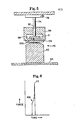
- the device used in the SS test is an Instron Universal Testing Machine (Model No. TMS) shown generally in Figure 5 as 70.
- Instron 70 consists basically of a vertically movable cross head 78 and a 200 lb. compression load cell 82 (for measuring the force generated) mounted on base 84 of the Instron.
- Cross head 78 drives unconnected cylindrical punch 74 which is received by rectangular fixture 88.
- This fixture 88 has a cylindrical bore in the form of punch guide 92 for slidable movement of punch 74.
- a test chamber 96 is also formed in fixture 88 for receiving the sample pad S to be tested.
- Fixture 88 also has a cylindrical bore in the form of die 100 over which sample S sits. The entire fixture 88 sits on load plate 104 of load cell 82.
- the SS test measures the hardness of the margarine and thus is an indication of its spreadability.
- the downward movement of crosshead 78 pushes punch 74 against sample pad S.
- Pad S is put under shear jointly by the action of the tip of punch 74, and die 100 of fixture 88.
- Load cell 82 measures the force required to punch through pad S and records it as a force curve on chart paper of a recorder. The Shear Stress value of pad S is then calculated from this force curve.
- sample pads from the margarine are formed.
- sample pads 1/4 in. thick by 1-1/4 in. square are cut using a thin wire cutter.
- the cut pads are then equilibrated at 40°F by submergence in a constant temperature waterbath for at least 1 hour.
- the product is gently removed from the tub and then cut into sticks having a 1-1/4 in. sq. cross section with a wire cutter. These sticks are then cut into sample pads in the same manner as the stick-type products.
- the SS test is conducted by placing sample pad S in test chamber 96 of fixture 88. Sample pad S is centered over die 100 of fixture 88. Fixture 88 with pad S is then placed on load plate 104 of load cell 82 and the load cell is then tarred. The full force scale of the Instron is then calibrated by placing a known weight on load plate 104 of load cell 82 along with fixture 88 and pad S. The scale is set to provide maximum resolution for a given sample pad, usually 5 lbs. full scale. The Instron is then set at a cross head speed of 10 ipm and a chart speed of 10 ipm. The upper and lower limits of cross head 78 are set to determine the penetration depth and the return height, respectively. The SS test is initiated by bringing cross head 78 into its downward motion which pushes punch 74 through sample pad S. The chart paper of the recorder moves in concert with cross head 78 with the pen recording the Shear Stress force curve of the penetration.
- a typical Shear Stress force curve 108 for a margarine made with the structural fat of the present application is shown in Figure 6.
- the height of curve 108 from the base thereof to the tip 112 indicates the amount of force (F) applied to the sample pad during the SS test, in this case about 1.3 lbs.
- the F values for 4 sample pads of the margarine are averaged for a representative indication of the amount of hardness.
- the heat stability of a margarine, in particular a stick-type product can be determined by a Slump Grade (SG) test.
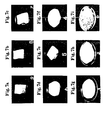
- the SG test measures, by visual inspection, the deformation of a sample due to melting when exposed to a warm environment (80°F). At a specified time, the sample is compared to a Slump Chart ( Figures 7a through 7i) to determine the Slump Grade.
- the SG test is conducted by'first preparing samples in the form of 1-1/4 in. cubes from margarines which have been stored in a 40°F constant temperature room for at least 1 day. These samples are cut from the margarine by using a thin wire cutting device. The sample cubes are equilibrated to 40°F.
- the sample cube is then placed in an 80°F constant temperature room. Visual deformation measurements are taken at 30 minutes, 45 minutes and 1 hour. Deformation of the sample cube is determined by comparison to the Slump Chart shown in Figures 7a through 7i. A grade of 10 is the highest and represents no melting. A grade of 9 ( Figure 7a) represents the first indication of melting, while a grade of 0 ( Figure 7i) represents a completely melted sample cube.
- the Slump Grades of 3 sample cubes are averaged for each margarine to give a more representative measure of heat stability. A Slump Grade of about 8 or better (based on consumer testing) at 80°F for 1 hour indicates a margarine having acceptable heat stability for a stick-type product.
- Temperature cycling is the exposure of a margarine to a temperature higher than the normal storage.temperature for a specified period one or more consecutive times.
- the temperature cycling stability of the margarine can be measured by evaluating the mouth texture, spreadability and heat stability thereof after cycling.
- Stick-type margarine products are initially stored at a temperature of 40°F. On three consecutive days, the margarine is placed in an environment of 70°F for 2 hours and then returned to the 40°F environment. These conditions were selected to approximate temperature cycling by the consumer. After this temperature cycling, sample pads or cubes of the margarine are evaluated by the preceding HP, SS and SG tests. Hot Probe, Shear Stress and Slump Grade (for stick-type products) values satisfying the previously mentioned criteria after cycling of the margarine indicate a significant benefit in terms of temperature cycling stability.
- the margarine fat basically consisted of the Palm Mid-Fractions and soybean oil.
- the margarines were formulated under similar processing conditions.
- the properties of these margarines (age of 10 to 17 days) are presented in the following Table:
- the margarine fat basically consisted of a structural fat of the present application (PMF-1) at various levels with the remainder of the margarine fat consisting of soybean oil.
- the margarines were formulated under similar processing conditions. The properties of these margarines (age of 10 days) are presented in the following Table:
- margarines formulated with PMF-1 at levels of 31% by weight or lower had insufficient heat stability (Slump Grade) for stick-type products.
- the margarine formulated with PMF-1 at a level of 75% by weight had insufficient cooling impact (Hot Probe) and unacceptable hardness (Shear Stress) after temperature cycling.
- Hot Probe insufficient cooling impact
- Shear Stress Shear Stress
- the effects of different soft oils and hydrogenation thereof on the properties of margarine products were also evaluated.
- the margarine fats basically consisted of PMF-1 at 46% by weight of the oil phase, the remainder consisting of the various soft oils.
- the margarines were formulated under similar processing conditions. The properties of these margarines (age of 10 to 14 days) are presented in the following Table:
- margarines formulated with Soybean and Sunflower oil as the soft oil had significant cooling impact (Hot Probe), acceptable hardness (Shear Stress), and sufficient heat stability (Slump Grade) for stick-type products, even after temperature cycling.
- the margarines formulated with the hydrogenated soft oils had unacceptable hardness (Hydrogenated Cottonseed), and insufficient cooling impact after cycling (Hydrogenated Cottonseed and Hydrogenated Sunflower).
- the margarine fats basically consisted of PMF-1 at 46% by weight of the oil phase, the remainder consisting of a major proportion of soybean oil, plus a minor amount of the various other fats or oils.
- the margarines were formulated under similar processing conditions. The properties of these margarines (age of 10 to 14 days) are presented in the following Table:
- the margarines formulated with 6% Palm Oil had significant cooling impact (Hot Probe), acceptable hardness (Shear Stress), and sufficient heat stability (Slump Grade) for stick-type products, even after temperature cycling.
- the margarine formulated with 12.5% Hydrogenated Coconut Oil had insufficient heat stability for a stick-type product.
- the margarine formulated with 4% Fix-X (rapeseed/soybean hardstock) had insufficient cooling impact.
- the effect of processing conditions on the properties of margarine products were evaluated.
- the first system involved chilling the emulsion in an A unit, followed by crystallization of the chilled emulsion in a static B unit.
- the flow rate (hence residence time) and outlet temperature of the A unit were varied.
- the margarine fats used basically consisted of PMF-1 at 46% by weight of the oil phase, the remainder consisting of soybean oil.
- the properties of these margarines (age of 10 to 14 days) are presented in the following Table:
- the margarines formulated under the various processing conditions of the first system had significant cooling impact (Hot Probe), acceptable hardness (Shear Stress), and sufficient heat stability (Slump Grade) for stick-type products, even after temperature cycling.
- the second system involved chilling the emulsion in an A unit, crystallizing the chilled emulsion in a working B unit, and then chilling the crystallized emulsion in an additional A unit.
- the flow rate (hence residence time) and the outlet temperature of the first A unit were varied.
- the outlet temperature of the second A unit was kept constant at about 40°F.
- the margarine fats consisted basically of PMF-1 at 46% by weight of the oil phase, the remainder consisting of soybean oil. The properties of these margarines (age of 10 days) are presented in the following Table:
- the margarines formulated under the various processing conditions of the second system had significant cooling impact (Hot Probe), acceptable hardness (Shear Stress), and sufficient heat stability (Slump Grade) for stick-type products, even after temperature cycling.
- the PMF-1 margarine compared favorably to butter (B), especially in terms of cooling impact (Hot Probe).
- butter had unacceptable hardness (Shear Stress) after temperature cycling.
- commercial margarines CM-1 to CM-3 had an insufficient cooling impact.
- the PMF-1 margarine compared favorably with the margarines made from Randomized Palm Oil, Cocoa Butter and Cocoa Butter Substitute, especially in terms of cooling impact (Hot Probe), even after temperature cycling.
- the margarines made from Palm Oil or 1st Palm Olein had insufficient heat stability (Slump Grade)for stick-type products.
- the margarine made from Hydrogenated 2d Palm Olein had insufficient cooling impact while the margarine made from Hydrogenated Coconut Oil had insufficient heat stability for stick-type products after cycling.
- One method for making a structural fat is as follows: Sixty-eight hundred g. of whole RBD palm oil (IV of 53.8) was placed in a glass fractionation column having a length of about 30 inches and an inside diameter of about 6 inches. This column had a jacket for circulation of a mixture of water-propylene glycol to heat and cool the palm oil.
- the palm oil was heated to a temperature of 170°F under agitation by an impeller rotating at 11 rpm for about 0.5 hours.
- the heated oil was slowly cooled to 80°F at a rate of 12.6°F/hr. under agitation of the impeller rotating at 11 rpm.
- the temperature of the cooled oil was maintained at 80°F for 16 hours with no agitation.
- the solid crystals forming the stearine fraction were filtered out with a Buchner funnel. A vacuum of 28 to 29 inches of mercury was applied to the funnel.
- the yield of the stearine fraction was about 20% by weight.
- This stearine fraction had an IV of 43.7.
- the triglyceride composition of this stearine fraction is presented in the following Table:
- a first olein fraction was filtered off from the stearine fraction.
- the yield of this olein fraction was about 80% by weight.
- This olein fraction had an IV of 57.3.
- the triglyceride composition of this olein fraction is presented in the following table:
- the first olein fraction was again placed in the fractionation column, and heated to a temperature of 150°F under agitation by the impeller rotating at 11 rpm for about 0.5 hours.
- the heated olein fraction was then slowly cooled to a temperature of 60°F at a rate of 14.2°F/hr. under agitation of the impeller rotating at 11 rpm.
- the temperature of the cooled first liquid fraction was maintained at 60°F for 16 hours with no agitation.
- the solid crystals forming the desired palm mid-fraction were filtered out as in the first filtration.
- the yield of the palm mid-fraction (based on whole palm oil) was about 13% by weight. This palm mid-fraction had an IV of 44.9.
- the triglyceride composition of this palm mid-fraction is presented in the following Table:
- Another method for making a structural fat is as follows: Ten separate 360 to 390 lb. quantities of whole RBD palm oil are heated to a temperature of about 150°F until melted. The melted quantities of palm oil are slowly cooled (without agitation) by holding at ambient temperatures for about 12 hours. The cooled quantities of oil are then held (without agitation) at about 80°F for about 48 hours to crystallize out the stearine fraction. The stearine fraction is then separated from the first olein fraction for each quantity of oil by using a rotary drum filter.
- the first olein fraction in separate 375 to 410 lb. quantities is heated to a temperature of about 150°F until essentially crystal free.
- the heated quantities of olein fraction are slowly cooled (without agitation) by holding at ambient temperatures for about 12 hours.
- the cooled quantities of olein fraction are held (without agitation) at about 70°F for about 24 hours, are then held (without agitation) at about 60°F for about 24 hours, and are further held (without agitation) at about 70°F for about 24 hours to crystallize out the palm mid-fraction.
- the palm mid-fraction is then separated from the second olein fraction using a rotary drum filter and centrifuge. This palm mid-fraction can be used after deodorization as a structural fat.
- a margarine oil product was made by blending a structural fat prepared by double thermal fraction of palm oil with soybean oil. The blend is heated to about 150°F to melt the structural fat.
- the fat designated PMF-1 was used.
- a 46% mixture of PMF-1 with 54% soybean oil has the following Solids Fat Content:
- a margarine was formulated from standard margarine aqueous phase ingredients (water, milk solids, salt, preservatives) dispersed in an oil phase containing the margarine fat of the present application (46% by weight palm mid-fraction, remainder soybean oil), plus other oil phase ingredients (mono-, di-glyceride and soybean lecithin emulsifiers, beta-carotene, flavors).
- the aqueous.phase formed about 20% by weight of the total emulsion; the oil phase formed about 80% by weight.
- the melted dispersion (temperature of about 120°F) of aqueous and oil phase ingredients was sent through an A unit of the Votator- type.
- the flow rate was such as to provide about 1 minute residence time in the A unit.
- the mutator speed of the A unit was 150 rpm.
- the water-in-oil emulsion was discharged from the A unit at a temperature of from 16° to 26°F:
- a margarine was formulated from aqueous and oil phase ingredients the same as those of Embodiment 1.
- the melted dispersion (temperature of about 120°F) of aqueous and oil phase ingredients was sent through two A units in series of the Votator- type.
- the A units provided a combined residence time of about 1.6 minutes.
- the mutator speeds of the A units were 250 rpm and 180 rpm, respectively.
- the water-in-oil emulsion was discharged from the second A unit at a temperature of from 17° to 27°F.
- the chilled emulsion from the second A unit was sent through a working B unit of the Votator type.
- This working B unit provided a residence time for the chilled emulsion of about 3.8 minutes.
- the shaft speed of the working B unit was 260 rpm.
- the crystallized emulsion in the working B unit picked up crystallization heat such that the margarine was discharged at a temperature of from 44° to 48°F.
- the crystallized emulsion from the working B unit was then sent through an additional A unit of the Votator type.
- the residence time of the crystallized emulsion in this additional A unit was about 0.7 minutes.
- the mutator speed of this additional A unit was 150 rpm.
- the crystallized emulsion was discharged from this additional A unit at a temperature of from 22° to 28°F.
- the chilled crystallized emulsion from this additional A unit was extruded into a stick-type margarine product and then stored at 40°F.
Landscapes
- Chemical & Material Sciences (AREA)
- Oil, Petroleum & Natural Gas (AREA)
- Life Sciences & Earth Sciences (AREA)
- Engineering & Computer Science (AREA)
- Food Science & Technology (AREA)
- Polymers & Plastics (AREA)
- Chemical Kinetics & Catalysis (AREA)
- Wood Science & Technology (AREA)
- Organic Chemistry (AREA)
- Edible Oils And Fats (AREA)
- Fats And Perfumes (AREA)
Applications Claiming Priority (6)
| Application Number | Priority Date | Filing Date | Title |
|---|---|---|---|
| US31816181A | 1981-11-04 | 1981-11-04 | |
| US318162 | 1981-11-04 | ||
| US06/318,163 US4388339A (en) | 1981-11-04 | 1981-11-04 | Margarine and method for making same |
| US318163 | 1981-11-04 | ||
| US06/318,162 US4390561A (en) | 1981-11-04 | 1981-11-04 | Margarine oil product |
| US318161 | 1999-05-25 |
Publications (3)
| Publication Number | Publication Date |
|---|---|
| EP0078568A2 true EP0078568A2 (fr) | 1983-05-11 |
| EP0078568A3 EP0078568A3 (en) | 1983-08-03 |
| EP0078568B1 EP0078568B1 (fr) | 1985-07-17 |
Family
ID=27405975
Family Applications (1)
| Application Number | Title | Priority Date | Filing Date |
|---|---|---|---|
| EP19820201327 Expired EP0078568B1 (fr) | 1981-11-04 | 1982-10-25 | Graisse structurale, son utilisation dans les produits à base d'huiles pour margarines et de graisses à tartiner émulsifiées et méthode pour sa préparation |
Country Status (4)
| Country | Link |
|---|---|
| EP (1) | EP0078568B1 (fr) |
| DE (1) | DE3264785D1 (fr) |
| GB (1) | GB2110710B (fr) |
| MY (1) | MY8800081A (fr) |
Cited By (22)
| Publication number | Priority date | Publication date | Assignee | Title |
|---|---|---|---|---|
| EP0347006A3 (fr) * | 1988-06-17 | 1991-04-17 | Unilever N.V. | Beurre artificiel à tartiner |
| EP0536824A1 (fr) * | 1991-10-03 | 1993-04-14 | Unilever N.V. | Graisses pour confiserie, non-conditionnées thermiquement |
| EP0555917A1 (fr) * | 1992-02-12 | 1993-08-18 | Unilever N.V. | Graisses non-tempérées de fourrage |
| WO1993019639A1 (fr) * | 1992-04-03 | 1993-10-14 | Preben Bo Fich | Meuble a chassis tubulaire |
| WO1994016572A1 (fr) * | 1993-01-28 | 1994-08-04 | Unilever N.V. | Margarines naturelles pour la pate feuilletee |
| EP0750844A3 (fr) * | 1995-06-30 | 1997-05-14 | Fuji Oil Co Ltd | Composition huileuse et aliment congelé |
| US5869124A (en) * | 1988-11-16 | 1999-02-09 | Van Den Bergh Foods Co., Division Of Conopco, Inc. | Edible spread |
| US6156370A (en) * | 1994-12-22 | 2000-12-05 | Van Den Bergh Foods, Co., Division Of Conopco, Inc. | Process for making a margarine hardstock fat blend |
| US6238723B1 (en) | 1995-11-10 | 2001-05-29 | Van den Bergh Foodś Co., division of Conopco, Inc. | Edible fat spread |
| WO2009090416A1 (fr) | 2008-01-19 | 2009-07-23 | Cadbury Holdings Limited | Emulsion alimentaire |
| AU2012208999B2 (en) * | 2008-01-19 | 2014-01-16 | Mondelez Uk Holdings & Services Limited | Food emulsion |
| WO2022038290A1 (fr) | 2020-08-21 | 2022-02-24 | Upfield Europe B.V. | Composition de triglycérides grasse solide |
| WO2022162026A1 (fr) | 2021-01-26 | 2022-08-04 | Upfield Europe B.V. | Graisses structurantes |
| WO2022248578A1 (fr) | 2021-05-26 | 2022-12-01 | Upfield Europe B.V. | Produits comestibles contenant de la graisse |
| WO2024110581A1 (fr) | 2022-11-25 | 2024-05-30 | Upfield Europe B.V. | Produits comestibles contenant des matières grasses et leurs procédés de préparation |
| WO2024153683A1 (fr) | 2023-01-18 | 2024-07-25 | Upfield Europe B.V. | Fromage d'origine végétale sans huile tropicale |
| WO2024153682A1 (fr) | 2023-01-18 | 2024-07-25 | Upfield Europe B.V. | Fromage à base végétale comprenant des esters de stérols végétaux |
| WO2024231576A1 (fr) | 2023-05-11 | 2024-11-14 | Upfield Europe B.V. | Émulsions de cuisson eau-dans-huile fluides |
| WO2025017031A1 (fr) | 2023-07-17 | 2025-01-23 | Upfield Europe B.V. | Poudres de matière grasse comestible sans huile de palme |
| WO2025017073A1 (fr) | 2023-07-17 | 2025-01-23 | Upfield Europe B.V. | Poudres de matière grasse comestibles sans huile de palme dans des pâtes à tartiner |
| WO2025061924A1 (fr) | 2023-09-22 | 2025-03-27 | Flora Food Global Principal B.V. | Produits comestibles contenant de la graisse contenant des protéines végétales présentant une aptitude à l'étalement améliorée |
| WO2025061925A1 (fr) | 2023-09-22 | 2025-03-27 | Flora Food Global Principal B.V. | Produits comestibles contenant de la matière grasse ayant une phase aqueuse et une phase grasse, la phase grasse étant composée d'huile et de matière grasse structurante répondant à certains critères de composition d'acide gras |
Families Citing this family (3)
| Publication number | Priority date | Publication date | Assignee | Title |
|---|---|---|---|---|
| US5395531A (en) * | 1992-09-28 | 1995-03-07 | Pall Corporation | Method for fractionating a fat composition |
| PL2215196T3 (pl) * | 2007-11-19 | 2017-07-31 | Aak Sweden Ab | Mrożony wyrób cukierniczy z mieszaniną glicerydową |
| WO2010060711A1 (fr) * | 2008-11-28 | 2010-06-03 | Unilever Nv | Emulsion contenant une graisse comprenant de l'huile de palme et un ester d'acide gras au sorbitan |
Family Cites Families (3)
| Publication number | Priority date | Publication date | Assignee | Title |
|---|---|---|---|---|
| GB1431781A (en) * | 1972-03-29 | 1976-04-14 | Unilever Ltd | Process for preparing chocolate using hard fat replacer |
| US4205095A (en) * | 1976-11-04 | 1980-05-27 | Barr Iain G | Glycerides |
| FR2386266A1 (fr) * | 1977-04-06 | 1978-11-03 | Blohorn Sa | Melange eutectique d'huiles alimentaires |
-
1982
- 1982-10-25 DE DE8282201327T patent/DE3264785D1/de not_active Expired
- 1982-10-25 EP EP19820201327 patent/EP0078568B1/fr not_active Expired
- 1982-10-29 GB GB08231017A patent/GB2110710B/en not_active Expired
-
1988
- 1988-12-30 MY MY8800081A patent/MY8800081A/xx unknown
Cited By (30)
| Publication number | Priority date | Publication date | Assignee | Title |
|---|---|---|---|---|
| EP0347006A3 (fr) * | 1988-06-17 | 1991-04-17 | Unilever N.V. | Beurre artificiel à tartiner |
| US5869124A (en) * | 1988-11-16 | 1999-02-09 | Van Den Bergh Foods Co., Division Of Conopco, Inc. | Edible spread |
| EP0536824A1 (fr) * | 1991-10-03 | 1993-04-14 | Unilever N.V. | Graisses pour confiserie, non-conditionnées thermiquement |
| EP0555917A1 (fr) * | 1992-02-12 | 1993-08-18 | Unilever N.V. | Graisses non-tempérées de fourrage |
| WO1993019639A1 (fr) * | 1992-04-03 | 1993-10-14 | Preben Bo Fich | Meuble a chassis tubulaire |
| WO1994016572A1 (fr) * | 1993-01-28 | 1994-08-04 | Unilever N.V. | Margarines naturelles pour la pate feuilletee |
| US6156370A (en) * | 1994-12-22 | 2000-12-05 | Van Den Bergh Foods, Co., Division Of Conopco, Inc. | Process for making a margarine hardstock fat blend |
| EP0750844A3 (fr) * | 1995-06-30 | 1997-05-14 | Fuji Oil Co Ltd | Composition huileuse et aliment congelé |
| US5766659A (en) * | 1995-06-30 | 1998-06-16 | Fuji Oil Company, Limited | Oily compostion and frozen food |
| US6238723B1 (en) | 1995-11-10 | 2001-05-29 | Van den Bergh Foodś Co., division of Conopco, Inc. | Edible fat spread |
| EP2614722A1 (fr) * | 2008-01-19 | 2013-07-17 | Cadbury Holdings Limited | Émulsion alimentaire |
| EP2614719A1 (fr) * | 2008-01-19 | 2013-07-17 | Cadbury Holdings Limited | Émulsion alimentaire |
| EP2614721A1 (fr) * | 2008-01-19 | 2013-07-17 | Cadbury Holdings Limited | Émulsion alimentaire |
| WO2009090416A1 (fr) | 2008-01-19 | 2009-07-23 | Cadbury Holdings Limited | Emulsion alimentaire |
| AU2012208999B2 (en) * | 2008-01-19 | 2014-01-16 | Mondelez Uk Holdings & Services Limited | Food emulsion |
| AU2012209000B2 (en) * | 2008-01-19 | 2014-02-27 | Mondelez Uk Holdings & Services Limited | Food emulsion |
| AU2009204702B2 (en) * | 2008-01-19 | 2012-05-03 | Mondelez Uk Holdings & Services Limited | Food emulsion |
| WO2022038290A1 (fr) | 2020-08-21 | 2022-02-24 | Upfield Europe B.V. | Composition de triglycérides grasse solide |
| EP4335913A2 (fr) | 2021-01-26 | 2024-03-13 | Upfield Europe B.V. | Structuration de graisses |
| WO2022162026A1 (fr) | 2021-01-26 | 2022-08-04 | Upfield Europe B.V. | Graisses structurantes |
| EP4327663A2 (fr) | 2021-01-26 | 2024-02-28 | Upfield Europe B.V. | Structuration de graisses |
| WO2022248578A1 (fr) | 2021-05-26 | 2022-12-01 | Upfield Europe B.V. | Produits comestibles contenant de la graisse |
| WO2024110581A1 (fr) | 2022-11-25 | 2024-05-30 | Upfield Europe B.V. | Produits comestibles contenant des matières grasses et leurs procédés de préparation |
| WO2024153683A1 (fr) | 2023-01-18 | 2024-07-25 | Upfield Europe B.V. | Fromage d'origine végétale sans huile tropicale |
| WO2024153682A1 (fr) | 2023-01-18 | 2024-07-25 | Upfield Europe B.V. | Fromage à base végétale comprenant des esters de stérols végétaux |
| WO2024231576A1 (fr) | 2023-05-11 | 2024-11-14 | Upfield Europe B.V. | Émulsions de cuisson eau-dans-huile fluides |
| WO2025017031A1 (fr) | 2023-07-17 | 2025-01-23 | Upfield Europe B.V. | Poudres de matière grasse comestible sans huile de palme |
| WO2025017073A1 (fr) | 2023-07-17 | 2025-01-23 | Upfield Europe B.V. | Poudres de matière grasse comestibles sans huile de palme dans des pâtes à tartiner |
| WO2025061924A1 (fr) | 2023-09-22 | 2025-03-27 | Flora Food Global Principal B.V. | Produits comestibles contenant de la graisse contenant des protéines végétales présentant une aptitude à l'étalement améliorée |
| WO2025061925A1 (fr) | 2023-09-22 | 2025-03-27 | Flora Food Global Principal B.V. | Produits comestibles contenant de la matière grasse ayant une phase aqueuse et une phase grasse, la phase grasse étant composée d'huile et de matière grasse structurante répondant à certains critères de composition d'acide gras |
Also Published As
| Publication number | Publication date |
|---|---|
| GB2110710B (en) | 1985-06-26 |
| EP0078568B1 (fr) | 1985-07-17 |
| DE3264785D1 (en) | 1985-08-22 |
| MY8800081A (en) | 1988-12-31 |
| EP0078568A3 (en) | 1983-08-03 |
| GB2110710A (en) | 1983-06-22 |
Similar Documents
| Publication | Publication Date | Title |
|---|---|---|
| US4447462A (en) | Structural fat and method for making same | |
| US4390561A (en) | Margarine oil product | |
| US4388339A (en) | Margarine and method for making same | |
| EP0078568B1 (fr) | Graisse structurale, son utilisation dans les produits à base d'huiles pour margarines et de graisses à tartiner émulsifiées et méthode pour sa préparation | |
| CA1216461A (fr) | Margarine et procede de production | |
| Che Man et al. | Composition and thermal profile of crude palm oil and its products | |
| US4386111A (en) | Fat blend | |
| CA1248405A (fr) | Compose de confiserie pour la preparation de chocolats | |
| CA1250482A (fr) | Procede de fractionnement a l'aide de solvants pour obtenir des graisses a partir de l'huile de palme | |
| US4610884A (en) | Confectionery cremes | |
| KR0168040B1 (ko) | 제조된, 베타-프라임 안정성 트리글리세라이드 경질스톡 | |
| US20140023773A1 (en) | Palm-based fractionated oil and fat, oil and fat composition and food product containing the same | |
| US4940601A (en) | Sucrose fatty acid ester compositions and shortenings and margarines made therefrom | |
| EP0050418A1 (fr) | Procédé pour la fabrication d'un produit gras comestible | |
| EP2584908A1 (fr) | Compositions de graisses texturantes, non trempées | |
| NZ224506A (en) | Sucrose fatty acid ester composition and uses in shortening and margarine compositions | |
| Hartel et al. | Fats, oils and emulsifiers | |
| Busfield et al. | Thermal analysis of palm stearine by DSC | |
| Okawachi et al. | Confectionery fats from palm oil | |
| EP0264149B1 (fr) | Produit gras comestible et procédé de préparation d'un tel produit | |
| EP0109721B1 (fr) | Mélange gras pour margarines | |
| Idris et al. | Chemical composition and physical properties of soft (tub) margarines sold in Malaysia | |
| Omar et al. | Crystallisation and rheological properties of hydrogenated palm oil and palm oil blends in relation to crystal networking | |
| CA1194889A (fr) | Matiere grasse et procede de preparation | |
| Hayati et al. | Physical characteristics of modified milkfat in high-melting fat preparation |
Legal Events
| Date | Code | Title | Description |
|---|---|---|---|
| PUAI | Public reference made under article 153(3) epc to a published international application that has entered the european phase |
Free format text: ORIGINAL CODE: 0009012 |
|
| AK | Designated contracting states |
Designated state(s): BE DE FR IT NL |
|
| PUAL | Search report despatched |
Free format text: ORIGINAL CODE: 0009013 |
|
| AK | Designated contracting states |
Designated state(s): BE DE FR IT NL |
|
| 17P | Request for examination filed |
Effective date: 19840123 |
|
| ITF | It: translation for a ep patent filed | ||
| GRAA | (expected) grant |
Free format text: ORIGINAL CODE: 0009210 |
|
| AK | Designated contracting states |
Designated state(s): BE DE FR IT NL |
|
| REF | Corresponds to: |
Ref document number: 3264785 Country of ref document: DE Date of ref document: 19850822 |
|
| ET | Fr: translation filed | ||
| PLBI | Opposition filed |
Free format text: ORIGINAL CODE: 0009260 |
|
| 26 | Opposition filed |
Opponent name: UNILEVER N.V. Effective date: 19860416 |
|
| NLR1 | Nl: opposition has been filed with the epo |
Opponent name: UNILEVER N.V. |
|
| PGFP | Annual fee paid to national office [announced via postgrant information from national office to epo] |
Ref country code: NL Payment date: 19861031 Year of fee payment: 5 |
|
| RDAG | Patent revoked |
Free format text: ORIGINAL CODE: 0009271 |
|
| STAA | Information on the status of an ep patent application or granted ep patent |
Free format text: STATUS: PATENT REVOKED |
|
| 27W | Patent revoked |
Effective date: 19861031 |
|
| NLR2 | Nl: decision of opposition | ||
| BERE | Be: lapsed |
Owner name: THE PROCTER & GAMBLE CY Effective date: 19871031 |
|
| REG | Reference to a national code |
Ref country code: FR Ref legal event code: ST |
|
| PLAB | Opposition data, opponent's data or that of the opponent's representative modified |
Free format text: ORIGINAL CODE: 0009299OPPO |