EP0079465A2 - Méthode pour la mise en mémoire et pour l'accès d'une base de donnée relationnelle - Google Patents
Méthode pour la mise en mémoire et pour l'accès d'une base de donnée relationnelle Download PDFInfo
- Publication number
- EP0079465A2 EP0079465A2 EP82109511A EP82109511A EP0079465A2 EP 0079465 A2 EP0079465 A2 EP 0079465A2 EP 82109511 A EP82109511 A EP 82109511A EP 82109511 A EP82109511 A EP 82109511A EP 0079465 A2 EP0079465 A2 EP 0079465A2
- Authority
- EP
- European Patent Office
- Prior art keywords
- data base
- records
- index table
- fields
- record
- Prior art date
- Legal status (The legal status is an assumption and is not a legal conclusion. Google has not performed a legal analysis and makes no representation as to the accuracy of the status listed.)
- Withdrawn
Links
Images

Classifications
-
- G—PHYSICS
- G06—COMPUTING OR CALCULATING; COUNTING
- G06F—ELECTRIC DIGITAL DATA PROCESSING
- G06F16/00—Information retrieval; Database structures therefor; File system structures therefor
- G06F16/20—Information retrieval; Database structures therefor; File system structures therefor of structured data, e.g. relational data
- G06F16/28—Databases characterised by their database models, e.g. relational or object models
- G06F16/284—Relational databases
-
- G—PHYSICS
- G06—COMPUTING OR CALCULATING; COUNTING
- G06F—ELECTRIC DIGITAL DATA PROCESSING
- G06F16/00—Information retrieval; Database structures therefor; File system structures therefor
- G06F16/90—Details of database functions independent of the retrieved data types
- G06F16/901—Indexing; Data structures therefor; Storage structures
- G06F16/9017—Indexing; Data structures therefor; Storage structures using directory or table look-up
Definitions
- This invention relates to information storage and retrieval systems and more particularly to improved methods for storing and accessing large data bases using relational query processing.
- lists of information may be processed as a "file", where the file is a collection of records containing the same type of information. Records are divided into fields to separate and identify units of information in the record so that system functions such as selecting, sorting and processing can be performed on the field data.
- a collection of files is commonly called a data base. The selection of records from the data base conditioned on particular attribute fields is referred to as data base retrieval.
- the number of record entries that can be stored in a given size information processing system memory and the flexibility with which the records can be accessed govern the practicality of a data base retrieval system. These constraints become particularly important when the information processing system is miniprocessor driven and a large part of the storage is disk or diskette files.
- Data base retrieval has normally been done in a sequential manner which only allows for retrieval of record entries after an explicit match on a given attribute field. Depending on the specifications of the system, only a limited number of such attributes can be accessed and used as a retrieval argument.
- a much more flexible apprbach to data base retrieval is that of relational data base access which allows retrieval of records implicitly through searching any of the attribute fields which constitute 'the record.
- An example of a sequential data base access is the query "List all the journals with the key word 'aeronautics'.
- a relational query could expand the scope of the interrogation of the data base to a query of the nature, "List the journals with the key word 'aeronautics' due for renewal in the next two months that cost $30.00, or more, and are received by managers".
- the retrieved set of records would simultaneously meet the above constraints, whereas sequential query would require specialized post output processing to refine the initial set of records down to the particular constraint set requested by the relational query.
- the present invention discloses an improved method for storing and accessing relational data bases which increases data base record storage efficiency and reduces processing time in an information processing system.
- the data base records are synthesized into a summary sorted list of unique data elements.
- the data elements are related by virtue of their positions in the sorted list to pointers stored in an index table which is an isomorphic mapping of the data base records from which the summary sorted list was derived.
- the index table captures the record content and juxtaposition of the record fields in a relational manner and yields the effect of a totally inverted data base file.
- the index table pointers facilitate high speed relational query processing with a minimum allocation of memory.
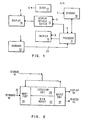
- the invention will now be described as embodied in an interactive text processing system of the type shown in FIG. 1.
- the "text processing system illustrated therein comprises a keyboard 10, a microprocessor 11, a display refresh buffer 12, a display device 14, a printer 15, and an auxiliary direct access storage device 16 such as a disk drive.
- a clock 17, for keeping the various components of the system in synchronism, is also shown in FIG. 1 and is effectively coupled to each of the units.
- Keyboard 10 comprises a normal set of graphic symbol keys such as letters, numbers, punctuation marks, and special character keys, plus text format or control keys like carriage return, tab, index, etc.
- the keyboard 10 includes a second set of control keys for issuing special control commands to the system.
- the control keys include cursor movement keys, keys for setting the keyboard 10 into a number of different modes, etc.
- the keyboard 10 is connected to the microprocessor 11 by means of a bus 20.
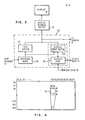
- the microprocessor 11, as shown in FIG. 2, comprises an input port 21, an output port 22, a random access memory 23, and a process execution unit 24.
- memory unit 23 stores both instructions and data in specified sections which will be described in more detail later on in the specification.
- Data is entered into memory 23 from the keyboard 10 as bytes of binary information through input port 21.
- the section of RAM 23 which received the keystroke data from the keyboard 10 is designated keystroke queue 26.
- Data to be displayed is transferred by a series of instructions from queue 26 to the text buffer section 27 and then to the display refresh buffer 12 through output port 22 of the microprocessor 11. This is achieved in a conventional way by the microprocessor 11 executing a series of move'instructions.
- the microprocessor 11 may be an IBM Series 1, INTEL model 8086, or any of the recognized functionally equivalent, currently available microprocessors.
- the display refresh buffer 12 is shown as a separate buffer connected between the output port 22 and the display device 14.
- Buffer 12 in practice, is normally a part of the display device 14 and functions to control the generation of characters on the screen of the display device 14 by exercising on-off control of the beam as it traces a series of horizontal lines across the screen.
- the output port 22 also supplies data stored in memory 23 to the printer 15 and disk storage unit 16, each of which may have their own internal buffers which are not shown. Commands to transfer data from the random access memory 23 to the printer 15 or storage unit 16 are sent to the microprocessor 11 by the operator from the keyboard 10.
- Printer 15 may be any suitable printer known in the art. In most text processing systems, the printer 15 is basically a standard input/output terminal printer having a type ball element or a daisy-wheel print element.
- Disk storage 16 may also be any suitable disk storage device which is capable of storing serial by byte data supplied to it at determined sector address locations, each of which are randomly addressable by the microprocessor 11 to retrieve the data. Spatially related data supplied from disk drive 16 is stored in the display data area 28 of the memory 23 in encoded form.
- the other section of memory 23 shown in FIG. 3 is the display format buffer area 29 which is involved in the handling of spatially related data in decoded form in accordance with the method of the present invention.
- FIG. 4 is a schematic representation of the screen of display device 14.
- the screen has, for example, the capability of displaying 25 lines of characters (RO-R24) where each line consists of 80 character column positions (CO-C79).
- one character position consists of a matrix of dot positions or picture elements sometimes referred to as pels.
- a typical character matrix for a display of the type represented by device 14 would be a matrix of six wide by ten high pels, which has been designated by reference character 32 in FIG. 4.
- the interaction of the refresh buffer 12 and the display 14 is to convert the characters stored at a location in the buffer 12 to the corresponding character as formed in a 6 x 10 dot matrix at the equivalent location on the display 14.
- Display 14 generally is provided with its own set of electronics to achieve that conversion.
- the microprocessor 11 need only supply the address and load the buffer 12 with the appropriate characters.
- the disk storage device 16 also is generally provided with its own set of electronics for converting a byte of data supplied from the display data area 28 of memory 23 through the output port 22 to a serial by bit stream of data to be recorded at a predetermined sector of the one addressed concentric recording track on the disk. Data from the device 16 is supplied to the microprocessor 11 serial by byte from the addressed sector and storage tracks when requested.
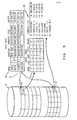
- FIG. 5 illustrates a storage arrangement for storing data on a direct access storage device such as a disk 16 in accordance with the present invention.
- the data base 44 is shown in simplified form for ease of explanation as a personnel file consisting of records 41 having five fields of information about each employee. Each field has reserved a fixed number of bytes for storing the corresponding data. Although the number of bytes per field may vary between fields within a record, each record contains the same number of bytes for each corresponding field.
- the name field may be 20 bytes while the location field is only 10 bytes. However the name field for all " records will be 20 bytes and the location field for all records will be 10 bytes.
- the data base 44 will consist of several files, for example, personnel files, inventory files, order files, etc. Each file may contain thousands of records and each record may contain up to 10 or more fields. Conventionally, such large data bases could only be processed on very large information processing systems having large capacity random access storage. Such large capacity random access storage was needed for performing operations such as sorting and searching the data base without time consuming input and output operations to disk storage devices.
- the present invention compacts and encodes the data base information to eliminate the need for large amounts of random access storage without serious degradation to processing efficiency.
- the data base information is brought into the system.
- the data base information may be stored on the disk file .16 or it may be accessed from a larger information processing system over telecommunications lines.
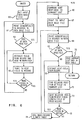
- each record 40 in the data base file is sequentially accessed.
- a test is conducted to determine if the end of the data base file has been reached. If not then in block 63 each field from the record is extracted and saved in a work area in the system memory 23.
- the next field in the record is addressed and in block 65 a test is conducted to determine if the record contains more fields.
- a branch is taken back to block 63 wherein the extraction of fields from the record and storing of the fields in the work area continues until there are no more fields in a record.
- the routine branches back to block 61 to continue the sequential processing of the records with the next record.
- a branch is taken to block 66 wherein the record fields that have been saved in the work area are summary sorted into a summary list 45.
- the "summary sort" operation sorts the fields into alphabetic and numeric order and eliminates duplicates. Referring to FIG. 5, it can be seen that the original data base 44 contained four records of five fields each making a total of 20 fields. However the summary list 45 contains only 13 fields after summary sorting. This represents a very significant reduction in the size of the data base and the amount of storage required to store the data base. Of course it is readily apparent that the amount of storage reduction is dependent upon duplicate field information contained in the records.
- each index record represents an isomorphic mapping of the corresponding record in the data base.
- the fields of the index records contain the position of the data base record field in the summary list rather than the data base record field data. In this way, 64,000 entries in the summary list can each be represented by a two-byte field in the index table.: This represents an extremely high reduction in the amount of storage required to store the data base information. For example, if we assume that each record is 80 bytes long and contains 10 fields of information, then each record can be represented by 20 bytes of storage in the index table as compared to the 80 bytes of storage required for each record in the data base. Consequently, four times as many records can be represented using the index table encoding as could be stored if the data base records themselves were stored or only one-fourth as much storage is required for the index table as is required for the data base.
- a condition is tested to determine if more fields exist in the record that have not been processed. If more fields do exist then the process returns to block 70 to continue extracting fields from the records.
- processing branches to block 74 wherein the index record is stored in the index table as shown in FIG. 5.
- a branch is then taken back to block 68 where processing continues with the next record.
- a branch is taken to block 75 wherein the summary list and the index table are saved by outputting them to disk storage device 16 in positions 40 and 42. The process then ends.
- Table 1 shows a pseudo code routine for implementing the process of FIG. 6.
- the information processing system operator will enter a query to the system through the keyboard 10.
- the query will contain key words that relate to the fields of information in the data base records. Retrieval processes of this type are well known in the prior art and an example is described herein in the Description of the Prior Art section of this application.
- the key words in the query may be set out in quotes or otherwise identified to the data base retrieval system.
- the input key words and the summary list table are brought into the process in block 80.
- the key words are compared against the summary list and when found the position code of the key word in the summary list is saved in block 82.
- a condition is tested to determine whether there are more key words to be processed. If so the processing returns to block 81 and continues to check the key words against the summary list. When the last key word has been located in the summary list, the columns of the index table corresponding to the key words are brought into the process in block 84.
- the index table is a matrix grid comprised of rows represented by each record and columns represented by each field. More efficient processing of this matrix can be made'by bringing into the random access memory only those fields that are needed to respond to the query. This provides a further enhancement to the number of records that can be processed in the system by statistically determining the average number of fields that will be required for any given input query.
- each field in each column is accessed and compared to the corresponding key word position code in block 86. If no match occurs in block 87 processing returns to block 85 and continues down each column.
- the field position codes are saved in an output record table at block 88 and the condition in block 89 is examined to determine if there are more column fields to be checked. If so processing returns to block 85 and continues comparing the column field position codes with the input key word position codes. Then following examination of the last column field the output record table and the summary list are retained in memory in block 90.
- the output record table contains all the address pointers to the terms in the summary list for reconstructing the records for printing or viewing on a display device.
- the summary list is accessed at the addresses specified by the output record table and the corresponding terms from the summary list are used to construct the data records for the output file. Processing then returns to operator control where the output file is available for display, storage, or printing and the routine ends.
- Table 2 shows a pseudo code routine for executing the retrieval process of FIG. 7. While the invention has been particularly shown and described with reference to a preferred embodiment thereof, it will be understood by those skilled in the art that various changes by equivalent means may be made therein such as using different input/output devices or storages and equivalent processing steps without departing from the scope of the invention as defined by the claims.
Landscapes
- Engineering & Computer Science (AREA)
- Databases & Information Systems (AREA)
- Theoretical Computer Science (AREA)
- Data Mining & Analysis (AREA)
- Physics & Mathematics (AREA)
- General Engineering & Computer Science (AREA)
- General Physics & Mathematics (AREA)
- Software Systems (AREA)
- Information Retrieval, Db Structures And Fs Structures Therefor (AREA)
Applications Claiming Priority (2)
| Application Number | Priority Date | Filing Date | Title |
|---|---|---|---|
| US32100381A | 1981-11-13 | 1981-11-13 | |
| US321003 | 1981-11-13 |
Publications (2)
| Publication Number | Publication Date |
|---|---|
| EP0079465A2 true EP0079465A2 (fr) | 1983-05-25 |
| EP0079465A3 EP0079465A3 (fr) | 1985-01-23 |
Family
ID=23248752
Family Applications (1)
| Application Number | Title | Priority Date | Filing Date |
|---|---|---|---|
| EP82109511A Withdrawn EP0079465A3 (fr) | 1981-11-13 | 1982-10-14 | Méthode pour la mise en mémoire et pour l'accès d'une base de donnée relationnelle |
Country Status (3)
| Country | Link |
|---|---|
| EP (1) | EP0079465A3 (fr) |
| JP (1) | JPS5892035A (fr) |
| ES (1) | ES8402446A1 (fr) |
Cited By (37)
| Publication number | Priority date | Publication date | Assignee | Title |
|---|---|---|---|---|
| WO1986003039A1 (fr) * | 1984-11-08 | 1986-05-22 | Datran Corporation | Systeme d'identification symbolique de mots et de phrases |
| EP0351786A3 (fr) * | 1988-07-19 | 1991-06-26 | Casio Computer Company Limited | Dispositif de traitement de données |
| EP0398884A4 (en) * | 1987-10-09 | 1992-08-12 | Nucleus International Corporation | A relational database representation with relational database operation capability |
| EP0494364A3 (en) * | 1991-01-08 | 1993-10-20 | Volt Inf Sciences Inc | Method and apparatus for information storage and retrieval |
| EP0560543A3 (en) * | 1992-03-09 | 1993-11-18 | Ibm | Computer user interface for relating key and index properties to database table columns |
| US5384836A (en) * | 1991-03-19 | 1995-01-24 | Casio Electronics Manufacturing Co., Ltd. | Facsimile apparatus automatically registrable of identification name |
| US5513348A (en) * | 1989-10-17 | 1996-04-30 | Fujitsu Limited | System for relational database retrieval through a link file built to access components of relational tables |
| EP0927940A1 (fr) * | 1997-12-31 | 1999-07-07 | The Explorid Group B.V. | Base de données et procédé de construction d'une base de données |
| US6192374B1 (en) * | 1998-10-10 | 2001-02-20 | Lawrence Technologies, Llc | Efficient implementations of constructs such as feature tables |
| EP1139238A2 (fr) * | 2000-03-28 | 2001-10-04 | Nissan Motor Company, Limited | Système pour l'affichage de données, système pour la formation d'une carte de données et procédé pour la formation d'une carte de données |
| WO2002063498A1 (fr) * | 2001-01-06 | 2002-08-15 | Qinetiq Limited | Procede d'interrogation d'une structure de donnees comprimees |
| EP1052577A3 (fr) * | 1999-05-08 | 2003-01-22 | Fujitsu Services Limited | Analyse de fichiers de données |
| US6513034B1 (en) * | 1999-04-16 | 2003-01-28 | International Business Machines Corporation | Deriving uniqueness for indices on summary tables |
| WO2003096230A3 (fr) * | 2002-05-10 | 2004-07-15 | Oracle Int Corp | Procede et dispositif pour le stockage de donnees et l'acces aux donnees, et pour l'amelioration de la performance des formulations de langage d'interrogation de base de donnees |
| EP1388088A4 (fr) * | 2001-04-12 | 2006-01-25 | Primentia Inc | Systeme et procede d'organisation de donnees |
| US7058783B2 (en) | 2002-09-18 | 2006-06-06 | Oracle International Corporation | Method and mechanism for on-line data compression and in-place updates |
| US7103608B1 (en) | 2002-05-10 | 2006-09-05 | Oracle International Corporation | Method and mechanism for storing and accessing data |
| WO2007018328A1 (fr) * | 2005-08-05 | 2007-02-15 | Gq Soft Co., Ltd. | Procede de compression et de securisation a plate-forme libre de fichiers dans un telephone cellulaire |
| US7213041B2 (en) | 2004-10-05 | 2007-05-01 | Unisys Corporation | Saving and restoring an interlocking trees datastore |
| US7340471B2 (en) | 2004-01-16 | 2008-03-04 | Unisys Corporation | Saving and restoring an interlocking trees datastore |
| US7348980B2 (en) | 2004-11-08 | 2008-03-25 | Unisys Corporation | Method and apparatus for interface for graphic display of data from a Kstore |
| US7389301B1 (en) | 2005-06-10 | 2008-06-17 | Unisys Corporation | Data aggregation user interface and analytic adapted for a KStore |
| US7409380B1 (en) | 2005-04-07 | 2008-08-05 | Unisys Corporation | Facilitated reuse of K locations in a knowledge store |
| US7418445B1 (en) | 2004-11-08 | 2008-08-26 | Unisys Corporation | Method for reducing the scope of the K node construction lock |
| US7424480B2 (en) | 2003-03-10 | 2008-09-09 | Unisys Corporation | System and method for storing and accessing data in an interlocking trees datastore |
| US7499932B2 (en) | 2004-11-08 | 2009-03-03 | Unisys Corporation | Accessing data in an interlocking trees data structure using an application programming interface |
| EP2008205A4 (fr) * | 2006-03-22 | 2009-08-26 | Prolific Publishing Inc | Système et procédé de courtage en information entre une pluralité de clients commercialement distincts |
| US7593923B1 (en) | 2004-06-29 | 2009-09-22 | Unisys Corporation | Functional operations for accessing and/or building interlocking trees datastores to enable their use with applications software |
| US7676477B1 (en) | 2005-10-24 | 2010-03-09 | Unisys Corporation | Utilities for deriving values and information from within an interlocking trees data store |
| US7676330B1 (en) | 2006-05-16 | 2010-03-09 | Unisys Corporation | Method for processing a particle using a sensor structure |
| US7689571B1 (en) | 2006-03-24 | 2010-03-30 | Unisys Corporation | Optimizing the size of an interlocking tree datastore structure for KStore |
| US7698283B2 (en) | 1999-07-20 | 2010-04-13 | Primentia, Inc. | System and method for organizing data |
| US7716241B1 (en) | 2004-10-27 | 2010-05-11 | Unisys Corporation | Storing the repository origin of data inputs within a knowledge store |
| US7734571B2 (en) | 2006-03-20 | 2010-06-08 | Unisys Corporation | Method for processing sensor data within a particle stream by a KStore |
| US7908240B1 (en) | 2004-10-28 | 2011-03-15 | Unisys Corporation | Facilitated use of column and field data for field record universe in a knowledge store |
| US8238351B2 (en) | 2006-04-04 | 2012-08-07 | Unisys Corporation | Method for determining a most probable K location |
| US8516004B2 (en) | 2003-09-19 | 2013-08-20 | Unisys Corporation | Method for processing K node count fields using an intensity variable |
Families Citing this family (1)
| Publication number | Priority date | Publication date | Assignee | Title |
|---|---|---|---|---|
| JPS63153623A (ja) * | 1987-09-10 | 1988-06-27 | Hitachi Ltd | 記憶装置及び記憶装置のアクセス方法 |
Family Cites Families (1)
| Publication number | Priority date | Publication date | Assignee | Title |
|---|---|---|---|---|
| DE1774886A1 (de) * | 1968-09-27 | 1971-12-23 | Siemens Ag | Verfahren zum Verarbeiten und Suchen von Eigenschaftssaetzen |
-
1982
- 1982-10-14 EP EP82109511A patent/EP0079465A3/fr not_active Withdrawn
- 1982-10-19 JP JP57182228A patent/JPS5892035A/ja active Pending
- 1982-11-12 ES ES517317A patent/ES8402446A1/es not_active Expired
Cited By (45)
| Publication number | Priority date | Publication date | Assignee | Title |
|---|---|---|---|---|
| WO1986003039A1 (fr) * | 1984-11-08 | 1986-05-22 | Datran Corporation | Systeme d'identification symbolique de mots et de phrases |
| EP0398884A4 (en) * | 1987-10-09 | 1992-08-12 | Nucleus International Corporation | A relational database representation with relational database operation capability |
| EP0351786A3 (fr) * | 1988-07-19 | 1991-06-26 | Casio Computer Company Limited | Dispositif de traitement de données |
| US5513348A (en) * | 1989-10-17 | 1996-04-30 | Fujitsu Limited | System for relational database retrieval through a link file built to access components of relational tables |
| EP0494364A3 (en) * | 1991-01-08 | 1993-10-20 | Volt Inf Sciences Inc | Method and apparatus for information storage and retrieval |
| US5384836A (en) * | 1991-03-19 | 1995-01-24 | Casio Electronics Manufacturing Co., Ltd. | Facsimile apparatus automatically registrable of identification name |
| EP0560543A3 (en) * | 1992-03-09 | 1993-11-18 | Ibm | Computer user interface for relating key and index properties to database table columns |
| US5553218A (en) * | 1992-03-09 | 1996-09-03 | International Business Machines Corporation | Graphical user interface for relating key index properties to database table columns |
| EP0927940A1 (fr) * | 1997-12-31 | 1999-07-07 | The Explorid Group B.V. | Base de données et procédé de construction d'une base de données |
| US6192374B1 (en) * | 1998-10-10 | 2001-02-20 | Lawrence Technologies, Llc | Efficient implementations of constructs such as feature tables |
| US6513034B1 (en) * | 1999-04-16 | 2003-01-28 | International Business Machines Corporation | Deriving uniqueness for indices on summary tables |
| EP1052577A3 (fr) * | 1999-05-08 | 2003-01-22 | Fujitsu Services Limited | Analyse de fichiers de données |
| US7698283B2 (en) | 1999-07-20 | 2010-04-13 | Primentia, Inc. | System and method for organizing data |
| EP1139238A2 (fr) * | 2000-03-28 | 2001-10-04 | Nissan Motor Company, Limited | Système pour l'affichage de données, système pour la formation d'une carte de données et procédé pour la formation d'une carte de données |
| WO2002063498A1 (fr) * | 2001-01-06 | 2002-08-15 | Qinetiq Limited | Procede d'interrogation d'une structure de donnees comprimees |
| US7194456B2 (en) | 2001-01-06 | 2007-03-20 | Qinetiq Limited | Method of querying a structure of compressed data |
| EP1388088A4 (fr) * | 2001-04-12 | 2006-01-25 | Primentia Inc | Systeme et procede d'organisation de donnees |
| US7870113B2 (en) | 2001-04-12 | 2011-01-11 | Primentia, Inc. | System and method for organizing data |
| WO2003096230A3 (fr) * | 2002-05-10 | 2004-07-15 | Oracle Int Corp | Procede et dispositif pour le stockage de donnees et l'acces aux donnees, et pour l'amelioration de la performance des formulations de langage d'interrogation de base de donnees |
| US7103608B1 (en) | 2002-05-10 | 2006-09-05 | Oracle International Corporation | Method and mechanism for storing and accessing data |
| CN100390790C (zh) * | 2002-05-10 | 2008-05-28 | 甲骨文国际公司 | 存储和访问数据,以及提高数据库查询语言语句性能的方法和机制 |
| AU2003229021C1 (en) * | 2002-05-10 | 2009-09-17 | Oracle International Corporation | Storing and querying relational data in compressed storage format |
| AU2003229021B2 (en) * | 2002-05-10 | 2009-04-23 | Oracle International Corporation | Storing and querying relational data in compressed storage format |
| US7058783B2 (en) | 2002-09-18 | 2006-06-06 | Oracle International Corporation | Method and mechanism for on-line data compression and in-place updates |
| US7451290B2 (en) | 2002-09-18 | 2008-11-11 | Oracle International Corporation | Method and mechanism for on-line data compression and in-place updates |
| US7424480B2 (en) | 2003-03-10 | 2008-09-09 | Unisys Corporation | System and method for storing and accessing data in an interlocking trees datastore |
| US8516004B2 (en) | 2003-09-19 | 2013-08-20 | Unisys Corporation | Method for processing K node count fields using an intensity variable |
| US7340471B2 (en) | 2004-01-16 | 2008-03-04 | Unisys Corporation | Saving and restoring an interlocking trees datastore |
| US7593923B1 (en) | 2004-06-29 | 2009-09-22 | Unisys Corporation | Functional operations for accessing and/or building interlocking trees datastores to enable their use with applications software |
| US7213041B2 (en) | 2004-10-05 | 2007-05-01 | Unisys Corporation | Saving and restoring an interlocking trees datastore |
| US7716241B1 (en) | 2004-10-27 | 2010-05-11 | Unisys Corporation | Storing the repository origin of data inputs within a knowledge store |
| US7908240B1 (en) | 2004-10-28 | 2011-03-15 | Unisys Corporation | Facilitated use of column and field data for field record universe in a knowledge store |
| US7348980B2 (en) | 2004-11-08 | 2008-03-25 | Unisys Corporation | Method and apparatus for interface for graphic display of data from a Kstore |
| US7499932B2 (en) | 2004-11-08 | 2009-03-03 | Unisys Corporation | Accessing data in an interlocking trees data structure using an application programming interface |
| US7418445B1 (en) | 2004-11-08 | 2008-08-26 | Unisys Corporation | Method for reducing the scope of the K node construction lock |
| US7409380B1 (en) | 2005-04-07 | 2008-08-05 | Unisys Corporation | Facilitated reuse of K locations in a knowledge store |
| US7389301B1 (en) | 2005-06-10 | 2008-06-17 | Unisys Corporation | Data aggregation user interface and analytic adapted for a KStore |
| WO2007018328A1 (fr) * | 2005-08-05 | 2007-02-15 | Gq Soft Co., Ltd. | Procede de compression et de securisation a plate-forme libre de fichiers dans un telephone cellulaire |
| US7676477B1 (en) | 2005-10-24 | 2010-03-09 | Unisys Corporation | Utilities for deriving values and information from within an interlocking trees data store |
| US7734571B2 (en) | 2006-03-20 | 2010-06-08 | Unisys Corporation | Method for processing sensor data within a particle stream by a KStore |
| EP2008205A4 (fr) * | 2006-03-22 | 2009-08-26 | Prolific Publishing Inc | Système et procédé de courtage en information entre une pluralité de clients commercialement distincts |
| US8166066B2 (en) | 2006-03-22 | 2012-04-24 | Herbert Stettin | System and method for brokering information between a plurality of commercially distinct clients |
| US7689571B1 (en) | 2006-03-24 | 2010-03-30 | Unisys Corporation | Optimizing the size of an interlocking tree datastore structure for KStore |
| US8238351B2 (en) | 2006-04-04 | 2012-08-07 | Unisys Corporation | Method for determining a most probable K location |
| US7676330B1 (en) | 2006-05-16 | 2010-03-09 | Unisys Corporation | Method for processing a particle using a sensor structure |
Also Published As
| Publication number | Publication date |
|---|---|
| JPS5892035A (ja) | 1983-06-01 |
| EP0079465A3 (fr) | 1985-01-23 |
| ES517317A0 (es) | 1984-01-16 |
| ES8402446A1 (es) | 1984-01-16 |
Similar Documents
| Publication | Publication Date | Title |
|---|---|---|
| EP0079465A2 (fr) | Méthode pour la mise en mémoire et pour l'accès d'une base de donnée relationnelle | |
| US5799184A (en) | System and method for identifying data records using solution bitmasks | |
| US6138114A (en) | Sort system for merging database entries | |
| US7783655B2 (en) | Processing data records | |
| US6163775A (en) | Method and apparatus configured according to a logical table having cell and attributes containing address segments | |
| EP0136710B1 (fr) | Structure de données dans un système de traitement de documents | |
| US11157463B2 (en) | Understanding data in data sets | |
| US5819256A (en) | Method and apparatus for processing count statements in a database system | |
| Faloutsos et al. | Fast text access methods for optical and large magnetic disks: Designs and performance comparison | |
| Roberts | A specialized computer architecture for text retrieval | |
| JPS6283787A (ja) | 表示画面の出力制御方式 | |
| US4531201A (en) | Text comparator | |
| US5317511A (en) | Method of finding definitions in computer source programs | |
| Freeman | Computers and classification systems | |
| JPS6310231A (ja) | 六つ山見出し検索装置 | |
| US6978272B1 (en) | Method and apparatus for displaying instrumentation parameters in a database system | |
| JP3288063B2 (ja) | 可変長データの格納および参照システム | |
| Avram et al. | MARC program research and development: a progress report | |
| Smith et al. | PULSAR: a personalized microcomputer-based system for keyword search and retrieval of literature information | |
| JPS61182132A (ja) | 情報検索方式 | |
| Blobel | BOS and related packages | |
| Petrucci | Application of a data structuring concept in a general-purpose fact-retrieval system. | |
| TABLE | structure (see Fig. 1 for illustration) of BOS banks adopted by the H1 collabora-tion ¹ the attributes and the relationships of a table (parallel, 1-to-1, 1-to-many, many-to-1) are described by statements like | |
| JPS5850044A (ja) | インデクス・レコ−ドの検索処理方式 | |
| Kilgour et al. | The shared cataloging system of the Ohio College Library Center |
Legal Events
| Date | Code | Title | Description |
|---|---|---|---|
| PUAI | Public reference made under article 153(3) epc to a published international application that has entered the european phase |
Free format text: ORIGINAL CODE: 0009012 |
|
| AK | Designated contracting states |
Designated state(s): BE CH DE FR GB IT LI NL SE |
|
| 17P | Request for examination filed |
Effective date: 19830915 |
|
| PUAL | Search report despatched |
Free format text: ORIGINAL CODE: 0009013 |
|
| AK | Designated contracting states |
Designated state(s): BE CH DE FR GB IT LI NL SE |
|
| 17Q | First examination report despatched |
Effective date: 19860505 |
|
| R17C | First examination report despatched (corrected) |
Effective date: 19860605 |
|
| STAA | Information on the status of an ep patent application or granted ep patent |
Free format text: STATUS: THE APPLICATION IS DEEMED TO BE WITHDRAWN |
|
| 18D | Application deemed to be withdrawn |
Effective date: 19870216 |
|
| RIN1 | Information on inventor provided before grant (corrected) |
Inventor name: GLICKMAN, DAVID Inventor name: ROSENBAUM, WALTER STEVEN |