EP0082470A2 - Verfahren zur Aufbereitung von Kohle minderer Qualität - Google Patents
Verfahren zur Aufbereitung von Kohle minderer Qualität Download PDFInfo
- Publication number
- EP0082470A2 EP0082470A2 EP82111623A EP82111623A EP0082470A2 EP 0082470 A2 EP0082470 A2 EP 0082470A2 EP 82111623 A EP82111623 A EP 82111623A EP 82111623 A EP82111623 A EP 82111623A EP 0082470 A2 EP0082470 A2 EP 0082470A2
- Authority
- EP
- European Patent Office
- Prior art keywords
- coal
- tar
- low
- dry distillation
- water
- Prior art date
- Legal status (The legal status is an assumption and is not a legal conclusion. Google has not performed a legal analysis and makes no representation as to the accuracy of the status listed.)
- Granted
Links
- 239000003245 coal Substances 0.000 title claims abstract description 142
- 238000000034 method Methods 0.000 title claims description 24
- 239000002002 slurry Substances 0.000 claims abstract description 38
- 238000000197 pyrolysis Methods 0.000 claims abstract description 28
- 239000002245 particle Substances 0.000 claims description 62
- XLYOFNOQVPJJNP-UHFFFAOYSA-N water Substances O XLYOFNOQVPJJNP-UHFFFAOYSA-N 0.000 claims description 55
- 238000001704 evaporation Methods 0.000 claims description 26
- 238000010438 heat treatment Methods 0.000 claims description 22
- 239000002864 coal component Substances 0.000 claims description 9
- 238000010298 pulverizing process Methods 0.000 claims description 3
- 238000005469 granulation Methods 0.000 abstract description 31
- 230000003179 granulation Effects 0.000 abstract description 31
- 230000000694 effects Effects 0.000 abstract description 9
- 239000011269 tar Substances 0.000 description 45
- 239000000843 powder Substances 0.000 description 32
- 239000003077 lignite Substances 0.000 description 20
- 239000003921 oil Substances 0.000 description 19
- 208000005156 Dehydration Diseases 0.000 description 18
- 230000018044 dehydration Effects 0.000 description 18
- 238000006297 dehydration reaction Methods 0.000 description 18
- 239000008187 granular material Substances 0.000 description 14
- 239000000203 mixture Substances 0.000 description 8
- 238000003756 stirring Methods 0.000 description 8
- 239000011230 binding agent Substances 0.000 description 7
- 239000003476 subbituminous coal Substances 0.000 description 7
- 239000000295 fuel oil Substances 0.000 description 6
- 238000005119 centrifugation Methods 0.000 description 5
- 239000000839 emulsion Substances 0.000 description 5
- 238000005054 agglomeration Methods 0.000 description 4
- 230000002776 aggregation Effects 0.000 description 4
- 238000002474 experimental method Methods 0.000 description 4
- 238000002360 preparation method Methods 0.000 description 4
- 239000004094 surface-active agent Substances 0.000 description 3
- OKTJSMMVPCPJKN-UHFFFAOYSA-N Carbon Chemical compound [C] OKTJSMMVPCPJKN-UHFFFAOYSA-N 0.000 description 2
- MWPLVEDNUUSJAV-UHFFFAOYSA-N anthracene Chemical compound C1=CC=CC2=CC3=CC=CC=C3C=C21 MWPLVEDNUUSJAV-UHFFFAOYSA-N 0.000 description 2
- 229910052799 carbon Inorganic materials 0.000 description 2
- 230000001186 cumulative effect Effects 0.000 description 2
- 239000007789 gas Substances 0.000 description 2
- 229930195733 hydrocarbon Natural products 0.000 description 2
- 150000002430 hydrocarbons Chemical class 0.000 description 2
- 125000004430 oxygen atom Chemical group O* 0.000 description 2
- 238000011084 recovery Methods 0.000 description 2
- 238000002407 reforming Methods 0.000 description 2
- 238000000926 separation method Methods 0.000 description 2
- WHRZCXAVMTUTDD-UHFFFAOYSA-N 1h-furo[2,3-d]pyrimidin-2-one Chemical compound N1C(=O)N=C2OC=CC2=C1 WHRZCXAVMTUTDD-UHFFFAOYSA-N 0.000 description 1
- 235000006173 Larrea tridentata Nutrition 0.000 description 1
- 244000073231 Larrea tridentata Species 0.000 description 1
- 239000000654 additive Substances 0.000 description 1
- QVGXLLKOCUKJST-UHFFFAOYSA-N atomic oxygen Chemical compound [O] QVGXLLKOCUKJST-UHFFFAOYSA-N 0.000 description 1
- 239000002802 bituminous coal Substances 0.000 description 1
- 238000005345 coagulation Methods 0.000 description 1
- 230000015271 coagulation Effects 0.000 description 1
- 239000011280 coal tar Substances 0.000 description 1
- 239000000571 coke Substances 0.000 description 1
- 229960002126 creosote Drugs 0.000 description 1
- 238000006114 decarboxylation reaction Methods 0.000 description 1
- 239000012153 distilled water Substances 0.000 description 1
- 238000009826 distribution Methods 0.000 description 1
- 239000000446 fuel Substances 0.000 description 1
- 239000010763 heavy fuel oil Substances 0.000 description 1
- 238000011835 investigation Methods 0.000 description 1
- 239000003350 kerosene Substances 0.000 description 1
- 239000007788 liquid Substances 0.000 description 1
- 239000010687 lubricating oil Substances 0.000 description 1
- 229910052760 oxygen Inorganic materials 0.000 description 1
- 239000001301 oxygen Substances 0.000 description 1
- 238000005096 rolling process Methods 0.000 description 1
- 239000007858 starting material Substances 0.000 description 1
- 238000003860 storage Methods 0.000 description 1
- 239000000126 substance Substances 0.000 description 1
Images

Classifications
-
- C—CHEMISTRY; METALLURGY
- C10—PETROLEUM, GAS OR COKE INDUSTRIES; TECHNICAL GASES CONTAINING CARBON MONOXIDE; FUELS; LUBRICANTS; PEAT
- C10F—DRYING OR WORKING-UP OF PEAT
- C10F7/00—Working-up peat
- C10F7/04—Working-up peat by moulding
-
- C—CHEMISTRY; METALLURGY
- C10—PETROLEUM, GAS OR COKE INDUSTRIES; TECHNICAL GASES CONTAINING CARBON MONOXIDE; FUELS; LUBRICANTS; PEAT
- C10F—DRYING OR WORKING-UP OF PEAT
- C10F5/00—Drying or de-watering peat
Definitions
- the present invention relates to an upgrading method of a low-rank coal such as brown coal, lignite or sub-bituminous coal.
- Coals are used generally as fuels or starting materials in the chemical industry. The major part of them is high-rank coals such as bituminous coal. About 1/4 of the total coals produced all over the world is low-rank coals such as brown coal. However, they are not used practically satisfactorily, since some of them have a water content of as high as 70 %.
- Some of the low-rank coals have an ash content of as high as more than 20 %.
- ash content for the removal of ash from low-rank coals, there may be mentioned a process disclosed in the specification of Shell Oil's U.S. Patent No. 4,153,419 "Agglomeration of coal fines" granted on May 8, 1979.
- this patent teaches merely a technique of combining a previously prepared tar with coal fines and agglomerating only the coal fines in an aqueous slurry. The object of this patent is not the dehydration of-coal.
- An object of the present invention is to prcvide a process for removing water and ash easily from a large amount of a low-rank coal.
- a coal is finely pulverized and subjected to dry distillation to obtain a tar, the coal thus distilled is added to an aqueous alurry to granulate the same in water using the tar distilled out in the former step as binder, whereby water and ash can be removed easily from the coal.
- coal herein refers to untreated trown coal,lignite and sub-bituminous coal.
- Fur example, raw brown coal has a carbon content (C %) of up to 78 % and a calorific value of 7300 kcal/kg (on dry basis).
- the process of the present invention comprises the following four steps.
- the first step comprises fine pulverization of coal.
- the coal finely pulverized in the first step is subjected to dry distillation to distill water and tar. It is desirable to determine the amount of the coal to be dry-distilled so thai the amount of the tar obtained by the dry distillation would be at least 2 % based on the coal component in the total amount of the coal.
- the term "coal component" refers to a residue remaining after the removal of ash and water from coal. If the amount of tar is smaller, efficient agglomeration in the fourth step which will be shown below becomes impossible and recovery of the coal is reduced.
- the dry distillation temperature of, for example, raw brown coal is 200 to 600°C, particularly preferably 350 to 500°C. If the dry distillation temperature is lower than that, the amount of the distillate is insufficient, while if it is higher than that, the distilled tar is thermally decomposed.
- the treatment is effected continuously at a constant temperature. Therefore, as compared with the known process disclosed in the specification of Japanese Patent Publication No. 11596/1982, the temperature control in the dry distillation is easy in the present invention.
- the water content of the coal can be reduced to about 7 % in the second step of the present invention.
- an aqueous slurry is formed from the dry-distilled coal and then the tar distilled out in the second step is added as a binder to the aqueous slurry to agglomerate the coal particles.
- water distilled out together with tar in the second step may be utilized as water for the preparation of the aqueous slurry.
- a surfactant may be used in this step for reducing the amount of the tar and saving the stirring power for the coagulation. It is a merit of this step of the agglomerating of fine coal particles that the fine ash particles are not agglomerated because they are hydrophilic, and the deashed fine coal particles are agglomerated.
- the granules formed by agglomeration are separated from water.
- the granules in this step have a diameter of generally 0.3 to 5 cm. They can be separated from water easily by a suitable means such as a vibration sieve or centrifugal separator which exhibits a high dehydration effect.
- tar required for removing ash from coal is obtained by the dry distillation of coal and the coal is agglomerated in water to reduce the water content of the coal after completion of the fourth step to about 12 %, to obtain a dehydration rate of about 60 % and to attain a deashing rate of about 30 to 35 %.
- reduction in the oxygen atom content of coal by the heat treatment brings about an effect of increasing a calorific value per unit weight during the burning.
- the amount of tar obtained in the second step is controlled at 2 to 30 %, preferably 4 to 25 %, based on the total amount of the coal finely pulverized in the first step for increasing the deashing rate.
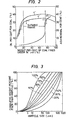
- the deashing rate can be increased to 30 to 35 % as shown in Fig. 2-c'.
- Another effect of the invention is that the dehydration treatment is facilitated as described above.
- the total coal finely pulverized in the first step is subjected to dry distillation. It is also possible, however, to send part of coal finely pulverized in the first step in a. dry distillator and to send the balance to a non-evaporating heating dehydrator so as to remove water and to distill tar.
- the non-evaporating heating temperature is preferably 180 to 350°C under a pressure of 8 to 160 bar.
- Low-quality coals are hydrophilic in many cases, since they contain chemically bonded oxygen atoms. This is one of the reasons for the high water content of the coal.
- Oxygen-containing groups are decomposed at a temperature of above 180°C according to a decarboxylation reaction or the like. At a temperature above 350°C, the coal structure itself is thermally decomposed. The inventors have found after the experiments that almost all raw brown coals can be reformed and water content thereof can be reduced to 20 to 14 % and the dehydration rate can be increased to about 40 % by the dehydration through the non-evaporating heating treatment.
- the dry-distilled coal in the form of an aqueous slurry is mixed with the non-evapcratingly heated coal to form an aqueous slurry and the tar distilled out in the second step is added as a binder to the aqueous slurry.
- the dry-distilled coal is mixed with the non-evaporatingly heated coal to form an aqueous slurry and the tar extracted in the second step is added as binder to the a q ue- ous slurry to agglomerate the coal particles.
- Water distilled out together with tar in the second step and water obtained by the non-evaporating heating dehydration treatment may be utilized as the water for the preparation of the aqueous slurry.
- the fourth step is the same as above with respect to the separation of water from the agglomerated coal irrespective of the use of non-evaporating heating dehydrator. It is important in this step that water is fed in the non-evaporating heating dehydration device to a level of the upper surface of the finely pulverized coal. Then, the non-evaporating dehydrator is heated under a high pressure to extract 2 to 8 %, based on the total amount of the coal, of tar from the fine coal powder in the non-evaporating heater. The tar thus extracted does not adhere to the ash in the fine coal powder in the non-evaporating heating device but is combined with the tar extracted in the second step and used for the agglomeration of the coal particles in the third step. As a result, the deashing rate from the coal granulated in water in the third step in this embodiment is higher than that attained in the above-described case of the invention. Thus, the deashing rate can be increased to as high as 34 to 40 %.
- a raw coal is fed in a pulverizer 2 through a line 1 and finely pulverized therein.
- the finely pulverized coal is introduced into a particle size-controlling tank 4 to control the same.
- Non- pulverized coal is returned into the pulverizer 2 through a line 5 and pulverized again to such a degree that the amount of the particles smaller than 200 mesh (74 ⁇ ) is up to 60 %.
- Part 6 of the finely pulverized coal is introduced into a dry distillation device 8 and the balance 7 is introduced into a non-evaporating heater 9. In case the total coal is dry-distilled, the system of the non-evapcrating header 9 is omitted. In the dry distillation device 8, coal 6 is dry-distilled.
- Distilled water, gas and tar 13 are introduced into a separator 14.
- the separator 14 the mixture is divided into gas 15, water 16 and tar 17.
- water is fed from a system 31 to the non-evaporating heater 9 and heated under a high pressure.
- the coal and water are sent to a slurry tank 20 thrcugh lines 11 and 32, respectively.
- Dry-distilled coal 10 is also introduced into the slurry tank 20 and required water 12 in addition to water from the dry distillator 8 is fed to the slurry tank 20.
- Tar 17 from the tar separator 14 is sent to an emulsion-preparation tank 18 together with tar discharged from the non-evaporating heater through line 33 and then stirred therein.
- the tar from the emulsion-preparation tank 18 is sent to a stirring tank 22 through a line 19 and the aqueous slurry from the slurry tank 20 is sent thereto through a line 21.
- the coal is subjected to the submerged granulation in the stirring tank 22.
- the granulated coal is introduced into a separator 25 such as a vibration sieve through a line 24 so as to separate the same from water and the ash particles.
- the separated, granulated coal is introduced into a centrifugal separator 28 through a line 26 to effect dehydration further.
- the water and ash separated are discharged through lines 27 and 29.
- the deashed coal particles are taken through a line 30.
- the reforming was effected in the same manner as in Example 1 except that a raw brown coal having a water content of 60 % and ash content of 2.2 % (on dry basis) was used.
- the product had a high quality, i.e., water content of 18 % and ash content of 1.7 %.
- the recovery of the coal component was about 90 %.
- the reforming was effected in the same manner as in Example 1 except that a lignite having a water content of 21 % and ash content of 21 % (on dry basis) was used and that 40 % of the total amount of the coal was dry-distilled to obtain a tar in an amount of 7 % based on the coal.
- the lignite had a high quality, i.e. water content of 14 % and ash content of 7 %.
- the treatment was effected using the same raw sub-bituminous coal as in Example 1 in the same manner as in Example 1 except that the total coal was dry-distilled to distill 8 wt. %, based on the coal, of a tar.
- the coal thus reformed had a high quality, i.e., water content of 7.5 % and ash content of 6.0 %.
- the water content of a low-rank coal can be reduced to several to ten-odd percent and, at the same time, deashing can be effected.
- the inventors made basic experiments for confirming the above-described facts.
- the relationship between the amount of oil required for the granulation and the deashing rare of fine coal powder was examined from many sides. The results are shown below.
- a 33 % aqueous slurry was prepared from brown coal having controlled particle sizes. An emulsion of an oil, water and surfactant was added to the slurry and the mixture was stirred to effect the submerged granulation. The results of the deashing rate determination are shown in Fig. 2.
- Fig. 3 is a graph showing a particle size distribution of the brown coal used in these experiments.
- the ordinates indicate cumulative weight percents of sieved coal.
- Numerals 100 %, 85 %, 75 %, 60 %, 50 %, 40 %, 30 % and 20 % in the figure show proportions of coal particles smaller than 74 ⁇ .
- Fig. 2 is a graph showing a relationship between the amount of oil required for the granulation of particles smaller than 74 ⁇ and the deashing rate.
- curve a' in Fig. 2 shows total oil (tar) percentage for coal in both cases of including and excluding the non-evaporating heating dehydration step.
- Curves c' and c" in Fig. 2 show the deashing rates in cases of excluding and including the non-evaporating heating dehydration step, respectively. It is apparent from Fig. 2 that if the amount of the particles smaller than 74 ⁇ is larger than 75 %, the amcunt of oil required for the granulation is increased sharply.
- the oil is added to the aqueous slurry of coal, the mixture is stirred to form an agglomerate of fine coal Powder containing the oil as binder, then the agglomerate is consolidated by the rolling action of the stirrer to form granules.
- a reason why the amount of oil required for the granulation is increased when the amount of the fine powder is larger than 75 % is that the surface area of the powder is increased to require the larger amount of the oil as tinder.
- the deashing rete is determined according to the following formula (1):
- the deashing occurs due to a difference in wettability between the coal and ash.
- Ash is hydrophilic, while coal is oleophilic. Therefore, fine coal powder is agglomerated preferentially in oil and the non-agglomerated ash particles remain in the liquid.
- a reason why the deashing rate is reduced with less than 20 % of particles smaller than 74 ⁇ is that the amount of the coal particles completely separated from the ash is small.
- the amount of tar exceeds 30 % based on the total amount of coal, the deashing rate is reduced by about 5 %, since ash particles are incorporated in the coal to be granulated. Accordingly., the amount of tar should be controlled to 2 to 30 % based on the total amount of coal for minimizing the reduction in the deashing rate and also for minimizing the amount of tar required in the submerged granulation of coal in the third step.
- oils used for the submerged granulation of coal there may be mentioned, in addition to coal tar, hydrocarbons such as light oil, fuel oil and kerosene, lubricating oils such as creosote and anthracene oil and heavy hydrocarbons such as heavy fuel oil.
- the amounts of tar required were 3 % and 24 % in the granulation of a fine powder having a controlled particle size (the amount of particles smaller than 74 ⁇ 22 %) and the one having an uncontrolled particle size (the amount of particles smaller than 74 ⁇ : 77 %), respectively.
- the amount of the tar required for the granulation of the powder having a controlled particle size was 1/3 of that of the powder having an uncontrolled particle size.
- the granules had a diameter of 0.8 to 2.0 mm in both cases.
- After the centrifugation 1.1 kg of the coal granules was obtained.
- the ash contents were 5.9 % and 5.6 % in the particle size-controlled and uncontrolled cases, respectively.
- the amounts of the required fuel oils were 5 % and 26 % in the granulation of a fine powder having a controlled particle size (the amount of the particles smaller than 74 ⁇ : 53 %) and the one having an uncontrolled particle size (the amount of particles smaller than 74 ⁇ : 79 %), respectively.
- the amount of the fuel oils required for the granulation of the particle size-controlled powder was about 1/5 of that of the particle size-uncontrolled powder.
- the granules had a diameter of 1.0 to 2.3 mm in bcth cases. After the centrifugation, 1.4 kg of the coal granules was obtained.
- the % in both ash content was 3.7 % in both cases.
- Sub-bituminous coal having a water content of 12 % and ash content of 15.6 % (on dry basis) was subjected to the submerged granulation treatment in the same manner as in Example 7.
- the amounts of the fuel oils required were 4.5 % in a particle size-controlled case and 24 % in a particle size-uncontrolled case.
- the amcunt of the fuel oils required in the former case was about 1/5 of that required in the latter case.
- the granules had a diameter of 1.2 to 2.0 mm in both cases.
- After the centrifugation, 1.42 kg of the coal granules was obtained.
- the ash content was 9.1 % in both cases.
- the granules After the granulation, the granules had a diameter of 1.2 to 3.0 mm in both cases. After the centrifugation, 0.97 kg of the coal granules was obtained. The ash content was 4.8 % in both cases.
- the amounts of the tar required for the granulation of the particle size-controlled powder (the amount of the particles smaller than 74 ⁇ : 24 %) and the particle size-uncontrolled powder (the amount of the particles smaller than 74 ⁇ : 12 %) were 3 % and 2 %, respectively, these amounts being substantially equal. Ash contents were 10.5 % in the former case and 13.7 % in the latter case. This fact clearly indicates the effect obtained by the grain dressing treatment. After the granulation, the granules had a diameter of 1.2 to 2.0 mm in both cases. After the centrifugation, 0.8 kg of the coal granules was obtained.
- Examples 6 to 10 suggest merits of the granulated coals in that they are convenient for transportation and storage and that they have a high calorific value per unit weight.
Landscapes
- Chemical & Material Sciences (AREA)
- Oil, Petroleum & Natural Gas (AREA)
- Organic Chemistry (AREA)
- Solid Fuels And Fuel-Associated Substances (AREA)
Applications Claiming Priority (4)
| Application Number | Priority Date | Filing Date | Title |
|---|---|---|---|
| JP203552/81 | 1981-12-18 | ||
| JP20355281A JPS58104998A (ja) | 1981-12-18 | 1981-12-18 | 石炭の改質方法 |
| JP3239082A JPS58150423A (ja) | 1982-03-03 | 1982-03-03 | 石炭微粉の水中造粒方法 |
| JP32390/82 | 1982-03-03 |
Publications (3)
| Publication Number | Publication Date |
|---|---|
| EP0082470A2 true EP0082470A2 (de) | 1983-06-29 |
| EP0082470A3 EP0082470A3 (en) | 1984-10-24 |
| EP0082470B1 EP0082470B1 (de) | 1987-09-09 |
Family
ID=26370957
Family Applications (1)
| Application Number | Title | Priority Date | Filing Date |
|---|---|---|---|
| EP82111623A Expired EP0082470B1 (de) | 1981-12-18 | 1982-12-14 | Verfahren zur Aufbereitung von Kohle minderer Qualität |
Country Status (5)
| Country | Link |
|---|---|
| US (1) | US4461627A (de) |
| EP (1) | EP0082470B1 (de) |
| AU (1) | AU549208B2 (de) |
| CA (1) | CA1187436A (de) |
| DE (1) | DE3277210D1 (de) |
Cited By (4)
| Publication number | Priority date | Publication date | Assignee | Title |
|---|---|---|---|---|
| US4645513A (en) * | 1982-10-20 | 1987-02-24 | Idemitsu Kosan Company Limited | Process for modification of coal |
| WO1998027186A1 (en) * | 1996-12-18 | 1998-06-25 | Minpro Australia N.L. | Coal processing method |
| CN102352272A (zh) * | 2011-09-14 | 2012-02-15 | 苏州海陆重工股份有限公司 | 褐煤提质装置 |
| CN110452723A (zh) * | 2019-07-25 | 2019-11-15 | 内蒙古万众炜业科技环保股份公司 | 一种煤炭生产的能量守恒系统 |
Families Citing this family (5)
| Publication number | Priority date | Publication date | Assignee | Title |
|---|---|---|---|---|
| JPS5953598A (ja) * | 1982-09-22 | 1984-03-28 | Hitachi Ltd | 石炭の改質方法 |
| US4605421A (en) * | 1984-09-10 | 1986-08-12 | Kerr-Mcgee Chemical Corporation | Process for the preparation of a carbonaceous-derived solid fuel product |
| US20070071590A1 (en) * | 2005-09-21 | 2007-03-29 | Podd Stephen D | Spillbox system for a shipping container |
| US20140227459A1 (en) * | 2013-02-11 | 2014-08-14 | General Electric Company | Methods and systems for treating carbonaceous materials |
| JP6266409B2 (ja) * | 2014-03-31 | 2018-01-24 | 株式会社神戸製鋼所 | 石炭混合材 |
Family Cites Families (9)
| Publication number | Priority date | Publication date | Assignee | Title |
|---|---|---|---|---|
| NL130819C (de) * | 1959-06-18 | 1900-01-01 | ||
| US3637464A (en) * | 1969-03-24 | 1972-01-25 | Canadian Patents Dev | Upgrading coking coals and coke production |
| US3980447A (en) * | 1972-04-26 | 1976-09-14 | Rheinische Braunkohlenwerke Ag | Process for the manufacture of brown coal briquettes |
| US4018571A (en) * | 1975-02-20 | 1977-04-19 | Texaco Inc. | Treatment of solid fuels |
| NL7513673A (nl) * | 1975-11-24 | 1977-05-26 | Shell Int Research | Werkwijze voor de beneficatie van vaste brandstof. |
| GB1575413A (en) * | 1976-12-03 | 1980-09-24 | Shell Int Research | Method for agglomeration of coal fines |
| US4082515A (en) * | 1977-01-12 | 1978-04-04 | American Minechem Corporation | Coke oven system and agglomerating carryover fines therein |
| US4234320A (en) * | 1979-04-23 | 1980-11-18 | Shell Oil Company | Process for the agglomeration of solids |
| US4362532A (en) * | 1981-08-11 | 1982-12-07 | Conoco Inc. | Production of blast furnace coke via novel briquetting system |
-
1982
- 1982-12-13 US US06/449,195 patent/US4461627A/en not_active Expired - Fee Related
- 1982-12-14 EP EP82111623A patent/EP0082470B1/de not_active Expired
- 1982-12-14 AU AU91479/82A patent/AU549208B2/en not_active Ceased
- 1982-12-14 DE DE8282111623T patent/DE3277210D1/de not_active Expired
- 1982-12-17 CA CA000418028A patent/CA1187436A/en not_active Expired
Cited By (4)
| Publication number | Priority date | Publication date | Assignee | Title |
|---|---|---|---|---|
| US4645513A (en) * | 1982-10-20 | 1987-02-24 | Idemitsu Kosan Company Limited | Process for modification of coal |
| WO1998027186A1 (en) * | 1996-12-18 | 1998-06-25 | Minpro Australia N.L. | Coal processing method |
| CN102352272A (zh) * | 2011-09-14 | 2012-02-15 | 苏州海陆重工股份有限公司 | 褐煤提质装置 |
| CN110452723A (zh) * | 2019-07-25 | 2019-11-15 | 内蒙古万众炜业科技环保股份公司 | 一种煤炭生产的能量守恒系统 |
Also Published As
| Publication number | Publication date |
|---|---|
| US4461627A (en) | 1984-07-24 |
| EP0082470A3 (en) | 1984-10-24 |
| AU9147982A (en) | 1983-06-23 |
| DE3277210D1 (en) | 1987-10-15 |
| AU549208B2 (en) | 1986-01-16 |
| CA1187436A (en) | 1985-05-21 |
| EP0082470B1 (de) | 1987-09-09 |
Similar Documents
| Publication | Publication Date | Title |
|---|---|---|
| US5379902A (en) | Method for simultaneous use of a single additive for coal flotation, dewatering, and reconstitution | |
| US4484928A (en) | Methods for processing coal | |
| CA1137904A (en) | Treatment of water-containing coal | |
| CA1134304A (en) | Deashing of coal by the oil agglomeration process | |
| EP0082470B1 (de) | Verfahren zur Aufbereitung von Kohle minderer Qualität | |
| US5830247A (en) | Process for processing coal | |
| CA1208587A (en) | Upgrading method of low-rank coal | |
| AU2013226908A1 (en) | Coal blend briquette and process for producing same, and coke and process for producing same | |
| US5858035A (en) | Process for processing coal | |
| US4854940A (en) | Method for providing improved solid fuels from agglomerated subbituminous coal | |
| CA1144500A (en) | Method of separating carbonaceous components from hydrophilic, inorganic solids and water in crude petroleum and coal particles, in an interdependant manner | |
| JPS6158109B2 (de) | ||
| CA1158439A (en) | Separation of hydrocarbon from coal by steam | |
| CA1082673A (en) | Method of making activated carbon | |
| WO1982001376A1 (en) | A dispersion fuel and a method for its manufacture | |
| KR100247328B1 (ko) | 재생 대체연료 | |
| JPS62177092A (ja) | コ−クス炉装入炭の事前処理方法 | |
| US5474582A (en) | Coal-water mixtures from low rank coal and process of preparation thereof | |
| SU3508A1 (ru) | Способ обработки угл с целью подготовки к брикетированию | |
| JPS58104998A (ja) | 石炭の改質方法 | |
| KR100258015B1 (ko) | 재생 대체연료의 제조방법 | |
| CA1084268A (en) | Process for preparing a suspension of particles in a hydrocarbon oil | |
| JPS58150423A (ja) | 石炭微粉の水中造粒方法 | |
| JPH0657830B2 (ja) | 高灰分炭の脱灰造粒方法 | |
| CA1331572C (en) | Method of providing improved solid fuels for agglomerated subbituminous coal |
Legal Events
| Date | Code | Title | Description |
|---|---|---|---|
| PUAI | Public reference made under article 153(3) epc to a published international application that has entered the european phase |
Free format text: ORIGINAL CODE: 0009012 |
|
| AK | Designated contracting states |
Designated state(s): DE FR GB |
|
| PUAL | Search report despatched |
Free format text: ORIGINAL CODE: 0009013 |
|
| AK | Designated contracting states |
Designated state(s): DE FR GB |
|
| RHK1 | Main classification (correction) |
Ipc: C10F 7/04 |
|
| 17P | Request for examination filed |
Effective date: 19841214 |
|
| 17Q | First examination report despatched |
Effective date: 19860203 |
|
| GRAA | (expected) grant |
Free format text: ORIGINAL CODE: 0009210 |
|
| AK | Designated contracting states |
Kind code of ref document: B1 Designated state(s): DE FR GB |
|
| PG25 | Lapsed in a contracting state [announced via postgrant information from national office to epo] |
Ref country code: FR Free format text: THE PATENT HAS BEEN ANNULLED BY A DECISION OF A NATIONAL AUTHORITY Effective date: 19870909 |
|
| REF | Corresponds to: |
Ref document number: 3277210 Country of ref document: DE Date of ref document: 19871015 |
|
| EN | Fr: translation not filed | ||
| PLBE | No opposition filed within time limit |
Free format text: ORIGINAL CODE: 0009261 |
|
| STAA | Information on the status of an ep patent application or granted ep patent |
Free format text: STATUS: NO OPPOSITION FILED WITHIN TIME LIMIT |
|
| 26N | No opposition filed | ||
| PGFP | Annual fee paid to national office [announced via postgrant information from national office to epo] |
Ref country code: GB Payment date: 19921204 Year of fee payment: 11 |
|
| PGFP | Annual fee paid to national office [announced via postgrant information from national office to epo] |
Ref country code: DE Payment date: 19930226 Year of fee payment: 11 |
|
| PG25 | Lapsed in a contracting state [announced via postgrant information from national office to epo] |
Ref country code: GB Effective date: 19931214 |
|
| GBPC | Gb: european patent ceased through non-payment of renewal fee |
Effective date: 19931214 |
|
| PG25 | Lapsed in a contracting state [announced via postgrant information from national office to epo] |
Ref country code: DE Effective date: 19940901 |