EP0082497A1 - Wässriges Anstrichmittel, damit versehener Gegenstand und Verwendung von Interferenzpigmenten hierfür - Google Patents
Wässriges Anstrichmittel, damit versehener Gegenstand und Verwendung von Interferenzpigmenten hierfür Download PDFInfo
- Publication number
- EP0082497A1 EP0082497A1 EP19820111726 EP82111726A EP0082497A1 EP 0082497 A1 EP0082497 A1 EP 0082497A1 EP 19820111726 EP19820111726 EP 19820111726 EP 82111726 A EP82111726 A EP 82111726A EP 0082497 A1 EP0082497 A1 EP 0082497A1
- Authority
- EP
- European Patent Office
- Prior art keywords
- weight
- parts
- paint
- metallic
- paints
- Prior art date
- Legal status (The legal status is an assumption and is not a legal conclusion. Google has not performed a legal analysis and makes no representation as to the accuracy of the status listed.)
- Withdrawn
Links
- 239000000049 pigment Substances 0.000 title claims abstract description 35
- 239000008199 coating composition Substances 0.000 title abstract description 4
- 230000000694 effects Effects 0.000 claims abstract description 27
- GWEVSGVZZGPLCZ-UHFFFAOYSA-N Titan oxide Chemical compound O=[Ti]=O GWEVSGVZZGPLCZ-UHFFFAOYSA-N 0.000 claims abstract description 20
- 238000000576 coating method Methods 0.000 claims abstract description 14
- 239000011248 coating agent Substances 0.000 claims abstract description 13
- 239000011230 binding agent Substances 0.000 claims abstract description 11
- 239000010445 mica Substances 0.000 claims abstract description 11
- 229910052618 mica group Inorganic materials 0.000 claims abstract description 11
- 239000000975 dye Substances 0.000 claims abstract description 10
- 239000004408 titanium dioxide Substances 0.000 claims abstract description 9
- 239000000654 additive Substances 0.000 claims abstract description 5
- 239000003973 paint Substances 0.000 claims description 49
- 239000002932 luster Substances 0.000 claims description 9
- VQLYBLABXAHUDN-UHFFFAOYSA-N bis(4-fluorophenyl)-methyl-(1,2,4-triazol-1-ylmethyl)silane;methyl n-(1h-benzimidazol-2-yl)carbamate Chemical compound C1=CC=C2NC(NC(=O)OC)=NC2=C1.C=1C=C(F)C=CC=1[Si](C=1C=CC(F)=CC=1)(C)CN1C=NC=N1 VQLYBLABXAHUDN-UHFFFAOYSA-N 0.000 abstract 1
- 239000006185 dispersion Substances 0.000 description 13
- 229910052751 metal Inorganic materials 0.000 description 11
- 239000002184 metal Substances 0.000 description 11
- DNIAPMSPPWPWGF-UHFFFAOYSA-N Propylene glycol Chemical compound CC(O)CO DNIAPMSPPWPWGF-UHFFFAOYSA-N 0.000 description 9
- 239000002966 varnish Substances 0.000 description 8
- XLYOFNOQVPJJNP-UHFFFAOYSA-N water Substances O XLYOFNOQVPJJNP-UHFFFAOYSA-N 0.000 description 8
- 239000003960 organic solvent Substances 0.000 description 7
- 235000013772 propylene glycol Nutrition 0.000 description 7
- 239000002904 solvent Substances 0.000 description 7
- DNIAPMSPPWPWGF-GSVOUGTGSA-N (R)-(-)-Propylene glycol Chemical compound C[C@@H](O)CO DNIAPMSPPWPWGF-GSVOUGTGSA-N 0.000 description 6
- 229910052709 silver Inorganic materials 0.000 description 6
- 239000004332 silver Substances 0.000 description 6
- POAOYUHQDCAZBD-UHFFFAOYSA-N 2-butoxyethanol Chemical compound CCCCOCCO POAOYUHQDCAZBD-UHFFFAOYSA-N 0.000 description 5
- 239000000203 mixture Substances 0.000 description 5
- LXOFYPKXCSULTL-UHFFFAOYSA-N 2,4,7,9-tetramethyldec-5-yne-4,7-diol Chemical compound CC(C)CC(C)(O)C#CC(C)(O)CC(C)C LXOFYPKXCSULTL-UHFFFAOYSA-N 0.000 description 4
- LYCAIKOWRPUZTN-UHFFFAOYSA-N ethylene glycol Natural products OCCO LYCAIKOWRPUZTN-UHFFFAOYSA-N 0.000 description 4
- 239000010931 gold Substances 0.000 description 4
- 229910052737 gold Inorganic materials 0.000 description 4
- 239000000843 powder Substances 0.000 description 4
- -1 aliphatic alcohols Chemical class 0.000 description 3
- VXIVSQZSERGHQP-UHFFFAOYSA-N chloroacetamide Chemical compound NC(=O)CCl VXIVSQZSERGHQP-UHFFFAOYSA-N 0.000 description 3
- 238000010422 painting Methods 0.000 description 3
- 229910001369 Brass Inorganic materials 0.000 description 2
- RYGMFSIKBFXOCR-UHFFFAOYSA-N Copper Chemical compound [Cu] RYGMFSIKBFXOCR-UHFFFAOYSA-N 0.000 description 2
- UQSXHKLRYXJYBZ-UHFFFAOYSA-N Iron oxide Chemical compound [Fe]=O UQSXHKLRYXJYBZ-UHFFFAOYSA-N 0.000 description 2
- KFZMGEQAYNKOFK-UHFFFAOYSA-N Isopropanol Chemical compound CC(C)O KFZMGEQAYNKOFK-UHFFFAOYSA-N 0.000 description 2
- BQCADISMDOOEFD-UHFFFAOYSA-N Silver Chemical compound [Ag] BQCADISMDOOEFD-UHFFFAOYSA-N 0.000 description 2
- ATJFFYVFTNAWJD-UHFFFAOYSA-N Tin Chemical compound [Sn] ATJFFYVFTNAWJD-UHFFFAOYSA-N 0.000 description 2
- XTXRWKRVRITETP-UHFFFAOYSA-N Vinyl acetate Chemical compound CC(=O)OC=C XTXRWKRVRITETP-UHFFFAOYSA-N 0.000 description 2
- XAGFODPZIPBFFR-UHFFFAOYSA-N aluminium Chemical compound [Al] XAGFODPZIPBFFR-UHFFFAOYSA-N 0.000 description 2
- 239000010951 brass Substances 0.000 description 2
- 239000003795 chemical substances by application Substances 0.000 description 2
- ZPUCINDJVBIVPJ-LJISPDSOSA-N cocaine Chemical compound O([C@H]1C[C@@H]2CC[C@@H](N2C)[C@H]1C(=O)OC)C(=O)C1=CC=CC=C1 ZPUCINDJVBIVPJ-LJISPDSOSA-N 0.000 description 2
- 238000004040 coloring Methods 0.000 description 2
- 229920001577 copolymer Polymers 0.000 description 2
- 229910052802 copper Inorganic materials 0.000 description 2
- 239000010949 copper Substances 0.000 description 2
- 239000013530 defoamer Substances 0.000 description 2
- 239000008367 deionised water Substances 0.000 description 2
- 229910021641 deionized water Inorganic materials 0.000 description 2
- 229910001254 electrum Inorganic materials 0.000 description 2
- 239000000839 emulsion Substances 0.000 description 2
- 238000001704 evaporation Methods 0.000 description 2
- 230000008020 evaporation Effects 0.000 description 2
- 239000010940 green gold Substances 0.000 description 2
- 239000004922 lacquer Substances 0.000 description 2
- 239000002609 medium Substances 0.000 description 2
- CKFGINPQOCXMAZ-UHFFFAOYSA-N methanediol Chemical compound OCO CKFGINPQOCXMAZ-UHFFFAOYSA-N 0.000 description 2
- 238000004321 preservation Methods 0.000 description 2
- 239000001054 red pigment Substances 0.000 description 2
- NIXOWILDQLNWCW-UHFFFAOYSA-M Acrylate Chemical compound [O-]C(=O)C=C NIXOWILDQLNWCW-UHFFFAOYSA-M 0.000 description 1
- 229910000906 Bronze Inorganic materials 0.000 description 1
- 241000288906 Primates Species 0.000 description 1
- 235000005505 Ziziphus oenoplia Nutrition 0.000 description 1
- 244000104547 Ziziphus oenoplia Species 0.000 description 1
- 230000002378 acidificating effect Effects 0.000 description 1
- NIXOWILDQLNWCW-UHFFFAOYSA-N acrylic acid group Chemical group C(C=C)(=O)O NIXOWILDQLNWCW-UHFFFAOYSA-N 0.000 description 1
- 238000007605 air drying Methods 0.000 description 1
- 229920000180 alkyd Polymers 0.000 description 1
- 229910052782 aluminium Inorganic materials 0.000 description 1
- 239000002518 antifoaming agent Substances 0.000 description 1
- 239000012736 aqueous medium Substances 0.000 description 1
- 239000010425 asbestos Substances 0.000 description 1
- 230000015572 biosynthetic process Effects 0.000 description 1
- 239000010974 bronze Substances 0.000 description 1
- 125000004432 carbon atom Chemical group C* 0.000 description 1
- 239000003054 catalyst Substances 0.000 description 1
- 239000004568 cement Substances 0.000 description 1
- 239000003086 colorant Substances 0.000 description 1
- 239000000470 constituent Substances 0.000 description 1
- KUNSUQLRTQLHQQ-UHFFFAOYSA-N copper tin Chemical compound [Cu].[Sn] KUNSUQLRTQLHQQ-UHFFFAOYSA-N 0.000 description 1
- JBSLOWBPDRZSMB-FPLPWBNLSA-N dibutyl (z)-but-2-enedioate Chemical compound CCCCOC(=O)\C=C/C(=O)OCCCC JBSLOWBPDRZSMB-FPLPWBNLSA-N 0.000 description 1
- 238000003912 environmental pollution Methods 0.000 description 1
- AYAQUZXJSZXBNY-UHFFFAOYSA-N ethenyl propanoate prop-2-enoic acid Chemical compound C(C=C)(=O)O.C(CC)(=O)OC=C AYAQUZXJSZXBNY-UHFFFAOYSA-N 0.000 description 1
- RTZKZFJDLAIYFH-UHFFFAOYSA-N ether Substances CCOCC RTZKZFJDLAIYFH-UHFFFAOYSA-N 0.000 description 1
- 229920006248 expandable polystyrene Polymers 0.000 description 1
- 239000000945 filler Substances 0.000 description 1
- 235000019256 formaldehyde Nutrition 0.000 description 1
- 150000002334 glycols Chemical class 0.000 description 1
- PCHJSUWPFVWCPO-UHFFFAOYSA-N gold Chemical compound [Au] PCHJSUWPFVWCPO-UHFFFAOYSA-N 0.000 description 1
- WGCNASOHLSPBMP-UHFFFAOYSA-N hydroxyacetaldehyde Natural products OCC=O WGCNASOHLSPBMP-UHFFFAOYSA-N 0.000 description 1
- 230000001771 impaired effect Effects 0.000 description 1
- 239000000463 material Substances 0.000 description 1
- 238000000034 method Methods 0.000 description 1
- 230000019612 pigmentation Effects 0.000 description 1
- 239000002985 plastic film Substances 0.000 description 1
- 229920006255 plastic film Polymers 0.000 description 1
- 229920003009 polyurethane dispersion Polymers 0.000 description 1
- 239000003755 preservative agent Substances 0.000 description 1
- 230000002335 preservative effect Effects 0.000 description 1
- HXHCOXPZCUFAJI-UHFFFAOYSA-N prop-2-enoic acid;styrene Chemical compound OC(=O)C=C.C=CC1=CC=CC=C1 HXHCOXPZCUFAJI-UHFFFAOYSA-N 0.000 description 1
- 239000001294 propane Substances 0.000 description 1
- 229910052895 riebeckite Inorganic materials 0.000 description 1
- 150000003839 salts Chemical class 0.000 description 1
- 239000004576 sand Substances 0.000 description 1
- 239000007787 solid Substances 0.000 description 1
- 239000007921 spray Substances 0.000 description 1
- 238000003756 stirring Methods 0.000 description 1
- 229920003048 styrene butadiene rubber Polymers 0.000 description 1
- 239000000758 substrate Substances 0.000 description 1
- 239000002562 thickening agent Substances 0.000 description 1
- 229920006337 unsaturated polyester resin Polymers 0.000 description 1
- 239000002023 wood Substances 0.000 description 1
- 239000001052 yellow pigment Substances 0.000 description 1
Classifications
-
- C—CHEMISTRY; METALLURGY
- C09—DYES; PAINTS; POLISHES; NATURAL RESINS; ADHESIVES; COMPOSITIONS NOT OTHERWISE PROVIDED FOR; APPLICATIONS OF MATERIALS NOT OTHERWISE PROVIDED FOR
- C09C—TREATMENT OF INORGANIC MATERIALS, OTHER THAN FIBROUS FILLERS, TO ENHANCE THEIR PIGMENTING OR FILLING PROPERTIES ; PREPARATION OF CARBON BLACK ; PREPARATION OF INORGANIC MATERIALS WHICH ARE NO SINGLE CHEMICAL COMPOUNDS AND WHICH ARE MAINLY USED AS PIGMENTS OR FILLERS
- C09C1/00—Treatment of specific inorganic materials other than fibrous fillers; Preparation of carbon black
- C09C1/0015—Pigments exhibiting interference colours, e.g. transparent platelets of appropriate thinness or flaky substrates, e.g. mica, bearing appropriate thin transparent coatings
- C09C1/0021—Pigments exhibiting interference colours, e.g. transparent platelets of appropriate thinness or flaky substrates, e.g. mica, bearing appropriate thin transparent coatings comprising a core coated with only one layer having a high or low refractive index
-
- C—CHEMISTRY; METALLURGY
- C09—DYES; PAINTS; POLISHES; NATURAL RESINS; ADHESIVES; COMPOSITIONS NOT OTHERWISE PROVIDED FOR; APPLICATIONS OF MATERIALS NOT OTHERWISE PROVIDED FOR
- C09C—TREATMENT OF INORGANIC MATERIALS, OTHER THAN FIBROUS FILLERS, TO ENHANCE THEIR PIGMENTING OR FILLING PROPERTIES ; PREPARATION OF CARBON BLACK ; PREPARATION OF INORGANIC MATERIALS WHICH ARE NO SINGLE CHEMICAL COMPOUNDS AND WHICH ARE MAINLY USED AS PIGMENTS OR FILLERS
- C09C1/00—Treatment of specific inorganic materials other than fibrous fillers; Preparation of carbon black
- C09C1/0081—Composite particulate pigments or fillers, i.e. containing at least two solid phases, except those consisting of coated particles of one compound
-
- C—CHEMISTRY; METALLURGY
- C09—DYES; PAINTS; POLISHES; NATURAL RESINS; ADHESIVES; COMPOSITIONS NOT OTHERWISE PROVIDED FOR; APPLICATIONS OF MATERIALS NOT OTHERWISE PROVIDED FOR
- C09C—TREATMENT OF INORGANIC MATERIALS, OTHER THAN FIBROUS FILLERS, TO ENHANCE THEIR PIGMENTING OR FILLING PROPERTIES ; PREPARATION OF CARBON BLACK ; PREPARATION OF INORGANIC MATERIALS WHICH ARE NO SINGLE CHEMICAL COMPOUNDS AND WHICH ARE MAINLY USED AS PIGMENTS OR FILLERS
- C09C1/00—Treatment of specific inorganic materials other than fibrous fillers; Preparation of carbon black
- C09C1/62—Metallic pigments or fillers
- C09C1/64—Aluminium
-
- C—CHEMISTRY; METALLURGY
- C09—DYES; PAINTS; POLISHES; NATURAL RESINS; ADHESIVES; COMPOSITIONS NOT OTHERWISE PROVIDED FOR; APPLICATIONS OF MATERIALS NOT OTHERWISE PROVIDED FOR
- C09D—COATING COMPOSITIONS, e.g. PAINTS, VARNISHES OR LACQUERS; FILLING PASTES; CHEMICAL PAINT OR INK REMOVERS; INKS; CORRECTING FLUIDS; WOODSTAINS; PASTES OR SOLIDS FOR COLOURING OR PRINTING; USE OF MATERIALS THEREFOR
- C09D5/00—Coating compositions, e.g. paints, varnishes or lacquers, characterised by their physical nature or the effects produced; Filling pastes
- C09D5/36—Pearl essence, e.g. coatings containing platelet-like pigments for pearl lustre
-
- C—CHEMISTRY; METALLURGY
- C09—DYES; PAINTS; POLISHES; NATURAL RESINS; ADHESIVES; COMPOSITIONS NOT OTHERWISE PROVIDED FOR; APPLICATIONS OF MATERIALS NOT OTHERWISE PROVIDED FOR
- C09C—TREATMENT OF INORGANIC MATERIALS, OTHER THAN FIBROUS FILLERS, TO ENHANCE THEIR PIGMENTING OR FILLING PROPERTIES ; PREPARATION OF CARBON BLACK ; PREPARATION OF INORGANIC MATERIALS WHICH ARE NO SINGLE CHEMICAL COMPOUNDS AND WHICH ARE MAINLY USED AS PIGMENTS OR FILLERS
- C09C2200/00—Compositional and structural details of pigments exhibiting interference colours
- C09C2200/10—Interference pigments characterized by the core material
- C09C2200/102—Interference pigments characterized by the core material the core consisting of glass or silicate material like mica or clays, e.g. kaolin
-
- C—CHEMISTRY; METALLURGY
- C09—DYES; PAINTS; POLISHES; NATURAL RESINS; ADHESIVES; COMPOSITIONS NOT OTHERWISE PROVIDED FOR; APPLICATIONS OF MATERIALS NOT OTHERWISE PROVIDED FOR
- C09C—TREATMENT OF INORGANIC MATERIALS, OTHER THAN FIBROUS FILLERS, TO ENHANCE THEIR PIGMENTING OR FILLING PROPERTIES ; PREPARATION OF CARBON BLACK ; PREPARATION OF INORGANIC MATERIALS WHICH ARE NO SINGLE CHEMICAL COMPOUNDS AND WHICH ARE MAINLY USED AS PIGMENTS OR FILLERS
- C09C2200/00—Compositional and structural details of pigments exhibiting interference colours
- C09C2200/30—Interference pigments characterised by the thickness of the core or layers thereon or by the total thickness of the final pigment particle
- C09C2200/301—Thickness of the core
-
- C—CHEMISTRY; METALLURGY
- C09—DYES; PAINTS; POLISHES; NATURAL RESINS; ADHESIVES; COMPOSITIONS NOT OTHERWISE PROVIDED FOR; APPLICATIONS OF MATERIALS NOT OTHERWISE PROVIDED FOR
- C09C—TREATMENT OF INORGANIC MATERIALS, OTHER THAN FIBROUS FILLERS, TO ENHANCE THEIR PIGMENTING OR FILLING PROPERTIES ; PREPARATION OF CARBON BLACK ; PREPARATION OF INORGANIC MATERIALS WHICH ARE NO SINGLE CHEMICAL COMPOUNDS AND WHICH ARE MAINLY USED AS PIGMENTS OR FILLERS
- C09C2200/00—Compositional and structural details of pigments exhibiting interference colours
- C09C2200/30—Interference pigments characterised by the thickness of the core or layers thereon or by the total thickness of the final pigment particle
- C09C2200/302—Thickness of a layer with high refractive material
Definitions
- the present invention relates to an aqueous paint with a metallic luster effect containing organic binders, dyes and / or color pigments and, if appropriate, customary technical additives.
- Aqueous paints of the type described above are used to a large extent for painting objects of all kinds, including buildings, or their walls inside and outside, wallpapers, utensils and utensils, etc. These aqueous paints contain organic binders, which are generally in the form of a Dispersion in the aqueous paint medium before.
- the aqueous paint medium can also contain organic solvents to a lesser extent, the amount of which is generally not more than 30% by weight, based on the total amount of solvent. With paints of this type, colors of any exposed shade can be produced by selecting the color pigments and / or dyes.
- This metallic effect or metal effect is achieved in that the paint on.
- organic solvents containing metal powder In most cases, so-called platelet-shaped metal powders, in particular aluminum of the so-called “leafing type", are preferably used as the metal powder.
- organic binders for these metallic paints, since the use of water as a solvent is not possible, because the metal powders mentioned are used in an aqueous medium on account of the pH values present at least partially dissolved in the alkaline or sometimes in the acidic range.
- the use of organic solvents has the known disadvantages: flammability, environmental pollution by evaporation, etc. There is therefore a great need to create paints with a metallic luster effect which contain water, as a solvent, completely or predominantly.
- the object of the present invention is therefore to find an aqueous paint with a metallic gloss effect. It has been found that this problem can be solved in a surprisingly simple manner by the fact that the aqueous paints contain the metallic luster pigments known per se defined below.
- the invention accordingly relates to an aqueous paint with a metallic gloss effect containing organic solvents, dyes and / or color pigments and, if appropriate, customary paint additives, which is characterized in that it contains interference pigments made of titanium dioxide-coated mica platelets.
- the present invention further relates to articles provided with this paint.
- the present invention relates to the use of the interference pigments defined above as metallic luster effect pigments for aqueous paints.
- Objects which can be given away according to the process of the invention with an aqueous paint containing metal luster effect pigments are the same as have been provided with aqueous paints, in particular emulsion paints. It will be on the above. referred to the prior art mentioned.
- the paints according to the invention can be used particularly advantageously for painting the inside and outside walls of buildings as well as windows and doors and other building components, such as gutters.
- the inner walls can be papered and the wallpaper can be painted with the paint according to the invention. It is also possible to coat wallpaper paper webs with the paint of the invention, to roll them up like normal wallpapers and to use them later for wallpapering.
- Plastic films can equally be coated with the paint of the invention.
- the essential feature of the paints of the invention is that they contain the interference pigments defined above. These are known per se (see, inter alia, DE-B 14 67 468 and DE-A 1 959 998). These are mica flake pigments, which are based on shimmering mica flakes.
- the coating with titanium dioxide is of such a strength that an interference is generated in a certain desired wavelength or a desired wavelength range.
- the mica scales have a relatively large width and length compared to the thickness.
- the length of the individual mica flakes is in the range from approximately 5 to 150 ⁇ m, the width in the range from approximately 5 to 150 ⁇ m and the thickness in the range from approximately 150 to 400 nm.
- the thickness of the titanium dioxide coating is in the range from approximately 40 to 300 nm.
- the length or width of the mica platelets is much greater than their thickness, while the large surfaces have a positive charge, the narrow side surfaces have. a negative charge. As a result, there is practically no coating with titanium dioxide on the narrow sides of these platelets.
- Suitable interference pigments are, for example, the products with the type numbers ' 121, 101, 105, 205, 215, 217, 225, 235 and 400 sold as commercial products by Merck, Darmstadt, Federal Republic of Germany, under the registered trademark Iriodin.
- water-dilutable binders are aqueous acrylate or acrylate-styrene dispersers or solutions, polyurethane dispersions, unsaturated polyester resins, acid-curing lacquer systems, air-drying alkyd resins, vinyl propionate-acrylate dispersions, copolymers of vinyl acetate and maleic acid di-n-butyl ester, copolymers of vinyl acetate and Versatic, PVC dispersions, styrene-butadiene copolymers, etc.
- aqueous acrylate or acrylate-styrene dispersers or solutions polyurethane dispersions
- unsaturated polyester resins unsaturated polyester resins
- acid-curing lacquer systems air-drying alkyd resins
- vinyl propionate-acrylate dispersions copolymers of vinyl acetate and maleic acid di-n-butyl ester
- the solvent consists of 70 to 100% by weight, preferably at least 80% by weight, and particularly preferably at least 85% by weight, based on the total amount of the solvent, of water.
- the remaining part if it exists, consists of water-miscible organic solvents. Examples of these are straight-chain and branched aliphatic alcohols with 1 to 4 carbon atoms, in particular isopropanol, and it is also possible to use glycols or glycol ethers, such as butyl glycol, propylene glycol, methylene glycol, butyl glycol butyl ether.
- the addition of organic solvents results in faster evaporation and a more even coating film.
- the coating composition according to the invention also contains dyes and / or color pigments, like the known coating compositions, in order to produce the desired shade.
- the known dyes and / or pigments in this regard can be used. Examples include water- and oil-soluble dyes and pigments, which are often commercially available as pigment pastes. It is both possible to have a color Setting to match the appearance of a metal surface, as well as to give the surface any color nuances that have a metallic sheen. Organic yellow or red pigments are used to produce a gold sheen (e.g. CI77491 and 71100). For example, iron oxide red pigment is suitable for producing a copper luster.
- the ratio between the interference pigment and the color pigments and / or dyes causing the coloring is in the range from approximately 100: 1 to 1: 1, preferably in the range from approximately 50: 1 to 4: 1.
- the desired color effect is decisive for the quantity ratio selected in each case.
- the total amount of interference pigment and dyes and / or color pigments, based on the amount of binder (solids content), is advantageously 1:10 to 1: 1, preferably about 1: 7 to 1: 3.
- paint additives that can optionally be used are fillers, hardening catalysts, leveling agents, adhesion improvers, anti-foaming agents and the like. Small amounts of platelet-shaped aluminum powder can also be added, provided the amount is kept so small that the stability of the paint is not significantly impaired.
- the constituents of the paint can be mixed with one another in the customary manner.
- Table 1 lists binders with reference to the trademarks registered in each case; which can be used according to the invention, among others, and are partly used in the examples.
- the abbreviation MFT means minimum film formation temperature
- the so crhalicne dispersion varnish can be applied with conventional salt spray water after the appropriate setting to a viscosity of 25 to 30 "4 DJK 53211.
- the undiluted material can be applied excellently with a roller or brush.
- the coatings obtained with this varnish are characterized by a uniform, silky, tin-metal-like surface effect.
- the brass effect varnish can be sprayed, rolled and painted analogously to the tin effect varnish on various substrates, such as foamed polystyrene, asbestos cement, wood, wallpaper, etc., and results in a brass-metal-like coating with a uniform silky sheen.
- the paint is composed as follows:
- Kergal AF As usual, 0.20 parts by weight of Kergal AF are added as a preservative.
- the paint can be rolled, painted and sprayed - as described in 1.2 and results in homogeneous, silky gloss surfaces.
- Nepcryl XK 70 60 parts by weight of Nepcryl XK 70 are mixed with 8 parts by weight of Iriodin 205, 2 parts by weight of Iriodin 235, 10 parts by weight of Green Paste 2A) and 1 part by weight of Black Paste 2C) for pigmentation.
- the paint can be applied as described in 1.2 to i6. In this way, l S an is given a coating which has a pronounced green-gold metallic traversing effect.
- a green-silver metallic colored dispersion varnish consists of:
- the dispersion varnish obtained in this way results in uniform, blue-silver metallic, iridescent surfaces.
- a blue-gold metallic iridescent paintwork is obtained by combining the following components:
Landscapes
- Chemical & Material Sciences (AREA)
- Organic Chemistry (AREA)
- Composite Materials (AREA)
- Life Sciences & Earth Sciences (AREA)
- Engineering & Computer Science (AREA)
- Materials Engineering (AREA)
- Wood Science & Technology (AREA)
- Paints Or Removers (AREA)
- Pigments, Carbon Blacks, Or Wood Stains (AREA)
Abstract
Description
- Die vorliegende Erfindung betrifft ein wäßriges Anstrichmittel tnit Metallglanzeffekt enthaltend organische Bindemittel, Farbstoffe und/oder Farbpigmente sowie gegebenenfalls übliche lacktechnische Zusatzstoffe.
- . Wäßrige Anstrichmittel der oben beschriebenen Art werden in großem Umfang eingesetzt zum Anstreichen von Gegenständen aller Art einschließlich Gedäuden, bzw. deren Wänden innen und außen, Tapeten, Bedarfs-und Gebrauchsgegenstände usw. Diese wäßrigen Anstrichmittel enthalten organische Bindemittel, die in der Regel in Form einer Dispersion in dem wäßrigen Anstrichmittelmedium vor liegen. Das wäßrige Anstrichmittelmedium kann dabei in geringern Umfang auch organische Lösungsmittel mit-enthalten, wobei deren Menge in der Regel nicht mehr als 30 Gew.%, bezogen auf die Gesamtmenge an Lösungsmittel beträgt. Mit derartigen Anstrichfarben kann man durch Auswahl der Farbpigmente und/oder Farbstoffe Farben jeder beliegenden Nuance herstellen.
- Bei Verwendung von Anstrichmitteln auf Basis organischcr Lösungsmittel allein ist es möglich auch sogcnannte Metalleffektlacke herzustellen, die auf dem lackicrten Gebenstand einen Überzug ergeben, der einen metallischen Glanz aufweist.
- Dieser Metallic-Effekt oder Metall-Effekt wird dadurch erzielt, daß die Anstrichmittel auf. Basis organischer Lösungsmittel Metallpulver enthalten. Als Metallpulver werden in den meisten-Fällen bevorzugt sogenannte plättchenförmige Metallpulver, insbesonder e Aluminium des sogenannten "Leafing-Typs" eingesetzt. Wie bereits dargelegt, werden jedcich als organische Bindemittel für cliese Metallic-Anstrichmittel nur solche verwendet, die in organischen Lösungsmittel löslich sinâ, da der Einsatz von Wasser als Lösungsmittel nicht möglich ist, denn die genannten Metallpulver werden in wäßrigem Medium aufgrund der vorhandenen pH-Werte im alkalischen oder manchmal auch im sauren Bereich zumindest teilweise angelöst. Die Verwendung organischer Lösungsmittel hat die bekannten Nachteile : Brennbarkeit, Uinweltverschmutzung durch Abdunsten usw. Es besteht deshalb ein großes Bedürfnis danach,Anstrichmittel mit Metallglanzeffekt zu schaffen, die vollständig oder überwiegend Wasser als Lösungsmittel enthalten.
- Im übrigen verbietet sich beim Anstrich von Innenräumcn von Gebäuden die Verwendung von Anstrichmitteln die wesentliche Mengen an Lösungsmittel enthalten. Hierfür können aus verständlichen Gründen nur wäßrige Anstrichmittel, sogenannte Dispersionsfarben einge- setzt werden.
- Der vorliegenden Erfindung liegt deshalb die Aufgabenstellung zugrunde ein wäßriges Anstrichmittel mit Metallglanzeffekt zu finden. Es wurde gefunden, daß diese Aufgabenstellung in überraschend einfacher Weise dadurch gelöst werden kann, daß die wäßrigen Anstrichmittel die nachfolgend definierten an sich bekannten Metallglanzpigmente enthalten.
- Gegenstand der Erfindung ist demgemäß ein wäßriges Anstrichmittel mit Metallglanzcffekt enthaltend organische Lösungsmittel, Farbstoffe und/oder Farbpigmente sowie gegebenenfalls übliche lacktechnische Zusatzstoffe, das dadurch gekennzeichnet ist, daß es Interferenzpigmente aus mit Titandioxid beschichteten Glimmerplättchen enthält.
- Weiterhin betrifft die vorliegende Erfindung mit diesem Anstrichmittel versehene Gegenstände.
- Außerdem betrifft die vorliegende Erfindung die Verwendung der oben definierten Interferenzpigmente als Metallglanzeffekt-Pigmente für wäßrige Anstrichmittel.
- Gegenstände, die gemäß dem Verfahren der Erfindung mit einem Metallglanzeffekt-Pigmente enthaltenden wäßrigen Anstrichmittel verschen werden können, sind die gleichen, wie sie bisher mit wäßrigen Anstrichmitteln , insbesondere Dispersionsfarben, versehen werden können. Es wird insofern, auf den oben. erwähnten Stand der Technik verwiesen. Besonders vorteilhaft können die Anstrichmittel gemäß der Erfindung eingesetzt werden zum Anstreichen von Innen-und Außenwänden von Gebäuden sowie Fenstern und Türen und sonstigen Gebäudebestandteilen, wie Dachrinnen. Die Innenwände können tapeziert sein, und die Tapeten können mit dem Anstrichmittel gemäß der Erfindung überstrichen werden. Es ist auch möglich, Tapeten-Papierbahnen mit dem Anstrichmittel der Erfindung zu streichen, diese wie übliche Tapeten aufzurollen und später zum Tapezieren einzusetzen.
- Das wesentliche Merkmale der Anstrichmittel der Erfindung liegt darin, daß sie die oben definierten - Interferenzpigmente enthalten. Diese sind an sich bekannt (vgl. u.a. DE-B 14 67 468 und DE-A 1 959 998). Es handelt sich um Glimmerschuppigmente, bei denen sich auf durchscheirenden Glimmerschuppen. ein Überzug aus Titandioxid befindet. Die Beschichtung mit Titandioxid weist eine solche Stärke auf, daß eine Interferenz in einer bestimmten gewünschten Wellenlänge oder einem gewünschten Wellenlängenbereich erzeugt wird. Die Glimmerschuppen weisen eine verhältnismäßig große Breite und Länge im Vergleich zur Dicke auf. Die Länge der einzelnen Glimmerschuppen liegt im Bereich von etwa 5 bis 150/um, die Breite im Bereich von etwa 5 bis 150/um und die Dicke im Bereich von etwa 150 bis 400 nm. Die Stärke der Titandioxidbeschichtung liegt im Bereich von etwa 40 bis 300 nm.
- . Die Länge bzw. Breite der Glimmerplättchen ist wesentlich größer als deren Dicke, während die großen Flächen eine positive Ladung aufweisen, haben die schmalen Seitenflächen. eine negative Ladung. Dies hat zur Folge, daß an den Schmalseiten dieser Plättchen praktisch keine Beschichtung mit Titandioxid erfolgt.
- Geeignete Interferenzpigmente sind zum Beispiel die als Handelsprodukte von der Firma Merck, Darmstadt, Bundesrepublik Deutschland, unter dem eingetragenen Warenzeichen Iriodin vertriebenen Produkte mit den Typennummern '121, 101, 105, 205, 215, 217, 225, 235 und 400.
- Beispiele für wasserverdünnbare Bindemittel sind wäßrige Acrylat- oder Acrylat-Styrol-Dispersioner bzw ―lösungen, Polyurethan-Dispersionen, ungesättigte Polyesterharze, säurehärtende Lacksysteme, lufttrocknende Alkydharze, Vinylpropionat-Acrylat-Dis- persionen, Copolymerisate aus Vinylacetat und Maleinsäure-di-n-butylester, Copolymerisate aus Vinylacctat und Versaticsäurevinylester, PVC-Dispersionen, StyrolButadien-Copolymerisate usw. In Grundsätzlicher Beziehung können sowohl alle organischen Bindemittel, wie sie bisher für wäßrige Anstrichmittel umgesetzt wurden (insbesondere sogenannte Dispersionen) als auch anorGanische Bindemittel, wie z.B. wasserverdünnbare Silikatbindemittel, eingesetzt werden.
- Das Lösungsmittel besteht zu 70 bis 100 Gew.―% , , vorzugsweise zu mindestens 80 Gew.%, und besonders bevorzugt zu mindestens 85 Gew.%, bezogen auf die Gcsamtmenge des Lösungsmittels, aus Wasser. Der restliche Anteil, soweit er vorhanden ist, besteht aus mit Wasser mischbaren organischen Lösungsmitteln. Beispiele hierfür sind geradkcttigo und verzweigte aliphatische Alkohole mit 1 bis 4 Kohlenstoffatomen, insbesondere Isopropanol und es können auch Glykole oder Glykol ether eingesetzt werden, wie Butylglykol, Propylenglykol, Methylenglykol, Butylglykoliscbutylether. Der Zusatz der organischen Lösungsmittel bewirkt ein schnelleres Abdunsten und einen gleich- mäßigeren Anstrichfilm.
- Das hnstrichmittel gemäß der Erfindung enthält außerdem wie die bekannten Anstrichmittel Farbstoffe und/ oder Farbpigmente, um den gewünschten Farbton zu erzeugen. Die diesbezüglichen bekannten Farbstoffe und/oder Pigmente können eingesetzt werden. Beispiele hierfür sind wasser- und öllösliche Farbstoffe sowie Pigmente, die im Handel häufig als Pigmentpasten erhältlich sind. Dabei ist es sowohl möglich, eine Farbgebung einzustellen, die dem Aussehen einer Metaljoberflache entspricht, als auch der Oberfläche beliebige Farbnuancen zu verleihen, die einen metallischen Glanz aufweisen. Zur Erzeugung eines Goldglanzes werden organische Gelb- oder Rot-Pigmente: verwendet (z.B. C.I.77491 und 71100). Zur Herstellung eines Kupferglanzes eignet sich z.B. Eisenoxid-Rotpigment.
- Das Verhältnis zwischen Interferenzpigment und die Farbgebung verursachenden Farbpigmenten und/oder Farbstoffen liegt im Bereich von etwa 100:1 bis 1:1, vorzugsweise im Bereich von etwa 50:1 bis 4 : 1.Der gewünschte Farbeffekt ist maßgeblich für das jeweils ausgewählte Mengenverhältnis.
- Die Gesamtmenge an Interfrenzpigment und Farbstoffen und/oder Farbpigmenten bezogen auf die Menge an Bindemittel (Festkörpergehelt) beträgt zweckmäßig 1:10 bis 1:1, vorzugsweise etwa 1:7 bis 1:3.
- übliche lacktechnische Zusatzstoffe, die gegebenenfalls verwendet werden können, sind Füllstoffe, Hartungskatalysatoren, Mittel zur Verbesserung des Verlaufs, Haftverbesserungsmittel, Antischaummittel und dergleichen. Es können auch geringe Mengen plättchenförmiges Aluminiurnpulver zugesetzt werden, sofern die Menge so gering gehalten wird, daß die Stabilität der Anstrichmittels nicht wesentlich beeinträchtigt wird.
- Die Bestandteile des Anstrichmittels können in üblicher Weise miteinander vermischt werden. Es ist jedoch erforderlich, darauf zu achten, daß die gemäß der Erfindung verwendeten Interferenzpigmente dabei ihre geometrische Form nicht verlieren. Der Einsatz von z.B. Sandmühlen, wie sie üblicherweise bei der HerStellung von pigmenthaltigen Lacken verwendet werden, ist deshalb nicht möglich. Dies stellt aber keinen Nachteil dar, da die Interferenzpigmente in einfacher Weise z.B. mittels eines sogenannten Dissolvrerseingearbeitet werden können.
- Die Erfindung wird anhand der folgenden Beispiele erläu-tert: In der nachfolgenden Tabelle 1 sind Bindemittel unter Erwähnung cler jeweils eingetragenen Warenzeichen aufgeführt; die gemäß der Erfindung unter anderem eingesetzt werden können, und teilweise in den Beispielen verwendet werden. (Die Abkürzung MFT bedeutet minimale Filmbildungstemperatur).

- Für die Darstellung der Metallefekt-Lacke werder in den Rezeptbeispielen folgende Pigmentpasten eingesetzt :
- 1A) Schwarzpaste, bestehend aus :

- 1B) Rotpaste, bestehend aus :
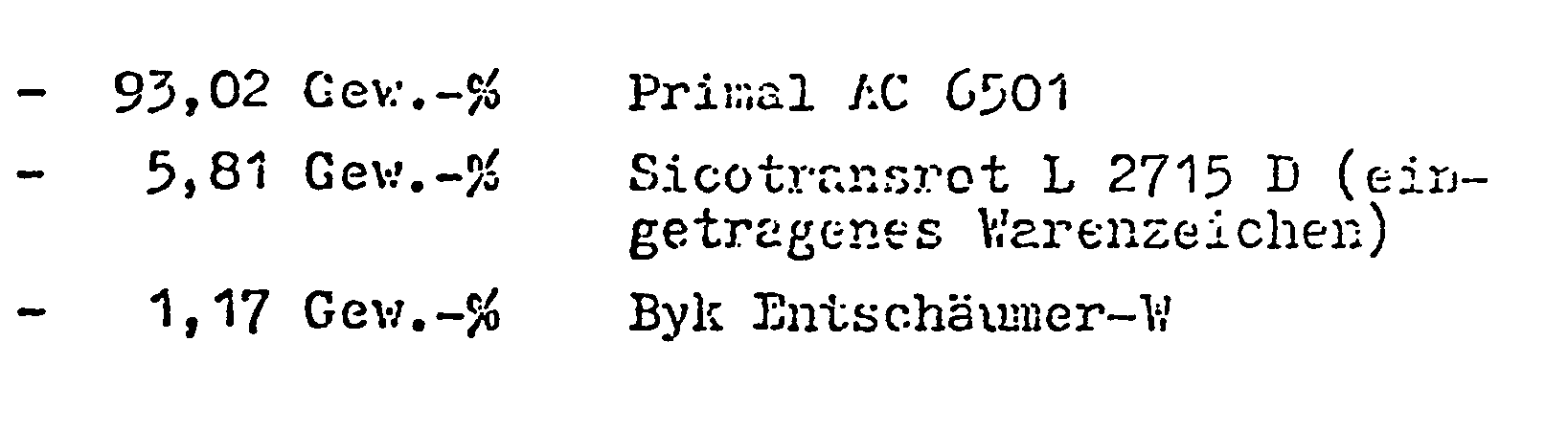
- 1C) Rotpaste; bestehend aus:

- Zu 60 Gew.―Teilen einer Reinacrylatdispersion Primal AC 6501 werden 5 Gew.―Teile mit Rutil beschichteter Glimmerplättchen ( Iriodin 101 Rutilsilber (eingetragenes Warenzeichen) ) und 5 Gew.-Teile der Schwarzpaste 1A) gegeben. Danach wird 1 Gew.―Teil Byk Entschäumer―W und 1 Gew.―Teil einer 50%igen Lösung des Entschäumers Surfynol 104 (eingetragenes Warenzeichen) in Propandiol-1,2 in diese Mischung eingerünrt.
- Zur Viskositätskorrektur wird ein Gemisch aus 3 Gew.―Teilen Verdicker Primat RM-8, 3 Gew.―Teilen Ethylenglykolmonobutylether, 10 Gew.―Teilen Propandiol-1,2, 11,80 Gew.―Teilen vollentsalztem Wasser und 0, 2 Gew.―Teilen Schimmelverhinderungsmittel Mergal AF (eingetragenes Warenzeicher) zugesetzt und erneut gut verrührt.
- Der so crhalicne Dispersionslack kann nach entsprechender Einstellung auf eine Viskosität von 25 bis 30" 4 DJK 53211 mit voljcktsalztem Wasser in konventionellen Spritzverfahren appliziort werden. Das unverdünnte Material läßt sich hervorragend mit der Rolle oder den. Pinsel auftragen.
- Die mit diesem Lack erhaltenen Beschichtungen zeichnen sich durch einen gleichmäßigen, seidenglänzenden, zinnmetallartigen Oberflächeneffekt aus.
- Wie in 1.2 beschrieben, werden 60 Gew.―Teile Primal AC 6501 mit 7 Gew.―Teilen Iriodin 205, 0,10 Gew,-Teilen der Schwarzpaste.1A), 0,20 Gew.-Teilen Colanylgelb HR, 0,06 Gew.―Teilen Colanylrot. TG und 0,10 Gew.―Teilen Colanylschwarz PR getönt und zur Entschäumung 1. Gew.―Teil Byk Entschäumer-W sowie 1 Gew.―Teil der in 1.2 beschriebenen Surfynol-104-Lösungzugesetzt.
- Alle Komponenten werden gut verrührt und mit einer Mischung aus 3 Cew.―Teilen Primal RM-8, 3 Gew.―Teilen Ethylenglykolmonobutylether, 10 Gew.-Teilen Propandiol-1,2 und 14,39 Gew.-Teilen Wasser verdickt.
- Zur Konservierung wird wie in 1.2 0,2 Gew.―Teile Mergal AF zugesetzt.
- Der Messingeffekt-Lack läßt sich analog zu dem Zinneffekt-Lack auf vergchiedtne Substrate, wie geschäumtes Polystyrol, Asbestzement, Holz, Tapeten usw., spritzer, rollen und streichen, und ergibt so eine messingmetallartige Beschichtung mit einem gleichmäßigen Seidenglanz.
- Der Lack setzt sich Wie folgt zusamren :

- Nach Applikation, wie in 1.2 und 1.3 beschrieben, erhält man homogene, seidenglänzende Oberflächen mit einem silbermetallartigen Erscheinungsbild.
- in 60,50 Gew.―Teile Primal AC 6501 werden zur-Farbgebung folgende Pigmente bzw. Pigmentpasten gegeben:

- Zur Entschaunmung werden je 1 Gew,―Teil Byk Entschäumer-W und Surfynol 104 (50%ig in Propandiol-1,2) zugesetztund mit einem Gemisch aus 3 Gew.―Teilen Ethylenglykolmonobutylother, 3 Gew.― Teilen Primal RN-8, 10 Gew.―Teilen PPropandiol-1,2 und 9,80 Gew.―Teilen Wasser auf die gewünschte Viskosität gebracht.
- Wie üblich, werden 0,20 Gew.―Teile Kergal AF als Konservierungsmittel zugesetzt.
- Die Applikation erfolgt wie in den vorhergehenden Beispielen beschrieben und ergibt einen gleichmäßigen, frischpoliertem Kupfer gleichenden Überzug.
- Einen Dispersionlack, der einen bronzemetallartigen Oberflächeneffekt liefert, erhält man aus folgenden Komponenten:


- Der Lack läßt sich ― wie in 1.2 beschriebenrollen, streichen und spritzen und ergibt homogene, seidenglänzende Oberflächen.
- Folgende Pigmentpasten werden in den unter 2.2 bis 2.5 beschriebenen Metallic-Malerlacken verwendet:
- 2A) Grünpaste, bestehend aus:

- 2B) Blaupaste, bestehend aus:

- 2C) Schwarzpaste, bestehend aus:

- 60 Gew.-Teile Nepcryl XK 70 werden zur Pigmentierung mit 8 Gew.-Teilen Iriodin 205, 2 Gew.-Teilen Iriodin 235, 10 Gew.-Teilen der Grünpastc 2A) und 1 Gew.-Teil der Schwarzpaste 2C) versetzt.
- Zur Entschäumung wird je 1 Geo:.-Teil Byk-Entschäumer-W und Surfynol 104 (50%ig in Propandiol-1,2) zugegeben und die Mischung mit einer Lösung aus 3 Gew.-Teilen Ethylenglykolmonobutylether, 3 Gew.-Teilen Dorchigel L-75, Gew.-Teilen Propandiol-1,2 und 5, 8 Gew-Teilen vollentsalztem Wasser verdickt. Zur Konservierung werden 0,2 Gew.-Teile Mergal AF zugesetzt.
- Der Lack läßt sich wie bei 1. 2 bis i .6 beschrieben applizieren. lSan erhält auf diese Weise einen Überzug, der einen ausgeprägten Grün-goldmetallic Changiereffekt auf weist.
- Ein grün-silbermetallic-farbener Dispersionslack setzt sich zusammen aus:


- Alle Komponenten werden analog zu 2. 2 zusammengegeben. Nach der Applikation erhält man eine homogene, seidenglänzende Beschichtung, die ähnlich einem konventionellen Metallicautomobillack einen grün-silberfarbenen Oberflächeneffekt aufweist.
- Folgende Bestandteile werden, wie in 2.2 angegeben, vermischt:

- Der so erhaltene Dispersionslack ergibt gleichmäßige, blau-silbermetallic changierende Oberflächen.
- Einen blau-goldmetallic changierenden Malerlack erhält man durch das Zusammengeben folgender Komponenten:

- Mit diesem Lack läßt sich ein intensiv blau-goldmetallic Changiereffekt erzielen. Die Oberflächen zeigen einen gleichmäßigen Seidenglanz und weisen eine gute Beständigkeit auf.
Claims (4)
Applications Claiming Priority (2)
| Application Number | Priority Date | Filing Date | Title |
|---|---|---|---|
| DE19813150483 DE3150483A1 (de) | 1981-12-19 | 1981-12-19 | Waessriges anstrichmittel, damit versehener gegenstand und verwendung von interferenzpigmenten hierfuer |
| DE3150483 | 1981-12-19 |
Publications (1)
| Publication Number | Publication Date |
|---|---|
| EP0082497A1 true EP0082497A1 (de) | 1983-06-29 |
Family
ID=6149246
Family Applications (1)
| Application Number | Title | Priority Date | Filing Date |
|---|---|---|---|
| EP19820111726 Withdrawn EP0082497A1 (de) | 1981-12-19 | 1982-12-17 | Wässriges Anstrichmittel, damit versehener Gegenstand und Verwendung von Interferenzpigmenten hierfür |
Country Status (4)
| Country | Link |
|---|---|
| EP (1) | EP0082497A1 (de) |
| JP (1) | JPS58109566A (de) |
| AU (1) | AU9159882A (de) |
| DE (1) | DE3150483A1 (de) |
Cited By (2)
| Publication number | Priority date | Publication date | Assignee | Title |
|---|---|---|---|---|
| WO1990015848A1 (en) * | 1989-06-19 | 1990-12-27 | Mandel Paul M Jr | Water soluble coloring compositions containing sparkle components |
| DE4241753A1 (de) * | 1992-12-11 | 1994-06-16 | Basf Ag | Verwendung von Interferenzpigmenten zur Herstellung von fälschungssicheren Wertschriften |
Families Citing this family (6)
| Publication number | Priority date | Publication date | Assignee | Title |
|---|---|---|---|---|
| JPS6060163A (ja) * | 1983-09-14 | 1985-04-06 | Shiseido Co Ltd | チタン化合物で被覆された雲母 |
| JPH0822982B2 (ja) * | 1988-08-05 | 1996-03-06 | 日本ペイント株式会社 | 塗料組成物 |
| DE4139993A1 (de) * | 1991-12-04 | 1993-06-09 | Merck Patent Gmbh, 6100 Darmstadt, De | Pigmentzubereitung |
| JP2849296B2 (ja) * | 1992-11-24 | 1999-01-20 | 日本ペイント株式会社 | 雲母質顔料組成物、雲母質顔料含有水性塗料組成物ならびにその製法 |
| JPH07316476A (ja) | 1994-05-24 | 1995-12-05 | Nippon Paint Co Ltd | 雲母質顔料含有水性塗料組成物 |
| CN114574058A (zh) * | 2022-02-12 | 2022-06-03 | 固克节能科技股份有限公司 | 单组份水性闪光建筑涂料及其制备方法 |
Citations (1)
| Publication number | Priority date | Publication date | Assignee | Title |
|---|---|---|---|---|
| US3970627A (en) * | 1973-09-24 | 1976-07-20 | E. I. Du Pont De Nemours And Company | Fluorocarbon polymer coating compositions containing mica particles |
Family Cites Families (8)
| Publication number | Priority date | Publication date | Assignee | Title |
|---|---|---|---|---|
| BE619447A (de) * | 1961-06-28 | |||
| BE759469A (fr) * | 1969-11-29 | 1971-05-26 | Merck Patent Gmbh | Pigment a brillant nacre et leurs procedes de |
| DE2009566C2 (de) * | 1970-02-28 | 1972-06-15 | Merck Patent Gmbh | Verfahren zur Herstellung von Titandioxid- bzw. Titandioxidaquatüberzügen |
| CA964403A (en) * | 1971-03-26 | 1975-03-18 | Howard R. Linton | Nacreous pigments of improved luster and process for their manufacture |
| DE2313331C2 (de) * | 1973-03-17 | 1986-11-13 | Merck Patent Gmbh, 6100 Darmstadt | Eisenoxidhaltige Glimmerschuppenpigmente |
| DE2522572C2 (de) * | 1975-05-22 | 1982-06-03 | Merck Patent Gmbh, 6100 Darmstadt | Rutilhaltige Perlglanzpigmente |
| US4115315A (en) * | 1977-02-16 | 1978-09-19 | Ncr Corporation | Pearlescent capsules and process for their preparation |
| DE2928287A1 (de) * | 1979-07-13 | 1981-01-29 | Merck Patent Gmbh | Perlglanzpigmente, verfahren zu ihrer herstellung und ihre verwendung |
-
1981
- 1981-12-19 DE DE19813150483 patent/DE3150483A1/de not_active Withdrawn
-
1982
- 1982-12-16 AU AU91598/82A patent/AU9159882A/en not_active Abandoned
- 1982-12-17 JP JP57220378A patent/JPS58109566A/ja active Pending
- 1982-12-17 EP EP19820111726 patent/EP0082497A1/de not_active Withdrawn
Patent Citations (1)
| Publication number | Priority date | Publication date | Assignee | Title |
|---|---|---|---|---|
| US3970627A (en) * | 1973-09-24 | 1976-07-20 | E. I. Du Pont De Nemours And Company | Fluorocarbon polymer coating compositions containing mica particles |
Cited By (2)
| Publication number | Priority date | Publication date | Assignee | Title |
|---|---|---|---|---|
| WO1990015848A1 (en) * | 1989-06-19 | 1990-12-27 | Mandel Paul M Jr | Water soluble coloring compositions containing sparkle components |
| DE4241753A1 (de) * | 1992-12-11 | 1994-06-16 | Basf Ag | Verwendung von Interferenzpigmenten zur Herstellung von fälschungssicheren Wertschriften |
Also Published As
| Publication number | Publication date |
|---|---|
| AU9159882A (en) | 1983-06-23 |
| JPS58109566A (ja) | 1983-06-29 |
| DE3150483A1 (de) | 1983-06-30 |
Similar Documents
| Publication | Publication Date | Title |
|---|---|---|
| DE2214545C3 (de) | Perlmuttpigmente und deren Herstellung | |
| DE1644703B2 (de) | Wässerige Dispersionen für Anstrichzwecke | |
| DE2345560B2 (de) | Thixotropes ueberzugsmittel | |
| DE1519290B2 (de) | Pigmentierte ueberzugsmassen fuer metalloberflaechen | |
| DE2305559A1 (de) | Wasserverduennbare beschichtungsmasse | |
| DE69921760T2 (de) | Wässriges Anstrichmittel, Verfahren zu seiner Herstellung und Kit zur Verwendung in diesem Verfahren | |
| DE2308594A1 (de) | Bisazomethinpigment und verfahren zu seiner herstellung | |
| DE1291041B (de) | Verbesserung der Eigenschaften von waessrigen Dispersionsanstrichmitteln oder -klebstoffen | |
| DE3150483A1 (de) | Waessriges anstrichmittel, damit versehener gegenstand und verwendung von interferenzpigmenten hierfuer | |
| DE1230153B (de) | Waessrige Einbrennlacke | |
| DE1519262A1 (de) | Fluessige UEberzugsmasse | |
| DE60207623T2 (de) | Verfahren zur Verbesserung der Viskositätsstabilität durch Zugabe einer wässrigen Färbungszusammensetzung | |
| EP0235646A2 (de) | Lackierungsverfahren unter Verwendung von Perlglanzpigmenten | |
| DE930410C (de) | Pigmentpaste | |
| DE1621851A1 (de) | Verfahren zur elektrophoretischen Abscheidung von Schutzueberzuegen | |
| DE1254791B (de) | Anpastungsmittel fuer Pigmente | |
| DE1242307B (de) | Waessrige Kunstharz-Dispersionen zur Herstellung von Effektlackierungen und -ueberzuegen | |
| DE1669950A1 (de) | Waermestabilisierte Massen zur Herstellung von Filmen und UEberzuegen | |
| DE1519017B2 (de) | Emulsionsueberzugsmittel mit koernigem fuellstoff | |
| DE4432225A1 (de) | Aluminiumeffektlacke und ihre Verwendung zur Lackierung von Emballagen | |
| DE1931998C3 (de) | Verfahren zur Herstellung von mehrfarbigen Farbmassen | |
| DE2733853A1 (de) | Verfahren zum bedrucken von vinylkunststoffen, druckfarbe zur durchfuehrung des erfindungsgemaessen verfahrens und damit bedruckte erzeugnisse | |
| DE2352143C2 (de) | Metallbehandlungsmittel | |
| DE3121670A1 (de) | Pigmentierter, lufttrocknender lack und dessen verwendung | |
| DE9314230U1 (de) | Wäßriges Beschichtungsmittel für Effektbeschichtungen sowie mit diesem Beschichtungsmittel beschichtete Substrate |
Legal Events
| Date | Code | Title | Description |
|---|---|---|---|
| PUAI | Public reference made under article 153(3) epc to a published international application that has entered the european phase |
Free format text: ORIGINAL CODE: 0009012 |
|
| AK | Designated contracting states |
Designated state(s): AT BE CH DE FR GB IT LI NL SE |
|
| 17P | Request for examination filed |
Effective date: 19831220 |
|
| STAA | Information on the status of an ep patent application or granted ep patent |
Free format text: STATUS: THE APPLICATION IS DEEMED TO BE WITHDRAWN |
|
| 18D | Application deemed to be withdrawn |
Effective date: 19841120 |
|
| RIN1 | Information on inventor provided before grant (corrected) |
Inventor name: BAEHR, GABRIELE Inventor name: STRANGHOENER, DIETER, DR. DIPL.-CHEM. Inventor name: RAUSCHER, GERHARD, DR. DIPL.-CHEM. Inventor name: GRAETZ, HANS-JOACHIM, DR. DIPL.-CHEM. |