EP0083066A2 - Procédé et dispositif pour la fixation de colorants cationiques sur des fibres de polyacrylonitrile à l'état de gel - Google Patents
Procédé et dispositif pour la fixation de colorants cationiques sur des fibres de polyacrylonitrile à l'état de gel Download PDFInfo
- Publication number
- EP0083066A2 EP0083066A2 EP82111874A EP82111874A EP0083066A2 EP 0083066 A2 EP0083066 A2 EP 0083066A2 EP 82111874 A EP82111874 A EP 82111874A EP 82111874 A EP82111874 A EP 82111874A EP 0083066 A2 EP0083066 A2 EP 0083066A2
- Authority
- EP
- European Patent Office
- Prior art keywords
- goods
- store
- zone
- dyeing
- fiber cable
- Prior art date
- Legal status (The legal status is an assumption and is not a legal conclusion. Google has not performed a legal analysis and makes no representation as to the accuracy of the status listed.)
- Withdrawn
Links
- 239000000975 dye Substances 0.000 title claims abstract description 45
- 238000000034 method Methods 0.000 title claims abstract description 35
- 230000008569 process Effects 0.000 title claims abstract description 20
- 125000002091 cationic group Chemical group 0.000 title claims description 6
- 229920002239 polyacrylonitrile Polymers 0.000 title claims description 6
- 239000000835 fiber Substances 0.000 claims abstract description 27
- 239000000463 material Substances 0.000 claims abstract description 24
- 230000009471 action Effects 0.000 claims abstract description 3
- 238000010438 heat treatment Methods 0.000 claims description 14
- 238000005470 impregnation Methods 0.000 claims description 7
- 230000015271 coagulation Effects 0.000 claims description 5
- 238000005345 coagulation Methods 0.000 claims description 5
- 239000007788 liquid Substances 0.000 claims description 4
- 238000004519 manufacturing process Methods 0.000 claims description 3
- 238000002166 wet spinning Methods 0.000 claims description 2
- 238000004043 dyeing Methods 0.000 abstract description 25
- 238000009987 spinning Methods 0.000 abstract description 6
- 238000004040 coloring Methods 0.000 abstract description 3
- 230000035515 penetration Effects 0.000 abstract description 2
- 229920006395 saturated elastomer Polymers 0.000 abstract description 2
- ZMXDDKWLCZADIW-UHFFFAOYSA-N N,N-Dimethylformamide Chemical compound CN(C)C=O ZMXDDKWLCZADIW-UHFFFAOYSA-N 0.000 description 9
- XLYOFNOQVPJJNP-UHFFFAOYSA-N water Substances O XLYOFNOQVPJJNP-UHFFFAOYSA-N 0.000 description 7
- QTBSBXVTEAMEQO-UHFFFAOYSA-N Acetic acid Chemical compound CC(O)=O QTBSBXVTEAMEQO-UHFFFAOYSA-N 0.000 description 6
- NLHHRLWOUZZQLW-UHFFFAOYSA-N Acrylonitrile Chemical compound C=CC#N NLHHRLWOUZZQLW-UHFFFAOYSA-N 0.000 description 6
- 229920001577 copolymer Polymers 0.000 description 5
- 238000001035 drying Methods 0.000 description 3
- 238000007654 immersion Methods 0.000 description 3
- 230000007246 mechanism Effects 0.000 description 3
- 229920000642 polymer Polymers 0.000 description 3
- XTXRWKRVRITETP-UHFFFAOYSA-N Vinyl acetate Chemical compound CC(=O)OC=C XTXRWKRVRITETP-UHFFFAOYSA-N 0.000 description 2
- 238000003860 storage Methods 0.000 description 2
- JAHNSTQSQJOJLO-UHFFFAOYSA-N 2-(3-fluorophenyl)-1h-imidazole Chemical compound FC1=CC=CC(C=2NC=CN=2)=C1 JAHNSTQSQJOJLO-UHFFFAOYSA-N 0.000 description 1
- 238000010521 absorption reaction Methods 0.000 description 1
- 230000015572 biosynthetic process Effects 0.000 description 1
- 150000001875 compounds Chemical class 0.000 description 1
- 238000010924 continuous production Methods 0.000 description 1
- 238000001816 cooling Methods 0.000 description 1
- 125000000664 diazo group Chemical group [N-]=[N+]=[*] 0.000 description 1
- 238000003912 environmental pollution Methods 0.000 description 1
- NLVXSWCKKBEXTG-UHFFFAOYSA-M ethenesulfonate Chemical compound [O-]S(=O)(=O)C=C NLVXSWCKKBEXTG-UHFFFAOYSA-M 0.000 description 1
- 230000002349 favourable effect Effects 0.000 description 1
- 239000002657 fibrous material Substances 0.000 description 1
- 229920001519 homopolymer Polymers 0.000 description 1
- 230000006872 improvement Effects 0.000 description 1
- NYGZLYXAPMMJTE-UHFFFAOYSA-M metanil yellow Chemical group [Na+].[O-]S(=O)(=O)C1=CC=CC(N=NC=2C=CC(NC=3C=CC=CC=3)=CC=2)=C1 NYGZLYXAPMMJTE-UHFFFAOYSA-M 0.000 description 1
- 125000001434 methanylylidene group Chemical group [H]C#[*] 0.000 description 1
- LVHBHZANLOWSRM-UHFFFAOYSA-N methylenebutanedioic acid Natural products OC(=O)CC(=C)C(O)=O LVHBHZANLOWSRM-UHFFFAOYSA-N 0.000 description 1
- 239000002245 particle Substances 0.000 description 1
- 238000002360 preparation method Methods 0.000 description 1
- 230000005855 radiation Effects 0.000 description 1
- 230000009467 reduction Effects 0.000 description 1
- 230000002040 relaxant effect Effects 0.000 description 1
- 230000035945 sensitivity Effects 0.000 description 1
- SZHIIIPPJJXYRY-UHFFFAOYSA-M sodium;2-methylprop-2-ene-1-sulfonate Chemical compound [Na+].CC(=C)CS([O-])(=O)=O SZHIIIPPJJXYRY-UHFFFAOYSA-M 0.000 description 1
- 239000002904 solvent Substances 0.000 description 1
- 239000000758 substrate Substances 0.000 description 1
- 239000004753 textile Substances 0.000 description 1
- 125000000391 vinyl group Chemical group [H]C([*])=C([H])[H] 0.000 description 1
- 238000005406 washing Methods 0.000 description 1
- 239000002351 wastewater Substances 0.000 description 1
Images
Classifications
-
- D—TEXTILES; PAPER
- D06—TREATMENT OF TEXTILES OR THE LIKE; LAUNDERING; FLEXIBLE MATERIALS NOT OTHERWISE PROVIDED FOR
- D06B—TREATING TEXTILE MATERIALS USING LIQUIDS, GASES OR VAPOURS
- D06B21/00—Successive treatments of textile materials by liquids, gases or vapours
-
- D—TEXTILES; PAPER
- D06—TREATMENT OF TEXTILES OR THE LIKE; LAUNDERING; FLEXIBLE MATERIALS NOT OTHERWISE PROVIDED FOR
- D06P—DYEING OR PRINTING TEXTILES; DYEING LEATHER, FURS OR SOLID MACROMOLECULAR SUBSTANCES IN ANY FORM
- D06P3/00—Special processes of dyeing or printing textiles, or dyeing leather, furs, or solid macromolecular substances in any form, classified according to the material treated
- D06P3/70—Material containing nitrile groups
- D06P3/702—Material containing nitrile groups dyeing of material in the gel state
-
- D—TEXTILES; PAPER
- D01—NATURAL OR MAN-MADE THREADS OR FIBRES; SPINNING
- D01D—MECHANICAL METHODS OR APPARATUS IN THE MANUFACTURE OF ARTIFICIAL FILAMENTS, THREADS, FIBRES, BRISTLES OR RIBBONS
- D01D10/00—Physical treatment of artificial filaments or the like during manufacture, i.e. during a continuous production process before the filaments have been collected
- D01D10/04—Supporting filaments or the like during their treatment
- D01D10/0436—Supporting filaments or the like during their treatment while in continuous movement
-
- D—TEXTILES; PAPER
- D01—NATURAL OR MAN-MADE THREADS OR FIBRES; SPINNING
- D01D—MECHANICAL METHODS OR APPARATUS IN THE MANUFACTURE OF ARTIFICIAL FILAMENTS, THREADS, FIBRES, BRISTLES OR RIBBONS
- D01D11/00—Other features of manufacture
-
- D—TEXTILES; PAPER
- D01—NATURAL OR MAN-MADE THREADS OR FIBRES; SPINNING
- D01F—CHEMICAL FEATURES IN THE MANUFACTURE OF ARTIFICIAL FILAMENTS, THREADS, FIBRES, BRISTLES OR RIBBONS; APPARATUS SPECIALLY ADAPTED FOR THE MANUFACTURE OF CARBON FILAMENTS
- D01F11/00—Chemical after-treatment of artificial filaments or the like during manufacture
-
- D—TEXTILES; PAPER
- D01—NATURAL OR MAN-MADE THREADS OR FIBRES; SPINNING
- D01F—CHEMICAL FEATURES IN THE MANUFACTURE OF ARTIFICIAL FILAMENTS, THREADS, FIBRES, BRISTLES OR RIBBONS; APPARATUS SPECIALLY ADAPTED FOR THE MANUFACTURE OF CARBON FILAMENTS
- D01F6/00—Monocomponent artificial filaments or the like of synthetic polymers; Manufacture thereof
- D01F6/02—Monocomponent artificial filaments or the like of synthetic polymers; Manufacture thereof from homopolymers obtained by reactions only involving carbon-to-carbon unsaturated bonds
- D01F6/18—Monocomponent artificial filaments or the like of synthetic polymers; Manufacture thereof from homopolymers obtained by reactions only involving carbon-to-carbon unsaturated bonds from polymers of unsaturated nitriles, e.g. polyacrylonitrile, polyvinylidene cyanide
-
- D—TEXTILES; PAPER
- D06—TREATMENT OF TEXTILES OR THE LIKE; LAUNDERING; FLEXIBLE MATERIALS NOT OTHERWISE PROVIDED FOR
- D06B—TREATING TEXTILE MATERIALS USING LIQUIDS, GASES OR VAPOURS
- D06B15/00—Removing liquids, gases or vapours from textile materials in association with treatment of the materials by liquids, gases or vapours
- D06B15/02—Removing liquids, gases or vapours from textile materials in association with treatment of the materials by liquids, gases or vapours by squeezing rollers
-
- D—TEXTILES; PAPER
- D06—TREATMENT OF TEXTILES OR THE LIKE; LAUNDERING; FLEXIBLE MATERIALS NOT OTHERWISE PROVIDED FOR
- D06B—TREATING TEXTILE MATERIALS USING LIQUIDS, GASES OR VAPOURS
- D06B17/00—Storing of textile materials in association with the treatment of the materials by liquids, gases or vapours
Definitions
- the present invention relates to the continuous fixing of cationic dyes in the course of the manufacturing process on cables made from polyacrylonitrile fibers in the gel state produced by a conventional wet spinning process, in accordance with a dip dyeing / dwelling technique.
- anionically modified polyacrylonitrile fibers in the gel state are immersed in a liquor with cationic dyes for dyeing, left in the dye bath for a dye fixation with continuous operation for a period of between 5 and 20 seconds and then to complete the dyeing rinsed with or without squeezing the fiber material.
- a large amount of particles entrained in the d ll rch transporting goods dye liquor contained dye is usually washed out again, it ie resulting strongly colored washing water and therefore to suffer a significant loss of dye.
- the fastness properties of dyeings obtained in this way also leave much to be desired as a result of insufficient dye fixation.
- the object of the present invention is now to eliminate the problems identified in this connection while maintaining the favorable aspects of gel coloring and to avoid the aforementioned disadvantages of this method of working.
- it is very difficult particularly in the case of a total titer of more than 1,000,000 dtex, to achieve uniform penetration and rapid and uniform fixation over the entire cross section of the fiber cable to achieve.
- An improvement of the known dyeing technique should therefore be developed on the basis of a short dwell process, but without questioning the continuous process principle.
- the spinning material which runs continuously in the form of a strand and is then soaked with dye liquor, after intensive squeezing off of the excess liquid for dye fixation, is placed in a goods store by lingering, during the passage, e.g. in the stored state or guided over rollers, sieve belts or sieve drums, exposed to moist heat and finally continuously removed from the store, after which the fiber cable thus dyed is rinsed and further processed.
- the concept of the measures applied according to the invention is thus based on the fact that the goods, which are relatively saturated with dye liquor, are introduced after sufficient squeezing into a dwell zone in which the Dye is given a reasonable time to fix. If necessary, the goods are heated up immediately before entering the dwell zone, which shortens the fixing time. Since the process runs continuously, the colored fiber cable can be rinsed and washed immediately after leaving the dwelling zone. Instead of a very cumbersome and time-consuming dyeing process, a continuously running, easily visible and controllable dyeing process has taken place. By using the residence method for dye fixation in accordance with the new process, the cationic dyes are not only fixed on the gel fibers continuously, but also extremely gently and quickly. The dye fixation is complete, the fastness properties of the dyed fibers are good.
- the dye liquor is normally applied at room temperature or moderately elevated temperature.
- the fiber cable soaked with the dye preparation is heated to 50 ° to 100 ° C. after being squeezed, but immediately before entering the goods store during a passage through a heating channel, and brought it to approximately the fixing temperature.
- the moist strand material is fed to a dwelling zone which it passes through more or less quickly in accordance with the time required for dye fixation. Only when the fixation of the dye is finished, do the rinsing of the colored fiber cable with water, as well as the measures for further treatment such as stretching, relaxing, drying etc. follow.
- the goods store itself i.e. the dwelling zone can be operated with or without separate heating, for example at 20 ° to 60 ° C, but the goods are preferably left at elevated temperature, i.e. stay at 50 ° to 100 ° C.
- the temperature control in the goods store, as well as in a possibly preceding heating zone, can be done by means of high frequency radiators (microwaves), by means of direct steam or by means of indirect steam, e.g. done by heated deflection rollers.
- microwaves microwaves
- indirect steam e.g. done by heated deflection rollers.
- the colored spinning material stays in the dwell zone for 5 to 120 seconds, preferably 10 to 60 seconds.
- the effectiveness of the dwell operation in the method according to the invention can be increased further by repeatedly squeezing the fiber cable strongly, possibly also alternately, from different sides during the passage through the warmed goods store.
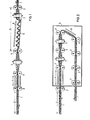
- a device suitable for carrying out the novel immersion dyeing / dwelling method, to which the present invention also relates consists essentially of an impregnation zone (2) containing a chassis for immersion, each designated in the direction of travel of the continuously running cable harness (1). or impregnation bath (not shown), including the subsequent pair of rollers (3), transverse to the goods run, for dewatering the spun material (1) soaked with excess dyeing liquor by squeezing pressure; a heating zone (4), essentially for applying radiation energy, steam or contact heat to the goods; and a dwelling zone (5) which is designed as a goods store (6) and has means for passing the strand material (1) through the stress-relieving phase during the dwelling phase for dye fixation.
- This dwell zone (5) is characterized in accordance with the invention in that (5), in addition to the direction of travel of the goods - at least at the goods inlet and at the goods outlet - a plurality of crushing units / roller pairs (7) for that transported through the goods store (G) Cables (1) are arranged in a parallel position to one another or advantageously in a position rotated relative to one another by an angle of up to 90 °, optionally alternately in combination with heating fields (8).
- the goods store which is used to hold the fiber cable soaked with dye liquor and often already preheated, can be designed quite differently: In the simplest case, it is a heatable chamber with an inclined floor, on which, due to the oblique position, the spun material is roughly de-laminated after Exit to slides. Systems in a kind of roller skids can also be used for this purpose, and chambers with sieve drums can also be used. Finally, endless circulating sieve belts are suitable for material transport through the goods store, optionally divided into several individual belts and arranged one above the other, on which the strand material is deposited.
- heating zone (4) and dwell zone (5) i.e. Goods store (6) together with squeeze rollers (7) and heating fields (8)] are accommodated in a common container (9) which is closed by means of the goods inlet and goods outlet.
- Dwell zones with heated chambers which are spacious enough to offer squeezing mechanisms at the entrance and exit, as well as a storage facility, are therefore extremely efficient.
- a dwell chamber is attached to a microwave heater, which heats the material to the desired temperature and there is another heater in the chamber to prevent the fiber cable from cooling.
- the dwell time is short in such systems, and as a result the speed of goods is relatively high.
- FIG. 2 contains a variant of such a device, according to which the goods store is alternately interrupted by squeezing mechanisms and heating fields over the length of the dwell path.
- the reference symbols used here are identical to the numbers used for this purpose in the text above.
- cationic dyes of both mono-quaternary and bis-quaternary type can be used, which belong to the most diverse classes of chemical compounds, in particular the class of monoazo dyes, disazo dyes, methine, azamethine and diazamethine dyes and naphthalactam Dyes.
- copolymers of acrylonitrile with other vinyl compounds can be used as substrates to be spun for the claimed process, these copolymers having at least 50% by weight, preferably at least 85% by weight, of acrylonitrile units.
- the homopolymers of acrylonitrile or their copolymers used are mostly acid-modified.
- the undrawn fibers or threads - without being dried - are treated at temperatures between 10 ° and 100 ° C., preferably between 20 ° and 80 ° C., with the dyes dissolved in aqueous or solvent-containing dyeing medium.
- the dyeing time is generally between 0.5 and 20 seconds, preferably between 2 and 20 seconds.
- the stated dyeing time corresponds to the contact time (residence time) of the polymer with the dye solution after spinning.
- the dyeing operation itself is carried out according to the method continuously in the course of the manufacturing process of the fiber cable, ie as long as the freshly spun acrylonitrile polymers exist in g g elarti he form. It can be carried out during or shortly after the polymer coagulation process.
- the colored fiber cables are then fixed under normal conditions with steam or hot air, stretched, finished and, if necessary, dried with the approval of shrinkage.
- An acrylonitrile copolymer made of 85% acrylonitrile, 14.5% vinyl acetate and 0.5% Na vinyl sulfonate is in the form of a 28% spinning solution in dimethylformamide according to standard conditions at 80 ° C using a 100-hole spinneret with a hole diameter of 80 ⁇ m wet spun, using a coagulation bath at 50 ° C, which consists of 50% dimethylformamide and 50% water.
- the thread material obtained passes through an impregnation zone in which a solution of 0.1 g of a mono-quaternary dye of the formula brought to pH 4.5 by means of acetic acid in 25 liters of water at room temperature.
- the spun material is then squeezed off, heated to 80 ° C. by microwaves and introduced into a chamber, where it passes through 4 pairs of squeezing rollers standing horizontally and vertically, then deposited briefly, squeezed twice and finally led out of the 80 ° C. warm chamber.
- the total dwell time during the passage of goods is 40 seconds.
- the threads treated in this way are then rinsed with water, stretched, relaxed and dried as usual.
- a blue color is obtained with excellent fastness properties, mainly particularly good wet fastness properties and very good light fastness properties.
- An acrylonitrile copolymer made from 94% acrylonitrile, 4% vinyl acetate, 1% itaconic acid Na and 1% Na methallylsulfonate is wet-spun in the form of a 28% spinning solution in dimethylformamide according to standard conditions as in Example 1 and passed through a coagulation bath.
- the thread material obtained is squeezed out and passes through an impregnation zone without prior drying, in which a solution of 0.1 g of a bis-quaternary dye of the formula adjusted to pH 4.3 by means of acetic acid is passed in 2.5 l of water at room temperature to act on the material.
- the spun material is then squeezed off, heated to approximately 70 ° C. with the aid of indirect steam and, at approximately the same temperature, passes through a chamber in which it is continuously exposed to the action of squeeze rollers.
- the passage of goods under these conditions takes place without a train, so that the material opens again after every crushing.
- the material remains in the chamber for a total of 10 seconds.
- the threads treated in this way are rinsed with water, then stretched, relaxed and dried as usual.
- M an receives a reddish yellow on the fiber cable with excellent fastness properties, mainly particularly good wet fastness properties and very good light fastness properties.
Landscapes
- Engineering & Computer Science (AREA)
- Textile Engineering (AREA)
- Chemical & Material Sciences (AREA)
- Materials Engineering (AREA)
- Chemical Kinetics & Catalysis (AREA)
- General Chemical & Material Sciences (AREA)
- Mechanical Engineering (AREA)
- Toxicology (AREA)
- Dispersion Chemistry (AREA)
- Health & Medical Sciences (AREA)
- Coloring (AREA)
- Treatment Of Fiber Materials (AREA)
- Artificial Filaments (AREA)
- Chemical Treatment Of Fibers During Manufacturing Processes (AREA)
Applications Claiming Priority (2)
| Application Number | Priority Date | Filing Date | Title |
|---|---|---|---|
| DE3151466 | 1981-12-24 | ||
| DE19813151466 DE3151466A1 (de) | 1981-12-24 | 1981-12-24 | "verfahren und vorrichtung zum fixieren von kationischen farbstoffen auf polyacrylnitrilfasern im gelzustand" |
Publications (1)
| Publication Number | Publication Date |
|---|---|
| EP0083066A2 true EP0083066A2 (fr) | 1983-07-06 |
Family
ID=6149780
Family Applications (1)
| Application Number | Title | Priority Date | Filing Date |
|---|---|---|---|
| EP82111874A Withdrawn EP0083066A2 (fr) | 1981-12-24 | 1982-12-21 | Procédé et dispositif pour la fixation de colorants cationiques sur des fibres de polyacrylonitrile à l'état de gel |
Country Status (4)
| Country | Link |
|---|---|
| EP (1) | EP0083066A2 (fr) |
| JP (1) | JPS58115165A (fr) |
| KR (1) | KR840002928A (fr) |
| DE (1) | DE3151466A1 (fr) |
Cited By (2)
| Publication number | Priority date | Publication date | Assignee | Title |
|---|---|---|---|---|
| EP0151374A1 (fr) * | 1983-12-30 | 1985-08-14 | Ciatti Angiolo s.a.s. di Roberto Benassai & C. | Appareil pour extraire des liquides de traitement hors d'une matière textile tubulaire tricotée |
| EP1342936A1 (fr) | 2002-03-07 | 2003-09-10 | Morse Tec Europe S.r.l. | Tendeur hydraulique avec piston creux et dispositif de retenue du type à vis |
-
1981
- 1981-12-24 DE DE19813151466 patent/DE3151466A1/de not_active Withdrawn
-
1982
- 1982-12-21 EP EP82111874A patent/EP0083066A2/fr not_active Withdrawn
- 1982-12-22 KR KR1019820005752A patent/KR840002928A/ko not_active Withdrawn
- 1982-12-23 JP JP57225112A patent/JPS58115165A/ja active Pending
Cited By (2)
| Publication number | Priority date | Publication date | Assignee | Title |
|---|---|---|---|---|
| EP0151374A1 (fr) * | 1983-12-30 | 1985-08-14 | Ciatti Angiolo s.a.s. di Roberto Benassai & C. | Appareil pour extraire des liquides de traitement hors d'une matière textile tubulaire tricotée |
| EP1342936A1 (fr) | 2002-03-07 | 2003-09-10 | Morse Tec Europe S.r.l. | Tendeur hydraulique avec piston creux et dispositif de retenue du type à vis |
Also Published As
| Publication number | Publication date |
|---|---|
| JPS58115165A (ja) | 1983-07-08 |
| DE3151466A1 (de) | 1983-07-21 |
| KR840002928A (ko) | 1984-07-21 |
Similar Documents
| Publication | Publication Date | Title |
|---|---|---|
| WO1998045521A1 (fr) | Procede et dispositif pour teindre en continu du fil de chaine | |
| EP1063337A2 (fr) | Procédé et dispositif pour le traitement thermique continu d'une étoffe textile, notamment pour le fixage des matières colorantes | |
| DE2151248A1 (de) | Verfahren zur Herstellung eines texturierten Garns mit hoher Geschwindigkeit unter gleichzeitiger Faerbung | |
| EP0797698B1 (fr) | Dispositif pour fixer les couleurs lors d'operations de teinture par colorants reactifs | |
| EP0119521B2 (fr) | Procédé en continu pour la fabrication de fibres et fils en polyacrylonitrile | |
| DE1460466C3 (de) | Verfahren und Vorrichtung zum Farben von Textilgut | |
| DE813698C (de) | Verfahren und Vorrichtung zum Faerben, Bleichen oder einer anderen Nassbehandlung von Geweben | |
| EP0083066A2 (fr) | Procédé et dispositif pour la fixation de colorants cationiques sur des fibres de polyacrylonitrile à l'état de gel | |
| DE4409953A1 (de) | Vorrichtung und Verfahren für das kontinuierliche Färben von Maschenware in Schlauchform | |
| DE3151465A1 (de) | "verfahren und vorrichtung zur behandlung von faserkabeln" | |
| DE2922809A1 (de) | Acrylfasern mit grosser schrumpfung und verfahren zu ihrer herstellung | |
| EP0089593B1 (fr) | Procédé de préparation de filaments et de fibres en polymères d'acrylonitrile | |
| DE1469087A1 (de) | Faerbeverfahren | |
| DD207943A5 (de) | Verfahren und vorrichtung zum fixieren von kationischen farbstoffen auf polyacrylnitrilfasern | |
| DE3151467A1 (de) | "verfahren und vorrichtung zur behandlung von faserkabeln" | |
| DE2359882A1 (de) | Faerben von acrylnitrilpolymer-faeden | |
| EP0091567B1 (fr) | Procédé de fabrication de fils ou de filés thermostables | |
| DE1460375B1 (de) | Vorrichtung zur Naßbehandlung von Textilgut | |
| DE900687C (de) | Verfahren und Vorrichtung zum Nassbehandeln von Textilgut in laufender Bahn | |
| DE2025434A1 (en) | Continuous fabric finishing - with fluid recirculation - and recharging system to maintain soln concentration level | |
| DE3885277T2 (de) | Verfahren zur Behandlung von schrumpffähigen Fasern. | |
| DE1469241A1 (de) | Verfahren zum Behandeln von synthetische Fasern enthaltenden Geweben oder Gewirken | |
| DE3045647A1 (de) | Verfahren zum kontinuierlichen faerben von kettgarnen nach dem prinzip des flachfaerbens und vorrichtung zur durchfuehrung des verfahrens | |
| DE3313842A1 (de) | Verfahren zum kontinuierlichen faerben einer stoffbahn | |
| DE2504611A1 (de) | Verfahren zum kontinuierlichen egalen veredeln von polyacrylnitril-spinnkabel im hydratisierten zustand |
Legal Events
| Date | Code | Title | Description |
|---|---|---|---|
| PUAI | Public reference made under article 153(3) epc to a published international application that has entered the european phase |
Free format text: ORIGINAL CODE: 0009012 |
|
| AK | Designated contracting states |
Designated state(s): DE FR GB IT |
|
| STAA | Information on the status of an ep patent application or granted ep patent |
Free format text: STATUS: THE APPLICATION HAS BEEN WITHDRAWN |
|
| 18W | Application withdrawn |
Withdrawal date: 19831202 |
|
| RIN1 | Information on inventor provided before grant (corrected) |
Inventor name: BEUTLER, HELMUT, DR. Inventor name: HAEHNKE, MANFRED, DR. |