EP0083190B1 - Verfahren zur Herstellung von Polybutadien-Kautschuk mit verbesserter mechanischer Festigkeit - Google Patents
Verfahren zur Herstellung von Polybutadien-Kautschuk mit verbesserter mechanischer Festigkeit Download PDFInfo
- Publication number
- EP0083190B1 EP0083190B1 EP82306792A EP82306792A EP0083190B1 EP 0083190 B1 EP0083190 B1 EP 0083190B1 EP 82306792 A EP82306792 A EP 82306792A EP 82306792 A EP82306792 A EP 82306792A EP 0083190 B1 EP0083190 B1 EP 0083190B1
- Authority
- EP
- European Patent Office
- Prior art keywords
- butadiene
- polymerization
- cobalt
- cis
- carbon disulfide
- Prior art date
- Legal status (The legal status is an assumption and is not a legal conclusion. Google has not performed a legal analysis and makes no representation as to the accuracy of the status listed.)
- Expired
Links
Images
Classifications
-
- C—CHEMISTRY; METALLURGY
- C08—ORGANIC MACROMOLECULAR COMPOUNDS; THEIR PREPARATION OR CHEMICAL WORKING-UP; COMPOSITIONS BASED THEREON
- C08F—MACROMOLECULAR COMPOUNDS OBTAINED BY REACTIONS ONLY INVOLVING CARBON-TO-CARBON UNSATURATED BONDS
- C08F295/00—Macromolecular compounds obtained by polymerisation using successively different catalyst types without deactivating the intermediate polymer
-
- C—CHEMISTRY; METALLURGY
- C08—ORGANIC MACROMOLECULAR COMPOUNDS; THEIR PREPARATION OR CHEMICAL WORKING-UP; COMPOSITIONS BASED THEREON
- C08F—MACROMOLECULAR COMPOUNDS OBTAINED BY REACTIONS ONLY INVOLVING CARBON-TO-CARBON UNSATURATED BONDS
- C08F136/00—Homopolymers of compounds having one or more unsaturated aliphatic radicals, at least one having two or more carbon-to-carbon double bonds
- C08F136/02—Homopolymers of compounds having one or more unsaturated aliphatic radicals, at least one having two or more carbon-to-carbon double bonds the radical having only two carbon-to-carbon double bonds
- C08F136/04—Homopolymers of compounds having one or more unsaturated aliphatic radicals, at least one having two or more carbon-to-carbon double bonds the radical having only two carbon-to-carbon double bonds conjugated
- C08F136/06—Butadiene
Definitions
- the present invention relates to a process for producing a polybutadiene rubber having an enhanced mechanical strength. More particularly, the present invention relates to a process for producing a polybutadiene rubber comprising 5% to 30% by weight of a fraction insoluble in n-hexane at the boiling temperature thereof and 70% to 95% by weight of a fraction soluble in the boiling n-hexane and having an excellent mechanical strength.
- cis-1,4-polybutadiene produced by polymerizing 1,3-butdiene in the presence of a cis-1,4-polymerization catalyst, are used as materials for tires and other rubber products.
- One of the reasons why large amounts of cis-1,4-polybutadiene are used in the rubber industry is that the rubber products produced therefrom exhibit a high resilience, a low heat buildup property, and superior abrasion resistance and, therefore, are superior to general purpose rubber products.
- Conventional cis-1,4-polybutadiene rubber products suffer from the disadvantages of poor tear resistance and small cut growth resistance.
- United Kingdom Patent No. 1372399 discloses a new type of polybutadiene rubber produced by first polymerizing 1,3-butadiene in an inert organic solvent in the present of a cis-1,4-polymerization catalyst and then second polymerizing 1,3-butadiene in the presence of a 1,2-polymerization catalyst and the resultant cis-1,4-polybutadiene.
- the publication contains some examples of processes in which polybutadiene rubbers are vulcanized and in which the resultant vulcanized rubber products exhibit excellent tear resistance and cut growth resistance.
- An object of the present invention is to provide a process for producing a polybutadiene rubber having enhanced mechanical strength, for example, excellent tear resistance, cut growth resistance, and abrasion resistance.
- Another object of the present invention is to provide a process for producing a polybutadiene rubber wherein the cis-1,4-polymerization of 1,3-butadiene is carried out in an increased catalytic activity of cis-1,4- polymerization catalyst while preventing formation of a gel.
- Still another object of the present invention is to provide a process for producing a polybutadiene rubber wherein a solution recovered from the resultant polymerization mixture and comprising non-reacted 1,3-butadiene, inert organic solvent, and carbon disulfide can be recycled to the process without separating the carbon disulfide from the recovered solution.
- a further object of the present invention is to provide a process for producing a polybutadiene rubber, wherein cis-1,4-polymerization and 1,2-polymerization can be smoothly carried out at high efficiencies and can be continued for a long time period without difficulty.
- the first polymerization mixture may be prepared by mixing the controlled 1,3-butadiene-carbon disulfide solution of step (B) with the 1,4-polymerization catalyst or may be provided by admixing the controlled 1,3-butadiene-carbon disulfide solution of step (B) with an aluminum catalytic ingredient (a'), consisting of at least one organic aluminum compound of the formula (la): wherein R and X are the same as defined above, by aging the resultant admixture for at least one minute and, then, by mixing the aged mixture with the cobalt catalytic ingredient (b).
- an aluminum catalytic ingredient (a') consisting of at least one organic aluminum compound of the formula (la): wherein R and X are the same as defined above
- the isolation residue can be processed for recovery of a mixture of the non-reacted 1,3-butadiene,the inert organic solvent and the carbon disulfide and the recovered mixture can be recycled to step (A).
- a 1,3-butadiene-carbon disulfide solution is prepared by mixing 1,3-butadiene with an inert organic solvent and carbon disulfide in an amount of 20 millimoles or less, preferably, 0.01 to 10 millimoles, per liter of the sum of the amounts of the 1,3-butadiene and the inert organic solvent.
- the carbon disulfide is effective as a catalytic ingredient of the 1,2-polymerization catalyst for 1,3-butadiene.
- the carbon disulfide does not obstruct the cis-1,4-polymerization of 1,3-butadiene and, therefore, may exist in the above-mentioned amount in the cis-1,4-polymerization mixture without affecting the cis-1,4-polymerization of 1,3-butadiene.
- an amount of carbon disulfide exceeding 20 millimoles per liter of the sum of the amounts of the inert organic solvent and the 1,3-butadiene is not only ineffective for enhancing the catalytic activity of the 1,2-polymerization, but also causes an increase in the side reaction of the carbon disulfide in the final procedure in which the inert organic solvent, non-reacted 1,3-butadiene and the carbon sulfide are recovered.
- the side reaction of the carbon disulfide produces a bad smell and the resultant polybutadiene rubber is contaminated with the side reaction product.
- the amount of 1,3-butadiene be in the range of from 3% to 40%, based on the sum of the weight of 1,3-butadiene and the inert organic solvent.
- the inert organic solvent is not limited to a specific type of liquid compound as long as the solvent is able to dissolve therein the cis-1,4-polybutadiene produced in step (C).
- the inert organic solvent consists essentially of at least one member selected from the group consisting of aromatic hydrocarbons, for example, benzene, toluene, and xylene; aliphatic hydrocarbons, for example, n-heptane and n-hexane; cycloaliphatic hydrocarbons, for example, cyclohexane and cyclopentane; and halogenated derivatives of the above-mentioned hydrocarbons, for example, dichloromethane and chlorobenzenes.
- step (B) of the process of the present invention the concentration of water contained in the 1,3-butadiene-carbon disulfide solution is measured and controlled to a desired value in the range of from 0.2 to 5 millimole, preferably, from 0.5 to 5 millimoles, per liter of the 1,3-butadiene-carbon disulfide solution.
- the control of the water concentration can be effected by any conventional water-controlling method.
- control of the amount of water to the above-mentioned level is effective for preventing the side reaction between the carbon disulfide and the aluminum catalytic ingredient (a) in the cis-1 A-polymerization step (C).
- a concentration of water in the 1,3-butadiene-carbon disulfide solution less than 0.2 millimoles/I or more than 5 millimoles/I will result in an unsatisfactory yield of cis-1,4-polybutadiene in step (C). If it is found that the concentration of water in the 1,3-butadiene-carbon disulfide solution prepared in step (A) is the same as that desired, the 1,3-butadiene-carbon disulfide solution can be directly subjected to step (C). The measurement and control of the water and carbon disulfide concentrations can be carried out by a conventional method. Before the controlled 1,3-butadiene-carbon disulfide solution is subjected to step (C), it is preferable that the solution be cooled to a temperature of 10°C or less.
- a first polymerization mixture comprising the controlled 1,3-butadiene-carbon disulfide solution and a cis-1,4-polymerization catalyst is subjected to a first polymerization procedure.
- the cis-1,4- polymerization catalyst comprises (a) an aluminum catalytic ingredient consisting of at least one organic aluminum compound of the formula (I): wherein R represents a member selected from the group consisting of alkyl radicals having 1 to 6 carbon atoms, a phenyl radical, and cycloalkyl radical, preferably, having 5 to 7 carbon atoms; X represents a halogen atom, preferably, a chlorine atom; and n represents the number of 1.5 to 2.0 and (b) a cobalt catalytic ingredient consisting of at least one cobalt compound which is soluble in the inert organic solvent used for dissolving 1,3-butadiene therein.
- R represents a member selected from the group consisting of alkyl radicals having 1 to 6 carbon
- the organic aluminum compound of the formula (1) is preferably selected from the group consisting of diethyl aluminum monochloride, diethyl aluminum monobromide, diisobutyl aluminum monochloride, and ethyl aluminum sesquichloride.
- the cobalt compounds usable for the cis-1,4-polymerization catalyst are not limited to a specific type of compound as long as the cobalt compounds are soluble in the inert organic solvent contained in the 1,3-butadiene solution.
- the cobalt compound is selected from the group consisting of cobalt ⁇ -ketone complexes, for example, cobalt (II) acetylacetonate and cobalt (III) acetylacetonate; cobalt ⁇ -ketoacid ester complexes, for example, cobalt acetacetic ethylester complexes; cobalt salts of organic carboxylic acids having 6 or more carbon atoms, for example, cobalt octoate, cobalt naphthenate, and cobalt benzoate; and cobalt halide complexes, for example, cobalt chloride-pyridine complexes; cobalt chloride-ethyl alcohol complexes and cobalt complex
- the first polymerization mixture can be prepared by mixing the controlled 1,3-butadiene-carbon disulfide solution with the cis-1,4-polymerization catalyst.
- the first polymerization mixture can be prepared by mixing the controlled 1,3-butadiene-carbon disulfide solution with an aluminum catalytic ingredient (a'), consisting of at least one organic aluminum compound of the formula (la): wherein R and X are the same as defined above, by aging the resultant mixture for at least one minute and then by admixing the aged admixture with the cobalt catalytic ingredient (b).
- the mixture of the controlled 1,3-butadiene-carbon disulfide solution with the aluminum catalytic ingredient be aged for one minute or more in the absence of the cobalt catalytic ingredient.
- This aging procedure is effective for enhancing the catalytic activity of the resultant cis-1,4-polymerization catalyst, for restricting formation of a gel in the first polymerization step, and for restricting deposit of polymer (including the gel) onto the inside surface of a vessel in which the cis-1,4-polymerization is carried out.
- the above-mentioned effects of the aging procedure are also effective for prolonging the lifetime in which the vessel can be continuously used for not only the cis-1,4-poiymerization but also the 1,2- polymerization.
- the above-mentioned effects of the aging procedure can be further enhanced by preventing contamination of water into the aged mixture after the aging procedure is completed.
- the aging procedure of the mixture consisting of the controlled 1,3-butadiene-carbon disulfide solution and the aluminum catalytic ingredient (a') is carried out for at least one minute, preferably, from 2 minutes to 2 hours, preferably, at a temperature of 10°C to 80°C, more preferably, 10°C to 50°C. If the aging time is less than one minute, it is difficult to attain the above-mentioned effects of the aging procedure.
- the aged mixture is preferably cooled to a temperature of 10°C or less.
- the resultant cooled mixture is then admixed with the cobalt catalytic ingredient (b) while the admixture is stirred.
- the cis-1,4-polymerization catalyst contain the aluminum catalytic ingredient (a) or (a') in an amount of at least 0.1 millimole, more preferably, from 0.5 to 50 millimoles, per mole of 1,3-butadiene in the first polymerization mixture. Also, it is preferable that it contains the cobalt catalytic ingredient (b) in an amount of at least 0.001 millimole, more preferably, at least 0.005 millimole, still more preferably, from 0.007 to 0.07 millimoles, per mole of 1,3-butadiene in the first polymerization mixture.
- the cis-1,4-polymerization catalyst have a molar ratio of the aluminum catalytic ingredient (a) or (a') to the cobalt catalytic ingredient (b) of at least 5:1, more preferably, at least 15:1, still more preferably, from 50:1 to 500:1.
- the resultant first polymerization mixture is subjected to the cis-1,4-poiymerization at a temperature of, preferably, from -20°C to 80°C, more preferably, from 5°C to 50°C, for a polymerization time, i.e., the average time for which the first polymerization mixture resides in the cis-1,4-poiymerization vessel, of from 10 minutes to 10 hours, while the mixture is stirred in the vessel.
- the polymerization vessel for the cis-1,4- polymerization is not limited to a specific type of vessel.
- a polymerization vessel with a high viscosity stirring apparatus for instance, as disclosed in Japanese Examined Patent Publication (Kokoku) No. 40-2645, can be used for carrying out the cis-1,4-polymerization procedure.
- the resultant polybutadiene contain 90% or more, more preferably, 95% or more, of cis-1,4-structure and exhibit an intrinsic viscosity of 1.5 to 8.0, more preferably, 1.5 to 5.0, determined in toluene at a temperature of 30°C.
- the molecular weight of the resultant cis-1,4-polybutadiene can be controlled by adding a molecular weight modifier to the first polymerization mixture.
- the molecular weight modifier preferably consists essentially of at least one member selected from non-conjugated diene compounds, for example, cyclooctadiene and allene (isoallylene), ethylene, and a-olefin compounds, for instance, propylene and butene-1.
- an anti-gelling agent be added to the first polymerization mixture.
- the anti-gelling agent may be selected from conventional anti-gelling agents.
- a second polymerization mixture containing the resultant cis-1,4-polybutadiene in step (C) and non-reacted 1,3 butadiene, which are dissolved in the inert organic solvent, and a 1,2-polymerization catalyst is subjected to a 1,2-polymerization.
- the second polymerization mixture can be prepared by mixing the resultant cis-1,4-polymerization mixture obtained in step (C) and containing therein the carbon disulfide with the aluminum catalytic ingredient (d) and if necessary the cobalt catalytic ingredient (c) of the 1,2-polymerization catalyst and, if necessary, an additional amount of fresh 1,3-butadiene which has been preferably cooled to a temperature of 10°C or less.
- the amount of the non-reacted 1,3-butadiene in the second polymerization mixture be in the range of from 3% to 35% by weight.
- the 1,2-polymerization catalyst comprises a cobalt catalytic ingredient (c) consisting of at least one cobalt compound, an aluminum catalytic ingredient (d) consisting of at least one organic aluminum compound of the formula (II): wherein R is the same as defined above, and another catalytic ingredient (e) consisting of carbon disulfide.
- the cobalt compounds usable for the cobalt catalytic ingredient (c) can be selected from the group of cobalt compounds as those usable for the cobalt catalytic ingredient (b). It is preferable that the cobalt catalytic ingredient (C) consists of at least one cobalt complex coordinated with butadiene.
- the aluminum compounds of the formula (II) are preferably selected from the group consisting of triethyl aluminum, trimethyl aluminum, triisobutyl aluminum, and triphenyl aluminum.
- the carbon disulfide is preferably free from water.
- Each of the catalytic ingredients may be fed, in the form of a solution thereof in the inert organic solvent or in 1,3-butadiene, to the second polymerization mixture.
- the solution is preferably cooled to a temperature of 10°C or less.
- the amount of the 1,2-polymerization catalyst is variable depending on the types of the catalytic ingredients, component of the catalyst, and the polymerization conditions.
- the cobalt catalytic ingredient (c) be used in an amount of 0.005 millimole or more, preferably, from 0.01 to 5 millimoles; the aluminum catalytic ingredient (d) in an amount of at least 0.1 millimole, preferably, from 0.5 to 50 millimoles; and carbon disulfide (e) in an amount of at least 0.001 millimole, more preferably, from 0.01 to 10 millimoles, each per mole of non-reacted 1,3-butadiene in the second polymerization mixture.
- the cis-1,4-polymerization catalyst may contain the cobalt compound in an amount necessary for both the cis-1,4- and 1,2- polymerization procedures.
- the second polymerization mixture can be prepared by mixing the resultant first polymerization mixture which contains the cobalt catalytic ingredient, in the necessary amount for the 1,2-polymerization catalyst, with the aluminum catalytic ingredient and, if necessary, carbon disulfide.
- step (B) the amount of the carbon disulfide necessary for the 1,2-polymerization is larger than that contained in the 1,3-butadiene-carbon disulfide solution
- a necessary additional amount of carbon disulfide should be added to the polymerization mixture in a certain step, for example, step (B), before step (D).
- the second polymerization mixture is subjected to the 1,2-polymerization procedure preferably at a temperature of from -20°C to 80°C, more preferably, from 5°C to 50°C for 10 minutes to 10 hours, under either atmospheric pressure or increased pressure for, for example, 10 minutes to 10 hours.
- the 1,2-polymerization procedure is carried out by stirring the second polymerization mixture in a polymerization vessel. Since the second polymerization mixture exhibits a high viscosity during the 1,2- polymerization procedure, the resultant polymer tends to deposit onto the surface of the polymerization vessel. Therefore, it is preferable that the polymerization vessel be provided with a device for removing the deposited polymer, as described in Japanese Examined Patent Publication No. 40-2645.
- the resultant 1,2-polymerization mixture which contains the resultant polybutadiene rubber, non-reacted 1,3-butadiene, carbon disulfide, cobalt catalytic ingredient(s), aluminum catalytic ingredients, and inert organic solvent be moved to a polymerization shortstopping vessel and that a polymerization shortstopper be added to the 1,2- polymerization mixture so as to short-stop the 1,2-polymerization.
- the polymerization shortstopper is not listed to a specific type of compounds as long as the compounds can be reacted with the aluminum compounds of the formula (II) so as to deactivate the aluminum catalytic ingredient (d).
- the polymerization shortstopper consists of at least one member selected from aliphatic alcohols, for example, methyl alcohol and ethyl alcohol; water; inorganic acids, for example, hydrchloric acid and sulfuric acid; organic acids, for instance, acetic acid and benzoic acid; monoethanolamine; ammonia; phosphorous esters, for example, tris(nonylphenyl)phosphite, and hydrogen chloride gas.
- the polymerization shortstopper may be in the form of an aqueous solution or an alcoholic solution.
- the resultant 1,2-polymerization mixture is subjected to a step for isolating the resulting polybutadiene rubber therefrom.
- This solution can be effected by adding a precipitating agent, for example, methyl alcohol to the polymerization mixture or by evaporating volatile substances from the polymerization mixture while blowing or not blowing steam into the polymerization mixture, so- as to cause the polybutadiene rubber to precipitate from the polymerization mixture.
- the precipitated polybutadiene rubber is separated from the polymerization mixture, washed with methyl alcohol or hot water, and then dried.
- an anti-oxidant be added to the resultant polymerization mixture during the shortstopping procedure, or be added to the isolated slurry of the polybutadiene rubber.
- a polybutadiene rubber consisting essentially of 5% to 30%, preferably, 7% to 15% by weight of a boiling n-hexane-insoluble fraction and 70% to 95%, preferably, 85% to 93% by weight of a boiling n-hexane-soluble fraction thereof is obtained.
- the boiling n-hexane-insoluble fraction usually exhibits a melting point of from 180°C to 215°C.
- the isolation residue is subjected to a recovery procedure in which the non-reacted 1,3-butadiene, inert organic solvent, and carbon disulfide are recovered, usually, by means of distillation.
- the distillation procedure be carried out in two steps. In this case, a mixture of the non-reacted 1,3-butadiene and almost all of the amount of the carbon disulfide is distilled at a low temperature in a first distillation column and, then, a mixture of the inert organic solvent and, occasionally, the remaining amount of the carbon disulfide is obtained at a high temperature in a second distillation column. Otherwise, the distillation procedure may be carried out in a single step so as to obtain a mixture of the non-reacted 1,3-butadiene, inert organic solvent, and carbon disulfide.
- the distillation procedure may be carried out in such a manner that a mixture of the non-reacted 1,3-butadiene and the minor amount of the carbon disulfide is distilled in a first distillation column and, then, a mixture of the inert organic solvent and the major amount of the carbon disulfide is obtained in a second distillation column.
- the distillation can be carried out in a single step so as to obtain a mixture of the non-reacted 1,3-butadiene, inert organic solvent, and carbon disulfide.
- the recovered mixture of the non-reacted 1,3-butadiene, inert organic solvent, and carbon disulfide is recycled to the first step (A) and, if necessary, is mixed with necessary amounts of fresh 1,3-butadiene and carbon disulfide to provide a 1,3-butadiene-carbon disulfide solution having a predetermined composition.
- the recovered mixture can be directly recycled to the step (A) without separating the carbon disulfide from the other components, the non-reacted 1,3-butadiene, and the inert organic solvent.
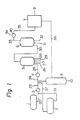
- Fig. 1 fresh 1,3-butadiene contained in a tank 1 is introduced into a mixer 3 through a conduit 20 and a recovered solution of 1,3-butadiene and carbon disulfide in an inert organic solvent having a higher boiling point than that of 1,3-butadiene, for example, benzene, from a tank 2 into a mixer 3 through a conduit 21.
- the fresh 1,3-butadiene and the recovered 1,3-butadiene-carbon disulfide solution are mixed with each other in the mixer 3 to provide a 1,3-butadiene-carbon disulfide solution having a desired concentration of 1,3-butadiene.
- the 1,3-butadiene-carbon disulfide solution is introduced from the mixer 3 into a mixer 4 through a conduit 22.
- water is fed into the conduit 22 through a water-supply conduit 23.
- an additional amount of fresh carbon disulfide is introduced into the conduit 22 through a carbon disulfide-supply conduit 24.
- the carbon disulfide-supply conduit 24 may be connected at the upstream to the water-supply conduit 23, to the conduit 22.
- the 1,3-butadiene-carbon disulfide solution is uniformly mixed with water and, occasionally, with the fresh carbon disulfide in the mixer 4.
- the resultant controlled 1,3-butadiene-carbon disulfide solution is supplied into a cis-1,4-polymerization vessel 5 through a conduit 25.
- An aluminum catalytic ingredient and a cobalt catalytic ingredient are fed into the vessel 5 through a conduit 26 and a conduit 29, respectively.
- a molecular weight modifier consisting of, for example, cyclooctadiene and an anti-gelling agent consisting of, for example, diiauryi-3,3'-thiodipropionate are fed into the vessel 5 through a conduit 27 and a conduit 28, respectively.
- the resultant first polymerization mixture is stirred in the vessel 5 to produce a cis-1,4-polybutadiene.
- the resultant polymerization mixture containing cis-1,4-polybutadiene is transferred from the vessel 5 to a 1,2-polymerization vessel 6 through a conduit 30.
- a cobalt catalytic ingredient is supplied to the vessel 6 through a conduit 31, an aluminum catalytic ingredient consisting of the aluminum compound of the formula (II) is fed into the vessel 6 through a conduit 32.
- the aluminum catalytic ingredient and/or carbon disulfide may be fed into the conduit 30.
- the resultant second polymerization mixture in the vessel 6 is stirred so as to allow the cis-1 A-polybutadiene and the non-reacted 1,3-butadiene to be converted to a polybutadiene rubber consisting essentially of 5% to 30% by weight of a boiling n-hexane-insoluble fraction and 70% to 95% by weight of a boiling n-hexane-soluble fraction.
- a polymer insoluble in the inert organic solvent deposits from the polymerization mixture onto the inside surface of the vessel 6 and the viscosity of the polymerization increases. Therefore, it is preferable that the 1,2-polymerization vessel 6 have an agitator equipped with a device for removing the deposited polymer from the inside surface of the vessel.
- the resultant polymerization mixture in the 1,2-polymerization vessel 6 is introduced into a polymerization shortstopping vessel 40 through a conduit 33. Also, a polymerization shortstopper is fed into the vessel 40 through a conduit 34 so as to shortstop the 1,2-polymerization.
- the polymerization shortstopped mixture is introduced into an isolating apparatus 7 through a conduit 35.
- the resultant polybutadiene rubber is isolated so as to leave an isolation residue containing non-reacted 1,3-butadiene, inert organic solvent, and carbon disulfide.
- the isolating apparatus 7 may be a conventional apparatus and may be equipped with a steam stripper and a filter.
- the isolated polybutadiene rubber is removed through a passage 8.
- the isolation residue containing the non-reacted 1,3-butadiene, inert organic solvent and carbon disulfide is introduced into a distillation apparatus 9 through a conduit 36.
- the distillation apparatus may be composed of a single distillation column or two or more distillation columns.
- distillation apparatus 9 a mixture of the non-reacted 1,3-butadiene, the inert organic solvent, and carbon disulfide is recovered and is introduced into the tank 2 through a conduit 37. A distillation residue containing a high boiling point substance is removed from the distillation apparatus 9 through a passage 10.
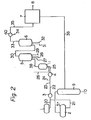
- the apparatus is composed of the same devices as those indicated in Fig. 1, with the following exceptions. That is, an aging vessel 11 is inserted between the mixer 4 and the cis-1,4-polymerization vessel 5.
- the mixer 4 is connected to the aging vessel 11 through the conduit 25 and a conduit 26 for feeding an aluminum catalytic ingredient of the cis-1,4-polymerization catalyst is connected to the conduit 25.
- the aging vessel 11 is connected to the cis-1,4-polymerization vessel 5 through a conduit 38.
- the controlled 1,3-butadiene-carbon disulfide solution is mixed with the aluminum catalytic ingredient in the conduit 25 or in the vessel 11 and the resultant mixture is aged in the aging vessel 11 for a predetermined time period.
- the aged mixture is fed into the cis-1,4-polymerization vessel 5 through the conduit 38 and is mixed in the vessel 5 with a molecular weight modifier fed through the conduit 27, an anti-gelling agent fed through the conduit 28, and a cobalt catalytic ingredient fed through the conduit 29.
- the above-mentioned aging procedure is effective for reducing the amount of the cobalt catalytic ingredient necessary for obtaining the cis-1,4-polymerization catalyst having a satisfactory catalytic activity.
- the amount of the boiling n-hexane-insoluble fraction of the resultant polybutadiene rubber was determined by immersing 2 g of the polybutadiene rubber in 200 ml of n-hexane at room temperature, by separating a fraction of the rubber insoluble in n-hexane by means of filtration, by extracting the n-hexane-insoluble fraction at a boiling point of n-hexane by using a Soxhlet's extractor for 4 hours, by separating the non- extracted fraction from n-hexane, by drying it under vacuum, and, finally, measuring the weight of the dried fraction.
- the amount of the boiling n-hexane-soluble fraction of the polybutadiene rubber was determined by subjecting the resultant extracted solution from the above-mentioned extraction procedure to an evaporation procedure in which n-hexane was evaporated from the solution, drying the residual fraction under vacuum, then measuring the weight of the dried fraction.
- the content of the cis-1,4-structure in the boiling n-hexane-soluble fraction in the polybutadiene rubber and the content of the cis-1,4-structure in the cis-1,4-polymerization product were determined by means of infrared absorption spectrum analysis (IR).
- the content of the 1,2-structure in the boiling n-hexane-insoluble fraction of the polybutadiene rubber was determined by means of nuclear magnetic resonance spectrum (NMR).
- the melting point of the boiling n-hexane-insoluble fraction of the polybutadiene rubber was determined from a temperature at a peak point appearing in an endothermic curve of the boiling n-hexane-insoluble fraction measured by a recording differential scanning calorimeter (DSC).
- the intrinsic viscosities [y] of the boiling n-hexane-soluble fraction of the polybutadiene rubber and of the cis-1A-polymerization product were determined in toluene at a temperature of 30°C.
- the reduced viscosity [ Ys p/C] of the boiling n-hexane-insoluble fraction of the polybutadiene rubber was determined in tetrahydronaphthalene at a temperature of 135°C.
- the concentration of carbon disulfide in a carbon disulfide-containing liquid was determined by using a gas chromatograph equipped with a flame spectrophotometer and containing therein a filler consisting of CHROMOSOLVE 102 (Registered Trade Mark).
- a solution containing 23.7% by weight of 1,3-butadiene and 10 mg/i of carbon disulfide dissolved in benzene was dehydrated by using a dehydrating column.
- the dehydrated 1,3-butadiene solution . was mixed with 40 mg/I (2.2 millimoles/1) of water and the mixture was stirred so as to allow water to be dissolved in the 1,3-butadiene solution.
- the resultant controlled solution was cooled to a temperature of -3°C, then was continuously introduced at a flow rate of 50 I/hr into a cis-1,4-polymerization vessel.
- the vessel was a stainless steel autoclave having an inside volume of 20 liters and equipped with double helical type stirring paddles and a jacket tube for controlling the temperature of the content in the autoclave.
- An aqueous solution of calcium chloride (CaCl 2 ) was circulated through the jacket tube at a temperature of -10°C.
- diethylaluminum monochloride was introduced at a flow rate of 25.5 g/hr, 1,5-cylooctadiene at a flow rate of 60.0 g/hr, dilauryl-3,3'-thiodipropionate (TPL) at a flow rate of 7.0 g/hr, and cobalt octoate at a flow rate of 253 mg/hr.
- TPL dilauryl-3,3'-thiodipropionate
- cobalt octoate was a flow rate of 253 mg/hr.
- the resultant first polymerization mixture was stirred at a temperature of 40°C for an average residing time of 24 minutes to cis-1,4-polymerize the 1,3-butadiene.
- cis-1,4-polybutadiene was produced at a rate of 3.20 kg/hr.
- the resultant polymer contained 96% or more of cis-1,4-structure and had an intrinsic viscosity of 1.7.
- the content of gel produced in the polymer was 0.02% by weight, determined by using a 200 mesh screen.
- the resultant polymerization mixture in the cis-1,4-polymerization vessel was introduced at a flow rate of 50 liters/hr into a 1,2-polymerization vessel of the same type as the cis-1,4-polymerization vessel.
- the 1,2-polymerization vessel was charged with triethylaluminum at a flow rate of 27.0 g/hr, and cobalt octoate at a flow rate of 840 mg/hr.
- the resultant second polymerization mixture was stirred at a temperature of 40°C for an average residing time of 24 minutes so as to 1,2-polymerize the non-reacted 1,3-butadiene.
- the resultant polymerization mixture was continuously introduced into a polymerization shortstopping vessel equipped with stirring paddles and was mixed with 1 PHR of 2,6-di-tert-butyl-methylphenol and then with a small amount of methyl alcohol so as to shortstop the 1,2-polymerization reaction.
- the resultant mixture was introduced at a flow rate of 120 liters/hr into a steam stripper equipped with stirring paddles and was mixed with hot water and saturated steam introduced into the stripper under a pressure of 4 kg/cm 2 G.
- the mixture was dispersed in the hot water so as to allow the volatile substances in the mixture to evaporate away.
- the resultant aqueous slurry of the polybutadiene rubber was removed from the steam stripper.
- the polybutadiene rubber in the form of crumbs and water were separated from the aqueous slurry.
- the separated polybutadiene rubber was dried at room temperature under vacuum.
- the above-mentioned procedures were continuously carried out for 14 hours.
- the polybutadiene rubber was produced at a rate of 3.60 kg/hr.
- the polybutadiene rubber contained 11.3% of a boiling n-hexane-insoluble fraction having a melting point of 206°C and a reduced viscosity ( Ys plC) of 2.0(dl/g) and containing 93.0% of 1,2-structure.
- the remaining boiling n-hexane soluble fraction of the polybutadiene rubber contained 97.1% of cis-1,4-structure and had an intrinsic viscosity of 1.7.
- the volatile substance evaporated from the steam stripper was cooled and was condensed.
- the condensed liquid was separated into an aqueous phase and an organic solvent phase.
- the organic solvent phase was isolated from the aqueous phase.
- a portion of the isolated organic solvent solution was subjected to a recovery process of carbon disulfide, 1,3-butadiene, and benzene in the following manner.
- the isolated organic solvent solution which contained 16.1 % by weight of 1,3-butadiene and 12 mg/I of carbon disulfide and was in an amount of 500 liters, was distilled so as to eliminate high boiling point substances from the solution.
- the distillation product containing-a mixture of the non-reacted 1,3-butadiene, inert organic solvent, and carbon disulfide was recycled to the first step, without removing the carbon disulfide therefrom.
- the concentration of water was adjusted to 38 mg (2.1 millimoles)/I.
- the resultant controlled solution was introduced at a flow rate of 50 liters/hr into an aging vessel equipped with stirring paddles and having an inside volume of 20 liters while diethylaluminum monochloride was introduced at a flow rate of 25.1 g (209 millimoles)/hr into the aging vessel.
- the resultant mixture was aged in the aging vessel at a temperature of 35°C for an average residing time of 25 minutes.
- the aged mixture was cooled to a temperature of -4°C and then introduced at a flow rate of 50 liters/hr into the same type of cis-1,4-po)ymerization vessel as that described in Example 1, while introducing, into the cis-1,4-polymerization vessel, cobalt octoate at a flow rate of 265 mg (0.77 millimoles)/hr, 1,5-cyclooctadiene at a flow rate of 60.5 g (0.561 moles)/hr, and dilauryl -3,3'-thiodipropionate (TPL) at a flow rate of 6.98 g (13.4 millimoles)/hr, to provide the first polymerization mixture.
- cobalt octoate at a flow rate of 265 mg (0.77 millimoles)/hr
- 1,5-cyclooctadiene at a flow rate of 60.5 g (0.561 moles)/hr
- TPL d
- cis-1,4-polymerization procedure at a polymerization temperature of 40°C for an average residing time of 25 minutes, cis-1,4-polybutadiene was produced at a rate of 3.60 kg/hr.
- the resultant polymer contained 96% or more of cis-1,4-structure and had an intrinsic viscosity of 2.0 and a content of gel of 0.01 % or less which was determined by using a 200 mesh screen.
- the resultant polymerization mixture was introduced at a flow rate of 50 liters/hr into the same type of 1,2-polymerization vessel as that described in Example 1, while introducing, into the 1,2-polymerization vessel, triethylaluminum at a flow rate of 27.2 g (239 millimoles)/hr and cobalt octoate at a flow rate of 838 mg (2.36 millimoles)/hr.
- the resultant second polymerization mixture was subjected to the 1,2-polymerization under the same conditions as those described in Example 1.
- the 1,2-polymerization reaction was shortstopped by introducing the polymerization mixture into the same type of polymerization shortstopping vessel as that described in Example 1 and by mixing it with tris-(nonylphenyl)phosphite (TNP) in an amount of 2 moles per mole of the cobalt octoate and with a small amount of water.
- TNP tris-(nonylphenyl)phosphite
- the procedures for producing the polybutadiene rubber were continuously carried out for 22 hours.
- the polybutadiene rubber was obtained in an amount of 4.09 kg/hr and contained 12.0% by weight of the boiling n-hexane-insoluble fraction thereof.
- the boiling n-hexane-insoluble fraction exhibited a melting point of 206°C and a reduced viscosity [y sP /C] of 2.0 (dl/g) and contained 92.9% of 1,2-structure.
- the remaining boiling n-hexane-soluble fraction of the resultant polybutadiene rubber contained 97.0% of cis-1,4-structure and had an intrinsic viscosity [y] of 2.1.
- the non-reacted 1,3-butadiene, the inert organic solvent (benzene), and carbon disulfide were recovered by the following manner.
- the organic solvent solution was isolated from the residue of the resultant polymerization mixture in the same manner as that described in Example 1.
- the isolated solution contained 15.5% by weight of 1,3-butadiene and 12 mg/I of carbon disulfide.
- Example 3 the polybutadiene rubber produced in Example 1 was converted into a composition as indicated in Table 1.
- the composition was uniformly mixed by using a Bambury mixer having a capacity of 1.7 1 and, then, by using a roll mill, and vulcanized at a temperature of 140°C for 30 minutes.
- the vulcanizing procedure was applied to a portion of the composition which was subjected to the measurement of a cut growth resistance of the vulcanized rubber, at 140°C for 75 minutes.
- the properties of the vulcanized rubber were determined in accordance with Japanese Industrial Standard K-6301.
- Example 4 the same procedures as those described in Example 3 were carried out except that the polybutadiene rubber used was one produced in Example 2.
- the 1,2-polymerization reaction can be carried out smoothly and uniformly. Therefore, the 1,2-polymerization can be continued for a long time period without difficulty.
Landscapes
- Chemical & Material Sciences (AREA)
- Health & Medical Sciences (AREA)
- Chemical Kinetics & Catalysis (AREA)
- Medicinal Chemistry (AREA)
- Polymers & Plastics (AREA)
- Organic Chemistry (AREA)
- Transition And Organic Metals Composition Catalysts For Addition Polymerization (AREA)
- Addition Polymer Or Copolymer, Post-Treatments, Or Chemical Modifications (AREA)
Claims (31)


Applications Claiming Priority (4)
| Application Number | Priority Date | Filing Date | Title |
|---|---|---|---|
| JP208107/81 | 1981-12-24 | ||
| JP20810781A JPS58109512A (ja) | 1981-12-24 | 1981-12-24 | 補強ポリブタジエンゴムの製造法 |
| JP125063/82 | 1982-07-20 | ||
| JP12506382A JPH0237927B2 (ja) | 1982-07-20 | 1982-07-20 | Hokyohoributajennoseizoho |
Publications (2)
| Publication Number | Publication Date |
|---|---|
| EP0083190A1 EP0083190A1 (de) | 1983-07-06 |
| EP0083190B1 true EP0083190B1 (de) | 1986-02-12 |
Family
ID=26461597
Family Applications (1)
| Application Number | Title | Priority Date | Filing Date |
|---|---|---|---|
| EP82306792A Expired EP0083190B1 (de) | 1981-12-24 | 1982-12-20 | Verfahren zur Herstellung von Polybutadien-Kautschuk mit verbesserter mechanischer Festigkeit |
Country Status (4)
| Country | Link |
|---|---|
| US (1) | US4472559A (de) |
| EP (1) | EP0083190B1 (de) |
| CA (1) | CA1219994A (de) |
| DE (1) | DE3269112D1 (de) |
Families Citing this family (28)
| Publication number | Priority date | Publication date | Assignee | Title |
|---|---|---|---|---|
| US5879805A (en) * | 1997-09-09 | 1999-03-09 | Union Carbide Chemicals & Plastics Technology Corporation | Gas phase polymerization of vinylpolybutadiene |
| US6281306B1 (en) | 1999-12-16 | 2001-08-28 | Univation Technologies, Llc | Method of polymerization |
| JP4955882B2 (ja) * | 1999-12-30 | 2012-06-20 | 株式会社ブリヂストン | アニオン重合技術と配位触媒の両方を使用することにより製造された共重合体 |
| US6765066B2 (en) | 1999-12-30 | 2004-07-20 | Bridgestone Corporation | Copolymers prepared by using both anionic polymerization techniques and coordination catalysts |
| US6723888B2 (en) | 2001-03-14 | 2004-04-20 | Bridgestone Corporation | Humidification of hydrocarbon mixtures for use in polymer synthesis |
| US7223822B2 (en) | 2002-10-15 | 2007-05-29 | Exxonmobil Chemical Patents Inc. | Multiple catalyst and reactor system for olefin polymerization and polymers produced therefrom |
| ES2394304T3 (es) | 2002-10-15 | 2013-01-30 | Exxonmobil Chemical Patents, Inc. | Sistema de múltiples catalizadores para la polimerización de olefinas y polímeros producidos a partir de éstos |
| US7985811B2 (en) * | 2004-01-02 | 2011-07-26 | Univation Technologies, Llc | Method for controlling sheeting in gas phase reactors |
| US20070073012A1 (en) * | 2005-09-28 | 2007-03-29 | Pannell Richard B | Method for seed bed treatment before a polymerization reaction |
| US20050148742A1 (en) * | 2004-01-02 | 2005-07-07 | Hagerty Robert O. | Method for controlling sheeting in gas phase reactors |
| US7629422B2 (en) | 2004-12-21 | 2009-12-08 | Univation Technologies, Llc | Process for transitioning between Ziegler-Natta-based and chromium-based catalysts |
| US7714082B2 (en) * | 2005-10-04 | 2010-05-11 | Univation Technologies, Llc | Gas-phase polymerization process to achieve a high particle density |
| US7868103B2 (en) * | 2006-05-22 | 2011-01-11 | Ube Industries, Ltd. | Method for producing polybutadiene |
| EP1918311A1 (de) * | 2006-10-31 | 2008-05-07 | Ineos Europe Limited | Dienpolymerisation |
| EP1918312B1 (de) * | 2006-10-31 | 2011-12-07 | Ineos Commercial Services UK Limited | Dienpolymerisation |
| US7754834B2 (en) * | 2007-04-12 | 2010-07-13 | Univation Technologies, Llc | Bulk density promoting agents in a gas-phase polymerization process to achieve a bulk particle density |
| RU2527945C2 (ru) | 2009-01-08 | 2014-09-10 | Юнивейшн Текнолоджиз, Ллк | Добавка для процессов полимеризации полиолефинов |
| WO2010080871A1 (en) | 2009-01-08 | 2010-07-15 | Univation Technologies, Llc | Additive for gas phase polymerization processes |
| WO2011011427A1 (en) | 2009-07-23 | 2011-01-27 | Univation Technologies, Llc | Polymerization reaction system |
| WO2011078923A1 (en) | 2009-12-23 | 2011-06-30 | Univation Technologies, Llc | Methods for producing catalyst systems |
| RU2577324C2 (ru) | 2010-12-22 | 2016-03-20 | Юнивейшн Текнолоджиз, Ллк | Добавка для способов полимеризации полиолефина |
| CN103974982B (zh) | 2011-11-30 | 2016-08-31 | 尤尼威蒂恩技术有限责任公司 | 用于催化剂输送的方法和系统 |
| WO2014018978A2 (en) | 2012-07-27 | 2014-01-30 | The Texas A&M University System | Transition metal complexes for enantioselective catalysis of carbon-carbon, carbon-heteroatom, and carbon-hydrogen bond forming reactions |
| WO2014074981A1 (en) | 2012-11-12 | 2014-05-15 | Univation Technologies, Llc | Recycle gas cooler systems for gas-phase polymerization processes |
| CA2933157C (en) | 2013-12-09 | 2021-11-16 | Univation Technologies, Llc | Feeding polymerization additives to polymerization processes |
| CA2974122C (en) | 2015-01-21 | 2023-09-19 | Univation Technologies, Llc | Methods for gel reduction in polyolefins |
| WO2016118599A1 (en) | 2015-01-21 | 2016-07-28 | Univation Technologies, Llc | Methods for controlling polymer chain scission |
| WO2025250307A1 (en) | 2024-05-30 | 2025-12-04 | ExxonMobil Technology and Engineering Company | Methods for improving gas phase polymerization |
Family Cites Families (6)
| Publication number | Priority date | Publication date | Assignee | Title |
|---|---|---|---|---|
| BE759763A (fr) * | 1969-12-02 | 1971-05-17 | Ube Industries | Procede pour la preparption de 1,2-polybutadiene |
| GB1372399A (en) * | 1970-12-25 | 1974-10-30 | Ube Industries | Process for producing polybutadiene |
| CA1040347A (en) * | 1973-09-27 | 1978-10-10 | Hideo Ishikawa | Process for producing butadiene polymers |
| DE2731067C3 (de) * | 1977-07-09 | 1981-11-26 | Bunawerke Hüls GmbH, 4370 Marl | Verfahren zur Herstellung von Polybutadien mit einem hohen Gehalt an Monomereneinheiten in cis-1,4- Struktur |
| US4303769A (en) * | 1978-08-22 | 1981-12-01 | The B. F. Goodrich Company | Process for preparing substantially gel-free cis-1,4-polybutadiene |
| JPS56109204A (en) * | 1980-01-31 | 1981-08-29 | Japan Synthetic Rubber Co Ltd | Preparation of polybutadiene |
-
1982
- 1982-12-16 CA CA000417956A patent/CA1219994A/en not_active Expired
- 1982-12-20 EP EP82306792A patent/EP0083190B1/de not_active Expired
- 1982-12-20 DE DE8282306792T patent/DE3269112D1/de not_active Expired
- 1982-12-21 US US06/451,756 patent/US4472559A/en not_active Expired - Lifetime
Also Published As
| Publication number | Publication date |
|---|---|
| EP0083190A1 (de) | 1983-07-06 |
| US4472559A (en) | 1984-09-18 |
| CA1219994A (en) | 1987-03-31 |
| DE3269112D1 (en) | 1986-03-27 |
Similar Documents
| Publication | Publication Date | Title |
|---|---|---|
| EP0083190B1 (de) | Verfahren zur Herstellung von Polybutadien-Kautschuk mit verbesserter mechanischer Festigkeit | |
| EP0034235B1 (de) | Verfahren zur Herstellung von Polybutadienkautschuk mit verbesserter mechanischer Festigkeit | |
| US4242232A (en) | Catalyst and its preparation and use for the solution polymerization of conjugated dienes | |
| US4751275A (en) | Process and catalyst for the preparation of syndiotactic 1,2,-polybutadiene | |
| US5428119A (en) | Process for polybutadiene production using catalyst with high activity | |
| US5089574A (en) | Trans-1,4-polybutadiene synthesis | |
| EP0106779B1 (de) | Mikroeingekapselter Katalysator für die Polymerisation in wässrigem Medium | |
| JPH072808B2 (ja) | シス−1,4−ポリブタジエンの製法 | |
| JPS61268706A (ja) | ブタジエン重合体又は共重合体の製造法 | |
| JPH07188341A (ja) | ゲル生成の減ぜられたシス−1,4−ポリブタジエンの製造法 | |
| EP0231143A1 (de) | Direktverfahren zur Herstellung von syndiotaktischem 1,2-Polybutadien | |
| US4506031A (en) | Microencapsulated aqueous polymerization catalyst | |
| US4476287A (en) | Process for producing polybutadiene rubber with enhanced mechanical strength | |
| EP0106597B1 (de) | Verfahren zur Herstellung von Polybutadien | |
| EP0823441B1 (de) | Kobalt enthaltender Katalysator | |
| EP0106596B1 (de) | Verfahren zur Herstellung von Polybutadien mit mechanischer Festigkeit | |
| JPH0354688B2 (de) | ||
| JPS62171B2 (de) | ||
| US3299032A (en) | Process for treating polybutadiene with sulfuric acid to improve cold flow | |
| JPH0237927B2 (ja) | Hokyohoributajennoseizoho | |
| JPH0238081B2 (ja) | Hokyohoributajengomunoseizoho | |
| US4242478A (en) | Low benzene butadiene polymerization | |
| JPH0363566B2 (de) | ||
| JPH0262123B2 (de) |
Legal Events
| Date | Code | Title | Description |
|---|---|---|---|
| PUAI | Public reference made under article 153(3) epc to a published international application that has entered the european phase |
Free format text: ORIGINAL CODE: 0009012 |
|
| AK | Designated contracting states |
Designated state(s): DE FR GB IT NL |
|
| 17P | Request for examination filed |
Effective date: 19830914 |
|
| RAP1 | Party data changed (applicant data changed or rights of an application transferred) |
Owner name: UBE INDUSTRIES, LTD. |
|
| GRAA | (expected) grant |
Free format text: ORIGINAL CODE: 0009210 |
|
| ITF | It: translation for a ep patent filed | ||
| AK | Designated contracting states |
Designated state(s): DE FR GB IT NL |
|
| REF | Corresponds to: |
Ref document number: 3269112 Country of ref document: DE Date of ref document: 19860327 |
|
| ET | Fr: translation filed | ||
| PLBE | No opposition filed within time limit |
Free format text: ORIGINAL CODE: 0009261 |
|
| STAA | Information on the status of an ep patent application or granted ep patent |
Free format text: STATUS: NO OPPOSITION FILED WITHIN TIME LIMIT |
|
| 26N | No opposition filed | ||
| ITTA | It: last paid annual fee | ||
| PGFP | Annual fee paid to national office [announced via postgrant information from national office to epo] |
Ref country code: GB Payment date: 19971211 Year of fee payment: 16 |
|
| PGFP | Annual fee paid to national office [announced via postgrant information from national office to epo] |
Ref country code: DE Payment date: 19971230 Year of fee payment: 16 |
|
| PGFP | Annual fee paid to national office [announced via postgrant information from national office to epo] |
Ref country code: FR Payment date: 19981209 Year of fee payment: 17 |
|
| PG25 | Lapsed in a contracting state [announced via postgrant information from national office to epo] |
Ref country code: GB Free format text: LAPSE BECAUSE OF NON-PAYMENT OF DUE FEES Effective date: 19981220 |
|
| PGFP | Annual fee paid to national office [announced via postgrant information from national office to epo] |
Ref country code: NL Payment date: 19981229 Year of fee payment: 17 |
|
| GBPC | Gb: european patent ceased through non-payment of renewal fee |
Effective date: 19981220 |
|
| PG25 | Lapsed in a contracting state [announced via postgrant information from national office to epo] |
Ref country code: DE Free format text: LAPSE BECAUSE OF NON-PAYMENT OF DUE FEES Effective date: 19991001 |
|
| PG25 | Lapsed in a contracting state [announced via postgrant information from national office to epo] |
Ref country code: NL Free format text: LAPSE BECAUSE OF NON-PAYMENT OF DUE FEES Effective date: 20000701 |
|
| PG25 | Lapsed in a contracting state [announced via postgrant information from national office to epo] |
Ref country code: FR Free format text: LAPSE BECAUSE OF NON-PAYMENT OF DUE FEES Effective date: 20000831 |
|
| NLV4 | Nl: lapsed or anulled due to non-payment of the annual fee |
Effective date: 20000701 |
|
| REG | Reference to a national code |
Ref country code: FR Ref legal event code: ST |