EP0083509A2 - Spracherkennung mit Voranpassung - Google Patents
Spracherkennung mit Voranpassung Download PDFInfo
- Publication number
- EP0083509A2 EP0083509A2 EP82307011A EP82307011A EP0083509A2 EP 0083509 A2 EP0083509 A2 EP 0083509A2 EP 82307011 A EP82307011 A EP 82307011A EP 82307011 A EP82307011 A EP 82307011A EP 0083509 A2 EP0083509 A2 EP 0083509A2
- Authority
- EP
- European Patent Office
- Prior art keywords
- pattern
- matching
- registered
- patterns
- matching operation
- Prior art date
- Legal status (The legal status is an assumption and is not a legal conclusion. Google has not performed a legal analysis and makes no representation as to the accuracy of the status listed.)
- Granted
Links
- 238000004364 calculation method Methods 0.000 claims abstract description 24
- 238000000034 method Methods 0.000 claims abstract description 20
- 230000000052 comparative effect Effects 0.000 description 6
- 238000010586 diagram Methods 0.000 description 4
- 230000001186 cumulative effect Effects 0.000 description 3
- 238000000605 extraction Methods 0.000 description 3
- 230000006870 function Effects 0.000 description 3
- 239000013598 vector Substances 0.000 description 3
- 238000004422 calculation algorithm Methods 0.000 description 2
- 239000000284 extract Substances 0.000 description 2
- 239000003795 chemical substances by application Substances 0.000 description 1
- 230000000694 effects Effects 0.000 description 1
- 238000010348 incorporation Methods 0.000 description 1
- 238000011160 research Methods 0.000 description 1
- 238000005070 sampling Methods 0.000 description 1
- 238000001228 spectrum Methods 0.000 description 1
Images



Classifications
-
- G—PHYSICS
- G10—MUSICAL INSTRUMENTS; ACOUSTICS
- G10L—SPEECH ANALYSIS TECHNIQUES OR SPEECH SYNTHESIS; SPEECH RECOGNITION; SPEECH OR VOICE PROCESSING TECHNIQUES; SPEECH OR AUDIO CODING OR DECODING
- G10L15/00—Speech recognition
- G10L15/08—Speech classification or search
- G10L15/12—Speech classification or search using dynamic programming techniques, e.g. dynamic time warping [DTW]
Definitions
- the present invention relates to means for recognizing speeches, more particularly, for example, relates to a speech recognizing system that enables characteristic patterns of the recognizable speech to properly match the characteristic patterns of a plurality of the preliminarily registered speeches before both are eventually matched.
- any prevailing system for recognizing -speech first performs, for example, a matching operation using the DP matching method in relation to the characteristic patterns of individual speeches before being recognized and the other characteristic patterns of a plurality of the preliminarily registered individual speeches so that the speeches can eventually be recognized in accordance with the result of the matching operation carried out.
- the present invention primarily aims to provide a speech recognition system that can satisfactorily meet such a demand mentioned above.
- the present invention provides a preliminary matching operation in advance of the final matching needed for eventually recognizing the characteristic patterns.
- characteristic pattern of at least more than one of the speeches are preliminarily selected out of the characteristic patterns of a plurality of the preliminary registered speeches in such an order as beginning the one that is presumably in the closest position in respect of the similarily to the actual characteristic patterns of the speeches to be recognized.
- the parameter correlating to the similarity between each characteristic pattern is calculated according to the sequence that has preliminarily been selected. As soon as a specific condition has been satisfied after completing the parameter calculation, any further calculation needed for the corresponding characteristic pattern is then discontinued so that the calculation requirements can effectively be minimized.
- Figure 1 shows a block diagram of a preferred embodiment of the present invention.
- a speech signal is fed to the characteristic pattern extraction circuit 1 which extracts the characteristics of the speech signal upon arrival, for example, using the coefficient of the auto correlation.
- the output from the characteristic pattern extraction circuit 1 is fed to the mode select switch 2, which, by switching its contact point, feeds the output from the characteristic pattern circuit 1 to the pattern memory 3 when the speed identifying operation is performed, while said output is also fed to the pattern memory 4 when the characteristic patterns are being registered.
- the pattern memory 3 has a memory capable of memorizing the characteristic output corresponding to at least one word, i.e., the characteristic pattern, which is fed from the characteristic pattern extraction circuit 1.
- the characteristic patterns read out from the pattern memory 3 and register table 4 are respectively fed to the preliminary selector 5.
- the preliminary selector 5 performs a preliminary matching between the characteristics patterns fed from the pattern memory 3 and register table 4, while the result is memorized by the preliminary selection table 6 comprising ( ⁇ n ) unit of the address area 6a and matching error area 6b.
- the address area 6a memorizes addresses in the register table 4 for such registered patterns which have been previously selected by the preliminary selector 5.
- the matching error area 6b memorizes any error in the result of the matching operation between the characteristic patterns fed from the pattern memory 3 which are selected by the preliminary selector 5 and the other characteristic patterns fed from the register table 4.
- the preliminary selector 5 shifts the alignment of the address and matching error in such an order as beginning with the one having the least error.
- the preliminary selector 5 can be made up.
- a means as the one using characteristic parameter including the length of individual words and spectrum either in the head or end portion of such words.
- Such a means may also be applied, which first extracts about 10 points from the characteristic vector time sequence at the same intervals in order to make up about 50 dimensional pattern vectors, then limits the number of the recognizable objects up to a maximum of 20% using the linear sampling reference.
- an invented technique may also be used, which was previously proposed and embodied by a preceding invention and eventually disclosed by the Patent Office of Japan under the disclosure number TOKUSHUOKAI 56-144449, corresponding to European Patent Application No. 82304782.4, filed 10th September 1982.
- Said technique is particularly effective and suitable for applying the coefficient of the auto correlation when extracting speech characteristics.
- said technique executes a linear matching by means of the low dimensional coefficient of correlation.
- Characteristic patterns read out of the pattern memory 3 and the other characteristic patterns read out of the register table 4 are respectively fed to the main selector 7, while the addresses of the register table 4 memorized by the preliminary selector table 6 are sequentially fed to the main selector 7.
- the main selector 7 In compliance with the addresses of the register table 4 fed from the preliminary selector table 6, the main selector 7 reads out characteristic patterns corresponding to the register table 4, then executes the final matching operation with the characteristic patterns stores in the pattern memory 3 in order of the frames.
- Each frame represents the length of the calculation period for the function, for example, an auto-correlative function that represents a characteristic pattern. For example, such a frame is set in a range from 8 to 30 micron seconds. Any erroneous element from the matching detected during the final matching operation is fed to the comparative circuit 8 and also to the minimum error register 9.
- the main selector 7 controls re-writing operation of the minimum error register 9 so that the least error from the matching so far detected can be memorized by the minimum error register 9.
- Said least error element memorized by the minimum error register 9 is fed to the comparative circuit 8, which then compares the matching error fed from the main selector 7 to the matching error memorized by the .minimum error register 9 after the matching operation for each individually registered pattern is completed, then feeds the result to the main selector 7, which, in responding to the result received, controls the matching operation.
- the main selector 7 then reads out the address of the registered characteristic pattern corresponding to the matching error memorized by the minimum error register 9, from the preliminary selector table 6. The main selector 7 then sends said address to the minimum error address register 10.
- Figure 2 A and B respectively show the flow chart describing the operation performed by both the preliminary and main selectors 5 and 7 shown in Figure 1.
- Figure 3 A and B respectively show the flow charts describing the matching operations performed by both the preliminary and main selectors 5 and 7 shown in Figure 1.
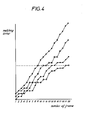
- Figure 4 shows a graph representing the differences of the matching effect between each of the registered characteristic patterns detected by the main selector 7.
- step 1 step is abbreviated as S in the drawing
- step 2A step is abbreviated as S in the drawing
- a matching operation for the preliminary selection is executed. Any matching error detected by the step 2 operation is then compared to all of the matching error stored in the preliminary selector table 6 during the ensuing step 3.
- an operation is executed in order to identify whether the matching error detected by the preliminary selector 5 is within the 3rd rank of the matching error, or not. In other words, it is identified whether the matching error detected by the preliminary selector 5 remains within the 3rd rank from the one having the least matching error in the preliminary selector table 6, or not. If it is within the 3rd rank, the detected error and the address of the registered characteristic pattern corresponding to said matching error are then fed to the preliminary selector table 6 during the next step 5.
- both the matching error stored in the preliminary selector table 6 and the corresponding address are then re-aligned in such an order as beginning from the one having the least error in the matching operation.
- both the matching error having the largest value and the corresponding address stored in the preliminary selector table 6 are eventually eliminated from it. Instead, a matching error fed from the preliminary selector table 6 and the corresponding address are written into said table 6.
- next step 6 operation it is identified whether the matching operation for the n-th registered characteristic pattern stored in the register table 4 is completed, or not. In other words, it is identified whether the matching of all the characteristic patterns stored in the registered table 4 is completed, or not.
- the input characteristic pattern memorized by the pattern memory 3 and n units of the registered characteristic pattern Rl or Rn of the registered table 4 are sequentially matched.
- the preliminary selector table 6 ought to memorize u units of the matching error in such an order as starting from the least error on, and all of such details are detected by the preliminary selector 5 and address corresponding to said u unit of the matching error.
- the main selector 7 operates in accordance with the flow chart shown in Figure 2-B.
- the main selector 7 sets the minimum error register 9 in its maximum value during the step 21.
- a maximum value represents a maximum of the matching error memorized by the minimum error register 9.
- a value one is set in the counter 1 (not illustrated) during the step 22 operation.
- the counter 1 for example, is included in the main selector table 7 and calculates the number of the registered characteristic patterns which have been treaty by the matching operation executed by the main selector 7.
- the first address is read out of the preliminary selector table 6.
- the value 1 is designated by the result calculated by said counter 1.
- the registered characteristic pattern corresponding to the address read out during the preceding step 23 is then read out of the register table 4 and brought to a matching with the input characteristic pattern.
- the matching operation is sequentially and cumulatively executed in order of the frames of the characteristic pattern.
- the more the number of the frames that completed the matching operation the more the matching errors will remain, and then the matching error shown in the last frame becomes the total of the matching error remaining in the characteristic patterns being present.
- the cumulative matching error shown in the existing frame and the other matching error memorized by the minimum error register 9 are compared to each other. Then, during the next step 26, it is identified whether the cumulative matching error shown in the existing frame is less than the other matching error memorized in the minimum error register 9, or not.
- the ensuing step 29 then .identifies whether the matching operations for the entire frames have been completed, or not. If the matching operations for the entire frames are not yet complete, procedures performed by the step 24 onward will be repeatedly executed.
- next step 27 identifies that the matching operations for the entire frames are completed, then during the next step 28, both the minimum error register 9 and the minimum error address register 10 are re-written with the addresses corresponding to the detected matching errors.
- the next step 29 adds i and the ensuing step 30 identifies whether i is greater than m, or not. If i is smaller than m, since the preliminary selector 5 has not yet completed the matching operations for all the preliminarily selected fully registered characteristic patterns, procedures performed by the step 23 onward will be repeatedly executed.
- the minimum error address register 10 still stores the memorized addresses containing the least matching error throughout all the preliminarily selected registered characteristic patterns. As a result, these addresses are output as the eventually recognized result.
- FIG. 5 shows a block diagram of another preferred embodiment of the present invention. With regard to its configuration, this embodiment is identical to the preferred embodiment shown in Figure 1 except the following functions. All the corresponding parts are provided with reference numbers identical to Figure 1, and therefore, descriptions related to these are deldted.
- the preliminary selector 50 shown in Figure 5 selects m units of the registered characteristic patterns from n units of the registered characteristic patterns stored in the register table 4. Nevertheless, the preliminary selector 50 replaces the alignment of the registered characteristic patterns themselves in such an order as starting from the one having the least matching error and feeds these data to the pattern area 60a of the preliminary selector table 60.
- the pattern area 60a in the preliminary selector 60 memorizes the registered characteristic patterns: themselves in place of the addresses of the registered characteristic patterns.
- the main selector 70 sequentially matches the input characteristic patterns fed from the pattern memory 3 and the registered characteristic patterns stored in the pattern area 60a, and then correctly calculates the matching error.
- the result is then fed to the matching error area 60b that corresponds to the preliminary selector table 60.
- the main selector 70 provides the comparative circuit 8 with the matching error that can be cumulatively sought in order of the frames and also provides said comparative circuit 8 with the least matching error by reading it out of the memory of the matching error area 60b.
- the comparative circuit 8 outputs an instruction to the main selector 70 as soon as the matching error cumulatively given in order of the frames has exceeded the least matching error fed from the matching error area 60b.
- the main selector 70 discontinues the matching operation for the existing registered characteristic patterns.
- the main selector 70 then reads out the registered characteristic patterns (or their addresses) corresponding to the least matching error memorized by the matching error area 60b, and then eventually outputs the read-out patterns as the result of the recognition.
- the present invention also includes substitutive means having ⁇ -close similarity to the preferred embodiments, and based on such a close similarity, matching operations may also be executed.
- a matching operation such as that described in our co-pending European Patent Application No. (Agent's Ref: J.16097 Europe), claiming priority from Japanese Patent Applications Nos. 56-210605 and 56-214175, which is being filed simultaneously with the present application, can be used after the preliminary matching operation.
Landscapes
- Engineering & Computer Science (AREA)
- Computational Linguistics (AREA)
- Health & Medical Sciences (AREA)
- Audiology, Speech & Language Pathology (AREA)
- Human Computer Interaction (AREA)
- Physics & Mathematics (AREA)
- Acoustics & Sound (AREA)
- Multimedia (AREA)
- Image Analysis (AREA)
Applications Claiming Priority (2)
| Application Number | Priority Date | Filing Date | Title |
|---|---|---|---|
| JP210605/81 | 1981-12-25 | ||
| JP56210605A JPS58111989A (ja) | 1981-12-25 | 1981-12-25 | 音声認識装置 |
Publications (3)
| Publication Number | Publication Date |
|---|---|
| EP0083509A2 true EP0083509A2 (de) | 1983-07-13 |
| EP0083509A3 EP0083509A3 (en) | 1983-08-24 |
| EP0083509B1 EP0083509B1 (de) | 1987-05-20 |
Family
ID=16592088
Family Applications (1)
| Application Number | Title | Priority Date | Filing Date |
|---|---|---|---|
| EP82307011A Expired EP0083509B1 (de) | 1981-12-25 | 1982-12-23 | Spracherkennung mit Voranpassung |
Country Status (4)
| Country | Link |
|---|---|
| US (1) | US4618983A (de) |
| EP (1) | EP0083509B1 (de) |
| JP (1) | JPS58111989A (de) |
| DE (1) | DE3276397D1 (de) |
Cited By (2)
| Publication number | Priority date | Publication date | Assignee | Title |
|---|---|---|---|---|
| US4720864A (en) * | 1982-05-04 | 1988-01-19 | Sanyo Electric Co., Ltd. | Speech recognition apparatus |
| EP0275327A4 (de) * | 1986-07-30 | 1990-02-21 | Ricoh Kk | Spracherkennung. |
Families Citing this family (14)
| Publication number | Priority date | Publication date | Assignee | Title |
|---|---|---|---|---|
| JPH0792673B2 (ja) * | 1984-10-02 | 1995-10-09 | 株式会社東芝 | 認識用辞書学習方法 |
| US4718094A (en) * | 1984-11-19 | 1988-01-05 | International Business Machines Corp. | Speech recognition system |
| US4759068A (en) * | 1985-05-29 | 1988-07-19 | International Business Machines Corporation | Constructing Markov models of words from multiple utterances |
| US5774851A (en) * | 1985-08-15 | 1998-06-30 | Canon Kabushiki Kaisha | Speech recognition apparatus utilizing utterance length information |
| US4827519A (en) * | 1985-09-19 | 1989-05-02 | Ricoh Company, Ltd. | Voice recognition system using voice power patterns |
| US5140668A (en) * | 1987-11-10 | 1992-08-18 | Nec Corporation | Phoneme recognition utilizing relative positions of reference phoneme patterns and input vectors in a feature space |
| US5228110A (en) * | 1989-09-15 | 1993-07-13 | U.S. Philips Corporation | Method for recognizing N different word strings in a speech signal |
| US5386492A (en) * | 1992-06-29 | 1995-01-31 | Kurzweil Applied Intelligence, Inc. | Speech recognition system utilizing vocabulary model preselection |
| US5682464A (en) * | 1992-06-29 | 1997-10-28 | Kurzweil Applied Intelligence, Inc. | Word model candidate preselection for speech recognition using precomputed matrix of thresholded distance values |
| US5828997A (en) * | 1995-06-07 | 1998-10-27 | Sensimetrics Corporation | Content analyzer mixing inverse-direction-probability-weighted noise to input signal |
| RU2119196C1 (ru) * | 1997-10-27 | 1998-09-20 | Яков Юноевич Изилов | Способ лексической интерпретации слитной речи и система для его реализации |
| WO2001065541A1 (en) * | 2000-02-28 | 2001-09-07 | Sony Corporation | Speech recognition device and speech recognition method, and recording medium |
| US20070263668A1 (en) * | 2006-05-11 | 2007-11-15 | Lau David K W | System, method and computer program for evaluating the audio quality of a received audio record |
| US10235993B1 (en) * | 2016-06-14 | 2019-03-19 | Friday Harbor Llc | Classifying signals using correlations of segments |
Family Cites Families (8)
| Publication number | Priority date | Publication date | Assignee | Title |
|---|---|---|---|---|
| JPS54145408A (en) * | 1978-05-06 | 1979-11-13 | Hiroya Fujisaki | Speech recognition system |
| US4238597A (en) * | 1979-04-26 | 1980-12-09 | General Electric Company | Process for producing copolyester-carbonates |
| US4277644A (en) * | 1979-07-16 | 1981-07-07 | Bell Telephone Laboratories, Incorporated | Syntactic continuous speech recognizer |
| JPS56101199A (en) * | 1980-01-16 | 1981-08-13 | Matsushita Electric Industrial Co Ltd | Voice identifier |
| JPS56119197A (en) * | 1980-02-25 | 1981-09-18 | Nippon Electric Co | Voice identifying device |
| JPS57102698A (en) * | 1980-12-18 | 1982-06-25 | Matsushita Electric Industrial Co Ltd | Pattern matching apparatus |
| US4400788A (en) * | 1981-03-27 | 1983-08-23 | Bell Telephone Laboratories, Incorporated | Continuous speech pattern recognizer |
| JPS5844500A (ja) * | 1981-09-11 | 1983-03-15 | シャープ株式会社 | 音声認識方式 |
-
1981
- 1981-12-25 JP JP56210605A patent/JPS58111989A/ja active Granted
-
1982
- 1982-12-22 US US06/452,298 patent/US4618983A/en not_active Expired - Fee Related
- 1982-12-23 EP EP82307011A patent/EP0083509B1/de not_active Expired
- 1982-12-23 DE DE8282307011T patent/DE3276397D1/de not_active Expired
Cited By (2)
| Publication number | Priority date | Publication date | Assignee | Title |
|---|---|---|---|---|
| US4720864A (en) * | 1982-05-04 | 1988-01-19 | Sanyo Electric Co., Ltd. | Speech recognition apparatus |
| EP0275327A4 (de) * | 1986-07-30 | 1990-02-21 | Ricoh Kk | Spracherkennung. |
Also Published As
| Publication number | Publication date |
|---|---|
| JPS6360919B2 (de) | 1988-11-25 |
| JPS58111989A (ja) | 1983-07-04 |
| DE3276397D1 (en) | 1987-06-25 |
| EP0083509B1 (de) | 1987-05-20 |
| EP0083509A3 (en) | 1983-08-24 |
| US4618983A (en) | 1986-10-21 |
Similar Documents
| Publication | Publication Date | Title |
|---|---|---|
| US4618983A (en) | Speech recognition with preliminary matching | |
| US4813074A (en) | Method of and device for segmenting an electric signal derived from an acoustic signal | |
| US4771385A (en) | Word recognition processing time reduction system using word length and hash technique involving head letters | |
| EP0949562B1 (de) | Verfahren und Anordnung zum Vergleichen von einkommenden Daten mit aufgezeichneten Daten | |
| JP2710062B2 (ja) | 出力候補数決定方式 | |
| US4277644A (en) | Syntactic continuous speech recognizer | |
| EP0049283B1 (de) | Anordnung zur erkennung kontinuierlicher sprachsignale | |
| US4355302A (en) | Spelled word recognizer | |
| EP0498419B1 (de) | Spracherkennungsgerät zur Berechnung einer korrigierten Ähnlichkeit die kaum abhängig ist von Umständen der Erzeugung von Eingangsmustern | |
| CA1173161A (en) | Pattern matching device operable with signals of a compressed dynamic range | |
| GB2095882A (en) | Continuous speech recognizer | |
| EP0701245A2 (de) | Spracherkenner | |
| US4905295A (en) | Code sequence matching method and apparatus | |
| US5970450A (en) | Speech recognition system using modifiable recognition threshold to reduce the size of the pruning tree | |
| EP0467661B1 (de) | Signalverarbeitung und -erkennung | |
| US4975974A (en) | Character recognition apparatus | |
| EP0977437A3 (de) | Methode zur Unterscheidung eines sich bewegenden Objekts und Gerät zur Verfolgung und Überwachung eines sich bewegenden Objekts | |
| US4910783A (en) | Method and apparatus for comparing patterns | |
| US4860358A (en) | Speech recognition arrangement with preselection | |
| EP0488208B1 (de) | Hochgeschwindigkeitserkennung einer Wortreihe verbunden mit einer Grammatik durch dynamische Programmiervergleiche | |
| US4418423A (en) | Disparity detection apparatus | |
| CN1183158A (zh) | 识别至少叠加了一个干扰信号的时变测试信号中的至少一个隐式马尔科夫模型建模的有定义信号的方法 | |
| US4790017A (en) | Speech processing feature generation arrangement | |
| EP0622752A2 (de) | Gerät und Verfahren für einen lexikalischen Nachprozessor für einen auf neuronalen Netzwerken basierenden Zeichenprozessor | |
| US6895117B1 (en) | Recognition system method |
Legal Events
| Date | Code | Title | Description |
|---|---|---|---|
| PUAI | Public reference made under article 153(3) epc to a published international application that has entered the european phase |
Free format text: ORIGINAL CODE: 0009012 |
|
| PUAL | Search report despatched |
Free format text: ORIGINAL CODE: 0009013 |
|
| AK | Designated contracting states |
Designated state(s): DE FR GB IT |
|
| AK | Designated contracting states |
Designated state(s): DE FR GB IT |
|
| 17P | Request for examination filed |
Effective date: 19840220 |
|
| ITF | It: translation for a ep patent filed | ||
| GRAA | (expected) grant |
Free format text: ORIGINAL CODE: 0009210 |
|
| AK | Designated contracting states |
Kind code of ref document: B1 Designated state(s): DE FR GB IT |
|
| REF | Corresponds to: |
Ref document number: 3276397 Country of ref document: DE Date of ref document: 19870625 |
|
| ET | Fr: translation filed | ||
| PLBE | No opposition filed within time limit |
Free format text: ORIGINAL CODE: 0009261 |
|
| STAA | Information on the status of an ep patent application or granted ep patent |
Free format text: STATUS: NO OPPOSITION FILED WITHIN TIME LIMIT |
|
| 26N | No opposition filed | ||
| ITTA | It: last paid annual fee | ||
| PGFP | Annual fee paid to national office [announced via postgrant information from national office to epo] |
Ref country code: FR Payment date: 19961211 Year of fee payment: 15 |
|
| PGFP | Annual fee paid to national office [announced via postgrant information from national office to epo] |
Ref country code: GB Payment date: 19961216 Year of fee payment: 15 |
|
| PGFP | Annual fee paid to national office [announced via postgrant information from national office to epo] |
Ref country code: DE Payment date: 19961231 Year of fee payment: 15 |
|
| PG25 | Lapsed in a contracting state [announced via postgrant information from national office to epo] |
Ref country code: GB Free format text: LAPSE BECAUSE OF NON-PAYMENT OF DUE FEES Effective date: 19971223 |
|
| PG25 | Lapsed in a contracting state [announced via postgrant information from national office to epo] |
Ref country code: FR Free format text: THE PATENT HAS BEEN ANNULLED BY A DECISION OF A NATIONAL AUTHORITY Effective date: 19971231 |
|
| GBPC | Gb: european patent ceased through non-payment of renewal fee |
Effective date: 19971223 |
|
| PG25 | Lapsed in a contracting state [announced via postgrant information from national office to epo] |
Ref country code: DE Free format text: LAPSE BECAUSE OF NON-PAYMENT OF DUE FEES Effective date: 19980901 |
|
| REG | Reference to a national code |
Ref country code: FR Ref legal event code: ST |