EP0083554B1 - Elektrokatalytische Elektrode - Google Patents
Elektrokatalytische Elektrode Download PDFInfo
- Publication number
- EP0083554B1 EP0083554B1 EP82810560A EP82810560A EP0083554B1 EP 0083554 B1 EP0083554 B1 EP 0083554B1 EP 82810560 A EP82810560 A EP 82810560A EP 82810560 A EP82810560 A EP 82810560A EP 0083554 B1 EP0083554 B1 EP 0083554B1
- Authority
- EP
- European Patent Office
- Prior art keywords
- oxide
- electrode
- mol
- electrocatalyst
- ruthenium
- Prior art date
- Legal status (The legal status is an assumption and is not a legal conclusion. Google has not performed a legal analysis and makes no representation as to the accuracy of the status listed.)
- Expired
Links
Classifications
-
- C—CHEMISTRY; METALLURGY
- C25—ELECTROLYTIC OR ELECTROPHORETIC PROCESSES; APPARATUS THEREFOR
- C25B—ELECTROLYTIC OR ELECTROPHORETIC PROCESSES FOR THE PRODUCTION OF COMPOUNDS OR NON-METALS; APPARATUS THEREFOR
- C25B11/00—Electrodes; Manufacture thereof not otherwise provided for
- C25B11/04—Electrodes; Manufacture thereof not otherwise provided for characterised by the material
- C25B11/051—Electrodes formed of electrocatalysts on a substrate or carrier
- C25B11/073—Electrodes formed of electrocatalysts on a substrate or carrier characterised by the electrocatalyst material
- C25B11/091—Electrodes formed of electrocatalysts on a substrate or carrier characterised by the electrocatalyst material consisting of at least one catalytic element and at least one catalytic compound; consisting of two or more catalytic elements or catalytic compounds
- C25B11/093—Electrodes formed of electrocatalysts on a substrate or carrier characterised by the electrocatalyst material consisting of at least one catalytic element and at least one catalytic compound; consisting of two or more catalytic elements or catalytic compounds at least one noble metal or noble metal oxide and at least one non-noble metal oxide
Definitions
- the invention relates to electrodes of the type comprising an electrocatalyst based on the oxides of ruthenium, palladium and titanium.
- Japanese Patent Application Open No. 51-56783 proposed a coating of 55-95 mol% PdO and 5-45 mol% RuO z , but these coatings have a very poor lifetime, and an attempt to remedy this was to provide an underlayer e.g. of RuO2. Ti0 2 (Japanese Patent Application Open No. 51-78787).
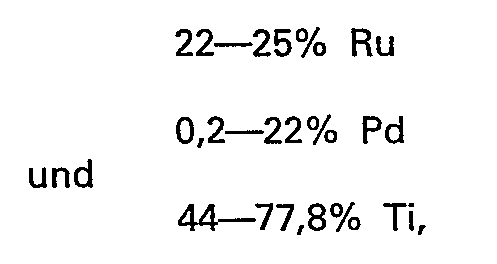
- the invention provides an improved electrode making optimum use of the electrocatalytic properties of palladium oxide, this electrode having an electrocatalyst composed of 22-55 mol% of ruthenium oxide, 0.2-22 mol% palladium oxide and 44-77.8 mol% titanium oxide.
- a mixed oxide electrocatalyst of this composition is found to consist of a solid-solution or mixed crystal of ruthenium-titanium oxide in which the palladium oxide is finely divided in a stabilized form.
- Such electrocatalytic coatings in particular on a valve- metal substrate such as titanium, have practically the same characteristic mud-cracked appearance and morphology as the ruthenium-titanium oxide solid solution coating without palladium oxide, and maintain the same excellent wear characteristics of the conventional ruthenium-titanium oxide coating enhanced by the addition of the stabilized palladium oxide which in particular provides a high oxygen overpotential and hence enhances the efficiency of the electrode for chlorine or hypochlorite production.
- the improved electrocatalyst is particularly advantageous as an electrode coating for chlorine and hypochlorite production, particularly in instances where it is important to suppress unwanted oxygen evolution as in the electrolysis of dilute brines and in membrane cells.
- the electrocatalyst may, as mentioned above, form a coating on a conductive electrode substrate but it may also advantageously be preformed into a powder and incorporated in or carried by an ion-selective membrane or other separator against which a current feeder is pressed, in so-called SPE (Solid Polymer Electrolyte) or Narrow Gap Cell technology.
- a particularly preferred composition of the electrocatalyst is 22-28 mol% ruthenium oxide 1-12 mol% palladium oxide and 60-77 mol% titanium oxide, in which range an optimum effect in terms of stability and oxygen-inhibition appears to be achieved.
- an electrocatalytically-inert porous layer of a ceramic oxide, in particular a valve metal oxide such as titanium or tantalum oxide is superimposed on top of the electrocatalytic coating.
- a ceramic oxide in particular a valve metal oxide such as titanium or tantalum oxide.
- Such protective layers act as a diaphragm and apparently synergistically combine with the palladium-oxide containing electrocatalytic coating to enhance its selectivity (oxygen inhibition) whilst appreciably increasing the lifetime. Best results have been obtained with a protective topcoating of titanium dioxide.
- a paint solution was prepared from:
- This paint solution was applied by brushing to a pre-etched titanium coupon. Ten coats were applied, each coat being dried for 5 minutes at 120°C and baked at 500°C for 10 minutes.
- the electrocatalytic coating produced contained approximately 25 mol% of ruthenium oxide, 9 mol% of palladium oxide and 66 mol% of titanium oxide.
- the coating had the same characteristic "mud-cracked" appearance as a comparable prior-art coating without the palladium oxide.
- Analysis of the coating by X-ray diffraction revealed that it consisted of a solid-solution or mixed-crystal of ruthenium-titanium oxide in which the palladium oxide was finely dispersed as a separate phase.
- the electrode was subjected to an accelerated lifetime test in 150 gpl H 2 S0 4 at 50°C with an anode current density of 7.5 kA/m 2 . Its lifetime was 140 hours compared to 23 hours for a comparable prior-art electrode (ruthenium-titanium oxide coating without palladium oxide, having the same precious metal loading).
- An electrode was prepared in a similar manner to the electrode of Example 1 but using a paint to give a final approximate composition of 28.5 mol% ruthenium oxide, 3 mol% palladium oxide and 68.5 mol% titanium oxide.
- the baking temperature was 525°C.
- the electrode was then topcoated with a layer of tantalum pentoxide by applying a solution of tantalum pentachloride in amyl alcohol and heating to 525°C for ten minutes.
- the electrode was subjected to an accelerated test in a swimming pool type hypochlorite generator in a dilute brine.
- the electrode operated at a chlorine current efficiency of 80-85% for 24 days compared to a 65% efficiency for 15 days using the best commercially-available prior art electrode.
- a topcoated electrode similar to that of Example 2 but containing approximately 0.3 mol% palladium oxide, 29.7 mol% ruthenium oxide and 70 mol% titanium oxide was compared to an electrode with a similar 30:70 mol% ruthenium-titanium oxide coating with the same topcoating.
- the inclusion of 0.3 mol% palladium oxide was found to double the electrode lifetime in the sulphuric acid lifetime test of Example 1.
- Example 1 of Japanese Patent Application Open No. 51-116182 was repeated to provide a titanium electrode with a coating nominally made up of 16 mol% palladium oxide, 4 mol% ruthenium oxide and 80 mol% titanium oxide.
- Four applications of the paint solution were made to give a precious metal loading of approx. 1.4 g/m 2 Pd and 0.35 g/m 2 Ru.
- the measured overpotentials for chlorine and oxygen evolution were promising (0.02 and 0.9V, respectively), but when an attempt was made to measure the lifetime of the electrode in 150 g/I H 2 SO 4 at 50°C with an anode current density of 7.5 kA/m 2 , as in Example 1, the electrode failed almost immediately.
- the first comparative example electrode coating was also examined by X-ray diffraction which revealed the presence of palladium oxide, ruthenium oxide and titanium oxide as three separate phases. No evidence of a ruthenium-titanium oxide solid solution was found. With the second comparative example electrode, the major components were the single oxides with a trace of a ruthenium-titanium oxide solid solution. In both cases, most of the titanium oxide was present in the undesirable anatase form.
Landscapes
- Chemical & Material Sciences (AREA)
- Organic Chemistry (AREA)
- Chemical Kinetics & Catalysis (AREA)
- Electrochemistry (AREA)
- Materials Engineering (AREA)
- Metallurgy (AREA)
- Engineering & Computer Science (AREA)
- Electrodes For Compound Or Non-Metal Manufacture (AREA)
- Inert Electrodes (AREA)
- Electrolytic Production Of Non-Metals, Compounds, Apparatuses Therefor (AREA)
- Catalysts (AREA)
- Organic Low-Molecular-Weight Compounds And Preparation Thereof (AREA)
- Illuminated Signs And Luminous Advertising (AREA)
- Electroluminescent Light Sources (AREA)
Claims (6)
Priority Applications (1)
| Application Number | Priority Date | Filing Date | Title |
|---|---|---|---|
| AT82810560T ATE16294T1 (de) | 1981-12-28 | 1982-12-21 | Elektrokatalytische elektrode. |
Applications Claiming Priority (2)
| Application Number | Priority Date | Filing Date | Title |
|---|---|---|---|
| PCT/US1981/001763 WO1983002288A1 (en) | 1981-12-28 | 1981-12-28 | Electrocatalytic electrode |
| WOPCT/US81/01763 | 1981-12-28 |
Publications (2)
| Publication Number | Publication Date |
|---|---|
| EP0083554A1 EP0083554A1 (de) | 1983-07-13 |
| EP0083554B1 true EP0083554B1 (de) | 1985-10-30 |
Family
ID=22161587
Family Applications (2)
| Application Number | Title | Priority Date | Filing Date |
|---|---|---|---|
| EP82900527A Withdrawn EP0097154A1 (de) | 1981-12-28 | 1981-12-28 | Elektrokatalytische elektrode |
| EP82810560A Expired EP0083554B1 (de) | 1981-12-28 | 1982-12-21 | Elektrokatalytische Elektrode |
Family Applications Before (1)
| Application Number | Title | Priority Date | Filing Date |
|---|---|---|---|
| EP82900527A Withdrawn EP0097154A1 (de) | 1981-12-28 | 1981-12-28 | Elektrokatalytische elektrode |
Country Status (9)
| Country | Link |
|---|---|
| US (1) | US4517068A (de) |
| EP (2) | EP0097154A1 (de) |
| JP (1) | JPS58502222A (de) |
| AT (1) | ATE16294T1 (de) |
| CA (1) | CA1213563A (de) |
| DE (1) | DE3267196D1 (de) |
| FI (1) | FI72149C (de) |
| NO (1) | NO160305C (de) |
| WO (1) | WO1983002288A1 (de) |
Families Citing this family (22)
| Publication number | Priority date | Publication date | Assignee | Title |
|---|---|---|---|---|
| US4584085A (en) * | 1983-05-31 | 1986-04-22 | The Dow Chemical Company | Preparation and use of electrodes |
| EP0174413A1 (de) * | 1984-09-17 | 1986-03-19 | Eltech Systems Corporation | Katalytisches Kompositmaterial besonders für Elektrolyse-Elektroden und Verfahren zu ihrer Herstellung |
| US5028568A (en) * | 1989-07-05 | 1991-07-02 | Wisconsin Alumni Research Foundation | Niobium-doped titanium membranes |
| US5215943A (en) * | 1989-07-05 | 1993-06-01 | Wisconsin Alumi Research Foundation | Ceramic membranes with enhanced thermal stability |
| JP3212327B2 (ja) * | 1991-08-30 | 2001-09-25 | ペルメレック電極株式会社 | 電解用電極 |
| US5503663A (en) * | 1994-11-30 | 1996-04-02 | The Dow Chemical Company | Sable coating solutions for coating valve metal anodes |
| US7247229B2 (en) * | 1999-06-28 | 2007-07-24 | Eltech Systems Corporation | Coatings for the inhibition of undesirable oxidation in an electrochemical cell |
| US6527939B1 (en) | 1999-06-28 | 2003-03-04 | Eltech Systems Corporation | Method of producing copper foil with an anode having multiple coating layers |
| ITMI20010402A1 (it) * | 2001-02-28 | 2002-08-28 | De Nora Elettrodi Spa | Nuova composizione elettrocatalitica per catodo depolarizzato ad ossigeno |
| AU2011221387B2 (en) * | 2004-09-01 | 2012-04-19 | Eltech Systems Corporation | Pd-containing coating for low chlorine overvoltage |
| CA2578894A1 (en) * | 2004-09-01 | 2006-03-16 | Eltech Systems Corporation | Pd-containing coating for low chlorine overvoltage |
| RU2425176C2 (ru) * | 2004-09-01 | 2011-07-27 | Элтек Систимс Копэрейшн | Способ получения электрода, электрод (варианты) и электролитическая ячейка (варианты) |
| US20070261968A1 (en) * | 2005-01-27 | 2007-11-15 | Carlson Richard C | High efficiency hypochlorite anode coating |
| ES2337271T3 (es) * | 2005-01-27 | 2010-04-22 | Industrie De Nora S.P.A. | Recubrimiento anodico de hipoclorito de alta eficiencia. |
| US8124556B2 (en) * | 2008-05-24 | 2012-02-28 | Freeport-Mcmoran Corporation | Electrochemically active composition, methods of making, and uses thereof |
| JP5582762B2 (ja) * | 2009-11-09 | 2014-09-03 | デノラ・テック・インコーポレーテッド | ハロゲン含有溶液の電気分解において用いるための電極 |
| DE102010030293A1 (de) * | 2010-06-21 | 2011-12-22 | Bayer Materialscience Ag | Elektrode für die elektrolytische Chlorgewinnung |
| TWI433964B (zh) | 2010-10-08 | 2014-04-11 | Water Star Inc | 複數層之混合金屬氧化物電極及其製法 |
| DE102010043085A1 (de) | 2010-10-28 | 2012-05-03 | Bayer Materialscience Aktiengesellschaft | Elektrode für die elektrolytische Chlorherstellung |
| KR101317669B1 (ko) * | 2011-12-08 | 2013-10-15 | (주) 테크로스 | 선박 밸러스트 수 전해살균용 불용성 전극 및 그 제조방법 |
| ITMI20130505A1 (it) * | 2013-04-04 | 2014-10-05 | Industrie De Nora Spa | Cella per estrazione elettrolitica di metalli |
| US11668017B2 (en) | 2018-07-30 | 2023-06-06 | Water Star, Inc. | Current reversal tolerant multilayer material, method of making the same, use as an electrode, and use in electrochemical processes |
Family Cites Families (9)
| Publication number | Priority date | Publication date | Assignee | Title |
|---|---|---|---|---|
| GB1195871A (en) * | 1967-02-10 | 1970-06-24 | Chemnor Ag | Improvements in or relating to the Manufacture of Electrodes. |
| US3778307A (en) * | 1967-02-10 | 1973-12-11 | Chemnor Corp | Electrode and coating therefor |
| GB1246447A (en) * | 1967-09-26 | 1971-09-15 | Imp Metal Ind Kynoch Ltd | Improvements in or relating to the manufacture of oxide-coated electrodes for use in electrolytic processes |
| US3616445A (en) * | 1967-12-14 | 1971-10-26 | Electronor Corp | Titanium or tantalum base electrodes with applied titanium or tantalum oxide face activated with noble metals or noble metal oxides |
| US3562008A (en) * | 1968-10-14 | 1971-02-09 | Ppg Industries Inc | Method for producing a ruthenium coated titanium electrode |
| JPS51144381A (en) * | 1975-06-09 | 1976-12-11 | Tdk Corp | An electrode |
| JPS5328278A (en) * | 1976-08-30 | 1978-03-16 | Matsushita Electric Works Ltd | Small switch |
| US4157943A (en) * | 1978-07-14 | 1979-06-12 | The International Nickel Company, Inc. | Composite electrode for electrolytic processes |
| US4306950A (en) * | 1979-10-15 | 1981-12-22 | Westinghouse Electric Corp. | Process for forming sulfuric acid |
-
1981
- 1981-12-28 EP EP82900527A patent/EP0097154A1/de not_active Withdrawn
- 1981-12-28 JP JP82500599A patent/JPS58502222A/ja active Pending
- 1981-12-28 WO PCT/US1981/001763 patent/WO1983002288A1/en not_active Ceased
- 1981-12-28 US US06/527,552 patent/US4517068A/en not_active Expired - Fee Related
-
1982
- 1982-10-27 CA CA000414299A patent/CA1213563A/en not_active Expired
- 1982-12-21 AT AT82810560T patent/ATE16294T1/de active
- 1982-12-21 EP EP82810560A patent/EP0083554B1/de not_active Expired
- 1982-12-21 DE DE8282810560T patent/DE3267196D1/de not_active Expired
-
1983
- 1983-08-15 NO NO83832930A patent/NO160305C/no unknown
- 1983-08-26 FI FI833054A patent/FI72149C/fi not_active IP Right Cessation
Also Published As
| Publication number | Publication date |
|---|---|
| NO160305B (no) | 1988-12-27 |
| EP0083554A1 (de) | 1983-07-13 |
| CA1213563A (en) | 1986-11-04 |
| FI72149C (fi) | 1987-04-13 |
| FI833054A0 (fi) | 1983-08-26 |
| EP0097154A1 (de) | 1984-01-04 |
| ATE16294T1 (de) | 1985-11-15 |
| FI833054L (fi) | 1983-08-26 |
| FI72149B (fi) | 1986-12-31 |
| DE3267196D1 (en) | 1985-12-05 |
| NO832930L (no) | 1983-08-15 |
| JPS58502222A (ja) | 1983-12-22 |
| US4517068A (en) | 1985-05-14 |
| WO1983002288A1 (en) | 1983-07-07 |
| NO160305C (no) | 1989-04-05 |
Similar Documents
| Publication | Publication Date | Title |
|---|---|---|
| EP0083554B1 (de) | Elektrokatalytische Elektrode | |
| US4288302A (en) | Method for electrowinning metal | |
| US3773555A (en) | Method of making an electrode | |
| US4331528A (en) | Coated metal electrode with improved barrier layer | |
| EP0208451A1 (de) | Elektrolyse von Halogenide enthaltenden Lösungen mit amorphen Metall-Legierungen | |
| EP0004387B1 (de) | Elektroden für elektrolytische Verfahren | |
| EP0027051A1 (de) | Beschichtete Metallelektrode mit Sperrschicht und Verfahren zu deren Herstellung und Verwendung | |
| US4572770A (en) | Preparation and use of electrodes in the electrolysis of alkali halides | |
| US4670122A (en) | Low over-voltage electrodes for alkaline electrolytes | |
| AU2020376483B2 (en) | Electrode for electrochemical evolution of hydrogen | |
| US4564434A (en) | Electrode for electrolysis of solutions of electrolytes | |
| CA1088026A (en) | Stable electrode for electrochemical applications | |
| US4107025A (en) | Stable electrode for electrochemical applications | |
| EP0032819B1 (de) | Verfahren zur Vorbeugung der Beschädigung einer Paladiumoxyd-Anode in einer Alkalimetallchlorid-Elektrolytzelle von Diaphragma-Typ | |
| US4267025A (en) | Electrodes for electrolytic processes, especially perchlorate production | |
| EP4146844B1 (de) | Elektrode zur elektrochemischen wasserstoffentwicklung | |
| EP0004880B1 (de) | Elektroden für elektrolytische Verfahren, insbesondere zur Herstellung von Perchloraten | |
| EP0209264A1 (de) | Amorphe Metall-Legierungen auf der Basis von Rhodium und Verwendung derselben als Halogen-Elektroden | |
| JPH0238672B2 (de) | ||
| JPS62240780A (ja) | 塩化アルカリ電解用陽極 |
Legal Events
| Date | Code | Title | Description |
|---|---|---|---|
| PUAI | Public reference made under article 153(3) epc to a published international application that has entered the european phase |
Free format text: ORIGINAL CODE: 0009012 |
|
| AK | Designated contracting states |
Designated state(s): AT BE CH DE FR GB IT LI LU NL SE |
|
| 17P | Request for examination filed |
Effective date: 19831224 |
|
| RAP1 | Party data changed (applicant data changed or rights of an application transferred) |
Owner name: ELTECH SYSTEMS CORPORATION |
|
| ITF | It: translation for a ep patent filed | ||
| GRAA | (expected) grant |
Free format text: ORIGINAL CODE: 0009210 |
|
| AK | Designated contracting states |
Designated state(s): AT BE CH DE FR GB IT LI LU NL SE |
|
| PG25 | Lapsed in a contracting state [announced via postgrant information from national office to epo] |
Ref country code: AT Effective date: 19851030 |
|
| REF | Corresponds to: |
Ref document number: 16294 Country of ref document: AT Date of ref document: 19851115 Kind code of ref document: T |
|
| REF | Corresponds to: |
Ref document number: 3267196 Country of ref document: DE Date of ref document: 19851205 |
|
| ET | Fr: translation filed | ||
| PLBE | No opposition filed within time limit |
Free format text: ORIGINAL CODE: 0009261 |
|
| STAA | Information on the status of an ep patent application or granted ep patent |
Free format text: STATUS: NO OPPOSITION FILED WITHIN TIME LIMIT |
|
| 26N | No opposition filed | ||
| PGFP | Annual fee paid to national office [announced via postgrant information from national office to epo] |
Ref country code: NL Payment date: 19871231 Year of fee payment: 6 |
|
| PG25 | Lapsed in a contracting state [announced via postgrant information from national office to epo] |
Ref country code: GB Effective date: 19881221 |
|
| PG25 | Lapsed in a contracting state [announced via postgrant information from national office to epo] |
Ref country code: LI Effective date: 19881231 Ref country code: CH Effective date: 19881231 Ref country code: BE Effective date: 19881231 |
|
| BERE | Be: lapsed |
Owner name: ELTECH SYSTEMS CORP. Effective date: 19881231 |
|
| PG25 | Lapsed in a contracting state [announced via postgrant information from national office to epo] |
Ref country code: NL Effective date: 19890701 |
|
| NLV4 | Nl: lapsed or anulled due to non-payment of the annual fee | ||
| GBPC | Gb: european patent ceased through non-payment of renewal fee | ||
| PG25 | Lapsed in a contracting state [announced via postgrant information from national office to epo] |
Ref country code: FR Free format text: LAPSE BECAUSE OF NON-PAYMENT OF DUE FEES Effective date: 19890831 |
|
| REG | Reference to a national code |
Ref country code: CH Ref legal event code: PL |
|
| REG | Reference to a national code |
Ref country code: FR Ref legal event code: ST |
|
| PGFP | Annual fee paid to national office [announced via postgrant information from national office to epo] |
Ref country code: DE Payment date: 19891214 Year of fee payment: 8 |
|
| PG25 | Lapsed in a contracting state [announced via postgrant information from national office to epo] |
Ref country code: DE Effective date: 19910903 |
|
| EAL | Se: european patent in force in sweden |
Ref document number: 82810560.1 |
|
| PGFP | Annual fee paid to national office [announced via postgrant information from national office to epo] |
Ref country code: LU Payment date: 19961231 Year of fee payment: 15 |
|
| PG25 | Lapsed in a contracting state [announced via postgrant information from national office to epo] |
Ref country code: LU Free format text: LAPSE BECAUSE OF NON-PAYMENT OF DUE FEES Effective date: 19971231 |
|
| PGFP | Annual fee paid to national office [announced via postgrant information from national office to epo] |
Ref country code: SE Payment date: 19981207 Year of fee payment: 17 |
|
| PG25 | Lapsed in a contracting state [announced via postgrant information from national office to epo] |
Ref country code: SE Free format text: LAPSE BECAUSE OF NON-PAYMENT OF DUE FEES Effective date: 19991222 |
|
| EUG | Se: european patent has lapsed |
Ref document number: 82810560.1 |