EP0084129B1 - Procédé de traitement de déchets de combustible nucléaire - Google Patents
Procédé de traitement de déchets de combustible nucléaire Download PDFInfo
- Publication number
- EP0084129B1 EP0084129B1 EP82111635A EP82111635A EP0084129B1 EP 0084129 B1 EP0084129 B1 EP 0084129B1 EP 82111635 A EP82111635 A EP 82111635A EP 82111635 A EP82111635 A EP 82111635A EP 0084129 B1 EP0084129 B1 EP 0084129B1
- Authority
- EP
- European Patent Office
- Prior art keywords
- scrap
- oxygen
- gas
- reactor
- temperature
- Prior art date
- Legal status (The legal status is an assumption and is not a legal conclusion. Google has not performed a legal analysis and makes no representation as to the accuracy of the status listed.)
- Expired
Links
Images
Classifications
-
- B—PERFORMING OPERATIONS; TRANSPORTING
- B01—PHYSICAL OR CHEMICAL PROCESSES OR APPARATUS IN GENERAL
- B01J—CHEMICAL OR PHYSICAL PROCESSES, e.g. CATALYSIS OR COLLOID CHEMISTRY; THEIR RELEVANT APPARATUS
- B01J8/00—Chemical or physical processes in general, conducted in the presence of fluids and solid particles; Apparatus for such processes
- B01J8/18—Chemical or physical processes in general, conducted in the presence of fluids and solid particles; Apparatus for such processes with fluidised particles
- B01J8/24—Chemical or physical processes in general, conducted in the presence of fluids and solid particles; Apparatus for such processes with fluidised particles according to "fluidised-bed" technique
- B01J8/40—Chemical or physical processes in general, conducted in the presence of fluids and solid particles; Apparatus for such processes with fluidised particles according to "fluidised-bed" technique with fluidised bed subjected to vibrations or pulsations
-
- G—PHYSICS
- G21—NUCLEAR PHYSICS; NUCLEAR ENGINEERING
- G21C—NUCLEAR REACTORS
- G21C19/00—Arrangements for treating, for handling, or for facilitating the handling of, fuel or other materials which are used within the reactor, e.g. within its pressure vessel
- G21C19/42—Reprocessing of irradiated fuel
-
- C—CHEMISTRY; METALLURGY
- C01—INORGANIC CHEMISTRY
- C01G—COMPOUNDS CONTAINING METALS NOT COVERED BY SUBCLASSES C01D OR C01F
- C01G43/00—Compounds of uranium
- C01G43/01—Oxides; Hydroxides
- C01G43/025—Uranium dioxide
-
- G—PHYSICS
- G21—NUCLEAR PHYSICS; NUCLEAR ENGINEERING
- G21C—NUCLEAR REACTORS
- G21C3/00—Reactor fuel elements and their assemblies; Selection of substances for use as reactor fuel elements
- G21C3/42—Selection of substances for use as reactor fuel
- G21C3/58—Solid reactor fuel Pellets made of fissile material
- G21C3/62—Ceramic fuel
- G21C3/623—Oxide fuels
-
- C—CHEMISTRY; METALLURGY
- C01—INORGANIC CHEMISTRY
- C01P—INDEXING SCHEME RELATING TO STRUCTURAL AND PHYSICAL ASPECTS OF SOLID INORGANIC COMPOUNDS
- C01P2006/00—Physical properties of inorganic compounds
- C01P2006/80—Compositional purity
-
- G—PHYSICS
- G01—MEASURING; TESTING
- G01N—INVESTIGATING OR ANALYSING MATERIALS BY DETERMINING THEIR CHEMICAL OR PHYSICAL PROPERTIES
- G01N1/00—Sampling; Preparing specimens for investigation
- G01N1/02—Devices for withdrawing samples
- G01N1/22—Devices for withdrawing samples in the gaseous state
-
- Y—GENERAL TAGGING OF NEW TECHNOLOGICAL DEVELOPMENTS; GENERAL TAGGING OF CROSS-SECTIONAL TECHNOLOGIES SPANNING OVER SEVERAL SECTIONS OF THE IPC; TECHNICAL SUBJECTS COVERED BY FORMER USPC CROSS-REFERENCE ART COLLECTIONS [XRACs] AND DIGESTS
- Y02—TECHNOLOGIES OR APPLICATIONS FOR MITIGATION OR ADAPTATION AGAINST CLIMATE CHANGE
- Y02E—REDUCTION OF GREENHOUSE GAS [GHG] EMISSIONS, RELATED TO ENERGY GENERATION, TRANSMISSION OR DISTRIBUTION
- Y02E30/00—Energy generation of nuclear origin
- Y02E30/30—Nuclear fission reactors
Definitions
- Scrap from nuclear fuel fabrication is normally uncontrollably oxidized to U 3 0 8 by burning or roasting at about 500°C in a boat placed in a furnace with an air atmosphere. Due to the highly exothermic nature of the oxidation reaction, the scrap in the boat may actually reach a temperature of 800 to 900°C or even greater.
- the U 3 0 8 so produced is usually "dead burnt" which means that because of its low surface area it cannot be sintered. As a result, the amount which can be directly recycled into fresh U0 2 powder is very low since the use of larger amounts would prevent the fuel pellet from reaching the high density required for fuel specifications.
- U.S. Patent 3 578 419 shows a method of reprocessing U0 2 using an oxidation-reduction cycle in a fluidized bed reactor maintained at 426°C to 705°C, using at least twice the oxygen stoichiometrically needed to oxidize U0 2 to U 3 0 8 .
- U.S. Patent 3 294 493 shows a method for reprocessing U0 2 in a fluidized bed reactor at 400 to 450°C, using a concentration of oxygen and nitrogen of about 20 to about 50%.
- U.S. Patent 3140151 shows a method for reprocessing U0 2 using a number of oxidation-reduction cycles. In the oxidation step the bed is maintained at 375°C and air is used as the oxidizing medium at a reduced pressure.
- U.S. Patent 3 343 926 describes a method of reducing the particle size of U0 2 which may occur directly in the fluidized bed during uranium dioxide production. The oxidation is accomplished with about 20% to 30% of the amount of oxidizing agent necessary for a complete oxidation U0 2 to U 3 0 8 .
- French Patent 1 315 822 describes a method of reducing the particle size of U0 2 powder in which the oxidation step is accomplished in an air atmosphere with a temperature in the region of 400°C.
- the present invention resides in a method of treating nuclear U0 2 fuel scrap wherein said scrap is introduced in a fluidizing reactor where it is uniformly fluidized with a gas, and wherein said scrap is first oxidized in an oxidizing gas and is then reduced to form a material of greater surface activity which improves sinterability, characterized in that said scrap is oxidized with oxygen at a given temperature of less than 400°C wherein the amount of oxygen in said oxidizing gas said into the reactor is controlled by the temperature of the reactor so as to decrease the amount of oxygen as the temperature limit and to increase the amount of oxygen as the temperature approaches a lower limit so as to obtain said given temperature.
- the process according to the invention is a dry process involving no liquids.
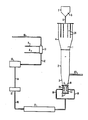
- a fluidized bed reactor 1 consists of a cylindrical column 2 having a conical lower portion 3 and an enlarged upper portion 4.
- Nuclear fuel scrap 5 is admitted to the reactor 1 through line 6 from scrap charging can 7.
- Air, hydrogen and an inert carrier gas from lines 8, 9, and 10, respectively, can be mixed in mixer 11 to give mixtures of air and carrier gas or hydrogen and carrier gas.
- the carrier gas is preferably nitrogen, as it is inexpensive, but helium, argon, or another inert gas could also be used.
- the mixture passes through line 12 to surge tank 13 which pulses the gas.
- the pulsed gas passes through line 14 to pulsed valve 15, then through line 16to pre-heater 17.
- Line 18 is divided and attaches to gas inlet assembly 19 at both sides.
- the gas inlet assembly 19 the gas initially passes through porous plate 20 partiallyfluidizing scrap 5.
- the partial fluidization relieves the weight on the powder 21 at the bottom of the column permitting the gas to push it up the column with the remaining scrap through passage 22.
- a conduit 23 in the side of the reactor can be used for pneumatically removing product. Off gases produced by the reaction pass through filters 24 and out the top of the reactor.
- the nuclear fuel fabrication scrap used in this invention includes rejected pellets, chips from pellets, grinder dust, green (unsintered) scrap, and rejected virgin powder.
- the scrap can come from light water reactors, which consists almost entirely of U0 2 , or it can come from fast breeder fuel and consist of a mixture of U0 2 and Pu0 2 containing up to about 15% Pu0 2 . Physically the scrap is in the form of small grains up to about 9.5 mm (3/8") in diameter.
- the process of this invention consists of passing the scrap through one or more oxidation-reduction cycles. Oxidation of U0 2 to U 3 0 1 increases surface area because U 3 0 8 is a less dense material and its formation fractures the crystal structure and reduces particle size.
- the reactor can either be filled with scrap or the scrap can be simultaneously gradually added and gradually withdrawn, a process known as trickle feed. It is preferable to fill the reactor with the scrap unless the scrap is green in which case a trickle feed is preferred because green scrap is very active and the presence of a large quantity might result in overheating.
- a mixture of oxygen and nitrogen heated to about 300 to about 400°C is admitted to the reactor which is also heated to within the same temperature range.
- the mole percent of oxygen in the gas mixture should be at least about 5 as less oxygen requires too long a time, but should not exceed about 15 as too much oxygen will result in a thermal excursion- -a hot spot and dead burnt scrap. If hard (sintered) scrap is being treated air can be used as the gas mixture.
- Cascading can be performed automatically by techniques well known in the art.
- the oxidation step is complete when an analysis of the off gases indicates that no more oxygen is being removed by reaction with the UO 2 .
- the gas mixture is switched to a mixture of hydrogen and nitrogen. If the fuel fabrication scrap being treated is a mixture of U0 2 and Pu0 2 , the gas mixture should be about 4 to about 6% hydrogen, but if the scrap is all U0 2 , the gas mixture may be about 15 to about 20% hydrogen.
- the gas mixture and the furnace are heated to about 400 to about 700°C. While the oxidation step is exothermic and the reaction itself provides much of the heat once it has begun, the reduction step is endothermic and heat must be supplied to the reaction.
- the fluidizing gases are preferably pulsed.
- the preferred pulse parameters are a frequency of about 0.2 to about 2 Hz., a pressure of about 0.5 to about 3 bar (gauge), an on cycle of about 0.1 to about 1 second, and an off cycle of about 0.4 to about 4 seconds.
- the activity of the scrap can be increased by repeating the oxidation-reduction cycle. If the scrap consists of U0 2 usually one cycle is sufficient; but if the scrap consists of mixed U0 2- P U 0 2 usually two cycles will be required. Also, if the amount of scrap being recycled is up to 40% usually one cycle will be sufficient, but if more than 40% of the scrap is being recycled additional cycles are usually required. If an additional oxidation-reduction cycle is to be performed, the furnace should be cooled with nitrogen to about 250 to about 500°C before beginning the second oxidation step. Also, in the second oxidation step the upper limit on temperature should be reduced somewhat to avoid producing dead burnt material. On each subsequent oxidation step the upper temperature limit should be further reduced as the scrap oxidizes more rapidly as it becomes more active.
- the scrap is removed from the reactor, for example, pneumatically through passage 22 as shown in the drawing.
- the processed scrap can then be pressed and sintered into pellets by techniques well known in the art.
Landscapes
- Engineering & Computer Science (AREA)
- Chemical & Material Sciences (AREA)
- Physics & Mathematics (AREA)
- Organic Chemistry (AREA)
- Plasma & Fusion (AREA)
- General Engineering & Computer Science (AREA)
- High Energy & Nuclear Physics (AREA)
- Chemical Kinetics & Catalysis (AREA)
- Combustion & Propulsion (AREA)
- Life Sciences & Earth Sciences (AREA)
- General Life Sciences & Earth Sciences (AREA)
- Geology (AREA)
- Inorganic Chemistry (AREA)
- Ceramic Engineering (AREA)
- Manufacture And Refinement Of Metals (AREA)
- Devices And Processes Conducted In The Presence Of Fluids And Solid Particles (AREA)
- Solid Fuels And Fuel-Associated Substances (AREA)
- Processing Of Solid Wastes (AREA)
- Fluidized-Bed Combustion And Resonant Combustion (AREA)
Claims (6)
Applications Claiming Priority (2)
| Application Number | Priority Date | Filing Date | Title |
|---|---|---|---|
| US34059382A | 1982-01-19 | 1982-01-19 | |
| US340593 | 1982-01-19 |
Publications (3)
| Publication Number | Publication Date |
|---|---|
| EP0084129A2 EP0084129A2 (fr) | 1983-07-27 |
| EP0084129A3 EP0084129A3 (en) | 1983-12-14 |
| EP0084129B1 true EP0084129B1 (fr) | 1986-07-02 |
Family
ID=23334074
Family Applications (1)
| Application Number | Title | Priority Date | Filing Date |
|---|---|---|---|
| EP82111635A Expired EP0084129B1 (fr) | 1982-01-19 | 1982-12-15 | Procédé de traitement de déchets de combustible nucléaire |
Country Status (5)
| Country | Link |
|---|---|
| EP (1) | EP0084129B1 (fr) |
| JP (1) | JPS58124998A (fr) |
| KR (1) | KR840003215A (fr) |
| DE (1) | DE3271902D1 (fr) |
| ES (1) | ES519079A0 (fr) |
Families Citing this family (4)
| Publication number | Priority date | Publication date | Assignee | Title |
|---|---|---|---|---|
| DE3573487D1 (en) * | 1984-01-26 | 1989-11-09 | Westinghouse Electric Corp | Process for treating nuclear fuel scrap |
| WO1987001433A1 (fr) * | 1985-09-09 | 1987-03-12 | Foerster Guenther | Procede et dispositif de combustion de matieres solides et/ou liquides |
| FR2599883B1 (fr) * | 1986-06-10 | 1990-08-10 | Franco Belge Fabric Combustibl | Procede de fabrication de pastilles de combustible nucleaire a base d'oxyde d'uranium |
| KR100794071B1 (ko) | 2006-12-05 | 2008-01-10 | 한국원자력연구원 | 핵연료 소결체의 제조 방법 |
Family Cites Families (6)
| Publication number | Priority date | Publication date | Assignee | Title |
|---|---|---|---|---|
| US3140151A (en) * | 1959-11-12 | 1964-07-07 | James R Foltz | Method of reprocessing uo2 reactor fuel |
| FR1315822A (fr) * | 1961-12-11 | 1963-01-25 | Commissariat Energie Atomique | Procédé de traitement d'une poudre de bioxyde d'uranium en vue de-la rendre particulièrement apte au frittage et produit obtenu suivant ce procédé |
| US3343926A (en) * | 1966-02-08 | 1967-09-26 | Irving E Knudsen | Oxidation-reduction procedure for particle-size reduction of uo2 |
| US3578419A (en) * | 1967-12-14 | 1971-05-11 | Gen Electric | Scrap nuclear fuel material recovery process |
| FR2001113A1 (fr) * | 1968-02-01 | 1969-09-26 | Nukem Gmbh | Procede pour le traitement a sec de grenaille de combustible nucleaire uo2 ceramique,ainsi que les produits obtenus |
| DE2004967A1 (de) * | 1969-03-14 | 1970-09-24 | The Babcock & Wilcox Company, New York, N.Y. (V.St.A.) | Verfahren zur Rückgewinnung von Bestandteilen aus Kernbrennstoff-Schrott |
-
1982
- 1982-12-15 DE DE8282111635T patent/DE3271902D1/de not_active Expired
- 1982-12-15 EP EP82111635A patent/EP0084129B1/fr not_active Expired
-
1983
- 1983-01-18 ES ES519079A patent/ES519079A0/es active Granted
- 1983-01-19 KR KR1019830000184A patent/KR840003215A/ko not_active Ceased
- 1983-01-19 JP JP58005968A patent/JPS58124998A/ja active Granted
Also Published As
| Publication number | Publication date |
|---|---|
| DE3271902D1 (en) | 1986-08-07 |
| KR840003215A (ko) | 1984-08-20 |
| ES8507287A1 (es) | 1985-08-16 |
| EP0084129A3 (en) | 1983-12-14 |
| ES519079A0 (es) | 1985-08-16 |
| JPS58124998A (ja) | 1983-07-25 |
| JPH0322600B2 (fr) | 1991-03-27 |
| EP0084129A2 (fr) | 1983-07-27 |
Similar Documents
| Publication | Publication Date | Title |
|---|---|---|
| EP0230087B1 (fr) | Préparation d'une matière à base de bioxyde d'uranium | |
| IE861586L (en) | Fluidised bed reactor | |
| US6110437A (en) | Method for preparing a mixture of powdered metal oxides from nitrates thereof in the nuclear industry | |
| RU2081063C1 (ru) | Способ получения топливных урановых таблеток (варианты) | |
| US4112055A (en) | Method of fabrication of uranium oxide UO2 by the dry processing route and a device for the practical application of the method | |
| EP0266927B1 (fr) | Procédé de préparation continue de poudre ultrafine de nitrure d'aluminium de haute pureté par carbonitruration d'alumine | |
| CN85103081A (zh) | 从金属的硝酸盐的水溶液或固体混合物制取粉状金属氧化物的方法 | |
| US6251309B1 (en) | Method of manufacturing large-grained uranium dioxide fuel pellets containing U3O8 | |
| KR20040029408A (ko) | 혼합산화물 핵연료 분말 및 혼합산화물 핵연료 소결체의제조 방법 | |
| EP0084129B1 (fr) | Procédé de traitement de déchets de combustible nucléaire | |
| Brandberg | The conversion of uranium hexafluoride to uranium dioxide | |
| US3641227A (en) | Manufacture of ceramic artefacts having pores | |
| US3578419A (en) | Scrap nuclear fuel material recovery process | |
| EP0047624A2 (fr) | Réacteur et procédé de préparation de trioxyde d'uranium et/ou d'oxyde de plutonium | |
| US3477830A (en) | Production of sinterable uranium dioxide | |
| Lackey et al. | Assessment of gel-sphere-pac fuel for fast breeder reactors | |
| EP0150737B1 (fr) | Procédé de traitement de déchets de combustible nucléaire | |
| US3519403A (en) | Method for the preparation of uranium dioxide powder (uo2) with good pressing and sintering properties from uranium hexafluoride (uf6) or aqueous solutions of uranyl nitrate (uo2(no3)2) | |
| EP0411299B1 (fr) | Procédé de passivation d'oxydes d'uranium pour contrôler l'oxydation | |
| JPH0545484A (ja) | 原子燃料用二酸化ウラン粉末及びその製造方法 | |
| EP0355438B1 (fr) | Procédé de passivation d'oxydes d'uranium pour contrôler l'oxydation et produit d'uranium résistant à l'oxydation | |
| JPH0711594B2 (ja) | 流動床システム | |
| US3230279A (en) | Manufacture of sintered uranium dioxide bodies | |
| GB1360341A (en) | Method for reducing the oxygen in certain actinide oxides to less than stoichiometric levels | |
| JP2701043B2 (ja) | 2重微細構造を有する酸化物核燃料体の製造方法 |
Legal Events
| Date | Code | Title | Description |
|---|---|---|---|
| PUAI | Public reference made under article 153(3) epc to a published international application that has entered the european phase |
Free format text: ORIGINAL CODE: 0009012 |
|
| AK | Designated contracting states |
Designated state(s): BE CH DE FR GB IT LI SE |
|
| PUAL | Search report despatched |
Free format text: ORIGINAL CODE: 0009013 |
|
| AK | Designated contracting states |
Designated state(s): BE CH DE FR GB IT LI SE |
|
| 17P | Request for examination filed |
Effective date: 19831208 |
|
| ITF | It: translation for a ep patent filed | ||
| GRAA | (expected) grant |
Free format text: ORIGINAL CODE: 0009210 |
|
| AK | Designated contracting states |
Kind code of ref document: B1 Designated state(s): BE CH DE FR GB IT LI SE |
|
| ET | Fr: translation filed | ||
| REF | Corresponds to: |
Ref document number: 3271902 Country of ref document: DE Date of ref document: 19860807 |
|
| PLBE | No opposition filed within time limit |
Free format text: ORIGINAL CODE: 0009261 |
|
| STAA | Information on the status of an ep patent application or granted ep patent |
Free format text: STATUS: NO OPPOSITION FILED WITHIN TIME LIMIT |
|
| 26N | No opposition filed | ||
| PG25 | Lapsed in a contracting state [announced via postgrant information from national office to epo] |
Ref country code: GB Effective date: 19881215 |
|
| PG25 | Lapsed in a contracting state [announced via postgrant information from national office to epo] |
Ref country code: LI Effective date: 19881231 Ref country code: CH Effective date: 19881231 Ref country code: BE Effective date: 19881231 |
|
| BERE | Be: lapsed |
Owner name: WESTINGHOUSE ELECTRIC CORP. Effective date: 19881231 |
|
| GBPC | Gb: european patent ceased through non-payment of renewal fee | ||
| PG25 | Lapsed in a contracting state [announced via postgrant information from national office to epo] |
Ref country code: FR Free format text: LAPSE BECAUSE OF NON-PAYMENT OF DUE FEES Effective date: 19890831 |
|
| REG | Reference to a national code |
Ref country code: CH Ref legal event code: PL |
|
| PG25 | Lapsed in a contracting state [announced via postgrant information from national office to epo] |
Ref country code: DE Effective date: 19890901 |
|
| REG | Reference to a national code |
Ref country code: FR Ref legal event code: ST |
|
| PG25 | Lapsed in a contracting state [announced via postgrant information from national office to epo] |
Ref country code: SE Effective date: 19891216 |
|
| EUG | Se: european patent has lapsed |
Ref document number: 82111635.7 Effective date: 19900104 |