EP0084210A2 - Herstellung von Keksen - Google Patents
Herstellung von Keksen Download PDFInfo
- Publication number
- EP0084210A2 EP0084210A2 EP82304912A EP82304912A EP0084210A2 EP 0084210 A2 EP0084210 A2 EP 0084210A2 EP 82304912 A EP82304912 A EP 82304912A EP 82304912 A EP82304912 A EP 82304912A EP 0084210 A2 EP0084210 A2 EP 0084210A2
- Authority
- EP
- European Patent Office
- Prior art keywords
- lines
- network
- dough piece
- impressed
- dough
- Prior art date
- Legal status (The legal status is an assumption and is not a legal conclusion. Google has not performed a legal analysis and makes no representation as to the accuracy of the status listed.)
- Granted
Links
- 235000015895 biscuits Nutrition 0.000 title claims abstract description 39
- 238000004519 manufacturing process Methods 0.000 title claims abstract description 20
- 238000000034 method Methods 0.000 claims abstract description 48
- 235000014510 cooky Nutrition 0.000 claims abstract description 20
- 239000000463 material Substances 0.000 claims abstract description 4
- 230000015572 biosynthetic process Effects 0.000 claims description 10
- 238000000465 moulding Methods 0.000 claims description 9
- 238000003012 network analysis Methods 0.000 claims description 3
- 235000013305 food Nutrition 0.000 claims 3
- 239000000047 product Substances 0.000 description 36
- 230000037361 pathway Effects 0.000 description 10
- 238000009826 distribution Methods 0.000 description 6
- 230000008901 benefit Effects 0.000 description 5
- 241000234314 Zingiber Species 0.000 description 3
- 235000006886 Zingiber officinale Nutrition 0.000 description 3
- 235000008397 ginger Nutrition 0.000 description 3
- 238000004806 packaging method and process Methods 0.000 description 3
- 238000005336 cracking Methods 0.000 description 2
- 230000000694 effects Effects 0.000 description 2
- 238000003892 spreading Methods 0.000 description 2
- 238000012512 characterization method Methods 0.000 description 1
- 239000000470 constituent Substances 0.000 description 1
- 238000005520 cutting process Methods 0.000 description 1
- 238000002474 experimental method Methods 0.000 description 1
- 239000012467 final product Substances 0.000 description 1
- 238000001033 granulometry Methods 0.000 description 1
- 230000002093 peripheral effect Effects 0.000 description 1
- 230000000717 retained effect Effects 0.000 description 1
- 238000000926 separation method Methods 0.000 description 1
- 239000007921 spray Substances 0.000 description 1
- 238000005507 spraying Methods 0.000 description 1
- 238000005303 weighing Methods 0.000 description 1
Images
Classifications
-
- A—HUMAN NECESSITIES
- A21—BAKING; EDIBLE DOUGHS
- A21D—TREATMENT OF FLOUR OR DOUGH FOR BAKING, e.g. BY ADDITION OF MATERIALS; BAKING; BAKERY PRODUCTS
- A21D13/00—Finished or partly finished bakery products
- A21D13/80—Pastry not otherwise provided for elsewhere, e.g. cakes, biscuits or cookies
Definitions
- This invention relates to biscuit manufacture and is concerned with an improved method of manufacturing biscuits of the type exemplified by cookies and ginger snaps, namely biscuits which have a cracked surface and are typically formed from doughs of high-fat and/or high-sugar content.
- the invention also relates to the biscuits produced by this improved method.
- Wire-cut cookies are made by feeding an appropriately-formulated dough downwardly through one or more vertical tubes located over an oven band and passing a cutting wire at intervals through the columns of dough as they leave the tubes, so that discrete circular discs of the dough are deposited upon the oven band.
- the baking step carried out during passage through the oven is effected under controlled conditions, sometimes with the spraying of steam into the oven.
- the resultant cookies have a haphazard fissured or cracked upper surface, which is not only attractive in appearance, but is also essential to the eating character.of the product.
- the fissures or cracks in the biscuit surface arise naturally in the oven, as the initially plain- surfaced dough piece spreads out as it cooks.
- Wire-cut dough pieces necessarily have flat top surfaces and one difficulty of this method of manufacture is the poor degree of control of the size, shape and appearance of the products so made. Because these products lack machine-made uniformity and are of high quality, there is a continuing demand for them. However, their manufacture is inefficient and expensive and the method is also relatively difficult to carry out.
- cookies and other cracked-surface high quality biscuit products are subject to some or all of a number of limitations, which may be summarized as:
- biscuits having a cracked or fissured surface such as is typical of cookies and ginger snaps, can be made efficiently and with considerably improved uniformity of shape and dimensions, but also with an attractive and satisfactory variety in the location of the cracks or fissures in the surface, so that all the advantages of conventional cookies, ginger snaps and similar products are retained and yet the disadvantages of conventional manufacturing and handling procedures are reduced or even eliminated.
- the method involves impressing lines into the dough piece so that fissures or cracks will develop as a result of these lines and it also involves allowing a certain degree of randomness in fissure or crack formation.
- the result of this latter feature is that, although the impressed dough pieces are, in effect, substantially completely identical as they start the baking step, each finished biscuit has an individual cracked surface which is different from any other.
- the permitted degree of randomness allows each dough piece to produce cracks in directions and to lengths, widths and depths which are not found in other dough pieces.
- the impressed series or network of lines allows each dough piece to produce cracks in accordance with those lines, but in such a way that the cracks vary in depth, width and other features from one finished biscuit to another.
- some of the impressed lines preferably terminate without reaching other lines or the edge of the dough piece and these "terminated" lines induce the formation of cracks, of random length, width, depth and/or direction, in some or all of the areas of the biscuit surface not initially provided with any of the crack-forming lines of the impressed network.
- the method of the invention requires the formation of the dough pieces into a shape which takes account of the settling and spreading of the dough as it is baked.
- the final biscuit which is essentially a generally flat circular disc, is derived from a shaped dough piece having a circular shape in plan, a flat under-surface formed by contact with the oven band and an upper surface which, disregarding the impressed lines forming the "instructions" where cracking is desired, is domed, having its maximum height at the centre and curving down to the edge.
- the circular dough piece settles to a substantially regular thickness,because its upper surface changes from being domed to being generally flat, its diameter increases typically by 10% to 40% and the applied impressed lines not only induce the desired formation of cracks in the top surface, but the cracks spread out and can even flow downwardly adjacent the rim and move towards the underside at the edges of the dough piece.
- Comparison of a finished biscuit with the kind of dough piece'from which it has been made will typically reveal that the edge of the finished biscuit comes from a circle located inside the edge of the unbaked dough piece and having a diameter of perhaps 70% of that of the dough piece itself. Since the dough piece is domed, its maximum thickness is at the centre and therefore the rate of outward spreading of the dough varies from the centre to the edge.
- the method of the invention also depends for its success upon the depth, cross-sectional shape, type of distribution and width of the lines formed in the dough piece and also upon the relationship between the network formed by these lines and the nature, including the consistency, viscosity, plasticity and granulometry, of the dough and the way these properties of the dough are affected by the baking process.
- Many types of patterns have been found not to give the desired results. Among the reasons why some patterns of lines have proved unsatisfactory are:
- a method of biscuit manufacture comprises (1) forming a shaped unbaked dough piece with a domed upper surface, (2) impressing an arrangement or network of lines upon or into the domed upper surface either in conjunction with formation of the dough piece or as a subsequent operation, the arrangement or network of lines including a major proportion which are non-terminated and a minor proportion which are terminated at least at one location, and (3) baking the dough piece under such conditions.that its diameter increases by at least one tenth and up to one half, that it thereby spreads and settles so as to assume an undomed shape and that the formation of fissures or cracks occurs along all or most of the impressed lines and in or into at least some of those areas of the surface not provided with any of the impressed network of lines.
- a biscuit according to another aspect of this invention, comprises a product, whether or not made by the method of the invention, as defined above, which has a circular or other shape, a surface which is fissured or cracked sufficiently randomly to be individually distinctive and recognisably different from other products made from the same materials by the same method and a sufficiently uniform thickness to allow at least 10 of such products to be stacked.
- rotary moulding in which an engraving is made in the surface of a roller which is the negative of the design intended for the biscuit. Portions of dough deposited upon a support are moulded as they pass the rotating engraved roller. Attempts have been made to apply rotary moulding to the manufacture of biscuits having a fissured or cracked surface, but these attempts have been unsuccessful because the results look artificial and unattractive. The biscuits so produced lack the haphazard appearance of naturally fissured products. It has now been discovered, however, that rotary moulding can be employed in a particular way of carrying out the manufacture of biscuits according to this invention.
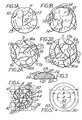
- FIG. 1A shows a product having very few deep or wide cracks.
- One such crack, indicated at 10, extends in from the edge, while the others, indicated at 11, extend across the central area and leave a region 12 between them entirely free from any cracks. The remainder are narrow, shallow and mostly short cracks 13.
- Fig. 1B shows a product having a considerable number of deep and/or wide cracks 14, most of which lie very near to or extend from the edge of the biscuit.
- the remaining cracks 15 are narrow and/or shallow and hardly any join up with others of the cracks 14 or 15. Virtually none of the cracks in the products shown in Figs. 1A and 1B extend to the edges.
- Figs. 2A and 2B two typical cookies are shown, made by the method of the invention.
- the main surface features of each consist of wide_ and/ or deep cracks 16 distributed over the entire upper surface of the product; some of which (16a) extend to the edge, together with narrow and/or shallow cracks 17 distributed over the entire upper surface of the product, some of which (17a) extend to the edge and some of which (17b) are virtually unconnected with any of the other cracks 16 or 17.
- the similar orientation of Figs. 2A and 2B also illustrates.how the'cracks and fissures 16,17 so produced are distributed over the whole surface, so that all of it has the same-general character, and yet the variability permitted by the method allows individual products to be recognisably different.
- Figs. 1A and 1B and Fig. 2A and 2B show examples of products of certain types, as already described in detail, and the particular detailed features shown in Figs. 2A and 2B are in no way intended to be limitative of the products of the invention, but instead are intended to point out some of their main characteristics.
- Figs. 3 and 4 respectively show in section along a diagonal and in plan view a typical pattern used to make a typical mould, which in turn is used to make the shaped dough pieces placed on the oven band or otherwise prepared ready for baking. Since a pattern is a reproduction of the article made in the corresponding.mould, Figs. 3 and 4 can also be regarded as showing the dough piece. These illustrations are shown to the same scale as Figs. 2A and 2B.
- the pattern 20 of Figs. 3 and 4 is circular in plan, has a flat base 21 like the resultant dough piece when deposited on a support (an oven band, for instance), and a domed upper surface 22 having a maximum height or thickness at the top centre point 23. Distributed over the surface 22 and extending to and down the sides 24 of the pattern 20 are a network of V-section grooves 25.
- Each groove 25 has a substantially uniform cross-section, with the respective sides making an angle preferably of 35 0 or, in general, within the range from 20° to 50° and desirably 35° ⁇ 3°, and having a depth of, say, 1.2 mm or, in general, within the range from 0.5 to 2.0 mm and desirably from 1.0 to 1.5 mm.
- Any of the grooves 25 can in fact be varied in cross-section at places along its length, if desired, for instance by being tapered off at a point where the groove ends without extending to the sides 24 of the pattern 20 or to another of the grooves 25.
- the grooves 25 which terminate within an area of the pattern surface 22 predominate around the central part of the surface 22.
- the arrangement of the grooves 25, which in the subsequent baking step encourage the formation of cracks or fissures in the biscuit surface such as those shown at 16, 15a, 17, 1 7a and 17b in Figs. 2A and 2B, can be applied to the dough piece either separately from its formation or simultaneously, such as is done by the use of moulds made from the pattern 20.
- a mould made from a pattern resembling that shown in Figs. 3 and 4 can be used, the desired grooves 25 being impressed into the resultant plain dough pieces, for instance by the use of hand moulds or preferably for volume production on a commercial scale, by the use of a rotary moulding machine.
- the pattern 20 produces dough pieces having a diameter of, for example, 50 mm and on baking these produce biscuits such as those shown in Figs. 2A and 2B having a diameter of, for example, 70 mm.
- the dough piece thus grows in diameter by as much as 40% during the baking step.
- the maximum thickness of the dough piece is, for instance, 16 mm at the centre 23 and, during baking, the dough piece spreads by increasing in diameter as just described and reduces to a generally constant thickness of, for instance, 9 to 10 mm.
- the randomly cracked or fissured upper surface of the product it is sufficiently regular in its overall size, shape and dimensions for a sufficient number of similar biscuits, e.g.
- the uniformity of the product is such that the overweight allowance required to ensure that a standard number of biscuits meets the minimum packaged weight can be as low as 3% to 5% in excess of the nominal weight, instead of as much as 15% to 20% as can be required with conventionally manufactured products of the same kind, such as are shown in Figs. 1A and 1B.
- one way in which the distribution of the lines or grooves 25 can be characterised is by reference to the number of such lines or grooves or portions thereof to be found in each 1 cm square. On average, there are 2 to 4 portions of the lines per square centimetre.
- the pattern 20 comprises an outer zone 30 having a diameter C, an inner zone 31 having a diameter B and a centre zone 32 having a diameter A. These may approximate respectively to the peripheral part of the dough piece which flows outwardly and downwardly in baking, the part which generally constitutes the rim of the finished product and the centre which bears most of the terminated lines in the prebaked state.
- this method of characterisation has the advantage that it indicates the probable or actual number of nodes of various orders in the zones of the circular plan of the surface and places no directional restraint upon the pathways extending from the nodes.
- a 1-node is a point having 1 pathway extending from it and thus defines the end of a terminating line
- a 2-node is a point having 2 pathways extending from it and this defines any location upon a pathway other than an end or a node of a higher order
- a 3-node is a point having 3 pathways extending from it and thus defines a location where one pathway extends to and joins another
- a 4-node is a point having 4 pathways extending from it and so on.
- References 41, 42, 43 and 44 in Fig. 4 indicate examples of 1-, 2-, 3- and 4-nodes.
- Zone diameters: A : B : C 25-75 : 40 - 90 : 100
- the network of the pathways represented by the grooves 25 is as follows, the figures in parentheses being the actual numbers of nodes present in a 50 mm diameter pattern:
- This invention thus provides a way to make cookies or biscuits with a cracked surface, using a rotary moulder or otherwise predetermining where all or most of the surface cracking occurs and thus enabling greater uniformity of size, shape and appearance to be achieved than by the use of known methods.
Landscapes
- Life Sciences & Earth Sciences (AREA)
- Engineering & Computer Science (AREA)
- Food Science & Technology (AREA)
- Bakery Products And Manufacturing Methods Therefor (AREA)
- Confectionery (AREA)
Applications Claiming Priority (2)
| Application Number | Priority Date | Filing Date | Title |
|---|---|---|---|
| GB8201178 | 1982-01-15 | ||
| GB8201178 | 1982-01-15 |
Publications (3)
| Publication Number | Publication Date |
|---|---|
| EP0084210A2 true EP0084210A2 (de) | 1983-07-27 |
| EP0084210A3 EP0084210A3 (en) | 1983-08-10 |
| EP0084210B1 EP0084210B1 (de) | 1986-02-05 |
Family
ID=10527655
Family Applications (1)
| Application Number | Title | Priority Date | Filing Date |
|---|---|---|---|
| EP82304912A Expired EP0084210B1 (de) | 1982-01-15 | 1982-09-17 | Herstellung von Keksen |
Country Status (9)
| Country | Link |
|---|---|
| US (1) | US4517209A (de) |
| EP (1) | EP0084210B1 (de) |
| JP (1) | JPS58121745A (de) |
| AU (1) | AU555086B2 (de) |
| DE (1) | DE3268968D1 (de) |
| DK (1) | DK160791C (de) |
| ES (1) | ES517689A0 (de) |
| GB (1) | GB2112625B (de) |
| IE (1) | IE53807B1 (de) |
Cited By (9)
| Publication number | Priority date | Publication date | Assignee | Title |
|---|---|---|---|---|
| WO1998026666A1 (en) * | 1996-12-19 | 1998-06-25 | Societe Des Produits Nestle S.A. | Cookie dough |
| WO1999066802A1 (en) * | 1998-06-24 | 1999-12-29 | Societe Des Produits Nestle S.A. | Ready-for-use cookie dough |
| US6024997A (en) * | 1997-12-17 | 2000-02-15 | Nestec S.A. | Cookie dough |
| US6280783B1 (en) | 1996-12-19 | 2001-08-28 | Nestec Sa | Ready to bake refrigerated sweet dough |
| AU738077B2 (en) * | 1996-12-19 | 2001-09-06 | Societe Des Produits Nestle S.A. | Cookie dough |
| US6312743B1 (en) | 1996-12-19 | 2001-11-06 | Nestec Sa | Cookie dough |
| US6627239B1 (en) | 2000-09-11 | 2003-09-30 | Nestec S.A. | Sweet dough tray |
| US6790467B2 (en) | 2001-08-16 | 2004-09-14 | Nestec S.A. | Ready to bake dough with shaped, coextruded filling and method of making same |
| US6942885B2 (en) | 2002-11-01 | 2005-09-13 | Nestec S.A. | Scored savory dough with toppings or fillings |
Families Citing this family (6)
| Publication number | Priority date | Publication date | Assignee | Title |
|---|---|---|---|---|
| US4445835A (en) * | 1982-08-25 | 1984-05-01 | Nabisco Brands, Inc. | Method and apparatus for marbleizing an extruded dough |
| GB2165712B (en) * | 1984-10-17 | 1988-05-11 | Stc Plc | Power transmission |
| US5104667A (en) * | 1988-08-01 | 1992-04-14 | Nabisco Brands, Inc. | Process of making coarse cookies |
| US4988276A (en) * | 1988-08-01 | 1991-01-29 | Nabisco Brands, Inc. | Apparatus for shaping cookie dough |
| US7067167B2 (en) * | 2003-01-31 | 2006-06-27 | General Mills Marketing, Inc. | Method for making sweet cookie dough having an imprinted surface |
| CN113749133A (zh) * | 2012-12-14 | 2021-12-07 | 洲际大品牌有限责任公司 | 在顶部和底部具有压凹的饼干 |
Family Cites Families (7)
| Publication number | Priority date | Publication date | Assignee | Title |
|---|---|---|---|---|
| FR324699A (fr) * | 1902-09-24 | 1903-04-08 | Dieterich Fritz | Appareil servant à séparer et à mouler simultanément les petits pains |
| FR901116A (fr) * | 1942-09-02 | 1945-07-18 | Biscuits Gondolo | Perfectionnements à la fabrication des biscuits secs |
| CH395900A (de) * | 1959-10-10 | 1965-07-31 | Z Potravinarskych A Chladicich | Einrichtung zur selbsttätigen Erzeugung von Gebäck |
| GB900292A (en) * | 1960-07-21 | 1962-07-04 | Hooimeijer En Zonen N V A | Improved process for the preparation of rusks or toasts and rusks or toasts so prepared |
| US3536014A (en) * | 1968-01-22 | 1970-10-27 | Louis G Kuchuris | Mechanism for imparting design to bakery product |
| GB1580442A (en) * | 1976-08-20 | 1980-12-03 | Baker Perkins Holdings Ltd | Production of biscuits |
| US4111624A (en) * | 1976-10-28 | 1978-09-05 | Hanson Douglas R | Dough piece imprinter and controls therefore |
-
1982
- 1982-08-18 JP JP57143169A patent/JPS58121745A/ja active Pending
- 1982-08-18 US US06/409,115 patent/US4517209A/en not_active Expired - Lifetime
- 1982-09-17 DE DE8282304912T patent/DE3268968D1/de not_active Expired
- 1982-09-17 EP EP82304912A patent/EP0084210B1/de not_active Expired
- 1982-11-25 ES ES517689A patent/ES517689A0/es active Granted
- 1982-12-30 IE IE3096/82A patent/IE53807B1/en not_active IP Right Cessation
-
1983
- 1983-01-14 GB GB08301043A patent/GB2112625B/en not_active Expired
- 1983-01-14 DK DK014683A patent/DK160791C/da active
- 1983-05-05 AU AU14276/83A patent/AU555086B2/en not_active Ceased
Cited By (12)
| Publication number | Priority date | Publication date | Assignee | Title |
|---|---|---|---|---|
| WO1998026666A1 (en) * | 1996-12-19 | 1998-06-25 | Societe Des Produits Nestle S.A. | Cookie dough |
| US6280783B1 (en) | 1996-12-19 | 2001-08-28 | Nestec Sa | Ready to bake refrigerated sweet dough |
| US6284295B1 (en) | 1996-12-19 | 2001-09-04 | Nestec Sa | Ready to bake refrigerated cookie dough |
| AU738077B2 (en) * | 1996-12-19 | 2001-09-06 | Societe Des Produits Nestle S.A. | Cookie dough |
| US6312743B1 (en) | 1996-12-19 | 2001-11-06 | Nestec Sa | Cookie dough |
| US6413563B1 (en) | 1996-12-19 | 2002-07-02 | Nestec S.A. | Ready-to-brake refrigerated sweet dough |
| US6726944B2 (en) | 1996-12-19 | 2004-04-27 | Nestec S.A. | Method for making cookies |
| US6024997A (en) * | 1997-12-17 | 2000-02-15 | Nestec S.A. | Cookie dough |
| WO1999066802A1 (en) * | 1998-06-24 | 1999-12-29 | Societe Des Produits Nestle S.A. | Ready-for-use cookie dough |
| US6627239B1 (en) | 2000-09-11 | 2003-09-30 | Nestec S.A. | Sweet dough tray |
| US6790467B2 (en) | 2001-08-16 | 2004-09-14 | Nestec S.A. | Ready to bake dough with shaped, coextruded filling and method of making same |
| US6942885B2 (en) | 2002-11-01 | 2005-09-13 | Nestec S.A. | Scored savory dough with toppings or fillings |
Also Published As
| Publication number | Publication date |
|---|---|
| AU555086B2 (en) | 1986-09-11 |
| DK14683A (da) | 1983-07-16 |
| AU1427683A (en) | 1984-11-08 |
| JPS58121745A (ja) | 1983-07-20 |
| ES8401828A1 (es) | 1984-01-01 |
| EP0084210B1 (de) | 1986-02-05 |
| DE3268968D1 (en) | 1986-03-20 |
| IE53807B1 (en) | 1989-03-01 |
| DK14683D0 (da) | 1983-01-14 |
| EP0084210A3 (en) | 1983-08-10 |
| ES517689A0 (es) | 1984-01-01 |
| DK160791C (da) | 1991-10-07 |
| GB2112625B (en) | 1985-10-16 |
| DK160791B (da) | 1991-04-22 |
| IE823096L (en) | 1983-07-15 |
| US4517209A (en) | 1985-05-14 |
| GB2112625A (en) | 1983-07-27 |
| GB8301043D0 (en) | 1983-02-16 |
Similar Documents
| Publication | Publication Date | Title |
|---|---|---|
| EP0084210B1 (de) | Herstellung von Keksen | |
| US4464405A (en) | Method for making pizza shells | |
| US5417150A (en) | Pizza pie mold and method of use | |
| US5789009A (en) | Pizza pie with crust structure | |
| US3503345A (en) | Pre-formed cake icing and method of making same | |
| US4176591A (en) | Cooking pan for baking pizza pies and like food products | |
| EP0763978B1 (de) | Verbesserungen in der herstellung von nahrungsmittelprodukten | |
| US20100005975A1 (en) | Multi-level cavitied bun molds | |
| US20070169636A1 (en) | Pizza pan | |
| DE2831456A1 (de) | Gebackenes teigprodukt und verfahren zu seiner herstellung | |
| US1950734A (en) | Food product | |
| CA1158919A (en) | Method of manufacturing a frozen food product | |
| CA1336242C (en) | Ravioli style food product | |
| US3237910A (en) | Cake pan | |
| CN100559949C (zh) | 华夫饼干片及其可加热烘烤模 | |
| EP0841009A2 (de) | Vorrichtung zum Formen von Brotteigstücken oder dergleichen | |
| US4792299A (en) | Biscuit cutter and cooperative mold | |
| EP0848909B1 (de) | Verfahren zur Herstellung eines Nahrungsmittels mit unterschiedllichem Teigvolumen und danach hergestelltes Nahrungsmittel | |
| EP3861860B1 (de) | Verfahren zur herstellung von zwieback scheiben | |
| DE102020100352B4 (de) | Zusatzbackform | |
| EP0315452A1 (de) | Verfahren zur Herstellung eines Nahrungsmittelproduktes | |
| GB2211391A (en) | Process for the manufacture of pastry cases | |
| CA1078637A (en) | Meatball maker and baker | |
| JPH03251135A (ja) | 二重構造のピザクラストおよびその製造方法 | |
| CA1143220A (en) | Making dough products with various fillings in domestic and public place with large output only for one time usage (30-60) pieces, excluding hand labor in pasting forming and cutting of dough by means of press form |
Legal Events
| Date | Code | Title | Description |
|---|---|---|---|
| PUAI | Public reference made under article 153(3) epc to a published international application that has entered the european phase |
Free format text: ORIGINAL CODE: 0009012 |
|
| PUAL | Search report despatched |
Free format text: ORIGINAL CODE: 0009013 |
|
| AK | Designated contracting states |
Designated state(s): BE CH DE FR LI NL SE |
|
| AK | Designated contracting states |
Designated state(s): BE CH DE FR LI NL SE |
|
| RBV | Designated contracting states (corrected) |
Designated state(s): BE CH DE FR LI NL SE |
|
| 17P | Request for examination filed |
Effective date: 19830921 |
|
| GRAA | (expected) grant |
Free format text: ORIGINAL CODE: 0009210 |
|
| AK | Designated contracting states |
Designated state(s): BE CH DE FR LI NL SE |
|
| ET | Fr: translation filed | ||
| REF | Corresponds to: |
Ref document number: 3268968 Country of ref document: DE Date of ref document: 19860320 |
|
| PLBE | No opposition filed within time limit |
Free format text: ORIGINAL CODE: 0009261 |
|
| STAA | Information on the status of an ep patent application or granted ep patent |
Free format text: STATUS: NO OPPOSITION FILED WITHIN TIME LIMIT |
|
| 26N | No opposition filed | ||
| EAL | Se: european patent in force in sweden |
Ref document number: 82304912.7 |
|
| PGFP | Annual fee paid to national office [announced via postgrant information from national office to epo] |
Ref country code: FR Payment date: 19950911 Year of fee payment: 14 |
|
| PGFP | Annual fee paid to national office [announced via postgrant information from national office to epo] |
Ref country code: SE Payment date: 19950918 Year of fee payment: 14 |
|
| PGFP | Annual fee paid to national office [announced via postgrant information from national office to epo] |
Ref country code: NL Payment date: 19950922 Year of fee payment: 14 |
|
| PGFP | Annual fee paid to national office [announced via postgrant information from national office to epo] |
Ref country code: DE Payment date: 19950928 Year of fee payment: 14 |
|
| PGFP | Annual fee paid to national office [announced via postgrant information from national office to epo] |
Ref country code: CH Payment date: 19951020 Year of fee payment: 14 |
|
| PGFP | Annual fee paid to national office [announced via postgrant information from national office to epo] |
Ref country code: BE Payment date: 19951031 Year of fee payment: 14 |
|
| PG25 | Lapsed in a contracting state [announced via postgrant information from national office to epo] |
Ref country code: SE Effective date: 19960918 |
|
| PG25 | Lapsed in a contracting state [announced via postgrant information from national office to epo] |
Ref country code: LI Effective date: 19960930 Ref country code: FR Effective date: 19960930 Ref country code: CH Effective date: 19960930 Ref country code: BE Effective date: 19960930 |
|
| NLS | Nl: assignments of ep-patents |
Owner name: UNITED BISCUITS (UK) LIMITED;UB GROUP LIMITED |
|
| NLT1 | Nl: modifications of names registered in virtue of documents presented to the patent office pursuant to art. 16 a, paragraph 1 |
Owner name: BURGERKING LTD;GRANDMET RESTAURANTS LTD;UB RESTAUR |
|
| BERE | Be: lapsed |
Owner name: UNITED BISCUITS (UK) LTD Effective date: 19960930 |
|
| PG25 | Lapsed in a contracting state [announced via postgrant information from national office to epo] |
Ref country code: NL Effective date: 19970401 |
|
| REG | Reference to a national code |
Ref country code: CH Ref legal event code: PL |
|
| NLV4 | Nl: lapsed or anulled due to non-payment of the annual fee |
Effective date: 19970401 |
|
| PG25 | Lapsed in a contracting state [announced via postgrant information from national office to epo] |
Ref country code: DE Effective date: 19970603 |
|
| EUG | Se: european patent has lapsed |
Ref document number: 82304912.7 |
|
| REG | Reference to a national code |
Ref country code: FR Ref legal event code: ST |
|
| REG | Reference to a national code |
Ref country code: FR Ref legal event code: ST |