EP0084269B1 - Composition sensible au rayons comprenant un précurseur d'un polyimide dérivé d'un composé fluorodiaryle - Google Patents
Composition sensible au rayons comprenant un précurseur d'un polyimide dérivé d'un composé fluorodiaryle Download PDFInfo
- Publication number
- EP0084269B1 EP0084269B1 EP82307025A EP82307025A EP0084269B1 EP 0084269 B1 EP0084269 B1 EP 0084269B1 EP 82307025 A EP82307025 A EP 82307025A EP 82307025 A EP82307025 A EP 82307025A EP 0084269 B1 EP0084269 B1 EP 0084269B1
- Authority
- EP
- European Patent Office
- Prior art keywords
- radiation
- radical
- polymer
- polyimide precursor
- precursor composition
- Prior art date
- Legal status (The legal status is an assumption and is not a legal conclusion. Google has not performed a legal analysis and makes no representation as to the accuracy of the status listed.)
- Expired
Links
- 239000000203 mixture Substances 0.000 title claims description 66
- -1 diaryl fluoro compound Chemical class 0.000 title claims description 52
- 230000005855 radiation Effects 0.000 title claims description 33
- 239000004642 Polyimide Substances 0.000 title claims description 27
- 229920001721 polyimide Polymers 0.000 title claims description 27
- 239000002243 precursor Substances 0.000 title claims description 22
- 150000004985 diamines Chemical class 0.000 claims description 45
- GTDPSWPPOUPBNX-UHFFFAOYSA-N ac1mqpva Chemical compound CC12C(=O)OC(=O)C1(C)C1(C)C2(C)C(=O)OC1=O GTDPSWPPOUPBNX-UHFFFAOYSA-N 0.000 claims description 44
- 239000000047 product Substances 0.000 claims description 42
- 229920000642 polymer Polymers 0.000 claims description 35
- 238000000034 method Methods 0.000 claims description 27
- 239000003999 initiator Substances 0.000 claims description 22
- 125000003118 aryl group Chemical group 0.000 claims description 20
- 239000002904 solvent Substances 0.000 claims description 20
- 125000004432 carbon atom Chemical group C* 0.000 claims description 19
- 238000006243 chemical reaction Methods 0.000 claims description 16
- 239000007795 chemical reaction product Substances 0.000 claims description 13
- NGNBDVOYPDDBFK-UHFFFAOYSA-N 2-[2,4-di(pentan-2-yl)phenoxy]acetyl chloride Chemical class CCCC(C)C1=CC=C(OCC(Cl)=O)C(C(C)CCC)=C1 NGNBDVOYPDDBFK-UHFFFAOYSA-N 0.000 claims description 11
- 230000032050 esterification Effects 0.000 claims description 9
- 238000005886 esterification reaction Methods 0.000 claims description 9
- 239000000852 hydrogen donor Substances 0.000 claims description 8
- 229910052739 hydrogen Inorganic materials 0.000 claims description 7
- 239000000758 substrate Substances 0.000 claims description 7
- 229920002818 (Hydroxyethyl)methacrylate Polymers 0.000 claims description 6
- APXJLYIVOFARRM-UHFFFAOYSA-N 4-[2-(3,4-dicarboxyphenyl)-1,1,1,3,3,3-hexafluoropropan-2-yl]phthalic acid Chemical group C1=C(C(O)=O)C(C(=O)O)=CC=C1C(C(F)(F)F)(C(F)(F)F)C1=CC=C(C(O)=O)C(C(O)=O)=C1 APXJLYIVOFARRM-UHFFFAOYSA-N 0.000 claims description 6
- WOBHKFSMXKNTIM-UHFFFAOYSA-N Hydroxyethyl methacrylate Chemical compound CC(=C)C(=O)OCCO WOBHKFSMXKNTIM-UHFFFAOYSA-N 0.000 claims description 6
- 150000001338 aliphatic hydrocarbons Chemical class 0.000 claims description 6
- 125000002915 carbonyl group Chemical group [*:2]C([*:1])=O 0.000 claims description 6
- VOZRXNHHFUQHIL-UHFFFAOYSA-N glycidyl methacrylate Chemical compound CC(=C)C(=O)OCC1CO1 VOZRXNHHFUQHIL-UHFFFAOYSA-N 0.000 claims description 6
- 125000002768 hydroxyalkyl group Chemical group 0.000 claims description 6
- 239000003960 organic solvent Substances 0.000 claims description 6
- 238000000214 vapour pressure osmometry Methods 0.000 claims description 6
- YZCKVEUIGOORGS-IGMARMGPSA-N Protium Chemical compound [1H] YZCKVEUIGOORGS-IGMARMGPSA-N 0.000 claims description 5
- 239000004305 biphenyl Substances 0.000 claims description 5
- 229910052794 bromium Inorganic materials 0.000 claims description 5
- 229910052801 chlorine Inorganic materials 0.000 claims description 5
- 238000002360 preparation method Methods 0.000 claims description 5
- HCLJOFJIQIJXHS-UHFFFAOYSA-N 2-[2-[2-(2-prop-2-enoyloxyethoxy)ethoxy]ethoxy]ethyl prop-2-enoate Chemical compound C=CC(=O)OCCOCCOCCOCCOC(=O)C=C HCLJOFJIQIJXHS-UHFFFAOYSA-N 0.000 claims description 4
- OMIGHNLMNHATMP-UHFFFAOYSA-N 2-hydroxyethyl prop-2-enoate Chemical compound OCCOC(=O)C=C OMIGHNLMNHATMP-UHFFFAOYSA-N 0.000 claims description 4
- 239000002202 Polyethylene glycol Substances 0.000 claims description 4
- ZJCCRDAZUWHFQH-UHFFFAOYSA-N Trimethylolpropane Chemical compound CCC(CO)(CO)CO ZJCCRDAZUWHFQH-UHFFFAOYSA-N 0.000 claims description 4
- 239000003504 photosensitizing agent Substances 0.000 claims description 4
- 229920001223 polyethylene glycol Polymers 0.000 claims description 4
- HLBLWEWZXPIGSM-UHFFFAOYSA-N 4-Aminophenyl ether Chemical group C1=CC(N)=CC=C1OC1=CC=C(N)C=C1 HLBLWEWZXPIGSM-UHFFFAOYSA-N 0.000 claims description 3
- 125000003277 amino group Chemical group 0.000 claims description 3
- MTPIZGPBYCHTGQ-UHFFFAOYSA-N 2-[2,2-bis(2-prop-2-enoyloxyethoxymethyl)butoxy]ethyl prop-2-enoate Chemical compound C=CC(=O)OCCOCC(CC)(COCCOC(=O)C=C)COCCOC(=O)C=C MTPIZGPBYCHTGQ-UHFFFAOYSA-N 0.000 claims description 2
- RSROEZYGRKHVMN-UHFFFAOYSA-N 2-ethyl-2-(hydroxymethyl)propane-1,3-diol;oxirane Chemical compound C1CO1.CCC(CO)(CO)CO RSROEZYGRKHVMN-UHFFFAOYSA-N 0.000 claims description 2
- DAKWPKUUDNSNPN-UHFFFAOYSA-N Trimethylolpropane triacrylate Chemical compound C=CC(=O)OCC(CC)(COC(=O)C=C)COC(=O)C=C DAKWPKUUDNSNPN-UHFFFAOYSA-N 0.000 claims description 2
- OKKRPWIIYQTPQF-UHFFFAOYSA-N Trimethylolpropane trimethacrylate Chemical compound CC(=C)C(=O)OCC(CC)(COC(=O)C(C)=C)COC(=O)C(C)=C OKKRPWIIYQTPQF-UHFFFAOYSA-N 0.000 claims description 2
- 125000001931 aliphatic group Chemical group 0.000 claims description 2
- 125000004386 diacrylate group Chemical group 0.000 claims description 2
- STVZJERGLQHEKB-UHFFFAOYSA-N ethylene glycol dimethacrylate Chemical compound CC(=C)C(=O)OCCOC(=O)C(C)=C STVZJERGLQHEKB-UHFFFAOYSA-N 0.000 claims description 2
- 229910052736 halogen Inorganic materials 0.000 claims description 2
- 150000002367 halogens Chemical class 0.000 claims description 2
- 229940096522 trimethylolpropane triacrylate Drugs 0.000 claims description 2
- 150000003254 radicals Chemical class 0.000 claims 14
- INQDDHNZXOAFFD-UHFFFAOYSA-N 2-[2-(2-prop-2-enoyloxyethoxy)ethoxy]ethyl prop-2-enoate Chemical compound C=CC(=O)OCCOCCOCCOC(=O)C=C INQDDHNZXOAFFD-UHFFFAOYSA-N 0.000 claims 2
- ASHGTJPOSUFTGB-UHFFFAOYSA-N 3-methoxyphenol Chemical compound COC1=CC=CC(O)=C1 ASHGTJPOSUFTGB-UHFFFAOYSA-N 0.000 claims 2
- 125000003178 carboxy group Chemical group [H]OC(*)=O 0.000 claims 2
- 125000002883 imidazolyl group Chemical group 0.000 claims 2
- HTWRFCRQSLVESJ-UHFFFAOYSA-N 3-(2-methylprop-2-enoyloxy)propyl 2-methylprop-2-enoate Chemical compound CC(=C)C(=O)OCCCOC(=O)C(C)=C HTWRFCRQSLVESJ-UHFFFAOYSA-N 0.000 claims 1
- HVVWZTWDBSEWIH-UHFFFAOYSA-N [2-(hydroxymethyl)-3-prop-2-enoyloxy-2-(prop-2-enoyloxymethyl)propyl] prop-2-enoate Chemical compound C=CC(=O)OCC(CO)(COC(=O)C=C)COC(=O)C=C HVVWZTWDBSEWIH-UHFFFAOYSA-N 0.000 claims 1
- 150000008064 anhydrides Chemical class 0.000 claims 1
- RPQRDASANLAFCM-UHFFFAOYSA-N oxiran-2-ylmethyl prop-2-enoate Chemical group C=CC(=O)OCC1CO1 RPQRDASANLAFCM-UHFFFAOYSA-N 0.000 claims 1
- 239000000243 solution Substances 0.000 description 17
- YXFVVABEGXRONW-UHFFFAOYSA-N Toluene Chemical compound CC1=CC=CC=C1 YXFVVABEGXRONW-UHFFFAOYSA-N 0.000 description 15
- RTZKZFJDLAIYFH-UHFFFAOYSA-N Diethyl ether Chemical compound CCOCC RTZKZFJDLAIYFH-UHFFFAOYSA-N 0.000 description 8
- QIGBRXMKCJKVMJ-UHFFFAOYSA-N Hydroquinone Chemical compound OC1=CC=C(O)C=C1 QIGBRXMKCJKVMJ-UHFFFAOYSA-N 0.000 description 6
- 239000011248 coating agent Substances 0.000 description 5
- 238000000576 coating method Methods 0.000 description 5
- 239000000539 dimer Substances 0.000 description 5
- VVBLNCFGVYUYGU-UHFFFAOYSA-N 4,4'-Bis(dimethylamino)benzophenone Chemical compound C1=CC(N(C)C)=CC=C1C(=O)C1=CC=C(N(C)C)C=C1 VVBLNCFGVYUYGU-UHFFFAOYSA-N 0.000 description 4
- YEJRWHAVMIAJKC-UHFFFAOYSA-N 4-Butyrolactone Chemical compound O=C1CCCO1 YEJRWHAVMIAJKC-UHFFFAOYSA-N 0.000 description 4
- CERQOIWHTDAKMF-UHFFFAOYSA-M Methacrylate Chemical compound CC(=C)C([O-])=O CERQOIWHTDAKMF-UHFFFAOYSA-M 0.000 description 4
- 150000008065 acid anhydrides Chemical class 0.000 description 4
- 239000002318 adhesion promoter Substances 0.000 description 4
- 239000003153 chemical reaction reagent Substances 0.000 description 4
- 150000001875 compounds Chemical class 0.000 description 4
- LYCAIKOWRPUZTN-UHFFFAOYSA-N ethylene glycol Natural products OCCO LYCAIKOWRPUZTN-UHFFFAOYSA-N 0.000 description 4
- VNWKTOKETHGBQD-UHFFFAOYSA-N methane Chemical compound C VNWKTOKETHGBQD-UHFFFAOYSA-N 0.000 description 4
- 239000003208 petroleum Substances 0.000 description 4
- 239000000376 reactant Substances 0.000 description 4
- 239000004065 semiconductor Substances 0.000 description 4
- 239000000126 substance Substances 0.000 description 4
- FYSNRJHAOHDILO-UHFFFAOYSA-N thionyl chloride Chemical compound ClS(Cl)=O FYSNRJHAOHDILO-UHFFFAOYSA-N 0.000 description 4
- ZMXDDKWLCZADIW-UHFFFAOYSA-N N,N-Dimethylformamide Chemical compound CN(C)C=O ZMXDDKWLCZADIW-UHFFFAOYSA-N 0.000 description 3
- XUIMIQQOPSSXEZ-UHFFFAOYSA-N Silicon Chemical compound [Si] XUIMIQQOPSSXEZ-UHFFFAOYSA-N 0.000 description 3
- 244000028419 Styrax benzoin Species 0.000 description 3
- 235000000126 Styrax benzoin Nutrition 0.000 description 3
- 235000008411 Sumatra benzointree Nutrition 0.000 description 3
- ISAOCJYIOMOJEB-UHFFFAOYSA-N benzoin Chemical compound C=1C=CC=CC=1C(O)C(=O)C1=CC=CC=C1 ISAOCJYIOMOJEB-UHFFFAOYSA-N 0.000 description 3
- 239000003990 capacitor Substances 0.000 description 3
- 125000006159 dianhydride group Chemical group 0.000 description 3
- 235000019382 gum benzoic Nutrition 0.000 description 3
- 230000000873 masking effect Effects 0.000 description 3
- 239000000463 material Substances 0.000 description 3
- YCWSUKQGVSGXJO-NTUHNPAUSA-N nifuroxazide Chemical group C1=CC(O)=CC=C1C(=O)N\N=C\C1=CC=C([N+]([O-])=O)O1 YCWSUKQGVSGXJO-NTUHNPAUSA-N 0.000 description 3
- 229910052710 silicon Inorganic materials 0.000 description 3
- 239000010703 silicon Substances 0.000 description 3
- YXIWHUQXZSMYRE-UHFFFAOYSA-N 1,3-benzothiazole-2-thiol Chemical compound C1=CC=C2SC(S)=NC2=C1 YXIWHUQXZSMYRE-UHFFFAOYSA-N 0.000 description 2
- BEKFRNOZJSYWKZ-UHFFFAOYSA-N 4-[2-(4-aminophenyl)-1,1,1,3,3,3-hexafluoropropan-2-yl]aniline Chemical compound C1=CC(N)=CC=C1C(C(F)(F)F)(C(F)(F)F)C1=CC=C(N)C=C1 BEKFRNOZJSYWKZ-UHFFFAOYSA-N 0.000 description 2
- KCXZNSGUUQJJTR-UHFFFAOYSA-N Di-n-hexyl phthalate Chemical compound CCCCCCOC(=O)C1=CC=CC=C1C(=O)OCCCCCC KCXZNSGUUQJJTR-UHFFFAOYSA-N 0.000 description 2
- LFQSCWFLJHTTHZ-UHFFFAOYSA-N Ethanol Chemical compound CCO LFQSCWFLJHTTHZ-UHFFFAOYSA-N 0.000 description 2
- PXGOKWXKJXAPGV-UHFFFAOYSA-N Fluorine Chemical compound FF PXGOKWXKJXAPGV-UHFFFAOYSA-N 0.000 description 2
- IWYRWIUNAVNFPE-UHFFFAOYSA-N Glycidaldehyde Chemical compound O=CC1CO1 IWYRWIUNAVNFPE-UHFFFAOYSA-N 0.000 description 2
- UFHFLCQGNIYNRP-UHFFFAOYSA-N Hydrogen Chemical compound [H][H] UFHFLCQGNIYNRP-UHFFFAOYSA-N 0.000 description 2
- FXHOOIRPVKKKFG-UHFFFAOYSA-N N,N-Dimethylacetamide Chemical compound CN(C)C(C)=O FXHOOIRPVKKKFG-UHFFFAOYSA-N 0.000 description 2
- 206010034972 Photosensitivity reaction Diseases 0.000 description 2
- 239000004952 Polyamide Substances 0.000 description 2
- ATUOYWHBWRKTHZ-UHFFFAOYSA-N Propane Chemical compound CCC ATUOYWHBWRKTHZ-UHFFFAOYSA-N 0.000 description 2
- WYURNTSHIVDZCO-UHFFFAOYSA-N Tetrahydrofuran Chemical compound C1CCOC1 WYURNTSHIVDZCO-UHFFFAOYSA-N 0.000 description 2
- YTPLMLYBLZKORZ-UHFFFAOYSA-N Thiophene Chemical compound C=1C=CSC=1 YTPLMLYBLZKORZ-UHFFFAOYSA-N 0.000 description 2
- 239000002253 acid Substances 0.000 description 2
- 125000004018 acid anhydride group Chemical group 0.000 description 2
- 125000000217 alkyl group Chemical group 0.000 description 2
- 150000004945 aromatic hydrocarbons Chemical class 0.000 description 2
- 150000008365 aromatic ketones Chemical class 0.000 description 2
- HFACYLZERDEVSX-UHFFFAOYSA-N benzidine Chemical group C1=CC(N)=CC=C1C1=CC=C(N)C=C1 HFACYLZERDEVSX-UHFFFAOYSA-N 0.000 description 2
- 229960002130 benzoin Drugs 0.000 description 2
- XXBDWLFCJWSEKW-UHFFFAOYSA-N dimethylbenzylamine Chemical compound CN(C)CC1=CC=CC=C1 XXBDWLFCJWSEKW-UHFFFAOYSA-N 0.000 description 2
- USIUVYZYUHIAEV-UHFFFAOYSA-N diphenyl ether Chemical compound C=1C=CC=CC=1OC1=CC=CC=C1 USIUVYZYUHIAEV-UHFFFAOYSA-N 0.000 description 2
- 239000000975 dye Substances 0.000 description 2
- 229910052731 fluorine Inorganic materials 0.000 description 2
- 239000011737 fluorine Substances 0.000 description 2
- 125000000524 functional group Chemical group 0.000 description 2
- 239000001257 hydrogen Substances 0.000 description 2
- 150000002734 metacrylic acid derivatives Chemical class 0.000 description 2
- JCXJVPUVTGWSNB-UHFFFAOYSA-N nitrogen dioxide Inorganic materials O=[N]=O JCXJVPUVTGWSNB-UHFFFAOYSA-N 0.000 description 2
- 239000003921 oil Substances 0.000 description 2
- 230000036211 photosensitivity Effects 0.000 description 2
- 239000004014 plasticizer Substances 0.000 description 2
- 229920005575 poly(amic acid) Polymers 0.000 description 2
- 229920002647 polyamide Polymers 0.000 description 2
- 238000006116 polymerization reaction Methods 0.000 description 2
- 239000002244 precipitate Substances 0.000 description 2
- YPFDHNVEDLHUCE-UHFFFAOYSA-N propane-1,3-diol Chemical compound OCCCO YPFDHNVEDLHUCE-UHFFFAOYSA-N 0.000 description 2
- FZHAPNGMFPVSLP-UHFFFAOYSA-N silanamine Chemical compound [SiH3]N FZHAPNGMFPVSLP-UHFFFAOYSA-N 0.000 description 2
- 239000007787 solid Substances 0.000 description 2
- 238000004528 spin coating Methods 0.000 description 2
- 239000007921 spray Substances 0.000 description 2
- 238000003756 stirring Methods 0.000 description 2
- GEYOCULIXLDCMW-UHFFFAOYSA-N 1,2-phenylenediamine Chemical compound NC1=CC=CC=C1N GEYOCULIXLDCMW-UHFFFAOYSA-N 0.000 description 1
- DKEGCUDAFWNSSO-UHFFFAOYSA-N 1,8-dibromooctane Chemical compound BrCCCCCCCCBr DKEGCUDAFWNSSO-UHFFFAOYSA-N 0.000 description 1
- VLDPXPPHXDGHEW-UHFFFAOYSA-N 1-chloro-2-dichlorophosphoryloxybenzene Chemical compound ClC1=CC=CC=C1OP(Cl)(Cl)=O VLDPXPPHXDGHEW-UHFFFAOYSA-N 0.000 description 1
- KWVGIHKZDCUPEU-UHFFFAOYSA-N 2,2-dimethoxy-2-phenylacetophenone Chemical compound C=1C=CC=CC=1C(OC)(OC)C(=O)C1=CC=CC=C1 KWVGIHKZDCUPEU-UHFFFAOYSA-N 0.000 description 1
- SVPKNMBRVBMTLB-UHFFFAOYSA-N 2,3-dichloronaphthalene-1,4-dione Chemical compound C1=CC=C2C(=O)C(Cl)=C(Cl)C(=O)C2=C1 SVPKNMBRVBMTLB-UHFFFAOYSA-N 0.000 description 1
- PAMNGTABBVLRFN-UHFFFAOYSA-N 2-[bis[2-(diethylamino)-6-methylphenyl]methyl]-n,n-diethyl-3-methylaniline Chemical compound CCN(CC)C1=CC=CC(C)=C1C(C=1C(=CC=CC=1C)N(CC)CC)C1=C(C)C=CC=C1N(CC)CC PAMNGTABBVLRFN-UHFFFAOYSA-N 0.000 description 1
- SONODMXIYNGWQY-UHFFFAOYSA-N 2-[bis[2-(dipropylamino)-6-methylphenyl]methyl]-3-methyl-n,n-dipropylaniline Chemical compound CCCN(CCC)C1=CC=CC(C)=C1C(C=1C(=CC=CC=1C)N(CCC)CCC)C1=C(C)C=CC=C1N(CCC)CCC SONODMXIYNGWQY-UHFFFAOYSA-N 0.000 description 1
- GPWZWWICAGSVPI-UHFFFAOYSA-N 2-amino-4-[2-(3-amino-4-carboxyphenyl)-1,1,1,3,3,3-hexafluoropropan-2-yl]benzoic acid Chemical compound C1=C(C(O)=O)C(N)=CC(C(C=2C=C(N)C(C(O)=O)=CC=2)(C(F)(F)F)C(F)(F)F)=C1 GPWZWWICAGSVPI-UHFFFAOYSA-N 0.000 description 1
- KMNCBSZOIQAUFX-UHFFFAOYSA-N 2-ethoxy-1,2-diphenylethanone Chemical compound C=1C=CC=CC=1C(OCC)C(=O)C1=CC=CC=C1 KMNCBSZOIQAUFX-UHFFFAOYSA-N 0.000 description 1
- SJEBAWHUJDUKQK-UHFFFAOYSA-N 2-ethylanthraquinone Chemical compound C1=CC=C2C(=O)C3=CC(CC)=CC=C3C(=O)C2=C1 SJEBAWHUJDUKQK-UHFFFAOYSA-N 0.000 description 1
- VZMLJEYQUZKERO-UHFFFAOYSA-N 2-hydroxy-1-(2-methylphenyl)-2-phenylethanone Chemical compound CC1=CC=CC=C1C(=O)C(O)C1=CC=CC=C1 VZMLJEYQUZKERO-UHFFFAOYSA-N 0.000 description 1
- IEVADDDOVGMCSI-UHFFFAOYSA-N 2-hydroxybutyl 2-methylprop-2-enoate Chemical compound CCC(O)COC(=O)C(C)=C IEVADDDOVGMCSI-UHFFFAOYSA-N 0.000 description 1
- FLFWJIBUZQARMD-UHFFFAOYSA-N 2-mercapto-1,3-benzoxazole Chemical class C1=CC=C2OC(S)=NC2=C1 FLFWJIBUZQARMD-UHFFFAOYSA-N 0.000 description 1
- BQZJOQXSCSZQPS-UHFFFAOYSA-N 2-methoxy-1,2-diphenylethanone Chemical compound C=1C=CC=CC=1C(OC)C(=O)C1=CC=CC=C1 BQZJOQXSCSZQPS-UHFFFAOYSA-N 0.000 description 1
- AXYQEGMSGMXGGK-UHFFFAOYSA-N 2-phenoxy-1,2-diphenylethanone Chemical compound C=1C=CC=CC=1C(=O)C(C=1C=CC=CC=1)OC1=CC=CC=C1 AXYQEGMSGMXGGK-UHFFFAOYSA-N 0.000 description 1
- YTPSFXZMJKMUJE-UHFFFAOYSA-N 2-tert-butylanthracene-9,10-dione Chemical compound C1=CC=C2C(=O)C3=CC(C(C)(C)C)=CC=C3C(=O)C2=C1 YTPSFXZMJKMUJE-UHFFFAOYSA-N 0.000 description 1
- UCFMKTNJZCYBBJ-UHFFFAOYSA-N 3-[1-(2,3-dicarboxyphenyl)ethyl]phthalic acid Chemical compound C=1C=CC(C(O)=O)=C(C(O)=O)C=1C(C)C1=CC=CC(C(O)=O)=C1C(O)=O UCFMKTNJZCYBBJ-UHFFFAOYSA-N 0.000 description 1
- RMQWVYXBQAHUJY-UHFFFAOYSA-N 3-[4-[2-[4-(2-cyanoethylamino)phenyl]-1,1,1,3,3,3-hexafluoropropan-2-yl]anilino]propanenitrile Chemical compound C=1C=C(NCCC#N)C=CC=1C(C(F)(F)F)(C(F)(F)F)C1=CC=C(NCCC#N)C=C1 RMQWVYXBQAHUJY-UHFFFAOYSA-N 0.000 description 1
- GNSFRPWPOGYVLO-UHFFFAOYSA-N 3-hydroxypropyl 2-methylprop-2-enoate Chemical compound CC(=C)C(=O)OCCCO GNSFRPWPOGYVLO-UHFFFAOYSA-N 0.000 description 1
- QZPSOSOOLFHYRR-UHFFFAOYSA-N 3-hydroxypropyl prop-2-enoate Chemical compound OCCCOC(=O)C=C QZPSOSOOLFHYRR-UHFFFAOYSA-N 0.000 description 1
- ICNFHJVPAJKPHW-UHFFFAOYSA-N 4,4'-Thiodianiline Chemical compound C1=CC(N)=CC=C1SC1=CC=C(N)C=C1 ICNFHJVPAJKPHW-UHFFFAOYSA-N 0.000 description 1
- AVCOFPOLGHKJQB-UHFFFAOYSA-N 4-(3,4-dicarboxyphenyl)sulfonylphthalic acid Chemical compound C1=C(C(O)=O)C(C(=O)O)=CC=C1S(=O)(=O)C1=CC=C(C(O)=O)C(C(O)=O)=C1 AVCOFPOLGHKJQB-UHFFFAOYSA-N 0.000 description 1
- MITHMOYLTXMLRB-UHFFFAOYSA-N 4-(4-aminophenyl)sulfinylaniline Chemical compound C1=CC(N)=CC=C1S(=O)C1=CC=C(N)C=C1 MITHMOYLTXMLRB-UHFFFAOYSA-N 0.000 description 1
- IWXCYYWDGDDPAC-UHFFFAOYSA-N 4-[(3,4-dicarboxyphenyl)methyl]phthalic acid Chemical compound C1=C(C(O)=O)C(C(=O)O)=CC=C1CC1=CC=C(C(O)=O)C(C(O)=O)=C1 IWXCYYWDGDDPAC-UHFFFAOYSA-N 0.000 description 1
- VAMIFVNKDFHXAY-UHFFFAOYSA-N 4-[1,1,1,3,3,3-hexafluoro-2-[4-(methylamino)phenyl]propan-2-yl]-n-methylaniline Chemical compound C1=CC(NC)=CC=C1C(C(F)(F)F)(C(F)(F)F)C1=CC=C(NC)C=C1 VAMIFVNKDFHXAY-UHFFFAOYSA-N 0.000 description 1
- RBHCRXIJTCFOCD-UHFFFAOYSA-N 4-[2-(4-amino-3,5-dibromophenyl)-1,1,1,3,3,3-hexafluoropropan-2-yl]-2,6-dibromoaniline Chemical compound C1=C(Br)C(N)=C(Br)C=C1C(C(F)(F)F)(C(F)(F)F)C1=CC(Br)=C(N)C(Br)=C1 RBHCRXIJTCFOCD-UHFFFAOYSA-N 0.000 description 1
- BRIJNJMDGLVFRU-UHFFFAOYSA-N 4-[2-(4-amino-3,5-dibromophenyl)-1-chloro-1,1,3,3,3-pentafluoropropan-2-yl]-2,6-dibromoaniline Chemical compound C1=C(Br)C(N)=C(Br)C=C1C(C(F)(F)Cl)(C(F)(F)F)C1=CC(Br)=C(N)C(Br)=C1 BRIJNJMDGLVFRU-UHFFFAOYSA-N 0.000 description 1
- QELZOXAZTBHQCS-UHFFFAOYSA-N 4-[2-(4-amino-3-chloro-5-nitrophenyl)-1,1,1,3,3,3-hexafluoropropan-2-yl]-2-chloro-6-nitroaniline Chemical compound C1=C([N+]([O-])=O)C(N)=C(Cl)C=C1C(C(F)(F)F)(C(F)(F)F)C1=CC(Cl)=C(N)C([N+]([O-])=O)=C1 QELZOXAZTBHQCS-UHFFFAOYSA-N 0.000 description 1
- KPPDNXBRICFWLV-UHFFFAOYSA-N 4-[2-(4-amino-3-nitrophenyl)-1,1,1,3,3,3-hexafluoropropan-2-yl]-2-nitroaniline Chemical compound C1=C([N+]([O-])=O)C(N)=CC=C1C(C(F)(F)F)(C(F)(F)F)C1=CC=C(N)C([N+]([O-])=O)=C1 KPPDNXBRICFWLV-UHFFFAOYSA-N 0.000 description 1
- KUMYQKJHIIDZLM-UHFFFAOYSA-N 4-[2-(4-aminophenyl)-1-chloro-1,1,3,3,3-pentafluoropropan-2-yl]aniline Chemical compound C1=CC(N)=CC=C1C(C(F)(F)Cl)(C(F)(F)F)C1=CC=C(N)C=C1 KUMYQKJHIIDZLM-UHFFFAOYSA-N 0.000 description 1
- JCRRFJIVUPSNTA-UHFFFAOYSA-N 4-[4-(4-aminophenoxy)phenoxy]aniline Chemical compound C1=CC(N)=CC=C1OC(C=C1)=CC=C1OC1=CC=C(N)C=C1 JCRRFJIVUPSNTA-UHFFFAOYSA-N 0.000 description 1
- QGMGHALXLXKCBD-UHFFFAOYSA-N 4-amino-n-(2-aminophenyl)benzamide Chemical compound C1=CC(N)=CC=C1C(=O)NC1=CC=CC=C1N QGMGHALXLXKCBD-UHFFFAOYSA-N 0.000 description 1
- NDWUBGAGUCISDV-UHFFFAOYSA-N 4-hydroxybutyl prop-2-enoate Chemical compound OCCCCOC(=O)C=C NDWUBGAGUCISDV-UHFFFAOYSA-N 0.000 description 1
- WXAIEIRYBSKHDP-UHFFFAOYSA-N 4-phenyl-n-(4-phenylphenyl)-n-[4-[4-(4-phenyl-n-(4-phenylphenyl)anilino)phenyl]phenyl]aniline Chemical compound C1=CC=CC=C1C1=CC=C(N(C=2C=CC(=CC=2)C=2C=CC=CC=2)C=2C=CC(=CC=2)C=2C=CC(=CC=2)N(C=2C=CC(=CC=2)C=2C=CC=CC=2)C=2C=CC(=CC=2)C=2C=CC=CC=2)C=C1 WXAIEIRYBSKHDP-UHFFFAOYSA-N 0.000 description 1
- VQVIHDPBMFABCQ-UHFFFAOYSA-N 5-(1,3-dioxo-2-benzofuran-5-carbonyl)-2-benzofuran-1,3-dione Chemical compound C1=C2C(=O)OC(=O)C2=CC(C(C=2C=C3C(=O)OC(=O)C3=CC=2)=O)=C1 VQVIHDPBMFABCQ-UHFFFAOYSA-N 0.000 description 1
- QQGYZOYWNCKGEK-UHFFFAOYSA-N 5-[(1,3-dioxo-2-benzofuran-5-yl)oxy]-2-benzofuran-1,3-dione Chemical compound C1=C2C(=O)OC(=O)C2=CC(OC=2C=C3C(=O)OC(C3=CC=2)=O)=C1 QQGYZOYWNCKGEK-UHFFFAOYSA-N 0.000 description 1
- HJSYPLCSZPEDCQ-UHFFFAOYSA-N 5-[2-(3-amino-4-methylphenyl)-1,1,1,3,3,3-hexafluoropropan-2-yl]-2-methylaniline Chemical compound C1=C(N)C(C)=CC=C1C(C(F)(F)F)(C(F)(F)F)C1=CC=C(C)C(N)=C1 HJSYPLCSZPEDCQ-UHFFFAOYSA-N 0.000 description 1
- NIXOWILDQLNWCW-UHFFFAOYSA-M Acrylate Chemical compound [O-]C(=O)C=C NIXOWILDQLNWCW-UHFFFAOYSA-M 0.000 description 1
- 239000004215 Carbon black (E152) Substances 0.000 description 1
- MQJKPEGWNLWLTK-UHFFFAOYSA-N Dapsone Chemical compound C1=CC(N)=CC=C1S(=O)(=O)C1=CC=C(N)C=C1 MQJKPEGWNLWLTK-UHFFFAOYSA-N 0.000 description 1
- MQIUGAXCHLFZKX-UHFFFAOYSA-N Di-n-octyl phthalate Natural products CCCCCCCCOC(=O)C1=CC=CC=C1C(=O)OCCCCCCCC MQIUGAXCHLFZKX-UHFFFAOYSA-N 0.000 description 1
- OTMSDBZUPAUEDD-UHFFFAOYSA-N Ethane Chemical compound CC OTMSDBZUPAUEDD-UHFFFAOYSA-N 0.000 description 1
- PAYRUJLWNCNPSJ-UHFFFAOYSA-N N-phenyl amine Natural products NC1=CC=CC=C1 PAYRUJLWNCNPSJ-UHFFFAOYSA-N 0.000 description 1
- NPKSPKHJBVJUKB-UHFFFAOYSA-N N-phenylglycine Chemical compound OC(=O)CNC1=CC=CC=C1 NPKSPKHJBVJUKB-UHFFFAOYSA-N 0.000 description 1
- XYFCBTPGUUZFHI-UHFFFAOYSA-N Phosphine Natural products P XYFCBTPGUUZFHI-UHFFFAOYSA-N 0.000 description 1
- 239000004698 Polyethylene Substances 0.000 description 1
- YSMRWXYRXBRSND-UHFFFAOYSA-N TOTP Chemical compound CC1=CC=CC=C1OP(=O)(OC=1C(=CC=CC=1)C)OC1=CC=CC=C1C YSMRWXYRXBRSND-UHFFFAOYSA-N 0.000 description 1
- 239000007983 Tris buffer Substances 0.000 description 1
- FQKWAYNTRKLICQ-UHFFFAOYSA-N [4-(diethylamino)phenyl]-(4-methoxyphenyl)methanone Chemical compound C1=CC(N(CC)CC)=CC=C1C(=O)C1=CC=C(OC)C=C1 FQKWAYNTRKLICQ-UHFFFAOYSA-N 0.000 description 1
- 150000001252 acrylic acid derivatives Chemical class 0.000 description 1
- 125000002947 alkylene group Chemical group 0.000 description 1
- 150000004984 aromatic diamines Chemical class 0.000 description 1
- GCAIEATUVJFSMC-UHFFFAOYSA-N benzene-1,2,3,4-tetracarboxylic acid Chemical compound OC(=O)C1=CC=C(C(O)=O)C(C(O)=O)=C1C(O)=O GCAIEATUVJFSMC-UHFFFAOYSA-N 0.000 description 1
- RWCCWEUUXYIKHB-UHFFFAOYSA-N benzophenone Chemical compound C=1C=CC=CC=1C(=O)C1=CC=CC=C1 RWCCWEUUXYIKHB-UHFFFAOYSA-N 0.000 description 1
- 239000012965 benzophenone Substances 0.000 description 1
- BJQHLKABXJIVAM-UHFFFAOYSA-N bis(2-ethylhexyl) phthalate Chemical compound CCCCC(CC)COC(=O)C1=CC=CC=C1C(=O)OCC(CC)CCCC BJQHLKABXJIVAM-UHFFFAOYSA-N 0.000 description 1
- VYHBFRJRBHMIQZ-UHFFFAOYSA-N bis[4-(diethylamino)phenyl]methanone Chemical compound C1=CC(N(CC)CC)=CC=C1C(=O)C1=CC=C(N(CC)CC)C=C1 VYHBFRJRBHMIQZ-UHFFFAOYSA-N 0.000 description 1
- 229930188620 butyrolactone Natural products 0.000 description 1
- 239000012986 chain transfer agent Substances 0.000 description 1
- 238000010960 commercial process Methods 0.000 description 1
- 239000000470 constituent Substances 0.000 description 1
- DROMNWUQASBTFM-UHFFFAOYSA-N dinonyl benzene-1,2-dicarboxylate Chemical compound CCCCCCCCCOC(=O)C1=CC=CC=C1C(=O)OCCCCCCCCC DROMNWUQASBTFM-UHFFFAOYSA-N 0.000 description 1
- 150000002148 esters Chemical class 0.000 description 1
- ANSXAPJVJOKRDJ-UHFFFAOYSA-N furo[3,4-f][2]benzofuran-1,3,5,7-tetrone Chemical compound C1=C2C(=O)OC(=O)C2=CC2=C1C(=O)OC2=O ANSXAPJVJOKRDJ-UHFFFAOYSA-N 0.000 description 1
- GNOIPBMMFNIUFM-UHFFFAOYSA-N hexamethylphosphoric triamide Chemical compound CN(C)P(=O)(N(C)C)N(C)C GNOIPBMMFNIUFM-UHFFFAOYSA-N 0.000 description 1
- 229930195733 hydrocarbon Natural products 0.000 description 1
- 150000002430 hydrocarbons Chemical class 0.000 description 1
- WGCNASOHLSPBMP-UHFFFAOYSA-N hydroxyacetaldehyde Natural products OCC=O WGCNASOHLSPBMP-UHFFFAOYSA-N 0.000 description 1
- 238000002329 infrared spectrum Methods 0.000 description 1
- 150000002500 ions Chemical class 0.000 description 1
- 230000001678 irradiating effect Effects 0.000 description 1
- 238000004519 manufacturing process Methods 0.000 description 1
- 229940086559 methyl benzoin Drugs 0.000 description 1
- BAVYZALUXZFZLV-UHFFFAOYSA-N mono-methylamine Natural products NC BAVYZALUXZFZLV-UHFFFAOYSA-N 0.000 description 1
- XHKNBCPCKAIPNR-UHFFFAOYSA-N n-ethyl-4-[2-[4-(ethylamino)phenyl]-1,1,1,3,3,3-hexafluoropropan-2-yl]aniline Chemical compound C1=CC(NCC)=CC=C1C(C(F)(F)F)(C(F)(F)F)C1=CC=C(NCC)C=C1 XHKNBCPCKAIPNR-UHFFFAOYSA-N 0.000 description 1
- KADGVXXDDWDKBX-UHFFFAOYSA-N naphthalene-1,2,4,5-tetracarboxylic acid Chemical compound OC(=O)C1=CC=CC2=C(C(O)=O)C(C(=O)O)=CC(C(O)=O)=C21 KADGVXXDDWDKBX-UHFFFAOYSA-N 0.000 description 1
- OBKARQMATMRWQZ-UHFFFAOYSA-N naphthalene-1,2,5,6-tetracarboxylic acid Chemical compound OC(=O)C1=C(C(O)=O)C=CC2=C(C(O)=O)C(C(=O)O)=CC=C21 OBKARQMATMRWQZ-UHFFFAOYSA-N 0.000 description 1
- FVDOBFPYBSDRKH-UHFFFAOYSA-N perylene-3,4,9,10-tetracarboxylic acid Chemical compound C=12C3=CC=C(C(O)=O)C2=C(C(O)=O)C=CC=1C1=CC=C(C(O)=O)C2=C1C3=CC=C2C(=O)O FVDOBFPYBSDRKH-UHFFFAOYSA-N 0.000 description 1
- 125000001997 phenyl group Chemical group [H]C1=C([H])C([H])=C(*)C([H])=C1[H] 0.000 description 1
- 229910000073 phosphorus hydride Inorganic materials 0.000 description 1
- 229920000573 polyethylene Polymers 0.000 description 1
- 239000001294 propane Substances 0.000 description 1
- 239000011253 protective coating Substances 0.000 description 1
- RTHVZRHBNXZKKB-UHFFFAOYSA-N pyrazine-2,3,5,6-tetracarboxylic acid Chemical compound OC(=O)C1=NC(C(O)=O)=C(C(O)=O)N=C1C(O)=O RTHVZRHBNXZKKB-UHFFFAOYSA-N 0.000 description 1
- 239000011347 resin Substances 0.000 description 1
- 229920005989 resin Polymers 0.000 description 1
- 229910000679 solder Inorganic materials 0.000 description 1
- 125000001424 substituent group Chemical group 0.000 description 1
- 238000005496 tempering Methods 0.000 description 1
- 125000006158 tetracarboxylic acid group Chemical group 0.000 description 1
- YLQBMQCUIZJEEH-UHFFFAOYSA-N tetrahydrofuran Natural products C=1C=COC=1 YLQBMQCUIZJEEH-UHFFFAOYSA-N 0.000 description 1
- 229930192474 thiophene Natural products 0.000 description 1
Classifications
-
- G—PHYSICS
- G03—PHOTOGRAPHY; CINEMATOGRAPHY; ANALOGOUS TECHNIQUES USING WAVES OTHER THAN OPTICAL WAVES; ELECTROGRAPHY; HOLOGRAPHY
- G03F—PHOTOMECHANICAL PRODUCTION OF TEXTURED OR PATTERNED SURFACES, e.g. FOR PRINTING, FOR PROCESSING OF SEMICONDUCTOR DEVICES; MATERIALS THEREFOR; ORIGINALS THEREFOR; APPARATUS SPECIALLY ADAPTED THEREFOR
- G03F7/00—Photomechanical, e.g. photolithographic, production of textured or patterned surfaces, e.g. printing surfaces; Materials therefor, e.g. comprising photoresists; Apparatus specially adapted therefor
- G03F7/004—Photosensitive materials
- G03F7/027—Non-macromolecular photopolymerisable compounds having carbon-to-carbon double bonds, e.g. ethylenic compounds
- G03F7/032—Non-macromolecular photopolymerisable compounds having carbon-to-carbon double bonds, e.g. ethylenic compounds with binders
- G03F7/037—Non-macromolecular photopolymerisable compounds having carbon-to-carbon double bonds, e.g. ethylenic compounds with binders the binders being polyamides or polyimides
-
- G—PHYSICS
- G03—PHOTOGRAPHY; CINEMATOGRAPHY; ANALOGOUS TECHNIQUES USING WAVES OTHER THAN OPTICAL WAVES; ELECTROGRAPHY; HOLOGRAPHY
- G03F—PHOTOMECHANICAL PRODUCTION OF TEXTURED OR PATTERNED SURFACES, e.g. FOR PRINTING, FOR PROCESSING OF SEMICONDUCTOR DEVICES; MATERIALS THEREFOR; ORIGINALS THEREFOR; APPARATUS SPECIALLY ADAPTED THEREFOR
- G03F7/00—Photomechanical, e.g. photolithographic, production of textured or patterned surfaces, e.g. printing surfaces; Materials therefor, e.g. comprising photoresists; Apparatus specially adapted therefor
- G03F7/004—Photosensitive materials
- G03F7/025—Non-macromolecular photopolymerisable compounds having carbon-to-carbon triple bonds, e.g. acetylenic compounds
-
- C—CHEMISTRY; METALLURGY
- C08—ORGANIC MACROMOLECULAR COMPOUNDS; THEIR PREPARATION OR CHEMICAL WORKING-UP; COMPOSITIONS BASED THEREON
- C08F—MACROMOLECULAR COMPOUNDS OBTAINED BY REACTIONS ONLY INVOLVING CARBON-TO-CARBON UNSATURATED BONDS
- C08F290/00—Macromolecular compounds obtained by polymerising monomers on to polymers modified by introduction of aliphatic unsaturated end or side groups
- C08F290/08—Macromolecular compounds obtained by polymerising monomers on to polymers modified by introduction of aliphatic unsaturated end or side groups on to polymers modified by introduction of unsaturated side groups
- C08F290/14—Polymers provided for in subclass C08G
-
- C—CHEMISTRY; METALLURGY
- C08—ORGANIC MACROMOLECULAR COMPOUNDS; THEIR PREPARATION OR CHEMICAL WORKING-UP; COMPOSITIONS BASED THEREON
- C08G—MACROMOLECULAR COMPOUNDS OBTAINED OTHERWISE THAN BY REACTIONS ONLY INVOLVING UNSATURATED CARBON-TO-CARBON BONDS
- C08G73/00—Macromolecular compounds obtained by reactions forming a linkage containing nitrogen with or without oxygen or carbon in the main chain of the macromolecule, not provided for in groups C08G12/00 - C08G71/00
- C08G73/06—Polycondensates having nitrogen-containing heterocyclic rings in the main chain of the macromolecule
- C08G73/10—Polyimides; Polyester-imides; Polyamide-imides; Polyamide acids or similar polyimide precursors
- C08G73/1039—Polyimides; Polyester-imides; Polyamide-imides; Polyamide acids or similar polyimide precursors comprising halogen-containing substituents
-
- C—CHEMISTRY; METALLURGY
- C08—ORGANIC MACROMOLECULAR COMPOUNDS; THEIR PREPARATION OR CHEMICAL WORKING-UP; COMPOSITIONS BASED THEREON
- C08L—COMPOSITIONS OF MACROMOLECULAR COMPOUNDS
- C08L79/00—Compositions of macromolecular compounds obtained by reactions forming in the main chain of the macromolecule a linkage containing nitrogen with or without oxygen or carbon only, not provided for in groups C08L61/00 - C08L77/00
- C08L79/04—Polycondensates having nitrogen-containing heterocyclic rings in the main chain; Polyhydrazides; Polyamide acids or similar polyimide precursors
- C08L79/08—Polyimides; Polyester-imides; Polyamide-imides; Polyamide acids or similar polyimide precursors
Definitions
- This invention relates to a radiation-sensitive or photopolymerizable polyamide precursor composition derived from a diaryl fluoro compound that is useful for forming relief structures on electrical or electronic devices such as semiconductors, capacitors, and printed circuits.
- Photopolymerizable polymeric compositions used to form relief structures on electronic devices are well known as shown in, for example: U.S. Patent No. 3,953,877, issued April 27, 1976, to Sigusch et al.; U.S. Patent No. 3,957,512, issued May 18,1976, to Kleeburg; and U.S. Patent No. 4,040,831, issued August 9, 1977, to Rubner et al. (now U.S. Reissue Patent No. 30, 186, reissued January 8, 1980).
- EP-A-0 026 820 discloses the production of highly heat-resistant relief structures by the application of a coating or film of radiation sensitive soluble polymer precursors to a substrate, irradiating through a negative original with actinic light or a beam of light, electrons or ions, removing the unexposed areas, and optionally tempering, wherein the polymer precursors are polyimides, polyisiondoloquinazolindiones, polyoxazindiones, or polyquinazolindiones in the form of specific adducts thereof.
- the photosensitive composition may further contain radiation-sensitive copolymerisable aerylates or methacrylates and common photoimitiators.
- a polyamide ester resin containing photolymerizable groups is made more rapidly photolymerizable and therefore more suitable for forming relief structures on electrical devices (such as capacitors, integrated circuits and semiconductors) by including therein a radiation-sensitive polymerizable polyfunctional acrylate compound and an aromatic biimidazole photopolymerization initiator.
- photopolymerization takes place rapidly and efficiently following which developing can be effected and the photopolymerized material baked to leave a heat-resistant polyimide structure.
- the present invention provides for a novel radiation-sensitive polyimide precursor composition derived from diaryl fluoro compounds, especially 2,2-bis(3,4-diacarboxyphenyl)-hexafluoropropane dianhydride and diaryl fluoronated diamines.
- a radiation-sensitive polyimide precursor composition of the present invention comprises:
- the radiation-sensitive polyimide precursor composition of the present invention is useful to form relief structures on electrical or electronic devices such as capacitors and semiconductors.
- a solution of the composition is applied to a substrate such as a silicon wafer and dried to form a film on the substrate.
- the film is then exposed to radiation through a masking template (pattern) and photopolymerized.
- the unexposed and unpolymerized part of the film is dissolved off with a developer solution to form a relief structure.
- the resulting relief structure is baked to eliminate the photopolymerized material and to form a polyimide structure with a sharp definition and with good mechanical, chemical and electrical properties.
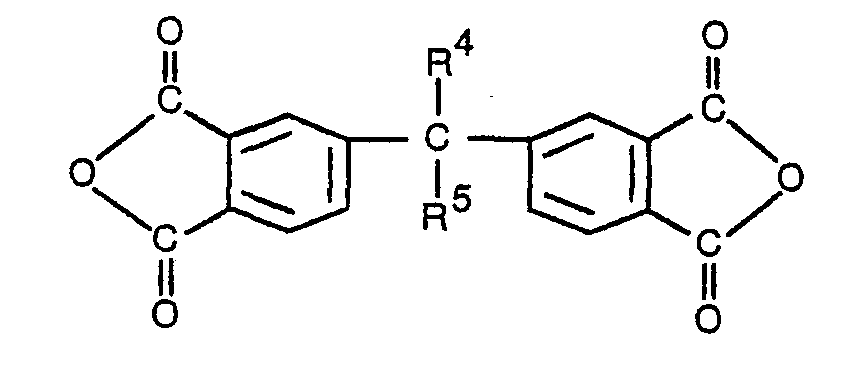
- R 4 and R 5 are selected from the group consisting of perfluoro and perhalofluoro aliphatic hydrocarbons having 1 to 8 carbons, perfluoro and perhalofluoro designate materials which do not contain hydrogen. Instead, the hydrogen is substituted totally by fluorine (perfluoro) or at least 1 fluorine and another halogen (perhalofluoro).
- R 4 and R 5 are selected from the group consisting of -CF 3 , -CCIF 2 and -CNrF 2 . Of particular interest, R 4 and R 5 are -CF 3 .
- the polymer of the formula wherein R ⁇ R 2 , R 3 , R 4 , R 5 and n are as defined earlier, may be prepared by one of at least two methods.
- One method involves preparing the addition product of an olefinically unsaturated monoepoxide on a product obtained by reacting a polycarboxylic dianhydride of the formula where R 4 and R 5 are as defined earlier, with at least one organic diamine having the structural formula wherein R 1 is a divalent radical containing at least 2 carbon atoms, the two amino groups of said diamine each attached to separate carbon atoms of said divalent radical.
- R 4 and R 5 of said polycarboxylic dianhydride have the formula CF 3 , so that the dianhydride is 2,2-bis(3,4-dicarboxyphenyl)-hexafluoropropane dianhydride.
- the 2,2-bis(3,4-dicarboxyphenyl)-hexafluoropropane dianhydride preferably utilized in the reaction product described above may be prepared in the manner detailed in U.S. Patent No. 3,310,573, issued March 21, 1967, to Coe.
- Suitable diamines include those described in more detail in U.S. Patent Nos. 3,179,614 and 3,179,634, both issued April 20, 1965, to Edwards. Also suitable are those diamines disclosed in the Coe patent (3,310,573), as well as those disclosed in U.S. Patent (3,959,350), issued May 25, 1976, to Rogers.
- Suitable diamines disclosed in the above-referenced patents to Edwards include aromatic diamines of the formula wherein R 1 is a divalent benzenoid radical selected from the group consisting of wherein R" is selected from the group consisting of an alkylene chain having 1-3 carbon atoms, -0-, _ S _ _ SO 2 _ , where R"' and R"" are radicals having 1-6 carbon atoms selected from the group consisting of alkyl and aryl.
- Diamines disclosed in the above-referenced patent to Rogers additionally include diamines of the formula H 2 N _ R 1_ NH 2 wherein R 1 is Exemplary diamines of such structure include:
- Suitable diamines disclosed on the above-referenced patent to Coe include diaryl fluoro diamines having the structure wherein R 4 and R 5 have the formula CCI, " F3-m, where m is 0 or 1,
- a and A' are selected from the group consisting of H, Cl, Br; and N0 2 .
- any suitable solvent for reacting the polycarboxylic dianhydride with the diamine may be used.
- suitable solvents are those organic solvents whose functional groups do not react with either the dianhydride or diamine to a greater extent than the latter do with each other.
- the organic solvent must be a solvent for at least one of the reactants (dianhydride or diamine), preferably for both of the reactants.
- a more detailed description of such suitable solvents may be found in two Edwards patents (3,179,614 and 3,179,634) and the Rogers patent (3,959,350).
- an olefinically unsaturaterd monoepoxide is added onto the reaction product prepared from the dianhydride and diamine.
- Such monoepoxides have the formula wherein R 7 is an olefinically unsaturated radical, preferably containing a (meth)acrylic ester-containing group.
- Preferred olefinically unsaturated monoepoxides are the unsaturated epoxides glycidyl acrylate and glycidal methacrylate.
- the following formula shows an addition product of glycidyl methacrylate on the product obtained by reacting 2,2-bis(3,4-dicarboxyphenyl)-hexafluoropropane dianhydride with 4,4'-diamine diphenyl ether:
- a composition of the addition product in a solvent for the dianhydride/diamine reaction will contain about 10-50% by weight, based on the combined weight of the addition product and solvent, of the addition product and about 50-90% by weight of the solvent.
- dianhydride/diamine reaction product a polyamic acid
- the end-position acid anhydride groups are intercepted or bound, and compounds with a clearly defined structure are obtained.
- the solubility also can be influenced by means of this intercept reagent, and, particularly, photosensitivity of the addition product is enhanced due to the unsaturated nature of this intercept reagent.
- a second method for preparing the polymer of the formula wherein R 1 , R 2 , R 3 , R 4 , R 5 and n are as defined earlier, is disclosed in the aforementioned Rubner U.S. Reisssue Patent 30,186.
- the Rubner method involves esterifying an aromatic polycarboxylic acid anhydride with a hydroxy alkyl acrylate or methacrylate, then converting that esterification product to a corresponding acid chloride derivative, and finally reacting said acid chloride derivative with diamine.
- aromatic polycarboxylic acid anhydride utilized is, of course, of the formula where R 4 and R 5 are as described earlier.
- a particularly preferred dianhydride is 2,2-bis(3,4-dicarboxyphenyl)-hexafluoropropane dianhydride, the preparation of which is described earlier.
- suitable diamines include those described above, and detailed in the two Edwards, the Coe, and the Rogers patents.
- a method for preparing the polymer from diaryl fluoronated diamines involves preparing the addition product of an olefinically unsaturated monoepoxide on a product obtained by reacting a tetracarboxylic acid dianhydride with at least one organic diamine having the structural formula wherein R 4 and R 5 are selected from the group consisting of perfluoro and perhalofluoro aliphatic hydrocarbons having 1 to 8 carbons; and A and A' are selected from the group consisting of H, Cl, Br, and N0 2 .
- organic diamines preferably utilized in the reaction product described above may be prepared in the manner detailed in U.S. Patent No. 3,310,573, issued March 21, 1967, to Coe.
- Particular diamines of interest include:
- Tetracarboxylic acid dianhydrides suitable for this invention are characterized by the following formula wherein R 6 is a tetravelent, aromatic, organic radical containing at least one ring of six carbon atoms, said ring characterized by benzenoid unsaturation, the four carbonyl groups being attached directly to separate carbon atoms in a ring of the R 6 radical, and wherein each pair of carbonyl groups is directly attached to adjacent carbon atoms in the R 6 group to provide a 5-membered ring as follows:
- dianhydrides suitable for use in the present invention include: pyromellitic dianhydride, 2,3,6-naphthalene tetracarboxylic dianhydride, 3,3',-4,4'-diphenyl tetracarboxylic dianhydride, 1,2,5,6-naphthalene tetracarboxylic dianhydride, 2,2-3,3'-diphenyl tetracarboxylic dianhydride-2,2-bis(3,4-dicarboxyphenyl) propane dianhydride, bis(3,4-dicarboxyphenyl) sulfone dianhydride, perylene 3,4,9,10-tetracarboxylic acid dianhydride, bis(3,4-dicarboxyphenyl) ether dianhydride, naphthalene-1,2,4,5-tetracarboxylic dianhydride, 2,2-bis(2,3-diacarboxypheyl) propane dianhydride, 1,1
- Any suitable solvent for reacting the tetracarboxylic acid dianhydride with the diamine may be used.
- suitable solvents are those organic solvents whose functional groups do not react with the either the dianhydride, or diamine to a greater extent than the latter do with each other.
- the organic solvent must be a solvent for at least one of the reactants (dianhydride or diamine), preferably for both the reactants.
- a more detailed description of such suitable solvents may be found in U.S. Patents No. 3,179,614 and 3,179,634, both issued April 20, 1965 to Edwards, and U.S. Patent No. 3,959,350, issued May 25, 1976 to Rogers.
- an olefinically unsaturated monoepoxide is added onto the reaction product prepared from the dianhydride and diamine.
- Such monoepoxides have the formula wherein R 7 is an olefinically unsaturated radical, preferably containing a (meth) acrylic ester-containing group.
- Preferred olefinically unsaturated monoepoxides are the unsaturated epoxides glycidyl acrylate and glycidal methacrylate.
- a composition of the addition product in a solvent for the dianhydride/diamine reaction will contain about 10-50% by weight, based on the combined weight of the addition product and solvent, of the addition product and about 50-90% by weight of the solvent.
- dianhydride/diamine reaction product a polyamic acid
- the end-position acid anhydride groups are intercepted or bound, and compounds with a clearly defined structure are obtained.
- the solubility also can be influenced by means of this intercept reagent and, particularly, photosensitivity of the addition product is enhanced due to the unsaturated nature of this intercept reagent.
- the Rubner method involves esterifying an aromatic polycarboxylic acid anhydride with a hydroxy alkyl acrylate or methacrylate, then converting that esterification product to a corresponding acid chloride derivative, and finally reacting said acid chloride derivative with diamine.
- the aromatic polycarboxylic acid anhydrides are the tatracarboxylic acid dianhydrides described above, the diamine has the structural formula wherein R 4 , R 5 , A and A' are as defined earlier.
- typical hydroxy alkyl acrylates and methacrylates are as follows: Hydroxyethyl acrylate, hydroxypropyl acrylate, hydroxy butyl acrylate, hydroxy ethyl methacrylate, hydroxypropyl methacrylate, hydroxybutyl methacrylate and the like.
- Thionyl chloride typically may be used to convert the esterification product to a corresponding acid chloride.
- Typical solvents in which the esterification of the dianhydride and subsequent reaction of the acid chloride derivative with diamine can take place include butyrolactone, tetrahydrofuran, hexamethylphosphoric acid triamide, and combinations of the above.
- Other suitable solvents include those disclosed in the two Edwards and the Rodgers patents and which do not react with the thionyl chloride or any other reagant used to form the acid chloride derivative.
- a photopolymerizable polyimide precursor composition of the present invention also comprises:
- Typical useful radiation sensitive polymerizable polyfunctional acrylate compounds are as follows: trimethylol propane trimethacrylate, trimethylol propane triacrylate, trimethylol propane ethoxylate polyethoxylate trimethacrylate, trimethylol propane polyoxylate triacrylate and mixtures thereof.
- trimethylol propane polyethoxylate triacrylate having a weight average molecular weight of about 500-1500 and trimethylol propane ethoxylate triacrylate, penaerythritol triacrylate, polyethylene glycol diacrylate, polyethylene glycol dimethacrylate, polymethylene diacrylate, polyethylene dimethacrylate, trimethylene glycol dimethyacrylate, tetraethylene glycol diacrylate.
- Typical aromatic biimidazole photopolymerization initiators are disclosed by Chambers U.S. 3,479,185 issued November 18, 1969 and Cescon U.S. 3,784,557 issued January 9, 1974.
- a 2,4,5-triphenyl imidazolyl dimer having an ortho substituent on the 2 phenyl ring is a particularly useful initiator.
- Typical initiators of this type are 2-o-chlorophenyl-4,5-diphenyl imidazoyl dimer, 2-(o-methoxyphenyl)-4,5-diphenyl imidazoyl dimer, 2(o-flurorophenyul)-4,5-diphenyl imidazoyl dimer (2-o-fluorohenyl)-4,5-diphenyl imidazolyl dimer 2-(o-methoxyphenyl)-4,5-diphenyl imidazolyl dimer and mixtures thereof.
- hexaaryl biimidszoles can be used as photopolymerization initiators as shown in Fishman U.S. Patent No. 3,552,973 issued January 5, 1971.
- Typical useful hydrogen donors, photosensitizers and photoinitiators include the following aromatic ketones such as benzophenone, Michler's ketone (4,4'-bis(dimethylamino) benzophenone], 4,4'- bis(diethylamino) benzophenone, 4-acyryloxy-4'-diethylaminobenzophenone, (4-methoxy-4'-diethylaminobenzophenone, 2-ethylanthraquinone, phenantraquinone, 2-t-butylanthraquinone, 1,2- benzathraquinone, 2,3-benzanthraquinone, 2,3-di-chloronaphthoquinone, benzil dimethyl ketal, and other aromatic ketones such as disclosed in the aforementioned U.S.
- benzoin benzoin ethers such as benzoin methyl ether, benzoin ethyl ether, benzoin isobutyl ether, and benzoin phenyl ether, methylbenzoin, ethylbenzoil and other benzoins, mercaptobenzothiazole, mercaptobenzoxazoles as disclosed in U.S. Patent 4,291,115 and n-phenyl glycine.
- the photopolymerization time is longer if the photosensitizer is not added.
- the photopolymerization is enhanced by the addition of photosensitiziers, photoinitiators, or mixtures thereof, it is preferred that such compounds be used in the composition in amounts of about 0.1 to 15% by weight, of the composition.
- Leuco dyes can be used such as those disclosed in the aforementioned U.S. 3,552,973 col. 6, line 6, to col. 11, line 9.
- useful dyes are alkyl amino-aromatic alkanes such as tris(diethylamino-o-tolyl) methane, tris(dimethylamino-o-oxylyl) methane and tris(dipropyl amino-o-tolyl) methane.
- Plasticizers can also be added to the composition of the present invention in amounts of 0.1-10% by weight, based on the weight of the polymer product.
- Typical plasticizers are tricresyl phosphate, dioctyl phthalate, dihexyl phthalate, dinonyl phthalate, polyethylene, glycol ethers, ethylene glycol dicaprolate.
- the composition is applied and then dried to form a film at about 30-100°C for about 20 minutes to 5 hours, depending upon the coating thickness.
- the film is then exposed to actinic radiation through a pattern for about 1 second to 5 minutes.
- exposure times of 1-60 seconds are required and usually an exposure time under 30 seconds is much preferred.
- Typical radiation sources are ultraviolet lamps providing a wave length of 250 to 400 nm and an intensity of 0.5-60 mW/cm 2 .
- the film is then dipped or sprayed, with a developer solution.
- Typical developer solutions are 4-butyrolactone/toluene in a weight ratio from 2/1 to 1/ 4, dimethyl formamide/ethanol in a weight ratio from 2/1 to 1/4.
- the film is then washed with a nonsolvent and afterwards, dried.
- the film is cured to a polyimide relief structure by baking at about 150-450°C for about 20 minutes to 4 hours. During curing, the acrylate components are decomposed leaving a formed polyimide structure.
- the resulting relief structure has a sharp definition, as well as good chemical, electrical and mechanical properties.
- compositions are as follow: protective coatings for semiconductors, dielectric layers for multilayer integrated circuits, high temperature solder mask, bonding multilayer circuits, a final passivating coating on electrical electronic devices and the like.
- composition A (Polymer Product)
- GMA glycidyl methacrylate
- benzyldimethylamine 0.03 grams of hydroquinone were added in that order.
- the mixture was then warmed to between about 50° to 60°C and stirred for 15 hours.
- the reaction solution was then cooled to room temperature and washed with 5 x 50 milliliters of petroleum ether to remove unreacted GMA.
- the polymer product was isolated by the dropwise addition of the reaction solution into 1,000 milliliters of a blend of aromatic hydrocarbons (such as sold by Union Oil Chemical Division as "Super High Flash Naphtha H-596") accompanied by vigorous stirring.
- the resulting gelatinous precipitate was triturated with 2 x 500 milliliters of petroleum ether and suction filtered to yield the product as a white solid (Composition A).
- a photopolymerizable polyimide precursor composition of the present invention was prepared by charging the following constituents into a container and placing the container on a roller where it was mixed for 2 hours:
- the above Composition B was filtered through a 1 micrometer filter.
- a 5.08 cm (2-inch) diameter silicon wafer was coated with a aminosilane adhesion promoter solution by a spin coating technique wherein the wafer was rotated at 3000 rpm for 30 seconds after the adhesion promoter solution was applied.
- Composition B was applied to the wafer by the above spin technique using 3000 rpm for 60 seconds. This wafer with a coating of Composition B was then dried for 2 hours at 50°C, after which it was exposed to an ultraviolet light source of 365 nanometers (nm) and an intensity of about 5 mW/cm 2 , said light passing through a masking template.
- an ultraviolet light source of 365 nanometers (nm) and an intensity of about 5 mW/cm 2 , said light passing through a masking template.
- the wafer was then developed by dipping it for 20 seconds in a 1/1 solution of 4-butylactone/toluene and then rinsing it for 10 seconds with a spray of toluene to remove any unexposed composition.
- the wafer was then spun dry at 3000 rpm for 60 seconds.
- the wafer was, finally, heated and held at about 300°C for 1 hour to provide a polymide relief structure of an electronic circuit, which is characterized by sharp, clean lines.
- composition A (Polymer Product)
- GMA glycidyl methacrylate
- benzyldimethylamine 0.03 grams of hydroquinone were added in that order.
- the mixture was then warmed to between about 50° to 60° and stirred for 15 hours.
- the reaction solution was then cooled to room temperature and washed with 5 x 50 milliliters of petroleum ether to remove unreacted GMA.
- the polymer product was isolated by the dropwise addition of the reaction solution into 1,000 milliliters of a blend of aromatic hydrocarbons (such as is sold by Union Oil Chemical Division as "Super High Flash Naphtha H-596") accompanied by vigorous stirring.
- the resulting gelatinous precipitate was triturated with 2 x 500 milliliters of petroleum ether and suction filtered to yield the product as a white solid (Composition A) with an acid number of 77.5.
- Infrared spectra data indicated carbonyl frequencies of 1720 and 1630 cm- 1 .
- a photopolymerizable polyimide precursor composition of the present invention was prepared by charging the following cxonstituents into a container and placing the container on a roller where it was mixed for 2 hours:
- the above Composition B was filtered through a 1 micrometer filter.
- a 5.08 cm (2-inch) diameter silicon wafer was coated with a aminosilane adhesion promoter solution by a spin coating technique wherein the wafer was rotated at 3000 rpm for 30 seconds after the adhesion promoter solution was applied.
- Composition B was applied to the wafer by the above spin technique using 3000 rpm for 60 seconds. This wafer with a coating of Composition B was then dried for 2 hours at 50°C, after which it was exposed to an ultraviolet light source of 365 nanometers (nm) and an intensity of about 5 mW/cm 2 , said light passing through a masking template.
- an ultraviolet light source of 365 nanometers (nm) and an intensity of about 5 mW/cm 2 , said light passing through a masking template.
- the wafer was then developed by dipping it for 20 seconds in a 1/1 solution of 4-butyrolactone/toluene and then rinsing it for 10 seconds with a spray of toluene to remove any unexposed composition.
- the wafer was then spun dry at 3000 rpm for 60 seconds.
- the wafer was, finally, heated and held at about 300°C for 1 hour to provide a polyimide relief structure of an electronic circuit, which is characterized by sharp, clean lines spaced as little as 3 microns apart, as examined under magnification at 150 x.
Landscapes
- Chemical & Material Sciences (AREA)
- Physics & Mathematics (AREA)
- Health & Medical Sciences (AREA)
- Chemical Kinetics & Catalysis (AREA)
- Medicinal Chemistry (AREA)
- Polymers & Plastics (AREA)
- Organic Chemistry (AREA)
- Spectroscopy & Molecular Physics (AREA)
- General Physics & Mathematics (AREA)
- Macromolecular Compounds Obtained By Forming Nitrogen-Containing Linkages In General (AREA)
- Macromonomer-Based Addition Polymer (AREA)
Claims (20)




Applications Claiming Priority (6)
| Application Number | Priority Date | Filing Date | Title |
|---|---|---|---|
| US33676582A | 1982-01-04 | 1982-01-04 | |
| US336765 | 1982-01-04 | ||
| US06/427,415 US4416973A (en) | 1982-01-04 | 1982-09-29 | Radiation-sensitive polyimide precursor composition derived from a diaryl fluoro compound |
| US427415 | 1982-09-29 | ||
| US06/430,856 US4430418A (en) | 1982-09-30 | 1982-09-30 | Radiation-sensitive polyimide precursor composition derived from a diaryl fluoronated diamine compound |
| US430856 | 1982-09-30 |
Publications (3)
| Publication Number | Publication Date |
|---|---|
| EP0084269A2 EP0084269A2 (fr) | 1983-07-27 |
| EP0084269A3 EP0084269A3 (en) | 1983-12-21 |
| EP0084269B1 true EP0084269B1 (fr) | 1987-10-28 |
Family
ID=27407151
Family Applications (1)
| Application Number | Title | Priority Date | Filing Date |
|---|---|---|---|
| EP82307025A Expired EP0084269B1 (fr) | 1982-01-04 | 1982-12-31 | Composition sensible au rayons comprenant un précurseur d'un polyimide dérivé d'un composé fluorodiaryle |
Country Status (8)
| Country | Link |
|---|---|
| EP (1) | EP0084269B1 (fr) |
| KR (1) | KR890004138B1 (fr) |
| CA (1) | CA1195039A (fr) |
| DE (1) | DE3277552D1 (fr) |
| HK (1) | HK26488A (fr) |
| IE (1) | IE54228B1 (fr) |
| IL (1) | IL67611A (fr) |
| SG (1) | SG3088G (fr) |
Families Citing this family (7)
| Publication number | Priority date | Publication date | Assignee | Title |
|---|---|---|---|---|
| ATE43924T1 (de) * | 1984-08-10 | 1989-06-15 | Siemens Ag | Thermostabiles, durch bestrahlung vernetzbares polymersystem fuer mikroelektronische anwendung. |
| JPS62143929A (ja) * | 1985-07-16 | 1987-06-27 | Kanegafuchi Chem Ind Co Ltd | ポリイミド前駆体薄膜 |
| EP0254230A3 (fr) * | 1986-07-22 | 1988-11-23 | Asahi Kasei Kogyo Kabushiki Kaisha | Film formant une photoréserve résistant à la chaleur |
| US4803147A (en) * | 1987-11-24 | 1989-02-07 | Hoechst Celanese Corporation | Photosensitive polyimide polymer compositions |
| JPH0680776A (ja) * | 1992-09-02 | 1994-03-22 | Asahi Chem Ind Co Ltd | ポリイミド前駆体及び組成物 |
| US5879858A (en) * | 1996-12-19 | 1999-03-09 | Kodak Polychrome Graphics, Llc | Photosensitive polymer composition containing photosensitive polyamide and negative working photosensitive element |
| US5925498A (en) * | 1997-06-16 | 1999-07-20 | Kodak Polychrome Graphics Llc | Photosensitive polymer composition and element containing photosensitive polyamide and mixture of acrylates |
Family Cites Families (7)
| Publication number | Priority date | Publication date | Assignee | Title |
|---|---|---|---|---|
| US3179614A (en) * | 1961-03-13 | 1965-04-20 | Du Pont | Polyamide-acids, compositions thereof, and process for their preparation |
| US3959350A (en) * | 1971-05-17 | 1976-05-25 | E. I. Du Pont De Nemours And Company | Melt-fusible linear polyimide of 2,2-bis(3,4-dicarboxyphenyl)-hexafluoropropane dianhydride |
| US3888672A (en) * | 1972-07-31 | 1975-06-10 | Du Pont | Photopolymerizable process capable of yielding a reverse image |
| DE2967162D1 (en) * | 1978-09-29 | 1984-09-13 | Hitachi Ltd | Light-sensitive polymer composition |
| DE2933827A1 (de) * | 1979-08-21 | 1981-03-12 | Siemens AG, 1000 Berlin und 8000 München | Verfahren zur herstellung hochwaermebestaendiger reliefstrukturen und deren verwendung. |
| US4308338A (en) * | 1980-03-26 | 1981-12-29 | E. I. Du Pont De Nemours And Company | Methods of imaging photopolymerizable materials containing diester polyether |
| US4329419A (en) * | 1980-09-03 | 1982-05-11 | E. I. Du Pont De Nemours And Company | Polymeric heat resistant photopolymerizable composition for semiconductors and capacitors |
-
1982
- 1982-12-30 CA CA000418747A patent/CA1195039A/fr not_active Expired
- 1982-12-31 EP EP82307025A patent/EP0084269B1/fr not_active Expired
- 1982-12-31 DE DE8282307025T patent/DE3277552D1/de not_active Expired
-
1983
- 1983-01-03 IL IL67611A patent/IL67611A/xx not_active IP Right Cessation
- 1983-01-03 IE IE1/83A patent/IE54228B1/en not_active IP Right Cessation
- 1983-01-04 KR KR1019830000010A patent/KR890004138B1/ko not_active Expired
-
1988
- 1988-01-08 SG SG30/88A patent/SG3088G/en unknown
- 1988-04-14 HK HK264/88A patent/HK26488A/en not_active IP Right Cessation
Also Published As
| Publication number | Publication date |
|---|---|
| HK26488A (en) | 1988-04-22 |
| SG3088G (en) | 1988-06-17 |
| KR840003365A (ko) | 1984-08-20 |
| EP0084269A2 (fr) | 1983-07-27 |
| IE54228B1 (en) | 1989-07-19 |
| CA1195039A (fr) | 1985-10-08 |
| DE3277552D1 (en) | 1987-12-03 |
| IE830001L (en) | 1983-07-04 |
| IL67611A (en) | 1986-02-28 |
| IL67611A0 (en) | 1983-05-15 |
| KR890004138B1 (ko) | 1989-10-21 |
| EP0084269A3 (en) | 1983-12-21 |
Similar Documents
| Publication | Publication Date | Title |
|---|---|---|
| US4416973A (en) | Radiation-sensitive polyimide precursor composition derived from a diaryl fluoro compound | |
| US4454220A (en) | Electrical device containing a radiation-sensitive polyimide precursor composition derived from a diaryl fluoro compound | |
| EP0047184B1 (fr) | Composition polymérisable par radiation pour la formation des structures en relief résistant à la chaleur sur des dispositifs électriques comme semi-conducteurs et condensateurs | |
| US4430418A (en) | Radiation-sensitive polyimide precursor composition derived from a diaryl fluoronated diamine compound | |
| JPH02142828A (ja) | 感放射線混合物及びその製造方法 | |
| EP0430221B1 (fr) | Composition résineuse photosensible | |
| EP0084269B1 (fr) | Composition sensible au rayons comprenant un précurseur d'un polyimide dérivé d'un composé fluorodiaryle | |
| JP2516276B2 (ja) | 感光性樹脂組成物 | |
| JPH0827538B2 (ja) | 感光性樹脂組成物 | |
| JP2550249B2 (ja) | 感光性樹脂の製造方法 | |
| JPH0130861B2 (fr) | ||
| JPH0990632A (ja) | 感光性樹脂組成物及びそのパターン形成方法 | |
| JPH0674323B2 (ja) | 感光性樹脂の製造方法 | |
| JPH0470661A (ja) | 感光性樹脂組成物 | |
| JPH01283554A (ja) | 耐熱感光性重合体組成物 | |
| JP2693670B2 (ja) | 感光性樹脂組成物 | |
| JP2546940B2 (ja) | 感光性樹脂組成物 | |
| JPH03233457A (ja) | 感光性樹脂組成物 | |
| JPH0495962A (ja) | 感光性樹脂組成物 | |
| JPH0680780A (ja) | 感光性樹脂の製造方法 | |
| JPH0651512A (ja) | 感光性樹脂組成物 | |
| Goff et al. | Radiation polymerizable compositions | |
| JP2004271801A (ja) | 感光性樹脂組成物およびその製造方法 | |
| JPH0386760A (ja) | 感光性樹脂組成物 | |
| JP2003316002A (ja) | 感光性樹脂組成物、これを用いたパターン製造方法及び電子部品 |
Legal Events
| Date | Code | Title | Description |
|---|---|---|---|
| PUAI | Public reference made under article 153(3) epc to a published international application that has entered the european phase |
Free format text: ORIGINAL CODE: 0009012 |
|
| AK | Designated contracting states |
Designated state(s): BE DE FR GB |
|
| PUAL | Search report despatched |
Free format text: ORIGINAL CODE: 0009013 |
|
| AK | Designated contracting states |
Designated state(s): BE DE FR GB |
|
| 17P | Request for examination filed |
Effective date: 19840606 |
|
| GRAA | (expected) grant |
Free format text: ORIGINAL CODE: 0009210 |
|
| AK | Designated contracting states |
Kind code of ref document: B1 Designated state(s): BE DE FR GB |
|
| REF | Corresponds to: |
Ref document number: 3277552 Country of ref document: DE Date of ref document: 19871203 |
|
| ET | Fr: translation filed | ||
| PLBE | No opposition filed within time limit |
Free format text: ORIGINAL CODE: 0009261 |
|
| STAA | Information on the status of an ep patent application or granted ep patent |
Free format text: STATUS: NO OPPOSITION FILED WITHIN TIME LIMIT |
|
| 26N | No opposition filed | ||
| PG25 | Lapsed in a contracting state [announced via postgrant information from national office to epo] |
Ref country code: BE Effective date: 19891231 |
|
| BERE | Be: lapsed |
Owner name: E.I. DU PONT DE NEMOURS AND CY Effective date: 19891231 |
|
| PGFP | Annual fee paid to national office [announced via postgrant information from national office to epo] |
Ref country code: DE Payment date: 19990902 Year of fee payment: 18 |
|
| PGFP | Annual fee paid to national office [announced via postgrant information from national office to epo] |
Ref country code: FR Payment date: 19990920 Year of fee payment: 18 |
|
| PGFP | Annual fee paid to national office [announced via postgrant information from national office to epo] |
Ref country code: GB Payment date: 19991001 Year of fee payment: 18 |
|
| PG25 | Lapsed in a contracting state [announced via postgrant information from national office to epo] |
Ref country code: GB Free format text: LAPSE BECAUSE OF NON-PAYMENT OF DUE FEES Effective date: 20001231 |
|
| GBPC | Gb: european patent ceased through non-payment of renewal fee |
Effective date: 20001231 |
|
| PG25 | Lapsed in a contracting state [announced via postgrant information from national office to epo] |
Ref country code: FR Free format text: LAPSE BECAUSE OF NON-PAYMENT OF DUE FEES Effective date: 20010831 |
|
| REG | Reference to a national code |
Ref country code: FR Ref legal event code: ST |
|
| PG25 | Lapsed in a contracting state [announced via postgrant information from national office to epo] |
Ref country code: DE Free format text: LAPSE BECAUSE OF NON-PAYMENT OF DUE FEES Effective date: 20011002 |