EP0085917A2 - Millimikrongrosse Teilchen enthaltende faserige Medien - Google Patents
Millimikrongrosse Teilchen enthaltende faserige Medien Download PDFInfo
- Publication number
- EP0085917A2 EP0085917A2 EP83100827A EP83100827A EP0085917A2 EP 0085917 A2 EP0085917 A2 EP 0085917A2 EP 83100827 A EP83100827 A EP 83100827A EP 83100827 A EP83100827 A EP 83100827A EP 0085917 A2 EP0085917 A2 EP 0085917A2
- Authority
- EP
- European Patent Office
- Prior art keywords
- matrix
- particulate
- resin
- weight
- slurry
- Prior art date
- Legal status (The legal status is an assumption and is not a legal conclusion. Google has not performed a legal analysis and makes no representation as to the accuracy of the status listed.)
- Granted
Links
Images



Classifications
-
- B—PERFORMING OPERATIONS; TRANSPORTING
- B01—PHYSICAL OR CHEMICAL PROCESSES OR APPARATUS IN GENERAL
- B01J—CHEMICAL OR PHYSICAL PROCESSES, e.g. CATALYSIS OR COLLOID CHEMISTRY; THEIR RELEVANT APPARATUS
- B01J20/00—Solid sorbent compositions or filter aid compositions; Sorbents for chromatography; Processes for preparing, regenerating or reactivating thereof
- B01J20/28—Solid sorbent compositions or filter aid compositions; Sorbents for chromatography; Processes for preparing, regenerating or reactivating thereof characterised by their form or physical properties
- B01J20/28014—Solid sorbent compositions or filter aid compositions; Sorbents for chromatography; Processes for preparing, regenerating or reactivating thereof characterised by their form or physical properties characterised by their form
- B01J20/28028—Particles immobilised within fibres or filaments
-
- A—HUMAN NECESSITIES
- A61—MEDICAL OR VETERINARY SCIENCE; HYGIENE
- A61K—PREPARATIONS FOR MEDICAL, DENTAL OR TOILETRY PURPOSES
- A61K35/00—Medicinal preparations containing materials or reaction products thereof with undetermined constitution
- A61K35/12—Materials from mammals; Compositions comprising non-specified tissues or cells; Compositions comprising non-embryonic stem cells; Genetically modified cells
- A61K35/14—Blood; Artificial blood
- A61K35/16—Blood plasma; Blood serum
-
- A—HUMAN NECESSITIES
- A61—MEDICAL OR VETERINARY SCIENCE; HYGIENE
- A61L—METHODS OR APPARATUS FOR STERILISING MATERIALS OR OBJECTS IN GENERAL; DISINFECTION, STERILISATION OR DEODORISATION OF AIR; CHEMICAL ASPECTS OF BANDAGES, DRESSINGS, ABSORBENT PADS OR SURGICAL ARTICLES; MATERIALS FOR BANDAGES, DRESSINGS, ABSORBENT PADS OR SURGICAL ARTICLES
- A61L2/00—Disinfection or sterilisation of materials or objects, in general; Accessories therefor
- A61L2/02—Disinfection or sterilisation of materials or objects, in general; Accessories therefor using physical processes
- A61L2/022—Filtration
-
- B—PERFORMING OPERATIONS; TRANSPORTING
- B01—PHYSICAL OR CHEMICAL PROCESSES OR APPARATUS IN GENERAL
- B01D—SEPARATION
- B01D39/00—Filtering material for liquid or gaseous fluids
-
- B—PERFORMING OPERATIONS; TRANSPORTING
- B01—PHYSICAL OR CHEMICAL PROCESSES OR APPARATUS IN GENERAL
- B01D—SEPARATION
- B01D39/00—Filtering material for liquid or gaseous fluids
- B01D39/14—Other self-supporting filtering material ; Other filtering material
-
- B—PERFORMING OPERATIONS; TRANSPORTING
- B01—PHYSICAL OR CHEMICAL PROCESSES OR APPARATUS IN GENERAL
- B01J—CHEMICAL OR PHYSICAL PROCESSES, e.g. CATALYSIS OR COLLOID CHEMISTRY; THEIR RELEVANT APPARATUS
- B01J20/00—Solid sorbent compositions or filter aid compositions; Sorbents for chromatography; Processes for preparing, regenerating or reactivating thereof
- B01J20/28—Solid sorbent compositions or filter aid compositions; Sorbents for chromatography; Processes for preparing, regenerating or reactivating thereof characterised by their form or physical properties
- B01J20/28002—Solid sorbent compositions or filter aid compositions; Sorbents for chromatography; Processes for preparing, regenerating or reactivating thereof characterised by their form or physical properties characterised by their physical properties
- B01J20/28004—Sorbent size or size distribution, e.g. particle size
-
- B—PERFORMING OPERATIONS; TRANSPORTING
- B01—PHYSICAL OR CHEMICAL PROCESSES OR APPARATUS IN GENERAL
- B01J—CHEMICAL OR PHYSICAL PROCESSES, e.g. CATALYSIS OR COLLOID CHEMISTRY; THEIR RELEVANT APPARATUS
- B01J20/00—Solid sorbent compositions or filter aid compositions; Sorbents for chromatography; Processes for preparing, regenerating or reactivating thereof
- B01J20/28—Solid sorbent compositions or filter aid compositions; Sorbents for chromatography; Processes for preparing, regenerating or reactivating thereof characterised by their form or physical properties
- B01J20/28014—Solid sorbent compositions or filter aid compositions; Sorbents for chromatography; Processes for preparing, regenerating or reactivating thereof characterised by their form or physical properties characterised by their form
- B01J20/28033—Membrane, sheet, cloth, pad, lamellar or mat
-
- B—PERFORMING OPERATIONS; TRANSPORTING
- B01—PHYSICAL OR CHEMICAL PROCESSES OR APPARATUS IN GENERAL
- B01J—CHEMICAL OR PHYSICAL PROCESSES, e.g. CATALYSIS OR COLLOID CHEMISTRY; THEIR RELEVANT APPARATUS
- B01J20/00—Solid sorbent compositions or filter aid compositions; Sorbents for chromatography; Processes for preparing, regenerating or reactivating thereof
- B01J20/28—Solid sorbent compositions or filter aid compositions; Sorbents for chromatography; Processes for preparing, regenerating or reactivating thereof characterised by their form or physical properties
- B01J20/28014—Solid sorbent compositions or filter aid compositions; Sorbents for chromatography; Processes for preparing, regenerating or reactivating thereof characterised by their form or physical properties characterised by their form
- B01J20/28052—Several layers of identical or different sorbents stacked in a housing, e.g. in a column
-
- A—HUMAN NECESSITIES
- A61—MEDICAL OR VETERINARY SCIENCE; HYGIENE
- A61L—METHODS OR APPARATUS FOR STERILISING MATERIALS OR OBJECTS IN GENERAL; DISINFECTION, STERILISATION OR DEODORISATION OF AIR; CHEMICAL ASPECTS OF BANDAGES, DRESSINGS, ABSORBENT PADS OR SURGICAL ARTICLES; MATERIALS FOR BANDAGES, DRESSINGS, ABSORBENT PADS OR SURGICAL ARTICLES
- A61L2103/00—Materials or objects being the target of disinfection or sterilisation
- A61L2103/05—Living organisms or biological materials
Definitions
- the present invention relates to fibrous media containing millimicron sized particulates, especially media containing fumed silica or fumed alumina.
- porous filter media described in these applications are comprised of fiber-particulate and fiber-fiber mixtures, with cationic charge modifiers serving as charge modifiers, wet strength providers and also as flocculating or dispersion agents in the forming slurry system.
- the mixtures are formed dynamically into sheets by vacuum felting from an aqueous slurry, and subsequently drying the finished sheets as the final product.
- the rate of production of such porous filter media is governed by the porosity of the sheets to be produced.
- a highly open filter media comprising particle sizes of 50 microns or larger requires only a few seconds to be felted, whereas a tight media utilizing particle sizes of 1-2 microns or smaller would require more than 5 minutes to be felted.
- media containing the finest grades of particulate additives cannot be felted at all due to improper flocculation. Therefore, it is impossible to form a fibrous media with adsorbent particles less than'l micron by current techniques.
- the retention of such small size particles in the matrix structure is a serious problem. Most of them are lost to the water drainage during felting.
- the limitations and drawbacks involved in current fibrous media manufacturing processes can be understood from the following method of formation.
- the application of vacuum for the formation of fibrous media is predominantly a hydromechanical process.
- a slurry containing all the components drains through a 100 mesh wire screen perpendicular to the plane of the screen, and drags all the components with its movement during felting.
- This process provides a self-adjusting mechanism for uniform distribution of particles and fibers in the fibrous structure, based upon the fact that the drainage flow always seeks the path of least resistance.
- silica The removal of lipids through adsorption on silica is a common practice in chemistry and biochemistry. See e.g. Stephan, U.S. Patent 3,686,395 and commonly asigned copending U.S. Patent Application Serial No. 238,686 filed February 27, 1981 to Carpenter and Cone entitled TISSUE CULTURE MEDIA.
- the efficiency of lipid removal by silica differs with the process by which the silica is made.
- Silicas precipitated from the vapor phase are better lipid removal agents than those precipitated from sodium silicate solutions.
- Typical commercial products of silicas made from vapor phase are Cab-O-Sil®, Acrostic (Degussa) or Sipernet 22SO.
- Fumed silica is fluffy and low in density (approximately 2 lbs. per cu. ft.). Even a small amount of fumed silica packed in a column will create extremely high pressures upon contact with buffer solutions, due to the formation of a three dimensional network among the particles, with water molecules functioning as bridges. When prior art methods of dispersal of particulates in fibrous media are applied to fumed silica, the previously mentioned problems of fabrication, retention and porosity are observed.
- Fumed silica - albeit not in immobilized form - has been used for the removal of hepatitis B surface antigen from fluids e.g. Stephan U.S. Patent 3,686,395.
- Other methods of removing viruses from fluids are taught in Porath et al U.S. Patent 3,925,152, Andersson et al U.S. Patent 4,168,300, Wallis et al U.S. Patent 3,770,625, Vnek et al U.S. Patent 3,951,937 and Bick et al U.S. Patent 4,057,628. None of these references uses or suggests immobilized inorganic adsorbants.
- particulate aids are mentioned diatomaceous earth, perlite, talc, silica gel, etc., having a high surface area, and being preferably siliceous materials such as the finer grades of diatomaceous earth-perlite.
- anionic charge modifiers are so as to provide high electrokinetic capture potential for positively charged fluid contaminants.
- inorganic (rather than organic) charge modifiers is so as to prevent the possibility of extracting organic elements into the filtrate. No solution is offered for the production of microparticulate-containing fibrous media.
- Yet another object of the invention is to provide fibrous materials containing fumed silica and/or alumina immobilized therein.
- Still another object of the invention is to provide a method for the production of fibrous media containing fumed silica dispersed therein.
- Another object of the invention is to provide for a method of removal of HBsAg from fluids by using immobilized fumed silica, and a method of removal of pyrogens from fluids by using immobilized alumina.
- the present invention is based on the discovery that fabrication of self-supporting fibrous media containing millimicron sized particulate material ("micro- particulates") is greatly facilitated by addition to the forming slurry of two types of organic polymeric resins: One type being a polycationic resin and the other type being a polyanionic resin. Unless both types of resins are present in the slurry of fibers and micro- particulate material, the microparticulate material on the one hand fails to be flocculated or on the other hand, reaches a stage where a water impermeable gel-like structure is formed, both of which prevent felting; the vacuum felting of the slurry is severely hampered, and the micro-particulates fail to be retained by the fibrous matrix.
- self-supporting fibrous media is meant to include any coherent matrix of fibers which will maintain its shape and form when in the dry state, i.e., will not fall apart.
- the self-supporting fibrous media is a sheet made from at least one component which is a long, self-bonding structural fiber, to give the sheet sufficient structural integrity in both the wet "as formed,” and in the final dried condition, and also to allow handling during processing and suitability for the intended end use.
- Cellulose fibers such as wood pulp, cotton, cellulose acetate or rayon can be used. These fibers are typically relatively large, with commercially available diameters in the range of six to sixty micrometers. Wood pulp, can also be used, and has fiber diameters ranging from fifteen to twenty-five micrometers, and fiber lengths of about 0.85 to about 6.5 mm.
- the preferred fibrous matrix of the invention is a porous self-bonding sheet of cellulose fibers.
- the long self-bonding structural fibers are preferably obtained from normally dimensioned cellulose pulp such as manila hemp, jute, caroa, sisal, bleached or unbleached kraft, kozu and the like, which typically has a Canadian Standard Freeness of +400 to +800 ml. These long self-bonding fibers will constitute greater than 50% of the porous matrix, by weight, preferably about 66-90% of the porous matrix, and most preferably 75-83%.
- the porous matrix be formed of a self-bonding matrix of normal cellulose pulp having a Canadian Standard Freeness of +400 to +800 ml.
- micro-particulate i.e., greater than about 50% by weight of the medium immobilized in the porous matrix. It is thus desirable to use the invention described in copending application U. S. Serial No. 123,467 to Hou et al filed February 21, 1980, now U.S. Patent , to maintain such high content of micro-particulate in the matrix.
- the entire disclosure of this application is incorporated herein by reference. Broadly, a minor portion of cellulose pulp refined to a Canadian Standard Freeness (CSF) of between about +100 and -600 ml is incorporated with a major portion of the normally dimensioned cellulose pulp (+400 to +800 ml).
- CSF Canadian Standard Freeness
- the weight ratio of unrefined to highly refined pulp will range from about 2:1 to about 10:1, preferably 3:1 to about 5:1. Such a mixture of pulps permits the increased retention of the fine particulates of the invention.
- particulate material is meant to include any adsorbent or particulate used in the filter art for some time such as those disclosed in the following U. S. Patents, which are herein incorporated by reference: 2,143,044; 2,746,608; 3,238,056; 3,253,978; 3,591,010; 4,007,113; 4,160,059; 4,238,334; 3,669,841; 3,722,181; 3,795,313; 3,983,299; 4,029,583; 3,664,967; 4,053,565 and 4,105,426.
- useful particulate is fumed silica, fumed alumina, microcarbon, inorganic salts, and various mixtures thereof.
- the particulates include those which can serve as support for further chemical modification of the particles.
- at least some of the particulate material has on the average a diameter of less than 1 micron; i.e., a Gaussian distribution of particle diameters will have a maximum at less than 1 micron and is therefore termed "micro-particulate".
- Those sizes wherein this invention is most useful are less than 100 millimicrons, most preferred less than 50 millimicrons, especially between 1 and 25 millimicrons.
- the microparticulate is fumed silica or fumed alumina.
- fumed silica includes materials made from the hydrolysis of SiCl 4 vapor in a flame of hydrogen and oxygen, and have diameters between 5 and 20 millimicrons.
- Fumed alumina includes aluminum oxide produced by flame hydrolysis of anhydrous aluminum chloride (e.g. Aluminum Oxide C from Degussa).
- the micro-particulate is present in the matrix in weights of at least about 5%, preferably 20-90% by weight, preferably about 70% by total weight. It is possible to use as immobilized particulate a mixture of microparticulate (average diameter less than 1 micron), with coarser particulate (having average diameter larger than 1 micron) in any ratio, preferably 5-95 parts by weight of micro to 95-5 parts of coarse particulate ratio; the total particulates content would then be within 5-90%, as before.
- the critical aspect of the invention is the presence in the matrix of polysalts, formed by mixing organic polycationic resins with organic polyanionic resins. These polysalts flocculate the microparticulates and increase their retention in the matrix. Any organic polyanion or mixtures thereof, and polycation or mixtures thereof can be used.
- organic is meant that the polymeric backbone is composed predominantly from carbon and hydrogen atoms, with the possible presence of other elements normally present in organic structures such as nitrogen, oxygen, sulfur and occasionally phosphorous.
- the common backbones are polyvinyl, polyacrylate, polymethacrylate, polyoxy, polythioxy, and the like.
- polymeric is meant that the resin is composed of a plurality of repeating units.
- Typical molecular weights are 2,000-1,000,000 or more.
- the anionic or cationic characters of the resins are usually provided by the pendant groups.
- carboxylic acid, sulfonic acid, phosphoric acid, or phosphonic acid groups can be used as pendant groups.
- cationic resins as an example, the ammonium group in its mono, di, tri or tetraalkyl forms (especially lower alkyl) is the most ubiquitous pendant group, although any positively charged pendant group can in principle, be used (pyridinium, quinolinium, etc.) Occasionally, some resins contain the positive charge directly along the backbone, and these can also be used.
- polystyrenesulfonate sold as Dow S21291 or Enjay RS-781
- polyvinylsulfonate made by Hercules
- polyacrylic acid sold as K702 or K714 by Goodrich
- sodium polyacrylate sold as K718
- polymethylvinyl ether maleic anhydride copolymer Gantrez AN-139®
- polytak RNA® sold by Penninsular Chemicals
- polyvinyl butyltrimethyl ammonium chloride sold as QT2781 or XD-7036 by Dow
- polydiallyl dimethyl ammonium chloride Calgon Hydroid 261
- polyamine polyamide Hercules 1884®
- poly-4-vinylpyridinum chloride Ionic PP-110®
- the total amount of polysalt (polycation + polyanion) is that sufficient or effective to flocculate the micro-particulate present in the medium, but insufficient to form an impermeable gel which would prevent slurry felting.
- the amount can be from 0.5 to 15% of the total weight of fibrous media, preferably 1 to 3%.
- the ratio of polycation tb polyanion can be adjusted so that the overall charge of the polysalt is positive, neutral or negative, depending on the relative proportions of one type of resin or the other.
- the best results are obtained when the polysalt is substantially neutral, i.e., when there are stoichiometrically equivalent amounts of both resins.
- the amounts can be readily determined by a simple pH titration.
- non-stoichiometric complexes can give rise to specialty media having e.g., overall positive charge (for the preferential trapping of negatively charged particles), or vice ,ersa.
- the self supporting fibrous matrix of the invention is preferably made by vacuum-felting an aqueous slurry of fibers, resins and particulate. This forms a sheet having the particulate immobilized in a porous matrix.
- the sheet shows a uniform high porosity, fine pore-size structure with excellent flow charcteristics and is substantially homogeneous with respect to the fiber, resins and particulate.
- the vacuum felting is performed on a foraminous surface, normally a woven wire mesh which, in practice, may vary from 50 mesh to 200 mesh, with mesh openings ranging from 280 micrometers to 70 micrometers respectively. Finer meshes are unsuitable because of clogging problems and/or structural inadequacy.
- the size of the openings in the foraminous vacuum felting surface, and the pore size of the cellulose fiber matrix of the formed sheet, are quite large in comparison to some or all of the dimensions of the fine fiber or particulate components required to produce the desired submicronic filter media sheet.
- the sequence of adding the overall components to the slurry appears to be relatively unimportant, provided that the slurry is subjected to controlled hydrodynamic shear forces during the mixing process.
- the refined pulp is added to a slurry of the unrefined pulp and then the flocculated or unflocculated particulate is incorporated therein.
- the slurry is normally prepared at about 4% consistency and then diluted with additional water to the proper consistency required for vacuum-felting and sheet formation. This latter consistency will vary depending upon the type of equipment used to form the sheet.
- the slurry is cast onto a foraminous surface, vacuum felted, and dried in the conventional manner.
- the flat, dimensionally stable sheet can be of any desired thickness and is then cut to the appropriate dimensions for each type of application.
- the fibrous media of the invention containing micro- particulate can be used in a myriad of applications wherever the free microparticulate would be used, with the advantage of solid phase immobilization.
- the media can be utilized in all filtrations described in aforementioned copending U. S. Applications Serial Number 147,975 filed May 8, 1980; Serial Number 164,797 filed May 30, 1980 and Serial Number 123,467 filed February 21, 1981.
- the media can be preferably used in the molecular separation (e.g., chromatographic) processes disclosed in copending, application to Crowder U. S. Serial Number 287,609 filed July 28, 1981 for MOLECULAR SEPARATION COLUMN AND USE THEREOF herein incorporated by reference.
- the media can also be used in preparation of zero standard serum, as that disclosed in copending U. S.
- fumed-silica containing media is in the removal of lipid enveloped viruses, for example hepatitis B surface antigen (HBsAg) from fluids, especially biological fluids, especially serum. Still another use is for removal of mycoplasma from fluids. Immobilized fumed alumina can be used for the removal pyrogens, endotoxins, and the like.
- lipid enveloped viruses for example hepatitis B surface antigen (HBsAg) from fluids, especially biological fluids, especially serum.
- HBsAg hepatitis B surface antigen
- mycoplasma from fluids.
- Immobilized fumed alumina can be used for the removal pyrogens, endotoxins, and the like.
- the present invention provides a specific way to resolve these technical problems by adding both polycation and polyanion resins to the system.
- Table 1 shows the media made by this process, as well as the felting times.
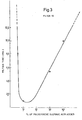
- FIGURE 1 The change of viscosity of the fumed silica slurry upon addition of Gantrez AN-139® thereto in 5% solids concentration, is shown in FIGURE 1.
- Gantrez AN-139@ is a polymethyl vinyl ether and maleic anhydride copolymer from GAF Corporation).
- the polymer is strongly anionic in nature.
- the decrease in slurry viscosity indicates that the polymer perturbs the hydrogen bonding force between the fumed silica particles.
- the decrease of viscosity reached a plateau after 5 ml of Gantrez solution had been added.
- polycationic resin such as polycup 1884® (Hercules Chemicals), as also shown in FIGURE 1.
- Polycup 1884® is a high molecular weight polyamine-polyamide and epichlorohydrin copolymer, commonly used in the paper and pulp industry as a cationic flocculant.
- Either cationic 18840 or anionic Gantrez 139@ reduced the slurry viscosity to certain level. Further addition of each only made the slurry more viscose. The combination of both, however, reduced the slurry viscosity to a minimum, which in turn reduced the required felting time for filter fabrication.
- the felting time of the process can generally be controlled by three mechanisms:
- FIGURE 2 A device for the measurement of the felting time is shown in FIGURE 2, where a filter fabricating tank 1, is shown in cross section, containing slurry 2 in container 3, which is snuggly positioned by means of rubber gasket 4, and O-ring 5 on support 6 holding a 100 mesh screen, whereupon is formed the final filter.
- a filter fabricating tank 1 is shown in cross section, containing slurry 2 in container 3, which is snuggly positioned by means of rubber gasket 4, and O-ring 5 on support 6 holding a 100 mesh screen, whereupon is formed the final filter.
- vacuum pump 7 water from the slurry is forced through the screen and drained into drainage tank 8, where it can later be retrieved through valve 9.
- the filter fabricating tank was made of a 5 inch diameter-polypropylene cylinder and a slurry containing all the components at 1% consistency was drawn through the cylinder.
- the length of time required to form the wet pad after applying 25 inch vacuum through the device was recorded as the felting time.
- the felting time for the filter should ideally be less than 10 minutes.
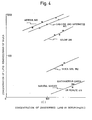
- a polyamine polyamide (such as polycup 1884) was used as polymeric cation, and the effects of polyanion addition (such as polystyrene sulfonic acid) on the felting times of the filters are shown in Table 2 and FIGURE 3.
- the amount of lipid in bovine serum was determined by the sulfo-phospho vanillin method by measuring the (pink) color developed at a wavelength of 540 nm, with olive oil serving as a standard.
- the reagents were as follows:
- silica containing media of the invention it is possible to overcome all of these difficulties as shown in the following study of delipidization of human serum.
- Unfiltered human serum having a lipid content of 500 mg/dl was continuously filtered thrugh a plurality of filters 10 and a plurality of filters 18 (supra), and the reduction in lipid concentration is shown in Table 4, with reduction expressed as % lipid removal.
- Fumed alumina with the same particle sizes as fumed silica can be produced by flame hydrolysis of anhydrous aluminum chloride.
- An example of such product is aluminum oxide C produced by Degussa.
- Pyrogens are substances which, when injected into animals, produce fever and other reactions which can result in death.
- the most common pyrogenic substances are endotoxins, the lipopolysaccharide (LPS) components of gram-negative bacterial organisms.
- Endotoxins are pyrogens capable of producing febrile reactions in the human body after intravenous doses of as small as 1 ng/kg.
- the principal method for keeping parenterals free of contaminating bacterial endotoxins is to keep the manufacturing process and all subsequent handling sterile. Because maintaining sterility is difficult in many production processes, a reliable method is needed for removal of endotoxin from an accidentally contaminated product. Asbestos fiber beds can be used to remove pyrogens but their use in the United States is prohibited by Food-and Drug Administration regulations.
- test solution 10-50 mL
- test solution was passed through the filters with the aid of a syringe at a constant flow rate.
- test solution was passed through 3.9 cm 2 filters at a flow rate of 3.05 gal./sq.ft./min.
- E. coli LPS obtained from Sigma Chemical Company
- Limulus Amebocyte Lysate (LAL) for endotoxin determination was obtained from M.A. Bioproducts. Its sensitivity for endotoxin determination was evaluated for each test solution and was found to be 30 pg/mL for almost all of the test solution.
- endotoxin concentration 0.1 mL lysate was mixed with 0.1 of test sample and allowed to incubate in a small test tube placed in a water bath at 37°C for 1 hr. The formation of a gel that did not collapse upon two 180" inversions of the tube indicated a positive test. A titration of the endotoxin was performed in every challenge to validate the sensitivity and efficiency of the LAL test.
- a 0.9% NaCl pH 6.7 solution for injection was contaminated with the concentration of E. coli endotoxin per mL indicated in Table 5 and filtered through 13 mm dia. (0.9 cm 2 surface area) unautoclaved filters. All filters were prewashed with 30 mL of test solution.
- a filter applied for pyrogen removal is fabricated based on the formulation 10 listed in Table 2, by replacing Aerosil 380 with fumed alumina.
- the filter was found capable of reducing endotoxin levels to less than the limits of the assay (30 pg/mL) from small volumes when the concentration of endotoxin ranged from 1,000 to 1,000,000 pg/mL. Results are shown in Table 5.
- the fumed silica filter of the invention can remove mycoplasma very effectively, through an adsorption mechanism.
- Detection of mycoplasma was performed by using a kit purchased from the Flow Laboratories, Inc., McLean, Virginia.
- Filter 10 was cut into 25 mm diameter discs, and stacked in a plastic column with 10 filters.
- the bovine serum was pumped through the column at 1 mL/min. of flow with a perastaltic pump.
- the filtrates were collected in the fractionation collector and inoculated on agar plates to detect mycoplasma by the Flow Lab kit as described above.
- the mycoplasma plaque assay was counted after two weeks of inoculation. The percentage of plaque reduction is reported as the efficiency on mycoplasma removal by the filter, in Table 6:
- the phenomena of removal of lipids by a fumed silica filter of the invention can also be applied to the removal of virus with lipid envelopes.
- An example of such is the hepatitis surface antigen in human serum.
- a filter containing fumed silica for removing HBsAg and lipids makes the process applicable for large volume filtration with minimum protein loss.
- HBsAg determinations were performed by Procedure B of Austria II-125 of Abbott Laboratories; a solid phase radioimmunoassay technique to measure HBsAg levels in serum. (See brochure of Abbott Laboratories, Diagnostics Division, entitled "Antibody to Hepatitis B Surface Antigen 125 I (Human) AusriaO II-125".) Polystyrene beads coated with guinea pig antibody are supplied in the kit.
- HBsAg if present, is fixed to the antibody.
- antibody tagged with 125 I it binds to any HBsAg on the beads creating an antibody-antigen- antibody sandwich.
- Plasma from chronic carriers of HBsAg was obtained from Herman Hospital in Houston, Texas. The patients' plasma was converted to serum by calcium chloride precipitation to remove fibrinogen. Most of the serum samples showed HBsAg over 100 counts per minute which is over the sensitivity range of the Abbott Ausria kit. Dilution with 0.05 M salt phosphate buffer pH 7.2 in the range of 1:5 to 1:10 ratio will bring the counts down to the accuracy region detectable by Abbott kit. It is our general practice to keep the counts around 50-60,000 CPM, with corresponding HBsAg concentration around 0.2 - 0.3 microgram per mL of serum. The diluted serum was stored in a freezer to avoid the decrease of HBsAg through precipitation during the time of storage.
- FIGURE 5 A schematic diagram of a column for serum filtration is shown in FIGURE 5.
- a peristaltic pump capable of handling AP up to 6.0 PSI was used.
- Ten filters of size 25 mm were stacked in the column. The test results were as follows:
Landscapes
- Chemical & Material Sciences (AREA)
- Health & Medical Sciences (AREA)
- Chemical Kinetics & Catalysis (AREA)
- Life Sciences & Earth Sciences (AREA)
- Organic Chemistry (AREA)
- Analytical Chemistry (AREA)
- Hematology (AREA)
- Veterinary Medicine (AREA)
- Public Health (AREA)
- General Health & Medical Sciences (AREA)
- Animal Behavior & Ethology (AREA)
- Cell Biology (AREA)
- Epidemiology (AREA)
- Biotechnology (AREA)
- Biomedical Technology (AREA)
- Engineering & Computer Science (AREA)
- Developmental Biology & Embryology (AREA)
- Immunology (AREA)
- Virology (AREA)
- Zoology (AREA)
- Medicinal Chemistry (AREA)
- Pharmacology & Pharmacy (AREA)
- Solid-Sorbent Or Filter-Aiding Compositions (AREA)
- Filtering Materials (AREA)
- Disintegrating Or Milling (AREA)
- Sampling And Sample Adjustment (AREA)
Applications Claiming Priority (2)
| Application Number | Priority Date | Filing Date | Title |
|---|---|---|---|
| US06/347,360 US4511473A (en) | 1982-02-09 | 1982-02-09 | Fibrous media containing millimicron-sized particulates |
| US347360 | 1982-02-09 |
Publications (3)
| Publication Number | Publication Date |
|---|---|
| EP0085917A2 true EP0085917A2 (de) | 1983-08-17 |
| EP0085917A3 EP0085917A3 (en) | 1984-03-28 |
| EP0085917B1 EP0085917B1 (de) | 1986-06-18 |
Family
ID=23363380
Family Applications (1)
| Application Number | Title | Priority Date | Filing Date |
|---|---|---|---|
| EP83100827A Expired EP0085917B1 (de) | 1982-02-09 | 1983-01-28 | Millimikrongrosse Teilchen enthaltende faserige Medien |
Country Status (8)
| Country | Link |
|---|---|
| US (1) | US4511473A (de) |
| EP (1) | EP0085917B1 (de) |
| JP (1) | JPS58146415A (de) |
| CA (1) | CA1201072A (de) |
| DE (1) | DE3364111D1 (de) |
| DK (1) | DK53283A (de) |
| IL (1) | IL67713A0 (de) |
| NO (1) | NO830394L (de) |
Cited By (5)
| Publication number | Priority date | Publication date | Assignee | Title |
|---|---|---|---|---|
| EP0259076A3 (de) * | 1986-09-04 | 1991-01-23 | I.D.L. International Diagnostic Laboratories Ltd. | Verfahren, Vorrichtung und Ausrüstung zur Mengenbestimmung von Lipoprotein-Bestandteilen in einer Körperflüssigkeit und Verfahren zur Trennung von Lipoproteinen aus Blut |
| EP0679405A1 (de) * | 1994-04-25 | 1995-11-02 | Rotkreuzstiftung Zentrallaboratorium Blutspendedienst Srk | Verfahren zur Abtrennung von Viren aus Proteinlösungen |
| WO1996009371A1 (en) * | 1994-09-21 | 1996-03-28 | Stichting Scheikundig Onderzoek In Nederland | Protein mixture prepared from serum for use as component in media for in vitro culture of animal cells |
| WO2006091180A3 (en) * | 2005-02-25 | 2007-03-15 | Ali Demir Sezer | Fucoidan multiparticulate drug carrier systems |
| CN107115719A (zh) * | 2017-04-27 | 2017-09-01 | 舒尔环保科技(合肥)有限公司 | 一种用于空气净化器的环保复合型滤芯 |
Families Citing this family (22)
| Publication number | Priority date | Publication date | Assignee | Title |
|---|---|---|---|---|
| US4859340A (en) * | 1976-03-15 | 1989-08-22 | Cuno, Incorporated | Filter sheet |
| US4596660A (en) * | 1982-07-23 | 1986-06-24 | Amf Inc. | Fibrous media containing millimicron-sized particulates |
| DE3329385A1 (de) * | 1983-08-13 | 1985-02-28 | Seitz-Filter-Werke Theo & Geo Seitz GmbH und Co, 6550 Bad Kreuznach | Asbestfreie filterschicht |
| AU6441490A (en) * | 1989-09-18 | 1991-04-18 | Cuno Incorporated | Filter media and use for pyrogen removal |
| US5585171A (en) * | 1993-01-11 | 1996-12-17 | Graver Chemical | Adsorbent filter bed with pliant and stiff members |
| ATE251946T1 (de) * | 1996-07-30 | 2003-11-15 | Cuno Inc | Filterschicht und deren verwendung zur reinigung einer fotoresistzusammensetzung |
| US6576139B1 (en) | 1996-07-30 | 2003-06-10 | Kenneth C. Hou | Process for purifying photoresist composition employing a filter sheet |
| US6680376B2 (en) * | 2000-12-08 | 2004-01-20 | Good Biotech Corporation | Process for selectively isolating avian immunoglobulins |
| US8173783B2 (en) * | 2000-12-08 | 2012-05-08 | Good Biotech Corporation | Process for selectively isolating IgY antibodies from egg yolk of an anseriform bird and IgY antibodies obtained thereby |
| EP1401571B1 (de) * | 2001-06-22 | 2006-05-10 | Argonide Corporation | Submikron filter |
| US7601262B1 (en) * | 2001-06-22 | 2009-10-13 | Argonide Corporation | Sub-micron filter |
| US7125434B2 (en) | 2002-12-19 | 2006-10-24 | Millipore Corporation | Deep gradient-density filter device |
| US7125490B2 (en) | 2003-05-29 | 2006-10-24 | Porex Corporation | Porous filter |
| US20050029198A1 (en) * | 2003-08-08 | 2005-02-10 | Frederick Tepper | Heavy metals absorbent and method of use |
| US20050279695A1 (en) | 2004-06-17 | 2005-12-22 | Millipore Corporation | Disposable integral filter unit |
| US20050279694A1 (en) * | 2004-06-17 | 2005-12-22 | Gregory Straeffer | Disposable integral filter unit |
| EP2684589B1 (de) | 2006-07-14 | 2022-06-22 | Imerys Filtration Minerals, Inc. | Verfahren zur Erstellung eine Zusammensetzung zum Filtern und Beseitigen von Teilchen und/oder Bestandteilen aus einer Flüssigkeit |
| US20080023395A1 (en) * | 2006-07-31 | 2008-01-31 | Sigma Aldrich Co. | Compositions and Methods for Isolation of Biological Molecules |
| US9108968B2 (en) | 2012-04-25 | 2015-08-18 | Ppg Industries Ohio, Inc. | Methods for producing 1,5,7-triazabicyclo[4.4.0]dec-5-ene by reaction of a disubstituted carbodiimide and dipropylene triamine |
| EP2866915A1 (de) | 2012-06-27 | 2015-05-06 | Argonide Corporation | Aluminisiertes siliziumhaltiges sorptionsmittel und wasserreinigungsvorrichtung damit |
| SG10202006161UA (en) | 2013-08-30 | 2020-07-29 | Emd Millipore Corp | High capacity composite depth filter media with low extractables |
| KR101619763B1 (ko) * | 2014-03-25 | 2016-05-11 | 주식회사 엔바이오니아 | 양전하가 부가된 2층 구조의 다공성 필터미디어의 제조 방법 |
Family Cites Families (31)
| Publication number | Priority date | Publication date | Assignee | Title |
|---|---|---|---|---|
| US2955067A (en) * | 1954-10-20 | 1960-10-04 | Rohm & Haas | Cellulosic paper containing ion exchange resin and process of making the same |
| US2956329A (en) * | 1954-12-15 | 1960-10-18 | Eastman Kodak Co | Manufacture of filamentary tobacco smoke filter |
| NL287283A (de) * | 1961-03-27 | |||
| NL130162C (de) * | 1962-08-06 | |||
| US3252270A (en) * | 1962-10-01 | 1966-05-24 | Pall Corp | Apparatus and method for removal of oil entrained in air |
| US3352424A (en) * | 1964-02-07 | 1967-11-14 | Dow Chemical Co | Coated filter aids |
| US3327859A (en) * | 1963-12-30 | 1967-06-27 | Pall Corp | Portable unit for potable water |
| US3420709A (en) * | 1965-04-29 | 1969-01-07 | Diamond Shamrock Corp | Liquid purification by adsorption |
| NL6702923A (de) * | 1966-04-06 | 1967-10-09 | ||
| US3455818A (en) * | 1966-06-15 | 1969-07-15 | Mallinckrodt Chemical Works | Chromatographic process |
| US3546142A (en) * | 1967-01-19 | 1970-12-08 | Amicon Corp | Polyelectrolyte structures |
| US3647684A (en) * | 1968-04-17 | 1972-03-07 | Dexter Corp | Adding cationic material to silicic acid sorbent chromatographic sheet for improved performance |
| DE1907014A1 (de) * | 1969-02-12 | 1970-09-03 | Haller Dr Wolfgang | Verfahren zur Trennung von Blutkomponenten,insbesondere von immunologisch aktiven Globulinen,von anderen Komponenten |
| JPS5220877B1 (de) * | 1970-12-29 | 1977-06-07 | ||
| US3770625A (en) * | 1971-04-19 | 1973-11-06 | Carborundum Co | Removal of virus from fluids |
| US3925152A (en) * | 1971-06-18 | 1975-12-09 | Exploaterings Ab Tbf | Virus separation |
| CS159406B1 (de) * | 1971-09-03 | 1975-01-31 | ||
| CA1044537A (en) * | 1973-05-09 | 1978-12-19 | Amf Incorporated | Filter medium and process |
| US3951937A (en) * | 1973-12-20 | 1976-04-20 | The Community Blood Council Of Greater New York, Inc. | Large scale purification of hepatitis type B antigen using polyethylene glycol |
| US4177142A (en) * | 1974-04-04 | 1979-12-04 | Ecodyne Corporation | Mixture of oppositely charged filter aid material |
| DE2510467A1 (de) * | 1975-03-11 | 1976-09-23 | Schenk Filterbau Gmbh | Filterwerkstoff |
| IL49752A (en) * | 1975-07-09 | 1979-07-25 | Kabi Ab | Compositions having affinity for hepatitis virus and method for hepatitis virus removal or concentration |
| US4309247A (en) * | 1976-03-15 | 1982-01-05 | Amf Incorporated | Filter and method of making same |
| SE420977B (sv) * | 1976-03-18 | 1981-11-16 | Kabi Ab | Forfarande for rening och isolering av hepatitvirus for vaccinframstellning |
| US4057628A (en) * | 1976-04-19 | 1977-11-08 | William L. Wilson | Removal of hepatitis associated antigen from plasma |
| US4190532A (en) * | 1976-06-11 | 1980-02-26 | Ecodyne Corporation | Charged filter aid material and ion exchange bed |
| US4168250A (en) * | 1977-04-19 | 1979-09-18 | Standard Brands Incorporated | Agglomerated fibrous ion exchange cellulose |
| US4232004A (en) * | 1977-09-21 | 1980-11-04 | American National Red Cross | Antibody-specific solid phase immunoadsorbent, preparation thereof, and antibody purification therewith |
| US4162192A (en) * | 1978-09-28 | 1979-07-24 | Juridical Foundation | Method for purification of HBs antigen |
| GB2043734B (en) * | 1979-03-01 | 1983-08-17 | Amf Inc | Filter and method of making same |
| US4238334A (en) * | 1979-09-17 | 1980-12-09 | Ecodyne Corporation | Purification of liquids with treated filter aid material and active particulate material |
-
1982
- 1982-02-09 US US06/347,360 patent/US4511473A/en not_active Expired - Lifetime
-
1983
- 1983-01-18 IL IL67713A patent/IL67713A0/xx unknown
- 1983-01-28 DE DE8383100827T patent/DE3364111D1/de not_active Expired
- 1983-01-28 EP EP83100827A patent/EP0085917B1/de not_active Expired
- 1983-02-07 NO NO830394A patent/NO830394L/no unknown
- 1983-02-08 CA CA000421114A patent/CA1201072A/en not_active Expired
- 1983-02-08 DK DK53283A patent/DK53283A/da not_active Application Discontinuation
- 1983-02-09 JP JP58020542A patent/JPS58146415A/ja active Pending
Cited By (7)
| Publication number | Priority date | Publication date | Assignee | Title |
|---|---|---|---|---|
| EP0259076A3 (de) * | 1986-09-04 | 1991-01-23 | I.D.L. International Diagnostic Laboratories Ltd. | Verfahren, Vorrichtung und Ausrüstung zur Mengenbestimmung von Lipoprotein-Bestandteilen in einer Körperflüssigkeit und Verfahren zur Trennung von Lipoproteinen aus Blut |
| EP0679405A1 (de) * | 1994-04-25 | 1995-11-02 | Rotkreuzstiftung Zentrallaboratorium Blutspendedienst Srk | Verfahren zur Abtrennung von Viren aus Proteinlösungen |
| US5696236A (en) * | 1994-04-25 | 1997-12-09 | Rotkreuzstiftung Zentrallaboratorium Blutspendedienst Skr | Method for the removal of viruses from protein solutions |
| WO1996009371A1 (en) * | 1994-09-21 | 1996-03-28 | Stichting Scheikundig Onderzoek In Nederland | Protein mixture prepared from serum for use as component in media for in vitro culture of animal cells |
| NL9401535A (nl) * | 1994-09-21 | 1996-05-01 | Stichting Scheikundig Onderzoe | Uit serum bereid eiwitmengsel voor het gebruik als component in media voor het in vitro kweken van dierlijke cellen. |
| WO2006091180A3 (en) * | 2005-02-25 | 2007-03-15 | Ali Demir Sezer | Fucoidan multiparticulate drug carrier systems |
| CN107115719A (zh) * | 2017-04-27 | 2017-09-01 | 舒尔环保科技(合肥)有限公司 | 一种用于空气净化器的环保复合型滤芯 |
Also Published As
| Publication number | Publication date |
|---|---|
| DK53283D0 (da) | 1983-02-08 |
| JPS58146415A (ja) | 1983-09-01 |
| EP0085917A3 (en) | 1984-03-28 |
| IL67713A0 (en) | 1983-05-15 |
| DK53283A (da) | 1983-09-19 |
| US4511473A (en) | 1985-04-16 |
| NO830394L (no) | 1983-08-10 |
| EP0085917B1 (de) | 1986-06-18 |
| DE3364111D1 (en) | 1986-07-24 |
| CA1201072A (en) | 1986-02-25 |
Similar Documents
| Publication | Publication Date | Title |
|---|---|---|
| US4488969A (en) | Fibrous media containing millimicron-sized particulates | |
| EP0085917B1 (de) | Millimikrongrosse Teilchen enthaltende faserige Medien | |
| EP0099586B1 (de) | Millimikrongrosse Teilchen enthaltende faserige Medien | |
| US4596660A (en) | Fibrous media containing millimicron-sized particulates | |
| US4606824A (en) | Modified cellulose separation matrix | |
| US4859340A (en) | Filter sheet | |
| US4366068A (en) | Filter and method of making same | |
| US4512897A (en) | Molecular separation column and use thereof | |
| US4305782A (en) | Filter and method of making same | |
| AU621266B2 (en) | Cationic charge modified filter media and use thereof | |
| US4384957A (en) | Molecular separation column and use thereof | |
| JPS61166861A (ja) | 変性シリカ質支持体 | |
| US4756834A (en) | Phase supports for the partition chromatography of macromolecules, a process for their preparation and their use | |
| GB2043734A (en) | Filter and method of making same | |
| AU688024B2 (en) | Method and porous support for removing contaminants | |
| WO1991004086A1 (en) | Filter media and use for pyrogen removal | |
| GB2045828A (en) | Filter and method of making same | |
| JP2543693B2 (ja) | 低比重リポ蛋白質の吸着材およびその製造方法 | |
| JPS59501323A (ja) | ミリミクロンサイズの顆粒を含有する繊維質媒体 | |
| GB2098590A (en) | Filter aid | |
| Chen et al. | Recovery of proteins and other biological compounds using fibrous materials: I. Adsorption by salt addition | |
| JPS59206046A (ja) | 低比重リポ蛋白質を吸着する材料 | |
| JPS6259975B2 (de) | ||
| JPH0341210B2 (de) | ||
| JPH0679104A (ja) | エンドトキシンの除去方法 |
Legal Events
| Date | Code | Title | Description |
|---|---|---|---|
| PUAI | Public reference made under article 153(3) epc to a published international application that has entered the european phase |
Free format text: ORIGINAL CODE: 0009012 |
|
| AK | Designated contracting states |
Designated state(s): CH DE FR GB IT LI NL SE |
|
| PUAL | Search report despatched |
Free format text: ORIGINAL CODE: 0009013 |
|
| AK | Designated contracting states |
Designated state(s): CH DE FR GB IT LI NL SE |
|
| 17P | Request for examination filed |
Effective date: 19840530 |
|
| GRAA | (expected) grant |
Free format text: ORIGINAL CODE: 0009210 |
|
| AK | Designated contracting states |
Kind code of ref document: B1 Designated state(s): CH DE FR GB IT LI NL SE |
|
| PG25 | Lapsed in a contracting state [announced via postgrant information from national office to epo] |
Ref country code: IT Free format text: LAPSE BECAUSE OF FAILURE TO SUBMIT A TRANSLATION OF THE DESCRIPTION OR TO PAY THE FEE WITHIN THE PRESCRIBED TIME-LIMIT;WARNING: LAPSES OF ITALIAN PATENTS WITH EFFECTIVE DATE BEFORE 2007 MAY HAVE OCCURRED AT ANY TIME BEFORE 2007. THE CORRECT EFFECTIVE DATE MAY BE DIFFERENT FROM THE ONE RECORDED. Effective date: 19860618 |
|
| REF | Corresponds to: |
Ref document number: 3364111 Country of ref document: DE Date of ref document: 19860724 |
|
| REG | Reference to a national code |
Ref country code: CH Ref legal event code: PL |
|
| PG25 | Lapsed in a contracting state [announced via postgrant information from national office to epo] |
Ref country code: NL Effective date: 19861003 |
|
| EN | Fr: translation not filed | ||
| PG25 | Lapsed in a contracting state [announced via postgrant information from national office to epo] |
Ref country code: GB Effective date: 19870128 |
|
| PG25 | Lapsed in a contracting state [announced via postgrant information from national office to epo] |
Ref country code: SE Effective date: 19870129 |
|
| PLBI | Opposition filed |
Free format text: ORIGINAL CODE: 0009260 |
|
| 26 | Opposition filed |
Opponent name: SEITZ-FILTER-WERKE THEO & GEO SEITZ GMBH UND CO. Effective date: 19870312 |
|
| GBPC | Gb: european patent ceased through non-payment of renewal fee | ||
| RDAG | Patent revoked |
Free format text: ORIGINAL CODE: 0009271 |
|
| STAA | Information on the status of an ep patent application or granted ep patent |
Free format text: STATUS: PATENT REVOKED |
|
| 27W | Patent revoked |
Effective date: 19870913 |
|
| REG | Reference to a national code |
Ref country code: CH Ref legal event code: PL |
|
| GBPR | Gb: patent revoked under art. 102 of the ep convention designating the uk as contracting state | ||
| EUG | Se: european patent has lapsed |
Ref document number: 83100827.1 Effective date: 19870923 |