EP0087359A2 - Nouveau réactif de nitrométhylation, son application à la préparation de composés nitrométhylénés et de certains de leurs dérivés et les composés nouveaux obtenus - Google Patents
Nouveau réactif de nitrométhylation, son application à la préparation de composés nitrométhylénés et de certains de leurs dérivés et les composés nouveaux obtenus Download PDFInfo
- Publication number
- EP0087359A2 EP0087359A2 EP83400315A EP83400315A EP0087359A2 EP 0087359 A2 EP0087359 A2 EP 0087359A2 EP 83400315 A EP83400315 A EP 83400315A EP 83400315 A EP83400315 A EP 83400315A EP 0087359 A2 EP0087359 A2 EP 0087359A2
- Authority
- EP
- European Patent Office
- Prior art keywords
- formula
- compound
- subjected
- action
- agent
- Prior art date
- Legal status (The legal status is an assumption and is not a legal conclusion. Google has not performed a legal analysis and makes no representation as to the accuracy of the status listed.)
- Granted
Links
- 0 CC(C(CC1)I(CC2)C1C1C2C(*[I+])(CCC(C2)O)C2=CC1)[N+]([O-])=O Chemical compound CC(C(CC1)I(CC2)C1C1C2C(*[I+])(CCC(C2)O)C2=CC1)[N+]([O-])=O 0.000 description 3
- XHWMBFVODGQKJT-UHFFFAOYSA-N CCC=C1CC(CC2)C2C1 Chemical compound CCC=C1CC(CC2)C2C1 XHWMBFVODGQKJT-UHFFFAOYSA-N 0.000 description 1
Classifications
-
- C—CHEMISTRY; METALLURGY
- C07—ORGANIC CHEMISTRY
- C07J—STEROIDS
- C07J13/00—Normal steroids containing carbon, hydrogen, halogen or oxygen having a carbon-to-carbon double bond from or to position 17
- C07J13/005—Normal steroids containing carbon, hydrogen, halogen or oxygen having a carbon-to-carbon double bond from or to position 17 with double bond in position 16 (17)
-
- C—CHEMISTRY; METALLURGY
- C07—ORGANIC CHEMISTRY
- C07C—ACYCLIC OR CARBOCYCLIC COMPOUNDS
- C07C201/00—Preparation of esters of nitric or nitrous acid or of compounds containing nitro or nitroso groups bound to a carbon skeleton
- C07C201/06—Preparation of nitro compounds
- C07C201/12—Preparation of nitro compounds by reactions not involving the formation of nitro groups
-
- C—CHEMISTRY; METALLURGY
- C07—ORGANIC CHEMISTRY
- C07J—STEROIDS
- C07J41/00—Normal steroids containing one or more nitrogen atoms not belonging to a hetero ring
- C07J41/0033—Normal steroids containing one or more nitrogen atoms not belonging to a hetero ring not covered by C07J41/0005
- C07J41/0038—Normal steroids containing one or more nitrogen atoms not belonging to a hetero ring not covered by C07J41/0005 with an androstane skeleton, including 18- or 19-substituted derivatives, 18-nor derivatives and also derivatives where position 17-beta is substituted by a carbon atom not directly bonded to a further carbon atom and not being part of an amide group
-
- C—CHEMISTRY; METALLURGY
- C07—ORGANIC CHEMISTRY
- C07J—STEROIDS
- C07J5/00—Normal steroids containing carbon, hydrogen, halogen or oxygen, substituted in position 17 beta by a chain of two carbon atoms, e.g. pregnane and substituted in position 21 by only one singly bound oxygen atom, i.e. only one oxygen bound to position 21 by a single bond
- C07J5/0007—Normal steroids containing carbon, hydrogen, halogen or oxygen, substituted in position 17 beta by a chain of two carbon atoms, e.g. pregnane and substituted in position 21 by only one singly bound oxygen atom, i.e. only one oxygen bound to position 21 by a single bond not substituted in position 17 alfa
- C07J5/0015—Normal steroids containing carbon, hydrogen, halogen or oxygen, substituted in position 17 beta by a chain of two carbon atoms, e.g. pregnane and substituted in position 21 by only one singly bound oxygen atom, i.e. only one oxygen bound to position 21 by a single bond not substituted in position 17 alfa not substituted in position 16
-
- C—CHEMISTRY; METALLURGY
- C07—ORGANIC CHEMISTRY
- C07C—ACYCLIC OR CARBOCYCLIC COMPOUNDS
- C07C2602/00—Systems containing two condensed rings
- C07C2602/02—Systems containing two condensed rings the rings having only two atoms in common
- C07C2602/04—One of the condensed rings being a six-membered aromatic ring
- C07C2602/10—One of the condensed rings being a six-membered aromatic ring the other ring being six-membered, e.g. tetraline
Definitions
- the present invention relates to a new nitronethylation reagent, its application to the preparation of nitroethylenated compounds and certain of their derivatives and the new compounds obtained.
- the subject of the invention is therefore, as a reagent for nitromethylation of ketone compounds, nitromethane used in the presence of a basic bifunctional catalyst.
- nitromethylation reaction of ketone compounds is understood to mean reactions which make it possible to transform a ketone group carried by a cyclic or acyclic organic compound into a nitromethylene group.
- a reaction of the type there can be cited a reaction of the type:
- the invention particularly relates to a reagent as defined above, characterized in that the basic bifunctional catalyst is a diamine and is chosen from the group consisting of ethylene diamine, trimethylene diamine and tetramethylene diamine.
- the subject of the invention is also the application of the reagent as defined above, characterized in that a cyclic or acyclic organic compound, comprising at least one ketone group, is subjected to the action of said reagent and thus obtains a compound nitromethylenated.
- reaction is carried out in the absence of solvent.
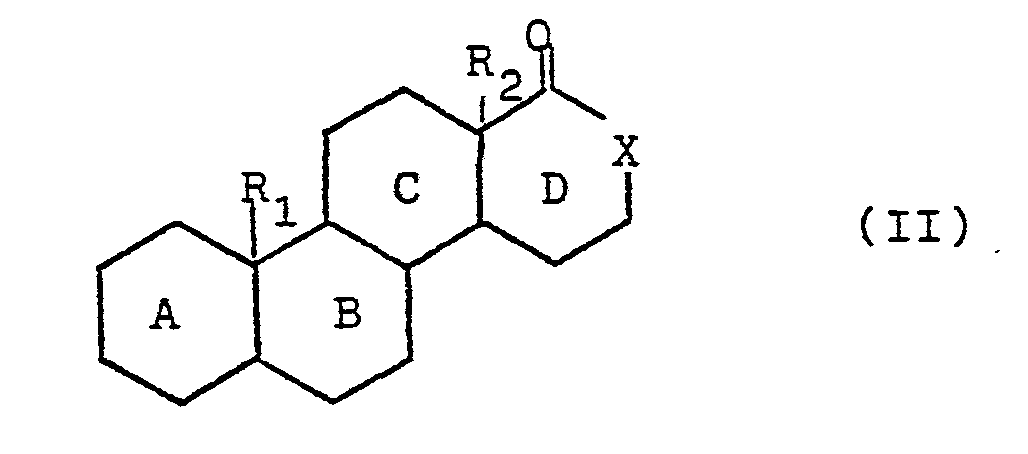
- the invention particularly relates to an application as defined above, characterized in that the ketone compound corresponds to formula (II): in which R 1 represents a hydrogen atom, an alkyl radical containing from 1 to 4 carbon atoms optionally substituted by an oxygenated or nitrogenous function or by a halogen atom or R1 represents an alkenyl or alkynyl radical containing from 2 to 4 carbon atoms, R 2 represents an alkyl radical containing from 1 to 4 carbon atoms, X represents a carbon atom or a carbon-carbon bond, the nuclei A, B, C and D optionally bear one or more double bonds and are optionally substituted by one or more hydroxyl or ketone functions, by one or more halogen atoms, by one or more alkyl or alkyloxy radicals containing from 1 to 4 carbon atoms or by one or more alkenyl and alkynyl radicals containing from 2 to 4 carbon atoms, and that the corresponding compound of formula (I) is obtained:
- R 2 preferably represents a methyl or ethyl radical.
- nuclei A, B, C and D carry one or more double bonds
- they are preferably double bonds at 1 (2), 3 (4), 4 (5) or 9 (11) or a system of double bonds conjugated in 3 (4) and 5 (6) or in 4 (5) and 6 (7) or in 1 (2) and 4 (5) or of an aromatic system of three double bonds 1, 3 , 5 or a system of three double bonds 1 (2), 4 (5), 6 (7).
- rings A, B, C and D are substituted by one or more hydroxyl functions, it is preferably a hydroxyl function at 3 or 11.
- the rings A, B, C and D are substituted by one or more halogen atoms, it is preferably a fluorine, chlorine or bromine atom in position 6 or 9 ⁇ for example.
- the rings A, B, C and D are substituted by one or more alkyl radicals, it is preferably the methyl or ethyl radical in 2, 6, 7 in 16d or in 16 ⁇ .
- rings A, B, C and D are substituted by one or more alkyloxy radicals, it is preferably a 3 or 11 ⁇ methoxy or ethoxy radical.
- rings A, B, C and D are substituted by one or more alkenyl radicals, it is preferably the vinyl or allyl radical in position 11 ⁇ for example.
- the rings A, B, C and D are substituted by one or more alkynyl radicals, it is preferably the ethynyl radical in position 11 ⁇ for example.
- the invention particularly relates to an application as defined above, characterized in that the ketone compound corresponds to the formula (IIA): in which R 1 , R2, A, B, C and D are defined as above and that the compound of formula (I A ) is obtained corresponding: in which R ⁇ , R 2 , A, B, C and D are defined as above.
- the invention particularly relates to an application as defined above, characterized in that the ketone compound corresponds to the formula (IIA) in which R 2 represents a methyl radical, as well as to the formula (IIA) in which R 1 represents a hydrogen atom or a methyl radical and the corresponding compounds of formula (I A ) are obtained.
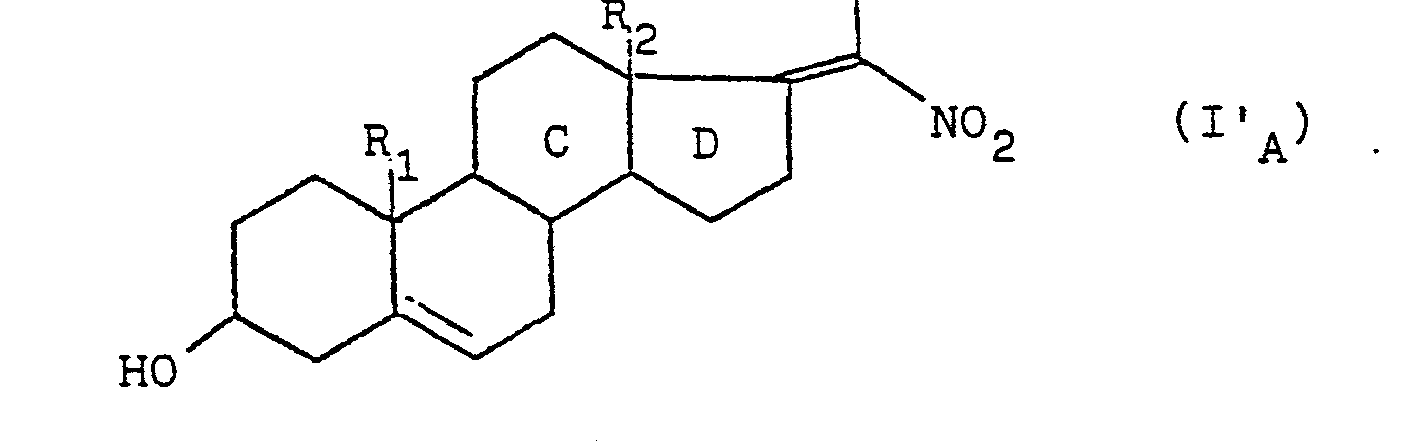
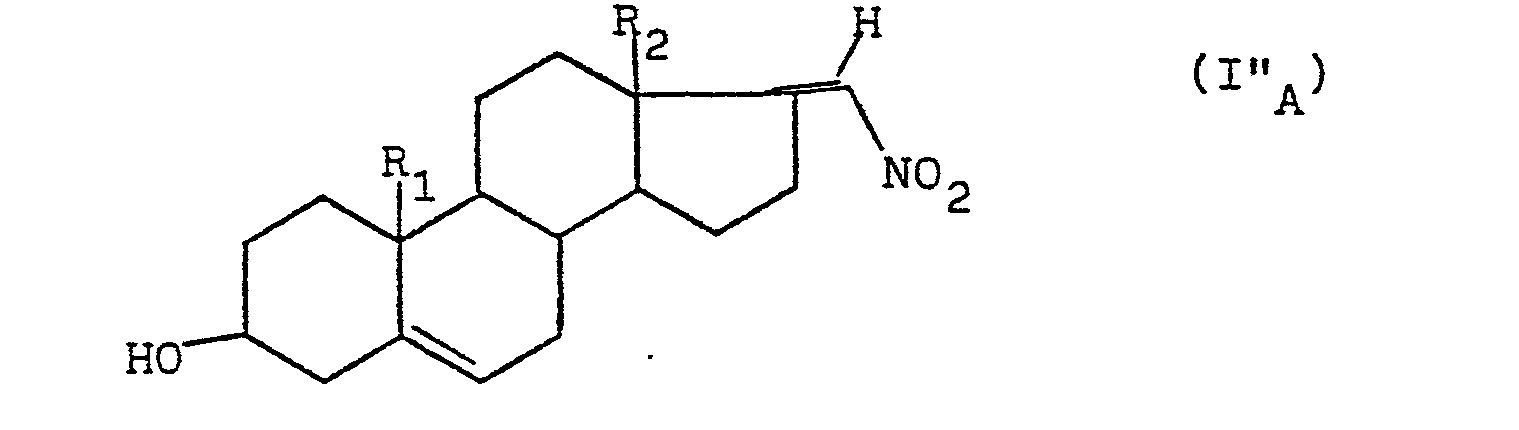
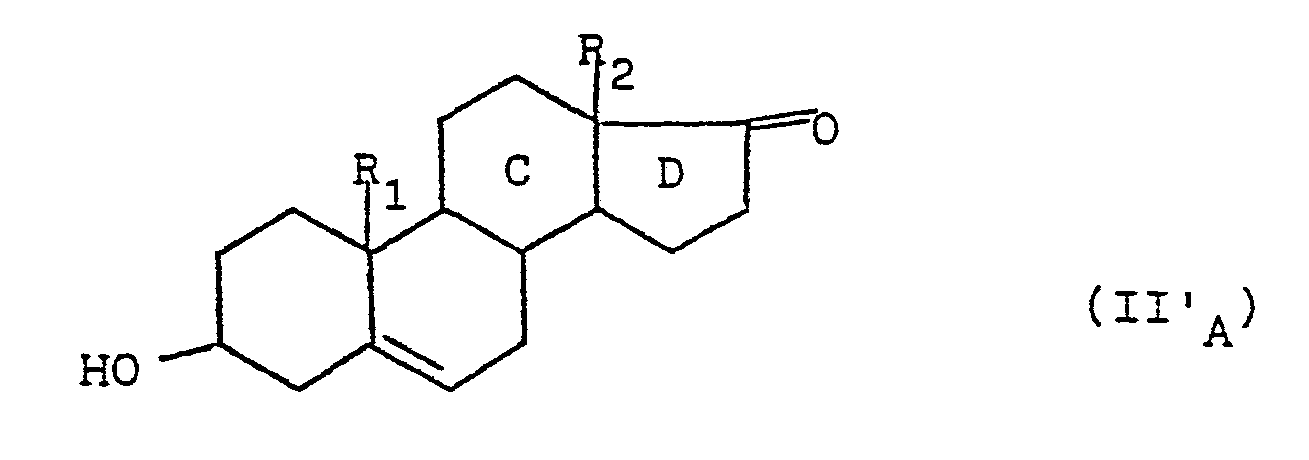
- the invention more particularly relates to an application as defined above, characterized in that the ketone compound corresponds to formula (II ′ A ): in which R 1 , R 2 , C and D are defined as above, and the compound of formula (I ' A ) is obtained corresponding: in which R 1 , R 2 , C and D are defined as above, as well as an application as defined above, characterized in that the ketone compound corresponds to the formula (II " A ): in which R 1 and R 2 are defined as above, and that the corresponding compound of formula (I " A ) is obtained: in which R 1 and R 2 are defined as above.
- the invention particularly relates to an application as defined above, characterized in that the product of formula II used is 3 ⁇ -hydroxy androst-5-en-17-one and the product of formula I obtained is 3 ⁇ -hydroxy 17- (nitromethylene) androst-5-ene.
- the application according to the invention relates to organic cyclic or acyclic compounds in general and is, of course, not limited to steroid compounds.
- the compounds of formula (I) obtained by the application according to the invention are new and the invention also relates to said compounds of formula (I) as new industrial compounds and in particular, among these, the compounds of formula I A and more particularly those for which R 2 represents a methyl radical and those for which R i represents a hydrogen atom or a methyl radical. Mention may also be made, as specially targeted compounds, of the compounds corresponding to formula (I ' A ): H in which R 1 , R 20 C and D are defined as above and more particularly, among these, the compounds corresponding to formula (I " A ): in which R 1 and R 2 are defined as above and very particularly, the compound of formula I, the preparation of which is given below in the experimental part.
- the compounds of formula I A can in particular be used to prepare the products described in German patent application 2,521,231, in French patents 1,058,850 and 1,021,728 in American patent 3,445,490.
- the products of formula I and in particular those of formula I A can therefore be used in the preparation of products of great interest as medicaments, such as, for example, triamcinolone and its derivatives.
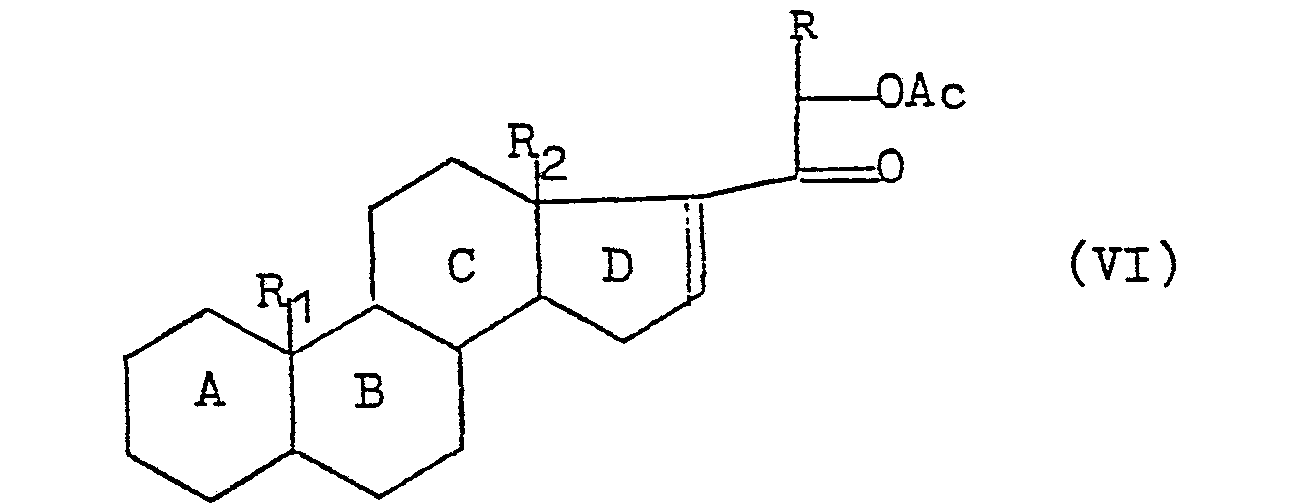
- the subject of the invention is also the application of the compounds of formula I A as defined above, characterized in that a compound of formula I A is subjected to the action of an aldehyde RCHO in which R represents a hydrogen atom or an alkyl radical containing from 1 to 18 carbon atoms, to obtain a compound of formula (III): in which A, B, C, D, R, R 1 and R 2 are defined as above, which is subjected to the action of an esterifying agent, to obtain the compound of formula (IV) in which Ac represents the remainder of an acyl radical containing from 1 to 18 carbon atoms, which is subjected to the action of a reducing agent for the nitro group, to obtain the compound of formula (V) which is subjected to a cleavage agent of the oxime function to obtain the compound of formula (VI)
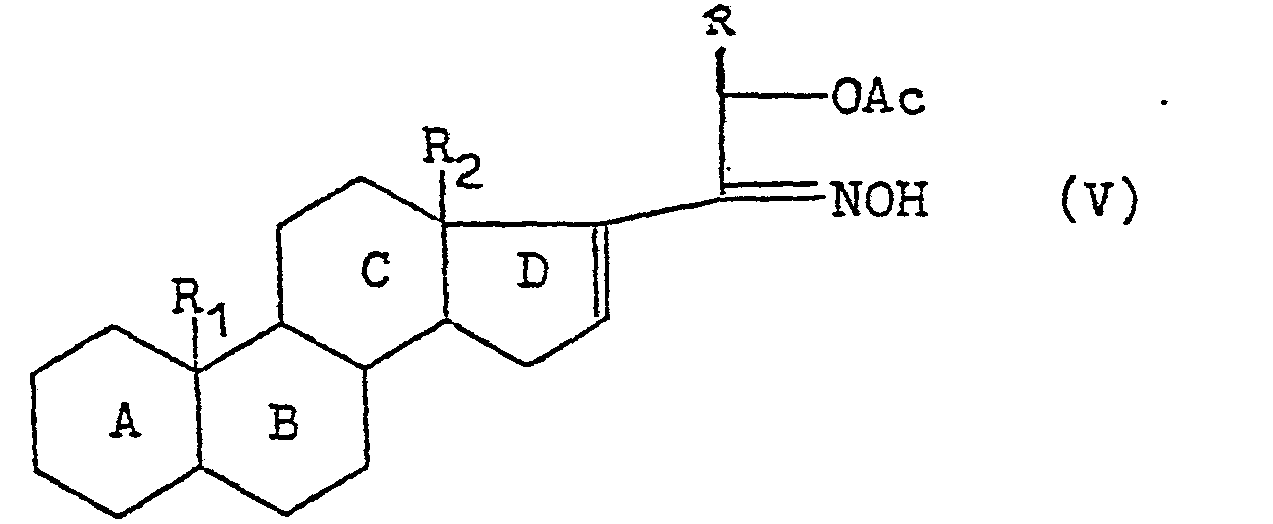
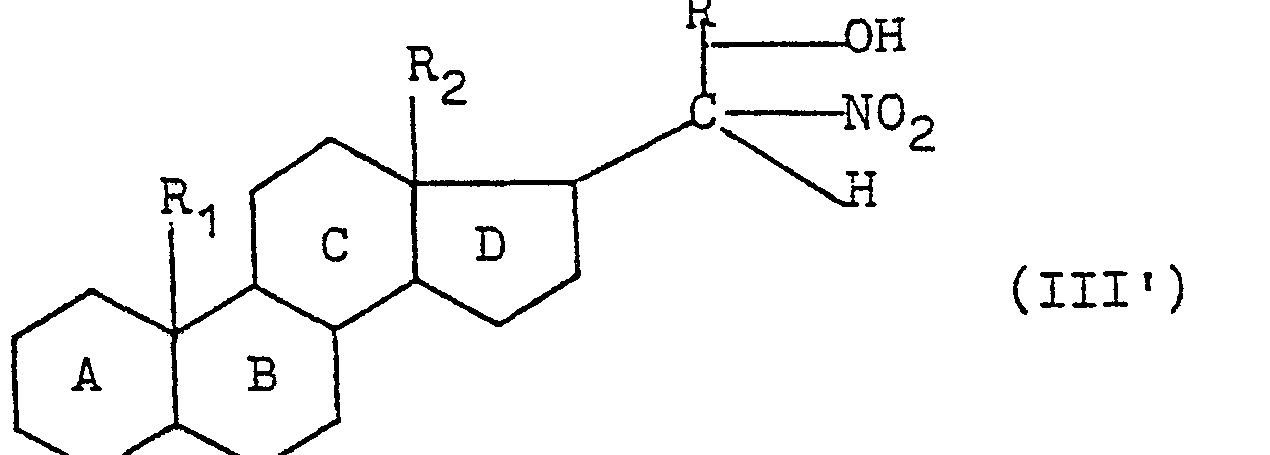
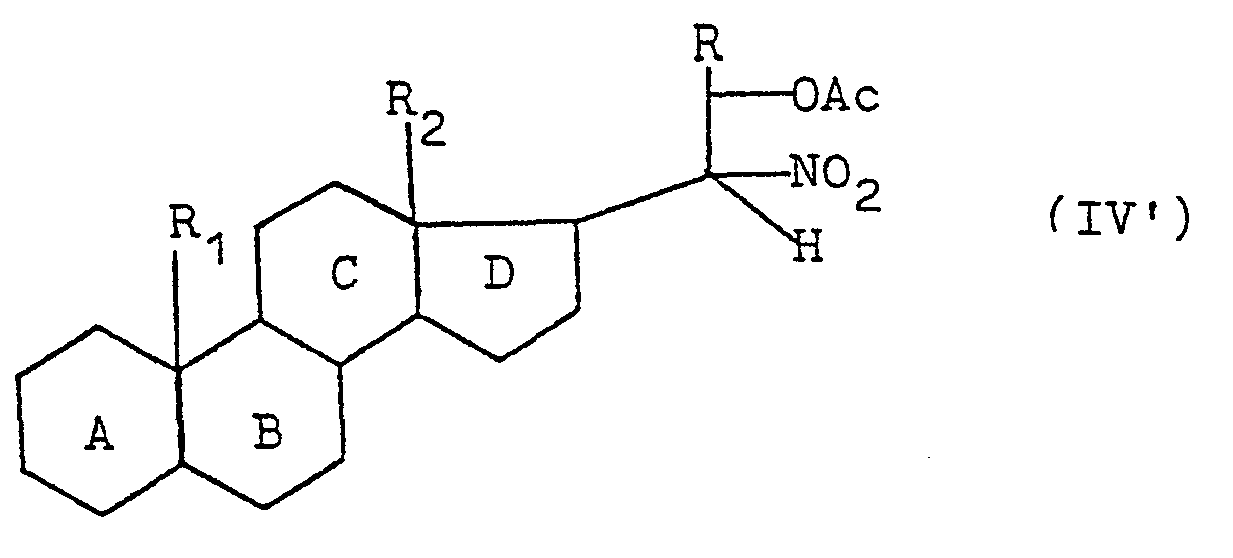
- the invention also relates to a variant of the application which has just been described, characterized in that a compound of formula (I A) in which A, B, C, D, R 1 and R 2 are defined as above first, to the action of a reducing agent for the double bond 17 (20), to obtain the compound of formula (VII ) which is then subjected following the reactions indicated above, that is to say first of all to the action of an aldehyde RCHO as defined above, to obtain the compound of formula (III ') : in which A, B, C, D, R, R 1 and R 2 are defined as above ment which is subjected to the action of an esterifying agent, to obtain the compound of formula (IV '): in which Ac represents the remainder of an acyl radical containing from 1 to 18 carbon atoms, which is subjected to the action of a reducing agent for the nitro group, to obtain the compound of formula (V ') which is subjected to the action of a cleavage agent of the oxime function to
- the double bond reducing agent is preferably an alkaline borohydride, such as, for example, sodium borohydride; the other reagents used in a preferential manner are those indicated above.
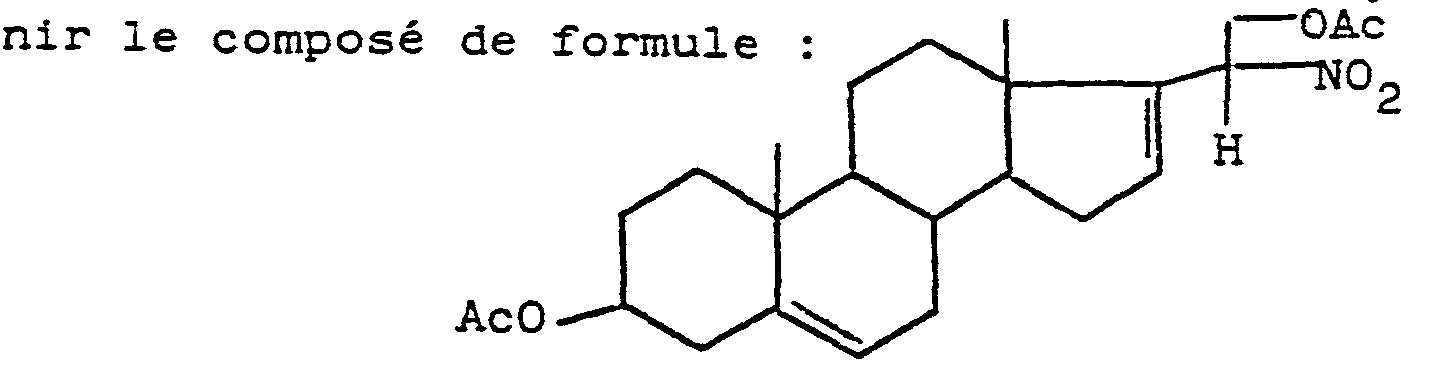
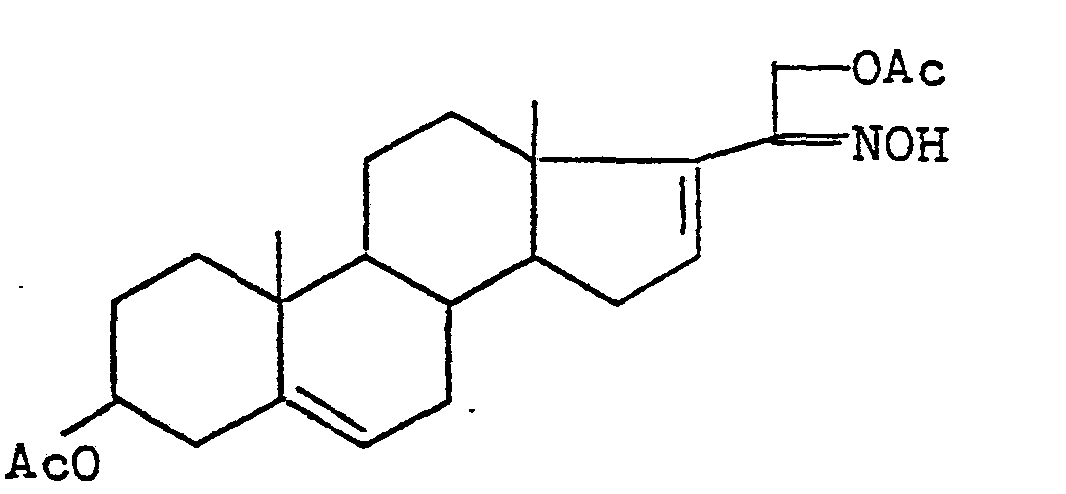
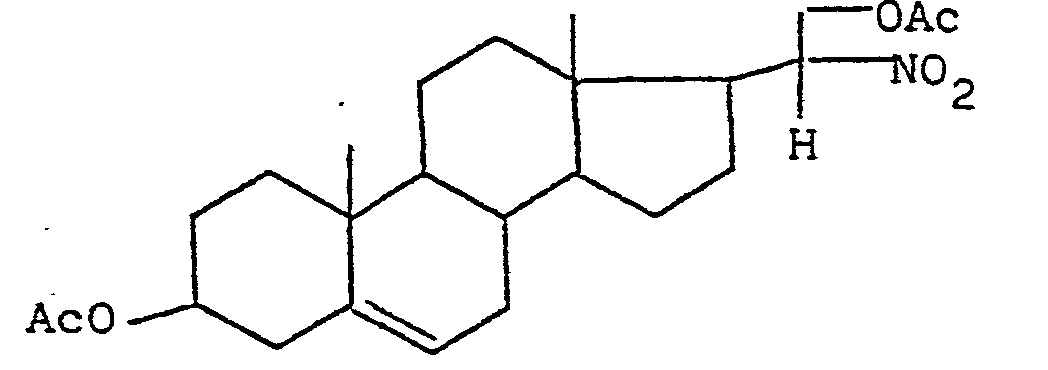
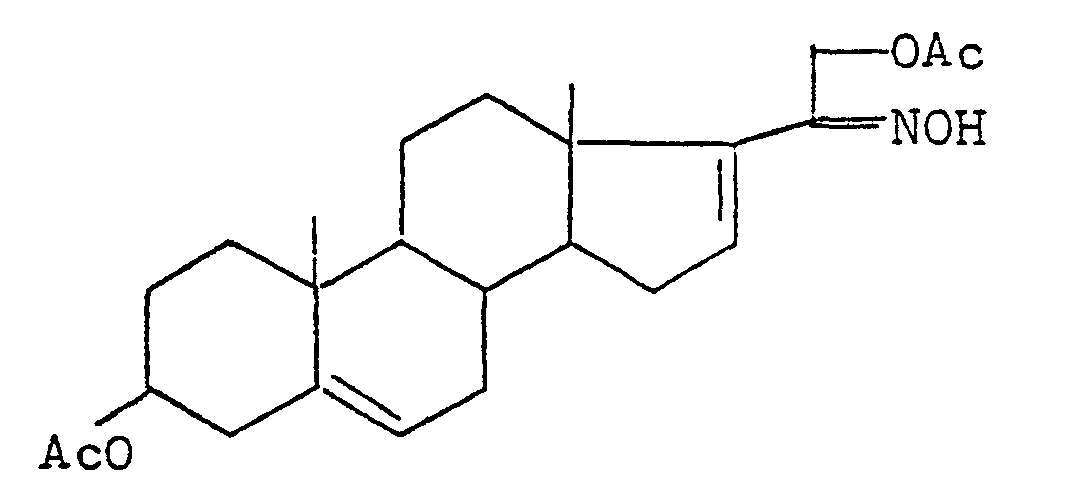
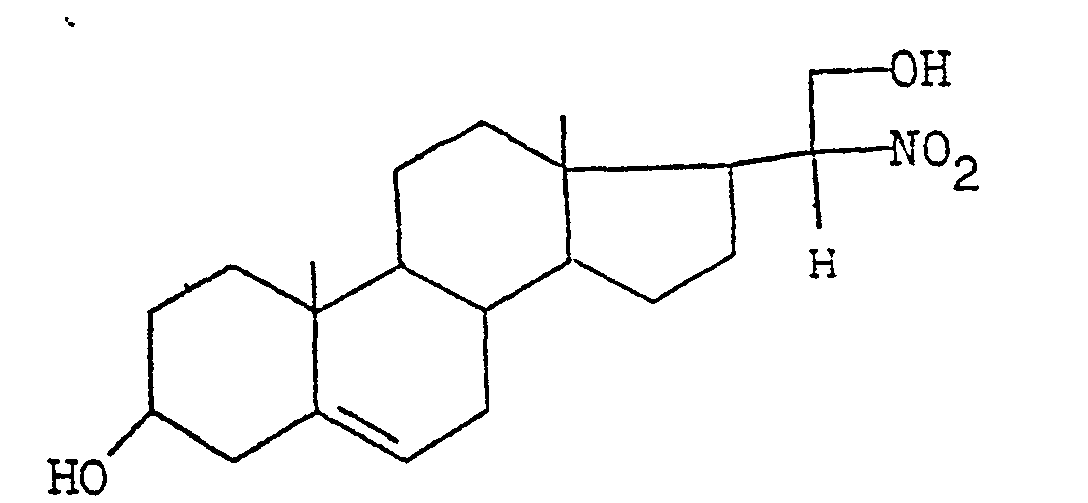
- a more specific subject of the invention is the application described in the experimental part, characterized in that the product of formula I A used is 3 ⁇ -hydroxy 17- (nitro methylene) androst-5-ene which is subjected to the action of a formylating agent, to obtain the compound of formula: which is subjected to the action of an acetylating agent to obtain the compound of formula in which Ac represents the acetyl radical, which is subjected to the action of a reducing agent for the nitrop group to obtain the compound of formula which is subjected to the action of a cleavage agent of the oxime function to obtain the compound of formula
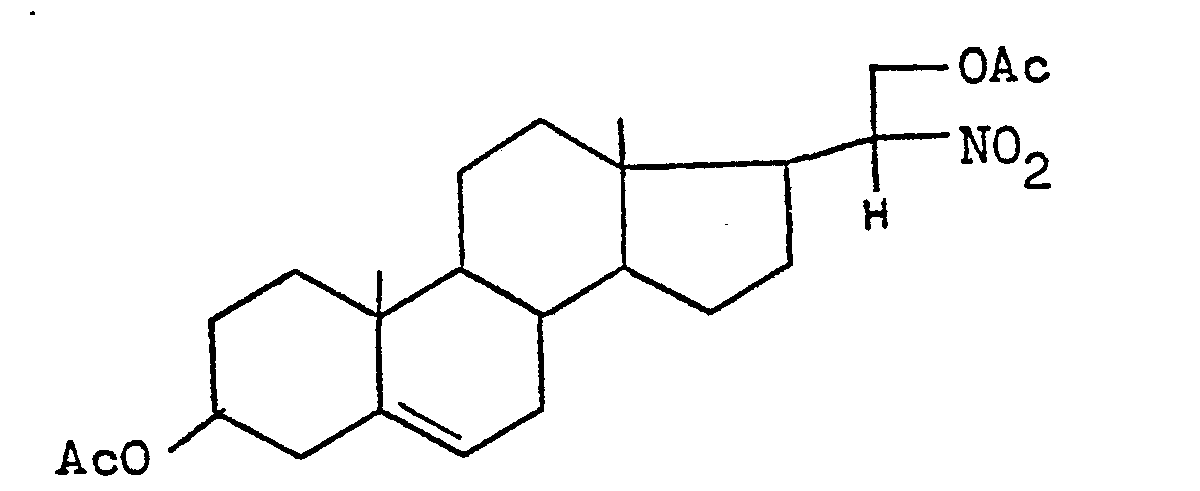
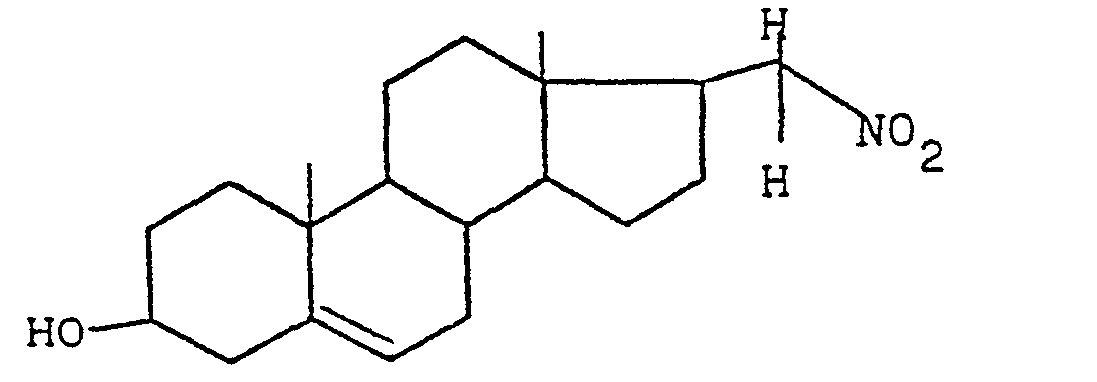
- the subject of the invention is also the application characterized in that the product of formula I A used is 3 ⁇ -hydroxy 17- (nitromethylene) androst-5-ene which is subjected to the reduction action.
- the compound of formula: which is subjected to the action of a formylation agent
- the compound of formula which is subjected to the action of an acetylating agent to obtain the compound of formula in which Ac represents an acetyl radical, which is subjected to the action of a reducing agent for the nitro group
- an oxime cleavage agent to obtain the compound of formula
- the invention obviously also relates to applications such as those leading to the compounds of formulas (VI) and (VI '), which have been defined above, characterized in that the products of formula I are used at the start which X represents a carbon atom.
- the compounds obtained during the application which has just been described, as well as those of the variant, are new chemicals.
- the invention therefore also relates, as new chemicals, to the products of formulas III, IV, V, VI, VII, III ', IV', V 'and VI' as well as the corresponding products derived from the products of formula I in which X represents a carbon atom.
- Example 1 3 ⁇ -hydroxy 17- (nitromethylene) androst-5-ene.
- Stage A 33.21-dihydrcxy 20-nitro pregna 5.16-diene and corresponding diacetate.
- Stage B 20-oxime of 3 ⁇ 21-diacetoxy pregna 5,16-dien-20-one.
- Stage C 3 ⁇ 21-diacetoxy pregna 5,16-dienin 20-one.
- 6.5 cm3 of an aqueous solution of titanium trichloride are added to a suspension containing 800 mg of 20-oxime of 3A21-diacetoxy pregna 5,16-dien-20-one, 16 cm3 of acetic acid and 6 cm3 d acetone containing 2.4 g of ammonium acetate.
- the reaction mixture is stirred for 6 hours, poured into water, and extracted with ether. The ethereal phase is washed and dried. Filtered on silica. After evaporation, 766 mg of a white solid is obtained, melting at 154-156 ° C.
- Example 3 3-methoxy 17- (nitromethylene) 19-nor androsta 1,3,5-triene.
Landscapes
- Chemical & Material Sciences (AREA)
- Organic Chemistry (AREA)
- Health & Medical Sciences (AREA)
- General Health & Medical Sciences (AREA)
- Chemical Kinetics & Catalysis (AREA)
- Steroid Compounds (AREA)
- Organic Low-Molecular-Weight Compounds And Preparation Thereof (AREA)
- Low-Molecular Organic Synthesis Reactions Using Catalysts (AREA)
Abstract
Description
- La présente invention concerne un nouveau réactif de nitro- néthylation, son application à la préparation de composés nitro- néthylénés et de certains de leurs dérivés et les composés nouveaux obtenus.
- L'invention a ainsi pour objet, à titre de réactif de nitrométhylation des composés cétoniques, le nitrométhane utilisé en présence d'un catalyseur basique bifonctionnel.
- Par réaction de nitrométhylation des composés cétoniques, on entend les réactions permettant de transformer un groupe cétonique porté par un composé organique cyclique ou acyclique en un groupe nitrométhylène. On peut citer à titre d'illustration, une réaction du type :

- L'invention a notamment pour objet un réactif tel que défini ci-dessus, caractérisé en ce que le catalyseur basique bifonctionnel est une diamine et est choisi dans le groupe constitué par l'éthylène diamine, la triméthylène diamine et la tétraméthylène diamine.
- L'invention a également pour objet l'application du réactif tel que défini précédemment, caractérisée en ce que l'on soumet un composé organique cyclique ou acyclique, comportant au moins un groupe cétonique, à l'action dudit réactif et obtient ainsi un composé nitrométhyléné.
- Dans des conditions préférentielles d'exécution de l'application ci-dessus, la réaction est effectuée en l'absence de solvant.
- L'invention a notamment pour objet une application telle que définie ci-dessus, caractérisée en ce que le composé cétonique répond à la formule (II) :
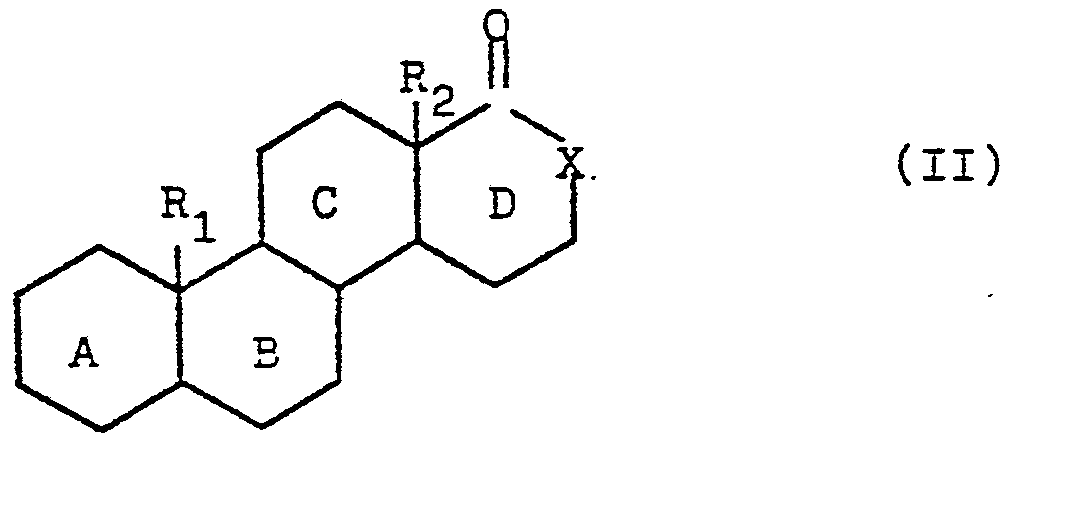

- Dans les composés de formules (II) et (I), R1, R2, A, B, C et D ont de préférence les significations suivantes :
- Lorsque R1 représente un radical alkyle, il s'agit de préférence du radical méthyle ou éthyle.
- Lorsque R1 représente un radical alkyle substitué par une fonction oxygénée, il s'agit de préférence du radical hydroxy méthyle ou hydroxy éthyle, du radical formyle ou du radical acétyle.
- Lorsque R1 représente un radical alkyle substitué par une fonction azotée, il s'agit de préférence du radical cyano ou du radical amino méthyle ou amino éthyle.
- Lorsque R1 représente un radical alkyle substitué par un halogène, il s'agit de préférence d'un radical -CH2Hal, dans lequel Hal représente un atome d'halogène, comme, par exemple, un atome de chlore, de fluor ou de brome.
- Lorsque R1 représente un radical alkényle, il s'agit de préférence du radical vinyle ou allyle.
- Lorsque R1 représente un radical alkynyle, il s'agit de préférence du radical éthynyle.
- R2 représente de préférence un radical méthyle ou éthyle.
- Lorsque les noyaux A, B, C et D portent une ou plusieurs doubles liaisons, il s'agit de préférence de doubles liaisons en 1(2),3(4), 4(5) ou 9(11) ou d'un système de doubles liaisons conjuguées en 3(4) et 5(6) ou en 4(5) et 6(7) ou en 1(2) et 4(5) ou d'un système aromatique de trois doubles liaisons 1, 3, 5 ou d'un système de trois doubles liaisons 1(2), 4(5), 6(7).
- Lorsque les cycles A, B, C et D sont substitués par une ou plusieurs fonctions hydroxyles, il s'agit de préférence d'une fonction hydroxyle en 3 ou en 11.
- Lorsque les cycles A, B, C et D sont substitués par une ou plusieurs fonctions cétones, il s'agit de préférence d'une fonction cétone en 3 ou en 11.
- Lorsque les cycles A, B, C et D sont substitués par un ou plusieurs atomes d'halogènes, il s'agit de préférence d'une atome de fluor, de chlore ou de brome en position 6 ou 9α par exemple.
- Lorsque les cycles A, B, C et D sont substitués par un ou plusieurs radicaux alkyles, il s'agit de préférence du radical méthyle ou éthyle en 2, 6, 7 en 16d ou en 16β .
- Lorsque les cycles A, B, C et D sont substitués par un ou plusieurs radicaux alkyloxy, il s'agit de préférence d'un radical méthoxy ou éthoxy en 3 ou 11β .
- Lorsque les cycles A, B, C et D sont substitués par un ou plusieurs radicaux alkényles, il s'agit de préférence du radical vinyle ou allyle en position 11β par exemple. Lorsque les cycles A,B,C et D sont substitués par un ou plusieurs radicaux alkynyles, il s'agit de préférence du radical éthynyle en position 11β par exemple.
- L'invention a notamment pour objet une application telle que définie précédemment, caractérisée en ce que le composé cétonique répond à la formule (IIA) :
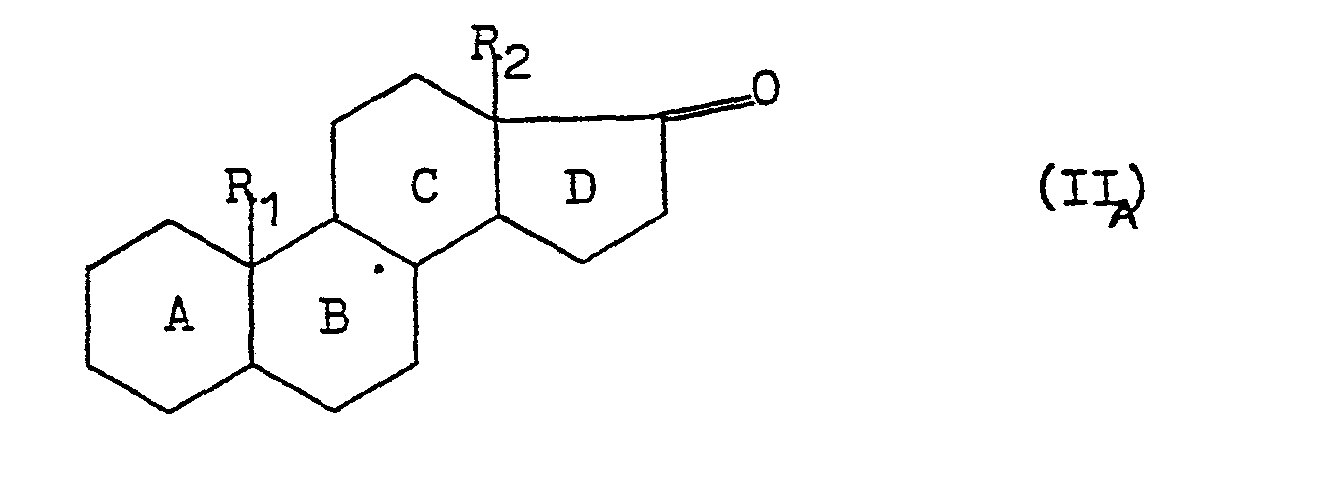

- L'invention a particulièrement pour objet une application telle que définie précédemment, caractérisée en ce que le composé cétonique répond à la formule (IIA) dans laquelle R2 représente un radical méthyle, ainsi qu'à la formule (IIA) dans laquelle R1 représente un atome d'hydrogène ou un radical méthyle et que l'on obtient les composés de formule (IA) correspondants.
- L'invention a plus particulièrement pour objet une application telle que définie précédemment, caractérisée en ce que le composé cétonique répond à la formule (II'A) :


- L'invention a tout particulièrement pour objet une application telle que définie précédemment, caractérisée en ce que le produit de formule II utilisé est la 3 β-hydroxy androst-5-en-17-one et le produit de formule I obtenu est le 3β-hydroxy 17-(nitrométhylène)androst-5-ène.
- Comme indiqué précédemment l'application selon l'invention concerne les composés organiques cycliques ou acycliques en général et n'est, bien entendu, pas limitée aux composés stéroïdes.
- La partie expérimentale ci-après fournit un autre exemple d'application à la préparation d'un composé bicyclique nitro- méthylé, au départ du composé cétonique correspondant.
- Les composés de formule (I) obtenus par l'application selon l'invention sont nouveaux et l'invention a également pour objet lesdits composés de formule (I) à titre de composés industriels nouveaux et notamment, parmi ceux-ci, les composés de formule IA et plus particulièrement ceux pour lesquels R2 représente un radical méthyle et ceux pour lesquels Ri représente un atome d'hydrogène ou un radical méthyle. On peut également citer comme composés tout spécialement visés, les composés répondant à la formule (I'A) : H

- Les produits de formule I et notamment ceux de formule IA sont d'un très grand intérêt industriel. Ils sont en effet préparés directement avec d'excellents rendements à partir des composés 17-cétcniques correspondants par un procédé simple et économique ; ils peuvent être facilement transformés en composés 21-acétoxy 20-oxo corticostéroides portant ou non une double liaison en 16(17), sans qu'il soit nécessaire d'isoler les produits intermédiaires obtenus.
- Les composés de formule IA peuvent servir notamment à préparer les produits décrits dans la demande de brevet allemand 2.521.231, dans les brevets français 1.058.850 et 1.021.728 dans le brevet américain 3.445.490.
- Les produits de formule I et notamment ceux de formule IA peuvent donc être utilisés dans la préparation de produits présentant un très grand intérêt comme médicaments, comme, par exemple, la triamcinolone et ses dérivés.
- L"'invention a également pour objet l'application des composés de formule IA tels que définis précédemment, caractérisée en ce que l'on soumet un composé de formule IA à l'action d'un aldéhyde RCHO dans lequel R représente un atome d'hydrogène ou un radical alkyle renfermant de 1 à 18 atomes de carbone, pour obrenir un composé de formule (III) :


- Dans un mode de réalisation préféré,
- - l'aldéhyde utilisé est le formaldéhyde ou l'acétaldéhyde ;
- - l'agent d'estérification est l'acide acétique, l'anhydride acétique le chlorure d'acétyle ou tout autre anhydride ou chlorure d'acide utilisé avec ou sans catalyseur;
- - l'agent de réduction du groupement nitro est le chlorure chro-5 meux ou le trichlorure de titane ;
- - l'agent de clivage du groupement oxime est une solution aqueuse de trichlorure de titane ou l'acide acétique en présence de nitrate alcalin ou un acide minéral aqueux en présence d'un aldéhyde.
- 10 L'invention a également pour objet une variante de l'application qui vient d'être décrite, caractérisée en ce que l'on soumet un composé de formule (IA)


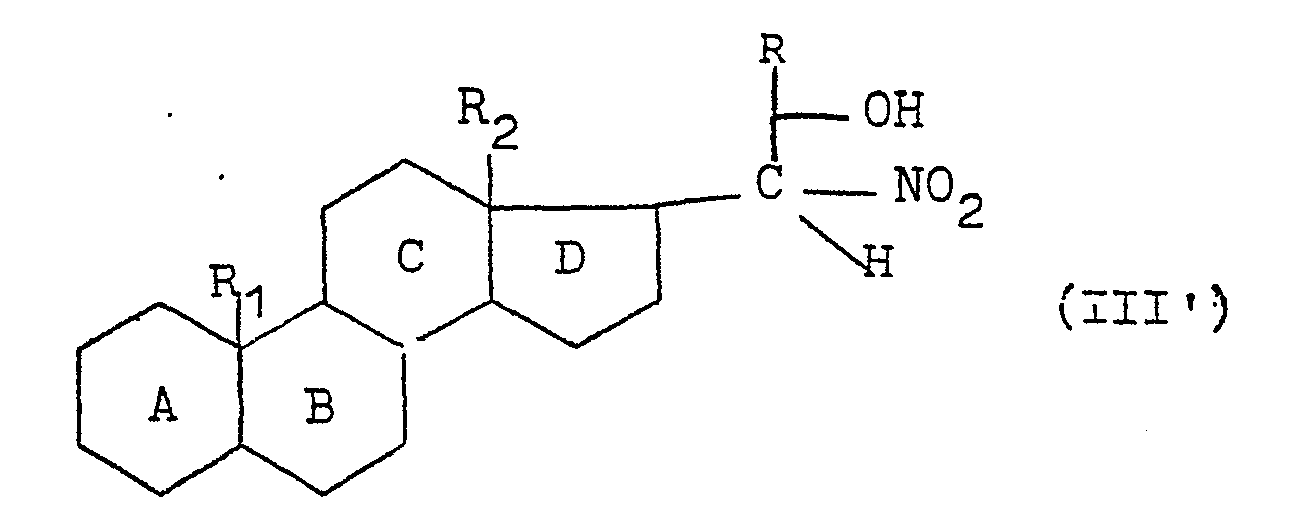


- L'agent de réduction de la double liaison est de préférence m borohydrure alcalin, comme, par exemple, le borohydrure de sodium ; les autres réactifs utilisés de façon préférentielle sont ceux indiqués ci-dessus.
- L'invention a tout naturellement plus particulièrement pour objet l'application des composés préférés de l'invention comme les composés I'A et I"A.
- L'invention a plus spécialement pour objet l'application décrite dans la partie expérimentale, caractérisée en ce que le produit de formule IA utilisé est le 3β-hydroxy 17-(nitrométhylène)androst-5-ène que l'on soumet à l'action d'un agent de formylation, pour obtenir le composé de formule :


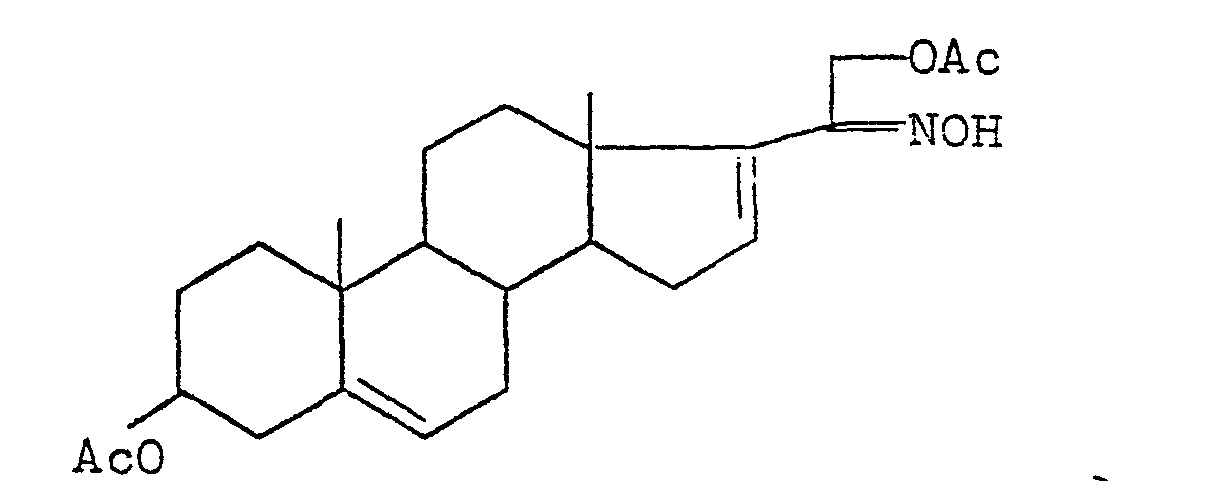
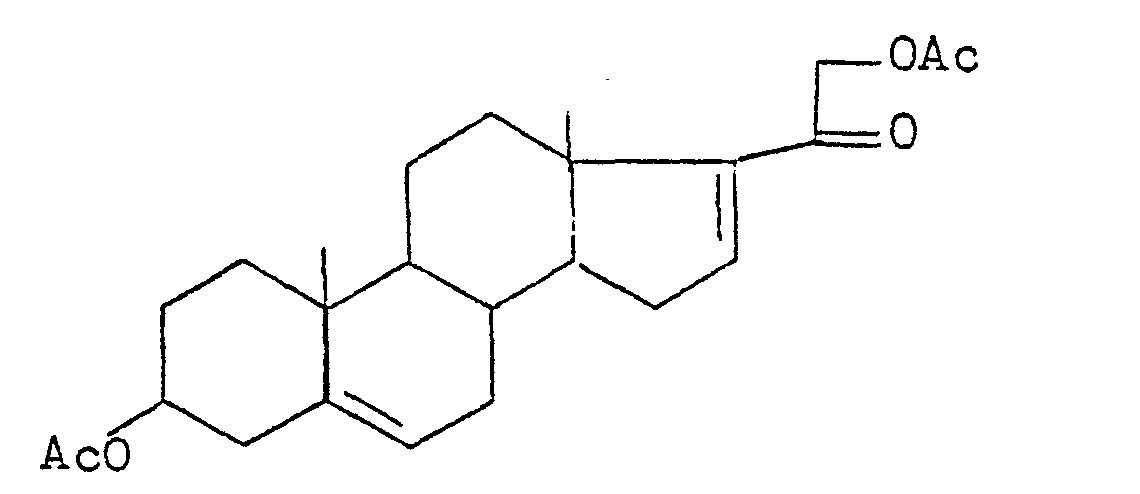
- L'invention a encore pour objet l'application caractérisée ce que le produit de formule IA utilisé est le 3β-hydroxy 17-(nitrométhylène)androst-5-ène que l'on soumet à l'action de réduction. pour obtenir le composé de formule :


- L'invention a bien entendu également pour objet les applications telles que celles menant aux composés de formules (VI) et (VI'), qui ont été définies précédemment, caractérisées en ce que l'on utilise au départ les produits de formule I dans laquelle X représente un atome de carbone.
- Les composés obtenus lors de l'application qui vient d'être décrite, ainsi que ceux de la variante sont des produits chimiques nouveaux. L'invention a donc également pour objet à titre de produits chimiques nouveaux, les produits de formules III, IV, V, VI, VII, III', IV', V' et VI' ainsi que les produits correspondants issus des produits de formule I dans laquelle X représente un atome de carbone.
- Les exemples suivants illustrent l'invention sans toutefois la limiter.
- On chauffe au reflux sous atmosphère d'azote, une solution renfermant 8,7 g de 3β-hydroxy androst-5-èr. 17-one dans 150 cm3 de nitrométhane, pour distiller 10 cm3 de nitrométhane. On ajoute 0,1 cm3 dethylènediamine et on chauffe le mélange au reflux pendant 50 ≃ 60 heures. On chasse le solvant sous pression réduite, reprend le résidu dans le dichlorométhane et le filtre sur silice en éluant par le mélange éther-dichlorométhane (1/1). On chasse le solvant organique sous pression réduite. On obtient ainsi 9,9 g du produit recherché fondant à 118-122°C. Le produit cristallise avec une demie-mole de méthanol. F = 165=168°C.
-

-

-

- Une solution de 220 mg de β-tétralone dans 3 cm3 de nitrométhane contenant environ 15 mg d'éthylène diamine, est chauffée à 75° C sous azote pendant 18 heures. L'excès de nitrométhane est évaporé sous pression réduite et le résidu est chromatogra- phié sur silice (benzène-pentane 2/3). On obtient 232 mg de produit brut que l'on recristallise dans le pentane, F = 29-31°C Spectre IR : max 1550 cm-1,
-

-

- Application 1 : 3β, 21-diacétoxy-prégna 5,16-dièn 20-cne.
- On maintient sous agitation à la température ambiante pendant 30 minutes, un mélange renfermant une suspension de 500 mg de 3β-hydroxy 17-(nitrométhylène) androst 5-ène dans 10 cm3 d'isopropanol, 2 cm3 d'une solution aqueuse de formaldéhyde et 1 cm3 de triéthylamine. On verse le mélange réactionnel dans une solution aqueuse d'acide acétique. On agite pendant 30 minutes, filtre et sèche le produit obtenu. On obtient ainsi 511 mg de produit recherché sous forme de diacétate qui fond
- à 155-163° C.
-

- RMN CCl4 ppm
- 5,95 : 1H large 16H
- 5,30 : 1H large 6H
-

- On ajoute 6 cm3 d'une solution d'acide chlorhydrique concentré et 1,8 g de poudre de zinc à une solution renfermant 3 g de CrCl3-6H2O dans 14 cm3 d'eau. On filtre la solution obtenue et la verse dans une solution renfermant 1 g de 3β,21- diacétoxy 20-nitro prégna 5,16-diène dans 150 cm3 d'acétone. Après 6 heures d'agitation, on verse la solution obtenue dans une solution aqueuse de chlorure de sodium et extrait à l'éther. On lave la phase éthérée à l'eau salée et la sèche. On filtre sur silice, évapore à sec et obtient 830 mg d'un solide blanc cristallisé fondant à 173-176°C. (α)D =-42° (c = 1,06 % CHC13) RMN CC14 ppm

- On ajoute 6,5 cm3 d'une solution aqueuse de trichlorure de titane dans une suspension renfermant 800 mg de 20-oxime de 3A21-diacétoxy prégna 5,16-dièn-20-one, 16 cm3 d'acide acétique et 6 cm3 d'acétone contenant 2,4 g d'acétate d'ammonium. On maintient le mélange réactionnel sous agitation pendant 6 heures, le verse dans l'eau, et extrait à l'éther. On lave la phase éthérée et la sèche. On filtre sur silice. On obtient après évaporation 766 mg d'un solide blanc fondant à 154-156° C.

- A une suspension de 0,5 g de 17-nitrométhylène 3β-hydroxy androst-5-ène dans 15 cm3 d'isopropanol, on ajoute, peu à peu en 10 minutes, environ 100 mg de borohydrure de sodium. On agite le mélange à température ambiante pendant 2 heures, verse dans 300 cm3 d'une solution aqueuse d'acide acétique à 1 %. On filtre, sèche et obtient 0,5 g de produit attendu, F = 178-181°C (méthanol).

- Spectre IR : max 1540 cm-1
- RMN CDC13 ppm

- A une suspension de 1 g de 17β-nitrométhyl 3β-hydroxy androst-5-ène dans 20 cm3 d'isopropanol, on ajoute 4 cm3 de formol et 2 cm3 de triéthylamine. On agite à température ambiante pendant 40-50 minutes puis verse dans 200 cm3 d'une solution aqueuse d'acide acétique à 2,5 %. On filtre sèche et obtient 1,07 g de produit attendu.


- A une solution de 200 mg de 3β,21-diacétoxy 20-nitro- pregn-5-ène dans 35 cm3 d'acétone on ajoute sous azote une solution filtrée de chlorure chromeux (préparée à partir de 0,6 g de CrCl3-6 H20 et de 0,3 g de zinc en poudre dans une solu- tion aqueuse d'acide chlorhydrique renfermant 1,5 cm3 d'acide concentré et 2,5 cm3 d'eau). Après 2-3 minutes, on verse le mélange dans l'eau et extrait avec du dichlorométhane. La phase organique est séchée et évaporée et le résidu est dissous dans 4 cm3 d'acide acétique. On ajoute goutte à goutte 2,5 cm3 d'une solution aqueuse de nitrite de sodium, puis 4 cm3 d'acide acétique. Le mélange est bouilli pendant 10 minutes, versé dans l'eau, neutralisé par le carbonate de sodium et extrait avec le dichlorométhane. La phase organique est séchée, filtrée sur silice et évaporée pour donner 149 mg de produit attendu.
- F = 162-164° C


- On opère de manière analogue à celle décrite à l'exemple 1, en utilisant au départ 0,2 g d'éther méthylique de l'oestrone, 5 cm3 de nitrométhane et environ 5 mg d'éthylène diamine. On obtient après chromatographie du produit brut obtenu, sur silice,en éluant au mélange hexane-dichlorométhane (2-3), 0,146 g de produit attendu. F = 192 - 205°C.

- On mélange 0,1 g de cholestanone, 3 cm3 de nitrométhane et 2 mg d'éthylène diamine. On porte au reflux pendant une heure, élimine le solvant sous pression réduite à température ambiante et obtient 0,11 g de produit brut, que l'on recristallise dans le méthanol. On obtient le produit attendu. F = 108 - 112°C.
-

- On mélange 0,5 g de 2-adamantone, 15 cm3 de nitrométhane et 20 mg d'éthylène diamine, porte au reflux pendant trois heures sous atmosphère d'azote, élimine le solvant sous pression réduite à température ambiante et dissout le résidu dans le chlorure de méthylène. On fait passer la solution sur silice et évapore le solvant. On obtient 0,63 g de produit attendu. F = 78 -81°C.
Claims (29)

















Priority Applications (2)
| Application Number | Priority Date | Filing Date | Title |
|---|---|---|---|
| DE8686200123T DE3380563D1 (en) | 1982-02-18 | 1983-02-15 | Steroids substituted at position 17 by a nitromethylene radical, and their use in the preparation of biologically active compounds |
| AT83400315T ATE43569T1 (de) | 1982-02-18 | 1983-02-15 | Reagenz zur nitromethylierung, seine anwendung zur herstellung von nitromethylierten verbindungen von bestimmten derivaten davon und die erhaltenen verbindungen. |
Applications Claiming Priority (2)
| Application Number | Priority Date | Filing Date | Title |
|---|---|---|---|
| FR8202681 | 1982-02-18 | ||
| FR8202681A FR2521567A1 (fr) | 1982-02-18 | 1982-02-18 | Nouveaux derives steroides 17(20)nitro, leur procede de preparation et leur application a la preparation de corticosteroides |
Related Child Applications (1)
| Application Number | Title | Priority Date | Filing Date |
|---|---|---|---|
| EP86200123.7 Division-Into | 1983-02-15 |
Publications (3)
| Publication Number | Publication Date |
|---|---|
| EP0087359A2 true EP0087359A2 (fr) | 1983-08-31 |
| EP0087359A3 EP0087359A3 (en) | 1984-08-22 |
| EP0087359B1 EP0087359B1 (fr) | 1989-05-31 |
Family
ID=9271110
Family Applications (2)
| Application Number | Title | Priority Date | Filing Date |
|---|---|---|---|
| EP86200123A Expired EP0192288B1 (fr) | 1982-02-18 | 1983-02-15 | Nouveaux dérivés stéroides portant en 17 un radical nitrométhylène, Leur application à la préparation de produits biologiquement actifs |
| EP83400315A Expired EP0087359B1 (fr) | 1982-02-18 | 1983-02-15 | Nouveau réactif de nitrométhylation, son application à la préparation de composés nitrométhylénés et de certains de leurs dérivés et les composés nouveaux obtenus |
Family Applications Before (1)
| Application Number | Title | Priority Date | Filing Date |
|---|---|---|---|
| EP86200123A Expired EP0192288B1 (fr) | 1982-02-18 | 1983-02-15 | Nouveaux dérivés stéroides portant en 17 un radical nitrométhylène, Leur application à la préparation de produits biologiquement actifs |
Country Status (7)
| Country | Link |
|---|---|
| US (1) | US4490296A (fr) |
| EP (2) | EP0192288B1 (fr) |
| JP (2) | JPS58152822A (fr) |
| AT (1) | ATE46346T1 (fr) |
| DE (1) | DE3379947D1 (fr) |
| FR (1) | FR2521567A1 (fr) |
| HU (1) | HU191199B (fr) |
Cited By (1)
| Publication number | Priority date | Publication date | Assignee | Title |
|---|---|---|---|---|
| RU2574685C1 (ru) * | 2014-11-05 | 2016-02-10 | Федеральное государственное бюджетное образовательное учреждение высшего профессионального образования "Волгоградский государственный технический университет" (ВолгГТУ) | Способ получения 2-нитрометиленадамантана |
Families Citing this family (6)
| Publication number | Priority date | Publication date | Assignee | Title |
|---|---|---|---|---|
| HU208437B (en) * | 1988-04-08 | 1993-10-28 | Roussel Uclaf | Process for producing 9-alpha-hydroxy- -17-methylene-steroides for synthetizing corticosteroides |
| US5300523A (en) * | 1988-07-28 | 1994-04-05 | Bayer Aktiengesellschaft | Substituted aminomethyltetralins and their heterocyclic analogues |
| IT1282289B1 (it) * | 1995-06-23 | 1998-03-16 | Sigma Tau Ind Farmaceuti | 17-idrossiimminoalchil e 17-idrossiimminometilalchenil ciclopentaperidrofenantreni attivi sul sistema cardiovascolare, |
| CN100345862C (zh) * | 2004-03-12 | 2007-10-31 | 浙江医药股份有限公司新昌制药厂 | 甾类化合物的制备方法 |
| CN104262442B (zh) * | 2014-10-10 | 2016-01-20 | 湖南科瑞生物制药股份有限公司 | 黄体酮的制备方法 |
| CN109796344B (zh) * | 2018-12-20 | 2022-01-14 | 浙江工业大学 | 一种(e)-1,3-二苯基-4-硝基-1-丁烯的制备方法 |
Family Cites Families (7)
| Publication number | Priority date | Publication date | Assignee | Title |
|---|---|---|---|---|
| US2383603A (en) * | 1945-08-28 | Condensation of nitroalkanes with | ||
| US3980681A (en) * | 1969-11-21 | 1976-09-14 | Peter Job Sykes | Process for the preparation of 11-β-nitro-oxysteroids |
| HU162303B (fr) * | 1970-09-30 | 1973-01-29 | ||
| JPS5113140B2 (fr) * | 1972-01-13 | 1976-04-26 | ||
| JPS526612B2 (fr) * | 1972-05-20 | 1977-02-23 | ||
| FR2462445A1 (fr) * | 1979-07-31 | 1981-02-13 | Roussel Uclaf | Nouveaux derives 17-/(hydroxymethyl) (formamido) methylene/steroides, leur procede de preparation et leur application a l'introduction de la chaine laterale hydroxyacetyle |
| FR2486947A1 (fr) * | 1980-07-15 | 1982-01-22 | Roussel Uclaf | Nouveaux derives steroides 20-isonitriles 17(20) insatures, leur procede de preparation et leur application a la preparation des steroides 17a-hydroxy 20-ceto |
-
1982
- 1982-02-18 FR FR8202681A patent/FR2521567A1/fr active Granted
-
1983
- 1983-01-31 US US06/462,684 patent/US4490296A/en not_active Expired - Fee Related
- 1983-02-15 EP EP86200123A patent/EP0192288B1/fr not_active Expired
- 1983-02-15 EP EP83400315A patent/EP0087359B1/fr not_active Expired
- 1983-02-15 DE DE8383400315T patent/DE3379947D1/de not_active Expired
- 1983-02-15 JP JP58022231A patent/JPS58152822A/ja active Granted
- 1983-02-15 AT AT86200123T patent/ATE46346T1/de not_active IP Right Cessation
- 1983-02-17 HU HU83561A patent/HU191199B/hu not_active IP Right Cessation
-
1991
- 1991-12-17 JP JP3352924A patent/JPH0559095A/ja active Pending
Cited By (1)
| Publication number | Priority date | Publication date | Assignee | Title |
|---|---|---|---|---|
| RU2574685C1 (ru) * | 2014-11-05 | 2016-02-10 | Федеральное государственное бюджетное образовательное учреждение высшего профессионального образования "Волгоградский государственный технический университет" (ВолгГТУ) | Способ получения 2-нитрометиленадамантана |
Also Published As
| Publication number | Publication date |
|---|---|
| EP0087359B1 (fr) | 1989-05-31 |
| FR2521567B1 (fr) | 1984-05-04 |
| JPS58152822A (ja) | 1983-09-10 |
| DE3379947D1 (en) | 1989-07-06 |
| US4490296A (en) | 1984-12-25 |
| HU191199B (en) | 1987-01-28 |
| EP0192288B1 (fr) | 1989-09-13 |
| FR2521567A1 (fr) | 1983-08-19 |
| JPH0480889B2 (fr) | 1992-12-21 |
| EP0087359A3 (en) | 1984-08-22 |
| ATE46346T1 (de) | 1989-09-15 |
| JPH0559095A (ja) | 1993-03-09 |
| EP0192288A1 (fr) | 1986-08-27 |
Similar Documents
| Publication | Publication Date | Title |
|---|---|---|
| CH633811A5 (fr) | Derives steroides 4,9-dieniques 11beta-substitues, procede de preparation et compositions pharmaceutiques. | |
| EP0280618B1 (fr) | Nouveaux 19-nor stéroîdes substitués en position 7, leur préparation, leur application comme médicaments, les compositions pharmaceutiques les renfermant | |
| EP0558416B1 (fr) | Nouveaux stéroides comportant en position 17 un radical méthylène lactone, leur procédé et des intermédiaires de préparation, leur application comme médicaments et les compositions pharmaceutiques les renfermant | |
| EP0056000B1 (fr) | Dérivés 17/(alkoxycarbonyle) (formamido) méthylène/stéroides et leur préparation | |
| EP0087359B1 (fr) | Nouveau réactif de nitrométhylation, son application à la préparation de composés nitrométhylénés et de certains de leurs dérivés et les composés nouveaux obtenus | |
| CH652726A5 (fr) | Derives steroides 17-oxazolines, leur procede de preparation et leur utilisation a la preparation de corticosteroides. | |
| EP0001029B1 (fr) | Procédé de préparation d'oximes en 3 de stéroides | |
| CA1146531A (fr) | Procede de preparation de nouveaux derives 2,2- dimethyl 19-nor steroides | |
| EP0574317A1 (fr) | Nouveau procédé de préparation de composés stéroides 20-céto 21alpha-hydroxy et intermédiaires | |
| EP0275728B1 (fr) | Nouveaux produits stéroîdes comportant, en position 23, un radical sulfinyle, leur procédé de préparation, leur application à la préparation de produits de la série des 20-cétoprégnanes et des intermédiaires de cette application | |
| EP0128839B1 (fr) | Stéroides radioactifs, leur procédé et leurs intermédiaires de préparation, leur application à la mise en évidence des récepteurs de glucocorticoides et au dosage du nombre de sites de fixation | |
| EP0058097B1 (fr) | Nouveau procédé de préparation de 17alpha-hydroxy 17bêta-hydroxyacétyl stéroides et produits intermédiaires correspondants obtenus | |
| FR2486947A1 (fr) | Nouveaux derives steroides 20-isonitriles 17(20) insatures, leur procede de preparation et leur application a la preparation des steroides 17a-hydroxy 20-ceto | |
| EP0443957A2 (fr) | Nouveaux produits stéroides comportant un radical spiro en position 17, leur procédé de préparation et les intermédiaires de ce procédé, leur application à titre de médicaments et les compositions pharmaceutiques les renfermant | |
| CH641475A5 (fr) | Derives acetyleniques de l'androst-4-ene, leur procede de preparation et medicament les renfermant. | |
| EP0059146B1 (fr) | Nouveaux médicaments dérivés de la 3-hydroxy dodécahydro benz (e) inden-7-one, produits dérivés de la 3-hydroxy dodécahydro benz (e) inden-7-one et leur procédé de préparation | |
| CH629823A5 (fr) | Derives steroides substitues en 11beta et leur procede de preparation. | |
| EP0237397B1 (fr) | Nouveaux stéroîdes 9(11) saturés substitués en position 10 par un radical comportant une triple liaison, leur procédé de préparation, leur application comme médicaments, les compositions pharmaceutiques les renfermant | |
| EP0114011B1 (fr) | Dérivés estratriéniques radioactifs marqués à l'iode, procédé et intermédiaires de préparation, application aux dosages radio-immunologiques et à la préparation d'antigènes, antigènes obtenus | |
| FR2474038A1 (fr) | 17-spiro-dihydrofuranones steroidales a action anti-inflammatoire, et leur procede de preparation | |
| EP0003090A2 (fr) | Nouveaux dérivés stéroides 17 alpha-aryle ou 17 alpha-hétéroaryle, leur procédé de préparation et leur application comme médicaments et les compositions pharmaceutiques les renfermant | |
| CH627193A5 (fr) | ||
| EP0275729B1 (fr) | Nouveaux produits stéroides comportant, en position 23, un radical cétonique, leur procédé de préparation, leur application à la préparation de produits de la série des 20-cétoprégnanes et des intermédiaires de cette application | |
| CA1326235C (fr) | Composes steroides utiles pour la preparation de produits de la serie 20-ceto pregnane | |
| FR2570076A1 (fr) | Nouveaux steroides et leur procede de preparation |
Legal Events
| Date | Code | Title | Description |
|---|---|---|---|
| PUAI | Public reference made under article 153(3) epc to a published international application that has entered the european phase |
Free format text: ORIGINAL CODE: 0009012 |
|
| AK | Designated contracting states |
Designated state(s): AT CH DE FR GB IT LI NL SE |
|
| PUAL | Search report despatched |
Free format text: ORIGINAL CODE: 0009013 |
|
| AK | Designated contracting states |
Designated state(s): AT CH DE FR GB IT LI NL SE |
|
| 17P | Request for examination filed |
Effective date: 19841018 |
|
| GRAA | (expected) grant |
Free format text: ORIGINAL CODE: 0009210 |
|
| AK | Designated contracting states |
Kind code of ref document: B1 Designated state(s): AT CH DE FR GB IT LI NL SE |
|
| REF | Corresponds to: |
Ref document number: 43569 Country of ref document: AT Date of ref document: 19890615 Kind code of ref document: T |
|
| REF | Corresponds to: |
Ref document number: 3379947 Country of ref document: DE Date of ref document: 19890706 |
|
| GBT | Gb: translation of ep patent filed (gb section 77(6)(a)/1977) | ||
| ITF | It: translation for a ep patent filed | ||
| PLBE | No opposition filed within time limit |
Free format text: ORIGINAL CODE: 0009261 |
|
| STAA | Information on the status of an ep patent application or granted ep patent |
Free format text: STATUS: NO OPPOSITION FILED WITHIN TIME LIMIT |
|
| 26N | No opposition filed | ||
| PGFP | Annual fee paid to national office [announced via postgrant information from national office to epo] |
Ref country code: SE Payment date: 19920115 Year of fee payment: 10 |
|
| PGFP | Annual fee paid to national office [announced via postgrant information from national office to epo] |
Ref country code: CH Payment date: 19920124 Year of fee payment: 10 |
|
| PGFP | Annual fee paid to national office [announced via postgrant information from national office to epo] |
Ref country code: GB Payment date: 19920211 Year of fee payment: 10 |
|
| PGFP | Annual fee paid to national office [announced via postgrant information from national office to epo] |
Ref country code: AT Payment date: 19920228 Year of fee payment: 10 |
|
| ITTA | It: last paid annual fee | ||
| PGFP | Annual fee paid to national office [announced via postgrant information from national office to epo] |
Ref country code: NL Payment date: 19920229 Year of fee payment: 10 |
|
| PGFP | Annual fee paid to national office [announced via postgrant information from national office to epo] |
Ref country code: DE Payment date: 19920320 Year of fee payment: 10 |
|
| PG25 | Lapsed in a contracting state [announced via postgrant information from national office to epo] |
Ref country code: GB Effective date: 19930215 Ref country code: AT Effective date: 19930215 |
|
| PG25 | Lapsed in a contracting state [announced via postgrant information from national office to epo] |
Ref country code: SE Effective date: 19930216 |
|
| PG25 | Lapsed in a contracting state [announced via postgrant information from national office to epo] |
Ref country code: LI Effective date: 19930228 Ref country code: CH Effective date: 19930228 |
|
| PG25 | Lapsed in a contracting state [announced via postgrant information from national office to epo] |
Ref country code: NL Effective date: 19930901 |
|
| GBPC | Gb: european patent ceased through non-payment of renewal fee |
Effective date: 19930215 |
|
| NLV4 | Nl: lapsed or anulled due to non-payment of the annual fee | ||
| REG | Reference to a national code |
Ref country code: CH Ref legal event code: PL |
|
| PG25 | Lapsed in a contracting state [announced via postgrant information from national office to epo] |
Ref country code: DE Effective date: 19931103 |
|
| EUG | Se: european patent has lapsed |
Ref document number: 83400315.4 Effective date: 19930912 |
|
| PGFP | Annual fee paid to national office [announced via postgrant information from national office to epo] |
Ref country code: FR Payment date: 19960228 Year of fee payment: 14 |
|
| PG25 | Lapsed in a contracting state [announced via postgrant information from national office to epo] |
Ref country code: FR Effective date: 19971030 |
|
| REG | Reference to a national code |
Ref country code: FR Ref legal event code: ST |