EP0087764A1 - Générateur d'impulsions de Josephson commandé par courant injecté - Google Patents
Générateur d'impulsions de Josephson commandé par courant injecté Download PDFInfo
- Publication number
- EP0087764A1 EP0087764A1 EP83101807A EP83101807A EP0087764A1 EP 0087764 A1 EP0087764 A1 EP 0087764A1 EP 83101807 A EP83101807 A EP 83101807A EP 83101807 A EP83101807 A EP 83101807A EP 0087764 A1 EP0087764 A1 EP 0087764A1
- Authority
- EP
- European Patent Office
- Prior art keywords
- circuit
- resistor
- resistors
- group
- current
- Prior art date
- Legal status (The legal status is an assumption and is not a legal conclusion. Google has not performed a legal analysis and makes no representation as to the accuracy of the status listed.)
- Granted
Links
- 238000002347 injection Methods 0.000 title abstract description 8
- 239000007924 injection Substances 0.000 title abstract description 8
- 230000004044 response Effects 0.000 claims description 2
- 238000004519 manufacturing process Methods 0.000 description 5
- 230000035945 sensitivity Effects 0.000 description 5
- 230000006872 improvement Effects 0.000 description 3
- 230000010354 integration Effects 0.000 description 3
- 230000008878 coupling Effects 0.000 description 2
- 238000010168 coupling process Methods 0.000 description 2
- 238000005859 coupling reaction Methods 0.000 description 2
- 238000010586 diagram Methods 0.000 description 2
- 230000004907 flux Effects 0.000 description 2
- 230000006870 function Effects 0.000 description 2
- 238000000034 method Methods 0.000 description 2
- 238000000926 separation method Methods 0.000 description 2
- 238000005094 computer simulation Methods 0.000 description 1
- 238000010276 construction Methods 0.000 description 1
- 230000000694 effects Effects 0.000 description 1
- 238000001459 lithography Methods 0.000 description 1
- 230000007257 malfunction Effects 0.000 description 1
- 230000008569 process Effects 0.000 description 1
- 238000005070 sampling Methods 0.000 description 1
Images

Classifications
-
- H—ELECTRICITY
- H03—ELECTRONIC CIRCUITRY
- H03K—PULSE TECHNIQUE
- H03K3/00—Circuits for generating electric pulses; Monostable, bistable or multistable circuits
- H03K3/02—Generators characterised by the type of circuit or by the means used for producing pulses
- H03K3/38—Generators characterised by the type of circuit or by the means used for producing pulses by the use, as active elements, of superconductive devices
-
- Y—GENERAL TAGGING OF NEW TECHNOLOGICAL DEVELOPMENTS; GENERAL TAGGING OF CROSS-SECTIONAL TECHNOLOGIES SPANNING OVER SEVERAL SECTIONS OF THE IPC; TECHNICAL SUBJECTS COVERED BY FORMER USPC CROSS-REFERENCE ART COLLECTIONS [XRACs] AND DIGESTS
- Y10—TECHNICAL SUBJECTS COVERED BY FORMER USPC
- Y10S—TECHNICAL SUBJECTS COVERED BY FORMER USPC CROSS-REFERENCE ART COLLECTIONS [XRACs] AND DIGESTS
- Y10S505/00—Superconductor technology: apparatus, material, process
- Y10S505/825—Apparatus per se, device per se, or process of making or operating same
- Y10S505/856—Electrical transmission or interconnection system
- Y10S505/857—Nonlinear solid-state device system or circuit
- Y10S505/863—Stable state circuit for signal shaping, converting, or generating
- Y10S505/864—Stable state circuit for signal shaping, converting, or generating with josephson junction
Definitions
- the present invention relates to a pulse generator of current injection type using the Josephson junctions, and more particularly to improvements thereof for generating pulses of very short width without causing resonance and for enabling high density integration.
- a closed loop including the above inductance and the capacity of the Josephson junction in the gate circuit causes a resonance which should be damped. Further, such a gate tends to trap stray magnetic flux when switched to the superconducting state,,,resulting in malfunctions.
- An object of this invention is to provide a Josephson pulse generator of current injection type which enables to remove the inductance component and to suppress the resonance phenomenon.
- Another object of this invention is to provide a Josephson pulse generator of current injection type which is capable of generating pulses of very short pulse width.
- Still another object of this invention is to provide a Josephson pulse generator of current injection type which has an improved operation margin and gain.
- Further object of this invention is to provide a J osephson pulse generator of current injection type which is easy to manufacture and suitable for high density integration.
- a circuit utilizing Josephson junctions comprising a first group of "N" (N ⁇ 2) resistors connected together at one end thereof and each having a predetermined resistance, a second group “N-1” resistors each being connected between the other ends of two of the "N” resistors and having a predetermined resistance, the second group of resistors being connected in series between a first node and a second node, a first group of "N” Josephson junctions connected between a reference potential and one of the other ends of the first group resistors and each having a predetermined critical current, a first Josephson junction connected at one end thereof with the first node and having,a predetermined critical current, and a first resistor connected between the reference potential and the other end of the first Josephson junction and having a predetermined resistance, and a second Josephson junction connected at one end thereof with the second node and having a predetermined critical current, the circuit producing an ultra-short duration pulse from the other end of the second Josephson junction when
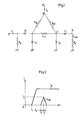
- Figure 1 shows a pulse generator of current injection type according to a first embodiment of this invention.
- reference symbols J 11 , J 12' J 2 and J 3 denote Jose phson junctions having critical currents I 11' I 12 , I 2 and I 3 respectively; R 11 , R 12' R 21 , R 0 resistors having resistances r 11' r 12' r 21 and r 0 respectively; 11 a gate current supply terminal; 12 an input terminal; 13 an output line; and R L a load resistor with a resistance r L .
- an input/output separation function is added to the pulse generation function and an improvement is made on the gain.
- the gate current I g supplied from the gate current supply terminal 11 is divided into two paths, a first path consisting of the resistor R 11 and the Josephson junction J 11 and a second path consisting of the resistor R 12 and the Josephson junction J 12 .
- the current flowing through the Josephson junction J 11 is then injected into the Josephson junction J 12 through the resistor R 21 and the resistors R 11 , R 12 thereby switching the Josephson junction J 12 into the voltage state.
- the gate current I g is distributed into two paths, a first path consisting of the Josephson junction J 2 and the resistor R 0 and a second path consisting of the Josephson junction J 3 , an output line 13 and the load resistor R L . If r L is set greater than r 0 , almost all the gate current Ig flows into the first path, switching the Josephson junction J 2 into the voltage state.
- the input current Ic flows through the resistor R 0 into ground while the gate current I g flows through the Josephson J 3 , the output line 13 and into the load resistor R L , thereby achieving the separation between the input and output.
- the gate current I g is distributed according to the resistance values of the four Josephson junctions in the voltage state and flows into ground.
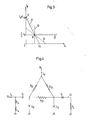
- Figure 2 shows an waveform of the output pulse current I out obtained in a manner described above.
- the pulse current I out starts to rise after the elapse of turn-on delay time Ts necessary for the gate circuit in Figure 1 to switch into the voltage state and continues to rise for the duration of a rise time T 1 of the gate circuit to the left of the Josephson junction J 3 . Then the pulse I out goes down for the duration of a rise time T 2 of the Josephson junction J 3 . Therefore, the pulse width is determined as (T 1 + T 2 ). In consideration that the obtainable switching time of the Josephson junction is about 10 picoseconds, the pulse width of 20 picoseconds may be obtained by the above circuit.
- This design rule is based on the control characteristic of the above pulse generator as shown in Figure 3 which shows the control characteristic of the gate circuit (circuit on the left side of the Josephson junction J 3 of Figure 1) in the pulse generator with the shaded portion representing the voltage state of the gate circuit.
- the line 21 represents the threshold value characteristic for switching the Josephson junction J 11 into the voltage state; the line 23 for switching the Josephson junction J 12 into the voltage state with the Josephson Junction J 11 in the zero-voltage state; the line 24 for switching the Josephson junction J 12 after the completion of switching of the Josephson junction J 11 ; the line 22 for switching the Josephson junction J 2 after the completion of switching of the Josephson junctions J 11 , J 12 .
- the input current I c is injected into the Josephson junction J 11 through the Josephson junction J 2 .
- the condition for switching the Josephson junction J 11 is given by
- the values of the intersection points between the line 24 and ordinate and ascissa becomes small as the resistance r O increases. This is preferable in the light of operation margin, but, considering the backlash of the input current T c , it is desirable to limit r 0 to a small value.
- the minimum allowable value of r 0 is the value attained at a contact point between the intersection B and the line 24.
- the pulse width calculated by the computer simulation is approximately 30 picoseconds, which is sufficiently short so that the Josephson circuit and the memory circuit can be operated with very high operation speed.
- the above circuit parameters can easily be achived by ordinary Josephson integrated circuit manufacturing technique employing lithography with minimum line width of 5 micrometer.
- the pulse generator according to this invention needs no input line for magnetic coupling with the gate circuit, which in turn reduces the number of integrated circuit fabrication processes. Further, the absence of inductances makes it possible to produce the logic gate in small and is suited for high density integration. It also does not require an additional provision to dampe the resonance because there is no inductance components causing the resonance in this circuit. Moreover, since this circuit does not use a superconductive loop, there is no risk of trapping stray magnetic flux and causing erroneous operation.
- Figure 4 shows the circuit of this embodiment.
- the difference from the first embodiment of Figure 1 is that an inductance component L O is connected in series with the resistor R 0 connected to the input terminal.
- the operation of this circuit is detailed below.
- the gate current I g is bisected into two current paths, a first path made up of the Josephson junction J 2 , the resistor R 0 and the inductance L 0 and a second path made up of the Josephson junction J 3 , the output line 13 and the load resistor R L .
- the inductance L 0 If the inductance L 0 is set sufficiently large, the current path consisting of the Josephson junction J 2 , resistor R O and inductance L 0 presents dynamically a large impedance, causing the gate current I g to flow through the Josephson junction J 3 into the output line 13. As a result, the current in the output line 13 rises during the switching time of the Josephson junction J 12 . When the current flowing through the output line 13 exceeds the critical current value of the Josephson junction J 3 , the Josephson junction J 3 is switched into the voltage state interrupting the output current. Therefore, a pulse current is obtained through the output line 13.
- the gate current Ig flows through the Josephson junction J 2 , resistor R 0 and inductance L 0 into ground, switching the Josephson junction J 2 into the voltage state. Consequently, the gate current I g is distributed according to the resistances of the junctions J 11 , J 12 , J 2 , J 3 in the voltage state and flows into ground through them.
- the input current I c flows through the resistor R 0 and inductance L 0 into ground. In this way, the input and output currents are separated.
- the switching order of the J osephson junctions in this circuit is J 11 , J 12 , J 3 and J 2 , and the output pulse I out rises after completion of switching of the Josephson junctions J 11 and J 12 .
- the sequence of switching is J 11 , J 12 , J 2 and J 3 .
- the capacitances of the Josephson junctions J 11 , J 12 and J 2 (each capacity is supposed to be C) which amounts to 3C, 1.5 times the capacity of the circuit shown in Figure 4, have to be charged.
- the rise time and fall time of the output pulse I out depend on the time constant CR. Since the capacitance of the circuit of Figure 4 when I out is produced is 2/3 the capacitance of the circuit of Figure 1, as mentioned above, the pulse obtained with the pulse generator of Figure 4 has shorter rise time and fall time. In this circuit, too, in order to keep the high input sensitivity and wide operation margin, it is preferable that the design rule similar to that of Figure 1 be followed. It is apparent that when the connecting sequence of the resistor R 0 and inductance L 0 is reversed the same effect can be obtained.
- Figure 5 shows a pulse generator circuit, a still another embodiment of this invention, in which further improvement is made on the operation margin and gain.
- a resistor R 22 resistance r 22
- a resistor R 13 resistor R 13
- a Josephson junction J 13 critical current I 13
- the operation margin and the gain are further improved as the number of resistors and Josephson junctions increases. This may be explained as follows.
- the input sensitivity depends on the gradient of the threshold line 21 for the Josephson junction J 11 . If we suppose the added resistors (n pieces including R 11 and R 12 ) have resistance equal to that of R 11 and R 12 and the Josephson junctions (n pieces including J 11 and J 12 ) have critical current equal to I 11 of J 11 and I 12 of J 12 , then the threshold line for the line 21 is expressed as
- Equation (17) also shows that the operation margin increases as the number of added resistors and Josephson junctions increases.
- the gate current I g is trisected into three current paths, a first path consisting of resistor R 11 and Josephson junction J 11 , a second path consisting of resistor R 12 and Josephson junction J 12 , and a third path consisting of resistor R 13 and Josephson junction J 13 with I g1 , Ig 2 and I g3 , respectively.
- the gate current I g is bisected into two paths, a first path consisting of Josephson junction J 2 and resistor R 0 and a second path consisting of Josephson junction J 3 , output line 13 and load resistor R L . If the resistance r L of the load resistor R L is set sufficiently higher than the resistance r 0 of the resistor R 0 , most of the gate current Ig flows through the Josephson junction J 2 and resistor R 0 thus switching the Josephson junction J 2 into the voltage state. This:causes the input current I c to flow through the resistor R 0 into ground and the gate current I g to flow through the Josephson junction J 3 , output line 13 and load resistor R L and into the ground. In this way, the input and output are separated.
- the Josephson junction J 3 As the current flowing through the output line 13 exceeds the critical current value I3 of the Josephson junction J 3 , the Josephson junction J 3 is switched into the voltage stage, cutting off the output current. As a result, a pulse current is obtained through the output line 13.
- the gate current I g is distributed according to the resistance of each junction in the voltage state and flows into ground-through them.
- the rise time and fall time of the output pulse current I out are given by the switching time of the Josephson junctions J 2 and J 3 , respectively.
- the pulse width is also given as the sum of these switching times.
- FIG. 6 shows another embodiment of the present invention in which an inductance component L 0 is connected in series with the resistance R 0 of Figure 5 to further shorten the output pulse width.
- the operation of this circuit is similar to that of Figure 1 and Figure 4, so detailed explanation is not presented here.
- the overall capacity of the gate circuit is the sum of each capacity of the Josephson junctions J 11 , J 12 and J 13 , which is 3/4 the capacity of the circuit of Figure 5. This means the pulse width is further reduced.
Landscapes
- Electronic Switches (AREA)
Applications Claiming Priority (4)
| Application Number | Priority Date | Filing Date | Title |
|---|---|---|---|
| JP3031682A JPS58147228A (ja) | 1982-02-26 | 1982-02-26 | ジヨセフソン効果を用いた電流注入型パルス発生回路 |
| JP3031782A JPS58147229A (ja) | 1982-02-26 | 1982-02-26 | ジヨセフソン効果を用いた電流注入型パルス発生回路 |
| JP30317/82 | 1982-02-26 | ||
| JP30316/82 | 1982-02-26 |
Publications (2)
| Publication Number | Publication Date |
|---|---|
| EP0087764A1 true EP0087764A1 (fr) | 1983-09-07 |
| EP0087764B1 EP0087764B1 (fr) | 1986-08-06 |
Family
ID=26368641
Family Applications (1)
| Application Number | Title | Priority Date | Filing Date |
|---|---|---|---|
| EP83101807A Expired EP0087764B1 (fr) | 1982-02-26 | 1983-02-24 | Générateur d'impulsions de Josephson commandé par courant injecté |
Country Status (3)
| Country | Link |
|---|---|
| US (1) | US4603263A (fr) |
| EP (1) | EP0087764B1 (fr) |
| DE (1) | DE3365058D1 (fr) |
Families Citing this family (4)
| Publication number | Priority date | Publication date | Assignee | Title |
|---|---|---|---|---|
| US5266844A (en) * | 1991-07-15 | 1993-11-30 | Hewlett-Packard Company | Timing discriminator circuit and method for determining the arrival order of input signals |
| US5233243A (en) * | 1991-08-14 | 1993-08-03 | Westinghouse Electric Corp. | Superconducting push-pull flux quantum logic circuits |
| US5331297A (en) * | 1991-12-26 | 1994-07-19 | Kyocera Corporation | Josephson device a.c. power supply circuit and circuit substrate for mounting same |
| US5552735A (en) * | 1994-10-07 | 1996-09-03 | Northrop Grumman Corporation | Multi-gigahertz single flux quantum switch |
Citations (2)
| Publication number | Priority date | Publication date | Assignee | Title |
|---|---|---|---|---|
| US4275314A (en) * | 1979-04-30 | 1981-06-23 | Bell Telephone Laboratories, Incorporated | Josephson Atto-Weber switch |
| GB2078046A (en) * | 1980-06-10 | 1981-12-23 | Nippon Telegraph & Telephone | Superconductive logic circuit |
Family Cites Families (2)
| Publication number | Priority date | Publication date | Assignee | Title |
|---|---|---|---|---|
| US4313066A (en) * | 1979-08-20 | 1982-01-26 | International Business Machines Corporation | Direct coupled nonlinear injection Josephson logic circuits |
| JPS5846727A (ja) * | 1981-09-14 | 1983-03-18 | Nec Corp | ジヨセフソン効果を用いた電流注入型論理ゲ−ト回路 |
-
1983
- 1983-02-23 US US06/468,908 patent/US4603263A/en not_active Expired - Fee Related
- 1983-02-24 EP EP83101807A patent/EP0087764B1/fr not_active Expired
- 1983-02-24 DE DE8383101807T patent/DE3365058D1/de not_active Expired
Patent Citations (2)
| Publication number | Priority date | Publication date | Assignee | Title |
|---|---|---|---|---|
| US4275314A (en) * | 1979-04-30 | 1981-06-23 | Bell Telephone Laboratories, Incorporated | Josephson Atto-Weber switch |
| GB2078046A (en) * | 1980-06-10 | 1981-12-23 | Nippon Telegraph & Telephone | Superconductive logic circuit |
Non-Patent Citations (4)
| Title |
|---|
| APPLIED PHYSICS LETTERS, vol. 36, no. 12, June 1980, New York D.B. TUCKERMAN "A Josephson ultrahigh-resolution sampling system", pages 1008-1010 * |
| IBM TECHNICAL DISCLOSURE BULLETIN, vol. 22, no. 2, July 1979 S.M. FARIS et al. "Pulsed output star driver", pages 846-847 * |
| IBM TECHNICAL DISCLOSURE BULLETIN, vol. 25, no. 3A, August 1982 S.M. FARIS et al. "Isolator for Josephson Logic", pages 1207-1208 * |
| IEEE TRANSACTIONS ON ELECTRON DEVICES, vol. ED-27, no. 10, October 1980 T.R. GHEEWALA "Josephson-logic devices and circuits", pages 1857-1869 * |
Also Published As
| Publication number | Publication date |
|---|---|
| US4603263A (en) | 1986-07-29 |
| EP0087764B1 (fr) | 1986-08-06 |
| DE3365058D1 (en) | 1986-09-11 |
Similar Documents
| Publication | Publication Date | Title |
|---|---|---|
| US6549059B1 (en) | Underdamped Josephson transmission line | |
| US4678942A (en) | Emitter coupled logic circuit with high drivability for capacitive load | |
| EP0074666B1 (fr) | Circuit utilisant l'effet Josephson | |
| EP0087764A1 (fr) | Générateur d'impulsions de Josephson commandé par courant injecté | |
| US2909680A (en) | Conditional steering gate for a complementing flip flop | |
| DE3884936T2 (de) | Asymmetrischer Verzögerungsgenerator für einen Taktzerhacker. | |
| US5124583A (en) | Dc-powered josephson integrated circuit | |
| EP0069534A2 (fr) | Circuit logique supra-conducteur | |
| US4373138A (en) | Hybrid unlatching flip-flop logic element | |
| CA1189916A (fr) | Circuit utilisant l'effet josephson | |
| JPH0230209B2 (fr) | ||
| Pei | Logic delays of 5‐μm current‐switched Josephson gates | |
| US5324997A (en) | Delayed negative feedback circuit | |
| JPS58146127A (ja) | ジヨセフソン効果を用いた電流注入型パルス発生回路 | |
| US3487235A (en) | Floating tunnel diode hybrid latch | |
| KR830002524B1 (ko) | 2진 분할기 집적 회로 | |
| JPH0374053B2 (fr) | ||
| Stabler | Square-loop magnetic logic circuits | |
| Kudlich | A set of transistor circuits for asynchronous, direct-coupled computers | |
| Eldridge | A new high-speed digital technique for computer use | |
| US6654312B1 (en) | Method of forming a low voltage semiconductor storage device and structure therefor | |
| Klein | Chip-to-chip driver and receiver circuits for a Josephson computer | |
| JPS59123310A (ja) | タイミング・パルス発生回路 | |
| JPH0754900B2 (ja) | ジョセフソン抵抗結合型否定回路 | |
| JPS6298913A (ja) | 論理二進回路 |
Legal Events
| Date | Code | Title | Description |
|---|---|---|---|
| PUAI | Public reference made under article 153(3) epc to a published international application that has entered the european phase |
Free format text: ORIGINAL CODE: 0009012 |
|
| AK | Designated contracting states |
Designated state(s): DE FR GB IT NL |
|
| RAP1 | Party data changed (applicant data changed or rights of an application transferred) |
Owner name: NEC CORPORATION |
|
| 17P | Request for examination filed |
Effective date: 19831222 |
|
| GRAA | (expected) grant |
Free format text: ORIGINAL CODE: 0009210 |
|
| AK | Designated contracting states |
Kind code of ref document: B1 Designated state(s): DE FR GB IT NL |
|
| REF | Corresponds to: |
Ref document number: 3365058 Country of ref document: DE Date of ref document: 19860911 |
|
| ET | Fr: translation filed | ||
| ITF | It: translation for a ep patent filed | ||
| PLBE | No opposition filed within time limit |
Free format text: ORIGINAL CODE: 0009261 |
|
| STAA | Information on the status of an ep patent application or granted ep patent |
Free format text: STATUS: NO OPPOSITION FILED WITHIN TIME LIMIT |
|
| 26N | No opposition filed | ||
| ITTA | It: last paid annual fee | ||
| PGFP | Annual fee paid to national office [announced via postgrant information from national office to epo] |
Ref country code: FR Payment date: 19950217 Year of fee payment: 13 |
|
| PGFP | Annual fee paid to national office [announced via postgrant information from national office to epo] |
Ref country code: GB Payment date: 19950222 Year of fee payment: 13 |
|
| PGFP | Annual fee paid to national office [announced via postgrant information from national office to epo] |
Ref country code: NL Payment date: 19950228 Year of fee payment: 13 |
|
| PG25 | Lapsed in a contracting state [announced via postgrant information from national office to epo] |
Ref country code: GB Effective date: 19960224 |
|
| PGFP | Annual fee paid to national office [announced via postgrant information from national office to epo] |
Ref country code: DE Payment date: 19960422 Year of fee payment: 14 |
|
| PG25 | Lapsed in a contracting state [announced via postgrant information from national office to epo] |
Ref country code: NL Effective date: 19960901 |
|
| GBPC | Gb: european patent ceased through non-payment of renewal fee |
Effective date: 19960224 |
|
| PG25 | Lapsed in a contracting state [announced via postgrant information from national office to epo] |
Ref country code: FR Effective date: 19961031 |
|
| NLV4 | Nl: lapsed or anulled due to non-payment of the annual fee |
Effective date: 19960901 |
|
| REG | Reference to a national code |
Ref country code: FR Ref legal event code: ST |
|
| PG25 | Lapsed in a contracting state [announced via postgrant information from national office to epo] |
Ref country code: DE Effective date: 19971101 |