EP0087836B1 - Couche carbonée de glissement - Google Patents
Couche carbonée de glissement Download PDFInfo
- Publication number
- EP0087836B1 EP0087836B1 EP19830200260 EP83200260A EP0087836B1 EP 0087836 B1 EP0087836 B1 EP 0087836B1 EP 19830200260 EP19830200260 EP 19830200260 EP 83200260 A EP83200260 A EP 83200260A EP 0087836 B1 EP0087836 B1 EP 0087836B1
- Authority
- EP
- European Patent Office
- Prior art keywords
- carbon
- friction
- layer
- sliding layer
- metallic element
- Prior art date
- Legal status (The legal status is an assumption and is not a legal conclusion. Google has not performed a legal analysis and makes no representation as to the accuracy of the status listed.)
- Expired
Links
Images
Classifications
-
- C—CHEMISTRY; METALLURGY
- C23—COATING METALLIC MATERIAL; COATING MATERIAL WITH METALLIC MATERIAL; CHEMICAL SURFACE TREATMENT; DIFFUSION TREATMENT OF METALLIC MATERIAL; COATING BY VACUUM EVAPORATION, BY SPUTTERING, BY ION IMPLANTATION OR BY CHEMICAL VAPOUR DEPOSITION, IN GENERAL; INHIBITING CORROSION OF METALLIC MATERIAL OR INCRUSTATION IN GENERAL
- C23C—COATING METALLIC MATERIAL; COATING MATERIAL WITH METALLIC MATERIAL; SURFACE TREATMENT OF METALLIC MATERIAL BY DIFFUSION INTO THE SURFACE, BY CHEMICAL CONVERSION OR SUBSTITUTION; COATING BY VACUUM EVAPORATION, BY SPUTTERING, BY ION IMPLANTATION OR BY CHEMICAL VAPOUR DEPOSITION, IN GENERAL
- C23C30/00—Coating with metallic material characterised only by the composition of the metallic material, i.e. not characterised by the coating process
-
- F—MECHANICAL ENGINEERING; LIGHTING; HEATING; WEAPONS; BLASTING
- F16—ENGINEERING ELEMENTS AND UNITS; GENERAL MEASURES FOR PRODUCING AND MAINTAINING EFFECTIVE FUNCTIONING OF MACHINES OR INSTALLATIONS; THERMAL INSULATION IN GENERAL
- F16C—SHAFTS; FLEXIBLE SHAFTS; ELEMENTS OR CRANKSHAFT MECHANISMS; ROTARY BODIES OTHER THAN GEARING ELEMENTS; BEARINGS
- F16C33/00—Parts of bearings; Special methods for making bearings or parts thereof
- F16C33/02—Parts of sliding-contact bearings
- F16C33/04—Brasses; Bushes; Linings
- F16C33/16—Sliding surface consisting mainly of graphite
-
- Y—GENERAL TAGGING OF NEW TECHNOLOGICAL DEVELOPMENTS; GENERAL TAGGING OF CROSS-SECTIONAL TECHNOLOGIES SPANNING OVER SEVERAL SECTIONS OF THE IPC; TECHNICAL SUBJECTS COVERED BY FORMER USPC CROSS-REFERENCE ART COLLECTIONS [XRACs] AND DIGESTS
- Y10—TECHNICAL SUBJECTS COVERED BY FORMER USPC
- Y10T—TECHNICAL SUBJECTS COVERED BY FORMER US CLASSIFICATION
- Y10T428/00—Stock material or miscellaneous articles
- Y10T428/30—Self-sustaining carbon mass or layer with impregnant or other layer
-
- Y—GENERAL TAGGING OF NEW TECHNOLOGICAL DEVELOPMENTS; GENERAL TAGGING OF CROSS-SECTIONAL TECHNOLOGIES SPANNING OVER SEVERAL SECTIONS OF THE IPC; TECHNICAL SUBJECTS COVERED BY FORMER USPC CROSS-REFERENCE ART COLLECTIONS [XRACs] AND DIGESTS
- Y10—TECHNICAL SUBJECTS COVERED BY FORMER USPC
- Y10T—TECHNICAL SUBJECTS COVERED BY FORMER US CLASSIFICATION
- Y10T428/00—Stock material or miscellaneous articles
- Y10T428/31504—Composite [nonstructural laminate]
- Y10T428/31678—Of metal
Definitions
- the invention relates to a sliding layer on a substrate that contains carbon and to methods for producing such sliding layers.
- Lubricants that reduce material wear and energy consumption are used to reduce the frictional resistance of solid sliding surfaces.
- a sliding surface is to be understood as the surface of a workpiece that slides on a counter surface of another workpiece with a certain contact pressure.
- the coefficient of friction ⁇ depends on the surface roughness of the rubbing surfaces, but on smooth surfaces it depends on the material pairing, i.e. on the sliding surface material, and on the surrounding atmosphere.
- the substances mentioned can be arranged loosely between the sliding surfaces or firmly in the form of thin layers with the aid of methods customary in thin-layer technology, such as, B. Evaporation in vacuum of the sputtering can be attached to the sliding surfaces.
- a particular disadvantage of graphite as a dry lubricant is that, although it has a low coefficient of sliding friction ( ⁇ ⁇ 0.1 to 0.2) under atmospheric conditions, which is desirable, it has a greatly increased coefficient of sliding friction ( ⁇ ⁇ 0.8) in a dry atmosphere. shows ; this has the consequence that the wear of the rubbing surfaces in a dry atmosphere is great, since the graphite is a very soft, i. H. is little abrasion-resistant material, and the friction is further increased by the increased sliding friction coefficient of the graphite.
- a general disadvantage of materials with a flaky structure - which applies to both graphite and M O S 2 - is their lack of abrasion resistance and their low hardness.
- Ductile metals such as gold, silver, lead and tin are good dry lubricants because these materials have relatively low sliding friction coefficients ( ⁇ ⁇ 0.2 to 0.4). However, since these metals are very soft - which on the other hand gives them their good sliding properties - they also have only a low abrasion resistance.
- materials of greater hardness such as silicides, borides, nitrides and carbides, have been used on sliding surfaces.
- Friction pairings in which components made of steel slide on one another without (adequate) hydrodynamic lubrication are of particularly great technical importance. Such friction pairings are generally required to have a very long service life, i. H. low wear and low friction independent of the environmental conditions.
- the invention is therefore based on the object of improving a carbon-containing sliding layer, which has the function of a dry lubricant, in such a way that it has a low coefficient of friction which is independent of the relative atmospheric humidity, and also the maintains favorable properties of the known carbon layer, namely adheres well to steel in particular, is wear-resistant and hard and has a low sliding friction coefficient against steel.
- the layer produced by chemical or physical vapor deposition contains 50.1 to 99.9 atom% of carbon and 0.1 to 49.9 atom% of at least one metallic element, but no thermodynamically stable carbides.
- the sliding layer contains 60 to 97, in particular 80 to 95, atomic% of carbon and 3 to 40, in particular 5 to 20, atomic% of at least one metallic element.
- the metallic element is an element from group Ib, Ilb, 111, IV, Va, Via, Vlla and / or VIII of the Periodic Table of the Elements (PSE).
- the primary elements are copper (Cu), silver (Ag), gold (Au), zinc (Zn), cadmium (Cd), boron (B), aluminum (AI), gallium (Ga), indium (In ), Thallium (TI), silicon (Si), titanium (Ti), germanium (Ge), zirconium (Zr), tin (Sn), hafnium (Hf), lead (Pb), vanadium (V), niobium (Nb ), Tantalum (Ta), chromium (Cr), molybdenum (Mo), tungsten (W), manganese (Mn), rhenium (Re), iron (Fe), ruthenium (Ru), osmium (Os), cobalt (Co ), Rhodium (Rh), iridium (Ir), nickel (Ni), palladium (Pd) and / or platinum (Pt).
- the metallic element is tantalum, ruthenium, tungsten, iron or silicon.
- Processes for producing this sliding layer are characterized in that carbon and the selected metallic element (s) by means of cathode sputtering of a target formed from carbon and the selected element (s) or that carbon and the selected metallic element (s) are deposited by sputtering a target formed from the selected metallic element (s) in an atmosphere of inert gas and a hydrocarbon gas.
- the deposition process is first started in an atmosphere which contains only inert gas and the deposition process is then continued under an inert gas-hydrocarbon gas atmosphere.
- This has the advantage that first a layer is deposited which consists only of the selected metallic element (s), which has proven to be an adhesion-promoting layer, and then the actual sliding layer, which in addition to the metallic element contains carbon contains, is deposited.
- the invention is based on the finding that the properties of the known carbon layer with a diamond-like structure, which are very good in terms of the friction behavior and the adhesion to steel in particular, can be improved further if the carbon forming the layer is embedded in a matrix of metallic elements .
- This matrix improves the hardness and decisively the adhesion of the carbon layer to the substrate.
- metallic elements can be used to build up a metal matrix, in which the carbon is virtually incorporated, if they can only be applied to a substrate by means of chemical or physical vapor deposition. It is by no means necessary for the metallic element to be a ductile metal which has already been described above and which is already known for dry lubrication purposes.
- the specific moisture-independent friction behavior of the layers according to the invention in relation to a friction partner is determined in particular by the choice of the material component added to the carbon from the possible groups of the periodic system mentioned.
- the proportion of the metallic element in the layer must in any case not be greater than 49.9 atom%, since otherwise the desired properties of the overlay deteriorate significantly.
- the sliding layers according to the invention are not only hard and wear-resistant and adhere very well to the substrate, but also a low sliding friction coefficient which is largely independent of the relative atmospheric humidity against steel.
- Another advantage can be seen in the fact that the sliding layers according to the invention can also reduce the wear on tool surfaces due to their abrasion resistance, ie they can be used as tempering layers for steel tools in particular.
- a particular advantage of the method for producing the sliding layers according to the invention can be seen in the fact that a layer which favors the adhesion of the sliding layers can first be separated from the metallic element forming the matrix in a particularly simple manner without interrupting the process; With regard to steel substrates in particular, a well-adhering, optimal intermediate layer of a metallic element is created between the steel substrate and the actual sliding layer consisting of carbon and at least one metallic element.
- metallic elements are to be understood in the narrower sense as those chemical elements which are opaque in the solid state only, show gloss due to high light reflectivity, conduct electricity and heat well, plastically by rolling, drawing, pressing, cutting and the like are deformable and have atomic lattices.
- the chemical elements are also to be understood as metallic elements that are not non-metals and have a pronounced metallic character, such as the elements sometimes referred to as semi-metals, sometimes as metals, e.g. B. Silicon (see, for example, Lueger, Lexikon dertechnik, Inc. Verlags GmbH Stuttgart, 4th edition 1961, volume 3, page 636).
- the layers claimed are not thermodynamically stable carbides, such as TiC or WC: the layers described are generally X-ray amorphous and can be produced in any composition.
- many of the layer compositions claimed are unknown as stable carbides (e.g. Ru-C).
- the stable carbides e.g. TiC, WC
- the stable carbides have friction coefficients compared to steel as a friction partner of ⁇ ⁇ 0.2 to 0.4, which are significantly higher than the values that the stressed layers show.
- a coefficient of friction ⁇ ⁇ 0.14 was used at a relative humidity of 50% with steel as the friction partner and as a friction partner with a second WC layer of the same composition Friction coefficient ⁇ ⁇ 0.06 measured.
- the layers of the invention are of great importance as lubricating and protective layers such. B. for plain bearings and oscillating friction pairings (z. B. shaving heads of electric shavers) or knives z. B. for cutting metal plates.
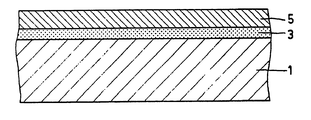
- the figure shows in section a layer sequence of a sliding layer applied to a substrate and an intermediate layer which promotes adhesion to the substrate.
- These layers can be obtained, for example, as follows: by sputtering a pure iron target in an atmosphere of an inert gas at a pressure of 20 mbar, e.g. B. argon, and a hydrocarbon gas of a pressure of 0.2 mbar, e.g. B. acetylene, layers with a thickness of 0.9 microns and a microhardness of 15 ⁇ 10 3 N / mm 2 were produced.
- Flat rings made of 100 Cr 6 steel served as the substrate.
- the layers which contain approx.
- Layers that are produced by sputtering an iron or an iron-carbon target in an inert gas-hydrocarbon gas atmosphere have a high hardness in the range from 15 ⁇ 10 3 to 30, 103 N / mm 2 (Knoop hardness) on.
- the sliding friction coefficients against steel as a friction partner are, depending on the coating conditions, usually in the range of ⁇ ⁇ 0.05 to 0.3.
- a coefficient of friction that is much less dependent on the relative air humidity can be achieved than is the case for pure carbon layers.
- the values for the coefficient of friction ⁇ against steel are at a relative humidity of ⁇ 0.1% at ⁇ ⁇ 0.02 and at a relative humidity of 95% at ⁇ ⁇ 0.2.
- compositions of the layers are controllable in relation to the amounts of carbon and metallic element (metallic elements) involved in their construction via the target composition or via the proportion of a hydrocarbon gas in the atomizing atmosphere, e.g. B. in the sense that if the concentration of carbon in the layer is to be higher, the proportion of hydrocarbon gas in the atomizing atmosphere is increased accordingly.
- a hydrocarbon gas in the atomizing atmosphere e.g. B.
- the exact conditions can be determined by simple experiments.
- Table 1 shows the manner in which the coefficient of friction ⁇ for iron-carbon layers of a composition with 3.7 atom% iron, 9.5 atom% carbon and 0.8 atom% residual gas with a friction partner in the form of a layer same composition and with steel as a friction partner is influenced by different relative humidity.
- a pure tantalum target was sputtered in an atmosphere of an inert gas at a pressure of 20 mbar, e.g. B. argon, and a hydrocarbon gas of a pressure of 0.2 to 1.0 mbar, e.g. B. acetylene, layers with a thickness of 0.9 microns.
- an inert gas at a pressure of 20 mbar, e.g. B. argon
- a hydrocarbon gas of a pressure of 0.2 to 1.0 mbar e.g. B. acetylene
- Steel rings or silicon single crystal wafers also served as the substrate.
- the layers with 95 atom% carbon and 5 atom% tantalum have in an atmosphere with a relative humidity of 50% a coefficient of friction against steel of ⁇ ⁇ 0.08 and against a layer of the same composition as a friction partner of ⁇ ⁇ 0.03 (cf. Table 4).
- the layers which contain 18 atom% ruthenium and 82 atom% carbon, have a sliding friction coefficient in an atmosphere with 50% relative air humidity of ⁇ ⁇ 0.05 for steel as a friction partner and of ⁇ ⁇ 0.03 for a layer with the same composition as Friction partner (see table 4).
- the layers which contain 9 atom% tungsten and 91 atom% carbon, have a sliding friction coefficient in an atmosphere with 50% relative air humidity of ⁇ ⁇ 0.14 with steel as a friction partner and of ⁇ ⁇ 0.06 for a layer with the same composition as Friction partner (see table 4).
- Table 3 also shows a layer composition with 59.3 atom% tungsten, 36.7 atom% carbon and 4.0 atom% residual gas from the cathode sputtering atmosphere: this layer composition lies outside the claimed composition range. It showed poor adhesion to the substrate, high wear in friction tests and a coefficient of friction ⁇ ⁇ 0.4 for steel as a friction partner in an atmosphere with 50% relative humidity.
- the layers which contain 20 to 5 atomic% silicon and 80 to 95 atomic% carbon, have a sliding friction coefficient against steel in an atmosphere with 50% relative air humidity of ⁇ ⁇ 0.07 (see Table 4).
- Table 5 shows the manner in which the coefficient of friction ⁇ for tungsten-carbon layers with a composition with 1.6 atom% tungsten, 94.5 atom% carbon and 3.9 atom% residual gas content with a friction partner in the form of a layer of the same composition and with steel as a friction partner is influenced by different relative air humidity. (See table 5 page 8 f.)
Landscapes
- Chemical & Material Sciences (AREA)
- Engineering & Computer Science (AREA)
- Mechanical Engineering (AREA)
- General Engineering & Computer Science (AREA)
- Chemical Kinetics & Catalysis (AREA)
- Materials Engineering (AREA)
- Metallurgy (AREA)
- Organic Chemistry (AREA)
- Physical Vapour Deposition (AREA)
- Lubricants (AREA)
Claims (12)
Priority Applications (1)
| Application Number | Priority Date | Filing Date | Title |
|---|---|---|---|
| AT83200260T ATE25112T1 (de) | 1982-02-27 | 1983-02-21 | Kohlenstoff enthaltende gleitschicht. |
Applications Claiming Priority (4)
| Application Number | Priority Date | Filing Date | Title |
|---|---|---|---|
| DE3207096 | 1982-02-27 | ||
| DE3207096 | 1982-02-27 | ||
| DE19823246361 DE3246361A1 (de) | 1982-02-27 | 1982-12-15 | Kohlenstoff enthaltende gleitschicht |
| DE3246361 | 1982-12-15 |
Publications (2)
| Publication Number | Publication Date |
|---|---|
| EP0087836A1 EP0087836A1 (fr) | 1983-09-07 |
| EP0087836B1 true EP0087836B1 (fr) | 1987-01-21 |
Family
ID=25799898
Family Applications (1)
| Application Number | Title | Priority Date | Filing Date |
|---|---|---|---|
| EP19830200260 Expired EP0087836B1 (fr) | 1982-02-27 | 1983-02-21 | Couche carbonée de glissement |
Country Status (4)
| Country | Link |
|---|---|
| US (1) | US4525417A (fr) |
| EP (1) | EP0087836B1 (fr) |
| CA (1) | CA1220680A (fr) |
| DE (2) | DE3246361A1 (fr) |
Cited By (4)
| Publication number | Priority date | Publication date | Assignee | Title |
|---|---|---|---|---|
| DE10203730A1 (de) * | 2002-01-30 | 2003-08-14 | Fraunhofer Ges Forschung | Verfahren zur Abscheidung von metallfreien Kohlenstoffschichten |
| DE10253178B4 (de) * | 2002-09-10 | 2004-08-19 | Fraunhofer-Gesellschaft zur Förderung der angewandten Forschung e.V. | Verwendung einer Schicht aus diamantartigem Kohlenstoff |
| DE10112854B4 (de) * | 2000-04-19 | 2007-06-28 | Ford Global Technologies, LLC (n.d.Ges.d. Staates Delaware), Dearborn | Si-dotierte amorphe C-Beschichtung für Lackierglocken |
| DE102010033543A1 (de) * | 2010-08-05 | 2012-02-09 | Bayerische Motoren Werke Aktiengesellschaft | Verfahren zur Beschichtung von Stahl-Bauteilen |
Families Citing this family (66)
| Publication number | Priority date | Publication date | Assignee | Title |
|---|---|---|---|---|
| US4594294A (en) * | 1983-09-23 | 1986-06-10 | Energy Conversion Devices, Inc. | Multilayer coating including disordered, wear resistant boron carbon external coating |
| JPS60107814A (ja) * | 1983-11-16 | 1985-06-13 | Hitachi Ltd | 保護膜の形成方法 |
| FR2566806B1 (fr) * | 1984-06-27 | 1986-12-05 | Diamant Boart Sa | Procede de realisation de revetements de carbures de bore et revetements obtenus |
| DE3442208C3 (de) * | 1984-11-19 | 1998-06-10 | Leybold Ag | Verfahren und Vorrichtung zum Herstellen harter Kohlenstoffschichten |
| US4931152A (en) * | 1984-11-19 | 1990-06-05 | Avco Corporation | Method for imparting erosion-resistance to metallic substrate |
| DE3503105A1 (de) * | 1985-01-30 | 1986-07-31 | Leybold-Heraeus GmbH, 5000 Köln | Verfahren zum beschichten von maschinenteilen und werkzeugen mit hartstoffmaterial und durch das verfahren hergestellte maschinenteile und werkzeuge |
| US4725345A (en) * | 1985-04-22 | 1988-02-16 | Kabushiki Kaisha Kenwood | Method for forming a hard carbon thin film on article and applications thereof |
| DE3664791D1 (en) * | 1985-06-05 | 1989-09-07 | Plessey Overseas | Methods of depositing germanium carbide |
| DE3538261A1 (de) * | 1985-10-28 | 1987-04-30 | Battelle Institut E V | Gegeneinander abdichtende ventilelemente fuer mischarmaturen |
| DE3606529A1 (de) * | 1986-02-28 | 1987-09-03 | Glyco Metall Werke | Verfahren zur herstellung von schichtwerkstoff oder schichtwerkstuecken durch aufdampfen mindestens eines metallischen werkstoffes auf ein metallisches substrat |
| DE3706218A1 (de) * | 1987-02-26 | 1988-09-08 | Werner Prof Dr Weisweiler | Vorrichtung und verfahren zur kontinuierlichen beschichtung der einzelnen fasern eines faserbuendels mit oberflaechenschuetzenden und haftvermittelnden carbid- oder plasmapolymer-filmen |
| DE3890961T1 (de) * | 1987-11-10 | 1989-12-21 | Masco Corp | Ein paar von dichtungskoerpern aus hartem material mit einem niedrigen reibungskoeffizienten |
| IT1211509B (it) * | 1987-11-10 | 1989-11-03 | Gevipi Ag | Coppia di organi di tenuta in materiale duro avente basso coefficiente di attrito |
| NL8800345A (nl) * | 1988-02-12 | 1989-09-01 | Philips Nv | Knipeenheid voor een scheerapparaat en scheerapparaat voorzien van deze knipeenheid. |
| US5088202A (en) * | 1988-07-13 | 1992-02-18 | Warner-Lambert Company | Shaving razors |
| DE3832692A1 (de) * | 1988-09-27 | 1990-03-29 | Leybold Ag | Dichtungselement mit einem absperrkoerper aus einem metallischen oder nichtmetallischen werkstoff und verfahren zum auftragen von hartstoffschichten auf den absperrkoerper |
| US4981071A (en) * | 1988-11-03 | 1991-01-01 | Leybold Aktiengesellschaft | Machine element with coating |
| US5030494A (en) * | 1989-01-26 | 1991-07-09 | International Business Machines Corporation | Carbon overcoat for a thin film magnetic recording disk containing discrete clusters of tungsten (W) or tungsten carbide (WC) which project from the surface of the overcoat |
| AU631037B2 (en) * | 1989-12-28 | 1992-11-12 | Kabushiki Kaisha Toyota Chuo Kenkyusho | Hard and lubricant thin film of amorphous carbon-hydrogen-silicon, iron base metallic material coated therewith, and the process for producing the same |
| US5052339A (en) * | 1990-10-16 | 1991-10-01 | Air Products And Chemicals, Inc. | Radio frequency plasma enhanced chemical vapor deposition process and reactor |
| US5770323A (en) * | 1991-02-20 | 1998-06-23 | T & N Technology Limited | Bearings |
| GB9103481D0 (en) * | 1991-02-20 | 1991-04-10 | T & N Technology Ltd | Bearings |
| US5249554A (en) * | 1993-01-08 | 1993-10-05 | Ford Motor Company | Powertrain component with adherent film having a graded composition |
| DE4421144C2 (de) * | 1993-07-21 | 2003-02-13 | Unaxis Balzers Ag | Beschichtetes Werkzeug mit erhöhter Standzeit |
| WO1995020982A1 (fr) * | 1994-02-01 | 1995-08-10 | Howmedica Inc. | Prothese femorale a broche recouverte d'un revetement |
| WO1996005153A1 (fr) * | 1994-08-13 | 1996-02-22 | Yoo Tong Enterprise Co., Ltd. | Procede de cementation par le carbone destine a un materiau de garniture patin ceramique |
| US5798134A (en) * | 1994-10-11 | 1998-08-25 | Agency Of Industrial Science & Technology | Process for producing nickel oxide film |
| DE29615040U1 (de) * | 1996-08-29 | 1998-01-02 | PVD Beschichtungsservice GmbH, 58511 Lüdenscheid | Formwerkzeug mit Beschichtung |
| DE19707232A1 (de) * | 1997-02-24 | 1998-08-27 | Betonwerk C Schmidt Gmbh Abt C | Spinnring und Läufer für Ringspinnmaschinen |
| US6569270B2 (en) | 1997-07-11 | 2003-05-27 | Honeywell International Inc. | Process for producing a metal article |
| GB9803213D0 (en) | 1998-02-14 | 1998-04-08 | Glacier Vandervell Ltd | Improved bearings |
| US5943389A (en) * | 1998-03-06 | 1999-08-24 | Varian Medical Systems, Inc. | X-ray tube rotating anode |
| US6348139B1 (en) | 1998-06-17 | 2002-02-19 | Honeywell International Inc. | Tantalum-comprising articles |
| DE19834966C2 (de) * | 1998-08-03 | 2001-10-04 | Fraunhofer Ges Forschung | Druckgußwerkzeug |
| DE19954164B4 (de) | 1999-11-10 | 2008-08-21 | Fraunhofer-Gesellschaft zur Förderung der angewandten Forschung e.V. | Sensor zur Zustandsbestimmung von Kenngrößen an mechanischen Komponenten unter Verwendung von amorphen Kohlenstoffschichten mit piezoresistiven Eigenschaften |
| US6878250B1 (en) | 1999-12-16 | 2005-04-12 | Honeywell International Inc. | Sputtering targets formed from cast materials |
| US20040072009A1 (en) * | 1999-12-16 | 2004-04-15 | Segal Vladimir M. | Copper sputtering targets and methods of forming copper sputtering targets |
| US6331233B1 (en) | 2000-02-02 | 2001-12-18 | Honeywell International Inc. | Tantalum sputtering target with fine grains and uniform texture and method of manufacture |
| US7517417B2 (en) * | 2000-02-02 | 2009-04-14 | Honeywell International Inc. | Tantalum PVD component producing methods |
| DE10018143C5 (de) * | 2000-04-12 | 2012-09-06 | Oerlikon Trading Ag, Trübbach | DLC-Schichtsystem sowie Verfahren und Vorrichtung zur Herstellung eines derartigen Schichtsystems |
| DE10037965A1 (de) * | 2000-08-04 | 2002-02-28 | Elringklinger Gmbh | Beschichtemasse zur Herstellung hochtemperaturfester Dichtungselemente |
| IT249046Y1 (it) * | 2000-12-11 | 2003-03-25 | Optikon 2000 Spa | Punta emulsificata per chirurgia oculistica, in particolare per lafacoemulsificazione della cataratta. |
| DE20101917U1 (de) * | 2001-02-03 | 2002-06-06 | stryker Trauma GmbH, 24232 Schönkirchen | Osteosynthesehilfsmittel aus einer Stahl-, Cobalt- und/oder Titanlegierung |
| EP1281796A1 (fr) * | 2001-07-26 | 2003-02-05 | Sulzer Markets and Technology AG | Elément guide-fils |
| US20030019973A1 (en) * | 2001-07-26 | 2003-01-30 | Sulzer Markets And Technology Ag | Thread guiding element |
| DE10331503A1 (de) * | 2003-07-10 | 2005-02-10 | Maschinenfabrik Rieter Ag | Fadenleitelement zum Führen von Fäden |
| US7300379B2 (en) * | 2003-11-10 | 2007-11-27 | The Timken Company | Differential with thin film coating at cross shaft and processes for manufacturing the same |
| NZ531396A (en) * | 2004-02-26 | 2005-11-25 | Doranda Ltd | A vehicle attachment for folding a ground cover |
| US20070084527A1 (en) * | 2005-10-19 | 2007-04-19 | Stephane Ferrasse | High-strength mechanical and structural components, and methods of making high-strength components |
| US20070251818A1 (en) * | 2006-05-01 | 2007-11-01 | Wuwen Yi | Copper physical vapor deposition targets and methods of making copper physical vapor deposition targets |
| DE102006022057B3 (de) | 2006-05-11 | 2007-10-31 | Dürr Systems GmbH | Applikationselement für einen Rotationszerstäuber und zugehöriges Betriebsverfahren |
| DE102006037774A1 (de) * | 2006-08-11 | 2008-02-14 | Polysius Ag | Walzen- oder Rollenmühle |
| JP4774080B2 (ja) * | 2007-08-02 | 2011-09-14 | 株式会社神戸製鋼所 | 硬質皮膜被覆材および冷間塑性加工用金型 |
| US8080324B2 (en) | 2007-12-03 | 2011-12-20 | Kobe Steel, Ltd. | Hard coating excellent in sliding property and method for forming same |
| WO2010006641A1 (fr) * | 2008-07-15 | 2010-01-21 | Abb Research Ltd | Dispositif pour revêtir de façon électrostatique une pièce à travailler |
| RU2507302C2 (ru) | 2009-06-18 | 2014-02-20 | Зульцер Метаплас Гмбх | Защитное покрытие, покрытый элемент, имеющий защитное покрытие, а также способ получения защитного покрытия |
| DE102009057444A1 (de) | 2009-12-08 | 2011-06-09 | Dürr Systems GmbH | Lackieranlagenbauteil mit einer Oberflächenbeschichtung |
| DE102010052971A1 (de) | 2010-11-30 | 2012-05-31 | Amg Coating Technologies Gmbh | Werkstück mit Si-DLC Beschichtung und Verfahren zur Herstellung von Beschichtungen |
| KR101935067B1 (ko) * | 2011-03-02 | 2019-01-03 | 오를리콘 서피스 솔루션스 아크티엔게젤샤프트, 페피콘 | 윤활 조건하에서 마찰 어프리케이션들에 의한 마모 및 마찰동작을 개선하기 위해 금속 포함 탄소 레이어로 코팅된 슬라이딩 컴포넌트 |
| AT511605B1 (de) * | 2011-12-12 | 2013-01-15 | High Tech Coatings Gmbh | Kohlenstoffbasierende beschichtung |
| DE102012007796A1 (de) | 2012-04-20 | 2013-10-24 | Amg Coating Technologies Gmbh | Beschichtung enthaltend Si-DLC, DLC und Me-DLC und Verfahren zur Herstellung von Beschichtungen |
| DE102012007763A1 (de) | 2012-04-20 | 2013-10-24 | Ulrich Schmidt | Modularer Rahmen für Steckdosen und Schalter |
| DE102014217040A1 (de) | 2014-08-27 | 2016-03-03 | Bayerische Motoren Werke Aktiengesellschaft | Beschichtung für Metallbauteile, Verfahren zum Beschichten eines Metallbauteils, Kolben für Verbrennungskraftmaschinen und Kfz |
| US10370613B2 (en) | 2014-10-24 | 2019-08-06 | Parag Gupta | Grey cast iron-doped diamond-like carbon coatings and methods for depositing same |
| US11389879B2 (en) * | 2018-04-12 | 2022-07-19 | Mcmaster University | Ultra soft cutting tool coatings and coating method |
| US12503784B2 (en) | 2023-06-21 | 2025-12-23 | SiTration, Inc. | Methods and apparatus for extracting metals from materials |
Citations (1)
| Publication number | Priority date | Publication date | Assignee | Title |
|---|---|---|---|---|
| DE1796122A1 (de) * | 1967-09-07 | 1972-02-10 | Nippon Carbon Co Ltd | Mit Aluminium impraegnierte Gleitteile aus Kohlenstoffmaterial |
Family Cites Families (9)
| Publication number | Priority date | Publication date | Assignee | Title |
|---|---|---|---|---|
| US3907514A (en) * | 1972-10-19 | 1975-09-23 | Pure Carbon Company Inc | Aluminum carbon composite seal material |
| US3950575A (en) * | 1973-01-23 | 1976-04-13 | Nippon Steel Corporation | Heat treatment of metals in a controlled surface atmosphere |
| US3869259A (en) * | 1973-05-02 | 1975-03-04 | Gen Motors Corp | Composite sliding member |
| CH611341A5 (fr) * | 1976-09-09 | 1979-05-31 | Balzers Hochvakuum | |
| GB1599810A (en) * | 1977-04-23 | 1981-10-07 | Kernforschungsanlage Juelich | Graphite or similar mouldings with corrosion-resistant protective layer |
| JPS554040A (en) * | 1978-06-26 | 1980-01-12 | Hitachi Ltd | Photoconductive material |
| DD145283A1 (de) * | 1979-08-06 | 1980-12-03 | Helmut Bollinger | Verfahren zur herstellung von verschleissfesten und korrosionsbestaendigen schichten |
| DD146307A1 (de) * | 1979-10-02 | 1981-02-04 | Helmut Bollinger | Einrichtung zur grossflaechigen haftfesten abscheidung,insbesondere von kohlenstoffschichten |
| DE2944301A1 (de) * | 1979-11-02 | 1981-05-14 | Berna AG Olten, Olten | Formteil aus stahl mit einer verschleissfesten beschichtung und verfahren zu dessen herstellung |
-
1982
- 1982-12-15 DE DE19823246361 patent/DE3246361A1/de not_active Withdrawn
-
1983
- 1983-02-21 DE DE8383200260T patent/DE3369347D1/de not_active Expired
- 1983-02-21 EP EP19830200260 patent/EP0087836B1/fr not_active Expired
- 1983-02-24 CA CA000422301A patent/CA1220680A/fr not_active Expired
- 1983-02-24 US US06/469,363 patent/US4525417A/en not_active Ceased
Patent Citations (1)
| Publication number | Priority date | Publication date | Assignee | Title |
|---|---|---|---|---|
| DE1796122A1 (de) * | 1967-09-07 | 1972-02-10 | Nippon Carbon Co Ltd | Mit Aluminium impraegnierte Gleitteile aus Kohlenstoffmaterial |
Cited By (5)
| Publication number | Priority date | Publication date | Assignee | Title |
|---|---|---|---|---|
| DE10112854B4 (de) * | 2000-04-19 | 2007-06-28 | Ford Global Technologies, LLC (n.d.Ges.d. Staates Delaware), Dearborn | Si-dotierte amorphe C-Beschichtung für Lackierglocken |
| DE10203730A1 (de) * | 2002-01-30 | 2003-08-14 | Fraunhofer Ges Forschung | Verfahren zur Abscheidung von metallfreien Kohlenstoffschichten |
| DE10203730B4 (de) * | 2002-01-30 | 2010-09-16 | Fraunhofer-Gesellschaft zur Förderung der angewandten Forschung e.V. | Verfahren zur Abscheidung von metallfreien Kohlenstoffschichten |
| DE10253178B4 (de) * | 2002-09-10 | 2004-08-19 | Fraunhofer-Gesellschaft zur Förderung der angewandten Forschung e.V. | Verwendung einer Schicht aus diamantartigem Kohlenstoff |
| DE102010033543A1 (de) * | 2010-08-05 | 2012-02-09 | Bayerische Motoren Werke Aktiengesellschaft | Verfahren zur Beschichtung von Stahl-Bauteilen |
Also Published As
| Publication number | Publication date |
|---|---|
| DE3246361A1 (de) | 1983-09-08 |
| DE3369347D1 (en) | 1987-02-26 |
| CA1220680A (fr) | 1987-04-21 |
| US4525417A (en) | 1985-06-25 |
| EP0087836A1 (fr) | 1983-09-07 |
Similar Documents
| Publication | Publication Date | Title |
|---|---|---|
| EP0087836B1 (fr) | Couche carbonée de glissement | |
| EP0300993B1 (fr) | Palier à glissement à haute résistance | |
| DE102005063324B4 (de) | Gleitlagerverbundwerkstoff, Verwendung und Herstellungsverfahren | |
| DE60116446T2 (de) | Mehrlagig beschichtetes Schneidwerkzeug | |
| DE2926080A1 (de) | Mittel zur trockenschmierung | |
| DE69812389T2 (de) | Beschichtetes wälzlager | |
| EP1161572B1 (fr) | Plaquette de coupe revetue comprenant une couche a base de sulfure de molybdene pour l'usinage de materiaux metalliques et methode pour sa fabrication | |
| DE602005003762T2 (de) | Gleitelement mit ausgezeichneter Abnutzungsbeständigkeit in einer wasserbasierten Umgebung | |
| EP0962674B1 (fr) | Coussinet de palier lisse et son procédé de fabrication | |
| DE102005023309B4 (de) | Gleitlagerverbundwerkstoff, Verwendung und Herstellungsverfahren | |
| EP2209621B1 (fr) | Procédé de production d'un élément de palier lisse présentant une couche de glissement contenant du bismuth, et élément de palier lisse | |
| CH667469A5 (de) | Verfahren zum aufbringen von schutzschichten. | |
| EP0534905B1 (fr) | Outils pour l'usinage de matériaux | |
| EP0801144A1 (fr) | Objet pourvu d'un revêtement résistant à l'usure et procédé d'obtention | |
| WO2006005200A1 (fr) | MATERIAU CONDUCTEUR A BASE DE CUIVRE PRESENTANT UN REVETEMENT EN MATERIAU DUR Me-DLC | |
| DE102005023308B4 (de) | Gleitlagerverbundwerkstoff, Verwendung und Herstellungsverfahren | |
| EP0907764B1 (fr) | Outil de coupe et son procede de fabrication | |
| DD202898A1 (de) | Hartstoff und festkoerperschmierstoffschichtsystem | |
| DE102005023307B4 (de) | Gleitlagerverbundwerkstoff, Verwendung und Herstellungsverfahren | |
| DE19640663C2 (de) | Feststoffschmierschicht, Verfahren zur Herstellung und deren Verwendung | |
| WO1999049098A1 (fr) | Film de lubrifiant solide | |
| AT6792U1 (de) | Werkzeug oder bauteil mit niedrigem reibwert | |
| DE102012017033A1 (de) | PVD Lichtbogenbeschichtung mit verbesserten reibungsmindernden und verschleissreduzierenden Eigenschaften | |
| DE3802869C2 (fr) | ||
| DE102022115550A1 (de) | Beschichtetes Werkzeug, Verfahren zu dessen Herstellung sowie Verwendung des Werkzeugs |
Legal Events
| Date | Code | Title | Description |
|---|---|---|---|
| PUAI | Public reference made under article 153(3) epc to a published international application that has entered the european phase |
Free format text: ORIGINAL CODE: 0009012 |
|
| AK | Designated contracting states |
Designated state(s): AT BE DE GB IT LU NL SE |
|
| 17P | Request for examination filed |
Effective date: 19840224 |
|
| GRAA | (expected) grant |
Free format text: ORIGINAL CODE: 0009210 |
|
| AK | Designated contracting states |
Kind code of ref document: B1 Designated state(s): AT BE DE GB IT LU NL SE |
|
| PG25 | Lapsed in a contracting state [announced via postgrant information from national office to epo] |
Ref country code: IT Free format text: LAPSE BECAUSE OF FAILURE TO SUBMIT A TRANSLATION OF THE DESCRIPTION OR TO PAY THE FEE WITHIN THE PRESCRIBED TIME-LIMIT;WARNING: LAPSES OF ITALIAN PATENTS WITH EFFECTIVE DATE BEFORE 2007 MAY HAVE OCCURRED AT ANY TIME BEFORE 2007. THE CORRECT EFFECTIVE DATE MAY BE DIFFERENT FROM THE ONE RECORDED. Effective date: 19870121 |
|
| REF | Corresponds to: |
Ref document number: 25112 Country of ref document: AT Date of ref document: 19870215 Kind code of ref document: T |
|
| REF | Corresponds to: |
Ref document number: 3369347 Country of ref document: DE Date of ref document: 19870226 |
|
| PG25 | Lapsed in a contracting state [announced via postgrant information from national office to epo] |
Ref country code: LU Free format text: LAPSE BECAUSE OF NON-PAYMENT OF DUE FEES Effective date: 19870228 |
|
| RAP2 | Party data changed (patent owner data changed or rights of a patent transferred) |
Owner name: N.V. PHILIPS' GLOEILAMPENFABRIEKEN Owner name: PHILIPS PATENTVERWALTUNG GMBH |
|
| PLBE | No opposition filed within time limit |
Free format text: ORIGINAL CODE: 0009261 |
|
| STAA | Information on the status of an ep patent application or granted ep patent |
Free format text: STATUS: NO OPPOSITION FILED WITHIN TIME LIMIT |
|
| BECN | Be: change of holder's name |
Effective date: 19870121 |
|
| 26N | No opposition filed | ||
| PGFP | Annual fee paid to national office [announced via postgrant information from national office to epo] |
Ref country code: BE Payment date: 19900207 Year of fee payment: 8 |
|
| PGFP | Annual fee paid to national office [announced via postgrant information from national office to epo] |
Ref country code: AT Payment date: 19900219 Year of fee payment: 8 |
|
| PGFP | Annual fee paid to national office [announced via postgrant information from national office to epo] |
Ref country code: SE Payment date: 19900222 Year of fee payment: 8 |
|
| PGFP | Annual fee paid to national office [announced via postgrant information from national office to epo] |
Ref country code: LU Payment date: 19900223 Year of fee payment: 8 |
|
| PGFP | Annual fee paid to national office [announced via postgrant information from national office to epo] |
Ref country code: NL Payment date: 19900228 Year of fee payment: 8 |
|
| PG25 | Lapsed in a contracting state [announced via postgrant information from national office to epo] |
Ref country code: AT Effective date: 19910221 |
|
| PG25 | Lapsed in a contracting state [announced via postgrant information from national office to epo] |
Ref country code: SE Effective date: 19910222 |
|
| PG25 | Lapsed in a contracting state [announced via postgrant information from national office to epo] |
Ref country code: BE Effective date: 19910228 |
|
| PG25 | Lapsed in a contracting state [announced via postgrant information from national office to epo] |
Ref country code: NL Effective date: 19910901 |
|
| NLV4 | Nl: lapsed or anulled due to non-payment of the annual fee | ||
| ITTA | It: last paid annual fee | ||
| EUG | Se: european patent has lapsed |
Ref document number: 83200260.4 Effective date: 19911008 |
|
| ITPR | It: changes in ownership of a european patent |
Owner name: CAMBIO RAGIONE SOCIALE;PHILIPS ELECTRONICS N.V. |
|
| REG | Reference to a national code |
Ref country code: GB Ref legal event code: 732E |
|
| REG | Reference to a national code |
Ref country code: GB Ref legal event code: IF02 |
|
| PGFP | Annual fee paid to national office [announced via postgrant information from national office to epo] |
Ref country code: GB Payment date: 20020211 Year of fee payment: 20 |
|
| PGFP | Annual fee paid to national office [announced via postgrant information from national office to epo] |
Ref country code: DE Payment date: 20020225 Year of fee payment: 20 |
|
| PG25 | Lapsed in a contracting state [announced via postgrant information from national office to epo] |
Ref country code: GB Free format text: LAPSE BECAUSE OF EXPIRATION OF PROTECTION Effective date: 20030220 |
|
| REG | Reference to a national code |
Ref country code: GB Ref legal event code: PE20 Effective date: 20030220 |